Bioethics
“Zeroboxer” by Fonda Lee- Bioethics in the Future, oh, and boxing
 Fonda Lee’s Zeroboxer is a science fiction work about the sport of zero-gravity boxing. See my review for more details on the work. Here, I’ll be highlighting aspects of the book that deal with bioethics, and offering some philosophical and theological comments on them.
The basics of the book are that Carr “The Raptor” Luka has been rising in the ranks as a great zeroboxer (one who boxes in zero-gravity). As his star rises, so does his fame, and possibly his infamy. There will be SPOILERS in what follows.
Genetic Therapy vs. Enhancement
The first question is simple: What is the difference between genetic therapy or genetic enhancement? I wrote about this distinction elsewhere:
Gene therapy is the use of genetic research and information to cure illness. Speaking very hypothetically, suppose that we were able to discover the exact genetic code for illnesses like sickle cell anemia, isolate it, and replace it with a non-anemic code before a person was even born; that would be gene therapy. Genetic enhancement takes this a step further. It allows for modifying people genetically to enhance certain features such as physical strength, endurance, mental aptitude, and the like. It would, in a sense, create “super humans.”
In the world of Zeroboxer, genetic therapy is standard, and enhancement is regulated, but normalized.
The main character, Luka Carr, unbeknownst to himself, has “illegal” levels of enhancement. His mother allowed a criminal to modify him and make him some kind of superhuman. But it is hard to see why he should be faulted for it–after all, as he says, he’s still himself. It isn’t his fault that others made such choices around his life.
Enhancement is more common on Mars than on Earth. The latter, so-called “Terrans,” stage protests on Mars and about Martians as they seek to go against their “freakish” ways of enhancing. It’s not hard to imagine just this would happen. Who are we to play God, after all? But that kind of argument leads to questions about what it means to play God. Is it playing God to prevent illnesses through modern medicine? How far a step is it from surgery to correct vision to enhancing vision genetically? These questions defy easy answers.
Poverty and Enhancement/Therapy
Lee also raised the issue of poverty and the enormous inequalities that could be created by furthering genetic enhancement. Luka remarks on the state of a friend, Enzo, who’s just shown up wearing glasses:
“Why don’t you get your eyes fixed, then?”
[Luka] guessed the answer before Enzo lowered his face in embarassment. “My mom doesn’t have the money right now. She said maybe in a few months…”
A surge of anger brought heat to Carr[ Luka]’s scalp. It was bad enough that the kid had an asthmatic wheeze and carried around an inhaler. Now he was half-blind too? What next, a peg leg? Didn’t Enzo’s mother care that her son walked around with genetic poverty written all over him? (117)
The phrase “genetic poverty” is forward-thinking and possibly prophetic on the part of Lee. What happens if and when genetic therapy and enhancement become norms? It seems to me that therapy is potentially very valuable and a great good. But what kind of greater inequalities would come to be from it? We must try to anticipate these and work to prevent further inequalities. As Christians, we need to care for the impoverished, and that includes what might be considered “genetic poverty.”
Supposing diseases begin to be cured on a broader scale through genetic therapy, it seems that Christians ought to support these changes with every effort. After all, curing illness and helping those in need is what we are called to do. But what does this mean for enhancement?
That question is much more complex. Enhancement, it seems to me, would necessarily increase the inequity between the haves and have-nots. After all, those who have the money to get super-sight or super-strength or predispositions to being great musicians could simply cash in to do so. Those who don’t, cannot. But does this mean it is wrong? It’s a very difficult question, and one that I don’t have a firm answer on. I lean towards saying that such things are permissible, but regulation seems a wise choice given we have little idea what impact modifying genes might have on the broader person. Again, I’ve written more on these questions here. What are your thoughts on answers to these questions?
Conclusion
Zeroboxer is an unexpectedly thoughtful book. Though it has some flaws, it is a worthy read. Just be aware of the violent and explicit content. See my review for more details on that. Exploring these issues related to genetics is very important. I see this as a field that will be expanding rapidly over the next decades. Christians need to engage with it and think about it ahead of time.
Links
Genetics and Bioethics: Enhancement or Therapy?– I delve into deeper questions about genetic enhancement vs. therapy. I also provide some further reading on the topic.
Be sure to check out the page for this site on Facebook and Twitter for discussion of posts, links to other pages of interest, random talk about theology/philosophy/apologetics/movies and more!
Popular Books– Read through my other posts on popular books–science fiction, fantasy, and more! (Scroll down for more.)
SDG.
——
The preceding post is the property of J.W. Wartick (apart from quotations, which are the property of their respective owners, and works of art as credited; images are often freely available to the public and J.W. Wartick makes no claims of owning rights to the images unless he makes that explicit) and should not be reproduced in part or in whole without the expressed consent of the author. All content on this site is the property of J.W. Wartick and is made available for individual and personal usage. If you cite from these documents, whether for personal or professional purposes, please give appropriate citation with both the name of the author (J.W. Wartick) and a link to the original URL. If you’d like to repost a post, you may do so, provided you show less than half of the original post on your own site and link to the original post for the rest. You must also appropriately cite the post as noted above. This blog is protected by Creative Commons licensing. By viewing any part of this site, you are agreeing to this usage policy.
Response to “Problem in the Pro-Life Camp”- Abortion, victims, and moral culpability
 A recent comment by Donald Trump caused something of a stir. What a surprise. This time, it was about abortion, and he said that there has to be “some kind of punishment” for the woman who chooses an abortion, should abortion be made illegal. The internet exploded, as people of both pro-choice and pro-life persuasions came out to discuss the topic, largely coming out against Trumps comments. Here, I want to discuss one post from a pro-life individual that offers a critique of the pro-life movement for not arguing for a harsher punishment of women who choose abortions, in the case of them being illegal. That post is entitled, “Problem in the Pro-Life Camp.” At the outset, it is worth revealing my bias in this. I am pro-life myself and I think that this is a complex topic that many pro-life persons have not thought deeply about. I am essentially editing and re-posting my comments here with some context.
The post in question begins by stating the “problem” with the pro-life camp:
The problem that I have with the “pro-life” movement in general is that much of it appeals to the woman as being the victim/or merely the accomplice to the crime. Rather, the mother is the transgressor who in the majority of cases, knowingly tested positive in her pregnancy test and nevertheless, storms into the abortion mill with premeditated murder. Whether the sin is done in ignorance or not, she is still morally culpable before God. She is not a victim.
Men and women are indeed victims when abortion is presented as the only logical choice or the only option. They are victims when people of specific races are targeted for abortion advertising. But whether one agrees on this or not, it is largely irrelevant to the primary point you’re making in this post. It seems that there are two issues raised in the post, but they are interlinked: the notion that the woman is a victim in abortion is false, and that is intrinsically linked to the notion that woman is morally culpable.
The original post asked, “Can an abortive mother who has malice of forethought be considered a victim and be morally responsible the same time? Morally responsible for what? when they are already deemed a victim.”
It seems to me that there are clear cases where someone who is a victim could still be morally culpable. A child soldier who has been forced into fighting for a cause they don’t believe in is a victim, yet the killing he or she may do is not without moral culpability. We may give a lighter sentence or charge than murder, but that doesn’t mean that this victim is without moral culpability whatsoever. Indeed, I think this is a far better analogy than the one with the bully utilized in the original post. (A bully beats up someone to take their money, and then sends others to do so; are they a victim?) After all, the analogy with the bully begins with the bully directly beating up someone else! The analogy, then, falls apart at the beginning, because I don’t know of any case (I suppose there could be such a case–but I would be surprised if it were even possible) where a woman performed an abortion on herself.
Now my analogy is to show that the notion of being a victim is not incompatible with the notion of being morally culpable. It does not demonstrate that the woman who seeks an abortion is a victim. Instead, my purpose was to show that the complaint of incompatibility is mistaken.
Thus, it seems to me that the pro-life person who maintains that a woman is, in some sense, morally culpable for the abortion, while also arguing or believing that the woman is, in some sense, a victim in such a situation is not being inconsistent.
The original post appealed to a question asked in a group of women who had abortions. They were asked whether they believed they were victims. I agree that self-definition is vastly important, but I also think it is easy to be mistaken about such things. For example, someone who is working as a prostitute may say that they are not a victim and they did it by choice, but even if they choose such a profession, the fact remains that the act of purchasing another’s body for sexual gratification does, indeed, victimize them whether they acknowledge it or not. I’m not saying that women who have abortions are prostitutes, obviously. My point is that self-defining oneself as “not a victim” does not make it the case.
To sum up: my response has sought to demonstrate two primary points. (1) The notion of someone being a victim does not necessarily undermine the notion of that person being morally culpable; (2) Self definition does not necessarily show us with certainty that someone is not a victim.
I would like to emphasize that these points don’t necessarily reflect my own views. I have, instead, written simply to show that the argument here is not sound.
Responses and Replies
The author of the original post kindly responded to my comments above. The comment can be viewed at the original post. I offer below my reply.
A woman cannot be both a victim or morally responsible at the same time. Either she is a victim or morally responsible (i.e. murderer)… I am using ‘victim’ in a more specific and literal fashion concerning a crime against the unborn.
As a result, it would be a logical fallacy (violates the law of non-contradiction and Scripture) to call a murderer a victim.
I think the conclusions here are hardly surprising, then. By what is written above, victim is being specifically defined as “a crime against the unborn” and then concluding, in accord with this definition, that anyone who disagrees is violating the law non-contradiction. Yet this is does not defeat the argument put forth above. I could just as easily say: “A woman can be both a victim and morally responsible at the same time. I am using ‘victim’ in the sense that makes this true. Therefore, disagreeing with me is fallacious.” Yet that is exactly what the response here has argued. I did assert that a woman can be a victim and morally responsible at the same time, but I defended that assertion with arguments.
Substantively we agree that it is a morally culpable act to seek an abortion. The area of disagreement remains as I outlined it in my original comment, and so far the response is simply to define out of existence any evidence to the contrary.
The author of the post followed with another response, arguing that the pro-life movement has consistently held that women are victims in abortions, but that they cannot be. He wrote,
abortive mothers are not victims, when they commit abortions… Either they are a victim or the transgressor when the abortion is committed.
In other words, what we have is simply a re-affirmation of the original point without argument. My purpose in commenting was to establish that being morally culpable is not incompatible with being a victim. I have been arguing all along this is a false dichotomy, and at no point has there been any attempt to refute the argument I’ve put forward. Each response has merely reasserted the initial premise without argument.
Because the purpose of my responses have been limited to the above point, I haven’t made an extended argument for how one might view the woman involved in abortion also as victim. Given the mere reassertion without argument, I believe that on some level my point has carried.
As a final question, I’d ask whether the author of this post, EvangelZ, believes that women are in no way harmed by abortion. That is, does he believe that abortion does not, in fact, lead to increased risk for breast cancer, that it leads to a higher risk of suicide, that it leads to increased risk for depression, that potential for future miscarriages is increased post-abortion, or that other risks (such as the possibility of the death or physical harm to the mother) are not, in fact damaging? The position of this post and the comments following it entail that no harm comes to the mother in any sense. After all, the mother is not–and according to the author–cannot be a victim (repeated claims of logical impossibility entail this). Hence, the woman cannot possibly be harmed by abortion, because that would entail that she is, in some sense, also a victim. Thus, EvangelZ or any who share this position are forced to conclude that abortion in no way causes harm to the mother. I think that is a pill too tough to swallow, because it seems obviously false.
Links
Be sure to check out the page for this site on Facebook and Twitter for discussion of posts, links to other pages of interest, random talk about theology/philosophy/apologetics/movies and more!
Problem in the Pro-Life Camp– The original post I am responding to here.
Be sure to check out my other posts in which I argue for the pro-life position. Particularly relevant to the present discussion are “From conception, a human” and “The issue at the heart of the abortion debate.”
SDG.
——
The preceding post is the property of J.W. Wartick (apart from citations, which are the property of their respective owners, and works of art as credited) and should not be reproduced in part or in whole without the expressed consent of the author. All content on this site is the property of J.W. Wartick and is made available for individual and personal usage. If you cite from these documents, whether for personal or professional purposes, please give appropriate citation with both the name of the author (J.W. Wartick) and a link to the original URL. If you’d like to repost a post, you may do so, provided you show less than half of the original post on your own site and link to the original post for the rest. You must also appropriately cite the post as noted above. This blog is protected by Creative Commons licensing. By viewing any part of this site, you are agreeing to this usage policy.
“The Masterpiece Society”- Star Trek: The Next Generation and Genetics, Eugenics, and Ethical Quandaries

Star Trek: The Next Generation is one of my all-time favorite shows. I have been watching through the series with my wife from the beginning and recently watched “The Mastepiece Society” from Season 5. The episode is a fascinating look into the moral issues of a society that wishes to control breeding. Here, we will examine some of these questions. For a plot summary, see here. There will be SPOILERS in what follows.
Eugenics/Genetics
The “Masterpiece” society is one in which they have actively worked to use genetic enhancement and therapy [see my post on genetic enhancement and therapy to get some background into this debate; see a differing opinion here] to try to create a perfect society. Diseases are genetically selected against; other alleged defects are also screened before birth (euphemistically referencing the termination of pregnancy); and other methods are hinted at.
One of the most poignant scenes is when Geordi La Forge, the Chief Engineer, is sitting down with Hannah Bates and they talk about his blindness. He challenges her on the notion that he would have been terminated before birth:
“It was the wish of our founders that no one have to suffer a life of disabilities.” – Bates
“Who gave them the right to decide whether or not I might have something to contribute?” – La Forge
After this brief discussion, it turns out in an ironic twist that Geordi’s visor that helps him see actually is the solution to saving the colony. This emphasizes his point: he does have much to contribute.
One can’t help but wonder about the echo that those unborn who are killed each and every day through abortion would raise. What contributions have we stolen from our society through the desire for convenience or other reasons for abortions?
Free Will
Suppose we were able to create a society in which we could select genetically the features we deemed best-suited for specific roles. What would this due to free will and the right to choose one’s own destiny? Jean-Luc Picard, the captain of the Enterprise, asks this very question.
It sounds like something wonderful: we can have sure and certain knowledge of what we’re going to do. There is no uncertainty; no worrying about a job. The society has been built around having you in the exact place you are to occupy based on your genetics.
Is there, in any sense, a right for children to not have their genetic qualities selected for them? I’ve discussed this very issue elsewhere, but I think this episode raises it fairly poignantly. Suppose someone was bred to be a leader in the society, but they felt they would rather be a construction worker? The society, it seems, would suffer in the sense that they now lack a leader; but perhaps someone else who would want to be a leader could step up to the task. Of course, as in the episode, one fears a kind of cascade effect in which people who would be perfect, allegedly, for the tasks they are destined to be assigned instead opt for tasks they can only “imperfectly” perform.
This, then, leads to questions of what it means to be “perfect” for a task. Are we merely genetically determined creatures, or does our freedom to choose transcend the genetic history we have been dealt? What benefits or costs might there be to a society in which you are trained from birth to occupy a specific role?
Conclusion
Star Trek frequently raises ethical issues, and “The Masterpiece Society” was particularly thoughtful. I’d recommend watching it and then reflecting on the worldview-level issues it raises. How much are we currently missing out on because of the system we have in place? What might we do ethically to improve our society without restricting the freedom of the individual? Is this latter question even important?
From a Christian perspective, it seems clear that it is impermissible to terminate humans simply because they are blind or have some genetic impairment. Here, it seems, the Christian perspective can also demonstrate its practical utility, for as Geordi demonstrated, we may miss out on quite a bit if we decide to allow such things to occur.
Regarding genetic enhancement, however, the issue is much more difficult. My perspective has shifted a bit, but I am still fairly wary of the notion. I admit this might purely be some kind of bias on my part that doesn’t have as much a rational foundation as I’d like to think. The post I shared earlier from a friend has some pretty strong arguments in the direction of genetic enhancement even from a Christian perspective. I recommend reading his post, and checking out my older post (about 2 years old) that I edited as I wrote this one.
Links
Be sure to check out the page for this site on Facebook and Twitter for discussion of posts, links to other pages of interest, random talk about theology/philosophy/apologetics/movies and more!
Genetics and Bioethics: Enhancement or Therapy?– I go over a number of key ethical issues related to genetic enhancement and therapy.
“The Measure of a Man”- Star Trek: The Next Generation and Personhood– I discuss matters of “personhood,” using the character Data from Star Trek as a foil.
Why You Should Genetically Engineer Your Children– An argument that differs from my perspective on genetic enhancement. What are your thoughts on this post in favor of it?
The photo in this episode was a screenshot capture of the episode. I claim no rights to it and use it under fair use.
SDG.
——
The preceding post is the property of J.W. Wartick (apart from quotations, which are the property of their respective owners, and works of art as credited; images are often freely available to the public and J.W. Wartick makes no claims of owning rights to the images unless he makes that explicit) and should not be reproduced in part or in whole without the expressed consent of the author. All content on this site is the property of J.W. Wartick and is made available for individual and personal usage. If you cite from these documents, whether for personal or professional purposes, please give appropriate citation with both the name of the author (J.W. Wartick) and a link to the original URL. If you’d like to repost a post, you may do so, provided you show less than half of the original post on your own site and link to the original post for the rest. You must also appropriately cite the post as noted above. This blog is protected by Creative Commons licensing. By viewing any part of this site, you are agreeing to this usage policy.
“But it’s Legal” – Does the legality of an act make it moral?
One argument that is often used to defend certain acts which are argued to be immoral is the notion that these acts are “legal.” For example, one might say they are personally opposed to abortion, but it is legal and so they do not seek to end abortions. A more specific example has been the defense of Planned Parenthood in regards to donating fetal tissue. It is argued that the donation is legal, and so no wrongdoing has occurred. Evidence from the recent videos released seems to suggest that those fetal tissues might be sold, rather than donated, but that is not the issue at hand. The question to address here is: “Does the legality of an act make it moral?”
Thus, in the case of Planned Parenthood’s donations/sales, if legal, does it follow that it is moral?
To be blunt, the legality of an act is not enough to make it moral. One clear example of this would be antebellum slavery, which was legal for quite some time in the United States. Would those who want to assert that legality is enough to make an act morally permissible agree that slavery, at that time, was moral? If so, that is a tough pill to swallow. But we can go beyond that example and see how Nazi Germany was treated. After World War II, several of the perpetrators of the Holocaust and other atrocities committed by the Nazis were put on trial. The first of these became known as the Nuremberg Trials. The argument they made, however, was that they were obeying the law of their land. The argument was thus made that there was no law to which they could be held accountable.
The argument was rejected, and the legacy of these trials led to the creation of various international law organizations and more specific definitions of war crimes and crimes against humanity. But the question that must be pressed is whether these trials were just. The laws that they were condemned by were largely created after or during the trials themselves. What were the Nazis guilty of? The answer has already been provided, in part, as crimes against humanity. By willingly participating in and carrying out genocide and other atrocities, despite having orders to do so and acting within the laws of their land, the Nazis had still violated a higher law, which held them to a moral standard. There remains much debate over the legal basis for the convictions and executions of those who carried out the atrocities, but it seems that if one ultimately wants to argue that the law is all it requires to make something moral, they must side with the Nazis and agree that they should not have been held accountable for their acts.
We can therefore see that the mere appeal to a law to argue something is moral is not enough. Anyone who disagrees must assert that slavery, as it was being conducted in the United States, was at least morally ambiguous if not a moral good, because it was legal. Similarly, they must assert that the genocide the Nazis carried out was itself at least morally ambiguous if not a moral good, because it was legal and they did it under orders. The absurdity of these two conclusions should lead any reasonable person to agree that the legality of an act is not enough to establish its morality.
Thus, the simple legality of an act does not make it moral. An appeal to an acts legality does not mean it should be dismissed from moral scrutiny. Planned Parenthood should justly remain under intense scrutiny.
Really Recommended Posts 8/7/15 – Planned Parenthood Edition

A Pro-Life Demonstration at the Supreme Court. Courtesy Wikimedia Commons.
I think it is an appropriate time to present a series of posts on Planned Parenthood and the wrongs that are being perpetuated within our midst. Thus, I have accumulated some resources from all over for your to browse and become more informed on regarding Planned Parenthood, abortion, and related issues. Please read and share these posts. We can no longer be silent: we must speak up for those who are unable to speak up for themselves.
Meet the Filmmaker Exposing Planned Parenthood– An interview with David Daleiden, the founder of the Center for Medical Process, the group that has released a number of videos exposing Planned Parenthood executives discussing the use of fetal body parts. A quote from the article: “All we had to do was say two things. Number one, that we supported their work. And number two, that we wanted to buy their fetal body parts. Those were the magic words. And they were willing to bend over backwards to accommodate that.”
Considering the “Planned Parenthood’s Abortion is only 3% of what it does” Defense– It has been parroted time and again: abortion is only 3% of what Planned Parenthood does! Therefore… what? When you look at the numbers, that 3% is pretty significant. Not only that, but the argument itself is quite faulty as an excuse.
Planned Parenthood Videos: Is this a Wilberforce Moment for the Church?– William Wilberforce was a defender of human rights who helped to get slavery outlawed across the British Empire. One of his strategies was to show people slave ships so that they couldn’t pretend not to know what was happening. The Planned Parenthood videos have shown only some of the horrors of abortion. We need to stand up, not look away, and refuse to allow it to continue.
The Faqs: What You Should Know about the Planned Parenthood Defunding Vote– This post discusses the vote to defund Planned Parenthood in light of various questions that arose around it, including why the Republican majority leader would vote against it (hint: it’s not because he’s in favor of abortion).
The ‘Ick Factor’ And The Planned Parenthood Videos– Is the response to the Planned Parenthood videos really just a gut “ick factor” reaction? Is it instead based on something more concrete?
“Keep Your Eye on the Ball”– A refutation of one of Planned Parenthood’s responses to the videos that are being released. It points to some of the absurdities being circulated in defense of Planned Parenthood.
Should You Be Outraged with Planned Parenthood Today? (Flowchart)– A flowchart that asks whether we should still be upset with Planned Parenthood over their abortion practices.
A Voice for the Voiceless– Sarah Bessey, author of Jesus Feminist, argues that feminists ought to speak up against abortion, particularly in light of the recent videos.
Now We Know Her– A personal story about a family prepared to abort their child should any defects have been spotted. This post demonstrates some of the inconsistency in the pro-choice reasoning, but does so in a winsome and personal fashion.
Silence in the Face of Evil (Comic) – Dietrich Bonhoeffer, a Lutheran pastor who was martyred by the Nazis for his resistance, argued that silence in the face of evil was itself an act: not to act is to act. Here’s a little quote from him alongside a comic.
My Own Posts
Whose Body Parts Are They?– I ask a simple question in light of the Planned Parenthood videos: whose body parts are they?
Abortion, the Violinist Analogy, and Body Parts– A common argument for the moral permissiveness of abortion is the violinist analogy. Here, I analyze that in light of the Planned Parenthood videos.
Planned Parenthood Does Much Good– I analyze the argument that Planned Parenthood does much good and whether that should matter.
Planned Parenthood Does Much Good
 One of the most common reactions to the Planned Parenthood videos has been the positive response and defense that largely consists of: “But they do good things for people too.”
Well, yes, they do.
It kind of reminds me of Monty Python’s Life of Brian. One of my favorite scenes is the one in which they’re planning a revolt against Rome and one persons asks “What have the Romans ever done for us?” The responses begin to pour in: they’ve built roads, aqueducts, improved education and public health, and more. It’s quite a funny scene.
The humor fades if you examine historical accounts of the destruction of Jerusalem in AD 70 (as described by Josephus), for just one example. Families starved to death–whole households. The Temple–the center of the Jewish cosmos–was torn apart and defiled. Before that destruction, of course, there were other “minor” skirmishes and slaughters. The Romans imposed a governor over the area and a military garrison in Jerusalem.
What have the Romans done for us, indeed?
We can envision a host of ravenous pro-life faceless hordes crying out in their foolish ignorance: “What has Planned Parenthood ever done for us?”
A host of responses could–and have–been offered. Who has not seen the people sharing images of themselves as someone who benefited directly or indirectly from the healthcare Planned Parenthood provides? They provide health support during pregnancy, sexual education, birth control, and more. The stories can and do pour in. We can imagine a Monty Python spoof happening that parallels the scenario: the dithering pro-life horde is silenced by the constant stream of stories from those who have benefited from Planned Parenthood.
Then, the facts start to confront us. We see videos that show the broken apart body of the unborn being picked apart. Then, we realize that hundreds of thousands of these procedures happen each year in the United States. Skulls are crushed, but those performing the operation are doing it in such a way that the organs will–hopefully–be intact. These unborn body parts, themselves part of a clearly separate individual from the mother, are then donated for a price to research.
Suddenly, the humor fades. Our smiles are washed away. What price did Jerusalem pay for those aqueducts, education, and public order? Infants starved to death; slaughter until the soldiers “tired of killing.” What price do we pay Planned Parenthood for that birth control, those health screenings, and the other care they provide? You can watch the videos yourself and see the tiny hands and feet cut apart and distributed.
#StandwithPP, indeed.
Links
Be sure to check out the page for this site on Facebook and Twitter for discussion of posts, links to other pages of interest, random talk about theology/philosophy/apologetics/movies and more!
SDG.
——
The preceding post is the property of J.W. Wartick (apart from citations, which are the property of their respective owners, and works of art as credited) and should not be reproduced in part or in whole without the expressed consent of the author. All content on this site is the property of J.W. Wartick and is made available for individual and personal usage. If you cite from these documents, whether for personal or professional purposes, please give appropriate citation with both the name of the author (J.W. Wartick) and a link to the original URL. If you’d like to repost a post, you may do so, provided you show less than half of the original post on your own site and link to the original post for the rest. You must also appropriately cite the post as noted above. This blog is protected by Creative Commons licensing. By viewing any part of this site, you are agreeing to this usage policy.
Abortion, the Violinist Analogy, and Body Parts
A Pro-Life Demonstration at the Supreme Court. Courtesy Wikimedia Commons.
The “violinist analogy” is an argument for the permissiveness of abortion. It is based on granting that the unborn is a human person, but argues that it is still permissible to kill the unborn because it may be justified as “non-intentional killing.” The argument originated with Judith Jarvis Thomson, to the best of my knowledge. She put the analogy like so:
You wake up in the morning and find yourself back to back in bed with an unconscious violinist. A famous unconscious violinist. He has been found to have a fatal kidney ailment, and the Society of Music Lovers has canvassed all the available medical records and found that you alone have the right blood type to help. They have therefore kidnapped you, and last night the violinist’s circulatory system was plugged into yours, so that your kidneys can be used to extract poisons from his blood as well as your own. [If he is unplugged from you now, he will die; but] in nine months he will have recovered from his ailment, and can safely be unplugged from you. (Thomson, cited below)
The argument seems to have much force. After all, who wouldn’t agree that you may be well within your rights to unplug yourself from this violinist. You aren’t obligated to him in any way.
There are a number of glaring difficulties with this argument (see this post for one argument against it), but the one I want to focus on now is tied to the recent controversy over the allegations of Planned Parenthood selling body parts. I’ve already pointed out one of the biggest problems is the question of “Whose body parts are they?” However, we may see that this controversy also undercuts the violinist analogy in a very brutal way.
Thomson has clearly massaged the analogy to make it seem fairly innocuous. After all, unplugging the violinist is fairly non-violent, right? You’re just having him removed from you so that you are no longer in the state of having to support him with your own body. But Thomson’s analogy needs to be amended. After all, Planned Parenthood itself acknowledges that they’re getting body parts from abortions and donating them. Thus, we might now fix Thomson’s argument for her to make it more accurate.
When the choice is made to “unplug” the violinist, it isn’t just unplugging him. Instead, those doing the unplugging are concerned with making sure that the violinist’s body parts come unplugged intact. They thus break his body apart in such a way as to preserve the heart, liver, brain, and other parts which might be used for science or saving the lives of other people. The violinist is not merely unplugged, but torn quite literally limb-from-limb in order to remove him.
Clearly, Thomson’s analogy has missed this point–a point Planned Parenthood itself acknowledges. For some reason, Thomson decided to smooth over these clinical facts in her “defense of abortion,” choosing instead to present it as something as simple and innocent as an “unplugging.” But the reality is that the analogy should point out that the choice involved is not merely to unplug the violinist but rather to have him effectively ripped from the one to whom he is hooked up in such a way that dismembers him.
There is good news, though: the parts of the violinist can now be used for research!
Source
Thomson, J. “A Defense of Abortion”. Philosophy and Public Affairs 1:1 (Autumn 1971): 47–66. Citation and quote found on Wikipedia.
Links
Be sure to check out the page for this site on Facebook and Twitter for discussion of posts, links to other pages of interest, random talk about theology/philosophy/apologetics/movies and more!
Be sure to check out my other posts in which I argue for the pro-life position. Particularly relevant to the present discussion are “From conception, a human” and “The issue at the heart of the abortion debate.”
SDG.
——
The preceding post is the property of J.W. Wartick (apart from citations, which are the property of their respective owners, and works of art as credited) and should not be reproduced in part or in whole without the expressed consent of the author. All content on this site is the property of J.W. Wartick and is made available for individual and personal usage. If you cite from these documents, whether for personal or professional purposes, please give appropriate citation with both the name of the author (J.W. Wartick) and a link to the original URL. If you’d like to repost a post, you may do so, provided you show less than half of the original post on your own site and link to the original post for the rest. You must also appropriately cite the post as noted above. This blog is protected by Creative Commons licensing. By viewing any part of this site, you are agreeing to this usage policy.
Whose body parts are they?
The recent revealing of a video that purports to show a Planned Parenthood employee talking about selling the body parts of aborted fetuses has caused a stir around the web. There have been, predictably, many different reactions to this video. Some have been skeptical, noting that Planned Parenthood itself claims to only receive reimbursement for the transportation of this “tissue.” Others have jumped to accuse Planned Parenthood of human trafficking. Tired labels rejected by those being labeled have been tossed back and forth, like “anti-abortion activists”; “murderers”; and the like.
I’m not going to dive into the controversy over whether careful editing made the video say more than it actually does, or whether Planned Parenthood needs to be shut down. It seems like investigations are already underway to look into this issue more deeply.
What I instead want to offer is a brief discussion of the question that is behind all of this controversy: “Whose body parts are they?”
To whom do these hearts, livers, lungs, and the like belong? Which body are they a part of? How you answer these questions is extremely important. If these are part of the mother, then the controversy may still stand–selling one’s own body parts would be questionable ethically. But if they’re not, then what?
The position that maintains these are just parts of the mother cannot be maintained. Does a mother, upon pregnancy, begin to grow an extra heart, extra limbs, an extra brain? How many brains do human beings have?
To maintain that this “tissue” is merely part of the mother that is being donated or sold for research (or whatever purposes) is absurd on its face. One would have to actually believe–not just argue for the sake of maintaining their position–that during pregnancy, a mother grows new parts of her body such as a brain, legs, and the like, which are all characterized by different DNA (unless cloned) and around 50% of the time has a different gender. That is, not to put too fine a point on it, one would have to actually claim that women grow penises.
So I ask you, dear readers. Whose body parts are they?
The outrage for selling these body parts may be on point. But how much greater should the outrage be at the fact that the body parts in question are those not of the mother, but of a distinct living organism with separate DNA?
Links
Like this page on Facebook: J.W. Wartick – “Always Have a Reason.”
Be sure to check out my other posts in which I argue for the pro-life position. Particularly relevant to the present discussion are “From conception, a human” and “The issue at the heart of the abortion debate.”
SDG.
——
The preceding post is the property of J.W. Wartick (apart from citations, which are the property of their respective owners, and works of art as credited) and should not be reproduced in part or in whole without the expressed consent of the author. All content on this site is the property of J.W. Wartick and is made available for individual and personal usage. If you cite from these documents, whether for personal or professional purposes, please give appropriate citation with both the name of the author (J.W. Wartick) and a link to the original URL. If you’d like to repost a post, you may do so, provided you show less than half of the original post on your own site and link to the original post for the rest. You must also appropriately cite the post as noted above. This blog is protected by Creative Commons licensing. By viewing any part of this site, you are agreeing to this usage policy.
Debate Analysis: Gregg Cunningham vs. T. Russell Hunter on “Pro-Life Incrementalism vs. Abolitionist Immediatism”
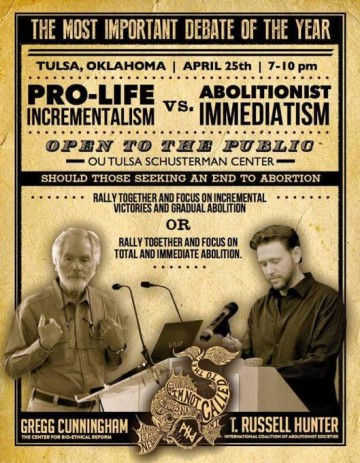
I do not take credit for this image and use it under fair use.
I recently took the time to watch through a debate on pro-life method between Gregg Cunningham and T. Russell Hunter. I summarized the debate here, along with a brief introduction of what was seen to be at issue. Essentially, Cunningham endorses the position that we should pass laws to limit abortion as much as possible now while working towards the ultimate goal of ending all abortion, whereas Hunter argues that we must work only for legislation that will “abolish” all abortions now.
Cutting Off Branches vs. Save Babies Now?
T. Russell Hunter continually made the same error: reducing everything down to an either-or when it could just as easily be both-and. His analogy of the tree was used throughout the talk. Abortion is the tree, he argued, and we must cut the tree down rather than hacking off the branches which will then grow back. The tree is thus the whole of abortion, while the branches are the individual methods used for it, ways to advocate for abortion, and the like. His argument is that if we stop abortion with one method, another will grow up in its place. It’s a powerful image, but one that is ultimately full of rhetorical flair with little basis in reality.
Jill Stanek pointed out a number of problems with this analogy in her own analysis of the debate. First, she notes that the analogy is faulty because trees can spring up even from their roots, so hacking a tree down doesn’t necessarily end it. This point might seem trivial at first, but Hunter’s whole goal was to argue we need to cut down the tree so it can’t grow back (unlike the branches) to kill the tree. But the analogy fails because trees can grow back. Moreover, Stanek notes that when we cut down trees, we saw off the branches first anyway.
Second, and most importantly, Hunter’s analogy fails because he assumes branches can cut back. But this begs the question. Suppose there was a law passed that made abortion illegal after 20 weeks. How could a “method” or “branch” grow back in that place? It would be a total ban on all abortions past a certain point in time. Thus, there is no such thing as growing back. The branch would be dead, and we could move on to the next one. Cunningham also showed data demonstrating that even ending methods lowers the amount of abortions. So when a branch is cut off, the tree is weakened.
Finally, Hunter’s view entails that the children whose lives are saved by incremental legislation should have been left to die. Again, he would oppose (and the “Abolish Human Abortion” group has opposed) legislation to limit abortions or stop certain methods from being used. But this means that the babies that are demonstrably saved by such laws, according to Hunter, should have been allowed to die. This is an awful turn of justice into injustice.
False Dichotomy
Hunter’s position seems to be entirely based on a false dichotomy, which Cunningham pressed pointedly throughout the debate. Namely, the notion that one has to be either someone who works through incremental legislation, or one is someone who supports the immediate ending of all abortions now. But this is just false. Cunningham put it better than I can: the issue is that we can be immediatists morally–that is, we absolutely want to end abortion now–while being incrementalists in practice. We can work to stop all the abortions we can now, even though we want all abortions to stop.
Cunningham also accurately noted that Hunter’s position depends on the notion that if everyone who was a pro-life incrementalist got together right now, we could bring an immediate end to all abortions. But this has not played out in legislation. Cunningham himself noted this–if we don’t have the votes, we do not have the votes. Thus, we can work with legislation that we can get passed to save those babies that legislation can rescue now.
If Hunter wins this debate, the implication is that all of these pro-life laws that do not end all abortions now should be voted down. But what about the lives that those laws demonstrably save? Should we allow them to be aborted just because we can’t pass a law to save all babies? Obviously not.
Hunter’s position fails, and it does so spectacularly. It fails the tests in the actual legislative procedures, as strict pro-life legislation continues to fail to get any votes. It fails the test of accuracy, because pro-life persons can oppose all abortions ethically while working incrementally within the system we have. Finally, it fails to save babies now that can be saved through legislation.
One Question and Answer
I didn’t type up a summary of the Q+A session but at 2:24:19 on this video of the debate, the question was asked as to whether Hunter would be for a bill that abolished all abortion except for one child. Hunter briefly described a scenario in which someone came to him and offered this legislation: all abortion would be abolished in his name except for one child, who would be aborted. He graphically described the abortion. His response was “Get behind me Satan.” He argued that if you take this deal, you are compromising and you might be able to say you saved lots of babies, but it never bears fruit.
Cunningham’s response was that no, he wouldn’t support the bill, and added that we don’t have the votes to pass legislation banning abortion. Cunningham agreed that this deal would be abhorrent because it would kill a child.
I think this is what many people don’t realize. Many pro-life advocates (I have no idea of the numbers so I’m hesitant to say most) would argue vehemently against consequentialism, the notion that the consequences of an action are the most important aspect of a moral decision (I am simplifying for brevity). Thus, there is no “ends justify the means” mentality, so the thought of killing one child to save others was found to be morally repugnant to both speakers.
Conclusion
T. Russell Hunter’s position against other pro-life views cannot be reasonably sustained. It collapses in on itself when it is challenged to present us with reasons as to why we should not try to save what lives we can now on the way to the total ending of abortion. The examples he used were shown to be false or misguided. I think that we need to realize that to end abortion, we should work together. The amount of energy the “Abolish Human Abortion” group has put into attacking others’ methods is better suited to work towards a goal we share: the ending of abortion.
I would like to end noting that I do appreciate the work the AHA/Abolish Human Abortion group does go out and pray, picket, and work at abortion clinics to try to save the babies they can there. But I wish they would join other pro-life persons like Cunningham in helping the other babies that are within our power to save now.
Links
Be sure to check out the page for this site on Facebook and Twitter for discussion of posts, links to other pages of interest, random talk about theology/philosophy/apologetics/movies and more!
Debate Between Gregg Cunningham and T. Russell Hunter– Scott Klusendorf, a major pro-life speaker and author, offers his reflections on this debate. He also has links to some other analyses.
Is it Wrong to pass incremental pro-life laws?– Here is a snip of the debate from the cross examination portion in which T. Russell Hunter is challenged on whether he would choose to save lives with incrementalism or let babies die for the sake of immediatism.
Debate: Pro-Life Incrementalism vs. Abolitionist Immediatism– a link to the debate.
The image used in this blog is not mine and I do not claim rights. I use it under fair use.
SDG.
——
The preceding post is the property of J.W. Wartick (apart from quotations, which are the property of their respective owners, and works of art as credited; images are often freely available to the public and J.W. Wartick makes no claims of owning rights to the images unless he makes that explicit) and should not be reproduced in part or in whole without the expressed consent of the author. All content on this site is the property of J.W. Wartick and is made available for individual and personal usage. If you cite from these documents, whether for personal or professional purposes, please give appropriate citation with both the name of the author (J.W. Wartick) and a link to the original URL. If you’d like to repost a post, you may do so, provided you show less than half of the original post on your own site and link to the original post for the rest. You must also appropriately cite the post as noted above. This blog is protected by Creative Commons licensing. By viewing any part of this site, you are agreeing to this usage policy.
Debate Overview: Pro-Life Incrementalism vs. “Abolitionist Immediatism” – Gregg Cunningham vs. T. Russell Hunter
I do not take credit for this image and use it under fair use.
I’ve been looking forward to this one, folks. Here we have a debate between Gregg Cunningham and T. Russell Hunter on “Pro-Life Incrementalism vs. Abolitionist Immediatism.” T. Russell Hunter, a member of the group “Abolish Human Abortion,” argued for “Abolitionist Immediatism,” which is effectively the position that we must only work for the immediate ban of abortion. He issued a challenge to so-called “pro-life incrementalists”–those who would allow for “gradual” steps to legislate abortion (i.e. banning abortions for gender selection, etc.)–to debate the topic. Gregg Cunningham, Executive Director of the Center for Bioethical Reform, took up the challenge.
I took the time to watch and reflect on this lengthy debate. Here, I provide an overview of the debate with summaries of the statements made throughout [I do not summarize the Q+A session]. My next post on this debate will be a commentary on the debate itself and the arguments presented therein. Here, I will stick as closely as I can the arguments as they are presented. I will not offer analysis of the arguments in this post. In my next post on this debate, I will go over many of the arguments found herein and offer reflections on the debate.
I’d love to read your thoughts on the debate. You can watch the debate here.
Hunter Opening
The debate between incrementalism and immediatism is ancient. It is ultimately a debate between “God has said” and “Did God really say?” [He quotes this.] Immediatism is not suggesting that something happens overnight, but is rather the working towards immediate action. American abolitionists against slavery were immediatists–they believed that slaves ought to be instantly set free. These immediatist abolitionist saw any incremental solution to slavery as something that would prolong the institution of slavery and opposed it entirely. They saw slavery as a national sin and the nation needed to immediately repent of the institution of slavery.
After citing a few abolitionists, Hunter argues that Wilberforce was an immediatist, not a gradualist as many pro-life incrementalists have argued. Total abolition, according to Wilberforce, is the only acceptable solution to slavery. Any delay allowing slavery to continue for even an hour undermines the notion that slavery is sin. Martin Luther King Jr. was also an immediatist and argued for the immediate ending of segregation and racial injustice.
Ultimately, the call for the immediate repentance and the doctrine of immediatism is found in the biblical prophets (Isaiah 1:16-17 among others).
Cunningham Opening
We [at the Center for Bioethical Reform] are moral immediatists but strategic and tactical incrementalists. This is not because the desire is only for incremental legislation, but because strategically it works. Hunter’s position presupposes that the pro-life movement has the power to end abortion right now but chooses not to. Strategically, we should work to save every baby by passing every law that the courts and public will allow.
Hunter’s position includes a number of factually incorrect statements. The pro-life position is not losing the battle over abortion. The pro-life position is not eager to compromise, nor is it comfortable with the current status. Hunter’s approach suggests that he is the only one praying; but the pro-life movement prays, but also works to pass every law to save every baby possible in the here-and-now. Peer-reviewed study shows that legislation that restricts or regulates abortion are saving babies’ lives. Abortion rate is falling in states in which funding is cut off, parental or other requirements are in written law, and the like. We can save those babies these laws save en route to abolishing abortion.
Pro-life lawmakers have put their seats on the line to try to draft pro-life legislation, and they have lost their positions due to their own pro-life views. Yet they have been proven to be effective–these laws save lives. Again, Cunningham asserted that we may be absolutists morally, but strategically must be incrementalists because that saves lives now.
Sometimes we need to compromise on our laws in order to get them passed and save lives now. (He uses an example of the rape exception clause and his own use of the rape exception clause in order to prevent Planned Parenthood from defining the clause, thus saving lives by making it as narrow as possible.) Years later, the evidence showed that not one abortion had happened with a rape exception clause, and this saved babies lives immediately, despite Cunningham himself being against rape exceptions.
Hunter is mistaken on William Wilberforce, who was a moral absolutist, but a strategic incrementalist. Wilberforce started off fighting the slave trade rather than directly abolishing slavery, and this demonstrated that he was out to save lives and end as much slavery as he could. Legislation Wilberforce supported forced slave ships to be redesigned and worked to put laws through that restricted the ports slave ships could use, etc. He worked incrementally to restrict and slow down slavery through slave trade as much as possible.
Hunter Rebuttal
Wilberforce did not author the bills that attacked the slave trade. He only sometimes voted for them and “often ridiculed” them.
There is no talking about abortion without talking about it as a spiritual issue. “Secular people need to hear that abortion is sin also.” It is people’s hatred of God which leads them to abortion. To modify bills to get them passed by including compromises regarding restrictions is “writing an iniquitous decree to pervert justice.” Every child who is aborted is an image bearer of God and one of our neighbors.
Making an occasion for sin allows it to grow. Through incremental legislation, abortion is perpetuated. When bans are placed on things like partial birth abortion, it is an attack on method, not on abortion itself. Thus, inevitably abortion methods will change and the banned method will end, but abortions will continue. Whenever one method is ended, another method takes precedence and abortion continues. Partial birth abortions are morally equivalent to any earlier abortion, and when we work to make things like that illegal, abortion continues and people focus on things like partial birth abortion rather than abortion at large.
Cunningham Rebuttal
The inescapable conclusion of Hunter’s argument is that until we can outlaw abortion, we should be utterly indifferent to the slaughter of the babies that we can save now. Instead, we should be committed to saving every baby that we can now. While we move towards the goal of ending all abortion, we should not allow those babies we can save to die.
Wilberforce gave a speech to Parliament in which he advocated paying compensation to slave owners for their freed slaves weeks before his death. He did this because he didn’t have the votes to get abolition without compensation. This was a strategic move, not indicative of the moral absolute of ending slavery now.
Hunter’s argument that pro-life incrementalists imply that abortion is okay when they try to regulate abortion is absurd on its face. It is not as though by saving a baby because dismemberment laws were passed, someone is then advocating the position that abortion that is not dismemberment is suddenly okay. Incremental legislation saves and changes what it can when it can; it does not at all imply that the whole system is acceptable.
Hunter criticizes those who spend times fundraising, but the very images he uses that show abortions would have been impossible without fundraising and the professionals who take the photographs and obtain the images.
Cross Examination
[I do not type up every question and answer in these Cross-Exam portions.]
Cunningham: Hunter is critical of pro-life people working with secular people and the like in order to try to end abortion. If, hypothetically, your child falls into a swimming pool, would you quiz the paramedics about their worldview before letting them resuscitate your child?
Hunter: I would want them to resuscitate my child. That’s a straw man. When we fight evils, we do need to fight them on God’s terms. If we want the power of God on our side, we should not join hands with a “God-hating worldview” because secular worldviews are the very things that make abortions possible. Making strategies with people who adopt the worldview that allows for abortion perpetuates abortion.
Cunningham: I’m not the one who decides what the limits are on legal restraints for abortion. The public decides what the restraints are by what they will allow and vote for. Hunter’s position suggests that pro-life advocates have the power to end abortion now and choose not to do it. This is mistaken because attempts to end all abortion immediately continue to fail to be voted in.
Hunter: I would not put a bill forward to begin with.
Cunningham: Do you care about the lives of the babies?
Hunter: Yes.
Cunningham: Then why do you suggest we shouldn’t vote for legislation that saves these babies lives?
Hunter: Children are not increments.
Cunningham: We can do both.
Cunningham: Why can we not work to save babies through incremental legislation while working to end abortion entirely?
Hunter: You can do both as long as you don’t undermine the whole project. The rape exception is always brought up. People begin to believe that murdering children is okay if exceptions are in place.
Cunningham: Do you understand the difference between a moral immediatist (with strategic incrementalism) and pure incrementalism or compromise?
Hunter: Yes.
Cunningham: Why do you insist on conflating the two?
Hunter: Because if you undermine your own immediatism, you are what the word of God says someone who perverts justice.
Cunningham: Should we allow these babies to die rather than enact incremental legislation? [This is a key portion of the debate. See the transcript of this entire question and answer here.]
Hunter: Abortion is evil and it is one of the things that the powers and principalities of darkness endorse. If they can keep abortion going by deceiving people into becoming gradualists, then that will be allowed.
Cunningham: Let’s be both [incrementalists and immediatists]. Let’s be both.
Hunter: Is it that you don’t want to deal with immediatism, or do you just want to avoid the conversation about immediatism?
Cunningham: I’m determined to save that baby [through incremental legislation], and that’s an immediate kind of thing. We can be both immediatists and incrementalists. It is a false dilemma.
Hunter: Do you believe we have to fight abortion as abortion and sin?
Cunningham: We have to use clauses which the courts will allow because they strike down legislation that is complete ending of abortion.
Hunter: How do you do “both” [immediatism/incrementalism]?
Cunningham: The way people have continually done both. We can talk about abortion as sin and as a human rights violation, while working to end as much of it as we can. It does not have to be either/or. Hunter tends to be binary without justification.
Hunter: Do you think the church is doing enough to work against abortion and do you think that incremental bills encourage apathy?
Cunningham: The church is not doing enough and we are not educating our pastors enough to combat abortion.
Hunter: I see apathy tied into incremental legislation because when I ask pastors to help and go to abortion clinics and the like, I hear them cite their support of incremental legislation.
Cunningham: The reason for this is because the pastors are poorly trained.
Hunter: Do you think that people are more likely to oppose abortion if we convert them? Do you think it is a wise strategy to deal differently with secularists and Christians?
Cunningham: We don’t know who believes what. It is not either/or. We make sure both sets of people here both sets of argument, including getting the opportunity to share faith in Christ.
Hunter: I have e-mails from you saying you bring different displays to Christian schools and state schools. Do you think it is folly to try to call the nation to repent of abortion?
Cunningham: We should work to make every argument we can make to save the life of every baby whose life is imperiled, and this includes passing every law we can pass now to save every baby we can.
Hunter Closing
Isaiah 30 (reads). Pro-life incrementalists are like the Israelites running to Egypt instead of God. People, instead of trusting in the word of God and going into conflict with the people of the age, go and look at the laws to see what they can get within the current federal ruling. We must cut down the tree itself rather than the branches. Incrementalism is not in the Bible. It is not in the historical record. If you believe and trust in God, then you would be an immediatist.
Cunningham Closing
We don’t have to do either immediatism or incrementalism, we can do both. Hunter doesn’t find incrementalism in the Bible, but it is in the Bible: 1 Corinthians 3 shows that God reveals revelation incrementally. Mark 10 shows that the Law was incrementally revealed over time regarding divorce laws, which became much more restrictive over time, working with people over time. Regarding the temple tax, Jesus saw that he did not owe the temple tax, but he paid it anyway in order to compromise and pick the battles. It is possible to save babies incrementally and not do so to the exclusion of trying to save all the babies. Hunter’s position does not save babies now. The position does not allow for the love of Christ.
Conclusion
I will be offering analysis of this debate in a coming blog post. Please feel free to comment yourself on what you think of the debate and the arguments put forward therein here (and on the future post as well).
Links
Debate Between Gregg Cunningham and T. Russell Hunter– Scott Klusendorf, a major pro-life speaker and author, offers his reflections on this debate. He also has links to some other analyses.
Is it Wrong to pass incremental pro-life laws?– Here is a snip of the debate from the cross examination portion in which T. Russell Hunter is challenged on whether he would choose to save lives with incrementalism or let babies die for the sake of immediatism.
Debate: Pro-Life Incrementalism vs. Abolitionist Immediatism– a link to the debate.
The image used in this blog is not mine and I do not claim rights. I use it under fair use.
SDG.
——
The preceding post is the property of J.W. Wartick (apart from quotations, which are the property of their respective owners, and works of art as credited; images are often freely available to the public and J.W. Wartick makes no claims of owning rights to the images unless he makes that explicit) and should not be reproduced in part or in whole without the expressed consent of the author. All content on this site is the property of J.W. Wartick and is made available for individual and personal usage. If you cite from these documents, whether for personal or professional purposes, please give appropriate citation with both the name of the author (J.W. Wartick) and a link to the original URL. If you’d like to repost a post, you may do so, provided you show less than half of the original post on your own site and link to the original post for the rest. You must also appropriately cite the post as noted above. This blog is protected by Creative Commons licensing. By viewing any part of this site, you are agreeing to this usage policy.

 J.W. Wartick - Reconstructing Faith