We are currently in the time of the year known as “40 Days for Life.” During these 40 days (as well as the rest of the year), it is important to focus on issues related to the beginning of life. The Bible has much to say about the topic.
A survey of the Bible can reveal many verses which can be used for the pro-life position. I will focus upon a few (verses in ESV). I will outline how they argue for the pro-life position, how a pro-choice Christian might respond to them, and a rebuttal or concession based upon their response.
Jeremiah 1:5- “”Before I formed you in the womb I knew you,and before you were born I consecrated you;I appointed you a prophet to the nations.”
Here we see that God called Jeremiah to be a prophet before he was born. In other words, even before his birth he was valuable to God, to the point of being called as a prophet. One interesting counter to a verse like this would be to hold that all it is saying is that God knew about Jeremiah from eternity, so the “before” is being used here as logical priority as opposed to temporal priority. I think this objection has some merit, so perhaps this verse isn’t as strong as it seems. But there is a more powerful verse on this topic to be found:
Luke 1:15- “for he [John the Baptist] will be great before the Lord. And he must not drink wine or strong drink, and he will be filled with the Holy Spirit, even from his mother’s womb.”
Here there is no question of the verse just being God’s knowledge of John the Baptist’s prophetic call before his birth, rather, God will fill him with the Holy Spirit, even while John is in the womb. In other words, before he is born, John will be empowered by God. I don’t see how a pro-choice response could get around this. That John will be filled with the Spirit before his birth is a powerful argument for the pro-life position from Scripture because it would mean John would have to be capable of being filled. Pro-choice Christians often have to fall back to saying the unborn aren’t “persons”, but that would be impossible here, for why would the Holy Spirit fill a being which is impersonal?
There are many verses which point to God forming us in the womb (i.e. Job 31:15; Isaiah 44:2; and Psalm 139:13-16). These verses could be seen as supporting the pro-life position. However, the pro-choice Christian may respond by saying that it does not follow that just because God makes us in our wombs, we exist as persons in the womb or that we are inherently valuable in the womb. The counter to this argument is that the verses do not make sense otherwise. For if it were true that all the verses were pointing out were God’s creative activity, then much of the sense of the verse would be lost. In the Isaiah passage, for example, God is talking about His interaction with the nation of Israel, the implication is that because he formed them in the wombs, they are loved by Him–His creative act was an act of love to His people. So it would seem these verses must be understood as pointing towards the value of the baby in the womb, as opposed to a mere observation of God’s action.
But there are more sophisticated arguments against abortion that can be drawn from the Bible. I wrote elsewhere on Exodus 21:22-25, which has interestingly been used by pro-choice Christians to say their position is correct:
“If men who are fighting hit a pregnant woman and she gives birth prematurely but there is no serious injury, the offender must be fined whatever the woman’s husband demands and the court allows. But if there is serious injury, you are to take life for life, eye for eye, tooth for tooth, hand for hand, foot for foot, burn for burn, wound for wound, bruise for bruise.” Some believers use this passage to state that it shows the unborn fetus has a lesser status of personhood. They state that verse 22 shows that though the woman loses the child, she sustains no injury, and the penalty is but a fine. They say that this, then, shows that the fetus does not demand the same repercussions as hurting a fellow human (Feinberg 63). There are several problems with this interpretation, however. First, it must be stated that even if one is to concede this interpretation [which is incorrect], it does not authorize abortion. The baby is not intentionally harmed in any manner, but only unintentionally hurt. Second, just the fact that there is a penalty shows that there is wrongdoing here. If the fetus something that may be discarded at will, why is there even a fine for its destruction? Third, the reason the fetus’ death does not require the death penalty is in keeping with the Mosaic exception to the death penalty in cases of accidental death (Exodus 21:13-14, 20-21, Numbers 35:10-34, Deuteronomy 19:1-13). Thus, the fact that there is “merely” a fine does not show that the fetus is less valued. Finally, it absolutely must be noted that Exodus 21 states various penalties for the killing of individuals that cannot be explained away with personhood. For example, verses 20-21 show that one who kills a slave unintentionally has no penalty. No one could argue that the slave is not a “person” (Feinberg, 64).
Further, the correct interpretation of this passage must be seen as the woman giving premature live birth, not a miscarriage. Thus, the implication is quite clear. If the mother gives a premature live birth because of the fight, there is merely a fine (despite no serious injury to anyone), but if either the mother or the fetus is injured, the law of retaliation (eye for an eye) is invoked. Thus, if the fetus is killed, the man causing harm is to be killed. This is remarkable, because it is the only place in Scripture where death is required for accidental homicide. It shows the extreme value placed on the life of the fetus (Feinberg, 65). This interpretation is based on the Hebrew verbs and nouns used in this passage… (here)
Given these passages (and there are more where those came from), it seems as though the pro-life position has very solid grounding in the Bible
Image: http://commons.wikimedia.org/wiki/File:Pro-Life_Demonstration_at_Supreme_Court.jpg
Feinberg and Feinberg, Ethics for a Brave New World (Wheaton, IL: Crossway, 1993).
SDG.
——
The preceding post is the property of J.W. Wartick (apart from citations, which are the property of their respective owners) and should not be reproduced in part or in whole without the expressed consent of the author. All content on this site is the property of J.W. Wartick and is made available for individual and personal usage. If you cite from these documents, whether for personal or professional purposes, please give appropriate citation with both the name of the author (J.W. Wartick) and a link to the original URL. This blog is protected by Creative Commons licensing. By viewing any part of this site, you are agreeing to this usage policy.
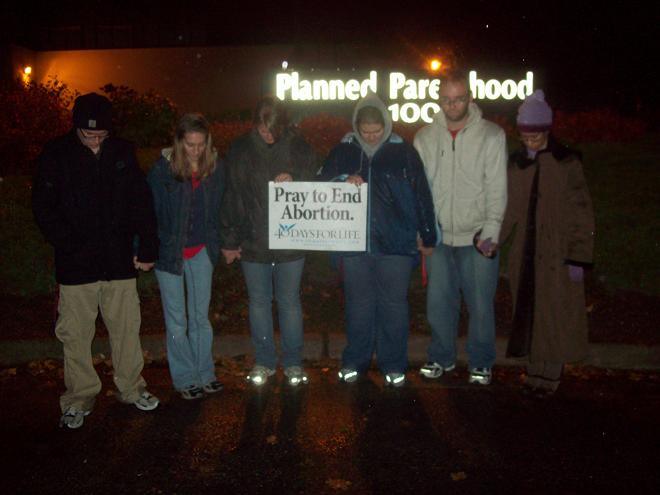
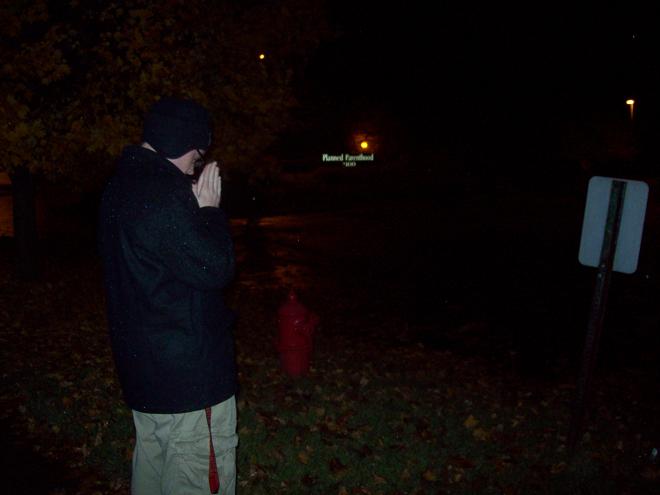
As part of 40 Days for Life, a group I’m in on Campus (Concordia Students for Life) went to an abortion clinic that was shockingly close. I’ll be discussing the experience, and there are a few photos:
When we first arrived on site, there was a man there to talk to us about what we could/could not do, where we could go, etc. It was late evening, so it was closed, but two employees drove by us while we were talking to the man. One of them had her hand over her mouth as she drove past. Not sure what she might have been saying/thinking but I hope that it may have been sorrow or regret of some kind. The man who was there told us about just talking to people, a couple stories, etc. The most striking thing though was him talking about the “medical waste” trucks that would come and take the “waste.” It’s disgusting… discarded babies, hauled as “waste.”
Once the man left, we stood in a circle and prayed. Then we sang some songs, just pieces of hymns or praise songs that we could remember. Then we separated and prayed individually.
The setting was so perfect. It was raining, freezing cold, and dark as sin. It was so striking to think of my previous thoughts on the notion of suffering and how God understands human suffering. Thinking of the rain as God’s tears… and thinking about the fact that just days before we drew 3200 hearts in chalk on the pavement outside the chapel to show the number of hearts each day that are never allowed to love. Those hearts were being washed away at the end of the day, just as the hearts they’d represented had been extinguished that entire day (several of us had this same thought). But we were there to protest, we were there to pray, to ask for forgiveness, and to acknowledge the Redeemer.
It was a truly powerful experience. There is an air about the place, a spiritual kind of malevolence. The moment I stepped onto the general property, I could feel it. I immediately teared up. What could I say? What prayer could I offer? I simply repeated a version of the Kyrie (“Lord have mercy, Christ have mercy, Lord have mercy on us”) the entire time as I prayed with emotions and thoughts, not words, just feelings. What kind of atrocity have we allowed? Will my generation stand against this? I pray it shall be so.
Most striking to me is the difference between just talking about abortion from an impersonal perspective and being at a clinic where I could feel the effects. I’m not trying to say it’s not worth trying to debate abortion from an objective standpoint, but it is so much more real than that (see here for my own arguments against abortion). It’s not something that’s just an interesting topic, but it is a matter of life and death, and it’s a matter of life on death on a huge scale. Several thousand a day in U.S.A. alone. What kind of happiness are we pursuing when we murder the innocent? It speaks volumes about our values that a “choice” is valued above a life. We have become such pragmatists that we can turn a blind eye to the massacre next door. It’s disgusting.
We can’t claim to care about freedom or justice or liberty and deprive thousands of people of their lives each day. It’s horrible. And the only response I can muster, the only prayer I can utter is “Lord have mercy on us.”
There are a couple pictures below.