Arguments against abortion
The “Dependency” Argument for Abortion: A Dilemma
 One common argument for the pro-choice position is what I shall call the “dependency” argument for abortion. This argument suggests that because the unborn is dependent in a unique way upon the mother, abortion is permissible. For example, one might argue that because a fetus cannot survive without the direct use of the mother’s body, the unborn does not have a right to life. The status of dependency upon another being in such an intimate and unique fashion means that abortion is permissible, according to this argument.
One way to respond to this argument is to show that the dependency of the unborn upon the mother is not relevantly unique. For example, one may cite the dependency of a newborn upon his or her parents, of a person hooked up to an artificial heart or some other dependency-creating situation. However, here we will consider what I think is a more direct and intractable problem for the abortion advocate. Namely, that the dependency argument yields an inescapable dilemma for their position.
The Thought Experiment
Suppose we were able to create artificial wombs–something which doesn’t seem all that preposterous given that it’s being worked on right now–to which we were able to move the unborn at any point up to birth and allow to grow there. In this case, the growing being is not dependent upon its mother or even any woman or person. We may cut out the people doing maintenance on the artificial wombs by having some kind of automated maintenance system.
The Dilemma
Would it be permissible to terminate the unborn within the artificial womb?
If so, then the grounding for abortion on the notion that the unborn is in a relevantly dependent situation related to the mother cannot be correct. For in this case the unborn is not in that dependent situation, yet the pro-choice advocate still maintains a right to abort. If it is not permissible, then there must be some reason why it is not permissible to abort once the unborn is no longer within the mother, and this reason would have to be one that could, in a way that is not ad hoc, not apply to the unborn when inside the mother.
I think this is a serious dilemma for those who use the “dependency” argument in order to ground objections to abortion.
Answering the Dilemma
Perhaps one might try to answer the dilemma by embracing the second horn of the dilemma and suggesting that once the dependency situation is removed, then the right to abort is also removed. However, the same type of dependency which the unborn is in with the mother has simply been transferred to an artificial womb. Perhaps, however, one cannot be relevantly (morally) dependent upon a machine. But this is to effectively beg the question, for the very grounds of the pro-choice argument is that it is dependency which creates a state of permissive abortion. Perhaps they could modify their stance and say that it is actually dependency upon the mother alone. But here is where the danger of an “ad hoc” stance rears its ugly head, because the relevant criterion–dependency–is maintained while it is the location of the unborn which has shifted. If dependency is alleged to be enough to ground abortion rights, then smuggling in additional premises alongside dependency defeats the initial argument.
The point needs to be emphasized: I think this is the best route for the pro-choice advocate to try to go to avoid the conclusions of the dilemma, but if they do go down this route it raises even more questions for their position. First, if we suppose that dependency must be on a person to be morally relevant, than it undermines the notion of dependency as the reasoning for allowing abortion to begin with. For, in this case, it would be the person grounding the moral status, not the dependency. Second, to embrace this horn means that the pro-choice advocate is effectively granting that the unborn has some right to live, so long as it is not in this relevant state of dependency. This is a startling admission, and it must be emphasized that this means, frankly, that according to the pro-choice advocate a being with a right to live has that right suspended so long as a valid “dependency criterion” can be met. The implications of this would be enormous.
Moreover, if we grant that the second horn may be embraced by means of saying that if dependency is removed, then it follows that any possible way to remove the dependency situation, if such a way could become reality, makes abortion impermissible.
Free Wombs?
Now, suppose further there were a foundation that was willing and able to pay for anyone (anywhere and anytime) to move their unborn into an artificial womb rather than abort the fetus. For the sake of argument, we will assume this is a risk-free type of procedure, with relevant clinical test results, etc., etc. This strengthens the dilemma posed above because at this point, there is effectively no dependency upon mothers beyond conception. For, the moment a woman finds she is pregnant, she could phone this foundation and transfer the unborn to an artificial womb, relinquish any claim to parental rights, and be done. But if this were the case, then dependency would in a sense no longer exist. The unwanted pregnancy could immediately be ended without the termination of the fetus.
Once again, it seems that in this situation only the location of the unborn remains relevant, should the pro-choice advocate wish to maintain the right to abort. The mother could choose to end her pregnancy by transferring the unborn and all rights/knowledge of/etc. thereof elsewhere at any point.
I realize that some may object and say that having a surgical procedure is an inconvenience, no matter how safe, quick, successful, secret, etc. it might be. But at that point I must wonder where the line is drawn for abortion. After all, if the scenario envisioned above really did exist, and someone really did want to maintain the right to abort, what they would have to be saying is that something thought to be inconvenient alone is enough to abort. Setting aside the fact that abortion is also a procedure–and one with risks–at this point I think I would point out that the dependency argument has been shown to be mistaken, because the pro-choice advocate must now base his or her argument upon the “convenience” of the mother.
Conclusion
It appears to me that the only recourse the pro-choice advocate has with regard to the dependency argument is to argue that location really is a relevant criterion for allowing for abortion. But in that case, dependency ceases to be the factor which grounds the right to abort, and thus the dependency argument fails.
I’m fairly sure I’ve read a similar argument to the one I present here somewhere. However, I do not remember where I may have read it and regret to omit a reference to it here.
Links
Be sure to check out the page for this site on Facebook and Twitter for discussion of posts, links to other pages of interest, random talk about theology/philosophy/apologetics/movies and more!
Pro-life– I have written a number of posts advocating the pro-life position. See, in particular, “From conception, a human” and “The issue at the heart of the abortion debate.”
The image is courtesy of Wikipedia Commons.
SDG.
——
The preceding post is the property of J.W. Wartick (apart from quotations, which are the property of their respective owners, and works of art as credited; images are often freely available to the public and J.W. Wartick makes no claims of owning rights to the images unless he makes that explicit) and should not be reproduced in part or in whole without the expressed consent of the author. All content on this site is the property of J.W. Wartick and is made available for individual and personal usage. If you cite from these documents, whether for personal or professional purposes, please give appropriate citation with both the name of the author (J.W. Wartick) and a link to the original URL. If you’d like to repost a post, you may do so, provided you show less than half of the original post on your own site and link to the original post for the rest. You must also appropriately cite the post as noted above. This blog is protected by Creative Commons licensing. By viewing any part of this site, you are agreeing to this usage policy.
The Epistemic Argument Against Abortion
 Epistemology is the study of knowing. That is, it is the study of how we know something is true. Here, I will offer an argument against abortion which concerns the question: what do we know about the unborn?
An Analogy*
Suppose you are a demolition expert. You’re sitting outside a building you are to blow and you are about to hit the button. The area has been declared clear and so you have flipped the cover of the button up and you’re about to blow the building. Suddenly, someone cries out–a little red tricycle has been discovered outside the building. Fortunately, however, the people who spotted the tricycle tell you there is only a 20% chance that the child made his or her way inside the building. The equipment being used is expensive and your company is paying more Shrugging while thinking “Time is money,” you go ahead and press the button, blowing up the building. After all, you’re 80% sure there is no one inside.
…Wait a second. That’s horrible! Shouldn’t you check and be sure that there is no one inside the building? After all, that person’s life is worth so much more than the extra money your company will have to spend as the child is searched for.
The question then must be asked: what percent is low enough for you to press the button? Suppose you were 90% sure the child was not inside the building, would you pull the button then, confident that you gave your best effort? How about 95%? 98%? It seems to me the only morally permissible situation would be certainty. The building has been swept entirely from top to bottom and cordoned off, you are positive no one is inside. Then, you may press the button without moral culpability: you are certain you are not killing anyone whether directly or indirectly.
*I should note this example is from Kevin A. Lewis. I modified the scenario slightly.
The Argument Stated and Defended
The argument is actually very simple:
1) If it is possible that the unborn is a human person, we should not kill the unborn.
2) It is possible that the unborn is a human person.
3) Therefore, we should not kill the unborn.
Premise one seems obviously true to me. In order to deny premise one, the advocate for abortion must claim that we may destroy “fetuses” even if it is possible that they are human persons. That is, the pro-choice position must hold that it is permissible to blow the building at 80%; or perhaps even at 98%. Given a similar situation: the doctor with the tools for abortion goes and destroys the fetus with the possibility that, like the red tricycle sitting outside the building, they may not know whether they are killing a child; instead, they go forward with the procedure, even though they may be murdering a baby.
Note that what I’m claiming here is a very small claim: it may be even a .5% chance that the fetus is a baby (of course, I am convinced that from conception, we have a human being, but for the sake of argument I will grant even .01% chance), but then the doctor, like the demolition expert, goes ahead and “blows the building” anyway.
Premise 2 also seems to be obviously true. In order to show me that it is wrong, the pro-choice party must make an argument towards the claim that the unborn is not a human person. Why must they try to prove a universal negative? Well, my claim is very broad: It is possible the unborn is a human person. I have argued towards this end multiple times, and would be willing to engage someone on those points. But the bottom line is, even if my arguments fail, I still think that it is possible the unborn is a human person. I just need reasonable doubt here, not epistemic certainty. Unfortunately for those who are pro-choice, their position must yield epistemic certainty, but it cannot.
The conclusion follows from the premises via modus ponens. Thus, the argument succeeds.
Objections
We can never be sure about anything
Perhaps the most thoughtful answer a pro-choice advocate might make for this argument is that we can never be sure of anything. After all, we cannot be certain that when we drive somewhere, a child might run in front of our car and get hit and killed. Indeed, in the case of a demolition expert, one could always have a helicopter drop a small child onto the building at the last second, or a child could tunnel underneath and get in, etc.
My response to this argument is fairly straightforward. In abortion, we are intentionally going in and killing the fetus (or dismantling it; however you want to put it). The analogy with driving simply doesn’t work. In order for it to be even close to accurate, the driver isn’t driving safely. Instead, it would be like driving drunk along a sidewalk in Chicago. You shouldn’t do it.
The problem with the ‘certainty’ objection is that while it is true we cannot be 100% of just about anything, it is also true that there are some steps we should take in order to give ourselves epistemic certainty. That is, there is a line between saying something is broadly logically possible and saying that it actually reduces one’s epistemic certainty of a proposition. Certainly, it is possible for a helicopter to parachute a child onto the building in the seconds before it explodes, but does that reduce one’s epistemic certainty pertaining to the situation? I do not think so.
You’re A Man
Unfortunately, I run into this argument far more often than one might think. It should be pretty obvious that this argument is completely fallacious. Whatever my gender happens to be, I am capable of reasoning.
Sometimes, the argument is put forth as “get out of my womb” or something similar. Well again, if the unborn is a human being, then I am attempting to protect a distinct human being. Thus, this objection not only begs the question, but it is also insulting. It is nothing more than a rhetorical device.
We can never be certain that the fetus is not a human being
A response like this basically grants my argument. As I have argued, if this is the case abortions should be impermissible. We shouldn’t just bank on uncertainty to gamble with lives. Of course, I am not going to merely appeal to uncertainty, I have positively argued that the unborn are human beings. Period.
Links
Like this page on Facebook: J.W. Wartick – “Always Have a Reason.”
Be sure to check out my other posts in which I argue for the pro-life position. Particularly relevant to the present discussion are “From conception, a human” and “The issue at the heart of the abortion debate.”
Image Credit: Wikimedia Commons Chixoy.
SDG.
——
The preceding post is the property of J.W. Wartick (apart from citations, which are the property of their respective owners, and works of art as credited) and should not be reproduced in part or in whole without the expressed consent of the author. All content on this site is the property of J.W. Wartick and is made available for individual and personal usage. If you cite from these documents, whether for personal or professional purposes, please give appropriate citation with both the name of the author (J.W. Wartick) and a link to the original URL. If you’d like to repost a post, you may do so, provided you show less than half of the original post on your own site and link to the original post for the rest. You must also appropriately cite the post as noted above. This blog is protected by Creative Commons licensing. By viewing any part of this site, you are agreeing to this usage policy.
Really Recommended Posts 1/4/13
 Readers, I encourage you to check out the posts I have linked here. Let me know what you think and be sure to check out the other Really Recommended Posts!
What’s Wrong with the Zeitgeist Movie? – Jonathan McLatchie has written this excellent article which thoroughly rebuts the Zeitgeist movie. That movie claims that Jesus is an amalgamation of Pagan myths and never actually existed. It claims that the very foundation of Christianity is a lie. McLatchie’s examination dispels this claims in the movie with insight. I highly recommend reading this.
Philosophical Arguments Destroy “Pro-Choice” Case on Abortion – Clinton Wilcox presents a fantastic look at how strong the philosophical arguments against abortion are, along with an evaluation of some common pro-choice arguments.
Time for a New Hobby – An apologetics comic (!) which poignantly shows the truth about end-of-the-world predictions. Short, sweet, and awesome.
Alien Particles Challenge a Young-Earth Creationist Model – This fascinating article presents a great difficulty with the young earth paradigm. Namely, the fact that we have particles from places which are too far away for a young universe. It’s a fascinating read. Check it out.
Apologetics: Fighting Last Year’s Battles, Last Year’s Way – A really insightful post on the need for story with arguments. A worldview is a story of how the universe works, and it is important to keep that in mind. This will stretch your mind.
J.P. Moreland’s EPS Address– I had the pleasure of attending the 2012 ETS/EPS conference. J.P. Moreland’s address was fantastic, with a message that deserves to be heard. I have written on the conference itself here.
From conception, a human
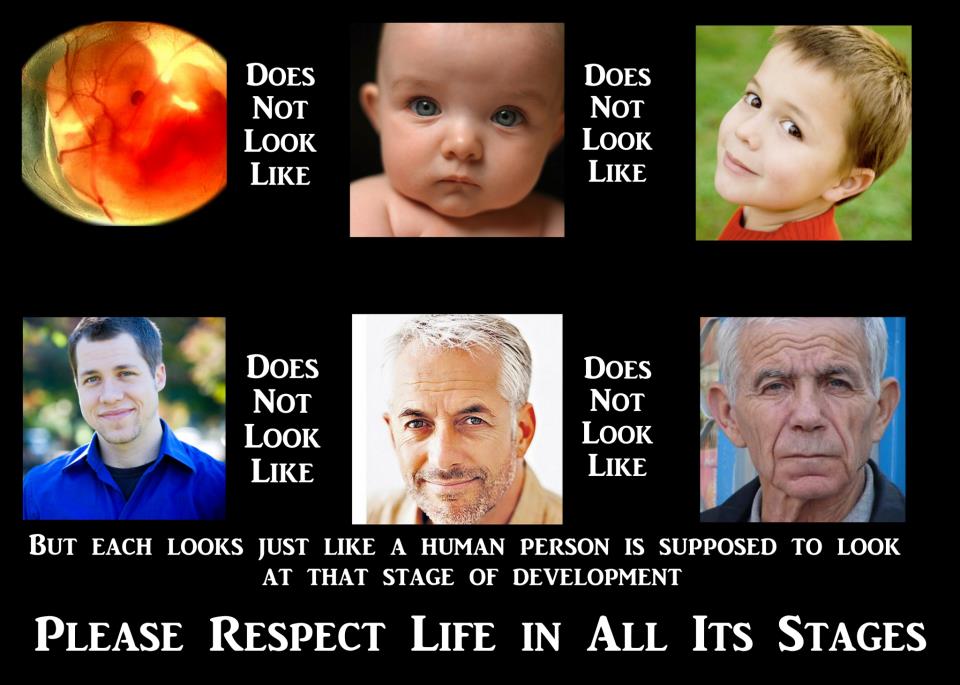 It is important for those on either side of the abortion debate to be informed. One part of that is to realize there are some really, really bad arguments out there. The argument that the unborn is merely a “blob of cells” or “human tissue” is one such argument. Simply put, if one makes this argument they are not on the side of scientific facts.
From the Scientists
A survey of textbooks on embryology by medical professionals shows that regardless of what the person on the street says, science tells us that from conception there is a new human being. I will now demonstrate through the citation of many such sources.
Zygote: this cell results from the union of an oocyte and a sperm. A zygote is the beginning of a new human being (i.e., an embryo). Human development begins at fertilization… This highly specialized, totipotent cell marks the beginning of each of us as a unique individual. [Moore, K. and T.V.N. Persaud, The Developing Human: Clinically Oriented Embryology (6th ed.), (Philadelphia: W.B. Saunders Company, 1998), pp 2-18.]*
“Embryo: An organism in the earliest stage of development; in a man, from the time of conception to the end of the second month in the uterus.”
[Dox, Ida G. et al. The Harper Collins Illustrated Medical Dictionary. New York: Harper Perennial, 1993, p. 146]**In this text, we begin our description of the developing human with the formation and differentiation of the male and female sex cells or gametes, which will unite at fertilization to initiate the embryonic development of a new individual. Larsen, W.J. 1998. Essentials of Human Embryology, Churchill Livingstone, New York, pp. 1-17.*
Fertilization is an important landmark because, under ordinary circumstances, a new, genetically distinct human organism is thereby formed… O’Rahilly, R. and F. Muller. 1996. Human Embryology & Teratology, Wiley-Liss, New York, pp. 5-55.*
The development of a human being begins with fertilization, a process by which two highly specialized cells, the spermatozoon from the male and the oocyte from the female, unite to give rise to a new organism, the zygote. [Langman, Jan. Medical Embryology. 3rd edition. Baltimore: Williams and Wilkins, 1975, p. 3]**
The development of a human begins with fertilization, a process by which the spermatozoon from the male and the oocyte from the female unite to give rise to a new organism, the zygote.
[Sadler, T.W. Langman’s Medical Embryology. 7th edition. Baltimore: Williams & Wilkins 1995, p. 3]**
Furthermore, a number of medical professionals testified under oath to a U.S. Senate committee.
“I have learned from my earliest medical education that human life begins at the time of conception.”- Dr. Alfred Bongioanni (University of Pennsylvania)*
“[A]fter fertilization has taken place a new human being has come into being.”- Dr. Jerome LeJeune (University of Descartes)*
“It is scientifically correct to say that an individual human life begins at conception”- Dr. Micheline Matthews-Roth (Harvard University Medical School)*
Quotes like these could be multiplied almost beyond measure. Scientifically speaking, those who say that the unborn is not a human being are, to put it bluntly, ignorant.
[Want more quotes from professionals? Check them out (each word there is a different link)]
Science, back with a vengeance
 Some may think that amassing endless quotes from medical professionals and scientists is not convincing. They’d rather see the evidence themselves. Let me present it very briefly.
1) The zygote has distinct DNA from the mother (and is therefore not part of the mother).
2) About 50% of the time, the unborn has a different gender than the mother (and is therefore not part of the mother).
3) From conception, the zygote grows and organizes itself (and is therefore a unique individual).
4) As long as there is an environment in which the resources required for life continue to be provided, the zygote will continue to mature and, well, live (much like a baby, or a 20 year old).
5) The zygote is alive and continues to grow.
Therefore, from conception we have an individual with unique DNA and sometimes even a different gender; we have an individual which grows and organizes itself; we have an individual which, as long as no one destroys it, will continue to grow and mature into an adult.
There is a reason the literature sounds so confident that human life begins at conception: those who deny this would have to say that 50% of the time, males with distinct DNA from their “bodies,” who organize themselves towards growth, are reducible to their female mothers. That is what the pro-choice advocate would have to say: “Yes, that male ‘clump of cells’ inside the mother with its self-organization and different DNA is actually part of the mother.” This despite the fact that any DNA test would not show this to be the case. Of course, the female’s DNA would be different as well, so again, the absurdity would have to follow.
The Philosophical Side
Let’s suppose for a moment the science were unconvincing, or at least left open the possibility of denial. What about philosophical arguments that the unborn is not a human being?
Viability
Some argue that viability is the point at which we can decide when an embryo goes from a ‘clump of cells’ to a human being. However, viability continues to be pushed to earlier and earlier stages of development for the embryo. Does that mean that human life continues to be extended earlier and earlier?
This argument is fairly ridiculous because it entails that what was not a human being 100 years ago is now suddenly, miraculously a human being due to new technologies to sustain life. In other words, it reduces humanity to a sliding scale. Imagine a nuclear fallout happened and our technology was pushed back into the 1700s era. Suddenly, viability would be much later than it currently is. Does that mean that those who were humans/persons before suddenly lost that privilege based upon our technology level?
No Brain/No Pain
Some argue that the ‘clump of cells’ is not a human being until it has a brain or can feel pain. There are a number of problems with this argument.
1) it assumes physicalism–it assumes that human beings are somehow identical with their brains. This is a huge area of exploration and I won’t delve into it here.
2) It is unclear how the growth of a body part somehow transforms something from a clump of cells into a human being.
3) It is a completely arbitrary cut-off. Why pick the brain as the arbitrary cutoff? Note that it has to be arbitrary unless someone has an intrinsic value to place all of the qualities of humanity in the brain.
4) If feeling pain is necessary for human life, then someone who is in a coma and can recover is not a human being. Likewise with someone who has passed or gone into shock.
5) The fact is that the unborn can feel pain at somewhere around 7-8 weeks into term. Those who deny that evidence simply must concede that evidence of pain at about 20 weeks. What does that mean? Unfortunately, abhorrently, it means that those unborn who are aborted in extremely gruesome ways [see here: warning: graphic descriptions–and I picked the least graphic one I could find] and that they feel the pain. This is an unfortunate, disturbing, fact. People who deny this fact are either blissfully unaware of the scientific literature or, to be frank, lying. So what to do with this evidence? If the reason for allowing abortion really is that the baby can’t feel pain (and I very much doubt that it is–this is just a rationalization for the real reason behind it), then any abortions over 20 weeks should be illegal.
But really, what is the rationale driving this argument? Why should we care if a “lump of cells” feels pain? After all, according to pro-choice advocates, until the unborn is somehow transformed into a baby by passing from inside to outside of the mother, the unborn is just a “ball of cells.” So really, who cares if it feels pain? Again, that’s because this reason is just a red herring. The real issue is personhood.
Reliance
Some argue that because the unborn has to rely upon the mother to survive it is not a human. But of course so does a newborn infant. If it is asserted that the difference is because the unborn is inside the mother than one can’t help but wonder how going from inside to outside the mother suddenly transforms something from a ‘clump of cells’ into a human being.
For a number of other philosophical arguments see my posts on my pro-life page.
Conclusion
The argument that the unborn is merely a clump of cells is scientifically untenable. Those who make this claim are ignorant of the scientific data that states the exact opposite is the case. If they maintain their assertions in the face of the scientific evidence, then it can only be through blind faith or willful deception.
The philosophical arguments fair no better.
From conception, a human.
*Found quoted at “When Does Human Life Begin”
**Found quoted at Life Begins at Fertilization with the Embryo’s Conception
SDG.
——
The preceding post is the property of J.W. Wartick (apart from citations, which are the property of their respective owners, and works of art as credited) and should not be reproduced in part or in whole without the expressed consent of the author. All content on this site is the property of J.W. Wartick and is made available for individual and personal usage. If you cite from these documents, whether for personal or professional purposes, please give appropriate citation with both the name of the author (J.W. Wartick) and a link to the original URL. If you’d like to repost a post, you may do so, provided you show less than half of the original post on your own site and link to the original post for the rest. You must also appropriately cite the post as noted above. This blog is protected by Creative Commons licensing. By viewing any part of this site, you are agreeing to this usage policy.
The Issue at the Heart of the Abortion Debate
 I’m going to make what may initially seem to be contentious statements, so read the post to contextualize:
If the unborn is not a person, then abortion is morally permissible, and it doesn’t matter what you do with the unborn.
If the unborn is a person, then abortion is morally impermissible, and the unborn must be protected.
Note that these statements are conditional, marked by the word, “If.”
Why would I make these statements? Simply because I want to clarify the issue that is at the heart of the abortion debate. Namely, the status of the unborn.
Consider the following arguments in favor of the pro-choice position:
We shouldn’t bring unwanted fetuses into the world. It’s better to abort fetuses than force a woman to have an unwanted child.
If a mother can’t afford to have a child, she shouldn’t be forced to continue her pregnancy.
Women’s rights are at stake: it is a woman’s body we’re talking about!
Now, let’s contextualize them. Rather than debating the viability of these arguments, suppose we plug in the case in which we all agree there is a “person” involved. Suppose in place of the “unborn” or “fetus” we put “toddler” into the argument. In that case, the arguments would be:
We should kill unwanted toddlers. It’s better to kill them than to have them live in homes where they are unwanted.
If a woman can’t afford to feed her toddler, we should kill it.
Women’s rights are at stake! Think of the drain toddlers place upon their mothers!
These arguments are clearly absurd. Why? Because we all know that we can’t just go around killing children because their families don’t want them. We can’t kill toddlers because their families can’t afford to feed them. But that’s exactly the question these types of arguments beg: what is the unborn?
And so we return to the statements at the beginning of this post. Suppose the unborn is, in fact, just a cluster of cells, no different from a wart or growth. In that case, I would agree it is perfectly permissible to discard of the unborn whenever a woman desires.
But then, what if the unborn is, in fact, a “person”? What if the unborn is a baby after all? Well, in that case, it is certainly not permissible to discard of the baby.
The fact is, many arguments raised in favor of the pro-choice position are made from a position where one simply assumes that the fetus is no more than a clump of cells. But that’s exactly what the debate is supposed to be about! If the fetus is no more then a clump of cells, the debate is over. But if the fetus is indeed a person, then the arguments raised in favor of the pro-choice position are just as shoddy as those arguments with “toddler” substituted in for “unborn” or “fetus.”
Thus, arguments like this must always be contextualized. The heart of the abortion debate is the status of the unborn. Once that question is answered, the answer to the question: “Is abortion permissible?” becomes crystal clear.
For arguments against abortion, check out my Pro-Life Page. Specifically, one can find my arguments for the personhood of the fetus here.
Scott Klusendorf does a simply phenomenal job of centralizing this issue and pointing out how most of the issues which cloud the debate can simply be dropped in favor of debating the status of the unborn. The arguments presented here are based upon his tactic “trot out the toddler” which one can find in his book, The Case for Life or in his lectures in Ethics at the Edge of Life (found in the links here).
SDG.
——
The preceding post is the property of J.W. Wartick (apart from citations, which are the property of their respective owners) and should not be reproduced in part or in whole without the expressed consent of the author. All content on this site is the property of J.W. Wartick and is made available for individual and personal usage. If you cite from these documents, whether for personal or professional purposes, please give appropriate citation with both the name of the author (J.W. Wartick) and a link to the original URL. If you’d like to repost a post, you may do so, provided you show less than half of the original post on your own site and link to the original post for the rest. You must also appropriately cite the post as noted above. This blog is protected by Creative Commons licensing. By viewing any part of this site, you are agreeing to this usage policy.
Abortion: Is It Justified as Non-intentional Killing?

A recent innovation within the pro-choice repertoire of arguments doubles as perhaps the most chilling argument to date: namely, that abortion is justified as non-intentional killing of an infant.
Judith Jarvis Thomson is a proponent of this view. She argues that while the fetus has a right to life, that does not mean that permissibly kill it (“A Defense of Abortion”, 174-175). She argues that “[t]here is a distinction between intentional killing… and bringing about death as a side effect, and instances of choosing not to make a great sacrifice [carrying the fetus to delivery], rather than refusing to make a small one. Thus, many abortions are morally right” (Patrick Lee, 11o).
Thomson infamously uses an analogy of a violinist and the violinist appreciation society. Suppose there is a famous violinist who is dying, and the violinist appreciation society discovers you are the only living match for her blood type. While you’re sleeping, they hook your vitals up to the violinists in order to keep you both alive. You only need to stay in this bedridden state for 9 months, and then she’ll have recovered. Would you be culpable for cutting off the treatment?
Intuitively, the answer seems to be no. The problem is when Thomson uses this analogy for pregnancy. For one, pregnancy is the result of a choice (other than in the case of rape), whereas the violinist was hooked up against someone’s will. Second, mothers have a duty to protect their children. Thomson agrees that the fetus is a human person, but then seems to think that the mother has no duty to protect this human person. Third, “…the child is committing no injustice against [the mother]. The baby is not forcing himself or herself on the woman, but is simply growing and developing in a way quite natural to him or her. The baby is not performing any action that could in any way be construed as aimed at violating the mother” (Patrick Lee, 129).
There are other problems with this view, of course. For example, what if caring for a three year old is deemed a “great burden”; perhaps even a burden which is as great as pregnancy. Should mothers and fathers be allowed to cut off care, thus leading to the “side-effect” death of the toddler?
Another problem is that Thomson’s view depends totally upon the distinction between “intentional killing” and causing death as a “side-effect.” Thomson argues that it is permissible to bring about death as a “side effect” as opposed to intentionally killing an infant. There are two ways to argue against Thomson. The first is to deny her major premise, namely, that abortion is non-intentional killing. One could argue that in every case, abortion brings about the intended death of an infant. Such an argument has initial plausibility, but mostly falls apart when one considers that in at least some cases the death of the infant really is a “side-effect.” Consider the case in which a woman “dislikes the prospect of bodily changes due to pregnancy” (Lee, 115). In such a case, the woman’s intent is to prevent the bodily changes. That the infant is killed in the process is an unintended, but known side-effect of terminating the pregnancy.
In light of this, a more fruitful counter is to deny that Thomson’s conclusion follows from her argument. One could argue that abortion is morally wrong for, among other reasons: 1) the parent has a responsibility to the child (again, contra Thomson’s scenario) and 2) the harm of destroying one’s life is significantly greater than the harm of things such bodily changes.
Justifying 1) should be intuitively obvious, but consider Patrick Lee’s example in Abortion and Unborn Human Life:
Suppose I am in a motorboat in a lake and speeding past the pier I knock… four children into the lake…. I am responsible for their being in a dependency condition [like that of the fetus upon the mother], and… I owe it to them to go back and try to help them out of the water, lest they drown. However… I might also claim that I was only responsible for their being in the water, not for their being in an imperiled condition. It is not my fault… that they do not know how to swim… But clearly, it is specious to distinguish between my causing them to be in the water (for which I am responsible) and their being in a dependency condition due to their inability to swim… (Patrick Lee, 122-123)
Thomson would have us believe that we should draw such distinctions, which are indeed specious. The mother is responsible for her child.
Similarly, 2) also defeats Thomson’s argument. Lee points out that “Death is not just worse in degree than the difficulties involved in pregnancy; it is worse in kind” (128). To kill an infant in order to avoid pregnancy is to confuse not only the degree of “difficulty” but also the kind of difficulty involved.
If either 1) or 2) is correct, Thomson’s argument fails. In order to deny 1), the advocate of abortion must deny that parents have responsibility for their children. In order to deny 2), the advocate of abortion must show that killing someone is no better or worse than putting them in the state of pregnancy. Either alternative is totally implausible. Therefore, abortion is not justified as non-intentional killing.
Sources:
Judith Jarvis Thomson, “A Defense of Abortion” in The Problem of Abortion, ed. Joel Feinberg (Belmont, CA: Wadsworth, 1984), 173-187.
Patrick Lee, Abortion and Unborn Human Life, 2nd edition (Washington, D.C.: Catholic University of America, 2010).
———
The preceding post is the property of J.W. Wartick (apart from citations, which are the property of their respective owners) and should not be reproduced in part or in whole without the expressed consent of the author. All content on this site is the property of J.W. Wartick and is made available for individual and personal usage. If you cite from these documents, whether for personal or professional purposes, please give appropriate citation and provide a link to the original URL. By viewing any part of this site, you are agreeing to this usage policy.
Abortion: The Struggle Between Objectivity and Subjectivity
 I’ve noticed in the past that as I debate the moral issue of abortion, it seems as though people tend to ignore reason in lieu of emotional appeals. Upon further examination of the issue, I am even more convinced that this is the case. But what is at the bottom of this appeal? Why is it that something which must have an objective answer is treated like subjective, lukewarm hogwash? The reason, I believe, is because the issue of abortion is involved in the overarching debate of subjective (relative) versus objective ethical theories.
What reasons do I have for making this claim? First, we must examine the most prominent pro-choice arguments. Pro-choice arguments generally fall into two broad categories:
1) Devaluing the fetus
2) Pointing towards the value of personal choice/control over one’s own body
Now, 1) fails miserably on a number of logical and scientific levels. See my other posts on the topic for discussions of these reasons (notably, this post and this one). But if 1) is rejected, then 2) may be the only way for pro-choice advocates to argue for their position. Unfortunately, 2) boils down to a kind of subjectivism about morality which ends up being self-defeating.
I am reminded of the echoing catch-phrase popular with politicians, “I am pro-choice, but against abortion.” What does this mean? Often, those who say such things generally mean that whatever someone else wants to do is fine with them. We shouldn’t try to limit the choices others make. We don’t have any reason to regulate what choices someone else can make or can’t make. And sure, I think abortion is wrong, but what right do I have to force my morality on others?
Initially, such arguments seem to make intuitive sense. The problem is that while the argument is trying to avoid forcing any “ought” statements, it has one huge “ought” planted right in the middle of its train of thought. That is, that “We ought not limit the choices of others.” But why should this be the case? There are certainly a huge number of cases in which I would limit the choices of others. Rape, for example, would be one instance where I would say this choice is not to be allowed. Perhaps the argument could be modified, then, and say that as long as one’s choice doesn’t harm anyone else, we ought not limit it. But then this pushes the burden of proof back onto argument 1), which is becoming ever more difficult for the pro-choice advocate to uphold.
Not only that, but having an “ought” statement like any of those above goes exactly contrary to what such statements are asserting. What if I choose to disagree with the statement that we “ought not limit the choices of others”? Should my choice to disagree be limited?
Furthermore, what reasons are their to argue that one should have absolute and total control over one’s own body? For if we do think that this is the case, we should then cease efforts in trying to limit substance abuse, cutting, anorexia, suicide, bulimia, and the like! These are all cases in which someone is simply making choices about his/her own body! If I want to cut myself, that should be my choice! If I want to starve myself, that should be my choice!
No, the bottom line is that the pro-choice camp wants to advocate total relativism. On this view, that which is ethically right for one person is okay for that person. There are innumerable difficulties with such a view (I’ve only touched on these above).
Thus, it seems to me that the pro-choice advocate has insurmountable difficulties with his or her position. First, this view cannot accurately measure when one’s “personhood” begins objectively. Second, it desires to claim an objective “ought” statement which ultimately defeats itself. Third, it runs contrary to scientific advances in measuring the stages of life of the human. Fourth, it stands on shift philosophical soil, for it is unable to accurately define “personhood” in any sufficient manner.
Thus, I conclude, as I’ve done so many times before, that to be pro-abortion is to hold a view that is positively irrational.
——
The preceding post is the property of J.W. Wartick (apart from citations, which are the property of their respective owners) and should not be reproduced in part or in whole without the expressed consent of the author.
The “Triumph” of Our Era: Institutionalized Death
It is Pro-Life Sunday (which I tend to think of as every Sunday, but that is beside the point).
As such, I will post again on that massacre of our day, abortion. I have written about it in the past. I’ve presented arguments against it here, and I attacked the institutionalized death again here. In this post, I will continue to make philosophical and scientific arguments against the institution of death.
It seems that arguments in the Pro-Choice camp are continually pushed back. I will examine this in detail in a moment, but for now let me sum up what I’m saying.
1. Some argued that the fetus was not a human. That has been obviously and scientifically refuted.
2. They retreated and then argued that the fetus is part of the woman. This has also been completely destroyed by scientific and common-sensical arguments.
3. Some then denied that the fetus was not a person and as such did not have the rights of other persons. This ridiculous claim is a slippery slope that, once started down, cannot be recouped.
4. Finally, the extremists argue that one’s right to one’s body justifies infanticide.
I’m not outlining every argument made by the pro-choice side, but rather showing how much they have been forced to retreat. It went from “a fetus is not a human” => “a fetus is part of the woman” => “a fetus is not a person” => “Okay, the fetus is a human person, but my rights trump the rights of it because it is inside me”
What a society we have become when we attempt to justify killing those whom we acknowledge are the same as us in every way, but unborn! This is the “triumph” of our era: institutionalized death.
First, there was the argument that the fetus was not a human. I don’t think I need to dwell on this point much at all. Clearly, the fetus is human. It is not a whale fetus, it is not a cat, it is not a unicorn, it is a human. It is biologically a human in every way. To deny that the fetus is human is to acknowledge that one has given up any attempt at rational inquiry into truth, as this is a simple fact.
Then, the argument became that the fetus was thus a part of the mother. Just as one had an arm, a leg, or an appendix, the fetus was a part of the body of the mother. This can be refuted in a way that is almost identical. The arm, leg, or appendix are made up of cells that are genetically coded by the mother’s DNA. The fetus, however, has a unique genetic code, often a different blood type, and 50% of the time is even a different gender than the mother. Thus, it is clearly not just some part of the mother that can be cast off. But here’s what makes this argument really strange to me. Even if the fetus were classified as part of the mother, does that mean that one is allowed to do whatever one wants with “it?” Do people routinely cut off their legs or arms, rip out a kidney, or do some other kind of self-mutilation? Obviously not. So what makes the fetus different? This argument is extremely confusing to me to begin with, but the fact that is entirely based on falsehoods means I don’t see a need to delve into it further.
The next stage of argumentation was then that a fetus is obviously human but not a person. While this claim may seem completely ludicrous, it is one that is used very often in debate on the abortion issue. The challenge I lay before one making this argument is to come up with an argument that does not exclude infants, young children, the elderly (senile), people with comas (that they are likely to recover from), etc. from being persons as well. If we are to play with the definition of who a person is, we must acknowledge the ramifications of such foul play and the potential for exclusion from basic rights that it can bring to all of us. And of course this is not to mention the obvious similarities in trying to strip personhood from the fetus with the Nazi efforts to strip personhood from various portions of the population.
A recent and disturbing trend in such argumentation that I have seen, however, is to acknowledge all of these points and still be pro-choice. Someone posting on another blog I was reading stated that they did agree that the fetus was a human person with such rights, but “If the entire human race is inside my womb, I am allowed to commit genocide.” Really? Are you? Is genocide now permissible for the sake of convenience? There really doesn’t seem to be a response to this argument, as the person making such an argument has shown that they literally have no qualms about killing at will. How long before being inside someone isn’t the only way this argument can be applied? Babies rely on their mothers for nourishment and care, so they clearly could be murdered as well, for it is not my duty (on such a view) to care for someone who is not me! This is morally disgusting.
I would like to cover a few other points before I close. There are a few more common arguments that I find equally ridiculous in their attempts to justify Institutionalized Death.
1) It is unfair to bring unwanted babies into the world.
2) It is unfair to bring babies into situations that are not beneficial to them
The first argument basically claims that it is not fair to children to be born to families that do not want them. What the person making such an argument seems fully willing to ignore is that it seems a lot more unfair to kill children who are unwanted! It’s striking that once the baby is born, if the mother doesn’t want it, and say, kills it, we charge her with murder. If she abandons it, we charge her with abandonment, etc. Not being wanted does not strip someone of their rights.
The second argument is often made with such claims that it is unfair to have children born into poverty, etc. I ask in response, “What right do we have to judge the quality of someone’s life before they live it?” In America, particularly, it seems that being born into poverty isn’t such a terrible thing, considering poverty here is rich in most other places. But not only that, I must press home the question, who are we to judge whether someone should live or die based on a guess that they will live in poverty (or some other situation). It seems obvious that a great many people in poverty are quite happy (and one needs only to read the tabloids to see how happy the rich are). There is no guarantee that someone born into poverty (or another situation) will always be there, and there is no way to objectively judge how much they will or will not enjoy their life. So what right do we have to kill people because we may think their lives aren’t worth living?
There are, as always, more points to cover, but I will save those for another post. I challenge anyone who is pro-choice to come here and present their arguments to me without being ad hominem in their attempts to refute me. I challenge anyone who is pro-choice to attempt to justify their position while maintaining some kind of civility. I challenge them to think about their position, and the ramifications that the arguments they make carry.
——
The preceding post is the property of J.W. Wartick and should not be reproduced in part or in whole without the expressed consent of the author.
Abortion: Further Issues
I’ve written arguments against abortion before, but I’ve come up with/read about some other ones and I wanted to bring them up as I think they raise some unique issues.
One argument I read recently (over here, though I can’t seem to locate the exact post) is that abortion seems to be very anti-men. Those concerned for the rights of individuals should, in order to be consistent, care about both women’s rights and men’s rights. The reason abortion is anti-male is because men don’t have the choice over whether the woman gets an abortion or not. Now, obviously, there are many cases where men (unfortunately) push their significant others for abortion, but what I’m pointing out is that if an adult woman wants to have an abortion, the man can’t stop her if she just goes in and does so. But here’s the punch line: if the woman decides to have the baby, and the man didn’t ever want him/her, he still has to pay child support. So the man can’t decide to have the baby, but if the woman does and he didn’t want him/her, he still has to pay the child support. I’m clearly not saying that men should not want babies, but this is an extreme double standard.
Another issue to raise is the fact that abortion is completely devastating certain minority communities, African Americans in particular (see here for a very interesting site, but if you doubt the validity of this claim, just google it and you’ll find plenty of statistics).
Abortion destroys objective human value. One great point that was brought to light in my eyes a while back (see other post) is the question of how is it that coming through the birth canal suddenly changes this fetus/nonhuman tissue/tumor/whatever term one wants to use to hide the “personhood” of the baby into a baby? What makes the “thing” a baby outside the mother, but not a baby inside the mother, at the exact same stage of pregnancy? How is it different to kill a baby inside the mother (abortion) or kill it outside (murder)? Just being inside a woman doesn’t somehow make the fetus/etc. part of the woman, particularly if it can survive outside of the woman. Though–and here is a very important and chilling point–if one wants to argue that direct dependence on the woman for survival is the difference, then children are not “persons” either until they are capable of taking care of themselves all on their own. A newborn baby, for example WOULD NOT SURVIVE without parental (or other) care. Does this mean the baby too is not a “person”? What definition of personhood is being used, and how does it avoid the points I raised in my other post that I have linked a few times?
Part of my reflections on abortion have lead me to try to see it through the eyes of a pro-choicer. Some of this has come through simply reading from blogs of pro-choice individuals. One thing that is surprising to me is how angry a lot of pro-choice people tend to be. They seem to think that pro-life people are specifically targeting women and trying to “keep them down” in some way. Is it really that hard to acknowledge that there is another side of the debate that might have legitimate reasons for being pro-life? Well, I at least am going to try to acknowledge that pro-choice individuals genuinely raise some good concerns. One of these is a concern for the rights of women. There is no reason to fault someone for wanting to be sure that men and women have equal rights (though interestingly, as above, it seems that men are sometimes pushed aside in this). Pro-choice people show a wonderful concern for women who are struggling with hard decisions, a concern that I think we pro-lifers need to acknowledge and adopt in our own testimony for our side of the debate.
Pro-lifers are not part of some agenda to “keep women down” this is completely ridiculous, and it is in fact a great example of the use of a “straw man” fallacy in argument. I wish that logic was incorporated more into this debate, because all too often I see people on both sides just shouting each other down or using all kinds of fallacious statements. Something this important to both sides, however, seems to alienate logic. I pray that one day this will not be the case. If any real headway is to be made, both sides need to sit down and discuss the issues in a logical way, while allowing for the other side to have some truth.

 J.W. Wartick - Reconstructing Faith
