Christian theology
A Dilemma for Open Theists
 John Sanders writes in his treatise arguing for open theism, The God Who Risks, “Following Plato, Calvin declares that any change in God would imply imperfection in the divine being” (74). He proceeds to argue merely that God does change His mind. The problem is that, in arguing thus, Sanders has perhaps unknowingly presented a powerful dilemma for open theism to solve.
If God literally changes His mind, as Sanders desires to demonstrate, then:
1) If God changes His mind, and this brings about a better state of affairs, then it reveals that God was previously operating under a flawed or imperfect plan. [By implication, there are parts of God’s plan which could use improvement, but which God either chooses not to improve or doesn’t know how to improve.]
or
2) If God’s changing His mind brings about a worse state of affairs, then God has made a mistake, which perfect beings cannot do.
Now an immediate response could be that perhaps neither state of affairs is best. In that case, then, there would be no reason for God to change His mind in the first place and is therefore acting arbitrarily.
A response to this rebuttal may be that the change of mind is not arbitrary, but rather demonstrates God’s responsive, interpersonal nature. By changing His plan, God is responding to prayers and altering the course of history. If that is true, though, we have the first horn of the dilemma: God’s changing His mind is an improvement. And then that would mean God increased in perfection.
One may object with a tu quoque response: “Doesn’t anyone who hold that God becomes incarnate imply that God changes, and therefore wouldn’t they equally be skewered by this dilemma?”
A response to this could be simply that, assuming God has comprehensive foreknowledge, God has planned the incarnation from before the dawn of time, and so there is no changing of the divine plan.
It is interesting to see that Open Theists don’t necessarily hold that the crucifixion was God’s way of bringing about salvation in history. Sanders writes, “Though the incarnation and human suffering and death which would accompany it may have been in God’s plan all along, the cross as the specific means of death may not have been” (102). He concludes this because of his alignment with open theism, and the assertion that, given the free will of those involved, the crucifixion was not predestined (105). Not only that, but Sanders also holds that the suffering and death of Jesus were required by the atonement. Wholly apart from criticizing this theological point of interest, one can see that in this quotation, the open theist is entirely open to the dilemma. Suppose Jesus were to be assassinated, stabbed like Julius Caesar, instead of dying on a cross. Clearly, this wouldn’t suit to fill the prophecies in the Bible which were taken to reference the crucifixion (see Sanders’ discussion 102ff). Thus, it seems that this fulfillment of the divine purpose would have been less perfect than the crucifixion. Perhaps there are ways to improve on the atoning sacrifice of Christ. It seems ludicrous to type such a sentence, but if the crucifixion was unnecessary, it seems at least logically possible that a better way to provide for atonement may have been accomplished.
Finally, one may object that the dilemma could work for any who hold that God created the world. One could adapt the dilemma for the creation of the universe and say that God could have brought about a better world and didn’t (and hence is imperfect). Now there are several ways in which this argument is disanalogous to the dilemma presented above, but one could simply answer it by saying that there are specific reasons for bringing about our world over others’ which are “better” or argue that there seems to be no such thing as a way to measure worlds against each other (for some discussion of this see here).
It seems to me that only versions of theism which imply that God does not know [comprehensively] the future will be susceptible to this dilemma. While some versions of theism hold both that God knows the future and that God changes, these versions will [almost all] fail to be susceptible to the dilemma because they’ll have an account for God’s plan which is unchanging.
SDG.
——
The preceding post is the property of J.W. Wartick (apart from citations, which are the property of their respective owners) and should not be reproduced in part or in whole without the expressed consent of the author. All content on this site is the property of J.W. Wartick and is made available for individual and personal usage. If you cite from these documents, whether for personal or professional purposes, please give appropriate citation with both the name of the author (J.W. Wartick) and a link to the original URL. If you’d like to repost a post, you may do so, provided you show less than half of the original post on your own site and link to the original post for the rest. You must also appropriately cite the post as noted above. This blog is protected by Creative Commons licensing. By viewing any part of this site, you are agreeing to this usage policy.
Book Review: “Man and Woman: One in Christ” by Philip Payne
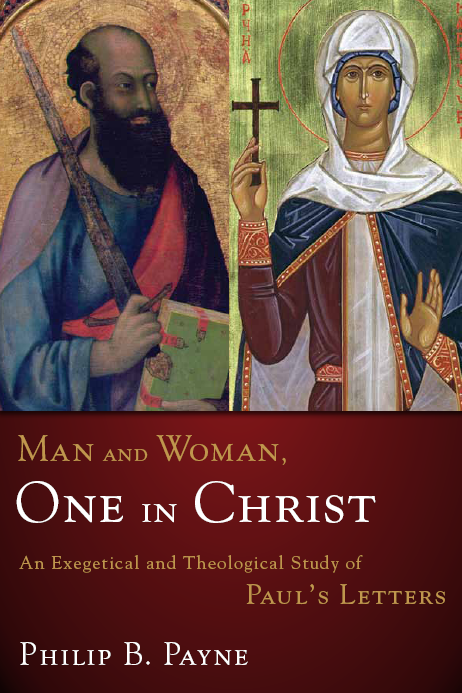 Philip Payne’s book Man and Woman, One in Christ
Summary of Contents
Paul’s Background
Payne notes that Paul was taught by Gamaliel, who was far more egalitarian than his contemporaries. Given this background, it is implausible that Paul had a low view of women (37).
Galatians 3:28
Those opposed to egalitarians (basically, egalitarians are people for women pastors, complementarians are those opposed to women pastors) often portray the position as having its only support in Galatians 3:28. Philip Payne does not base the egalitarian position on this verse alone, but he does argue that the passage provides a strong basis for the egalitarian position. Payne writes, “The natural implication of the equality of male and female in Paul’s teaching is that the gifts of women for ministry in the church should be recognized, welcomed and exercised in all areas of church life, including… church leadership” (104).
1 Corinthians 7- the equal rights of men and women in marriage
In 1 Corinthians 7, Paul explicitly parallels the obligations, rights, and conditions of men and women in marriage. Payne notes a large number of verses in which Paul uses the same language for both men and women (105-106). Not only that, but Paul specifically challenges the concept that men should be the spiritual leaders in the home in 1 Cor. 7:14 (107).
1 Corinthians 11
Payne’s book quickly turns to an extremely in-depth exegesis of the core verses related to the debate over women in church leadership. To put this into concrete terms, Payne’s analysis of 1 Timothy 2:8-15 covers eight chapters and 142 pages; 1 Corinthians 14 has nearly 50 pages dedicated to it, 1 Corinthians 11 is covered by over 100 pages. Payne does not set theology or exegesis to the side in favor of emotional appeals, as some complementarians tend to accuse egalitarians of doing. Rather, he centralizes the Bible as the inerrant Word of God and unswervingly demands that all sides conform to what the Bible teaches, no matter how difficult that teaching may be.
Regarding 1 Corinthians 11, Payne notes that the analogy regarding the “head” of woman does not imply authority, as complementarians must hold. Rather, “source” is a better exegetical and philological fit (113ff, see especially 131, 133). Payne further argues that the proper application of 1 Corinthians 11 would draw out the respect and honor men and women should have for each other as equals (214-215).
1 Corinthians 14:34-35
Rather than mincing words, I’ll jump right to the point: Payne argues that these verses are an interpolation. I’ll cover my own thoughts in the section below “Analysis/Critique,” but for now, I’ll focus on Payne’s argument.
Payne notes that there are a number of ways offered to interpret the passage, but he argues that the only plausible interpretation of the text is that women must be silent, no matter what, in every circumstance. The reasoning is lengthy, but the primary rationale behind this interpretation as most plausible is the it reiterates the prohibition three times, which, in the 1st Century, would have been seen as an absolute prohibition (218-219). Complementarians who allow women to sing in worship, therefore, are inconsistent in their interpretation of this passage, because they add a qualification which is not in the text (221).
Payne, however, argues the text is an interpolation. The evidence is both internal and external. First, the external evidence. The movement of the text itself hints that it was an interpolation which was placed in different parts of 1 Corinthians depending on the textual lineage (227ff). There is also a distigme which is used elsewhere to mark interpolations that is in the last line of 14:33, the correct place to mark 14:34-35 as an interpolation (232ff). Bishop Victor, between AD 541-544, corrected the text to omit 14:34-35 as an interpolation (246ff). Victor’s acumen for detecting interpolations is noteworthy, because he also omits the Trinitarian interpolation in 1 John 5:7-8 (246). MS88 omits the text, likely because it was copied from a manuscript which lacked the interpolation (249). Clement reflects a text without the verses (250-251). He notes other evidence as well (251ff). Payne also notes 9 lines of internal evidence for the text being an interpolation (253ff).
1 Timothy 2:8-15
These verses occupy the largest treatment in MWOC. The key to properly interpreting this passage, argues Payne, is the context and the church situation to which it is addressed. Context is always important in properly interpreting the Bible, but with letters it is even more important. Payne approvingly quotes Raymond Collins on this point, “…it is the epistolary genre that is most conditioned by the coordinates of time and space, historical and relational circumstances… They are ad hoc compositions whose essential import relates immediately and directly only to the situation that dictated their composition” (291).
Payne asserts that scholars know the situation in Ephesus–there was a preponderance of false teaching (296ff). Because of this, it is important to read the letter as a letter designed to put a stop to these teachings. Paul’s prohibition of women’s teachings is tied directly to the fact that false teachers had been praying upon women (299ff). The phrase Paul uses, “I am not permitting” “indicat[es] a new, case-specific injunction in response to a problem in Ephesus that does not carry the weight of church tradition” (321).
Payne also highlights the importance of the Greek word oude as conjoining the prohibitions Paul makes in this passage. The word is used throughout the Pauline corpus to “join together expressions that reinforce or make more specific a single idea” (338). Because of this, it is important to note that the word is used to conjoin the prohibitions in 1 Timothy 2:12. The prohibitions are “to teach” and “to assume authority.” Thus the prohibition is not Paul saying women cannot teach or assume authority over man… rather it is “Women should not teach in conjunction with assumed authority” (348-356).
But does authenteo mean “assume authority”? Complementarians generally must argue that it means simply “have authority.” Payne destroys such arguments, citing etymological (363-365) and document (365-373) evidence to demonstrate the word means “assume authority [to oneself-385ff].” Payne also deconstructs the complementarian argument to the contrary, showing that Paul used other words to refer to authority in a basic sense (373-380).
Importantly, Payne draws out the implications of Paul’s exhortations to women to learn quietly. This was the proper position of students. Paul is not telling women they have no place in the church, he’s calling them to learn in a proper fashion before teaching (see 316-317 for an example of this argument).
Thus, Payne concludes that Paul is not prohibiting women from teaching in the church. In the face of the counter-evidence of Paul’s affirmation of women teachers (61-68), the specific context of 1 Timothy, and the proper translation of the Greek words, the text should be read as a temporal restriction on teaching by women in a church struggling with false teachings being spread by women.
…And More
I have not even begun to draw out all of Payne’s arguments in MWOC. There are many more lines of reasoning including Paul’s affirmation of women in positions of ministry, Paul’s theological axioms which imply equality of man and woman, “salvation through childbirth,” Ephesians 5:21-33 and Colossians 3:18-19 with husband-wife relationships, Titus 1:5-9 and 1 Timothy 3:1-13 and the requirements for deacons and overseers, etc., etc. I cannot emphasize how broad Payne’s line of argument is, and how lucidly he explains his points. The book simply must be read by anyone interested in the topic.
Analysis/Critique
There are so many points Payne makes in MWOC that it would be impossible to cover them all. I found Payne’s arguments largely persuasive. That said, I have a few minor notes.
First, I am not convinced that 1 Corinthians 14:34-35 is an interpolation. I also think Payne dismisses the possible egalitarian readings of the passage too quickly (219ff). That said, Payne’s arguments are extremely powerful. I would have dismissed such arguments before reading this book, but now I’d say I’m very close to agreeing with Payne that these verses are an interpolation.
However, I wish that Payne had did a bit more work on the text to at least investigate the exegetical possibilities. I believe very few complementarians would be willing to accept that these verses are an interpolation, so if Payne had offered other possible interpretations, complementarians might find his case stronger. However, it is the case that complementarians who desire to use this passage to exclude women from the ministry now have the burden of proof upon them to demonstrate that it is not an interpolation, and they must do so with the same careful attention to the internal and external evidence which Payne utilized.
Initially I thought Payne might be overstating the case from Galatians 3:28, but he drew out enough parallel passages that it seems pretty convincing that egalitarians can interpret other passages in light of the Galatians verse (Payne does not use this method–he deals directly with the texts said to undermine egalitarianism… I’m merely suggesting that Payne’s work on Galatians 3:28 would allow egalitarians to be justified in utilizing it as a kind of “proof text” by which others must be judged).
Conclusion
Payne’s sustained positive argument for the equality of man and woman essentially convinced me of the egalitarian position over a year and a half ago. I have only recently finished the book, but when I first got it and skimmed through the arguments, I realized every argument I’d been using as a complementarian had an egalitarian answer. Not only that, but Payne’s critique of the complementarian position undermined the theological position which I’d held my entire life. I think it takes a great deal of intellectual integrity to read books which challenge one’s fundamental beliefs, and I have experienced it firsthand. I challenge readers on both sides of the issue to read this book.
Man and Woman, One in Christ provides an insurmountable challenge to the complementarian position. Any scholar working on the topic in the future must interact with this magnificent work. I simply must recommend it over and over again. I am thoroughly convinced that egalitarianism has a much stronger Scriptural and theological basis than the complementarian position, and MWOC is one of the works which lead me to that position. Payne’s thorough and thought-provoking analysis of the texts themselves demonstrates the Biblical accuracy of the egalitarian position. His work is one with which all must contend. The issue of women in the ministry is one we [the church] cannot get wrong. A thoughtful, open-minded approach to the Biblical issues is necessary. Let us make men and women one again.
Source
Philip B. Payne, Man and Woman, One in Christ
SDG.
——
The preceding post is the property of J.W. Wartick (apart from citations, which are the property of their respective owners) and should not be reproduced in part or in whole without the expressed consent of the author. All content on this site is the property of J.W. Wartick and is made available for individual and personal usage. If you cite from these documents, whether for personal or professional purposes, please give appropriate citation with both the name of the author (J.W. Wartick) and a link to the original URL. This blog is protected by Creative Commons licensing. By viewing any part of this site, you are agreeing to this usage policy.

 J.W. Wartick - Reconstructing Faith