Archive for
Book Review: “A Carpenter’s View of the Bible” by Charlie March
 A Carpenter’s View of the Bible (hereafter CVB) by Charlie March is a unique book. It is part memoire, part Bible study, and part an archaeological/carpentry primer.
Throughout the book, there is a palpable sense of wonder with God’s creation. March delights in the hexagonal patterns found throughout nature, from the bee’s hive to the cowfish (7). Moreover, the book is structured around this sense of wonder; filled with the assertion that God is a “builder” (2-3), and our building reflects His.
There is a diversity of topics within CVB, and this sometimes takes away from the cohesiveness of the book, which at a few points seems to flounder. However, March covers the diversity of topics with a flair and insight that keeps it going despite the sometimes disconnected nature of topics.
On the topic of God’s destruction of the peoples of Palestine in the wake of the Hebrews, March writes “God’s perfect justice and righteousness is defined by his treatment toward disobedience and immorality, for which the typical response is his corresponding punishment. He reacts harshly against sin… (28).” He continues on to discuss how Noah’s Ark and the Ark of the Covenant show “divine-human collaboration” which can be seen as a “redemptive act” (29).
The joy of God’s “building” plan interwoven with mankind’s struggles therein is a strand March works throughout CVB. His discussion of the Tower of Babel and idols reflects the kind of interesting interplay between memoir, biblical study, and carpentry I hinted at earlier. The Tower, argues March, can be seen as a kind of attempt at protection from another flood–an attempt to reach above the waters and strike at God. The result is “a humanistic building that challenges God’s law” (41). Rather than reacting with destruction in this case, God confuses the languages, thus resulting in a kind of third chance for mankind as they are forced to rebuild once more. But they fail again, by constructing idols. March points out the strangeness that is an idol: it is something that the craftsman must make himself, and then worship. One might rightly ask, “Dude, how does that chunk of wood you harvested from the forest become a god?” (48).
But humans didn’t always fail. March writes that the construction of altars, ‘heaps’, and standing stones is a “physical act” which serves as a “physical marker in our lives to remind us of the passing of significant events” (49).
The chapter on Jericho is where many of the themes in CVB really come together. March not only makes an interesting argument about the symbolism of the wall, but he also delves into the archaeological research done on Jericho and discusses the faith of Rahab. March argues that the key to the story is the wall (again, the elements of memoir remain as he remembers a show, The Time Tunnel, he used to watch). The wall is a symbol of our lives as well as the kind of barriers we can put up to God (62), but they also symbolize strength. March makes an interesting argument that perhaps the entire purpose of God’s rerouting to Jericho wasn’t so much to eliminate a threat to His people (a plausible argument) as it was a specific salvific act. He argues that God was rescuing the “little lamb who was caught up in the thicket”–Rahab, among the people in Jericho. “[S]imilarly,” argues March, God would “divert the course of history for you and me” (75). One could draw out the implications here and say God did do this in Christ.
Again, March’s discussion of archaeology in conjunction with Sodom is enlightening, and readers will find his discussion there interesting. But March doesn’t leave it with archaeology, he goes on to note that it is important to realize that Sodom was not some ugly town, but a “cool” one which would have the kind of appeal for God’s people that other sinful locales may have for His people today (111-112).
Thinking about Jesus is, of course, a central task of CVB. He is the savior, but we should not forget that “the principle of redemption is not only an event of salvation but an ongoing lifestyle program” (136).
CVB is a fresh, if sometimes disjointed, look at the Bible. March draws from his own life, detailed analysis of archaeology and history, and Scripture in order to weave together an enriching work on the Bible. Interestingly, the book’s central purpose is withheld until it is almost over. March writes that “To live a full life is to build according to the precepts of Scripture drawn to our scale by the Great Architect who set the code from which we should build our lives.” This is the theme throughout the book: our lives are a work in progress, and it is not just God’s work but our own. The book is filled with wonder at God’s creation and insightful parallels between His and our creative acts. Choose wisely how to build.
Disclaimer: I was provided a review copy of this book by WinePress publishing.
SDG.
The Life Dialogue: Geocreationism and Original Sin
This is a guest post by Mike Trutt on Geocreationism. Check out other posts on the “Life Dialogue” within Christianity here. Check out his other posts on Geocreationism here and here.
Mike Trutt is an evangelical Christian with a Jewish background. He believes the Bible is inspired by God, recorded by man, and given its life by the Holy Spirit. You can read about and discuss his Old Earth views on scripture, science, history, and other topics at his blog,http://geocreationism.com.
Original Sin
Whether you believe Adam was physically born or formed directly from dust, most Old Earth Creationists have the following belief in common: animals, plants, and people were alive and dying long before Adam and Eve ate of the apple. Why is this important? Because Original Sin introduced “death” into the world, and Evolution requires you to believe physical death existed before Original Sin.
Consider the following two passages, commonly used by Young Earth Creationists (YECs) to demonstrate that if the Word of God is true, then there was no physical death before Original Sin (emphasis added)…
Romans 5:12 – Therefore, just as sin entered the world through one man, and death through sin, and in this way death came to all people, because all sinned.
1 Corinthians 15:21-22 – For since death came through a man, the resurrection of the dead comes also through a man. For as in Adam all die, so in Christ all will be made alive.
In other words, so the argument goes, physical death could not precede Original Sin because physical death entered the world through Original Sin. It is in part why Christ Himself died for us. Looking at these passages, could it be any clearer? Allow for physical death before Adam, and it means either Christ had no reason to die, or the Word of God is wrong. It makes Old Earth Creationists (OECs) appear not to take the scripture very seriously.
= = =
Christians generally agree that Adam’s body began to deteriorate immediately after the Original Sin, and it eventually led to his physical death. But, is it the corrupting nature of sin that caused the deterioration, and hence death? Not according to 2 Corinthians 5 (emphasis and (comments) added)…
4 For while we are in this tent (i.e., earthly body), we groan and are burdened, because we do not wish to be unclothed but to be clothed instead with our heavenly dwelling, so that what is mortal may be swallowed up by life. 5 Now the one who has fashioned us for this very purpose is God, who has given us the Spirit as a deposit, guaranteeing what is to come.
In other words, God designed us to physically die so that our earthly mortality can be swallowed up by our heavenly immortality. Knowing that God designed us to be mortal while on earth, that same design should be found in Adam, even before his sin. In fact, it is found in Genesis 2:9 (emphasis added)…
The LORD God made all kinds of trees grow out of the ground—trees that were pleasing to the eye and good for food. In the middle of the garden were the tree of life and the tree of the knowledge of good and evil.
Why provide sinless Adam with the Tree of Life, unless his body was otherwise mortal? Without that tree, Adam would die; with the tree, he would live forever. Even after Adam’s sin, God placed angels and a flaming sword to guard the Tree of Life from him, lest he “reach out his hand and take also from the tree of life and eat, and live forever.” (Genesis 3:22b) In other words, before the Original Sin and after, Adam’s immortality depended on the Tree of Life. Like Paul said, Adam was designed to die.
= = =
We could just leave it at that, but there are a few scriptures we should address. For example, if Original Sin was merely the occasion of Adam’s physical death, never the instrument, then what was God warning Adam of when he said not to eat from the Tree of the Knowledge of Good and Evil?
Genesis 2:17b – …for when you eat from [the Tree of the Knowledge of Good and Evil] you will certainly die.
The most straightforward reading of this verse implies that eating the apple would immediately physically kill Adam. In fact, when Eve repeated God’s warning back to Satan in the Garden, she clearly thought God meant immediate physical death. But then Satan corrected her…
Genesis 3:4-5 – “You will not certainly die,” the serpent said to the woman. “For God knows that when you eat from it your eyes will be opened, and you will be like God, knowing good and evil.”
In the Gospels, Satan always tempted Jesus with the truth. That is what made it tempting. Is it not then reasonable to consider that Satan was telling Eve the truth about physical death, even while he deceived her in regards to God’s meaning? After all, when Eve ate the fruit, she did not immediately physically die. In fact, just as Satan predicted, Adam’s and Eve’s eyes were opened to knowing good and evil… and they knew what they did was evil.
What then was Satan’s deception? For one thing, he left out what God really meant by “die”, by making “death” seem like a “coming alive”. Before the Fall, Adam and Eve were in a state of sinless perfection; afterwards they were not. Before the fall, they were naked and did not think twice about it; afterwards they were self-conscious and covered themselves up. The moment they both sinned, they went from being blameless to being in need of redemption. It was a dramatic change, as sudden and jarring as Genesis 2:17 makes it sound. In a very significant and spiritual way, they both died that day.
By the same token, there was another deception. Assuming Eve realized the fruit was keeping her alive, she really had no idea that God was going to punish her by depriving her of it. God may have been promising spiritual death for her sin, but Eve was in fear of physical death. Satan knew God would not immediately kill her physical body, but he failed to tell her that she would eventually die. One possibility is that he didn’t know.
So now we see that both spiritual death and physical death indeed resulted from the Fall. However, it is the immediacy of Adam’s and Eve’s spiritual death that demonstrates the meaning of God’s promise in Genesis 2:17. Yes, they physically died… eventually. Yes, it was a result of their sin. However, the mechanism of their death was through deprivation of the Tree of Life; their tendency to deteriorate was designed into them.
= = =
When Adam and Eve sinned, they died a spiritual death. Original Sin deprived them of the Tree of Life, but the design of their bodies did not actually change. It is in this context that we can review the first proof verse on Original Sin…
Romans 5:12 – Therefore, just as sin entered the world through one man, and death through sin, and in this way death came to all men, because all sinned.
As a proof verse against evolution, YECs are essentially viewing the verse as if it says the following…
Therefore, just as sin entered the world through one man, and mortality through sin, and in this way mortality came to all men, because all sinned.
But, Paul also wrote 2 Corinthians 5:5, which says that mortality is designed into us, providing our path toward immortality with God. Therefore, mortality did not enter the world through sin. Now, Romans 5:12 is clearly a reference to the death in Genesis 2:17b, and we saw above that it was speaking of spiritual death. It is spiritual death that entered the world through sin.
= = =
The other proof verse is similar…
1 Corinthians 15:21-22 For since death came through a man, the resurrection of the dead comes also through a man. For as in Adam all die, so in Christ all will be made alive.
Similar to Romans 5:12, YECs use this verse as follows…
For since mortality came through a man, immortality comes also through a man. For as in Adam all are mortal, so in Christ all will be made immortal.
However, not only is this verse not discussing mortality and immortality, it isn’t even discussing Christ’s saving grace. According to 1 Corinthians 15:12 verses 21 and 22 are trying to explain the resurrection, which the Corinthians were on the verge of rejecting. Daniel explained the resurrection as follows…
Daniel 12:2 – Multitudes who sleep in the dust of the earth will awake: some to everlasting life, others to shame and everlasting contempt.
In other words, both saved and unsaved will be resurrected through Christ. To be sure, judgment will follow, but Paul was only talking about the resurrection itself. To paraphrase our proof verse…
For since spiritual death came through a man, the resurrection of the dead comes also through a man. For as in Adam all earn judgment, so in Christ all will resurrect to face that judgment.
In closing, Original Sin introduced spiritual death, but we were always designed to die.
———
The preceding post is the property of Mike Trutt (apart from citations, which are the property of their respective owners) and should not be reproduced in part or in whole without the expressed consent of the author. All content on this site is the property of J.W. Wartick and is made available for individual and personal usage. If you cite from these documents, whether for personal or professional purposes, please give appropriate citation and provide a link to the original URL. By viewing any part of this site, you are agreeing to this usage policy.
Abortion: Is It Justified as Non-intentional Killing?
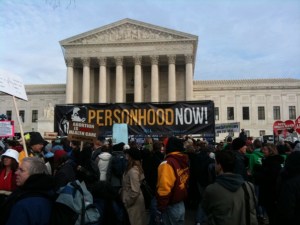
A recent innovation within the pro-choice repertoire of arguments doubles as perhaps the most chilling argument to date: namely, that abortion is justified as non-intentional killing of an infant.
Judith Jarvis Thomson is a proponent of this view. She argues that while the fetus has a right to life, that does not mean that permissibly kill it (“A Defense of Abortion”, 174-175). She argues that “[t]here is a distinction between intentional killing… and bringing about death as a side effect, and instances of choosing not to make a great sacrifice [carrying the fetus to delivery], rather than refusing to make a small one. Thus, many abortions are morally right” (Patrick Lee, 11o).
Thomson infamously uses an analogy of a violinist and the violinist appreciation society. Suppose there is a famous violinist who is dying, and the violinist appreciation society discovers you are the only living match for her blood type. While you’re sleeping, they hook your vitals up to the violinists in order to keep you both alive. You only need to stay in this bedridden state for 9 months, and then she’ll have recovered. Would you be culpable for cutting off the treatment?
Intuitively, the answer seems to be no. The problem is when Thomson uses this analogy for pregnancy. For one, pregnancy is the result of a choice (other than in the case of rape), whereas the violinist was hooked up against someone’s will. Second, mothers have a duty to protect their children. Thomson agrees that the fetus is a human person, but then seems to think that the mother has no duty to protect this human person. Third, “…the child is committing no injustice against [the mother]. The baby is not forcing himself or herself on the woman, but is simply growing and developing in a way quite natural to him or her. The baby is not performing any action that could in any way be construed as aimed at violating the mother” (Patrick Lee, 129).
There are other problems with this view, of course. For example, what if caring for a three year old is deemed a “great burden”; perhaps even a burden which is as great as pregnancy. Should mothers and fathers be allowed to cut off care, thus leading to the “side-effect” death of the toddler?
Another problem is that Thomson’s view depends totally upon the distinction between “intentional killing” and causing death as a “side-effect.” Thomson argues that it is permissible to bring about death as a “side effect” as opposed to intentionally killing an infant. There are two ways to argue against Thomson. The first is to deny her major premise, namely, that abortion is non-intentional killing. One could argue that in every case, abortion brings about the intended death of an infant. Such an argument has initial plausibility, but mostly falls apart when one considers that in at least some cases the death of the infant really is a “side-effect.” Consider the case in which a woman “dislikes the prospect of bodily changes due to pregnancy” (Lee, 115). In such a case, the woman’s intent is to prevent the bodily changes. That the infant is killed in the process is an unintended, but known side-effect of terminating the pregnancy.
In light of this, a more fruitful counter is to deny that Thomson’s conclusion follows from her argument. One could argue that abortion is morally wrong for, among other reasons: 1) the parent has a responsibility to the child (again, contra Thomson’s scenario) and 2) the harm of destroying one’s life is significantly greater than the harm of things such bodily changes.
Justifying 1) should be intuitively obvious, but consider Patrick Lee’s example in Abortion and Unborn Human Life:
Suppose I am in a motorboat in a lake and speeding past the pier I knock… four children into the lake…. I am responsible for their being in a dependency condition [like that of the fetus upon the mother], and… I owe it to them to go back and try to help them out of the water, lest they drown. However… I might also claim that I was only responsible for their being in the water, not for their being in an imperiled condition. It is not my fault… that they do not know how to swim… But clearly, it is specious to distinguish between my causing them to be in the water (for which I am responsible) and their being in a dependency condition due to their inability to swim… (Patrick Lee, 122-123)
Thomson would have us believe that we should draw such distinctions, which are indeed specious. The mother is responsible for her child.
Similarly, 2) also defeats Thomson’s argument. Lee points out that “Death is not just worse in degree than the difficulties involved in pregnancy; it is worse in kind” (128). To kill an infant in order to avoid pregnancy is to confuse not only the degree of “difficulty” but also the kind of difficulty involved.
If either 1) or 2) is correct, Thomson’s argument fails. In order to deny 1), the advocate of abortion must deny that parents have responsibility for their children. In order to deny 2), the advocate of abortion must show that killing someone is no better or worse than putting them in the state of pregnancy. Either alternative is totally implausible. Therefore, abortion is not justified as non-intentional killing.
Sources:
Judith Jarvis Thomson, “A Defense of Abortion” in The Problem of Abortion, ed. Joel Feinberg (Belmont, CA: Wadsworth, 1984), 173-187.
Patrick Lee, Abortion and Unborn Human Life, 2nd edition (Washington, D.C.: Catholic University of America, 2010).
———
The preceding post is the property of J.W. Wartick (apart from citations, which are the property of their respective owners) and should not be reproduced in part or in whole without the expressed consent of the author. All content on this site is the property of J.W. Wartick and is made available for individual and personal usage. If you cite from these documents, whether for personal or professional purposes, please give appropriate citation and provide a link to the original URL. By viewing any part of this site, you are agreeing to this usage policy.
Awesome Person of the Bible: Michael
 There are few persons (using the word “person” here in the broad sense as opposed to meaning simply “humans”) in the Bible more awesome than Michael the Archangel. He only shows up a few times, but those times in which he does appear, he is one bad (read: good) dude. Seriously, check out the three major places he shows up:
1) Daniel 12:1: “At that time Michael, the great prince who protects your people, will arise. There will be a time of distress such as has not happened from the beginning of nations until then. But at that time your people—everyone whose name is found written in the book—will be delivered.”
You read that right. The archangel Michael is the prince of God’s chosen people. And by prince, we don’t mean that sissy version of a prince who’s always running around wishing he wasn’t king or being stupid. We mean he’s the ruler, protector, and guide of Israel. He protects them until God’s chosen people are delivered, according to God’s plan.
I know, “So what? There are a bunch of princes out there. Big deal.” Fine, but what about:
2) Jude 1:9: “But even the archangel Michael, when he was disputing with the devil about the body of Moses, did not himself dare to condemn him [the devil] for slander but said, ‘The Lord rebuke you!'”
Oh yeah, that’s right. The archangel Michael fought with SATAN over Moses’ body. Not only that, but he won the fight. How did he win? By invoking the name of the Lord, YHWH. You may be saying “Wow, that’s not a very big deal. I could probably do that.” Think so? How about:
3) Revelation 12:7-9: “Then war broke out in heaven. Michael and his angels fought against the dragon, and the dragon and his angels fought back. But he was not strong enough, and they lost their place in heaven. The great dragon was hurled down—that ancient serpent called the devil, or Satan, who leads the whole world astray. He was hurled to the earth, and his angels with him.”
Uh huh. Try that one on for size. First off, Michael’s an archangel. That, on its own, makes you awesome. But Michael isn’t just some rank-and-file archangel, he is an archangel out to kick some massive tail. Michael is just chilling out in heaven one day, picking his teeth with a toothpick made of demon’s bone, when suddenly war breaks out between God and Satan. I don’t know about you, but I’d be running the opposite direction. What does Michael do? He gets his gang of burly warrior-angels and fights Satan and the demons. And notice what the text tells us about Michael: “[Satan] was not strong enough, and they lost their place in heaven.” Yup, Michael is more powerful than Satan himself. He comes along and literally hurls Satan out of heaven and down to the earth. I don’t know about you, but I think that is pretty awesome.
Archangel Michael, you are a certified “Awesome Person of the Bible.”
SDG
———
The preceding post is the property of J.W. Wartick (apart from citations, which are the property of their respective owners) and should not be reproduced in part or in whole without the expressed consent of the author. All content on this site is the property of J.W. Wartick and is made available for individual and personal usage. If you cite from these documents, whether for personal or professional purposes, please give appropriate citation and provide a link to the original URL. By viewing any part of this site, you are agreeing to this usage policy.
Religious Pluralism: The Argument Assessed
 “If you were born in India, you’d probably be a Hindu.” “What of those sincere believers in other faiths, are you suggesting they are wrong?” “Jesus is just one of the many ways towards salvation/bliss/righteousness/etc.”
These are the types of “bumper sticker” quotes Christians often get in our pluralistic society. I’ll be focusing on only one of the many problems with views such as these:
The argument against theism from religious pluralism rests on the implicit assumption that all religions are equally veridical.
The religious pluralist (or the objector to religious belief) who uses arguments like these unjustifiably makes the assumption that all religions are on equal ground (epistemically–on equal footing in the realm of knowledge). That this assumption is made is fairly evident, but we can illustrate it with a thought experiment (ignore some of the disanalogies–this is for example only):
Suppose Bob believes that he is reading a book, An Introduction to Philosophy. Now, suppose Steve else comes along and says “You can’t be sure that you’re right in your belief that you are reading An Introduction to Philosophy–after all, there are billions of people who read books which are not An Introduction to Philosophy. And they think they know what they are reading. How can you be sure that you are reading An Introduction to Philosophy? You may be reading a book on psychology, or a novel!”
Bob responds by saying, “Well, I can look at the cover and see the title. I can open it up and see the ISBN and confirm by searching for the ISBN online that it is only tied to An Introduction to Philosophy. The contents certainly seem as though they would match a book of that title. Also, I know the authors name is Jane Doe and this is the only book she’s ever written.”
The key point is that Bob has some very good reasons for thinking that he is reading An Introduction to Philosophy. Steve’s objection assumed that there was no way to determine what book Bob was reading.
Religious pluralists often do the same thing. They ask “How can you know you are right?” or “How do you know yours is the only true religion?” The assumption seems to be that there are no criteria for determining whether one religion is to be favored over another (again, using these terms in an epistemic sense–the sense having to do with knowledge). SO, let’s revisit the scenario:
Bob is sitting contemplating the universe. He’s a Christian, and Steve knows it. Steve comes along and says “Bob, how do you know you’re right? The Hindu, the Buddhist, and the Muslim all think they are just as right as you.”
Bob responds, “Well, I think there are very good reasons to think Christianity is true. There are cosmological, teleogical, and ontological arguments which I believe are quite successful. If they are successful, Buddhism and Hinduism are wrong. And I think the Gospels are quite reliable due to the standard historical criteria such as the principle of embarrassment and multiple attestation. But if the Gospels are reliable (and Jesus died and rose again), then Islam is wrong too. So I don’t think those other religions are on equal footing with my own faith. Christianity seems to me to have the most explanatory power.”
The assumption that all religions are on equal footing seems patently false. Why should we think that Hinduism = Buddhism = Islam = Christianity = Jainism (etc.) when it comes to whether or not we can evaluate their truth? The religious pluralist simply assumes we cannot. However, in light of the evidence for Christianity, it seems the world religions are not all on equal epistemic ground.
Finally, the pluralist objection assumes that it is, itself, on a higher epistemic ground than its rivals. The pluralist believes that, while all religions are equally veridical, pluralism itself is true. Yet pluralism’s truth entails the falsehood of large portions of theistic, pantheistic, and atheistic belief. Pluralism must chop away the incompatible components in the world’s religions in order to make way for a distorted view of reality. What reason do we have for holding on to pluralism when we have much better reasons to think Christianity is true?
SDG
———
The preceding post is the property of J.W. Wartick (apart from citations, which are the property of their respective owners) and should not be reproduced in part or in whole without the expressed consent of the author. All content on this site is the property of J.W. Wartick and is made available for individual and personal usage. If you cite from these documents, whether for personal or professional purposes, please give appropriate citation and provide a link to the original URL. By viewing any part of this site, you are agreeing to this usage policy.
Description is not Prescription: A tale of interpretation
 Imagine someone, let’s call him Jim, reading a chapter from a typical history book written on World War 2. In said chapter, one page says “Hitler was intent upon exterminating the Jews. The Nazis proposed a ‘final solution’ intended to wipe the Jews off the face of the earth.”
Jim stands up, indignant, and reacts to this text, “I can’t believe whoever wrote this book! They actually endorse the ‘final solution’! What evil person would dare to recommend such atrocities!?”
We would obviously be puzzled by Jim’s reaction. We would probably correct him by saying something like “Jim, the author isn’t recommending that course of action, they’re merely reporting what happened. It’s a history book. The author’s intent is not to tell you what to do, but to tell you what happened.”
Now imagine a similar scenario. This time, it’s Jessica reading the Bible. She reads that “Jephthah promised God that if he beat the Ammonites in battle he’d sacrifice the first living thing he saw at his house… He beat the ammonites and the first thing he saw was his daughter, whom he sacrificed after giving her time to grieve.” (A paraphrase of Judges 11. See my discussion of this passage here.)
Jessica immediately stands and shouts “How dare the Bible condone human sacrifice! God Himself told Jephthah to sacrifice his daughter!”
Our answer to Jessica is the same as it was to Jim: “Jessica, the Bible is reporting what happened, the author of Judges reports many horrific incidents and sins that God’s people committed, but that doesn’t mean the author is commending what happened or urging others to do likewise.”
Such reactions are similar to those of many who read the Bible. They read a passage which describes something that happened and jump to the conclusion that the Bible–or the God portrayed therein–is evil. The Bible is a collection of genres and writings from various authors, a point often overlooked by those unable–or unwilling–to fully engage the text. Yet often the Bible is merely describing what happened as opposed to prescribing something for God’s people.
Another problem is that people too often think of the Bible as being exclusively a “rulebook.” I think this really plays into the description/prescription fallacy because if the Bible were just a big rulebook, then everything in it would be taken prescriptively. Such people seem to think that every verse can be taken out of context and genre and used as a command. There isn’t much to say in answer to such people except to point out the obvious: there are different genres in the Bible, not all of it is a rulebook.
Image source: http://commons.wikimedia.org/wiki/File:Geneva-bible-picture.jpg
———
The preceding post is the property of J.W. Wartick (apart from citations, which are the property of their respective owners) and should not be reproduced in part or in whole without the expressed consent of the author. All content on this site is the property of J.W. Wartick and is made available for individual and personal usage. If you cite from these documents, whether for personal or professional purposes, please give appropriate citation and provide a link to the original URL. By viewing any part of this site, you are agreeing to this usage policy.

 J.W. Wartick - Reconstructing Faith
