Archive for
Book Review: “The Rise of Evangelicalism” by Mark A. Noll

The Rise of Evangelicalism is a broad look at the early history of the movement called “evangelicalism” in global (though largely American/British) perspective.
Mark A. Noll is one of the major names that comes up when discussing modern church history, and for good reason. Here, he alternates between sweeping across the ocean(s), traversing countries, and magnifying small moments that lead to the birth of evangelicalism as movement. Noll splits the rise of evangelicalism into several moments and movements, eventually acknowledging that it becomes too broad to even envision it as a connected movement anymore, showing readers the global spread.
Readers also will get background of the driving forces behind evangelicalism and its growth, reasons that it may have spawned in specific times and places, and the way it grew. The book is, at its core, a big picture overview, however. It will serve as a springboard for additional reading as people can travel down one of the many hundreds of avenues for further research Noll’s research opens up or serve as a standalone look at how this movement came to span the globe.
The Rise of Evangelicalism is a great reference for readers wanting to know about the history of that movement. Recommended.
All Links to Amazon are Affiliates links
Links
Be sure to check out the page for this site on Facebook and Twitter for discussion of posts, links to other pages of interest, random talk about theology/philosophy/apologetics/movies and more!
Book Reviews– There are plenty more book reviews to read! Read like crazy! (Scroll down for more, and click at bottom for even more!)
SDG.
——
The preceding post is the property of J.W. Wartick (apart from quotations, which are the property of their respective owners, and works of art as credited; images are often freely available to the public and J.W. Wartick makes no claims of owning rights to the images unless he makes that explicit) and should not be reproduced in part or in whole without the expressed consent of the author. All content on this site is the property of J.W. Wartick and is made available for individual and personal usage. If you cite from these documents, whether for personal or professional purposes, please give appropriate citation with both the name of the author (J.W. Wartick) and a link to the original URL. If you’d like to repost a post, you may do so, provided you show less than half of the original post on your own site and link to the original post for the rest. You must also appropriately cite the post as noted above. This blog is protected by Creative Commons licensing. By viewing any part of this site, you are agreeing to this usage policy.
Book Review: “Learning from Henri Nouwen and Vincent van Gogh” by Carol A. Berry
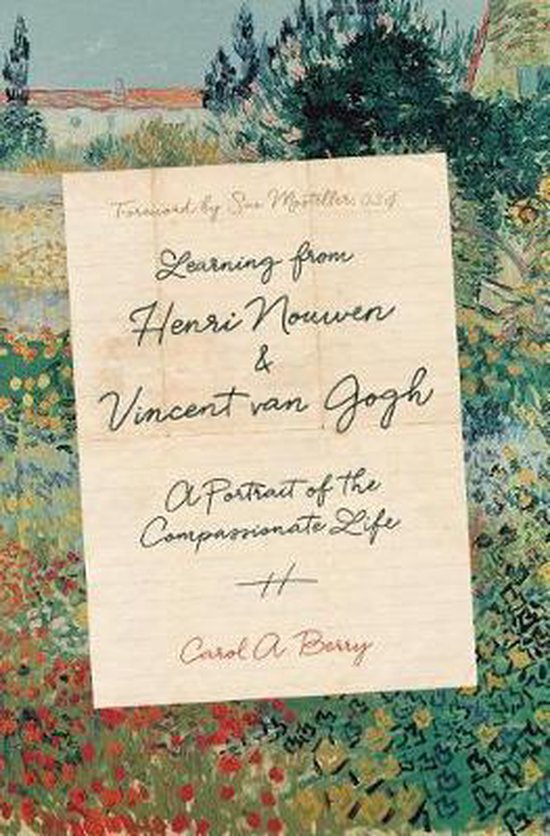
Learning from Henry Nouwen and Vincent van Gogh is a meditative work looking at insights from Nouwen and the faith background of van Gogh’s canon of work.
Carol A. Berry attended lectures from Nouwen on van Gogh, and she uses the notes from those lectures along with her own personal knowledge of the topic to highlight aspects of van Gogh’s life, struggle, and journey from a compassionate perspective. Van Gogh was a complex man with an extremely interesting life who poured his heart and soul into his works. Nouwen drew upon this to show how van Gogh gave glimpses of hope even in the hardest circumstances.
The book is lavishly illustrated with van Gogh’s works in full color, and Berry draws attention to the details and the background of the works while allowing his touch to speak for itself. The chapters alternate between Berry’s own story, and reflections from Nouwen and on van Gogh. The format makes the book one that’s easy to pick up and read off and on, contemplating each sentence as one sees where art and faith may take one’s life.
Learning from Henry Nouwen and Vincent van Gogh will enthrall readers interested in art and faith or in contemplative faith life.
Disclaimer: I was provided with a copy of the book for review by the publisher. I was not required to give any specific kind of feedback whatsoever.
All Links to Amazon are Affiliates links
Links
Be sure to check out the page for this site on Facebook and Twitter for discussion of posts, links to other pages of interest, random talk about theology/philosophy/apologetics/movies and more!
Book Reviews– There are plenty more book reviews to read! Read like crazy! (Scroll down for more, and click at bottom for even more!)
SDG.
——
The preceding post is the property of J.W. Wartick (apart from quotations, which are the property of their respective owners, and works of art as credited; images are often freely available to the public and J.W. Wartick makes no claims of owning rights to the images unless he makes that explicit) and should not be reproduced in part or in whole without the expressed consent of the author. All content on this site is the property of J.W. Wartick and is made available for individual and personal usage. If you cite from these documents, whether for personal or professional purposes, please give appropriate citation with both the name of the author (J.W. Wartick) and a link to the original URL. If you’d like to repost a post, you may do so, provided you show less than half of the original post on your own site and link to the original post for the rest. You must also appropriately cite the post as noted above. This blog is protected by Creative Commons licensing. By viewing any part of this site, you are agreeing to this usage policy.
Book Review: “Gender Identity & Faith” by Mark A. Yarhouse and Julia A. Sadusky

Gender Identity & Faith: Clinical Postures, Tools, and Case Studies for Client-Centered Care is one of those books that tells you exactly what it is with the title and subtitle. Or does it? As a non-professional, I didn’t realize exactly how focused on the subtitle the book would be. Nevertheless, I found quite a bit of interest as I read the book.
Mark A. Yarhouse and Juila A. Sadusky explore questions of gender identity in a clinical setting, offering specific, concrete advice and even exact examples for how to go about having these discussions. Thus, there are specific examples of people who came in seeking therapy for a variety of gender identity related issues, and the authors share these examples from a wide array of backgrounds. Some were supported by family, others were not. Some had favored pronouns, others hadn’t contemplated that. The variety of specific examples show just how complex these topics are, going far beyond the yes-or-no that is often offered in faith settings.
The authors also offer concrete advice for therapists and others, along with worksheets that can be used to discuss topics of gender identity. I am not trained in this field, so I can’t comment much on how useful they are, but I did find them of interest as a lay person in the setting.
Some reviews of the book have attacked it for not taking an entirely negative stance towards anyone who questions gender identity. Such attacks are short-sighted and scientifically uninformed. While Yarhouse and Sadusky don’t really dive into any of this, the fact is that strict binaries of gender identity (eg. boys wear blue/girls wear pink) are obviously constructed by humans rather than being objective aspects of reality. Additionally, the existence of intersex persons, whose numbers are far higher than most people know, is a direct challenge for such binaries. So far as this reader could tell (without any relevant degree–only an interest in the topic), the authors take a neutral stance regarding the questions, seeking instead to bring help and healing to people wherever they are on their journey.
Gender Identity and Faith is a useful book for Christians (and non-Christians who want to know more about faith and gender identity) wishing to discuss gender identity in clinical settings. That’s the book’s purpose. Readers who aren’t involved in that field–such as myself–will still find it of interest to see how these topics can be approached.
Disclaimer: I was provided with a copy of the book for review by the publisher. I was not required to give any specific kind of feedback whatsoever.
All Links to Amazon are Affiliates links
Links
Be sure to check out the page for this site on Facebook and Twitter for discussion of posts, links to other pages of interest, random talk about theology/philosophy/apologetics/movies and more!
Book Reviews– There are plenty more book reviews to read! Read like crazy! (Scroll down for more, and click at bottom for even more!)
SDG.
——
The preceding post is the property of J.W. Wartick (apart from quotations, which are the property of their respective owners, and works of art as credited; images are often freely available to the public and J.W. Wartick makes no claims of owning rights to the images unless he makes that explicit) and should not be reproduced in part or in whole without the expressed consent of the author. All content on this site is the property of J.W. Wartick and is made available for individual and personal usage. If you cite from these documents, whether for personal or professional purposes, please give appropriate citation with both the name of the author (J.W. Wartick) and a link to the original URL. If you’d like to repost a post, you may do so, provided you show less than half of the original post on your own site and link to the original post for the rest. You must also appropriately cite the post as noted above. This blog is protected by Creative Commons licensing. By viewing any part of this site, you are agreeing to this usage policy.

 J.W. Wartick - Reconstructing Faith