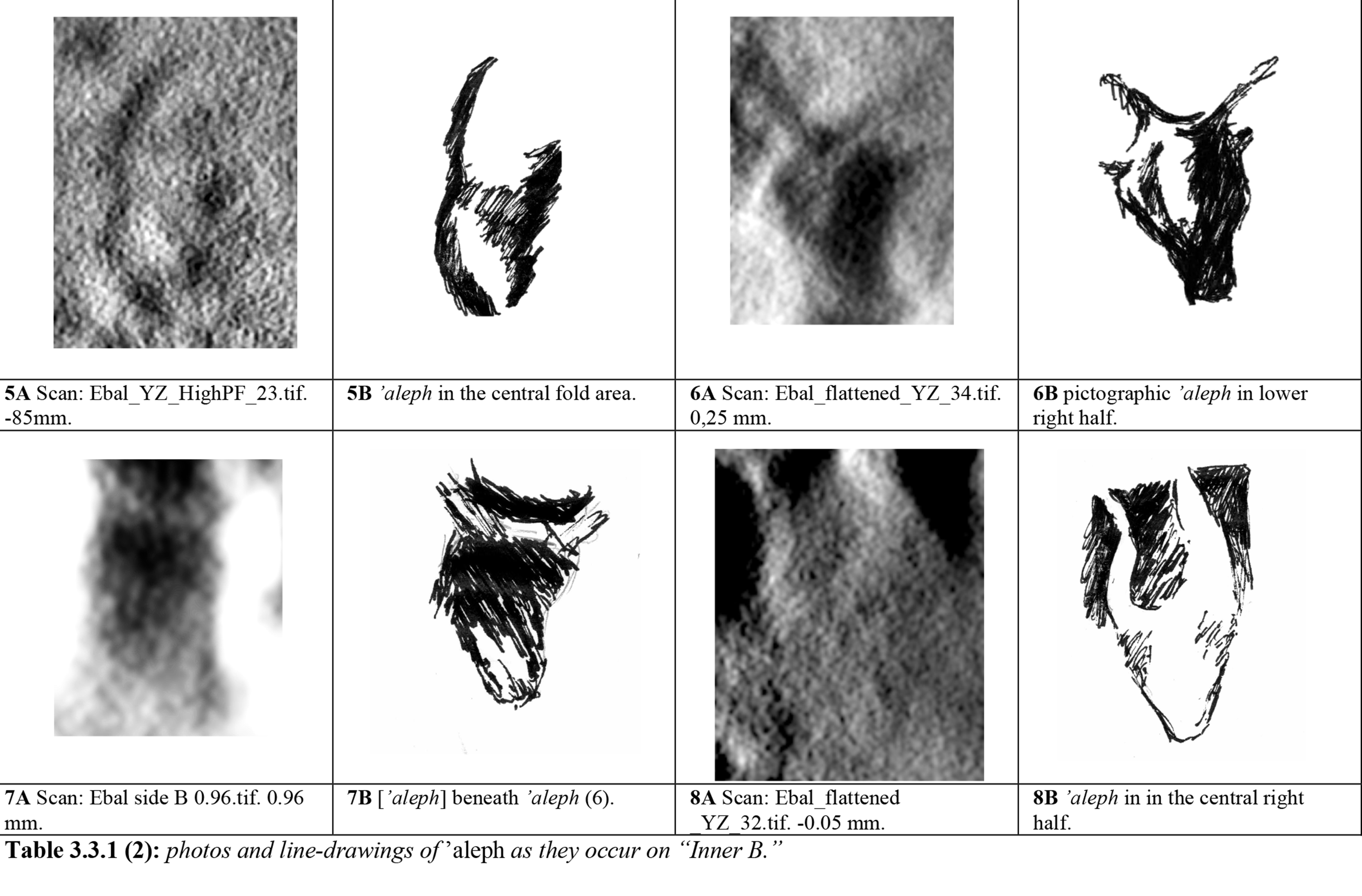
The “Mt. Ebal Curse Tablet” has created something of a stir in some circles, especially those interested in Christian apologetics. The find itself could be extraordinary, assuming it passes additional review. While published in a peer reviewed journal, the publication of the findings is not published in an archaeology journal, leading to some skepticism about the ability to stand up to archaeological peer review. Others have pointed out additional problems with the journal publication, some of which are summarized in an article from the Biblical Archaeology Society.
What I want to hone in on, though, are the fantastical claims made about the fine by Scott Stirpling, one of the archaeologists involved in the find and interpretation thereof, in a video he made with Sean McDowell. The video is on YouTube and entitled, “Oldest Hebrew Writing? Mt. Ebal Curse Tablet (Revisited).” Stirpling makes a number of claims in this video, and I think some of these are emblematic of the way the apologetics community unfortunately over-inflates the evidence for Christianity. This, I believe, is detrimental to the aims of Christian apologetics, because if we make claims that cannot be adequately backed by evidence, it makes people more likely to doubt other claims which may have a better evidentiary grounds for belief.
I won’t be reviewing the whole video, nor do I personally have expertise in archaeology. Any time I write about the “curse tablet” it should be understood that is meant as an “alleged” due to the highly controversial nature of the find. What I want to point out instead are problems with what I do have expertise in: apologetics.
Stirpling claims, among other things:
1. the curse tablet provides evidence for the notion that Moses and Joshua were literate (Starting around 20:00 into the video)
2. The curse tablet is directly tied to Deuteronomy 27 and Joshua 8 as a real find that really backs up those specific chapters of the Bible (21:20 and following)
3. The curse tablet undermines the documentary hypothesis (35:00 and following)
4. The curse tablet summarizes Deuteronomic curses and therefore provides evidence for them as historical events (9:20)
1. Curse Tablet and Literacy
The argument here has a number of hidden assumptions. First, that having a single inscribed tablet suggests widespread literacy. Second, it appears Stirpling is actually at least skirting the claim of suggesting this tablet just was written by Joshua and/or Moses. That’s a huge assumption and claim that I don’t think anyone could take as anything beyond invention. Would it be great to have? Of course! But this tablet is not that proof. It’s not like it’s signed “-Moses” or “-Joshua.” I don’t get it. Even assuming the tablet has writing, and that that writing is earlier than the earliest Proto-Hebrew we have, one has to ask the question: how does this prove that Moses and/or Joshua were literate/wrote this tablet? So far as I can tell, there is no evidence to suggest this is correct.
2. and 4. Curse Tablet and Bible verses
I couldn’t find the exact time stamp for one of the claims I heard from Stirpling as I listened to the video a couple times, but not only does he claim that the curse tablet is tied to Deuteronomy 27 and 28 and Joshua 8, he also claims that Job 19:24, in which the author exclaims desire to have their words inscribed by iron implement(s) on lead shows that this curse tablet is the exact kind of thing being referenced there. If a reader happens to watch the video and can find that reference again, I’d appreciate it.
Anyway, this claim is incredible to me. Not only does Stirpling acknowledge immediately after making it that he has to presuppose the exacting historical nature of the references in the Bible in order to make the argument (thus making it a kind of loop: Dt. 27 and Jsh. 8 and Job 19 all tie together to show a lead curse tablet; the lead curse tablet proves the veracity of those references), but the claim itself is so much stronger than the evidence at hand suggests we ought to make. Assuming Stirpling is right about the date of the tablet, its location[1], it actually having text, that text actually being “Proto-Hebrew,” and that text actually reading as Stirpling et al. suggest it does, how does a tablet that reads [quoting directly from their paper]:
“A.You are cursed by the god yhw—cursed. B. You will die, C. Cursed – C’. Cursed, B’. you will surely die. A’.Cursed you are by yhw—cursed.”
…how does that text actually support the claim that this is a summary of Deuteronomy 27 and 28’s curses? What exactly is there here to tie this tablet so explicitly to the exact curses of Deuteronomy, as Stirpling directly claims it is? Other than it using the word “cursed” and a possible version of the divine name, YHWH, what connection is there between this tablet and the verses it’s supposed to confirm? There doesn’t seem to be any other than in the imagination of those who want to connect the two, and that’s highly problematic for evidential value.
3. Documentary Hypothesis
The Documentary Hypothesis itself is a bit of a misnomer, as its splintered off into a number of different theories, and more recent works I’ve read (extreme caveat–I’m not an expert, so I may very well be behind the times here) seem to suggest that the overarching hypothesis has fallen somewhat out of favor due to its somewhat pedantic way of reading the Bible. Anyway, it’s really not clear to me how this find, if genuine, is supposed to undermine the Documentary Hypothesis (DH hereafter). We know that worship of YHWH was more ancient than most or all of the Bible, and that YHWH was worshiped in other lands possibly or probably prior to the ancient Israelites coming into the region. So having an ancient inscription using the name YHWH does nothing to the DH so far as I can tell. It’s not that no one ever used the name YHWH before the Yahwist came and edited the Bible. Instead, the DH, to my knowledge, suggests that a Yahwistic worshiper came through later and edited the Bible to insert YHWH’s name into portions somewhat haphazardly to ensure worship was properly being directed to YHWH instead of just or merely Elohim/El. But nothing about the date of the use of the divine tetragrammaton would somehow disprove or distort the DH. I’m willing to be corrected here, of course, but I just don’t see the relevance.
Conclusion
More study of the Mt. Ebal curse tablet is needed. I personally hope it turns out to be something genuine that might have value. The limited scope of the supposed text on the tablet, however, along with the already highly contested nature of the text itself makes me urge caution. We should not set up apologetics claims that are so grandiose that it’s easy to knock them down.
Additional Notes
[1] Stirpling admits at several points that his group is relying upon the earlier excavators’ accuracy in reporting exactly where the debris that they sifted through came from. Allowing for human error, it’s possible the tablet didn’t even come from an altar as the report claims. Moreover, the location of Mt. Ebal is, according to Stirpling himself, only known through the Bible. So while that doesn’t mean it’s wrong, one does wonder how one can tie this exact find to this exact mountain as the exact one in the Bible and on the exact altar of Joshua, as Stirpling claims in one of the claims I’m not covering at more length. He really does say that he thinks that the rounded altar this tablet supposedly came from due to notes from another archaeologist about where the debris came from that they sifted to find the tablet just is the altar Joshua used in Joshua 8. Why? It seems mostly because that would be of the most apologetic significance.
SDG.


 J.W. Wartick - Reconstructing Faith
Discussion
No comments yet.