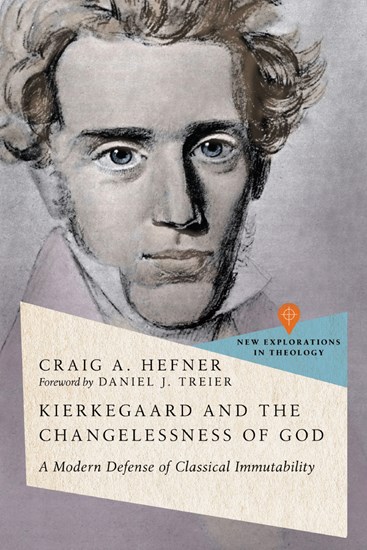
Kierkegaard and the Changelessness of God by Craig A. Hefner presents an unusual dynamic: Kierkegaard being used in defense of a core tenet of classical theology: divine immutability.
Hefner begins with a brief introduction to Kierkegaard and correction of misconceptions, including the notion that Kierkegaard was somehow out of tune with classical Christian theology. What Kierkegaard was reacting against was not Christian doctrine but rather than sleepy, comfortable way in which people were living in light of it. Kierkegaard united, rather than divided, traditional Christianity and existentialism.
Next, Hefner moves into four chapters that cover Kierkegaard and the doctrine of divine immutability or changelessness. What makes this defense of immutability unique is in part its focus on Kierkegaard’s existentialism as a defense of that changelessness. The two topics appear to be divergent, but Hefner argues the are in fact unified in Kierkegaard’s milieu. Kierkegaard’s existentialism provides a way to contrast God and humanity. The changing, “all flesh is grass” nature of humanity is contrasted with the immutable God.
Rather than simply relying on this contrast, however, Hefner with Kierkegaard argues that the Self can be reintegrated across change due to its relationship only with an immutable God. God, in other words, is the ground for the Self in a very real way. A whole chapter focuses on James 1:17 and Kierkegaard’s interpretation thereof. James 1:17 is often used as the core text for divine immutability, and Hefner draws on various interpreters to bring its insights to life.
Finally, Hefner argues that Kierkegaard’s conception of immutability doesn’t rely upon metaphysics but rather upon the concept of the self. I admit some of this section was a bit beyond me, because it seems to me that ultimately anything relies upon some kind of metaphysics. However, grounding the concept of immutability on the divine self was an interesting endeavor.
Kierkegaard and the Changelessness of God is an unexpected read. I found it refreshing despite being extremely dense. Recommended for readers looking for deep discussion of existential theology and its application to classical theism.
All Links to Amazon are Affiliates links
Links
Be sure to check out the page for this site on Facebook and Twitter for discussion of posts, links to other pages of interest, random talk about theology/philosophy/apologetics/movies and more!
Book Reviews– There are plenty more book reviews to read! Read like crazy! (Scroll down for more, and click at bottom for even more!)
SDG.
——
The preceding post is the property of J.W. Wartick (apart from quotations, which are the property of their respective owners, and works of art as credited; images are often freely available to the public and J.W. Wartick makes no claims of owning rights to the images unless he makes that explicit) and should not be reproduced in part or in whole without the expressed consent of the author. All content on this site is the property of J.W. Wartick and is made available for individual and personal usage. If you cite from these documents, whether for personal or professional purposes, please give appropriate citation with both the name of the author (J.W. Wartick) and a link to the original URL. If you’d like to repost a post, you may do so, provided you show less than half of the original post on your own site and link to the original post for the rest. You must also appropriately cite the post as noted above. This blog is protected by Creative Commons licensing. By viewing any part of this site, you are agreeing to this usage policy.


 J.W. Wartick - Reconstructing Faith
Discussion
No comments yet.