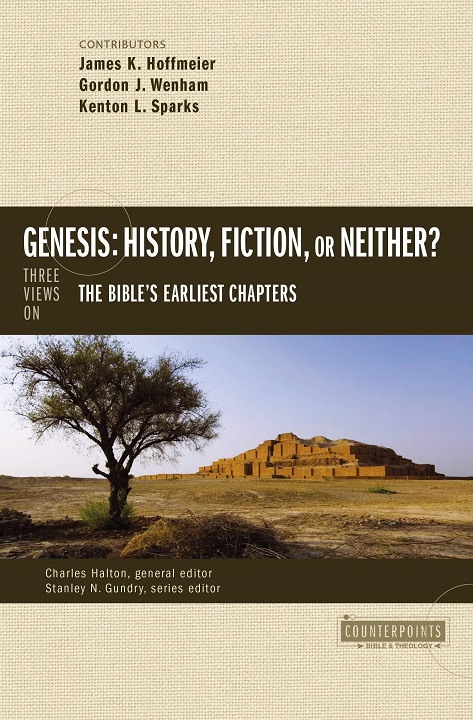
Zondervan’s Counterpoints Series brings together different views on various theological subjects to compare and contrast them. The series has varying success, often not representing even the full gamut of even Evangelical views on a topic or even misrepresenting orthodox views from other traditions[1]. Here, in Genesis: History, Fiction, or Neither? Three views on the Bible’s Earliest Chapters, we see another example of failing to include a whole range of views on a topic. Obviously this has to be at least partially an editorial choice, as representing thousands of years and hundreds of views on the earliest chapters of Genesis would be impossible in any single book. On the surface it seems to provide all the options, but even within the text of the book, the struggle over labeling something as “myth” and what that means for history persists. Outlining all of the problems in attempting to classify Genesis as straightforward history would be a monumental task, but here I want to use James K. Hoffmeier’s chapter as a case study in some of the difficulties with taking Genesis as “history.”
Hoffmeier has the unenviable task of attempting to turn Genesis 1-11 into “history.” One obvious question, then, is “What is history?” As someone who has a major interest in history and historiography, defining history is… quite difficult. Even basic assumptions about what is meant by history are questioned in the academic literature on the topic. This isn’t because academics are trying to be difficult, but rather because human endeavors are rarely simple, and an attempt to write about or describe those endeavors in the past just adds layers upon layers to that complexity. For example, is it the case that someone writing a text of history is trying to tell the reader what “really happened”? On its face, the answer seems to be yes, but that is often not the case. In ancient times, acts of writing about the past often had meaning behind them. A simple act of creating a genealogy might have the intent of linking one ruler to another who had previously had no connection. We in fact see this in Ancient Near Eastern genealogies, when we find that they often move kings in and out of lists and find new fathers for legitimizing current or past rulers. In our own time, we can see the bias inherent in writing on certain topics. The simple description of history as the attempt to write down what “really happened” is just that- simple to the point of being overly simplistic. History is rarely just an attempt to write what actually occurred, and the connection between our time and the past is often less straightforward than one might think.
All of this is to say that it is somewhat astonishing to me to see that there is almost no attempt to define history either by the editor of this volume or by Hoffmeier. Reading an intent onto such an act is folly, but the lack of attempting the definition certainly makes the whole endeavor squishier. Namely, it allows one defending the concept of Genesis as “history” to simply hand wave at a generalized idea of what history is when they are challenged on specific points (more on this later).
Hoffmeier’s defense of Genesis as history is necessarily short based on the nature of the work, but it gives us some interesting avenues to pursue. He specifically cites some case studies to show that Genesis is intended as history. First, he looks at the Garden of Eden. After simply stating that the talking snake, the forming of Eve from Adam’s rib (a likely mistranslation anyway with some, erm, lively interpretive attempts), etc. are tied to “myth,” he quickly states that “the author of the narrative goes to great lengths to place Eden within the known geography of the ancient Near East…” (32). Hoffmeier’s argument moves on to show that there are four rivers that are named and that other geographic details are presented in order to help the reader geographically locate the Garden. Remarkably, simply because of these geographic details, Hoffmeier concludes, “though the garden pericope may contain mythic elements, it is set in ‘our historical and geographical world,’ which is hard to reconcile with pure mythology” (35).
I find this an entirely inadequate defense of this story as history. Ben Hur by Lew Wallace takes place in our historical and geographical world and contains mythical elements, but can hardly be construed as history. Similar things could be said for any number of alternative histories. Indeed, one could make the same vague conclusion about the Harry Potter series! It has identifiable places and often goes to great lengths to tell readers where they are in the world. As a parallel to Hoffmeier’s difficulty in locating some of the rivers mentioned around Eden, perhaps the location of Privet Drive, Harry Potter’s boyhood home, could serve–something intended as sounding like a place, but impossible to locate on a map. The stories contain mythical elements, but we can hardly dismiss them as “pure mythology,” right? After all, they’ve got place names! Similar things could be said for Percy Jackson or even the Chronicles of Narnia! It is astonishing that simply having some geographical details is seen as evidence to suggest the contents of a story is intended to be accurately describing things that actually happened.
Hoffmeier’s defense of the historical nature of Genesis 6:1-4–a story rife with literary, theological, and textual questions–is even more vague. Here, he notes several of the problems with figuring out who the Nephilim are, argues for some parallels with Babel, and then when it comes time to show that it is history simply appeals to a theological point, not an historical one! He writes, “I contend that despite our inability to completely understand this short episode, it must recall a genuine memory from early human history; after all, it is held up as the ‘final straw’ that caused God to determine to judge creation [and send a Flood]… For God to resolve to wipe out humans on the earth would surely not be the result of some made up story!” (41).
There’s a lot we could unpack here, from the assumption that the Flood narrative is global and actually wiped out all humans on Earth to the fact that Hoffmeier essentially concedes that this allegedly historical narrative is confusing enough that we can’t really understand what’s happening. But instead of unpacking all of that, I want to focus simply on his defense. His entire defense of this as historical is wrapped up not in features of the text itself, not in any archaeological or paleontological finds to back it up; no, it is based upon a theological argument from incredulity! If we assume that God wiped out all humanity because of this story, then wouldn’t it be really silly if this story wasn’t actually historically true? Well yes, it would be, but those are the very questions at issue! Isn’t it possible that there might be some other theological purpose for the story to be there, one that is mythical or perhaps even lost to time because we are living thousands of years after it was first composed and written down? No, for Hoffmeier, we must simply assume that it is historical because if it is not, then… what? It’s not even clear, because his point is entirely rhetorical rather than based in reality.
Fascinatingly, Hoffmeier’s extensive analysis of the Flood narrative seems to undercut his rhetorical point above. After noting the presence of Flood narratives elsewhere, he takes the similarities in the Genesis Flood account to the Babylonian one to somehow mean it is historical, despite his own admission that it seems to have been “consciously aimed at refuting the Babylonian worldview” (54). One would think that after this admission, Hoffmeier and other defenders of the Flood as history might see an incongruity in their clinging to it as a story that really happened as written and their conceding that the story is deliberately intended as a refutation of a differing worldview. But no, that’s not what happens. Instead, Hoffmeier simply argues that it is part of the shared memory of Israel and Babylon, contradicting his own earlier conclusion that it was intended to refute the Babylonian worldview.
I mentioned above that the term history is “squishy” and by not defining it, Hoffmeier essentially gives himself room for hand waving about what issues might come up with claiming Genesis as such. I appreciated Kenton L. Sparks’s response to Hoffmeier in this volume when he essentially pinned him to the wall on this exact difficulty. After Hoffmeier vaguely suggests the Garden of Eden is a historical story, Sparks challenges him to explain what exactly is meant by that- “If the author of Genesis used mythical imagery, as Hoffmeier has suggested, then which images are mythic symbol and which are closer to historical representation? Does Hoffmeier believe that the cosmos was created in six literal days? Does he believe that the first woman was made from Adam’s rib? Does he believe that a serpent spoke in the garden? Does he believe that our broken human condition can be traced back to eating pieces of fruit? Does he believe in giants who roamed the pre-flood earth?” (64). Sparks doesn’t, in fact, stop there and asks even more questions, ultimately finishing: “One wonders why Hoffmeier does not answer these questions when the historicity of Gen 1-11 is the main theme of our discussion” (ibid). Yes, one wonders that indeed. When someone claims Genesis is history and doesn’t clarify what is meant by that, these are the exact kinds of questions that should be asked. And, to be clear, any attempt to answer them affirmatively while claiming that that can be backed up by modern analysis of the genre of these early chapters or by modern methods of historical analysis is an exercise in futility.
I think I have written enough here to show that a defense of Genesis as history is filled with extreme difficulties. There are many, many more I could go into, but I’d like to wrap this up for now. If a defender wishes to defend Genesis as history they must not only define history and show that it meats that definition, but they must also show that each individual detail can meet their standard of history or at least not contradict it. Hoffmeier has failed to do any of those things. Genesis is not a historical account. This conclusion should not bother those who wish to still find theological and spiritual meaning in the text. Indeed, it should be somewhat freeing, because instead of having to defend individual details of the text in such a roundabout way, they can set aside the questions of “did this really happen” and ask the far more interesting questions like “What is this text supposed to be telling us?” Hoffmeier almost made it to that point with his look at the Flood when he admitted it appears to have been written to refute the Babylonian worldview. Religious readers of the text can see that as a magnificent detail and one that might shine light on a text that is otherwise quite alarming.
Note and Citation
[1] One example is the abysmal “modified Lutheran” view of Law and Gospel in the 5 views on the same–yes, I have a bone to pick here as a Lutheran. Douglas Moo wrote that chapter. He’s not a Lutheran and it’s clear he doesn’t even have a mild grasp on the Lutheran position on Law and Gospel. He erroneously outlines the Lutheran position as a temporal split between Law and Gospel, paralleling it with the Old and New Testaments. This is completely mistaken from a Lutheran view. Then he chastises Lutherans for taking this position and says it has to be modified into whatever he makes up on the fly and calls it a modification of a view he didn’t even present to begin with. It’s truly an abysmal job and I wonder why the editor didn’t call upon some Lutherans to weigh in (because I sincerely doubt they did so) or, if one wants to write a Lutheran chapter, why they didn’t choose a Lutheran to do so.
Genesis: History, Fiction, or Neither? Three views on the Bible’s Earliest Chapters edited by Charles Halton, Grand Rapids: MI, Zondervan 2015.
All Links to Amazon are Affiliates
Links
Be sure to check out the page for this site on Facebook and Twitter for discussion of posts, links to other pages of interest, random talk about theology/philosophy/apologetics/movies and more!
Gregg Davidson vs. Andrew Snelling on the Age of the Earth– I attended a debate between an old earth and young earth creationist (the latter from Answers in Genesis like Ken Ham). Check out my overview of the debate as well as my analysis.
Ken Ham vs. Bill Nye- An analysis of a lose-lose debate– In-depth coverage and analysis of the famous debate between young earth creationist Ken Ham and Bill Nye the science guy.
SDG.
——
The preceding post is the property of J.W. Wartick (apart from quotations, which are the property of their respective owners, and works of art as credited; images are often freely available to the public and J.W. Wartick makes no claims of owning rights to the images unless he makes that explicit) and should not be reproduced in part or in whole without the expressed consent of the author. All content on this site is the property of J.W. Wartick and is made available for individual and personal usage. If you cite from these documents, whether for personal or professional purposes, please give appropriate citation with both the name of the author (J.W. Wartick) and a link to the original URL. If you’d like to repost a post, you may do so, provided you show less than half of the original post on your own site and link to the original post for the rest. You must also appropriately cite the post as noted above. This blog is protected by Creative Commons licensing. By viewing any part of this site, you are agreeing to this usage policy.


 J.W. Wartick - Reconstructing Faith
Discussion
No comments yet.