Florissant Fossil Beds National Monument preserves an incredible piece of geological and paleontological time in Colorado. The uniqueness of its geologic history helped preserve incredible details of tiny animals, all the way down to insects, including one of the most famous fossils in the world: a butterfly’s imprint preserved in ash. What struck me most as I wandered this beautiful National Monument and learned more about it was how intricately we can construct the past in this region. Geologists and paleontologists are able to use the clues spread across the landscape to see what happened in great detail. Those details, however, either directly contradict or at least present major difficulties for the narrative told by some Christians known as young earth creationists. Here, we will examine the two narratives alongside the region itself and ask which presents a better picture of the past.
The Narrative told by Conventional Geology and Paleontology
The National Park Service actually has a wonderful video that tells about how Florissant was formed, along with how it was discovered, used, and preserved by humans. My own narrative of conventional science is largely based on that video as well as on placards and other things I read and observed around the site itself.
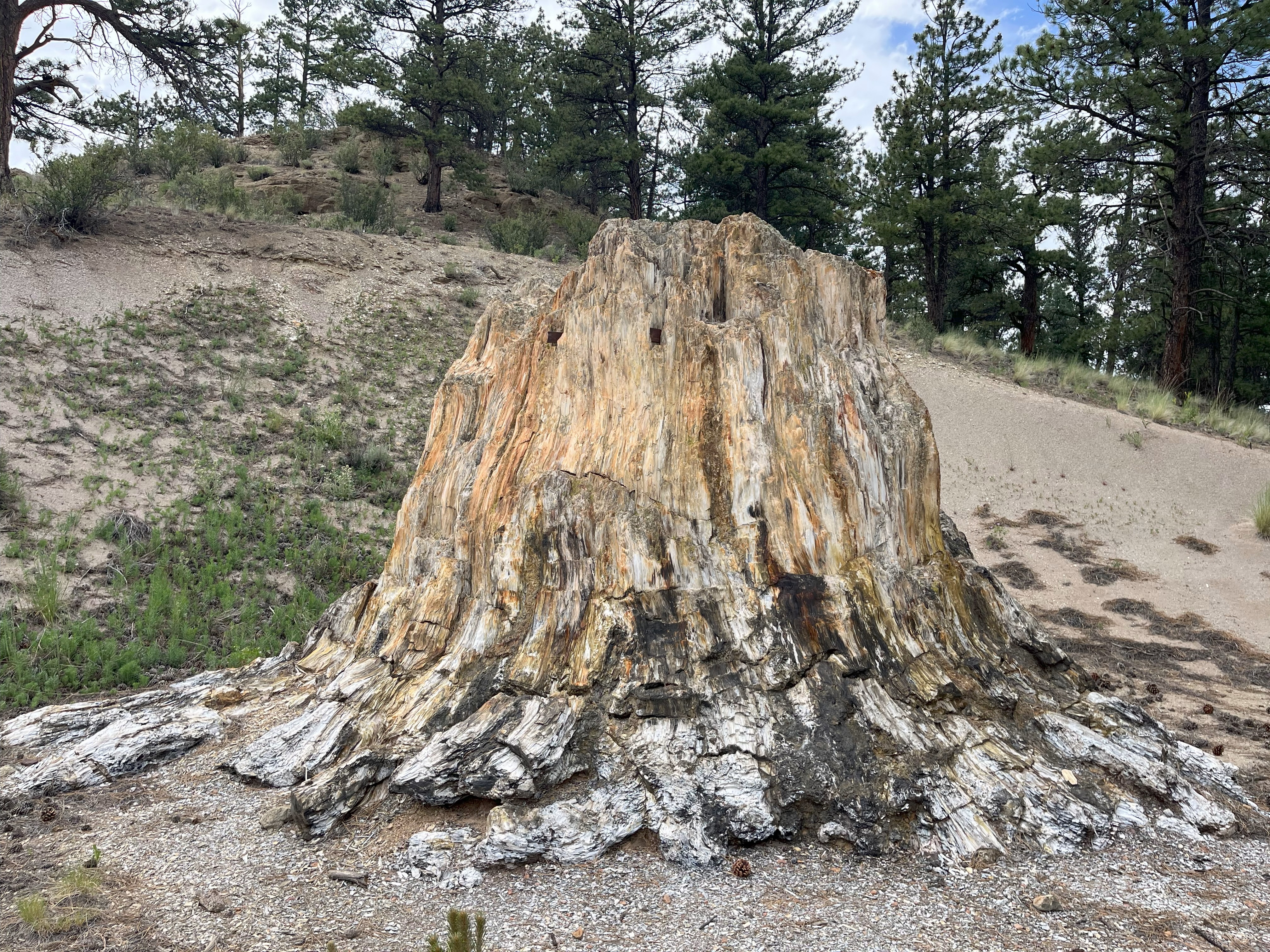
About 37 million years ago, a volcano’s crater exploded, covering the region with ash. Volcanic activity continued for millions of years, forming layers of ash across the region. Eventually, heavy rainfall dislodged a massive amount of this ash, creating a kind of avalanche of volcanic material known as a lahar. This fast-moving mudflow was enormous, stretching for miles as it spread and eventually covering about 15 feet of the area we now know as the area within Florissant. This mud covered the bottoms of a number of enormous trees, which eventually died and decomposed. Life recovered and the region began to grow again, but another lahar blocked a stream and that stream formed a shallow lake across the area. The water that covered the area had deposited minerals into the ash-covered stumps of these trees, eventually preserving them as petrified wood. Meanwhile, diatoms–tiny algae observable on a microscopic level that persist into today–bloomed in massive quantities in the lake. Along with occasional volcanic eruptions that layered ash in the lake, the diatom blooms dying off also formed layers at the bottom of the lake. These layers alternated (not in a specific pattern), eventually forming paper-thin shale.
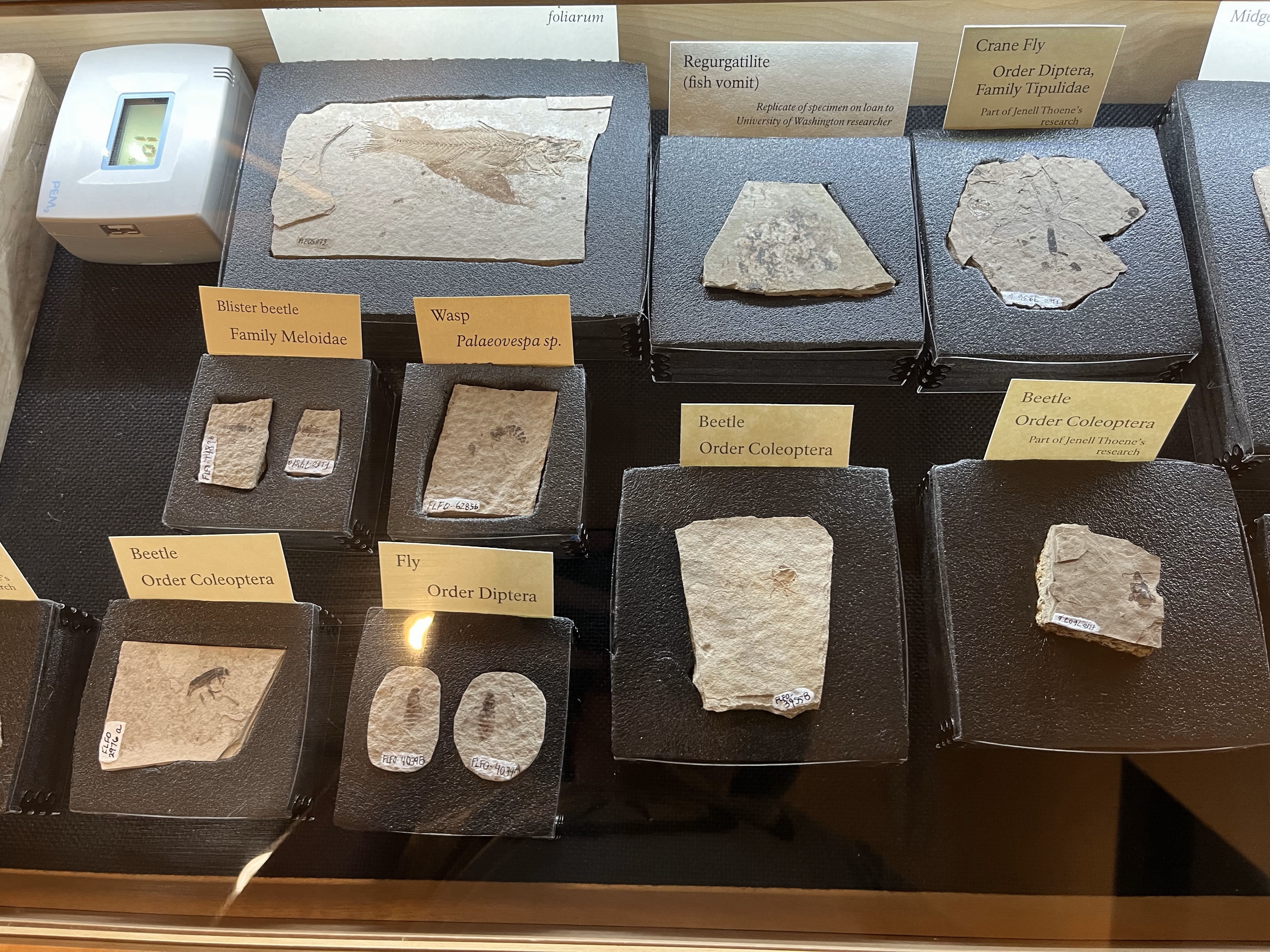
As creatures like fish, birds and even insects died and settled to the bottom of the lake, they were covered with these layers of diatoms and ash. Their bodies were mineralized, and to this day paleontologists can chip apart these incredibly thin layers of shale and find one of the richest deposits of well-preserved insect and plant life in the entire world. Large mammals also roamed the region, including brontotheres, an extinct rhinocerous-like mammal whose bones can be found across the area and into the Badlands. Their bones can also be found. Volcanic activity can be mapped across the region by observing directly the path of lava flows that have hardened into rock. Additionally, distant mountains can be seen to have blown off their tops in volcanic activity of that same time period, demonstrating the violent geologic past of the area.
The uniqueness of this site is due to the many factors involved in its formation: the volcanic activity that led to a lahar covering and preserving enormous ancient trees (including the largest petrified trees by diameter in the entire world); another lahar blocking a stream; additional volcanic activity that mostly spewed ash instead of lava in the area, allowing for preservation of fossils as the ash was cooled and settled in the water; intense periods of diatom activity due to whatever nutrients were provided by rich volcanic soil and plant deposits. For all of these, geologists can quite literally trace lines across the region and map where lava flows hit, where ash fell, whence came some of the volcanic activity (I had a park ranger literally point to the distance at a group of mountains; when looking more closely at the mountains later in the trip, you could see how they were partially collapsed from their volcanic past, blowing parts of themselves almost 100 miles across the landscape), and more. These were observable evidences of a past that linked all of these facets together to create the world-famous fossil site. It was incredible to see how well geologists could use the tools at their disposal to tell the story of the ancient past.
One last broad point in this section: the paleontological record here shows a dramatically different world than what we see in the same region today. The brontotheres are obviously extinct as we don’t see them anymore, but another facet of the discussion is that while the insects look incredibly similar to those of today, there are many with key differences that have changed over the 30+ million years since they were preserved. Some of them aren’t extinct and live into today, but in entirely different parts of the world. One prominently displayed fossil was of a tsetse fly, which once inhabited the land we now know as Colorado, but today lives in tropical Africa. The climate, in other words, has changed so dramatically that this kind of fly can no longer live in the snowy peaks of Colorado, but we have a record of its having done so in a past that was much warmer, and the other fossils in the area confirm the same observations. Conventional timelines don’t have difficulty explaining this, as the long timespan involved allowed for plate tectonics, glacier movement, ice age(s), and more to impact the climate.
Young Earth Creationism’s Two (or more) Narratives
Before diving too far into the narrative told by young earth creationism, we must realize that that movement itself is not monolithic. For a believe system that claims to be the plain reading of the Bible and that can be understood quite simply, it actually ends up teaching incredibly complex and continually edited narratives about the past. Its practitioners disagree on timelines and on how Earth’s geological history formed. So to tell a narrative of Florissant from that perspective, I have to do so knowing that there could be any number of “well, actually” type statements. That said, I believe that death by a thousand caveats is an issue that plagues young earth creationism generally. As YECs have to continually edit their narratives to try to force evidence to fit into a specific favored timeline, the constant ad hoc amendments serve to show just how mistaken YEC is generally. There are at least two broad narratives YECs could offer for Florissant.
The Noah’s Flood Narrative[s]
The Noahic Deluge truly did cover the entire surface of the Earth. In doing so, it churned up enormous amounts of dirt and sediment, remaking it and setting down virtually all sediment layers that we see across the entire Globe. An alternate version of this has a more tranquil Flood, which settled over the surface of the Earth but didn’t greatly impact the geologically observed history. This latter theory is largely abandoned in the literature as it has no explanation for the many aspects of geologic history we see to this day. The former is beset with difficulties, but the one I want to highlight here is that if we assume this is what happened, places like Florissant are almost entirely nonsensical. How would a churning Flood lay down deposits that happen to align in such ways that they can be traced across a region and layered, such that we can see a lahar covered the region, then another blocked a stream, forming a lake, volcanic lava flowed across nearby, and more, and more? It seems to be a non-starter. Why would random bits of sediment get deposited in ways that suggest a geologic past?
The Post-Flood Deposits Narrative
Increasingly, thoughtful YECs are being forced to draw lines to designate pre- and post-Flood deposits in the geologic record. There are a number of reasons for this, but one of the most obvious is that we can see geologic deposits being made today, so the obvious question is asked about how far into the past these records extend before one hits layers that were set down by a supposed global Flood. Many of the difficulties with the YEC narrative in which the Flood explains Florissant are assuaged by claiming that those deposits really were set down in the manner described, but that they were done so in a much more condensed timeline than mainstream geology teaches.
Going along with this, some YECs have suggested the Flood itself is responsible for almost none of the geologic record or, perhaps, only a tiny portion of it. The rest was formed largely as mainstream geologists suggest, but at a pace accelerated by hundreds or even thousands (millions?) of times the speed suggested by mainstream geology. This latter notion has its own massive difficulties, among them being the now well-known (among those involved in debating creationism) heat problem, but also that it doesn’t really provide an explanation for the geologic record other than “it moves fast.” So we’re going to set that one aside and focus on the more mainstream YEC view that Noah’s Flood formed the majority of the geologic column, but that some of it is post-Flood (and pre-, but we’re setting that aside, too). On this view, Florissant is post-Flood and so the way it formed geologically is essentially exactly as the geologists stated with lahars, lava flows, and more leading to what we observe today. The timeline, of course, is off (only a few thousand years instead of 37 million), but this YEC view at least has some kind of attempt to allow for us to learn about such features.
There are many problems with this view, too, however. One is that when we observe layering of sediment in the ways suggested at Florissant, it takes much longer than YECs could allow. While they often point to places like Mount Saint Helens to suggest that such formation could be much faster, this is problematic for a couple reasons. The first is that no mainstream geologist suggests catastrophes like Mount Saint Helens don’t happen in the past; rather, their timelines and observations align with such catastrophic events happening. The second is that Mount Saint Helens has been greatly exaggerated in YEC literature, taking features and labeling them with geologic terms that do not correspond with reality. Thus, an alleged canyon at Mount Saint Helens formed with the eruption is really just ash deposited and then cut through with runoff, which will continue to erode it rapidly in ways expected by mainstream geology. It’s not analogous to something like the Grand Canyon. Finally, a major problem with this “it just went fast” scenario is that it does nothing to explain the observation of different climate zones found in Colorado than what exist today. Are we to believe that alongside layering of ash and diatoms turning to rock and an immensely accelerated rate, the region also went from tropical to Mountainous and snow-covered during the winter in just a thousand or so years?
The answer from YECs of course is, yes, we are supposed to believe that. But what mechanisms do they suggest for this actually occurring? One is the notion that the Flood led to an ice age which, as the Flood waters receded, then changed the climate of the Earth. Another mechanism is the acceleration of nuclear decay (which again runs into the heat problem). Here we find YECs must continue to invent extrabiblical scenarios to explain extrabiblical observations, thus undermining their claim to be simply observing what the Bible says as their scientific starting point.
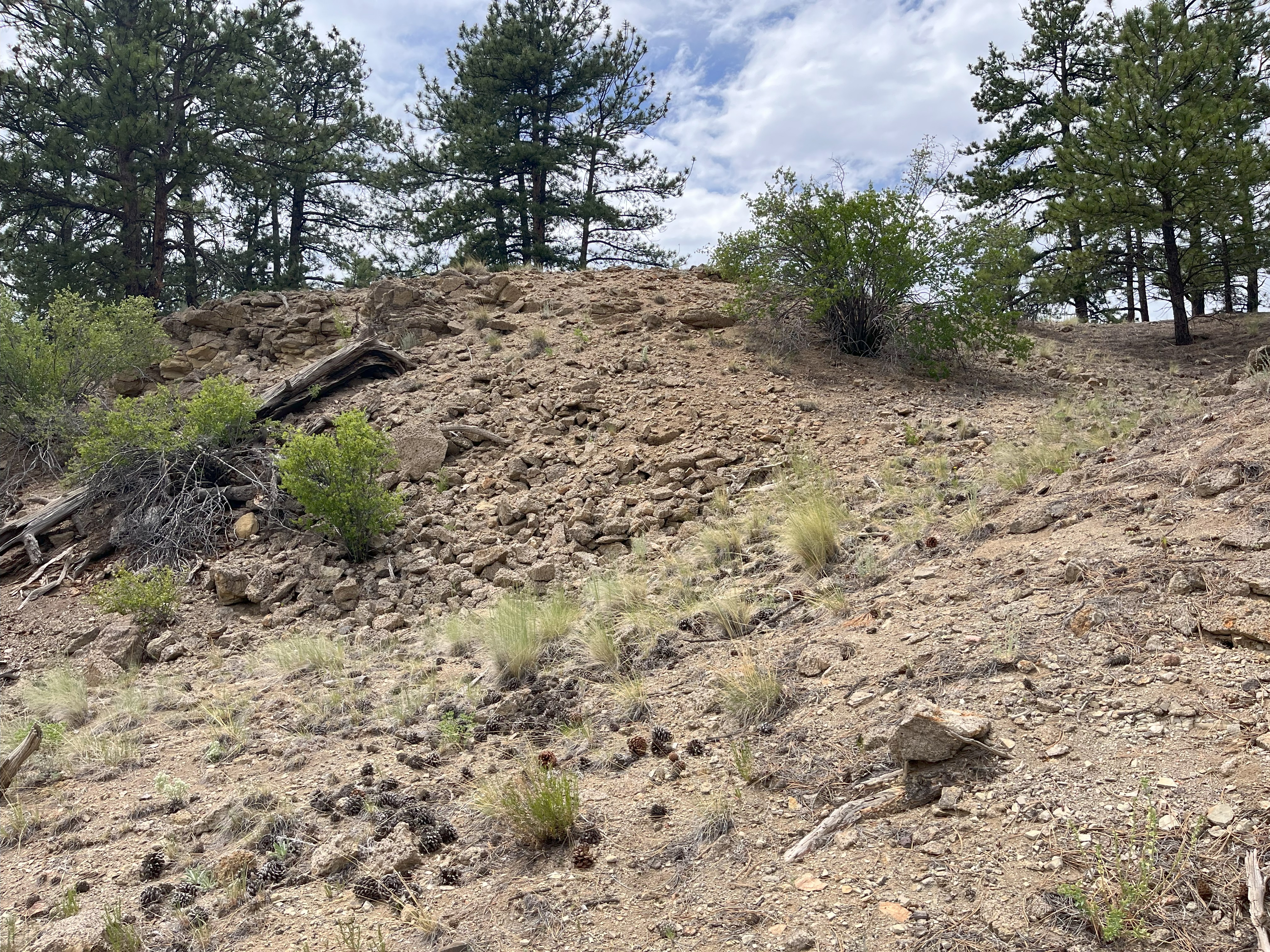
A final problem (not the final problem, simply the last one I’m touching on here) with the YEC scenarios is the sheer amount of deposition at even a relatively tiny site like Florissant. The photograph above shows just one hill composed of shale. This entire hill could be dug into and one could pull out paper-thin pieces of shale layering the entire hill (one should not do this as it is a National Park site and is very illegal; I’m saying this for the sake of observation!). This hill stands far taller than I do, and taller than surrounding trees, and is just one of many hills composed of the same material. All of this managed to get layered, ash-diatom-ash-ash-diatom-diatom-ash, etc. in such minute, miniscule layers that you literally can push them apart with a wedge and see the rock crumble in your hand because each layer is so thin. And for YECs, all of this is supposed to have happened in just a few thousand years, with the ash and diatoms getting compressed into those thin layers of rock, but in such an immense volume that it can cover hills, and in such precision that one can see where the trees were covered with mud from a lahar, and in such a careful way that it settled softly enough to cover but not destroy butterfly wings. Such a belief stretches the imagination beyond the breaking point. And this is but one site.
Conclusion
The first thing I want to conclude is that if you get the chance to visit Florissant Fossil Beds National Monument, you should do so. The hikes are fairly short- it isn’t a massive site. But for a day of exploring and learning about Earth’s past, it is nearly unrivaled.
Florissant provides an incredibly rich look at Earth’s geologic past. In just this one small region, one can literally see where volcanoes once spewed ash and covered parts of the area with lava, one can walk up to rock layers showing deposition of lava that flowed from nearly 100 miles away, one can see the world’s largest (by diameter) petrified trees, one can see the depositions of shale that led to some of the best insect fossils in the entire world, and more. It is an immensely wonderful experience to be able to see firsthand how geologists really can see the landscape and form conclusions about our past. And for all of that, it also provides a set of major problems for young earth creationism, a theory that is continually forced to evolve and add explanations simply to try to wave away the many, many difficulties with it.
Finally, Christians should know that young earth creationism is not even remotely a necessary doctrine for believing the Bible or remaining Christian. It is a theory with almost no connection to church history, and one which is a modern invention to try to counter modern science. The eternal truths of God do not rely upon human innovation of doctrine.
Links
Be sure to check out the page for this site on Facebook and Twitter for discussion of posts, links to other pages of interest, random talk about theology/philosophy/apologetics/movies and more!
Young Earth Creationism– This link will take you to the all my posts on YEC (scroll down for more).
Gregg Davidson vs. Andrew Snelling on the Age of the Earth– I attended a debate between an old earth and young earth creationist (the latter from Answers in Genesis like Ken Ham). Check out my overview of the debate as well as my analysis.
Ken Ham vs. Bill Nye- An analysis of a lose-lose debate– In-depth coverage and analysis of the famous debate between young earth creationist Ken Ham and Bill Nye the science guy.
SDG.
——
The preceding post is the property of J.W. Wartick (apart from quotations, which are the property of their respective owners, and works of art as credited; images are often freely available to the public and J.W. Wartick makes no claims of owning rights to the images unless he makes that explicit) and should not be reproduced in part or in whole without the expressed consent of the author. All content on this site is the property of J.W. Wartick and is made available for individual and personal usage. If you cite from these documents, whether for personal or professional purposes, please give appropriate citation with both the name of the author (J.W. Wartick) and a link to the original URL. If you’d like to repost a post, you may do so, provided you show less than half of the original post on your own site and link to the original post for the rest. You must also appropriately cite the post as noted above. This blog is protected by Creative Commons licensing. By viewing any part of this site, you are agreeing to this usage policy.


 J.W. Wartick - Reconstructing Faith
Discussion
No comments yet.