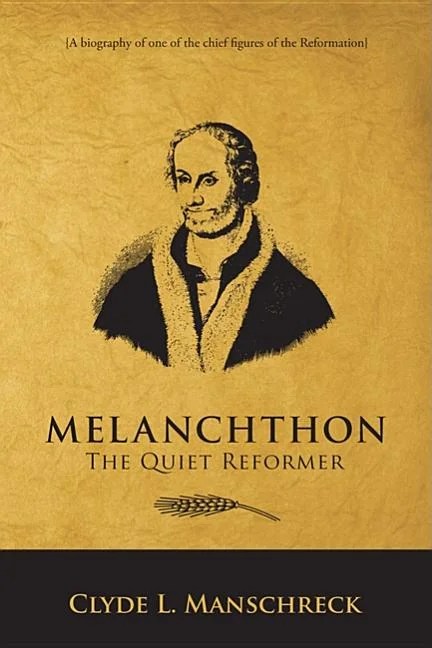
I have long wondered about Philip Melanchthon. He seemed to get vilified in a lot of Lutheran circles I ran in, but he also was clearly at the forefront of Lutheran theology at the time of its formation. Luther rarely seemed to have said anything negative about Melanchthon, but the charge was that he turned away from Lutheranism later in his life and compromised. Enter Clyde L. Manschreck’s excellent biography, Melanchthon: The Quiet Reformer. Manschreck presents a fascinating, balanced perspective on Melanchthon, one of the most intriguing of Reformation persons.
Manschreck starts off, appropriately enough, with looking at how Melanchthon has been treated historically. Surprisingly few biographies exist of the Reformer, especially compared to other luminaries of the period who had less of an impact. After his death, there was criticism from three fronts: he was too Lutheran for Catholics, too Calvinist for Lutherans, and too Catholic for Calvinists. That’s oversimplifying it a bit, but it becomes clear that his legacy was marred by attacks from all sides. So who was the man, and what did he really believe–and was he an infamous compromiser?
Manschreck moves very swiftly past Melanchthon’s early life, almost immediately settling into the time that brought him to Wittenberg. But as Manschreck paints the picture of Melanchthon’s time there, first as an extraordinary lecturer with phenomenal skill and later as a Reformer, we also get deep insight into his character and beliefs. Melanchthon, like many early Lutherans (and a huge amount of the surrounding population) believed in astrology. It’s a strange thing when you look back on it, but it was conceived as a kind of science. Melanchthon was a firm believer, even lamenting the sign a child-in-law was born under when he came to dislike them. Melanchthon also was a champion for public schools, creating the first publicly funded schools across Germany, and advocated for (and got) living wages for teachers. His reasoning was that if a teacher had to work yet another job to just be able to eat or live, the wouldn’t be able to focus on bettering their mind and, in turn, their students’ minds.
Melanchthon and Luther hit it off almost immediately, and Melanchthon joining the Reformation was an organic thing, rather than something one can just point to a single moment as the moment of changing of heart. He clearly believed in the arguments of justification, and ultimately became one of the primary (or the primary) authors of much of the Lutheran Confessions. Setting the writing of these alongside the circumstances in which they occurred makes them more understandable. The Augsburg Confession being prepared to try to, in part, make it clear that their movement wasn’t heretical and could be defended on Scriptural grounds is a fascinating story. Additional clarification due to attempts to unite with other Reformers–attempts that ultimately failed with Zwingli and Calvin–is also set in its historical perspective. The writing of the Confessions should not be separated in understanding from their historical circumstances.
Fascinating historical details about Melanchthon’s life can be found in abundance. Did you know that he had no small amount of correspondence with Henry VIII? The latter desired Melanchthon’s comments on his marriage, hoping the Reformer might be open to giving him an out. Even when Melanchthon failed to deliver for Henry VIII, the King realized the political expediency of an alliance and, perhaps, even was swayed ever so slightly towards some Protestant points. Manschreck makes it clear Henry VIII’s interest was almost certainly political–how to get out of an undesired marriage in a desirable way.
Ultimately, Manschreck paints Melanchthon as a man of convictions who was willing to change his beliefs as he learned more. One of the most obvious examples was Melanchthon’s shift towards a kind of spiritualized view of real presence regarding the Lord’s Supper. What’s interesting with this is that Manschreck is able to document that Luther was aware of this shift and yet explicitly did not condemn it, despite multiple means and opportunities to do so. Was it out of respect for Melanchthon? Or was it a recognition that Melanchthon’s position was somewhere within the Lutheran fold (a fold that is anachronistic to apply to the situation anyway)? I don’t know, but it is worth reading the whole account, including Luther’s non-condemnation. Perhaps Melanchthon could be somewhat welcomed back into Lutheran teaching on some level? Again, I know not. But what’s clear is that Melanchthon sought to go back to the source (the ad fontes of the Reformation and Renaissance) and to understand Scripture’s teaching without trying to invent new doctrines.
Melanchthon: The Quiet Reformer is a superb biography that is well worth the read by any wishing to learn more about one of the most important figures of the early Reformation. I found it informative, balanced, and of interest to even broader world events.
Links
Reformation Theology– Check out all my posts on various topics related to the Reformation (scroll down for more).
SDG.
——
The preceding post is the property of J.W. Wartick (apart from quotations, which are the property of their respective owners, and works of art as credited; images are often freely available to the public and J.W. Wartick makes no claims of owning rights to the images unless he makes that explicit) and should not be reproduced in part or in whole without the expressed consent of the author. All content on this site is the property of J.W. Wartick and is made available for individual and personal usage. If you cite from these documents, whether for personal or professional purposes, please give appropriate citation with both the name of the author (J.W. Wartick) and a link to the original URL. If you’d like to repost a post, you may do so, provided you show less than half of the original post on your own site and link to the original post for the rest. You must also appropriately cite the post as noted above. This blog is protected by Creative Commons licensing. By viewing any part of this site, you are agreeing to this usage policy.


 J.W. Wartick - Reconstructing Faith
Discussion
No comments yet.