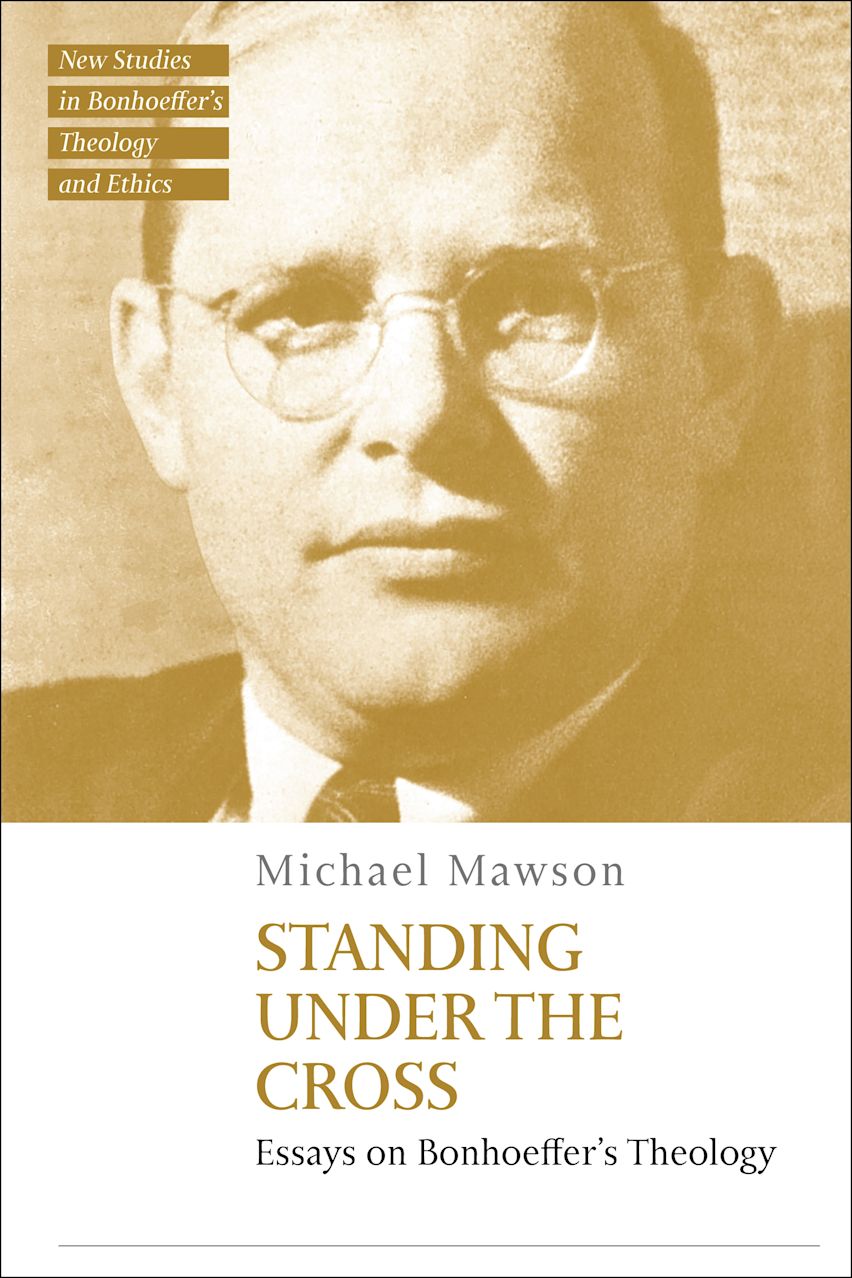
Michael Mawson’s Standing Under the Cross features several essays about Dietrich Bonhoeffer’s theology. It’s been a fascinating read. I was struck, however, by one essay that reads like an outlier. “Lutheran or Lutherish: Engaging Michael DeJonge on Bonhoeffer’s Reception of Luther” seeks to engage with Michael DeJonge’s Bonhoeffer’s Reception of Luther (reviewed by me here) and argue, at least in part, that there needs to be more complexity regarding Bonhoeffer’s relationship with Lutheranism than DeJonge presents. I found this essay an outlier–and perplexing–because Mawson himself cites Luther in conjunction with Bonhoeffer more than 20 times outside of this essay, which certainly lends itself to the interpretation of seeing Bonhoeffer as consciously Lutheran.
At the outset, I must note it is possible there is some subtlety to Mawson’s argument I’m missing. Following DeJonge, Mawson engages with Alasdair MacIntyre’s definitions of tradition, and draws from that a different conclusion–that Bonhoeffer should be approached to see “whether there are other, less determinate and more fluid ways of attending to this presence, of framing Bonhoeffer’s complex reception of Luther” (70). Interpreting this conclusion is difficult. Is Mawson saying that we need to view Bonhoeffer more along “Lutherish” lines than “Lutheran” ones–the latter being DeJonge’s claim? Or is he merely saying we ought to allow for broader influence on Bonhoeffer than Lutheranism?
If the latter, the point doesn’t actually seem to be outside of DeJonge’s purview either. While DeJonge certainly argues that Bonhoeffer is “consciously” Lutheran, that doesn’t preclude other influences. One can be Lutheran and still be influenced by and interacting with other authors of your own time. Mawson notes Hegel and Nietzsche as others with whom Bonhoeffer interacts (68). But again, this is hardly precluded by saying Bonhoeffer was Lutheran.
Mawson also makes some slight points about how Bonhoeffer refers to himself as Evangelical first, rather than Lutheran (67)–but the German Lutheran church referred to itself as Evangelical, anyway. Additionally, Mawson criticizes DeJonge for framing the debate as between Lutheran and Reformed positions. DeJonge’s complaint about scholars not paying enough attention to Bonhoeffer as Lutheran leading to misinterpretations of Bonhoeffer is counted by Mawson’s question: “does… the very existence of such diverse readings (and misreadings) itself complicate attempts to organize and stabilize Bonhoeffer theology as straightforwardly inside of ‘the Lutheran tradition’?” (69). I would argue that such diverse readings and misreadings does not do that at all. The fact that death of God theologians glommed onto Bonhoeffer’s works to extract “religionless Christianity” as meaning the same as “God is dead” hardly means we have to take as seriously the idea that Bonhoeffer might have believed God is dead as we do his stance on the theologia crucis (theology of the cross) which he consistently taught through his life. Diversity of opinion or interpretation does not entail diversity of the thing itself.
I already noted some confusion as well about Mawson’s own writings related to Bonhoeffer and Luther. Right before this essay, Mawson offered up two essays on Bonhoeffer’s view of Scripture and Bonhoeffer on discipleship, respectively, which heavily cite Luther in context of Bonhoeffer’s own view. Indeed, in the latter essay Mawson himself concludes by linking the theologia crucis with Bonhoeffer and Lutheranism specifically, not even bothering to distinguish between the Lutheran view and Bonhoeffer’s (see 58). Apart from all of this, though, looking at Bonhoeffer’s own works it becomes incredibly difficult to take seriously the notion that Bonhoeffer was anything but Lutheran. That doesn’t preclude him having other influences, advancing ideas that critiqued some parts of Lutheranism, or anything of the sort. But it does mean that reading Bonhoeffer correctly means reading him as a Lutheran pastor, which he was.
Just a few examples can serve to demonstrate Bonhoeffer’s deep commitment to Lutheranism. Bonhoeffer actively sought to catechize students within Lutheran traditions, including writing a catechism for students which closely followed Luther’s own catechism. Bonhoeffer’s discussion of the extra Calvinisticum includes a critique of Lutheran attempts to ground the counter to Calvinistic/Reformed doctrine in the concept of ubiquity precisely because Bonhoeffer argues that attempting to answer the Calvinist critique abandons the Lutheran answer which can simply be that Christ promised His presence and to leave it at that. Bonhoeffer defends infant baptism in more than one place in his works (for example in DBWE 14:829-830). He grounds the church on word and sacrament–the very way that Luther speaks of the church (again DBWE 14:829). He cites Luther more than any other theologian or scholar, and does so many, many times simply to settle the answer to a question such as saying [I paraphrase here] “Luther wrote [x]” and letting that settle the matter. He rarely critiques anything of Luther, rather citing Luther almost always in supporting a point or merely to cite something only to elucidate it afterwards. Mawson himself notes Bonhoeffer’s incredibly close interpretations of the theologia crucis–the very concept Luther wielded to differentiate himself from other theologians. Again, this isn’t a broader Christian concept but one that was explicitly and repeatedly taught and used by Martin Luther himself and one that Bonhoeffer cites again and again throughout his work such that it became the grounding for his notion that “only the suffering God can help.” Bonhoeffer doesn’t cite the Lutheran confessions as often as Luther, but when he does it is always done positively. For example, Bonhoeffer, after quoting the Formula of Concord, wrote: “The ‘expediency’ of any given church regulation is thus to be gauged solely by its accordance with the confessions. Only such accordance with the confessions is expedient for the church-community” (DBWE 14:704). How can one possibly read this passage, in which Bonhoeffer explicitly states that the way to judge a church regulation must be only in accordance to the Lutheran confessions–and he must mean Lutheran specifically because he just cited the Formula of Concord!
Examples could be multiplied ad nauseum, and DeJonge has done good work doing so, along with a handful of other authors who have put in the legwork to show that reading Bonhoeffer correctly means reading him as a Lutheran. I add my voice to this chorus, and as much as I enjoy Mawson’s work, I have to strongly question this specific essay. It is impossible to rightly interpret Bonhoeffer apart from realizing that he is Lutheran. And doing so does damage to his theology. None of this is to say other influences are impossible; it simply means that Bonhoeffer himself followed the Lutheran Confessions and Luther, even while engaging with them in a constructive way.
Standing Under the Cross continues to be a thought-provoking work that has led me to much reflection on Bonhoeffer’s theology–and my own. I recommend it.
Links
Dietrich Bonhoeffer– read all my posts related to Bonhoeffer and his theology.
SDG.
——
The preceding post is the property of J.W. Wartick (apart from quotations, which are the property of their respective owners, and works of art as credited; images are often freely available to the public and J.W. Wartick makes no claims of owning rights to the images unless he makes that explicit) and should not be reproduced in part or in whole without the expressed consent of the author. All content on this site is the property of J.W. Wartick and is made available for individual and personal usage. If you cite from these documents, whether for personal or professional purposes, please give appropriate citation with both the name of the author (J.W. Wartick) and a link to the original URL. If you’d like to repost a post, you may do so, provided you show less than half of the original post on your own site and link to the original post for the rest. You must also appropriately cite the post as noted above. This blog is protected by Creative Commons licensing. By viewing any part of this site, you are agreeing to this usage policy.


 J.W. Wartick - Reconstructing Faith
Discussion
No comments yet.