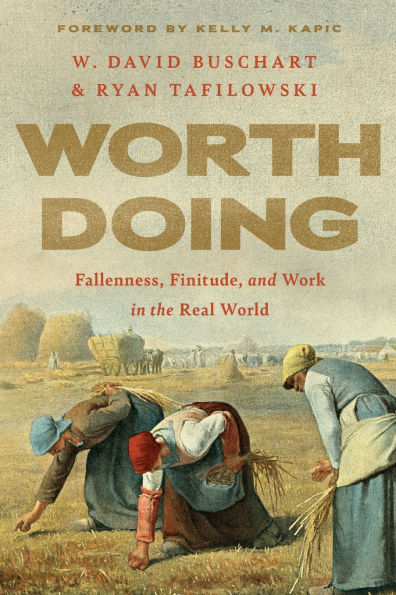
Worth Doing by W. David Buschart and Ryan Tafilowski explores the concept of “work in the real world” through a lens of fallenness and finitude.
The authors first introduce the concepts of finitude and fallenness, noting that their goal is to provide a theology of work for the “real world.” They use a few intriguing examples of how perspective can change attitudes related to workers. One is a comparison of the thoughts of both construction workers and office workers about the other–wishing they had what the other had not.
There are a few things that are notable for their absence. For example, there is little-to-no linkage of the concept of work to the capitalist system, nor are there critiques of unfettered capitalism and the exploitation of the worker. This, despite how neatly such a topic fits into the exploration. What could be more fallen than turning finite workers into mere numbers or cogs in the machine? The subject index, for example, doesn’t even have capitalism as a reference, while far more general terms (economics) or hyper-specific concepts (gig economy) get entries. Is it because there’s an avoidance of what could be a controversial critique of capitalism from a theological standpoint? I don’t know. What I do know is that the whole book seems to have such a topic looming in the background. When questions about how certain theologies of work might lead to the oppression of workers are right there and even being asked, the conspicuous absence of how capitalism can set up such an exploitation is all the more alarming.
The section on the goodness of work is another area where the critique of exploitative systems is notably so subtle as to be absent. Despite commenting on the goodness of work, it does so alongside the insights form Qoheleth (the teacher of Ecclesiastes). Even as discussing how everything is meaningless under the sun, the need for and even goodness of the harvest can be emphasized. Turning to the very end of the book, the authors urge readers to “still make hay while the sun rises” for creation is growning in need of redemption and renewal, but we must “come to terms with the kinds of creatures we are…” and that work, while “constrained… by finitude and haunted as it is by the curse, work is nonetheless a good gift from the good God and therefore worth doing” (195). I appreciate this ending note, though linked as it is with some of the discussion on vocation (see below) and the lack of critique of exploitative systems, it can feel a little empty or trite.
One section (190-193) has a scintillating discussion of the concept of “vocation” and how such a concept could be “easily put to exploitative use” through the notion of “doing what you love” (190). The authors call this a kind of “work mythology” that can use an “agency-dignity-power narrative” that “works well for those whose work is creative and satisfying” but perhaps not so much for those whose work is “degrading or unfulfilling” (190-192). Many scholars are referenced here–but one of the major thinkers on the concept of vocation, Martin Luther, is not. While the authors turn back on the concept of vocation and find some benefits, they do so in an explicitly theological framework that essentially sidelines the concept of work rather than integrating it into the concept of work. Here, Luther’s insights on the topic of vocation feel almost painfully absent. While the authors simply say that people were made for communion and union in Jesus Christ (193) and that “it is this; it is not a job or career or even a vocation” as the one thing we should be passionate about (ibid). Yet closing the discussion of vocation with this, moments after noting the lack of fulfillment that might be found in “degrading or unfulfilling” work reads almost as if the entire foregoing discussion on work and the “mythologies” involved in it is solved by a kind of “thoughts and prayers” response. Well, it’s one thing to have a job that we might feel is degrading; but worry not, our true fulfillment is found in union with Christ! Saying this is one thing; living it is another. And living it requires, ironically (based on the emphasis on “real world” in the subtitle), a more real world approach that has God entering into the world, entering into our suffering, and entering into our vocations.
The concepts of finitude and fallenness work well alongside discussions of work, and Buschart and Tafilowski are to be commended for bringing these insights alongside the concept of work. They do this alongside also finding the goodness of work. It’s a fine balance that the authors mostly navigate well (though, see above). Readers looking to start a theological exploration of work will certainly find plenty of depth to think on here.
Worth Doing is, well, worth reading if you’re interested exploring the intersection of theology and work. Readers of this review will, perhaps, think my thoughts are largely negative. But where I’m offering critique, I’m seeking more. There’s a wealth of information and topics to mine here, I just wish that some of them were turned to more incisive points made against what seems to be invisible problems lurking in the background. The book provoked quite a bit of thinking for me, and I believe it will for other readers, as well.
SDG.


 J.W. Wartick - Reconstructing Faith
Discussion
No comments yet.