J.W. Wartick
Naturalism and Groundless Truth
I’ve been reflecting on the concept of “Warrant” a lot as I’m reading through Alvin Plantinga’s trilogy on Warrant (including the books Warrant: The Current Debate, Warrant and Proper Function, and Warranted Christian Belief). Just how is it that we can claim that someone is justified or warranted in believing something? This got me thinking on naturalism. I remember an example someone quoted as being Plantingian in origin (edit: I’ve finally figured out where I originally read it: it’s found in a similar form in Warrant and Proper Function), but I’d like to use my own version of what I remember from his example. I do not believe that, on naturalism in particular, but atheism in general, there can be any grounds for believing that we as humans have the cognitive means by which we can discover truth. Further, on naturalism specifically and atheism in general, there is no reason to suppose that what we regard as “truth” is in fact truth.
I think perhaps the best way to argue this would be by using an example (and it is in this example that I borrow from Plantinga… I think. It has been heavily modified by myself into a form that doesn’t resemble the original form that I remember all that much). Let us consider the case of Tim the Tiger Lover and Suzy the Warrior.
Tim the Tiger Lover has formed false beliefs that a) wild tigers are warm and cuddly and b) the best way to pet them is to sneak away from them silently. Suzy the Warrior has formed the beliefs that a) wild tigers are ferocious critters and b) they must be killed to insure the survival of mankind.
Tim and Suzy are walking through the jungle one day, when they spot in the distance a tiger. Now, Tim immediately begins joyfully sneaking away, believing that he will soon be petting that warm, cuddly tiger. Suzy dashes forward to attempt to strangle the beast with her bare hands. Suzy dies, though it seems clear that her beliefs were at least partially true (wild tigers are indeed ferocious). Tim, however, succeeds in escaping and surviving, despite this not actually being his goal.
Now, on naturalism, it seems quite obvious that Tim has succeeded. He has survived, and will thus pass his genes on to the next generation. Indeed, it seems quite likely he will pass along his false beliefs as well. For let us modify the scenario only slightly and say that it was quite dark. While Suzy was being torn to bits by the tiger, Tim happened upon a tiger cub or some other beast he took to be a tiger cub. He immediately, happily danced with it and cuddled it for a while before sneaking away to go home, having quite happily reinforced his false beliefs. So Tim, with his false beliefs enforced by some data that they are in fact true (after all, he sneaked away quietly from the tiger and managed to pet tigers), also manages to survive, and therefore pass along his genes and his false beliefs.
But this means that, on naturalism, Tim has succeeded! His genes have been passed on, and he has, in a way, won the race for survival by having done so. But if this is the case, then why should we not suppose that there are any number of these cases in fact? For there is no reason to suppose that, granting atheistic naturalism, this case and many hundreds, thousands, millions etc. of others should not be actual. Indeed, there seems to be no non-question-begging way for naturalism to claim that evolution in particular or naturalism in general is truth-oriented or truth-seeking.
Why should we then, on naturalism or atheism, suppose that we even have the cognitive capability to learn truth or discover it? The most common answer that has been given is that it is to our evolutionary advantage to know truth and use it. But this, as seen in the case above, does not seem to be true all the time, and there really is no reason to suppose it must be true any of the time. I’ll grant that we must at least learn some truths if evolution is true in order to survive, but why suppose that our species is necessarily truth-seeking? It seems clear to me that there is no reason to suppose this, and thus there is no reason to think that, granting naturalism and atheism, we should think that we know the truth or indeed can know it! For our evolutionary past could be utterly filled to the brim with Tim the Tiger Seekers! There are any number of beliefs that we hold now, from our evolutionary forefathers, that are in fact utterly false! But we have no reason to know that or even be able to discover that, especially if they are falsely confirmed!
So if naturalism and atheism are indeed true, then there is no reason at all to suppose that anything we know constitutes true knowledge or true beliefs. There is no ground for truth in naturalism, and indeed I believe there is sufficient reason to think that naturalism would likely have us forming all kinds of false beliefs, without ever finding out otherwise. Sure, we may eventually eliminate some of them, but only while we are forming more false beliefs in the meantime!
Thus, I find this another reason to reject naturalism, which I’ve already discussed as being unintelligible and undermining things it should hold most dear.
Theistic Idealism
I’ve written about Idealism (which I’ve also referred to specifically as Immaterialism) before. I’ve also written about what I call the paucity of objections to Berkeley’s Immaterialism. Now I would like to return to the subject of my first post (the first link above) and discuss briefly (my definition of briefly is likely different than that of others’) what the philosophy known as Idealism can do in interactions with Theism. I am certainly both an Idealist by philosophy and a theist by religion, so these naturally combine for me.
I do not, however, think that Berkeley’s Immaterialism is correct. Rather, I see it as a step along the way to a kind of Idealism that I’ve been developing by piecing together Berkeley’s Immaterialism, some parts of Kant’s Transcendental Idealism, Husserl’s Phenomenology, and my own ideas. Berkeley has a great point, in my opinion, when he starts out by pointing to the idea that “to be is to be perceived (or to perceive).” But one of the things that Berkeley leaves out (at least in the writings of his that I’ve read–currently reading through Three Dialogues) is the demand for the ego or the “I” to be the view of reality. Berkeley makes no claims of exclusivity of mind for interpretation in the sense of demanding that the mind is where all perception must start. He assumes that people should know this, but, as with anything in philosophy, that’s not fair to the audience, no matter how studied. I believe that the ego must first be established in order to maintain an idealist philosophy. Further, I believe that there is literally no way to escape the inevitable conclusion that it is indeed “I” who ultimately interpret reality for myself (note that I’m not saying I determine reality or create it or sustain it, only that I am the ultimate arbiter for interpreting). Because “I” cannot escape myself (such an attempt would indeed be ludicrous) I must start off with glancing from myself to others. But it is the ego that ultimately interprets reality, this is a crucial point that cannot be stressed enough. But anyway, I’m getting ahead of myself and into issues I’m not planning to address here.
The problem, I believe, is that people tend to simply grant that objects in themselves are not only possible, but actual. I don’t see any grounds for granting that objects can or do exist of themselves, as mind-independent things, for there is no way for us to give something any kind of properties, modally or otherwise, that are not dependent, ultimately, on the mind. Assuming a priori that objects-in-themselves are actual is unfounded because, as our ego is the interpreter of reality, we cannot actually demonstrate that objects are mind independent, for there is no way for us to escape our ego in order to do so. We cannot become some being outside of mind that can objectively view such things.
Husserl, in a work with an extremely long title that I’m not going to type out here despite the fact that I will type it below and have now used more space than I would have just typing it out to begin with (and it is usually just referred to as Ideas anyway, which means I’ve spent a whole lot of extra time typing that I really did not have to), states, “…all real unities are ‘unities of sense.’ Unities of sense presuppose… a sense-bestowing consciousness which, for its part, exists absolutely and not by virtue of another sense-bestowal” (Ideas… 107, emphasis his). This is where theism comes into play. While Husserl was not here referring specifically to God, one can find the roots of immaterialism and idealism throughout his Ideas (something which apparently alienated him from his earlier followers). Husserl rightly notes that the thing which the physicist explores is necessarily the thing that is perceived, it is not something outside of perception (Ideas, 99). He states earlier that “…one must not let oneself be deceived by speaking of the physical thing as transcending consciousness or as ‘existing in itself'” (Ideas, 89). Husserl’s goal in Ideas was to found phenomenology as a science that explored essences (I’m heavily summing up), but I think he clearly has some very insightful thoughts on idealism in these and other passages. Husserl, mind you, does believe in a world external to our minds. I agree.
Here again theism permeates my philosophy, for I see the physical, external world as the ideas of God, who views them objectively (in the sense of absolutely, not in the sense of “as objects”) whereas we view them subjectively (here in the sense of not absolute, perhaps flawed, not complete, etc.). So without this absolute sense bestower (to use Husserl’s terms), there can be no perception, no sense. For in Him we move and have our being (Acts 17:28). So within our ego we have a kind of inescapable interpretation, we view reality from this perspective that we cannot escape. But we can clearly show that for any two people A and B, A and B’s perceptions of the world are going to be different on a number of points. But there must be some kind of objective (absolute) world from which we derive sensations and perceptions. However, because we cannot discuss any object as mind independent, this objective world is not mind-independent either, or if it is, then it is such in a way that we cannot access or understand, and in either case it is dependent on something else. So, in either case we have a metaphysics, not a physics, for physics deals with that which is perceived. If we want to establish how that which is perceived came to be, we must move into the realm of metaphysics, beyond the clutches of naturalism, beyond the access of science and firmly into the realm of philosophy, which governs both naturalism and science to begin with.
Sources:
Berkeley, George. The Works of George Berkeley, Volume I. Bibliobazaar.
Husserl, Edmund. Ideas Pertaining to a Pure Phenomenology and to a Phenomenological Philosophy: First Book. Martinus Nijhoff Publishers. 1982.
——–
The preceding post is the property of J.W. Wartick and should not be reproduced in part or in whole without the expressed consent of the author.
Abortion: Further Issues
I’ve written arguments against abortion before, but I’ve come up with/read about some other ones and I wanted to bring them up as I think they raise some unique issues.
One argument I read recently (over here, though I can’t seem to locate the exact post) is that abortion seems to be very anti-men. Those concerned for the rights of individuals should, in order to be consistent, care about both women’s rights and men’s rights. The reason abortion is anti-male is because men don’t have the choice over whether the woman gets an abortion or not. Now, obviously, there are many cases where men (unfortunately) push their significant others for abortion, but what I’m pointing out is that if an adult woman wants to have an abortion, the man can’t stop her if she just goes in and does so. But here’s the punch line: if the woman decides to have the baby, and the man didn’t ever want him/her, he still has to pay child support. So the man can’t decide to have the baby, but if the woman does and he didn’t want him/her, he still has to pay the child support. I’m clearly not saying that men should not want babies, but this is an extreme double standard.
Another issue to raise is the fact that abortion is completely devastating certain minority communities, African Americans in particular (see here for a very interesting site, but if you doubt the validity of this claim, just google it and you’ll find plenty of statistics).
Abortion destroys objective human value. One great point that was brought to light in my eyes a while back (see other post) is the question of how is it that coming through the birth canal suddenly changes this fetus/nonhuman tissue/tumor/whatever term one wants to use to hide the “personhood” of the baby into a baby? What makes the “thing” a baby outside the mother, but not a baby inside the mother, at the exact same stage of pregnancy? How is it different to kill a baby inside the mother (abortion) or kill it outside (murder)? Just being inside a woman doesn’t somehow make the fetus/etc. part of the woman, particularly if it can survive outside of the woman. Though–and here is a very important and chilling point–if one wants to argue that direct dependence on the woman for survival is the difference, then children are not “persons” either until they are capable of taking care of themselves all on their own. A newborn baby, for example WOULD NOT SURVIVE without parental (or other) care. Does this mean the baby too is not a “person”? What definition of personhood is being used, and how does it avoid the points I raised in my other post that I have linked a few times?
Part of my reflections on abortion have lead me to try to see it through the eyes of a pro-choicer. Some of this has come through simply reading from blogs of pro-choice individuals. One thing that is surprising to me is how angry a lot of pro-choice people tend to be. They seem to think that pro-life people are specifically targeting women and trying to “keep them down” in some way. Is it really that hard to acknowledge that there is another side of the debate that might have legitimate reasons for being pro-life? Well, I at least am going to try to acknowledge that pro-choice individuals genuinely raise some good concerns. One of these is a concern for the rights of women. There is no reason to fault someone for wanting to be sure that men and women have equal rights (though interestingly, as above, it seems that men are sometimes pushed aside in this). Pro-choice people show a wonderful concern for women who are struggling with hard decisions, a concern that I think we pro-lifers need to acknowledge and adopt in our own testimony for our side of the debate.
Pro-lifers are not part of some agenda to “keep women down” this is completely ridiculous, and it is in fact a great example of the use of a “straw man” fallacy in argument. I wish that logic was incorporated more into this debate, because all too often I see people on both sides just shouting each other down or using all kinds of fallacious statements. Something this important to both sides, however, seems to alienate logic. I pray that one day this will not be the case. If any real headway is to be made, both sides need to sit down and discuss the issues in a logical way, while allowing for the other side to have some truth.
True Christianity: A Brief Discussion
People today are often confused about what it means to be Christian. Often, when one tries to claim that someone who calls oneself a Christian and does not believe in things that are Christian, they are confronted with people saying this is some kind of fallacy (specifically the “No True Scotsman” fallacy, as I was accused of in a previous debate).
The question then stands, is there a definition of what it means to be Christian? Are there people that claim to be Christian and are not, or can anyone claim to be a Christian regardless of their beliefs about, say, the Trinity or the divinity of Christ?
Yes, there is a clear definition of what it means to be Christian, and, apart from these beliefs there is no salvation. The early church defined Christian belief through three “Ecumenical Creeds.” These creeds explicitly state what the Christian belief is, and that apart from this faith there is no salvation. These creeds outline the one Holy Catholic faith (note that Catholic doesn’t only refer to Roman Catholics, but rather to the Catholic Church, the eternal “City of God”), and apart from this faith there is no salvation and no Christianity.
I’ve been listening to a number of debates that I downloaded and a few of them featured John Dominic Crossan (the founder of the misnamed “Jesus Seminar”) verses various conservative Christians. Crossan denies the bodily resurrection of Jesus, he seems to deny in some ways Christ’s deity, he rejects Christianity as the only way, etc. He claims to be Christian. Can we say that he is not Christian? Absolutely. In denying the bodily resurrection, he denies the One True Faith found in the Creeds of the Catholic Faith. There is no fallacy in rejecting that people like this are not Christians, for there is a clear definition of what it means to be a Christian. If one does not believe in the One Triune God, the Father, Son, and Holy Spirit coequal and coeternal, one is not a Christian. This applies for every statement of belief within the creeds. If one rejects any part of these creeds, they are not Catholic in belief. The Athanasian Creed concludes: “This is the true Christian Faith. Whoever does not faithfully and firmly believe this cannot be saved.”
This is the teaching of the One True Church, this is the teaching of Scripture (which does not contain the Creeds, but from which the Creeds were directly derived), this is the truth.
The creeds are found below:
The Apostle’s Creed
I believe in God, the Father Almighty, Creator of heaven and earth,
And in Jesus Christ, his only Son, our Lord, who was conceived by the Holy Spirit, born of the Virgin Mary, suffered under Pontius Pilate, was crucified, dead and buried; He descended into hell. The third day he rose again from the dead; He ascended into heaven, and sits at the right hand of God the Father Almighty. From there he shall come to judge the quick and the dead.
I believe in the Holy Spirit, I believe in the holy catholic church, the communion of saints, the forgiveness of sins, the resurrection of the body, and the life everlasting. Amen.
The Nicene Creed
We believe in one God the Father, the Almighty, creator of heaven and earth, and of all things, seen and unseen.
We believe in one Lord, Jesus Christ, the only Son of God, eternally begotten of the Father, God from God, Light from Light, true God from true God, begotten, not made, of one substance with the Father. Through him all things were made. For us and for our salvation he came down from heaven; by the power of the Holy Spirit he became incarnate from the Virgin Mary, and was made truly human. For our sake he was crucified under Pontius Pilate; he suffered death and was buried. On the third day he rose again in accordance with the Scriptures; he ascended into heaven and is seated at the right hand of the Father. He will come again in glory to judge the living and the dead, and his kingdom will have no end.
We believe in the Holy Spirit, the Lord and giver of life, who proceeds from the Father and the Son, who with the Father and the Son he is worshiped and glorified. He has spoken through the Prophets.
We believe in one, holy, catholic, and apostolic Church. We acknowledge one baptism for the forgiveness of sins. We look for the resurrection of the dead, and the life of the world to come. Amen
The Athanasian Creed
Whoever wishes to be saved must, above all else, hold to the true Christian Faith. Whoever does not keep this faith pure in all points will certainly perish forever.
Now this is the true Christian faith: We worship one God in three persons and three persons in one God, without mixing the persons or dividing the divine being. For each person — the Father, the Son, and the Holy Spirit — is distinct, but the deity of Father, Son, and Holy Spirit is one, equal in glory and coeternal in majesty. What the Father is, so is the Son, and so is the Holy Spirit.
The Father is uncreated, the Son uncreated, and the Holy Spirit uncreated; The Father is eternal, the Son eternal, and the Holy Spirit eternal. And yet they are not three who are eternal, but there is one who is eternal, just as they are not three who are uncreated, nor three who are infinite, but there is one who is uncreated and one who is infinite.
In the same way the Father is almighty, the Son is almighty, and the Holy Spirit is almighty. And yet they are not three who are almighty, but there is one who is almighty. So the Father is God, the Son is God, the Holy Spirit is God. And yet they are not three Gods, but one God. So the Father is Lord, the Son is Lord, the Holy Spirit is Lord; yet they are not three Lords, but one Lord.
For just as Christian truth compels us to confess each person individually to be God and Lord, so the true Christian faith forbids us to speak of three Gods or three Lords. The Father is neither made not created, nor begotten of anyone. The Son is neither made nor created, but is begotten of the Father alone. The Holy Spirit is neither made nor created nor begotten, but proceeds from the Father and the Son. So there is one Father, not three Fathers; one Son, not three Sons; one Holy Spirit, not three Holy Spirits.
And within this Trinity none comes before or after; none is greater or inferior, but all three persons are coequal and coeternal, so that in every way, as stated before, all three persons are to be worshiped as one God and one God worshiped as three persons. Whoever wishes to be saved must have this conviction of the Trinity.
It is furthermore necessary for eternal salvation truly to believe that our Lord Jesus Christ also took on human flesh. Now this is the true Christian faith: We believe and confess, that our Lord Jesus Christ, God’s Son, is both God and Man. He is God, eternally begotten from the nature of the Father, and he is man, born in time from the nature of his mother, fully God, fully man, with rational soul and human flesh, equal to the Father, as to his deity, less than the Father, as to his humanity; and though he is both God and Man, Christ is not two persons but one, one, not by changing the deity into flesh, but by taking the humanity into God; one, indeed, not by mixture of the natures, but by unity in one person.
For just as the reasonable soul and flesh are one human being, so God and man are one Christ, who suffered for our salvation, descended into hell, rose the third day from the dead. He ascended into heaven, is seated at the right hand of God the Father almighty, and from there he will come to judge the living and the dead. At his coming all people will rise again with their own bodies to answer for their personal deeds. Those who have done good will enter eternal life, but those who have done evil will go into everlasting fire.
This is the true Christian Faith. Whoever does not faithfully and firmly believe this cannot be saved.
The Teleological Argument
The “Teleological Argument,” which is also known as the “Argument from Design,” has been popularized by the Intelligent Design movement, though the version I defend below is cosmological rather than biological.
The Teleological Argument is an inductive argument that doesn’t attempt to prove that God exists, but rather argues to justify or confirm that belief. In other words, it can function much like the Argument from Religious Experience in providing warrant, not proof, for belief. It’s an inductive argument that seeks to increase the probability of theism, not prove it.
Robin Collins wrote the chapter on the Teleological Argument in The Blackwell Companion to Natural Theology, entitled “The Teleological Argument: An Exploration of the Fine-Tuning of the Universe.” I can honestly say that I only understood about 70-80% of the material. While there is a large amount of hefty philosophical argumentation involved, it was the double-dose of astronomy and physics (things I have an average-at-best understanding of) that kept me from fully understanding this chapter. That said, I think That I understood enough to have the core of the argument intact. Collins argues that the universe has been “fine-tuned” to be a Life-Permitting Universe (LPU). He states that “This fine-tuning falls into three major categories: that of the laws of nature, that of the constants of physics, and that of the intial conditions of the universe…” (BCNT, 202).
I have long been skeptical of the usefulness of the Teleological Argument, but Collins puts forward a rather subdued version, in which he doesn’t loftily claim to prove God’s existence, but rather to state that “…given the fine-tuning evidence, LPU strongly supports T[heism] over the [Naturalistic Single Universe Hypothesis (hereafter referred to as the NSU)]” (205). Thus, instead of arguing that theism is true based on teleology, he argues that naturalism is less likely than theism based on teleology.
Collins pits the “Theistic Hypothesis” (as he calls it, T) against the NSU. He introduces the “Likelihood Principle,” which, in my own stripped down version basically states that if there is some evidence, e in favor of a hypothesis (say, T) over another (NSU), then T is more likely (205). All of this sounds, as I said, very subdued. The Teleological Argument as Collins presents it is not an end-all, be-all argument to convince everyone, but rather seems to be a justification for belief.
Now we must return to the evidence for fine-tuning. As previously stated, this falls into three categories: the laws of nature, the constants of nature, and the intial conditions of the universe (202). The laws or principles of nature that are required for “self-reproducing, highly complex material systems” (211) are 1) a universal attractive force, such as gravity 2) a force similar to the strong nuclear force, 3) a force similar to electromagnetic force, 4) Bohr’s Quantization Rule or something similar (electrons occupy only fixed orbitals [213]), and 5) the Pauli Exclusion Principle (“no two fermions… can occupy the same quantum state” [213]). The reason such things are required is because without #1, things would just float around everywhere, #2 allows for nucleons to stay together, without which it seems obvious there would be no complexity, #3, if it were not true, would mean there were no atoms (for nothing could hold them in orbit [212]), #4 allows electrons to keep energy, and #5 directly allows for complex chemistry (“without this principle, all eelectrons would occupy the lowest atomic orbital…” [213]) (211).
The constants of physics also are essential for an LPU. These include the constant of gravity and the cosmological constant (214, 215). Both of these seem necessary for the existence of life. The cosmological constant, for example, states that when it is positive, it will act as a repulsive force, but when negative, it will act as a negative force. If this constant had been different than it is, then the universe would have expanded or collapsed too quickly for stars and galaxies to form (215).
Naturalistic alternatives will be lacking. For example, one of the most likely alternatives for the naturalist is to discover some set of laws such that they explain the cosmological constant being what it is. But if this is the case, the naturalist has only pushed the question up one step higher, for now one could ask for an explanation for the fine-tuning of such a law. Another problem is that, as always, it seems the naturalist is assuming that an explanation will be discovered (219). There are a few problems with this in itself. One is that it is an argument to the future, which is a logical fallacy. One cannot simply state that one’s position is correct by stating that one day it will be demonstrated. Further, the naturalist may claim the theist has now created a “God of the gaps.” This is another fallacious way to attempt to argue against the theist. As stated before, the assumption that science will one day fill in every gap is a fallacy: argument to the future. Naturalists create their own “science of the gaps” in which they assume every gap will be filled by science. Another problem is that in order for the naturalist’s objection “God of the gaps” to work, it must carry weight for the theist, lest it be question-begging in nature. Yet there is no plausible way that, given theism, appealing to God for explanation of some concept should be ruled out a priori. Thus, the naturalist begs the question in objecting in a “God of the gaps” fashion. Further, such an objection as the “God of the gaps” is question begging in that they assume the theist is proposing theism as a scientific hypothesis. This is not the case. The theist is proposing God as a metaphysical and philosophical explanation, not a scientific one (225). Not only that, but if, for example, there is some theory of everything yet to be discovered, this would only push the fine-tuning up one level, and the naturalist would have to explain the existence of this theory of everything. The Teleological Argument doesn’t lose weight in light of such objections.
The Teleological Argument Collins brings forward is (my very summed up version, though all of the following are direct quotes):
“1) Given the fine-tuning evidence, LPU is very, very epistemically unlikely under NSU…
2) Given the fine-tuning evidence, LPU is not unlikely under theism…
3) Theism was advocated prior to the fine-tuning evidence (and has independent motivation)
4) Therefore, by the restricted version of the Likelihood Principle, LPU strongly supports Theism over NSU (207)”
The first premise is one that should not really be all that heavily debated. Just as one example, the cosmological constant is fine tuned to about 1 part in 10^120 (Reasonable Faith by William Lane Craig, 159). There are many other constants that have such unfathomably small likelihood of occurring. The difference is in how one explains this. Some argue for brute fact (it just is), but others argue based on the multiverse hypothesis.
Collins argues in various ways against the multiverse hypothesis scientifically. I will present my own argument, which is philosophical in nature. If our universe is one of many (perhaps infinitely many), then a number of logical problems arise. One is the problem of discovery. If we are granting naturalism, then how do we scientifically discover these other universes, if, based on the multiverse hypothesis, we cannot? Not only that, but there are modal problems with the multiverse hypothesis. Given an infinite number of universes that exist, then it seems highly likely there are other “J.W. Wartick”s in these universes. But there would likely be a far greater number in which there is no “J.W. Wartick” (much to the chagrin of the inhabitants!). If this is the case, then I simultaneously exist and do not exist, which is contradictory. But, it could be argued, these other “J.W. Wartick”s are not actually me, they are alternate mes in entirely different universes! This only introduces other problems, such as identity.
This problem is another discovery problem, but this one does not exist in a scientific sense but a philosophical one. How, for example, do we identify these other universes? How do we discover their properties? How do we infer any truths about our universe if, as stated just before, they are entirely different universes, and one cannot say that there are two “J.W. Wartick”s out there? In other words, if we state that the problem of “J.W. Wartick” existing and not existing isn’t a problem because these universes are not our own and are entirely different, how then do we derive knowledge of our own unverse from these hypothetical universes in the sense that we infer that our own universe isn’t all that unlikely given that we are one in infinite (or a great many)? One cannot have it both ways.
Others modify the multiverse hypothesis to say that there really aren’t infinite universes out there, but rather only those with laws similar to our own, selected by a sort of naturalistic machine that determines which universes are and are not possible. But if this is the case, then we have again only shifted the problem of our own existence from one point on the ladder to another. What determines this “machine” that selects universes non-arbitrarily (for it must not be arbitrary if we are using it to try to explain apparent fine-tuning)? Thus, this hypothesis doesn’t solve anything.
Then there is what Collins calls the “Weak Anthropic Principle objection.” I believe this is the claim Dawkins was making that I analyzed in another post. Collins writes, “According to the weak verson of the so-called Anthropic Principle, if the laws of nature were not fine-tuned, we should not be here to comment on the fact. Some have argued, therefore, that LPU is not really improbable or surprising at all under NSU, but simply follows from the fact that we exist” (277). There are a few problems with this, as I pointed out in the post I linked with Dawkins (such as the claim that such a thing is necessarily true that is implicit). But there are even more problems. The first is the argument could simply be restated to argue that our existence as embodied moral agents is extremely unlikely under NSU, but not under theism (277).
More convincing, however, is an example:
Imagine that I am standing to be executed, with 50 sharpshooters ready to fire at me. They fire, and they all miss. Would my response really be, “if they had not missed me, I would not be here to consider the fact?” Such a response is inadequate. One would almost be forced to conclude that there was some reason they all missed, given the background information that had the intention been to kill me, they almost certainly would have killed me (276).
Thus, such a dismissal of the evidence as Dawkins performs misses the mark (pun slightly intended).
Brute Fact must similarly be discareded as an explanation. Dr. Parrish argues in his book God and Necessity (which I recently read and discussed) that Brute Fact is logically undercut as an explanation for a number of reasons. These include that the Brute Fact hypothesis states explicitly that everything is random. If this is the case, then there should be no laws to observe, and, in fact, things should randomly be happening constantly. But Brute Fact proponents may argue that everything was random, but once it started, it was determined (God and Necessity, Stephen E. Parrish, 189). This, however, ignores the fact that relationships, in Brute Fact, are completely random. There is no reason to believe that, for example, a law should continue to operate how it does, even if we can observe it for a great deal of time doing so. Further, if such things were set in place upon being randomly selected by Brute Facy randomness, there are two major probelms. The first is that Brute Fact has no way to explain why such things should become determined upon selection, and the second is that even if one could get around this first problem, there remains no way to explain why it should always be the case. If everything is random, then everything is random, necessarily. There can be no constants.
Thus, it seems as though theism is the best way to explain the fine-tuning of the universe. Multiverse hypotheses fail in that they have scientific (which I did not discuss) and logical problems. Brute Fact can’t account for constants. Finally, just saying that we are here to observe the universe doesn’t do anything to undermine questions that ask Why are we here, and not somewhere else, or nowhere?
I don’t believe the Teleological Argument proves God exists, but it does add a significant amount of warrant to the belief that He does.
——–
The preceding post is the property of J.W. Wartick and should not be reproduced in part or in whole without the expressed consent of the author.
God and Necessity
Logical necessity is one of the most interesting concepts within philosophy, in my opinion. What does it mean, for example, to say something is necessary? Can anything have necessary existence? It doesn’t take long for questions like these to come into play when thinking about the God of classical theism. This is what makes the concept so interesting to me.
Not so long ago, I read and reviewed the book The Nature of Necessity by Alvin Plantinga. I honestly must say I highly underrated it on my “Relevance” Criterion. I constantly find myself opening the book and paging through it in order to clarify some concept. It was a truly monumental work which outlayed the foundations of what the concept of “necessity” means within logic. Further, it presented Plantinga’s now famous (at least in the corner of the philosophical world I’m interested in) “Victorious Modal” Ontological Argument for the existence of God. But Plantinga only dedicated a chapter to these questions of what logical necessity means in terms of theism.
I have just finished reading God and Necessity
The idea that God exists necessarily is obviously an important one. But it must be maintained that this is not held in a question-begging fashion. Rather, the idea is that if God exists, God exists necessarily (9). Why is this important? If one were to simply say that God exists necessarily, it seems that one is begging the question in theisms favor. But this is not the case. Rather, theists are defending the view that if it is the case that God exists, then God exists necessarily. It is this kind of subtle but important point that God and Necessity excels in pointing out. They aren’t the central point of the work, but they are welcome additions.
If God exists, it is argued, then God exists of de re or ontological necessity rather than de dicto necessity (21). I have written about these concepts before, but I will briefly reiterate the definitions of these terms:
De dicto necessity is: “a matter of a proposition’s being necessarily true”
While de re necessity is: “an object’s having a property essentially or necessarily” (The Nature of Necessity Plantinga, V)
Thus, if God exists, then it could not be otherwise. Parrish states “God, if he is the LNG [logically necessary God], exists in all possible worlds and is eternal, independent, omniscient and omnipotent, etc. in all of the worlds. It is because of this concept that the factually necessary God (FNG), as Parrish describes it, cannot be the Greatest Possible Being (GPB), for the FNG is only necessary in one or some possible worlds, while the LNG is necessary in all possible worlds and unchanging (26). Further, the FNG could exist in worlds in which it were not the GPB in that world, so it can clearly not be the GPB, for one could conceive of a being that existed in more (or all) possible worlds and was the GPB in all of these.
Thus, God must be conceived of as the LNG. But some, such as Hume, have objected that God cannot be logically necessary, for we can conceive of God not existing. This objection quite obviously misses the point (49). For it is necessarily true that “2+2=4.” But we could certainly (mistakenly) hold that, say, “2+2=5.” Just ask any 3 or 4 year old some kind of logically true mathematical equation and you may get a wrong answer. Does this mean that these things are not necessarily true? Obviously not. Thus, just being able to conceive of it not being the case that a necessarily true proposition is true does not actually mean it is not necessarily true (50). “One can, and often does, conceive of necessary truths as being false” (51), but this does not make them false. This is generally a misconception I continually see in debate. When considering the laws of logic, something simply is regardless of whether or not anyone believes it to be the case. Things that are logically necessary simply are no matter what anyone thinks about them. The only way to argue against something that is being held as necessarily true is to show that there is some contradiction in holding this truth (56).
Another excellent point that Parrish makes is the concept of different kinds of existence. Often, a debate can derail because different kinds of existence are being discussed. He defines:
A-existence: something exists extra-mentally in the actual world
P-existence: something exists in any way (including mentally)
N-existence: something exists in every possible world (60)
It is a sign of a well-argued book if it can change a mind about an important issue. I have been operating under a kind of dichotomy in which I generally grant that God operates logically for the sake of argument, but don’t actually believe that, for example, the law of noncontradiction applies to God. God and Necessity changed my mind on this stance, and I now agree that God does operate logically and that logic is synthetically necessary to his being. One reason for this is Parrish’s discussion of Norman Geisler writing on this subject, “[O]ntologically, the laws of logic are dependent on God for their existence” (47). But it is across pages 72-79 that I became convinced. I don’t want to type out all of it here, but I will state the main points that convinced me. “For any object x, where x is intrinsically unknowable [i.e. it is a logical contradiction], then x is meaningless… Nothing whatsoever can be said about it (77).” I think this was possibly the turning point. For let us try to imagine some kind of thing that, on my old view (that God could do anything including make contradictions true) is possible. Let us imagine God could make a square circle. But just examining this concept, one can see that it literally means nothing at all. Other contradictions suffer the same problem. Finally, in closing his refutation of accomodationalism (that God can do contradictions and every logically possible thing), Parrish states, “This is not a limitation, for anything that God [as the GPB] could not do is nothing (79).” This tightly argued section was a simply fantastic refutation of a view that I have held throughout my philosophical explorations of theism.
The next section is quite important, the ontological argument. Two versions are given. The first is Plantinga’s victorious modal version:
1. The proposition there is a maximally great being is possible in the broadly logical sense
2. There is a possible world in which there is a maximally great being
3. Necessarily, a being with maximal greatness would be necessarily existent and would have (at least) omnipotence, omniscience, and moral perfection essentially
4. What is necessary does not vary from possible world to possible world
5. Therefore, a being that is necessarily existent and essentially omniscient, omnipotent and wholly good exists (Generally from “God, Freedom, and Evil” or “The Nature of Necessity”)
And the second is Parrish’s version:
1. The concept of the GPB is coherent (and thus broadly logically possible)
2. Necessarily, a being who is the GPB is necessarily existent, and would have (at least) omnipotence, omniscience, and moral perfection essentially.
3. If the concept of the GPB is coherent, then it exists in all possible worlds.
4. But if it exists in all possible worlds, then it exists in the actual world.
5. The GPB exists (82)
I again unfortunately don’t have the space or time to write out the wonderful defenses of this argument in the book, so I will highlight key points. Parrish starts with a refutation of the various parodies of the ontological argument. I have addressed these elsewhere and so will let this point stand.
The main point Parrish makes with the ontological argument is this: “When considering the GPB, the only way this object could fail to exist is through internal incoherence. The GPB cannot, by definition, fail to exist by chance or because his existence was prevented by some other being or beings (105).”
Another excellent point Parrish makes is about the GPB’s omni-benevolence, a point I have debated at some length. Parrish states, “[H]ow can there be some objective standard of good and evil to judge the being which, by definition, is the source of everything else (98)?” Further, “[T]here is no autonomous standard of ethics by which he might be judged (98).” There is more there, of course, but these two points were quite enlightening on this point that I myself have had some problems clarifying: why believe the GPB is all-good? Well, the GPB simply would be the standard of good and evil, so there would be no way by which to judge that the GPB is evil. Simply put, the GPB would be the standard and therefore would have no standard which could in turn judge the GPB.
Next, Parrish investigates the cosmological and teleological arguments. I’m not going to write much on this section, not because I didn’t think it was valuable, but because it is mostly a set up for Parrish’s main argument, that which he terms the “Transcendental Argument.” Parrish points out that everyone has some kind of “probability structure” from which they judge various propositions. Thus, someone who is a non-theist will believe that the probability of God’s existence is quite low, while a theist will most likely believe quite the opposite. Because of these probability structures, it is hard to fairly examine evidence from either viewpoint (generally 145 and following). I’d like to point out that Parrish’s discussion of plausibility/possibility structures is similar to Michael C. Rea’s own discussion of “Research Programs” in World Without Design (which I discussed here).
Thus, Parrish advances the “Transcendental Argument” which is, in my own terms, the argument that God’s existence is necessary prior to any kind of logical thought whatsoever. Basically, Parrish states that there are three possibilities for the existence of the universe: Brute Fact (that everything is chance), Necessary Universe (our universe exists necessarily), and Necessary Deity (183). There are worldviews that combine aspects of some or all of these, but essentially any worldview can be reduced to these beliefs. Parrish argues that the universe cannot be brute fact, because there is no way to explain for everything in our universe not continually fluctuating (i.e. if everything is chance, why are things not popping into and out of existence at random). He argues against the Necessary Universe by pointing out some contradictions in this structure, including that those who hold to objectivism commit a kind of de dicto – de re fallacy, equating what should simply be de dicto necessity with de re necessity. Finally, Parrish sums it all up by pointing to the GPB as argued earlier as being the only possible explanation for our universe. This is a very bare-bones summing up of his argument, but there really is no way to sum it up in any small fashion that does it justice. As with most philosophical works, it must be judged as a whole, not by taking single parts out and critiquing them. The arguments contained in God and Necessity build off of each other throughout the book, and culminate in the conclusion that in order for their to be any kind of rational thought at all, God, as outlined in Classical Theism, must exist (279).
Now that I’ve essentially outlined the contents of the book, I will review it below:
God and Necessity by Dr. Stephen E. Parrish is one of those books that is definitely exactly what the title says it is: a defense of classical theism that applies logical necessity to the concept of God.
Dr. Parrish argues for the concept of God as the Greatest Possible Being (GPB). Because of this concept of God, one can draw a number of conclusions, including God’s omnipotence, omniscience, omni-benevolence, etc. Dr. Parrish argues conclusively against the concept of a Factually Necessary God (FNG) as opposed to a Logically Necessary God (LNG) being the GPB. The FNG exists in many worlds as the GPB, but not in all possible worlds. Only the LNG exists in all possible worlds as the GPB.
He follows this with a form of the ontological argument unique to the work. Instead of grounding his version of the ontological argument on the premise that “Possibly, the GPB exists in some possible world” as most modal versions of the argument do, Parrish starts with “The concept of the GPB is coherent (82).” In this way, he avoids the problem that some versions of the argument don’t address, which is that someone could simply deny that it is possible that the GPB exists in any possible world. Thus, Parrish’s version is strengthened, for he bases it on concept of the GPB rather than on the modality of the GPB.
In each chapter, Parrish fairly presents counter-arguments and refutes them. His argumentation is always clear and as concise as possible. I would compare his style of arguing with Plantinga’s in that they both have a very clear flow of their book from start to finish, with each point building on the last throughout the work. Further, Parrish injects a touch of humor here and there in his work.
My one criticism is that sometimes, in his efforts to refute as many counter-arguments as possible, Parrish dismisses them a little too easily. This was particularly evident in his discussion of the compatibility of omniscience with incompatibilist (I believe this is equivalent to libertarian) free will. I would love to see his style of systematic argumentation applied to this issue. Despite this, this discussion really wasn’t all that relevant to the rest of his work, which may be part of the reason he didn’t dwell on it.
After presenting the case for the ontological argument, Parrish discusses the teleological and cosmological arguments, concluding that they may hold weight depending on one’s own plausbility structure. This point is quite interesting: everyone has his or her own plausibility structure from which he or she judges everything, including other plausibility structures. Thus, an argument like the teleological argument may hold some weight in one struture, but not as much in another.
Because of this, Parrish presents what he calls the “Transcendental Argument.” This argument, in my own words, essentially states that God’s existence is necessary for any kind of logical thought. The rest of the book focuses on this argument. Essentially, Parrish argues for this by presenting three possibilities for the universe: Brute Fact (the universe is chance), Necessary Universe (the universe exists for intrinsic reasons), and Necessary Deity (the universe exists because of an external, necessary being). He refutes the first two worldviews and provides support for the Necessary Deity (the GPB). This constitutes about half the book and is extremely useful, not just for its applicability in regards to the argument Parrish is making, but in that it helps refute various alternatives to theism.
God and Necessity is a philosophical masterpiece. It has a broad scope, it is tightly argued, and it is extremely relevant. Despite very few minor flaws, Dr. Stephen E. Parrish’s book, God and Necessity is an essential part of any Christian apologist’s library.
——–
The preceding post is the property of J.W. Wartick and should not be reproduced in part or in whole without the expressed consent of the author.
God, Human Freedom, and Necessity
Divine Omniscience and Human Freedom is a topic I have written on in the past. Initially, I wrote a post that was derived almost entirely from William Lane Craig’s The Only Wise God. Shortly thereafter, I wrote a second post that expanded slightly on the ideas. These garnered much discussion, though perhaps more on Facebook than on here.
In all of these discussions, I had a nagging feeling. I believe the viewpoint I hold is fairly well defended, but I felt as though I wasn’t defending it correctly. Questions kept arising that I was on the verge of having answers to, but was unsure of how exactly to explain. But as has often been the case in my life, I read more, learned more, and want to discuss more.
In my first post I outlined an argument that basically stated that while:
Argument A:
1. Necessarily, if God foreknows x, then x will happen.
2. If God is omniscient, God foreknows x.
3. Therefore, x will happen.
is true
Argument B:
“1. Necessarily, if God foreknows x, then x will happen.
2. If God is omniscient, God foreknows x.
3. Therefore, x will necessarily happen.”
is not.
The problem was in how to explain the fallacy in the second statement. After reading Plantinga’s The Nature of Necessity, (my review here... ever the shameless plug for my site!) however, I started to figure it out. It was only today that the idea kind of sprung on me (divine providence?).
The fallacy is in confusing de dicto and de re necessity. The first syllogism grants de dicto necessity, but not de re, while the second argument unjustifiably concludes de re necessity from de dicto.
Of course, a definition of terms is necessary (pun intended):
De dicto necessity is: “a matter of a proposition’s being necessarily true”
While de re necessity is: “an object’s having a property essentially or necessarily” (Plantinga, V)
Here’s an example:
I am sitting on a chair (a comfortable one, I might add) as I write this. Thus, it is necessarily true that I am sitting (for x=x necessarily, I am sitting, therefore I am sitting). But this kind of necessity is de dicto. It does not follow that I am necessarily sitting in the de re sense, for if that were true, I could simply not do otherwise. I could never get up.
But let us return to freedom and divine omniscience. The first syllogism states de dicto necessity: If God knows x will happen, x happens. But the second syllogism argues for de re necessity: if God knows x will happen, necessarily, x will happen. This is the fallacy. There is no de re necessity here. God’s knowledge of x does not assign x any essence or property. Rather, God’s knowledge that x will happen simply means x will happen. God’s knowledge of x does not assign any kind of necessity to x, but merely means that his own knowledge is true. God’s knowledge of x does not mean that x could not have been otherwise, only that it will not be.
Thus, we can reveal a few errors. The first is the error that God’s knowledge of some action x somehow makes x itself necessary. The second is the error of tying God’s knowledge of x in with his causation of x. Oftentimes, one can read works where people write believing that God’s knowledge of an event x somehow determines or even causes x to occur, and it could not be otherwise. While God may indeed choose to cause x, just because God knows x doesn’t mean it follows that x is necessarily true.
Perhaps another example might help:
Let’s consider the moon. God created the moon. He also knows exactly what interactions it has with other objects in the universe. But it seems quite obvious that God could have done otherwise concerning the moon. The moon could have been created with a smaller mass, a different color dust, an atmosphere. But to say that, as some would, Argument B is true would mean that the moon exists as it does, and because God knows this it could not have been otherwise. But this seems obviously false. There is nothing inherent in the moon itself that means it is necessarily true that it looks the way it does or has the mass it does. Rather, the only necessity, if any, that can be assigned to the moon is de dicto, not de re. (I realize there are some problems with this example, such as using an object rather than a proposition, but it is to illustrate a point.)
Thus, those who believe God’s foreknowledge of some action x determines x necessarily have committed the de dicto – de re fallacy. It is quite an easy error to commit, but on further examination it can be demonstrated fallacious.
——–
The preceding post is the property of J.W. Wartick and should not be reproduced in part or in whole without the expressed consent of the author.
I’m an Uncle!
Hah! Now I’m posting something that has nothing to do with apologetics!
I’m now an UNCLE! 😀 My sister had a son, Isaac Bejamin, who is the first child on her side of the family, the second on her husband’s side.
He is currently very sick, but getting much better. I had the joy of visiting yesterday and earlier today. I’m going to be the Godfather :).
YAY 😀
Keep Taxpayers from Paying for Abortions
Regardless of whether you are for the health care reforms or not, do you want your tax money to go to abortions? Write to your representatives in congress and ask them to vote against any proposal that does not explicitly state that tax dollars will not be used for abortions. Click here for an easy link, fill out the form, and you’re done! They send the email to your representatives. It takes a minute at most, but it will help make a difference.
Abortion Clinic Prayer Vigil
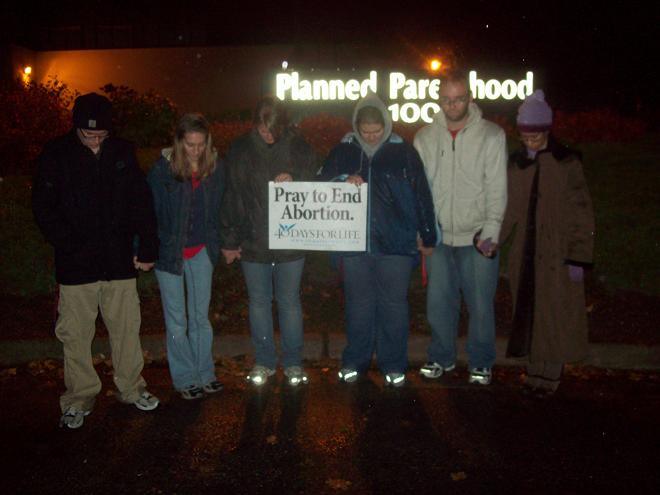
As part of 40 Days for Life, a group I’m in on Campus (Concordia Students for Life) went to an abortion clinic that was shockingly close. I’ll be discussing the experience, and there are a few photos:
When we first arrived on site, there was a man there to talk to us about what we could/could not do, where we could go, etc. It was late evening, so it was closed, but two employees drove by us while we were talking to the man. One of them had her hand over her mouth as she drove past. Not sure what she might have been saying/thinking but I hope that it may have been sorrow or regret of some kind. The man who was there told us about just talking to people, a couple stories, etc. The most striking thing though was him talking about the “medical waste” trucks that would come and take the “waste.” It’s disgusting… discarded babies, hauled as “waste.”
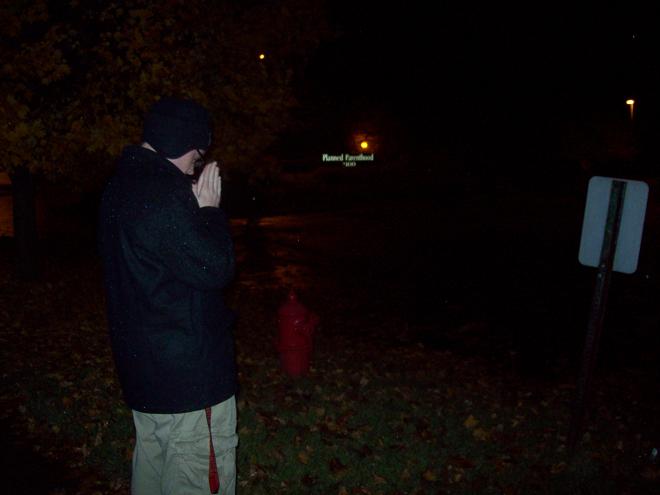
Once the man left, we stood in a circle and prayed. Then we sang some songs, just pieces of hymns or praise songs that we could remember. Then we separated and prayed individually.
The setting was so perfect. It was raining, freezing cold, and dark as sin. It was so striking to think of my previous thoughts on the notion of suffering and how God understands human suffering. Thinking of the rain as God’s tears… and thinking about the fact that just days before we drew 3200 hearts in chalk on the pavement outside the chapel to show the number of hearts each day that are never allowed to love. Those hearts were being washed away at the end of the day, just as the hearts they’d represented had been extinguished that entire day (several of us had this same thought). But we were there to protest, we were there to pray, to ask for forgiveness, and to acknowledge the Redeemer.
It was a truly powerful experience. There is an air about the place, a spiritual kind of malevolence. The moment I stepped onto the general property, I could feel it. I immediately teared up. What could I say? What prayer could I offer? I simply repeated a version of the Kyrie (“Lord have mercy, Christ have mercy, Lord have mercy on us”) the entire time as I prayed with emotions and thoughts, not words, just feelings. What kind of atrocity have we allowed? Will my generation stand against this? I pray it shall be so.
Most striking to me is the difference between just talking about abortion from an impersonal perspective and being at a clinic where I could feel the effects. I’m not trying to say it’s not worth trying to debate abortion from an objective standpoint, but it is so much more real than that (see here for my own arguments against abortion). It’s not something that’s just an interesting topic, but it is a matter of life and death, and it’s a matter of life on death on a huge scale. Several thousand a day in U.S.A. alone. What kind of happiness are we pursuing when we murder the innocent? It speaks volumes about our values that a “choice” is valued above a life. We have become such pragmatists that we can turn a blind eye to the massacre next door. It’s disgusting.
We can’t claim to care about freedom or justice or liberty and deprive thousands of people of their lives each day. It’s horrible. And the only response I can muster, the only prayer I can utter is “Lord have mercy on us.”
There are a couple pictures below.