J.W. Wartick
Book Review: “A Multitude of All Peoples: Engaging Ancient Christianity’s Global Identity” by Vince L. Bantu
 Christianity has always been a global religion, but awareness of those global roots and the impact across the world is not high. Vince L. Bantu, in A Multitude of All Peoples, demonstrates the eclectic, beautiful, global vision of Christianity across the world.
After an introduction looking at Christianity as a global religion, Bantu examines the “roots of Western Christianity Identity Politics. Here, Bantu argues that Christianity as a Hellenistic Latin/Greek religion has its origins in the 3rd/4th century with the rise of Constantine and the sometimes rewriting of church history. With the enshrinement of Christianity as state religion, it became all too easy to see the faith indelibly tied to the state, and specifically the construct of the “West.” This view didn’t entirely come from “Western” sources, either. Bantu shows that Persian Christians, for example, saw the ties of Christianity and Rome and viewed it with some suspicion, seeing the ties of church and state as making Christians loyal to the nation rather than God (21-22). The Hellenization of theology occurred in this period too, despite some of the most important Christian thinking happening outside of the global West. The Council of Chalcedon, long seen as a standard of Orthodoxy, itself used Hellenistic terminology and ended up causing division in the church. Such divisions were exacerbated by political schisms as borders changed (31-33). Bantu traces the history of these through more serious schisms and Christianity’s earliest encounters with Islam.
The next chapter gives an overview of Christianity’s roots in Africa. Egypt was a major part of the growth of Christianity and Christians there trace their lineage through St. Mark. The religious roots of Egypt itself shaped Christianity there, as Bantu argues Cyril explicitly developed Christian theology as a counter to worship of Isis and Horus. Nubia is another major area of growth in Africa, and the conflict between Christianity and Islam there ultimately led to a peace that lasted for centuries. Due to this peace, Nubian Christianity was able to thrive and encounter other cultures that it integrated into Nubian identity (90-93). Ethiopia was noher place of significant growth and development of early Christianity. King Ezana helped integrate Christianity into the area of his domain, and he continued some of his pre-Christian religion as well, forming a kind of syncretism that in some ways lasted for centuries afterwards (100-102). Ethiopian Christianity would go on to influence global Christianity to the extent that seeing Christianity as solely “white man’s religion” instead of a part of African culture is an untenable description (103). North African Christianity also made contributions to global faith and practice, which Bantu traces through Carthage and many other places.
The Middle East also experienced massive growth of Christianity and cannot be ignored when it comes to historical Christianity or the history of the church. Syria was a huge part of this global growth as Antioch became a center of Christianity. Syriac theology and poetry has been formative for Christianity since the outset, though that influence was downplayed throughout long periods of time. Thankfully, a recovery of Syrian Christian traditions and theology is continuing into today (124ff). Lebanon, Arabia, and Armenia also had massive surges of Christanity as it spread across the globe. In Armenia, Christianity confronted Zoroastrianism in complex ways (148ff). The Armenian church continues into today as one of the ancient traditions of Christianity. In Georgia, we find another ancient Christian tradition that reaches back into the fourth century CE. Georgian Christianity continues into today with an identity that is at least “synonymous with the Georgian identity that began in Late Antiquity” (164).
The Silk Road provided a fertile missions field for early Christians as well, and Bantu traces the spread of Christianity through Asia. Persia’s first Christians were largely identified with the Jewish community that had lived there since the Babylonian Captivity in the sixth century BCE. Persian Christians, however, had to encounter a kind of ancient identity politics that demanded they become servants of Caesar in order to be truly Christian. Bantu draws some parallels to today’s own challenges for non-white/non-Western people and Christianity from this (169-170). The origins of Christianity in India have been commonly attributed to the work of the Apostle Judas Thomas, and some interesting historical (and ahistorical) debate over the apocryphal Acts of Thomas and stories therein do not take away from the broader fact that Christianity came to India at a fairly early time (180ff). Christianity also spread across central Asia. Some of this spread was through areas controled by the Mongolian civilization which was generally tolerant for Christianity. China encountered Christianity during the Tang dynasty (618-907CE) and the opening of trade that accompanied it. Contextualization was central to the Christian faith in China, and various symbols were adopted (204ff). Christianity flourised under a tolerant rule of the Mongolians in china but later declined due to persecution and direct anti-Christian campaigns in China and elsewhere (215-217).
A Multitude of Peoples is a necessary read for anyone interested in global Christianity, and, in particular, interested in Christianity beyond what has been called the “West.” It’s an exciting book that makes readers think about the ancient roots of Christian faith even while tracing the successes and failures of the same. Bantu demonstrates unquestionably that Christianity, from its earliest periods, reached across the globe and shaped–and was shaped by–cultures across the world. May it ever be so.
Disclaimer: I was provided with a copy of the book for review by the publisher. I was not required to give any specific kind of feedback whatsoever.
Links
Be sure to check out the page for this site on Facebook and Twitter for discussion of posts, links to other pages of interest, random talk about theology/philosophy/apologetics/movies and more!
Book Reviews– There are plenty more book reviews to read! Read like crazy! (Scroll down for more, and click at bottom for even more!)
SDG.
——
The preceding post is the property of J.W. Wartick (apart from quotations, which are the property of their respective owners, and works of art as credited; images are often freely available to the public and J.W. Wartick makes no claims of owning rights to the images unless he makes that explicit) and should not be reproduced in part or in whole without the expressed consent of the author. All content on this site is the property of J.W. Wartick and is made available for individual and personal usage. If you cite from these documents, whether for personal or professional purposes, please give appropriate citation with both the name of the author (J.W. Wartick) and a link to the original URL. If you’d like to repost a post, you may do so, provided you show less than half of the original post on your own site and link to the original post for the rest. You must also appropriately cite the post as noted above. This blog is protected by Creative Commons licensing. By viewing any part of this site, you are agreeing to this usage policy.
Book Review: “Thomas Cochrane and the Dragon Throne” by Andrew Adam
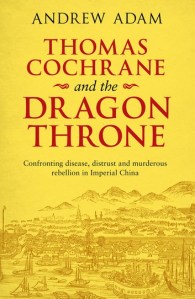 A while ago, I read a fascinating duology of graphic novels about the Boxer Rebellion that showed it from both the side of missionaries and from the side of the Boxers. They were entitled Boxers and Saints and moved me very deeply. I still think about them qutie a bit, and how the interplay of mission work, thoughtful Christianity, colonialism, imperialism, and more all got jumbled together in a mess that makes it difficult to discern any goodness at all. When I saw Thomas Cochrane and the Dragon Throne, I knew I wanted to read it to learn more about this fascinating, awful time.
The book is largely biographical, following the time Thomas Cochrane spent in China as a doctor and a missionary, which overlapped with the Boxer Rebellion and other key developments in Peking. It also features a large amount of fantastic background information for anyone who wants to learn about many different topics. For example, there’s a lot here about the medical practices in China in the early 20th century. There’s also no small amount of discussions of how colonialism from European powers combined with political maneuvering on the part of the Empress Dowager Cixi and others. And, of course, there are more historical details about the Boxer Rebellion. The book is not always for the faint of heart. Both medical information and historical information about the Boxer Rebellion is conveyed in an almost matter-of-fact style that includes graphic descriptions of things like foot binding, torture, and castration. These are all extremely important details, but, again, readers should be aware that they’re not glossed over.
Thomas Cochrane ended up in China at a young age with his wife, Grace, after being inspired by Dwight Moody to become a missionary. He wanted to go where he was needed most, and he truly had a passion for healing the sick, providing his service free of charge and, eventually, delivering a top of the line medical school to help train doctors in modern medicine in China. Throughout the section of his life outlined in this biography, he repeatedly felt like a failure as various ventures collapsed, but it is hard to see his work as not having a deeply positive impact on those with whom he lived. As he worked to both heal and convert people, the Boxer Rebellion broke out, and the Cochrane family was forced to flee. Adam reports this and other harrowing episodes with fascinating details that show the reality of the situation, both from Cochrane’s own writings and from his own firsthand knowledge as the son of Thomas Cochrane’s stepdaughter.
Eventually, Cochrane confronted a cholera epidemic in the Imperial City, managing to gain allies in court as he did so. This opened up new avenues and even allowed him to get help from the chief eunuch and the Empress Dowager. This, in turn, lead to his establishment of the Union Medical College in Peking, China. His vision was for this school to churn out doctors who also would be able to spread knowledge of Christ across the interior of China, but although the school became immensely prestigious, it ultimately became a major graduate school that departed from his vision. Cochrane’s legacy, like that of mission work in general, is complex. It would be hard to question whether his heart was in the right place, and fascinating details like how Cochrane adapted biblical stories to Chinese contexts show his avoidance of the major pitfalls of colonialism (see p. 47, for example, and how Cochrane added Chinese details to biblical stories). Adam has presented a portrait of a man who made a difference in many people’s lives, both temporal and eternal.
Andrew Adam has written a fascinating biography/historical piece that helps shed light on a terrible piece of history. I very highly recommend Thomas Cochrane and the Dragon Throne to any reader. It’s of interest to those who like history, want to learn about Christianity, are interested in China, in medicine, in politics, and more. It’s fantastic.
Disclaimer: I was provided with a copy of the book for review by the publisher. I was not required to give any specific kind of feedback whatsoever.
Links
Be sure to check out the page for this site on Facebook and Twitter for discussion of posts, links to other pages of interest, random talk about theology/philosophy/apologetics/movies and more!
Book Reviews– There are plenty more book reviews to read! Read like crazy! (Scroll down for more, and click at bottom for even more!)
SDG.
——
The preceding post is the property of J.W. Wartick (apart from quotations, which are the property of their respective owners, and works of art as credited; images are often freely available to the public and J.W. Wartick makes no claims of owning rights to the images unless he makes that explicit) and should not be reproduced in part or in whole without the expressed consent of the author. All content on this site is the property of J.W. Wartick and is made available for individual and personal usage. If you cite from these documents, whether for personal or professional purposes, please give appropriate citation with both the name of the author (J.W. Wartick) and a link to the original URL. If you’d like to repost a post, you may do so, provided you show less than half of the original post on your own site and link to the original post for the rest. You must also appropriately cite the post as noted above. This blog is protected by Creative Commons licensing. By viewing any part of this site, you are agreeing to this usage policy.
Book Review: “Keys to Bonhoeffer’s Haus: Exploring the World and Wisdom of Dietrich Bonhoeffer” by Laura M. Fabrycky
 The intersection of the scholarly and the intimate is a rare gift. At first, some readers may think that scholarly works simply cannot be intimate. How can someone be so closely associated with a topic while also writing in a serious, academic way? Laura M. Fabrycky’s work, Keys to Bonhoeffer’s Haus: Exploring the World and Wisdom of Dietrich Bonhoeffer shows how that can be done related to Dietrich Bonhoeffer. By integrating her personal experiences of leading tours at the Bonhoeffer Haus and in Germany with insights into the background of Bonhoeffer’s life, Fabrycky manages to create a unique read in the field of Bonhoeffer scholarship.
Keys to Bonhoeffer’s Haus is a kind of memoir, exploring Fabrycky’s own interaction with Bonhoeffer through her time in Germany. Because of this, it offers a deeply personal look at many aspects of Bonhoeffer’s life. But alongside that, Fabrycky also offers scholarly details to go along with her reflections such that a compelling narrative-driven exploration of Bonhoeffer. But the book provides more than that–it is much more a kind of look at Bonhoeffer’s place and how that impacted his life and decisions. Seeing how locations in Germany were set up helped to understand certain points in Bonhoeffer’s life more thoroughly.
Fabrycky’s style is excellent. The chapter on learning to ride bikes and finding locations related to Bonhoeffer’s life while navigating the strange world (to Americans) of European rules regarding bikes was an absolutely fascinating read. Time and again, Fabrycky’s style drew this reader in to the extent that it truly felt like riding along the streets with her while exploring the interior of Bonhoeffer’s life through buildings and places. Another example of this was her note of the roadside crucifixions, which, contextually, were used by the Nazis to bolster anti-Semitism in portraying the Jews as those to fully blame for killing Christ.
But a strong sense of place and personal reflection are not all that is offered in this fascinating work. Fabrycky continually draws readers’ eyes and imaginations to reading alongside and experiencing alongside Bonhoeffer, examining concepts of friendship, how Bonhoeffer read Scripture, and concepts of loyalty and nationalism. Because these are integrated into a broader, personal narrative, it once again presents readers with a feeling of sitting next to Fabrycky and exploring and experiencing these things oneself. One example is related to Bonhoeffer’s use of Moravian watchwords, called Die Losungen (see Kindle locations 1718ff). Fabrycky writes, “These were, and are, daily Scripture meditations published every year by the Moravian Brethern, a Protestant group that traces its religious heritage to a pre-Reformation movement of pietists who were committed to Scripture, prayer, an evangelism… Bonhoeffer and many others used their so-called watchwords… as a daily devotional practice, and it was one he commended to others as well” (ibid). After reading this, this reviewer looked it up, and it turns out one can subscribe to these to this day via email, and it has been edifying practicing a religious discipline Bonhoeffer himself commended. After reading this from Fabrycky, moreover, this reviewer was reading in Dietrich Bonhoeffer’s works and noticed several times these very watchwords were mentioned in letters and elsewhere. It was a fascinating insight that let this reader focus more on aspects of Bonhoeffer’s works that had been missed before. These kind of insights are found in abundance throughout Keys… and make it an invaluable look at Bonhoeffer’s thought life.
One critique I have is of the portrayal of church and state in Lutheran theology. Fabrycky writes, for example, that Bonhoeffer’s pacifism challenged Lutheran ideals in German society. She also writes that “Being a good Lutheran and a good German meant inhabiting two worlds at the same time… the spiritual… and the secular…but these worlds were fully compartmentalized from one another” (Kindle Location 3922). Much debate has gone into Bonhoeffer scholarship regarding Two Kingdoms theology, and Fabrycky here aligns herself with those who read as Lutheran what others read as distortions of Luther. This may be semantics, but many (such as Trey Palmisano in Peace and Violence in the Ethics of Dietrich Bonhoeffer, review here) have argued that Bonhoeffer’s stance on church and state is the genuine Lutheran position. Further, several have argued that Bonhoeffer’s position is both consistent and draws directly from Luther to offer a corrective to the notion of Volk that turned the Two Kingdoms doctrine into a justification of essentially any state action (see Michael P. DeJonge’s Bonhoeffer’s Reception of Luther, review here). I also favor an approach that sees Bonhoeffer’s theology of church and state–the Two Kingdoms doctrine–both as genuinely Lutheran and consistent, such that his view of pacifism would have challenged those Lutherans who had effectively ceded the Two Kingdoms doctrine to a carte blanche for the state.
Keys to Bonhoeffer’s Haus is an enthralling, captivating read. It reads as though one is exploring Bonhoeffer’s world through the mind of one who has been deeply impacted by close connection with his physical world, even decades removed. It will give readers insights into Bonhoeffer that this reader, at least, hasn’t found elsewhere. It’s the kind of unique work that even the most thorough reader of Bonhoeffer’s life and related works will likely find fresh and insightful. Highly recommended.
Disclaimer: I was provided with a copy of the book for review by the publisher. I was not required to give any specific kind of feedback whatsoever.
Links
Be sure to check out the page for this site on Facebook and Twitter for discussion of posts, links to other pages of interest, random talk about theology/philosophy/apologetics/movies and more!
Book Reviews– There are plenty more book reviews to read! Read like crazy! (Scroll down for more, and click at bottom for even more!)
SDG.
——
The preceding post is the property of J.W. Wartick (apart from quotations, which are the property of their respective owners, and works of art as credited; images are often freely available to the public and J.W. Wartick makes no claims of owning rights to the images unless he makes that explicit) and should not be reproduced in part or in whole without the expressed consent of the author. All content on this site is the property of J.W. Wartick and is made available for individual and personal usage. If you cite from these documents, whether for personal or professional purposes, please give appropriate citation with both the name of the author (J.W. Wartick) and a link to the original URL. If you’d like to repost a post, you may do so, provided you show less than half of the original post on your own site and link to the original post for the rest. You must also appropriately cite the post as noted above. This blog is protected by Creative Commons licensing. By viewing any part of this site, you are agreeing to this usage policy.
Book Review: “But What About God’s Wrath? The Compelling Love Story of Divine Anger” by Kevin Kinghorn with Stephen Travis
God’s Wrath is a question that often comes up when people talk about the attributes of God. But What About God’s Wrath? by Kevin Kinghorn with Stephen Travis attempts to address many of the issues related to God’s wrath and Christian life, as well as several questions about interpretation and reconciling various passages in the Bible.
Kinghorn begins by highlighting some key questions and answers related to God’s wrath. These include pointing towards God’s intentional action in the world. He argues that God’s wrath “typically involves a pattern of action” (19). Such patterns of action typically are related to goals and purposes, and so the question of why God should act in wrath is intricately woven into the question of why God acts in such a way. God’s wrath, he argues, is focused on accomplishing certain purposes within individuals’ lives.
A central aspect of rightly understanding wrath is to see its place in the overall picture of divine act and character. As such, Kinghorn argues that there is a difference between essential attributes of God which entail necessary acts and facts and contingent attributes or acts of God (23-24). The Trinity is essentially love/loving, and this essential attribute can lead to patterns of action that express themselves in different ways (38-39).
God, argues Kinghorn, is committed to the well-being of God’s people, which also means that God will act with benevolence towards all people, having a commitment to seeking human flourishing. This doesn’t cancel all other commitments (eg, to justice), but it does say much about how God acts towards us. But Kinghorn further argues that these other commitments don’t compete with or cancel the commitment to benevolence, they are instead subsumed under that broader category (79-80). God’s wrath, on this view, is a kind of last resort that is intended to press truths about ourselves on us from God (98-99, see also 117ff).
Ultimately, Kinghorn’s conclusion is that while God is a God of love and wrath, God is not such in a “sense that God’s wrath could ever compete with God’s love. God’s wrath and God’s love are not twin, equal pillars…” (154). Using wrath to trump God’s love is moving in the wrong direction.
But What About God’s Wrath? provides thoughtful, challenging arguments to commonly held conceptions about the wrath of God and its important for Christian living and biblical interpretation. Kinghorn argues against many common assumptions related to God’s wrath and shows that there are deeper considerations to be made before making blithe assertions about the wrath of God. Recommended.
Disclaimer: I was provided with a copy of the book for review by the publisher. I was not required to give any specific kind of feedback whatsoever.
Links
Be sure to check out the page for this site on Facebook and Twitter for discussion of posts, links to other pages of interest, random talk about theology/philosophy/apologetics/movies and more!
Book Reviews– There are plenty more book reviews to read! Read like crazy! (Scroll down for more, and click at bottom for even more!)
SDG.
——
The preceding post is the property of J.W. Wartick (apart from quotations, which are the property of their respective owners, and works of art as credited; images are often freely available to the public and J.W. Wartick makes no claims of owning rights to the images unless he makes that explicit) and should not be reproduced in part or in whole without the expressed consent of the author. All content on this site is the property of J.W. Wartick and is made available for individual and personal usage. If you cite from these documents, whether for personal or professional purposes, please give appropriate citation with both the name of the author (J.W. Wartick) and a link to the original URL. If you’d like to repost a post, you may do so, provided you show less than half of the original post on your own site and link to the original post for the rest. You must also appropriately cite the post as noted above. This blog is protected by Creative Commons licensing. By viewing any part of this site, you are agreeing to this usage policy.
“A Crown of Swords” by Robert Jordan – A Christian (Re)reads The Wheel of Time
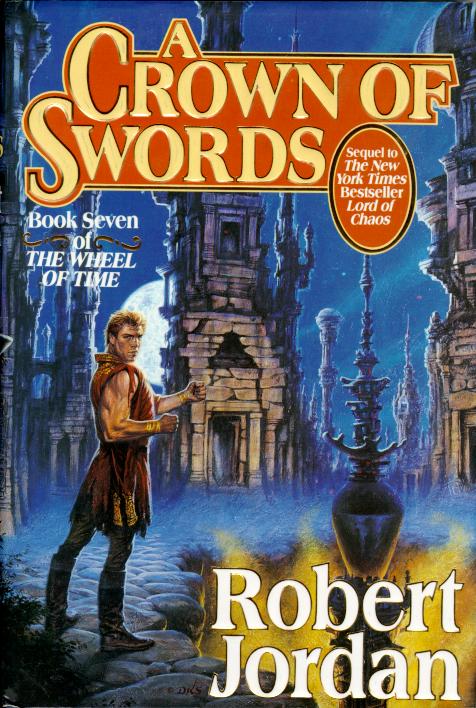
“The Wheel of Time” is a massive fantasy series by Robert Jordan (and, later, Brandon Sanderson) that is being developed into a television show for Amazon Prime. It’s cultural impact is huge, the series having sold more than 44 million copies. Here, we continue our look at the worldview in the series with Book 7, A Crown of Swords. There will be SPOILERS in this post for the series.
Evil Comes in Many Forms
It’s easy to see evil as being all of one sort. The childhood cry of “The Devil made me do it!” is a familiar trope. In The Wheel of Time universe, it’s easy to try to assign all evil to the Dark One or blame one of the Forsaken. It’s just as easy to assume any evil done by an Aes Sedai is due to their being part of the Black Ajah. But the truth is that evil comes in many forms. Evil can be like that of Elaida, who allows her zealousness to overcome her goodness, her thirst for power to overcome her caution. Evil can come from fundamental beliefs, pushed to their extremes.
Elaida is an absolute case study in this, as she starts to lose her grip and becomes controlled by the Black Ajah. Yes, some of her evil is due to that influence, but she’d never have accomplished what she did without her own striving and willingness to compromise justice for an ideal.
Changing Perspective
Viewing things from a different perspective is a theme that remains central to the series. Are men who channel a danger to everyone, or are they a potential way to thwart evil with the use of the Power? The notion of men who can channel faces numerous challenges depending upon one’s perspective in this book. It’s fascinating to see Jordan play with this theme. What applications might it have to our own experience today?
Stereotyping Sex
We continue to have Jordan using the characters to draw out stereotypes about sex. Nynaeve complains about men gossiping all the time to each other–a stereotype that runs opposite of common stereotypes today. Time and again, characters complain about “men” doing something, or how “women” always act in a certain way. I am still trying to discern for myself whether this is Jordan intentionally playing with stereotypes and turning them on their head, or whether Jordan means that there are inherent acts in men and women.
If the latter, that seems to go against reality. Behaviors are learned, and men and women are created equally in the image of God. To reduce their worth to stereotypes or their range of activity to certain assumptions is to do wrong.
Links
The Wheel of Time– Read all my posts on The Wheel of Time (scroll for more).
Be sure to check out the page for this site on Facebook and Twitter for discussion of posts, links to other pages of interest, random talk about theology/philosophy/apologetics/movies and more!
Book Reviews– There are plenty more book reviews to read! Read like crazy! (Scroll down for more, and click at bottom for even more!)
SDG.
——
The preceding post is the property of J.W. Wartick (apart from quotations, which are the property of their respective owners, and works of art as credited; images are often freely available to the public and J.W. Wartick makes no claims of owning rights to the images unless he makes that explicit) and should not be reproduced in part or in whole without the expressed consent of the author. All content on this site is the property of J.W. Wartick and is made available for individual and personal usage. If you cite from these documents, whether for personal or professional purposes, please give appropriate citation with both the name of the author (J.W. Wartick) and a link to the original URL. If you’d like to repost a post, you may do so, provided you show less than half of the original post on your own site and link to the original post for the rest. You must also appropriately cite the post as noted above. This blog is protected by Creative Commons licensing. By viewing any part of this site, you are agreeing to this usage policy.
Book Review: “Weathering Climate Change” by Hugh Ross
 Hugh Ross is the founder of Reasons to Believe, a science-faith think-tank that approaches the topics from an Old Earth Creationist perspective. Ross’s latest book, Weathering Climate Change, presents a view of climate change from that same perspective. Ross, however, does not succumb to the pitfalls of denying climate change or trying to sugarcoat humanity’s impact on it. Instead, the book provides an in-depth look at the factors causing climate change, its potential impact, on ways that humanity might mitigate some of the impact, all set alongside a perspective that sees humanity as called by God to care for creation.
The majority of the book is occupied by presenting readers with the data. This is surely intentional, given the vast array of misinformation available a click away online. Ross presents chart after chart with data from reputable sources, showing the clear fact that what we’re experiencing now is irregular and not simply part of a broader pattern of Earth’s climate change. However, he also notes the historical data and how the Earth has undergone severe climate changes, and notes that our current period of relative stability is an exception.
That said, Ross doesn’t use that climate change to dismiss our current situation–time and again, he notes the severe nature of human impact on the climate and demonstrates that it is much more than another part of Earth’s natural cycle. This care for approaching the data, both modern and ancient, means that Ross is able to present readers with a fuller picture, hopefully leading them to grasp more accurately the state of the climate today.
Ross also analyzes several paths forward to combat climate change. What’s interesting is that he offers these while recognizing human’s sinful propensity to avoid long term problems and continue harmful behaviors that make them comfortable. Many of these solutions are outside of the box. For example, ending all consumption of red meat would make a huge impact, but it would also drive black markets for red meat and many likely would rebel against restrictions on such consumption. So an alternative solution, offers Ross, is to switch the kind of red meat consumed. In a surprising turn, he argues that ostriches could provide a middle way, allowing people to consume red meat (apparently similar to beef), while also mitigating much of the methane (and other) problem(s) related to wide consumption of beef.
Other, more enormous solutions, are also proposed. Re-planting parts of the Sahara, creating massive solar panels that can both block some sunlight while using it for energy, and more are analyzed both for the potential impact they could have and also for their practicality. It’s a quite refreshing turn, and certainly not what skeptics of creationism (honestly, including myself), might expect from someone who’s avowedly a creationist (of the Old Earth variety). The presentation of the data, analysis of solutions, and look at long-term trends are all, so far as this reviewer can tell (as someone who reads science texts but is by no means an expert), quite accurate and informative.
Ross also offers all of this alongside comments that the trends are part of God’s plan for humanity, allowing for humans to be–on his view–created at just the right moment for use of fossil fuels, for climate stability, and more. While some readers may balk at this, it is imperative to underscore the importance of a work like this, that introduces audiences who might otherwise not interact with the climate change data to hard science that backs up broader scientific consensus.
Weathering Climate Change is an unexpected delight. Ross offers a thorough look at the evidence for climate change, the recent history of Earth’s climate (in geologic terms), and potential solutions from the perspective of a creationist, without ever balking at the scientific challenges to his own perspective. He also offers it alongside his characteristic grace with competing views and his heart for speaking about God to those who will hear. I recommend it, even if you (like me), do not necessarily agree with all of his position. It will inform you and maybe even surprise you, as it did me.
Disclaimer: I was provided with a copy of the book for review by the publisher. I was not required to give any specific kind of feedback whatsoever.
Links
Be sure to check out the page for this site on Facebook and Twitter for discussion of posts, links to other pages of interest, random talk about theology/philosophy/apologetics/movies and more!
Book Reviews– There are plenty more book reviews to read! Read like crazy! (Scroll down for more, and click at bottom for even more!)
SDG.
——
The preceding post is the property of J.W. Wartick (apart from quotations, which are the property of their respective owners, and works of art as credited; images are often freely available to the public and J.W. Wartick makes no claims of owning rights to the images unless he makes that explicit) and should not be reproduced in part or in whole without the expressed consent of the author. All content on this site is the property of J.W. Wartick and is made available for individual and personal usage. If you cite from these documents, whether for personal or professional purposes, please give appropriate citation with both the name of the author (J.W. Wartick) and a link to the original URL. If you’d like to repost a post, you may do so, provided you show less than half of the original post on your own site and link to the original post for the rest. You must also appropriately cite the post as noted above. This blog is protected by Creative Commons licensing. By viewing any part of this site, you are agreeing to this usage policy.
Book Review: “Bearing God’s Name: Why Sinai Still Matters” by Carmen Joy Imes
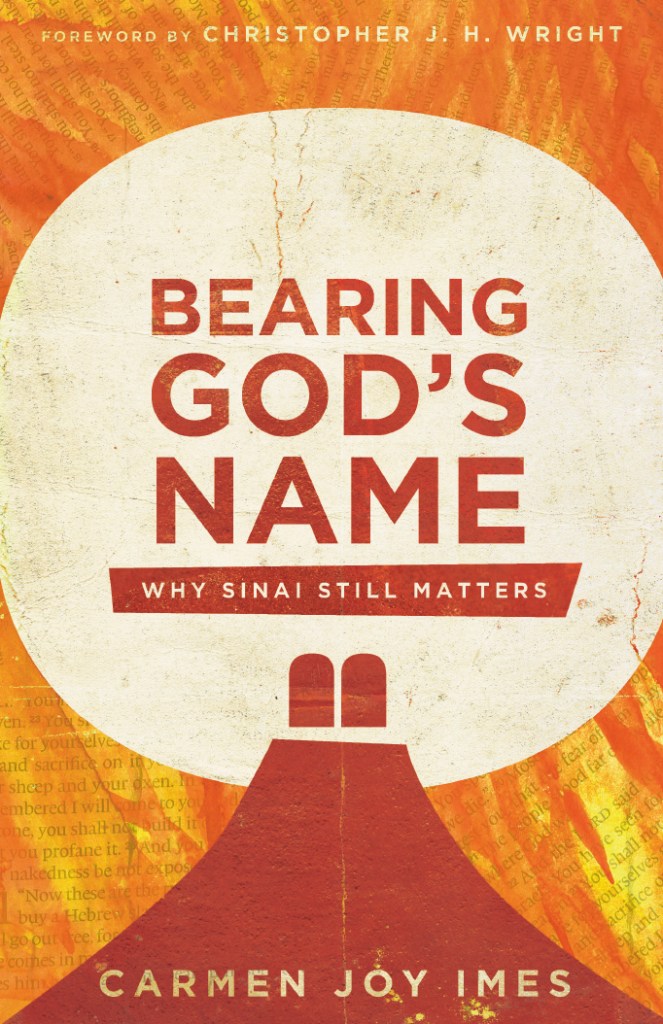
The question of what to do with the Old Testament and what to do with the Law specifically is one that has loomed large throughout all Christian history, from questions about the Judaizers of Acts 15 all the way to the present. Carmen Joy Imes works to provide an answer to several questions about Christianity and its relation to the covenant at Sinai specifically in Bearing God’s Image.
Central to Imes’s argument is the notion that “taking the Lord’s name in vain” is a misunderstood commandment. Instead, we ought to see it in the context of being God’s name-bearers, those who carry God’s word throughout the world.
The first part of the book focuses on becoming the people who are God’s name-bearers. Perhaps the central feature of the book is found in this part as Imes notes several major points related to Christian living. First, the question of the Ten Commandments–Imes notes that people assume the Ten Commandments apply in every way to everyone to this day, but in reality they were part of the cultural mandate going along with the covenant with God at Sinai. Additionally, the second commandment about taking the Lord’s name in vain makes it seem as though God’s name is a swear word, which is almost the exact opposite of what it should be seen as. The commandment, according to Imes, truly is about bearing God’s name falsely–that is, it is a commandment not to claim to be of God while not acting as though one is of God. As she puts it, it ought to “change… everything about how we live” (51, emphasis hers).
Going along with this notion of being God’s name bearers, Imes draws on several sources to highlight the way they practiced religion in the Ancient Near East and how that would play out in context of the commandment. For example, the way covenantal priesthood dressed was itself one aspect of this (72-74).
Part two focuses on how we ought to live as God’s people who bear God’s name. This begins with asking what Moses and Joshua themselves made of this way of living. Next, Imes surveys more of the Old Testament to draw out living in God’s name throughout the Bible. Jesus is another way to live out God’s name, as Jesus is the name above all other names (151ff). She draws this same strand through some of the epistles as well.
Bearing God’s Image is written at an introductory level and could serve as a study group book fairly easily. It would help readers get exposed to many ideas related to the Christian use of the Hebrew Scriptures. It’s a solid introduction to a complex topic. Recommended.
Disclaimer: I was provided with a copy of the book for review by the publisher. I was not required to give any specific kind of feedback whatsoever.
Links
Be sure to check out the page for this site on Facebook and Twitter for discussion of posts, links to other pages of interest, random talk about theology/philosophy/apologetics/movies and more!
Book Reviews– There are plenty more book reviews to read! Read like crazy! (Scroll down for more, and click at bottom for even more!)
SDG.
——
The preceding post is the property of J.W. Wartick (apart from quotations, which are the property of their respective owners, and works of art as credited; images are often freely available to the public and J.W. Wartick makes no claims of owning rights to the images unless he makes that explicit) and should not be reproduced in part or in whole without the expressed consent of the author. All content on this site is the property of J.W. Wartick and is made available for individual and personal usage. If you cite from these documents, whether for personal or professional purposes, please give appropriate citation with both the name of the author (J.W. Wartick) and a link to the original URL. If you’d like to repost a post, you may do so, provided you show less than half of the original post on your own site and link to the original post for the rest. You must also appropriately cite the post as noted above. This blog is protected by Creative Commons licensing. By viewing any part of this site, you are agreeing to this usage policy.
Book Review: “The Gospel of the Son of God: An Introduction to Matthew” by David R. Bauer
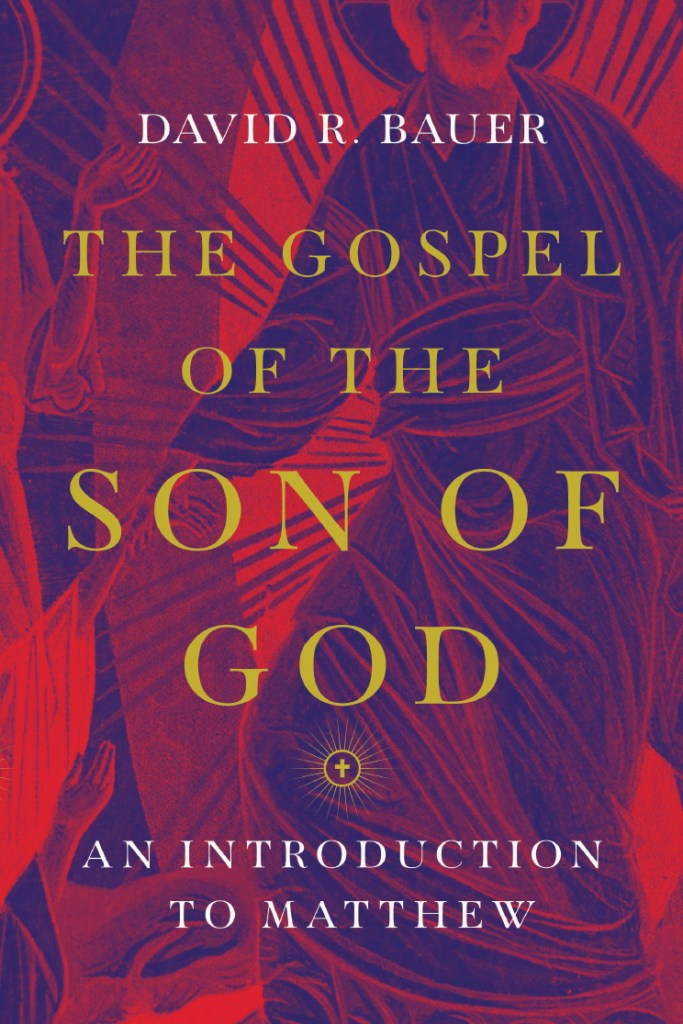
Matthew is probably the most well-known Gospel, whether due to its ordering in most copies of the New Testament at the beginning or its balance between being readable and theological, it is immensely popular. David Bauer seeks, with The Gospel of the Son of God, to introduce the book of Matthew to readers while also drawing out its theological insights and major themes.
The first part of Bauer’s text focuses on the “orientation” of Matthew: its form and genre, the approach and method of studying Matthew, the circumstances of Matthew’s composition, and the shape of the text itself. In this first part, it is the chapter on method for studying Matthew that I found most interesting, as Bauer surveys the many methods that have been leveled at the text, whether from various textual critical methods or more modern or ancient methods. What Bauer points out is that each of these methods tends to focus on just one aspect of the Gospel at the expense of others (40). He offers instead an inductive approach that attempts to work from the Gospel towards its interpretation, which includes many of the methods he discussed already.
The second part focuses on interpretation of Matthew, dividing the book into three sections. I found Bauer’s look at the earliest part of Matthew, that which most readers are both familiar with and probably skip over in parts, to be quite fascinating. I especially enjoyed Bauer’s analysis of the genealogy and its ties to various theological themes throughout the Bible and the New Testament. Bauer tends to avoid major controversy throughout the book with his interpretation.
Part three offers a reflection and conclusions on the book of Matthew, with particular focus on who Jesus is, discipleship, and eschatology. Time and again, the titles and works attributed to Jesus are aligned with those of God, demonstrating Matthew’s high Christology. Along with this, there are things like the formula of Matthew 28:18-20 that demonstrate the unity of persons in the Godhead (eg. the singular ‘name’ of Father, Son, and Holy Spirit). Two chapters here are dedicated to the titles of Jesus and Christology, showing Bauer’s emphasis as well as Matthew’s as lying firmly within questions of who Jesus is and what he came to do. It’s a fairly detailed look at Christology within the broader work of interpreting Matthew.
As an aside, I’d like to mention the indices for the book are well-done, though I wish there a subject index. The author index, bibliography, and Scripture index are excellent.
The Gospel of the Son of God is a fascinating look at one of the most popular books of the Bible. For those readers looking to dive more deeply into the Bible, this introduction to the whys and hows of Matthew is an excellent work. Recommended.
Disclaimer: I was provided with a copy of the book for review by the publisher. I was not required to give any specific kind of feedback whatsoever.
Links
Be sure to check out the page for this site on Facebook and Twitter for discussion of posts, links to other pages of interest, random talk about theology/philosophy/apologetics/movies and more!
Book Reviews– There are plenty more book reviews to read! Read like crazy! (Scroll down for more, and click at bottom for even more!)
SDG.
——
The preceding post is the property of J.W. Wartick (apart from quotations, which are the property of their respective owners, and works of art as credited; images are often freely available to the public and J.W. Wartick makes no claims of owning rights to the images unless he makes that explicit) and should not be reproduced in part or in whole without the expressed consent of the author. All content on this site is the property of J.W. Wartick and is made available for individual and personal usage. If you cite from these documents, whether for personal or professional purposes, please give appropriate citation with both the name of the author (J.W. Wartick) and a link to the original URL. If you’d like to repost a post, you may do so, provided you show less than half of the original post on your own site and link to the original post for the rest. You must also appropriately cite the post as noted above. This blog is protected by Creative Commons licensing. By viewing any part of this site, you are agreeing to this usage policy.
Book Review: “Bonhoeffer’s Theology of the Cross” by J. I. de Keijzer
 Act and Being is perhaps Dietrich Bonhoeffer’s most opaque and difficult book. J. I. de Keijzer seeks, in Bonhoeffer’s Theology of the Cross, to show that Bonhoeffer’s book was, in fact, constructing a theology of the cross in conversation with Karl Barth, Martin Heidegger, and, most importantly, Martin Luther.
The introduction lays out de Keijzer’s project, including an emphasis on seeing Bonhoeffer in his context and, specifically, as a Lutheran theologian. This latter point is important, because de Keijzer goes on to emphasize the need to avoid starting with a defined theology of the cross in order to read that back onto Bonheoffer (and Barth–more on that soon) but instead to draw on the work of the individual to allow them to outline their theology of the cross (31). He then goes on to outline Barth’s theology of the cross and argue that Bonhoeffer is, himself, intentionally arguing for an alternative. Evidence for this is derived from Act and Being, Bonhoeffer’s second dissertation, and how it argues in a parallel structure to Karl Barth’s “Fate and Idea.”
After showing that Bonhoeffer’s Act and Being is intended as a parallel and contrasting project to Barth’s own theology of the cross, de Keizjer notes several points of divergence Bonhoeffer takes over and against Barth. One of these is the argument over whether the finite can contain the infinite (Bonhoeffer sides with Lutheran theology here, and de Keijzer shows that the Lutheran view does not stumble in the ways Reformed/Calvinist theologians often charge it with). (He expands on this both on 42-43 and 109-111, the latter of which shows how this is a major dividing line between the two Reformation branches of theology.) Another is a series of problems Bonhoeffer–explicitly or not–shows in Barth’s theology, such as how Barth’s theology is individualistic rather than comunal, that he (Barth) essentially made Christianity into a branch of idealism (47-49), and most famously, Bonhoeffer’s charge that Barth’s theology is a negativism of revelation. The latter receives quite a bit of space in de Keizjer’s work, as he argues that Bonhoeffer sees Barth’s work as failing to fully create a Christian theology. The negativism (or positivism) in Barth’s thought regarding theology receives an answer, according to de Keijzer, in Bonhoeffer’s use of the theology of the cross because Bonhoeffer’s own theology offers 3 things that Barth’s does not: 1. it offers helpful insight to the nonreligious person; 2. it does not undercut grace as a gift; 3. it provides guidance in nonreligious interpretations of theological concepts (52-54).
Martin Luther also looms large in de Keijzer’s discussion, as he notes that Luther cannot simply be reduced to one along a continuum of theologians who argued for a theology of the cross (55ff). Instead, Luther’s insights were essential for Bonhoeffer and, argues de Keijzer, for rightly understanding the theology of the cross in general. God’s real presence in and for the world is absolutely central to a right understanding of the incarnation and how God is present in Jesus’s flesh (57-58). Moving ahead, de Keijzer argues that Bonhoeffer’s theology of the cross provides a strong basis for just such a theology, giving several essential elements toward that end, such as the ambiguous relationship between revelation/faith and reason, the ability to use spacial metaphors fruitfully in theology, movement from the cross to the world, Christ on the cross as God acting in behalf of humanity, and a radically sacramental understanding of the body of Christ.
Luther’s influence continues as de Keijzer notes that while it may look as though Bonhoeffer and Luther diverged regarding epistemology and faith, that is far from the case. Luther’s epistemological project was to make room for grace in his own context, while Bonhoeffer’s project was to break the epistemological barrier created by idealism in order to retrieve grace (115ff). Luther continues to be central to Bonoheffer in the latter’s reading of Heidegger. Heidegger himself was heavily influenced by Luther, and Bonhoeffer utilized Heidegger’s philosophy in Act and Being to deconstruct rationalistic schemes (127ff, esp. 138-140). Ultimately, of course, Bonhoeffer’s project is heavily focused on ecclesiology and how through the church, Christ truly is present with God’s people (162ff).
Bonhoeffer’s Theology of the Cross is a fascinating look at a specific aspect of Bonhoeffer’s theology, and, more specifically, the points he was elucidating in his complex Act and Being. De Keizjer does a fantastic job of both explaining the finer points of Bonhoeffer’s view in contrast to his contemporaries and interlocutors while also showing how Bonhoeffer’s work may be applied to Christian life today. Highly recommended.
Disclaimer: I was provided with a copy of the book for review by the publisher. I was not required to give any specific kind of feedback whatsoever.
Links
Be sure to check out the page for this site on Facebook and Twitter for discussion of posts, links to other pages of interest, random talk about theology/philosophy/apologetics/movies and more!
Book Reviews– There are plenty more book reviews to read! Read like crazy! (Scroll down for more, and click at bottom for even more!)
SDG.
——
The preceding post is the property of J.W. Wartick (apart from quotations, which are the property of their respective owners, and works of art as credited; images are often freely available to the public and J.W. Wartick makes no claims of owning rights to the images unless he makes that explicit) and should not be reproduced in part or in whole without the expressed consent of the author. All content on this site is the property of J.W. Wartick and is made available for individual and personal usage. If you cite from these documents, whether for personal or professional purposes, please give appropriate citation with both the name of the author (J.W. Wartick) and a link to the original URL. If you’d like to repost a post, you may do so, provided you show less than half of the original post on your own site and link to the original post for the rest. You must also appropriately cite the post as noted above. This blog is protected by Creative Commons licensing. By viewing any part of this site, you are agreeing to this usage policy.
Jon Meacham's "The Hope of Glory" and Reconstructing Faith

Jon Meacham is best known as a biographer of Presidents, whether his excellent look at Thomas Jefferson’s life (my review here), or his Pulitzer-winning biography of Andrew Jackson. His recent work, The Hope of Glory, is a short reflection on Jesus’s words from the cross. I grabbed it after I got an email from Goodreads in which Meacham described his perspective and talked about his faith. I thought it might be interesting to see his perspective, but have to admit I was a little worried due not wanting to see some sort of patriotic deity paraded in front of me. I shouldn’t have been worried. What I found instead was a pithy, frank discussion of faith alongside some theological reflection. I found it helpful in my own reading as I’ve been reconstructing faith.
Meacham writes that, “For the thoughtful believer… there is nothing more certain than the reality of uncertainty, nothing more natural than doubt…” (12). He notes the difficulty with seeking certainty: “Fundamentalist believers and fundamentalist atheists would both do well… to acknowledge that literalism may be comforting but is ultimately dangerous, for an uncritical acceptance of one worldview or another (whether in religion or politics) ends more conversations than it begins” (13). Though I feel more certain now than I had before, a lot of that is due to my decision to “go public” with my own thoughts about faith. The common saying about the more you know, the more you know you don’t know seems so true to me in regards to Christianity and faith. While once, I felt so certain that I could demonstrate my beliefs were superior to those of others’, I no longer feel that way.
Fundamentalism is a frequent target of Meacham, and he even goes so far as to note that it can be sinful: “Literalism is for the weak; fundamentalism is for the insecure. Both are sins, too, against God, for to come to believe that we are in exclusive possession of the truth about things beyond time and space, and thus hold the power to shape lives about things within time and space, is to put ourselves in the place of God” (69-70). Over and over again, I see people who talk about the “clear teaching of Scripture” and how those who disagree with them are sinning due to their rejection of God’s word. But if that’s true, how is it possible that people do, seemingly in good conscience, disagree on so many of these “clear” issues? I think that we need to be very careful about what we say is so clear. What is clear for one of us may not be clear to all. We get in danger of reductionism when we push for the “yes or no” clarity of certainty.
Meacham notes that we as Christians “are called to use our minds as well as our hearts in reading the Bible…” and that we need not ignore possible difficulties in the Bible. He goes so far as to say that one can hold the Scriptures are “perhaps inspired but certainly fallible” (42). His wording is strong, to the point I’m not sure agree (I would affirm the Bible is inspired, for example), but part of his effort seems to be to force readers to think through their assumptions and certainties and see where there may be problems.
Meacham writes about hell, and he argues that one can find verses to contradict each other on the topic, such that a reader who wants to insist on literal interpretations will end up in a “guerrilla war that never ends” as they “fight… verse-to-verse” (90). One thing I’ve contemplated a lot as I reconstruct faith is the notion of the polyvalence of Scripture. I don’t remember where I first heard the term–it may have been Peter Enns–but I know I reacted poorly the first time I heard it. But more and more, I’ve thought about it as I’ve read and reflected on Scripture in my reading and devotion times. I think about how Kings and Chronicles portray the Kings of Israel and Judah in different, sometimes apparently competing ways. What does that mean for our own reading of Scripture? What does it mean as we try to take it seriously and read at as inspired?
Meacham’s book is a fascinating, challenging read that highlights his love of Jesus while also noting his own perspectives related to Scripture and believers. It’s worth reading and challenging yourself to look beyond individual quotes and think about what he says. Like me, you may find yourself nodding along at times, while at others you may sit back in contemplation and wonder about your own faith journey.
Links
Reconstructing Faith– Read other posts as I search for truth and navigate the messiness that is faith.
Be sure to check out the page for this site on Facebook and Twitter for discussion of posts, links to other pages of interest, random talk about theology/philosophy/apologetics/movies and more!
SDG.
——
The preceding post is the property of J.W. Wartick (apart from quotations, which are the property of their respective owners, and works of art as credited; images are often freely available to the public and J.W. Wartick makes no claims of owning rights to the images unless he makes that explicit) and should not be reproduced in part or in whole without the expressed consent of the author. All content on this site is the property of J.W. Wartick and is made available for individual and personal usage. If you cite from these documents, whether for personal or professional purposes, please give appropriate citation with both the name of the author (J.W. Wartick) and a link to the original URL. If you’d like to repost a post, you may do so, provided you show less than half of the original post on your own site and link to the original post for the rest. You must also appropriately cite the post as noted above. This blog is protected by Creative Commons licensing. By viewing any part of this site, you are agreeing to this usage policy.

 J.W. Wartick - Reconstructing Faith