J.W. Wartick
Book Review: “The Making of Stanley Hauerwas: Bridging Barth and Postliberalism” by David B. Hunsicker
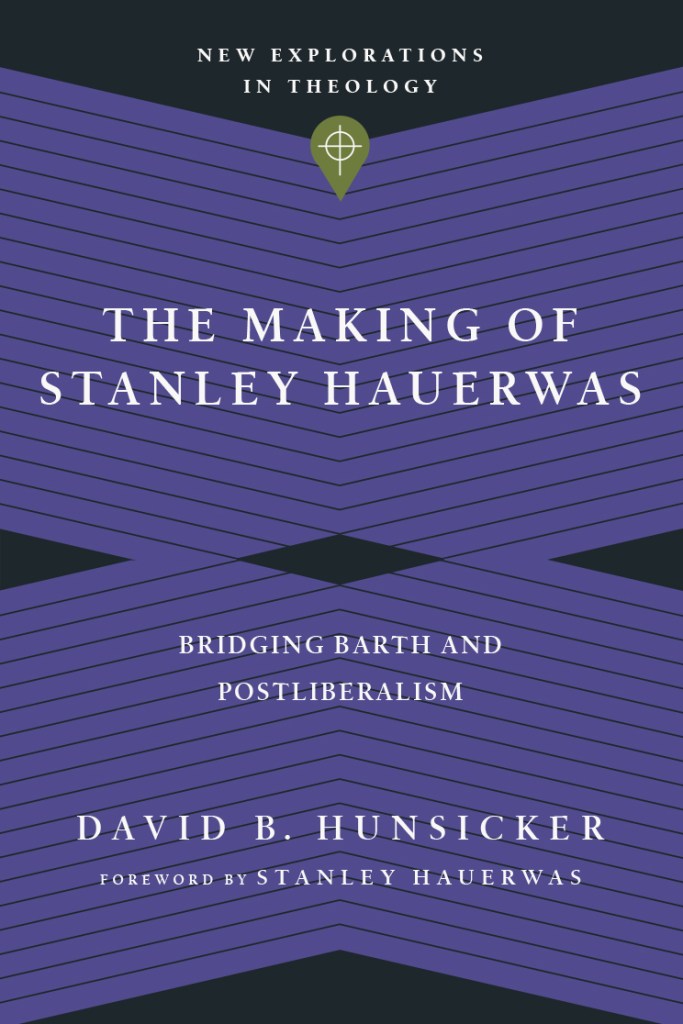
Stanley Hauerwas is one of the most influential theologians of our time. He is well-known for his pacifism, as well as his works on theological ethics more generally. David B. Hunsicker, in The Making of Stanley Hauerwas, sheds valuable insight into the influences on Hauerwas as well as how he has created his own synthesis of thought.
Central to the book are the concepts of postliberalism and Barthianism. Is Hauerwas a Barthian, as he claims? Or is he fully in the postliberal camp, as others have charged? Of course, the definitions of “Barthian” and “postliberal” are highly relevant to this. A Barthian, Hunsicker argues, can fairly be described as someone who has a genuine understanding of and use of Barth. It is possible to be someone who is “indirectly influenced” by Barth by interacting but perhaps not understanding Barth (3-4). Postliberalism is difficult to pin down, with somewhat broad and slippery definitions. Ultimately, Hunsicker notes that there is no single postliberalism (8) but that it can still be a useful way to categorize thinkers among a broad stream of thought. Specifically for Hauerwas, Hunsicker argues that he falls into postliberalism’s pragmatic bent within theology (9). Hauerwas, then, is envisioned in this book as a Barthian postliberal–he’s both/and rather than either/or when it comes to those often opposed categories.
The rest of the book delves into the details of Hauerwas’s ethical theology in order to draw out both the influence of Barth on it and to show his innovations, all set within the context of Hauerwas’s stated claims to be genuinely trying to interpreter Barth and apply his theology to today. He starts with a chapter outlining the influences on Hauerwas from his life. Then, he shows how Hauerwas moves with and beyond Barth.
Next is a brief case study on the question of abortion from a theological, ethical perspective. This chapter is of particular interest because it shows how Hauerwas applies both postliberal and Barthian insights to make a theological case against abortion. It also shows how those united streams of thought create a different case against abortion that rejects a natural law framework and instead grounds the debate theologically. Part of this is a rejection of accepting the premises of non-Christians in debates over the topic (79). It’s a fascinating chapter that shows Hauerwas’s own ethical innovations on Barth’s uncompromising theology.
The following chapters go back and forth on showing influences and usage of Barth and postliberalism by Hauerwas. The last section wraps up the book by giving insights into Hauerwas’s doctrine of the church, itself a major part of Barth’s project.
Hunsicker is unafraid to be critical of the subject of his work. Regarding Hauerwas defense of John Howard Yoder and the way he sexually abused many women, Hunsicker notes somewhat laconically that this “problematizes” Hauerwas’s dependence upon Yoder’s work.
The Making of Stanley Hauerwas is a deep, engaging look at the theological and ethical formation of one of the most important theologians of our time. For those interested in Hauerwas’s work, it is an absolute must-read. For me, as one who hasn’t engaged much with Hauerwas, it was still of great interest, with several points that caused me to think more deeply on theological and ethical topics.
Disclaimer: I was provided with a copy of the book for review by the publisher. I was not required to give any specific kind of feedback whatsoever.
Links
Be sure to check out the page for this site on Facebook and Twitter for discussion of posts, links to other pages of interest, random talk about theology/philosophy/apologetics/movies and more!
Book Reviews– There are plenty more book reviews to read! Read like crazy! (Scroll down for more, and click at bottom for even more!)
SDG.
——
The preceding post is the property of J.W. Wartick (apart from quotations, which are the property of their respective owners, and works of art as credited; images are often freely available to the public and J.W. Wartick makes no claims of owning rights to the images unless he makes that explicit) and should not be reproduced in part or in whole without the expressed consent of the author. All content on this site is the property of J.W. Wartick and is made available for individual and personal usage. If you cite from these documents, whether for personal or professional purposes, please give appropriate citation with both the name of the author (J.W. Wartick) and a link to the original URL. If you’d like to repost a post, you may do so, provided you show less than half of the original post on your own site and link to the original post for the rest. You must also appropriately cite the post as noted above. This blog is protected by Creative Commons licensing. By viewing any part of this site, you are agreeing to this usage policy.
Craig Keener on Women in the Ministry (Video and Discussion)
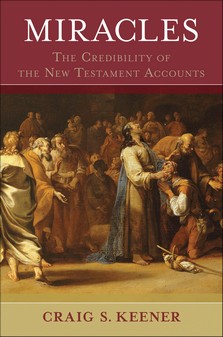
Craig Keener is a renowned New Testament scholar. In some of the circles I run in–circles with Christian apologetics at the forefront–he is well-known for his work on miracles in the New Testament and defense of their possibility and actually having happened. Other circles appreciate the depth of his work on Acts and commentaries on the New Testament more generally. But many of these same people reject the notion of having women in the ministry. In particular, many of these same people assert that one cannot take the Bible seriously and advocate for women pastors. But those people either don’t know or are inconsistent about the scholars they cite so favorably for biblical scholarship also affirming women pastors. Craig Keener is but one example.
His recent talk, Women in Ministry, was posted on Youtube recently. In it, Keener provides a detailed introduction to the biblical egalitarian position. I encourage you–whether you agree or disagree with Keener’s position–to watch the video. Let’s have some discussion about it, if we can! I’ve set out some things to think about with the video:
Keener notes some of the common objections to women in the ministry and shows how they would be ridiculous when applied the other way. For example, arguing against women who are named to positions in the church throughout the NT, some complementarians say that no women are actually named as pulpit preachers. But of course no male is named in that role anywhere in the Bible, either. So for the argument to work, no one would be allowed to be a pastor.
Can one seriously claim, watching this video, that egalitarians simply reject what the Bible has to say? Keener demonstrates time and again that careful interpretation favors the egalitarian position. What do you think?
Links
Women in the Ministry– Keener’s talk about women in the ministry in the Bible.
Be sure to check out the page for this site on Facebook and Twitter for discussion of posts, links to other pages of interest, random talk about theology/philosophy/apologetics/movies and more!
Book Reviews– There are plenty more book reviews to read! Read like crazy! (Scroll down for more, and click at bottom for even more!)
SDG.
——
The preceding post is the property of J.W. Wartick (apart from quotations, which are the property of their respective owners, and works of art as credited; images are often freely available to the public and J.W. Wartick makes no claims of owning rights to the images unless he makes that explicit) and should not be reproduced in part or in whole without the expressed consent of the author. All content on this site is the property of J.W. Wartick and is made available for individual and personal usage. If you cite from these documents, whether for personal or professional purposes, please give appropriate citation with both the name of the author (J.W. Wartick) and a link to the original URL. If you’d like to repost a post, you may do so, provided you show less than half of the original post on your own site and link to the original post for the rest. You must also appropriately cite the post as noted above. This blog is protected by Creative Commons licensing. By viewing any part of this site, you are agreeing to this usage policy.
“Debate on the Evidences for Christianity” – Alexander Campbell vs. Robert Owen (1829) Part 3- Historical Apologetics Debates
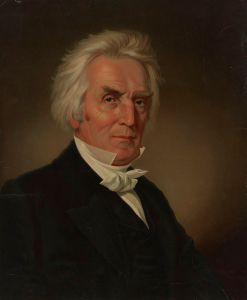
Alexander Campbell (1788-1866)
Alexander Campbell (1788-1866) was a Scots-Irish immigrant in the United States who debated Christianity with a few well-known skeptics. One of his best known debates was with Robert Owen (1771-1858), who argued in favor of agnosticism. This debate was published as “Debate on the Evidences of Christianity” (1829, see link for download). Here, will look at what answers Campbell gave and where his arguments might have been improved. Owen was a fine opponent whom Campbell himself acknowledged as a worthy scholar.
Debate on the Evidences for Christianity Part III
Campbell’s reply
Campbell here rises and responds to Owen by going back to the propositions he seeks to prove, namely, Owen is trying to demonstrate that all religions are founded upon ignorance; that all religions “are directly opposed to the never-changing laws of nature”; that all religions are the “source of vice, disunion, and misery of every description”; that religions are the “only bar” to human society forming in a way of charity and intelligence; and that religions can no longer be maintained but by “the ignorance of the mass of the people, and the tyranny of the few over that mass” (30).
Each of these propositions, notes Campbell, is independent of the others and requires its own set of proofs. The twelve facts that Owen alleged (p. 22-23) themselves require establishment and also interpretation–how are they to be applied in such a way as to demonstrate the five propositions Owen seeks to demonstrate against religion? After some other preliminary concerns, Campbell also notes the difficulty of pinning down exactly how Owen is using key terms in the debate. This may seem to be a kind of obfuscation on Campbell’s part, but given the broadness of Owen’s claims, it is important, as Campbell notes, to understand how Owen is using terms like divine, religion, morality, virtue, and the like. Owen throws these terms out alongside what he calls proofs without really going into how these are proven. If it is true that all religions lead to vice–what is it that is meant by vice? One might think that it is a vice to waste one’s time going to a worship service every week, but that is only a vice if the worship itself is to a false god and truly a waste of time. Indeed, some modern studies have suggested that going to church can improve mental health, suggesting that even if there is no God, the practice itself may have pragmatic benefit.
Looking back to Campbell and Owen’s time, the terms in question are therefore very important, and coming to agreement on their use is beneficial. But again, one wonders if the debate will be able to get off the ground if it begins to circle the questions of exacting definitions of every term.
Campbell then moves to the offensive and suggests that he could affirm each of Owen’s 12 facts and still have no trouble maintaining his belief. He notes several reasons for this, including that the facts pertain to the physical and so cannot prove or disprove the metaphysical; that the facts, if granted, do not seem to have a specifically logical connection to any of Owen’s 5 theses; and that the facts themselves require organization into premises (33-34).
Owen then Rises
Owen surprisingly suggests that:
it did not, nor does it now, appear to me that I stand pledged to prove the fallacy of the Christian religion, separated from all other religions. To me they all appear one and the same in principle and in general practice, except the difference in the rites and ceremonies, which I deem mere
form. (35)
After some back-and-forth over the exact nature of the debate, Owen continues, asserting once again that Campbell and others are not to blame for their alleged ignorance in being Christian any more than anyone of any other religious tradition is to blame for their own. Each, he suggests, is merely the product of their time and circumstance, such that if one were born to a family of Buddhists, one would be Buddhist. Thus, Campbell happens to be Christian, but one can’t blame him for it (37). Here, it is worth noting something that Owen has yet to acknowledge. Namely, that his own birth is also a product of time and circumstance, and so perhaps his own beliefs are a product of the same whims of history that he alleges all religious believers succumb to. After all, if he believes that the chance of one’s birth is truly a logical reason to doubt the beliefs one has, then what makes his own system of beliefs excluded from the same charge?
Owen’s reading of his address digresses into areas of his own personal interest, including the allegation that two sciences are now capable of being spread globally: the science of “influence of circumstance over human nature” and the science of the “means of creating infinite wealth and of its equal distribution” (38). He alleges that if all humans would just embrace this knowledge, the need for religion would disappear, all revolutions would cease, etc. It seems possible that if we could truly generate infinite wealth and distribute it evenly, that might end a number of societal ills, but whether Owen truly possessed such a knowledge remains to be seen.
Campbell answers that Owen has yet to establish an argument for his positions, and the meeting adjourned for the moment. Here, we, too, will await the next installment.
Questions
- Does the chance of one’s birth provide a reason to doubt one’s beliefs? If so, how? If not, why not?
- How important is it to establish definitions in a discussion like this debate?
Links
Be sure to check out the page for this site on Facebook and Twitter for discussion of posts, links to other pages of interest, random talk about theology/philosophy/apologetics/movies and more!
Apologetics Read-Through: Historical Apologetics Read-Along– Here are links for the collected posts in this series and other read-throughs of apologetics books (forthcoming).
Dead Apologists Society– A page for Christians interested in the works of historical apologetics. There is also a Facebook group for it.
SDG.
——
The preceding post is the property of J.W. Wartick (apart from quotations, which are the property of their respective owners, and works of art as credited; images are often freely available to the public and J.W. Wartick makes no claims of owning rights to the images unless he makes that explicit) and should not be reproduced in part or in whole without the expressed consent of the author. All content on this site is the property of J.W. Wartick and is made available for individual and personal usage. If you cite from these documents, whether for personal or professional purposes, please give appropriate citation with both the name of the author (J.W. Wartick) and a link to the original URL. If you’d like to repost a post, you may do so, provided you show less than half of the original post on your own site and link to the original post for the rest. You must also appropriately cite the post as noted above. This blog is protected by Creative Commons licensing. By viewing any part of this site, you are agreeing to this usage policy.
Book Review: “Spirit Outside the Gate: Decolonial Pneumatologies of the American Global South” by Oscar García-Johnson

Oscar García-Johnson’s work, The Spirit Outside the Gate, focuses on how the Holy Spirit–and the “logic of Pentecost”–tears down borders and decolonizes Christianity.
That introduction is dense, and itself needs some unpacking. Essentially, García-Johnson argues that Christians’ history of global conquest–specifically of European conquest–has led to an association of Christianity with a logic that creates borders and sets up the “Other” as “outside the gate.” In contrast to this, he argues that Christianity has the capacity of freedom through the Holy Spirit to unite Christians across the globe. He makes this argument through the examination of specific pneumatologies–studies of the Holy Spirit.
The argument is woven throughout the book and is complex. First, García-Johnson notes the narrative(s) of the American Global South as well as some challenges and visions therein. Then, he highlights the meaning of “gates” and how theologies have been constructed as almost gatekeepers in ensuring that those “outside” the gate do not have a voice. Next, he highlights some specific ways in which there are “ungating Christian logics” in the Global South. For example, Christian epistemology is taken to be a direct challenge to colonial power, along with several systems of thought that undermine unity, equity, and equality (99). More specific explorations of various pneumatologies follow, and García-Johnson wraps up the discussion with ways that global Christianity can integrate the insights of the American Global South to create a “church without borders” that exhibits the power of the Spirit.
The Spirit Outside the Gate is a challenging read. Time and again I had to re-read sections to grasp exactly what was being argued, not because of lack of clarity but because of the complexity of the topics involved. García-Johnson here issues a truly interdisciplinary challenge to Christianity to take seriously the message of freedom that comes with the Holy Spirit. In doing so, he puts the work and power of the Holy Spirit at the center of Christian thought and understanding in ways that the Spirit has not frequently enough been highlighted. It’s a fascinating, difficult book. Recommended.
Disclaimer: I was provided with a copy of the book for review by the publisher. I was not required to give any specific kind of feedback whatsoever.
Links
Be sure to check out the page for this site on Facebook and Twitter for discussion of posts, links to other pages of interest, random talk about theology/philosophy/apologetics/movies and more!
Book Reviews– There are plenty more book reviews to read! Read like crazy! (Scroll down for more, and click at bottom for even more!)
SDG.
——
The preceding post is the property of J.W. Wartick (apart from quotations, which are the property of their respective owners, and works of art as credited; images are often freely available to the public and J.W. Wartick makes no claims of owning rights to the images unless he makes that explicit) and should not be reproduced in part or in whole without the expressed consent of the author. All content on this site is the property of J.W. Wartick and is made available for individual and personal usage. If you cite from these documents, whether for personal or professional purposes, please give appropriate citation with both the name of the author (J.W. Wartick) and a link to the original URL. If you’d like to repost a post, you may do so, provided you show less than half of the original post on your own site and link to the original post for the rest. You must also appropriately cite the post as noted above. This blog is protected by Creative Commons licensing. By viewing any part of this site, you are agreeing to this usage policy.
Book Review: “The Collected Sermons of Dietrich Bonhoeffer: Volume 2” edited by Victoria J. Barnett

Dietrich Bonhoeffer is one of the most influential theological voices of the 20th century, whose words resonate into the 21st century in wonderful and sometimes challenging and surprising way. Victoria J. Barnett, editor of Dietrich Bonhoeffer’s Works in English, has, with The Collected Sermons of Dietrich Bonhoeffer, Volume 2, put together a collection of his sermons that is both relevant and insightful into his life.
Barnett introduces each sermon so that readers have a context in which to place it. Often, this demonstrates the radical nature of his sermons as well as other biographical details about Bonhoeffer that shine through in his preaching. For example, when the German church experienced a takeover by the Nazis, Bonhoeffer preached sermons that went against the grain of going along with the state.
It is difficult to find a place to begin to understand a man like Dietrich Bonhoeffer. Each word he wrote seems so carefully considered, each quote needs to be placed within its broader context. It is easy to misquote him or to twist what he said. As such, a collection of sermons like this is almost an ideal entry point into his theology. Not only does a sermon contain whole theological points, but it also does so in a somewhat condensed form. One could argue–rightfully, I think–that drawing individual quotes from Discipleship may actually do damage to understanding the whole. But with sermons, one can listen, analyze, and parse wholly contained thoughts in a more condensed form.
Another thing that the collection does well is display the whole range of Bonhoeffer’s talent for sermons. Yes, his sermons tended on the scholarly side, but he tailored his sermon to the audience, and some of them are deeply personal. Others explore heavy theological concepts like the communication of attributes.
A few quotes from Bonhoeffer’s sermons seem in order to demonstrate the depth of this text:
We have become accustomed to seeing religion as something that corresponds to a need of the human soul and satisfies this need… But we forget the one most important question: whether religion is also something true, whether it is the truth.
Bonhoeffer, preaching from Finkenwalde after the Confessing Church refused to publicly come out condemning antisemitism:
“Babylon, which on its own power defies Christ, the crucified Lord… Babylon.. demands nothing of its subjects except blind love and intoxication… who would dare say that this Babylon is not eternal?–it will take a bad fall–woe to it!–how anxiously the Christian community… must… have yearned for its fall!”
Bonhoeffer makes a direct link between the hatred and action against a group of people (Jews) and defiance of Christ and acting as the apocalyptic Babylon.
Time and again stirring insights like these pour from the pages of Bonhoeffer’s sermons.
The Collected Sermons of Dietrich Bonhoeffer, Volume 2 is a valuable addition to any theological library. Even if one already owns his entire collected works, this collection puts together a number of impactful sermons with important contextual details that make it a necessary part of a Bonhoeffer collection.
Disclaimer: I was provided with a copy of the book for review by the publisher. I was not required to give any specific kind of feedback whatsoever.
Links
Be sure to check out the page for this site on Facebook and Twitter for discussion of posts, links to other pages of interest, random talk about theology/philosophy/apologetics/movies and more!
Book Reviews– There are plenty more book reviews to read! Read like crazy! (Scroll down for more, and click at bottom for even more!)
SDG.
——
The preceding post is the property of J.W. Wartick (apart from quotations, which are the property of their respective owners, and works of art as credited; images are often freely available to the public and J.W. Wartick makes no claims of owning rights to the images unless he makes that explicit) and should not be reproduced in part or in whole without the expressed consent of the author. All content on this site is the property of J.W. Wartick and is made available for individual and personal usage. If you cite from these documents, whether for personal or professional purposes, please give appropriate citation with both the name of the author (J.W. Wartick) and a link to the original URL. If you’d like to repost a post, you may do so, provided you show less than half of the original post on your own site and link to the original post for the rest. You must also appropriately cite the post as noted above. This blog is protected by Creative Commons licensing. By viewing any part of this site, you are agreeing to this usage policy.
Book Review: “Richard Dawkins, C.S. Lewis, and the Meaning of Life” by Alister McGrath
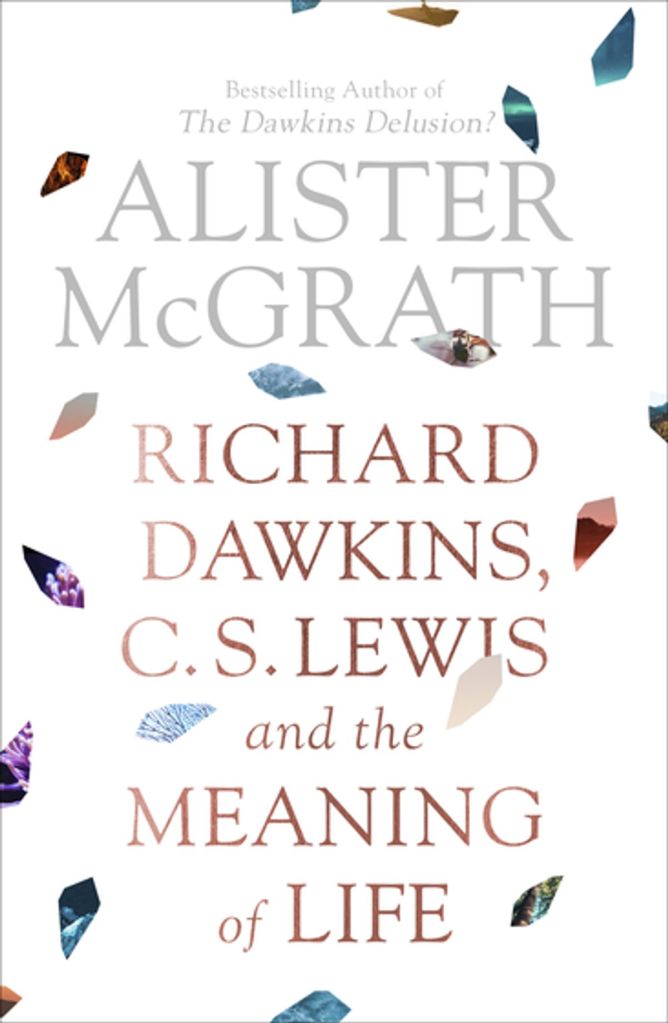
Alister E. McGrath, in Richard Dawkins, C.S. Lewis, and the Meaning of Life, constructs a pithy look at the titular question through the lenses of two of the most famous (or infamous, depending your leanings) thinkers of the last century.
This short volume features four chapters about, respectively, why meaning matters, reasoned belief, whether there is a God, and what human nature is. C.S. Lewis and Richard Dawkins almost could not be more far afield in their answers to these questions, but McGrath does a good job integrating thoughts of each of them into the text so that readers can understand some of the answers they gave.
What may surprise readers at times is how Dawkins’s views effectively take to extremes some of Lewis’s cautions. For example, Dawkins is highly critical of myth and the notion of letting it control our lives. But Lewis isn’t an ignorant fool simply because he was a Christian. Lewis himself offers cautions regarding the way that myths can lead to stigmatization and false beliefs (13). On another extreme, Dawkins purports to believe that science is proof and effectively nothing else is. But Lewis notes that the very concept of proof is illusive even on some physical questions. Do we need to discount the possibility of any true beliefs simply because we cannot prove them?
What is perhaps most interesting is the very brief synthesis of thought McGrath offers near the end, where he notes that while these thinkers disagree sharply on the meaning of various questions, they agree that there are problems in the way of pursuing human goals and that there are limitations on human nature. For Dawkins, the primary thing in the way, so to speak, is our own genetic and evolutionary past, to which we may be dancing whether we want to or not. For Lewis, the captivity of sin has engulfed us and prevented us from pursuing goals.
Ultimately, McGrath leaves the questions open ended at the close of the book. What he accomplishes in Richard Dawkins, C.S. Lewis, and the eaning of Life is to get readers to consider these deep questions and perhaps how they may relate to each other. He also opens up avenues for further exploration.
Disclaimer: I was provided with a copy of the book for review by the publisher. I was not required to give any specific kind of feedback whatsoever.
Links
Be sure to check out the page for this site on Facebook and Twitter for discussion of posts, links to other pages of interest, random talk about theology/philosophy/apologetics/movies and more!
Book Reviews– There are plenty more book reviews to read! Read like crazy! (Scroll down for more, and click at bottom for even more!)
SDG.
——
The preceding post is the property of J.W. Wartick (apart from quotations, which are the property of their respective owners, and works of art as credited; images are often freely available to the public and J.W. Wartick makes no claims of owning rights to the images unless he makes that explicit) and should not be reproduced in part or in whole without the expressed consent of the author. All content on this site is the property of J.W. Wartick and is made available for individual and personal usage. If you cite from these documents, whether for personal or professional purposes, please give appropriate citation with both the name of the author (J.W. Wartick) and a link to the original URL. If you’d like to repost a post, you may do so, provided you show less than half of the original post on your own site and link to the original post for the rest. You must also appropriately cite the post as noted above. This blog is protected by Creative Commons licensing. By viewing any part of this site, you are agreeing to this usage policy.
Frozen 2: A Christian Perspective- Changes, Safety, and Love

Frozen 2 released on November 22, 2019 to a smashing success. The first movie is among the most beloved films from Disney in recent times, and the second had much to live up to. Here, I offer a look at some major themes in the movie, evaluating it from a Christian perspective. Let me know what you thought in the comments! There will, of course, be SPOILERS in what follows.
My Love is Not Fragile – Seeking the Unchanging
A major theme throughout the film, whether it’s “Some Things Never Change”–one of the headlining pieces from the soundtrack, or the constant question of whether love can endure through hardships and whether promises can be counted on.
Perhaps the most poignant line in the movie for me was when Kristoff was talking with Anna near the climax. Anna apologizes for leaving him, and his response is “My love is not fragile.” It’s a strong affirmation of the strength of his love for Anna. Love is perhaps the central theme of the interactions of the characters–whether it’s friendship, the love among family, or the love of a relationship, it is presented as being the kind of thing that doesn’t change.
Of course, we also know that that kind of love does change–it waxes and wanes, and can even fade away entirely. Relationships break, conditions are set where there ought to not be any, people lie, cheat, and betray each other.
From a Christian perspective, though, we also know that love is something unchanging, because it reflects the nature of God. God is love, and God’s love is not fragile–it is the sturdiest, most powerful thing in the universe. Because of God’s love, we are saved. Frozen 2, then, reflects that truth for us–even as we may wonder at the changing nature of the world around us, we can remind ourselves that “some things never change” and that that is where we can ground our hope.
Colonialism and Having it All?
Another central theme of the movie is that of conflict between Arandelle and the Northuldra people. It turns out that Elsa and Anna’s grandfather made a treaty with the Northuldra but betrayed them, angering the spirits of the forest and leading to a break between the two peoples that appears irreparable. But the time in the woods has led to a kind of uneasy truce between the soldiers from Arandelle and the Northuldra people in the enchanted forest.
As Elsa and Anna discover the truth of the past, it is Anna who takes direct action to heal the division, realizing that the building of a dam to benefit Arandelle was also a way to destroy Northuldra’s way of life. She gets the massive stone giants to destroy the dam, and Arandelle itself is saved by Elsa’s magic. In a way, this is an everybody wins kind of scenario. It is through the direct intervention of the spirits (more on this below) that the waters settle in a way that doesn’t continue to threaten Arandelle.
In our own world, we have many situations like Arandelle and Northuldra, many situations where one group of people have taken advantage of another, marginalized them, even actively killed them. How do we work to heal those wounds? Perhaps the most important first step is to listen–really listen–to the “other” and take seriously their concerns. Direct action may even be necessary–action that might place one’s own interests at risk. Dietrich Bonhoeffer once wrote that peace is something that must be dared, and as Christians we need to be willing to dare that peace. We need to be willing to dare that we can help make amends for past mistakes, and try to bring healing in places where there has only been hurt.
Spirits and the Spirit
I mentioned the forest spirits already, but it’s worth reflecting on them again. Each of the spirits is explained through natural phenomena, in a way. The fire spirit is a kind of salamander creature that burns, the wind is… wind, water is the movement of the waves, and earth is the power of the ground in earthquakes and some stone giants. Yes, these are mythical and magical elements, but they can also provide a way for looking at the world by Christians as well. We know that in God all things live and move and have their being (Acts 17:28), and the Spirit of God is working in our world still. Even as we find natural explanations for things like the wind an the movement of the earth, that doesn’t mean that God is absent; rather, it means that God is working with God’s own creation, sustaining it and nurturing it. When we destroy God’s creation with our greed or our inaction, we are dishonoring God.
Conclusion
Frozen 2 is a very different film from the first installment. It is deeper, older, and wiser. It has more inside jokes for adults, and it has themes that most kids probably won’t entirely understand. It is a way to speak with kids about the nature of God through God’s unchanging love and God’s sustaining creation. It also gives a way to look on the complex past of human relationships and how we need to work for reconciliation.
Links
Be sure to check out the page for this site on Facebook and Twitter for discussion of posts, links to other pages of interest, random talk about theology/philosophy/apologetics/movies and more.
Engaging Culture: A brief guide for movies– I outline my approach to evaluating movies from a worldview perspective.
I have a number of ways in which I have critically engaged with culture in movies, books, and other arts in my posts on current events (scroll down for more posts).
SDG.
——
The preceding post is the property of J.W. Wartick (apart from quotations, which are the property of their respective owners, and works of art as credited; images are often freely available to the public and J.W. Wartick makes no claims of owning rights to the images unless he makes that explicit) and should not be reproduced in part or in whole without the expressed consent of the author. All content on this site is the property of J.W. Wartick and is made available for individual and personal usage. If you cite from these documents, whether for personal or professional purposes, please give appropriate citation with both the name of the author (J.W. Wartick) and a link to the original URL. If you’d like to repost a post, you may do so, provided you show less than half of the original post on your own site and link to the original post for the rest. You must also appropriately cite the post as noted above. This blog is protected by Creative Commons licensing. By viewing any part of this site, you are agreeing to this usage policy.
Book Review: “A Week in the Life of a Slave” by John Byron

A Week in the Life of a Slave by John Byron is a combination of an historic fiction novel and a text exploring background of 1st Century Christianity. Like other books in the series, this one features a number of biblical characters. It focuses on the persons of Philemon and Onesimus, weaving what we know from the Bible into a narrative that jumps back and forth between Ephesus and Laodicea and into early Christianity.
The book is set up so that readers can go through and just read the plot, but throughout there are insets that give deep background information relevant to the plot. Readers are treated, then, to a book that is a combination of a story that asks questions of the biblical text–what was happening in the background?–while also giving a wealth of information to those wanting to know about the world of early Christianity.
The main plot is good, with its focus on Philemon and Onesimus, centered around Paul as well. The way it bounced back and forth between cities created some interest. The value of the book, though, is more to be found in the background information provided that helps readers understand what’s happening in the Bible. What was slavery like in Rome? What rights did slaves have? When the Bible speaks of conversions of households, what did that mean for slaves? What were some of the gods being worshiped in the cities mentioned in the Bible? These, and many, many more questions are answered throughout the book.
A Week in the Life of a Slave is another fascinating entry in this series. It gives readers deep insights into what slavery was like in the first century world in which Christianity was born while also delivering some background to make an intriguing plot for some familiar names. Recommended.
Disclaimer: I was provided with a copy of the book for review by the publisher. I was not required to give any specific kind of feedback whatsoever.
Links
Be sure to check out the page for this site on Facebook and Twitter for discussion of posts, links to other pages of interest, random talk about theology/philosophy/apologetics/movies and more!
Book Reviews– There are plenty more book reviews to read! Read like crazy! (Scroll down for more, and click at bottom for even more!)
SDG.
——
The preceding post is the property of J.W. Wartick (apart from quotations, which are the property of their respective owners, and works of art as credited; images are often freely available to the public and J.W. Wartick makes no claims of owning rights to the images unless he makes that explicit) and should not be reproduced in part or in whole without the expressed consent of the author. All content on this site is the property of J.W. Wartick and is made available for individual and personal usage. If you cite from these documents, whether for personal or professional purposes, please give appropriate citation with both the name of the author (J.W. Wartick) and a link to the original URL. If you’d like to repost a post, you may do so, provided you show less than half of the original post on your own site and link to the original post for the rest. You must also appropriately cite the post as noted above. This blog is protected by Creative Commons licensing. By viewing any part of this site, you are agreeing to this usage policy.
Book Review: “All Things New: Revelation as Canonical Capstone” by Brian J. Tabb
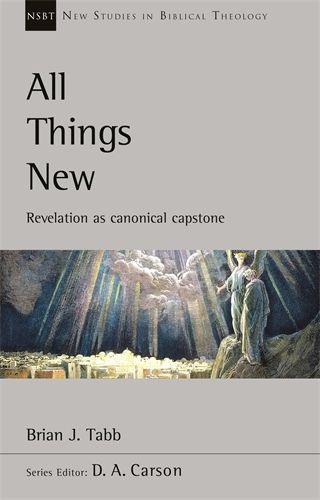
Revelation inspires extremes of opinions. Today, people heatedly argue over its meaning, what is to be taken literally, when its events will/have/should happen. It was challenged on its canonicity in the Reformation and before. What can be done to bring some light to this mysterious, complex book? Brian J. Tabb attempts, in All Things New, to provide a way forward in reading Revelation not as an obscure, impenetrable text, nor as a newspaper to tell us about the end times, but rather as a capstone of Scripture that highlights theological themes throughout the whole Bible.
Tabb notes in the introduction the disputed nature of Revelation. Rather than trying to refute all the positions with which he disagrees, he instead seeks from the beginning to build a reading of Revelation that makes sense of its place in Scripture.
First, Tabb turns to how Revelation reveals the Triune God, highlighting the use of language throughout the Bible to demonstrate how the book reveals God’s Triuine nature. This first part is a fascinating section as Tabb draws on broad swathes of Scripture to show that the author of Revelation drew from all over the Bible to demonstrate the Trinity as well as the work of the divine Persons. Next, Tabb turns to themes in Revelation of suffering for God, witnessing, and worship. The third part focuses on judgment, salvation, and restoration. Here again Tabb’s argument is holistic, seeking to show how the author of Revelation drew from Biblical imagery to make their argument about these themes. It is important to note the way that the author of Revelation uses this language, which seems to work against the notion that they took everything literally themselves, picking and choosing from throughout the canon to make their points. Finally, part four shows Revelation’s view of the word of God as trustworthy, prophetic, and true.
Tabb’s work here is admirable in that he has written a book that could benefit readers of many different views related to the book of Revelation and its meaning. All Things New is a helpful book in clarifying the meaning and purpose of one of the most debated and confusing books in the canon.
Disclaimer: I was provided with a copy of the book for review by the publisher. I was not required to give any specific kind of feedback whatsoever.
Links
Be sure to check out the page for this site on Facebook and Twitter for discussion of posts, links to other pages of interest, random talk about theology/philosophy/apologetics/movies and more!
Book Reviews– There are plenty more book reviews to read! Read like crazy! (Scroll down for more, and click at bottom for even more!)
SDG.
——
The preceding post is the property of J.W. Wartick (apart from quotations, which are the property of their respective owners, and works of art as credited; images are often freely available to the public and J.W. Wartick makes no claims of owning rights to the images unless he makes that explicit) and should not be reproduced in part or in whole without the expressed consent of the author. All content on this site is the property of J.W. Wartick and is made available for individual and personal usage. If you cite from these documents, whether for personal or professional purposes, please give appropriate citation with both the name of the author (J.W. Wartick) and a link to the original URL. If you’d like to repost a post, you may do so, provided you show less than half of the original post on your own site and link to the original post for the rest. You must also appropriately cite the post as noted above. This blog is protected by Creative Commons licensing. By viewing any part of this site, you are agreeing to this usage policy.
“Darwin Devolves” – Behe’s Rewriting of Evolution: A Critique from a Christian
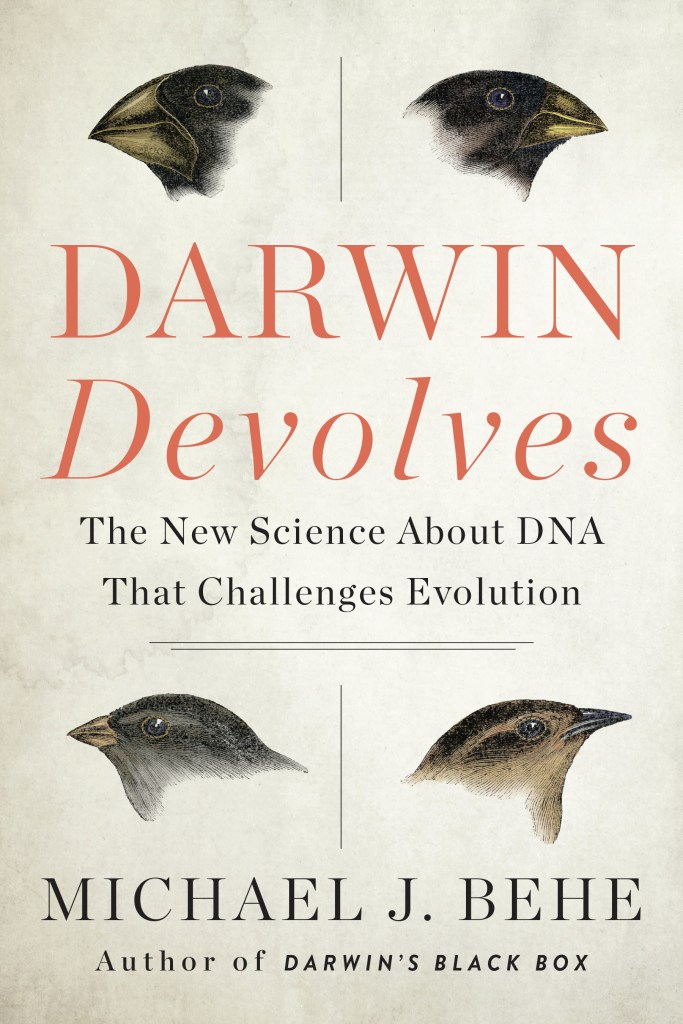
Michale Behe’s latest book, Darwin Devolves, purports to demonstrate that a major challenge to evolution is that rather than producing new functions, the demonstrable changes that we can see in experimental science is due to “devolution” or loss-of-function in genes. Behe bases this, in part, on his “First Rule”: “The First Rule of Adaptive Evolution… Break or blunt any functional coded element whose loss would yield a net fitness gain” (185). (It’s stated somewhat differently on the first page of the book: “The First Rule of Adaptive Evolution: Break or blunt any functional gene whose loss would increase the number of a species offspring” – emphasis his.)
I am sympathetic to Behe’s project. As a Christian, I would prefer there to be testable, obvious proof that God exists, and Intelligent Design theory purports to be that for at least some kind of cosmic “intelligence.” On the flip side, I am also wary, because I recall Dietrich Bonhoeffer’s words that “a god who could be proved by us would be an idol” (DBWE 11, 260). I’m not convinced that God works in such a way as to leave tantalizing fingerprints all over everything for us to find. God is personal and we relate to God in a personal way, not in an abstract way that can remain impersonal or without challenge. For most of my life, I was a young earth creationist, and then spent several years studying apologetics and advocating ID theory. Since then, I’ve become much more skeptical of ID theories, and Behe’s book illustrates several of the reasons why.
Selection Effect
One of the biggest difficulties I have with Behe’s book here, as well as with ID in general, is that there is, of necessity, a selection effect happening in the examples used. That is, the human author making the argument must be selecting examples rather than showing the whole range of life and applying their theory to it (to do the latter would be prohibitively time-consuming and likely impossible). But because there is such human agency in selecting the examples, the tendency towards selecting those examples which most easily support one’s theory is at least possibly in play.
In Darwin Devolves, selections of which evidence is discussed appears to be a large part of the weight of the argument. Evidence is mustered from polar bears and the deleterious way they acquired (perhaps not the term Behe would use) “white” fur, from laboratory experiments with bacteria and fruit flies, and from the (in)famous Darwin’s Finches. In each case, it is shown (I believe demonstrated–though I admit I’m not an expert so it is possible that this is wrong) that the “evolution” of certain features (eg. different forms of beak, see p. 143ff) is not new information or beneficial mutations but rather mutations or deletions genetically that are acting on existing DNA in ways that Behe calls “devolutions” rather than evolution.
Though it seems contentious to change the terminology of genetic reshuffling/deleting on existing information to “devolution” when it seems most assuredly an example of evolution (if not, necessarily, fitting within Behe’s specific definition(s)–more on that below), assuming Behe is right here, it would be a fascinating argument if it carried the day. But Behe must demonstrate, for his argument to work and for evolution (again, his usage) to fail, that such deletions/reshuffling is the case in every single instance of purported evolution. That would be a monumental task (and likely impossible), but one way to approach it would be to broaden the selection of data and to take on some of the most powerful evidences of evolution. But here we see the selection of Behe appears to be quite artificial. In addition to the selection effect, Behe fails to note that the very thing he’s arguing shows the failure of evolution as a theory (loss-of-function, etc.) in a lab experiment for E. Coli are, in fact, an expected outcome for such a lab experiment, and the evidence for genuinely new information is dismissed.
Additionally, given Behe’s language about loss-of-function and his “first rule,” readers would be right to expect that the data would support loss-of-function as the predominant, if not the only, means by which scientists have been able to mention what they call evolution. But that is demonstrably not the case. Rice and Lang note:
In humans only ∼3.5% of exonic and splice site variants (57,137 out of 1,639,223) are putatively loss‐of‐function (Saleheen et al. 2017), and a survey of 42 yeast strains found that only 242 of the nearly 6000 genes contain putative loss‐of‐function variants (Bergström et al. 2014).
Gregory Lang and Amber Rice ” Evolution unscathed: Darwin Devolves argues on weak reasoning that unguided evolution is a destructive force, incapable of innovation” https://onlinelibrary.wiley.com/doi/full/10.1111/evo.13710
Behe’s challenge to evolution doesn’t mention these and other related facts. The selection effect is operating strongly here, and it is selecting out those aspects of the data that do not match the theory.
Misrepresentations and Language
Throughout the book, there were difficulties with Behe’s use of terminology and misrepresentations of arguments. The definition of “evolution,” for example, seems malleable to fit Behe’s needs. He begins by noting that Darwin’s own theory couldn’t account for genetic data (Darwin didn’t know about it) and so had to be modified. But as more modifications to the theory happen, Behe seems to take that as evidence that evolution is, minimally, in crisis. Chapter 4 is dedicated to the various ways scientists have modified the theory of evolution, according to Behe–in order to “shoehorn” various discoveries into it. But one would hardly discredit the theory of gravity due to the fact that it has been modified to account for more modern discoveries. Would Behe use the same charged language that we have “shoehorned” in modern science to the theory of gravity in order to discred it? Doubtful.
Additionally, Behe is quick to dismiss evolution and evidence for it as useless or baseless. For example, across pages 22-24 he notes various examples that have been said to have evolved and then asserts that deleting the word “evolved” doesn’t change the information in the sentence. For example, “Birds like the silky flycatcher… that are mistletoe specialists have evolved a ‘wiggle dance.'” Behe then asserts that no information is lost if one just says the birds “have a wiggle dance.” But this seems to be clearly untrue, for the claim that the birds “evolved” a wiggle dance would include in it inherited traits, genes, and behaviors, where as merely “having” a dance does not. Even if one is anti-evolution, the claim that deleting the word “evolved” from sentences like that doesn’t delete information seems puzzling.
Behe is also keen to discredit natural selection. On 99-100 he offers an example that he alleges proves that increased DNA is not due to selection but rather entirely to the amorphous term called “luck.” But renaming selection “luck” doesn’t really undermine the fact that Behe doesn’t seem to have an answer for how DNA increases within his “First Rule” system. Indeed, across these pages, he actually attributes the formation of DNA increase to environmental factors and having the increased DNA continue due to isolation. But that is exactly what evolutionary theory suggests–when populations are isolated, there is the chance for selection to operate differently one one group than on another. Behe saying this is “serendipity” or “luck” seems clear obfuscation on his part–avoidance of the fact that it is exactly due to factors alleged by evolution to drive natural selection that has led to increase in DNA.
Perhaps the part of the book is Behe’s charge that evolution must produce entirely new lifeforms, including new phyla, given enough time. In looking at Darwin’s finches, he argues that the changes among them is incredibly tiny, given the amount of time they’ve had as an isolated population. he asserts that it is “very unlikely” that an environmental factor is limiting their evolution (155) and goes on to ask whether 2 million years in isolation is too little time for evolution to make major changes. After noting that “profoundly different animal phyla… arose during the Cambrian explosion… in only about ten million years” (ibid), along with some other swift evolution, he incredibly states: “Surely we should expect at least one crummy new phylum, class, or order to be conjured by Darwin’s vaunted mechanism in the time the finches have been on the Galapagos. But no, nothing” (ibid). Behe’s claim is, frankly, absurd. I don’t know of any evolutionary biologist who suggests that entirely new phyla are a necessary outcome of long-term isolation. Additionally, to compare the emergence of phyla during the Cambrian–before life had even begun to walk the land–to the state of the islands is disingenuous to the highest degree. Remarkably, Behe does nothing to acknowledge the extreme differences between the examples he cited and the state of the islands; instead, he writes, “A surprising but compelling conclusion is that Darwin’s mechanism has been wildly overrated–it is incapable of producing much biological change at all” (ibid). There is can be no doubt that this strong conclusion is in no way demonstrated by the fact that finches didn’t transform into new phyla, but Behe draws these kind of strong conclusions from minimal data throughout the book.
Conclusion
Darwin Devolves is tantalizing in theory, but in practice it does not prove what it sets out to prove. It would be nice, as the dust jacket states, to come to the point where “It’s time to acknowledge the conclusion that only an intelligent mind could have designed life.” But with all those weighted terms comes a burden of proof that is not met in the text. I have no doubt that an intelligent mind–God–brought forth life, but I remain unconvinced that God did so in a way that required direct intervention throughout the process.
Links
What options are there in the origins debate? – A Taxonomy of Christian Origins Positions– I clarify the breadth of options available for Christians who want to interact on various levels with models of origins. I think this post is extremely important because it gives readers a chance to see the various positions explained briefly.
What is the relationship between Christianity and science?- An Overview of 4 Views– How should the Christian faith interact with science? Do they interact at all? I survey 4 major views on these and other questions.
Be sure to check out the page for this site on Facebook and Twitter for discussion of posts, links to other pages of interest, random talk about theology/philosophy/apologetics/movies and more!
Origins Debate– Read a whole bunch more on different views within Christianity of the “origins debate.” Here I have posts on young and old earth creationism, intelligent design, theistic evolutionism, and more!
SDG.
——
The preceding post is the property of J.W. Wartick (apart from quotations, which are the property of their respective owners, and works of art as credited; images are often freely available to the public and J.W. Wartick makes no claims of owning rights to the images unless he makes that explicit) and should not be reproduced in part or in whole without the expressed consent of the author. All content on this site is the property of J.W. Wartick and is made available for individual and personal usage. If you cite from these documents, whether for personal or professional purposes, please give appropriate citation with both the name of the author (J.W. Wartick) and a link to the original URL. If you’d like to repost a post, you may do so, provided you show less than half of the original post on your own site and link to the original post for the rest. You must also appropriately cite the post as noted above. This blog is protected by Creative Commons licensing. By viewing any part of this site, you are agreeing to this usage policy.

 J.W. Wartick - Reconstructing Faith