J.W. Wartick
Really Recommended Posts 10/21/16- Reading the Bible, a pro-life argument, and more!
 Go Cubs! Enjoy the reads.
The What-He-Did: The Poetic Science Fiction of Cordwainer Smith– Cordwainer Smith was a Christian who also happened to be an expert in psychological warfare, among other things. He wrote science fiction that is strange and alluring and poetic all at once, and imbued with his worldview.
Spoilers– Too often, we assume that because we’ve read it before, or know the “spoilers” of the story, we know exactly what the Bible is teaching. Is that really the case?
The Most Undervalued Argument in the Pro-Life Movement– A defense of a rather simple argument for the pro-life position.
Let’s All Be Nicene– The continuing debate over eternal subordination of the Son is, frankly, disturbing to me. I think the call to be Nicene is an appropriate one. This is a post highlighting some of the issues with those who are for eternal subordination of the Son and its problems.
6 Myths About Advocating for Women in Ministry– Don’t be deceived by false arguments that advocating for women in the ministry is somehow detrimental to the church.
“Here I stand, I can do no other, so help me God. Amen.”– A brief account and reflection on Luther’s famous words.
Did the Son have a beginning? – Origen vs. heresies
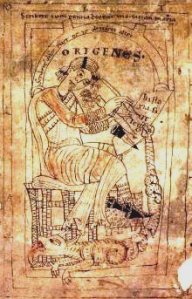
Image credit: https://commons.wikimedia.org/wiki/File:Origen3.jpg – Public Domain
Origen (184-253 AD) was one of the earliest defenders of the Christian faith.* In his work, Contra Celsum, he engaged with a Greek skeptic who brought many arguments against Christianity. In his De Principiis, he laid out the foundations of the Christian faith. (Both works are availble in The Works of Origen.) The latter work demonstrates key points to understanding the relationship between God the Father and God the Son:
John… says in the beginning of his Gospel, “And God was the Word, and this was in the beginning with God.” Let him, then, who assigns a beginning to the Word or Wisdom of God, take care that he be not guilty of impiety against the unbegotten Father Himself, seeing he denies that He had always been a Father, and had generated the Word…
This Son, accordingly, is also the truth and life of all things which exist… For how could those things which were created live, unless they derived their being from life? (Origen, De Principiis, Book I Chapter 2)
Origen, then, notes that the very descriptor of “Father” for God the Father entails that the Son has always been generated. Otherwise, one must deny that God was always the Father. But in that case, the Son must also always have been. And to deny this, one would have to deny creation itself, for all things were made through the Son.
Again, this point must not be lost: Origen, one of the earliest defenders of the church, saw the Father and the Son as distinct from each other and also co-eternal. Effectively, this goes against many false teachings, including modalism (the idea that the Father, Son, and Holy Spirit are different aspects of one God), any form of Arianism (that Jesus is not fully God), and the like. For a modern example, Jehovah’s Witnesses teach that Jesus is not fully God and not co-eternal with God the Father (whom they call Jehovah). Origen would repudiate this, noting that the Father can only right so be called in eternity, which entails the Father has always been the Father, and so the Son is co-eternal with the Father.
Reading many of these ancient historians reveals much truth about Christianity and helps to correct false teachings of today. I recommend readers read the Works of Origen.
*Origen did hold many unorthodox views which were later condemned as heretical. His faith was clearly one influenced by Platonic thought in which the human soul pre-existed and was eternal. Moreover, his view of the relations between the persons of the Trinity is deficient on many levels. My point in this post is specifically to show that Origen showed that the Son is co-eternal with the Father.
Links
Be sure to check out the page for this site on Facebook and Twitter for discussion of posts, links to other pages of interest, random talk about theology/philosophy/apologetics/movies and more!
Faith is Belief Without Evidence? Origen contra Boghossian (and others)– Origen countered the claim that faith is to be categorized as belief without evidence, as many atheists continue to claim to this day.
Eclectic Theist– Check out my other blog for posts on Star Trek, science fiction, fantasy, books, sports, food, and more!
SDG.
——
The preceding post is the property of J.W. Wartick (apart from quotations, which are the property of their respective owners, and works of art as credited; images are often freely available to the public and J.W. Wartick makes no claims of owning rights to the images unless he makes that explicit) and should not be reproduced in part or in whole without the expressed consent of the author. All content on this site is the property of J.W. Wartick and is made available for individual and personal usage. If you cite from these documents, whether for personal or professional purposes, please give appropriate citation with both the name of the author (J.W. Wartick) and a link to the original URL. If you’d like to repost a post, you may do so, provided you show less than half of the original post on your own site and link to the original post for the rest. You must also appropriately cite the post as noted above. This blog is protected by Creative Commons licensing. By viewing any part of this site, you are agreeing to this usage policy.
Really Recommended Posts 10/14/16- Apologetics, Egalitarianism, the Ark, and more!
I must apologize for a long absence from Really Recommended Posts… posts. There’s no specific reason other than forgetfulness of a dad with a toddler. With no further adieu, we have:
5 False Assumptions about Egalitarians– Think you know what those who advocate for women’s equality in the church and home believe? Check your assumptions against this list! I know I made these assumptions about egalitarians before I became one, and I have experienced people assuming these about me repeatedly since then.
5 Things I Wish I Knew When I Started Apologetics– Continuing on the “5’s” theme, here are 5 simple things to keep in mind regarding apologetics.
Ark Encounter Common Ancestors The Increasing Inclusiveness of Biblical Kinds– As Young Earth Creationists continue to try to fit all known animals on board the ark, the understanding of biblical “kinds” has changed. Here’s a post showing the great swathes of the animal kingdom included in these categories now.
The next two posts are different sides of the same issue. Jerry Walls has made an argument that he alleges shows Calvinism cannot be true. On the one hand, one answer has been offered that argues that Walls’ argument is mistaken. However, a more recent post argues that Walls’ argument is sound and Calvinism is false. Yet another more concise post argues that Wall’s argument is mistaken in specific premises. I’ve been following this debate with interest. I think it is worth viewing both sides’ points. What do you think?
Master of the Arts in Apologetics: World Religions– An intriguing, 100% online program for getting an MA in Apologetics with a special focus on world religions. We need more Christians out there not just learning apologetics related to atheism, but also on doing evangelism worldwide in a truly inter-religious atmosphere. Check out the program info here.
Book Review: “The New Christian Zionism” edited by Gerald R. McDermott
 The New Christian Zionism is a book of essays aimed to show that Zionism is both true and not necessarily linked to dispensationalism. Chapters range from hermeneutics to international law as authors approach the questions related to Christian Zionism from a number of angles.
The best chapters are those that focus specifically on exegesis and one controversial but historically interesting chapter on international law and theology. The exegetical chapters provide, at times, a formidable challenge to contrary opinions. In particular, David Rudolph’s chapter arguing for Zionism in the Pauline corpus argues cogently that some of the alleged proof-texts against “particularity” (read: Zionism/etc.) that speak of differences between Jew and Gentile as “nothing” do not literally eliminate all distinctions, because similar language is used by Paul in contexts that do not or cannot mean nothing. Robert Nicholson’s analysis of international law is sure to be controversial, but cannot be simply dismissed.
Perhaps the biggest problem with the book is that at several points the authors undermine their own commitment to scholarly engagement and instead resort to mud-slinging at their opponents. Discussions of eschatology are often unnecessarily heated, and at times authors if The New Christian Zionism do little but stoke the flames. For example, in a chapter on “Biblical Hermeneutics,” Craig Blaising writes “…the claim that Matthew is thereby teaching that Israel’s identity as an ethnic, national, territorial reality is ending as such and being replaced by the singular person of the Christ… reads too much into the text. It belongs to an anti-Semitic, anti-Judaic interpretation of Matthew that is generally rejected today” (84).
Apart from not actually putting forward what I think most amillennialists I’ve read believe with Matthew (i.e. not replacement but rather fulfillment; not redefinition but revealing), it’s stunning that this claim can be just thrown out there basically without commentary or defense. Though not frequent, such accusations are found in various parts of the book and do little to sell the point that McDermott attempted to put forward in the introduction that this book was not uniquely dispensational nor were its authors unaware of the complexity of the debate. Flat-out accusations of Antisemitism against those who believe Jesus is the fulfillment of the OT promises does little to advance discussion and smacks of being either desperate or uncomprehending. Blaising does little here to refute the alternative interpretation but rather dismisses it through guilt by (perceived) association. This is intellectual dishonesty at the basest level, and shows little-to-no engagement with one’s opponents.
In a chapter entitled “Theology and the Churches: Mainline Protestant Zionism and Anti-Zionism,” Mark Tooley reports on several Mainline Protestant Denominations’ interactions with Israel and policy related thereto. Interestingly, the United Methodist Church’s repeated stance to note that both Israeli Jews live amidst oppression while also citing Palestinian suffering and injustice against Palestine is labeled as an attempt to equate Zionism with racism. The Presbyterian Church (USA) urged the United States in 1983 to stop sending aid to Israel so long as they continued to settle on the West Bank. Episcopalians opposed moves by Israel that were seen as violating human and civic rights. This support of basic human rights for Palestinian peoples is put under a subheading called “‘Final Solution’ of Palestinian Problem.” This is astonishing. The call by these church bodies for protection of human rights was then labeled by the author as a “Final Solution,” hearkening ominously to the Final Solution the Nazis heinously carried out against the Jews. Such labeling shows a monumental incapacity for understanding opposing viewpoints, as well as an astounding lack of tact and awareness of historical perspective. The concluding statements of the chapter are most revealing:
Official mainline Protestantism’s outspoken hostility toward Israel and indifference to human rights abuses by far more repressive regimes reflects a divorce from ethical reality by religiously heterodox church bodies… Evangelical leaders… tempted to follow the mainline example should study its consequences. (219)
Of course, no reference was given to show that this indifference is indeed the case. For example, the briefest search on the internet turns up that just in 2015 the United Methodist Church raised $2 million for the Syrian/Iraq refugee crisis–hardly a show of indifference towards human rights abuses. The message of several of the authors of The New Christian Zionism, then, ought not to be missed: if an individual or a church body does not express Zionist tendencies, they will be denounced as similar to Nazis, as Antisemites, and the like, and your contributions to other areas will be overlooked or ignored.
Another difficulty is the constant use of verses stripped of context in order to make points. At many points, discussion will be happening in one book, and then a portion of a single verse from another book will be brought over as a proof text to put forward the interpretation being given. Certainly some of this is for space considerations, but it seems strange to jump around so frequently in citations. It would be simpler to follow the argument if proof texts were put either in parentheses after a statement (as is the case in the overwhelming majority of instances in the book) or cited in full with deeper discussion.
The historical analysis offered in the book is often uneven. Several early church writers are cited as supersessionists, and often labeled as having that position due to anti-Judaism, though these same writers are frequently taken out of context. When it is alleged that the majority of patristics scholars agree on something, only one citation of one scholar is offered. Moreover, some of the same church writers are cited as both Zionist and anti-Zionist writers. For example, though Irenaeus and Justin Martyr are both stated to be “replacement theologians,” they are recruited as Zionists-in-principle because they believed that eschatological fulfillment would center around Jerusalem (54). In other words, though these early writers were explicitly the opposite of Zionists by the author’s own admission, they are still recruited to the cause as early Christian Zionists.
None of these criticisms should be taken to mean that it is unnecessary or even wrong to support Israel in some endeavors. However, the dangers of both making one-to-one connections with the current nation-state and the theocracy of the Hebrew Scriptures and of blithely dismissing real wrongs committed by the current state of Israel are illustrated throughout this book.
The New Christian Zionism set out to show that Zionism is not intrinsically linked to dispensationalism and that Zionism is the correct viewpoint for Christians. I believe it failed on the latter point, and the former point is still in dispute. Though some arguments found in the book are intriguing, the majority are built on poor use of church history, proof-texting out of context, or simply by insulting and dismissing opposing views.
The Good
+Interesting exegetical background
+Insight into wide range of topics
The Bad
-Flat-out accusations of anti-Semitism against those who disagree
-Strips many verses of context to make points
-Historical analysis lacking
-Fails to carry thesis
-Highly uneven in presentation
Disclaimer: I received a copy of the book from the publisher for review. I was not obligated to provide any specific kind of feedback whatsoever.
Links
Be sure to check out the page for this site on Facebook and Twitter for discussion of posts, links to other pages of interest, random talk about theology/philosophy/apologetics/movies and more!
Book Reviews– There are plenty more book reviews to read! Read like crazy! (Scroll down for more, and click at bottom for even more!)
Eclectic Theist– Check out my other blog for my writings on science fiction, history, fantasy movies, and more!
SDG.
——
The preceding post is the property of J.W. Wartick (apart from quotations, which are the property of their respective owners, and works of art as credited; images are often freely available to the public and J.W. Wartick makes no claims of owning rights to the images unless he makes that explicit) and should not be reproduced in part or in whole without the expressed consent of the author. All content on this site is the property of J.W. Wartick and is made available for individual and personal usage. If you cite from these documents, whether for personal or professional purposes, please give appropriate citation with both the name of the author (J.W. Wartick) and a link to the original URL. If you’d like to repost a post, you may do so, provided you show less than half of the original post on your own site and link to the original post for the rest. You must also appropriately cite the post as noted above. This blog is protected by Creative Commons licensing. By viewing any part of this site, you are agreeing to this usage policy.
What evidence should we expect about Jesus? Smithsonian Magazine answers
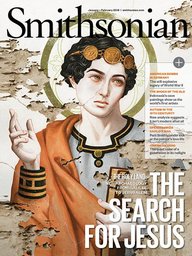
Smithsonian owns all rights. I use under fair use.
I was browsing magazines at the library and saw the cover of the January/February Smithsonian (pictured). I grabbed it because it caught my interest with the article title. What impressed me most, however, was the several points made within the article. Though it at times took a conspiratorial tone, overall the point of the article was to show what daily life would be like in 1st Century Palestine.
One of the most interesting points is one that I think is often missed by the recent resurgence of those who are arguing that Jesus never existed. Namely, what kind of evidence should we expect to find when looking for the historical Jesus (if any). From the article:
“The sorts of evidence other historical figures leave behind are not the sort we’d expect with Jesus,” says Mark Chancey, a religious studies professor at Southern Methodist University and a leading authority on Galilean history. “He wasn’t a political leader, so we don’t have coins, for example, that have his bust or name. He wasn’t a sufficiently high-profile social leader to leave behind inscriptions. In his own lifetime, he was a marginal figure and he was active in marginalized circles.” (49, cited below)
I think this quote shows much of the confusion that exists in Jesus mythicist circles. We can’t read 21st century expectations onto 1st century realities. Although Jesus is certainly an influential figure now, when he was crucified, he had disciples who had abandoned him and the only followers who stayed with him were women. Women were seen as unreliable witnesses in that time and place, and so the notoriety of Jesus, was of course, quite low. He was another messianic figure who had been crucified. It was only when some of these same women claimed to have seen the Christ as the first evangelists, spreading the message to the aforementioned disciples and beyond, that the message and fame of Jesus began to spread.
We cannot measure the evidence for Jesus’ life by what we would expect of similar figures today–or, worse–of what we’d expect from someone with Jesus’ influence now.
Source
Ariel Sabar, “Unearthing the World of Jesus” in Smithsonian (January/February 2016).
Links
Be sure to check out the page for this site on Facebook and Twitter for discussion of posts, links to other pages of interest, random talk about theology/philosophy/apologetics/movies and more!
Eclectic Theist– Check out my other blog for my writings on science fiction, history, fantasy movies, and more!
SDG.
——
The preceding post is the property of J.W. Wartick (apart from quotations, which are the property of their respective owners, and works of art as credited; images are often freely available to the public and J.W. Wartick makes no claims of owning rights to the images unless he makes that explicit) and should not be reproduced in part or in whole without the expressed consent of the author. All content on this site is the property of J.W. Wartick and is made available for individual and personal usage. If you cite from these documents, whether for personal or professional purposes, please give appropriate citation with both the name of the author (J.W. Wartick) and a link to the original URL. If you’d like to repost a post, you may do so, provided you show less than half of the original post on your own site and link to the original post for the rest. You must also appropriately cite the post as noted above. This blog is protected by Creative Commons licensing. By viewing any part of this site, you are agreeing to this usage policy.
Book Review: “Eight Women of Faith” by Michael A.G. Haykin
 Haykin’s Eight Women of Faith sets out with an admirable goal: highlight the contributions of women at key points in church history. The women chosen each have biographical information reported alongside brief discussion of their primary contributions to theology. In this sense, the book achieves its goal.
One difficulty with the book is the lack of critical historical perspective. For example, Jane Austen is gently chastised for her aversion to evangelicalism(Kindle location 1994ff), while then being recruited for the same evangelical cause (Location 2005, 2064). But to see evangelicalism of today as the same as evangelicalism in Austen’s own time (the late 18th and early 19th centuries) does little justice to the development of what has been called “evangelical” over that time into today. This is perhaps the most glaring example in the book, but time and again similar oversight of historical perspective is demonstrated.
Another negative is that Haykin’s work is clearly written with a very specific doctrinal agenda in mind that undercuts the book’s value outside of the circle of those with whom he agrees. For example, he spends no small amount of time promoting the Calvinist view of the Lord’s Supper, attempting to cling both to a literal and figurative meaning of Christ’s words (see especially the excursus in the chapter on Anne Dutton starting around Kindle Location 903). Later, a lengthy section of the chapter on Ann Judson is dedicated to highlighting Judson’s autobiographical account of her change from pedobaptism (infant baptism) to a more Baptist position. Very few arguments are offered in favor of the latter position, other than highlighting that Judson herself believed the arguments for the it were stronger than for infant baptism. This is not a deep theological work, but this section again shows no interaction with opposing views and so provides those who come from a different background little reason to read or enjoy the book.
Perhaps the greatest problem with the book is the irony of continually attempting to silence women’s voices in a book that is, on the surface, about calling attention to them. This begins on the very first page of the Forword, as Karen Swallow Prior writes, “Both within the church and outside it, we too have treated in a similar fashion the biblical admonition against women preaching: we focus on the single thing that is off-limits and thereby fail to see the abundant opportunities and roles God has clearly offered…” (Kindle location 59-64). Of course, this biblical admonition is not cited–and could not be, for there is no Bible verse that says women cannot preach (it is instead an inference from a number of verses that are often misread)–but beyond that, the point is that the book highlights the silence of women throughout.
In the chapter on Anne Dutton, for example, we see that Dutton argued for the validity of her theological writings, so long as they were not read in churches or used in public worship but rather read privately (Kindle loc 825-834). But of course the line drawn in the sand here between private and public use is not drawn in the Bible but in human tradition. Moreover, the prior alleged admonition against women preaching comes from verses that, if read literally as must be the case for restring women in the ministry, also would prevent women from speaking at all in church, yet one of the women highlighted is Anne Steele, a prolific hymn writer.
All of this is to say that the book has a very limited appeal. Only those from the very specific perspective of Reformed Baptists will be able to see their perspective put forward without critique. This is not necessarily a bad thing, for the publisher, Crossway, continues to publish Reformed Baptist books. It’s not a bad thing to have books that appeal to your own readers. The problem is that anyone outside of that perspective has no reason to read the book. Their views are not presented well if they are presented at all, and there is an almost self-congratulatory feel to the way specific doctrines are presented. Moreover, the lack of historical perspective gives the book a simplistic feel that grants readers only the most surface-level understanding of the issues at hand.
The best that can be said for Eight Women of Faith is that it at least acknowledges that women have made significant contributions to the Christian faith. It just doesn’t acknowledge all of women’s contributions, and continues to limit women.
The Good
+Highlights importance of women in church history
The Bad
-Unbalanced perspective
-Uncritical look at historical development of theology
-Undermines women’s voices while ostensibly uplifting them
-Limited appeal beyond denominational lines
Disclaimer: I received a copy of the book from the publisher for review. I was not obligated to provide any specific kind of feedback whatsoever.
Links
Be sure to check out the page for this site on Facebook and Twitter for discussion of posts, links to other pages of interest, random talk about theology/philosophy/apologetics/movies and more!
Book Reviews– There are plenty more book reviews to read! Read like crazy! (Scroll down for more, and click at bottom for even more!)
Eclectic Theist– Check out my other blog for my writings on science fiction, history, fantasy movies, and more!
SDG.
——
The preceding post is the property of J.W. Wartick (apart from quotations, which are the property of their respective owners, and works of art as credited; images are often freely available to the public and J.W. Wartick makes no claims of owning rights to the images unless he makes that explicit) and should not be reproduced in part or in whole without the expressed consent of the author. All content on this site is the property of J.W. Wartick and is made available for individual and personal usage. If you cite from these documents, whether for personal or professional purposes, please give appropriate citation with both the name of the author (J.W. Wartick) and a link to the original URL. If you’d like to repost a post, you may do so, provided you show less than half of the original post on your own site and link to the original post for the rest. You must also appropriately cite the post as noted above. This blog is protected by Creative Commons licensing. By viewing any part of this site, you are agreeing to this usage policy.
Book Review: “Silence and Beauty” by Makoto Fujimura
 Makoto Fujimura’s Silence and Beauty: Hidden Faith Born of Suffering is a difficult book to categorize. It is, in part, an answer to the problem of evil, part an examination of Shusaku Endo’s book Silence, part cross-cultural dialogue between Western Christianity and Japan, and part a work of art criticism. It is, in my opinion, itself a work of beauty that inspires much reflection.
Fujimura’s major reflections center around Shusaku Endo’s classic, Silence. An appendix at the end of the book provides a summary of Silence that is pretty deep, so readers who haven’t read the novel can read and appreciate this book regardless. Of course Fujimura strongly urges readers to carefully read Silence, and I’d echo that sentiment, as Endo’s work is one of the most profound explorations of faith I have ever read. The basics are that a missionary arrives in Japan, where major persecution of Christians is currently occurring. One of the central images–figuratively and literally–in the book is that of the fumi-e, which is an image of Christ that the Japanese believers are required to trample upon in order to renounce their faith and demonstrate allegiance with Japan rather than foreign faith.
Fujimura continually returns to this image–the fumi-e–as an image of betrayal, hiddenness of God, and beauty. The novel Silence constantly asks the question: Why is God silent through this suffering? This leads Fujimura to reflection upon what it means to say God is silent, as well as the meaning of apostasy and faith. His reflections are often poetic–not literally, but the way he writes is beautiful and lyrical. He leads readers to deeper thought rather than providing immediate answers.
Another major aspect of Silence and Beauty is the unity of arts and faith. Fujimura is a renowned artist who utilizes ancient Japanese techniques to create modern art. Several of his–and other–works are featured in color in a set of plates towards the middle of the book. I found his reflection upon these and other artworks to be fascinating, and to demonstrate how the visual arts are extremely important in a life of faith. Even more intriguingly, however, he also points to how art and the image of the fumi-e may not be easily understood in a Western context.
At last, this leads us to the third major aspect of the book, which is that Japanese culture and Western culture are different. Yes, this seems a no-brainer, but Fujimura, who has straddled the line between these cultures for his entire life, approaches it from an insider’s perspective on both sides, demonstrating how blithe dismissal of certain symbolic aspects in the West does not do justice to the importance of those same ideas in Japan. This, he argues, is part of the way that Christians have been talking past the Japanese in a culture that, at some times in history, was considered prime territory for seeds of faith to grow. Fujimura issues a call for better evangelistic efforts to Japan, as well as a cry for those in the West to try to come to a fuller understanding of Japanese culture and history.
Silence and Beauty: Hidden Faith Born of Suffering is an amazing book that fuses multiple disciplines and ideas together into a wonderfully readable, thought-provoking whole. I recommend it highly.
The Good
+Integrates arts seamlessly into narratives
+Full of anecdotes with direct application
+Careful and thought-provoking examination of the problem of evil
+Cross-cultural insights are fair and substantive
+Exposes readers to many new ideas
The Bad
-More subdued in some conclusions than necessary
Disclaimer: I received a copy of the book for review from the publisher. I was not required to provide any specific kind of feedback whatsoever.
Source
Makoto Fujimura Silence and Beauty: Hidden Faith Born of Suffering (Downers Grove, IL: InterVarsity, 2016).
Links
Be sure to check out the page for this site on Facebook and Twitter for discussion of posts, links to other pages of interest, random talk about theology/philosophy/apologetics/movies and more!
Book Reviews– There are plenty more book reviews to read! Read like crazy! (Scroll down for more, and click at bottom for even more!)
Eclectic Theist– Check out my other blog for my writings on science fiction, history, fantasy movies, and more!
SDG.
——
The preceding post is the property of J.W. Wartick (apart from quotations, which are the property of their respective owners, and works of art as credited; images are often freely available to the public and J.W. Wartick makes no claims of owning rights to the images unless he makes that explicit) and should not be reproduced in part or in whole without the expressed consent of the author. All content on this site is the property of J.W. Wartick and is made available for individual and personal usage. If you cite from these documents, whether for personal or professional purposes, please give appropriate citation with both the name of the author (J.W. Wartick) and a link to the original URL. If you’d like to repost a post, you may do so, provided you show less than half of the original post on your own site and link to the original post for the rest. You must also appropriately cite the post as noted above. This blog is protected by Creative Commons licensing. By viewing any part of this site, you are agreeing to this usage policy.
Really Recommended Posts 9/16/16- Jesus as false prophet?, Irenaeus, ESV, and more!
 The latest round of Really Recommended Posts is in, dear readers, and is it a good batch, or what? We have a few posts on Crossway’s announcement of the “Permanent Text” of the ESV, a post addressing the claim that Jesus was a false prophet, insight into one of the earliest Christian apologists, and controversy over a citation of a scientist in regards to creationism. As always, let me know your thoughts.
The ESV: The New Inspired Version– A tongue-in-cheek look at the announcement of the “Permanent” ESV and the kind of reasoning it seems like is behind it.
A Permanent Text of the ESV Bible? They Must Be Joking– A more straightforward critique noting several difficulties with the concept of a permanent text or a “literal word-for-word” translation.
The New Stealth Translation: ESV– A post with some more in-depth look at specific aspects of the ESV changed in this “Permanent” text.
Was Jesus Really a False Prophet?– Thorough analysis of the argument that some have made that Jesus was, in fact, a false prophet.
A Crash Course on Irenaeus– Irenaeus offered one of the earliest defenses of the Christian faith. Check out this post with a wonderful infographic to learn the basics on Irenaeus.
Patterson Misquoted: A Tale of Two “Cites”– Some young earth creationists have been using a quote from Dr. Colin Patterson, a paleontologist, to support their claims. Here is a detailed background of the quote and why it does not support young earth creationism.
“Manual of Christian Evidences”- Fisher Chapter 4 Guided Reading

All rights reserved.
I am leading a guided reading of the Manual of Christian Evidences by George Park Fisher. It is freely available online and will serve as a base for discussing Christian apologetics throughout this series. The chapters are short and readable. I encourage you to join in by reading the chapters and commenting with your thoughts. When I discuss the book, I will be citing page numbers from the edition linked above.
Chapter 4
Fisher wrote:
Before proceeding further, it is well to remind the reader how much there is in Christianity that is not a subject of dispute. (28)
I think it is important to note immediately that almost none of the points he raises following this declaration would be without dispute anymore. People wish to deny that Jesus existed, and so would certainly deny the preceding ministry of John the Baptist. Indeed, basically every historical fact about Jesus is thrown into dispute because of the existence of people that think Jesus did not exist. This is not to say that the “Jesus myth” is a legitimate historical hypothesis that has any basis in reality; it is just to say that the claim that something is beyond dispute is difficult to maintain.
Fisher then gave an overview (very briefly) of the spread and benefits of Christianity. Moreover, he argued that violence “done in the name of the Christian religion, is due… not to the religion itself, but to the perversion and corruption of it.” The part I took out with ellipses again says “generally conceded.” I think that this is generally conceded now among anyone who has even a working understanding of Christian theology and history, but the problem is that the task of those interested in the defense of the faith must start, in part, with simply informing others.
There are so few things which we may call “admitted facts” anymore that it can be daunting to know where to begin. That’s why it is important to begin an apologetic with a relationship–get to know those with whom you’re discussing your faith so that you can relate to them on a level that addresses specific concerns they have rather than making assumptions about them.
Links
Be sure to check out the page for this site on Facebook and Twitter for discussion of posts, links to other pages of interest, random talk about theology/philosophy/apologetics/movies and more!
Apologetics Read-Through: Historical Apologetics Read-Along– Here are links for the collected posts in this series and other read-throughs of apologetics books (forthcoming).
Dead Apologists Society– A page for Christians interested in the works of historical apologetics. There is also a Facebook group for it.
SDG.
——
The preceding post is the property of J.W. Wartick (apart from quotations, which are the property of their respective owners, and works of art as credited; images are often freely available to the public and J.W. Wartick makes no claims of owning rights to the images unless he makes that explicit) and should not be reproduced in part or in whole without the expressed consent of the author. All content on this site is the property of J.W. Wartick and is made available for individual and personal usage. If you cite from these documents, whether for personal or professional purposes, please give appropriate citation with both the name of the author (J.W. Wartick) and a link to the original URL. If you’d like to repost a post, you may do so, provided you show less than half of the original post on your own site and link to the original post for the rest. You must also appropriately cite the post as noted above. This blog is protected by Creative Commons licensing. By viewing any part of this site, you are agreeing to this usage policy.
Really Recommended Posts 9/9/16- Zionism, Lewis on Medieval Literature, and more!
Hello friends! I have gathered some links from around the web to share with you! Be sure to let the authors know if you find them interesting, and let me know what you think in the comments.
Notes on “Studies in Medieval and Renaissance Literature” by C.S. Lewis– Some interesting insights gleaned from Lewis’ work on writings of the period noted. Lewis was a fascinating literary critic, and these insights are worth reading through.
The Popular Bonhoeffer Quote that Isn’t in Bonhoeffer’s Works– One of the most popular quotes I’ve seen circulating from Dietrich Bonhoeffer may not actually be from Bonhoeffer. Check out this thorough investigation into finding the source for the quote. Be sure to let me know if you know of some actual citation from Bonhoeffer for the quote.
The New Christian Zionism- Introduction- Review- The beginning of a thorough look at a book I’ve also been in the process of reviewing, The New Christian Zionism.
Celebrating 50 Years of Star Trek– Check out the series of posts in which I collaborated with The Sci-Fi Christian to celebrate 50 years of Star Trek.



