J.W. Wartick
A God Who Risks… too much?- A Difficult Dilemma for Open Theists
 Open theism is, briefly, the notion that God does not comprehensively know the future [edit: strictly speaking, the view is that there is no settled “future” to know to begin with, so it is not a lack of knowledge but rather the absence of such a thing as a future that will occur; see next sentence and thanks for a clarifying comment below]. The future, it is held, is in some sense “open” because it is undetermined, even for God. Most frequently, this claim is put forth in terms of denial of knowledge of free creaturely action. Representative is the claim of John Sanders:
God cannot know as definite what we will do unless he destroys the very freedom he granted us… The future is not completely fixed, but open, to what both God and humans decide to do, so there are numerous possible futures (not just one). God knows as possibilities and probabilities those events which might happen in the future. (Sanders, 206, cited below)
Thus, it is fairly central to the open theistic perspective that God does not (and indeed cannot) know the future exhaustively, and the parts God does not know exhaustively are such because free will is involved. For the open theist, then, the proposition: ‘God does not know the future free actions of creatures with certainty’ is true. Gregory Boyd, another prominent open theist, puts it this way: “open theists hold that if God is omniscient… and if the future is in fact partly comprised of ontological possibilities, then God must know the future as partly comprised of such possibilities” (Boyd, 195, cited below).
Because of this, we may fairly state the open theistic perspective as holding the following proposition to be true: “God does not know [future] counterfactuals of creaturely freedom [CCF].”
The Dilemma
I propose that open theism, because of its commitment to denial that God knows the future free actions of agents, raises an enormously difficult dilemma for those who hold to the position:
Either God possibly created knowing that it was possible no one would be saved or at least one counterfactual is true.
The dilemma draws its strength from propositions open theists, by their own writings, accept. Open theists, as demonstrated above, deny that God knows CCF. Thus, the following statement is unknown to God according to open theism:
If I (God) create the universe, at least one free creature will be saved.
Open theists must deny this statement as being known by God in order to maintain their stance that God cannot know the future free actions of creatures. But denying this counterfactual is theologically very problematic, because it means that the God who risks (to use John Sanders’ terminology) effectually risked so much that God decided to create a universe populated by moral agents without so much knowing that even one of these agents would be saved. Sure, one of the possibilities was probably that all such moral beings would be saved, but another possibility is that all moral beings would be damned. On open theism, God just didn’t know.
Now it could be that God was 99.999999999(repeating)% sure that at least one agent would be saved, but according to open theism, God could not know. I would suggest that any theological system which seriously puts forth the notion that God would create without knowing that at least one being would be saved is a theological system that cannot maintain the moral benevolence of deity.
The second part of the dilemma is also a serious problem for the open theist. Suppose the open theist embraces this part and counters “Very well, then God knew that at least one being would be saved.” But of course this would have been a CCF when God chose to create. Thus, the open theist would be forced to accept that at least one of these future counterfactuals is true. But if one is true, what possible grounds could there be for denying that others are true as well? It seems the open theist would either have to accept that CCF can be known without restraint (and therefore overthrow the philosophical framework of open theism) or simply engage in special pleading for those CCFs that must be maintained in order to not impugn the moral character of God.
Counter Arguments
Character Settled?
Greg Boyd has argued that free agents may have settled characters such that free will may not be a consideration (for the sake of space I’ve greatly summarized here; see Boyd 193-194 for one example). Perhaps at least one creature could have a settled will such that they are saved and thus God could know their salvific status without threatening to know CCFs. My response to this would be to note the highly controversial nature of this argument on a number of levels: 1) it suggests that humans are capable of, by their own free will, coming to such a point that they change their will into a form that will, with certainly, act according to God’s will, which is objectionable on a number of Scriptural grounds; 2) it holds to a view of human nature that both affirms and denies compatibilism; 3) the possibility of a “settled will” is difficult to establish or define; etc.
CCFs not Denied
Perhaps the open theist could respond by arguing that open theism need not deny that God knows CCFs. I do not think this would be possible while still maintaining open theism because it would mean God knows comprehensively the future including my future free actions.
God’s Character not Impugned?
Perhaps the most fruitful counter for the open theist would be to deny that God’s moral character is impugned by creating without knowing that at least one person would be saved. Perhaps such an activity is merely morally neutral, or God’s other reasons for creating could overcome the difficulty.
I think this is, as I said, the best avenue for open theists to pursue, but on reflection I think that the real possibility that God would create in such a way as to not know that the moral agents God brought into being would be saved–that they all might be damned despite that not being God’s intent–is extremely problematic.
Conclusion
I believe that the dilemma offered above is, frankly, lethal to open theism. I have read several works by leading proponents of open theism and think that many arguments against the same are off the mark because they often do not hit on the points open theists actually hold. Here, however, I have presented an argument derived from the core of open theistic thought. Thus, I believe that open theism is untenable. It either impugns God’s character or is self-referentially incoherent.
Links
Be sure to check out the page for this site on Facebook and Twitter for discussion of posts, links to other pages of interest, random talk about theology/philosophy/apologetics/movies and more!
The Consolation of Counterfactuals: The Molinism of Boethius– Boethius was an early Christian thinker who thought of a very insightful way to discuss counterfactuals of freedom.
Is God Just Lucky?: Possible Worlds and God’s Providence, a Defense of Molinism– I examine the set of possible worlds from a molinistic perspective.
The New Defenders of Molinism: Reconciling God’s Foreknowledge and Our Free Will– I present a general case for molinism, analyzing various positions and concluding that God does know what we will do without predetermining it.
Sources
John Sanders, The God Who Risks (Downers Grove, IL: InterVarsity, 2007).
Gregory Boyd “God Limits His Control” in Four Views on Divine Providence edited Gundry and Jowers (Grand Rapids, MI: Zondervan, 2011).
SDG.
——
The preceding post is the property of J.W. Wartick (apart from quotations, which are the property of their respective owners, and works of art as credited; images are often freely available to the public and J.W. Wartick makes no claims of owning rights to the images unless he makes that explicit) and should not be reproduced in part or in whole without the expressed consent of the author. All content on this site is the property of J.W. Wartick and is made available for individual and personal usage. If you cite from these documents, whether for personal or professional purposes, please give appropriate citation with both the name of the author (J.W. Wartick) and a link to the original URL. If you’d like to repost a post, you may do so, provided you show less than half of the original post on your own site and link to the original post for the rest. You must also appropriately cite the post as noted above. This blog is protected by Creative Commons licensing. By viewing any part of this site, you are agreeing to this usage policy.
Sunday Quote!- The Gospels and Contemporary Biography
 Every Sunday, I will share a quote from something I’ve been reading. The hope is for you, dear reader, to share your thoughts on the quote and related issues and perhaps pick up some reading material along the way!
The Gospels and Contemporary Biography
The question of the genre of the Gospels and whether they are to be considered to have historical content is clearly one which is central for Christians. One way we can explore this question is by looking at writings which are contemporary with the Gospels. Simon Swain, in his essay “Defending Hellenism,” which itself shows how various first century Pagans used apologetics against Christians, provides some interesting insight into this issue:
Philostratus has… a biographical aim. In the Roman imperial period, biographical records came to function as vehicles of belief systems, pagan and Christian. (180, cited below)
Swain is specifically discussing a work by Philostratus, In Honour of Apollonius. He notes that the aim of this work is to provide not so much a modern understanding of biography, but a “way of life of that individual…” The genre of Bioi, first century biographies, were both filled with historical teachings but also served a[n]–apologetic–purpose. This is not to say that the documents themselves are false or that anything contained therein is a fabrication. Instead, it is to acknowledge certain aspects of writing in the ancient world which differ from our own understanding of how biographies should work. For the study of the Gospels, then, it provides a way to avoid limiting them to wooden reports of what happened and allow us to see the theological thrust of the writers.
Links
Be sure to check out the page for this site on Facebook and Twitter for discussion of posts, links to other pages of interest, random talk about theology/philosophy/apologetics/movies and more!
Sunday Quote– If you want to read more Sunday Quotes and join the discussion, check them out! (Scroll down for more)
Source
Simon Swain, “Defending Hellenism: Philostratus In Honour of Apollonius” in Mark Edwards, Martin Goodman, and Simon Price, eds., Apologetics in the Roman Empire
SDG.
——
The preceding post is the property of J.W. Wartick (apart from quotations, which are the property of their respective owners, and works of art as credited; images are often freely available to the public and J.W. Wartick makes no claims of owning rights to the images unless he makes that explicit) and should not be reproduced in part or in whole without the expressed consent of the author. All content on this site is the property of J.W. Wartick and is made available for individual and personal usage. If you cite from these documents, whether for personal or professional purposes, please give appropriate citation with both the name of the author (J.W. Wartick) and a link to the original URL. If you’d like to repost a post, you may do so, provided you show less than half of the original post on your own site and link to the original post for the rest. You must also appropriately cite the post as noted above. This blog is protected by Creative Commons licensing. By viewing any part of this site, you are agreeing to this usage policy.
Really Recommended Posts 11/7/14- Dracula, Hamlet, Ebola, and more!
 Another go-round the web leads to some more great reading material for you. Let me know what you think of the various posts in the comments here, and be sure to let the authors know as well! Featured topics are the movie Dracula Untold, Ebola, Hamlet, women in the church, and the existence of God.
Dracula Untold– Anthony Weber offers a perspective on the film “Dracula Untold” from a Christian. Here, read his interesting insights and also get some help deciding whether you want to go see the movie!
Can a Monkey type Hamlet given infinite time?– A common claim regarding complexity and the possibility of it coming through chance is the now time-honored monkeys with keyboards view. Check out this brief look at this thought experiment.
Women as Other– How are women involved in the church? Are we excluding women? What are some consequences of views that treat women as “other” in Christianity?
Edward Feser on the Existence of God– Edward Feser is an extraordinarily brilliant philosopher and even when I disagree I learn from him. Here, there is a brief presentation of one of his arguments for the existence of God.
God Outwits Ann Coulter on Ebola– I’ll admit I don’t always keep up on current events, so this post was surprising to me. What did Ann Coulter say about Ebola and God? Check out this analysis.
“The Wheel of Time”: A Christian reflection on Books 1-5 of Robert Jordan’s epic saga
Note: I have many updated posts for all the books of The Wheel of Time, as well as looks at worldview questions in the TV series, here.
The Wheel of Time turns and Ages come and pass. What was, what will be, and what is, may yet fall under the Shadow… Let the Dragon ride again on the winds of time.

The Wheel of Time is nothing short of mammoth in size. The series spans 14 books, the shortest of which is about 680 pages. It is a fantasy series encompassing the fulfillment of a number of prophecies which foretold of an Age to come that would once more “break” the world: a man called the Dragon would simultaneously bring salvation and destruction. Here, we’ll explore many of the themes found in the first five books of the series–The Eye of the World, The Great Hunt, The Dragon Reborn, The Shadow Rising, and The Fires of Heaven. We’ll explore the series from a worldview perspective by seeking out the overarching themes found in the books related to the real world.
There will, of course be SPOILERS in what follows. If you’re leaving a comment, do try to limit your discussion to books 1-5. I will be posting on the following books in the series in the upcoming months, so if you want to comment on later parts of the series, please wait for the appropriate post.
Prophecy
It is clear that prophecy is a central theme throughout the books. Everyone, from beggar on the street to king or queen, is aware of the prophecies concerning the Dragon. Bards and entertainers recite the prophecies, using language to tell the stories in different forms. The fulfillment of prophecy is taken to be essentially guaranteed by everyone encountered.
Prophecy is not, however, always fulfilled in the ways expected by the main characters. Rand, for example, is often surprised by how the prophecies about the Dragon are fulfilled in him. Frankly, this makes me think about the way some prophecies of Christ were fulfilled. For example, the statement “Out of Egypt I called my son” is clearly a statement about the nation of Israel, but it is later applied to Christ. Moreover, many expected the Messiah to be a conqueror, but Jesus came to save through his own sacrifice.
The fact that the expectation existed, but the interpretation of the prophecies was diverse, is itself an interesting parallel to Christ as the fulfillment of prophecy. It will be interesting to see how the theme of fulfilled prophecy continues going forward.
Messiah and The Pattern
Interestingly, Rand may be understood as a kind of Messiah figure, but a bit of the inversion of Jesus Christ. Jesus came not to build an earthly kingdom; Rand’s kingdom must be ushered in through war and conquest. However, the destruction Rand is supposed to usher in in some ways seem to mirror prophecies about the end times in the book of Revelation. Moreover, one might wonder at this stage in the series where Rand is headed. Perhaps he will end up giving himself to save the world. But Rand is not himself incarnate Lord ushering in salvation through sacrifice; instead, he is driven by the Pattern–the force of the Wheel of Time which “weaves” strands–people’s lives, the activities of nations, and all things.
The Pattern is said to be woven around certain people who are part of its plan for continuing the revolution of ages. The system seems to imply an eternal universe with a repetition of time and places and reincarnation, but in these books, it seems that Rand may be breaking that pattern. It is unclear as to whether the series is developing in a direction which implies the repetition will continue, but it will be interesting to see where it leads.
Reincarnation is fairly explicit in the book, as Rand, the Dragon, is a reborn Lews Therin–one who was prophesied to return as the Dragon. He has to fight with the thoughts that are in his head from Lews Therin in order to control his own destiny. Again, it will be interesting to see how this plays out. Will Jordan continue to affirm reincarnation as an aspect of reality with a continually repeating “Wheel of Time” or will Rand manage to break the Pattern and turn time into a line rather than a Wheel?
It seems clear that the notions of reincarnation or a continually repeating pattern of time are no part of the Christian worldview. As interesting as these themes are in the books, it is clear they are fiction. The notion that time is constantly repeating is, in fact, false. The universe has a beginning and it is heading towards an end. As fiction, it is entertaining, but it should remain clear that it is fiction.
Rand as Messiah is an interesting way to view the series. The connections to the notion of prophesied salvation are interesting. But in Jordan’s world, the savior comes not only to save, but to ruin. It will be interesting to see where he takes it.
Men and Women
The characters each have their own ideas of how men and women should operate. Jordan seems to satirize the expectations as much as he flaunts them. Women are just as capable as men in the series, though of interest is the different cultural expectations and how men and women are expected to fulfill them in the different nations throughout the books. The Aiel, for example, a people group who live in a desert reason, have extremely different views of men and women than one encounters in other nations. They have societies of warriors, including ones for women, and both men and women are expected to comply with the unwritten laws of honor. Other nations operate with fairly patriarchal views which are reflective of the medieval setting of the work. The complexity of male-female interaction is continually interesting.
In the last of the books we’re exploring, The Fires of Heaven, some characters begin to interact sexually. As with the general views of the roles of men and women, the cultural expectations regarding marriage and sexual union are shown to be diverse across the differing cultures. The acts themselves are not explicit, but nudity is at times referenced and it is clear what has happened.
These sections demonstrate that the characters are not perfect but rather succumb to their various desires, not unlike real people. However, the fact that they are often interwoven with the different cultural expectations regarding marriage may spur discussion among Christians, who are often challenged to defend traditional views of marriage. It seems clear to me that the mere existence of culturally diverse ways of defining marriage does not undermine the notion that there is an ideal form of marriage which was established “in the beginning.”
Conclusion
“The Wheel of Time” starts off strong. It’s a powerful fantasy saga with quite a few themes which resonate with the Christian worldview. There are other themes which are contrary to truth as well. The series may spur discussion about various aspects of reality, from prophecy to views of men and women. So far, I have greatly enjoyed it. I look forward to reading the rest of the series and seeing how I might use it to interact with others regarding the Christian worldview.
Links
Be sure to check out the page for this site on Facebook and Twitter for discussion of posts, links to other pages of interest, random talk about theology/philosophy/apologetics/movies and more!
The art is the official galley art for the cover of The Fires of Heaven. I make no claims to ownership and give all credit to the artist, Darrell Sweet, and copyright holders.
SDG.
——
The preceding post is the property of J.W. Wartick (apart from quotations, which are the property of their respective owners, and works of art as credited; images are often freely available to the public and J.W. Wartick makes no claims of owning rights to the images unless he makes that explicit) and should not be reproduced in part or in whole without the expressed consent of the author. All content on this site is the property of J.W. Wartick and is made available for individual and personal usage. If you cite from these documents, whether for personal or professional purposes, please give appropriate citation with both the name of the author (J.W. Wartick) and a link to the original URL. If you’d like to repost a post, you may do so, provided you show less than half of the original post on your own site and link to the original post for the rest. You must also appropriately cite the post as noted above. This blog is protected by Creative Commons licensing. By viewing any part of this site, you are agreeing to this usage policy.
Sunday Quote!- The Advance of the Shadow
Every Sunday, I will share a quote from something I’ve been reading. The hope is for you, dear reader, to share your thoughts on the quote and related issues and perhaps pick up some reading material along the way!
The Advance of the Shadow
I read a fair amount of fiction alongside my nonfiction books, and my favorite genres are science fiction and fantasy. One series I’ve been reading through is “The Wheel of Time” by Robert Jordan. This huge fantasy series (it’s complete at 14 books averaging probably around 800 pages a piece) is about an epic struggle between good and evil, but it has many other themes which I will continue to explore in my upcoming series of posts on the books. One line which has stuck with me throughout my reading of the series is this:
Humanity retreated, and the Shadow advanced. – Robert Jordan, “Lord of Chaos,” p. 450.
The passage is so poignant because its context is in looking at a bunch of ancient maps which show pictorially how the Shadow–evil creatures and persons–had advanced and hacked away borders from people. To me, it serves as a visceral image of how easy it is to allow Shadow to advance in our own lives as we lower one border down or give in to temptation in one area, compromise on one topic and advance another.
Are there real boundaries of good and evil? What does your “map” of life look like? Where might the “Shadow” be overcoming, and how might you fight it?
Links
Be sure to check out the page for this site on Facebook and Twitter for discussion of posts, links to other pages of interest, random talk about theology/philosophy/apologetics/movies and more!
Sunday Quote– If you want to read more Sunday Quotes and join the discussion, check them out! (Scroll down for more)
Check out my looks at various popular books, including some upcoming posts on The Wheel of Time, and past posts on Star Wars, Harry Potter, The Hunger Games, and more!
SDG.
Reformation Recommended Posts 10/31/14- Reformation Day Reading
 Happy Reformation Day! I have a special edition of posts put together to discuss the Reformation.
Forming and Reforming– Timothy Siburg reflects on how we might see the Reformation working into today in the church. How might we apply the notion of “reform” to formative thought and practice?
The Coming Vindication of Martin Luther– Martin Luther has been both vilified and praised. Will his thought have a vindication, despite the splitting of the church? Check out this post which summarizes a number of points related to Luther’s thought along with many other links to explore.
Debate: Is the Roman Catholic Priesthood Biblical & Ancient? James White vs. Mitchell Pacwa– One of the issues that divides the church is the notion of the priesthood and that office. I found this debate interesting to listen to, and I found that there were some points raised by either side. Is it possible to debate these issues with respect and care? Should we debate these issues? What do you think?
My Writings on the Reformation
I discuss the origins of the European Reformations and how many of its debates carry on into our own day. The debates that took place during the Reformation continue on into today’s theological discussions.
The Church Universal: Reformation Review– What makes a church part of the Church Universal? What makes a church part of the true church? I write on these topics (and more!) and their origins in the Reformation.
Who Interprets Scripture? Sola Scriptura, the Reformation, and the modern era: Reformation Review– I investigate the notion of “sola scriptura” and its different applications in interpreting Scripture. I particularly emphasize the problem of doctrinal unity and the various ways church bodies have dealt with these difficulties from the Reformation into today.
The Continuing Influence of the Reformation: Our lives, our thoughts, our theology- Reformation review– I examine how the issues which came up during the Reformation continue to influence almost every aspect of our lives today. Theology matters.
Women in the Reformation: Hope, Silence, and Circumstance– I explore the role of women throughout the Reformation period from different angles.
Microview: “The Intellectual Origins of the European Reformation” by Alister McGrath
 It’s Reformation Month and I unfortunately haven’t been able to write as much as I’ve been able to in the past years on the Reformation, but I’d like to focus here on one of the several books on the topic I read this month. Check out the links for more of my writing on the Reformation.
Alister McGrath’s The Intellectual Origins of the European Reformation
Among the insights provided by McGrath, his analysis of humanism and its relationship with Reformation thought was particularly helpful. He showed that the Reformation did not rely as much upon humanism as is often alleged, while also describing the various ways in which humanist and Reformation thought interacted.
Overall, the book is a much-needed work on the background to the Reformation. Anyone who is interested in studying the development of thought in this period or in Reformation theology should read this excellent book.
Links
I discuss the origins of the European Reformations and how many of its debates carry on into our own day. The debates that took place during the Reformation continue on into today’s theological discussions.
The Church Universal: Reformation Review– What makes a church part of the Church Universal? What makes a church part of the true church? I write on these topics (and more!) and their origins in the Reformation.
Who Interprets Scripture? Sola Scriptura, the Reformation, and the modern era: Reformation Review– I investigate the notion of “sola scriptura” and its different applications in interpreting Scripture. I particularly emphasize the problem of doctrinal unity and the various ways church bodies have dealt with these difficulties from the Reformation into today.
The Continuing Influence of the Reformation: Our lives, our thoughts, our theology- Reformation review– I examine how the issues which came up during the Reformation continue to influence almost every aspect of our lives today. Theology matters.
Women in the Reformation: Hope, Silence, and Circumstance– I explore the role of women throughout the Reformation period from different angles.
Source
Alister E. McGrath b, The Intellectual Origins of the European Reformation
SDG.
——
The preceding post is the property of J.W. Wartick (apart from quotations, which are the property of their respective owners, and works of art as credited; images are often freely available to the public and J.W. Wartick makes no claims of owning rights to the images unless he makes that explicit) and should not be reproduced in part or in whole without the expressed consent of the author. All content on this site is the property of J.W. Wartick and is made available for individual and personal usage. If you cite from these documents, whether for personal or professional purposes, please give appropriate citation with both the name of the author (J.W. Wartick) and a link to the original URL. If you’d like to repost a post, you may do so, provided you show less than half of the original post on your own site and link to the original post for the rest. You must also appropriately cite the post as noted above. This blog is protected by Creative Commons licensing. By viewing any part of this site, you are agreeing to this usage policy.
“The Railway Man”: Forgiveness is more powerful than hate
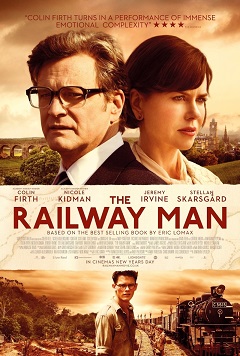 Forgiveness is Stronger than Hate
“Railway Man” is a film based on a true story about WW2 prisoners of war held and tortured by the Japanese. There are SPOILERS in what follows.
Colin Firth plays Eric Lomaz, one of the prisoners. He struggles with PTSD and his wife tries to help him through it. Ultimately, he finds that Takashi Nagase, one of the Japanese soldiers who tortured him, is still alive. He goes back to confront Nagase with malignant intent, but cannot bring himself to kill him. Instead, he goes back to the United Kingdom after the confrontation. Nagase writes to Lomaz in apology and of how he is working towards reconciliation. In the final scene, Lomaz returns with his wife to speak to Nagase, thank him for his work on reconciliation, and offer forgiveness.
The way this film plays out therefore offers a powerful apologetic for the Christian worldview, which values forgiveness very highly. Nagase turned to Buddhism to try to make penance for his sins and work towards reconciliation, but only in the act of forgiveness is any comfort found. True reconciliation is found in the act of forgiveness and the realization that only by acknowledging the incapacity of humanity to work off their sins might one come to the free gift of grace. Nagase is redeemed, but he is redeemed through the free, unmerited forgiveness offered by Lomaz.
Here we have a powerful message which, though never explicit, speaks of the Christian worldview and power of forgiveness.
Conclusion
I was greatly moved by this film. Christians can reflect much on the power of forgiveness and the need for reconciliation from the film. There are a number of themes running throughout “The Railway Man” which have not been discussed here, so feel free to bring more up in the comments. It is a film with great power, and I recommend you watch it.
Links
Be sure to check out the page for this site on Facebook and Twitter for discussion of posts, links to other pages of interest, random talk about theology/philosophy/apologetics/movies and more!
Movies– Read other posts on this site about movies written from a worldview perspective. (Scroll down for more.)
SDG.
The image used in this post was a movie poster and used under fair use. I make no claims to the rights for the image.
——
The preceding post is the property of J.W. Wartick (apart from quotations, which are the property of their respective owners, and works of art as credited; images are often freely available to the public and J.W. Wartick makes no claims of owning rights to the images unless he makes that explicit) and should not be reproduced in part or in whole without the expressed consent of the author. All content on this site is the property of J.W. Wartick and is made available for individual and personal usage. If you cite from these documents, whether for personal or professional purposes, please give appropriate citation with both the name of the author (J.W. Wartick) and a link to the original URL. If you’d like to repost a post, you may do so, provided you show less than half of the original post on your own site and link to the original post for the rest. You must also appropriately cite the post as noted above. This blog is protected by Creative Commons licensing. By viewing any part of this site, you are agreeing to this usage policy.
Exegetical Fallacies- Who determines when it’s a fallacy?
 I recently read through Exegetical Fallacies by D.A. Carson. I think that he did an excellent job introducing a number of common errors regarding exegesis which may be avoided. However, I would have liked there to be more appeals for caution in the application of these fallacies. I worry about the possibility for someone to read through a book like this and then just willy-nilly apply the ‘exegetical fallacy’ hammer to all sorts of solid exegesis.
My concern is based upon two primary issues. First, the concept of “fallacy” within Carson’s usage. Second, the rather obscure nature of some of the specific “fallacies” he outlines.
The first concern is perhaps one that should be heavily qualified on its own. That is, I think that Carson’s choice of the term “fallacy” will imply, for many readers [the book is intended for an introductory level] a hard-and-fast rule for determining when something is blatantly false. Now, of course Carson cannot be faulted for using a technical term and having people misunderstand it. I simply wish that he had done more to clarify his usage of the term, because he clearly means it more broadly than “logical fallacy” but more narrowly than anything which appears to be wrong.
The second concern may help highlight the first. I am a bit worried about the application of these fallacies in practice. One can’t just say “Ha, [x fallacy] was committed, your interpretation fails!” I’m not at all suggesting that this is what Carson did (and I would be mistaken if I were to suggest that), but I am rather expressing a concern that some may attempt to use “exegetical fallacies” in this manner. For example, on page 37, Carson introduced the fallacy he termed “Appeal to unknown or unlikely meanings…” Now this, of course, is not a logical fallacy. And, in practice, it can be useful. But the question is: to what or whom are we referencing when we say “unknown” or “unlikely”? I fear that the application of this terminology could lead to people subjectively calling those things with which they disagree “unknown” or “unlikely” and then dismissing the other side as “fallacious.” Again, I’m not saying Carson does that himself, but I still think one must have a certain sense of caution in the application of this and other “fallacies.”
Another example may be found in the “root fallacy,” wherein one appeals to etymology to determine the meaning of a word. There are certainly fallacious usages of etymology in order to try to sort out the meaning of words, but as Carson himself noted, etymology can be quite useful for determining the meaning, and its usage is sometimes correct. Yet, tied into my first concern, calling this the “root fallacy” seems to denote a definitively fallacious sense to using roots to determine the meaning of words. But although Carson himself urges caution in this, he doesn’t really help to clarify when something would be fallacious as opposed to valid. Of course, that may just be the nature of the beast regarding some of these fallacies: they are highly difficult to pin down. But then I wonder what the usefulness is of making it seem as though there is some “rule” of “fallacy” regarding interpretation in this area.
I’d certainly like to be corrected and perhaps have my cautions dispelled, so feel free to drop a comment on your thoughts regarding this work.
On final analysis, I do think Carson’s book is useful in many ways. I just wish he had given more space to urging some caution and defining terms.
Links
Be sure to check out the page for this site on Facebook and Twitter for discussion of posts, links to other pages of interest, random talk about theology/philosophy/apologetics/movies and more!
Source
D.A. Carson, Exegetical Fallacies (Grand Rapids, MI: Baker Books, 1996).
SDG.
——
The preceding post is the property of J.W. Wartick (apart from quotations, which are the property of their respective owners, and works of art as credited; images are often freely available to the public and J.W. Wartick makes no claims of owning rights to the images unless he makes that explicit) and should not be reproduced in part or in whole without the expressed consent of the author. All content on this site is the property of J.W. Wartick and is made available for individual and personal usage. If you cite from these documents, whether for personal or professional purposes, please give appropriate citation with both the name of the author (J.W. Wartick) and a link to the original URL. If you’d like to repost a post, you may do so, provided you show less than half of the original post on your own site and link to the original post for the rest. You must also appropriately cite the post as noted above. This blog is protected by Creative Commons licensing. By viewing any part of this site, you are agreeing to this usage policy.
Sunday Quote!- Ancient Apologetics and the Disinterest of the Modern Age
Every Sunday, I will share a quote from something I’ve been reading. The hope is for you, dear reader, to share your thoughts on the quote and related issues and perhaps pick up some reading material along the way!
Ancient Apologetics and the Disinterest of the Modern Age
After getting a recommendation from… I don’t remember whom/which book, I picked up Apologetics in the Roman Empire
[T]he style of the ancient apologists has estranged them further from practical apologetic than their contents did in any previous century… The only modern scholars, therefore, to whom the [ancient] apologists [like Justin Martyr, Josephus, Tatian, and the like] mean anything are those who take a sympathetic interest in the culture and the interplay of religious traditions in the Roman Empire… (13, cited below)
Thus, according to the editors of this volume, the “only” reason that anyone would be interested in these works in the modern era is because they wish to explore the cultural understanding of the religious traditions in Ancient Rome.
That makes me quite sad, to be honest! As one who is deeply interested in the study of historical apologetics, it seems clear that much of what is discussed in this volume is actually of interest to modern apologists, those interested in church history, and many others. Of course the editors are perhaps merely speaking only of the interest which they have found for their subject, which speaks of the sorry state of how we modern apologists have abandoned our historic roots. Perhaps these words can serve as a rallying cry to raise us from our stupor of historical ignorance and realize the vast, untapped wealth of historical apologetics.
I have written to that end in a post in which I discuss the lost defenses of Christianity. Explore, take, and read!
The book itself has much appeal for those interested in historical apologetics. I’m about halfway through right now and have found it to be quite excellent.
Links
Be sure to check out the page for this site on Facebook and Twitter for discussion of posts, links to other pages of interest, random talk about theology/philosophy/apologetics/movies and more!
Sunday Quote– If you want to read more Sunday Quotes and join the discussion, check them out! (Scroll down for more)
On the Shoulders of Giants: Rediscovering the lost defenses of Christianity– I have written on how we may discover these enormous resources historical apologists have left behind for us. Take and read!
Source
Mark Edwards, Martin Goodman, and Simon Price, eds., Apologetics in the Roman Empire
SDG.

 J.W. Wartick - Reconstructing Faith