J.W. Wartick
Book Review: “Dawn: A Proton’s Tale of All that Came to Be” by Dekker, Oranje, and Van Den Brink
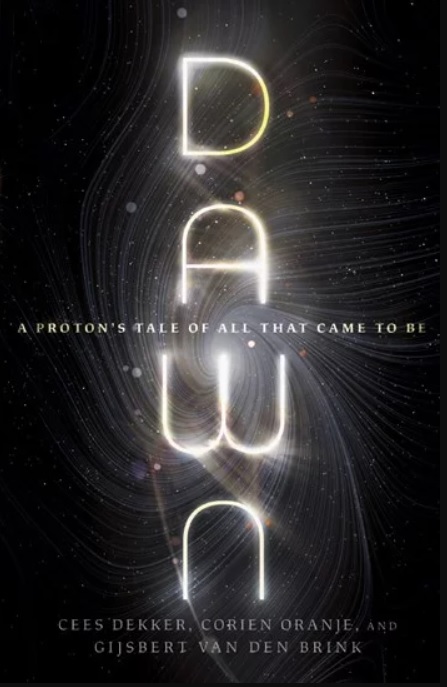
Dawn is, as the subtitle suggests, a story from the perspective of a proton from the beginning of time until now.
The authors tell the story in first person, making for some interesting asides. This gives creative freedom to talk about the “discomfort” the proton feels as it bumps up against molecules. One humorous scene is the authors’ rendition of the beginnings of evolution, as the proton is bumped, grabbed, etc. all while new molecules are formed and copied (sometimes incorrectly) (p. 33ff). The winsome way the proton’s voice is written also makes for a safe feeling for exploring some of the more difficult questions the book may raise for readers who disagree with some of the contents.
The story does, of course, run into Jesus. It’s a cool perspective when you have the first person account of a proton from the dawn of creation seeing the events surrounding Jesus. The proton even reflects on what will happen next (122) and eventually on the new creation (147).
Dawn is an interesting perspective on a number of scientific questions. It will appeal to those hoping to get a survey of the basics of how the universe grew from the beginning.
All Links to Amazon are Affiliates links
Links
Be sure to check out the page for this site on Facebook and Twitter for discussion of posts, links to other pages of interest, random talk about theology/philosophy/apologetics/movies and more!
Book Reviews– There are plenty more book reviews to read! Read like crazy! (Scroll down for more, and click at bottom for even more!)
SDG.
——
The preceding post is the property of J.W. Wartick (apart from quotations, which are the property of their respective owners, and works of art as credited; images are often freely available to the public and J.W. Wartick makes no claims of owning rights to the images unless he makes that explicit) and should not be reproduced in part or in whole without the expressed consent of the author. All content on this site is the property of J.W. Wartick and is made available for individual and personal usage. If you cite from these documents, whether for personal or professional purposes, please give appropriate citation with both the name of the author (J.W. Wartick) and a link to the original URL. If you’d like to repost a post, you may do so, provided you show less than half of the original post on your own site and link to the original post for the rest. You must also appropriately cite the post as noted above. This blog is protected by Creative Commons licensing. By viewing any part of this site, you are agreeing to this usage policy.
Book Review: “Creating Cultures of Belonging” by Beth Birmingham and Eeva Sallinen Simard

Creating Cultures of Belonging is a practical guide to making organizations friendly to both men and women in leadership.
The authors first outline the ways in which missional organizations have demonstrated difficulty with integrating women into the workings and leadership of their groups. Next, they give a brief background for why this is an important topic. Then, they provide numerous chapters with specific, applicable strategies for correcting that problem.
A book like this turns upon how useful its strategies are. Identifying the problem is one thing, but providing solutions is another. Thankfully, Birmingham and Simard give numerous useful applications of strategies to directly address inequalities in the workplace. Not only that, but they also continue to bring up potential difficulties that may not be on people’s radar related to those same topics. For example, the concept of “living wage” has been influenced by the notion that men are the income earners and so they need to be paid enough (more) to make a living–the authors point out how this mindset can impact those making decisions regarding raises (136-138). Without awareness of the problem and the ways in which certain background beliefs play into it, there is no possibility for a solution. Time and again the authors provide these kind of asides with real, workable solutions.
There are also numerous charts, helpful questions, and ideas for goal-setting found throughout the book. Indeed, this is the kind of work someone wishing to increase the equality of men and women in an organization can pick up and immediately start to use and incorporate in everyday life.
A couple points of critique for the book. One is fairly simple: I wish it had included an index. The chapters are well-organized and have sub-headings, but an index would make the utility of the book increase. Second, the authors don’t really address questions beyond male-female dichotomy in the work. That is, there isn’t guidance about how to apply these practices to sexual minorities. No matter what an organization’s stance is on political topics related to this, the fact remains that this is a question that won’t go away. Not only that, but many Christian groups have stances that are affirming and welcoming to sexual minorities, and the book would have been served to have a chapter or related sections to help integrate practices for those organizations.
Creating Cultures of Belonging does what it sets out to do. Birmingham and Simard provide practical, applicable ways to make organizations places that are welcoming to men and women. It doesn’t move beyond that dichotomy, but it does provide information within that framework.
All Links to Amazon are Affiliates links
Links
Be sure to check out the page for this site on Facebook and Twitter for discussion of posts, links to other pages of interest, random talk about theology/philosophy/apologetics/movies and more!
Book Reviews– There are plenty more book reviews to read! Read like crazy! (Scroll down for more, and click at bottom for even more!)
SDG.
——
The preceding post is the property of J.W. Wartick (apart from quotations, which are the property of their respective owners, and works of art as credited; images are often freely available to the public and J.W. Wartick makes no claims of owning rights to the images unless he makes that explicit) and should not be reproduced in part or in whole without the expressed consent of the author. All content on this site is the property of J.W. Wartick and is made available for individual and personal usage. If you cite from these documents, whether for personal or professional purposes, please give appropriate citation with both the name of the author (J.W. Wartick) and a link to the original URL. If you’d like to repost a post, you may do so, provided you show less than half of the original post on your own site and link to the original post for the rest. You must also appropriately cite the post as noted above. This blog is protected by Creative Commons licensing. By viewing any part of this site, you are agreeing to this usage policy.
Book Review: “The Gospel of Peace in a Violent World” edited by Shawn Graves and Marlena Graves
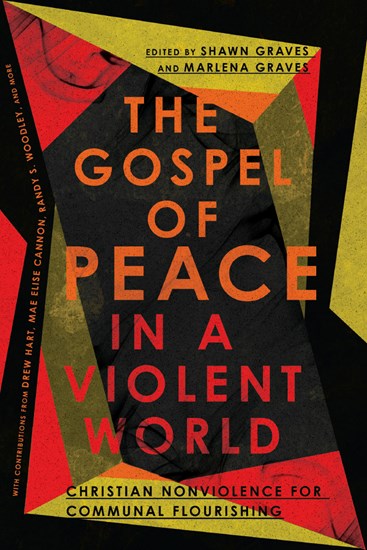
The Gospel of Peace in a Violent World is a collection of essays centered around the defense of Christian pacifism. The essays are broadly arranged around five parts- biblical reflections, learning from others, war and violence, race, gender, and disability, and finally immigration and environment.
Reviewing a large, important collection like this forces a reviewer to skim across or even past many fascinating topics. We must select from among numerous excellent essays and highlight just a few for our readers. And that is the unenviable task to which I now turn. Suffice to say, this collection as a whole is well worth readers’ time.
Part one turns to biblical reflections on pacifism. I was somewhat surprised to see the very first essay by Eric A. Seibert come out and say bluntly that Christians should push back on the notion of God as warrior and indeed reject that portrayal. In response to the question of what to do with passages which simply state God is warrior, Seibert writes, “some Christian pacificstts will find it difficult to state publicly their rejection of the image of God as warrior…” for reasons such as personal cost or simply personal pre-commitment to seeing how the Bible is read. However, Seibert responds, “these assumptions about God’s very active role in determining the content of the Bible do not match the evidence at hand. It appears that ancient Israelites were free to write about God in ways that made sense in their particular historical and cultural context…” (19). This full on confrontation with biblical texts often used to undercut pacifism is a significant difference from even the next essay by T.C. Ham, who instead argues broadly that the Bible’s broad teaching on shalom is the focus. The difference between these two approaches–direct acknowledgement of difficult passages and reading of them as reflections of the culture from which they sprang vs. attempted integration–starts the book with a clear message: Christian pacifism is broader than one may think.
Part two introduces the concept in one essay of a “Pentagon for Peace” in which Randy S. Woodley argues for resources being committed to peaceful undertakings rather than the warfare/mutual destruction that seems to be the national priority today (79ff). Other essays show MLK Jr.’s passionate peace-giving activism, other historical examples of nonviolence, integration of nonviolence into human rights advocacy and more. Part three reflects upon war and violence in a number of essays. Perhaps the most shocking essay here (at least for one not as well versed in pacifism) is Ted Grimsrud’s “Christian Pacifism and the ‘Good War'” in which he notes that World War II is often taken for granted as a paradigm case of just war theory, but that upon examination, much of the justice behind the war can find cracks in the façade. This essay alone was worth reading the book for, and while I’m not totally convinced by it, I found it incredibly deep and challenging. Those who scoff at pacifism and use paradigm cases like this to argue against it should contend with such a well-reasoned argument. Other essays in this section push back on certain kinds of Christian peacemaking through violence and contend that Christianity can be a light in the darkness in the midst of violence.
Part four turns to questions of nonviolence in race, gender, and disability, bringing forward numerous surprising topics and insights to these important topics that go beyond what this reviewer would have typically associated with pacifism. These essays show the breadth of the question of violence and peace in Christian theology and how one’s theology of those questions certainly has an impact beyond the simple question of whether war is just. Part five continues that theme, applying it to questions about immigration and the environment.
My overall impression coming away from the book is that the case for pacifism is much stronger than I’d thought. I still believe that Dietrich Bonhoeffer’s ethic of peace and violence is likely the best approach, however. In that ethic, Christians may engage in violent resistance while also acknowledging the guilt which they are taking in while doing so. As Bonhoeffer wrote- “Everyone who acts responsibly becomes guilty.” Interestingly, Bonhoeffer is cited multiple times in this collection, largely as a voice for pacifism or at least a way to lean towards it. I would agree, as Bonhoeffer has plenty written that could lean that direction. A holistic reading of Bonhoeffer doesn’t portray him as a committed pacifist, however, and I maintain that position myself–peace is preferred, but resistance is allowed, while acknowledging the guilt and sinfulness that involves.
The Gospel of Peace in a Violent World provides one of the most robust defenses of pacifism I’ve read. It’s highly recommended.
All Links to Amazon are Affiliates links
Links
Be sure to check out the page for this site on Facebook and Twitter for discussion of posts, links to other pages of interest, random talk about theology/philosophy/apologetics/movies and more!
Book Reviews– There are plenty more book reviews to read! Read like crazy! (Scroll down for more, and click at bottom for even more!)
SDG.
——
The preceding post is the property of J.W. Wartick (apart from quotations, which are the property of their respective owners, and works of art as credited; images are often freely available to the public and J.W. Wartick makes no claims of owning rights to the images unless he makes that explicit) and should not be reproduced in part or in whole without the expressed consent of the author. All content on this site is the property of J.W. Wartick and is made available for individual and personal usage. If you cite from these documents, whether for personal or professional purposes, please give appropriate citation with both the name of the author (J.W. Wartick) and a link to the original URL. If you’d like to repost a post, you may do so, provided you show less than half of the original post on your own site and link to the original post for the rest. You must also appropriately cite the post as noted above. This blog is protected by Creative Commons licensing. By viewing any part of this site, you are agreeing to this usage policy.
Book Review: “Teach Your Children Well: A Step-by-Step Guide for Family Discipleship” by Sarah Cowan Johnson

Teach Your Children Well seeks to provide a guide for discipling children. It has activities, stats, and ideas for forming faith throughout the lives of kids.
The first few chapters cover some issues the author sees as important for readers. It starts with “bad news” about faith retention rates, but then goes into good news of faith retention being higher when faith is modeled and practiced at home. This all makes sense, but it also was a little off-putting. I am likely from a different theological stream from the author, and that made some of the comments about children’s faith and the extreme fear of some kind of falling away or even certain moral questions difficulties for me in the book.
Sarah Cowan Johnson then breaks out a bunch of practical things to do with kids, even breaking them down into age-appropriate chapters. Some of these activities were really surprising to me. One example was the practice labeled Ignatian Prayer. In this practice, readers settle into a comfortable position and imagine themselves with Jesus and in conversation with Jesus, ultimately writing down things that strike them and “testing” it against Scripture. I thought this was certainly an interesting way to go about the practice and learn more about oneself while praying and imagining with God. Concrete examples like this are abundant in the book, and provide readers with real ways to integrate faith into the lives not just of children but also themselves.
I do have a few concerns with the book. I mentioned already the fear-inducing method of the first chapter. It seemed an odd way to start off a book that also potentially places a lot of the responsibility and implied liability for the faith of children on their parents instead of on God’s grace. I also am concerned about the somewhat rigorous way several ideas are enforced or implied to be necessary. For example, pages 44-45 feature a “family time audit” broken down into 8 segments and all 7 days. Parents are told to fill in the “audit” with initials of kids or F for family time so they can see what and where they could do differently. It’s presented in a non-judgmental tone, but the “feel” of it is off. It reads kind of like “if you don’t have enough family time built in, that’s bad.” And it may be… but I’m not sure this is the way to convey that. Only one page later, on 46, the author writes, “In addition to time, the other thing parents have is spiritual authority. One simple definition of spiritual authority is the right to make use of God’s power on earth.” I am quite leery about this terminology and the drawn conclusions about where that authority goes. It’s not necessarily seen as an authoritarian way to go over your children’s head on spiritual matters, but again, I’m wondering about the direction. The author writes specifically of confronting “shrieking demons” in Uganda, but then doesn’t build upon what that is supposed to mean in day-to-day life for the readers. A final difficulty is things like the Ignatian Prayer above–some of the suggested activities seem to go against the grain that they appear initially to do. Ignatian prayer at first seems to suggest a calm, meditative conversation with an imagined Jesus, building spiritual muscle by doing so. But then this imagined Christ has to be painstakingly evaluated against Jesus in Scripture, which isn’t bad, but does imply that something is wrong with oneself if one imagines, well, wrongly.
Teach Your Children Well has plenty of activities and ideas for building faith alongside kids. Parents from various Christian traditions will likely find at least something to take away and build upon in the book.
All Links to Amazon are Affiliates links
Links
Be sure to check out the page for this site on Facebook and Twitter for discussion of posts, links to other pages of interest, random talk about theology/philosophy/apologetics/movies and more!
Book Reviews– There are plenty more book reviews to read! Read like crazy! (Scroll down for more, and click at bottom for even more!)
SDG.
——
The preceding post is the property of J.W. Wartick (apart from quotations, which are the property of their respective owners, and works of art as credited; images are often freely available to the public and J.W. Wartick makes no claims of owning rights to the images unless he makes that explicit) and should not be reproduced in part or in whole without the expressed consent of the author. All content on this site is the property of J.W. Wartick and is made available for individual and personal usage. If you cite from these documents, whether for personal or professional purposes, please give appropriate citation with both the name of the author (J.W. Wartick) and a link to the original URL. If you’d like to repost a post, you may do so, provided you show less than half of the original post on your own site and link to the original post for the rest. You must also appropriately cite the post as noted above. This blog is protected by Creative Commons licensing. By viewing any part of this site, you are agreeing to this usage policy.
Book Review: “War, Peace, and Violence: Four Christian Views” edited by Paul Copan

The question of what Christians ought to do when it comes to war is one that has a long, deep history of thought in historical theology. It’s one of those questions that can seem incredibly straightforward, depending upon one’s proof texts, only to become increasingly complex as the discussion goes on. War, Peace, and Violence: Four Christian Views attempts to introduce readers to the debates about these questions by providing four major points of view on the topic.
Reviewing a multiview book is always a challenge, as summarizing each point or view is difficult in the limited time of a review. Broad comments are all one can do in this case, and so that’s what I’ll offer. The views presented in the book are a just war view by Eric Patterson, a nonviolence view by Myles Werntz, a Christian realist view by A.J. Nolte, and a church historical view by Meic Pearse. Each author is careful to say their own presentation is not the extent of the type of view they’re presenting. Indeed, each is a typology. This especially seems the case with the nonviolent view, in which Werntz explicitly notes differences from his approach and others related to Christian nonviolence, as well as the vast landscape of possibilities contained within the family of views about nonviolence.
I admit a little bit of confusion over the views of “church historical” and “Christian realist.” The latter seems not much different from a just war theory, basically saying that the realities of the world in which we live mean that we must use violence at times to act justly. The former doesn’t attempt a consensus view of the church on violence, but rather offers a kind of composite of the author’s perspective of at least one strand of historical Christian thought on the topic. Perhaps the sharpest interaction is that of Patterson’s (just war) response to Pearse, in which he asserts that Pearse fails to reference the best historians or theologians on violence and war in Christian history, and then Pearse fires back noting that it’s not his fault Patterson has read different books–continuing on to note that Patterson’s own perspective seems to lean towards only modern American theologizing on the topic (216-217; cf. 197). Because of the limited space in a book like this, though, the point-counterpoint barely had time to get off the ground before it had to be brought to a close. I appreciated later in Pearse’s response his note of the difference between his preferred method–that, he says, of Bonhoeffer as approaching the necessity of violence with repentance and weeping, knowing it is sinful–versus that of Neibuhr, which is a more coldly rational approach. All of that said, there seems to be little at least here to distinguish between those two views, and I suspect it is more my own lack of knowledge on the topic than it is the authors’ fault.
The hardest questions raised are against pacifism, again raised in Pearse’s essay in which he lays out gruesome scenarios that truly did happen and continue to happen. What is one supposed to do when faced with relentless evil and violence with no possible right answer. Pearse notes that the only response is total horror even as one takes action. Yet it seems to simple to face the view of nonviolence with holding up violent questions. Here is where I personally lean into Bonhoeffer myself, seeing that he had a kind of sliding scale of necessity of action, with a strong preference for pacifism that ultimately gave way to violent resistance–despite him still holding it to be sinful (see, for example, this work). While I don’t hold to pacifism, I find it an appealing view, and Werntz did an excellent job noting the different ways it can be presented and thought about.
Just war is one of the simpler to understand positions, but that doesn’t make it the right one or the strongest. However, reading Patterson’s essay may sway some towards his view. He notes that “Christians are called to serve in the time and place where God has put them…” and that could include “fighting on the frontlines to stop genocide” (40-41). But such a view also runs into difficulty, effectively having to go beyond Jesus’s command to turn the other cheek and reason from that to participating in drone strikes on potentially violent targets. I kind of wish some of the others had pressed harder against this position in the responses.
War, Peace, and Violence does a good job introducing readers to the major topics related to Christianity and war. Readers interested in the topic should view it as a good way to pick up discussion and further reading recommendations on the topic.
All Links to Amazon are Affiliates links
Links
Be sure to check out the page for this site on Facebook and Twitter for discussion of posts, links to other pages of interest, random talk about theology/philosophy/apologetics/movies and more!
Book Reviews– There are plenty more book reviews to read! Read like crazy! (Scroll down for more, and click at bottom for even more!)
SDG.
——
The preceding post is the property of J.W. Wartick (apart from quotations, which are the property of their respective owners, and works of art as credited; images are often freely available to the public and J.W. Wartick makes no claims of owning rights to the images unless he makes that explicit) and should not be reproduced in part or in whole without the expressed consent of the author. All content on this site is the property of J.W. Wartick and is made available for individual and personal usage. If you cite from these documents, whether for personal or professional purposes, please give appropriate citation with both the name of the author (J.W. Wartick) and a link to the original URL. If you’d like to repost a post, you may do so, provided you show less than half of the original post on your own site and link to the original post for the rest. You must also appropriately cite the post as noted above. This blog is protected by Creative Commons licensing. By viewing any part of this site, you are agreeing to this usage policy.
“An Artful Relic” by Andrew R. Casper- Apologetics of the Shroud
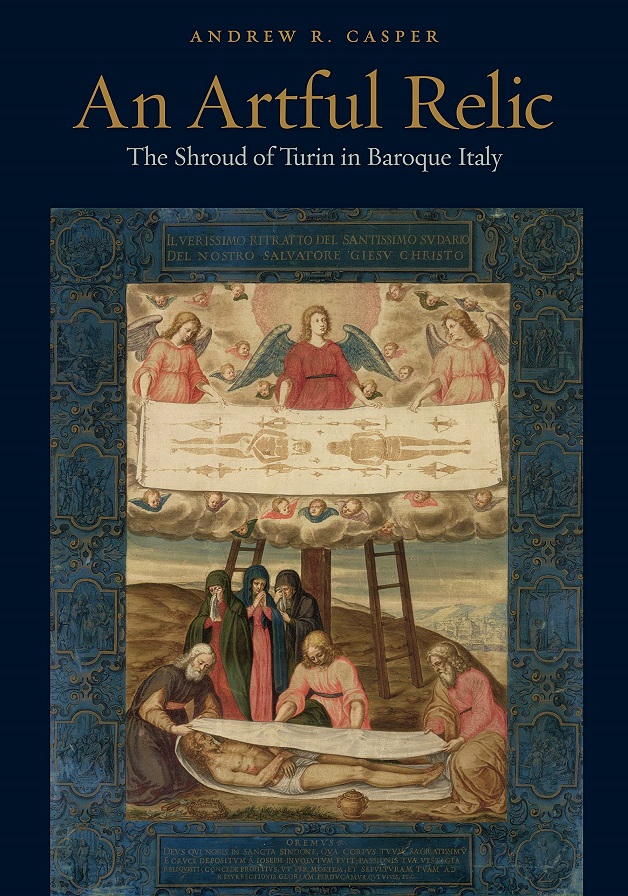
An Artful Relic: The Shroud of Turin in Baroque Italy by Andrew R. Casper is an impressive study of the impact of the Shroud of Turin on art, artists, and society in the 1500s-1600s. Not only is it lavishly illustrated, it also provides excellent historical data for those interested in the Shroud of Turin.
The thesis of the book is simple: the Shroud of Turin was immensely important in shaping art and even culture in Baroque Italy. That said, the work touches upon many important aspects for those interested in Shroud research. One aspect is the debate over its authenticity in history. While the debate over the Shroud’s authenticity continues today, the historical debate should inform those interested in the question. Casper notes that the acceptance of the Shroud’s authenticity in Italy (and elsewhere) was at least partially due to the immense influence of the House of Savoy. Their vested interest in making the Shroud a focal point for veneration and cultic worship greatly raised its esteem in Europe. Additionally, its survival of a fire in 1532 was seen as only explicable by miraculous intervention, thus leading more to accepting the Shroud as authentic (10). Neither of these, of course, will fully tilt opinion in modern minds regarding the Shroud’s authenticity. For people interested in that question, though, they should take into account the fact that the Shroud’s authenticity only became cemented in this time, and that its appearance in history cannot be traced to earlier than the latter half of the 1300s.
Casper draws attention to the way artists and others commented upon the supposed miraculous nature of the Shroud’s image in Baroque Italy. This included much comment on the way blood formed the image. The notion that the Shroud was explicitly a work of art made by God arose in this time period. It was insisted that God’s handiwork was shown with Christ’s blood as the pigmentation (57-58). These contentions had to deal with earlier Christian theology that argued against the possibility of Christ’s blood being left behind in the resurrection. For example, Aquinas had argued that because Christ’s body was true and complete in the Resurrection, the blood all rose with Christ “without any diminution” (73). Of course, not all Christian theology held to this view, and others argued that not all the blood had to be back in Christ’s body at the resurrection (74). The notion that it was the blood that formed the image stands in contrast to some modern arguments that radiation from the energy of resurrection formed the image. While it might be too strong to suggest that these two interpretations are irreconcilable, the inability to agree upon the formation of the Shroud remains an open question in research. Casper notes the blood as central to the veneration and worship of/around the Shroud in Baroque Italy, however. This would suggest that any modern explanation that does not hold to the same view has shown evolution from and important differences with earlier thought on the Shroud.
Casper goes over the influence of the Shroud on art in detail, noting the care with which copies were made, contrasting that with the apparent carelessness (or at least, lack of caring for) selection of artists to copy the Shroud was sometimes conducted. The Shroud and veneration thereof appeared all over in artwork, and influenced how illustrations of Christ were made. Casper forcefully makes the point that the Shroud as an artwork hasn’t been explored enough, and that its influence on contemporary artwork (here going with the assumption that it did not exist earlier than the 14th century) is quite strong.
Indeed, this raises a question for those who argue in favor of the Shroud’s authenticity: why did it not influence art so heavily before? While some arguments insist upon coins or certain icons being based upon the Shroud, no artwork exists depicting the Shroud qua Shroud prior to this time period. If the Shroud existed and was venerated in the 4th century or earlier, as some argue, why did artwork not depict it as such? No argument about the alleged secret history of the Shroud could work here, because if other artworks depicting Christ were widely distributed that depict a Christ allegedly based upon the Shroud of Turin, why could not the Shroud itself exist in such artworks? And why is it that only once an imminently powerful European family, the House of Savoy, threw their weight behind it that the Shroud rose in cultural prominence? One could anticipate various answers to these questions, but for this author, the answers are insufficient to demonstrate the Shroud’s actual existence prior to the 14th century. Indeed, the ubiquity and influence of the Shroud in and upon art in Baroque Italy seems an argument against its earlier existence.
Casper’s work is not, I should clarify, an argument for or against the authenticity of the Shroud. While he touches upon the question, his focus is almost entirely on the way the Shroud was depicted in art. nd this itself is a fascinating question. Casper presents many firsthand accounts of the Shroud, explanations of its depiction, and specific inquiries into artworks based upon it. The book therefore is of great interest to anyone interested in the Shroud of Turin.
An Artful Relic is a highly recommended read. It clearly demonstrates the influence of the Shroud in Baroque Italy and raises many questions and paths of research into religious art and the Shroud specifically. Those interested in the question of its authenticity should also read the book and see what questions and answers may come to mind based upon Casper’s thorough research.
Links
The Shroud of Turin- An Apologetics Sinkhole? – My first post in the series on the Shroud of Turin in which I comment broadly about my interest in it and why I think it demonstrates so many problems.
Be sure to check out the page for this site on Facebook and Twitter for discussion of posts, links to other pages of interest, random talk about theology/philosophy/apologetics/movies and more!
SDG.
——
The preceding post is the property of J.W. Wartick (apart from quotations, which are the property of their respective owners, and works of art as credited; images are often freely available to the public and J.W. Wartick makes no claims of owning rights to the images unless he makes that explicit) and should not be reproduced in part or in whole without the expressed consent of the author. All content on this site is the property of J.W. Wartick and is made available for individual and personal usage. If you cite from these documents, whether for personal or professional purposes, please give appropriate citation with both the name of the author (J.W. Wartick) and a link to the original URL. If you’d like to repost a post, you may do so, provided you show less than half of the original post on your own site and link to the original post for the rest. You must also appropriately cite the post as noted above. This blog is protected by Creative Commons licensing. By viewing any part of this site, you are agreeing to this usage policy.
Book Review: “A Supreme Love: The Music of Jazz and the Hope of the Gospel” by William Edgar

A Supreme Love by William Edgar explores the history of jazz music and sets it alongside questions about the meaning of and hope found in Christianity.
I was surprised to find as much historical background as Edgar provides here, and I must say the surprise was a pleasant one. Indeed, the entire first part (of three) is dedicated to historical context, and shows not only how jazz music arose from spirituals, but also how Christianity was leveraged by the enslaved to find hope and even find acts of resistance against the enslavers, who themselves claimed Christianity as their faith. The juxtaposition of the two Christian-ities is stark at times. The colonialism and evils found therein is starkly displayed, such as the discussion of hope found in music even on board slave ships (23).
Later in the book, Edgar whisks readers past a who’s-who of jazz musicians, showing the evolution of the sound, the use of language, and the way it is intertwined with Christianity. Edgar demonstrates a total knowledge of the topic, effortlessly skimming lyrics from a variety of artists to demonstrate his points and cultural milieus that he is discussing through the book. That knowledge and intimate detail Edgar displays makes the book constantly readable, and, as odd as it sounds, turns it into something of a page-turner. This reader was happy to go along for the ride one afternoon, looking up the references Edgar provides for sampling the music as he goes (youtube links, largely, with wonderful renditions of jazz tunes from various artists and styles) even as I enjoyed the theological tenor of the book.
A Supreme Love is a fantastic read by someone who clearly loves the subject and knows it inside and out. I recommend it highly for basically anyone interested at all in music, justice, or Christianity. It’s a great all-around read.
All Links to Amazon are Affiliates links
Links
Be sure to check out the page for this site on Facebook and Twitter for discussion of posts, links to other pages of interest, random talk about theology/philosophy/apologetics/movies and more!
Book Reviews– There are plenty more book reviews to read! Read like crazy! (Scroll down for more, and click at bottom for even more!)
SDG.
——
The preceding post is the property of J.W. Wartick (apart from quotations, which are the property of their respective owners, and works of art as credited; images are often freely available to the public and J.W. Wartick makes no claims of owning rights to the images unless he makes that explicit) and should not be reproduced in part or in whole without the expressed consent of the author. All content on this site is the property of J.W. Wartick and is made available for individual and personal usage. If you cite from these documents, whether for personal or professional purposes, please give appropriate citation with both the name of the author (J.W. Wartick) and a link to the original URL. If you’d like to repost a post, you may do so, provided you show less than half of the original post on your own site and link to the original post for the rest. You must also appropriately cite the post as noted above. This blog is protected by Creative Commons licensing. By viewing any part of this site, you are agreeing to this usage policy.
Coins, Icons, and the Shroud of Turin- Apologetics of the Shroud

One category of claims made in favor of the authenticity of the Shroud is that other artwork reflects the image of the Shroud. Often, this is linked to legal status for points of congruence. Thus, for example, it is argued that legally, 14 points of congruence between a suspect’s fingerprint and a fingerprint from a crime scene are necessary to determine a match. But with the Shroud, there are allegedly many icons and coins and other objects with a huge number of points of congruence well beyond the legal standard. Thus, in a video on Shroud3D (linked to me by one apologist interest in the Shroud), it is stated that there are “250 points of congruence between [the] Shroud and icon,” which is left as an argument for the clear link between the icon and the Shroud.
There are a number of problems with this species of argument related to the Shroud of Turin. I don’t have the time nor the expertise to analyze individual alleged points of congruence. Indeed, most of the sources I found making claims like this cited other sources, which in turn cited other sources, which in turn I was either unable to find or unable to determine the specific alleged points of congruence. The video I linked above shows someone waving a mouse icon on a screen at some alleged similarities between the Shroud and an icon, but that, with the claim on screen of “250 points of congruence,” does not do nearly enough to allow for any kind of detailed analysis. And, again, I am not any kind of expert in forensics of icons or the like. Instead, what I’m going to focus on are some broader problems with the argument.
Why It Matters
The reason this argument matters is that apologists of the Shroud claim that because coins, icons, and possibly other artworks reflect attempts to imitate the Shroud, this allows them to place the date of the Shroud much earlier in history than the earliest historical mentions of it (14th century). The logic is simple: if coins from earlier than the 14th century show that they are copied from or based upon the Shroud, it follows that the Shroud existed prior to the 14th century. I’ll have more to say about this argument in the future.
Points of Congruence
I mentioned above that claims are made about these alleged “points of congruence” or similarities between the Shroud of Turin and other objects. What I’ve struggled to track down are both the actual diagrams showing these exact points of congruence, the methodology used to detect these alleged points, and the linkage between those points and actual forensic evidence. After some deep searching online on the website of the Department of Justice, I was able to find a number of articles about fingerprint analysis. One of these, an abstract of a chapter of a book about forensics and fingerprinting, notes that identification of similarities involves: “perception, similarity judgments, memory, and decision making. These abilities vary among individuals and can be improved with training and experience.” This raises far more questions than it answers regarding the alleged proof of the earlier dating of the Shroud of Turin based upon its alleged “congruencies” with icons, coins, and the like.
First, what kind of actual training do those marking these supposed similarities have? From what I can tell, the people making these types of claims do not have any training in forensic analysis of photographs, art, or fingerprints. While expertise is not absolutely necessary in order to make identification of similarities (I’m fairly sure that without a degree in art, I could identify a painting by or in the style of Salvador Dali, for example), it certainly would give more credence to the claims being made. And, it’s possible that I, being fairly new to this discussion, am missing people with relevant degrees or job experience. But I do know how often I’ve seen online apologists making these claims without citation, and those doing that certainly do not have the relevant expertise, nor are they citing sources with that expertise. This alone should be enough to urge skepticism about said claims.
Second, what about making judgment calls? If I have an image with a crown of thorns and another image with a crown of thorns, how do I make a judgment call of how many similarities there are? One has a thorn piercing the forehead directly in the middle of the left eyebrow? That could be evidence of congruence, but it could also be happenstance–the thorns had to hit the head at some points, after all. It seems somewhat obvious to me that those making these judgment calls in favor of the Shroud may have significant bias in favor of finding more congruence than there may actually be. And without degrees or expertise to back them up, this becomes even more likely. It’s easy to multiply points of congruence when one wants them to be there. And, as I will note below, this is even more problematical because of the nature of what is being alleged about, anyway (see the section on Baseline below).
Third, it’s clear that nearly every aspect of these points of congruence regarding the Shroud and various artworks are matters of opinion. But when the subject being depicted has many features that are generally well-known (crucified figure, scourged, with crown of thorns, etc.), how does one determine whether a point of congruence is evidence of actual copying or whether it is just happenstance based upon the known circumstances of the subject being depicted? It seems like sorting that question out would be nearly impossible. It would rely so much upon judgment calls it would start to become absurd. Indeed, one would have to constantly assume intent into the depictions on the coins or icons–that they were intended to look like the Shroud, rather than happening to follow the same general outline of an image. But that brings us to the argument below.
There is a Baseline
Perhaps the most severe problem with claims about the supposed congruence between the Shroud and various artworks, coins, etc. is that these arguments fail to note the works are not independent. What I mean by this will take a little explaining. Going back to the example that is being cited–fingerprint analysis–the example has no independent goal towards which to aim. If I have a fingerprint from a crime scene, and I have the fingerprints of the suspect, I can compare them and conclude that if there are enough similarities–whatever that standard is legally–then that means they’re a match.
With the Shroud, however, we have two objects, the Shroud, and some other item, say a coin, which are not independent of each other. This isn’t like plucking a fingerprint from somewhere and hoping to find a match. Instead, it is taking two objects, each of which has a goal oriented towards depiction of a specific subject, and then declaring that because they have similarities to each other, they are necessarily connected. Icons, coins, and the like are all intended to depict Jesus, at least in some sense. Obviously, they didn’t have a photograph, and details about what Jesus looked like in the Bible are totally scarce, but there are very early artistic depictions of Jesus, some with significant variation. There are also obvious features of a crucified human being with a crown of thorns that would lead to points of similarity in depiction of a human in that state. Two people trying to show a crucified Jewish man from the first century would likely align on many “points of congruence” without having any other knowledge of each others’ works.
The history of iconography of Jesus is its own separate subject, but by the time the artworks like the coins and icons being discussed by Shroud apologists were created, there was already an established baseline for what Jesus was supposed to look like in such iconography. So if you have an established representative style for what a subject, Jesus, is supposed to look like, and you have an icon and a coin that match that style, having another object–the Shroud–have many dozens or even hundreds of “points of congruence” with those other objects does not prove that those objects are based upon the Shroud. At best, it just proves the Shroud is consistent with the established baseline representation of Jesus in that era, but that would hardly be surprising whether it is a copy or genuine. But if I have three independent things, Bob, a coin that is supposed to depict Bob, and something that allegedly is the cloth Bob was buried in, it would hardly be surprising that both the burial cloth and coin are similar, given that they are both trying to aim at Bob as an image. That would be true whether the cloth is genuine or not.
One example of this was found in a podcast I was listening to about the Shroud of Turin [and, of course, my apologies as I have been unable to find the exact time stamp, but it was the Backstory on the Shroud of Turin Podcast, “The Stories Coins Can Tell with Justin Robinson,” August 11, 2022]. In that podcast, the person being interviewed noted that the way a strand of hair came across Jesus’s face matches the Shroud of Turin. In fact, it gets better, said Robinson, because the coin had to be printed in reverse, and so the artist was intentionally matching how that strand of hair came across the face to the Shroud of Turin! But this argument is specious. If you have two depictions intentionally aimed at a long haired Jewish man crucified, it would hardly be surprising for there to be a strand of hair dangling across the face, no matter which side the strand of hair falls upon. And the argument about the image having to be flipped for a coin does nothing to strengthen the attempt to link it to the Shroud, apart from making a supposed link to intention that cannot be proven. But these types of arguments are put forth as if they give definitive proof of (or at least, strong evidence for) the notion that these artists were copying the Shroud. Even as one who would love to have such evidence, this rings hollow and reads as attempted justification for something tenuous at best.
Fingerprints and Coins?
Similarly, those making claims about coins, icons, and the like fail to recognize the goal-directed nature of artwork. These aren’t just someone’s happenstance fingerprints or something; these are intentional depictions of a figure purported to be a representation of Jesus. The people making the argument about forensic evidence in court of law and applying that same style of evidence-gathering to questions about the Shroud of Turin seem to be engaging in a category error.
Fingerprints, as one might note, are not coins. Fingerprints are subjects of nature, possibly subject to scarring, and have numerous other aspects that are quite different from coins or icons. Icons and the faces on coins are intentional depictions of something. They are meant to appear as whatever vision the artist intended. Not only does this make it problematic as an argument because there is a baseline, as noted above, but it also means that trying to establish a 1:1 correspondence between what is required to demonstrate in court of law that a suspect and a piece of fingerprint evidence are the same and what is required to establish that a coin was specifically based upon the Shroud at least requires some kind of argument to establish. But that argument is never made. It’s just noted that in court of law there is some number of similarities required for fingerprints, and then because there are allegedly even more similarities between the Shroud and some piece of artwork, that establishes the artwork was copying the Shroud.
The leaps in logic here are over vast chasms. Criminal forensic evidence just is not the same as analysis of art and vice versa. Expert analysis simply does not exist for comparison of the coins with the Shroud imagery, so far as I can tell. Forensic analysis would not be the correct category to make this comparison with anyway. What possible correspondence could there be between an artwork and a supposedly genuine image of a body and between a naturally occurring phenomenon–a fingerprint–and the discovery of a fingerprint at the scene of a crime? They’re entirely different fields of study with entirely different backgrounds, contexts, and levels of intent. While it sounds like a good argument to cite one to defend the other, when one examines the actual arguments, they fall apart.
Conclusion
There are more problems that could be raised with the supposed similarities between the Shroud and various icons or coins or other artworks, but many of them would need to focus on specific artwork. I have left aside analysis of specific, individual claims to focus more upon methodology. Because of this, my argument may be dismissed by some as being to vague or broad. That may be, but I think that the points I’ve raised here should cause some to pause and urge caution about claims related to the Shroud of Turin. So often, it’s not experts doing this analysis, the arguments are vague, or categories are confused. Apologists should hold ourselves to a higher standard, and I don’t think this is happening with the Shroud.
Links
The Shroud of Turin- An Apologetics Sinkhole? – My first post in the series on the Shroud of Turin in which I comment broadly about my interest in it and why I think it demonstrates so many problems.
Be sure to check out the page for this site on Facebook and Twitter for discussion of posts, links to other pages of interest, random talk about theology/philosophy/apologetics/movies and more!
SDG.
——
The preceding post is the property of J.W. Wartick (apart from quotations, which are the property of their respective owners, and works of art as credited; images are often freely available to the public and J.W. Wartick makes no claims of owning rights to the images unless he makes that explicit) and should not be reproduced in part or in whole without the expressed consent of the author. All content on this site is the property of J.W. Wartick and is made available for individual and personal usage. If you cite from these documents, whether for personal or professional purposes, please give appropriate citation with both the name of the author (J.W. Wartick) and a link to the original URL. If you’d like to repost a post, you may do so, provided you show less than half of the original post on your own site and link to the original post for the rest. You must also appropriately cite the post as noted above. This blog is protected by Creative Commons licensing. By viewing any part of this site, you are agreeing to this usage policy.
Book Review: “Ministers of a New Medium” by Kirk D. Farney
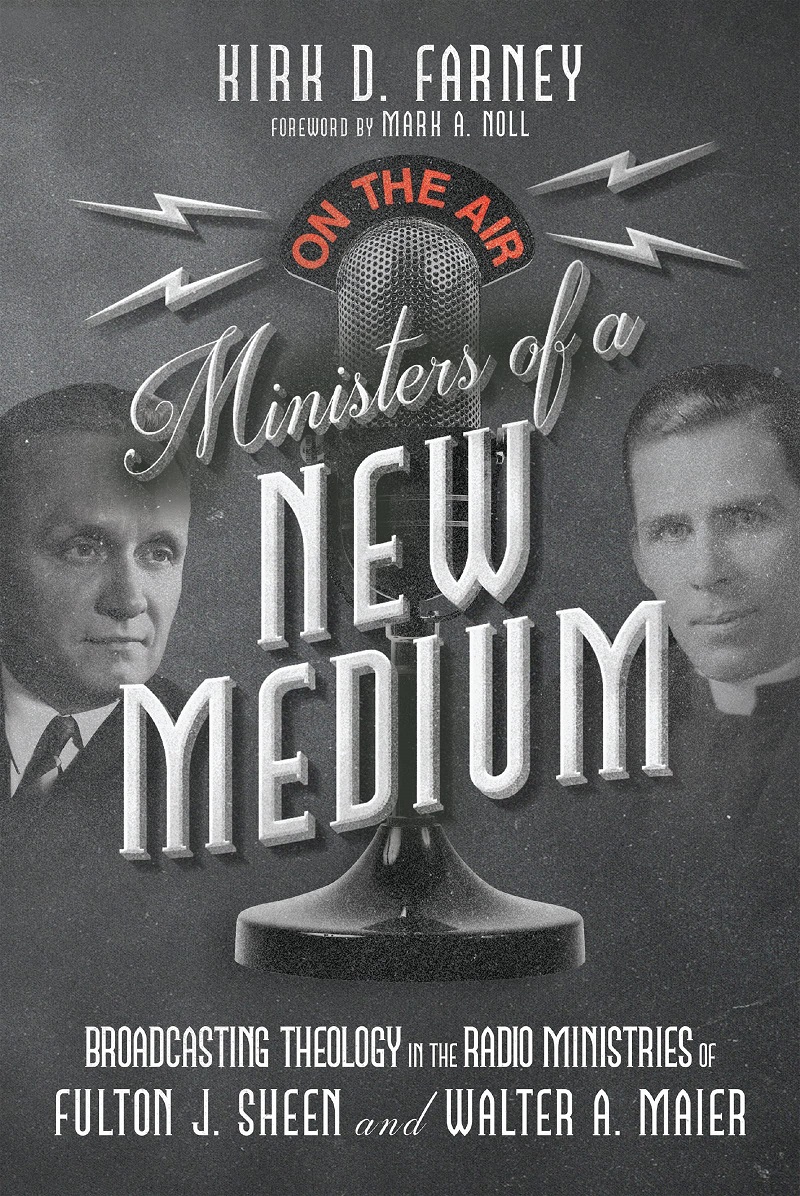
Ministers of a New Medium: Broadcasting Theology in the Radio Ministries of Fulton J. Sheen nd Walter A Maier by Kirk D. Farney reads in part as a biography, in part as a love letter to radio broadcasting, and finally as a deep look at the impact of broadcasted theology in the rising popularity and height of radio.
Before Farney dives into the radio ministers themselves, he briefly draws out the history and surging popularity of radio. He notes the penetration of radio into American homes and the way it was essentially set up to be a purveyor of truths to the masses. Broadcasters were seeking religious programing and as radio continued to soar in popularity, they became more specific about that which they were seeking. Enter Sheen and Maier.
Fulton J. Sheen was a Catholic priest and Walter A. Maier was a pastor of the Lutheran Church – Missouri Synod. Though they came from different theological backgrounds, their focus on bringing Christianity to the masses through radio was shared. Farney first gives deep background for each of the radio ministers. Then, he draws out extensively the content and tone of their messages. For Maier, for example, there’s some discussion of continuity and shifting tone during World War II as he integrated more patriotic themes into his prayers and messaging (237ff). But Maier also did not shield the United States from criticism, drawing parallels between the Nazi treatment of the Jews and the United States’ towards Native and African Americans (239). Sheen bemoaned the state of universities and the alleged elitism of the intelligentsia (158). One could see easily how messages like these could resonate broadly.
I would have liked to have more critical interaction with the material presented. The strength of Farney’s work is in the lengthy, detailed presentation of the beliefs of the radio ministers. There is no shortage of anecdotes, quotes, and specificity related to the messages Sheen and Maier conveyed to the masses. But there is very little by way of analysis. It’s a kind of “just the facts” approach that left me longing for some analysis. That said, it’s clear that analysis is not the focus of the work. Instead, Farney is focused upon cluing readers into the broad messages and background of these two radio giants.
Ministers of a New Medium is a fascinating read, cluing readers into a somewhat forgotten era of broadly popular evangelism. Recommended.
All Links to Amazon are Affiliates links
Links
Be sure to check out the page for this site on Facebook and Twitter for discussion of posts, links to other pages of interest, random talk about theology/philosophy/apologetics/movies and more!
Book Reviews– There are plenty more book reviews to read! Read like crazy! (Scroll down for more, and click at bottom for even more!)
SDG.
——
The preceding post is the property of J.W. Wartick (apart from quotations, which are the property of their respective owners, and works of art as credited; images are often freely available to the public and J.W. Wartick makes no claims of owning rights to the images unless he makes that explicit) and should not be reproduced in part or in whole without the expressed consent of the author. All content on this site is the property of J.W. Wartick and is made available for individual and personal usage. If you cite from these documents, whether for personal or professional purposes, please give appropriate citation with both the name of the author (J.W. Wartick) and a link to the original URL. If you’d like to repost a post, you may do so, provided you show less than half of the original post on your own site and link to the original post for the rest. You must also appropriately cite the post as noted above. This blog is protected by Creative Commons licensing. By viewing any part of this site, you are agreeing to this usage policy.
“Avatar: The Way of Water” – A Christian worldview perspective
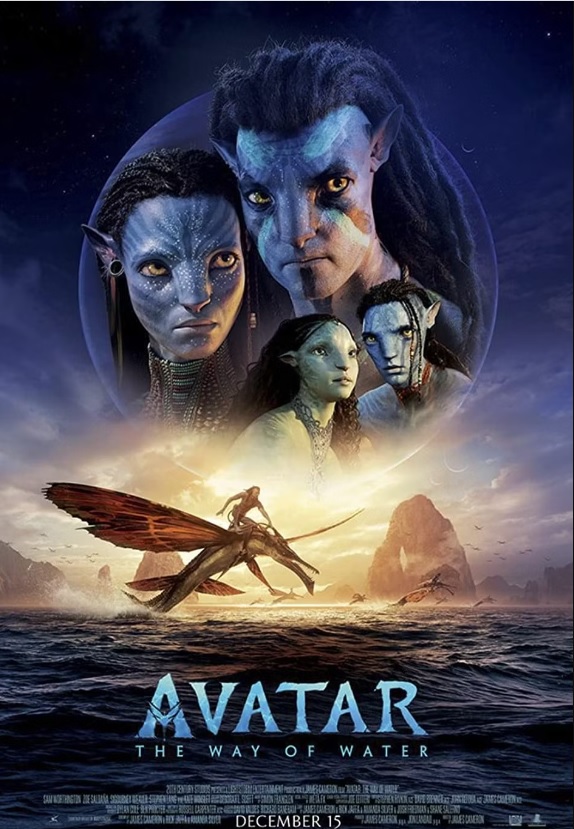
The immensely popular Avatar begged for a sequel nearly from release, and after 13 years, it’s finally arrived. “Avatar: The Way of Water” landed in theaters, and I won’t make a secret of being a huge fan of the franchise. But what might the movie have to say about worldview? Quite a bit, actually. Here, I’ll take a look at the movie from a worldview perspective. There will be SPOILERS throughout this post.
Family
It would be impossible to write about the film without reflecting on the way it discusses and represents family.
Jake seems obsessed with the notion of a father protecting his family. One of the later lines in the movie reflects this, and is a repeated comment: “A father protects his family.” The line, repeated near the end of the film, is somewhat ambiguous. Is James Cameron trying to put forward this line as a truism, or is he offering a subtle critique of Jake’s patriarchal tendencies, as with the critique of his militarism? I lean towards the latter. After all, Jake himself acknowledges his failure to protect his family, but still hangs together as a family and acknowledges the strength of that. Additionally, Neytiri did a huge amount of the protecting of family, especially in the final few scenes.
The importance of familial attachment is a major theme in the film. “Sullys stick together” is a recurring theme. But what does it mean? There are so many scenes that reflect on this. Neytiri tells Jake at one point that the family is not a squad–it’s not a military unit. It’s a unit based upon love, relationship, and bonds that go beyond those even of a squad. Jake’s attempted military style leadership isn’t working, and it is what causes some of the rifts in the family.
The loss of Neteyam was one of the most impactful scenes in the movie. When Jake and Neytiri bond with Eywa towards the end of the film, they see a younger Neteyam frolicking and playing with Jake years before. It’s both healing and unbelievably sad all at once. We know that we will see our loved ones again, but the time in between is one for healing and sorrow.
Colonialism and Peacemaking
The question of pacifism looms throughout the film. The people of the water aren’t involved in the conflict with the sky people (humans). They keep to themselves, living lives that remain tranquil despite conflict on the other parts of the planet. But can they ignore the plight of other peoples? Such a question must rank among the deepest in philosophy, and even the whale stand-ins, the tulkun. The tulkun shun even their own if they participate in a conflict, weighing the damage done by any conflict against those who decided to participate in it.
Colonialism from the sky people–the humans–is what drives the conflict. It’s impossible to miss the major themes here contrasting the peaceful nature of the people of Pandora with the militant, capital-driven humans. And as Christians, I wonder about lines like no one can serve God and money or what good is it to gain the world but lose one’s soul?
Seizures and Religious Experience
Kiri, the daughter of Dr. Grace Augustine’s Avatar, is imbued with unknown power and skills. She seems to commune with many aspects of Pandor’as natural world in ways no one else does–or even notices at times. Late in the film, she is able to bond with anemone-like things in the coral reefs and cause them to fight against a human incursion. Fish gather around her. Glowing sea creatures do her bidding even without a direct bond.
But in the midst of all this, she makes a bond with Eywa which leads to seizure-like symptoms no one else experiences. The human scientists are brought in to assess and help, but they are ultimately powerless to awaken the comatose Kiri. However, they do discern it was a seizure that caused her state and warn Jake that Kiri must not bond with Eywa in that fashion again, because she could have another seizure underwater and die. They also directly link seizures to the part of the brain that is active in religious experiences. I have an interest in religious experience and neuroscience, but certainly no expertise in it. With that caveat, I found this an extremely interesting and specific point for Cameron to raise in the film. As viewers, we have privileged access to Kiri that the scientists did not, and we also know there’s more going on than what seems a physicalist explanation. While it is true that activating certain parts of the brain can yield religious-like ecstasy and experience, that in itself does not demonstrate that no genuine religious experiences happen. Indeed, the later parts of the film with Kiri genuinely interacting with the world in seemingly unexplainable ways seems to show Cameron agrees here, and that something more will loom larger later. For now, though, we’re left not knowing where it’s going.
One last note on this, though. In the first film, we had the groundwork laid to see a kind of unity of science and religion. The “direct line to Eywa” of the tree, detected by scientific means in the roots and throughout Pandora and the clear way there is some kind of unifying intelligence on Pandora shows more is going on here. Is Eywa going to be depicted as deity? Or will there be some kind of unifying theory presented in the future? In our world, some try to unify science and religion quite a bit. There are many views about how to and even whether to do this (see my post on differing positions here). We know that God works in the world, but whether science can or even should detect that work is an open question.
The Way of Water and Eywa
The Way of Water itself is a central theme of the film, and certainly one of the driving aspects of its worldview.
“The way of water has no beginning, and no end.
“The sea is your home before your birth and after your death.
“The sea gives and the sea takes.
“Water connects all things. Life to death. Darkness to light.”
The way of water certainly seems connected to the previous film’s depictions of Eywa, the balance of all life, and the harmony and disharmony. It’s easy to contrast this with traditional Christianity, but parallels may also be found. Interestingly, the contrast can mostly be found with platonic views of the human soul, which hold that human souls are imbued with objective eternality after creation. In some Christian beliefs, all humans are eternal by virtue of creation, not by virtue of God granting immortality. The debate over this would go beyond what I’m trying to discuss here, but it’s interesting to see the parallels with eternality of the soul here. However, as depicted in both this film and the previous one, there’s not a sense of reincarnation or eternality of necessity here. The Way of Water, instead, is a kind of way of being, living in harmony with nature rather than attempting to dominate it. It’s acknowledgement that we all share commonalities. And that, I believe, is something Christians can embrace–the knowledge that we all, as God’s creation, share in the broader creation God has made. Thus, when we harm creation, we harm God’s good order and work against what God brought forth.
Interestingly, the humans who are hunting the tulkun are seeking immortality. A substance from the brain of the tulkun stops aging for humans, thus granting a kind of immortality that is seen as valued above all else. The disordered seeking of self-immortality is one aspect of humanity the film highlights very well.
Eywa is in the background throughout the movie, and I still wonder where James Cameron is going to go with this plotline. Above, I mentioned some more specific aspects of the religious and scientific aspects of the film. But we don’t learn much regarding where Cameron is taking this specific aspect of the plot beyond that. It will be interesting to see in the next several films what happens.
Conclusion
There is much more that could be discussed about “Avatar: The Way of Water.” I found it a deeply provocative film, reflecting the best science fiction which both enthralls with mesmerizing visuals and asks big questions about humanity. It feels to me like a kind of “Empire Strikes Back” middle movie, in which the “bad guys” have much more power than the “good guys,” and we’re left with a somewhat ambiguous ending. I cannot wait for the next one.
I’d love to read your own thoughts on the movie. Let me know what you think in the comments.
Links
“Avatar” – A Christian reflection on the film– 7 years ago I wrote about worldview level issues in the original movie. Note that some of my views may have changed.
Be sure to check out the page for this site on Facebook and Twitter for discussion of posts, links to other pages of interest, random talk about theology/philosophy/apologetics/movies and more!
Caring for Creation: A discussion among evangelicals– I write about creation care from a number of perspectives offered at a recent panel of prominent evangelical thinkers in this area.
Also see my other looks into movies (scroll down for more).
SDG.
——
The preceding post is the property of J.W. Wartick (apart from quotations, which are the property of their respective owners, and works of art as credited; images are often freely available to the public and J.W. Wartick makes no claims of owning rights to the images unless he makes that explicit) and should not be reproduced in part or in whole without the expressed consent of the author. All content on this site is the property of J.W. Wartick and is made available for individual and personal usage. If you cite from these documents, whether for personal or professional purposes, please give appropriate citation with both the name of the author (J.W. Wartick) and a link to the original URL. If you’d like to repost a post, you may do so, provided you show less than half of the original post on your own site and link to the original post for the rest. You must also appropriately cite the post as noted above. This blog is protected by Creative Commons licensing. By viewing any part of this site, you are agreeing to this usage policy.

 J.W. Wartick - Reconstructing Faith