Apologetics of Christ
Jesus, Dedication, and Wise Men
 Are these Biblical accounts of Jesus’ birth irreconcilable:
“When the time came for the purification rites required by the Law of Moses, Joseph and Mary took him to Jerusalem to present him to the Lord.”- Luke 2:22
“When [the Magi] had gone, an angel of the Lord appeared to Joseph in a dream. ‘Get up,’ he said, ‘take the child and his mother and escape to Egypt. Stay there until I tell you, for Herod is going to search for the child to kill him.’ So he got up, took the child and his mother during the night and left for Egypt…” Matthew 2:13-14
One says he was dedicated in the temple, the other, that Joseph took Mary and Jesus and fled to Egypt. The key to solving this potential problem is, as frequently is the case with Bible difficulties, context, context, and context.
The dedication of Jesus would have taken place very shortly after His birth. But reading the account of the visit of the Magi, we find that the wise men came at some point after the birth of Jesus. This is evident in Matthew 2:1-12, in which the Magi initially stop to visit King Herod to ask him where Jesus was born. Unless one is to assume the Magi were able to travel instantaneously to Bethlehem from Jerusalem with all of their escort, one should have no difficulty thinking that the Magi arrived at some point after Jesus had already traveled to Jerusalem and back for His dedication at the temple.
Not only that, but despite some traditions drawings of the Magi, it is unlikely that they came while Jesus was merely a babe. Again, these men came from “the east,” so it is unlikely that they made the trip in a few days. But there is also textual evidence for this idea, for when Herod seeks to kill Jesus, he kills all boys 2 years old and younger (2:16). Sure, he may have simply had no idea how old Jesus was and simply been shoring up his bets, but the text goes on to say that he kills boys 2 and younger “in accordance with the time he had learned from the Magi” (2:16b). So at some point he must have asked them how long they’d been traveling, and it was long enough to warrant killing the boys 2 and younger.
Thus, there is no contradiction in the text.
Merry Christmas.
SDG.
This is part of a series I’ve entitled “Jesus: the Living God,” which explores Jesus from Biblical, theological, and apologetic levels. View other posts in the series here.
——
The preceding post is the property of J.W. Wartick (apart from citations, which are the property of their respective owners) and should not be reproduced in part or in whole without the expressed consent of the author. All content on this site is the property of J.W. Wartick and is made available for individual and personal usage. If you cite from these documents, whether for personal or professional purposes, please give appropriate citation and provide a link to the original URL. By viewing any part of this site, you are agreeing to this usage policy.
Jesus and the Stable: A Theory
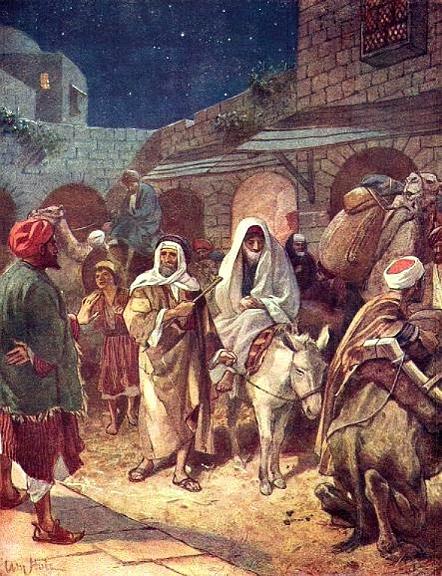 The Christmas season is upon us and I have been contemplating much of the story of Christ’s birth. Apologetically, I’ve decided to focus this season upon a few questions about Jesus.
One argument I have heard is that the account of Jesus’ birth in Luke 2 is inaccurate. The charge is made because it seems unfathomable culturally that Joseph could have gone to his hometown and found no family who would accommodate he and his betrothed. Luke 2:7 says “And she gave birth to her firstborn son and wrapped him in swaddling cloths and laid him in a manger, because there was no place for them in the inn.” The latter part of the verse is that to which the objector points, saying that surely one of Joseph’s family members would have provided a bed for them.
There are a few important points to be made here. First, the text actually provides for the possibility of Joseph’s family providing lodging. The Greek word translated “inn” in this verse can also be translated as “guest room” which implies that Joseph did seek lodging with family, but all of their guest rooms were full. This is reflected in the NIV translation, which states that “there was no guest room available to them.”
Second, while those who make this objection focus on the cultural significance of hospitality, they also ignore the cultural significance of adultery. That Mary was pregnant was a pretty big deal. She would have been seen as an adulterer–possibly with Joseph (though some anti-Christian literature from the second century suggested that Jesus was the illegitimate child of Mary and a Roman soldier named Panthera). The penalty for adultery was death by stoning. Joseph had stayed with Mary and protected her. It doesn’t seem unlikely that this could have incurred his family’s wrath to the point where they simply didn’t allow him to stay with them for the census. Treated like the family member no one talks about, everyone’s door was shut when Joseph came knocking with his pregnant bride-to-be.
It should be noted that this later theory is just that; a theory. The textual evidence could easily support my first point (that all the guest rooms were full). I think that my own theory is plausible. Either way, the objection fails.
SDG.
This is part of a series I’ve entitled “Jesus: the Living God,” which explores Jesus from Biblical, theological, and apologetic levels. View other posts in the series here.
——
The preceding post is the property of J.W. Wartick (apart from citations, which are the property of their respective owners) and should not be reproduced in part or in whole without the expressed consent of the author. All content on this site is the property of J.W. Wartick and is made available for individual and personal usage. If you cite from these documents, whether for personal or professional purposes, please give appropriate citation and provide a link to the original URL. By viewing any part of this site, you are agreeing to this usage policy.
Jesus: A Fact of History
This post is part of a series, “Jesus: The Living God.” See other posts in the series here.
The belief that Jesus existed is, quite simply, historical fact. The historical figure of Jesus is beyond denial. Jesus walked on this planet. There are those who actually deny this fact. They say things about our knowledge of Jesus being derived only from “hearsay” accounts, or that the other historical sources outside the Gospels aren’t reliable because they were written after Jesus died.
What people who try to deny Jesus as a historical fact don’t realize is that we have more evidence for the historicity of Jesus than we do for historical figures such as Alexander the Great. Our sources on Alexander the Great date from sources written utilizing biographical accounts about him. This is hearsay, if that is how those who want to attack the historicity of Jesus want to define such historical accounts. The sources we do have date at least 200 years after Alexander’s death (derived from Green, Alexander the Great and the Hellenistic Age, pp. xxii–xxviii). But according to the “historical standards” set by those who wish to deny that Jesus ever existed, we absolutely must accept that Alexander the Great existed either!
We know of Alexander the Great only through accounts written hundreds of years after his death (scholars date the Gospels to about 70AD–40 years after the death of Jesus [see Blomberg, Craig, The Historical Reliability of the Gospels)! Sure, there are many reasons to think Alexander existed, such as the shape of western civilization, various corroborating evidence, etc… but we have reasons like that to believe Jesus existed too!
The reality is that no serious scholar denies the historicity of Jesus, due not only to the Gospel accounts, but also Josephus, Tacitus, etc. Those who wish to discredit the accounts of the Gospel, Josephus, etc. should realize they should be consistent in their “historiography” and discredit the accounts written about Alexander the Great, not to mention other figures like Attila the Hun, Confucius, etc.! If this is the kind of historical relativism and denial we are forced to embrace due to the denial of the historical Jesus, then almost all ancient history is thrown into question.
The fact of the matter is that the reason people try to deny the historicity of Jesus isn’t due to historical reasons, it’s either due to ignorance about how historiography operates or simply willingness to blatantly deny historical fact.
Recommended reading
Wright, N.T. The Challenge of Jesus, The New Testament and the People of God, Jesus and the Victory of God, and The Resurrection of the Son of God
Blomberg, Craig The Historical Reliability of the Gospels
Strobel, Lee The Case for the Real Jesus and The Case for Christ
Komoszewski, Sawyer, and Wallace Reinventing Jesus
Note that even accounts critical of Jesus do not deny his historicity, cf Crossan, John Historical Jesus or Borg, Marcus Jesus
——
The preceding post is the property of J.W. Wartick (apart from citations, which are the property of their respective owners) and should not be reproduced in part or in whole without the expressed consent of the author.
Jesus: The Living God
The life of Jesus is the single most important event in human history. If Christianity is true, then salvation is available to all who believe in Him. If not, then billions of people have been deceived for millennia. This is part of a series of posts on Jesus, the Living God. I’ll be exploring apologetic, theological, and Biblical works that discuss Jesus.
This post serves as a place to collect links to this series.
The Morality of God: Christ at the Center.
Jesus and the Stable: A Theory.
The Historicity of Jesus: The Tools for the Task
This is part of a series I’ve entitled “Jesus: the Living God,” which explores Jesus from Biblical, theological, and apologetic levels. View other posts in the series here.
For now, let us focus on the “tools for the task” (Wright, 29 and following). What kind of historical, textual means are used to talk about Jesus? I’ll be outlining views made by N.T. Wright in his The New Testament and the People of God, (hereafter NTPG) and Blomberg in The Historical Reliability of the Gospels. First, I should outline my presuppositions. I believe that Jesus Christ is Lord and Savior, whose salvation is freely available to all who believe by grace through faith (Ephesians 2:8-9). There is no other name by which we are saved (Acts 4:12). I believe that the Bible is the Holy, Inerrant Word of God. It is infallible in its teachings.
Wright argues for a “critical realist” view of history. This view describes a “process of ‘knowing’ that acknowledges the reality of the thing known, as something other than the knower… while also fully acknowledging that the only access we have to this reality lies along the spiralling path of appropriate dialogue or conversation between the knower and the thing known” (Wright, 35 emphasis his). This acknowledges that observers have their own point of views, that they have their own interpretations, and that metaphysical beliefs will influence interpretation of data (36). This is vitally important throughout not just Wright’s body of works, but any historical (or other field) study–one’s presuppositions will influence how one interprets the same data.
Wright argues that one primary function of worldviews is to tell “stories” (38). This doesn’t mean these stories are fiction, rather, Wright is arguing that these stories form the basis of a worldview as well as the ways the worldview will interact with other views (38-40). In the context of the New Testament, “They [first-century Jews] never expressed a worldview in which the god in question was uninterested in, or uninvolved with, the created world in general, or the historical fortunes of his people in particular” (41). It is this worldview that, upon reading more of Wright, I think Wright not only acknowledges but agrees with. God is not uninterested or uninvolved, rather, the opposite is true–God is intimately involved and interested in His creation and creatures.
Wright emphasizes the “impossibility of ‘Mere History'” that is wholly divorced from any worldview (82). This doesn’t mean there are no facts… rather, it means there is no such thing as an uninterpreted fact (88). These interpretations are generally used in conjunction with historical hypotheses. Thus, it is important to note what composes a good historical hypothesis:
1) The historical hypothesis must include the data. One cannot, for example, simply drop the eschatology which was clearly part of Jesus’ teachings as well as the rest of the New Testament, in order to make one’s hypothesis easier to produce. The data must all be included (99).
2) “It must construct a basically simple and coherent overall picture” (100).
3) The hypothesis must show that it is useful in related areas, it must explain other problems (100).
It is important to realize that a simply enormous amount of material has been produced on Jesus and the Gospels, not to mention the rest of the New Testament. Thus, I will turn to Craig Blomberg’s work, The Historical Reliability of the Gospels (hereafter HRG) to analyze some of the ways this study has been done. The tools for our task (to borrow Wright’s terminology) should utilize the best available evidence from New Testament scholarship, while discerning everything in light of the truth of Scripture.
Craig Blomberg wonderfully summarizes the various methods of historical criticism and analyzes them for usefulness in HRG. Note that I’m not endorsing historical criticism, rather, I’m endorsing taking what is useful from historical criticism and use it as part of the toolbox. In my summing up, I’m leaving out much of Blomberg’s task of pointing out flaws in these criticisms (which is not only in-depth, but also illuminating), but rather emphasizing his ways to use them in the presuppositions that I’ve outlined above.
1) Form Criticism- Form criticism emphasizes the genre of the work being viewed (Blomberg, 50). It also discusses how a text was transmitted or brought into being. Christians can find this useful as it can be readily implemented in the “historical grammatical” type of reading of Scriptures. The background of the text is indeed important, as well as realizing the genre involved (i.e. the historical telling of what Jesus did, as opposed to His parables, which are not literal history).
2) Redaction Criticism- Redaction criticism views the writers of the Gospels as “editors” of the New Testament, “selecting, arranging, and rewording their sources to highlight particular theological and stylistic emphases” (Blomberg, 67). Christians can utilize this not to break down the reality of the Gospels, but rather they can use it as they realize there are indeed differences in the portrayal of Jesus in the Gospels (i.e. Mark’s suffering servant and Matthew’s son of David), not as contradictions, but as parts to a whole picture of Christ as suffering servant, son of David, compassionate teacher, and Word Incarnate (74).
3) Midrash- Midrash criticism of the Gospels focus on the “relationship of the Gospels to various [Hebrew Scripture] passages to which they may refer” (75). Clearly, this has uses for the Christian. How did the writers of the Gospels utilize Hebrew Scriptures to make their arguments or draw their conclusions about who Jesus was and what He did? This is vitally important to Christological study–who did Jesus say He was, based on the passages He cites, and who did others say He was?
4) Literary Criticism- this discipline is broken down into three types, though the most useful type for the Christian is the “narrative criticism” which analyzes characters, symbolism, figures of speech, etc. within the Gospels (87).
I’ve left out much of Blomberg’s analysis in order to simply sift off what we can use from these various methods, in light of the presuppositions I’ve outlined above. There is much more that could be said about either of these fantastic works (NTPG or HRG), and there is much more that could be said about the “tools for the task”, but for now, these are our tools, and I shall soon move into some of the historicity of Jesus.
Sources:
Blomberg, Craig L. The Historical Reliability of the Gospels. InterVarsity Press. 2007.
Wright, N.T. The New Testament and the People of God. Fortress. 1992.
——
The preceding post is the property of J.W. Wartick (apart from citations, which are the property of their respective owners) and should not be reproduced in part or in whole without the expressed consent of the author.
The Covenant and Christ
This post is part of a series on Jesus: The Living God. View other posts here.
Recently I wrote a guest post for a fellow Christian blogger (an excellent site, check it out), Chris Reese, on N.T. Wright’s Climax of the Covenant. I wanted to re-blog it for my site and add a bit to it.
A subject that is often ignored within discussions of who Christ is involves Covenant theology, specifically, the theology of the Torah. How exactly does Christ relate to the Covenant that God made with the people of Israel? N.T. Wright discusses this very issue in his book, The Climax of the Covenant.
First, what is the Torah? The Torah, in Wright’s usage, is not just the Mosaic books of the Bible or the Law, but the promise of God to His people, Israel. He states that “…the law… was regarded not merely as a general code of ethics, but as the charter of Israel’s national life” (24). The problem was, of course, that God demanded perfect obedience to the Torah, to the Law. As His covenant people, Israel was to keep the Torah and to cherish it. But Israel constantly strayed. Thus, the power of the Torah became death, the consequence of sin (209).
So how could Israel fulfill the Torah? The short answer is that Israel simply could not. It demanded perfection, and the people of Israel could not be perfect. God had to intervene directly in history in order to accomplish His covenant with His people, and to open this covenant up to all people.
And how did this happen? First, note the relationship between Christ, Adam, and humanity. Wright notes that “Adam has [for the rabbis of Israel] become embodied already in Israel, the people of the Torah, and in her future hope” (25). This, in turn, must be viewed in light that “Israel, the family of Abraham, is God’s true humanity. Her land is God’s land. Her enemies are God’s enemies” (23). This reflects back on the Torah, as discussed above. It is the “charter of Israel’s national life” (24). So there is a relationship between Adam and Israel–Adam, Wright argues, is to be understood as Israel. Jesus Christ, then, became a New Adam for a New Israel. By acting as the New Adam and redeeming Israel, He fulfilled the Torah and seal the charter of Israel. Not only that, but He opened this charter, this Covenant, to all people.
“Jesus, as last Adam, had revealed what God’s saving plan for the world had really been… by enacting it, becoming obedient to death, even the death of the cross” (40). The resurrection confirmed Jesus as Christ–Messiah.
Finally, how could God keep this promise in light of the failure of Israel (and mankind at large) to keep the Torah? Christ, argues Wright, is the “Climax” of the covenant. “The Messiah is the fulfillment of the long purposes of Israel’s God” (241). How does this happen? Wright argues that the “…answer must be that sin, by causing death, stood in the way of the divine intention of giving life; when, on the cross, God condemns sin… then sin is powerless to prevent the gift of life” (209). God’s plan of salvation “always involved a dramatic break, a cross and a resurrection written into the very fabric of history” (241, emphasis his). Thus, Torah and Covenant Theology can be summed up by saying that “Christ on the cross is thus the goal of the Torah” (243, emphasis his). It is in Christ that we become the people of God.
Source:
Wright, N.T. The Climax of the Covenant. Fortress Press. 1991.
——
The preceding post is the property of J.W. Wartick (apart from cited material which is the property of its respective owner[s]) and should not be reproduced in part or in whole without the expressed consent of the author.

 J.W. Wartick - Reconstructing Faith