Literary Apologetics
Aliens that believe in God: The theological speculations of Robert Sawyer’s “Calculating God”
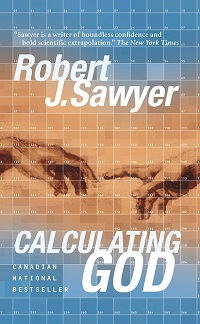 The interplay between worldviews and science fiction is very strong. In any writing, an author’s viewpoint will show through, but I think that it is particularly true in sci-fi. For in science fiction, the author is most frequently presenting a view of the world as it should be or as it should not be. The speculative future can be used as a foil through which the reader views reality in a new way. Often, science fiction will touch upon theological issues.
Robert Sawyer’s Calculating God
Fine Tuning
The most immediately striking and pervasive theme of Calculating God is that aliens show up on earth, and they believe in God. In fact, they take the existence of God to be a scientific certainty. The main character of the book, a paleontologist named Tom Jericho, is very skeptical throughout. Here’s the kicker, though, the aliens have been convinced of the existence of God through the evidence–specifically, the fine-tuning argument. Said argument is presented throughout the course of the book in interactions between Tom and Hollus, an alien paleontologist.
What is surprising is how much depth the book goes into while exploring the argument. Yes, Sawyer does fudge the argument a bit by allowing the aliens the possibility of a grand unified theory of science as well as a few other fictionalized aspects of the argument, but overall the fine-tuning argument he presents is very similar to the modern fine-tuning argument.
Not only that, but the characters Sawyer created go to great lengths to explore objections to and defenses of the fine tuning argument. For example, there is a discussion on p. 144ff (mass market paperback edition) in which Hollus and Tom discuss some objections to fine tuning. Tom is arguing against the probability of God:
“All the actions you ascribe to God could have been the doing of advanced aliens” [said Tom].
“There are… problems with your argument,” said Hollus, politely. “[E]ven if you dispense with the need for a god in recent events–events of the last few billion years; events after other conscious observers had emerged in this universe–you have done nothing to dispense with the relative strengths of the five fundamental forces [its science fiction, so there is an extra force], who designed the thermal and other properties of water, and so on. And therefore what you are doing is contrary to the razor of Occam you spoke of: you are increasing, not reducing the number of entities that have influenced your existence…”
The book is replete with debates like this, and the inevitable conclusion is that, shock of all shocks, God exists. I don’t say that sarcastically, I mean that I was genuinely surprised that the book affirmed God exists. But what kind of God?
God Exists… but?
It should be clear that in Calculating God, God is nowhere near the God of classical theism. In fact, one could almost argue that what Sawyer has offered here is a materialistic supplanting of God. The “god” of this work is essentially a super-powerful alien which is capable of swallowing the enormous energy output of a supernova, while also capable of designing our biology and fixing the constants of the universe during the early stages of the Big Bang.
God’s action is described purely in non-transcendent language. For example, the aliens confirm that god caused ice ages and mass extinctions on all the planets with intelligent life. The way this was accomplished was a matter of some speculation–perhaps God generated a dust cloud by using particles from across the galaxy to shield the planets from light and lower the temperature, or perhaps God redirected an asteroid or two to send them hurtling at the planets with life that needed a ‘jump start’ of evolution (146ff).
So why think that this is an image of god supplanting the classical theistic God? Well, clearly many who use the teleological argument are intending for it to point towards a creator God. What Sawyer has offered is a more naturalistic explanations of these events. Yes, there is a ‘god’ in the sense of a being capable of tampering with the very fabric of our universe, but that ‘god’ is itself trapped within the spatio-temporal boundaries of the known universe. In fact, god is said to subsist by recreating itself via a kind of reproductive method and passing one generation through a Big Crunch (think of a bouncing universe model).
Now what?
Calculating God offers a unique look at theology from a science fiction perspective. The fine tuning argument is presented in full force–even enhanced by some fudging of the science–and it leads to the inevitable conclusion that god exists. Yet this ‘god’ is not at all amenable to the god of Christianity or classical theism. So what should we do with this book?
Well, it is important to note that it is a work of fiction. The author clearly adds in some extra ‘fluff’ to make the fine tuning argument more powerful than it is (and I think it is quite powerful as it stands). And really Sawyer’s shoehorning in of a materialistic entity that is able to fiddle with physics boils down to hand-waving. Again, it is fiction, but it is important to note that Sawyer’s attempt to supplant the God of classical theism simply doesn’t work. Think of it this way: how would a purely physical being, however powerful, manage to transcend the physical universe in such a way as to literally rewrite the laws of physics? Extremely interesting science fiction? Yes. Compelling argument? No.
So where are we left? Sawyer does present the fine tuning argument in a way that is quite compelling, even when one strips away all the layers of fiction over it. It seems to me that, at a minimum, readers are left with a rock in their shoe: how do we explain away all this fine tuning without going beyond the cosmos? Sawyer’s own proffered answer, while entertaining fiction, remains that: fiction.
Other Issues
I have not yet even begun to delve into the depths of Sawyer’s Calculating God. The book covers an extremely broad array of topics related to science and faith as well as the secular-religious [false] dichotomy. For example, he discusses abortion in a few places, and I think the view the characters favor is very inconsistent. There is also some clear portrayal of the religious “other” as only a fundamentalist who seeks to halt scientific advancements. Yes, Sawyer panders to Christians in a few places, but the overall look at religious persons seems to be fairly negative (apart from Tom’s wife). I wish I could do justice to each of these topics, so I think I may follow this post up with another touching on more. For now…
Conclusion
Ultimately, Sawyer’s work is a simply phenomenal read. The amount of scientific, ethical, and religious issues upon which it touches is stunning, and readers will be forced to deal with the argument. Sawyer has done an excellent job using fiction for what I think it is called to do: inspire, entice, and force thought. Readers will be uncomfortable. The work will challenge people to really think about the arguments, and to think about the offered solutions.
Links
I have discussed the use of science fiction in showing how religious persons act. Check out Religious Dialogue: A case study in science fiction with Bova and Weber.
What would it mean if we discovered life? I have reflected on the possibility: Alien Life: Theological reflections on life on other planets.
Our Spooky Universe– I make the case for the intelligent design argument for the existence of God, which is heavily used throughout Calculating God.
Check out my other looks at popular level books. (Scroll down to see more!)
Source
Robert Sawyer, Calculating God
SDG.
——
The preceding post is the property of J.W. Wartick (apart from citations, which are the property of their respective owners, and works of art as credited) and should not be reproduced in part or in whole without the expressed consent of the author. All content on this site is the property of J.W. Wartick and is made available for individual and personal usage. If you cite from these documents, whether for personal or professional purposes, please give appropriate citation with both the name of the author (J.W. Wartick) and a link to the original URL. If you’d like to repost a post, you may do so, provided you show less than half of the original post on your own site and link to the original post for the rest. You must also appropriately cite the post as noted above. This blog is protected by Creative Commons licensing. By viewing any part of this site, you are agreeing to this usage policy.
“Fitzpatrick’s War”- Religion, truth, and forgiveness in Theodore Judson’s epic steampunk tale
The roar of our guns was more than my ears could hear. The slaughter in the two rivers was more than one man’s mind could absorb… A sort of madness over came us; we had an infinity of bullets and an infinity of Chinese before us. Every one of our men felt he was killing thousands… Death ran wild. How terrible it is, I thought, that the Yukons should be so good at this. (Judson, 319-320)
Fitzpatrick’s War
Brief Overview of the Plot
Fitzpatrick’s War is written as an autobiographic tell-all from the perspective of Sir Robert Mayfair Bruce. He is writing about Lord Isaac Prophet Fitzpatrick, a man who, like Alexander the Great, had conquered the world at a young age and also died young. Bruce was a close friend of Fitzpatrick (whom he calls Fitz) and so reveals a number of less-than-flattering aspects of his personality in his account of the life of the former ruler. It describes Fitzpatrick’s rise to power, his preparations for war during behind his father’s back, and his post-war rule.
Fitzpatrick is revealed as a man who lusted for power and ruled ruthlessly. He participated in assassinations, set up deaths, and mercilessly slaughtered his enemies. He used biological and chemical weapons and burned his enemies to the ground, all simply because of a desire to conquer the world. He had delusions of grandeur, envisioning himself as a kind of modern Alexander who would outdo the other man in every way.
The Timermen are another major player throughout the book. They are mysterious in their motivations and have supreme power over all space travel and most communications. Bruce reveals a number of unflattering details about these people as well.
The book has been edited by Doctor Professor Roland Modesty Van Buren, who is hostile to Bruce’s recounting of the events. Van Buren does not believe that Bruce is telling the truth about the great Fitzpatrick and believes he is instead attempting to make his own name live on through his lies. Thus, the book is footnoted throughout with Van Buren’s corrections to Bruce’s “lies.”
Religion
Religion is pervasive throughout Judson’s work. The characters constantly quote from the Bible to justify their positions which frequently seem unbiblical and evil. Although the society at large seems to think highly of the Bible, the United Yukon Church itself seeks to take over all religion and has repressed other expressions of religion for quite some time.
Yet Bruce is fully aware of how the Christian faith is being abused throughout the work for evil ends. In one scene, he is speaking privately with Fitzpatrick, who asks Bruce whether God can love someone who will wreak such evil on the world. Specifically, he asks about King David in the Bible. Fitzpatrick wants to know whether he himself is like King David and why God would love someone who so frequently strayed from righteousness. Bruce realizes that it is here that he could have influenced Fitzpatrick to turn from the great evils he would perpetuate. Yet, coveting power, Bruce makes the decision he would regret for the rest of his life and backs Fitzpatrick’s notions of glory and God. He writes:
I would today give up my soul if I could go back to that moment and tell Fitz he could still turn back from his awful destiny. I grant that he had at this date already committed murder. It was equally true that he had not yet made his oceans of blood… The world could have still been saved from his wrath… (204)
Instead, Bruce caves into his own lust for power and desire to please Fitzpatrick. He tells Fitzpatrick:
God loves you… There are a few special men… who, like David, walk through History as Angels walk through thunderstorms. Those about them become wet with sin, while they remain untouched. They may seem to be bad men, these special ones. If we judge them by the standards we hold ordinary men to, they are the worst of men. Ordinary standards do not apply to them. They are doing God’s work here on earth, and as we do not know God’s motives or His ends we cannot judge His servants… You [Fitzpatrick] will be said to be God’s beloved. (204-205)
Bruce regrets this discussion with Fitzpatrick for the rest of his life and struggles with the notion that he can be redeemed.
Fitzpatrick himself seeks a kind of syncretism of all religions, but realizes that it will not ultimately work. He keeps his old tutor, Dr. Flag, around mostly to feel superior about himself. But he had initially attempted Dr. Flag’s project of making all faiths equally valid. One discussion in the book is particularly revealing. Dr. Flag is expounding upon the notion that all religions are essentially the same, but Marshal Jeremiah Truth Hood challenges him on this notion:
“Sir, am I to understand you believe all major religions profess the same core beliefs?” [Hood Asked]
“Yes…” [replied Flag]
“Then that would mean, let us say, that the Chinese and the Arabs share the same beliefs on marriage and family?” asked Hood… “Can we say,” asked Hood, “that Arabs and the Chinese value life to the same degree? Or is human life another secondary question?”
“I mean specific, general matters. You see, such as treating others well.” [Responded Flag]
“You say cultures are essentially the same,” continued Hood. “How would you explain, sir, the different Histories of North and South America? Both continents are inhabited by Christians. The majority in both continents are of European descent…” (364-366)
Hood’s point is well taken. The fact of the matter is that all religions are not the same and to say otherwise devalues the religious persons themselves. The way that Judson presents this dialogue allows for some real insight into the issue: how is it possible to say that, at their core, all cultures or religions are the same when they are so radically different?
Evil, Repentance, and forgiveness
There is great evil in the world, and Bruce’s world is no different. Much of the evil is caused by Fitzpatrick and the war which he created in his lust for power.
Ultimately, Fitzpatrick is reduced to a broken, suspicious man who becomes incapable of even doing the simplest tasks on his own. Marshal Hood is greatly distressed over his own incapacity to make amends for the evils he had done during the War. Hood is sitting with Fitzpatrick and several other Lords when they watch a video from an aerial shot of China and see the destruction their war had done to the country. The bodies were strewn about and death was everywhere. Bruce, too, feels the need for repentance: “There were no words in my vocabulary I could utter that could justify this abomination, no act of contrition that could ever take away what I had done” (410). Hood himself begins quoting from the Bible, Joel chapter 1. He relates the evils they have done to the crimes that Joel cries out against. Later, Hood is found among the Chinese, trying to help them by growing food and feeding them. It was his way of making amends.
Bruce himself finds forgiveness only through his wife, who speaks with clarity on God’s will and his grace. It seems to me that this theme of forgiveness is grounded thoroughly in the Christian notion wherein people are to forgive each other. We act as God’s agents here on earth, and so we are called to repentance and forgiveness.
Charlotte
Bruce’s wife, Charlotte, is a paradigm example of a powerful, spiritual, loving woman. Van Buren, the hostile editor of the book, has several choice words to describe Charlotte, whom he believes is overstepping her bounds by attempting to be equal to Bruce. She often seems overbearing, but ultimately she strives to be equal to Bruce, and to temper the poor qualities of Bruce’s character. Charlotte is Roman Catholic, a religion which is violently oppressed in Yukon, until Fitzpatrick allows for religious freedom to endorse his own pluralism. Charlotte’s character is important throughout the work as one who provides the positive example of womanhood and the equality of men and women.
History and Doing History
History (always with a capital “H”) is an area of extreme interest in the world of Fitzpatrick’s War. Fitzpatrick himself continues to utter a recurring theme: History is written by the winners. Above, there was a discussion of King David. Fitzpatrick in that same conversation presses the notion that King David rewrote the history books in order to paint him in the most positive light. Later, in his own life, Fitzpatrick would do the same thing. He had the greatest poets and historians of his age come and write histories about him which were highly favorable in their portrayals of himself.
There is active repression of historical knowledge due to the fact that the culture at the time the book is set in believes that the “Electronic Age” (20th and 21st centuries) was a blight upon all History. During one scene, Bruce is being questioned about the Electronic Age and readers discover that only one history exists from that period. The reason is because “[A]ll other Histories of that era were perverted by the strange ideologies of the day…” (35).
As one who has studied historiography (and written on the method regarding Jesus), I can’t help but think of all the issues these discussions raise throughout the book. Interested readers should check out the post linked in the parentheses for one brief account of historiographic method.
Conclusion
I have read few books which have had such a great depth of knowledge about so many subjects as is demonstrated in Fitzpatrick’s War. The book is just phenomenal, and it touches upon so many areas of great importance for Christians and non-Christians alike. As with all great fiction, it does this without becoming overbearing, but instead focuses upon the story. Judson develops wonderful characters whom the reader can relate to, love, or loathe. He explores heady themes with wit and precision. I highly recommend this book to my readers.
Links
Religious Dialogue: A case study in science fiction with Bova and Weber– I explore two excellent science fiction books alongside each other to see how they speak to religious dialogue.
The Presumption of Pluralism: How religious pluralism devalues all religious persons– I discuss religious pluralism, a topic which is brought up throughout Fitzpatrick’s War and show how it fails.
Check out more of my looks at popular level books. (Just scroll down to see more!)
Hieropraxis is an excellent site which focuses upon a number of cultural issues and how they relate to Christianity. I really cannot recommend this site highly enough.
Empires and Mangers– Another phenomenal site which looks at many popular level works from a Christian perspective. The posts are consistently fantastic. I encourage you to follow this site closely.
SDG.
——
The preceding post is the property of J.W. Wartick (apart from citations, which are the property of their respective owners, and works of art as credited) and should not be reproduced in part or in whole without the expressed consent of the author. All content on this site is the property of J.W. Wartick and is made available for individual and personal usage. If you cite from these documents, whether for personal or professional purposes, please give appropriate citation with both the name of the author (J.W. Wartick) and a link to the original URL. If you’d like to repost a post, you may do so, provided you show less than half of the original post on your own site and link to the original post for the rest. You must also appropriately cite the post as noted above. This blog is protected by Creative Commons licensing. By viewing any part of this site, you are agreeing to this usage policy.
Religious Dialogue: A case study in science fiction with Bova and Weber
I love science fiction. One of the main reasons is because it provides a medium for authors to share their philosophical outlook for the world. Some authors portray their vision of what the world would like like if…. and what fills in that “if” is that which the author would like readers to be wary of our condemn. For example, distopian fiction often takes some aspect of society and shows how if we allow it to run rampant, we will create a world wherein we would not want to dwell. Other authors use science fiction to portray an ideal (or nearly ideal) society and show how the things they are promoting or believe fit into that ideal society.
Ben Bova and David Weber are two of my favorite science fiction authors. Bova blends hard science fiction (sci-fi which is largely focuses upon the applications of science that is at least seemingly possible) with great storytelling. His “Grand Tour” series of books is the story of humanity spreading across our solar system and even finding life on mars and founding a colony on the moon. David Weber writes military science fiction on an epic scale, complete with amazing battles in space (and who doesn’t like some big explosions in space?). I was fascinated to see both authors interact with Christianity, particularly on a fundamentalist level, and see how they took that discussion.
 David Weber
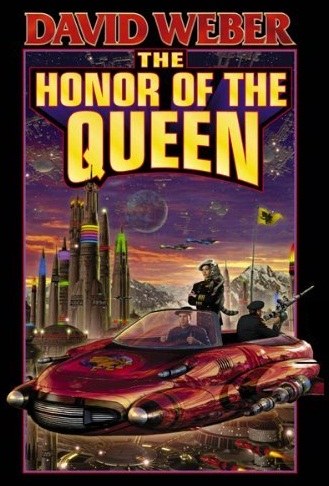
David Weber’s book, The Honor of the Queen
What really struck me is that David Weber fairly presented firm believers as a spectrum. He showed that believers can be reasoned with and even persuaded to believe differently based upon evidence. Furthermore, he showed that even those who may line up on the side with which he disagrees [presumably–I don’t know where he stands on the issue] are not all (or even mostly) blinded by faith or foolishness. Rather, although there are some truly evil and disillusioned people, Weber shows that many are capable of changing their position or at least acknowledging that rival views are worth consideration.
The most vivid portrayal of this theme is found in a conversation between Admiral Courvosier and Admiral Yakanov. Courvosier is from the same nation as Honor Harrington and wholly endorses his female officer in a position of command. They discuss Captain Honor Harrington:
[Yanakov responds to Courvosier’s question about his society’s reaction to Honor]: “If Captain Harrington is as outstanding an officer as you believe–asI believe–she invalidates all our concepts of womanhood. She means we’re wrong, that our religion is wrong. She means we’ve spent nine centuries being wrong… I think we can admit our error, in time. Not easily… but I believe we can do it.”
“Yet if we do[” Yanakov continues, “]what happens to Grayson [their world]? You’ve met two of my wives. I love all three of them dearly… but your Captain Harrington, just by existing, tells me I’ve made them less than they could have been… Less capable of her independence, her ability to accept responsibility and risk… How do I know where my doubts over their capability stop being genuine love and concern?”
The exchange is characteristic of the way Grayson’s people are treated throughout the book. They are real people, capable of interacting with other views in honest ways. They feel challenged by a view contrary to their own. Some react poorly, and there are extremists who are blinded by hatred and anger. Yet all of them are treated as people with real concerns shaped by their upbringing and backgrounds.
Honor Harrington ends up saving Grayson, and at the end of the book, she is commended by the rulers of that planet. She talks to the “Protector” [read: king/president]:
“You see,” [said the Protector] “we need you.”
“Need me, Sir?” [Responded Honor]
“Yes, Grayson faces tremendous changes… You’ll be the first woman in our history to hold land… and we need you as a model–and a challenge–as we bring our women fully into our society.”
Weber thus allows for even ardent supporters of specific religious backgrounds to respond to reasoned argument and to change. They are capable of interacting on a human level and deserve every bit of respect as those who disagree with them. Again, there are those who are radicals and will not be reasoned with, but they are the minority and they do not win out.
Weber therefore presents religious dialogue in The Honor of the Queen as a genuine interaction between real people from differing backgrounds. Those who are “fundamentalist” are capable of changing their views when challenged with a rival view which out-reasons their own. Religious dialogue is possible and fruitful.
 Ben Bova
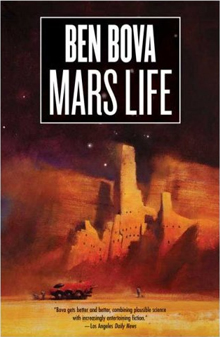
Ben Bova’s whole “Grand Tour” series has a number of dealings with “fundamentalists.” He never really defines the term to be specifically Christian but one can tell when reading the books that it is pretty clear he is referencing hardcore fundamentalist evangelical Christianity.
I recently finished reading Mars Life
Bova’s treatment of extremist positions in religion is somewhat disingenuous in my opinion, particularly when one compares his portrayal with that of Weber. Bova tends to illustrate religious fundamentalists as a black and white issue. Basically, if you are a hardcore believer, you’re in it for power and control, you are willing to incite violence to achieve your ends, and you are incapable of reasoning. Again, note the contrasts with Weber’s depiction above. A few examples will help to draw this out.
On page 142 and following there is a discussion about putting together a panel to discuss the finding of a fossil on Mars. The interaction shows that no matter what, fundamentalists cannot accept scientific findings:
“Look,” said the bureau chief… “everybody’s calling it a fossil…. …”Call it an alleged fossil, then,” insisted the consultant (from the fundamentalists)… [The group then continues to suggest terms for the fossil:] “A probable fossil?” …”A possible fossil”… [Then, finally] “Say that the scientists believe it’s a fossil and until proven otherwise that’s what we’re going to call it.”
Here one can see that fundamentalism is intrinsically tied to an anti-science mentality. The key for them is to use words which deny absolutes, essentially skirting issues rather than discussing the truth. But that’s not all there is to it. Later on, one of the fundamentalists is engaged in a discussion about “requesting” that some lyrics in music they view as morally reprehensible be changed. The musician flat out refuses, angering the fundamentalist in the process. The section closes as follows:
[The musician] was shot to death at a Dog Dirt concert three months later. His killer surrendered easily to the police, smilingly explaining that he was doing God’s work.
What is interesting about this example is that it is illustrative of a number of such examples throughout the book. These are completely unrelated to the main plot. Rather, it seems what Bova is doing is very explicitly showing that fundamentalists are unafraid to use immoral tactics, censoring, and even incite violence in order to get their way. Theirs is an unquestioned and unquestionable faith. Those in power in fundamentalism are inherently evil and devious. They only want to control. Again, these asides are in no way tied to the plot of the book. It’s almost as though Bova is preaching a different worldview, one which views religiosity as inherently dangerous and violent, with few exceptions.
There is one positive example, however. A Roman Catholic, Monsignor Fulvio DiNardo, who is also a world-renowned geologist decides he wants to go to Mars to find the answer to a question about faith which is pressing on him. Namely, why God would exterminate an entire intelligent species. His thread in the story seems to show two things: first, that fundamentalism is inherently incapable of responding to reason; second, that it is possible to have reasoned faith and science together. The second point is illustrated very well when DiNardo is finally on Mars. He suffers from a likely stroke and is dying and begins a dialog with God:
Why did you kill them, Lord? They were intelligent. They must have worshipped You in some form or other. Why kill them? How could you–
And then DiNardo understood. Like a calming wave of love and peace, comprehension flowed through his soul at last… God had taken the Martians to Him! Of course. It was so simple, so pure. I should have seen it earlier. I should have known. My faith should have revealed the truth to me.
The good Lord took the Martians to Him. He ended their trial of tears in this world and brought them to eternal paradise. They must have fulfilled their mission. They must have shown their Creator the love and faith that He demands from us all. So He gave them their eternal reward…
The light was getting so bright… Glaring. Brilliant… Like staring into the sun. Like looking upon the face of… (297-298)
So Bova does offer a counterbalance to fundamentalism, and I appreciate that portrayal. Although DiNardo’s death and his revelation receives very little further comment (and no further comment at all on the revelation), it seems as though it is positively portrayed.
A reason for criticism is that Bova is uncompromising with fundamentalists. I’ve already drawn out his portrayal of them, and it seems to me to be a bit disingenuous. Although there are plenty on the “religious right” who would be all too happy to be able to legislate all morality, control the media, and deny well-attested scientific findings, I have hardly found that to be the majority. And certainly, fundamentalism is not a homogeneous entity filled with people who are trying to control everyone else. I’ll grant that this is a work of fiction, but in light of how Weber was able to handle a fairly similar issue with respectful portrayals of the ‘other side,’ I had hoped for more from Bova, whose work I enjoy greatly. For Bova, it seems, religious dialogue is not a real possibility, with few exceptions. Fundamentalists are incapable of reasoning and are barely even convinced believers; rather they are using their positions of authority within their organizations to consolidate power and execute their own prerogatives on their witless followers.
Fair Discussion
It seems pretty clear to me that David Weber provided a better model for utilizing science fiction in religious dialogue than Ben Bova did. The people representing the ‘bad guys’ in Weber’s book did have some who were truly evil and/or beyond reason, but also had many with whom reason resonated. When confronted with rival views, they were thoughtful and even receptive. On the other hand, the characters with whom Bova disagreed were a true black/white dichotomy with the “good guys.” Fundamentalists were bad. Period. He portrayed them as power-hungry, censor-happy maniacs. Although there was one notable exception (the Catholic priest, DiNardo), who showed a bright spot for “believers” at large, he was by far the exception.
It seems clear this study has applications for real-world dialogue about religion. When we interact with other worldviews, we should be capable of treating the other side with the same kind of dignity we would like to be treated. Although other worldviews may have their extremists who will not respond to reason, our attitude should be that of the humble friend trying to explore the beliefs of the “other.” The “other” is not that which must be demonized, but rather understood and with which to interact.
More Reading
I explore the theological implications of life on other planets.
I discuss a book which will change the way you think about about the notion that religion is violent. It also deals with the notion of the religious “other” as a construct.- William Cavanaugh’s The Myth of Religious Violence.
Sources
Ben Bova, Mars Life
David Weber, The Honor of the Queen
SDG.
——
The preceding post is the property of J.W. Wartick (apart from citations, which are the property of their respective owners, and works of art as credited) and should not be reproduced in part or in whole without the expressed consent of the author. All content on this site is the property of J.W. Wartick and is made available for individual and personal usage. If you cite from these documents, whether for personal or professional purposes, please give appropriate citation with both the name of the author (J.W. Wartick) and a link to the original URL. If you’d like to repost a post, you may do so, provided you show less than half of the original post on your own site and link to the original post for the rest. You must also appropriately cite the post as noted above. This blog is protected by Creative Commons licensing. By viewing any part of this site, you are agreeing to this usage policy.
Guest Post: “The Vision of Literary Apologetics” by Holly Ordway
Why is apologetics, the defense of the Christian faith, important?
In one sense, Christianity needs no defense. God, who is Father, Son, and Holy Spirit, does not depend for His existence on our belief. However, many people who do not know the living God are separated from Him in part by intellectual obstacles. Removing those obstacles by showing that Christianity indeed makes sense on a rational level is an act of love and care for our neighbor. Defending the faith also builds up a strong foundation for believers. A securely built house has a solid, well-built foundation, so that the vagaries of wind and weather don’t damage it or cause distress to the inhabitants. It’s natural to have questions and doubts – think of the disciples, asking Jesus “increase our faith!” or the man who cries out “Lord, I believe: help my unbelief!” Apologetics helps strengthen the foundations by providing answers to questions and doubts, so that the Christian can grow stronger in his or her faith.
What about “literary apologetics”?
 Literary apologetics is that mode of apologetics that functions through the use of the Imagination in stories, poetry, drama, and song. Imagination is a mode of knowing; it is the twin sister of Reason. Imagination that is not grounded in Reason can become what JRR Tolkien called “morbid fantasy,” unhealthy and unhelpful; conversely, Reason that is not supported by Imagination can become sterile, rigid, and unfruitful. Literature is particularly well suited to bring these two often-separated sisters together, so that Reason and Imagination can illuminate the path to truth.
Stories, poetry, and drama can help us to both comprehend the truth (with our intellect) and apprehend it (imaginatively and emotionally). As with rational argument, literature cannot in itself bring a person to know Christ, but it can open doors, challenge assumptions, and most importantly provide a glimpse of experienced truth. Stories invite readers to indeed “taste and see that the Lord is good” (Psalm 34:8).
Literature can best fulfill this role when the author is committed both to expressing the truth and to creating a good story. The best literary apologists – CS Lewis, JRR Tolkien, GK Chesterton, Dorothy Sayers, and others, just to name those of the past century – did not set out to wrap a moral in a story, or explicitly to promote Christianity through their fiction writing. Rather, they believed fully and deeply, and sought to glorify God in all that they did – and so their stories show the truth, in deep and satisfying ways.
Today, we need a new generation of Christian writers who will do what those great writers did. We need well-informed, thinking Christians, who know their Scripture and theology, are committed to living out the Christian life in word and deed, and show forth that living truth in their work.
We need writers who will immerse themselves in the best writing of centuries past and learn from it, and be able to draw on that rich treasury of imagery to do new things.
We need writers who are willing and eager to view writing as a God-given calling, and to joyfully pursue the craft and art of it with dedication and hard work.
Fortunately, we do not have to start from scratch! We have the works of Lewis, Tolkien, Chesterton, MacDonald, and others to study and learn from. Going further back, we have an absolute treasure chest of writers: Coleridge, Donne, Herbert, Hopkins, Shakespeare, Chaucer, Spenser, Dante, to name just a few.
 We are not limited to the great writers of the past, however. We have people who even now are taking up the challenge of writing to draw people through the imagination to know Christ. In England, the poet and scholar Malcolm Guite (www.malcolmguite.com) is doing marvelous work with poetry. In my own blog, Hieropraxis (www.hieropraxis.com), I am attempting to cultivate an appreciation for literature and literary apologetics, as well as writing my own poetry.
To be an effective literary apologist means a commitment to the craft of writing, so that the great and glorious truth of our faith is presented to the world in the most beautiful, powerful, gripping, and transformative ways possible. It also means a commitment to community. Just as Lewis and Tolkien were part of the Inklings, commenting and critiquing each others’ work, so too the writers of today need the kind of community where “iron sharpens iron.”
In the Cultural Apologetics program that I head up at Houston Baptist University (link: hbu.edu/maa), we pay close attention to literature and the arts in the service of apologetics. In addition to myself as a ‘literary apologist,’ Dr. Michael Ward (author of Planet Narnia: The Seven Heavens in the Imagination of C.S. Lewis) is now on our full-time faculty for the MA in Apologetics, teaching on CS Lewis and Imaginative Apologetics and also on Literature and Apologetics. In addition to helping apologists learn how to use imaginative means to present apologetics arguments, we hope also to encourage Christian writers to do new creative work. The Thesis option for our MA can be either an academic thesis or a creative one.
I think we’re at the beginning of great things for literature in the service of God. My friends, let’s go further up and further in!
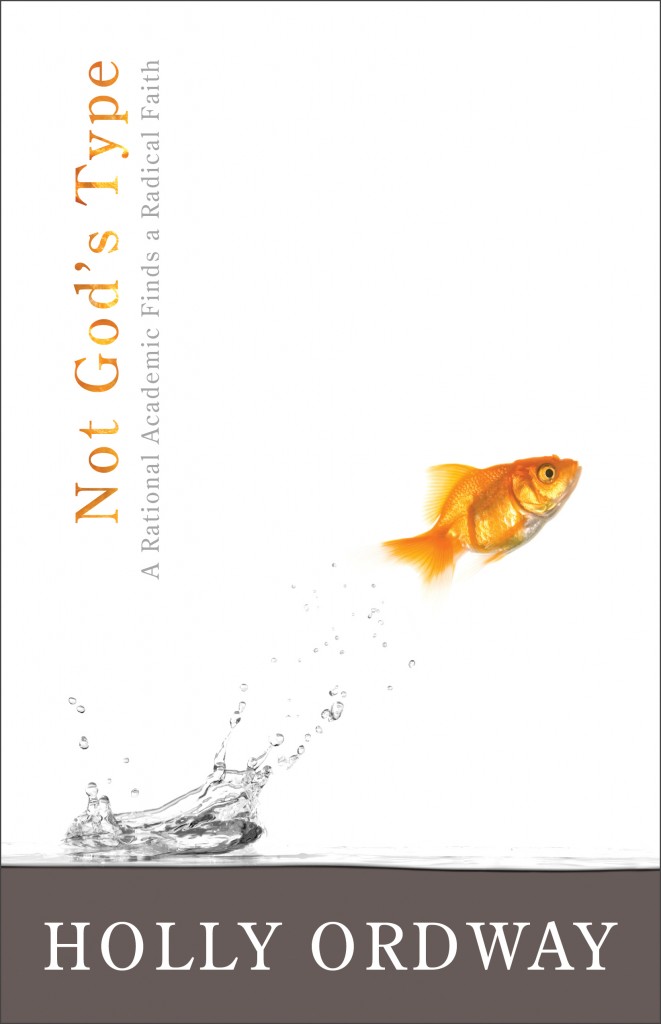
Dr. Holly Ordway is a poet, academic, and Christian apologist. She is the chair of the Department of Apologetics and director of the MA in Cultural Apologetics at Houston Baptist University, and the author of Not God’s Type: A Rational Academic Finds a Radical Faith
Really Recommended Posts: 11/26/11
 The Problem of Pain Sonnet Sequence 3– Holly Ordway, author of “Not God’s Type,” has an awesome blog going. This post is a sonnet which focuses on the problem of pain/evil. Be sure to check her site out in-depth, it has some amazing and unique content.
Over at Geocreationism, there is a new blog discussing death and original sin. It’s extremely interesting. Be sure to read his links on the various passages, which each lead to another in-depth and thoughtful discussion of creationism.
Book Review: “Good God: The Theistic Foundations of Morality” by David Baggett and Jerry Walls. The best book reviews don’t just review the content of a book, but present its central arguments. This is one such review. Check it out.
David and Tiffany O’Day have a great series of posts about “Authentic Community & Friendship.” Check out Part 1. Be sure to visit their homepage to check out the rest in the series.
The problem of anti-intellectualism in the church and some solutions.
Check out Apologetics 315’s list of 10 Apologetics books for giving. I will surely copy this feature with one of my own. His top book is Edgar Andrews’ “Who Made God,” with which I heartily agree. Check out the review.
10 Surprisingly Simple Tips for Talking to Cult Members, Part 3– this is part of a series on, well, look at the title! Find Part 1 and Part 2 as well.

 J.W. Wartick - Reconstructing Faith