apologetics
Book Review: “Providence and the Problem of Evil” by Richard Swinburne
“In order rationally to believe that there is a God, despite [evil], we need either strong positive evidence for the existence of God, or a record of discovering with respect to many apparent bad states that a theodicy works with respect to them, or a theodicy for each kind of bad state which seems to count against the existence of God.”[1]
The problem of evil is considered by many to be the greatest challenge to theism.[2] Richard Swinburne offers a defense against this problem in his work Providence and the Problem of Evil
Swinburne first develops an account of goods within creation. His account includes beauty, actions, thoughts and feelings as various goods. Given the existence of God, he also argues that worship is a great good.[4] Human freedom is necessary for many goods. With freedom, humans can bring about all types of great goods.[5] The freedom of persons also allows for great evils. These goods are not just goods for people, but they are states which God would be expected to desire to bring about.[6] By developing this account, he is able to turn towards various types of evils.
First, there are moral evils. Moral evils are essentially those bad states of affairs which persons bring about. Swinburne argues that some moral evil is going to be necessary, because it is simply a fact that there are good states of affairs which are logically incompatible.[7] Second, there is natural evil—evils which occur without direct causation by persons.
These sections of the book are largely made up of background, yet Swinburne interweaves his theodicy into the chapters on evil. Central to Swinburne’s account is the idea that for every evil, there is some reason that it occurred. There is, in other words, no evil which is superfluous, no evil which is gratuitous. For every evil mentioned, Swinburne provides a possible reason for God’s allowing it to occur. What reasons could God have for allowing evils like the holocaust, or animal pain? Swinburne sums up his view concisely as follows:
“Every moral evil in the world is such that God allowing it to occur makes possible… the great good of a particular choice between good and bad… Every pain makes possible a courageous response… and normally the goods of compassion and sympathetic action… And all animal pain gives knowledge and opportunity for compassion to animals and humans if they know of it.”[8]
Swinburne’s view is that for every evil, there is a reason. The reason can be knowledge: when people (or animals) observe animals dying in forest fires, they learn to flee from the fires, and thus save themselves and others.[9] Choice is a great good, but in having choices, people can choose to bring about great evils. Horrendous evils like the Holocaust are not just the result of choices in the present, but are the consequences of a long series of evil choices.[10]
Importantly, Swinburne also argues that God is under no obligation to make everyone’s life equally good. “[I]f [God] gives to some ten good things, and to others twenty good things, no one is wronged; nor has he failed to be perfectly good. He has been generous, and, more so, he has made it possible for us to be generous.”[11] God’s providence is good to everyone. There is a level of inequality in the gifts received—but to any and all, gifts are given. The way people choose to use their gifts is what leads to extreme inequities.
Finally, Swinburne argues that God has the right to allow evil, largely due to the extreme dependence people have upon him.[12] Not only that, but God has brought about a world in which every person has the possibility of the nearly infinite good of being with God forever. Thus, Swinburne concludes that God has provided people with a choice between the good and rejection of the good. The responsibility for that action is upon the person, not God.[13]
Throughout Swinburne’s account are several theses many readers may find implausible. He rejects original guilt [he does not deny that there was an original sin and instead holds to an Eastern Orthodox view–thanks to a reader of the original review (linked below) for this point][14] and denies that God knows the future free actions of creatures.[15] These theological points do not undermine his main theses, however. It is undeniable that Swinburne has provided a lucid account of a “greater good theodicy.” He does provide possible reasons for allowing any type of evil to occur.
The key point of divergence with readers will be whether they are willing to accept these reasons in conjunction with his later conclusions. God has reasons for allowing every evil, and he provides for people to have extraordinarily good lives with the afterlife, but there remain those who will reject these goods. Swinburne’s account is cumulative: the reasons provided for allowing evils do not stand on their own. Rather, they stand together and in unison with God’s providence and direct goodness to all persons through maintaining the world, creating them, and providing them with choices.
Those interested in the problem of evil would do well to read Providence and the Problem of Evil. Usage of the “greater good theodicy” is on the wane. Many theists today only provide versions of the “free will defense” in relation to the problem of evil. In doing so, they cast aside a powerful philosophical tool for theism. While the “greater good theodicy” will not convince everyone, it can at least provide a strong cumulative case when joined with other defenses against the problem of evil.
[1] Richard Swinburne, Providence and the Problem of Evil (New York, NY: Oxford, 1998), 29.
[2] See Swinburne’s thoughts on this on pages 4ff.
[3] He also believes that we have strong positive evidence for the existence of God, but he focuses upon theodicy in this work. See his The Existence of God for a case for the existence of God based on positive evidence.
[4] 111ff.
[5] 105-107.
[6] 45.
[7] 125.
[8] 217.
[9] 176ff.
[10] 151-152.
[11] 149.
[12] 223ff.
[13] 251.
[14] 36-41.
[15] 127ff.
This review was originally posted at Apologetics315 here: http://www.apologetics315.com/2011/11/book-review-providence-and-problem-of.html
SDG.
——
The preceding post is the property of J.W. Wartick (apart from citations, which are the property of their respective owners) and should not be reproduced in part or in whole without the expressed consent of the author. All content on this site is the property of J.W. Wartick and is made available for individual and personal usage. If you cite from these documents, whether for personal or professional purposes, please give appropriate citation with both the name of the author (J.W. Wartick) and a link to the original URL. This blog is protected by Creative Commons licensing. By viewing any part of this site, you are agreeing to this usage policy.
The Multiverse and Theism: Theistic reflections on many worlds
 There has been much philosophical and scientific discussion on the topic of the multiverse. Recently, a lot of this discussion has been happening within philosophy of religion. Some attempt to use the multiverse to overcome classical theistic arguments like the Kalam Cosmological Argument, while others try to utilize it to avoid the teleological argument. Atheists and skeptics are not the only ones who are interested in the multiverse, however. Recently, a few prominent theistic philosophers have utilized the multiverse in inventive ways.
The Multiverse and the Problem of Evil
Some theistic philosophers have argued that the multiverse can provide a new type of theodicy. As eminent a philosopher as Alvin Plantinga writes:
…a theist might agree that it is unlikely, given just what we know about our world, that there is such a person as God. But perhaps God has created countless worlds, in fact, all the… universes… in which there is a substantial overall balance of good or evil… [A]s it happens, we find ourselves in one of the worlds in which there is a good deal [of evil]. But the probability of theism, given the whole ensemble of worlds, isn’t particularly low (Plantinga, 463).
Does such a theodicy help theists with the problem of evil? It seems to me that it may, but that it is not particularly strong. It could be included in a cumulative-case type of theodicy, however.
First, Michael Almeida offers a critique of this position. Suppose that God did, in fact, create such a multiverse. It seems plausible that such a universe would be infinite in the number of worlds (after all, for every “good” world, there seems one can always imagine a “better” world). Here Almeida ingeniously applies William Lane Craig’s arguments about the infinite, not to show that the set of universes cannot be infinite, but to show that in an infinite multiverse one could subtract specific worlds from this set without decreasing the good of the multiverse (Almeida, 305-306). Suppose God did in fact actualize an infinite multiverse–all the worlds which are, on the whole, good. If that’s the case, then God could easily not actualize any one (or infinite!) world(s) without decreasing the total good of creation. After all, it would remain infinitely good!
Timothy O’Connor offered a possible response to this argument, noting that “It may well be that [God] would have a distinct motivation to realize every fundamental kind of good-making feature, some of which are incommensurable. If so, this would put a further constraint on universe types… within a candidate infinite hierarchy” (O’Connor 2, 315). God could have chosen to actualize each individual type of good–some of which may exist in our own world to a maximal extent. This doesn’t seem implausible given the tremendous goodness of an event like the Redemption.
Some may be concerned that an appeal to the multiverse may undermine more traditional theodicies such as the “greater good theodicy” or the “free-will defense.” One might envision the multiverse as a kind of “throwing in the towel” on the traditional theistic defenses. I don’t see why this should follow, because any of these traditional theodicies would be just as applicable to our own universe whether it were one or one of many. There are, however, a few problems I see with this defense, which I’ll put off until the section “On the Possibility of a Multiverse” below.
 Which world would God Create?
Some have argued theism is irrational because they hold God is a perfect being, which would entail that God would create the best possible universe–itself an incoherent concept. It is possible that God need not create the best possible world. Robert Merrihew Adams, for example, doesn’t agree that God is obligated to create the “best possible world.” Rather, God could choose to create worlds which manifest His grace (Adams, 62). O’Connor cites William Rowe as providing an effective counter to this by arguing that there would then be a possible being better than the perfect being (O’Connor 1, 114). I’m unconvinced by this counter. If there is no best possible world, God cannot be obligated to create it (because it doesn’t exist).
O’Connor anticipates this response and seems to grant that it may be plausible (115). However, he among other theists, seems to believe that God would actualize a multiverse. He writes, “God’s choice isn’t between… single universes, but between the super universes [‘super universe’ being a ‘collection of one or more totalities that are mutually disconnected save for their common origin within God’s creative choice’]” (O’Connor 1, 116). God, on this view, actualizes many “good” worlds. He writes, “the creative motivation would be not to settle for a finite limit on the individual organic goodness of any of His products” (O’Connor 2, 315). God’s creation of many universes shows his “artisanship” (Ibid).
Such arguments are both interesting and compelling. Those who attack theism based upon the “best possible world” objection may be thwarted by the hypothesis of God’s creative multiverse.
On the Possibility of a Multiverse
Theistic proposals of a multiverse are clearly sometimes motivated for entirely different reasons than naturalists. What difficulties are there with such a proposal?
First, some theists object to the multiverse by arguing that it undermines several theistic arguments. It does not seem that the multiverse would do so, however. The cosmological argument would stand strong in spite of a multiverse, because any inflationary multiverse would still have a beginning in time. Design arguments would similarly be unchallenged because one would have to explain the fine-tuning of the multiverse. These objections to the multiverse, therefore, do not do much damage.
Other objections to the multiverse require more discussion of the meaning of the term “multiverse.” Jeffrey Zweerink notes several levels of multiverse. Some of these are uncontroversial. For example, the “Level I” multiverse is simply a description of other regions beyond the observable universe (Zweerink, 28). Of course, this is hardly what many mean when they refer to a “multiverse.” What is meant by multiverse here is a Level II or higher multiverse, such as inflationary bubble universes or other generative scenarios (Zweerink, 28-29). The difficulty with these is that there doesn’t seem to be any reason to hold that these universes exist. Zweerink notes that the Level II multiverse is predicted by some models of string theory, but to believe there are literally other unobservable universes on the basis of theoretical predictions alone hardly seems convincing.
Given these observations, it seems initially that while theism is unthreatened by the multiverse (and perhaps even bolstered by its possible existence), there is no better reason to think it exists on theism as on other worldviews. But perhaps that’s not the case. One can reflect once more on O’Connor’s belief that the multiverse shows God’s creative artistry (O’Connor 2, 315). Not only that, but one may even predict that God would actualize many worlds in order to bring about His desire to actualize various goods (O’Connor 1, 112ff). Perhaps one could argue that theism may even predict many universes. In that case, the multiverse is more likely than not.
My thoughts
Clearly, I think there may be some merit in the use of the multiverse in theistic arguments. I think it would amazing if, somehow, we made a discovery which confirmed the existence of other universes, and I do believe people could hold that theism might even predict such a discovery, but color me skeptical. I think it would generate an enormous amount of metaphysical baggage to hold to the existence of a multiverse. While the previous arguments may have shown that theism increases the likelihood of a multiverse, I don’t think it increases it enough to justify belief in a world ensemble. I remain open to the possibility, and indeed some compelling arguments have been offered in its favor, but for now I remain unconvinced. That said, I think theists could still utilize the multiverse in response to the problems illustrated above, because even a hypothetical multiverse could be used to bolster these defenses. Those opposed to theism might here object, saying that I condemn their own uses of the multiverse to try to get around theistic arguments. They would be incorrect. I condemn the use of the multiverse on competing views because I don’t think the other views can justify belief in the multiverse, nor do I think their usage actually defeats the difficulties with their own positions.
Is there a theistic multiverse? Maybe. Can theists utilize a hypothetical multiverse in their philosophical speculations? Absolutely.
Sources
Alvin Plantinga, Warranted Christian Belief (New York, NY: Oxford, 2000).
Timothy O’Connor 1, Theism and Ultimate Explanation (Malden, MA: Blackwell, 2008).
Timothy O’Connor 2, “Is God’s Necessity Necessary? Replies to Senor, Oppy, McCann, and Almeida,” Philosophia Christi 12 (2010), 309-316.
Michael J. Almeida, “O’Connor’s Permissive Multiverse” Philosophia Christi 12 (2010), 297-307.
Robert Merrihew Adams, “Must God Create the Best?” in The Virtue of Faith and Other Essays in Philosophical Theology 51-64 (New York: Oxford, 1987).
Jeffrey Zweerink, Who’s Afraid of the Multiverse? (Reasons to Believe, 2008).
Links
I discuss and rebut multiverse objections to the Kalam Cosmological Argument here and here.
The Theological Attraction of the Multiverse– An interesting post on the theology of the multiverse.
Christological Implications of the Multiverse– Another post worth reading on theology and the multiverse.
Living in the Multiverse- Is It Science?– Discussion of scientific evidence for the multiverse.
SDG.
——
The preceding post is the property of J.W. Wartick (apart from citations, which are the property of their respective owners) and should not be reproduced in part or in whole without the expressed consent of the author. All content on this site is the property of J.W. Wartick and is made available for individual and personal usage. If you cite from these documents, whether for personal or professional purposes, please give appropriate citation with both the name of the author (J.W. Wartick) and a link to the original URL. If you’d like to repost a post, you may do so, provided you show less than half of the original post on your own site and link to the original post for the rest. You must also appropriately cite the post as noted above. This blog is protected by Creative Commons licensing. By viewing any part of this site, you are agreeing to this usage policy.
Book Review: “Existential Reasons for Belief in God” by Clifford Williams
 Clifford Williams’ Existential Reasons for Belief in God (hereafter ERBG) is one of the most unique philosophy of religion books this reader has experienced. Rather than engaging in systematic arguments for the existence of God based upon sensory experience or philosophical reflection on the cosmos, Williams focuses on the subject of his subtitle: A Defense of Desires & Emotions for Faith.
Williams argues that “Christians need a conception of faith that is at least as much need-based as reason-based” (13). By uniting these into one concept Christians can help acquire and sustain faith (13). Need has been too often cast aside or ridiculed when it comes to faith (12).
After these introductory remarks, Williams jumps into detailed argument on the topic. Throughout the work he focuses on the concept that “people acquire their faith partly because they feel that it meets… existential needs and partly because they think that it makes sense or is true” (17, emphasis his). He begins his argument by surveying various types of needs people have (20ff). In chapter 3, Williams presents an existential argument for believing in God:
1. We need [various things like cosmic security, meaning, awe, delight in goodness, etc.]
2. Faith in God justifies these needs.
3. Therefore, we are justified in having faith in God. (32)
Clearly, this is not the typical argument for the existence of God. It’s not an argument for God’s existence at all. Williams recognizes this fact and argues that there is a distinction between evidential and existential reasons for belief. “In evidential justification for believing in God, one believes in God because of what one takes to be good evidence for doing so ” (41). By contrast, “The existential argument… says that faith in God is justified solely because it satisfies certain needs” (41). The argument, therefore, is not to show God exists, but to show that one can rationally believe in God.
Williams argues that such existential justification is permissible for a number of reasons. First, it helps clarify what nature is–it is not merely a faith based on aspects of reality but is instead a faith which is aimed at meeting certain needs (41). Second, people use existential reasoning in other instances–for example when they need to eat, they know that they are justified in going to meet that need (41).
Objections to this reasoning will, of course, be raised. The first objection is that “the existential argument does not guarantee truth” (61). With this objection, one sees the distinction between evidential and existential arguments becoming very clear. Williams returns to the food analogy. The existential argument there would be “1. Humans get hungry; 2. Eating food assuages hunger; 3. Therefore, eating food is justified” (63). Here the argument is not to establish the existence of food but rather to establish that eating food is justified (63). Similarly, with the existential argument for God, the argument is to establish the justification for believing in God (63-64). The argument presupposes, to some extent, the existence of God, and justifies that very belief (64).
Another interesting implication of the distinction between existential and evidential reasons for belief is that they can be combined to form a cumulative type of argument for the existence of God. Williams presents such an argument, which combines these types of reasoning:
1. We [have various existential needs.]
2. The best explanation for the presence of these needs in humans is that there is a God who has put them into humans.
3. Faith in God satisfies these needs.
4. Therefore, we are justified in believing there is a God in whom we can have faith. (67)
But, it may be objected, this argument justifies belief in any type of God! Consider someone who wants to believe in “Tyrant George” because they need humans to be tortured. They could be justified in believing in such a deity based upon their in-built needs. Williams frankly admits that this objection has its merit. The existential argument should be combined with reason (88). But he also takes issue with the “need” to torture. He delimits criteria which define “needs.” These criteria are:
1. Needs must be felt by many others… most people, if not all.
2. Needs must endure…
3. Needs must be significant…
4. Needs must be part of a constellation of connected needs, each of which meets the other criteria…
5. Needs must be felt strongly (89).
Why, however, should we believe these criteria? Williams argues that these criteria are independently verified and that they have been found useful in a number of settings, including psychology, courtrooms, and in assessment of unusual phenomena (90).
A third objection notes that not everyone feels existential needs. Williams challenges this notion and argues that most people will be aware of having the various needs he has outlined (119). Finally, it may be objected that we can satisfy these needs without faith. Williams counters by presenting a various tests wherein subjects may find temporary satisfaction in varied cases but their ultimate needs are not met (133ff).
Williams also surveys various thinkers–from Pascal to William James to Freud–and what they had to say about needs. He offers critiques of several theories while advancing his own.
There are those who may be thinking this is, so far, an entirely fideist account. Williams begs to differ and provides several reasons for why faith and emotion can work with the mind and reason to bring about a satisfactory, fulfilling faith (chapter 8). He concludes by showing various ways needs can draw us toward and away from God. Ultimately, “We humans find ourselves with certain deep and abiding needs… We need meaning… We need to kneel, so we kneel” (183).
One interesting thing to note throughout the book is that Williams continually underscores his points with excerpts written by people who have had various existential needs met by faith. These illustrations are also used to show various objections or difficulties people have when their needs aren’t met. They give ERBG a unique feel to it–one that is more intimate than most philosophy works. They’re also useful in that they give readers a concrete example for his argument.
Those coming from a very evidentialist view of apologetics and philosophy will have difficulties with this book, as this reader can attest to. It’s hard to admit that needs and emotions have their place in a rational world, but Williams does an excellent job focusing the reader on this fact. Too often, the focus is only upon a posteriori arguments based upon the world as opposed to those based upon the human condition. Williams adequately defends existential reasons for belief, and–perhaps most importantly–presented them in a way to which evidentialists can relate and understand. He acknowledged difficulties in the argument and responded to many key objections. Hopefully, Williams has reopened an avenue for philosophers of religion to explore. Too long have they ignored the usefulness of existential reasoning.
Source:
Clifford Williams, Existential Reasons for Belief in God (Downers Grove, IL: InterVarsity Academic, 2011).
SDG.
——
The preceding post is the property of J.W. Wartick (apart from citations, which are the property of their respective owners) and should not be reproduced in part or in whole without the expressed consent of the author. All content on this site is the property of J.W. Wartick and is made available for individual and personal usage. If you cite from these documents, whether for personal or professional purposes, please give appropriate citation with both the name of the author (J.W. Wartick) and a link to the original URL. This blog is protected by Creative Commons licensing. By viewing any part of this site, you are agreeing to this usage policy.
Genetic Evidence and the Book of Mormon: Did any Native Americans come from the Middle East?
 The Book of Mormon’s veracity hinges on the claim that the lost tribes of Israel came to America, settled there, and wrote their history on gold plates which Joseph Smith later translated. Such claims at the time of Joseph Smith seemed irrefutable; they simply couldn’t conceive of technology which could test these propositions. Today, however, such technology is available. Unfortunately for Joseph Smith and the Mormon Church, the evidence runs contrary to what the Book of Mormon claims.
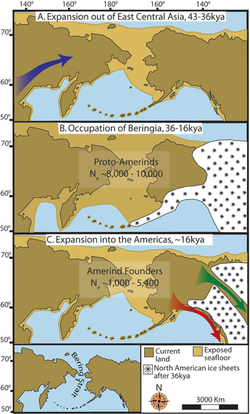
Archaeological evidence has long favored the hypothesis that Native Americans crossed into the Americas during the Ice Age from Siberia across a frozen Bering Strait.[1] The Book of Mormon, by contrast, asserts that “…Israelites accomplished at least two marathon oceanic voyages to the New World in approximately 600 B.C… By about AD 400, the descendants of these lost Israelites had multiplied into million-strong civilizations and spawned other migratory groups that went on to colonize additional territory in the Americas…”[2] The Latter Day Saints’ introduction to the Book of Mormon states that:
[t]he record [in the Book of Mormon] gives an account of two great civilizations. One came from Jerusalem in 600 B.C., and afterward separated into two nations, known as the Nephites and the Lamanites. The other came much earlier when the Lord confounded the tongues at the Tower of Babel. This group is known as the Jaredites. After thousands of years, all were destroyed except the Lamanites, and they are among the ancestors of the American Indians.[3]
These claims can now be analyzed utilizing DNA evidence. Contrary to the claims of the Book of Mormon, this evidence has shown that there are four major genetic lineages for the peoples of the Americas which are of Eastern Asiatic origin, along with a fifth that is possibly Caucasian.[4]
In order to support the claim that Israelites came to America, the DNA evidence would have to reflect their Israeli genetic lineage, which “resemble[s that] of Europeans.”[5] The only European genetic heritage in America, however, came with Columbus and the European settlers who followed him.[6] Furthermore, Mormons frequently assert that it was the Mayans and Olmecs who parallel the civilizations of Nephi and the Jaredites.[7] This evidence simply doesn’t match the genetic history, which demonstrates that traces of European (and therefore possibly Israelite) origins have been found in the North American peoples and not with the Mesoamerican Olmecs and Mayans—as would be necessary to support this Mormon theory.[8] The assertion that Native Americans descended from the lost tribes of Israel is groundless. The Smithsonian Institute wrote that “The physical type of the Native Americans is basically Mongoloid, being most closely related to that of the peoples of eastern, central and northeastern Asia.”[9] This evidence leads Simon Southerton to conclude that “The ancestors of Native Americans were Asians who unknowingly became the first Americans as they walked across Beringia over 14,000 years ago… Regardless of coincidental cultural, linguistic, or morphological parallels with the Old World, the peoples of the Pacific Rim who met Columbus and Cook were not Israelites.”[10] Native Americans descend from Asia, not Israel. Therefore, the Book of Mormon is strongly undercut by prevailing scientific evidence and genetic data.
Mormonism’s response to this DNA evidence has been threefold. The Mormon apologist counters by arguing that Christianity is undercut by scientific evidence,[11] that science can’t disprove the Book of Mormon anyway,[12] or that the conclusions drawn from the DNA evidence are stronger than such studies warrant.[13] There is little need to argue against the first rebuttal, as it amounts to little more than a tu quoque. It serves only to try to push the burden of proof off the Mormon apologist. Furthermore, it seems very strange, considering the lengths to which many have gone to argue that Mormons are Christians.[14] The second response also has little to recommend it. In an article curiously titled “BYU professor refutes Book of Mormon DNA Claims,”[15] Mark Nolte writes “[Michael] Whiting [a BYU scientist] said the Book of Mormon was not written as a scientific book, and therefore cannot be wholly proved or disproved using scientific methods… it is no surprise that DNA analysis could not find a genetic marker that links American Indians to a Middle-Eastern population. [Whiting said,]‘I would be skeptical of someone standing up and saying, ‘I have DNA evidence that the Book of Mormon is true.’”[16] The assertion seems to be that the Book of Mormon is theology, not science, and therefore cannot be evaluated scientifically. Examining such claims fully is beyond the scope of this work, but it seems like this whole response is glaringly dismissive. The Book of Mormon does claim that the Native Americans are descendants of the Israelites, as Whiting acknowledges,[17] so evidence which demonstrates they are not disconfirms the Book of Mormon.
 The third claim warrants further examination. Essentially, Mormon apologists argue that we simply can’t know enough to determine whether or not Israelite DNA is present in Native Americans.[18] The problem with this claim is that the evidence is not at all inconclusive. In fact, the evidence demonstrates that 99.6% of Native Americans are of Asian descent. The .4% of non-Asian Native American lineage is found in those genetic pools which interacted with the early colonizers.[19] Not only that, but even if the .4% of non-Asian genetic lineage could be Israelite (which it is not), the Book of Mormon claims that the Israelites in America were huge civilizations.[20] Why, then, would their genetic footprint be so small? Furthermore, the claims that such methodology is problematic or that we have limited data[21] is also demonstrably false. The genetic data is conclusive, and studies which utilize other methods for determining heritage (such as dental, osteological [study of bones], and molecular studies) confirm that the descent of the Native American is Asian, not Israelite.[22] According to Stephen Whittington, “Archaeologists and physical anthropologists have not found any evidence of Hebrew origins for the people of North, South and Central America.”[23] Genetic evidence therefore provides a strong defeater for the veracity of the Book of Mormon.
We have seen that the Book of Mormon is integral to the faith of Mormonism. If this book is factually incorrect, then there is no reason to suppose its theological message is true. Joseph Smith once said, “One of the grand fundamental principles of ‘Mormonism’ is to receive truth, let it come from whence it may.” I hope that Mormons will indeed receive the truths found in genetic and archaeological evidence.
[1] Simon Southerton, Losing a Lost Tribe: Native Americans, DNA, and the Mormon Church, (Salt Lake City, UT: Signature, 2004), 73.
[2] Southerton, Losing a Lost Tribe, 117-118.
[3] The Mormon Church, “Introduction to the Book of Mormon”, The Church of Jesus Christ of Latter Day Saints. http://lds.org/scriptures/bofm/introduction?lang=eng (accessed February 1, 2011).
[4] Southerton, Losing a Lost Tribe, 89-90.
[5] Ibid, 129.
[6] Ibid, 129.
[7] Ibid, 83.
[8] Ibid, 129.
[9] Quoted in Martin, Kingdom of the Cults, 215 and Jerald and Sandra Tanner, Mormonism: Shadow or Reality? 97.
[10] Southerton, Losing a Lost Tribe, 130.
[11] David Stewart, “DNA and the Book of Mormon.” The Latter-Day Saints Foundation for Apologetics Information and Research. http://www.fairlds.org/Book_of_Mormon/DNA_and_the_Book_of_Mormon_2.html (accessed October 29, 2010.
[12] Mark Nolte, “BYU Professor refutes Book of Mormon DNA claims.” Brigham Young University. http://newsnet.byu.edu/story.cfm/41852/ (accessed October 29, 2010).
[13] Stewart, “DNA and the Book of Mormon”; see also, Southerton, Losing a Lost Tribe, 184f.
[14] A simple search on google for “Are Mormons Christians” turns up 610,000 results (at the time of this writing), many of which argue the affirmative, from a Mormon perspective.
[15] Emphasis mine.
[16] Nolte, “BYU Professor…”
[17] Ibid.
[18] Stewart, “DNA and the Book of Mormon”; see also Southerton, Losing a Lost Tribe, 188.
[19] Southerton, Losing a Lost Tribe, 187, 192.
[20] Ibid, 117-118. For just one example within the Book of Mormon itself, see the Book of Alma [one of the books in the Book of Mormon] 51:27, which states “And thus had the Lamanites obtained, by the cunning of Amalickiah, so many cities, by their numberless hosts, all of which were strongly fortified after the manner of the fortifications of Moroni; all of which afforded strongholds for the Lamanites.” The language suggests huge civilizations: “many cities”; “numberless hosts”.
[21] Stewart, “DNA and the Book of Mormon.”
[22] Southerton, Losing a Lost Tribe, 191.
[23] Quoted in Ibid, 191.
This post was derived from an essay I wrote for my graduate studies at Biola University.
SDG.
——
The preceding post is the property of J.W. Wartick (apart from citations, which are the property of their respective owners) and should not be reproduced in part or in whole without the expressed consent of the author. All content on this site is the property of J.W. Wartick and is made available for individual and personal usage. If you cite from these documents, whether for personal or professional purposes, please give appropriate citation with both the name of the author (J.W. Wartick) and a link to the original URL. This blog is protected by Creative Commons licensing. By viewing any part of this site, you are agreeing to this usage policy.
William Lane Craig vs. Peter Millican- Thoughts and Links
 Theistic philosopher of religion William Lane Craig recently debated Atheistic Philosopher Peter Millican on the topic “Does God exist?” I daresay this was one of the most interesting debates I’ve heard. Millican came in with a clear strategy, and the debate covered an extreme range of topics. The friendly nature of the debate was also quite rewarding to hear. Clearly, we can have such discussions without attacking each other. Anyway, to the outline and analysis.
Craig Opening
Craig began by outlining the topic: Does God exist? The topic can be answered as yes or no. Craig argued for the former, and left the latter to Millican.
First, he argued philosophically against an infinite past. This argument would become quite important throughout the debate so I’ll outline it briefly. If we had an infinite number of coins, each with a number upon them, and took away ten, the number of coins would still be infinite. If we took away all the even coins, we’d have subtracted an infinite number of coins, and still, there would be an infinite number of coins. If, however, we subtracted all the coins above 3, we’d have subtracted infinite from infinite, and be left with 3 coins, not infinite coins. Craig argued that this is obviously a contradiction because despite subtracting the same amount (or different amounts) we can come up with two different answers (or the same answer). Therefore the past cannot be infinite.
Craig also argued scientifically that the universe began by bringing up the Borde, Guth, and Vilenkin theory which shows that irregardless of theories about the multiverse, bubble universes, and the like, the universe had a beginning.
He then presented the Kalam cosmological argument, though with a slight twist. He instead presented it as “The universe began to exist; if the universe began to exist, then it has a transcendent cause; therefore, the universe has a transcendent cause.”
He then argued the fine-tuning argument. There are a number of conditions of the universe which have been fine-tuned within a narrow range for the existence of life. Because of this, argued Craig, we can conclude the universe was designed.
Objective morality also necessitates the existence of God, argued Craig. The argument was based upon two major conditions: that objective morals exist, and that they cannot if there is no God. He quoted atheist philosopher Michael Ruse who said (in part): “morality is just an aid to survival” on naturalism.
Yet our moral experience leads us to believe that morality is indeed objective, and we know that, on naturalism, there is no ontological basis for morals. Thus, God exists.
Three facts must be explained by those who argue Jesus did not rise from the dead, and any theory must answer all of them: 1) the empty tomb; 2) on different occasions and settings to different people, Jesus appeared alive; 3) disciples showed a sudden belief that Jesus had risen, despite every predisposition to the contrary.
Craig noted that these three facts are agreed upon by New Testament scholars–both theists and non.
Finally, Craig argued for the experiential awareness of God.
Millican Opening
Millican used a different strategy here. Rather than immediately rebutting Craig’s arguments, as most have done in debates with Craig (although, notably, Stephen Law did not either in his debate with Craig), Millican argued against the method used first.
Christianity, he stated, is a hypothesis about reality. It makes a claim about what reality is. Therefore, the burden of proof lands squarely upon the theist.
He argued that people are primed for belief in gods. They have a “permiscuous teleology” which seeks for design. Furthermore, the dominant determinant of religious orientation is place of birth.
Before one could accuse Millican of the genetic fallacy (I actually wrote this on the side of my notes), he stated that he was not arguing these disprove God. Rather, he argued that if a method leads to variant beliefs, then it should discredit the method.
He then turned to rebutting Craig’s arguments. He said that quantum mechanics has shown that particles can come into existence out of nothing (note that he did indeed use the word “nothing” here). He furthermore argued that in our experience, we only see physical things being rearranged, not coming into existence ex nihilo. He argued that our experience must establish these truths.
He also cited Vilenkin, in a letter, stating that his theorem did not show the universe had a beginning.
Regarding the moral argument, he asked “what is objective?” He said that based upon how one defines this, one could have different answers about objective morality.
Craig First Rebuttal
Craig noted that Millican’s attempt to put all burden of proof on the theist didn’t work, because they also make a claim about reality: “There is no God.” This claim needs support as well, and Millican did not support it.
Regarding Millican’s claim about method, Craig responded that his method is logic, evidence, and personal experience–the same things which the scientific method relies upon. Thus, if the method yields God’s existence, it is not to be distrusted but embraced by those who value the latter method.
Not only that, but Millican’s argument seemed to suggest that religions all used the same methodology in reaching their truth claims, which is highly contentious and definitely untrue. Religions use a broad array of methods in how they discover truth.
Craig argued that absence of evidence is not evidence of absence. Only if we should expect more proof than there is should we be in doubt of the existence of something due to absence of evidence. Furthermore, argued Craig, he presented a great wealth of evidence already.
Craig then quoted Vilenkin’s letter in context. Vilenkin wrote that the beginning could be avoided only if one allowed for a contracting universe, but that this was highly unlikely and would have prevented the expansion of the universe. Thus, Vilenkin said, if he were to give a short answer to the question “Does your theory imply the beginning of the universe?” the answer would be yes. I should note that Millican dropped Vilenkin faster than Dawkins runs from Craig after this quote was read.
Craig then argued that the unembodied mind is hinted at our own experience. Furthermore, epiphenominalism simply cannot ground reality as we experience it.
Finally, regarding the moral argument, Craig asked why we should value humans and not chimps.
Millican First Rebuttal
Millican responded to the fine-tuning argument by saying that perhaps we may explain these evidences later. Further, we can’t base it all upon current physics, which may change. He also argued that there is difficulty with using the probability argument because our only sample is our current universe. God, argued Millican, would have been greatly inefficient if he made the universe as he did.
He briefly touched on the evil god thesis (as seen in the Law debate) and argued that the evidences could work for an evil deity.
Millican also suggested we should expect more evidence–why can’t there be more evidence for the existence of God?
Regarding the philosophical argument about the beginning of the universe, Millican noted that transfinite math does not allow for subtraction or addition because it yields diverse answers. Thus, he stated, Craig’s argument is confused.
He also conceded that the quantum vaccuum is not nothing, which was interesting considering he had literally used that word for it in his opening statement. He pressed his point, however, by stating that it is the closest we can come to nothing in our experience.
Unfortunately, Millican ran short on time and couldn’t respond to all Craig’s points.
Craig Second Rebuttal
Craig argued there are still no good reasons to support the contention “there is no God.” Furthermore, Millican’s response to the “absence of evidence” argument was just a personal opinion: ‘I think there should be more.’
God’s ‘inefficiency’ presupposes a God-as-engineer, argued Craig. One would have to be limited on time or resources in order to be compelled towards efficiency–limits God obviously does not have. God might be better compared to an artist or chef–enjoying the creation and beauty as he designed the universe.
The philosophical argument about infinites is problematic for Millican, argued Craig. The reason is because while we can slap the hand of a mathematician who tries to do so with abstract math, we can’t do the same thing in real life. If we literally had infinite coins, we couldn’t prevent someone from taking one away, and leading to the absurdities. In fact, Millican essentially demonstrated the point: such things are excluded in transfinite math because they are absurd, and so can’t happen in the real world.
Millican’s argument that the fine-tuning argument depends only on current physics illustrates Craig’s point exactly, countered Craig. Namely, that current physics supports the existence of God.
Millican Second Rebuttal
Millican argued that it doesn’t follow that if epiphenominalism is false, dualism is true. I think it’s really unfortunate the debate was so short–it would be interesting to see their views on this matter face off. He argued statistically that there are many moral realists who are not theists.
Why shouldn’t an atheist believe in objective moral values? asked Millican. There’s no good reason they can’t detect them and experience them. Further, we can value humans because they’re rational, and the same species.
Finally, he argued that scholars like Bart Ehrman had undermined the evidence for the resurrection by showing that the Gospels weren’t independent and unreliable.
Craig Conclusion
Craig noted there still was no good argument for atheism and that he’d presented good arguments for theism.
Bart Ehrman and the others Millican cited actually agree with the three facts Craig used to support the resurrection, so there was still no counter to that argument.
Craig noted that rationality doesn’t serve as an objective cut off point for morals. Sam Harris argued that sentience is. On atheism, argued Craig, there is no non-arbitrary line at which to base morality. Why should we value rationality? Why value humans more than chimps? Again, the line is arbitrary. The fact that many atheistic philosophers believe in realism of morality doesn’t show that it has grounds ontologically in atheism.
Millican Conclusion
Millican said there are many theories of how objective reality can be established on atheism.
He argued that physics may change and so we can’t base the existence of God upon current physics.
Finally, regarding evil, Millican said that our empirical evidence should lead us to doubt whether God exists. What should we see if there is a God? Certainly not this much suffering.
[Millican also argued throughout that there is no experiential evidence for things coming into being out of nothing, so that the causal premise of the Kalam is undermined. I forgot to write down where he started this argument, but wanted to make note of it here.]
Analysis
The debate was great. There were so many topics covered, it was a whirlwind.
Millican’s refutations of the Kalam were dramatically undercut by Craig. His citation of Vilenkin was just utterly demolished when Craig read the rest of the passage. His arguments about how we can’t add or subtract from infinity merely demonstrated Craig’s point: that it is absurd to suppose actual infinites exist. Regarding the causal premise, Craig argued in the debate that Millican would have to hold there was no essential or material cause for the universe, an argument to which Millican never had a response. To be fair, this may have been due to time.
I thought Millican’s response the fine-tuning argument was quite strange. Certainly, physics may change, but that doesn’t mean we can’t trust what we know now. As Craig argued, physicists today are quite convinced of the trustworthiness of physics. Further, Craig responded to the probabilistic argument by showing that we do indeed know the probability–despite the sample size. There is simply a life-permitting range for the values cited, so we can be justified in holding the fine-tuning argument to be true.
The moral argument was another point of contention. I don’t think Millican really undermined it. He merely referenced that atheists think they can have objective moral values, and questioned the meaning of the word “objective.” Interestingly, in the Q&A, Craig responded to Millican’s confusion: “That’s why I defined it.”
The resurrection definitely didn’t get defeated. Millican’s deferment to Ehrman and the like actually justified Craig’s 3 facts approach, because the scholars he cited affirmed the three facts.
Overall, I think Millican did much better than Law and definitely better than Harris or Krauss in those debates which I reviewed. That said, Craig still established the existence of God–at least as best can be done in under an hour to speak. Millican’s objections were interesting, but ultimately defeated by Craig. I think it’s fair to say that this debate showed, once more, that in the forum of rational inquiry, theism has an upper hand.
Links
Check out the audio of the debate at Apologetics 315. Also see their awesome feed which features tons of Craig’s debates.
See Wintery Knight’s summary of the debate.
SDG.
——
The preceding post is the property of J.W. Wartick (apart from citations, which are the property of their respective owners) and should not be reproduced in part or in whole without the expressed consent of the author. All content on this site is the property of J.W. Wartick and is made available for individual and personal usage. If you cite from these documents, whether for personal or professional purposes, please give appropriate citation with both the name of the author (J.W. Wartick) and a link to the original URL. This blog is protected by Creative Commons licensing. By viewing any part of this site, you are agreeing to this usage policy.
Really Recommended Posts 10/22
 Why Do Atheists Talk So Much About Religion?– A short, interesting post with a self-explanatory title. Check it out.
Ah, Richard Dawkins, when will he learn that attacking people doesn’t make their views wrong? His buddy PZ Myers has actually attacked me personally as well, but that’s beside the point. Check out Max Andrews’ thoughts on Dawkins refusing to debate Craig. Dawkins, of course, enlists the help of his yes man Myers.
Undesigned Coincidences and the Historicity of the New Testament– This is a great apologetics video making the rounds. The “undesigned coincidences” argument is one which is slowly seeing a revival–in part due to Dr. Tim McGrew, a friend of mine and a phenomenal philosopher. Check it out.
A Review of “The Magic of Reality”– Dawkins has been adamant that we should not indoctrinate our children. Yet his new book is intended to do just that: indoctrinate children with atheism. Check out this timely review over at Deeper Waters.
Sharing the Gospel – 10 Surprisingly Simple Tips for Talking with Cult Members (part 1)– it is what it says… some great hints for witnessing when the cults come a-knockin’.
The Book of Mormon, 1/18– part one of a series in which an apologist reads through the Book of Mormon. Great stuff.
The Book of Mormon: Introduction and Importance
 Mormonism is growing with great speed. There are few, however, who understand the limits of Mormonism’s truth claims. Mormon apologists have frequently made assertions which are either false or ungrounded. I have therefore decided to write a series of posts on the Book of Mormon, followed by a critique of Mormonism’s philosophical stances. This post will introduce the book of Mormon.
A man was born on December 23, 1805 in Vermont. He was known for digging for imagined buried treasure with his father and others.[1] He was also known for being a mystic,[2] for his conviction for disorderly conduct in a scam in which he tried to convince locals he had found treasure underground,[3] and for being the translator of golden plates: The Book of Mormon.[4] The man was Joseph Smith, Jr., the founder of the Mormon faith, “The Prophet.”[5] The Book of Mormon, according to the Church of Jesus Christ of Latter Day Saints (the official name of the Mormon Church), is “another witness that Jesus Christ… was and is God’s Son… It supports and verifies the Bible.”[6] If this is true, then the Book of Mormon is as much the Word of God as the Bible. However, the Book of Mormon’s validity as the Word of God is strongly undercut by scientific and historical evidence which contradicts its claims.
The Mormon Articles of Faith describe the Book of Mormon as “a volume of sacred scripture which, like the Bible, embodies the word of God.”[7] The Book of Mormon is supposed to record other prophecies about Jesus.[8] Perhaps the most striking enunciation of the contents of the Book of Mormon is found later in the Articles:
The Book of Mormon is a divinely inspired record, made by the prophets of the ancient peoples who inhabited the American continent for centuries before and after the time of Christ, which record has been translated in the present generation through the gift of God and by His special appointment. The authorized and inspired translator of these sacred scriptures… is Joseph Smith.[9]
Furthermore, the arguments for the authenticity of the Book of Mormon often parallel those arguments used to justify the Bible: it is said to be “internally consistent,”[10] prophetically fulfilled,[11] and supported by archaeology.[12] Yet there are also arguments unique to the Book: it was certified as genuine by three men who signed a statement confirming they witnessed the translation of the Book,[13] eight other witnesses claimed to have seen the gold plates from which the Book was purportedly translated,[14] and the ethnic background of Native Americans is said to be Israelite, which would demonstrate the Book’s truth.[15] It is clear that the Book of Mormon is the absolute bedrock of Mormon faith. If the evidences for the Book do not hold the evidential weight required to confirm its truth, then Mormon faith is undone.
The Book of Mormon’s veracity hinges on the claim that the lost tribes of Israel came to America, settled there, and wrote their history on gold plates which Joseph Smith later translated. Such claims at the time of Joseph Smith seemed irrefutable; they simply couldn’t conceive of technology which could test such ideas. Today, however, such technology is available. Unfortunately for Joseph Smith and the Mormon Church, the evidence runs contrary to what the Book of Mormon claims.
Over the coming weeks, I’ll investigate each of these claims in turn, while finding them wanting. The next post will demonstrate that the Book of Mormon cannot be true based upon a genetic analysis of Native Americans. Future posts will argue that the Book of Mormon does not reflect ancient near eastern writing and that the Mormon concept of God is philosophically untenable.
[1] Walter Martin. The Kingdom of the Cults (Bloomington, MN: Bethany, 2003), 197; Jerald and Sandra Tanner, Mormonism: Shadow or Reality? (Salt Lake City, UT: Modern Microfilm Company, 1972), 32.
[2] Martin, Kingdom, 197
[3] Wayne L. Cowdrey, Howard A. Davis, and Arthur Vanick, Who Really Wrote the Book of Mormon: The Spalding Enigma (St. Louis: Concordia, 2005), 395f.
[4] Martin, Kingdom, 201.
[5] Ibid., 197f.
[6] The Mormon Church, “Frequently Asked Questions,” The Church of Jesus Christ of Latter Day Saints, http://www.mormon.org/faq/#Book+of+Mormon|question=/faq/what-is-book-of-mormon/ (accessed October 14, 2010).
[7] James Talmage. A Study of the Articles of Faith (Salt Lake City, UT: The Church of Jesus Christ of Latter-day Saints, 1976), 251.
[8] Talmage, Articles of Faith, 252.
[9] Talmage, Articles of Faith, 255.
[10] Ibid, 278-279.
[11] Ibid, 274-275.
[12] Ibid, 283-293.
[13] Ibid, 270.
[14] Ibid, 271.
[15] Ibid, 283.
Image Credit: http://commons.wikimedia.org/wiki/File:Slc_mormon_tempel.jpg
SDG.
——
The preceding post is the property of J.W. Wartick (apart from citations, which are the property of their respective owners) and should not be reproduced in part or in whole without the expressed consent of the author. All content on this site is the property of J.W. Wartick and is made available for individual and personal usage. If you cite from these documents, whether for personal or professional purposes, please give appropriate citation with both the name of the author (J.W. Wartick) and a link to the original URL. This blog is protected by Creative Commons licensing. By viewing any part of this site, you are agreeing to this usage policy.
Thermodynamics, the Past, and the Multiverse: Arguing about the Kalam Cosmological Argument

I wrote recently about several objections to the Kalam Cosmological Argument, but I wasn’t able to cover even the most common objections in one post. Here, I’ll examine a few more objections to the argument, as well as offer critiques and more links to read.
Matter can be neither created nor destroyed
A common objection to the Kalam Cosmological Argument (hereafter KCA or Kalam) is against its principles of causation. The atheist points out the principle of the conservation of energy: that energy can be neither created nor destroyed, but only change forms (it can equally be said that “matter can be neither created nor destroyed…”). Applying this to the Kalam, they argue that because the KCA asserts the universe began and was caused, it cannot be true–matter cannot come into existence.
There are several problems with this objection. First, it assumes a causal principle: that only material causes exist. For it is true that the conservation of energy applies to material causation, but it may not apply to immaterial causation. “Ah,” the atheist may counter, saying, “but why think that there is immaterial causation anyway?” Why? Because that’s exactly what the KCA is made to demonstrate: that the universe was caused by an immaterial entity. The first premise (Everything that begins has a cause) would indeed have to surrender to the conservation of energy… but only if it is assumed that the cause is material. The Kalam is presenting an immaterial cause, creating the universe ex nihilo–out of nothing. For more on this objection, see William Lane Craig’s answer to the question “Must everything have a material cause?”
Second, using the conservation of energy to argue against the beginning of the universe reveals confusion about cosmology to begin with. Scientists can extrapolate back to the beginning of the big bang–which is the moment when both space and time came into existence, along with all of the material world (Craig and Copan, cited below, 222ff). So we know scientifically that there was a moment when there was no matter at all. It was created, not out of other matter, but out of nothing. Here is the key to note: it is once the universe came into existence that the laws of nature came into effect–before the universe, there was nothing.
Third, if it is true that matter has never been created or destroyed, matter and energy would be eternal. But if that is the case, then due to another law of thermodynamics–entropy–the entire universe would have evened out all the energy by now. There would be no stars burning, no people breathing, etc. Thus, it is easy to see scientifically that the universe is not eternal.
Infinite Past is No Problem
The late atheistic philosopher J.L. Mackie objected to the Kalam from a different perspective. He felt that there was a problem with the way William Lane Craig tried to establish a finite past. He argues that “[The Kalam] assumes that, even if past time were infinite, there would still have been a starting-point of time, but one infinitely remote, so that an actual infinity would have had to be traversed to reach the present from there. But to take the hypothesis of infinity seriously would be to suppose that there was no starting-point…” (Mackie, 93, cited below).
William Lane Craig and Paul Copan point out that, “On the contrary, the beginningless character of the series of past events only serves to underscore the difficulty of its formation by successive addition. The fact that there is no beginning at all, not even an infinitely distant one, makes the problem worse, not better” (Craig and Copan, 214, cited below). It’s not that defenders of the Kalam argue that if the past is infinite, one could not count to the present–rather, it’s that if the past is literally infinite, there is no beginning, and one could never reach the present moment by successive addition.
If one finds this line of reasoning unconvincing, however, one must also deal with the empirical problem with an infinite past: entropy. If the universe has existed forever, then all the energy in the universe should have evened out by now. We would simply not observe the universe we do. Thus, both philosophically and scientifically, we can discount the idea of an infinite past.
The Multiverse, Redux
I addressed the multiverse in my previous post on the topic, but it should be noted how much of a difficulty there is for those wishing to use the multiverse to discredit the Kalam. Jeffrey Zweerink points out that according to Arvind Borde, Alexander Vilenkin, and Alan Guth, “any cosmos that expands on average (like an inflationary multiverse) must have a beginning in the finite past” (Zweerink, 32, cited below). The multiverse does not help those trying to avoid a beginning for the universe, it merely pushes the problem up one level.
Conclusion
Again, after subjecting the Kalam Cosmological Argument to multiple objections, it emerges unscathed. It establishes its conclusion: the universe has a cause. What does this mean? That’s a question we should all consider of utmost importance.
Links
An outline of the Kalam Cosmological Argument.
Dawkins and Oppy vs. Theism: Defending the Kalam Cosmological Argument– A survey of some philosophical and popular attacks on the KCA along with rebuttals.
Sources
William Lane Craig and Paul Copan,Creation out of Nothing
J.L. Mackie, The Miracle of Theism (New York, NY: Oxford, 1982).
Jeffrey Zweerink, Who’s Afraid of the Multiverse? (Reasons to Believe, 2008).
SDG.
——
The preceding post is the property of J.W. Wartick (apart from citations, which are the property of their respective owners) and should not be reproduced in part or in whole without the expressed consent of the author. All content on this site is the property of J.W. Wartick and is made available for individual and personal usage. If you cite from these documents, whether for personal or professional purposes, please give appropriate citation with both the name of the author (J.W. Wartick) and a link to the original URL. This blog is protected by Creative Commons licensing. By viewing any part of this site, you are agreeing to this usage policy.
“The Multiverse Created Itself” and “Who made God after all?” -The Kalam Cosmological Argument

The most reasonable belief is that we came from nothing, by nothing, and for nothing. -Quentin Smith, Theism, Atheism, and Big Bang Cosmology, 135.
Is this so reasonable? Is it true that we came from nothing, by nothing, and for nothing? The Kalam Cosmological Argument is one of the most compelling arguments for theism. The broad opposition to the Kalam (or, more specifically, to its implications) from atheists has lead to some sophisticated arguments (like those of Graham Oppy or J.L Mackie), but it has also lead to some pretty poor arguments. Below, several objections to the Kalam Cosmological Argument have been outlined, along with rebuttals of varying lengths.
The Multiverse?
Some have objected to the Kalam by raising the possibility of a multiverse. They say that this counters the Kalam because it’s possible that our universe is one of nearly infinite past universes, generated as another “bubble” among untold trillions of other bubble universes. There should be one glaring difficulty with this objection that most can see immediately: “Whence the multiverse?” If the multiverse is proposed as eternal, then every objection about actual infinites applies to the multiverse. Not only that, but the multiverse itself would have to account for entropy. How is it that all the energy in this (nearly) infinite multiverse has not been used if it has existed for all eternity?
Ways around these difficulties have been proposed. For example, regarding entropy, some have argued that perhaps different laws of nature apply to the multiverse as a whole. Clearly, this is an extremely ad hoc theory that is really only invented to try to get around the argument. Once we’re allowed to modify reality to our every whim, we could indeed create anything we like–including (nearly) infinite universes.
Another problem with the multiverse objection is that we have startlingly little evidence for such a hypothesis. While there are many hypothetical scientists proposing bubble universes and the like, it’s shocking to read just how little evidence there really is for such a hypothesis.
Finally, even were there an infinite multiverse–as some have proposed due to string theory–this would not avoid an absolute beginning for the entirety of the multiverse. Bruce Gordon points out that the standard inflationary models still use inflation with a finite duration, which would entail that regardless of the number of universes which exist, there would still have to be an absolute beginning to the multiverse (Gordon, cited below, 86-87).
Perhaps, however, this multiverse (or the universe) is finite, but it created itself. There are a number of proposals suggesting just that.
The Universe Created Itself
I don’t think I can do much better than Edgar Andrews did over at his blog when he asks “Could a universe create itself?” He points out that the difficulty with each scenario proposed in which the universe creates itself is that it presupposes the existence of either matter, energy, or the laws of nature–the very things which this objection is supposed to answer. Andrews writes,
Stephen Hawking [who recently proposed the universe created itself] falls into this dilemma by claiming that the universe was created as a result of quantum mechanical fluctuations (in a vacuum) which became stabilized by gravitational forces [Hawking pp. 131-135; Hawking review]. He thus requires the laws of quantum mechanics and of gravity to have pre-existed the universe… But what is the law of gravity but a description of the way materialbodies interact — either with one another or with the space-time continuum? To claim that such a law existed in the absence of matter, energy, space or time stretches credulity and is incapable of demonstration. Only ‘mind of God’ and ‘non-material blueprint’ arguments remain and these are theological not scientific.
Similarly, suppose we took the claim of Smith (above) seriously–that the universe created itself from nothing. Does this even make sense? William Lane Craig writes, “…if prior to the existence of the universe, there was absolutely nothing–no God, no space, no time–how could the universe possibly have come to exist?” This is an extremely important question for the atheist to answer. Most often, however, atheists have instead changed the meaning of “nothing” to mean quantum vacuum or some other physical reality. This is hardly “nothing” that would have existed before the universe. Before the universe, there was no space, no time, no anything.
Edgar Andrews points out the confusion that some atheist philosophers and physicists perpetuate with this conflation of “nothing”:
[Victor Stenger] begins by utterly confusing the pre-creation ‘nothing’ that lies outside of space-time with the ‘nothing’ of a vacuum within space-time. Next, without making it clear which ‘nothing’ he is talking about, he claims that ‘the transition from nothing to something is a natural one, not requiring any agent.’ (Andrews, 97, cited below).
The problem isn’t solved when one lends it the idea of a multiverse, either. Oscillating universe models still imply a finite beginning (Gordon, 86ff). The idea that an infinite number of universes caused each other in a causal loop does no better–it leads only to a vicious regress. Ultimately, such proposals must be rejected for what they are–fiction.
Who Caused God?
Another trite response to the Kalam is the classic “Well fine, you say the universe is caused, well who caused God?” line. Here the atheist commits a number of classic blunders, to steal the phrase from “The Princess Bride.”
First, as in all scientific (and otherwise) inquiry, once one has reached the best possible explanation for an event, one has reached the end of the inquiry. An inference to the best explanation does not require an explanation of that explanation. There’s a reason that scientific inquiry can appeal to laws: they best explain how the world works.
Second, the first part of the Kalam is that “Everything which begins to exist has a cause” not “Everything is caused.” The atheist has merely misread or misinterpreted this principle. Should the atheist want to press the second point–that everything is caused, they have already conceded the weaker principle (that everything which begins has a cause), and they must further argue for a much stronger metaphysical claim. I leave it to the atheist to establish this claim.
“But,” the atheist may object, “you’re just denying the antecedent!” Not quite. I’m not saying that God didn’t begin, therefore God was uncaused–rather, I’m arguing that because God did not begin, this argument does not apply to God. There could be other arguments made to establish that God is caused, but to do so would require, as I pointed out, arguing for the metaphysical principle that “everything is caused.” Again, I leave the atheist to make this argument.
Conclusion
While many objections to the Kalam might be made in good faith, it is clear upon examination that they all fall far short of defeating the argument. The Kalam Cosmological Argument succeeds in its goal: to show that the universe is caused. What is this cause? That’s a question we must all consider with fear and trembling.
Links
Those interested in a broad outline of the Kalam Cosmological Argument can read my post on the topic.
For a discussion of one both Richard Dawkins’ and Graham Oppy’s objections to the Kalam, read Dawkins and Oppy vs. Theism: Defending the Kalam Cosmological Argument.
Sources:
Edgar Andrews, “Could a universe create itself?”
Edgar Andrews, Who Made God (Darlington, England: EP books, 2009). Reviewed here.
Bruce Gordon, “Inflationary Cosmology and the String Multiverse” in New Proofs for the Existence of God by Robert Spitzer (Grand Rapids, MI: William B. Eerdmans, 2010).
William Lane Craig and Paul Copan, Creation Out of Nothing (Grand Rapids, MI: Baker, 2004).
SDG.
——
The preceding post is the property of J.W. Wartick (apart from citations, which are the property of their respective owners) and should not be reproduced in part or in whole without the expressed consent of the author. All content on this site is the property of J.W. Wartick and is made available for individual and personal usage. If you cite from these documents, whether for personal or professional purposes, please give appropriate citation with both the name of the author (J.W. Wartick) and a link to the original URL. This blog is protected by Creative Commons licensing. By viewing any part of this site, you are agreeing to this usage policy.
Book Review: “Who Made God?” by Edgar Andrews
 Who Made God?
Interestingly, Andrews gets the title of the book out of the way quickly. Andrews argues against the common atheistic retort, “Well if God made everything, who made God?” He writes, “Because cause and effect is only proven for the physical world, we can no longer insist that cause and effect are relevant when it comes to the origin of a spiritual entity like God.” I am not sure about the strength of this response. It seems to potentially put God outside the rules of logic, something of which most theists are very wary. A more convincing response, in my opinion, is to simply point out that the concept of God includes necessity. Theistic arguments are designed to show just this–that God is the uncaused ground of being.
Who Made God, however, quickly jumps into stride and doesn’t look back. Andrews lucidly argues that while science can describe events and put them to the test, it cannot explain things in the sense of a comprehensive explanation. Science, for example, “doesn’t tell us why there is [a force of gravity]” (30).
Without slowing down Andrews jumps into a clear explanation of String Theory and its attempts to be a “theory of everything.” Even were science to unify into a theory of everything, however, Andrews point would still stand. The theory would offer descriptions of how things happen, but it wouldn’t explain why the theory itself worked. He also offers a few critiques of string theory, such as the counter-intuitive nature of the theory (48).
Andrews continues on, offering God as a “hypothesis.” He argues that “the methodology of science” can be applied to God (58-59). He argues that Victor Stenger’s God: the failed hypothesis fails on a number of levels. Stenger claims that God “should be detectable: (1) by scientific ‘models’; (2) by scientific measurements… (3) by scientific ‘methods'” (67). Against this, Andrews points out that Stenger is trying to exclude God from existence by “having it both ways.” Stenger argues that God should be detectable, but cannot be because the measurements of science are restricted to the physical. Obviously, this begs the question against theism.
Andrews also addresses nothing, by which I mean the redefinition of “nothing” into “something” often done by atheists (see the debate between Lawrence Krauss and William Lane Craig). He points out that they often use “nothing” to reference vacuum and/or empty space or dark matter. But this is either deliberately misleading or just incomprehensible (97ff). As the atheists who say this often admit themselves, this “empty” space is hardly “nothing.” It is full of energy. But beyond space, beyond the existence of our universe, outside of space and time–that is what is meant by “nothing” (105).
The God hypothesis is vindicated when it comes to the evidence from astronomy and physics. The low entropy state of our universe (117-118), along with its origin (98ff) both point to a creator. Andrews moves on to argue that the origin of the laws of nature must also point to the God hypothesis (138-153). He then goes on to argue that our biological origins, the information found in cells, and the diversity of life have their best explanation with God. To cover these arguments fully would double the size of this review, but I found these arguments just as exciting as the rest of Who Made God. A sampling: proteins and DNA must have information in order to function correctly (181ff); origin of life theories can only be explained with the God hypothesis (196ff); evolution is nonfalsifiable (214-216); natural selection is a tautology (219-220); junk DNA isn’t junk (234ff); mutations really only help within dynamic populations and cannot lead to new species (230ff [through 240]). Andrews isn’t finished there, however, he tackles arguments for and against mind/body dualism (250ff).
Another strength of Who Made God is the format. There is a summary of each chapter prior to its contents, along with definitions of important terms. Humor is found throughout the work as the author tells funny stories or makes witty comments about the arguments. These aspects increase the readability of the book to a great degree.
This is not to say the book is without faults. Andrews’ treatment of the Ontological Argument was a bit abrupt. I’ve written on the argument before (see my posts here and here). Andrews’ critiques don’t apply to the most current versions of the argument. The most commonly used ontological argument is the modal version developed by Alvin Plantinga and others. This version of the argument doesn’t appeal to human ideas, but to modal necessity and possibility. To his credit, Andrews does point out that some philosophers find the argument compelling.
Another issue with Who Made God is the sometimes unconventional use of philosophical terms. For example, Andrews defines “phenomenology” as “The way phenomena… manifest themselves” (27). Phenomenology, however, is most commonly used (in philosophy) as the study of consciousness. Outside of philosophy, it generally refers to conscious experience or sense experience, not so much about the phenomena themselves. While the definition is not wrong, it caused some confuse, and may confuse other readers familiar with the other, more conventional uses. Another uncommon definition was given for “Monism.” Most often, the term refers to the idea that all of reality is one [i.e. it is all material, or all immaterial]. Andrews definition makes sense in context (he defines it as “The idea that mind is nothing more than the brain at work” [257] but that definition in philosophy of mind is more often used for “reductionism” which Andrews defines differently as well).
However, neither of these negatives outweigh the significant positives found throughout Who Made God. You know that I’m nitpicking when my main critique focuses on a couple unconventional definitions, particularly when Andrews uses valid definitions that simplify the terminology for the reader.
Edgar Andrews’ Who Made God is unique among the slew of apologetics books written at a popular level in that it offers a nearly comprehensive argument for Christianity based upon various scientific theories. Despite a few small flaws, I unreservedly recommend this book to all Christians looking to increase their knowledge of biology, physics, and astronomy. Andrews clearly and succinctly explains several scientific theories in terms which are easy to understand, while also showing the relevance for the “God hypothesis.” Readers will come away convinced that when it comes to science, their faith stands on firm ground. Books with scopes this broad most often shine their lights upon lots of topics and illumine none. Readers will find that Who Made God illumines nearly every topic it touches, bringing new insight and clarity into often confusing issues.
Source: Edgar Andrews, Who Made God?
Disclaimer: I was provided with a review copy free of charge by EP books. My thanks to both Edgar Andrews and EP books.
SDG.
——
The preceding post is the property of J.W. Wartick (apart from citations, which are the property of their respective owners) and should not be reproduced in part or in whole without the expressed consent of the author. All content on this site is the property of J.W. Wartick and is made available for individual and personal usage. If you cite from these documents, whether for personal or professional purposes, please give appropriate citation with both the name of the author (J.W. Wartick) and a link to the original URL. This blog is protected by Creative Commons licensing. By viewing any part of this site, you are agreeing to this usage policy.

 J.W. Wartick - Reconstructing Faith
