apologetics
Jesus, Dedication, and Wise Men
 Are these Biblical accounts of Jesus’ birth irreconcilable:
“When the time came for the purification rites required by the Law of Moses, Joseph and Mary took him to Jerusalem to present him to the Lord.”- Luke 2:22
“When [the Magi] had gone, an angel of the Lord appeared to Joseph in a dream. ‘Get up,’ he said, ‘take the child and his mother and escape to Egypt. Stay there until I tell you, for Herod is going to search for the child to kill him.’ So he got up, took the child and his mother during the night and left for Egypt…” Matthew 2:13-14
One says he was dedicated in the temple, the other, that Joseph took Mary and Jesus and fled to Egypt. The key to solving this potential problem is, as frequently is the case with Bible difficulties, context, context, and context.
The dedication of Jesus would have taken place very shortly after His birth. But reading the account of the visit of the Magi, we find that the wise men came at some point after the birth of Jesus. This is evident in Matthew 2:1-12, in which the Magi initially stop to visit King Herod to ask him where Jesus was born. Unless one is to assume the Magi were able to travel instantaneously to Bethlehem from Jerusalem with all of their escort, one should have no difficulty thinking that the Magi arrived at some point after Jesus had already traveled to Jerusalem and back for His dedication at the temple.
Not only that, but despite some traditions drawings of the Magi, it is unlikely that they came while Jesus was merely a babe. Again, these men came from “the east,” so it is unlikely that they made the trip in a few days. But there is also textual evidence for this idea, for when Herod seeks to kill Jesus, he kills all boys 2 years old and younger (2:16). Sure, he may have simply had no idea how old Jesus was and simply been shoring up his bets, but the text goes on to say that he kills boys 2 and younger “in accordance with the time he had learned from the Magi” (2:16b). So at some point he must have asked them how long they’d been traveling, and it was long enough to warrant killing the boys 2 and younger.
Thus, there is no contradiction in the text.
Merry Christmas.
SDG.
This is part of a series I’ve entitled “Jesus: the Living God,” which explores Jesus from Biblical, theological, and apologetic levels. View other posts in the series here.
——
The preceding post is the property of J.W. Wartick (apart from citations, which are the property of their respective owners) and should not be reproduced in part or in whole without the expressed consent of the author. All content on this site is the property of J.W. Wartick and is made available for individual and personal usage. If you cite from these documents, whether for personal or professional purposes, please give appropriate citation and provide a link to the original URL. By viewing any part of this site, you are agreeing to this usage policy.
Jesus and the Stable: A Theory
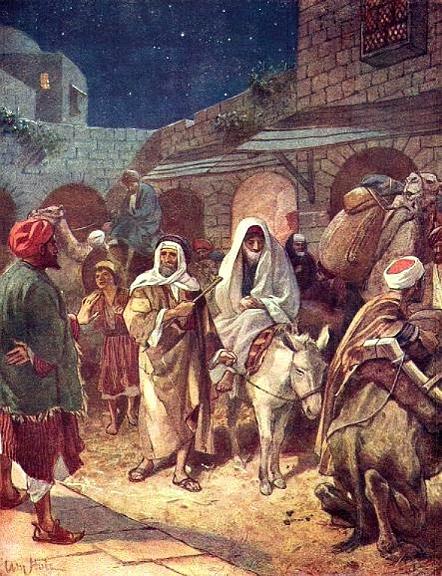 The Christmas season is upon us and I have been contemplating much of the story of Christ’s birth. Apologetically, I’ve decided to focus this season upon a few questions about Jesus.
One argument I have heard is that the account of Jesus’ birth in Luke 2 is inaccurate. The charge is made because it seems unfathomable culturally that Joseph could have gone to his hometown and found no family who would accommodate he and his betrothed. Luke 2:7 says “And she gave birth to her firstborn son and wrapped him in swaddling cloths and laid him in a manger, because there was no place for them in the inn.” The latter part of the verse is that to which the objector points, saying that surely one of Joseph’s family members would have provided a bed for them.
There are a few important points to be made here. First, the text actually provides for the possibility of Joseph’s family providing lodging. The Greek word translated “inn” in this verse can also be translated as “guest room” which implies that Joseph did seek lodging with family, but all of their guest rooms were full. This is reflected in the NIV translation, which states that “there was no guest room available to them.”
Second, while those who make this objection focus on the cultural significance of hospitality, they also ignore the cultural significance of adultery. That Mary was pregnant was a pretty big deal. She would have been seen as an adulterer–possibly with Joseph (though some anti-Christian literature from the second century suggested that Jesus was the illegitimate child of Mary and a Roman soldier named Panthera). The penalty for adultery was death by stoning. Joseph had stayed with Mary and protected her. It doesn’t seem unlikely that this could have incurred his family’s wrath to the point where they simply didn’t allow him to stay with them for the census. Treated like the family member no one talks about, everyone’s door was shut when Joseph came knocking with his pregnant bride-to-be.
It should be noted that this later theory is just that; a theory. The textual evidence could easily support my first point (that all the guest rooms were full). I think that my own theory is plausible. Either way, the objection fails.
SDG.
This is part of a series I’ve entitled “Jesus: the Living God,” which explores Jesus from Biblical, theological, and apologetic levels. View other posts in the series here.
——
The preceding post is the property of J.W. Wartick (apart from citations, which are the property of their respective owners) and should not be reproduced in part or in whole without the expressed consent of the author. All content on this site is the property of J.W. Wartick and is made available for individual and personal usage. If you cite from these documents, whether for personal or professional purposes, please give appropriate citation and provide a link to the original URL. By viewing any part of this site, you are agreeing to this usage policy.
Arguing for Deism?

One curious objection I have seen and heard to arguments for the existence of God is that these arguments apply to deism, not Christianity. For example, Michael, an atheist blogger, writes, “Note that these are effectively arguments for deism, not Christianity!” about the Moral Argument (here). Another example is found in the irrational and rather virulent attack on theistic argument (laughably, they use Dawkins as the primary source for saying that all arguments for God’s existence have been refuted) can be found here. The author, confused about the implications of the cosmological argument, writes, “YECers actually deny the Big Bang, but Craig appears to be a deist.”
I must confess at least a little confusion about these comment and others which I have seen and heard. The objection seems to be that an argument for the existence of God (such as the cosmological argument) that could be utilized for deism doesn’t help the epistemic justification for belief in the Christian God. This objection is completely misguided, however, for a number of reasons.
First, Michael objects in this way in his discussion of the Moral Argument. But deism is the belief in “a creator who has established the universe and its processes but does not respond to human prayer or need” (Honderich, 195 cited below). Clearly, then, this god of deism cannot be the God towards which the Moral Argument points. The moral argument places God as the objective standard of morality for the universe (note, it doesn’t place God as the arbitrary decision maker for what is right or wrong–but argues that God has objective goodness necessarily or essentially, thus avoiding the Euthyphro dilemma Michael presses). It is hard to see how a god which doesn’t care about or respond to human need could be the objective standard of morality.
Second, the classic arguments for the existence of God don’t each point specifically to the Christian God, but serve as a cumulative case to demonstrate His existence and attributes. The Moral Argument argues for omnibenevolence; the teleological argument demonstrates omniscience and omnipotence (along with omnibenevolence, to a lesser extent); the cosmological argument illustrates omnipotence, transcendence, and necessary existence; the transcendental argument shows God’s transcendence and necessity; the ontological argument combines all of the attributes into its first premise (usually); the argument from consciousness demonstrates God as mind; the argument from reason demonstrates the rationality of God; the list could continue. Furthermore, almost all of these arguments show that God is personal, and therefore, by definition, not deistic but theistic. The objection is specious already.
Furthermore, how is it an objection to these arguments to say that they don’t each individually demonstrate the Christian God is the one true God? This seems to be a confusion about how arguments work. Argumenst for the existence of a god, as long as they don’t contradict the God of Christianity, can be taken as evidence for the existence of the God, namely, the Christian God.
Take an example of a case in court. A man is accused of committing murder. The victim was found hung in his room. The prosecuting attorney argues that the accused had the means–he recently bought some rope. He then argues the accused had motive–the victim had recently gotten a promotion for which the accused was vying. He also shows that the accused has rope marks on his hand and scratch marks on his face, which show the struggle which occurred as the accused allegedly hung the victim. He argues, finally, the accused had opportunity–he was in the room at the time the victim died and he was also the only other person in the room.
Now imagine how ridiculous it would be if the defense attorney stood up and complained that these arguments don’t really apply to the case at hand, because none of them demonstrates the accused committed the murder! They just show, individually, that he had means, motive, and opportunity; not to mention the strong evidence for the accused being involved in a struggle with some rope and another person. But to demonstrate the guilt of the accused, the defense continues, the prosecution must come up with an argument that demonstrates all of these things at once! Otherwise, they just demonstrate the other things individually!
Obviously, the defense attorney has something wrong here. But then the atheistic objector also has something wrong. The Christian philosopher of religion has argued that God is omnipotent, omniscient, omnibenevolent, transcendent, necessary, etc.; the atheist responded by saying “those arguments individually only demonstrate a deistic God!” [Discounting, for the moment, that a deistic God wouldn’t share some of these attributes.] But that isn’t how the arguments work. Any argument which demonstrates that a God exists, as long as that God is not contradictory to the Christian God, can serve as evidence for the existence of the Christian God.
Source:
Ted Honderich, ed., The Oxford Guide to Philosophy (New York, NY: Oxford, 2005).
——
The preceding post is the property of J.W. Wartick (apart from citations, which are the property of their respective owners) and should not be reproduced in part or in whole without the expressed consent of the author. All content on this site is the property of J.W. Wartick and is made available for individual and personal usage. If you cite from these documents, whether for personal or professional purposes, please give appropriate citation and provide a link to the original URL. By viewing any part of this site, you are agreeing to this usage policy.
The Myth of Atheism: Is it (epistemic) Neutral Ground?
 Is there such a thing as epistemic neutral ground? The question deserves serious consideration, for if there is epistemic neutral ground, surely we should all stand upon it in order to evaluate worldviews. The reason for this is because the ability to strip away all bias and preconceptions and simply evaluate a worldview “as is” without any pretensions would be highly invaluable. I’ve run into atheists who seem to think that atheism somehow counts as this epistemic neutral ground. I think there is good reason to doubt that there is such a thing as epistemic neutral ground; and if there is, atheism is surely not it.
What reason do we have for thinking atheism is neutral ground? Those who argue that it is tend to say that it is neutral ground because they reject all religions a priori, which allows them to evaluate religious truth more fairly. This seems clearly misguided; rejecting all alternative worldviews hardly means that one is on neutral ground. In fact, it is more like dogmatics than neutrality.
But is atheism really a worldview, properly formulated? If it is not, can it serve as our elusive neutral ground? There is no doubt that those who are nontheists share little in common other than the simple attribution of “not believing in God” or “believing there is no God”. There are atheists who are buddhists; atheists who believe in ghosts; atheists who are staunch secular humanists. There doesn’t seem to be any shared connection. Does this mean it is not a worldview? I think the answer is yes and no. Atheism, construed as some kind of singular entity, is not a worldview. Rather, each atheists has his or her own worldview–part of which is atheism. Analyzed in this light, then, atheism is a piece of the fabric weaving together a worldview, not the worldview itself.
Does this, then, allow for atheism to be epistemic neutral ground? Again, I don’t see why it would. What reasons are there for favoring atheism as a research program (borrowing the phrase from Michael Rea) over theism? Again, it seems the only answer could be that it rejects all gods, so it somehow must allow for equal evaluation of other views. This still seems totally misguided. Why does rejecting all things make one neutral? If I am presented with some event, e, and possible explanations for e, A, B, and C, and then I reject A, B, and C, does this somehow make me neutral towards A-C? No! It means I reject them as explanations for e! Perhaps this is because I have my own explanation for e, or believe that e cannot be explained, but that doesn’t mean I am neutral towards the explanations which have been offered.
It therefore seems as though atheism cannot serve as epistemic neutral ground, either as a worldview itself, or as a method for research. Can alternative views suffice? It seems as though logic could serve as a research method which can be epistemically neutral. The immediate objection to this could be that there are those who reject logic and claim that there can be contradictions, impossibilities, and the like. My answer to this is that even those who reject logic can only claim to do so for logical reasons. In other words, they formulate logical arguments in order to argue that logic is false. It seems as though if someone has to assume the truth of some proposition (in this case that logic is true) in order to argue against that same proposition, then their arguments can in no way undermine the truth of that proposition.
I’m happy to follow logic where it leads. It seems to me that it leads straight towards the existence of God. Why? I’ve discussed this elsewhere: the Liebnizian Cosmological Argument, the Ontological Argument, Purposively Available Evidence, and the Teleological Argument. I’ve written on this same subject here.
– – –
Image: Copyright CalistaZ. Accessed http://commons.wikimedia.org/wiki/File:Lavaux_Alpes_et_Lac_l%C3%A9man.jpg
——
The preceding post is the property of J.W. Wartick (apart from citations, which are the property of their respective owners) and should not be reproduced in part or in whole without the expressed consent of the author. All content on this site is the property of J.W. Wartick and is made available for individual and personal usage. If you cite from these documents, whether for personal or professional purposes, please give appropriate citation and provide a link to the original URL. By viewing any part of this site, you are agreeing to this usage policy.
Sam Harris on Morality, Again. Ugh.
I noticed Sam Harris had a new book out. He’s still trying to make that argument that science can somehow determine objective morality. Ugh. I’ve already talked about his ideas here. I found this site (and some of its own links to other pages) fairly interesting. It seems as though we can decide what objective morality is, according to Sam Harris.
Maryann Spikes, of the San Francisco Apologetics Examiner, wrote, “In answer to the question, ‘Who decides what is a successful life?’ Harris proclaims, ‘The answer is: ‘we do.” In other words, Harris says we determine objective morality, but this is a contradiction, because objective morality, if it exists, is discovered–not created.”
Unfortunately, it seems he has no idea what “objective” means in that case. Anyway, check out the comments here.
“The Christian Delusion” Rebutted
Those interested in whether “The Christian Delusion” actually has anything useful to say (hint: it doesn’t) should check out “The Infidel Delusion,” a free book which rebuts it point-by-point. By the end of “The Infidel Delusion,” the atheistic “Christian Delusion” has been totally destroyed. Not that this was any surprise to me. The authors of “The Infidel Delusion” do a fantastic job, and it is a very, very worthy read.
The Past, Probability, and Teleology
 This post has been expanded, edited, and published in the journal Hope’s Reason. View it in full here.
I have run into the idea more than once recently that we should discount things like the teleological argument due to the fact that it happened in the past. The thinking goes that, because an event (the existence of the universe, for example), has happened, the probability of that event happening is 1/1. Thus, people like Dawkins can say, “The fact of our own existence is perhaps too surprising to bear… How is it that we find ourselves not merely existing, but surrounded by such complexity, such excellence, such endless forms so beautiful… The answer is this: it could not have been otherwise, given that we are capable of noticing our existence at all and of asking questions about it” (here).
There are a number of ways to take such sentiment. The first is quite trivial. Of course, if an event e happened, the probability e having happened is 1/1. That’s, as I said, trivially true.
The problem is when people try to use this thinking against something like some forms of the teleological argument. Statistically, some people assert, the odds that the universe would be life-permitting (like the one we observe) must be 1/1, because, we are here, after all, to observe it!
Now, imagine the following:
d: The chances of any one side coming up are (granting a fair die and surface) 1/6. I toss a die (I really just did here) and get a 1.
Now, the equivalent claim of saying that the universe must have been life permitting because we are here to observe it is saying that d must happen, given that it is what did happen. Some people have no problem with asserting this, and indeed say that this should be the case. The fact that something is true, they may argue, means that the probability that it would happen was 1/1.
We can, in fact, reduce this whole discussion to symbolic logic. It is the case that:
□(p⊃p)
Which tells us that, if p is the case, then necessarily p is the case. Those who are arguing as above, however, need a much stronger conclusion, namely, □p. But this simply doesn’t follow from reality. It is the case that p, therefore, necessarily, p. But it is not the case that necessarily p.
The distinction is a simple de re verses de dicto fallacy. It is an elementary error philosophically, but it is easy to commit. I’ve done so in the past (see here for a post in which I caught myself in this confusion). Now, de dicto necessity is “a matter of a proposition’s being necessarily true” while de re necessity is “an object’s having a property essentially or necessarily” (Plantinga, v). De dicto necessity ascribes necessity to a proposition, while de re necessity argues only that each “res of a certain kind has a certain property essentially or necessarily” (Plantinga, 10).
Returning to the idea of past events, such as the universe coming into existence or rolling a die and having it come up as a 1, we can see where this error occurs. Those who deny with Dawkins that we can work out the prior probabilities of the universe being life-permitting because “it could not have been otherwise” are actually committing this basic error. They have assigned the proposition that the universe exists de re necessity, when in reality it is only a de dicto necessity. It is, in other words, true that whatever has happened, necessarily has happened. It is not true that whatever has happened has happened necessarily.
(This post is a very miniature version of a journal article I have under review for Hope’s Reason right now.)
Sources:
Plantinga, Alvin. The Nature of Necessity. Oxford University Press. 1979.
Image: http://commons.wikimedia.org/wiki/File:God-dice.jpg
Thanks to Dr. Timothy Folkerts and Dr. Stephen Parrish for some enlightening correspondence on the above points.
——
The preceding post is the property of J.W. Wartick (apart from citations, which are the property of their respective owners) and should not be reproduced in part or in whole without the expressed consent of the author.
The Leibnizian Cosmological Argument
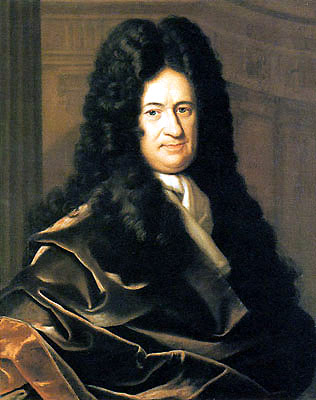 One of my personal favorite areas of philosophy of religion is studying the arguments for existence of God. One type of argument for God is the Cosmological Argument, and one of these arguments was developed by Gottfried Wilhelm Leibniz.
The Argument
A simple version of the argument, in syllogistic form, goes as follows:
1) Everything which exists has an explanation of its existence
2) If the universe has an explanation for its existence, that explanation is God
3) The universe exists
4) The universe has an explanation of its existence
5) Therefore God exists (Craig, 54ff)
Now I think this outlining of Leibniz’s argument is a little forward. Premise 2 may be a bit strong. I’ve edited it some, though I’m sure many others have outlined it similarly, to become:
1) All entities which exist have explanation of their existence. This explanation is either their own necessity or (for contingent entities) an external cause. (P1)
2) The universe exists (Axiom [A] 1)
3) The universe’s existence is not found in its own necessity (P2)
4) Therefore, the universe has an external cause (P1, P2)
5) There cannot be an infinite series of non-necessary causes (A2)
6) Therefore, the cause of the universe is transcendent (external) to it and necessary (4, A2 [I’m skipping a few steps here, but it would end up here eventually, as follows from 4 and A2])
What the Argument Demonstrates
I’m content with settling for the conclusion found in 6). Demonstrating that an external, necessary entity caused the universe is as close as to God as many arguments can go. A being which causes the universe would obviously be exceedingly powerful, the argument itself states it is transcendent to the universe, and the being exists necessarily. Many (most?) theists tend to agree that the other attributes Classical Theism has generally assigned to God follow quite easily from the acknowledgement that such a being exists.
The question must now turn towards reasons why we should believe that this valid argument is true.
Defense of the Premises
1) seems as though it should be accepted simply as a given. I don’t think I should need to defend 1). If we abandon the idea that everything which exists has an explanation (either contingently–from something outside of itself, or necessarily–from its own necessity), then we should expect any number of utterly random things to pop into and out of existence for no reason whatsoever! After all, it would be the height of self-delusion to think that, while all things require reasons to exist, it just so happens (how fortuitously!) that our universe is the only thing which exists for no reason. I’ll leave it at that for now… such ideas are more important for the Transcendental Argument, after all.
2) simply doesn’t need a defense.
Step 3) is alongside step 1) as the only two premises which are capable of being denied (for 2 is, again, obvious, and 4) follows simply from the first 3; we will discuss step 5 shortly) to avoid the conclusion. Denying step 1), I think, is clearly unacceptable, so denying step 3) is really the only way to go for the anti-theist. But what reasons do we have for thinking the universe exists necessarily? I think this is patently not the case. After all, everything which exists necessarily exists (necessarily) forever! Therefore, a necessary universe must have existed for an infinite amount of time (for time is part of the universe). But if this is the case, we run into the insurmountable problems which an infinite past brings up (these problems are also important for the Kalam Cosmological Argument).
I’ll pick just one problem to demonstrate: if the past is actually infinite (as it must be, granting a necessary universe), then we could never get to the present moment, for we would have had to traverse an actually infinite amount of time to get here! Not only that, but as time passes, there is no time being “added” to what came before. Infinity is infinity and it cannot be increased by adding to it or decreased from taking away from it. Therefore, every second which seems as though it is lengthening our lives is actually not doing anything of the sort, despite every commonsense notion with which we have lived out whole lives saying otherwise! The universe, on this view, is a deceptive place, in which nothing is as it seems.
Not only that, but if the universe were necessary, then it seems as though hard determinism–that is, the view that there is no freedom of the will whatsoever–must be the case. For, if the universe exists necessarily, then it has possessed all of its parts necessarily, forever.
Furthermore, there doesn’t seem to be any reason as to why the universe could not have been different. To assert the universe exists necessarily, once again, means to assert that no part of the universe could have failed to exist. Think of it this way: the universe in which I ate breakfast this morning (as opposed to this universe, in which I did not [shame on me, I know]) is logically impossible. Why? Because things which exist necessarily cannot change!
Worse yet, the explanation of a necessary universe leads to the question of why exactly everything is as it is. The anti-theistic view of such a universe is that, necessarily, the universe exists as it does, which happens to have an extraordinary amount of order, laws of nature which happen to allow for life, etc. (this objection was brought to my attention through Stephen Parrish’s God and Necessity, 241).
Thus, even if we grant that it is possible the universe exists necessarily, the individual properties of the universe still call out for explanation: why is it that the universal constants are what they are, and don’t deviate by the infinitesimal amount which would have prevented the existence of life? Ultimately, then, the necessary universe theory falls victim not just to objections against the idea of a necessary universe, but it also falls victim to the objections against the universe existing for no reasons whatsoever.
This means that we have established 1-4. Step 5 is an axiom which I have proposed, because it seems to me quite clear that an infinite regress of contingent causes is a vicious regress–an impossibility. Everything in such a chain would have to, by 1), have a cause outside of itself. If we take C1 to be caused by C2, but both are contingent, then C2 calls for an explanation, C3, which calls for C4, which calls for C5… ad infinitum. I don’t see any reason to deny that this regress is vicious.
Thus, 1-5 have been established. If this is the case, however, then 6 follows, simply because at some point the series of causes C1…C5… would have to be terminated in N1 (a necessary cause). Furthermore, this cause would be external to the universe, from step 1). Thus, the Leibnizian Cosmological argument provides us with powerful reasons to think that a transcendent, powerful, necessary entity brought the universe into existence. I don’t see any reason to call this entity anything but God. There are many reasons to think that an entity with these properties (namely, necessary existence, transcendence, omnipotence) would possess many or all the other properties generally assigned to God.
Therefore, God exists.
Sources:
Craig, William Lane. On Guard. David C. Cook Publishers. 2010.
Parrish, Stephen. God and Necessity. University Press of America. 1997.
——
The preceding post is the property of J.W. Wartick (apart from citations, which are the property of their respective owners) and should not be reproduced in part or in whole without the expressed consent of the author.
Religious Diversity: What’s the Problem?
Religious diversity is one of the greatest challenges found by people of any faith in our pluralistic society. There are so many things to consider about this subject that there is no way to adequately cover it in one post.
First we must ask ‘what exactly is the problem of religious diversity?’ Is there really any logical problem to their being more than one religion in existence? I think the answer to this objection, if it is any objection at all, is simply to answer that, as in other areas of life, the fact that there is a broad array of beliefs about a subject does not mean that all are false or that the subject is unknowable.
Is the problem, then, instead specific to religions which claim exclusivism? Is it true that all religions have truth in some way, and that those which claim to have the truth are fundamentally flawed in some way? This, again, doesn’t seem to follow from anything. The fact that there is a plurality of opinions over the Divine (or whether there is a Divine-thing-being) alone does not justify the assertion that all religions are somehow about the same thing or that none are true. Nor does it imply that religions which claim to have the only way are incorrect. Again, there doesn’t seem to be any kind of structured argument here.
Often, this problem is focused around a specific religion; namely, Christianity. The problem is posed in the following way: If [traditional] Christianity is true, then Jesus is the only way of salvation. What then, of those “good people” who are not Christians? What of the faithful Buddhist, Hindu, or Zoroastrian? Would the loving God of Christianity condemn these to hell?
This is the problem posed in its most powerful form, in my opinion. Religious diversity doesn’t itself function as a defeater for theistic belief. Instead, it can pose a problem to exclusivist Christian belief. This is the problem upon which my next posts will focus. Broadly, I will address the other attempted defeaters above throughout my posts on religious diversity, but it is the exclusivist Christian position around which I will focus. This is the position to which the problem of religious diversity poses the greatest problem (note that any religion which features exclusivism will also face this problem).
Let me briefly offer the outline of what will be my expanded response:
1) Jesus is indeed the only way to salvation (John 14:6)
2) Jesus’ death and resurrection provided the possibility of salvation to all people, on the condition of faith (Romasn 3:21ff)
3) People are judged by the knowledge they have (Romans 2:12ff)-This is the key point. The distinction between ontological (availability of) and epistemological (knowledge of the means of) salvation must be drawn.
4) The salvation provided by Christ is ontologically necessary. The key issue is of its epistemic necessity.
The Need for Apologetics
Just thought I’d share this video with my readers. Ultimately, it is Frank Turek offering the services of his ministry, but I think that my readers should note the important points he raises in regards to the need for apologetics in our society.

 J.W. Wartick - Reconstructing Faith
