Bible Studies
The Pro-Life position and the Bible
 We are currently in the time of the year known as “40 Days for Life.” During these 40 days (as well as the rest of the year), it is important to focus on issues related to the beginning of life. The Bible has much to say about the topic.
A survey of the Bible can reveal many verses which can be used for the pro-life position. I will focus upon a few (verses in ESV). I will outline how they argue for the pro-life position, how a pro-choice Christian might respond to them, and a rebuttal or concession based upon their response.
Jeremiah 1:5- “”Before I formed you in the womb I knew you,and before you were born I consecrated you;I appointed you a prophet to the nations.”
Here we see that God called Jeremiah to be a prophet before he was born. In other words, even before his birth he was valuable to God, to the point of being called as a prophet. One interesting counter to a verse like this would be to hold that all it is saying is that God knew about Jeremiah from eternity, so the “before” is being used here as logical priority as opposed to temporal priority. I think this objection has some merit, so perhaps this verse isn’t as strong as it seems. I looked up the Hebrew in this verse and it seems to me that the first clause may be referencing pre-ordination, however the verb is not in the right form (Pual) to make this certain, and so the first clause may be referencing a process of forming not yet completed (which would mean the verse suggests God is interacting with a person before that person is born). The word “before” here, however, again could be said to note that the verse is talking about pre-ordination even though the verb doesn’t necessitate that reading. I tend to lean towards the pre-ordination meaning, but not as the only possibility. However, the second clause is even stronger because it talks about “consecrating,” and that word seems to entail the existence of something to be consecrated. Thus, it would mean that Jeremiah would have had to exist in order to be consecrated while in the womb, before being born.
There is a more powerful verse on this topic to be found:
Luke 1:15- “for he [John the Baptist] will begreat before the Lord. And he must not drink wine or strong drink, and he will be filled with the Holy Spirit, even from his mother’s womb.”
Here there is no question of the verse just being God’s knowledge of John the Baptist’s prophetic call before his birth, rather, God will fill him with the Holy Spirit, even while John is in the womb. In other words, before he is born, John will be empowered by God. I don’t see how a pro-choice response could get around this. That John will be filled with the Spirit before his birth is a powerful argument for the pro-life position from Scripture because it would mean John would have to be capable of being filled. Pro-choice Christians often have to fall back to saying the unborn aren’t “persons”, but that would be impossible here, for why would the Holy Spirit fill a being which is impersonal?
Psalm 51:5 states: “Surely I was sinful at birth, sinful from the time my mother conceived me.” It would seem to be quite absurd for someone who is not a person to be sinful. Pro-choice Christians who argue that the unborn is not a human person are placed in a very difficult position by this verse. It quite clearly states that from conception a person is sinful. Without personhood, one cannot sin. One must have the capacity to be sinful in order to sin. It would seem very odd for the pro-choice Christian to have to say an impersonal ‘blob of cells’ is capable of sinning.
There are many verses which point to God forming us in the womb (i.e. Job 31:15; Isaiah 44:2; and Psalm 139:13-16). These verses could be seen as supporting the pro-life position. However, the pro-choice Christian may respond by saying that it does not follow that just because God makes us in our wombs, we exist as persons in the womb or that we are inherently valuable in the womb. The counter to this argument is that the verses do not make sense otherwise. For if it were true that all the verses were pointing out were God’s creative activity, then much of the sense of the verse would be lost. In the Isaiah passage, for example, God is talking about His interaction with the nation of Israel, the implication is that because he formed them in the wombs, they are loved by Him–His creative act was an act of love to His people. So it would seem these verses must be understood as pointing towards the value of the baby in the womb, as opposed to a mere observation of God’s action.
But there are more sophisticated arguments against abortion that can be drawn from the Bible. I wrote elsewhere on Exodus 21:22-25, which has interestingly been used by pro-choice Christians to say their position is correct:
“If men who are fighting hit a pregnant woman and she gives birth prematurely but there is no serious injury, the offender must be fined whatever the woman’s husband demands and the court allows. But if there is serious injury, you are to take life for life, eye for eye, tooth for tooth, hand for hand, foot for foot, burn for burn, wound for wound, bruise for bruise.” Some believers use this passage to state that it shows the unborn fetus has a lesser status of personhood. They state that verse 22 shows that though the woman loses the child, she sustains no injury, and the penalty is but a fine. They say that this, then, shows that the fetus does not demand the same repercussions as hurting a fellow human (Feinberg 63). There are several problems with this interpretation, however. First, it must be stated that even if one is to concede this interpretation [which is incorrect], it does not authorize abortion. The baby is not intentionally harmed in any manner, but only unintentionally hurt. Second, just the fact that there is a penalty shows that there is wrongdoing here. If the fetus something that may be discarded at will, why is there even a fine for its destruction? Third, the reason the fetus’ death does not require the death penalty is in keeping with the Mosaic exception to the death penalty in cases of accidental death (Exodus 21:13-14, 20-21, Numbers 35:10-34, Deuteronomy 19:1-13). Therefore, the fact that there is “merely” a fine does not show that the fetus is less valued. Finally, it absolutely must be noted that Exodus 21 states various penalties for the killing of individuals that cannot be explained away with personhood. For example, verses 20-21 show that one who kills a slave unintentionally has no penalty. No one could argue that the slave is not a “person” (Feinberg, 64).
Further, the correct interpretation of this passage must be seen as the woman giving premature live birth, not a miscarriage. The implication is quite clear. If the mother gives a premature live birth because of the fight, there is merely a fine (despite no serious injury to anyone), but if either the mother or the fetus is injured, the law of retaliation (eye for an eye) is invoked. Thus, if the fetus is killed, the man causing harm is to be killed. This is remarkable, because it is the only place in Scripture where death is required for accidental homicide. It shows the extreme value placed on the life of the fetus (Feinberg, 65). This interpretation is based on the Hebrew verbs and nouns used in this passage… (here)
Given these passages (and there are more where those came from), it seems as though the pro-life position has very solid grounding in the Bible
Image: http://commons.wikimedia.org/wiki/File:Pro-Life_Demonstration_at_Supreme_Court.jpg
Feinberg and Feinberg, Ethics for a Brave New World (Wheaton, IL: Crossway, 1993).
SDG.
——
The preceding post is the property of J.W. Wartick (apart from citations, which are the property of their respective owners) and should not be reproduced in part or in whole without the expressed consent of the author. All content on this site is the property of J.W. Wartick and is made available for individual and personal usage. If you cite from these documents, whether for personal or professional purposes, please give appropriate citation with both the name of the author (J.W. Wartick) and a link to the original URL. This blog is protected by Creative Commons licensing. By viewing any part of this site, you are agreeing to this usage policy.
Awesome Person of the Bible: Michael
 There are few persons (using the word “person” here in the broad sense as opposed to meaning simply “humans”) in the Bible more awesome than Michael the Archangel. He only shows up a few times, but those times in which he does appear, he is one bad (read: good) dude. Seriously, check out the three major places he shows up:
1) Daniel 12:1: “At that time Michael, the great prince who protects your people, will arise. There will be a time of distress such as has not happened from the beginning of nations until then. But at that time your people—everyone whose name is found written in the book—will be delivered.”
You read that right. The archangel Michael is the prince of God’s chosen people. And by prince, we don’t mean that sissy version of a prince who’s always running around wishing he wasn’t king or being stupid. We mean he’s the ruler, protector, and guide of Israel. He protects them until God’s chosen people are delivered, according to God’s plan.
I know, “So what? There are a bunch of princes out there. Big deal.” Fine, but what about:
2) Jude 1:9: “But even the archangel Michael, when he was disputing with the devil about the body of Moses, did not himself dare to condemn him [the devil] for slander but said, ‘The Lord rebuke you!'”
Oh yeah, that’s right. The archangel Michael fought with SATAN over Moses’ body. Not only that, but he won the fight. How did he win? By invoking the name of the Lord, YHWH. You may be saying “Wow, that’s not a very big deal. I could probably do that.” Think so? How about:
3) Revelation 12:7-9: “Then war broke out in heaven. Michael and his angels fought against the dragon, and the dragon and his angels fought back. But he was not strong enough, and they lost their place in heaven. The great dragon was hurled down—that ancient serpent called the devil, or Satan, who leads the whole world astray. He was hurled to the earth, and his angels with him.”
Uh huh. Try that one on for size. First off, Michael’s an archangel. That, on its own, makes you awesome. But Michael isn’t just some rank-and-file archangel, he is an archangel out to kick some massive tail. Michael is just chilling out in heaven one day, picking his teeth with a toothpick made of demon’s bone, when suddenly war breaks out between God and Satan. I don’t know about you, but I’d be running the opposite direction. What does Michael do? He gets his gang of burly warrior-angels and fights Satan and the demons. And notice what the text tells us about Michael: “[Satan] was not strong enough, and they lost their place in heaven.” Yup, Michael is more powerful than Satan himself. He comes along and literally hurls Satan out of heaven and down to the earth. I don’t know about you, but I think that is pretty awesome.
Archangel Michael, you are a certified “Awesome Person of the Bible.”
SDG
———
The preceding post is the property of J.W. Wartick (apart from citations, which are the property of their respective owners) and should not be reproduced in part or in whole without the expressed consent of the author. All content on this site is the property of J.W. Wartick and is made available for individual and personal usage. If you cite from these documents, whether for personal or professional purposes, please give appropriate citation and provide a link to the original URL. By viewing any part of this site, you are agreeing to this usage policy.
Devotion for an Apologist/Philosopher: Ecclesiastes
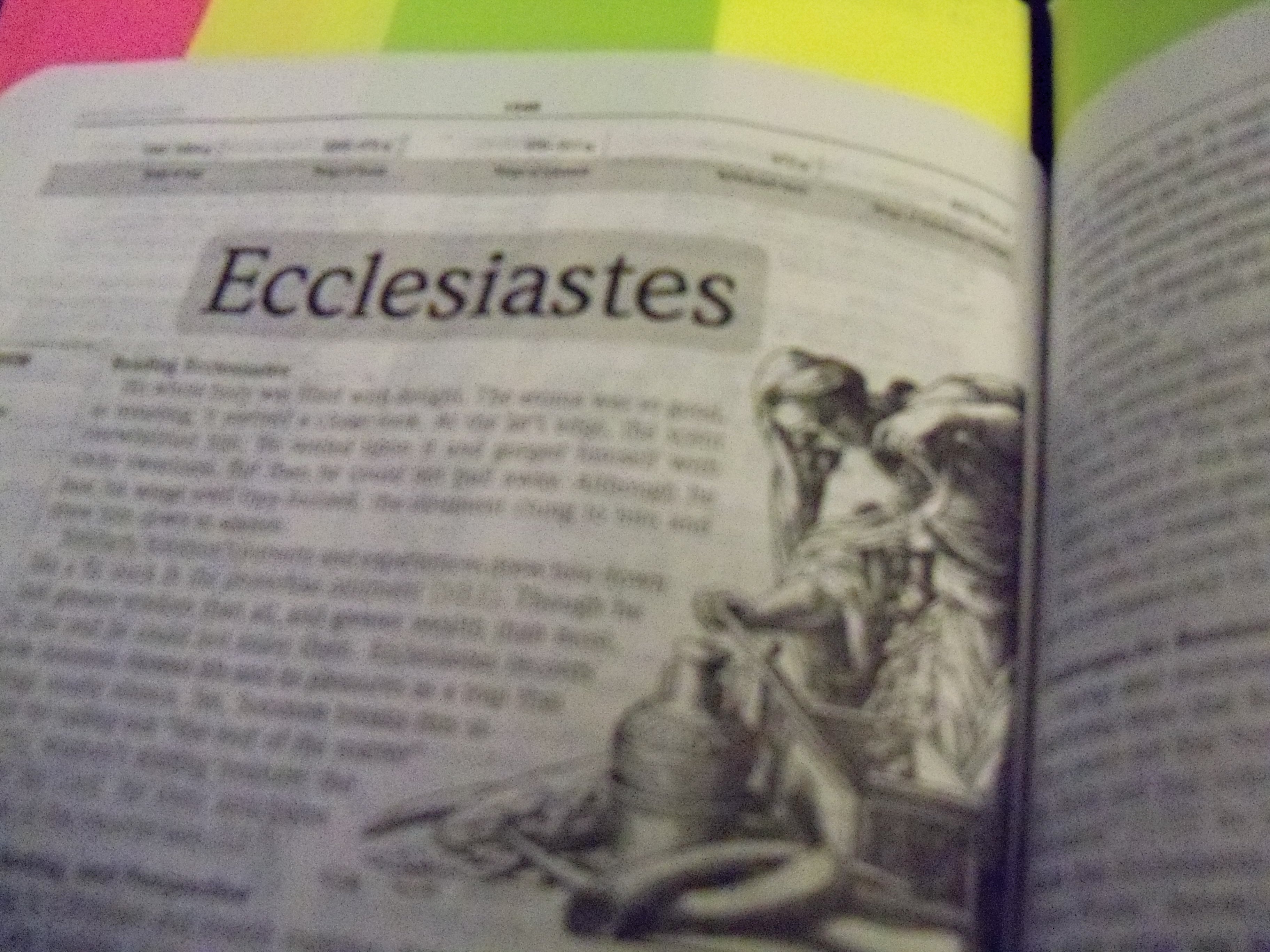 There are so many verses, chapters, and books in the Bible which resonate with me as a Christian philosopher/apologist. Ecclesiastes ranks near the top, however, due to its wonderfully philosophical message and style. The underlying theme of Ecclesiastes is that without God, everything is meaningless.
“‘Meaningless! Meaningless!’
says the Teacher.
‘Utterly meaningless!
Everything is meaningless.’… What has been is what will be, and what has been done is what will be done, and there is nothing new under the sun.” (1:2, 9).
The book starts with the idea that there is “nothing new under the sun.” The theme of “under the sun” is important to note. Consistently, “under the sun” is used to refer to “on earth.” It is in stark contrast to the “permanence of heaven” (TLSB). The theme contrasting life here on earth with heaven does not become apparent until very late in the book, so we too shall leave it until the end.
Solomon continues to explore the idea that that which we do “under the sun” is utterly meaningless. “For in much wisdom is much vexation, and he who increases knowledge increases sorrow” (1:18). The more we know, the more we sorrow. We can see themes like this in atheists like Albert Camus or Sartre, whose exploration of a world without God lead them to question whether suicide may be the only valid option.
“For what happens to the children of man and what happens to the beasts is the same; as one dies, so dies the other. They all have the same breath, and man has no advantage over the beasts, for all is vanity [also translated “meaningless”]. All go to one place. All are from the dust, and to dust all return” (3:19-20). The Teacher/Preacher goes on to contemplate our end: “Who knows whether the spirit of man goes upward and the spirit of the beast goes down into the earth? …Who can bring [man] to see what will be after him?” (3:21, 22b). It is death itself which makes life meaningless. Who knows what happens after death? Everything “appears utterly futile” (Waltke).
However, the Preacher/Teacher does not want us to collapse into despair. Without God, under the sun, all is meaningless. But with God, there is hope, joy, and meaning. This theme is sown in chapter 5 (verses 2-3; 7; and 19-20). Yet before fully developing this theme, Solomon returns to a life (and death) under the sun.
The existential life under the sun is absurd. “For the living know that they will die, but the dead know nothing, and they have no more reward, for the memory of them is forgotten. Their love and their hate and their envy have already perished, and forever they have no more share in all that is done under the sun” (9:5-6). Again the theme is “under the sun”. Without God, the life under the sun is meaning. We die, we pass away forever, we know not what comes after death, and even our actions pass away from under the sun. We no longer have a “share” in what is done under the sun.
The theme repeats throughout the book. “Under the sun”, all is meaningless, there is nothing new, and life itself passes away. Even a constant search for pleasure can only be meaningless.
Yet the conclusion to Ecclesiastes radically re-imagines the book. Solomon’s point so far has been that “you cannot make sense of life” (Waltke). Life under the sun is meaningless, futile, and vain. Existentially, the more we know, the more despair we can find. The more we explore life “under the sun,” the more we realize that it will be extinguished, and our actions will no longer impact that life.
The story does not end there, however. “The end of the matter; all has been heard. Fear God and keep his commandments, for this is the whole duty of man. For God will bring every deed into judgment, with every secret thing, whether good or evil” (12:13-14). The final verses of the book turn the meaning of the entire work about. The Preacher/Teacher comes to the conclusion: without God, all is meaningless; with God, there is good and evil, there is judgment, and there is duty. Rather than striving for nothing, we should strive for God. Rather than despair and futility; there is duty and good. Without God, life is meaningless; with God, there is meaning.
Sources:
Bruce Waltke, “Understanding the Old Testament.” Institute of Theological Studies. 2009.
The Lutheran Study Bible. (St. Louis, MO: Concordia Publishing House, 2009).
The picture is from The Lutheran Study Bible.
———
The preceding post is the property of J.W. Wartick (apart from citations, which are the property of their respective owners) and should not be reproduced in part or in whole without the expressed consent of the author. All content on this site is the property of J.W. Wartick and is made available for individual and personal usage. If you cite from these documents, whether for personal or professional purposes, please give appropriate citation and provide a link to the original URL. By viewing any part of this site, you are agreeing to this usage policy.
Devotion for a Philosopher/Apologist: Job and Natural Theology
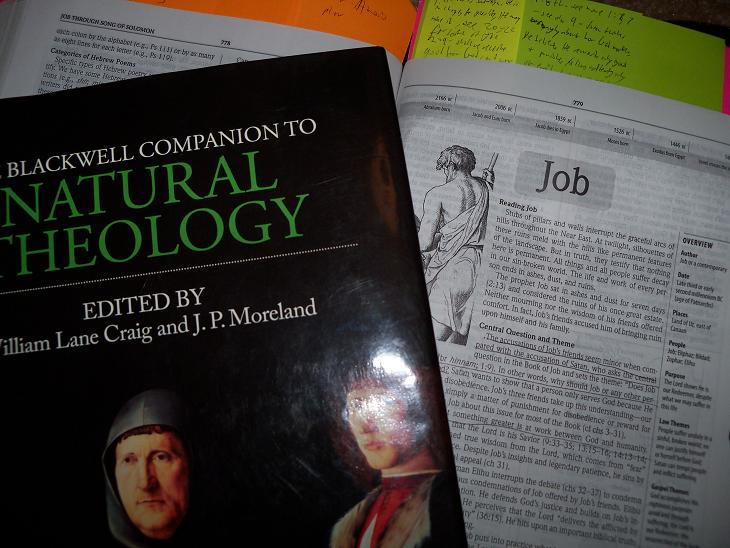 One thing I’ve noted throughout my involvement in apologetics and philosophy is a constant need and desire for good devotions. I’ve written some guidelines for how to go about a devotional life here, but I’ve noticed that many readers are coming to my site looking for actual devotions themselves. Thus, I’ve decided to start this series of devotions for the Christian Philosopher or Apologist.
Job and Natural Theology
Recommended reading: The book of Job, a chapter or book on natural theology
Often, I find myself struggling, as I am so enmeshed in abstract concepts of God and philosophy, to maintain that personal connection with my Lord. Nowhere do I find a better place to reignite this personal connection than the book of Job. It appeals to me on a number of levels–it has verses which demonstrate the greatness of faith, the horrors of evil, and the greatness and existence of God.
As Christian philosophers/apologists, we can smile and nod along with such passages as Job 12:7-10″
“But ask the beasts, and they will teach you; the birds of the heavens, and they will tell you; or the bushes of the earth, and they will teach you; and the fish of the sea will declare to you. Who among all these does not know that the hand of the LORD has done this? In his hand is the life of every living thing and the breath of all mankind.”
We can note how often we echo these very words, pointing to such things as the teleological argument or arguments from design. Scripture preaches what we teach! We are told here that creation itself witnesses the Creator! But these aren’t the only verses in Job which help affirm the tasks to which we have set ourselves, for we are told in Job about the attributes of God (He is unchangeable 23:13, almighty chapters 25-26, majestic 37:1ff, omnibenevolent 34:10 [though note that we must be careful to assertain doctrinal truths from Job’s friends, who are often mistaken about the works of God], and sovereign 1:21) we are informed that religious experience can convey knowledge (4:12, but again note that this is a friend of Job’s, so be careful with interpretation), and we discover that there will be a physical resurrection (19:25).
Already, we have experienced many of the parts of Job which speak directly to us as apologists and philosophers. But there is so much more here! We are to focus upon faith. As I said before, I often lose sight of my personal relationship with God in the midst of the abstract arguments, but Job (the book) calls us towards such a strong relationship with God.
Job 5:8-27 can give us great comfort. It is God to whom we commit our cause (5:8). God does great and unsearchable things, providing for our every need (5:9-16). Furthermore, we are comforted in times of trouble. God may allow us to be wounded, but he binds us, we may be shattered, but God heals us (5:18).
Finally, within Job we have a stirring account from God. Another struggle I can find myself involved in is an inflated view of my knowledge. Job struggled with this same issue, as he complained to God about his sufferings. God’s response is not to explain suffering, but to reassert His greatness and unlimited knowledge (see the dialogue in chapters 38 and following). We are then shown what our proper response is to God’s great majesty, Job 42:1-6:
Then Job answered the LORD and said: “I know that you can do all things, and that no purpose of yours can be thwarted. ‘Who is this that hides counsel without knowledge? ‘Therefore I have uttered what I did not understand, things too wonderful for me, which I did not know. ‘Hear, and I will speak; I will question you, and you make it known to me.’ I had heard of you by the hearing of the ear, but now my eye sees you; therefore I despise myself, and repent in dust and ashes.”
Job understands how our lives should reflect our commitment to God. We too often utter what we do not understand, when we encounter God, we realize that compared to His great glory, we can only repent of inability to always be perfect ambassadors of Christ. Yet, along with Job, we know that our redeemer lives (Job 19:25). What a great blessing it is to know that we will walk with him, in the flesh, upon the earth!
God’s grace and peace to you, my fellow brothers and sisters in Christ Jesus. I hope this devotion will be helpful in your studies. I’d appreciate any feedback you can give me to help improve any future devotions I may share.
The image in this post was a (very unprofessional) photograph by me of the Lutheran Study Bible and the Blackwell Companion to Natural Theology
——
The preceding post is the property of J.W. Wartick (apart from citations, which are the property of their respective owners) and should not be reproduced in part or in whole without the expressed consent of the author.
The Devotional Life of a Christian Apologist/Philosopher
As a Christian Apologist and Philosopher (if I may be so bold as to refer to myself in such a way) it is important to maintain an intimate relationship with my God. Often, it is easy to get lost in all the “If… then…”s the “therefore”s, and the premises of arguments about God and forget that God is the Living God, who wants to interact on a real, personal level with all His people. It is a trap that awaits those who talk about God in such abstract terms: forgetting that that same God is there and should be praised and loved.
Thus, it is important to maintain a devotional life. I encourage readers to set their own routines for exploration of God’s Word, prayer life, etc. It is important to utilize those periods of downtime–be they periods of an hour, two hours, or even ten or fifteen minutes–in order to expand knowledge of Word and Truth. I’ve outlined my own routine below (though I sometimes stray from it) in order to provide a potential base for study and some recommendations.
Daily (or as often as possible)
1. Read at least 1 chapter from the Bible: This may be done all in order (as I’m doing right now) or by a variety of other methods (such as following a “read the Bible in a year” type of thing).
2. Devotion: I use and very highly recommend the Treasury of Daily Prayer, which has readings from Scripture, church fathers, etc. along with liturgies for personal devotion.
3. Pray: This can be done independently or by using various books of prayer (I utilize the Lutheran Book of Prayer).
4. Hone Greek/Hebrew Skills: This one takes some prior study and knowledge, but I definitely recommend learning Biblical Greek and Hebrew in order to study the Word (a wonderful Hebrew Text is here, while a great introduction to Greek is here). Once one can utilize these languages, they can be used in daily meditation by taking a reader (such as this one) to practice this wonderful gift.
5. Other readings: Normally, I’m working through at least one “hard” book and one “light reading” book at a time. An example of a “hard” book could be God and Necessity while a “light reading” can be C.S. Lewis. Daily, I would say try to read as much as possible in whatever downtime one has. A fifteen minute period can mean 10-20 pages of reading for a “light reading” book, while I usually save “hard” books for times I have an hour or more. Utilize a notebook to take notes on the readings you do. Also, sometimes it’s good to read both a “hard” and “light” book from the same author, as this will reinforce the ideas (for example N.T. Wright–one could read The New Testament and the People of God [hard] and The Challenge of Jesus [light]).
Weekly (at least)
1. Church: Attending worship with fellow believers is extremely important for spiritual nurturing.
2. Extra reading: Take at least one day a week to sit and have some serious reading time from Scripture and books you are reading.
3. Exercise: Don’t forget to utilize the body God gave you. Take a 1-3+ mile run 1-3 times a week. While running, reflect on the gifts God has given. Pray, think about topics you’ve read from Scripture or other readings, recite verses.
4. Memory work: Try to memorize at least one verse a day. You may not retain them all in your memory, but once you start to do this, you will find you’ll be opened to an even more intimate understanding of Scripture.
Hopefully these ideas will serve to encourage others who are looking for devotional life. Do not neglect prayer and reading the Word; these are vitally important to the spiritual life of the Christian.
——
The preceding post is the property of J.W. Wartick (apart from citations, which are the property of their respective owners) and should not be reproduced in part or in whole without the expressed consent of the author.

 J.W. Wartick - Reconstructing Faith
