Book Reviews
Book Review: “Escaping the Beginning? Confronting Challenges to the Universe’s Origin” by Jeff Zweerink
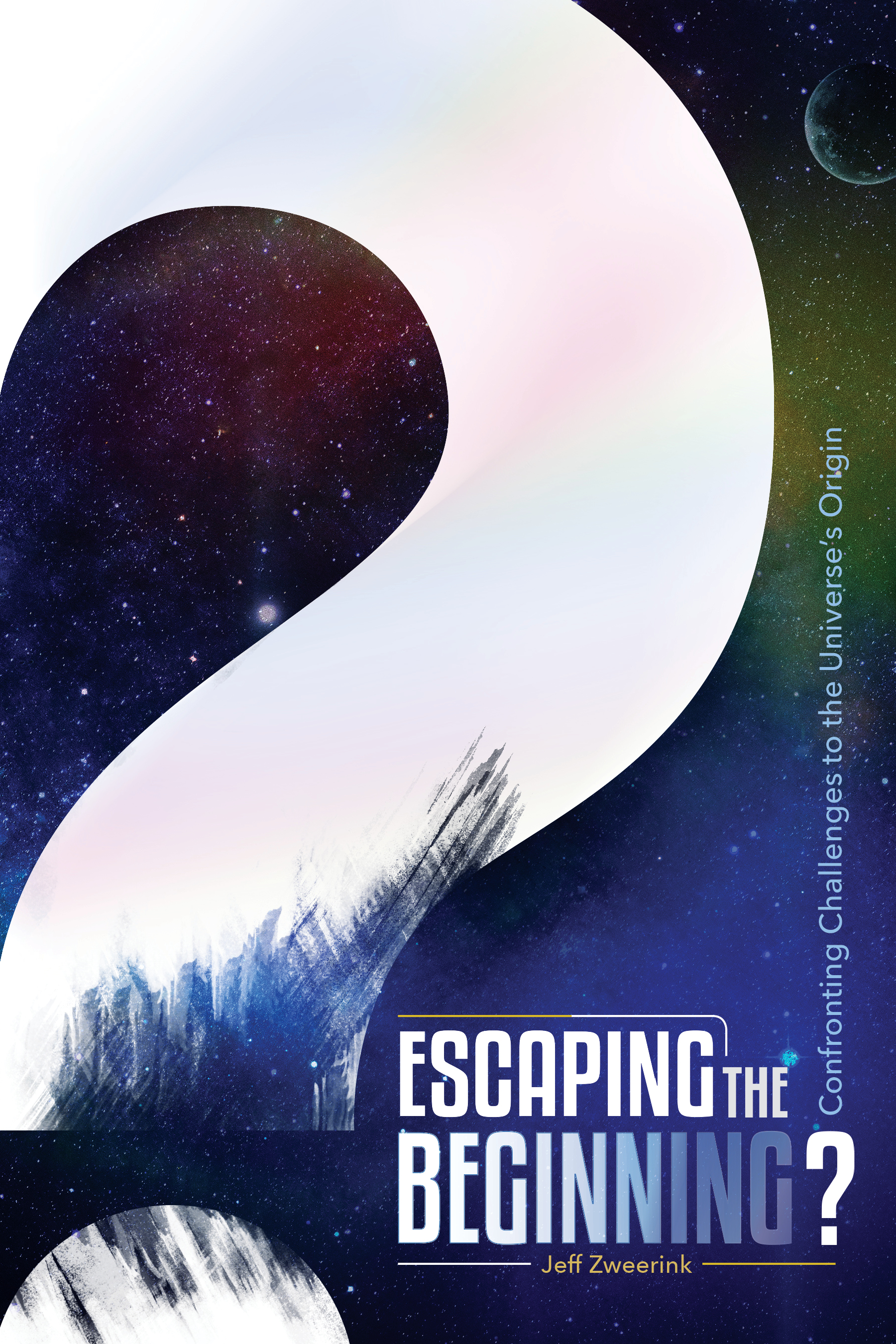 Whether the universe had a beginning or not is a hotly debated topic in philosophical, theological, and scientific circles. Jeff Zweerink is an astrophysicist who works with Reasons to Believe, a science-faith think tank that comes from an Old Earth Creationist perspective. With Escaping the Beginning, he has written an important, insightful resource for people wishing to explore the science of various theories that preclude a beginning of the universe.
Zweerink’s book is robust on the scientific theories around the universe, multiverse, and quantum theory. Chapters in the book include “The Case for a Beginning,” “Did Our Universe Reincarnate?”; “Did Our Universe come from Nothing?”; “If Hawking and Krauss are Right, Does That Remove God?” and many more. These chapter titles hint at the content of each chapter, and each is absolutely filled with clear explanations of some pretty advanced theories on physics and astronomy. Zweerink covers the major theories of the multiverse and goes deeply into the labors of Lawrence Krauss and Stephen Hawking to come up with theories that do not require a beginning to the universe. He does this by sticking to the science, showing where these theories have holes or import philosophical assumptions (which are usually unacknowledged by those putting them forward), and giving analysis of each theory on the table. Each chapter is followed by a brief summary of the contents of that chapter as well as some discussion questions.
Zweerink makes a strong case that many of these theories still do not get away from the need for an absolute beginning or a Creator. For example, even the theories which posit the universe came from quantum effects in a vacuum still must posit a reason for the vacuum itself existing to begin with.
The book ends with a discussion of whether Christianity could still be true even if there were no beginning of the universe. Zweerink argues from Scripture that there must be a creation out of nothing to align with the biblical evidence. Zweerink does not, however, engage with the parts of Christian tradition that does maintain the universe is eternal. Though in the minority, there are clear instances of Christian believers throughout history who held the universe was eternal and that this was unproblematic. Most obvious as examples are those Christians who hold to Platonic thought and see the universe as eternal due to philosophical precommitments on that regard. Thus, though it seems the Christian tradition and Scriptures align more readily with a beginning of the universe, it does not seem to be the case that such a belief is absolutely necessary for Christianity to survive. Further discussion of that topic would be well afield of the book, but it would have been good to have included at least an acknowledgement of this tradition in the section that alleges Christianity cannot comport with an eternal universe.
What makes the book especially laudable is that Zweerink consistently admits when their are difficulties with his own position–that the universe had a beginning–or where the challenges to his view can even come to be strengthened in the future. For example, though it is clear throughout that Zweerink favors a Big Bang model as an actual beginning of the universe, he notes that oscillating models provide a challenge to this position and that scientific challenges may confirm the latter and usurp the Big Bang model for the origins of the universe (84). This kind of frank discussion of the science is commendable, particularly in a book about science written from a Christian perspective with a clear position at stake. Yet Zweerink consistently notes that when he makes predictions or comes out on one side or the other in various debates where his own position might be falsified or confirmed. It makes the book that much more valuable to have one that not only lays out all of these scientific theories and approaches them from a particular Christian perspective but also notes where that perspective might be challenged.
Escaping the Beginning is a fantastic resource for those who want to learn about the latest scientific research related to the beginning (or lack thereof) for our universe. It is commendably even in its presentation of the evidence, and Zweerink is clear when he provides predictions and how they might be challenged. The book is an achievement, and very much worth anyone picking up to read.
Disclaimer: I was provided with a copy of the book for review by the publisher. I was not required to give any specific kind of feedback whatsoever.
Links
Be sure to check out the page for this site on Facebook and Twitter for discussion of posts, links to other pages of interest, random talk about theology/philosophy/apologetics/movies and more!
Book Reviews– There are plenty more book reviews to read! Read like crazy! (Scroll down for more, and click at bottom for even more!)
SDG.
——
The preceding post is the property of J.W. Wartick (apart from quotations, which are the property of their respective owners, and works of art as credited; images are often freely available to the public and J.W. Wartick makes no claims of owning rights to the images unless he makes that explicit) and should not be reproduced in part or in whole without the expressed consent of the author. All content on this site is the property of J.W. Wartick and is made available for individual and personal usage. If you cite from these documents, whether for personal or professional purposes, please give appropriate citation with both the name of the author (J.W. Wartick) and a link to the original URL. If you’d like to repost a post, you may do so, provided you show less than half of the original post on your own site and link to the original post for the rest. You must also appropriately cite the post as noted above. This blog is protected by Creative Commons licensing. By viewing any part of this site, you are agreeing to this usage policy.
Book Review: “Scientism and Secularism: Learning to Respond to a Dangerous Ideology” by J.P. Moreland
 Scientism and Secularism: Learning to Respond to a Dangerous Ideology provides an introduction to and critique of the philosophical position of scientism.
Moreland defines scientism as “the view that the hard sciences–like chemistry, biology, phsyics, astronomy–provide the only genuine knowledge of reality” (Kindle location 263-271, hereafter citations are also Kindle locations). He provides several examples of how he’s encountered this belief in various realms.
The strength of the book is found in Moreland’s arguments that scientism is self-refuting, the possibility of nonscientific knowledge, several principles theism explains that scientism cannot, and the attempt to integrate science and Christian thought. For example, when arguing about scientism being self-refuting, Moreland notes that the claim of scientism itself is a philosophical claim that cannot be tested through the hard sciences. But he goes further, noting that many are aware of this significant difficulty in the theory and instead argue that it can be a kind of first principle. But again, such an attempt to insulate the claim from scientific inquiry itself is a philosophical endeavor, essentially establishing the first principles of knowledge on a basis that those principles themselves reject.
Moreland also offers a condensed form of Alvin Plantinga’s evolutionary argument against naturalism: basically, if we agree that evolution is true and that naturalism is true–all that exists is the material world–then, minimally, we have at least some small reason to believe our cognitive facilities may be untrustworthy.
Where Moreland struggles is when he tries to outline the vast influence he believes scientism has in our culture. Essentially anything Moreland perceives as a societal ill can be tied back to scientism, in his view. Universities having any sort of secular slant? Scientism is to blame. People believing evolution is true? Scientism is to blame. Specific instances of perceived moral decay? Scientism caused it.
The problem with this is it begins to read more like a screed against positions in disfavor with Moreland than a tightly argued philosophical attack on scientism. A specific example can be found in chapter 3, entitled “How scientism changed the universities.” After an introductory quote from Dallas Willard, who taught at USC from 1965-2013 and is thus taken, apparently, to be broad evidence for the totality of experience at all universities, Moreland argues following another scholar (see below) that American universities followed a specific, three-stage path from 1880-1930 that went from a “Religious Stage” through a “Scientific Stage” before ending up at a “Humanities and Extracurricular Stage” (Kindle location 561-570). Tellingly, Reuben is the only citation of any study in the entire chapter–a work from 1996 about which Moreland states “I have relied on Reuben’s insightful analysis for much of what follows in this chapter” (Kindle location 639).
But following this brief look at what is surely a substantial claim (did all universities in America follow this pattern? based on what evidence? what other studies back up this data?), Moreland goes on to state that the central problem is found in the fact/value distinction and, allegedly, that science became the only knowledge that universities–all of them, apparently–valued (577). This, in turn, de-centered Christian monotheism “from the cognitive domain” and led to the impossibility of having unified curriculums or even “justifying why one discipline should have anything at all to do with another…” (588). One may well wonder how such a claim can be justified when there are such clearly inter-related disciplines as critical theory or intersectionality on the rise which explicitly demand convergence of numerous disciplines, but one also wonders what the evidence is for these claims to begin with. More importantly for the thesis at hand, the question is whether scientism is specifically and verifiably to blame for such a shift in university cultures. Moreland states that it is rather explicitly, but does little to actually support that claim. The same goes for many other things he views as societal ills–scientism is clearly at fault for them all. How? It’s unclear.
Another problem is that Moreland, as he has elsewhere, is quick to assert that his own vision of reality just is the only possible biblical view of reality and so those who disagree with it just are influenced by scientism and secularism and ought to be condemned. In a revealing passage, Moreland writes:
Thus, the ‘dialogue’ between science and theology or biblical exegesis is really a monologue, with theologians asking scientists what the latest discoveries allow them to teach:
Homosexuality is caused by our DNA? No problem. The Bible doesn’t teach the immorality of homosexuality anyway. We have misread it for two thousand years.
Neuroscience shows there is no soul? No problem. Dualism and the soul are Greek ideas not found in the Bible, which is more Hebraic and holistic.
A completely naturalistic story of evolution is adequate to explain the origin and development of all life? No problem. After all, the Bible isn’t a science text.
Studies in the human genome suggested human life did not begin with Adam and Eve? No problem. We can reread the historical narrative in a new way.
And on and on it goes. (Kindle location 1025ff)
Moreland, of course, sees scientism to blame for all of this. Christians and even theologians, he asserts, are so steeped in scientism that they cannot see past it and instead conform all of their theological beliefs to the latest fashionable science. But Moreland doesn’t establish his claim in reality. This lengthy passage shows his feelings about all of these developments, but it fails to account for the fact that without scientific discoveries that may challenge interpretations of Scripture, these discussions wouldn’t be possible in the first place. That is, he complains about he lack of “dialogue” between science and theology, but is apparently upset when that dialogue leads some to differing conclusions from himself, which conclusions, of course, can only be due to the theologians total capitulation to scientism.
Never mind that science and theology have informed each other for much of history. Note that one of Moreland’s complaints is not “Exploration of space and mathematical models have shown that the Earth revolves around the sun? No problem. The Bible doesn’t actually teach that the Sun revolves around the Earth.” Never mind that Moreland would almost certainly hold that latter position, and that such a revision of reading the Bible did in fact take place. Never mind that some theologians actually did turn to seeing divine accommodation in Scripture when it came to scientific truths instead of demanding that a re-reading of the Bible make it so that the sun did not literally rise. No, this is an issue that Moreland himself agrees with, so it can’t be due to scientism, right?
These examples show a weakness in the book that is unfortunate, because on some other counts it is quite strong. Moreland is keen to cast aspersions on rival theological positions and to blame scientism for more than he can establish in reality that it may make readers of the book less interested in those parts of the book he does establish fairly well. For example, his critique of the possibility of rational thought given a purely scientistic worldview is spot-on, and his analysis of how scientism is self-defeating ought to seal the deal for most readers.
Scientism and Secularism: Learning to Respond to a Dangerous Ideology is a brief but solid critique of scientism contained within a broader attack on secularism in general. What’s unfortunate is that Moreland seems to see the latter as not just entirely encompassed (or at least caused by) the former, but also that he does so without reason for making such an equivocation. The book thus ends up as an uneven look at an important topic.
Disclaimer: I was provided with a copy of the book for review by the publisher. I was not required to give any specific kind of feedback whatsoever.
Links
Be sure to check out the page for this site on Facebook and Twitter for discussion of posts, links to other pages of interest, random talk about theology/philosophy/apologetics/movies and more!
Book Reviews– There are plenty more book reviews to read! Read like crazy! (Scroll down for more, and click at bottom for even more!)
SDG.
——
The preceding post is the property of J.W. Wartick (apart from quotations, which are the property of their respective owners, and works of art as credited; images are often freely available to the public and J.W. Wartick makes no claims of owning rights to the images unless he makes that explicit) and should not be reproduced in part or in whole without the expressed consent of the author. All content on this site is the property of J.W. Wartick and is made available for individual and personal usage. If you cite from these documents, whether for personal or professional purposes, please give appropriate citation with both the name of the author (J.W. Wartick) and a link to the original URL. If you’d like to repost a post, you may do so, provided you show less than half of the original post on your own site and link to the original post for the rest. You must also appropriately cite the post as noted above. This blog is protected by Creative Commons licensing. By viewing any part of this site, you are agreeing to this usage policy.
Book Review: “Christ and Revelatory Community in Bonhoeffer’s Reception of Hegel” by David S. Robinson
 Robinson shows in Christ and Revelatory Community in Bonhoeffer’s Reception of Hegel that Bonhoeffer was influenced by, but also departed from GWF Hegel’s philosophy and theology on a number of key points. The book serves as a way to see Bonhoeffer through a Hegelian lens, and also note how Bonhoeffer developed Hegel’s thoughts in some key ways, particularly related to the community of the church.
Robinson begins with outlining some of Hegel’s thought related to the community and the somewhat elusive Geist (Spirit) in his thought. Then, he turns to Hegel’s incorporation of those ideas into the unfolding of Revelation in history and how Bonhoeffer specifically also incorporated revelation into history. The coming of Christ leads to a new community and the creator-human (Jesus Christ) opens new possibilities for the one and the many to come into conversation with each other. More explicitly, Robinson then turns to Christology in both Bonhoeffer and Hegel. Robinson argues Hegel’s Trinitarian theology–including the was not pantheistic but instead understood relationship as a central aspect of community. Bonhoeffer utilized similar themes in writing about Christ as existing in the community of the church.
One particularly fascinating chapter focused in on Bonhoeffer’s sacramental theology, contrasting it with how Hegel viewed the Eucharist. Bonhoeffer explicitly aligned himself against the Reformed objections to the Lutheran understanding of real presence of Christ in the bread and wine. Franz Hildebrandt, a friend of Bonhoeffer’s, utilized Hegelian thought to counter Karl Barth’s Reformed understanding of “this is my body” (132-134). Bonhoeffer himself incorporated Hegel’s concepts of seeing doctrine ad integral to the community to see Christ present in the Word preached as well as in the sacrament–the est of the sermon and sacrament (142). Hegel’s vision of the Eucharist sees union of objective and subjective into one through Christ, and he sees the Sacrament as the place where the Geist may become indwelling in the human person (146). Such a Lutheran understanding is reaffirmed and even made stronger in Bonhoeffer’s position, as he argues that one cannot distinguish idea from history/nature (though Robinson argues this was not necessarily Hegel’s position; see p. 147ff).
Community continues to be important as the concepts of freedom and revolution arise in Hegel and Bonhoeffer. These are questions of community that must be asked, and the thinkers diverge on this point. Hegel has been seen as an “apologist for Prussia” (169ff), though Robinson argues that he would better be understood as someone seeking Reform within existing institutions (172). Bonhoeffer addresses these questions through confessional space and seeing the church as the body of Christ–Christ existing as community in the church (177ff).
The concept of the Volk–folk–a kind of nationalist precursor to the Nazi ideology in Germany, is one that looms large in Hegel and Bonhoeffer in different ways. Robinson argues that Hegel’s Volkish tendencies were exacerbated and expanded by later Neo-Hegelian thinkers who sought exclusion based upon bloodlines and race, turning Hegel’s concepts of Geist into blood and “racialism” (197-198). Nevertheless, the dominant strand of Hegelian thought that arose in Bonhoeffer’s time was highly tied to Volk and bloodlines, an intensely racist theme that was used by the Nazis. Bonhoeffer, however, was exposed to thinkers apart from Hegel and one of those who helped shape his thought was W.E.B. Du Bois, whose The Souls of Black Folk, Robinson argues, was at least intrinsically influential for Bonhoeffer’s thinking. Both Hegel and Bonhoeffer criticized the state for its treatment of Jews and emphasized their humanity (204-206; 207-09). Hegel’s thought was Eurocentric, despite some aspects of criticizing the nationalism of his peers. Bonhoeffer’s thinking, Robinson argues, became transnational and ecumenical.
Robinson clearly carries the argument that Bonhoeffer was deeply influenced by Hegel’s thought. Whether it was by way of contrast or utilizing similar structure of arguments, Bonhoeffer’s training made him cognizant of Hegelian philosophy and interacted with it at many points.
Christ and Revelatory Community in Bonhoeffer’s Reception of Hegel is a fascinating look at Bonhoeffer’s reception of Hegelian thought. Robinson demonstrates that Bonhoeffer developed some ideas along Hegelian lines, while also sharply breaking from them in some respects. I highly recommend it for those looking to delve deeply into Bonhoeffer’s thought.
Disclaimer: I was provided with a copy of the book for review by the publisher. I was not required to give any specific kind of feedback whatsoever.
Links
Be sure to check out the page for this site on Facebook and Twitter for discussion of posts, links to other pages of interest, random talk about theology/philosophy/apologetics/movies and more!
Book Reviews– There are plenty more book reviews to read! Read like crazy! (Scroll down for more, and click at bottom for even more!)
SDG.
——
The preceding post is the property of J.W. Wartick (apart from quotations, which are the property of their respective owners, and works of art as credited; images are often freely available to the public and J.W. Wartick makes no claims of owning rights to the images unless he makes that explicit) and should not be reproduced in part or in whole without the expressed consent of the author. All content on this site is the property of J.W. Wartick and is made available for individual and personal usage. If you cite from these documents, whether for personal or professional purposes, please give appropriate citation with both the name of the author (J.W. Wartick) and a link to the original URL. If you’d like to repost a post, you may do so, provided you show less than half of the original post on your own site and link to the original post for the rest. You must also appropriately cite the post as noted above. This blog is protected by Creative Commons licensing. By viewing any part of this site, you are agreeing to this usage policy.
Book Review: “Understanding Scientific Theories of Origins” by Bishop, Funck, Lewis, Moshier, and Walton
 Understanding Scientific Theories of Origins: Cosmology, Geology, and Biology in Christian Perspective is a massive introduction to various sciences alongside Christian thought from the perspective of evolutionary creationists (also known as theistic evolution). It can fairly be said to be the most comprehensive book of which this reader is aware of for giving a broad look at the many related fields in the origins debate within Christianity.
The book is broken into 7 parts: Getting Started on the Journey, which offers 4 chapters on biblical interpretation, doctrine of creation, pursuing origins questions, and seeing science and theology together; Cosmic Origins, which has 6 chapters starting with a look at Genesis and then going through the details of Big Bang theory, Fine-Tuning, and biblical/theological perspectives; Origin and Geologic History of the Earth, which has 8 chapters on the origin and formation of the Earth and Solar system, the history of geology, discussions of the biblical Flood, how we know about geologic timescales, plate tectonics, finding history in rocks and fossils, and biblical/theological perspectives; Origin of Life on Earth, which has 5 chapters discussing spontaneous generation to abiogenesis, the chemistry of prebiotics, biological information, alternate scenarios, and biblical/theological perspectives; Origin of Species and Diversity of Life, which has 5 chapters on the history of the theory of evolution, the modern synthesis, evidence for evolution, developments in evolutionary theory, and biblical/theological perspectives; Human Origins, which has 4 chapters on the biblical story, physical anthropology, genomic evidence, and biblical/theological perspectives on the image of God; and a Concluding Postscript, which is 1 chapter tying things together. The book is about 630 pages of text, with a glossary, general index, and scripture index. Throughout the whole book, there are color illustrations and charts, and it is richly detailed.
To be sure, there are many books with a lot of this information that you can find elsewhere. The things that set this book apart are 1) its comprehensive scope, with experts from various fields contributing huge sections of data and reflections from a Christian standpoint; 2) its one-stop shop type of reference; 3) its extensive look at the scientific evidence for evolution alongside some counters to arguments against it; 4) its accessible format; 5) the wealth of its illustrations (in color!). Many books in the creation-evolution debate have tended to focus almost entirely on theological questions or scientific ones (though I acknowledge there are exceptions). Rarely is the evidence presented in such a balanced fashion, and with such detail when it comes to the scientific arguments. It’s a massive text that is a bit daunting to read cover-to-cover, but the tone is so accessible and the explanations so well-written that it remains interesting and readable throughout.
The book can be read either in individual chapters or front-to-back. Thus, it would be useful as a textbook in many classes, or as a study book, or as a reference tool for interested readers. This is the kind of book that people like this reader have been longing for: a truly broad introduction to the many, many topics that converge upon theories of origins that is presented from a perspective that remains thoroughly orthodox in its theology. Those who oppose evolution will find here not some conspiracy or lies, but rather evidence and data backed with a warm, winsome tone that encourages readers to explore these tough questions.
Some of the most contentious questions, of course, receive the most space. Human Origins, as noted above, has its own entire section with more than 50 pages dedicated to the topic. Some things that struck me in that section were, first, the theological introduction that shows some of the questions that come up even from a “simple” reading of the text. Second, the extensive look at the physical and genomic evidence for human evolution is presented in a straightforward way. From my own background, I tended to think that any such evidence was falsified or simply presented in a misleading way. It would be impossible to accuse the authors here of doing so, as they note (especially earlier in the discussion of evolution) some of the problems with classification. But these problems are not demonstrations of the theory being false; rather, they show that we will probably never have a complete picture. For example, one common charge I have seen is that because scientists cannot put together a sequence of fossils that show human evolution in a chain: A-B-C-D-E-F-G-H but rather that we have an idea that it may be A-D-G-J or something of the sort, this means there is no sequence. But that is demonstrably false. A ladder that is missing a step could still be identified as a ladder, just an incomplete one. Similarly, an incomplete fossil record does not demonstrate there is no such record or series. What’s particularly surprising, though, is how comprehensive the fossil record we do have is, particularly related to human origins. Though the exact sequence will likely be debate in perpetuity, the fact remains that there are many, many, many fossils of clear ancestors of humanity throughout the fossil record, and that a comparison of skulls, MRI measured brain sizes, etc. seems to demonstrate a sequence that does exist, even if incomplete. Of course, there is much more offered in regards to human evolution, such as population genetics, and the like, but the evidence is presented here and is fascinating.
Readers who are wondering about the scientific credibility of evolution will find this an excellent work to pick up. Those already convinced will have a superb introduction to the topic on hand that does not eschew faith for science or vice versa. The authors do a truly commendable job of showing that Christianity does not counter science, and neither does science show Christianity is false.
The chapters on geology are another excellent section, which teach the basics of geology alongside real-world examples that show the principles are sound. Coming from a young earth background, it was the geologic evidence that convinced me some years ago the Earth had to be much older. The authors present real, measurable evidence to show the earth is much more ancient than a few thousand years. But set alongside that is the valuable history of thought surrounding the age of the earth and how these discoveries were made, often by Christian geologists! To see how yes, science has changed as we’ve come to a fuller understanding helps readers understand that as well. The origins of life is another hotly contested area, and the authors do a good job of showing that it remains contentious while there is much work being done that suggests even biological information may have a natural origin. The many theories of origins will continue to be tested and improved, but we should be careful to attempt to plug God into the gap in understanding between what we don’t know yet and what may be discovered. Indeed, some of the scenarios presented for the origin of life continue to gain credibility as tests confirm aspects of their theorizing.
The authors have, with Understanding Scientific Theories of Origins: Cosmology, Geology, and Biology in Christian Perspective , written a book that is sure to be a reference point for years to come. Though science constantly updates and changes with new discoveries and insights, the book is destined to be fruitful for some time. It provides a serious, fairly comprehensive introduction to many of the most hotly contested issues within Christianity today. It comes highly recommended.
Disclaimer: I was provided with a copy of the book for review by the publisher. I was not required to give any specific kind of feedback whatsoever.
Links
Be sure to check out the page for this site on Facebook and Twitter for discussion of posts, links to other pages of interest, random talk about theology/philosophy/apologetics/movies and more!
Book Reviews– There are plenty more book reviews to read! Read like crazy! (Scroll down for more, and click at bottom for even more!)
SDG.
——
The preceding post is the property of J.W. Wartick (apart from quotations, which are the property of their respective owners, and works of art as credited; images are often freely available to the public and J.W. Wartick makes no claims of owning rights to the images unless he makes that explicit) and should not be reproduced in part or in whole without the expressed consent of the author. All content on this site is the property of J.W. Wartick and is made available for individual and personal usage. If you cite from these documents, whether for personal or professional purposes, please give appropriate citation with both the name of the author (J.W. Wartick) and a link to the original URL. If you’d like to repost a post, you may do so, provided you show less than half of the original post on your own site and link to the original post for the rest. You must also appropriately cite the post as noted above. This blog is protected by Creative Commons licensing. By viewing any part of this site, you are agreeing to this usage policy.
Book Review: “Placemaking and the Arts” by Jennifer Allen Craft
 Jennifer Allen Craft’s Placemaking and the Arts: Cultivating the Christian Life is one of those books that lives at an intersection of topics one might not normally see as connected. Craft pulls together insights from the Bible and Christian theology on the concepts of place and embodiment with her extensive knowledge of the arts to draw readers’ attention to how our theology of place may be developed and grown.
After a brief introduction, Jennifer Allen Craft provides working definitions of place and art. Place is not merely physical; it involves social relationships, networks of people, and one’s mental states as well. Moreover, space is distinguished from place in that the former is a kind of universal denotation while the latter is particular (8-9). The reason to deal with place as Christians is because it helps answer who we are and why we are here–really here in a sense as embodied creations of God. Art is notoriously difficult to define, and Craft opts for a somewhat general definition, with a few qualifications: art, for her, “will be generally referring to some practice or object of the fine arts…” though she also includes craft, folk art, and other “making” practices (21). Art is important because it helps humans define themselves and relations to others.
Craft argues that the arts can help us to cultivate responsible relationships with the natural world. Integrating nature into our imagination helps us see it as valuable and calls us to protect it. Humans as the image of God can be seen as co-creators rather than simply those exercising conquest of the earth. We participate, through art, in creation and the natural world.
Art can also help in the processes of homemaking and hospitality, each aspects of place that allow us to form our own space. Craft notes the ways that people have created false dichotomies or devalued the arts as well as ways we can correct those misunderstandings. The arts can enter into church as well, leading to worship and the sense of community. Interaction with art can also help stir a sense of wonder at the majesty of God’s creation. The arts can also help Christians see the Kingdom of God on earth and the shaping of that Kingdom in the here and now.
The book is peppered throughout with images, both black-and-white and (in a set of plates in the middle) in color. These help illustrate Craft’s points more vividly and allow the reader to reflect directly upon the themes of the book.
Placemaking and the Arts is a fascinating look at the unity of two themes that aren’t often explored in conjunction. On a higher level, it is a call to Christians to be co-creators with God and to see the impact of the arts on every aspect of our lives.
Disclaimer: I was provided with a copy of the book for review by the publisher. I was not required to give any specific kind of feedback whatsoever.
Links
Be sure to check out the page for this site on Facebook and Twitter for discussion of posts, links to other pages of interest, random talk about theology/philosophy/apologetics/movies and more!
Book Reviews– There are plenty more book reviews to read! Read like crazy! (Scroll down for more, and click at bottom for even more!)
SDG.
——
The preceding post is the property of J.W. Wartick (apart from quotations, which are the property of their respective owners, and works of art as credited; images are often freely available to the public and J.W. Wartick makes no claims of owning rights to the images unless he makes that explicit) and should not be reproduced in part or in whole without the expressed consent of the author. All content on this site is the property of J.W. Wartick and is made available for individual and personal usage. If you cite from these documents, whether for personal or professional purposes, please give appropriate citation with both the name of the author (J.W. Wartick) and a link to the original URL. If you’d like to repost a post, you may do so, provided you show less than half of the original post on your own site and link to the original post for the rest. You must also appropriately cite the post as noted above. This blog is protected by Creative Commons licensing. By viewing any part of this site, you are agreeing to this usage policy.
Book Review: “Peace and Violence in the Ethics of Dietrich Bonhoeffer” by Trey Palmisano
 The question of Bonhoeffer’s views on pacifism and related issues like just war or tyrannicide is one that has been controversial almost since the beginning of Bonhoeffer scholarship. Trey Palmisano argues in Peace and Violence in the Ethics of Dietrich Bonhoeffer that such questions are needlessly reductionistic. Instead, Palmisano suggests that instead taking seriously Bonhoeffer’s own claim of consistency means we need to read him in light of how peace and violence might intermix or even be called for in different situations.
After a brief introduction including a timeline of Bonhoeffer’s life, Palmisano begins with a survey of major influences on Bonhoeffer’s thought. Martin Luther’s influence can’t be understated, and Palmisano thankfully notes the distinct impact Luther had on Bonhoeffer, a Lutheran pastor. Specifically, Luther’s impact on Bonhoeffer’s sacramental theology as well as the Lutheran doctrine of the Two Kingdoms are highlighted here. Regarding the latter, Palmisano reflects more nuance than several other writers, noting that Bonhoeffer did not reject Two Kingdoms theology as many have suggested. Instead, Bonhoeffer saw the Nazi attempt to separate public and private life, and the success they had in foisting this false dichotomy on the German Christian church, as a threat to sound doctrine. Instead, Bonhoeffer accepted a separation between church and state while rejecting the Reich’s attempts to subordinate the church, particularly to racial injustice. Other thinkers who influenced Bonhoeffer surveyed are Kierkegaard, Nietzsche, Reinhold Seeberg, and Barth.
The next chapter looks at Bonhoeffer’s ethical method. This is Palmisano’s central contribution to Bonhoeffer scholarship and ties into the other chapters. First, he notes that Bonhoeffer faced questions of individuality vs. community; formal and material cause and effect, and a world-church relationship that was fracturing in new and challenging ways with the threat from the Nazis. He surveys other ethical systems, noting where Bonhoeffer may reflect them while also going beyond or against them. For example, regarding deontological ethics, it is clear that Bonhoeffer felt it failed to adequately account for abstraction in ethical questions. More plausible for impacts on Bonhoeffer are situational ethics–something that largely developed after him in philosophical circles–and a kind of utilitarianism. But neither of these captures what Bonhoeffer thought for ethical grounding. After this survey of different views, Palmisano goes over Bonhoeffer’s own ethical development through his early career and into late in his life. Then, Bonhoeffer’s Christology is clearly central to his thought, and this continues throughout his career. Palmisano argues that it is this Christological grounding in ethics that makes it possible to see the individual and other as dual grounds for ethical relationships, with Christ as the central, objective grounds. Thus, Bonhoeffer’s ethic has an objective criterion in Christ while largely being capable of contextual/subjective application of moral norms. Revelation, for Bonhoeffer, in the form of Christ, is to encounter oneself and reshape one’s ethical standards and boundaries (51-52; 53ff). The way this plays out in the real world–something that was particularly concerning to Bonhoeffer–is that “Obedience understood as the dutiful observance of commandments is never simple because too many moving parts exist… obedience… is oriented to a relationship with Christ…” and this relationship with Christ ultimately yields an almost “creative” ethical stance in which questions are approached on an individual basis following the question of who Christ is for us and for the other (64-65).
The third chapter explores Bonhoeffer’s “Quest for Peace” and argues that Bonhoeffer did not “discover” pacifism in New York, but rather had experiences that brought those ideas to the forefront (see, for example, 78ff). Drawing from Discipleship, Palmisano notes that for Bonhoeffer violence has no place in the gospel message (90) while also nuancing it as a contextual ethical response to relationship (91). Bonhoeffer’s own responses to those in military service as well as to questions of war show a more complex response than a perfect pacifism. Thus, Palmisano concludes that Bonhoeffer’s alleged pacifism is instead “bound to a dynamic notion of ethical relationship through which its very expression was subject to change…” Moreover, “Bonhoeffer’s pacifism is situationally diffuse, located at one and the same time in both the sacred and the secular…” (106).
We especially see this contextuality in Bonhoeffer’s response to the question of murder. Palmisano uses this stronger word because Bonhoeffer does not himself put words like tyrannicide in between himself and the question of killing, and one which Bonhoeffer saw as guilt-laden regardless (120, note 36). The question of killing Hitler, then, is able to be located not in an outside perspective of tyrannicide and the ethical justification thereof, but rather within Bonhoeffer’s own strands of thought and ethical method (125ff). Thus, for Bonhoeffer, taking on sin and guilt for the sake of the other is itself capable of being sanctified, or, at least, forgiven through the “deep waters of relationship with Christ” (143).
Peace and Violence in the Ethics of Dietrich Bonhoeffer offers a bold, refreshing interpretation of Bonhoeffer in regards to the ethics involved in pacifism, just war, and murder/tyrannicide. The greatest strength is that Palmisano is able to offer a cohesive account of Bonhoeffer’s ethics, rather than chopping his thought into distinct and sometimes opposed periods. Moreover, he is able to ground it (thought not explicitly) in the concept of Lutheran thinking and development of those doctrines. He thus offers a compelling, and, to my mind, convincing way of reading Bonhoeffer on pacifism and related questions. Very highly recommended.
Disclaimer: I was provided with a copy of the book for review by the publisher. I was not required to give any specific kind of feedback whatsoever.
Links
Be sure to check out the page for this site on Facebook and Twitter for discussion of posts, links to other pages of interest, random talk about theology/philosophy/apologetics/movies and more!
Book Reviews– There are plenty more book reviews to read! Read like crazy! (Scroll down for more, and click at bottom for even more!)
SDG.
——
The preceding post is the property of J.W. Wartick (apart from quotations, which are the property of their respective owners, and works of art as credited; images are often freely available to the public and J.W. Wartick makes no claims of owning rights to the images unless he makes that explicit) and should not be reproduced in part or in whole without the expressed consent of the author. All content on this site is the property of J.W. Wartick and is made available for individual and personal usage. If you cite from these documents, whether for personal or professional purposes, please give appropriate citation with both the name of the author (J.W. Wartick) and a link to the original URL. If you’d like to repost a post, you may do so, provided you show less than half of the original post on your own site and link to the original post for the rest. You must also appropriately cite the post as noted above. This blog is protected by Creative Commons licensing. By viewing any part of this site, you are agreeing to this usage policy.
Book Review: “Twelve Lies that Hold America Captive” by Jonathan Walton
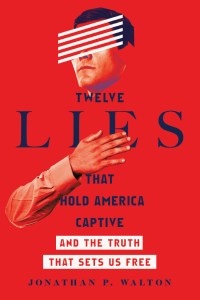 Twelve Lies that Hold America Captive is a provocative title for a book, and the subtitle: “And the Truth that Sets Us Free” only calls for a closer look. Jonathan Walton, in this work, calls for a close look at several pervasive ideas in the United States and calls them out for being mistaken on several counts.
Walton pulls no punches in his denunciation of the mixture of Christianity with nationalism. Early on, he notes that “Many Christians hold the same level of commitment to the Pledge of Allegiance that they hold to the Apostles’ Creed” (12). One could go on from this statement and note that plenty of Christians likely have the former memorized but know almost nothing about the formulation of the Apostles’ belief as outlined in the Creed. What does this say about the allegiance of American Christianity? Walton continues to press this kind of point throughout the book.
What are the twelve lies? They are: We are a Christian Nation; We All Are Immigrants, We Are a Melting Pot, All Men Are Created Equal, We Are a Great Democracy, The American Dream is Alive and Well, We are the Most Prosperous Nation in the World, We Are the Most Generous People in the World, America Is the Land of the Free, America Is the Home of the Brave, America Is the Greatest Country on Earth, and We Are One Nation. One’s visceral reaction to seeing these sentiments as “lies” is a good guide for how much this book is needed. I personally had a negative response to calling some of these lies, but as Walton drew out his meaning and the implications for a Christian life, came to find myself in agreement on most of his points.
Walton continues to make convicting points throughout the book. For example, while talking about the lie that “All Men are Created Equal,” Walton notes that it encourages us to see all achievement as personal success, thus leading to a kind of works righteousness in which if one just does what they ought, they receive (financial) reward. It’s a distortion of the Christian message, and ignores real, societal challenges to success that exist. It also encourages the vision of politeness rather than true kindness. Walton writes, “Preserving the image of a society that is polite and respectful and rewards hard work and grit is more important than genuine kindness, justice, and living like every person is made in the image of God” (65). It is this kind of insight and call to true Christianity that is found throughout the book.
Each chapter goes back to the Bible and Christianity to find a truth instead of the lie that nationalism and what Walton calls “White American Folk Religion” offers. For example, in the chapter on the “melting pot,” Walton points out that God’s kingdom is not a melting pot and instead that it will have every tribe, tongue, and nation–that God’s Kingdom is “shalom [peace] amid difference” (57). Again, the book is filled to the brim with this kind of insight.
Twelve Lies that Hold America Captive is a thoughtful, challenging book. It calls Christians to do better–to see beyond themselves and even their country to the ties that bind us all together in Christ. I recommend it very highly.
Disclaimer: I was provided with a copy of the book for review by the publisher. I was not required to give any specific kind of feedback whatsoever.
Links
Be sure to check out the page for this site on Facebook and Twitter for discussion of posts, links to other pages of interest, random talk about theology/philosophy/apologetics/movies and more!
Book Reviews– There are plenty more book reviews to read! Read like crazy! (Scroll down for more, and click at bottom for even more!)
SDG.
——
The preceding post is the property of J.W. Wartick (apart from quotations, which are the property of their respective owners, and works of art as credited; images are often freely available to the public and J.W. Wartick makes no claims of owning rights to the images unless he makes that explicit) and should not be reproduced in part or in whole without the expressed consent of the author. All content on this site is the property of J.W. Wartick and is made available for individual and personal usage. If you cite from these documents, whether for personal or professional purposes, please give appropriate citation with both the name of the author (J.W. Wartick) and a link to the original URL. If you’d like to repost a post, you may do so, provided you show less than half of the original post on your own site and link to the original post for the rest. You must also appropriately cite the post as noted above. This blog is protected by Creative Commons licensing. By viewing any part of this site, you are agreeing to this usage policy.
Book Review: “Haunted by Christ: Modern Writers and the Struggle for Faith” by Richard Harries
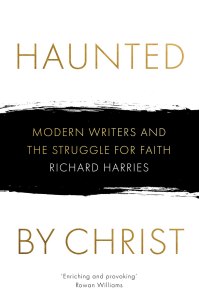 Haunted by Christ is a riveting look at how modern writers dealt with lingering doubts, anger, sorrow, and the question of Christianity. Richard Harries asks readers to engage with several writers to ask them questions that might not normally be asked, and he challenges readers in ways that are intricately tied into these authors’ lives.
First, it is worth pointing out that the concept of “modern” here is being used in the technical sense, related to modernism. Harries sets this period starting with Fyodor Dostoevsky (1821-1881) and Closing in the early 20th century. The authors Harries surveys are Dostoevsky, Emily Dickinson, Gerard Manley Hopkins, Edward Thomas, T.S. Eliot, Stevie Smith, Samuel Beckett, W.H. Auden, William Golding, R.S. Thomas, Edwin Muir and George Mackay Brown, Elizabeth Jennings, Graham Greene with Flannery O’Connor, Shusaku Endo, and Evelyn Waugh, C.S. Lewis and Philip Pullman, and Marilynne Robinson. Readers familiar with the works of these authors will know they run the gamut from skeptics to devout Christians. What ties them together, in Harries reading, is that their works are “haunted” by the supernatural, and specifically through a grappling with the person of Jesus Christ.
As a reader, I was unfamiliar with many of the authors, not having read much from the modernist movement. (This line makes me want to say sorry to my English teachers.) Nevertheless, Harries gives enough biographical information on each author to understand the points he’s making. Indeed, most of the information in the book is biographical, as Harries draws out each authors’ struggle with faith and coming to terms with the person of Jesus Christ. Even the skeptics surveyed clearly interact with Christianity, even if in negative ways.
I found several chapters of particular interest. Seeing C.S. Lewis’s and Philip Pullman’s competing mythologies set alongside each other for examination was fascinating. The chapter on W.H. Auden and his quiet, almost “polite” faith drew to light the great impact culture can have on one’s perception of religion and the work of God. The chapter on Golding makes me want to read more from him, despite not enjoying The Lord of the Flies. Emily Dickinson as “smouldering volcano” was an insightful look at a phenomenally successful poet. Each chapter had something that struck me, though the book also left me wishing I did know more about the authors and their works. I suspect Harries would be pleased to know his work led me to reach out and start reading some of these other works.
The biographical way Harries writes integrates worldview questions into the writings of each author. It never felt as though he subverted their own personal narratives, however. He didn’t pull punches in describing the way a skeptic like Pullman spoke about religion. Nor did he cover up aspects of authors’ lives that some might find unappealing. It’s an honest, almost unyielding book. It made me uncomfortable at times, but in ways that challenged me to learn and understand.
Haunted by Christ is a fascinating work. Harries offers insight and vision into Christianity in ways that I hadn’t really thought of before. It made me want to read many of the authors mentioned. And it made me want to know what someone who actually was more familiar with these authors might think. Recommended.
Disclaimer: I was provided with a copy of the book for review by the publisher. I was not required to give any specific kind of feedback whatsoever.
Links
Be sure to check out the page for this site on Facebook and Twitter for discussion of posts, links to other pages of interest, random talk about theology/philosophy/apologetics/movies and more!
Book Reviews– There are plenty more book reviews to read! Read like crazy! (Scroll down for more, and click at bottom for even more!)
SDG.
——
The preceding post is the property of J.W. Wartick (apart from quotations, which are the property of their respective owners, and works of art as credited; images are often freely available to the public and J.W. Wartick makes no claims of owning rights to the images unless he makes that explicit) and should not be reproduced in part or in whole without the expressed consent of the author. All content on this site is the property of J.W. Wartick and is made available for individual and personal usage. If you cite from these documents, whether for personal or professional purposes, please give appropriate citation with both the name of the author (J.W. Wartick) and a link to the original URL. If you’d like to repost a post, you may do so, provided you show less than half of the original post on your own site and link to the original post for the rest. You must also appropriately cite the post as noted above. This blog is protected by Creative Commons licensing. By viewing any part of this site, you are agreeing to this usage policy.
Book Review: “Bonhoeffer’s Black Jesus: Harlem Renaissance Theology and an Ethic of Resistance” by Reggie L. Williams
 Reggie L. Williams’s Bonhoeffer’s Black Jesus is a deep look at how Bonhoeffer’s experience in New York, and more specifically in Harlem, shaped him as a theologian of resistance against Hitler. It’s not just that, though, as it also traces Bonhoeffer’s intellectual development, specifically about racism, both before and after this epochal change.
First, Williams outlines the early theological development of Bonhoeffer, tracing his early intellectual development as well as his struggles to find a church home while visiting the United States. Here, in the United States, Bonhoeffer first encountered white racial terrorism in the form of lynching. Later, he would appeal to a German theologian to speak out against the charade of trials against in Scottsboro, in which nine black men were falsely accused of raping two white women. Eight of them were sentenced to death and killed. This caused something of an awakening for Bonhoeffer to racial violence, though he still had to become aware of his own biases.
The movement of Bonhoeffer from a proponent of volk (the German word for “Folk) type nationalism to a race-conscious and anti-racist perspective is one of the most fascinating portions of Williams’s research. While Bonhoeffer retained several core convictions throughout his life, his thought about race was directly impacted by his time in Harlem. Germany had been a colonial power until the Treaty of Versailles assigned the nation’s colonies to the winning powers, and many German people longed for that Imperial power once again. Williams demonstrates that Bonhoeffer’s own thought was impacted by this, particularly when he surveys Bonhoeffer’s early sermons and discussions of the concept of volk.
Williams then draws an outline of the Harlem Renaissance, including major thinkers and themes, as well as how some of these thinkers and themes explicitly or implicitly show up in Bonhoeffer’s works. Unfortunately, at least one of the works that would provide more insight into this has been lost (a paper Bonhoeffer wrote on black thinkers while in the United States). Nevertheless, Williams demonstrates that the themes of the Harlem Renaissance, along with Bonhoeffer’s own time in Harlem, became deeply influential on his later life. It is in this section that Williams does the most to bring to light strands of thought in Bonhoeffer that might otherwise be missed. Specifically, he traces the constant theme of Jesus identifying with the marginalized as something that would lead to active theology of resistance in Bonhoeffer’s thought. This theme is highlighted both in the thought of W.E.B. Du Bois and the poem “Black Christ” by Countee Cullen, which Bonhoeffer was aware of. The latter is lain out in detail, and shows both how Harlem Renaissance theology could be linked to liberation theology and how Bonhoeffer’s thought developed along that direction as well. It was black thinkers who helped awaken in Bonhoeffer a truly great desire for resistance against racism.
Another major theme of Williams’s work is that of empathy. He argues throughout that Bonhoeffer’s move towards empathy was something that he found through observing segregation in the United States and the resistance to it in Harlem. This, Williams argues, developed into a “Christ-Centered Empathic Resistance,” which is the last part of Bonhoeffer’s life as he actively worked against the Nazis in Germany.
The bulk of Williams’s work focuses on Bonhoeffer’s time in the United States, supporting his theses with meticulous notes and documentary evidence. The endnotes are full of additional argumentation as well as sources and reading.
Bonhoeffer’s Black Jesus is an essential read for those interested in Bonhoeffer’s theology of resistance. More than that, Williams provides here both an historic overview of Bonhoeffer’s thought and the ways in which one might develop him further. The unity of Bonhoeffer’s thought with Harlem Renaissance thinking and the movement of that into modern movements for societal justice is another major theme in the book. It’s a rare work that surveys the thought of a thinker while also offering insight into how modern thought might move forward along the same lines or go beyond its subject. Highly recommended.
Links
Be sure to check out the page for this site on Facebook and Twitter for discussion of posts, links to other pages of interest, random talk about theology/philosophy/apologetics/movies and more!
Book Reviews– There are plenty more book reviews to read! Read like crazy! (Scroll down for more, and click at bottom for even more!)
SDG.
——
The preceding post is the property of J.W. Wartick (apart from quotations, which are the property of their respective owners, and works of art as credited; images are often freely available to the public and J.W. Wartick makes no claims of owning rights to the images unless he makes that explicit) and should not be reproduced in part or in whole without the expressed consent of the author. All content on this site is the property of J.W. Wartick and is made available for individual and personal usage. If you cite from these documents, whether for personal or professional purposes, please give appropriate citation with both the name of the author (J.W. Wartick) and a link to the original URL. If you’d like to repost a post, you may do so, provided you show less than half of the original post on your own site and link to the original post for the rest. You must also appropriately cite the post as noted above. This blog is protected by Creative Commons licensing. By viewing any part of this site, you are agreeing to this usage policy.
Book Review: “Phoebe: A Story” by Paula Gooder
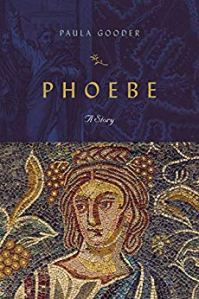 Phoebe: A Story by Paula Gooder is two books in one: a fictional picture of what Phoebe’s life and society might have looked like; and an academic exploration of this same society, world, and individual.
Paula Gooder writes in a style that is engaging and informative. The plot of the narrative section grabbed my interest from the get-go with its interweaving of biblical details with background information from historical studies as well. The main plot is of interest, following Phoebe through potential struggles and a narrative that gives readers rich imagery of what house churches were like and how these could have differed in different places due to income levels, the patrons, and the like. Gooder gives a vital look into the life of early Christians, doing so in a way that is winsome in style. What’s interesting is that, due to the integration of some biblical persons, I as a reader was hyper-aware of these characters. I have to say, I was a bit sad that I didn’t love Junia as a character in Gooder’s book as much as I’d have hoped. But Gooder makes these characters seem true to life, with real motivations and interests beyond simply being set pieces for teaching readers about early Christianity.
The second part is full of notes that bring historical and theological insight into the narrative woven throughout the book. They provide justification for various narrative choices, background information about how things may have been in the early church, and are full of rich details about Christian life. Gooder’s research is quite thorough and will give interested readers more avenues for exploration.
Readers should note that the book is probably best enjoyed with one finger in the endnotes to integrate those notes into their reading of the narrative. I saw the notes section at the back, but read the book front-to-back, thinking that since the notes were called “Part 2,” it made sense to read Part 1 and then 2. But doing so meant I missed out on several key points of interest within the narrative, which meant I went back and re-read portions to make more sense of what Gooder was saying. The book doesn’t have an introduction or preface to recommend this reading order, so be aware of it.
Readers will find much of interest in Phoebe: A Story. From the background information to the more intimate picture of what life may have looked like in the early church, this book is well-worth the time investment. Recommended.
Disclaimer: I was provided with a copy of the book for review by the publisher. I was not required to give any specific kind of feedback whatsoever.
Links
Be sure to check out the page for this site on Facebook and Twitter for discussion of posts, links to other pages of interest, random talk about theology/philosophy/apologetics/movies and more!
Book Reviews– There are plenty more book reviews to read! Read like crazy! (Scroll down for more, and click at bottom for even more!)
SDG.
——
The preceding post is the property of J.W. Wartick (apart from quotations, which are the property of their respective owners, and works of art as credited; images are often freely available to the public and J.W. Wartick makes no claims of owning rights to the images unless he makes that explicit) and should not be reproduced in part or in whole without the expressed consent of the author. All content on this site is the property of J.W. Wartick and is made available for individual and personal usage. If you cite from these documents, whether for personal or professional purposes, please give appropriate citation with both the name of the author (J.W. Wartick) and a link to the original URL. If you’d like to repost a post, you may do so, provided you show less than half of the original post on your own site and link to the original post for the rest. You must also appropriately cite the post as noted above. This blog is protected by Creative Commons licensing. By viewing any part of this site, you are agreeing to this usage policy.

 J.W. Wartick - Reconstructing Faith