Book Reviews
Book Review: “Always Be Ready” by Hugh Ross with Kathy Ross
 Always Be Ready is another entry in the crowded field of introductory apologetics works. What sets it apart? I’d answer the question two ways: first, it has a number of deeply personal stories about faith and defending the faith from a noted apologist, Hugh Ross; second, it gives more insight than most books do into how to set up your own apologetics group/meeting/blog/etc.
The Ross couple give a number of anecdotes about their experience sharing the faith. As with most of the books from Reasons to Believe, there are a number of scientific discoveries sprinkled throughout the work. But the focus of the book is really on the title and the verse(s) it is taken from, 1 Peter 3:15-16 (NIV) “Always be prepared to give an answer to everyone who asks you to give the reason for the hope that you have. But do this with gentleness and respect, keeping a clear conscience, so that those who speak maliciously against your good behavior in Christ may be ashamed of their slander.”
Too often, apologists focus on the preparation and being ready, but not on the gentleness and respect aspects of it. The authors do a great job preparing readers for that side, while also opening readers to the resources to explore how to be ready for a defense when needed. The aspects of apologetic argument that are offered are in line with other Reasons to Believe publications, primarily focused upon an old earth creationist, concordist view of science, and seeing science as directly related to specific statements in the Bible. Whether one finds such a view of hermeneutics compelling or not will determine, largely, how useful such sections are.
But the book also has a surprising latter part, which deals in specifics of setting up small or large groups for apologetics discussions, along with a few tips that can apply to blogging, other online ministries, and more. I found these sections particularly useful, because they aren’t often things that apologetics works touch upon. It’s one thing to have an apologetics method and knowledge, but what if we don’t know how to sit down and compassionately, compellingly share that? The authors prepare readers for just that activity, making the last section of the book extremely valuable. Tips include thinking about your goal for the group. A large group is nice on the “numbers” front, but you won’t be able to make it as personalized as a smaller group. On the flip side, a larger group may allow some people who aren’t comfortable in small group settings to come and be somewhat anonymous. These kinds of tips that direct thinking for those who are eager to go and share their faith are essential reading.
Always Be Ready is a solid, introductory apologetics work with a focus on method and storytelling. Those are two aspects that aren’t discussed enough in much of the apologetics-related literature.
Disclaimer: I was provided with a copy of the book for review by the publisher. I was not required to give any specific kind of feedback whatsoever.
Links
Be sure to check out the page for this site on Facebook and Twitter for discussion of posts, links to other pages of interest, random talk about theology/philosophy/apologetics/movies and more!
Book Reviews– There are plenty more book reviews to read! Read like crazy! (Scroll down for more, and click at bottom for even more!)
SDG.
——
The preceding post is the property of J.W. Wartick (apart from quotations, which are the property of their respective owners, and works of art as credited; images are often freely available to the public and J.W. Wartick makes no claims of owning rights to the images unless he makes that explicit) and should not be reproduced in part or in whole without the expressed consent of the author. All content on this site is the property of J.W. Wartick and is made available for individual and personal usage. If you cite from these documents, whether for personal or professional purposes, please give appropriate citation with both the name of the author (J.W. Wartick) and a link to the original URL. If you’d like to repost a post, you may do so, provided you show less than half of the original post on your own site and link to the original post for the rest. You must also appropriately cite the post as noted above. This blog is protected by Creative Commons licensing. By viewing any part of this site, you are agreeing to this usage policy.
Book Review: “Introduction to Political Science: A Christian Perspective” by Fred Van Geest
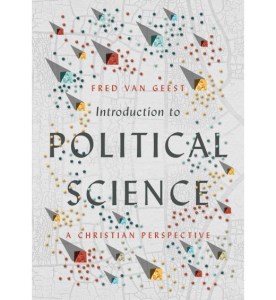 How are we to live as Christians in the political arena? It’s a question that feels tired at times, but it remains as pressing as ever. Fred van Geest’s Introduction to Political Science: A Christian Perspective is remarkable for its even, fair look at a number of political questions from a broadly Christian viewpoint.
There is no possible way to approach a book like this without bias. Van Geest acknowledges this and notes that Christians ought not to be excluded from using their faith to help determine their answers to political questions; after all, no one can be an unbiased commentator on political questions. The book is organized around four parts: Foundational Values and Ideas for Government; Institutions; Policy; and Foreign Policy and International Relations.
Included among the foundational values and ideas are questions about what a government is to begin with, what it means to be a “Christian” government, and whether such a thing ought to even exist. What makes van Geest’s analysis interesting is that he largely manages to navigate that space between liberal and conservative, showing how ideas and ideals from both groups can be held in unity and even lead to policy change that may be mutually agreed upon. Though it is impossible to truly navigate entirely in that tiny “in between” space, van Geest’s book helps readers to at least understand both sides more than they might have before.
One aspect that makes van Geest’s analysis particularly interesting is his breaking out of the unfortunate tendency to simply analyze U.S. politics from a Christian perspective. Instead, he frequently looks at international perspectives and uses examples of countries outside of North America. Many charts are included showing things like voting turnout (and setting that alongside how different systems of voting may encourage or discourage said turnout), opinions on gun control in the U.S., corporate tax rates in different countries (and why some aspects of taxing corporations may be beneficial or not), and many, many more.
Where van Geest brings in a specifically Christian perspective to politics, it becomes even more interesting. He compares Jimmy Carter’s and George W. Bush’s statements on politics and faith, shows the real challenges of poverty and health care in various countries (including the U.S.), argues that income inequality can lead to very real wrongs, questions some aspects of Just War thought, and challenges readers to look at human rights in a global perspective. Though I didn’t always agree with van Geest, I found him bringing so much information to bear in some of these chapters that I was able to sit back and reflect and even change my view on some things.
The book is an introduction, so it doesn’t delve too deeply into any one topic, but it does give readers all kinds of information for further reading and exploration. Moreover, van Geest does a remarkable job of presenting so many different topics in such a short space. Having read the book, I found I felt more informed, even as someone who was a social studies major in college.
Introduction to Political Science: A Christian Perspective is most notable for the fact that van Geest manages to navigate the difficult terrain of the political minefield without becoming overly polemical. I found it highly enjoyable and challenging in the best ways. I recommend it highly.
Disclaimer: I was provided with a copy of the book for review by the publisher. I was not required to give any specific kind of feedback whatsoever.
Links
Be sure to check out the page for this site on Facebook and Twitter for discussion of posts, links to other pages of interest, random talk about theology/philosophy/apologetics/movies and more!
Book Reviews– There are plenty more book reviews to read! Read like crazy! (Scroll down for more, and click at bottom for even more!)
SDG.
——
The preceding post is the property of J.W. Wartick (apart from quotations, which are the property of their respective owners, and works of art as credited; images are often freely available to the public and J.W. Wartick makes no claims of owning rights to the images unless he makes that explicit) and should not be reproduced in part or in whole without the expressed consent of the author. All content on this site is the property of J.W. Wartick and is made available for individual and personal usage. If you cite from these documents, whether for personal or professional purposes, please give appropriate citation with both the name of the author (J.W. Wartick) and a link to the original URL. If you’d like to repost a post, you may do so, provided you show less than half of the original post on your own site and link to the original post for the rest. You must also appropriately cite the post as noted above. This blog is protected by Creative Commons licensing. By viewing any part of this site, you are agreeing to this usage policy.
Book Review: “Rethinking Incarceration: Advocating for Justice that Restores” by Dominique DuBois Gilliard
 People from across the political system have called for reform of the penal system in the United States. With Rethinking Incarceration: Advocating for Justice that Restores, Dominique DuBois Gilliard delivers both a bevvy of information for those curious about the penal system alongside a call to work for higher justice.
The book is arranged around two parts: “The Roots and Evolution of Mass Incarceration” and “The Church’s Witness and Testimony.” These parts have much interplay with each other. The first part lays the groundwork for understanding how the United States has become the world’s largest prison system. He grounds this in a slew of historical details, starting with an examination of the “War on Drugs” and how it led to a massive upturn in numbers of incarcerated. Gilliard notes how Black Codes paved the way for “Neoslavery” and the use of the penal system to effectively make slaves once again. He notes these historical perspectives alongside discussion of the “pipelines” (to prison) of mental health, privatized prisons for profit, and immigration. Each of these has clear justice issues that cannot be ignored. The School-to-Prison pipeline, something I had only heard referenced but not really dug into before, seems quite clear to me after reading this book. Essentially, by allowing police presence into schools, we have criminalized delinquency at an alarming rate. Things that may have earned detention or suspension before now yield prison sentences to minors. Frankly, this seems insane. I was blown away by learning that very few states have any special training for the “resource officers” that are put into schools to watch our children is equally disturbing. There is no requirement for any kind of child psychology, de-escalating situations with minors, and the like whatsoever in most places.
After establishing this historical basis for the increase in incarceration rates, Gilliard turns to seeing what the church might do about this plight. He does not ignore historical perspective here, either. One of the most moving and interesting chapters in the book is “The Prisoners’ Pastor: Chaplaincy and Theology’s Institutional Impact.” Therein, Gilliard uses chaplains at the notorious Sing Sing prison in New York as a case study. It was thought by some that sending chaplains to the prisoners was pointless because they were “too far gone” to be impacted by such a ministry. The impact of the persistent chaplains in the face of serious opposition–including by those who ran the prison–is a wonderful tale, but not one without stumbling blocks either. It is also clear that when the chaplains become tools of the system, it can be incredibly damaging.
Another chapter examines the nature of punishment and how a Christian view of the penal system ought to be oriented towards not just punishment but also bringing people back into community. He argues this through an analysis of biblical justice and showing that restoration is a major theme. One of the major ways we can help to cut down on the system of mass incarceration is to educate rather than resort to exclusion and punishment every single time.
Rethinking Incarceration: Advocating for Justice that Restores is a fascinating, heart-rending, and immediately applicable book. Agree or disagree with Dominique DuBois Gilliard’s positions, it should be read by Christians who wish to think discerningly about our penal system. I highly recommend it.
Disclaimer: I was provided with a copy of the book for review by the publisher. I was not required to give any specific kind of feedback whatsoever.
Links
Be sure to check out the page for this site on Facebook and Twitter for discussion of posts, links to other pages of interest, random talk about theology/philosophy/apologetics/movies and more!
Book Reviews– There are plenty more book reviews to read! Read like crazy! (Scroll down for more, and click at bottom for even more!)
SDG.
——
The preceding post is the property of J.W. Wartick (apart from quotations, which are the property of their respective owners, and works of art as credited; images are often freely available to the public and J.W. Wartick makes no claims of owning rights to the images unless he makes that explicit) and should not be reproduced in part or in whole without the expressed consent of the author. All content on this site is the property of J.W. Wartick and is made available for individual and personal usage. If you cite from these documents, whether for personal or professional purposes, please give appropriate citation with both the name of the author (J.W. Wartick) and a link to the original URL. If you’d like to repost a post, you may do so, provided you show less than half of the original post on your own site and link to the original post for the rest. You must also appropriately cite the post as noted above. This blog is protected by Creative Commons licensing. By viewing any part of this site, you are agreeing to this usage policy.
Book Review: “Faith Across the Multiverse” by Andy Walsh
 Faith Across the Multiverse is a difficult book for me to categorize. Based on the title and cover blurb, it seemed a bit like another entry in the crowded field of basic science-faith works. It’s an interesting field, but one that has many, many entry points. Yet as I continued to read the book, I discovered an appreciation for the unique style and depth of discussion that definitely separates it from the pack.
Walsh separates the book into four parts: The Language of Mathematics, The Language of Physics, The Language of Biology, and The Language of Computer Science. These titles might lead one to assume that this is (again) yet another book arguing for design or intelligent design. It is not. So it isn’t a broad introduction to faith-science issues, and it isn’t an entry level book on ID theory. What is it? It’s a kind of stream of consciousness look at several deep science-faith topics with some nerdy anecdotes and Biblical interpretation sprinkled in. That’s a mouthful, and that’s because this book is heady, much headier than one may expect. It grew on me more and more as I read it.
Each chapter has some kind of theme woven through it, typically drawn from some part of nerd culture. For example, in chapter 7 Orphan Black, a Canadian science fiction drama that I’m currently watching myself, is used to talk about nature vs. nurture, DNA coding, the church body, and denominations. It should be easy for readers to see why the book deserves a careful reading. Yes, many, many topics are raised all at once, but Walsh does an admirable job tying them all together and relating them back to Christianity in realistic ways. It’s fascinating to read about Walsh’s thoughts on mathematics and see how he applies them to the Bible and Christian doctrine. This isn’t a kind of 1-to-1 correlation as if Walsh is arguing for some kind of biblical numerology–far from it. Instead, he uses physics, math, biology, and computer science to highlight reasons to believe as we do–and sometimes to challenge those beliefs.
I noted already that the titles of the parts in the book make it sound like it’s arguing for Intelligent Design. It isn’t. Indeed, Walsh actually argues against the theory (though it doesn’t appear in the index) by noting how mathematical models can create seemingly infinite complexity without needing informational input. One example he uses is the Koch Curve, which is a phenomenally complex early look at a fractal that seems to create massive complexity through a very simple form (225ff). The Bible itself speaks to God using seemingly random things to generate information or to work for God’s ends (eg. the casting of lots) (p. 251-252). Evolution, he argues, doesn’t threaten God’s sovereignty any more than a seemingly unknowable outcome on our end (the rolling of dice) means God can’t design or control the process.
The book is truly a monument of imagination, while being grounded in real outcomes, science, and math. It’s fascinating to see Walsh tie Ms. Marvel, the X-Men, or Mark Watney, the star of The Martian into real life scenarios and biblical examples. By my count, Walsh managed to reference 65 books of the Bible in the text, while also drawing in nerd references, Francis Collins, discussions of the soul, and more. I can’t really overstate how remarkable I find the fact that there is unity in a text like this, but Walsh somehow pulls it off and delivers a rather fascinating science-faith work.
Andy Walsh’s Faith Across the Multiverse manages to distinguish itself by both the depth of its science and the fun of its references. It’s a surprising, thought-provoking work worthy of a careful read. I recommend it. Incidentally, I also found the book’s website as I wrote this review, if you’d like to explore further.
Disclaimer: I was provided with a copy of the book for review by the publisher. I was not required to give any specific kind of feedback whatsoever.
Links
Be sure to check out the page for this site on Facebook and Twitter for discussion of posts, links to other pages of interest, random talk about theology/philosophy/apologetics/movies and more!
Book Reviews– There are plenty more book reviews to read! Read like crazy! (Scroll down for more, and click at bottom for even more!)
SDG.
——
The preceding post is the property of J.W. Wartick (apart from quotations, which are the property of their respective owners, and works of art as credited; images are often freely available to the public and J.W. Wartick makes no claims of owning rights to the images unless he makes that explicit) and should not be reproduced in part or in whole without the expressed consent of the author. All content on this site is the property of J.W. Wartick and is made available for individual and personal usage. If you cite from these documents, whether for personal or professional purposes, please give appropriate citation with both the name of the author (J.W. Wartick) and a link to the original URL. If you’d like to repost a post, you may do so, provided you show less than half of the original post on your own site and link to the original post for the rest. You must also appropriately cite the post as noted above. This blog is protected by Creative Commons licensing. By viewing any part of this site, you are agreeing to this usage policy.
“1 Corinthians 14:33B-38, 1 Timothy 2:11-14, and the Ordination of Women” by Peter Kriewaldt and Geelong North, Part 2, in “Women Pastors?” edited by Matthew C. Harrison and John T. Pless
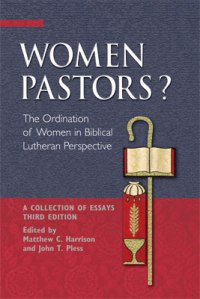 I grew up as a member of the Lutheran Church-Missouri Synod, a church body which rejects the ordination of women to the role of pastor. The publishing branch of that denomination, Concordia Publishing House, put out a book entitled Women Pastors? The Ordination of Women in Biblical Lutheran Perspective edited by Matthew C. Harrison (who is the current President of the LCMS) and John T. Pless. I have decided to take the book on, chapter-by-chapter, for two reasons. 1) I am frequently asked why I support women pastors by friends, family, and people online who do not share my position, and I hope to show that the best arguments my former denomination can bring forward against women pastors fail. 2) I believe the position of the LCMS and other groups like it is deeply mistaken on this, and so it warrants interaction to show that they are wrong. I will, as I said, be tackling this book chapter-by-chapter, sometimes dividing chapters into multiple posts. Finally, I should note I am reviewing the first edition published in 2008. I have been informed that at least some changes were made shortly thereafter, including in particular the section on the Trinity which is, in the edition I own, disturbingly mistaken. I will continue with the edition I have at hand because, frankly, I don’t have a lot of money to use to get another edition. Yes, I’m aware the picture I used is for the third edition.
“1 Corinthians 14:33B-38, 1 Timothy 2:11-14, and the Ordination of Women” by Peter Kriewaldt and Geelong North Part 2
1 Timothy 2:11-15
It is interesting to note that in this subheading (in the first edition, anyway), the verses noted are different from those in the chapter title, though the authors don’t actually address verse 15 in their verse-by-verse analysis.
Kriewaldt and North begin by noting the context of the letter- “to Timothy in Ephesus, the economic, political, and religious center of Asia Minor. In that region, the social position of women was well developed. There were numerous female doctors there. In politics, women were thoroughly involved in leadership. Female philosophers were known to teach…” (50). Moreover, they state that “In Paul’s day the Greek and Roman world was awash with priestesses” (ibid). With this context in mind, the authors here argue that Paul is going against the cultural norms of the surrounding environment. They also note that “False teaching had invaded the church in Ephesus…” and “sowed dissension…” According to them, “One of its features led women to discard traditional roles…” (51). They allege that part of the problem was that women “were endeavoring to teach the apostolic word…” (51-52), which is taken to be a bad thing (“false teaching”). Women, they argue, were to learn in full submission, which they take to mean “submit to Christ’s Word and those who teach it. Paul is not saying that all women are to be submissive to all males” (52).
1 Timothy 2:12 is taken to mean that a woman ought not teach or exercise authority over a man. Kriewaldt and North argue that Paul’s saying “I do not permit” cannot suggest a personal opinion because the letter “bristles with apostolic authority” which “suggests that apostolic authority underlies and pervades this whole section…” (52). Specifically, however, women are “not permitted to teach the apostolic doctrine or engage in apostolic ministry of the Word in the worship assembly” (ibid). Verse 13 is taken to mean that “God’s will” is “revealed through the priority of Adam’s Creation… Adam was created first. ‘First’ is not merely first in time, but carries with it a position of leadership, authority, and responsibility (1 Cor. 12:28…)” (53). In response to those who say that making this argument means animals are are masters, the authors dismiss it by saying “That is really scraping the barrel!” (ibid). Verse 14, they argue, shows that the man “who was meant to be the leader and head, fell down on the job… He deliberately and knowingly chose to listen to the woman and thereby sinned by following her teaching” (54).
There are several issues with Kriewaldt and North’s analysis of 1 Timothy 2:11-15. First, and most obviously, though the section heading says they take it to go through verse 15, as almost every commentator does that I have read, they fail to so much as remark on verse 15. Yet verse 15 may be a pivotal verse in the understanding of the whole passage, though it is generally acknowledged as an extraordinarily difficult passage to interpret. What does it mean to say that the woman is saved through [the?] childbirth? Is it a reference to Christ? Is it a note that women do indeed have some kind of power? Is it a bringing women back into equality with men by noting no man exists without a woman? We don’t know Kriewaldt and North’s own opinion because they excluded the verse from their comments and utterly ignored what seem to be the closing remarks of Paul in the section they are trying to interpret properly.
The cultural context is quite interesting because Kriewaldt and North emphasize false teaching over the cultural context. That is, they use the context briefly to frame it as Paul going against the context, but don’t tie context and false teaching together. When we do tie them together, it seems to be sensible to think that perhaps women were teaching in the churches (a cultural norm in the area) but were the ones teaching falsely. Thus, Paul’s teaching for women to be silenced would be directed at this false teaching, which Kriewaldt and North explicitly mention as a major issue in the church in Ephesus (51). Thus, Paul’s silencing of women ought to be understood as localized, but normative. Localized, because it applies to the Ephesian church in the specific case of women spreading false teaching. Normative, because it allows a rule where an entire group of people may be silenced in order to stop false teaching. If, for example, a number of elderly people had imbibed false teaching and continued to spread it, it may be appropriate to call for their silence such that the false teaching does not continue to spread.
Another issue in just the first few pages is why Kriewaldt and North take women “endeavoring to teach the apostolic word” as a bad thing. After all, would they not agree that if it is true women are to be silenced from public teaching, they ought to teach that very apostolic teaching to others? Is it not a strange situation in which anyone is considered a false teacher for wishing to teach the apostolic word? Yet that is exactly what Kriewaldt and North charge women with in the Ephesian Church! The false teaching isn’t actually a teaching on their view; rather, the false teaching is related simply to which chromosomes those people doing the teaching have! This nonsensical reduction of false teaching to actually teaching the apostolic word as a woman shows, frankly, the lengths to which some are willing to go to silence women. The preconception that women ought not teach is what is dominating the interpretation here, not the text itself. Think about it abstractly: is it really false teaching for anyone to teach the apostolic word? Really, truly? But Kriewaldt and North come back later and once again insist women are not to “teach the apostolic doctrine.” I find this doubling down astonishing. Imagine actually using the Bible to insist that about 50% of all humans on the planet may not actually teach that which the apostles do, or that they ought not even endeavor to teach the apostolic word. Incredible.
Kriewaldt and North also seem to contradict Henry Hamann in the same volume, who himself argues that women should not hold political office or other positions of authority over men. Yet in this chapter, Kriewaldt and North suggest submission is not to all men everywhere, just in the specific instance of teaching apostolic word (strange as that is). Thus, despite the fact that this book tries to present what is seen as the unified teaching of the Bible and church, its authors can’t even agree on how much women ought to be submissive.
It is odd for Kriewaldt and North to take other verses in the same letter to mean that the entire section must be explicitly apostolic teaching that persist for all time. Do they use the same reasoning in 1 Timothy 5:23 and insist no one drinks water but rather imbibes wine for stomach illness? That goes a bit against what my doctor has advised, but the authors of our chapter insist that the entire section takes on the authority of eternal commands because Paul’s claim of apostolic authority is scattered throughout the letter. But, as we’ve noted with other authors in this same book, it becomes clear Kriewaldt and North don’t actually mean that. Rather, they mean it when it suits their own theological perspectives.
I am so pleased that Kriewaldt and North take 1 Corinthians 12:28 as a clear example of a list of authority. As I’ve noted before, if they do acknowledge this, they’ve already conceded women hold more authority than pastors, which clearly undermines their entire argument. As every other author has done at some point so far in the book, Kriewaldt and North fail to actually counter the arguments of their theological opponents. When it is noted that Paul’s appeal actually is to the temporal order of the creation of male and female, they dismiss the clear point that animals were created before people as an argument that “scrapes the bottom of the barrel!” Truly? If so, it ought to be simple enough to refute. But they don’t engage it, apparently hoping their readers will quickly dismiss arguments that show the absurdity of their position simply because they do so. Their disdain for women is once again shown by the lurid language of the first man stumbling and falling down on the job and indeed sinning simply by listening to his wife! This position has absolutely nothing redemptive to offer women and it contradicts itself.
Kriewaldt and North fail completely to show that the passages they address exclude women from the ministry. Their selective editing of the text to exclude passages that may be difficult to fit with their reading is just one issue. Far more problematic are their simplistic dismissal of opponents’ arguments without engagement, the self-contradiction inherent in their views, the failure to actually address the totality of the culture to which the letters were addressed, inconsistent literalism, their poisoning of the well, lack of knowledge or engagement with textual critical issues, and many more serious difficulties demonstrate that the complementarian perspective does not adequately address these texts. This is particularly important, because these two passages are the most powerful ones typically mustered by complementarians.
Links
Be sure to check out the page for this site on Facebook and Twitter for discussion of posts, links to other pages of interest, random talk about theology/philosophy/apologetics/movies and more!
Book Reviews– There are plenty more book reviews to read! Read like crazy! (Scroll down for more, and click at bottom for even more!)
Interpretations and Applications of 1 Corinthians 14:34-35– Those wondering about egalitarian interpretations of this same passage can check out this post for brief looks at some of the major interpretations of the passage from an Egalitarian viewpoint.
SDG.
——
The preceding post is the property of J.W. Wartick (apart from quotations, which are the property of their respective owners, and works of art as credited; images are often freely available to the public and J.W. Wartick makes no claims of owning rights to the images unless he makes that explicit) and should not be reproduced in part or in whole without the expressed consent of the author. All content on this site is the property of J.W. Wartick and is made available for individual and personal usage. If you cite from these documents, whether for personal or professional purposes, please give appropriate citation with both the name of the author (J.W. Wartick) and a link to the original URL. If you’d like to repost a post, you may do so, provided you show less than half of the original post on your own site and link to the original post for the rest. You must also appropriately cite the post as noted above. This blog is protected by Creative Commons licensing. By viewing any part of this site, you are agreeing to this usage policy.
Book Review: “Paul and Gender: Reclaiming the Apostle’s Vision for Men and Women in Christ” by Cynthia Long Westfall
[U]ntil very recently (ca. 1980s), traditional readings [of Bible passages related to women] have assumed the ontological inferiority of women through the entire history of interpretation, and it is implausible to think that an interpreter can effectively shed the foundational assumptions of the traditional view and still coherently maintain the remainder of interpretations and applications virtually intact. (4)
[T]raditional readings of the texts have been used and are being used overtly in a social construction of a theology of power and control that privileges one group over another (males over females), and those readings are controlled by the privileged group (males). (4)
Cynthia Long Westfall’s Paul and Gender: Reclaiming the Apostle’s Vision for Men and Women in Christ brings forward insights from hermeneutics, linguistics, sociology, history, and insight into the ancient world to present a consistent reading of the Pauline corpus in regards to gender. Westfall contends that the traditional reading of the text must face the challenge that it does not consistently read the Pauline corpus, but rather tends to prioritize certain readings of texts over other texts, rather than trying to unify them. A lack of consistent methodology is also a problem, as hermeneutic method changes depending upon what the text is taken to defend (3). Moreover, traditional readings of the texts are “problematic,” she argues, for several reasons: first, the traditional readings of the texts “have not resulted in making sense of Paul’s Letters” (ibid); second, these readings of the texts are making a theology of power (4); third, the ontological basis for the traditional reading has largely been acknowledged as mistaken (see the first quote, above); fourth, both the individual and the group can make significant contributions to and impact on interpretation. For these reasons, Westfall suggests a return to the texts to see what they actually mean in context, again, drawing on linguistics, contemporary cultural studies, and many more disciplines.
Westfall organizes the book topically, looking at how various topics relate to Paul and gender. These topics are culture, stereotypes, creation, the Fall, eschatology, the body, calling, authority, and an extended look at 1 Timothy 2:11-15. By organizing the book largely around these important topics in Paul’s thought, Westfall avoids the somewhat common theme of books about sexuality in Christianity of looking at one proof text after another to come down on one side or the other. Instead, Westfall presents a cohesive, rational way for looking at the whole of the Pauline corpus, yes, through looking at individual texts, but also by uniting Paul’s thought and bringing in insights from various fields.
Time and again throughout Paul and Gender, I came upon a way of looking at things I hadn’t considered before. Westfall’s use of linguistics and deep knowledge of the cultural context of the New Testament leads to arguments and conclusions that are powerful and compelling. Some of her points seem obvious on reflection, but were points I have rarely if ever seen discussed in literature related to men and women in Christ. For example, regarding 1 Timothy 2:13, she notes that in Genesis, from which Paul is drawing his point, primogeniture is constantly reversed. That theme is one I had learned and put forward myself, but I hadn’t thought about how it could be applicable to understanding Paul’s use of Adam first/Eve next in 1 Timothy. Why is it that complementarians repeatedly make a bald assumption that primogeniture is seen by Paul as an inherent hierarchy between man and woman when Paul is specifically using an example from a book where primogeniture is consistently overthrown by God? Her extensive look at 1 Corinthians 11 helps to make it even more clear how difficult it is to adequately understand some of these texts as English speakers. Through conversation with many contemporary sources, she conclusively demonstrates that the notion of the man being “head” is not a hierarchy. Moreover, her reading of what is meant by calling woman the glory of man as well as her interpretation of why women should have a kind of covering over their heads is one that answers many, many questions for me as a reader. By showing what, culturally, was going on in Corinth and the church in general, she presents readings that explain the text rather than obscure it further–or turn it into a proof text for a specific position.
The greatest strength of Westfall’s approach is that it truly does present a unified look at the Pauline corpus. Rather than having to look at texts piecemeal and form a series of doctrinal theses therefrom, Westfall’s reading of the texts related to gender present a consistent, holistic view of Paul’s teaching on gender. It is a truly remarkable book that deserves careful reading. I spent several hours on the chapter on “culture” alone, finding many deep insights both in the main text and the footnotes. As a reader, I feel as though I have a much deeper and more complete understanding of Paul on these topics than I did before I read it.
With Paul and Gender, Cynthia Long Westfall has created one of the most profoundly exegetical and deep challenges to the complementarian reading of the Pauline Corpus in existence. Her breadth of knowledge of many different fields of studies is effectively utilized to present a cohesive, persuading reading of Paul regarding gender. May all who are interested in finding what the New Testament teaches on gender read this book.
Disclaimer: I was provided with a copy of the book for review by the publisher. I was not required to give any specific kind of feedback whatsoever.
Links
Be sure to check out the page for this site on Facebook and Twitter for discussion of posts, links to other pages of interest, random talk about theology/philosophy/apologetics/movies and more!
Book Reviews– There are plenty more book reviews to read! Read like crazy! (Scroll down for more, and click at bottom for even more!)
SDG.
——
The preceding post is the property of J.W. Wartick (apart from quotations, which are the property of their respective owners, and works of art as credited; images are often freely available to the public and J.W. Wartick makes no claims of owning rights to the images unless he makes that explicit) and should not be reproduced in part or in whole without the expressed consent of the author. All content on this site is the property of J.W. Wartick and is made available for individual and personal usage. If you cite from these documents, whether for personal or professional purposes, please give appropriate citation with both the name of the author (J.W. Wartick) and a link to the original URL. If you’d like to repost a post, you may do so, provided you show less than half of the original post on your own site and link to the original post for the rest. You must also appropriately cite the post as noted above. This blog is protected by Creative Commons licensing. By viewing any part of this site, you are agreeing to this usage policy.
“1 Corinthians 14:33B-38, 1 Timothy 2:11-14, and the Ordination of Women” by Peter Kriewaldt and Geelong North, Part 1, in “Women Pastors?” edited by Matthew C. Harrison and John T. Pless
I grew up as a member of the Lutheran Church-Missouri Synod, a church body which rejects the ordination of women to the role of pastor. The publishing branch of that denomination, Concordia Publishing House, put out a book entitled Women Pastors? The Ordination of Women in Biblical Lutheran Perspective edited by Matthew C. Harrison (who is the current President of the LCMS) and John T. Pless. I have decided to take the book on, chapter-by-chapter, for two reasons. 1) I am frequently asked why I support women pastors by friends, family, and people online who do not share my position, and I hope to show that the best arguments my former denomination can bring forward against women pastors fail. 2) I believe the position of the LCMS and other groups like it is deeply mistaken on this, and so it warrants interaction to show that they are wrong. I will, as I said, be tackling this book chapter-by-chapter, sometimes dividing chapters into multiple posts. Finally, I should note I am reviewing the first edition published in 2008. I have been informed that at least some changes were made shortly thereafter, including in particular the section on the Trinity which is, in the edition I own, disturbingly mistaken. I will continue with the edition I have at hand because, frankly, I don’t have a lot of money to use to get another edition. Yes, I’m aware the picture I used is for the third edition.
“1 Corinthians 14:33B-38, 1 Timothy 2:11-14, and the Ordination of Women” by Peter Kriewaldt and Geelong North
Peter Kriewaldt and Geelong North seek to demonstrate that the titular verses show women may not be pastors. While Jesus “elevated the status of women,” they say, it is nevertheless the case that “Jesus entrusted the oversight of the Church to men only…” (45).
The first thing that strikes me in this chapter are the verses selected. Why begin at 14:33B and extend only to 38? Why do the authors cut verse 15 of 1 Timothy 2 out of its immediate context with the verses preceding it? Of course, the authors must limit the scope at some point. That’s not a question. But when there is a question of whether verse 33 is a continuous clause and when verse 15 is highly relevant to the interpretation of the rest of the passage, one must wonder why those verses were excised in this exegetical chapter. Readers can’t know. But especially with 1 Timothy 2:15, it is quite clear that it is a continuation of the previous thoughts and should not be cut off. From the outset, Kriewaldt and North miss out on key aspects of interpreting these texts.
1 Corinthians 14:33B-38
Kriewaldt and North acknowledge that we know “that Corinth had a number of cults that included priestesses…” (45). Thus, they argue, Paul’s silencing of women “runs counter to the pagan culture in Corinth. He is not culturally conditioned” (ibid).
Surprisingly, Kriewaldt and North feel confident enough to say “The integrity of this passage is certain. There is no manuscript evidence for the omission of these verses from chapter 14, though some manuscripts place them after v. 40” (46). In this, the authors are simply mistaken. Not only are they wrong to say that the textual integrity is “certain,” but also to say that there is no manuscript evidence for their omission. Certainty, as the word is typically understood, implies the kind of 100% clear textual integrity that rarely exists. But 1 Corinthians 14:34-35 does not have that integrity. Not only do the verses exist in different places (after 1 Corinthians 14:40) in some manuscripts–thus demonstrating that the passage does not have a “certain” place in the text–but as Philip B. Payne and others have demonstrated, there are some serious questions about the textual transmission of this text. As he notes, the fact of the movement of the passage itself is rather alarming for those who wish to claim textual certainty: “Similarly, it is highly unlikely that if the text were originally in Paul’s letter after v. 40, that any later scribe would move that text to follow v. 33. We know it is highly unlikely since no scribe of any surviving manuscript (and there are thousands) of any of Paul’s letters ever did anything like this in any other passage of Paul’s letters.” But apart from the movement in the text, there is the issue of textual markings that indicate textual variants “Codex Vaticanus’s evidence that 1 Cor 14:34-35 is an interpolation is especially important for several reasons. Its distigme (mark of a textual variant) at the end of v. 33 with no corresponding distigme at the end of v. 40 is evidence of a textual variant that was not the Western displacement was written prior to Codex Vaticanus.” So how is it that Kriewaldt and North may claim that the passage is “certain” in its integrity? How may they say that there is “no manuscript evidence for the omission of these verses…”? Simply put, it must be due either to misleading the reader or ignorance of the fact that just such evidence does exist. And if these passages are an interpolation, there is no need to even continue to engage them. Those unconvinced by the textual evidence–which is, again, quite strong–will see below that even when we do take the passage as original to the letter, there is little reason to think it means women may not be pastors.
Kriewaldt and North claim that “Paul says that his commands are followed in all the churches” (46). Though it is true that the passage begins “As in all the congregations of the saints,” but this is not the same as saying his commands are followed in all churches. The language itself seems more passive than that, and some English translations do not have this clause as the beginning of a sentence but rather as the conclusion of 14:33 and the clause preceding it (see examples here). However, the authors of this essay do not make an argument for preferring to cut the verse in half where they do, even though it is clearly germane to their interpretation as follows.
One of the places Kriewaldt and North attempt to drive a point of division between women and authority in the text is by challenging what it means to prophesy. “Prophecy is not preaching; it is speech directly inspired by God… Although instruction and learning are connected with prophecy, it is not an institution that is constantly ready for action…. It is quite different from preaching and official teaching of the apostolic word. Prophecy, then, is open also for women. Scripture refers to a number of women prophets…” (46). It has already been noted, however, that this concession makes it very clear women hold positions of authority higher than those of male teachers (see the argument here, for example). It is interesting, though, that on Kreiwald and North’s own discussion, they admit that women may give “speech directly inspired by God.” What is odd, then, is that they then seem to think that prophecy is less authoritative than the act of teaching or preaching. As if somehow having direct revelation from God (as noted p. 46) is less authoritative than simply expounding upon that same revelation! This seems backwards. If God chooses to use women to directly reveal God’s own word, is it not a strange position that would then say “Ah, but God would not actually let women teach about that word they delivered”? Yet that is what readers are expected to believe, and indeed to affirm as if it were just obvious from the text, for Kreiwaldt and North immediately go on to say that women are to “be silent” when it comes to “prophecy… being weighted and evaluated” (47).
The meaning of lalein is much discussed on the literature related to this passage, and Kriewaldt and North argue that it means “speak” but specifically “authoritative teaching,” for they insist that it is a “a synonym for authoritative teaching” (47). Indeed, they go so far as to say that lalein “certainly doesn’t mean chattering or strident speaking,” despite the fact that some studies have shown exactly that, and (as noted in the previous link), ancient evidence in a dictionary and elsewhere suggests that is exactly what it means.[1] Such studies would greatly undermine the interpretation the authors give here, but as we have seen throughout the book so far, serious studies by those who disagree are largely ignored or dismissed.
Kriewaldt and North give four reasons that “women are to be silent and are not to speak” (47). First, they claim it is “the ecumenical practice of all the churches” (ibid). As we’ve mentioned, this begs the question regarding where they put the clause about the commands from Paul. The authors don’t actually establish that it was this ecumenical practice; nor do they address serious NT counter-examples (eg. Phoebe, Junia), nor do they do anything to demonstrate that 1 Corinthians 14:34-35 is actually next to the clause about “all the congregations of the saints” despite their own admission that some manuscripts place it after verse 40! Each of these would be highly relevant to their claim here, but none of these points is addressed beyond the mere dismissal of opposing viewpoints. Second, they claim that the submission of women is due to the “Law” (capital “L,” of course, though no argument is made). This Law, they claim “probably has to do with the whole Pentateuch.” Yet as many interpreters have noted (see discussion of this part of the passage here), there is serious difficulty discerning exactly where this is supposed to be found in the Law. Some have suggested it is actually related to the culture surrounding Corinth, rabbinic teaching, or other extrabiblical sources. Our authors, however, say it is related to Genesis 2:18-25 (ibid). But nothing in Genesis 2 says anything specifically about woman submitting to man. There is nothing there. So how can it be that this is what Paul is referring to? It seems like the reason to suggest this is because it best fits Kreiwaldt and North’s preconceptions of what the text ought to say and refer to, rather than any relevant evidence from the texts themselves. They do go on to say that it is due to “order of creation” (47-48), which is certainly a weak argument. Too often, as here, a bare appeal is made to “order of creation” without any reference for what that is supposed to mean. Indeed, it seems the reader is just supposed to assume that that order of creation is submission of women, but that begs the question. Moreover, if we are serious about the mere order of creation–that is, what comes first in creation–as a grounding for submission, then men everywhere ought to be submitting to all other animals, the heavenly bodies, dirt, the seas, etc.–for according to the order of creation, all of these things were created first. Of course, I don’t actually believe that; but the point is it is incredibly easy to make the malleable term “order of creation” mean whatever one wishes, and much more difficult to ground it in the texts.
The third reason given, after a brief aside in which the authors dismiss “mutual submission” in Ephesians 5, is that “It is disgraceful” for women to speak (49). They argue that the shame is “theological rather than… social” (ibid) such that it is “shameful to God for a woman to assume a teaching role in the church…” (49). But again, given that women are already allowed to present direct revelation from God, it is hard to see why a much less authoritative form of speech would somehow be shameful. The authors once again ignore this intriguing dilemma. They then address briefly 1 Cor. 14:36, which seems a bit of a strange question given Kriewaldt and North’s view. Indeed, it seems more likely that Paul is here showing that he is answering a false teaching that originated in Corinth as he does elsewhere, but the authors of this essay take it to mean that the church must submit to Christ’s word, which is of course what they already told us it is.
The fourth and final reason for women to be silent is “because anyone filled with the Spirit would have to admit that what Paul is saying is really a command of the Lord!” (49). This is a blatant kind of poisoning the well. What Kriewaldt and North say here, seriously, is that anyone who disagrees with their interpretation is not filled with the Spirit! After all, if they were, then they would just accept this interpretation of the text and force women into silence. This kind of questioning the salvation of those with whom one disagrees is unbecoming and nothing more than an attack on fellow believers with whom the authors disagree. It is unfit for a scholarly work.
Thus far, we have seen that Kriewaldt and North essentially assume their position is correct and then turn to question the salvation of those with whom they disagree on whether women ought to be silenced. They fail to deal with the serious textual critical issues related to the placement of the passage at question; they appeal baldly to “order of creation” as if that term is a settled issue, and they fail to account for the cultural context of the Corinthian church.
[1] ‘Phrynichus, the ancient dictionarian, defined the term as “to talk nonsense.” The word is used of gossip, prattling, babbling, animal sounds, and musical instruments. During the classical period, it usually was employed in a contemptuous sense. Debrunner, writing in the Kittel-Friedrich Theological Dictionary of the New Testament, states “Lalein can also be used quite objectively of speech when there is reference to sound rather than meaning.”‘ See “Pandemonium and Silence at Corinth” by Catherine Clark Kroeger.
Links
Be sure to check out the page for this site on Facebook and Twitter for discussion of posts, links to other pages of interest, random talk about theology/philosophy/apologetics/movies and more!
Book Reviews– There are plenty more book reviews to read! Read like crazy! (Scroll down for more, and click at bottom for even more!)
Interpretations and Applications of 1 Corinthians 14:34-35– Those wondering about egalitarian interpretations of this same passage can check out this post for brief looks at some of the major interpretations of the passage from an Egalitarian viewpoint.
SDG.
——
The preceding post is the property of J.W. Wartick (apart from quotations, which are the property of their respective owners, and works of art as credited; images are often freely available to the public and J.W. Wartick makes no claims of owning rights to the images unless he makes that explicit) and should not be reproduced in part or in whole without the expressed consent of the author. All content on this site is the property of J.W. Wartick and is made available for individual and personal usage. If you cite from these documents, whether for personal or professional purposes, please give appropriate citation with both the name of the author (J.W. Wartick) and a link to the original URL. If you’d like to repost a post, you may do so, provided you show less than half of the original post on your own site and link to the original post for the rest. You must also appropriately cite the post as noted above. This blog is protected by Creative Commons licensing. By viewing any part of this site, you are agreeing to this usage policy.
Book Review: “Reformation Commentary on Scripture: New Testament XIII- Hebrews, James” edited by Ronald K. Rittgers
 The Reformation Commentary on Scripture series focuses on sharing insights from Reformation theologians on the Bible. Here, we’ll take a look at the Hebrews, James volume of this extensive series.
I was particularly excited to read and review this volume of the series, because Hebrews and James were especially controversial in the Reformation period. The editor of this volume, Ronald K. Rittgers, does an excellent job of both showing that controversy over these books while also bringing forward some unified themes of the Reformers in regards to them. As a Lutheran, I found the various quotes and notes from Luther and other early Lutherans (particularly Veit Dietrich) to be of great interest. Luther infamously called James an epistle of straw, and here we have his quote in its context. It seems clear that the notions of inerrancy of modern evangelicalism cannot easily be read back onto many of these Reformers. When you have one explicitly stating that James is “worthy of censure in some places” (Veit Dietrich), it is hard to say that the Reformers unanimously would have affirmed modern notions of biblical inerrancy. Reading what these reformers actually said about specific Christian doctrines may serve as a corrective to some clearly false statements.
Of course, reading these Reformers also means we get insight into the controversies of their time, and we see, for example, John Calvin hitting back at those “who do not think [James is] entitled to authority” because he sees “no just cause for rejecting it” (quoted p. 202). Other major controversies dealt with Christology, human and divine responsibility for evil, and works righteousness. These issues are presented with multiple Reformation perspectives given, making the volume an essential resource for those wishing to look more deeply into some major modern controversies as well. Other areas are less controversial, such as the teaching of the eternally begotten Son–an orthodox position unfortunately rejected by some today.
Both the general introduction and the Editor’s introduction to this volume were informative and well worth reading on their own. They each provided much-needed background for understanding some of the controversies, as well as the names, involved in the text.
Volume XIII of the New Testament series of Reformation Commentary on Scripture is a simply excellent resources for those interested in reading and understanding Scripture. Reformation thinkers share much wisdom and insight. The conflicts that happened then, in some ways, still impact us today. By reading these voices from the past we can begin to understand our present more fully. I highly recommend this volume.
Disclaimer: I was provided with a copy of the book for review by the publisher. I was not required to give any specific kind of feedback whatsoever.
Links
Be sure to check out the page for this site on Facebook and Twitter for discussion of posts, links to other pages of interest, random talk about theology/philosophy/apologetics/movies and more!
Book Reviews– There are plenty more book reviews to read! Read like crazy! (Scroll down for more, and click at bottom for even more!)
SDG.
——
The preceding post is the property of J.W. Wartick (apart from quotations, which are the property of their respective owners, and works of art as credited; images are often freely available to the public and J.W. Wartick makes no claims of owning rights to the images unless he makes that explicit) and should not be reproduced in part or in whole without the expressed consent of the author. All content on this site is the property of J.W. Wartick and is made available for individual and personal usage. If you cite from these documents, whether for personal or professional purposes, please give appropriate citation with both the name of the author (J.W. Wartick) and a link to the original URL. If you’d like to repost a post, you may do so, provided you show less than half of the original post on your own site and link to the original post for the rest. You must also appropriately cite the post as noted above. This blog is protected by Creative Commons licensing. By viewing any part of this site, you are agreeing to this usage policy.
Book Review: “Dietrich Bonhoeffer and the Ethical Self: Christology, Ethics, and Formation” by Clark J. Elliston
 Clark J. Elliston’s Dietrich Bonhoeffer and the Ethical Self is a fascinating look at Dietrich Bonhoeffer in conversation regarding the concept of oneself in relation to the other, as well as one’s commitments to oneself. It is also an exposure to some writings and engagement with them that I suspect most readers of Bonhoeffer have yet to engage. As complex as Bonhoeffer’s philosophical writings were, Elliston manages to connect them to the reader in ways that make sense and holistically bring together Bonhoeffer’s thoughts on the self.
Before diving into this deep work, it is worth asking the question of why it is important. Most simply put, it is nearly impossible to accurately interpret Dietrich Bonhoeffer without coming to some understanding of his concept of the self and how one relates to the “other.” To do so, however, requires engagement with the deepest and most difficult of Bonhoeffer’s writings. Elliston’s book is just such an endeavor.
Clark J. Elliston engages the topic of the “ethical self” in Dietrich Bonhoeffer’s body of work through the lens of Emmanuel Levinas and Simone Weil. Who? Yeah, that’s what I thought, too. But Elliston introduces these thinkers and summarizes their thoughts to the extent that it not only makes sense for them to be the dialogue partners with Bonhoeffer but that I as a reader enjoyed the engagement. With Levinas and Weil, Elliston is able to approach Bonhoeffer’s thought from a two-pronged approach.
Levinas’s approach to the self is largely focused on the self in relation to the other. Elliston notes that this may present a “challenge for both theology and philosophy” by noting the interplay between self-other and the way responsibility forms. Bonhoeffer, however, Elliston argues, is able to meet the challenge and provide a holistic self in ethical relations to the other, allowing for theology to remain coherent as well. While Levinas believes that theology neutralizes the “other,” Bonhoeffer provides a corrective that preserves “otherness” without reducing it to the self.
Weil’s perspective is interesting becuase it is so other-oriented. The self exists “for” the other (Kindle location 2568). Weil’s thought included the concept of “decreation” which sees people as obstacles to God’s becoming. Creation is a kind of “renunciation” for God to provide other “selves” outside of himself. Decreation, though, is the act of total orientation of the self towards God. Attention is another central theme for Weil, and the attention towards the other is a way to engage with decreation and God. While Levinas and Bonhoeffer would surely be at odds regarding theology, he and Weil would be much closer. Many points of intersection exist between the two on the self. They share the notion that the self must limit its ego in order to better engage with the other.
I was particularly surprised when I saw that Elliston had utilized Adolf Eichmann as an example in the last chapter. Yes, that Eichmann. But it made sense in that Eichmann was a contemporary of Bonhoeffer’s and Elliston makes it quite clear that Eichmann is not being used positively. Instead, Eichmann is, Elliston argues, a good example of irresponsibility regarding the personal self. Eichmann demonstrated a defective view of the self and this undercut greatly his capacity to engage in proper ethics.
From all of this, it should be clear Elliston’s work is deeply philosophical. Much like reading Bonhoeffer’s Act and Being, reading Elliston here is a deep engagement on tough issues which demand much reflection.
On a side note, it would be remiss to not mention how excellent Elliston’s notes are throughout the book. Often paragraph-length themselves, these notes direct the reader to many different and intriguing topics, as well as providing insight into the details of Elliston’s theses.
Elliston’s Dietrich Bonhoeffer and the Ethical Self is a deep, thoughtful, and sometimes surprising book. It takes a careful reading to fully engage with the topics here, and it warrants re-reading several sections. I recommend the book for those who are looking to go more deeply into their study of Dietrich Bonhoeffer.
Disclaimer: I was provided with a copy of the book for review by the publisher. I was not required to give any specific kind of feedback whatsoever.
Links
Be sure to check out the page for this site on Facebook and Twitter for discussion of posts, links to other pages of interest, random talk about theology/philosophy/apologetics/movies and more!
Book Reviews– There are plenty more book reviews to read! Read like crazy! (Scroll down for more, and click at bottom for even more!)
SDG.
——
The preceding post is the property of J.W. Wartick (apart from quotations, which are the property of their respective owners, and works of art as credited; images are often freely available to the public and J.W. Wartick makes no claims of owning rights to the images unless he makes that explicit) and should not be reproduced in part or in whole without the expressed consent of the author. All content on this site is the property of J.W. Wartick and is made available for individual and personal usage. If you cite from these documents, whether for personal or professional purposes, please give appropriate citation with both the name of the author (J.W. Wartick) and a link to the original URL. If you’d like to repost a post, you may do so, provided you show less than half of the original post on your own site and link to the original post for the rest. You must also appropriately cite the post as noted above. This blog is protected by Creative Commons licensing. By viewing any part of this site, you are agreeing to this usage policy.
Book Review: “Scars Across Humanity: Understanding and Overcoming Violence Against Women” by Elaine Storkey
 Warning: Some statistics related to domestic violence and sexual violence are discussed in this post.
[T]he… acts of violence to women aged between 15 and 44 across the globe produce more death, disability and mutilation than cancer, malaria, and traffic accidents combined (2).
Every three seconds a girl under the age of 18 is married somewhere across the world-usually without her consent and sometimes to a much older man (49).
Nearly 200 million women and girls worldwide are living with the traumatic consequences of female genital mutilation (30).
It is an alarming picture of mass termination: prenatal offspring, aborted for no other reason than they happen to be female (19).
There are some nonfiction books that have made me sit back upon finishing reading them, wondering about the world we live in, because the book has given me new eyes to see. Scars Across Humanity has become one of those books. Though I was aware of, broadly, some of the statistics of violence against women, I had no idea how completely pervasive it is at all stages of life. Nor did I fully comprehend or appreciate how totally violence against women has penetrated every level of nearly every society on Earth. Though the #MeToo and #ChurchToo movements have highlighted some of these issues, Storkey gets to the meat of the issue, giving enormous amounts of statistics and serious analysis of the totality of this horrific situation.
The bulk of Scars Across Humanity focuses on statistics and specifics. First, Storkey shows that violence against women is a “global pandemic.” There is no part of the world that is untouched by this blight upon humanity. Then, several chapters go over specific instances of violence against women. Abortion is the first level of violence against women. Sex-selective abortions are almost entirely chosen to kill unborn girls. This, in turn, fuels human trafficking as women are moved into those parts of the world where a serious imbalance of adult men and women exists, largely due to sex-selective abortions. Female genital mutilation is opposed by leaders of all major faiths, yet it continues across the world and cases of it in places like England and the United States are on the rise. Early and forced marriage is another global problem. Indeed, in the United States, very few restrictions exist on girls being married off to men–indeed, 20 states have no minimum age of marriage.
The misnomer of “honor” killings continue in some parts of the world and, where it is outlawed, enforcement is incredibly lax. Women are murdered or disfigured for the sake of male notions of “honor.” Domestic violence exists in the home and a stigma surrounds it such that it is underreported. Women are at the highest risk when they attempt to leave an abuser, and as many, many instances have shown, they are often not believed when accusations of abuse are made. To help stop the wave of violence in the home, we must work to end stigmas surrounding those who have been harmed by domestic partners, work with law enforcement agencies, and change laws as needed to provide for the greatest possible protection of those towards whom violence is directed. Human trafficking and prostitution are closely tied together and even in those areas where prostitution is made into “just another job,” evidence suggests that massive increases in trafficking occur. Rape is a worldwide epidemic and Storkey shows clear instances of how “rape culture” is a real thing that women must deal with when they report this sexual violence. A huge part of ending rape is to educate men and punish them where they perpetrate these vicious acts. War almost inevitably leads to sexual violence, as can be seen in the historical record as well as into today. Rape is sometimes even used as a weapon of genocide in cultural warfare. Women, time and again, are seen as pawns in conflicts and power dynamics of men.
By the end of Storkey’s analysis, I was left wondering whether there was any room for hope. Storkey does offer a few points, sometimes highlighting how laws have changed to help fight violence against women (though often noting alongside this the serious lack of enforcement of those same laws). However, it is in the last few chapters that Storkey offers her broader vision of overcoming violence against women. Largely, this includes working both internationally and locally (with specific guidelines and stories of how this has worked) to create and enforce laws and to spread and teach the Christian theology of the equality of all humanity.
From before women are born to their all-too-often violent deaths, women across the planet are attacked in often brutal ways. Scars Across Humanity shines a light upon this darkness and issues a serious, empowering call to end this horror of violence against women. If we are truly serious about men and women being made in the image of God, we must fight this gender-based violence on a global level. Storkey’s book is highly recommended.
Links
Be sure to check out the page for this site on Facebook and Twitter for discussion of posts, links to other pages of interest, random talk about theology/philosophy/apologetics/movies and more!
Book Reviews– There are plenty more book reviews to read! Read like crazy! (Scroll down for more, and click at bottom for even more!)
SDG.
——
The preceding post is the property of J.W. Wartick (apart from quotations, which are the property of their respective owners, and works of art as credited; images are often freely available to the public and J.W. Wartick makes no claims of owning rights to the images unless he makes that explicit) and should not be reproduced in part or in whole without the expressed consent of the author. All content on this site is the property of J.W. Wartick and is made available for individual and personal usage. If you cite from these documents, whether for personal or professional purposes, please give appropriate citation with both the name of the author (J.W. Wartick) and a link to the original URL. If you’d like to repost a post, you may do so, provided you show less than half of the original post on your own site and link to the original post for the rest. You must also appropriately cite the post as noted above. This blog is protected by Creative Commons licensing. By viewing any part of this site, you are agreeing to this usage policy.

 J.W. Wartick - Reconstructing Faith