Book Reviews
Book Review: “How to Be an Atheist” by Mitch Stokes
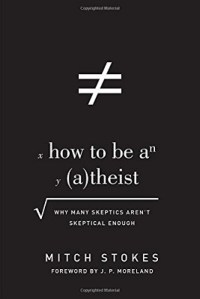 I’ll admit it: going into Mitch Stokes’ How to Be an Atheist: Why Many Skeptics Aren’t Skeptical Enough, I was skeptical [har, har]. Any book that claims to discuss “how to be x” where “x” is some worldview to which the author does not describe has an uphill battle. After finishing, I have to say that my fears were premature. In this astonishing book, Stokes does well what few even attempt: relational, witty engagement with those with whom one disagrees. The book is a calling for self-described skeptics to examine their own skepticism and see whether they are being skeptical enough. Throughout the book, key tenets of “belief” that most people share are challenged by means of classical and modern skeptical argument. Few aspects of life are left unexamined. Whether it is the belief in other minds, morality, or the origin of the universe, Stokes encourages consistent skepticism on all counts.
The book is organized around three parts: Sense and Reason, Science, and Morality. Stokes avoids the potential pitfalls of getting bogged down in complex attempts to defend an alternative view and focuses instead upon skeptical inquiry. He takes a microscope to these topics and asks, effectively, “How should we treat this topic if we were really going to be skeptics?” It’s a refreshing perspective, and one that makes the book highly readable. It reads like an inquiry in the best, technical sense of the term.
‘How do the topics of this inquiry fare?’ you might wonder. Under skeptical scrutiny, very little is left for us. This is not an extended apologetic for the Christian faith. No, this book is specifically aimed at seeing where skepticism takes us if we are actually consistent about it. Free will, objective morality, sense perception, and even realism about scientific inquiry are each cast into doubt. None of this is done in a condescending way or through trickery. Instead, Stokes continually utilizes the works of atheists as sources for his points. True skepticism leaves very little to be affirmed in the world, and what is left behind looks rather pale in comparison to what we experience.
How to Be an Atheist is one of those rare apologetics books that could, I think, reasonably be handed to a skeptical, atheistic friend as a book they might be willing to read–and engage with. Stokes’ humorous style is never offputting. Instead, he encourages a consistent, skeptical look at the world. He shows just how bleak such a vision of the world ought to be. Moreover, he does so by using the words and works of atheists themselves. The New Atheists (Sam Harris, Christopher Hitchens, Richard Dawkins, and Daniel Dennett) are featured throughout, but Stokes doesn’t limit the scope of the work to them. He delves deeper, citing some of the great skeptical minds of all time–people like J.L. Mackie and David Hume. The continued engagement with the best and brightest atheists demonstrates a willingness to engage with the “other side” on the part of Stokes that is admirable and fascinating.
If there is anything to critique in this excellent work, it would be that Stokes, having demonstrated the bleak view of the world through skeptical eyes, doesn’t do enough to dig readers back out of the “hole” of doubt that has been descended into. There are a few moments where this happens, but the book is almost entirely a work of skeptical inquiry–showing what it would look like if people consistently applied their skepticism. It is an endeavor to show the absurdity of life without God.
How to Be an Atheist: Why Many Skeptics Aren’t Skeptical Enough is an enjoyable read that provides both a mental workout and a bit of fun. It will serve as a valued reference and resource for me for some time to come, I’m sure. I recommend it very highly.
The Good
+Humorous examples
+Encourages consistency
+Engages top skeptical minds
+Valuable resource all-around
The Bad
-Little direction about where to go next
Disclaimer: I received a copy of this book for review from the publisher. I was not required to provide any specific kind of feedback whatsoever.
Source
Mitch Stokes, How to Be an Atheist: Why Many Skeptics Aren’t Skeptical Enough (Wheaton, IL: Crossway, 2016).
Links
Be sure to check out the page for this site on Facebook and Twitter for discussion of posts, links to other pages of interest, random talk about theology/philosophy/apologetics/movies and more!
Book Reviews– There are plenty more book reviews to read! Read like crazy! (Scroll down for more, and click at bottom for even more!)
Eclectic Theist– Check out my other blog for my writings on science fiction, history, fantasy movies, and more!
SDG.
——
The preceding post is the property of J.W. Wartick (apart from quotations, which are the property of their respective owners, and works of art as credited; images are often freely available to the public and J.W. Wartick makes no claims of owning rights to the images unless he makes that explicit) and should not be reproduced in part or in whole without the expressed consent of the author. All content on this site is the property of J.W. Wartick and is made available for individual and personal usage. If you cite from these documents, whether for personal or professional purposes, please give appropriate citation with both the name of the author (J.W. Wartick) and a link to the original URL. If you’d like to repost a post, you may do so, provided you show less than half of the original post on your own site and link to the original post for the rest. You must also appropriately cite the post as noted above. This blog is protected by Creative Commons licensing. By viewing any part of this site, you are agreeing to this usage policy.
Book Review: “The Reality of God and Historical Method” by Samuel V. Adams
The Reality of God and Historical Method by Samuel V. Adams offers an in-depth look into how God’s existence impacts historical method. Adams specifically utilizes the work of N.T. Wright as a lens for apocalyptic theology and historical study.
The central thesis of the book is that the reality of God ought to have a significant impact on our historical method. Thus, a method like N.T. Wright’s which specifically sets out to treat the Bible like any other historical book takes away the power of God’s breaking into history. God’s activity in history causes an “irruption” in which history is reconstituted and centered around that event. Specifically, Jesus Christ’s death and resurrection entail that all of history is now oriented around those events, rather than being a kind of unified whole without any outside influence.
Adams pursues his argument by first outlining Wright’s historical method. Then, he introduces the notion of a theological view of history. For Adams, history ought to be informed by theology. The reason for this is because Christology demands that if Christianity is true, then God’s acting in history ought to determine how history is done, rather than having Christians attempt to do history in a way that puts God on the sideline. Thus, history is not a continuous chain, but rather the in-breaking of God into history brings discontinuity. Adams therefore argues that historiography cannot be theologically neutral. Believing God exists means that the way we do history must itself change. He uses the notion of apocalyptic to show how this method plays out, with theology informing historical study.
The book provides fascinating insight into and critique of N.T. Wright’s historical method, but it is much more than that. Adams presents a significant step forward into how theological history is to be understood.
The main criticism I have of the book is that it does little to present how, exactly, one is to do history going forward. Granting the notion of God’s in-breaking into history and the discontinuity that makes, what impact does this make for historical study beyond those things we tend to think of as theological. For example, how does Adams’ view of historical method impact how one does investigation into a specific event like McCarthyism or the Presidency of George Washington? Does it have no impact at all? That seems to be unlikely given the commitments Adams has drawn out. Does it mean that all history must be redefined by God’s in-breaking of the Word? If so, how?
The Reality of God and Historical Method is a fascinating, deep work that warrants careful reading. It is the kind of book that opens up new avenues to explore, and I think it should make an impact farther reaching than just one book. It will be interesting to see if Adams will continue the project and offer a way to interpret history more broadly than apocalyptically.
The Good
+In-depth look at N.T. Wright’s historical method
+Fascinating thesis with historical and theological import
+Well-documented with many insights
+New avenues to explore
The Bad
-Not enough specifics on a way forward
Disclaimer: I was provided with a copy of this book for review by the publisher. I was not required to write any specific kind of feedback whatsoever.
Source
Samuel V. Adams, The Reality of God and Historical Method (Downers Grove, IL: InterVarsity, 2015).
Links
Be sure to check out the page for this site on Facebook and Twitter for discussion of posts, links to other pages of interest, random talk about theology/philosophy/apologetics/movies and more!
Book Reviews– There are plenty more book reviews to read! Read like crazy! (Scroll down for more, and click at bottom for even more!)
Eclectic Theist– Check out my other blog for my writings on science fiction, history, fantasy movies, and more!
SDG.
——
The preceding post is the property of J.W. Wartick (apart from quotations, which are the property of their respective owners, and works of art as credited; images are often freely available to the public and J.W. Wartick makes no claims of owning rights to the images unless he makes that explicit) and should not be reproduced in part or in whole without the expressed consent of the author. All content on this site is the property of J.W. Wartick and is made available for individual and personal usage. If you cite from these documents, whether for personal or professional purposes, please give appropriate citation with both the name of the author (J.W. Wartick) and a link to the original URL. If you’d like to repost a post, you may do so, provided you show less than half of the original post on your own site and link to the original post for the rest. You must also appropriately cite the post as noted above. This blog is protected by Creative Commons licensing. By viewing any part of this site, you are agreeing to this usage policy.
Book Review: “Modern Orthodox Thinkers” by Andrew Louth
 Modern Orthodox Thinkers presents a survey of recent Orthodox thinkers that goes beyond what a word like “survey” may imply. Andrew Louth manages to bring readers into an experiential awareness of Orthodoxy lived.
After an introductory chapter about the Philokalia, a collection of texts by Orthodox thinkers that emphasis a spiritual dimension to faith, twenty chapters present a number of Orthodox believers–from members of the church hierarchy to lay theologians–to readers. Each chapter provides a brief overview of the life of the thinker(s), a survey of their writings, and a focused look at selected aspects of their thought.
There is something here for almost any reader who is looking to glean from Orthodox thought. Whether it is Vladimir Solov’ev’s reflection on Sophia or Mother Thekla (Sharf)’s insight into Shakespeare, Keats, and others, Modern Orthodox Thinkers is a grab-bag of topics that will interest anyone. What’s more, the book presents these thinkers in such a way as to seemingly bring them into conversation with the reader. There is a sense of intimacy in the way that Louth presents the theology of each one that makes it go beyond a mere presentation of thought and towards an experiential awareness of the way theology is done.
Another strength of Louth’s work is that he brings women’s voices into the conversation as well. Too often, surveys of theological writers skip over the contributions women have made throughout history. Not so in this book, in which women thinkers are some of the most interesting people presented. For example, St Maria of Paris (Mother Maria Skobtsova)’s life was perhaps the most moving of all those presented. After the loss of a child, she pursued a life of helping others, taking the place of a Jew to go into a concentration camp, only to be executed in a gas chamber, again having taken the place of someone else (116). Her theology was that of lived theology, and it challenges readers to pursue the same lived faith for their own lives.
One difficulty with the book is that it will, at times, be completely impenetrable for the uninitiated (including the current reviewer). Although a brief introduction to the Philokalia is given, there is never a clear sense of exactly what it is supposed to be or how it is supposed to influence the thinkers presented. Other things are referenced in an offhand manner which gives little ground for readers to understand what is being discussed. For example, the “hesychast controversy” is presented with only the barest historical background of what it is supposed to be, despite the fact that it features prominently in several thinkers’ chapters. Although this was likely done due to space limitations and/or to keep the focus on the thinkers rather than on side issues, deeper discussion in the footnotes or even an extra paragraph would help those who are unfamiliar with Orthodoxy to understand more of the individual chapters.
Modern Orthodox Thinkers will challenge readers on a number of levels. First, it brings into focus the notion of a Christian life lived, whether by someone in the church or as someone who seeks to live as a Christian. Second, it will spur readers to a deeper understanding and exploration of Orthodox thought. Third, the breadth of topics will open readers to new avenues to explore. The book comes recommended.
The Good
+Impressive mix of topics and authors
+Includes women’s voices
+Experiential feeling to the writing
+Very broad scope
The Bad
-At times impenetrable for the uninitiated
Source
Andrew Louth, Modern Orthodox Thinkers (Downers Grove, IL: InterVarsity, 2015).
Disclaimer: I was provided with the book for review by the publisher. I was not required to provide any sort of feedback whatsoever.
Links
Be sure to check out the page for this site on Facebook and Twitter for discussion of posts, links to other pages of interest, random talk about theology/philosophy/apologetics/movies and more!
Book Reviews– There are plenty more book reviews to read! Read like crazy! (Scroll down for more, and click at bottom for even more!)
Eclectic Theist– Check out my other blog for my writings on science fiction, history, fantasy movies, and more!
SDG.
——
The preceding post is the property of J.W. Wartick (apart from quotations, which are the property of their respective owners, and works of art as credited; images are often freely available to the public and J.W. Wartick makes no claims of owning rights to the images unless he makes that explicit) and should not be reproduced in part or in whole without the expressed consent of the author. All content on this site is the property of J.W. Wartick and is made available for individual and personal usage. If you cite from these documents, whether for personal or professional purposes, please give appropriate citation with both the name of the author (J.W. Wartick) and a link to the original URL. If you’d like to repost a post, you may do so, provided you show less than half of the original post on your own site and link to the original post for the rest. You must also appropriately cite the post as noted above. This blog is protected by Creative Commons licensing. By viewing any part of this site, you are agreeing to this usage policy.
Book Review: “Keeping Your Kids on God’s Side” by Natasha Crain
 As a Christian parent, one of the things most important to me is bringing my son up in faith in Christ. As a man with an MA in Christian Apologetics, I know that my child will face many challenges going forward, and that the Christian faith has the answers. The problem, it seems, is figuring out how to unite these two–apologetics and child-rearing–in a way that can be understood by children, without being domineering or scary. Natasha Crain’s book, Keeping Your Kids on God’s Side, is an answer to prayers about this important topic.
The book features 40 “conversations” that can be had with children centered around topics from why we believe the Bible and textual criticism to the existence of God to questions about science and Christianity. Each of these chapters provides an introduction to the topic at hand. Crain utilizes stories of her own children quite well to demonstrate how these conversations might play out–or how they might get started.
The most helpful aspect of the book is that it provides a kind of all-in-one reference for common questions and apologetic topics that can be used to start children on the right path towards defending their faith and the calling of 1 Peter 3:15-16. Each of the 40 conversations is one that is worth having, and is often accompanied with quotes from prominent atheist thinkers to show the objections often raised to the faith.
Crain also does a good job of presenting multiple sides of controversial topics without specifying a side. For example, in the chapter on hell, she presents historical Christian positions (a literal view, a figurative view with eternal punishment, and the conditionalist view). The one place there is a bit of a slip on this regard is when it comes to the creation and evolution debate. She adequately presents both young and old earth creationism, but only gives a view like theistic evolution a passing mention, despite having seemingly increasing support among evangelicals.
A downside to the variety of topics that Crain presents is that she is only ever able to scratch the surface on each. The type of book it is basically makes this a necessity, and Crain does provide resources for further reading. Parents should note that they will need to utilize these resources for continuing conversations.
Keeping your Kids on God’s Side is a phenomenal work. It is the kind of book that parents will come back to time and time again. Not only that, but it has broad enough appeal that it serves as an excellent general apologetic work. It will energize parents to start these conversations with their children and give them the tools to keep them going. I highly recommend this work.
The Good
+Broad-minded approach that doesn’t tell readers what to think on controversial topics
+Clear tone and presentation
+Astounding number of topics introduced with valuable information
+Offers several key points to help discuss topics with children
The Bad
-Very brief on several points
-Doesn’t address full breadth of views on creation/evolution
Disclaimer: I received the book for review from the author. I was not obligated to provide any specific kind of feedback whatsoever.
Source
Natasha Crain, Keeping Your Kids on God’s Side (Eugene, OR: Bethany House Publishers, 2016).
Links
Be sure to check out the page for this site on Facebook and Twitter for discussion of posts, links to other pages of interest, random talk about theology/philosophy/apologetics/movies and more!
Book Reviews– There are plenty more book reviews to read! Read like crazy! (Scroll down for more, and click at bottom for even more!)
Eclectic Theist– Check out my other blog for my writings on science fiction, history, fantasy movies, and more!
SDG.
——
The preceding post is the property of J.W. Wartick (apart from quotations, which are the property of their respective owners, and works of art as credited; images are often freely available to the public and J.W. Wartick makes no claims of owning rights to the images unless he makes that explicit) and should not be reproduced in part or in whole without the expressed consent of the author. All content on this site is the property of J.W. Wartick and is made available for individual and personal usage. If you cite from these documents, whether for personal or professional purposes, please give appropriate citation with both the name of the author (J.W. Wartick) and a link to the original URL. If you’d like to repost a post, you may do so, provided you show less than half of the original post on your own site and link to the original post for the rest. You must also appropriately cite the post as noted above. This blog is protected by Creative Commons licensing. By viewing any part of this site, you are agreeing to this usage policy.
Book Review: “Edwards on the Christian Life” by Dane C. Ortlund
 Jonathan Edwards is perhaps the most famous of all American theologians. Edwards on the Christian Life draws from his enormous body of work to provide insight into Christian life.
The book is organized around chapters which each focus on one aspect of the Christian life, according to Edwards. Chapters include Joy, Beauty, Heaven, Satan, and more. Each of these is oriented around showing how the chapter’s title relates to Edwards’ view of the Christian life. The chapter on beauty provides a feel for the rest of the book, as Ortlund argues that Edwards’ view of God as beauty/beautiful impacts most of the rest of his theology. The chapter on heaven was particularly excellent. On heaven, Edwards’ vision of the beauty that believers would experience and the way they would interact is brought forth by Ortlund in breathtaking fashion. It is rare to find myself filled with emotion while reading a theology book, but Ortlund’s work in this chapter had me just overcome with awe at the beauty of how Edwards described it.
Other chapters were quite helpful as well, such as the chapters on pilgrimage, obedience, and Satan, set all in a row, which outlined the Christian life, sanctification, and spiritual warfare and temptation respectively. The insights to be drawn from this book on Christian living ought not be understated. Ortlund did a great job bringing forward many of these insights.
Ortlund admirably steers clear of the primary pitfall of some books in the series–getting so caught up in discussing the theology of the person being examined that the book loses focus on “the Christian Life.” This is not to say any of the books in the series are bad–indeed, I have read many and enjoyed them all–but it is good to have the focus on the topic at hand. Each aspect of Edwards’ theology that is examined here is brought to bear on the Christian life in meaningful ways.
The one criticism I have is, ironically, of the criticisms offered. The final chapter (apart from the conclusion) offers four criticisms of Edwards’ theology, such as an overly introspective view. Although I think Ortlund’s criticisms of Edwards are on point, they could have been better dealt with in individual chapters. It’s a minor criticism for a phenomenal book.
Edwards on the Christian Life is yet another excellent entry in the “Theologians on the Christian Life” series. Ortlund introduces readers to a fantastic range of Edwards’ thought, all while remaining focused on how that thought applies to the Christian life. Indeed, it made me want to read more of Edwards myself. I recommend it highly.
The Good
+Amazing chapter on heaven
+Practical examples of Christian living
+Focused and concise
+Excellent format
The Bad
-Criticisms could have been better placed
Source
Dan C. Ortlund, Edwards on the Christian Life (Wheaton, IL: Crossway, 2014).
Disclaimer: I received a copy of the book from the publisher. I was not required to give any specific feedback whatsoever.
Links
Be sure to check out the page for this site on Facebook and Twitter for discussion of posts, links to other pages of interest, random talk about theology/philosophy/apologetics/movies and more!
Book Reviews– There are plenty more book reviews to read! Read like crazy! (Scroll down for more, and click at bottom for even more!)
Eclectic Theist– Check out my other blog for my writings on science fiction, history, fantasy movies, and more!
SDG.
——
The preceding post is the property of J.W. Wartick (apart from quotations, which are the property of their respective owners, and works of art as credited; images are often freely available to the public and J.W. Wartick makes no claims of owning rights to the images unless he makes that explicit) and should not be reproduced in part or in whole without the expressed consent of the author. All content on this site is the property of J.W. Wartick and is made available for individual and personal usage. If you cite from these documents, whether for personal or professional purposes, please give appropriate citation with both the name of the author (J.W. Wartick) and a link to the original URL. If you’d like to repost a post, you may do so, provided you show less than half of the original post on your own site and link to the original post for the rest. You must also appropriately cite the post as noted above. This blog is protected by Creative Commons licensing. By viewing any part of this site, you are agreeing to this usage policy.
Book Review: “Pitfalls: A Quick Guide to Identifying Logical Fallacies for Families” by J.D. Camorlinga
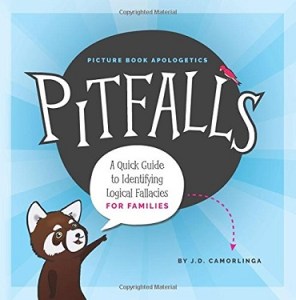
Pitfalls: A Quick Guide to Identifying Logical Fallacies for Families provides a way to teach logic in a concise, easy to understand format. The book is part of the “Picture Book Apologetics” series and approaches the fallacies from the stance of teaching children to engage in conversations about their faith, though it is clearly broadly applicable.
The fallacies covered in this book are informal fallacies, though at the end the authors note the difference between formal and informal fallacy. Both the back cover and the table of contents explain what a logical fallacy is. Fallacies covered include ad hominem, appeal to force, equivocation, and many more. There are 24 covered in all, along with the distinction made between informal and formal. Each features an illustration with a dialogue between various delightful critters demonstrating the fallacy. Many of the explanations close with a humorous application of the fallacy. Each explanation is about 50-80 words long (I counted a few of them).
The explanations are clear and concise, to the point where they would frankly serve the introductory philosophy course as well as the six-year-old. They’re impressively well done and with plenty of humor on the side for older children and adults. It is rare I find myself really enjoying a children’s book, but this is one that easily fits in that category.
I put the book through the rigorous test of seeing how long the illustrations could please my son. He isn’t quite a year and a half old yet, and his attention span reflects that. Nevertheless, he touched many of the cutely drawn animals and even made (highly accurate) animal noises for a few. Given that both I and my son enjoyed the illustrations, I think its safe to say they’re well done.
I would be a poor reviewer if I didn’t note the tongue-in-cheek humor behind some of these illustrations. For example, the fallacy of “Begging the Question” is clearly a depiction of Joseph Smith with the gold plates for the Book of Mormon, and the “Genetic Fallacy”‘s illustration is a pair of Jehovah’s Witness gerbils (or hamsters? I can never keep them straight). These do not mock these groups, but instead expose their ideas in the briefest conversation bubble and show some of the fallacious reasoning behind them. It’s done smartly.
It’s difficult to judge exactly how easily understood these fallacies are made by the book with myself and my son as subjects, but having discussed this kind of thing with parents who have older children, I believe this book would be highly beneficial for introducing some heady concepts at fairly young ages. Of course, do that at your own risk as you will be training little lawyers. Each explanation is quite brief, to the point where a few times I wish there had been just a little more clarification. It’s hard to fault that, however, given the intended audience of the book.
Pitfalls: A Quick Guide to Identifying Logical Fallacies for Families is just as advertised, but with no small amount of wit. It is both informative and delightful, well-illustrated and humorous. I highly recommend it.
The Good
+Clever examples
+Cute illustrations
+Grab-bag of information
+Useful for review
The Bad
-Could be a bit more expansive on a few topics
Disclaimer: I was provided with a copy of the book by the publisher. I was not required to give any specific kind of feedback whatsoever.
Source
J.D. Carmolinga Pitfalls: A Quick Guide to Identifying Logical Fallacies for Families (Whittier, CA: Picture Book Apologetics, 2015).
Links
Be sure to check out the page for this site on Facebook and Twitter for discussion of posts, links to other pages of interest, random talk about theology/philosophy/apologetics/movies and more!
Book Reviews– There are plenty more book reviews to read! Read like crazy! (Scroll down for more, and click at bottom for even more!)
Eclectic Theist– Check out my other blog for my writings on science fiction, history, fantasy movies, and more!
SDG.
——
The preceding post is the property of J.W. Wartick (apart from quotations, which are the property of their respective owners, and works of art as credited; images are often freely available to the public and J.W. Wartick makes no claims of owning rights to the images unless he makes that explicit) and should not be reproduced in part or in whole without the expressed consent of the author. All content on this site is the property of J.W. Wartick and is made available for individual and personal usage. If you cite from these documents, whether for personal or professional purposes, please give appropriate citation with both the name of the author (J.W. Wartick) and a link to the original URL. If you’d like to repost a post, you may do so, provided you show less than half of the original post on your own site and link to the original post for the rest. You must also appropriately cite the post as noted above. This blog is protected by Creative Commons licensing. By viewing any part of this site, you are agreeing to this usage policy.
Book Review: “The Open Minded Christian” by Richard Bushey
Richard Bushey’s book, The Open Minded Christian: How to Engage Charitably with Fellow Sinners presents a message that we often need to hear. That message is one of Christian love for neighbor.
Bushey outlines this necessary love of neighbor broadly in the first several chapters, noting that too often Christians tend to treat other Christians as though they were necessarily enemies of the faith. Moreover, this lack of charity extends to non-Christians as well. Repeated challenges are issued throughout the book for Christians to re-examine their own attitudes.
Several of the examples used to this regard are utilized very effectively. Bushey leads with a hot-button word like “evolution” or “homosexuality” and then turns around and presents analysis of how Christians tend to react to such topics. After that, he issues a call to Christians to act more Christlike in disagreement and to avoid jumping to conclusions about the “other” when it comes to issues like these. Thus, in the chapter on homosexuality, Bushey notes how quick many Christians are to disown or disavow people who are homosexual, thus leading to a continuing circle of anger and frustration. These and other examples are enlightening and help to bring to light how we ought to have a greater love of neighbor, even if we do not love everything about them.
A difficulty with the book is that there are many assertions about how certain groups shouldn’t split that ultimately seem unsubstantiated. For example: “[T]here is no ecclesiological reason that Calvinists and Arminians cannot congregate together” (7). First, what is meant by an “ecclesiological reason” as opposed to some other reason? A little ways down on the same page, Bushey seems to define what is meant by the term “ecclesiological reason”: “That is to say that if a church’s general practice is different from another, then creating different denominations make sense.” Second, why limit the scope of separation between denominations/churches to whatever is meant by “ecclesiological” reasons?
Given the definition Bushey apparently offers for “ecclesiological reason,” though, it seems that groups like Calvinists and Arminians do have reasons not to congregate together. For, if the umbrella is “general practice,” then many Calvinist churches have a general practice to speak of the sovereign decree of God in sermons and Bible studies; while many Arminian churches have a general practice to critique Calvinism from the pulpit (I have experienced both instances personally in different churches). Just a paragraph or so later, Bushey further clarifies, claiming that such ecclesiological differences are to be differentiated from “secondary” or “tertiary” differences, but again we have no definition of what is meant by those. I doubt that most convinced Arminians or Calvinists would feel their adherence to those sets of theological teachings are merely secondary or tertiary, given that it often comes back to the doctrine of God; but that is neither here nor there. The point is that some definitions offered at the outset would improve this work immensely.
Another problem is that Bushey at times mischaracterizes theological opponents when trying to demonstrate we ought not to do that very thing. For example, in section in which he is arguing that Christians ought to challenge their own beliefs in order to see if they match with reality, he writes, “The person who believes that water baptism washes away sins should dive into Romans 3-5 and try to prove that their view is wrong. They should read the text closely with the end in mind of proving that salvation comes by faith alone to the exclusion of baptism” (73). But this is a clear misunderstanding of what baptismal regeneration teaches. As one who affirms that (a Lutheran), I was shocked to see how my view was so clearly misrepresented here. It’s not as though by believing in baptismal regeneration, I deny salvation by faith alone. Far from it, and this shows how crucial a misunderstanding Bushey has here, for he seems to think that the view entails a kind of works-righteousness. Instead, Lutherans see baptism as a means of grace–an act of God; not a work of humanity. It was pretty jarring to have such a clear lack of understanding in a book that continually encourages understanding the other side.
Another example of this is the offhanded comment on the hypostatic union as allegedly entailing a kind of contradiction: “In the case of the hypostatic union, adherents deny that there are two persons within Christ, even though their view logically entails it” (88-89). Given that the hypostatic union has historically been affirmed as an orthodox understanding of Christology, and is used exactly to demonstrate that the two natures of Christ explicitly do not entail two persons, this is an astonishing statement. Indeed, one might ask how, exactly, two natures “logically entails” two persons. It doesn’t, and this basic, nonchalant dismissal of orthodox Trinitarian theology as being “inconsistent” is disappointing, to say the least.
The Open-Minded Christian is ultimately an uneven ride. The central message is one that needs to be heard, but it is surrounded by some serious misunderstandings and misrepresentations that make it difficult to take it as seriously as we ought to. It is worth a read for the good examples, but requires a critical eye.
The Good
+Some examples utilized quite effectively
The Bad
-Theologically suspect at times
-Some basic misunderstandings of opposing views
-Some grammatical errors
Disclaimer: I was provided with a copy of the book for review by the author. I was not obligated to provide any specific kind of feedback whatsoever.
Links
Be sure to check out the page for this site on Facebook and Twitter for discussion of posts, links to other pages of interest, random talk about theology/philosophy/apologetics/movies and more!
Book Reviews– There are plenty more book reviews to read! Read like crazy! (Scroll down for more, and click at bottom for even more!)
Eclectic Theist– Check out my other blog for my writings on science fiction, history, fantasy movies, and more!
SDG.
——
The preceding post is the property of J.W. Wartick (apart from quotations, which are the property of their respective owners, and works of art as credited; images are often freely available to the public and J.W. Wartick makes no claims of owning rights to the images unless he makes that explicit) and should not be reproduced in part or in whole without the expressed consent of the author. All content on this site is the property of J.W. Wartick and is made available for individual and personal usage. If you cite from these documents, whether for personal or professional purposes, please give appropriate citation with both the name of the author (J.W. Wartick) and a link to the original URL. If you’d like to repost a post, you may do so, provided you show less than half of the original post on your own site and link to the original post for the rest. You must also appropriately cite the post as noted above. This blog is protected by Creative Commons licensing. By viewing any part of this site, you are agreeing to this usage policy.
Book Review: “Partners in Christ: A Conservative Case for Egalitarianism” by John G. Stackhouse, Jr.
 Partners in Christ: A Conservative Case for Egalitarianism is a challenging, extraordinary work. The first thought many readers might have when they see the title of this book is “A conservative case for egalitarianism? What!?” Yet that is exactly what this is. John G. Stackhouse, Jr. presents a case for egalitarianism that will challenge those on either side of the issue to rethink various aspects of their view.
The book is organized around a number of chapters, each of which is quite short. Each chapter’s title basically states what the goal of that chapter is. For example, a chapter entitled “Counterarguments from Church History” presents counterarguments to Stackhouse’s position from, well, church history. The organization is helpful, though it should not be mistaken for a license to jump around within the book. The case made herein is progressive and builds up over the course of the whole book.
Central to Stackhouse’s model is the notion that complementarians and egalitarians often talk past each other or fail to recognize the genuine concerns and possible insights from the “other side.” Thus, he challenges egalitarians to take more seriously the arguments for maintaining complementarity in gender, while he pushes complementarians to realize how often their case is based on presupposition rather than the biblical texts themselves. In other words, Stackhouse is going to make you uncomfortable, no matter what your position is. And, frankly, that’s a good thing. I’m a staunch egalitarian who used to be just as entrenched a complementarian, and it was good for me to have a book that challenged the assumptions I’m working under now. I think that effectively any reader could benefit from Stackhouse’s approach, even in disagreement.
The breadth of topics the book addresses makes it an excellent resource. Church history, theology, exegesis, modern social science, and more are each pieces of evidence that is brought forward to shed light on the issue. Particularly interesting was the chapter “Why, then, Do Women Not Lead?” which answered the question with a number of arguments from social science to theology. This kind of integrated approach is used beneficially throughout the book.
A disadvantage of the way the book is organized is that there is little space to dedicate to individual exegesis. Make no mistake, this is not the strongest egalitarian case from the Bible that can be made. It is an introduction to the full scope and depth of egalitarian arguments, yes, but it should not be mistaken for the most powerful argument possible.
Stackhouse’s ultimate conclusion is that women should be allowed the same roles in leadership in the church and home as men are allowed to fulfill. Again, this is not to say he will not challenge those who agree with this conclusion. I was taken aback by how fair and balanced this case was, and I know of no other book that presents as broad an introduction to such a complex topic as this one. I highly recommend Partners in Christ to you.
The Good
+Will challenge virtually every reader
+Excellent case, in brief, for egalitarianism
+Addresses wide variety of topics, arguments, and counter-arguments
+Balanced approach
The Bad
-Quite brief on several key points
-Concedes the notion of the “feminization of worship”
Disclaimer: I was provided with a copy of this book for review by the publisher. I was not required to write any specific kind of feedback whatsoever.
Source
John G. Stackhouse, Jr. Partners in Christ (Downers Grove, IL: InterVarsity, 2015).
Links
Be sure to check out the page for this site on Facebook and Twitter for discussion of posts, links to other pages of interest, random talk about theology/philosophy/apologetics/movies and more!
Book Reviews– There are plenty more book reviews to read! Read like crazy! (Scroll down for more, and click at bottom for even more!)
Eclectic Theist– Check out my other blog for my writings on science fiction, history, fantasy movies, and more!
SDG.
——
The preceding post is the property of J.W. Wartick (apart from quotations, which are the property of their respective owners, and works of art as credited; images are often freely available to the public and J.W. Wartick makes no claims of owning rights to the images unless he makes that explicit) and should not be reproduced in part or in whole without the expressed consent of the author. All content on this site is the property of J.W. Wartick and is made available for individual and personal usage. If you cite from these documents, whether for personal or professional purposes, please give appropriate citation with both the name of the author (J.W. Wartick) and a link to the original URL. If you’d like to repost a post, you may do so, provided you show less than half of the original post on your own site and link to the original post for the rest. You must also appropriately cite the post as noted above. This blog is protected by Creative Commons licensing. By viewing any part of this site, you are agreeing to this usage policy.
Book Review: “Judges and Ruth: God in Chaos” by Barry Webb

Barry Webb’s commentary, Judges and Ruth: God in Chaos is part of the “preaching the word” series and presents the books in a pastoral, conversational fashion.
Webb continually brings up details of the text that are overlooked, bringing to light wonderful insights where people may tend to skip over. Minor judges (like Shamgar) are at times given as much detailed discussion as those we might consider more important. There is a clear method to this, as Webb seems uninterested in sharing those things readers learned and re-learned since Sunday School. This is a book that feels fresh and exciting–and I’ve read one of Webb’s other commentaries on Judges!
These insights are not limited to the minor judges, however. The sections on Gideon, Ehud, and Samson (one of my favorite Bible personages) are particularly excellent. Each will make readers look with more depth even at stories they think they knew. For example, regarding Eglon, the king Ehud kills, Webb points out that readers of the story should reflect on the interplay between Ehud’s bringing a harvest tribute and the corpulence of Eglon. The fatness of Eglon is, ironically, in part due to his gleaning food from Israel! It is just this kind of deep look at the text that can be found throughout the book, time and again, regarding the judges and Ruth.
The tone of the book is quite pastoral. There are no sections of Hebrew painstakingly pored over word-by-word. Admittedly, I love that kind of commentary. That’s not the kind of commentary this is. Instead, it is presented in a kind of conversational style that takes you directly to the story. A good word to describe the style is “immersive”: reading the commentary makes one feel as though they are inside the Bible story themselves, experiencing it, and seeing the world anew as the contemporaries might have. It is a pretty thrilling experience.
The section on Deborah as a “maverick” is unfortunate, because it undercuts the importance of the woman Deborah (though calling her a “maverick” seems on-point). Webb has written elsewhere (his commentary in the New International Commentary on the Old Testament Series on Judges) about how “there is no hint in the narrative or elsewhere in Scripture that her [Deborah’s] exercise of such a role [as leader/judge/prophetess] was contrary to God’s purposes, or a breach of his declared will in the way that the irregular worship practices of the period were” (Webb, The Book of Judges, (Eerdman’s, 2012) 188). Here, however, Webb qualifies this endorsement, carefully pointing to a pattern of male leadership throughout the Old Testament and arguing that Deborah is exceptional in her role here as prophetess/Judge. Yet in the same chapter, he also notes how the Old Testament is a patriarchal culture, which makes Deborah’s function as judge/prophetess even more exceptional! The exceptional nature, however, is not that it is improper–as Webb himself admits–but rather that her acting in this function, a prophetess called by God, challenges the very patriarchy that Webb has noted (and, at times, challenged himself) as the background for Old Testament practices. That is, Deborah functions as an attack on that paradigm, not a confirmation of it.
Though Webb notes that Deborah was praised in her function, he nowhere points out how this very act of praising Deborah for her role as leader and prophetess of Israel entails a theological truth of the gifting of God for women in such positions. I was disappointed to see this subtle shift in Webb’s affirmations about Deborah from his other commentary. This makes the section on Deborah less insightful than it could have been, however, particularly given her importance in the book of Judges.
Judges and Ruth: God in Chaos is a beautiful, pastoral book full of insights that will have you scrambling to grab your Bible and make notes. Although it isn’t perfect, it is a worthwhile read that will open the pages of the books covered in new ways. It is recommended.
The Good
+Full of intriguing details
+Immersive, engaging writing style
+Continually takes readers back to the text
+Plenty of background information
The Bad
-Inserts complementarian language into discussion of Deborah
Disclaimer: I received a copy of the book for review from the publisher. I was not required to provide any specific kind of feedback whatsoever.
Source
Barry Webb, Judges and Ruth: God in Chaos (Wheaton, IL: Crossway, 2015).
Links
Be sure to check out the page for this site on Facebook and Twitter for discussion of posts, links to other pages of interest, random talk about theology/philosophy/apologetics/movies and more!
Book Reviews– There are plenty more book reviews to read! Read like crazy! (Scroll down for more, and click at bottom for even more!)
Eclectic Theist– Check out my other blog for my writings on science fiction, history, fantasy movies, and more!
SDG.
——
The preceding post is the property of J.W. Wartick (apart from quotations, which are the property of their respective owners, and works of art as credited; images are often freely available to the public and J.W. Wartick makes no claims of owning rights to the images unless he makes that explicit) and should not be reproduced in part or in whole without the expressed consent of the author. All content on this site is the property of J.W. Wartick and is made available for individual and personal usage. If you cite from these documents, whether for personal or professional purposes, please give appropriate citation with both the name of the author (J.W. Wartick) and a link to the original URL. If you’d like to repost a post, you may do so, provided you show less than half of the original post on your own site and link to the original post for the rest. You must also appropriately cite the post as noted above. This blog is protected by Creative Commons licensing. By viewing any part of this site, you are agreeing to this usage policy.
Book Review: “American Exceptionalism and Civil Religion” by John Wilsey
John D. Wilsey’s American Exceptionalism and Civil Religion sheds light on the ways that Americans through history have conceived of the United States as a blessed nation.
The book is organized around various historical periods, from the origins of exceptionalism in the earliest colonial periods to modern times. One aspect of American exceptionalism is “the idea that Americans are a people specially chosen by God and given a destiny to fulfill by him…” (16, cited below). Throughout the book, Wilsey shows how this idea has developed and how it has negatively impacted not only our theology but also the way the country developed politically and ethically.
Wilsey traces the sad history of slavery and expansion into North America, highlighting how the ideology of American Exceptionalism played into the whole endeavor. Because that which was deemed “American” was theologically tied to a concept of chosen nation and a skewed view of manifest destiny, people from the lowliest white farmer to the President of the United States were able to justify heinous acts upon fellow human beings. Furthermore, due to the concept of chosen nation that theologians lifted from the pages of the Bible and applied to the United States, many of these atrocities were dismissed as aspects of a new eschatological narrative pointing towards the concept of America’s growth and civil religion.
This notion is made particularly acute in the chapter entitled “The Innocent Nation” which shows how various American leaders portrayed the United States as innocent and without moral faults. Though this narrative was often challenged, it has been maintained over time and modified to keep up a notion of America as the moral light for all nations. The occasional mixing in of imagery is a powerful way Wilsey depicts narratives like this, such as the image of John Gust’s American Progress (featured on p. 78). Readers are exposed to a number of firsthand accounts and quotes from those involved in the process of theologizing and putting forth ideas about the United States.
Balance is an admirable feature of this book, which cautions against going to extremes in either direction related to the notion of the United States as a chosen nation. Moreover, even when critical of certain figures throughout history, Wilsey notes how many helped to bring about some good as well. For example, a few Presidents have perpetuated notions of America as an “Innocent Nation” while still working for justice and international peace–thus showing that exceptionalism can lead to a belief that those with the blessings ought to use them to help others.
What is all too often lacking in books like this is presentation of a way forward. That is, too often books like this focus solely on showing the problems with systematic corruption or evil, but then leave readers at a loss for how to combat it or try to move beyond it. Wilsey, however, laces commentary on “open exceptionalism” throughout the book as a way for Christians to remain appreciative of the blessings of their country without turning to an unbiblical view of deifying their nation. This open exceptionalism allows for Americans to see the United States as blessed with certain freedoms and prosperity, while still moderating notions that might lead to seeing America as above criticism or without fault. Thus, he provides a way to reevaluate our own views and move towards a position where we can remain patriotic while not falling into the traps of an exceptionalism that redefines Christianity.
American Exceptionalism and Civil Religion is an incisive critique of the notion of American Exceptionalism and Civil Religion. Moreover, it provides a way forward for those wanting to help bring about change.
The Good
+Excellent analysis of American exceptionalism
+Balanced view
+Presents a positive way forward
+Utilizes several threads of evidence
The Bad
-Requires readers to draw out definitions on some points
Disclaimer: I was provided with a review copy of the book by the publisher. I was not required to provide any specific kind of feedback whatsoever.
Source
John D. Wilsey, American Exceptionalism and Civil Religion (Downers Grove, IL: InterVarsity, 2015).
Links
Be sure to check out the page for this site on Facebook and Twitter for discussion of posts, links to other pages of interest, random talk about theology/philosophy/apologetics/movies and more!
Book Reviews– There are plenty more book reviews to read! Read like crazy! (Scroll down for more, and click at bottom for even more!)
Eclectic Theist– Check out my other blog for my writings on science fiction, history, fantasy movies, and more!
SDG.
——
The preceding post is the property of J.W. Wartick (apart from quotations, which are the property of their respective owners, and works of art as credited; images are often freely available to the public and J.W. Wartick makes no claims of owning rights to the images unless he makes that explicit) and should not be reproduced in part or in whole without the expressed consent of the author. All content on this site is the property of J.W. Wartick and is made available for individual and personal usage. If you cite from these documents, whether for personal or professional purposes, please give appropriate citation with both the name of the author (J.W. Wartick) and a link to the original URL. If you’d like to repost a post, you may do so, provided you show less than half of the original post on your own site and link to the original post for the rest. You must also appropriately cite the post as noted above. This blog is protected by Creative Commons licensing. By viewing any part of this site, you are agreeing to this usage policy.

 J.W. Wartick - Reconstructing Faith