Book Reviews
Book Review: “Why It Doesn’t Matter What You Believe If It’s Not True” by Stephen McAndrew
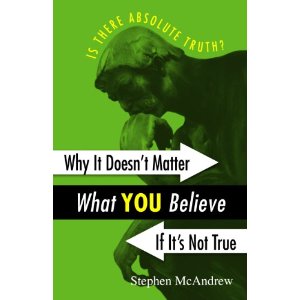 Is there absolute truth? Such is the topic of Stephen McAndrew’s new book, Why It Doesn’t Matter What You Believe If It’s Not True (hereafter DMYB).
McAndrew begins the work by noting that his book is an examination of a position and an affirmation of absolute truth. This is done because it is important to “examine even the most comfortable beliefs and leave standing only those that survive the disciplined assault of reason” (9).
He begins this testing by exploring some philosophical background, from Plato to positivism to relativism. These summaries are succinct, but provide a great background for those who haven’t read much on the topic. He turns next to a discussion of the effects of an abandonment of absolute truth. Relativism divorces one from any capacity to judge right and wrong. McAndrew notes, “These actions [such as the holocaust, racism, etc.] may brutally offend our sense of right and wrong, but the moral relativist cannot apply his or her values to others” (27).
What is interesting, however, is that McAndrew doesn’t stop at discussing relativism alone, but rather a conjunction of two beliefs: relativism and universal human rights. Many people, McAndrew notes, hold to relativism but also want to affirm universal human rights. In DMYB, he uses the discussion of the Nuremberg Tribunals–at which Nazis were tried for war crimes–as a case study for these conflicting views. He notes that “The defendants at Nuremberg argued that international law could only punish states and not individuals…. The Nuremberg court held that individuals could be punished for crimes against humanity under international law” (34).
Relativists, however, cannot consistently agree with the Nuremberg court, because “If there are no absolute truths, there can be no universal human rights” (35). These rights, if relative, are “contingent upon our cultural and historical position…” (ibid).
But relativism has a worse problem–it is contradictory. If all truth is contingent, then the statement “All truth is relative” is also relative, and therefore cannot be true for all people in all places (43ff). McAndrew next turns to the source for the “human rights urge”–the notion that all humans have certain universal rights. This source, argues McAndrew, is God (62ff). He makes a final case study when he turns to art–if there is no absolute truth, then there is no enduring beauty or truth in art (77ff).
The strengths of McAndrew’s book are readily apparent. He does a great job explaining difficult philosophical topics with terms and examples that anyone can understand. Not only that, but his discussion of Wittgenstein and the book 1984 give concrete, workable topics for those interested in the topic to use as talking points. My only criticism is that I believe I found a minor error. On page 85 McAndrew refers to the law of the excluded middle as the law that “propostion A and its direct contradiction–proposition B–cannot both be true at the same time.” This is in fact the law of noncontradiction. The law of the excluded middle is “For any proposition, it is either the case that the proposition is true or its negation is true.” This is a minor quibble, and one can derive the law of noncontradiction from the law of the excluded middle, but I thought I should note it.
Overall, the book may not convince everyone that there is absolute truth, but it will certainly force them to think about the positions they hold and wonder whether they can consistently cling to a relative absolutism. Those who already own a few books on the topic may wonder whether it is worth adding to their collection. Simply put, yes it is, if only to have at hand some great specific examples and talking points to discuss with relativists. It’s also a quick read that can be handed out to friends to open up the path for future discussion. I highly recommend DMYB.
Source
Stephen McAndrew, Why It Doesn’t Matter What You Believe If It’s Not True (Sisters, OR: Deep River, 2012).
Disclaimer: I was provided a review copy of this book by the author. My thanks to Stephen for the opportunity to review his book.
SDG.
——
The preceding post is the property of J.W. Wartick (apart from citations, which are the property of their respective owners) and should not be reproduced in part or in whole without the expressed consent of the author. All content on this site is the property of J.W. Wartick and is made available for individual and personal usage. If you cite from these documents, whether for personal or professional purposes, please give appropriate citation with both the name of the author (J.W. Wartick) and a link to the original URL. If you’d like to repost a post, you may do so, provided you show less than half of the original post on your own site and link to the original post for the rest. You must also appropriately cite the post as noted above. This blog is protected by Creative Commons licensing. By viewing any part of this site, you are agreeing to this usage policy.
Contest: “How My Savior Leads Me” by Terri Stellrecht
 Recently, I reviewed How My Savior Leads Me by Terri Stellrecht. I now have the opportunity to host a free book giveaway in which one winner will be selected to receive a copy of the book. I highly encourage readers to check out the book and Terri’s site, How My Savior Leads Me.
Rules:
Those who wish to participate need only to post a question for the author of the book. The author and I will select a few questions for her to answer, and we will select the winning entry randomly from the total pool of questions selected. (All valid entries will have a chance to win, including those with questions not selected.)You Must Provide a Valid E-Mail Address To Be Selected As A Winner. Please note that only entries that ship to addresses within the Continental United States are eligible. Only one entry per person is allowed, but entrants can choose to enter more than one question should they desire.
“How am I supposed to know what to ask, if I haven’t read the book?”
Well, read the review to get some insight into the book, or check out the handy “look inside” feature on Amazon! Or, if you’re feeling particularly lazy: it’s a book which beautifully reflects on the passing of Trent, Terri’s son. She focuses upon God’s sovereignty and his plan throughout it all and rejoices in the fact that Trent is saved in heaven. So, questions can be asked on anything from divine sovereignty to Christianity generally to personal questions about coping with the loss of a child. But for more, I’d suggest reading the review.
The questions chosen to be answered will be featured following the contest in a follow up post, “Q and A with Terri Stellrecht.”
Any entry deemed offensive will be deleted. The contest will be open through midnight, central time, on February 19th, 2012. The winner will be selected by February 26, 2012.
Disclaimer:
This contest is being held at the sole discretion of J.W. Wartick and Terri Stellrecht. They reserve the right to cancel or amend the details of the contest in any way at any time. Specifically, they will not be held accountable if the book is lost in the mail; if an entry is missed; etc. In other words, this contest is in no way legally binding for any who participate. By submitting an entry, you agree to the stipulations and rules provided in this post.
Book Review: “How My Savior Leads Me” by Terri Stellrecht
It is with great rejoicing that we release our son, Trent Lee Stellrecht, age 12, to our Heavenly Father. Dance before your King, my son (xiii).
“How My Savior Leads Me” by Terri Stellrecht is a beautiful work of theological reflection.
Terri’s son, Trent, passed away at age 12. The first part of the book reflects upon the incident. Everything is set against the background of Terri’s faith. She describes Tren’s life from birth to death, and throughout focuses on the joys of a son and his coming to faith. The reality of sin in the life Trent is acknowledged, even from a young age (10-11). But Trent eventually repented, telling Terri, “I’m not right with God” and repenting, turning to Bible study, and glorying in the Lord (12ff).
But Trent’s life was cut short in a skiing accident. Terri describes the heart-rending scenes. The whole family saw his body, and Terri noted that “There was my son, but it was so clearly not Trent anymore. It was truly just a shell. A beautiful, young, 12-year-old shell of a body… It was so evident that there was no soul left” (32). The family took comfort in the last verses Trent had read, Isaiah 65:17-25, which starts, “See I will create new heavens and a new earth. The former things will not be remembered, nor will they come to mind.” Terri’s description of the funeral and other events surrounding Trent’s death is stirring and easily draws readers in. This is a Christian sister in mourning, and it rends the heart, even as readers rejoice with her that her son is in heaven.
The book continues with several chapters on sovereignty, mourning, and other topics. It concludes with a series of edited blog posts Terri wrote during the period shortly before and after Trent’s death. The blog posts are all worth reading. Readers will delight in Terri’s joy in her son and also weep with her in the times of sorrow. Her exhortations to fellow Christians to “wake up” reflect an intimate knowledge of one’s own standing with God that Christians would do well to remember (132ff).
Theology is found throughout “How My Savior Leads Me.” Terri is consistently affirming of God’s sovereignty. The book makes it very apparent how comforting a strong view of sovereignty can be in times of mourning. Terri writes, “When we are weak, God is strong/ He empowered us to walk through those church doors, and promised to be with us for it all… We acknowledged God’s goodness in His perfect plan…” (40). Later, she writes, “If God ordained the beginning, the middle, and every detail until the end of Joseph’s life, [see the Joseph narrative Genesis chapters 37-50] then isn’t it easy to conclude that He has ordained every detail in our lives as well?” (59). Clearly, the comfort is found in acknowledging that all things are part of God’s plan.
She turns also to the important question “Why has God ordained all things?” The answer Terri provides, on the basis of Ephesians 1:11-12 and Isaiah 43:7 is that it is for God’s glory to show through all things (59ff). “God’s sovereign hand” is found in suffering (61). It is part of a process of sanctification by which we are made holy (62ff).
Now, within the Christian tradition there are those who definitely do not agree that God “ordained” every detail of Joseph’s life, if the sense of “ordained” is “caused.” Here, this reader’s own philosophy of religion may be peeking through, but it does seem that, at times, “How My Savior Leads Me” is advancing theological determinism. That may indeed be the view Terri holds, but it seems to me that such a position is inconsistent with some other propositions she makes. For example, she clearly does seem to hold that Trent willingly came to the faith after being a willing rebel against God’s will earlier in his life. Further, Terri writes, “In God’s sovereign plan, man had to fall so that the glory of God would be revealed to it’s [sic] fullest” (65, emphasis mine). Now, this assertion is highly contentious and doesn’t receive any argument [there are verses on either side of it, but they are used to support propositions in conjunction with them… the quoted statement has no cited verses]. I realize this is a position most in the various Reformed schools hold, but it does require some kind of argument to support it. Many Christians–myself included–certainly do not agree that man “had to fall” in order to reveal God’s glory. Also, Terri briefly admits chagrin at the female chaplain presented to her at the hospital, noting “How many times… have I gone on about women pastors and what I believe about the churches embracing of a practice and position that the Bible clearly lays out as a man’s role?” (31). Again, no argument is made to support this position. It should be noted that these criticisms mostly come from treating the book as something it’s not. The book itself is a book of mourning and theological reflection; it is not a defense of a position. Readers like me who may disagree with some of Terri’s points, but can still laugh, cry, and jump for joy with Terri as we follow her reflective journey in this book.
Ultimately, “How My Savior Leads Me” deserves a read by anyone. I must use the word “beauty” to describe much of the book. It is beautiful to see a mother mourning her son while affirming the Lord. It is beautiful to weep with our fellow Christian as they endure suffering. It is beautiful to look ahead, and to marvel at how our savior leads us.
Terri Stellrecht, How My Savior Leads Me (Bloomington, IN: WestBow, 2011).
Disclaimer: I was provided a review copy of this book by the author. My thanks to Terri for the opportunity to review her book.
SDG.
——
The preceding post is the property of J.W. Wartick (apart from citations, which are the property of their respective owners) and should not be reproduced in part or in whole without the expressed consent of the author. All content on this site is the property of J.W. Wartick and is made available for individual and personal usage. If you cite from these documents, whether for personal or professional purposes, please give appropriate citation with both the name of the author (J.W. Wartick) and a link to the original URL. If you’d like to repost a post, you may do so, provided you show less than half of the original post on your own site and link to the original post for the rest. You must also appropriately cite the post as noted above. This blog is protected by Creative Commons licensing. By viewing any part of this site, you are agreeing to this usage policy.
Book Review: “Material Beings” by Peter van Inwagen
 Peter van Inwagen presents a discussion of composition in his work, Material Beings
there are no tables or chairs or any other visible objects except living organisms (1).
This sounds odd to a great many people, and he acknowledges this. The thesis, however, solves many of the standard problems of composition. Specifically, van Inwagen seeks to answer, specifically, the special composition question: “In what circumstances is a thing a (proper) part of something?” (21). He surveys traditional answers to this question and finds them wanting. Some have argued simply that “contact” is enough to deduce when an object is composed of other objects, but van Inwagen utilizes a series of thought experiments to show this cannot be right (33ff). Specific types of physical bonding fair no better (61ff) while nihilism (there are no composite objects) and universalism (one can’t compose something, because if there are disjoint xs they compose something [74]) fall victim to a number of difficulties (72ff).
Van Inwagen therefore suggests that one way to show that things are composed is:
(there is a y such that the xs composes y) iff the activity of the xs constitutes a life (or there is only one of the xs) (82).
He goes on to define what he means by life (87ff). Against those who argue that his answer violates ordinary beliefs, van Inwagen proposes various linguistic fixes to allow for everyday language to still be “correct” without violating his suggested answer to the composition question. Thought experiments about artifacts (constructs of people/other living things) help bolster his points (124ff).
After these sections, van Inwagen turns to questions over how to identify life as well as offering attempts to deal with various dilemmas presented to materialists. This composes most of the rest of his work, but more on that shortly.
Van Inwagen’s analysis of the problem of composition seems quite sound, and while his proposed modifications of everyday language to fit into the philosophical answer he has proposed may seem a bit odd to many, they seem to answer the charges his opponent may level against him regarding such questions. Furthermore, his proposed answer gets past the difficulties of the other answers which have been proposed. The most intuitive answer, “contact,” van Inwagen shows is at least fraught with difficulties.
That said, there are some significant problems with van Inwagan’s approach, most of which stem from those which he, being a materialist, has presented to himself and other materialists.
First, he takes life as the basic indicator for when things are composed. But van Inwagen does little to clearly define life, only briefly touching on what it means to be “alive.” Although he devotes several chapters towards various problems about life, his basis for seeing something as alive or not is fairly weak. There is significant debate in scientific literature on what it means for something to be living (or indeed if “living” is a category at all separate from “nonliving”). While one can hardly fault van Inwagen for not dealing directly with these heavy issues in biology and philosophy of science, it is hard to feel comfortable accepting his thesis without a better understanding of what he means by “life.”
Second, van Inwagen has to resort to some extremely implausible positions regarding life. The reason van Inwagen must deal with such problems, I charge, is exactly because he is a materialist. [Astute readers will note that van Inwagen is a theistic materialist, but the problems I raise here go against any materialists who wish to hold to his analysis.]
One place to identify van Inwagen’s problematic approach is in section 12. He writes, “…the fact that I am a thinking being shows that there is at least one composite material object…” (120). He continues, “What is the ground of my unity? …It seems to me to be plausible to say that what binds [the simples which compose me] together is that their activites constitute a life…” (121).
These thoughts start to reveal the serious cracks in his view. He holds that he himself is a material object, which he takes to be demonstrated by the fact that he is thinking. Yet then he argues that what binds him together is the fact that he’s alive. But this is exactly what he is seeking to demonstrate via his observation that he is thinking. But what is “he”? He is a material object. Thus, we have the argument, tied to his thesis:
1) Only those things which are living are composite objects
2) I think
3) Thinking things must be alive [implicit premise given his conclusion on p. 120]
4) Therefore, I am alive
5) Therefore, I am a composite object
Now, wholly apart from whether or not “simples” can be thinking objects, this argument seems unsound. For, on materialism, what justifies 3? Why think that whatever thinks is alive? I’ve already noted that there are philosophers of science and biologists who seem to think there isn’t such a distinction as alive/nonliving (see, for example, Iris Fry’s work, The Emergence of Life on Earth). This therefore reflects the problem I’ve noted already: without a clearer definition of “life,” it is hard to analyze van Inwagen’s thesis.
Yet one may also question the second premise. Why suppose that “I think?” Materialists cannot be substance dualists and must therefore justify personhood in purely materialistic ways. As I’ve argued elsewhere, it seems that materialists almost must deny that there are such things as subjects. Yet van Inwagen just makes the assumption that “I think.” What is “I” on his view? Finally, why think that 1 is true?
One can see the great difficulties with his position illustrated when he turns to thought experiments about when human life begins. Van Inwagen argues that we cannot be the same as the zygote which was our intial state because it splits from A into B and C, neither of which is identical to A (152ff). He argues that the zygote ceases to exist. One instantly wonders how it is that “I” am therefore the same person as I was yesterday, or years ago when all the material which composes me is different. Van Inwagen’s answer is his thesis (above) with the supposition that life actively continues itself. But then one wonders why he doesn’t consider a zygote alive, because it clearly self-organizes, continues itself, etc. In fact, when one examines van Inwagen’s definitions of life, one sees that a zygote meets every criteria. They maintain themselves, they are individuating events, they are “jealous events,” etc. (see his brief discussion 87-90). So why suppose that the zygote isn’t alive?
Again one can observe van Inwagen’s frustrations with brain transplants (section 15). Eventually, he resorts to a mock discourse in which he uses question-and-answer format to try to deal with some extremely illogical consequences of his own naturalism (196ff).
Similar confounding issues arise with the “vagueness of composition,” unity and thought, and the identity of material objects. One can see that van Inwagen’s materialistic bias truly undermines his position in each of these problems. If one holds to substance dualism, one can easily answer any of these problems. Not only that, but his “proposed answer” makes much more sense conjoined with substance dualism, which allows one to make sense of the persistence of persons, living things, etc. without any of the counter-intuitive solutions to which van Inwagen must adhere.
Thus, it seems to me that Material Beings is an excellent book which will provoke much thought, but that its author is, unfortunately, trapped within his own materialism. If he’d think outside the [brain] box, the seemingly insurmountable problems he honestly faces find solutions.
Source:
Peter van Inwagen, Material Beings
SDG.
——
The preceding post is the property of J.W. Wartick (apart from citations, which are the property of their respective owners) and should not be reproduced in part or in whole without the expressed consent of the author. All content on this site is the property of J.W. Wartick and is made available for individual and personal usage. If you cite from these documents, whether for personal or professional purposes, please give appropriate citation with both the name of the author (J.W. Wartick) and a link to the original URL. If you’d like to repost a post, you may do so, provided you show less than half of the original post on your own site and link to the original post for the rest. You must also appropriately cite the post as noted above. This blog is protected by Creative Commons licensing. By viewing any part of this site, you are agreeing to this usage policy.
Really Recommended Posts: 11/26/11
 The Problem of Pain Sonnet Sequence 3– Holly Ordway, author of “Not God’s Type,” has an awesome blog going. This post is a sonnet which focuses on the problem of pain/evil. Be sure to check her site out in-depth, it has some amazing and unique content.
Over at Geocreationism, there is a new blog discussing death and original sin. It’s extremely interesting. Be sure to read his links on the various passages, which each lead to another in-depth and thoughtful discussion of creationism.
Book Review: “Good God: The Theistic Foundations of Morality” by David Baggett and Jerry Walls. The best book reviews don’t just review the content of a book, but present its central arguments. This is one such review. Check it out.
David and Tiffany O’Day have a great series of posts about “Authentic Community & Friendship.” Check out Part 1. Be sure to visit their homepage to check out the rest in the series.
The problem of anti-intellectualism in the church and some solutions.
Check out Apologetics 315’s list of 10 Apologetics books for giving. I will surely copy this feature with one of my own. His top book is Edgar Andrews’ “Who Made God,” with which I heartily agree. Check out the review.
10 Surprisingly Simple Tips for Talking to Cult Members, Part 3– this is part of a series on, well, look at the title! Find Part 1 and Part 2 as well.
Book Review: “Providence and the Problem of Evil” by Richard Swinburne
“In order rationally to believe that there is a God, despite [evil], we need either strong positive evidence for the existence of God, or a record of discovering with respect to many apparent bad states that a theodicy works with respect to them, or a theodicy for each kind of bad state which seems to count against the existence of God.”[1]
The problem of evil is considered by many to be the greatest challenge to theism.[2] Richard Swinburne offers a defense against this problem in his work Providence and the Problem of Evil
Swinburne first develops an account of goods within creation. His account includes beauty, actions, thoughts and feelings as various goods. Given the existence of God, he also argues that worship is a great good.[4] Human freedom is necessary for many goods. With freedom, humans can bring about all types of great goods.[5] The freedom of persons also allows for great evils. These goods are not just goods for people, but they are states which God would be expected to desire to bring about.[6] By developing this account, he is able to turn towards various types of evils.
First, there are moral evils. Moral evils are essentially those bad states of affairs which persons bring about. Swinburne argues that some moral evil is going to be necessary, because it is simply a fact that there are good states of affairs which are logically incompatible.[7] Second, there is natural evil—evils which occur without direct causation by persons.
These sections of the book are largely made up of background, yet Swinburne interweaves his theodicy into the chapters on evil. Central to Swinburne’s account is the idea that for every evil, there is some reason that it occurred. There is, in other words, no evil which is superfluous, no evil which is gratuitous. For every evil mentioned, Swinburne provides a possible reason for God’s allowing it to occur. What reasons could God have for allowing evils like the holocaust, or animal pain? Swinburne sums up his view concisely as follows:
“Every moral evil in the world is such that God allowing it to occur makes possible… the great good of a particular choice between good and bad… Every pain makes possible a courageous response… and normally the goods of compassion and sympathetic action… And all animal pain gives knowledge and opportunity for compassion to animals and humans if they know of it.”[8]
Swinburne’s view is that for every evil, there is a reason. The reason can be knowledge: when people (or animals) observe animals dying in forest fires, they learn to flee from the fires, and thus save themselves and others.[9] Choice is a great good, but in having choices, people can choose to bring about great evils. Horrendous evils like the Holocaust are not just the result of choices in the present, but are the consequences of a long series of evil choices.[10]
Importantly, Swinburne also argues that God is under no obligation to make everyone’s life equally good. “[I]f [God] gives to some ten good things, and to others twenty good things, no one is wronged; nor has he failed to be perfectly good. He has been generous, and, more so, he has made it possible for us to be generous.”[11] God’s providence is good to everyone. There is a level of inequality in the gifts received—but to any and all, gifts are given. The way people choose to use their gifts is what leads to extreme inequities.
Finally, Swinburne argues that God has the right to allow evil, largely due to the extreme dependence people have upon him.[12] Not only that, but God has brought about a world in which every person has the possibility of the nearly infinite good of being with God forever. Thus, Swinburne concludes that God has provided people with a choice between the good and rejection of the good. The responsibility for that action is upon the person, not God.[13]
Throughout Swinburne’s account are several theses many readers may find implausible. He rejects original guilt [he does not deny that there was an original sin and instead holds to an Eastern Orthodox view–thanks to a reader of the original review (linked below) for this point][14] and denies that God knows the future free actions of creatures.[15] These theological points do not undermine his main theses, however. It is undeniable that Swinburne has provided a lucid account of a “greater good theodicy.” He does provide possible reasons for allowing any type of evil to occur.
The key point of divergence with readers will be whether they are willing to accept these reasons in conjunction with his later conclusions. God has reasons for allowing every evil, and he provides for people to have extraordinarily good lives with the afterlife, but there remain those who will reject these goods. Swinburne’s account is cumulative: the reasons provided for allowing evils do not stand on their own. Rather, they stand together and in unison with God’s providence and direct goodness to all persons through maintaining the world, creating them, and providing them with choices.
Those interested in the problem of evil would do well to read Providence and the Problem of Evil. Usage of the “greater good theodicy” is on the wane. Many theists today only provide versions of the “free will defense” in relation to the problem of evil. In doing so, they cast aside a powerful philosophical tool for theism. While the “greater good theodicy” will not convince everyone, it can at least provide a strong cumulative case when joined with other defenses against the problem of evil.
[1] Richard Swinburne, Providence and the Problem of Evil (New York, NY: Oxford, 1998), 29.
[2] See Swinburne’s thoughts on this on pages 4ff.
[3] He also believes that we have strong positive evidence for the existence of God, but he focuses upon theodicy in this work. See his The Existence of God for a case for the existence of God based on positive evidence.
[4] 111ff.
[5] 105-107.
[6] 45.
[7] 125.
[8] 217.
[9] 176ff.
[10] 151-152.
[11] 149.
[12] 223ff.
[13] 251.
[14] 36-41.
[15] 127ff.
This review was originally posted at Apologetics315 here: http://www.apologetics315.com/2011/11/book-review-providence-and-problem-of.html
SDG.
——
The preceding post is the property of J.W. Wartick (apart from citations, which are the property of their respective owners) and should not be reproduced in part or in whole without the expressed consent of the author. All content on this site is the property of J.W. Wartick and is made available for individual and personal usage. If you cite from these documents, whether for personal or professional purposes, please give appropriate citation with both the name of the author (J.W. Wartick) and a link to the original URL. This blog is protected by Creative Commons licensing. By viewing any part of this site, you are agreeing to this usage policy.
Book Review: “Man and Woman: One in Christ” by Philip Payne
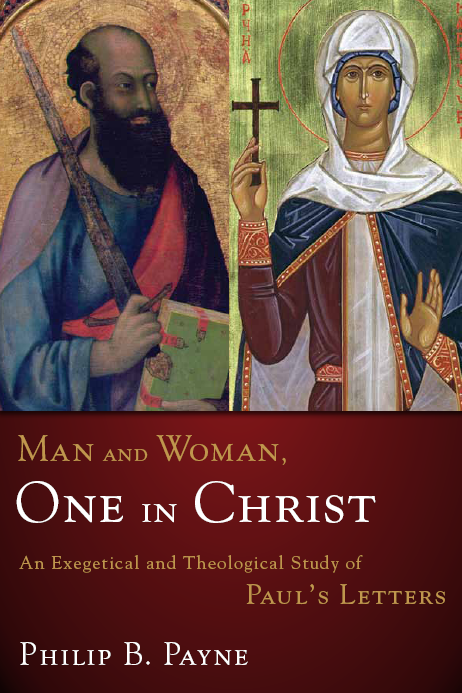 Philip Payne’s book Man and Woman, One in Christ
Summary of Contents
Paul’s Background
Payne notes that Paul was taught by Gamaliel, who was far more egalitarian than his contemporaries. Given this background, it is implausible that Paul had a low view of women (37).
Galatians 3:28
Those opposed to egalitarians (basically, egalitarians are people for women pastors, complementarians are those opposed to women pastors) often portray the position as having its only support in Galatians 3:28. Philip Payne does not base the egalitarian position on this verse alone, but he does argue that the passage provides a strong basis for the egalitarian position. Payne writes, “The natural implication of the equality of male and female in Paul’s teaching is that the gifts of women for ministry in the church should be recognized, welcomed and exercised in all areas of church life, including… church leadership” (104).
1 Corinthians 7- the equal rights of men and women in marriage
In 1 Corinthians 7, Paul explicitly parallels the obligations, rights, and conditions of men and women in marriage. Payne notes a large number of verses in which Paul uses the same language for both men and women (105-106). Not only that, but Paul specifically challenges the concept that men should be the spiritual leaders in the home in 1 Cor. 7:14 (107).
1 Corinthians 11
Payne’s book quickly turns to an extremely in-depth exegesis of the core verses related to the debate over women in church leadership. To put this into concrete terms, Payne’s analysis of 1 Timothy 2:8-15 covers eight chapters and 142 pages; 1 Corinthians 14 has nearly 50 pages dedicated to it, 1 Corinthians 11 is covered by over 100 pages. Payne does not set theology or exegesis to the side in favor of emotional appeals, as some complementarians tend to accuse egalitarians of doing. Rather, he centralizes the Bible as the inerrant Word of God and unswervingly demands that all sides conform to what the Bible teaches, no matter how difficult that teaching may be.
Regarding 1 Corinthians 11, Payne notes that the analogy regarding the “head” of woman does not imply authority, as complementarians must hold. Rather, “source” is a better exegetical and philological fit (113ff, see especially 131, 133). Payne further argues that the proper application of 1 Corinthians 11 would draw out the respect and honor men and women should have for each other as equals (214-215).
1 Corinthians 14:34-35
Rather than mincing words, I’ll jump right to the point: Payne argues that these verses are an interpolation. I’ll cover my own thoughts in the section below “Analysis/Critique,” but for now, I’ll focus on Payne’s argument.
Payne notes that there are a number of ways offered to interpret the passage, but he argues that the only plausible interpretation of the text is that women must be silent, no matter what, in every circumstance. The reasoning is lengthy, but the primary rationale behind this interpretation as most plausible is the it reiterates the prohibition three times, which, in the 1st Century, would have been seen as an absolute prohibition (218-219). Complementarians who allow women to sing in worship, therefore, are inconsistent in their interpretation of this passage, because they add a qualification which is not in the text (221).
Payne, however, argues the text is an interpolation. The evidence is both internal and external. First, the external evidence. The movement of the text itself hints that it was an interpolation which was placed in different parts of 1 Corinthians depending on the textual lineage (227ff). There is also a distigme which is used elsewhere to mark interpolations that is in the last line of 14:33, the correct place to mark 14:34-35 as an interpolation (232ff). Bishop Victor, between AD 541-544, corrected the text to omit 14:34-35 as an interpolation (246ff). Victor’s acumen for detecting interpolations is noteworthy, because he also omits the Trinitarian interpolation in 1 John 5:7-8 (246). MS88 omits the text, likely because it was copied from a manuscript which lacked the interpolation (249). Clement reflects a text without the verses (250-251). He notes other evidence as well (251ff). Payne also notes 9 lines of internal evidence for the text being an interpolation (253ff).
1 Timothy 2:8-15
These verses occupy the largest treatment in MWOC. The key to properly interpreting this passage, argues Payne, is the context and the church situation to which it is addressed. Context is always important in properly interpreting the Bible, but with letters it is even more important. Payne approvingly quotes Raymond Collins on this point, “…it is the epistolary genre that is most conditioned by the coordinates of time and space, historical and relational circumstances… They are ad hoc compositions whose essential import relates immediately and directly only to the situation that dictated their composition” (291).
Payne asserts that scholars know the situation in Ephesus–there was a preponderance of false teaching (296ff). Because of this, it is important to read the letter as a letter designed to put a stop to these teachings. Paul’s prohibition of women’s teachings is tied directly to the fact that false teachers had been praying upon women (299ff). The phrase Paul uses, “I am not permitting” “indicat[es] a new, case-specific injunction in response to a problem in Ephesus that does not carry the weight of church tradition” (321).
Payne also highlights the importance of the Greek word oude as conjoining the prohibitions Paul makes in this passage. The word is used throughout the Pauline corpus to “join together expressions that reinforce or make more specific a single idea” (338). Because of this, it is important to note that the word is used to conjoin the prohibitions in 1 Timothy 2:12. The prohibitions are “to teach” and “to assume authority.” Thus the prohibition is not Paul saying women cannot teach or assume authority over man… rather it is “Women should not teach in conjunction with assumed authority” (348-356).
But does authenteo mean “assume authority”? Complementarians generally must argue that it means simply “have authority.” Payne destroys such arguments, citing etymological (363-365) and document (365-373) evidence to demonstrate the word means “assume authority [to oneself-385ff].” Payne also deconstructs the complementarian argument to the contrary, showing that Paul used other words to refer to authority in a basic sense (373-380).
Importantly, Payne draws out the implications of Paul’s exhortations to women to learn quietly. This was the proper position of students. Paul is not telling women they have no place in the church, he’s calling them to learn in a proper fashion before teaching (see 316-317 for an example of this argument).
Thus, Payne concludes that Paul is not prohibiting women from teaching in the church. In the face of the counter-evidence of Paul’s affirmation of women teachers (61-68), the specific context of 1 Timothy, and the proper translation of the Greek words, the text should be read as a temporal restriction on teaching by women in a church struggling with false teachings being spread by women.
…And More
I have not even begun to draw out all of Payne’s arguments in MWOC. There are many more lines of reasoning including Paul’s affirmation of women in positions of ministry, Paul’s theological axioms which imply equality of man and woman, “salvation through childbirth,” Ephesians 5:21-33 and Colossians 3:18-19 with husband-wife relationships, Titus 1:5-9 and 1 Timothy 3:1-13 and the requirements for deacons and overseers, etc., etc. I cannot emphasize how broad Payne’s line of argument is, and how lucidly he explains his points. The book simply must be read by anyone interested in the topic.
Analysis/Critique
There are so many points Payne makes in MWOC that it would be impossible to cover them all. I found Payne’s arguments largely persuasive. That said, I have a few minor notes.
First, I am not convinced that 1 Corinthians 14:34-35 is an interpolation. I also think Payne dismisses the possible egalitarian readings of the passage too quickly (219ff). That said, Payne’s arguments are extremely powerful. I would have dismissed such arguments before reading this book, but now I’d say I’m very close to agreeing with Payne that these verses are an interpolation.
However, I wish that Payne had did a bit more work on the text to at least investigate the exegetical possibilities. I believe very few complementarians would be willing to accept that these verses are an interpolation, so if Payne had offered other possible interpretations, complementarians might find his case stronger. However, it is the case that complementarians who desire to use this passage to exclude women from the ministry now have the burden of proof upon them to demonstrate that it is not an interpolation, and they must do so with the same careful attention to the internal and external evidence which Payne utilized.
Initially I thought Payne might be overstating the case from Galatians 3:28, but he drew out enough parallel passages that it seems pretty convincing that egalitarians can interpret other passages in light of the Galatians verse (Payne does not use this method–he deals directly with the texts said to undermine egalitarianism… I’m merely suggesting that Payne’s work on Galatians 3:28 would allow egalitarians to be justified in utilizing it as a kind of “proof text” by which others must be judged).
Conclusion
Payne’s sustained positive argument for the equality of man and woman essentially convinced me of the egalitarian position over a year and a half ago. I have only recently finished the book, but when I first got it and skimmed through the arguments, I realized every argument I’d been using as a complementarian had an egalitarian answer. Not only that, but Payne’s critique of the complementarian position undermined the theological position which I’d held my entire life. I think it takes a great deal of intellectual integrity to read books which challenge one’s fundamental beliefs, and I have experienced it firsthand. I challenge readers on both sides of the issue to read this book.
Man and Woman, One in Christ provides an insurmountable challenge to the complementarian position. Any scholar working on the topic in the future must interact with this magnificent work. I simply must recommend it over and over again. I am thoroughly convinced that egalitarianism has a much stronger Scriptural and theological basis than the complementarian position, and MWOC is one of the works which lead me to that position. Payne’s thorough and thought-provoking analysis of the texts themselves demonstrates the Biblical accuracy of the egalitarian position. His work is one with which all must contend. The issue of women in the ministry is one we [the church] cannot get wrong. A thoughtful, open-minded approach to the Biblical issues is necessary. Let us make men and women one again.
Source
Philip B. Payne, Man and Woman, One in Christ
SDG.
——
The preceding post is the property of J.W. Wartick (apart from citations, which are the property of their respective owners) and should not be reproduced in part or in whole without the expressed consent of the author. All content on this site is the property of J.W. Wartick and is made available for individual and personal usage. If you cite from these documents, whether for personal or professional purposes, please give appropriate citation with both the name of the author (J.W. Wartick) and a link to the original URL. This blog is protected by Creative Commons licensing. By viewing any part of this site, you are agreeing to this usage policy.
Book Review: “The Cell’s Design” by Fazale Rana
 Arguments for intelligent design often hinge upon what mechanistic, naturalistic means “cannot explain.” The arguments go something like “See feature x, how can naturalistic mechanisms explain x? They cannot. Therefore, ID is true.” There is something to be said for this type of argument. If one simply cannot explain a specific thing by means of the mechanisms suggested, one must look for different means. That said, if the case for intelligent design rested only upon negative arguments, it would not be as robust as if it also had positive evidence.
Fazale Rana’s book, The Cell’s Design
Rana’s argument is an argument from analogy. He draws heavily from William Paley’s “watchmaker” example (If one came across a watch in the sand, they’d know it was designed… Paley argued that one could similarly conclude that life was designed). Rana doesn’t ignore the arguments raised against such analogical reasoning, but confronts them head on. After identifying several criteria which allow proper analogical reasoning (30ff), Rana makes his case for the Creator.
The first line of evidence comes from the machines in the cell. Again, Rana’s approach is analogical, rather than negative. The machine-like nature of the flagellum, along with other motor-like cellular functions presents an argument: “Organisms display design. Therefore, organisms are the product of a creator” (86).
The case doesn’t rest merely upon molecular machines. Rather, that is but one of the many lines of evidence. Rana draws out the implications of several “chicken-and-egg” paradoxes. These include the “mutual interdependence of DNA and proteins” (99), the origin of proteins themselves (100ff), and more (105ff). These systems present a kind of “irreducible complexity in which the system depends on the system to exist” (108).
Other elements of design are present in the cell as well. Aquaporins intricate and detailed workings illustrate the design that is present in the system (111ff). Other detailed, intricate designs (such as collagen, mRNA, and the breakdown of proteins) hint at the need for a designer. But the reasoning is not only supported by the details, it is also bolstered by the structural composition of the cell (126ff). The analogy of cells to machines is strengthened further by the quality control systems within the cell (198ff). Again, the reasoning is analogical–these things are designed, therefore they need a designer.
“Information can’t be separated from the activity of an intelligent agent” (142). The numerous examples of information in the cell lead to the inference of an agent. But it is not only the information’s presence that hints at a designer. Here Rana’s case really builds on and develops the work of other ID theorists. The information alone could be enough to infer an agent, but one must also account for the fact that cellular information follows rules like syntax, semantics, and pragmatics (144ff). It is not merely information, it is the use of that information and the rules governing that use that strengthen the case for an agent behind the information.
One of the most amazing parts of The Cell’s Design is the chapter called “A Style All His Own.” Darwinian evolution, if rewound, would come out different ways every time. Different mutations would occur, which would lead to different organisms. What is not expected, on Darwinism, is a convergence pattern in evolution. When the same templates keep showing up through independent routes of development, it provides strong evidence for a designer. Yet this “molecular convergence” is exactly what scientists have discovered again and again. On pages 207-214 Rana writes, with citations from scientific journals, of no less than 100 examples of molecular convergence. As a reader, one can’t help but be stunned as they go through these pages. Over and over, there is evidence that the same designs show up in different places, independently, throughout nature. As Rana writes, “if life emanates from a Creator, it’s reasonable to expect he would use the same designs repeatedly…” (215). And this repetition of design is found in life’s most basic components: DNA (216ff).
Rana does not ignore detractors arguments against his position. One counter-argument to Rana’s conclusions is the presence of poorly-designed mechanisms in nature. Yet Rana effectively nullifies these examples, citing how many of them have turned out to be optimally tuned for life, and how others may be expected to be equally tuned (258ff).
The Cell’s Design is an extremely difficult read, but it does not leave readers who are not scientists to flounder. Rana’s second and third chapters provide some basic biological understanding which readers must have to understand the argument throughout the rest of the book. There is also a 12-page glossary at the back of the book which will let those unfamiliar with the terminology follow along. That said, this is not an easy book. The argument is heavily scientific and involves an exploration, in extreme detail, of the mechanisms and machines at work in the cell. The book presents a fantastic case for ID, but not at the expense of the details.
Finally, it is important to underscore the reasoning behind Rana’s conclusions. His argument is abductive. He explicitly outlines it:
1) X is observed
2) If Y were true, then X would be expected.
3) There is good reason to believe that Y is true.
In the case of the cell:
1) Design is observed in biochemical systems.
2) If life stemmed from the direct work of a Creator, the elegant design of biochemical systems would be expected.
3) There is good reason to believe that life is the product of a Creator (276, these arguments are an exact quote).
After reading through The Cell’s Design, this reader cannot help but agree with this argument. Over and over again, Rana has drawn out the exquisite design in the cell. The positive evidence is there, life is designed.
The Cell’s Design presents a phenomenal case for a designer of life. Those interested in exploring intelligent design should add this book to their list. It is not an easy read, by any means, but it provides some explicit, positive evidence for the conclusion that a Creator exists. Those wishing to deny this fact will find much with which they must contend in Rana’s work. I recommend it without reservation.
Source:
Fazale Rana, The Cell’s Design
Disclaimer: I was provided with a review copy of this book by Reasons to Believe. You can learn more about this science-faith think tank at reasons.org.
SDG.
——
The preceding post is the property of J.W. Wartick (apart from citations, which are the property of their respective owners) and should not be reproduced in part or in whole without the expressed consent of the author. All content on this site is the property of J.W. Wartick and is made available for individual and personal usage. If you cite from these documents, whether for personal or professional purposes, please give appropriate citation with both the name of the author (J.W. Wartick) and a link to the original URL. This blog is protected by Creative Commons licensing. By viewing any part of this site, you are agreeing to this usage policy.
Book Review: “My Christian Apology” by Martin Murphy
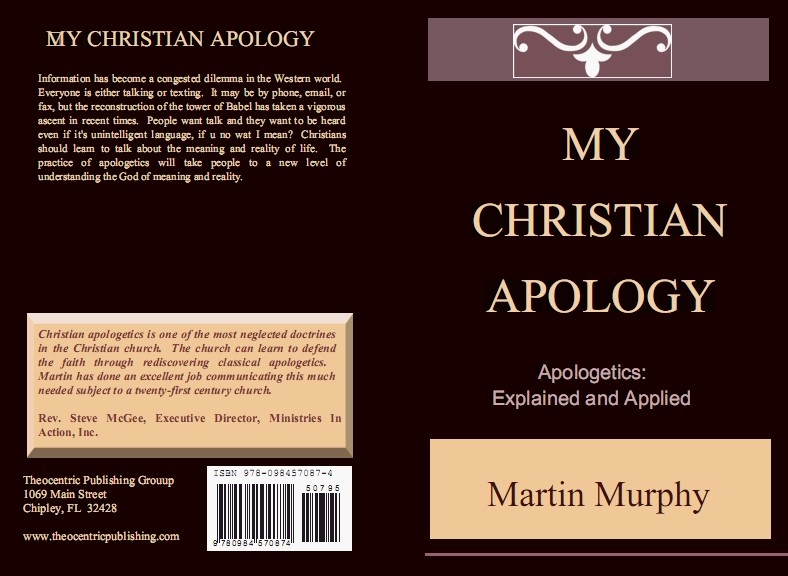 My Christian Apology by Martin Murphy provides some unique insight into apologetics. Rather than focusing upon arguments for the existence of God or methodology at the expense of historical understanding, Murphy grounds both arguments and method in history.
The book starts off with some introductory notes. What is apologetics? How do we communicate apologetics? These sections provide the groundwork of many apologetics texts. But Murphy quickly differentiates his work from most standard introductions to apologetics. His book focuses largely on epistemology and its relation to apologetics.
Murphy does a great job of making these concepts accessible to general readers. He defines epistemology (19) and then gradually eases the reader into its various applications to apologetics (19ff). A central theme throughout is that unbelievers and Christians have common grounds from which they can start discussions. One of these common grounds is Natural Law, which Murphy goes into at length (65ff). Natural Law has been repudiated by many modern thinkers, but it is grounded in Scripture and has a great theological base. I’ve reviewed a Lutheran book on the topic which I think helps show how useful Natural Law is. Murphy points out that Natural Law can provide a basis for knowledge of God. “If we know we are transgressors then we know we have violated the law of God” (73). This knowledge is not saving knowledge, but it provides a basis for judgment (84) and, I think, a possible common ground for apologetics.
Another strength of Murphy’s work is the focus upon historical apologetics. He cites Jonathan Edwards at length and in numerous places while exploring Edwards’ applications to apologetics (see 20-21, 29, 36, etc.). He also emphasizes the works of Southern Presbyterians in the area of apologetics. The historical background is a great quality of the work and one that I think Christian Apologists often fail to emphasize or utilize.
There is some emphasis on theology in My Christian Apology as well. Murphy’s discussion of natural law leads to a drawing out of the “noetic effects of sin.” Again, the points Murphy raises are clear and concise. Some readers will disagree, but all will be challenged. I find this account eminently plausible and I think that even those who disagree need to at least account for the Biblical case for original sin.
Martin Murphy’s My Christian Apology is a brief work that has a ton of great information packed into it. Questions that other basic apologetics books tend to avoid are treated with precision and lucidity. The emphasis on historical apologetics leads to many insights readers won’t find in other introductory works. I recommend that readers use this book along with other basic apologetics books in order to develop a more well-rounded apologetic method.
Source:
Martin Murphy, My Christian Apology (2010).
SDG.
——
The preceding post is the property of J.W. Wartick (apart from citations, which are the property of their respective owners) and should not be reproduced in part or in whole without the expressed consent of the author. All content on this site is the property of J.W. Wartick and is made available for individual and personal usage. If you cite from these documents, whether for personal or professional purposes, please give appropriate citation with both the name of the author (J.W. Wartick) and a link to the original URL. This blog is protected by Creative Commons licensing. By viewing any part of this site, you are agreeing to this usage policy.
Book Review: “Diamonds in the Dust” by Shirley Mowat Tucker
 Recently widowed–her husband murdered–and living in fear, Ida Morgan feels utterly alone. Suddenly, a young girl, whom she calls Moses, floats into her life and sets off a series of events that awakens Ida to even more of the horrors of South Africa–horrors often hidden behind the scenes.
Ida’s interactions with Moses (and Moses’ siblings) lead her to a fork in the road: she can either confront her fear and help these children, or she can return to her safe, easier life.
But Ida is not the only character Shirley Mowat Tucker follows in Diamonds in the Dust, there are her neighbors, whose silver-lined lives may just be a facade; a man with a dark past, trapped by his circumstances; and others. Each character feels real. They each have their flaws, but the reader cannot help but be sucked in by their stories.
One tremendous strength of the book is how the reader is shown two worlds. On the one side is the world of Ida and her neighbors, on the other is the world of the children and others. One world needs no hope–it is “normal”; the other world must create hope from the horrible circumstances in which its people seem trapped.
Perhaps most interesting is the way it deals with God. It’s not the kind of Christian Fiction which throws God in the reader’s face every page. God, rather, works behind the scenes. He works through people. It’s a very realistic take on how God works in even the worst circumstances. “He has ears.”
Diamonds in the Dust comes out on December 1, 2011. You can check out the author’s web site: http://diamondsinthedust.net/
Christians looking for a quick, engaging read should pick up Diamonds in the Dust. It will open eyes to the issues of disparity that still exist in South Africa (and elsewhere), and it’s just a plain good read.
Disclaimer: I was provided with a review copy of Diamonds in the Dust by the publisher. My thanks to Athanatos Publishing Group for the copy of this book.
SDG.
——
The preceding post is the property of J.W. Wartick (apart from citations, which are the property of their respective owners) and should not be reproduced in part or in whole without the expressed consent of the author. All content on this site is the property of J.W. Wartick and is made available for individual and personal usage. If you cite from these documents, whether for personal or professional purposes, please give appropriate citation with both the name of the author (J.W. Wartick) and a link to the original URL. This blog is protected by Creative Commons licensing. By viewing any part of this site, you are agreeing to this usage policy.

 J.W. Wartick - Reconstructing Faith