Book Reviews
Book Review: “Hidden Treasures in the Book of Job” by Hugh Ross
 Hidden Treasures in the Book of Job
Ross begins with an exhortation to Christian leaders to stop avoiding the issue of Creation and to come up with a reasonable “strategy of engagement. Christians who take the Bible as a trustworthy revelation from God need to study science and engage with scientists at the highest academic and research levels” (12). I pray Ross’s words will not fall on deaf ears.
Ross goes on to point out the historical backdrop of the book. The debaters present, Job, Eliphaz, Zophar, and Bildad were “likely the intellectual powerhouses of their day…” (28). Along with Elihu, who most likely recorded the book, they comprise the major characters. Interestingly, Eliphaz was named as a Temanite. Teman, Ross points out, “was famous in the ancient world for its exceptionally wise scholars” (28). Contrary to some who may accuse Ross of demeaning the historical value of Scripture, it is clear that he affirms the historical realism of the Book of Job.
Interestingly, HTBJ doesn’t start with the scientific questions; it dives in to “timeless questions” about God. Ross points out answers given throughout Job about the reason for death (39-40), the shorter lifespans of humans (40-41), blessings for the wicked (43ff), and more. Ross provides an argument about what is often called “natural evil.” He points out Job’s rejection of a “direct cause-and-effect relationship between destructive natural events and the people affected by them” and goes on to argue that scientifically, these “acts of God” are necessary for life (49). Hurricanes, for example, bring a number of benefits (51).
Ross quickly moves into scientific questions throughout the book of Job. He argues that God’s challenges to Job and friends reject naturalism, deism, evolutionism, and young-earth creationism (54). Job specifically points out that God continually interacts with creation. Perhaps most interestingly, Ross points out that in Job the Bible specifically points towards the Big Bang–with language of God “stretching out the heavens.” This, thousands of years before any scientific evidence existed (56-58). Not only that, but the book also alludes to dark matter. Rather than treating darkness as the “absence of light” as was the belief historically, Job points out the actual existence of darkness and its separation from light. Here again there is evidence that Job lines up powerfully with science (60-63).
Another fascinating aspect of the Book of Job, argues Ross, is its ability to speak to current situations like Global Warming (63ff).
Central to Ross’ argument in HTBJ is the thesis that the book of Job can be used as an interpretive backdrop for the Genesis creation account. Ross argues that Job 38-39 can be read in their entirety as a creation account (72). This opens the gate for interpreting other creation accounts through the lens of Job 38-39. He points out that there are areas of Moses’ creation account that Job makes explicit. Some of these points include a correct interpretation of “heavens and earth” (74); an outline of when plants were created (78-79); and perhaps most interestingly, one of the best explanations of the problem of light before the sun I’ve ever seen (80-84). Ross argues that, contrary to most interpretations, the Genesis account does not explicate that there was no sun before light, but rather that the light had been hidden by the atmosphere (82-83). Again, this would serve as powerful scientific confirmation of the Bible.
Ross is unafraid to pull his punches. He takes on the question of the extent of the flood (92ff) and argues convincingly that the flood was localized to all of humanity. Perhaps the most controversial point Ross makes is in regards to one of the best arguments for young-earth creationism–death and the Fall. Often, the young-earth argument is that the Bible excludes any possibility of death before the Fall. Ross argues that, given Job 38-39’s creation account, that interpretation can no longer be valid. He urges that Job 38:39-41 coincides with creation day five, and because these verses include death before the fall, this argument for a young-earth is unsuccessful. Ross’s argument here will really depend upon how convincing his assertion is that all of Job 38-39 lines up with the days of creation. Ultimately, I think, most young-earth creationists will remain unconvinced and argue that only the early part of Job 38 is a creation account. In Ross’s favor is the continuing tense (it appears as though the verbs throughout the section are in the Qal stem). But Ross doesn’t make this argument. Thus, it seems that this part of Ross’s argument will be convincing only to those willing to agree that Job 38-39 are, in their entirety, a creation account.
Later, Ross soundly demolishes the young-earth argument that Job provides evidence for dinosaurs living with humans. He convincingly argues that the behemoth is a hippopotamus (178-180) and the leviathan a crocodile (180-183).
Ross doesn’t leave the book of Job without discussing what seems like its primary question: suffering. He presents evidence that Job argues for both a greater good theodicy along with a free-will defense (190ff). Both of these sections are interesting, if brief.
There are many areas of interest within HTBJ I have left unexplored. Ross focuses extensively on soulish creatures and the differences between humans and animals. Most interestingly is Ross’s explication of the list of 10 “soulish” creatures named in Job and their import for humans (150-165). Suffice to say that there is much more content in the book worth reading.
There were times as I read Hidden Treasures in the Book of Job that I was filled with marvel at the magnificence of creation. At one point I stood up and surprised my wife, saying “Can you believe what God has made? And we know it from the Book of Job! Can you believe this!?” as I described some of the things Ross reveals in the book. There are some astounding ways that the Bible lines up with the evidence we have from cosmology, astronomy, biology, and other sciences. While some Christians may remain unconvinced by Ross’s argument for interpreting Genesis 1 through the lens of all of Job 7-39, the book deserves a reading and response by even those who disagree. Ultimately, readers of Hidden Treasures in the Book of Job will come away with some powerful evidence from science for the truths of Scripture–and vice versa.
Disclaimer: I was provided with a review copy of this book by Reasons to Believe. You can learn more about this science-faith think tank at reasons.org.
Source: Hugh Ross, Hidden Treasures in the Book of Job
SDG.
——
The preceding post is the property of J.W. Wartick (apart from citations, which are the property of their respective owners) and should not be reproduced in part or in whole without the expressed consent of the author. All content on this site is the property of J.W. Wartick and is made available for individual and personal usage. If you cite from these documents, whether for personal or professional purposes, please give appropriate citation with both the name of the author (J.W. Wartick) and a link to the original URL. This blog is protected by Creative Commons licensing. By viewing any part of this site, you are agreeing to this usage policy.
Book Review: “Who Made God?” by Edgar Andrews
 Who Made God?
Interestingly, Andrews gets the title of the book out of the way quickly. Andrews argues against the common atheistic retort, “Well if God made everything, who made God?” He writes, “Because cause and effect is only proven for the physical world, we can no longer insist that cause and effect are relevant when it comes to the origin of a spiritual entity like God.” I am not sure about the strength of this response. It seems to potentially put God outside the rules of logic, something of which most theists are very wary. A more convincing response, in my opinion, is to simply point out that the concept of God includes necessity. Theistic arguments are designed to show just this–that God is the uncaused ground of being.
Who Made God, however, quickly jumps into stride and doesn’t look back. Andrews lucidly argues that while science can describe events and put them to the test, it cannot explain things in the sense of a comprehensive explanation. Science, for example, “doesn’t tell us why there is [a force of gravity]” (30).
Without slowing down Andrews jumps into a clear explanation of String Theory and its attempts to be a “theory of everything.” Even were science to unify into a theory of everything, however, Andrews point would still stand. The theory would offer descriptions of how things happen, but it wouldn’t explain why the theory itself worked. He also offers a few critiques of string theory, such as the counter-intuitive nature of the theory (48).
Andrews continues on, offering God as a “hypothesis.” He argues that “the methodology of science” can be applied to God (58-59). He argues that Victor Stenger’s God: the failed hypothesis fails on a number of levels. Stenger claims that God “should be detectable: (1) by scientific ‘models’; (2) by scientific measurements… (3) by scientific ‘methods'” (67). Against this, Andrews points out that Stenger is trying to exclude God from existence by “having it both ways.” Stenger argues that God should be detectable, but cannot be because the measurements of science are restricted to the physical. Obviously, this begs the question against theism.
Andrews also addresses nothing, by which I mean the redefinition of “nothing” into “something” often done by atheists (see the debate between Lawrence Krauss and William Lane Craig). He points out that they often use “nothing” to reference vacuum and/or empty space or dark matter. But this is either deliberately misleading or just incomprehensible (97ff). As the atheists who say this often admit themselves, this “empty” space is hardly “nothing.” It is full of energy. But beyond space, beyond the existence of our universe, outside of space and time–that is what is meant by “nothing” (105).
The God hypothesis is vindicated when it comes to the evidence from astronomy and physics. The low entropy state of our universe (117-118), along with its origin (98ff) both point to a creator. Andrews moves on to argue that the origin of the laws of nature must also point to the God hypothesis (138-153). He then goes on to argue that our biological origins, the information found in cells, and the diversity of life have their best explanation with God. To cover these arguments fully would double the size of this review, but I found these arguments just as exciting as the rest of Who Made God. A sampling: proteins and DNA must have information in order to function correctly (181ff); origin of life theories can only be explained with the God hypothesis (196ff); evolution is nonfalsifiable (214-216); natural selection is a tautology (219-220); junk DNA isn’t junk (234ff); mutations really only help within dynamic populations and cannot lead to new species (230ff [through 240]). Andrews isn’t finished there, however, he tackles arguments for and against mind/body dualism (250ff).
Another strength of Who Made God is the format. There is a summary of each chapter prior to its contents, along with definitions of important terms. Humor is found throughout the work as the author tells funny stories or makes witty comments about the arguments. These aspects increase the readability of the book to a great degree.
This is not to say the book is without faults. Andrews’ treatment of the Ontological Argument was a bit abrupt. I’ve written on the argument before (see my posts here and here). Andrews’ critiques don’t apply to the most current versions of the argument. The most commonly used ontological argument is the modal version developed by Alvin Plantinga and others. This version of the argument doesn’t appeal to human ideas, but to modal necessity and possibility. To his credit, Andrews does point out that some philosophers find the argument compelling.
Another issue with Who Made God is the sometimes unconventional use of philosophical terms. For example, Andrews defines “phenomenology” as “The way phenomena… manifest themselves” (27). Phenomenology, however, is most commonly used (in philosophy) as the study of consciousness. Outside of philosophy, it generally refers to conscious experience or sense experience, not so much about the phenomena themselves. While the definition is not wrong, it caused some confuse, and may confuse other readers familiar with the other, more conventional uses. Another uncommon definition was given for “Monism.” Most often, the term refers to the idea that all of reality is one [i.e. it is all material, or all immaterial]. Andrews definition makes sense in context (he defines it as “The idea that mind is nothing more than the brain at work” [257] but that definition in philosophy of mind is more often used for “reductionism” which Andrews defines differently as well).
However, neither of these negatives outweigh the significant positives found throughout Who Made God. You know that I’m nitpicking when my main critique focuses on a couple unconventional definitions, particularly when Andrews uses valid definitions that simplify the terminology for the reader.
Edgar Andrews’ Who Made God is unique among the slew of apologetics books written at a popular level in that it offers a nearly comprehensive argument for Christianity based upon various scientific theories. Despite a few small flaws, I unreservedly recommend this book to all Christians looking to increase their knowledge of biology, physics, and astronomy. Andrews clearly and succinctly explains several scientific theories in terms which are easy to understand, while also showing the relevance for the “God hypothesis.” Readers will come away convinced that when it comes to science, their faith stands on firm ground. Books with scopes this broad most often shine their lights upon lots of topics and illumine none. Readers will find that Who Made God illumines nearly every topic it touches, bringing new insight and clarity into often confusing issues.
Source: Edgar Andrews, Who Made God?
Disclaimer: I was provided with a review copy free of charge by EP books. My thanks to both Edgar Andrews and EP books.
SDG.
——
The preceding post is the property of J.W. Wartick (apart from citations, which are the property of their respective owners) and should not be reproduced in part or in whole without the expressed consent of the author. All content on this site is the property of J.W. Wartick and is made available for individual and personal usage. If you cite from these documents, whether for personal or professional purposes, please give appropriate citation with both the name of the author (J.W. Wartick) and a link to the original URL. This blog is protected by Creative Commons licensing. By viewing any part of this site, you are agreeing to this usage policy.
Book Review: “Divine Motivation Theory” by Linda Zagzebski
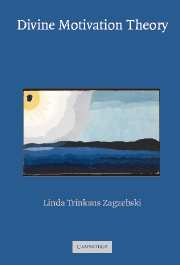 Linda Zagzebski is rightfully becoming a well-known figure in philosophy of religion. Her book, Divine Motivation Theory
The thrust of Zagzebski’s work is focused around two ideas: 1) exemplarism; 2) motivation. Together, these formulate the foundation for the rest of her discussion. The book is divided into three parts. The first explores “Motivation Theory” from a perspective which could be held even by those who are not theists. The second part explores “Motivation Theory” from within a theistic perspective. The third part deals with ethical pluralism.
One of the most important concepts in DMT is that of an exemplar. An exemplar is exactly what one would expect: a figure who demonstrates a “good life” by living it. Zagzebski writes of exemplars: “The particular judgments to which a moral theory must conform include judgments about the identity of paradigmatically good persons [exemplars]” (41). The thrust of Motivation Theory is a refocusing of metaethics. Rather than examining what is good and then evaluating judgments in light of that (as in Platonism, including theistic Platonism in many ways), and rather than focusing upon virtue (as in virtue theory), motivation theory focuses upon persons who are good. These persons formulate the basis for judging what is good, based upon motivation and emotion (40-50). A good action, motivation, or emotion, argues Zagzebski, is one which an exemplar would perform, have, or entertain.
Initially I admit I was a bit put off by this because it seemed quite arbitrary. Could we not define as exemplars people who are vicious and evil. Could not an exemplarist focus on ethics lead to Stalin, Hitler, and Pol Pot as exemplars?
Zagzebski counters this within DMT by focusing in part 2 upon the “divine.” Rather than arbitrarily choosing whomever one wishes as the exemplar, Zagzebski endorses God as the primary exemplar. This provides an alternative to Christian Platonism and Divine Command Theory by arguing instead that “God is essential to morality, not because it comes from either his intellect or his will, but because it comes from his motives. God’s motive dispositions, like ours, are components of his virtues, and all moral value derives from God’s motives” (185). The upshot of this is that God, being a perfect being (granting traditional theism), would have perfect motivations. Whatever God does, must be perfectly motivated.
The theistic focus on motivation within DMT provides several advantages. One among them is the fact that it solves many of the “problems” related to perfect goodness. For example, regarding what makes something God does good, DMT offers the solution that “God is good in the same way that the standard meter stick is one meter long. God is the standard of goodness” (185). Regarding the problem of evil, Zagzebski points out that her theory successfully solves the issue if it is metaphysically possible (313). The reason is that DMT’s focus upon motivation can be used analogically with human parents. “If we can understand,” she writes, “how the motivation of love of a human parent for her child might not involve any considerations of good and evil and yet still be a good motive, we must conclude that promoting good and preventing (or eliminating or not permitting) evil is not necessarily part of the motivational structure of a good being… even a perfect being might love in such [a] way that he would be willing to permit any amount of evil, not for the sake of some good, but out of love for persons” (317). These are oversimplifications of what Zagzebski writes on these problems, but I encourage the interested reader to read her work for a fuller explication.
There are so many things to discuss about DMT that remain, but I feel a full explanation would drag this review on unnecessarily. I would like to note a couple other very interesting arguments Zagzebski makes. She argues that there can be truth values with emotions (75ff). She points out that motivation is extremely important in moral judgments–if someone is doing something just to be hailed as a hero, they are much less praiseworthy than if they are doing it merely out of goodness (see 100ff). Elsewhere, Zagzebski and discusses several principles for dealing with pluralism (369ff). There are important points like these throughout the book. DMT challenges readers to rethink aspects of metaethical theory which they have unreflectively ignored. Yet in doing so, Zagzebski articulates a metaethic for theists which seems to have just as much (or more) plausibility as the alternatives.
Divine Motivation Theory deserves a reading by anyone interested in theistic metaethics. Linda Zagzebski offers a theory that has advantages over both Christian Platonism and Divine Command Theory. I highly recommend this work to any philosopher of religion. I cannot emphasize how much I think readers should get their hands on this work.
Source (and link to Amazon):
Linda Zagzebski Divine Motivation Theory
SDG.
——
The preceding post is the property of J.W. Wartick (apart from citations, which are the property of their respective owners) and should not be reproduced in part or in whole without the expressed consent of the author. All content on this site is the property of J.W. Wartick and is made available for individual and personal usage. If you cite from these documents, whether for personal or professional purposes, please give appropriate citation with both the name of the author (J.W. Wartick) and a link to the original URL. This blog is protected by Creative Commons licensing. By viewing any part of this site, you are agreeing to this usage policy.
Book Review: “No Other God: A Response to Open Theism” by John Frame
 I recently finished No Other God
Areas of Agreement
One of the strengths of Frame’s book is how clear his thinking is. His style of argumentation is precise, and he clearly lays out what he considers evidence for his positions. He is unafraid to make statements with huge implications.
A particularly interesting aspect of Frame’s work was a brief historical look at the roots of Open Theism, leading it back to the Socinianism. Frame points out that advocates of Open Theism tend to portray their view as the “new theology on the block” despite the fact that it has been around (and rejected) for quite some time.
I believe Frame is correct when he argues against the centralization of any one attribute of God. Specifically, the centralization of love on Open Theism tends to ignore other important attributes of God (49ff). (Interestingly, Frame’s own account of God unnecessarily over-emphasizes Sovereignty, though he disguises this by calling it “Lordship.)
Frame levels strong critiques against Open Theism’s reading of Scripture. Open Theists tend to advocate the “straightforward” reading of texts which help their case. One of Open Theist’s favorite passages is God testing Abraham. Yet Frame rightly notes that if there is a straightforward reading of the text, then God did not know the present truth of Abraham’s heart, whereas Open Theists attempt to use this to support God not knowing the future (47). Further, if God was trying to figure out how Abraham would act in the future, then He was trying to do something He couldn’t (determine what the libertarian free choices of humans would be) according to Open Theism. So the story’s straightforward reading does not work to support Open Theism. Frame urges a similar examination of other passages, though he doesn’t expand on it.
Areas of Disagreement
Despite these areas of agreement, I vehemently oppose Frame’s position on several issues. Most notably, on theistic determinism, compatibilism, and libertarianism.
First, libertarianism. Frame correctly notes that the core of Open Theism is the assumption of libertarianism. Yet his critique of libertarianism is wrongheaded. He caricatures libertarians as believing that choices are made in the absence of any motivation. He writes, commenting on the libertarian view, “if our decisions are caused by anything or anyone (including our own desires), they are not properly our decisions… to be responsible, we must be able to do otherwise” (121). Yet this is explicitly not libertarianism. Peter van Inwagen, for example, explicates libertarianism by saying “…that someone’s acts are undetermined does not entail that they are uncaused” (van Inwagen, An Essay on Free Will, Oxford: 1983, p. 14).
But Frame explicitly centers his critique of libertarianism on a contra-causal account of freedom, saying, for example, “If guilt presupposed libertarian freedom, then in order to show that Hubert [a man accused of robbing a bank] is guilty, the prosecutor would have to show that his decision to rob a bank had no cause…” (126). But again, libertarians deny this very type of contra-causal freedom, so Frame is arguing against a straw man. Because Frame thinks libertarianism is so utterly central to Open Theism, this means that the core of his critique fails to hit home.
The problem with Frame’s counter against libertarianism is that it barely touches the surface of the philosophical arguments for the position. He correctly rails against the idea that our actions are just random occurrences, but incorrectly assumes that this is libertarianism.
Finally, the greatest area of disagreement I have with Frame is on his view of omnidetermination. Consider the following two quotes:
“The uniform witness of Scripture is that the evils of this life come from God” (140).
“…[I]t is important to see that God does in fact bring about the sinful behavior of human beings, whatever problems that may create in our understanding” (68).
I’d be curious to see how Frame reconciles these assertions with the constant witness of Scripture that God is just; fair; good; opposed to evil; etc. Frame utilizes several verses to support his position, but he makes primary those which say God uses “all things” and verses which say calamities are from God. But regarding the former, this can easily refer simply to permissive will, and regarding the latter, the verses he uses are out of context (and even were one to grant the “straightforward reading,” one could counter by saying the calamities are not every evil action, but merely those things which God uses–i.e. storms, other nations, etc.–to instruct His people). Frame, like many theological determinists, is not building even on sand, but on a void. Literally saying that God causes evil is so utterly repugnant and contrary to Scripture that this view overshadows all the good things Frame has to say.
Conclusions
Ultimately, No Other God is on target in a few ways, but it is wildly gunning the wrong direction on too many issues. Frame’s philosophical case against libertarianism is off the mark, he fails to deal with the strong philosophical arguments for libertarianism, and his view that God literally causes evil is baseless. Interestingly, while I went in reading this book looking for some good arguments against Open Theism, I came out with the realization that theological determinism is a far more dangerous doctrine indeed.
SDG.
Check out other posts about Open Theism here.
John Frame,No Other God
——
The preceding post is the property of J.W. Wartick (apart from citations, which are the property of their respective owners) and should not be reproduced in part or in whole without the expressed consent of the author. All content on this site is the property of J.W. Wartick and is made available for individual and personal usage. If you cite from these documents, whether for personal or professional purposes, please give appropriate citation with both the name of the author (J.W. Wartick) and a link to the original URL. This blog is protected by Creative Commons licensing. By viewing any part of this site, you are agreeing to this usage policy.
Book Review: “Eternal God: A Study of God Without Time” by Paul Helm
 Paul Helm is, in my opinion, one of the most lucid thinkers on the topic of God and Time. His Eternal God
Helm points out early in his book that the issue of divine temporality/atemporality is “underdetermined” in Scripture (7). This means it’s one of those fun issues that lies most squarely in philosophy of religion.
And that is where Helm excels. Chapter-by-chapter he outlines a cohesive case for divine atemporality. Where Paul is most successful, I think, is in his rebuttals of arguments for temporality. For example, a well-known argument for temporality is that if God interacts in time, he must be temporal. Helm counters by pointing out that a precisely parallel argument could be constructed for God and space. Yet few Christian philosophers accept that God is spatial (49ff). While this doesn’t rebut the argument, it does point out something important: it doesn’t seem as though the conclusion (God is temporal) follows from the premise (God interacts in time) any more than it would if it were spatial (God is spatial/God interacts with space).
There are many different accounts of divine timelessness, from Brian Leftow’s spaceless timelessness (see his work Time and Eternity) to relative timelessness, and beyond. Helm takes the much less popular route and takes the tough pill of saying that God created spacetime as a static bloc. This allows Helm to easily deny many of the arguments for temporality which stem from a-theory or dynamic time. But it also raises many problems. Foremost among these (in my opinion) is human freedom. For, on the B-Theory of time (static theory), everything which will ever happen, has happened, and in a sense exists. As we go from moment to moment, we’re really just passing through a bloc of spacetime, we aren’t literally moving through a present. Presentness is a subjective phenomenon, given static/B-theory. It’s just our perspective. So where does human responsibility and freedom come in?
Helm here turns to compatibilism. He freely admits that timeless creation entails determinism (170). Thus, he denies that humans have free will in the libertarian sense. But this, he argues, does not undermine human responsibility. I don’t think I can do justice to the nuances of his argument, but the basic idea is that Helm argues that just because past actions/events determine our actions in the future, that doesn’t mean that we aren’t responsible for what we do. As I said, this is a really, really watered down version of his argument, but I think this is one of the weaker points of his work.
Why? Because the idea of responsibility simply does not make sense on determinism, particularly when it is theistic determinism. For consider the idea proposed here. God has created all of time and space as one bloc. Thus, everything I do or have ever done was created by God once he brought the universe into being. Literally, everything I did, I do because God created the universe such that I would do x. So how could it be that I am responsible for doing x, if I never chose to do x. I simply do x because I have to, I have “already” done it, on the static theory. If I could create a time travel device, I could travel forward in time and see myself doing x, and could not prevent it, because God created the world such that I would do x. But the core of responsibility is that I chose to do x. While we punish people for things they do by accident (vehicular manslaughter, for example, or accidentally breaking a window), these things still resulted from prior choices (playing baseball near breakable window/driving carelessly). I simply do not see how any account of responsibility could make sense unless someone can choose to do what they do.
There are several different positions about divine temporality/atemporality. Helm swallows the hard pill of going with the static theory of time to ground his divine atemporality. This, I believe, grants his account extreme philosophical plausibility. If God created the entire universe as a space-time continuum (I’ve always wanted to use that phrase from Star Trek!), then there’s no reason to suppose God would be affected by time. It’s ontologically outside of God, and all of his interactions already have taken place. While I’ve already pointed out some of the problems with this view, these problems are not with the coherence of the view but with the theological nature of it. Thus, I think it possible to say that Helm has adequately defended a position of divine eternity.
It would be impossible to cover everything of interest in such a comprehensive look at the topic of divine timelessness. Helm analyzes an extraordinary number of arguments in great detail. I cannot recommend the book more highly. Although I ultimately reject Helm’s second contention (B-theory), I believe his view is extremely coherent, and I can find little fault in it. Anyone interested in the issue of God’s relationship to time must read this book. It’s a book I think I shall re-read so that I can better grasp his arguments.
(Note: This review is based on the recently published second edition of this text, which includes several new chapters with much of interest, including a rebuttal of William Lane Craig’s arguments against timelessness. I recommend interested readers get their hands on the newer edition.)
SDG.
Source:
Paul Helm, Eternal God
——
The preceding post is the property of J.W. Wartick (apart from citations, which are the property of their respective owners) and should not be reproduced in part or in whole without the expressed consent of the author. All content on this site is the property of J.W. Wartick and is made available for individual and personal usage. If you cite from these documents, whether for personal or professional purposes, please give appropriate citation with both the name of the author (J.W. Wartick) and a link to the original URL. This blog is protected by Creative Commons licensing. By viewing any part of this site, you are agreeing to this usage policy.
Book Review: “God Behaving Badly” by David Lamb
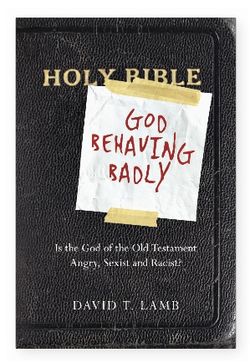 David Lamb’s God Behaving Badly
Throughout the book, Lamb follows a similar outline through each chapter: introduce tough texts, provide answers, synthesize general remarks. Lamb is unafraid to take on the toughest Scripture passages (1 Sam 4-5; Gen 3; Josh 10, 11, etc.). He points out rightly that people who line up on either side of these issues tend to ignore the texts on the other side. Those who call God angry, racist, sexist, and the like tend to ignore those passages which portray God as loving, welcoming, and empowering. Similarly, too many Christians ignore the ‘tough’ passages.
Lamb’s book excels in many specific areas. When discussing issues related to women, Lamb follows William Webb’s “redemptive/progressive” hermeneutic and points out that God is not sexist, but affirming. His treatment of the oft-misunderstood Genesis account is superb. Most interestingly in relation to women in the Bible, he writes, “If it is okay for women to compose sections of the Bible, perhaps we should let them teach it?”(64). Lamb’s scholarship in the Old Testament shines through on numerous occasions throughout the work. He points out the Ancient Near Eastern tendency to utilize hyperbole in descriptions of conquests (77).
There is one major point of divergence I feel with Lamb, however, and that is in the area of mutability/immutability. Without getting too far afield, it is worth noting that Lamb’s treatment of God’s interaction with people is a bit off, in my opinion. While noting texts which say God does not change, Lamb also notes those in which God appears to change his mind. He goes on to say,
Is it good that God changes his mind? …If you are a child who deserves to be punished, it is good when a parent changes his mind about your punishment. If you are a car buyer, it is bad when a used-car dealer changes his mind about the low price he had promised (151).
The words I wrote in my notes were “gross anthropomorphism.” The reason is because while it may be written that God “changes his mind” it would be very strange to say that He could be compared to the cases Lamb points out. God, knowing the future, would know what was going to happen, and so to say that God is like a parent changing their mind seems a bit out of place. I’ll not delve into a major argument with this, but Lamb brings up the case of Jonah as an example for this. Yet it seems from the book of Jonah that God knew Nineveh would repent–the very reason he sent Jonah in the first place (and the reason Jonah did not initially want to go). For it would not make sense for Jonah to be so upset about being sent to Nineveh to tell them to repent if he felt God would punish them regardless. In any case, this does little to undermine Lamb’s overall argument, but it is worth noting as a flaw. A final note I’d like to make is that Lamb frequently uses God’s divine name. This may be off-putting to some readers who feel it should only be presented as the Tetragrammaton, YHWH.
The conclusion of GBB is simply fantastic. Lamb sums up his points in each chapter (a feature I think every conclusion should have).
God Behaving Badly is a great introductory look at a well-known challenge to Christianity. Lamb doesn’t ignore the hard issues in the Bible and tackles them with sincerity and intelligence. I recommend the book to those looking to start exploring issues related to God’s moral nature.
SDG.
——
The preceding post is the property of J.W. Wartick (apart from citations, which are the property of their respective owners) and should not be reproduced in part or in whole without the expressed consent of the author. All content on this site is the property of J.W. Wartick and is made available for individual and personal usage. If you cite from these documents, whether for personal or professional purposes, please give appropriate citation with both the name of the author (J.W. Wartick) and a link to the original URL. This blog is protected by Creative Commons licensing. By viewing any part of this site, you are agreeing to this usage policy.
Book Review: Natural Law: A Lutheran Reappraisal
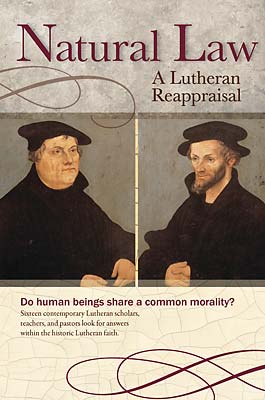 Natural Law: A Lutheran Reappraisal
The individual essays presented in NLL are almost all extremely strong. The topics covered include the views of early Lutherans on natural law (including Luther and the authors of the Confessions) , the view of several later Lutheran individuals (like Barth and Forde), and a kind of “applied ethics” section which uses natural law in individual instances.
The strength of many of these essays is a credit to the Lutheran scholarship which went into the work. The insight into Lutheran thinkers’ views on natural law helps to refute some notions that Lutherans do not “believe in” natural law. In fact, it seems the opposite is the case. “Luther,” argues Thomas Pearson, “understands natural law not as a Christian teaching, but as an observation of human nature in general” (63). Later, Carl Rockrohr expands on this idea to view natural law as a place of common ground for evangelism (196-197).
NLL really shines when it demonstrates that even topics which may at first seem unimportant (like an essay on Friedrich Stahl’s rejection of natural law) can serve to develop a modern view of natural law (Jacob Corzine argues in the aforementioned essay that Stahl’s critique helps ground a Christian natural law theory not in reason but in God [115]).
The applied ethics section of NLL has its ups and downs. “Natural Science, Natural Rights, and Natural Law: Abortion in Historical Perspective” by Korey D. Maas is a simply amazing critique of abortion which presents the case for pro-life not as a religious issue, but as one which can be established on common grounds of natural law (228ff). On the other hand, Albert Collver III’s argument against the ordination of women struggles because it only presents one Lutheran view on the issue (more on that below). The section (and book) concludes with Matthew Cochran’s great summing up and case for the use of natural law as a “Way Forward” for discussions of epistemology and natural law (see esp. 274ff).
The strength of NLL is therefore found in the fact that the essays manage to cohere to the point of building off one another. Whether this was intentional or not, it strengthens the whole work. The early essays provide the framework for the later developments into applied ethics.
This is not to say the book is without faults. One such fault is the woefully inadequate glossary. While the terms included are defined in detail, some terms are inexplicably left out. For example, while the glossary takes lengths to define idealism, it makes no mention of “epistemology,” a concept which was referenced several times. This makes the book seem at times unsure of its purpose. Is it written for the layperson or the professional, the philosopher or the theologian? It includes study questions and a glossary, which suggests use as a textbook in undergraduate (or high school) theology classes, but the very nature of the essays included and the inadequacy of the glossary suggests that only those already familiar with some of the issues will get the most bang for their buck. A final criticism I would level against the book is that while it does present essays from various Lutheran traditions, it is clearly founded specifically upon LCMS teaching. This is unsurprising, given that it is published by Concordia Publishing House (the official publishing arm of the LCMS), but this could cause some confusion when the book devotes an entire chapter to a critique of a different Lutheran tradition (the ELCA). This small shortcoming can also be seen when the book only presents a complementarian view of natural law (that is, a view that natural law excludes women from the ministry) despite the fact that other Lutheran traditions (for example, the NALC or ELCA) are egalitarian (ordain women).
NLL is a simply fantastic work. Lutherans looking to learn about the concept of natural law would be well served to pick the book up and read it cover-to-cover. Those outside of the Lutheran tradition would surely find NLL useful as well, as the essays on applications of natural law can serve as foils for the development of one’s own position. For those wishing to explore the important issue of natural law, I recommend the book highly.
SDG.
——
The preceding post is the property of J.W. Wartick (apart from citations, which are the property of their respective owners) and should not be reproduced in part or in whole without the expressed consent of the author. All content on this site is the property of J.W. Wartick and is made available for individual and personal usage. If you cite from these documents, whether for personal or professional purposes, please give appropriate citation with both the name of the author (J.W. Wartick) and a link to the original URL. This blog is protected by Creative Commons licensing. By viewing any part of this site, you are agreeing to this usage policy.
Book Review: “A Carpenter’s View of the Bible” by Charlie March
 A Carpenter’s View of the Bible (hereafter CVB) by Charlie March is a unique book. It is part memoire, part Bible study, and part an archaeological/carpentry primer.
Throughout the book, there is a palpable sense of wonder with God’s creation. March delights in the hexagonal patterns found throughout nature, from the bee’s hive to the cowfish (7). Moreover, the book is structured around this sense of wonder; filled with the assertion that God is a “builder” (2-3), and our building reflects His.
There is a diversity of topics within CVB, and this sometimes takes away from the cohesiveness of the book, which at a few points seems to flounder. However, March covers the diversity of topics with a flair and insight that keeps it going despite the sometimes disconnected nature of topics.
On the topic of God’s destruction of the peoples of Palestine in the wake of the Hebrews, March writes “God’s perfect justice and righteousness is defined by his treatment toward disobedience and immorality, for which the typical response is his corresponding punishment. He reacts harshly against sin… (28).” He continues on to discuss how Noah’s Ark and the Ark of the Covenant show “divine-human collaboration” which can be seen as a “redemptive act” (29).
The joy of God’s “building” plan interwoven with mankind’s struggles therein is a strand March works throughout CVB. His discussion of the Tower of Babel and idols reflects the kind of interesting interplay between memoir, biblical study, and carpentry I hinted at earlier. The Tower, argues March, can be seen as a kind of attempt at protection from another flood–an attempt to reach above the waters and strike at God. The result is “a humanistic building that challenges God’s law” (41). Rather than reacting with destruction in this case, God confuses the languages, thus resulting in a kind of third chance for mankind as they are forced to rebuild once more. But they fail again, by constructing idols. March points out the strangeness that is an idol: it is something that the craftsman must make himself, and then worship. One might rightly ask, “Dude, how does that chunk of wood you harvested from the forest become a god?” (48).
But humans didn’t always fail. March writes that the construction of altars, ‘heaps’, and standing stones is a “physical act” which serves as a “physical marker in our lives to remind us of the passing of significant events” (49).
The chapter on Jericho is where many of the themes in CVB really come together. March not only makes an interesting argument about the symbolism of the wall, but he also delves into the archaeological research done on Jericho and discusses the faith of Rahab. March argues that the key to the story is the wall (again, the elements of memoir remain as he remembers a show, The Time Tunnel, he used to watch). The wall is a symbol of our lives as well as the kind of barriers we can put up to God (62), but they also symbolize strength. March makes an interesting argument that perhaps the entire purpose of God’s rerouting to Jericho wasn’t so much to eliminate a threat to His people (a plausible argument) as it was a specific salvific act. He argues that God was rescuing the “little lamb who was caught up in the thicket”–Rahab, among the people in Jericho. “[S]imilarly,” argues March, God would “divert the course of history for you and me” (75). One could draw out the implications here and say God did do this in Christ.
Again, March’s discussion of archaeology in conjunction with Sodom is enlightening, and readers will find his discussion there interesting. But March doesn’t leave it with archaeology, he goes on to note that it is important to realize that Sodom was not some ugly town, but a “cool” one which would have the kind of appeal for God’s people that other sinful locales may have for His people today (111-112).
Thinking about Jesus is, of course, a central task of CVB. He is the savior, but we should not forget that “the principle of redemption is not only an event of salvation but an ongoing lifestyle program” (136).
CVB is a fresh, if sometimes disjointed, look at the Bible. March draws from his own life, detailed analysis of archaeology and history, and Scripture in order to weave together an enriching work on the Bible. Interestingly, the book’s central purpose is withheld until it is almost over. March writes that “To live a full life is to build according to the precepts of Scripture drawn to our scale by the Great Architect who set the code from which we should build our lives.” This is the theme throughout the book: our lives are a work in progress, and it is not just God’s work but our own. The book is filled with wonder at God’s creation and insightful parallels between His and our creative acts. Choose wisely how to build.
Disclaimer: I was provided a review copy of this book by WinePress publishing.
SDG.
Book Review: Is There a God? by Richard Swinburne
 The purpose of Is There a God?
ITG starts off with a chapter aptly titled “God.” In this chapter (modeled after his longer work, The Coherence of Theism), Swinburne outlines the properties and concept of God. It should be noted that Swinburne’s view of God differs from classical theism in two major ways. First, Swinburne’s conception of God does not involve knowledge of the future. His reasoning is that it is logically impossible to know that which does not yet exist (the future), so God is omniscient, but does not know the future. Going into great detail for an argument against that notion would take me too far away from this review, but suffice to say that I find the argument wrong for at least two reasons: 1) There are many coherent ways to envision the future as possible knowledge; 2) A timeless view of God would definitely entail foreknowledge, because all time would be equally present to such a deity. Second, Swinburne’s view of God differs in that he believes God’s existence is contingent, not necessary (he does believe that God is necessary in the sense that his existence does not cease–the necessity/contingence is the difference between modern and Aristotelian contingency–thanks to Tim McGrew and Chris Reese for pointing this out). Again, I disagree, but I find Swinburne’s view coherent.
Swinburne then turns in chapter two to the nature of explanation and argues that we often take personal explanations as valid even within scientific inquiry. Further, he puts much weight upon the simplicity of a theory, which leads into his third chapter, which argues for the simplicity of theism as an explanation for much of our known data. These chapters sum up his work in The Existence of God.
Swinburne then turns to other arguments for the existence of God, such as the cosmological argument and the teleological argument. In chapter 6, he provides a theodicy–an explanation of evil on theism. While I’ve read some pretty harsh critiques of Swinburne’s view on the problem of evil in the past, I found his argument here very compelling, personal, and interesting. His argument is largely a “greater good” type of argument–evils allow for things like heroism–but it is the most compelling version of such a theodicy I have read. I’m still not sure about whether I would incorporate this argument into my own apologetic, but I find Swinburne’s account compelling. (More on this topic can be found in his Providence and the Problem of Evil.)
The last chapter of ITG deals with Swinburne’s discussion of miracles and the argument from religious experience. Swinburne has been hugely influential in the field of arguing for the existence of God from religious experience, and this chapter sums up his argument. He argues that “we ought to believe that things are as they seem to be (in the epistemic sense) unless and until we have evidence that we are mistaken” (115). He then goes on to apply this to theistic experiences and concludes that “the overwhelming testimony of so many millions of people to occasional experiences of God must… be taken as tipping the balance of evidence decisively in favor of the existence of God” (120). (Swinburne’s arguments here are developed in his book, The Existence of God.)
I find two downsides to ITG. First, the concise nature of the work means that those interested in his arguments will need to go beyond the book to fully explore the issues. However, this is barely a downside because that is exactly what the book is meant to be: an introduction.
The second is that Swinburne doesn’t offer a very comprehensive “Guide to Further Reading” in his chapter of the same title. For example, about the question for the existence of God, Swinburne only offers two books arguing against God’s existence for further reading. Furthermore, the two books he suggests are heavy philosophical texts not at all comparable to ITG. I would have liked to see Swinburne offer some suggestions for equally philosophical explorations on the positive side of the theistic question. (I recommend the Blackwell Companion to Natural Theology edited by William Lane Craig and J.P. Moreland and God and Necessity by Stephen Parrish as two “heavier” books on the side of theism.)
Richard Swinburne’s Is There a God?
———
The preceding post is the property of J.W. Wartick (apart from citations, which are the property of their respective owners) and should not be reproduced in part or in whole without the expressed consent of the author. All content on this site is the property of J.W. Wartick and is made available for individual and personal usage. If you cite from these documents, whether for personal or professional purposes, please give appropriate citation and provide a link to the original URL. By viewing any part of this site, you are agreeing to this usage policy.
Harry Potter: A Christian Youth Perspective
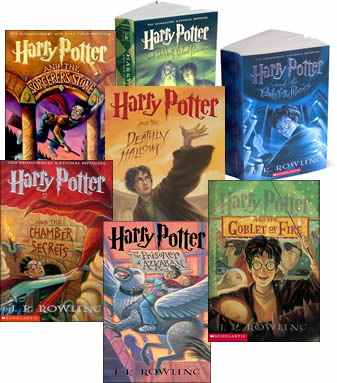 There Will be Spoilers Throughout This Post for the Harry Potter Series.
Alright, maybe I’m stretching it when I call myself a “youth” (I’m 23 now), but I grew up with Harry Potter. Harry was my age when the books came out, and I’ve followed them throughout.
The popularity of the Harry Potter books is undeniable. Few in my generation don’t at least know about the series. The movies are consistently blockbusters, and surprisingly well made.
Christian parents rightly wonder whether these books–which are filled with sorcery, witchcraft, curses, hexes, and the like–are suitable for their children. Let me preface the rest of my discussion with my conclusion: the Harry Potter books are enjoyable literature which will build vocabulary, expand minds, and get children excited about reading.
Synopsis
The series follows Harry Potter through 7 years of his life, starting when he is 11. It is set in modern day England. There are two worlds in the series: the world of “muggles”–those who can’t use magic–and the world of wizards. The wizards go to great lengths to keep their world a secret from any “muggles” who are unrelated to wizards (or in important positions like the Prime Minister). Thus, when the series starts, Harry Potter knows nothing of his wizarding past, having been raised by his aunt and uncle, who hate everything having to do with wizards.
Despite his lack of knowledge about the world of wizards, Harry Potter is himself hugely famous to wizards. He is known as the “Boy Who Lived” because when he was but a baby, an evil wizard known as Lord Voldemort (frequently referred to as “You-Know-Who” or “He-Who-Must-Not-Be-Named”) attempted to kill him and failed. Harry’s parents were killed in the scuffle, but when Voldemort tried to kill Harry, the killing curse rebounded and killed Voldemort instead. Thus, Harry is seen by many as the defeater of the greatest evil wizard of all time. Everyone knows his name; there is a monument to him at his old home; he has a lightning-bolt shaped scar which clearly identifies him, and he knows nothing about this.
Then his life changes when, at age 11, he is invited to attend Hogwarts, a school for wizards. Thereafter, the books follow Harry’s growth as a wizard with his friends, as well as the rumors of and eventual rise to power of Voldemort. It culminates in the final book, The Deathly Hallows, when Harry races against time with his friends to destroy Voldemort. (For a more in-depth synopsis, check out the page here. Check out the links for each book’s plot synopsis on the same page.)
Analysis
The question which has been asked repeatedly within the Christian community is “Are these books appropriate for my children?”
I started reading Harry Potter when I was 11 years old. As each book came out, I devoured it immediately (except for a brief hiatus before book 5). The books do have very scary, and even disturbing, moments. Voldemort is an evil wizard, and he is portrayed as such. He orchestrates murders and he and his cohorts murder with an attitude of nonchalance. The books also have many scenes of “kids being kids”. Harry and his best friend, Ron, often cheat off their mutual friend Hermione in order to complete their homework. Ron’s older brothers are pranksters of the highest level, whose very lives are dedicated to perfecting their antics. Rivalry between youths is also portrayed, as Hogwarts features four “Houses” which compete for top honors at the end of each year. The books also pull no punches in the realm of “magic”; the children are engaged in hexes, curses, charms, astrology, and the like.
Suggestions for Parents
So what should a Christian parent do with this series? It is impossible to issue a blanket statement that will apply to all parents. Instead, I want to offer several suggestions and comments.
First, there are few books which will keep children and youths reading as well as the Harry Potter Series. It has helped to increase literacy in a generation from which appreciation for books seems to be disappearing. (See the interesting article here for some insight on this phenomenon.)
Second, the Harry Potter books distinguish between good and evil to an extent that much other literature does not. There is no doubt that Voldemort is evil and that Harry and friends are the “good guys.” However, this leads me to the third point: the series acknowledges that no human is perfect. Everyone, from Harry’s father to Dumbledore (headmaster of Hogwarts) has things in their past they regret. I don’t think this is a fault of the series (though some people do–arguing that this diminishes the distinction between good and evil); rather, it brings to light something we–as Christian in particular–acknowledge is true: all people are sinners in need of salvation (this is not a theme developed in the books).
Fourth, despite the use of magic of all kinds, there remains a clear distinction between acceptable practice and unacceptable practice. Some have feared that Harry Potter would increase the interest in witchcraft and wizardry in youths. I personally think this is ludicrous. But that leads me to the fifth point.
Fifth, you as parents are responsible for teaching your children the difference between reality and fiction. My parents did a fantastic job on this. Reading Harry Potter never made me want to explore witchcraft, alchemy, or astrology. I knew such things were to be avoided. That is, I could distinguish between reality and unreality. I think that too often, Christian parents in particular underestimate the power of youths to make this distinction. Yet few parents would object to their children reading Star Wars. Perhaps it is the use of “witch” and “wizard” which makes parents leery. But, in my opinion as a Christian who grew up reading Harry Potter, there is no need to fear… unless children have not been taught to realize a difference between fact and fiction.
Sixth, parents need to be informed. When their children are interested in something like Harry Potter, it is too often that parents read only the negative sources. What better way to judge whether something is appropriate for your children than by reading the book yourself?
Questions
Kenneth Samples (cited below) argues that there are three major questions for parents to ask about Harry Potter (and other books). First: “How can Christian parents test their decisions in terms of Scripture, conscience, and reason?” Christian parents should always turn to these sources to figure out whether something is appropriate for their children.
Second: “Is it appropriate to use dark and occult images in fantasy literature to convey a narrative in fantasy literature?” Samples notes that C.S. Lewis and J.R.R. Tolkien both use these images to convey their message. Are these appropriate usages? (I think yes, but the key here is that there is no quick and easy answer for everyone.)
Third: “Does the book use these images at literary devices to propel the broader story, or, rather to promote occult involvement?” Samples argues this is a critical question. If the Harry Potter books simply use the occult images as a literary device, then it seems like there is no problem. The Harry Potter books do seem to be in the former category rather than the latter.
Fourth, “What is the overarching worldview reflected in the books and how does it compare or contrast with the Christian worldview?” This can spur discussion on books and series that aren’t even intended to convey the Christian worldview.
Conclusion
I said earlier that there is no fast and easy way to say “yea” or “nay” for all parents to a series like Harry Potter. I hope that my comments will help concerned parents figure out where to stand on the series. I want to make my own view absolutely clear, here at the close. I think the Harry Potter books are fantastic. They feature memorable characters and exciting plots. Not only that, but they get kids interested in reading. They build vocabulary (I remember personally grabbing a dictionary once in a while when I was younger and reading Harry Potter). The books distinguish between good and evil while maintaining the reality no one is perfect. They will spur discussion. Ultimately, I recommend Harry Potter to parents, but with the qualifier that parents have taught their children about fact and fiction and that they are willing to engage their children in discussion, which may (probably does) require reading the books themselves.
Source
Samples, Kenneth. “To Read or Not to Read: Harry Potter and the Philosopher’s Response.” Straight Thinking Podcast. 10/20/2009.
———
The preceding post is the property of J.W. Wartick (apart from citations, which are the property of their respective owners) and should not be reproduced in part or in whole without the expressed consent of the author. All content on this site is the property of J.W. Wartick and is made available for individual and personal usage. If you cite from these documents, whether for personal or professional purposes, please give appropriate citation and provide a link to the original URL. By viewing any part of this site, you are agreeing to this usage policy.

 J.W. Wartick - Reconstructing Faith