Book Reviews
Book Review: “The Doctrine of Creation: A Constructive Kuyperian Approach” by Bruce Riley Ashford and Craig G. Bartholomew
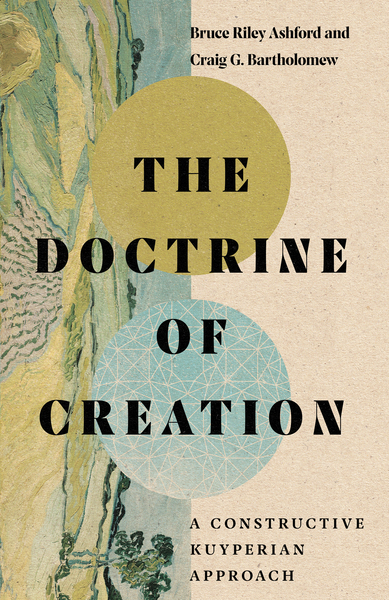
A systematic doctrine of creation is the core of Bruce Riley Ashford and Craig G. Bartholomew’s The Doctrine of Creation: A Constructive Kuyperian Approach. The subtitle begs questions about what is meant by this specific doctrine of creation. First, the authors follow the theology of Abraham Kuyper, a Dutch Reformed theologian of the late 19th and early 20th centuries. Second, the notion of being “constructive” means the doctrine builds upon itself, layer upon layer, making a truly systematic approach.
The authors pursue a broad approach, first discussing the historic Christian Creeds and their place in a construction of a doctrine of creation, then moving on to a broad historical overview of the doctrine itself. Next, they turn to God’s omnipotence and its bearing on creation, then move through biblical and theological discussion of creation to show a specific view of how Creation occurred and what relevance it has for today. Providence–God’s sustaining of the world–is a subject of its own chapter, followed by a chapter about Christ and the Holy Spirit in the New Creation, and the book ends with a application of the doctrine of creation to a few modern topics. There is a short appendix about missional neo-Calvinism at the end.
The way Ashford and Bartholomew build the doctrine of creation is infused with insight from Kuyper throughout, though it’s clear that calling it “Kuyperian” is more to designate it as along the Newo-Calvinist tradition than specifically or robotically following Kuyper. I am by no means an expert in Kuyper’s theology. My comment to this effect is based upon the extensive use of more modern citations as well as more generalized theological strands than simply adherence to Kuyper. Much as a Lutheran might call their approach Lutheran without explicitly following Luther in every regard, the authors are doing the same here.
It was interesting to see the first chapter begin with a discussion of the historic Christian Creeds and a defense of their use in helping construct a doctrine of creation. The book’s audience is clearly intended to be broader than Dutch Reformed readers, and this was perhaps included to show the authors have done their legwork regarding why we should see the Creeds as important to faith formation and theology today. As a Lutheran myself, it is just a given that the Creeds are of great import, and it was most interesting to see the authors engaging in such an extended defense of their use. Speaking of the book’s audience–this book is one that will largely yield fruits based on two things: the effort the reader puts into understanding and following the systemic theology therein; and one’s own theological biases. For example, the author’s discussion of the creation accounts (yes, the “s” is intentional) in Genesis was of great interest to this reader, but others might be inclined to see the accounts as a unified whole. More specifically on the doctrines of providence, omnipotence, and elsewhere, the authors’ Neo-Calvinist/Kuyperian view looms large and so will challenge readers who hold other positions.
I was somewhat surprised to see the focus in the chapter about God’s omnipotence to be so specifically focused on God the Father. Indeed, the chapter itself, following the language of the Apostle’s Creed, is titled “God, the Father Almighty.” But one gets a sense within the chapter that the other members of the Trinity are almost afterthoughts in this aspect of the doctrine of Creation. This is most clear when the authors use language that seems almost a concession in describing the role of the other divine Persons: “we know that the Son and the Spirit are also involved in the act of creation” (140). However, those Persons get little say until a later chapter discusses the New Creation (306ff). Many modern controversies are discussed, with views of omniscience and providence being at the center of a section about creatio continua (continued creation). Here, the authors wrestle with authors within their own tradition (eg. Barth’s resistance to philosophy p. 290-292 and elsewhere) as well as others like Molinists with competing views (they argue for an Augustinian view against the Molinist position, see p. 293-294, but also the discussion on 126).
Numerous intriguing insets are found throughout the text, such as an extended discussion of creation out of nothing (133-137) that includes some discussion of ancient Near Eastern literature. However, the authors focus much more upon Christian tradition and writings than on any attempt to understand the contemporary culture or meanings inherent in the text from an ANE perspective. Many other insets highlight important topics relevant to the issues at hand and present readers with more extensive looks at the authors’ arguments.
I was quite surprised in the final chapter to see the author’s application of their systematic theology to contemporary issues. I wasn’t surprised to see that application made–surely if a Christian doctrine of creation is true, it ought to be able to speak to many modern problems–but rather with the seeming lack of care given in this section to sources and argumentation. Specifically, the authors turn to the question of transgender individuals. They make a distinction between gender dysphoria and “transgender ideology” (360) and assert that “we must recognize transgenderism as deeply incoherent” (ibid). Beyond that, they agree with another writer that “it is a gnostic denigration of the material body that nonetheless insists that a trans person must transform his or her body in order to be whole…” among other things. Here we see the ugly aphorism that “If I don’t like a theological position, it must be Gnosticism” rearing its ugly head.
Beyond the utter historical nonsense that is the equivocation of modern transgender ideology to ancient Gnosticism without anything more than bald assertion, the authors themselves produce the very type of incoherent argument they accuse their interlocutors of performing. First, their definition of “transgender ideology” as the belief that “a person can be born into the body of the wrong sex and can be transformed into the other sex through gender reassignment surgery and/or hormone therapy” (ibid). This definition may reflect the beliefs of some people, but surely not a broad enough consensus as to lump all who go beyond mere acknowledgement of gender dysphoria into this category. Moreover, the authors themselves seem to totally miss one of the central aspects of an understanding of gender dysphoria–something they at least seem to acknowledge as a real difficulty–as they move quite swiftly from discussion of “sex” to discussion of gender. Just one page after their definition, they continue: “A person should not, and indeed cannot, change his or her gender” (361). This seems utterly confused, because the language they’re using reflects objectivity of gender standards which simply cannot be the case given how frequently throughout history those expectations have changed. Men in Elizabethan England were expected to wear ruffles and stockings, so according to these authors’ confused understanding, men today are either sinfully attempting to change their gender by not doing so, or the whole of societal expectations in that era and place were themselves mistaken and indeed impossible (referring to the language of “cannot”). Given the deep misunderstandings of the basic tenets and talking points of modern discussions of transgender topics (something I myself do not claim any expertise in), it seems the authors may have been better served if they’d let the topic lie instead of attempting a triumphant broadside that dissolves into silliness on the most superficial examination.
It is clear that readers of The Doctrine of Creation: A Constructive Kuyperian Approach will be challenged on many levels as they read the book. It is an impressive look at what it means to build a doctrine of creation within a specific theological tradition. There are some stumbles throughout the book, but readers–especially those interested in Reformed doctrine–will find much of interest. Unfortunately, I cannot recommend some of the discussion of modern topics.
Disclaimer: I was provided with a copy of the book for review by the publisher. I was not required to give any specific kind of feedback whatsoever.
All Links to Amazon are Affiliates links
Links
Be sure to check out the page for this site on Facebook and Twitter for discussion of posts, links to other pages of interest, random talk about theology/philosophy/apologetics/movies and more!
Book Reviews– There are plenty more book reviews to read! Read like crazy! (Scroll down for more, and click at bottom for even more!)
SDG.
——
The preceding post is the property of J.W. Wartick (apart from quotations, which are the property of their respective owners, and works of art as credited; images are often freely available to the public and J.W. Wartick makes no claims of owning rights to the images unless he makes that explicit) and should not be reproduced in part or in whole without the expressed consent of the author. All content on this site is the property of J.W. Wartick and is made available for individual and personal usage. If you cite from these documents, whether for personal or professional purposes, please give appropriate citation with both the name of the author (J.W. Wartick) and a link to the original URL. If you’d like to repost a post, you may do so, provided you show less than half of the original post on your own site and link to the original post for the rest. You must also appropriately cite the post as noted above. This blog is protected by Creative Commons licensing. By viewing any part of this site, you are agreeing to this usage policy.
“Bonhoeffer’s America: A Land Without Reformation” by Joel Looper
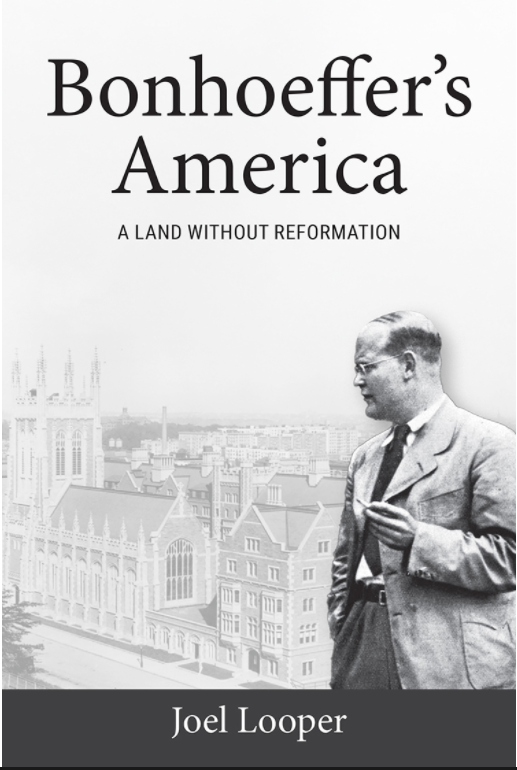
Dietrich Bonhoeffer’s time in America has been the subject of much scholarly discussion. It is clear it had enormous impact on his theology, but what hasn’t been as clear is exactly what kind of impact it may have had. Joel Looper’s phenomenal, challenging work, Bonhoeffer’s America: A Land Without Reformation not only seeks to answer definitively what kind of impact Bonhoeffer’s time in the United States had on the man and his theology, but also shows how extremely timely Bonhoeffer’s words and warnings about American theology can be for us today.
The book is divided into three parts. The first, “What Bonhoeffer Saw in America,” is Looper’s deep narration of Bonhoeffer’s life in America. Here, Looper delves deeply into Bonhoeffer’s coursework at Union Theological Seminary, who he interacted with, and what he himself reports about the situation with American theology. This part lays the foundation for the rest of the book. Here, Looper’s depth of knowledge and exploration of Bonhoeffer’s theology is on full display. It’s not just a report of Bonhoeffer’s time and words, but also an analysis that helps elucidate themes in Bonhoeffer’s writing from this time period that make much more clear what his issues were with American theology. Much of Bonhoeffer’s writing from his time in America is difficult to understand or comprehend without significant knowledge of contemporary issues, and Looper does an admirable job filling in those gaps, showing readers the background for understanding many of Bonhoeffer’s critiques. For example, some have utilized Bonhoeffer’s hard critiques of the social gospel to attempt to decry modern movements for social justice. However, Looper demonstrates that Bonhoeffer’s critique of the social gospel is not because it seeks to bring justice, but rather because it displaces the very gospel itself–that is, it doesn’t center revelation in Christ in the Christian message (see, for example pages 41, 46, and especially 48-49). The problem is not the ultimate efforts to feed the poor, stand with the oppressed, &c. The problem is, rather, the starting point of theology and its abandonment of revelation as the ultimate grounds.
The second part of the book focuses on Bonhoeffer’s analysis of American Protestantism specifically. American theology, as read by Bonhoeffer, had a primary problem in that it was “Protestantism without Reformation.” The meaning of this phrase is complex, but Looper notes that for Bonhoeffer, it can be traced back to Wycliffe and the Lollards. This sounds like an obscure point, but Looper, making Bonhoeffer’s own arguments clearer, shows how and why one might take this to be the case, particularly in the circles in which Bonhoeffer ran. It is clear, of course, that Bonhoeffer was not exposed to all of American theology, but what he saw ran in this vein, and the more conservative branches of theology he encountered were, in his opinion, little more than the most blunt and un-nuanced attempts to enforce orthodoxy. The Protestantism of the United States is so influenced by the strands Bonhoeffer mentioned that even Jonathan Edwards, cited by many as one of the greatest theologians America as produced, doesn’t even mention the church in his discussion of what one needs to be saved (75-76). American churches gave up any kind of confessional standard, only enforcing them after splitting again and again, and, in doing so, abandoned the Christian confession (86). American Protestants, for Bonhoeffer, no longer had something against which to protest, because they had severed themselves so distantly from the one true, holy, catholic church (86-87).
Even more damning is Bonhoeffer’s analysis of secularization in America. The pluralism enforced in America led to a kind of secularization of the church and idolization of the individual to the point that the allegiance was given to the nation state rather than to the church and God (102-103). This can be traced, again, to English dissenters who formed the backbone of colonial America. The secularization of the church is not due to some outside force acting upon it, but rather due to the church itself abandoning the word and being, again, a Protestantism without any kind of Reformation. In America, rather than having state churches, secularization came into play precisely because of the focus on freedom and independence–the church then becomes a mouthpiece for the alleged freedom the state provides (106-107).
Bonhoeffer’s own oft-misunderstood theology of the two kingdoms is, according to Looper, central to his understanding of the Gospel as well. Here is where Bonhoeffer’s Lutheranism is so central to his understanding of the problems with American theology and beyond. The call for “thy kingdom come” must include both church and state precisely because of the two kingdoms theology–the church and state are both necessary and linked to one another (113-114). Thus, the famous phrase from Bonhoeffer about “seizing the wheel” is not actually revolutionary but rather counter-revolutionary. Bonhoeffer saw the Nazis as the revolutionaries, and such an understanding fits well within the Two Kingdoms theology Bonhoeffer so ardently supported.
The third part of the book centers around objections to both Bonhoeffer’s view of the American church and objections that seek to counter this narrative. For example, much has been made of Bonhoeffer’s largely positive analysis of the Abyssinian Baptist Church in Harlem. Looper doesn’t downplay this positive theme in Bonhoeffer’s analysis of America, but he does contextualize it. The Abyssinian Baptist Church was, to our knowledge, the only African American church he encountered in the United States apart from perhaps one or two Sundays in the American south (131). Bonhoeffer has threads that sound like W.E.B. Du Bois in some of his analysis of the American situation, such as when he talks about what is “hidden behind the veil of words in the American constitution saying ‘all men are created free and equal'” (136). It’s clear this had a positive and even eye-opening impact on Bonhoeffer, and traces of this can be found in his theology. Bonhoeffer’s own discussion of Jews in Germany, such as in his “The Church and the Jewish Question” may have been somewhat influenced here. Looper analyzes Bonhoeffer’s discussion of the Jewish people and shows how, while at times it is couched in problematic language, it demonstrates a deeper understanding and concern than one could credit him merely given his background or upbringing. (The whole section on this is a fascinating read, showing clear analysis that’s well-worth reading. See p. 141-146 in particular.) Bonhoeffer’s theology, however, remained firmly German Lutheran, and his own life-risking efforts in behalf of the Jews were not traceable to some kind of vague Western morality of “equality of all” but rather, Looper asserts, clearly based upon his Christology (150). Thus, Bonhoeffer’s experience with the Abyssinian church demonstrates a caveat in his analysis of American theology. Rather than a total rejection of all American theology, Bonhoeffer’s words ought to be seen directed exactly as they were, against the overwhelmingly popular academic streams of thought in contemporary American theology.
Bonhoeffer’s imprisonment and his now famous Letters and Papers from Prison have led some to argue that he changed his views profoundly while in prison. Looper instead notes that his late-stage theology has continuity with that of his earlier life.
Looper’s work serves as a powerful challenge to many theologies of today. For those adhering to modern forms of the social gospel, Bonhoeffer’s warnings and critiques of that movement from his own time continue to apply: are these movements removing Christ from the center? For progressive Christians, Bonhoeffer’s critique of the social gospel can loom large–“Do such [progressive] theologies tend to respond to the critique of the word [revelation, Scripture] and think critically about their subjects in its wake? Or, rather, do they often begin with the (oppressed) self and work from the experience of that self and the non-ecclesial community with which it identifies? If the latter, are these theologies then only variants of ‘religious’ logic…?” (197-198). For conservatives, especially American evangelicals, Looper notes that the constant efforts to try to maintain a “seat at the table” in the larger world and their defense of their institutions, even to the point of, as many have said, voting while “holding their nose” for someone who, ethically, cannot be defended, would have been seen by Bonhoeffer as “Niebuhrian realism, pragmatism par excellence, and, in working from this script, evangelicals both brought the name of Christ into disrepute and forgot how the economy of God and of the church are supposed to work… Bonhoeffer would have called this evangelical struggle a cause of American secularization, not a buffer against it” (196). Bonhoeffer would see American theology today as a total abandonment of Protestant norms, exactly because of his theology of two kingdoms (joined with Luther’s) and because of the stark pragmatism of the right and the rush to de-center the Gospel on the left (198). Looper’s book thus serves as a blunt reminder of the dangers of our modern theological era and the need to offer correctives.
I have now read more than 70 books by or about Dietrich Bonhoeffer, his theology, and the world he inhabited in order to try to understand more about the man and his theology. Bonhoeffer’s America: A Land Without Reformation easily ranks in the top 10 of those books. Anyone who is interested in learning more about Bonhoeffer’s theology should consider it a must read. More importantly, though, those wishing to have an understanding of American theology and its problems to this day should seek out this fantastic book. I highly recommend it without reservation.
All Links to Amazon are Affiliates links
Links
Be sure to check out the page for this site on Facebook and Twitter for discussion of posts, links to other pages of interest, random talk about theology/philosophy/apologetics/movies and more!
Book Reviews– There are plenty more book reviews to read! Read like crazy! (Scroll down for more, and click at bottom for even more!)
SDG.
——
The preceding post is the property of J.W. Wartick (apart from quotations, which are the property of their respective owners, and works of art as credited; images are often freely available to the public and J.W. Wartick makes no claims of owning rights to the images unless he makes that explicit) and should not be reproduced in part or in whole without the expressed consent of the author. All content on this site is the property of J.W. Wartick and is made available for individual and personal usage. If you cite from these documents, whether for personal or professional purposes, please give appropriate citation with both the name of the author (J.W. Wartick) and a link to the original URL. If you’d like to repost a post, you may do so, provided you show less than half of the original post on your own site and link to the original post for the rest. You must also appropriately cite the post as noted above. This blog is protected by Creative Commons licensing. By viewing any part of this site, you are agreeing to this usage policy.
Book Review: “Every Leaf, Line, and Letter: Evangelicals and the Bible from the 1730s to the Present” edited by Timothy Larsen
Timothy Larsen is an author whose works have fascinated me time and again, so when I saw his edited volume on evangelicals’ reading of the Bible, I knew I had to hop in. Every Leaf, Line, and Letter: Evangelicals and the Bible from the 1730s to the Present is a superb look at some specific ways evangelicals have engaged with the Bible throughout the last several centuries.
Collections of essays are often hit-or-miss affairs, but Larsen has compiled a selection of essays full of excellent topics and insights. The essays are grouped by century, starting in the 18th and terminating in the 21st. They rnage fro mearly evangelical readings of the Bible to global evangelical mindset in today’s contexts. Instead of providing an overview of every one of these great works, I’ll highlight a few I found especially insightful.
With “British Exodus, American Empire: Evangelical Preachers and the Biblicisms of Revolution,” Kristina Benham introduces readers into the ways in which American evangelicals and their British forebears used the biblical narrative–particularly those of the Exodus–to draw parallels to their own situations in colonial and Revolutionary America. It’s a fascinating look at how one’s own context can shape how one reads Scripture. Mark A. Noll’s “Missouri, Denmark Vesey, Biblical Proslavery, and a Crisis for Sola Scriptura” engages with readings of the Bible and advocates of slavery. Indeed, at times the proslavery position claimed the high ground of reading the Bible more literally or even accurately than did those who opposed slavery. Such readings of the Bible in evangelicalism are too often ignored or skirted around.
Malcom Foley’s essay about resisting lynching, “‘The Only Way to Stop a Mob’: Francis Grimke’s Biblical Case for Lynching Resistance” seems poignant to this day, despite being part of twentieth century readings of Scripture. Catherine A. Brekus’s examination, “The American Patriot’s Bible: Evangelicals, the Bible, and American Nationalism,” shows how evangelicalism in the 21st century has so often conflated nationalism, patriotism, and theology. Her detailed analysis of what may seem an aberration also highlights how emblematic of American Evangelicalism the American Patriot’s Bible actually is.
This short sampling of just a few topics out of the 12 essays offered shows the broad array of topics available to the reader. I can’t emphasize just how refreshing this collection was. Yes, the topics are focused around a single subject: evangelical readings of the Bible; but they did so from such broad categories that each essay felt it broached new and intriguing avenues of exploration for the reader.
One drawback of collections of essays does loom here, though: there is, again, an unbalance in authors selected. I’m unsure of the racial breakdown in authorship, but the contributors are heavily weighted towards males, with at least 2/3 being men. Though each essay is excellent on its own merits, one wonders whether there couldn’t have been more attention paid to a diversity of voices.
Every Leaf, Line, and Letter gives readers a broad swathe of topics related to evangelicals’ reading of the Bible both past and present. Each essay brings a unique perspective and whole avenues of new reading and insight along with it. This volume is highly recommended.
Disclaimer: I was provided with a copy of the book for review by the publisher. I was not required to give any specific kind of feedback whatsoever.
All Links to Amazon are Affiliates links
Links
Be sure to check out the page for this site on Facebook and Twitter for discussion of posts, links to other pages of interest, random talk about theology/philosophy/apologetics/movies and more!
Book Reviews– There are plenty more book reviews to read! Read like crazy! (Scroll down for more, and click at bottom for even more!)
SDG.
——
The preceding post is the property of J.W. Wartick (apart from quotations, which are the property of their respective owners, and works of art as credited; images are often freely available to the public and J.W. Wartick makes no claims of owning rights to the images unless he makes that explicit) and should not be reproduced in part or in whole without the expressed consent of the author. All content on this site is the property of J.W. Wartick and is made available for individual and personal usage. If you cite from these documents, whether for personal or professional purposes, please give appropriate citation with both the name of the author (J.W. Wartick) and a link to the original URL. If you’d like to repost a post, you may do so, provided you show less than half of the original post on your own site and link to the original post for the rest. You must also appropriately cite the post as noted above. This blog is protected by Creative Commons licensing. By viewing any part of this site, you are agreeing to this usage policy.
Book Review: “Worshiping with the Reformers” by Karin Maag
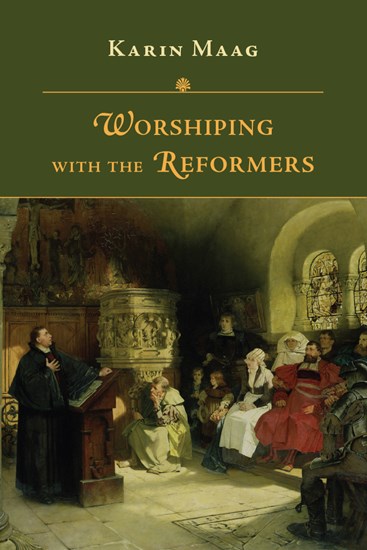
What did worship during the Reformation look like? Karin Maag’s Worshiping with the Reformers provides a broad look at what worship during time of the Reformers was like, what kind of singing–if any–they did, and answers a host of other questions about worship during this formative time for the Christian church.
Each chapter explores various branches of the Reformers’ churches and their practices on the topic at hand. These chapters cover: going to church, at church, preaching, prayer, baptism, communion, the visual arts and music, and worship outside church. Firsthand accounts of worship abound, along with the occasional humorous (in retrospect–certainly not at the time) reports of charges being leveled at people for improperly worshiping, not showing up, and more. Every individual chapter has some fascinating detail to take away.
What’s especially of interest to those looking to explore Reformation history is the broad areas of unity of practice along with the rather sharp distinctions between the various branches of Reformers on things like music in worship, the use of art, or how to practice sacraments–and what they ought to be called. These practices show that the Reformation, far from being a truly unified movement, was one in which Christians were exploring the meaning of worship in often unique and divergent ways. Set alongside that, however, there is unity found in the importance of Scripture, attempts to return to biblical practices, and more. Maag consistently provides a combination of firsthand accounts and third person analysis, making the book a fascinating read from cover to cover.
Worshiping with the Reformers is a fascinating glimpse into the worship practices of various branches of the Reformation during that time of societal change. Readers with interest in the Reformation, worship styles, or even European history will find this a fascinating book.
Disclaimer: I was provided with a copy of the book for review by the publisher. I was not required to give any specific kind of feedback whatsoever.
All Links to Amazon are Affiliates links
Links
Be sure to check out the page for this site on Facebook and Twitter for discussion of posts, links to other pages of interest, random talk about theology/philosophy/apologetics/movies and more!
Book Reviews– There are plenty more book reviews to read! Read like crazy! (Scroll down for more, and click at bottom for even more!)
SDG.
——
The preceding post is the property of J.W. Wartick (apart from quotations, which are the property of their respective owners, and works of art as credited; images are often freely available to the public and J.W. Wartick makes no claims of owning rights to the images unless he makes that explicit) and should not be reproduced in part or in whole without the expressed consent of the author. All content on this site is the property of J.W. Wartick and is made available for individual and personal usage. If you cite from these documents, whether for personal or professional purposes, please give appropriate citation with both the name of the author (J.W. Wartick) and a link to the original URL. If you’d like to repost a post, you may do so, provided you show less than half of the original post on your own site and link to the original post for the rest. You must also appropriately cite the post as noted above. This blog is protected by Creative Commons licensing. By viewing any part of this site, you are agreeing to this usage policy.
Book Review: “Misreading Scripture with Individualist Eyes: Patronage, Honor, and Shame in the Biblical World” by E. Randolph Richards and Richard James
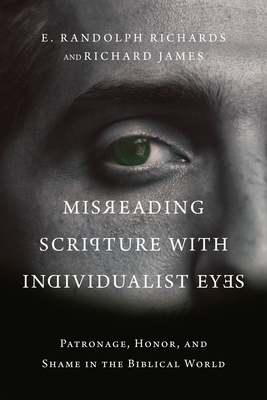
Sometimes, there are passages in Scripture that can be hard to understand. One holdup for those of us in the United States, for example, is our individualist lenses as we read the Bible. E. Randolph Richards and Richard James’s Misreading Scripture with Individualist Eyes shows readers how they might be misunderstanding the Bible–or even missing some core points–due to those lenses.
The authors split the discussion into three parts: social structures of the Biblical world; social tools: enforcing and reinforcing our values; and “Why does collectivisim really matter to me?” These sections each show different aspects of the ancient world and how those cultural norms could directly impact how certain verses and stories would have been understood. Additionally, the authors show how our modern readings could use some correction based upon understanding the cultural background of Scripture.
The social structures of the biblical world are the subject of the first chapter, and the authors make it clear fairly quickly why these social structures ought to matter to our reading of the Bible. The story of Joseph and Potiphar’s wife is used to show the various ways honor, shame, and other factors played into the way the human characters acted. While it seems possible to grasp some of this without a broader understanding of Ancient Near Eastern social structures, it is also clear that such an understanding adds much to the reading of these stories.
Patronage also looms large in the Bible, and a fascinating chapter on how these relationships played out explains not just how patronage culture works today but also how we can see that very same kind of relationship throughout the Bible. For example, patronage “created new households” with the patron-client relationship, and this was behind the understanding of many of Paul’s points in his letters (106ff, see esp 109, emphasis theirs).
After reading this book, readers will come away with an understanding of honor-shame, patronage-client, and other cultural norms found in the Bible which are often obscured by our individualist lenses. Books like this, which provide insight into understanding the Bible without trying to force readers into a particular theological perspective, are extremely valuable.
Misreading Scripture with Individualist Eyes demonstrates that we can very easily misunderstand God’s word if we approach it the wrong way. It is highly recommended for both individual readers seeking to learn more about how to understand Scripture as well as for small groups.
Disclaimer: I was provided with a copy of the book for review by the publisher. I was not required to give any specific kind of feedback whatsoever.
All Links to Amazon are Affiliates links
Links
Be sure to check out the page for this site on Facebook and Twitter for discussion of posts, links to other pages of interest, random talk about theology/philosophy/apologetics/movies and more!
Book Reviews– There are plenty more book reviews to read! Read like crazy! (Scroll down for more, and click at bottom for even more!)
SDG.
——
The preceding post is the property of J.W. Wartick (apart from quotations, which are the property of their respective owners, and works of art as credited; images are often freely available to the public and J.W. Wartick makes no claims of owning rights to the images unless he makes that explicit) and should not be reproduced in part or in whole without the expressed consent of the author. All content on this site is the property of J.W. Wartick and is made available for individual and personal usage. If you cite from these documents, whether for personal or professional purposes, please give appropriate citation with both the name of the author (J.W. Wartick) and a link to the original URL. If you’d like to repost a post, you may do so, provided you show less than half of the original post on your own site and link to the original post for the rest. You must also appropriately cite the post as noted above. This blog is protected by Creative Commons licensing. By viewing any part of this site, you are agreeing to this usage policy.
Book Review: “J. I. Packer: His Life and Thought” by Alister McGrath
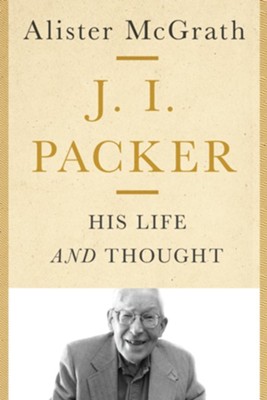
J. I. Packer was undoubtedly one of the most influential American theologians of the 20th Century. Alister McGrath offers a pithy look at the man’s legacy with J. I. Packer: His Life and Thought.
McGrath covers quite a bit of ground in the book, compressing a life’s story as well as an intellectual journey into 154 pages of text. He shows how Packer’s early life influenced his later thought, demonstrates shifts in Packer’s direction, and even offers some brief analysis of aspects of Packer’s theology. In doing so, McGrath can touch delicately on controversial topics.
For example, Packer was a vociferous opponent of women’s ordination, but McGrath attempts to moderate this opposition by couching it in concern for “conviction and process” related to tradition (134-135). This very brief discussion of Packer and women’s ordination led me to wonder if other less amenable aspects of Packer’s theology might have been toned down.
That said, there is quite a bit to appreciate about McGrath’s work introducing any reader to such a swathe of ideas from Packer as well as showing his life in toto in such a readable form.
It’s worth a brief note saying that the book has an absolutely superb index. I was easily able to browse topics and sections and used it a few times in writing this review, as well as as I was reading the book. I commend the editors for doing such a great job on this oft-overlooked aspect of the book.
J. I. Packer: His Life and Thought is a surprisingly deep look at Packer’s legacy in an easily digestable form. Recommended for those interested in learning about one of the more influential theologians of our time.
Disclaimer: I was provided with a copy of the book for review by the publisher. I was not required to give any specific kind of feedback whatsoever.
All Links to Amazon are Affiliates links
Links
Be sure to check out the page for this site on Facebook and Twitter for discussion of posts, links to other pages of interest, random talk about theology/philosophy/apologetics/movies and more!
Book Reviews– There are plenty more book reviews to read! Read like crazy! (Scroll down for more, and click at bottom for even more!)
SDG.
——
The preceding post is the property of J.W. Wartick (apart from quotations, which are the property of their respective owners, and works of art as credited; images are often freely available to the public and J.W. Wartick makes no claims of owning rights to the images unless he makes that explicit) and should not be reproduced in part or in whole without the expressed consent of the author. All content on this site is the property of J.W. Wartick and is made available for individual and personal usage. If you cite from these documents, whether for personal or professional purposes, please give appropriate citation with both the name of the author (J.W. Wartick) and a link to the original URL. If you’d like to repost a post, you may do so, provided you show less than half of the original post on your own site and link to the original post for the rest. You must also appropriately cite the post as noted above. This blog is protected by Creative Commons licensing. By viewing any part of this site, you are agreeing to this usage policy.
Book Review: “The Making of C. S. Lewis (1918-1945): From Atheist to Apologist” by Harry Lee Poe
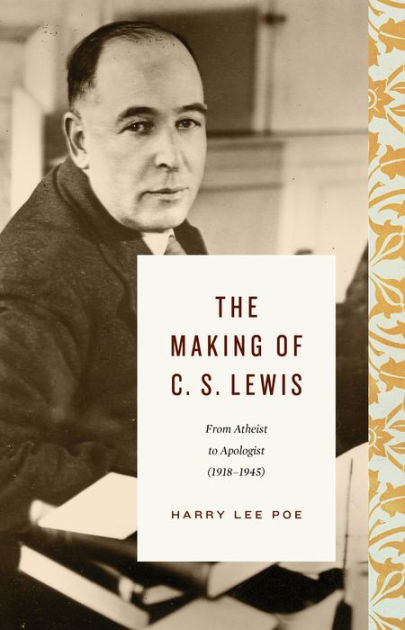
C. S. Lewis is one of the best known Christian thinkers of the 20th century. Harry Lee Poe has been working on a multivolume biography of the man, presenting a revealing and detailed portrait of his life and intellectual development. The first volume, Becoming C. S. Lewis: A Biogaphy of Young Jack Lewis covered 1898-1918 (my review). Here, in The Making of C. S. Lewis (1918-1945): From Atheist to Apologist, we see Lewis in adulthood as he moves from atheism to Christianity and, ultimately, to defending the faith. Readers could certainly read this as a standalone work and glean enormous insight into Lewis’s life, but the first biography is also well-worth the effort.
Harry Lee Poe documents extensively the life of Lewis, but he does so with a style that remains engaging throughout. The biography is divided into various periods of Lewis’s life, such as his return to Oxford, his academic work and war work, and more. Each chapter explores not just Lewis’s life, but also his intellectual development and work. Having recently read Splendour in the Dark: C. S. Lewis’s Dymer in His Life and Work by Jerry Root (review here), it was great to see Poe also highlighting several aspects of this lesser-known work of Lewis’s pre-Christian days. Lewis was pleased to be published, and it was one of the moments that his father also seemed to be pleased with. Perhaps more importantly, however, Lewis’s fascination with myth and enchantment of the world was already fully formed before his conversion. Poe notes the derision with which Lewis held several Christian influences on his life, but how he later changed his views as he encountered more devout believers. Poe balances this experience of Lewis with his intellectual development, showing how Lewis’s exploration of myth and legend led him to be fascinated by Christianity even as he was enthralled by the behavior of some of its adherents.
Lewis as a Christian continued to write and explore themes of myth, while also being pushed by several friends who influenced how and what he wrote. From such exploration, we received works like Miracles, as Lewis was encouraged to write a book defending the possibility of the titular events. Of course, Lewis’s fiction is also a much-beloved aspect of his writing, though the period covered in this book covers his Space Trilogy and not Narnia. Lewis clearly had apologetic intent in mind for these books, as he worked against some of the prevailing themes in science fiction at the time.
One difficulty with this biography is that, while Poe occasionally mentions some of Lewis’s failings, he seems to gloss over others and ignore or leave out some aspects of Lewis’s life that may not be as palatable to the presumably largely American Evangelical audience it is intended to reach. Regarding the latter, for example, no mention of Lewis’s interest in sadomasochism is made here, despite it being recently documented in other works. Additionally, Lewis is portrayed most frequently as a kind of “mere Christian,” a portrayal which makes some sense in light of his own writings. However, this also means that it leaves out some of his Anglicanism and unique beliefs. It’s possible some of this latter discussion will happen in the final volume of the biography, but it makes some of the discussion of C. S. Lewis’s intellectual Christianity seem milquetoast at times. Additionally, little analysis of Lewis’s thoughts are offered here. The style Poe has chosen is generally to simply report the events of Lewis’s life without commentary. Thus, when Lewis makes some alarming comments about women, they are noted with little comment.
Much discussion of Lewis’s personal life, financial situation, and work is included in the biography. Learning of Lewis’s work to philanthropize using the income from his writings even as he failed to make much on them was one of the more intriguing details about his life. Reading of his interactions with the inklings and others who influenced his thought makes him feel much more real and connected to the reader than he was before. Poe does a superb job of weaving all of this into his overall narrative of Lewis’s life.
The Making of C. S. Lewis is another deep dive into the life of a man who is a spiritual hero for many. Poe writes in a way that captures the reader and draws them deeply in to the life of a man whose ideas continue to shape the minds of millions of Christians to this day. It comes highly recommended.
Disclaimer: I was provided with a copy of the book for review by the publisher. I was not required to give any specific kind of feedback whatsoever.
All Links to Amazon are Affiliates Links.
Links
Be sure to check out the page for this site on Facebook and Twitter for discussion of posts, links to other pages of interest, random talk about theology/philosophy/apologetics/movies and more!
Book Reviews– There are plenty more book reviews to read! Read like crazy! (Scroll down for more, and click at bottom for even more!)
SDG.
——
The preceding post is the property of J.W. Wartick (apart from quotations, which are the property of their respective owners, and works of art as credited; images are often freely available to the public and J.W. Wartick makes no claims of owning rights to the images unless he makes that explicit) and should not be reproduced in part or in whole without the expressed consent of the author. All content on this site is the property of J.W. Wartick and is made available for individual and personal usage. If you cite from these documents, whether for personal or professional purposes, please give appropriate citation with both the name of the author (J.W. Wartick) and a link to the original URL. If you’d like to repost a post, you may do so, provided you show less than half of the original post on your own site and link to the original post for the rest. You must also appropriately cite the post as noted above. This blog is protected by Creative Commons licensing. By viewing any part of this site, you are agreeing to this usage policy.
Book Review: “Bonhoeffer: God’s Conspirator in a State of Exception” by Petra Brown
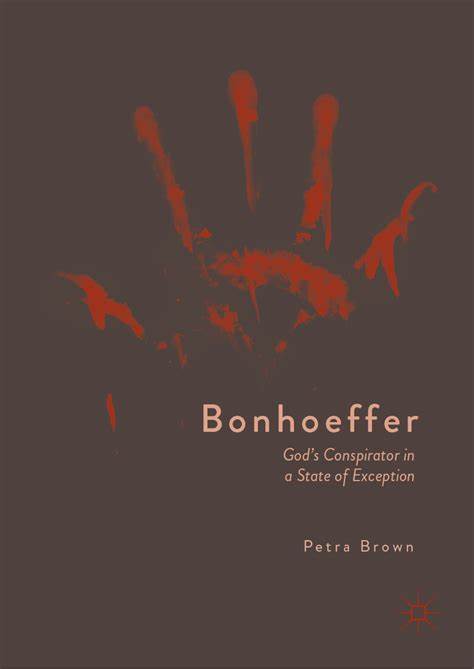
It’s no secret that I have been deeply impacted by Dietrich Bonhoeffer’s theology. However, as with everything, I believe it is important to read views which are critical of your own. Sometimes, this can help moderate your own enthusiasim for a view by showing potentially problematic aspects of it. Other times, reading something which disagrees with your views can help confirm you in that view as you rebut the critique. Petra Brown’s book, Bonhoeffer: God’s Conspirator in a State of Exception is a remarkable critique leveled directly at Bonhoeffer’s ethic. I found it enlightening and, at times, course-correcting.
The central point Brown argues that Bonhoeffer’s ethic is dangerous because it essentially allows the individual Christian disciple to justify essentially any form of violence so long as they believe they are living in a state of “exception.” Brown cites numerous examples of Christians who used violence, claiming Bonhoeffer for support when challenged on it.
The state of exception is developed by Brown through the lens of Carl Schmitt, a Nazi jurist who developed the notion of “state of exception” as “a state of emergency which requires decisive action by the sovereign (in Schmitt’s case) or by other actors within the state” (5). Schmitt is explicitly cited by Brown as the lens through which she’s viewing the state of exception and analysis of Bonhoeffer, though she also clearly state’s Bonhoeffer’s own concept of exception is intended “in a fairly straightforward way, based on Machiavelli’s concept of necessita” (106). Brown rigorously documents Bonhoeffer’s writings showing that he did speak about a state of exception, along with the need for potential individual action on the part of the disciple. However, Brown’s own definition of exception is, by her own argument, placed squarely within Schmitt’s writings, not those of Bonhoeffer. And, since Brown denotes a significant divergence between the two, this seemingly undercuts her central point. Indeed, at times this reader wondered if the point was more akin to arguing that Bonhoeffer’s ethic could be misunderstood in light of other writers on states of exception, thus becoming dangerous because of that misunderstanding. Yet Brown herself seems to be arguing that Bonhoeffer’s ethic is problematic in just this sense: that it can and does yield individual, “lone wolf” type violence. The tension between these two points is, to my eye, not resolved.
Brown does make attempts to unite Bonhoeffer’s state of exception with that of Schmitt’s, but these arguments are tenuous. For example, she notes that one possible objection to her use of Schmitt with Bonhoeffer is that comparing Schmitt’s ideas with the “emerging ideas of Bonhoeffer” is mistaken because Schmitt was “a German Catholic who explicitly claimed to speak from a Catholic position” (112). Brown argues instead that Schmitt’s position was “highly idiosyncratic” compared to traditional Catholic political stance such that it was “neither neoscholastic, nor Romantic as German Catholicism tended to be at the time” (ibid). Of course, showing Schmitt had theological distance from Roman Catholicism of his time and place does not somehow mean that Bonhoeffer’s state of exception can be seamlessly united with Schmitt. Indeed, it is telling that after making these distinctions, Brown simply moves on with the analysis of Schmitt’s concept of exception rather than attempting to unite it with Bonhoeffer’s. Indeed, she noted earlier that Bonhoeffer’s position is more akin to Machiavelli, from whom she says Schmitt is “a significant departure” (114). This, again, makes it seem as though Brown’s point is less that Bonhoeffer’s ethic itself is dangerous than that it can be dangerous once one unites it with other ethical theories or concepts that are, yes, adjacent to it, but not actually part of it.
On this latter point, I think Brown and I are in general agreement. In fact, Brown’s argument here seems to demonstrate that American evangelicals who cite Bonhoeffer in support of violent acts are doing so by misunderstanding him. But Brown, as far as I saw (and I could have missed something in my own reading), never actually makes this point explicitly. Instead, the implication is that Bonhoeffer’s own ideas are dangerous in that exact way; but that point is not sufficiently established.
Another area in which Brown’s argument loses ground is that she attempts–and fails–to adequately account for Bonhoeffer’s moderation of that state of exception and ethic when related to the church. She acknowledges that Bonhoeffer’s writings about church-community present a significant problem to her reading of Bonhoeffer’s ethic as dangerous (184). However, even as she agrees that one cannot isolate Bonhoeffer’s discussion of ethics from his discussion of the church-community, she works to move Bonhoeffer’s concept of church to that of an individual.
Brown writes, “Bonhoeffer regards the church-community not as an institution, but as a collective person; the personhood of the church-community reflects its identity as the ‘body of Christ’ that is made [up of] ‘actual, living human beings who follow Christ” (187). Thus, she says, “The church community is understood by Bonhoeffer to have ‘personhood,’ and as such I suggest that it can suffer the same isolation experienced by Abraham or the isolated disciple in her obedience to Christ’s call” (ibid). The passage she quotes in support of giving the church-community personhood is from Discipleship (aka The Cost of Discipleship). Brown moves from this quote using the words “actual living beings who follow Christ” to saying the church-community has personhood. However, Bonhoeffer himself, in that very passage which Brown quotes, is not making that point. Instead, Bonhoeffer’s point is made explicitly: the church-community is the physical embodiment of Christ on Earth, preaching God’s word to the world (DBWE 4: 225-226). Thus, for Bonhoeffer, the church-community does not become personal by means of its composition of persons. No, for Bonhoeffer, the church-community has personhood because it becomes Christ to others. And this remarkable claim obviates the difficulty Brown is trying to press. For the church-community is not reducible to a person except that that person is Christ in the world. Therefore, Brown’s argument here fails, because she reduces the church-community to the person in the wrong direction. For her argument to work, it must be reducible, again, to the Christian acting as lone wolf, possibly through violence. But in fact, Bonhoeffer’s reduction is to bring it all to Christ.
One difficulty for Brown is that shared by her imagined–and real–opponents in interpreting Bonhoeffer. Namely, by lifting his name and ethic of the pages of a book and the specific time in which he lived and plugging it in to modern debates, they’ve assumed the context and intent of his ethic today. I need to unpack this a bit. It is abundantly clear that Bonhoeffer’s ethic is not meant to be a list of principles from which people are supposed to draw to make their decisions. Indeed, his ethic does encourage individual action. However, it always does so within the community of believers. Brown’s rebuttal for this was mentioned above, but I think it is worth noting again that community for Bonhoeffer is irreducible to the individual except that of Christ. Thus, the lone wolf violence about which Brown worries and which several have attempted to justify using Bonhoeffer’s words is deeply mistaken in putting Bonhoeffer’s name to it. Just as Bonhoeffer argues one cannot have church without sacrament, so too does he insist upon the church community as working together to embody Christ on Earth. Acting in state of exception does not mean merely acting individually–it means acting along with Christ and the church.
Brown’s arguments do have merit. It is demonstrable that many violent acts have been done in the name of, or at least justified after the fact by, Dietrich Bonhoeffer. Brown’s argument that Bonhoeffer’s own ethic justifies this violence is, I believe, mistaken. However, her argument has powerful force if one includes those positions which are adjacent to Bonoheffer’s. So, for example, if one integrates others’ views of a state of exception, it becomes much simpler to justify violence. If one ignores or is ignorant of Bonhoeffer’s insistence upon the church-community and acting ethically alongside that, it becomes much easier to justify violence. So, is Bonhoeffer God’s conspirator, ushering in the possibility for violent acts by Christians? Yes and no. Yes, if Bonhoeffer’s ethic is read divorced from much of its context and with others’ interpretations and concepts smuggled in. No, if one takes Bonhoeffer at his own words.
There is, however, one clear exception to this. Brown presses hard on a sermon Bonhoeffer gave in Barcelona in which he clearly stated that even violent acts could be sanctified. She states, “I don’t believe that the 1929 Barcelona lecture can be dismissed as an aberration” for Bonhoeffer’s ethic. Her attempt to unify this lecture with Bonhoeffer’s Ethics and Discipleship is intriguing. I also think that we ought to see Bonhoeffer’s ethic more as unified whole than as a collection of different positions. The Barcelona lecture needs to fit into that somewhere. Of course, Bonhoeffer himself wrote of having some regrets about what he’d written before, so one wonders if it’s possible that, due to the influence of pacifism on his views, he would have wholly rejected what he said in Barcelona. That, or, as others have argued, perhaps Bonhoeffer was moving along a continuum of a Lutheran view of ethics, and one can unify the whole through that. Whatever the case, more work needs to be developed to discover what was meant by Bonhoeffer in Barcelona, or whether Brown’s case succeeds at this point.
Petra Brown’s Bonhoeffer: God’s Conspirator in a State of Exception presents a significant challenge for Bonhoeffer scholarship. Those who wish to engage with Bonhoeffer’s ethics–particularly those of resistance–ought to engage carefully with Brown’s critique.
All Links to Amazon are Affiliates links
Links
Dietrich Bonhoeffer– read all my posts related to Bonhoeffer and his theology.
Be sure to check out the page for this site on Facebook and Twitter for discussion of posts, links to other pages of interest, random talk about theology/philosophy/apologetics/movies and more!
Book Reviews– There are plenty more book reviews to read! Read like crazy! (Scroll down for more, and click at bottom for even more!)
SDG.
——
The preceding post is the property of J.W. Wartick (apart from quotations, which are the property of their respective owners, and works of art as credited; images are often freely available to the public and J.W. Wartick makes no claims of owning rights to the images unless he makes that explicit) and should not be reproduced in part or in whole without the expressed consent of the author. All content on this site is the property of J.W. Wartick and is made available for individual and personal usage. If you cite from these documents, whether for personal or professional purposes, please give appropriate citation with both the name of the author (J.W. Wartick) and a link to the original URL. If you’d like to repost a post, you may do so, provided you show less than half of the original post on your own site and link to the original post for the rest. You must also appropriately cite the post as noted above. This blog is protected by Creative Commons licensing. By viewing any part of this site, you are agreeing to this usage policy.
Book Review: “How Do We Know? An Introduction to Epistemology” by James K. Dew Jr. and Mark W. Foreman
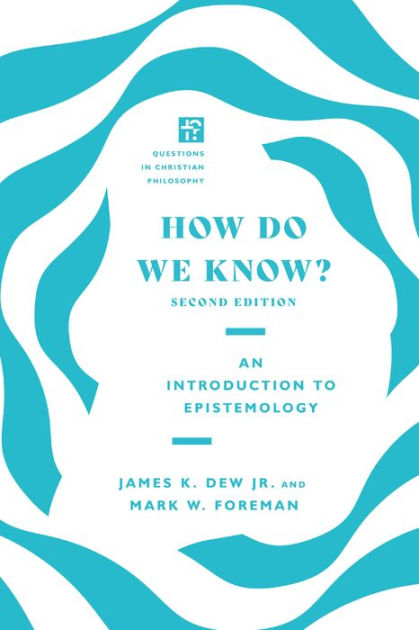
“How do you know?” sounds like such a simple question. It’s the kind of question a young child might fire off dozens of times a day to a flustered parent who tries to explain how they know that the sun can burn skin or that the mourning doves don’t pose any threat to their walk. But, like many simple questions, when one thinks more deeply about it, it becomes deeply complex. After all, how do we know what we know? That’s the question that James K. Dew, Jr. and Mark W. Foreman turn towards in How Do We Know? An Introduction to Epistemology.
Epistemology is the study of knowledge, and such a study lends itself directly to asking questions. The titles of the 11 chapters of the book reflect this, with headings like “What Do We Perceive?” and “Do We Need Justification?” Along the way, the authors introduce a wealth of information to the reader, along with resources for further exploration, discussion questions, and more. The book is clearly intended as an introductory textbook, and would serve that function well. But because of its format, it would also serve the general reader who wants to learn more about epistemology without having to dive right into a major work on the topic.
The authors focus largely on modern authors, bringing the latest thinking on the topics invovled to the reader. For example, in the chapter on justification, much is made of Alvin Plantinga’s work on epistemic justification and warrant. The book is written from a Christian perspective, but its rarely exclusive to Christian thinking. What makes the perspective useful, for one, is that the readings include several Christian authors, but only when they’re at the forefront of their fields. For example, it makes sense to include Plantinga and William Alston in the section on justification, because they’ve done so much work on the topic. The topic of “revelation” treated in an epistemology text sets this one apart, as well. It allows readers to engage with questions about faith that aren’t ordinarily addressed in this context.
How Do We Know? is a great introduction to several massive topics. Readers will come away with many question, but also equipped with several paths to explore and ways to pursue those questions. Recommended.
Disclaimer: I was provided with a copy of the book for review by the publisher. I was not required to give any specific kind of feedback whatsoever.
All Links to Amazon are Affiliates links
Links
Be sure to check out the page for this site on Facebook and Twitter for discussion of posts, links to other pages of interest, random talk about theology/philosophy/apologetics/movies and more!
Book Reviews– There are plenty more book reviews to read! Read like crazy! (Scroll down for more, and click at bottom for even more!)
SDG.
——
The preceding post is the property of J.W. Wartick (apart from quotations, which are the property of their respective owners, and works of art as credited; images are often freely available to the public and J.W. Wartick makes no claims of owning rights to the images unless he makes that explicit) and should not be reproduced in part or in whole without the expressed consent of the author. All content on this site is the property of J.W. Wartick and is made available for individual and personal usage. If you cite from these documents, whether for personal or professional purposes, please give appropriate citation with both the name of the author (J.W. Wartick) and a link to the original URL. If you’d like to repost a post, you may do so, provided you show less than half of the original post on your own site and link to the original post for the rest. You must also appropriately cite the post as noted above. This blog is protected by Creative Commons licensing. By viewing any part of this site, you are agreeing to this usage policy.
Much Ado About Nothing: Alisa Childers’ “Another Gospel?”

I believe one of the most important thing anyone can do for their edification is to read books with which one disagrees. There are a number of reasons for this, such as the possibility that such books may enlighten or even change one’s position about at topic or to ensure that one does not misrepresent the “other side” when discussing topics with which you disagree. Alisa Childers’ Another Gospel? A Lifelong Christian Seeks Truth in Response to Progressive Christianity* presents her opinions on what she calls Progressive Christianity, and, being sometimes labeled progressive myself, I figured it was worth taking a look.
The book has a Foreword by Lee Strobel, a journalist who writes bestselling apologetic works centered around interviews of experts and whose fame was only increased by the “A Case for Christ” movie about his life. I was honestly stunned when I saw his example of sailing a boat and needing an anchor to ensure one’s safety. He goes on to say that the anchor for Christianity is… what? Reading the analogy, I most definitely expected the answer to the question: “What is the anchor of Christianity?” to be, well, Christ! After all, Christ is the chief cornerstone of our faith (Ephesians 2:19-20). It seems reasonable to expect that the anchor would be similar enough to a cornerstone in an analogy to have Christ be the answer. Well, you’d be wrong. Strobel’s answer is: “In Christianity, the anchor is sound biblical doctrine” (xiii). Strobel’s answer is not only surprising but also wrong. Christ just is the foundation and anchor of our faith. Having the right beliefs is all well and good, but those right beliefs are nothing but foolishness without Christ. I belabor this point because Strobel’s answer in this foreword is indicative of Childers’ approach. For Childers, progressive Christianity is a threat not because it fails to honor Christ or because Christ is not at work in the progressive Church. No, progressive Christianity is a danger because they don’t agree with her own definition and beliefs of what is entailed by “sound biblical doctrine.”
Childers provides autobiographical details throughout the book, many of which resonated with me because I had some similar experiences growing up in the church. Childers was apparently a member of a CCM group known as ZOEgirl, which had songs I’m sure I’ve listened to at some point. What’s interesting is that these autobiographical details are often used as the foundation for her chapters dealing with her analysis of progressive Christianity. For example, a surprising example of a pastor who was an agnostic with whom she took a class serves, apparently, as her definition of what a progressive Christian is. I don’t say this to be disingenuous. It just appears that, as far as Childers is operating, her experience with this agnostic pastor became so formative for her with her visceral reaction away from him that she then associates anything even remotely related to that pastor’s views as progressive and therefore not really Christian, in her mind. I admit I’m taking some psychoanalysis too far here, but if one reads the book just trying to find what she means by “progressive Christianity,” this seems to be the ultimate answer. Indeed, Childers herself writes that this single class “would permanently embed the voice of a skeptic into my mind–that has to this day affected my ability to read the Bible without inner conflict” (20-21). That Childers reveals this is good, because it tells us about her biases. But then it clouds not just her personal reading of the Bible, but also her interaction with any Christian who strays from an unconflicted idea of “sound biblical doctrine.”
Childers words quoted above reveal what seems a painful experience to her based on her wording about conflict. It also shows a recurring theme in Another Gospel?, namely, that doubt is inherently to be distrusted or “fixed.” A later example occurs in Childers discussion of church, “Fixing What Isn’t Broken.” Over the course of a few pages, Childers delivers a terribly confusing message about doubt, first noting the problem with defining faith as 100% certainty all the time (49-50), then helpfully suggests that faith is “trust based on evidence” (51), and finally suggests that churches must become “safe places for those who experience doubt” (51-52). That sounds great, until Childers adds the addendum, “If people don’t feel understood, they are likely to find sympathy from those in the progressive camp who thrive on reveling in doubt. In progressive Christianity, doubt has become a badge of honor to bask in, rather than an obstacle to face and overcome” (52). Citation. Needed. Childers has absolutely nothing to back this up. Again, contextually, the aforementioned agnostic pastor is mentioned (50), apparently setting up Childers’ entire view of what progressive Christianity is, such that she can make these broad stroke claims about “progressive Christianity” without even a single citation of evidence. Indeed, one may wonder based on her own encouragement of churches to become “safe places” (note that she dare not use safe “spaces,” for that term is too progressive) for doubters is itself evidence that the non-progressive church itself dares not “face and overcome” the “obstacle” of doubt. Her words are insulting at best, and uninformed in the text itself.
Critical theory serves as a bogeyman in Another Gospel? just as it does in much conservative Christianity. Rather than providing any primary sources to discuss what critical theorists actually believe or think, Childers is content to set up false dichotomies regarding critical theory and Christianity (59-61). She ends this brief section with this whopper: “[W]hen someone accepts the ideas of critical theory, it can begin to erode their Christian worldview… It can lead someone into progressive Christianity, which already devalues the historic Christian answers to these ‘worldview questions’ and focuses on actions over belief. That becomes just another works-based gospel that ebbs and flows with cultural norms” (61). This passage is riddled with unwarranted assumptions, and Childers hasn’t even come close to establishing that progressive Christianity does anything of the sort regarding what she claims.
Claims about historical Christian belief abound in Another Gospel?, but it is clear that Childers has, at best, a passing knowledge of selections from church history. Her claims about the apparent unanimity of church history in agreement with her own current moral compass should set off alarm bells already (again, see quote above). Once she actually turns to discussing church history, those alarms turn into blaring claxons. For example, her discussion of “digging into their [church fathers’] writings” is especially revealing in that she she portrays them as seemingly united in doctrine (78-80), emphasizing that there are “hundreds” of quotes (81) about Scripture showing similar views to her own, but failing to demonstrate that what they were saying actually aligns in any way to her own views beyond superificial similarities in appealing to Scriptural authority. Yes, the church fathers had a high view of Scripture, but the way Childers writes, one comes away thinking they aligned on virtually everything else regarding morals, doctrine, &c.
A simple demonstration of Childers’ strange mixture of attempted awareness of church history and ignorance thereof is her treatment of universalism. I’m not a universalist myself, but it is clear there is a strand of universalist thought throughout church history. Childers’ discussion rejects universalism with little more than a trite “I learned that it is not biblical” and a quote from Richard Bauckham (187). The standard proof texts for eternal conscious torment are cited, but Childers seems to think that universalists have never even attempted to deal with these, and shows no actual awareness of a position like conditional immortality. No, for Childers, unsurprisingly at this point, it’s her way or the highway. After all, we know the anchor of Christianity is what? For Childers, it’s sound biblical [read: her view] doctrine.
Childers’ chapter about atonement is abysmal. I don’t use that word lightly, but Childers shows that she’s totally uninformed about historical positions on the atonement. Yes, there are voices in progressive Christianity that talk about the atonement theory in ways that don’t make sense historically as well. Yes, the “cosmic child abuse” narrative is nonsense. But also, yes, there have historically been several atonement theories. And Childers has the audacity to conclude this chapter by writing “Progressive Christians assume they are painting God in a more tolerant light by denying the substitutionary atonement of Jesus. But in reality, they are simply constructing a codependent and impotent god who is powerless to stop evil. That god is not really good. That god is not the God of the Bible. That god cannot save you” (224). Throughout this chapter, Childers cherry-picks quotes from various people and then trashes them based on proof texts that she presumably believes prove substitutionary atonement as the One True Atonement Theory. But if Childers really, truly believes that one must hold to substitutionary atonement or else have a “god” who “cannot save you,” then she’s writing off many, many Christians even back to church fathers throughout history. And the thing is, I genuinely do not believe Childers has any idea she’s doing this. Childers could not actually believe what she writes about competing atonement theories while also quoting C.S. Lewis in a positive light (Lewis did not believe that a single theory of atonement was necessary, as anyone who has read his views in Mere Christianity would know, and he seems to have held to a ransom theory or some variation thereof, though Lewis scholars continue to debate this). The chapter on atonement is, once again, Childers widely missing the mark. And that’s unfortunate, because a genuine critique of those within progressive circles who say things like “cosmic child abuse” needs to be written, but maybe it just can’t be done by someone who’s going to throw people’s salvation into question. Again, for Childers, the “achor” of Christianity seems to be “sound biblical doctrine” (read: doctrine she agrees with) rather than Christ.
Another Gospel? is an unfortunate mess. I say unfortunate because I, as a sometimes-labeled progressive Christian, believe that progressive Christians could use a gut check at times. It is true that the “cosmic child abuse” view some Christians put forward is astonishingly ignorant of church history and probably very poor Trinitarian theology, at that. It is true that progressive Christianity could stand to think more strongly about church history. It is true that progressive Christianity could use some subtle corrections. But Childers’ work is not that work. It is a series of misrepresentations, mistakes, and fear-mongering. Childers, like Strobel, appears to think that the anchor of Christianity is doctrine, not Christ. Perhaps they could each learn from so many progressives I’ve known personally who value Jesus so much that they’re willing to be uncomfortable with their own beliefs or those of others for the sake of the Gospel. Perhaps they could learn that God is strong and powerful enough to exceed our own expectations and break out of the boxes we set up.
*I did not comment upon the subtitle in the main body of my text because I know authors often don’t get to choose their titles or even subtitles. Nevertheless, the implication of progressive Christianity being so obviously untrue that “lifelong Christians” (such as myself, a lifelong, sometimes labeled progressive Christian) must “seek truth in response” to it is, minimally, a tough pill to swallow.
All Links to Amazon are Affiliates links
Links
Be sure to check out the page for this site on Facebook and Twitter for discussion of posts, links to other pages of interest, random talk about theology/philosophy/apologetics/movies and more!
Book Reviews– There are plenty more book reviews to read! Read like crazy! (Scroll down for more, and click at bottom for even more!)
SDG.
——
The preceding post is the property of J.W. Wartick (apart from quotations, which are the property of their respective owners, and works of art as credited; images are often freely available to the public and J.W. Wartick makes no claims of owning rights to the images unless he makes that explicit) and should not be reproduced in part or in whole without the expressed consent of the author. All content on this site is the property of J.W. Wartick and is made available for individual and personal usage. If you cite from these documents, whether for personal or professional purposes, please give appropriate citation with both the name of the author (J.W. Wartick) and a link to the original URL. If you’d like to repost a post, you may do so, provided you show less than half of the original post on your own site and link to the original post for the rest. You must also appropriately cite the post as noted above. This blog is protected by Creative Commons licensing. By viewing any part of this site, you are agreeing to this usage policy.

 J.W. Wartick - Reconstructing Faith