Current Events
When the Bigots Came for Us: the LCMS Youth Gathering, Protests, and Bigotry
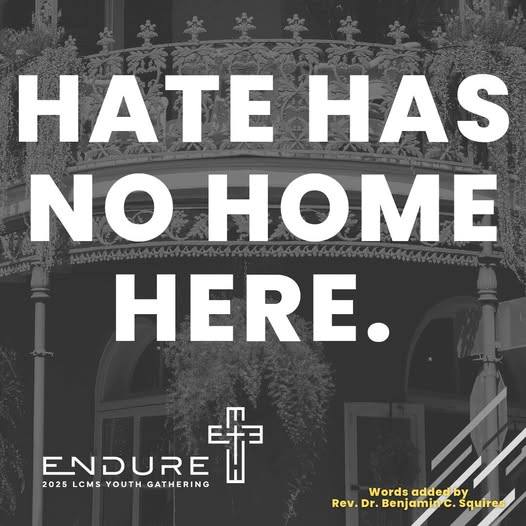
The Lutheran Church – Missouri Synod Youth Gathering took place from July 19-23, 2025 in New Orleans, LA. Apparently Westboro Baptist Church–the one that is infamous for its hateful rhetoric, signs, and general awfulness–protested at the gathering. An LCMS pastor, reacting to this, added “Hate Has No Home Here” to official LCMS Youth Gathering imagery, apparently trying to point out that Westboro was in the wrong here for varied reasons.
I was once in the LCMS myself, and attended a youth gathering. If I had had such a protest at my gathering, I suspect I would have been, like the few reactions I saw from current LCMS youth, mostly confused. Why is this radically fundamentalist group showing up to protest the LCMS, itself a conservative organization? Apparently, according to Westboro’s own release about the protest (quoted by an LCMS person reacting to it here), it is in part because the LCMS isn’t pure enough: “This organization is filled with creepy, “voluntary humility” (Colossians 2:18) about the less popular sins of sodomy and transgenderism, while you whitewash fornication, adultery and idolatry.” So, according to Westboro, the LCMS basically condemns LGBTQ+ but doesn’t do so regarding “fornication, adultery, and idolatry.”
What to make of this odd protest? First, I wonder if this can be leveraged to have discussions with LCMS persons about how awful it was to have this nonsense at their youth gathering, literally targeting children. I saw some comments on Facebook like “but we agree with them on LGBTQ+ issues” from LCMS people. Not only is that awful–since the WBC preaches that God quite seriously hates queer people [God manifestly does not hate queer people, btw] and anyone saying they agree with that is agreeing with their god-forsaken stance–but it also opens a door for discussion: Purity tests for doctrinal or moral excellence can always get more stringent, and someone will always be left out.
Here, we had the LCMS Youth getting left out by the WBC. Not just left out, but seen as actively sinful to the point of needing to be protested, shouted at, and condemned publicly as much as possible. To the WBC, the LCMS is enabling “fornication” and divorce, among other things. It was probably quite shocking for LCMS members to be on the “wrong” side of such a protest. But, imagine discovering that you’re left on the outside of heaven or outside of God’s love because of something you believe or who you are! This is time for reflection. These LCMS youths now see that a purity test for doctrine/morality can get more and more extreme. The narrower and narrower one gets with God’s love and inclusion, the narrower the gates of heaven, and the more limits we place on God’s mercy and love. Hopefully this will lead some to question their stance.
Second, the addition of “hate has no home here” to the LCMS youth gathering logo was controversial in the limited comments I saw. It should spur -some- reflection that simply saying “hate has no home here” is controversial. Do you want hate to have a home amongst your church, amongst your youth? Hopefully the obvious answer is “no.” Now, I do understand making it look like it was official if it wasn’t released officially could be an issue, but that’s a different discussion.
Third, and finally, I hope it spurs some within the LCMS to think on their reaction of “but we agree with you” regarding WBC’s stance on queer people. Look at the vitriolic hate being spewed at you because you don’t fully come into line with everything they believe! Do you really believe it is Christlike to have that same thing done to LGBTQIA+ people? Is that the standard you want for your Christianity? I pray others would come to see God’s love as open and inclusive for all people, not just for whatever narrowing of the path we prefer.
Disclaimer: I am not endorsing any of the words of LCMS persons or Westboro Baptist in this post. LGBTQIA+ persons are fully loved by God and should be fully included in the activity and work of the church.
“Bonhoeffer: Pastor, Spy, Assassin” or, how to turn a martyred theologian’s life into a pointless, directionless slog

Bonhoeffer: Pastor, Spy, Assassin is, ostensibly, a film about the life of Dietrich Bonhoeffer, the German pastor and theologian who was murdered by the Nazis. Bonhoeffer’s works have been incredibly formative in my own life and faith formation. I’ve read and reread his works for over a decade, and I was incredibly excited to see an attempt to make his life into a blockbuster film. That being said, the movie was a great disappointment. It is important to discuss why and how it was disappointing, though, because I think that matters.
First, I think biopics almost always have to fudge on details and stories. That’s fine. Often, for the sake of time, films have to combine life events together, omit details, and tell aspects of one’s life in a more interesting (read: usually action packed) way in order to keep the movie flowing. I am not planning to critique the movie (much) for this apart from where it is necessary.
The most important critique I want to offer of the film, though, is that it turns Bonhoeffer’s life into something that is at its core, almost entirely pointless. In the movie, Bonhoeffer is arrested for attempting to kill Hitler (not historically accurate) and at his execution, that’s the reason (along with money laundering) that he is executed. But in the movie, Bonhoeffer’s alleged involvement in the plot to assassinate Hitler amounts to virtually nothing. This is what is actually depicted in the movie: 1. Bonhoeffer agrees with his brother-in-law Hans Dohnanyi to join violent resistance against Hitler, over the protestations of his friend Eberhard Bethge that he should remain committed to pacifism; 2. he prays with a guy who’s going to wear a bomb to try to kill Hitler; 3. he is asked by Dohnanyi to try to get a bomb from Churchill and fails. What exactly was this supposedly heroic act that Bonhoeffer did, according to the movie’s own narrative arc that makes him so incredibly amazing? What makes him into this wonderful martyr or hero of the resistance? Nothing, according to the movie. He barely had even tangential awareness of what was happening in the attempt to kill Hitler, even according to the film. But because the film makes that the central aspect of Bonhoeffer’s life, the culmination of his theological work, it drains Bonhoeffer’s life and theological work of its actual power. And because the assassination attempt was manifestly not the central aspect of Bonhoeffer’s actual life, the film struggles to shoehorn it in and then fails to even make that interesting.
The film thus turns Bonhoeffer’s life into a pointless footnote. It is Dohnanyi who is the real hero of the Bonhoeffer movie, a man who infiltrated the Abwehr, worked to save Jews, acquired the bomb, and planned the assassination attempt. Bonhoeffer did what? He prayed for the success of the mission? How does that make him into an interesting character?
The real parts of Bonhoeffer’s life that make his story so vital or interesting are, somewhat ironically, either glossed over or modified so much as to be comically overwrought or drained of all value. Bonhoeffer’s theology–his lived theology–is what makes him such a fascinating and important person to this day. Bonhoeffer, in the movie, lands in Germany and is kidnapped by a group of friends in what I can only hope is an attempt to ape the story of Luther being kidnapped and taken in to protect him from enemies. Bonhoeffer then is shown Finkenwalde Seminary, at which, in the movie, the most important thing he does is play a game of soccer and offer forgiveness to Niemoller for being wrong. The movie then immediately has Bonhoeffer sneak into Berlin to see how things are going there. In reality, Bonhoeffer helped plan and fundraise for Finkenwalde, sending letters to people all over Germany and even abroad to raise funds for the illegal seminary at which he developed his theology, wrote quite a bit, and trained a number of Confessing Church pastors. Scenes at this seminary could have shown the trials and tribulations of working through fraught political times while trying to train seminarians in the true Gospel against Nazi propaganda. These points are barely hinted at in the film, as Finkenwalde is but a tiny footnote.
Bonhoeffer’s struggle to decide how exactly to best help in the Confessing Church is occasionally present in the plotline of the film, but for some reason subordinated to the footnoted storyline of Bonhoeffer as assassin-adjacent. In reality, the resisting church was the absolute center of Bonhoeffer’s life for much of his latter years, and would have made a much more interesting and believable story. His concept of religionless Christianity comes up in the film in 1933 at a sermon in Berlin, weirdly, but in actuality that concept was a late development in his theology. I was thankful the film hones in a bit on this concept, but it does very little with it, mostly making it clear that Bonhoeffer saw a distinction between religion and Christ. An attempt was made to tie that to the Nazification of the German church, but it was not clear exactly how that connection was envisioned. I give kudos for at least trying here, but the messaging was so unclear that it is difficult to pinpoint what was going on. Like many other theological ideas presented, the religionless Christianity is hinted at and implied but never really explicated or put into practice.
Bonhoeffer’s ethics are also sacrificed in the movie for the sake of the central Bonhoeffer as vaguely related to an assassination attempt plot. There is no conviction to his positions. He thinks that in America the way they treat black people is clearly wrong, but has to be chastised for thinking nothing is wrong in Germany. He believes killing the Jews is bad (something we don’t historically know how aware he was of it even occurring), but that’s like, a “the bar is on the floor” level of ethics. When he receives pushback on his ethics related to pacifism, he sacrifices it. We don’t get to see any development of his thought in this or any other area. Instead, we are treated to a Bonhoeffer with several absolutes, but one shifting perspective (that on violence in stopping violence) that doesn’t even get more than a quick rebuttal to change his view. When he somehow goes to England to write the Barmen Declaration and publish it in London papers (amusingly read and commented on by nearly everyone in England, apparently), we get little of the meat of his ethics and the whole idea is invented anyway. Bonhoeffer’s ethics are fascinating precisely because they invite deep reflection. His view on pacifism and war and peace has many book length monographs dedicated to it because of its depth, so to see his view dismissed by a brief conversation between himself, Bethge, and Dohnanyi was deeply disappointing and, once again, robbed his life of one of the things that actually makes it worth learning about.
Bonhoeffer’s return to America and realizing he has to “take up a cross” is put in context of his work Discipleship and specifically the quote: “When Christ calls a man, he bids him come and die.” While powerfully placed within the context of the movie, it also is robbed of its force when he is then immediately confronted as if he is avoiding that very thing in America, despite his own inner turmoil and demons related to that decision in real life. Bonhoeffer very much did “come and die” for Christ, and even this moment is robbed of its power because one of the greatest quotes in his oeuvre is thrown back in his face almost immediately.
The movie does do a commendable job showing how important the black church was to Bonhoeffer’s time in America, though it does so only by white knighting Bonhoeffer, having him take the spittle and blow for his black friend, Frank Fisher. I didn’t hate the scenes of Bonhoeffer enjoying jazz and gospel music in black communities, something that seems obviously true and also deeply impactful on his life. These scenes actually made him seem more human than reading through his theological works can.
Bonhoeffer, a Lutheran through-and-through, gets a couple chances in the film to hint at or make explicit commitments to sacramental theology. A late scene in the movie has him offering communion to his fellow prisoners, and, for intentional shock/forgiveness value, a Nazi soldier. Bonhoeffer of course had quite a strong view of the church’s authority and certainly would have viewed excommunication as a real option for Nazis, but in context it wasn’t that surprising. He also mentions baptism at least once with the rising waters of a rainy London. Early on, when he’s at Abyssinian Baptist Church, the pastor asks him where he met Jesus (or some similar conversion experience story) and Bonhoeffer comments to the effect of “I don’t know what you’re talking about.” Bonhoeffer, a Lutheran, affirmed infant baptism (even writing at least one sermon for such a ceremony) and baptismal regeneration and so would indeed have seen any kind of conversion moment as a part of one’s faith life as confusing when not tied to that sacrament. The movie did a surprisingly okay job showing this aspect of his theology.
Of course, the question of just how involved Bonhoeffer was in real life in the plot to kill Hitler is itself a question of no small amount of scholarly debate. Obviously there is very little record of what happened, as the conspirators would have intentionally attempted to hide and cover up any such records. Additionally, there is the question of whether Bonhoeffer ever did actually go past his pacifistic beliefs. For my part, I think it’s clear that Bonhoeffer’s ethic aligned with his Lutheranism, and when he wrote that “everyone who acts responsibly must become guilty,” he knew that both it is sinful to act violently against another and sometimes one must act sinfully–becoming guilty for the sake of responsibility to the other. There is a vast chasm between saying “this is the right thing to do, though it is sinful/guilt-inducing” and “this is a good thing to do” related to tyrannicide. The film had no time for such nuance, which is admittedly None of these interesting questions arise in the movie apart from a tiny scene in which Bonhoeffer, who we only find out in this scene is an “avowed pacifist” (apart from a tiny part where he says “I can’t even punch back” to a white racist who hits him in the face with a rifle), is convinced out of being a pacifist by the film’s hero, Dohnanyi.
The clear anti-elitist jab at Union Theological Seminary’s lectures made for a funny moment, but stands against just how clearly Bonhoeffer paid attention and worked hard in those classes. I get that Bonhoeffer was highly critical of the American church, but this isn’t presented apart from this brief look at class at Union. In reality, Bonhoeffer saw white American churches as being caught up in anything but the Gospel, and that was not exclusive to the professors.
Many, many aspects of Bonhoeffer’s life were modified for little apparent reason, and this is reflected time and again. I’ve already said a few things about it above, and while I get things like leaving out his entire time in Barcelona or deciding to have him present at Niemoller’s arrest, I was surprised that Maria von Wedemeyer, his fiancée, doesn’t even appear in the film. The invented scenes of Bonhoeffer’s being kidnapped to go to Finkenwalde and his being swept up as the prayer warrior for an assassination attempt all made it seem as though Bonhoeffer isn’t even the main character in his own life, but rather someone led around by events surrounding him. His friendship with Bethge is barely a plot–he meets him in the incredibly abbreviated Finkenwalde period of the movie, then dismisses his objections about pacifism before Bethge is largely excised from the plot. Bethge served, however, as a sounding board for Bonhoeffer’s ideas and his most intimate and important confidant for the rest of his days. I get taking him out for the sake of time in the movie, but if the film had turned just slightly toward reality, it would have, again, made Bonhoeffer a more interesting and human person.
There are so many other nitpicks that could be made. The end credits talk about Bonhoeffer’s writings filling 34 volumes. Bonhoeffer’s works are 17 volumes in German, and when translated are 17 volumes in English. I actually think they made the mistake of just adding these together as if they comprised his whole works, when they are in fact two copies of the same thing in different languages. Like, that seems to be actually what they did. A search for Bonhoeffer’s works with the number 34 shows up on Logos with 34 volumes–the German and English editions. That’s how thoughtful the research was that went into some aspects of this movie! Bonhoeffer was not arrested because of a plot to kill Hitler but rather because of his involvement in the Confessing Church and his work smuggling Jews to Switzerland. Bonhoeffer absolutely did not write the Barmen Declaration on his own in England. Bonhoeffer’s first sermon did not reference religionless Christianity. The movie “quotes” Bonhoeffer saying the “silence in the face of evil is itself evil, not to speak is to speak, not to act is to act,” a quote that has been proven is not from Bonhoeffer at all. Bonhoeffer didn’t even like strawberries (okay, I made that one up out of spite). These minutiae of incorrect details doesn’t matter that much compared to the overall pointlessness of the movie. I love Bonhoeffer. I wanted this to be a fantastic movie.
There is a vague anti-nationalist message found in the movie, but it would be all too easy for people to tie that only and directly to Nazism rather than realizing that Bonhoeffer’s critiques would absolutely be applied to Christian Nationalism today as found in America.
The worst part of all, though, is that because of the many, many changes to Bonhoeffer’s life, it starts to fall apart as a narrative and the film’s writing isn’t good enough to rescue it. The movie becomes a slog, somehow turning a fascinating life into a boring mess of a film that takes too long to get anywhere. It’s just boring, and that is so sad to me as such a great fan of the man’s life and work.
Bonhoeffer: Pastor, Spy, Assassin ultimately reduces its subject to a shell of the importance of his life. Rather than being a theologian who challenges us today to realize how we have become guilty through our complacency or our willingness to go along with the flow, it mostly writes him as a side character–at best–in an attempt to kill Hitler. The most impactful scenes are near his death, but at that point, everything about the how and why has been reduced down to a plot that it isn’t even clear he was involved in. His ethics, his theology, and his life are largely set to the side in favor of that narrative. And because he’s demonstrably not the main character in that narrative, the film is rather boring. And that’s a crying shame.
Links
Biographies of Dietrich Bonhoeffer: An Ongoing Review and Guide– Want to learn more about Bonhoeffer? You’ve come to the right place. I have a whole bunch of reviews of various biographies of Bonhoeffer, along with recommendations for their target audiences.
Dietrich Bonhoeffer– read all my posts related to Bonhoeffer and his theology.
Be sure to check out the page for this site on Facebook and Twitter for discussion of posts, links to other pages of interest, random talk about theology/philosophy/apologetics/movies and more!
SDG.
——
The preceding post is the property of J.W. Wartick (apart from quotations, which are the property of their respective owners, and works of art as credited; images are often freely available to the public and J.W. Wartick makes no claims of owning rights to the images unless he makes that explicit) and should not be reproduced in part or in whole without the expressed consent of the author. All content on this site is the property of J.W. Wartick and is made available for individual and personal usage. If you cite from these documents, whether for personal or professional purposes, please give appropriate citation with both the name of the author (J.W. Wartick) and a link to the original URL. If you’d like to repost a post, you may do so, provided you show less than half of the original post on your own site and link to the original post for the rest. You must also appropriately cite the post as noted above. This blog is protected by Creative Commons licensing. By viewing any part of this site, you are agreeing to this usage policy.
Book Review: “Faithful Politics: Ten Approaches to Christian Citizenship and Why it Matters” by Miranda Zapor Cruz

Faithful Politics: Ten Approaches to Christian Citizenship and Why it Matters by Miranda Zapor Cruz provides an introduction to several different ways Christians have engaged in the political arena.
A few introductory chapters outline Cruz’s approach. Instead of taking a direct partisan line, she seeks to provide overviews of the ten approaches she covers and then give some analysis for each broad approach to Christian life in politics. One early insight is contrasting Christian and broadly American concepts of freedom: “American freedom conceptualizes freedom as for self; the Kingdom conceptualizes freedom for others” (15). This latter insight is backed by theologians such as Bonhoeffer, who wrote about explicitly being free for the sake of the other in Christianity (ibid).
After several broad comments on general guidelines for analyzing political approaches from within Christian perspectives, Cruz turns to the 10 approaches she covers. These are sometimes grouped together, and I’ll list them as grouped: three separationist approaches based on “Keeping the Kingdom out of the Country” (essentially approaches that advocate for Christians separating from public life in various ways in order to demark a clear separation between “the world” and church); two separationist approaches based on “Keeping the Country out of the Kingdom” (these are approaches like early Baptist separationism based upon keeping church and state separate, less than actually splintering from society itself); social gospel approaches (using one’s faith to guide society, ethics, and even spending programs); two Calvinist approaches (contrasting direct Christian influence on society a la Geneva and John Calvin and a more nuanced approach from Abraham Kuyper); dominionist approaches (the teaching that Christians must gain dominion over society and how this applies to political spheres); and Christian Nationalism (a view which puts faith in Christ essentially subordinate to allegiance to the nation-state).
Summarizing all of these is beyond the scope of what I want to do. Highlights include the look at Two Kingdoms separationist approaches and how Lutheranism was co-opted through that view for Fascism, but how Dietrich Bonhoeffer, a Lutheran pastor, went back to nuance of the Two Kingdom approach to fight back (101). I thought the insight into social gospel approaches and the several Anabaptist approaches was fascinating. Cruz’s evaluation of the different approaches constantly offered fruitful ground for thought and comment. For example, in her analysis of Christian nationalism, she writes, “physical and rhetorical violence are endemic to Christian nationalism, which is part of what makes it incompatible with Christian faithfulness…” (189). The constant rhetoric of modern nationalists that challenges people opposed to them to define Christian nationalism and show how it is bad would run into a wall when confronted with the basic quotes from Christian nationalists and analysis by Cruz here. Cruz’s analysis isn’t always negative, of course. For example, despite clearly not advocating for a separationist approach, Cruz writes that: “Anabaptist and evangelical approaches to separationism have their strongest appeals in their ability to clearly differentiate between the church and the world, and their commitment to Christian formation as an essential function of the church. We are all being discipled by something…” (81). These kinds of insightful comments from Cruz make the book incredibly valuable.
The book would absolutely serve well for a reading group of Christians who wanted to discuss how to interact with Christianity and politics, or even just looking at one single approach and diving more deeply from there.
Faithful Politics is an insightful, timely book. It provides readers with enough background on numerous options in Christian living to at least get a grasp on key concepts. It also provides ways forward for continued thought and research. Recommended.
All Links to Amazon are Affiliates
Links
Be sure to check out the page for this site on Facebook and Twitter for discussion of posts, links to other pages of interest, random talk about theology/philosophy/apologetics/movies and more!
Book Reviews– There are plenty more book reviews to read! Read like crazy! (Scroll down for more, and click at bottom for even more!)
SDG.
——
The preceding post is the property of J.W. Wartick (apart from quotations, which are the property of their respective owners, and works of art as credited; images are often freely available to the public and J.W. Wartick makes no claims of owning rights to the images unless he makes that explicit) and should not be reproduced in part or in whole without the expressed consent of the author. All content on this site is the property of J.W. Wartick and is made available for individual and personal usage. If you cite from these documents, whether for personal or professional purposes, please give appropriate citation with both the name of the author (J.W. Wartick) and a link to the original URL. If you’d like to repost a post, you may do so, provided you show less than half of the original post on your own site and link to the original post for the rest. You must also appropriately cite the post as noted above. This blog is protected by Creative Commons licensing. By viewing any part of this site, you are agreeing to this usage policy.
“Camp Damascus” by Chuck Tingle- A surprising look at faith, hope, and bigotry

CW: Conversion therapy, demonology, horror fiction, discussion of sexuality
Camp Damascus by Chuck Tingle
I just read this novel by Chuck Tingle (more on author below). The story follows a young woman who’s part of an insular evangelical group that basically owns the town she’s in. The religious group is internationally famous for its Camp Damascus, a gay conversion camp that boasts a 100% success rate.
Fairly early on, some elements of horror crop up, and the main character seeks to figure out what’s going on. It becomes more and more clear that Camp Damascus is the center of something quite insidious. Just how did they get the 100% success rate, and how does it tie into the horrifying things experienced throughout town?
I wanted to bring the novel to this blog because it is a remarkably strong look at deconstruction from within a cult-like group, along with several other deep looks at Christianity. There are scenes in which characters fire verses back and forth at each other to try to discredit the other. There is discussion of science/faith and a logical/evidence vs. spiritual/faith based approaches to reality that is incredibly nuanced for genre fiction. Tingle asks readers how far is too far to go when it comes to one’s beliefs.
The book is horror, so it has several gruesome moments and isn’t probably the best pre-sleeping reading at times. It definitely tugs at the heartstrings and should engage readers to consider their opposition to LGBTQ+ rights.
I honestly grabbed it because I know the author will cause a stir, but was blown away by the content. I was shocked to see such frank and honest discussion of difficulties with faith and finding middle ground and even finding one’s way back when one’s been harmed by that faith.
I can’t in good conscience share without noting broader context of the author. Chuck Tingle is (in)famous for some extremely raunchy and intentionally ridiculous stories (search Amazon for his author name and you’ll see- NSFW titles FYI). A glance at his Wikipedia shows a strange history. The intent appears to be satirizing more than anything, but having not read these other works I can’t comment more upon them. Anyway, I am glad curiosity led me to read this book because it is such a thought-provoking look at faith and doubt.
Camp Damascus has me thinking. I was not expecting it to get me thinking. I don’t really know what I was expecting, but I thought it was worth writing more about. What happens when we make our own narratives; when we are willing to do what it takes to get results? And what of faith? How do we balance it and logic or evidence? I recommend the book, but only so long as readers are comfortable.
SDG.
“Avatar: The Way of Water” – A Christian worldview perspective

The immensely popular Avatar begged for a sequel nearly from release, and after 13 years, it’s finally arrived. “Avatar: The Way of Water” landed in theaters, and I won’t make a secret of being a huge fan of the franchise. But what might the movie have to say about worldview? Quite a bit, actually. Here, I’ll take a look at the movie from a worldview perspective. There will be SPOILERS throughout this post.
Family
It would be impossible to write about the film without reflecting on the way it discusses and represents family.
Jake seems obsessed with the notion of a father protecting his family. One of the later lines in the movie reflects this, and is a repeated comment: “A father protects his family.” The line, repeated near the end of the film, is somewhat ambiguous. Is James Cameron trying to put forward this line as a truism, or is he offering a subtle critique of Jake’s patriarchal tendencies, as with the critique of his militarism? I lean towards the latter. After all, Jake himself acknowledges his failure to protect his family, but still hangs together as a family and acknowledges the strength of that. Additionally, Neytiri did a huge amount of the protecting of family, especially in the final few scenes.
The importance of familial attachment is a major theme in the film. “Sullys stick together” is a recurring theme. But what does it mean? There are so many scenes that reflect on this. Neytiri tells Jake at one point that the family is not a squad–it’s not a military unit. It’s a unit based upon love, relationship, and bonds that go beyond those even of a squad. Jake’s attempted military style leadership isn’t working, and it is what causes some of the rifts in the family.
The loss of Neteyam was one of the most impactful scenes in the movie. When Jake and Neytiri bond with Eywa towards the end of the film, they see a younger Neteyam frolicking and playing with Jake years before. It’s both healing and unbelievably sad all at once. We know that we will see our loved ones again, but the time in between is one for healing and sorrow.
Colonialism and Peacemaking
The question of pacifism looms throughout the film. The people of the water aren’t involved in the conflict with the sky people (humans). They keep to themselves, living lives that remain tranquil despite conflict on the other parts of the planet. But can they ignore the plight of other peoples? Such a question must rank among the deepest in philosophy, and even the whale stand-ins, the tulkun. The tulkun shun even their own if they participate in a conflict, weighing the damage done by any conflict against those who decided to participate in it.
Colonialism from the sky people–the humans–is what drives the conflict. It’s impossible to miss the major themes here contrasting the peaceful nature of the people of Pandora with the militant, capital-driven humans. And as Christians, I wonder about lines like no one can serve God and money or what good is it to gain the world but lose one’s soul?
Seizures and Religious Experience
Kiri, the daughter of Dr. Grace Augustine’s Avatar, is imbued with unknown power and skills. She seems to commune with many aspects of Pandor’as natural world in ways no one else does–or even notices at times. Late in the film, she is able to bond with anemone-like things in the coral reefs and cause them to fight against a human incursion. Fish gather around her. Glowing sea creatures do her bidding even without a direct bond.
But in the midst of all this, she makes a bond with Eywa which leads to seizure-like symptoms no one else experiences. The human scientists are brought in to assess and help, but they are ultimately powerless to awaken the comatose Kiri. However, they do discern it was a seizure that caused her state and warn Jake that Kiri must not bond with Eywa in that fashion again, because she could have another seizure underwater and die. They also directly link seizures to the part of the brain that is active in religious experiences. I have an interest in religious experience and neuroscience, but certainly no expertise in it. With that caveat, I found this an extremely interesting and specific point for Cameron to raise in the film. As viewers, we have privileged access to Kiri that the scientists did not, and we also know there’s more going on than what seems a physicalist explanation. While it is true that activating certain parts of the brain can yield religious-like ecstasy and experience, that in itself does not demonstrate that no genuine religious experiences happen. Indeed, the later parts of the film with Kiri genuinely interacting with the world in seemingly unexplainable ways seems to show Cameron agrees here, and that something more will loom larger later. For now, though, we’re left not knowing where it’s going.
One last note on this, though. In the first film, we had the groundwork laid to see a kind of unity of science and religion. The “direct line to Eywa” of the tree, detected by scientific means in the roots and throughout Pandora and the clear way there is some kind of unifying intelligence on Pandora shows more is going on here. Is Eywa going to be depicted as deity? Or will there be some kind of unifying theory presented in the future? In our world, some try to unify science and religion quite a bit. There are many views about how to and even whether to do this (see my post on differing positions here). We know that God works in the world, but whether science can or even should detect that work is an open question.
The Way of Water and Eywa
The Way of Water itself is a central theme of the film, and certainly one of the driving aspects of its worldview.
“The way of water has no beginning, and no end.
“The sea is your home before your birth and after your death.
“The sea gives and the sea takes.
“Water connects all things. Life to death. Darkness to light.”
The way of water certainly seems connected to the previous film’s depictions of Eywa, the balance of all life, and the harmony and disharmony. It’s easy to contrast this with traditional Christianity, but parallels may also be found. Interestingly, the contrast can mostly be found with platonic views of the human soul, which hold that human souls are imbued with objective eternality after creation. In some Christian beliefs, all humans are eternal by virtue of creation, not by virtue of God granting immortality. The debate over this would go beyond what I’m trying to discuss here, but it’s interesting to see the parallels with eternality of the soul here. However, as depicted in both this film and the previous one, there’s not a sense of reincarnation or eternality of necessity here. The Way of Water, instead, is a kind of way of being, living in harmony with nature rather than attempting to dominate it. It’s acknowledgement that we all share commonalities. And that, I believe, is something Christians can embrace–the knowledge that we all, as God’s creation, share in the broader creation God has made. Thus, when we harm creation, we harm God’s good order and work against what God brought forth.
Interestingly, the humans who are hunting the tulkun are seeking immortality. A substance from the brain of the tulkun stops aging for humans, thus granting a kind of immortality that is seen as valued above all else. The disordered seeking of self-immortality is one aspect of humanity the film highlights very well.
Eywa is in the background throughout the movie, and I still wonder where James Cameron is going to go with this plotline. Above, I mentioned some more specific aspects of the religious and scientific aspects of the film. But we don’t learn much regarding where Cameron is taking this specific aspect of the plot beyond that. It will be interesting to see in the next several films what happens.
Conclusion
There is much more that could be discussed about “Avatar: The Way of Water.” I found it a deeply provocative film, reflecting the best science fiction which both enthralls with mesmerizing visuals and asks big questions about humanity. It feels to me like a kind of “Empire Strikes Back” middle movie, in which the “bad guys” have much more power than the “good guys,” and we’re left with a somewhat ambiguous ending. I cannot wait for the next one.
I’d love to read your own thoughts on the movie. Let me know what you think in the comments.
Links
“Avatar” – A Christian reflection on the film– 7 years ago I wrote about worldview level issues in the original movie. Note that some of my views may have changed.
Be sure to check out the page for this site on Facebook and Twitter for discussion of posts, links to other pages of interest, random talk about theology/philosophy/apologetics/movies and more!
Caring for Creation: A discussion among evangelicals– I write about creation care from a number of perspectives offered at a recent panel of prominent evangelical thinkers in this area.
Also see my other looks into movies (scroll down for more).
SDG.
——
The preceding post is the property of J.W. Wartick (apart from quotations, which are the property of their respective owners, and works of art as credited; images are often freely available to the public and J.W. Wartick makes no claims of owning rights to the images unless he makes that explicit) and should not be reproduced in part or in whole without the expressed consent of the author. All content on this site is the property of J.W. Wartick and is made available for individual and personal usage. If you cite from these documents, whether for personal or professional purposes, please give appropriate citation with both the name of the author (J.W. Wartick) and a link to the original URL. If you’d like to repost a post, you may do so, provided you show less than half of the original post on your own site and link to the original post for the rest. You must also appropriately cite the post as noted above. This blog is protected by Creative Commons licensing. By viewing any part of this site, you are agreeing to this usage policy.
“The Towers of Midnight” by Brandon Sanderson and Robert Jordan- A Christian (re)reads the Wheel of Time

“The Wheel of Time” is a massive fantasy series by Robert Jordan (and, later, Brandon Sanderson) that is being developed into a television show for Amazon Prime. It’s cultural impact is huge, the series having sold more than 44 million copies. Here, I continue my series exploring the books from a Christian worldview perspective. There will be SPOILERS in this post for the series.
The Towers of Midnight by Robert Jordan and Brandon Sanderson
The penultimate book in the Wheel of Time series is a doorstopper. It’s got plenty to discuss, and I’ve only picked a few themes out. Let me know what you think in the comments!
Renewing of Creation
There are several times in the book in which Rand shows up and makes a kind of renewal of creation. In chapter 1, we see a town relying on their apple harvest to prevent them from starving, only to have it corrupted and destroyed. Rand shows up, and after a brief discussion with a farmer, the apples are blooming and ready for harvest again. I think of Isaiah 35:1: “The desert and the parched land will be glad; the wilderness will rejoice and blossom” (NIV). But this isn’t the only thematic parallel to the renewing and refreshing of creation. Later, Rand tells a group to open their sacks of grain (chapter 25). All they’ve opened so far has shriveled grain mixed with pests. But they follow Rand’s direction and find abundance of good grain. It’s like Jesus telling the disciples to fish on the other side of the boat, or turning water into wine. Rand’s parallels with the Messiah here are strong, though in the world of the novels it seems more like he’s bringing balance than making all things new.
Subterfuge Over
Rand, as he continues to step into the memories of Lews Therin, decides the time for subterfuge is over (chapter 13). “Today is a day of reunion, not of death,” Rand says as he sends Darkfriends out of his camp. I felt this was a kind of Narnia-esque moment, where evil is made plain but not completely destroyed–all things must happen in their times. Whether the parallel is Aslan willingly giving himself up, or allowing servants of the White Witch to flee, I was strongly reminded of similar feelings and scenes.
Malice or Ignorance?
It’s easy to assign the label “darkfriend” to others, just as we today can easily assign labels like “heretic,” or “apostate” to those with whom we disagree. When Maradon is opened at last to Ituralde’s army (chapter 24), it is only because someone took the initiative to overrule its governor. The question is raised over whether he was a darkfriend, and it is somewhat ambiguous whether he is or not. But the question arises in how we assign malice so often when it might be ignorance or cowardice instead. We need to be careful to assign labels to those who don’t deserve them and be willing to try to convince others of seeing things our way instead of so quickly other-ing them and rejecting them.
Prophecy
Prophecy is a recurring theme throughout the series, and questions of how to interpret prophecy abound. Late in The Towers of Midnight, there’s a discussion of how prophecy works in the world (chapter 51). Rand points out that if he’d been just a bit earlier in meeting up with the borderlanders, he’d have destroyed them for daring to slap him. They took something as a prophecy and a test, but he took it as a “foolish gamble.” While Paitar claims his family analyzed the prophecy “a hundred times over,” he says the words “seemed clear.” Rand points out that some prophecies are “not like the others”–they’re a “declaration of what might happen, not advice.”
Often, Christians see verses they take as prophecies in Scripture and then assume they can discern clear meanings. After all, one’s family or theological forebears analyzing a prophecy a “hundred times over” cannot be wrong, right? But if we choose to act or not act based upon how we take a prophecy which we may or may not be interpreting correctly, is that truly what the verses are there to tell us? Christians all too frequently ignore prophetic utterances warning against greed, accumulation of wealth, and injustice at the expense of seeking headline-grabbing events that they take to tell us about end times. Instead, perhaps those actions are “foolish gambles,” working to try to discern hidden meanings in prophecies rather than acting on ethical demands.
Conclusion
The Towers of Midnight is another excellent entry that somehow manages to stay action-packed and intense despite its absurdly long length. What worldview-level questions did you find in the novel?
(All Amazon Links are Amazon Affiliates Links.)
Links
The Wheel of Time: A Worldview Hub– All my Wheel of Time-related posts can be found here. Let me know what you think!
Be sure to check out the page for this site on Facebook and Twitter for discussion of posts, links to other pages of interest, random talk about theology/philosophy/apologetics/movies and more!
Book Reviews– There are plenty more book reviews to read! Read like crazy! (Scroll down for more, and click at bottom for even more!)
SDG.
——
The preceding post is the property of J.W. Wartick (apart from quotations, which are the property of their respective owners, and works of art as credited; images are often freely available to the public and J.W. Wartick makes no claims of owning rights to the images unless he makes that explicit) and should not be reproduced in part or in whole without the expressed consent of the author. All content on this site is the property of J.W. Wartick and is made available for individual and personal usage. If you cite from these documents, whether for personal or professional purposes, please give appropriate citation with both the name of the author (J.W. Wartick) and a link to the original URL. If you’d like to repost a post, you may do so, provided you show less than half of the original post on your own site and link to the original post for the rest. You must also appropriately cite the post as noted above. This blog is protected by Creative Commons licensing. By viewing any part of this site, you are agreeing to this usage policy.
Why I Left the Lutheran Church – Missouri Synod: Points of Fracture: Women in the Church Part 2
The reasons I left the Lutheran Church – Missouri Synod were complex. Whether it was the science I was taught as a child not aligning with reality or the misogynistic and racist actions of pastors and those training to be the same, or any of a number of other issues I had, these all were contributing factors. Now, I am going to spend some time on perhaps the biggest reason I am no longer part of the LCMS, which is their views on women in the church and home. This is a deeply personal subject for me, and I have numerous personal stories related to it. Names and other details may be modified for privacy.
Points of Fracture: Women in the Church, Part 2
I wrote before about being confronted about the possibility of women being pastors when I was in college and dated a woman who wanted to be a pastor. I went straight to texts approved by the LCMS to try to prove that women could not be pastors. For a while, I was in a comfortable space thinking I was right, despite a few hiccups here and there. But one question that I’d never thought of before continued to plague me: why couldn’t women be pastors? It was one thing to read the texts a certain way and believe they excluded women from the ministry, but why would that be?
The answers I received when I asked LCMS pastors–who were plentiful at my school and the churches I attended in college–were unsatisfactory. With few exceptions, they boiled down to “Because God said so.” I could accept that. There were plenty of things I believed God had done or determined that I either couldn’t understand or hadn’t the information to even begin trying to comprehend them. But what bothered me more is that this didn’t seem to be the reason given until very recently. When I looked into why women were excluded from the ministry in older LCMS works or in church history, the answer continually came up that women had less ability to pastor. That is, they weren’t as smart, or they had some inferiority in them. Or, because of the curse from the fall, women had to submit to men. Another answer was a reading of 1 Timothy 2:14 (“Adam was not the one deceived; it was the woman who was deceived and became a sinner”) that claimed women were inherently more prone to being deceived.
These reasons, while they didn’t align with reality I observed, at least were reasons apart from “God said so.” As someone who was becoming increasingly interested in Christian Apologetics (a branch of theology in which people work to defend the Christian faith against objections and provide positive reasons for belief), I was especially sensitive to the “God did it” type of reasoning which many non-Christians accused Christians of appealing to when it came to questions of how the universe works. To me, having a reason why women shouldn’t be pastors, even if it was a poor and transparently misogynistic one, was better than having no reason other than a bare appeal to authority. But this reason didn’t stand up when I raised it to others. At one point, I recall even foolishly raising it to the young woman I was dating who wanted to be a pastor. She shot the reasoning down with all the scorn it deserved. After all, did I really, truly believe that men were any less inclined than women towards sinfulness? And didn’t the Lutheran confessions themselves teach that all people–men and women alike–are inherently sinful? How did men somehow get a free pass on this?
I realized that the reason I’d found didn’t work pretty quickly. Not only did it not match reality, but it also was blatantly misogynistic on a level with which I was uncomfortable despite the misogyny in my own background (see, for example, here). This left me adrift. I thought the Bible taught women couldn’t be pastors, but I could find no adequate as to why that should be the case. Then, one day, I walked into a Christian bookstore and came upon a book: Man and Woman, One in Christ by Philip Payne.
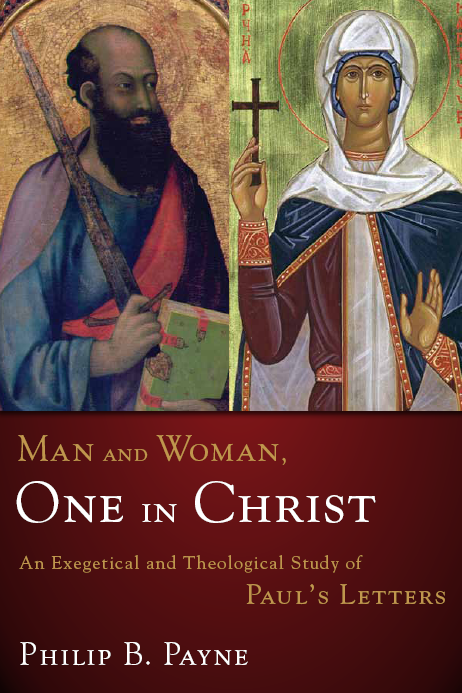
The first few pages of the book had the author talking about how he affirmed inerrancy but believed that men and women were equally gifted to serve and lead in the church. Here was someone who claimed to believe as I did about the authority of the Bible while still affirming women in leadership. I bought the book and over the course of the vacation I was on I read it, underlining copiously, looking up Bible passages (“Does it really say that!?”), looking at my Greek New Testament, and more. Payne focused on the Pauline corpus related to women in the church, but as that’s where the most significant “clobber passages” were drawn from in my own tradition, that made it a nearly comprehensive study of the topic. And what I found is what I’d begun to suspect: the reading I had been taught was mistaken. Not only did it ignore the cultural context of the text, which I’d been taught was important for understanding the true meaning of the words, but the readings were simplistic on the highest level. They relied, often, on English translations by people already inclined to exclude women from ministry in order to make their points. Payne’s analysis was insightful and absolutely cut the core out of my own view.
I still wasn’t ready to accept women as pastors, but I realized I had massively oversimplified the biblical debate. Then, one day, push came to shove.
My girlfriend had changed her career path because of my objections to her chosen field. She’d decided to study psychology and possibly do some kind of family counseling. But then she came to me telling me that her sense of call from the Holy Spirit into the pastoral ministry hadn’t gone away. Indeed, in some ways it had strengthened. Could I accept what she felt called to do?
I prayed fervently that God would show me the way. I believed–and believe–that God answers prayer, and I dedicated most of my free time for over a week to ask God to guide me. Finally, I prayed one night something like, “God, I know I should not test you, but even your servant Gideon asked for a sign[1]. Please, show me a sign.” I set my Bible on my bed, and flipped it open.[2] It landed on 1 Corinthians 12. I started reading, and became greatly agitated. There it was, about as plain as it seemed it could be, 1 Corinthians 12:28: “And God has appointed in the church first apostles, second prophets, third teachers, then miracles, then gifts of healing, helping, administrating, and various kinds of tongues.” The verse showed that God put an order in the church. That order seemed to be a kind of authoritative or hierarchal order. First were the apostles, second the prophets, third the teachers, and then other gifts. But those first 3 were numbered in an order form first through third. And every understanding I’d seen of pastors in the Bible would say the word “teachers” could be applied to pastors. And, while Junia was an apostle in the Bible, I hadn’t yet read enough on that topic to realize how important she was or even acknowledge that fact. No, what mattered is that women were prophets in the Bible. Absolutely no one could deny that. But if that was the case, then women prophets were set above teachers in the church by God Himself.
It can’t be emphasized enough how much this verse shifted my understanding of the topic. I had been taught that men were suppose to have more authority than women. Indeed, the word “authority” was absolutely essential to an understanding of the topic of women in the ministry. Women just weren’t supposed to have authority over men, they were supposed to submit to them in everything. But here was a verse that plain as day stated that prophets ranked above teachers–the word I’d been assured was one of the biblical words for pastors. And because women prophets existed and no one denies that, that meant that women could be above pastors in whatever sense the verse meant.[3]
It was a revelation, and one that had struck me at the very moment I’d been most fervently praying for a sign from God. There it was. What more could I do than acknowledge it? My mind had been changed, and not because I wanted it to be changed for the sake of my relationship. It hadn’t been changed by “the culture,” whatever that’s supposed to mean. It had instead been changed by prayerful consideration of the text and a strong adherence to carefully reading the same. My mind had been changed. Women could be pastors. I realized this was going to be a major life-changing event for me in a way that people outside some obscure theological debates might not be fully able to grasp. It truly was a paradigm-shifting moment in my life, and one about which I’d not yet realized the full implications and consequences that would follow.
[1] The book of Judges has been a longtime favorite of mine, ever since I was enthralled by the illustrated kids’ Bible in which the action hero nature of this book made it jump off the page. Gideon’s story can be found in Judges 6 and following. The part I was referencing was Judges 6:37-40.
[2] I realize some readers might be uncomfortable about thinking God works this way. So am I. I don’t think God typically works in such a fashion. I can only report what I experienced and my belief that, in the moment, God used a broken, mistaken understanding about how God works to bring me to a better understanding of the Bible.
[3] Obviously much more nuance is needed here, and I’ve since thought and read quite a bit about this issue. However, I’ve yet to see a complementarian answer about this specific verse that is able to read the words on the page without somehow subverting the order in the church as stated here.
Next: Women in the Church Part 3- I write about my experience within the LCMS on the other side of the issue of women in the church.
Links
Formerly Lutheran Church – Missouri Synod (LCMS) or Wisconsin Synod (WELS)– A Facebook group I’ve created for people who are former members of either of these church bodies to share stories, support each other, and try to bring change. Note: Anything you post on the internet has the potential to be public and shared anywhere, so if you join and post, be aware of that.
Leaving the LCMS/WELS– Not sure about whether to leave or thinking about leaving? Do you want to others who are thinking along the same lines? I created a group for those who are contemplating leaving these denominations, as well.
Why I left the Lutheran Church – Missouri Synod Links Hub– Want to follow the whole series? Here’s a hub post with links to all the posts as well as related topics.
Be sure to check out the page for this site on Facebook and Twitter for discussion of posts, links to other pages of interest, random talk about theology/philosophy/apologetics/movies and more!
SDG.
——
The preceding post is the property of J.W. Wartick (apart from quotations, which are the property of their respective owners, and works of art as credited; images are often freely available to the public and J.W. Wartick makes no claims of owning rights to the images unless he makes that explicit) and should not be reproduced in part or in whole without the expressed consent of the author. All content on this site is the property of J.W. Wartick and is made available for individual and personal usage. If you cite from these documents, whether for personal or professional purposes, please give appropriate citation with both the name of the author (J.W. Wartick) and a link to the original URL. If you’d like to repost a post, you may do so, provided you show less than half of the original post on your own site and link to the original post for the rest. You must also appropriately cite the post as noted above. This blog is protected by Creative Commons licensing. By viewing any part of this site, you are agreeing to this usage policy.
LCMS President Harrison’s Letter to Board of Regents of Concordia University Wisconsin – Ann Arbor

I’ve written before about the storm brewing within the Lutheran Church – Missouri Synod over controversy at Concordia University Wisconsin – Ann Arbor. The controversy, so far as I can tell, is at least in part due to the inclusion in the Presidential Search of having a need for “diversity, equity, and inclusion” on the part of the candidates. One professor wrote about how this showed that CUWAA had gone “woke” and “Marxist.” I wrote that that reaction was unchristian nonsense. However, Rev. Matthew Harrison, the President of the LCMS, apparently decided it was worth a visit to CUWAA, and after that investigation, sent a letter to the Board of Regents. This letter has been published on various sites, though I haven’t been able to find it on an official LCMS front-facing website. If anyone has such an official source or any additional information, please let me know.
I wanted to write a response to this letter. For one, I am intimately connected with CUWAA. For another, the letter is timely in all the wrong ways, and I believe that needs to be addressed.
Harrison’s letter, after saying he and his people were welcomed to the CUWAA and given full access to things they requested, goes over a bunch of supposed bylaw violations that occurred in the presidential search for the new President of CUWAA. Harrison writes about how the “visitation team uncovered the following concerns…” and then lists a number of those alleged violations. Intriguingly, one of the supposed violations includes a lengthy note about how the list of candidates given was 38 names instead of the approved list of 11, which “especially belittled candidates from the CUWAA theology and philosophy departments, and precipitated the Schultz matter.” What Schultz matter? The Schultz matter about the former Professor of Philosophy who wrote the screed I responded to in my link above.
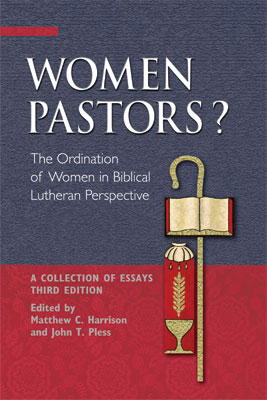
Going on, another concern listed is “changes to the faculty handbook include referring to the president with the pronouns ‘he or she’ and ‘his or her,’ in violation of the teaching of Holy Scripture that spiritual and doctrinal oversight in the church and its universities is given to qualified men. Accordingly, Commission on Constitutional Matter rulings have consistently ruled that presidents of CUS schools must be qualified men. Mr. Polzin’s errant council to the Regents, even after I spoke at length with the Regents in person, about this matter, is unacceptable.” I personally seem to have missed the Bible verses about universities being run by men. Of course, this kind of assumed Scriptural precedent is what qualifies for argument in much of the LCMS discussion related to women in the church and home. When arguments are provided, they’re unconvincing. (See, for example, my series of posts analyzing a Concordia Publishing House book on Women Pastors.)
A primary problem, Harrison notes, is “concern over the introduction of secular diversity, equity, and inclusion language and initiatives into the mission of the university. This philosophy is laden with ideas antagonistic to the sacred Scriptures, including great lies about human sexuality and race.” Once again, Harrison doesn’t delineate any of these alleged antagonistic ideas. And, to be fair, that’s probably outside the scope of a letter like this. But when the question is whether racism needs to be addressed at a university is apparently a live question, and a professor on the philosophy department who Harrison explicitly names as having been “belittled” somehow by being included among others in a list of names for possible President of CUWAA comments about how racism cannot exist on that same campus, red flags should be raised all over.
This letter was dated May 9th, 2022. On May 14th, 2022, a white man entered a grocery store in a zip code he explicitly targeted due to its high population of black people and murdered 10 people, shooting others before his arrest. He specifically cited the “Great Replacement” theory in his manifesto–the notion that white people are being replaced by non-white people through migration, differing birth rates, and more. I can personally attest to encountering the Great Replacement theory in LCMS schools, including at CUWAA when I attended speaking in class about how we needed to have a higher birth rate to keep up with or surpass Muslims. I’ve written about the racism, Islamophobia, and antisemitism I encountered among men training to be pastors and teachers. I’ve also written about the unity of nationalism and Christianity I was taught in LCMS schools. Maybe the allegedly “secular diversity, equity, and inclusion” isn’t the bogeyman we need; maybe we need to refocus and acknowledge that racism is a real, true threat and that explicitly racist theories have been spoken out loud in classes at CUWAA before. I can’t attest whether that’s still happening, but the fact that it did happen and did so without any investigation from the President then suggests that actual, real life racism might be a more urgent issue to address than the latest right wing buzzwords.
Now would be a great time for President Harrison to take a step back and call out racism. Now is the time to acknowledge that it exists in the LCMS, in schools and churches, and to repent of it. Now is the time to strongly condemn the Great Replacement theory, which I personally have heard from LCMS pastors. Now is the time to take real, lasting steps for change that will work to bring God’s Kingdom here on Earth, as we pray daily. I hope and pray that President Harrison will rethink his dismissal of social change and instead work so that one day, we truly can have a church that reflects Galatians 3:28.
Links
Formerly Lutheran Church – Missouri Synod (LCMS) or Wisconsin Synod (WELS)– A Facebook group I’ve created for people who are former members of either of these church bodies to share stories, support each other, and try to bring change. Note: Anything you post on the internet has the potential to be public and shared anywhere, so if you join and post, be aware of that.
Why I left the Lutheran Church – Missouri Synod Links Hub– Want to follow the whole series? Here’s a hub post with links to all the posts as well as related topics.
Be sure to check out the page for this site on Facebook and Twitter for discussion of posts, links to other pages of interest, random talk about theology/philosophy/apologetics/movies and more!
SDG.
——
The preceding post is the property of J.W. Wartick (apart from quotations, which are the property of their respective owners, and works of art as credited; images are often freely available to the public and J.W. Wartick makes no claims of owning rights to the images unless he makes that explicit) and should not be reproduced in part or in whole without the expressed consent of the author. All content on this site is the property of J.W. Wartick and is made available for individual and personal usage. If you cite from these documents, whether for personal or professional purposes, please give appropriate citation with both the name of the author (J.W. Wartick) and a link to the original URL. If you’d like to repost a post, you may do so, provided you show less than half of the original post on your own site and link to the original post for the rest. You must also appropriately cite the post as noted above. This blog is protected by Creative Commons licensing. By viewing any part of this site, you are agreeing to this usage policy.
Why I Left the Lutheran Church – Missouri Synod: By Their Fruits… (Part 5)
By Their Fruits… (Part 5)
My previous posts in this miniseries focused on specific things: my discovery that Christians could believe one thing and act in ways contrary to it, racism I encountered in the LCMS, misogyny I encountered in the LCMS, and homophobia rampant in the LCMS. This post will summarize several other aspects of practice and belief I found within the LCMS that drove me away. It comes from a wide variety of sources, but again, I focus on behavior from people who either were leaders in the LCMS (pastors, professors, teachers) or were studying to become those leaders. These are not stories of random laity, but trained LCMS people. Other examples are specifics about LCMS teachings, whether official or not. [1]
Growing up in LCMS schools, I learned to say not just the pledge of allegiance, but the pledge to the cross. Yes, the pledge to the cross. “I pledge allegiance to the cross of our Lord Jesus Christ, and to the faith for which it stands, with mercy and grace for all.” We would stand and say the pledge to both flags, which were set up across from each other in classrooms and sanctuaries. It didn’t bother me until I was a young adult that we would say a pledge to both–as if our allegiance to a nation state should be as strong or on the same level as our allegiance to Christ. When I started to raise objections to flags in sanctuaries or unquestioning allegiance to our nation, I was told, basically that that was along the lines of a Jehovah’s Witness and because they were wrong about everything, I shouldn’t agree with them on this topic. That didn’t sit well with me.
It wasn’t until years later, when I read The Myth of Religious Violence by William Cavanaugh (book review here), that I could better articulate my problems with the integration of nationalism and religion that remains entrenched in many LCMS churches. When I started to express those views, the reaction was almost entirely negative. Flags were in sanctuaries in part, I was told, because of a holdover from when the LCMS shed some of its outward associations with Germany, particularly during WWI[2]. But that didn’t explain why they needed to remain there, or why the pledge to the cross was said alongside the pledge of allegiance. The nation state, I kept pointing out, seemed to be elevated to the same place as allegiance to Christ. The flag in the sanctuary was and is very often next to and on the same level as the so-called Christian flag. The pledges were said in tandem. As a kid, the link between the two was impossible to miss. As an adult, no correctives were offered. Nationalism is frequently conflated with patriotism, just as it is in the general populace. However, reconciling my belief that our allegiance should be to Christ alone with the way allegiance to the nation state is assumed and even pushed within the LCMS became impossible.

Pastors in the LCMS are extremely inconsistent when it comes to practice related to the Lord’s Supper. Many speak with pride about the extreme doctrinal purity the LCMS pushes. In practice, however, maintaining that supposed purity gets complicated. As a kid, I remember not taking communion in other churches. It was because they believed differently from us, and so we weren’t supposed to participate in that. I specifically remember one time before I was “confirmed”[3], I was offered communion at a Methodist church. I was super excited to take it, but (as I recall-it was a young memory) my hand was physically moved from taking the bread or grape juice offered. I remember people being denied communion in our church, and some of them being upset by that. Again, I learned it was because of different beliefs about what communion was. When I got older, I learned that the reasoning behind denying others communion was because we didn’t want people to eat and drink destruction on themselves. This belief was backed by a rather idiosyncratic reading of 1 Corinthians 11:27: “So then, whoever eats the bread or drinks the cup of the Lord in an unworthy manner will be guilty of sinning against the body and blood of the Lord.” This verse was used to justify virtually any reason for not allowing a person to have communion.
While the LCMS has produced documents about who should and should not be allowed to receive communion, from firsthand experience I can say that these documents are entirely ignored or applied whenever the pastor desires (or not). Ultimately, the practice of closed (or, a preferred term: “close”) communion, while given lip service as a way to protect people from grave sin, is wielded by many LCMS pastors as a totally arbitrary way to punish those with whom they disagree. Alternatively, refusing communion to people can enforce a pastor’s doctrinal whims. Indeed, the LCMS website itself renders many decisions to the “individual pastor’s judgment,” such as whether someone with Celiac disease can have communion with gluten-free wafers. Thus, it is entirely possible for there to be LCMS churches in which, because the pastor chooses not to use gluten free wafers, people with Celiac disease are effectively excommunicated not because of different belief but because of a chronic immune disorder.
The decision about whether or not to commune someone was totally arbitrary even in churches in which I found inserts about their beliefs about who could or could not commune in bulletins. One church had such an insert, and it said, essentially, that people who differed about the real presence of Christ’s body and blood in the bread and wine could not receive communion. I remain Lutheran, and affirm real presence to this day. When I was denied communion by the pastor of that same church, he justified it by saying that because I disagreed with the LCMS on other things, I couldn’t really share their belief on real presence, as all beliefs are ultimately tied together. Such a reach for what can or cannot qualify someone based on what is already a tenuous reading of Scripture effectively meant this pastor believed he could exclude anyone from communion for any reason. I told the pastor this, and he just smiled and said he wasn’t changing what he said.
In the LCMS, one of the strongest beliefs I was taught was the need to properly divide law and gospel. C.F.W. Walther, perhaps the single most influential LCMS pastor and leader, wrote a book on the topic. There was no question in my mind that the arbitrariness with which this pastor and others applied closed communion was a key example of mixing gospel (the forgiveness found in the Lord’s Supper) with law (attempts to punish people for disagreement or call out sin therein). This was not the first or only time I’d be denied communion for absurd reasons. Another time, while staying at a friend’s house on a trip, I was denied communion because I didn’t affirm young earth creationism. Indeed, that pastor’s interpretation of 1 Corinthians 11:29 meant that I’d be unworthily receiving the body and blood because I disagreed about how old the planet is. At that stage, I was still a member in good standing within the LCMS and regularly attended an LCMS church, at which I was given communion. In spite of that, I was denied communion at this LCMS church based on the age of the Earth. The practice is, again, entirely arbitrary. LCMS documents and leaders give lip service to how it protects people, but show total disregard for the spiritually abusive way many pastors apply the practice to exclude Christians from participating in Christ’s body and blood.
I could illustrate this time and again with many, many firsthand accounts or accounts shared with me by others. Another Lutheran was denied communion when they were traveling as part of an LCMS choir because they weren’t a young earth creationist. At a different time, the same person was denied communion because they believed women could be pastors. In neither case was this policy stated, nor were others on the same trip queried about their beliefs on those same topics. The only reasonable conclusion is that LCMS pastors are totally arbitrary about when they apply the doctrine of closed communion. This should be seen as a damning indictment of the practice. After all, the LCMS teaches that closed communion is intended to protect people’s souls, or at least protect them from unknowingly participating in sin. If that’s the case, then why would something with such huge import be so subject to inconsistency about its application? And how is it possible that people like me could go to four different LCMS churches and experience 4 totally different practices about communion such that I received it without question in one, after a brief discussion with the pastor in another, and was denied it for totally different reasons in two others? Inconsistency is one of the surest signs of a failing belief or system, and it can be found all over regarding this practice in LCMS churches. The leadership of the LCMS has effectively handed individual pastors a carte blanche to use their office to arbitrarily withhold the Sacrament from parishioners for whatever reason they desire. It’s a recipe for abuse of the system.
In LCMS schools, I was taught to read the Bible. It’s a legacy I keep to this day, and one I hugely appreciate. When I got to college, I finally began learning more about how to read the Bible, not just to read it. The consistency with which the method was applied was impressive, as I found multiple different professors in the theology department (all of whom were pastors) emphasizing points that were, if not the same, then essentially interchangeable. The bedrock belief was that scripture interprets scripture. Another hallmark of the system was talking about the historical grammatical method of interpretation. The historical grammatical method includes attempting to find the original meaning of the text. I found this exciting, because it meant that for the first time, I was reading about history and archeology and seeing what they could teach me regarding the Bible. This was alongside my surging interest in Christian apologetics. I was (and am) fascinated by finding out about idioms in the Bible, or euphemistic language that explained why things were written in the way they were. It was truly an exciting time.
Then, it started to become problematic. The simplistic reading of passages that I grew up with started to make less sense. Some of this coincided with my turning away from young earth creationism. There was a distinct incongruity between what I was learning regarding what the original intent might have been for a passage and what I was supposed to accept it to mean. It culminated in one private discussion with a professor (who, again, was an LCMS pastor) in which I pointed out that it seemed like the Flood story had precursors in the ancient world, and that it seemed to be almost polemical in its intent rather than historical. That is, the Flood story to me read as an intentional reframing of existing stories to teach monotheism and about how God overpowered forces of chaos than it did as a sort of rote historical report. This reading, the professor pointed out, contradicted another aspect of the historical grammatical method, which is that the events depicted in the Bible are actually historical essentially all the way through. I would later learn that this was a distortion of what evangelicals broadly held to be the historical grammatical method, and that would be its own kind of revelatory gain. In the moment, however, I was a bit shocked. I was simply trying to apply the hermeneutic I’d been learning to the texts themselves. Instead, I was being told that I was undermining Scripture as history and, possibly, denying the Bible itself.
When I shared my thoughts with another LCMS pastor, I was told straightforwardly that the way to distinguish someone who believed the Bible or not was to ask them about whether certain passages or books were historical. Thus, this pastor said you should ask whether they believe Jonah was a real person who was truly swallowed by a whale (or, he conceded, maybe a giant fish instead). You should ask whether they believe Adam and Eve were real and whether they were the first and only humans. You should ask whether a snake literally did speak to them. Noah’s Flood was another example. This pastor wasn’t just implying that denial of any of these meant one didn’t believe the Bible, he straightforwardly said it. That meant that my reading had to be rejected out of hand. I was devastated, but for the moment I dropped my investigation of Ancient Near Eastern background for the text. It would take me years to get back into it, and to this day I’m still trying to find resources to learn more.
One thing I’d theorized for a while about the LCMS and other groups that push beliefs that are outside of mainstream science was that once someone starts to disbelieve scientists regarding one thing, it becomes much easier to doubt scientists in other things. I wrote about how, as a child, I learned that scientists weren’t just wrong but were actively lying about things like the age of the Earth. Once you’ve accepted that there is some kind of global scientific conspiracy to cover up something like the age of the Earth, it becomes much easier to accept that same kind of thinking in other areas.
I dove into the question of climate change entirely from the view of one who wanted to deny that it was occurring. Again, from hearing things like Rush Limbaugh’s radio show and other sources, I was convinced it was another example of scientists lying. In college, I continued to read on the topic, watched and listened to several debates, and read some books on either side. What I kept finding is that the numbers couldn’t be thrown out. When I explored the age of the Earth, I kept finding young earth creationists saying things like “We look at the same data, we just interpret it differently.” The same thing seemed to be occurring with climate change. I eventually brought this notion to one of my professors as we talked about what I was hoping to study going forward. We were in his office and I distinctly remember him saying “It’s such a shame that global warming [using the parlance more common at the time] has become a politically charged question. The data is there; it is happening! It’s okay to debate what to do about it, but to deny that it exists is like sticking your head in the sand. It shouldn’t be political.” He went on to talk about a number of other issues he saw as unnecessarily political. It was hugely refreshing to hear, and it helped free me to think about all sorts of topics in different ways. But this put me on the outside of many conversations with LCMS leaders or leaders-in-training, who frequently talked about the lie of global warming. It wouldn’t be a major factor in alienating me from the LCMS, but it would serve as another example of how teaching about scientists all lying in one area made it easier to accept the same elsewhere.[4]
None of these served as overwhelming reasons why I left the LCMS, but united with the reasons from the previous posts, they became a massive case for leaving. Next time, we’ll delve into one more major reason I left the LCMS.
Next: Points of Fracture- Women in the Church
[1] I’ve said before there are many things the LCMS has a de facto position in relation to without explicitly drawing out or spelling it out in doctrines. One of these is the de facto young earth creationism within the LCMS. While they have some documents saying there is no official position, the continued adoption of resolutions effectively teaching YEC makes holding other positions problematic at best and grounds for excommunication for some pastors. I say the latter from my own experience of being denied communion for differing beliefs on the age of the Earth.
[2] There is some of the history of the LCMS’s transition from a German-speaking church to an English-speaking church in Authority Vested by Mary Todd, which has a history of the LCMS.
[3] a broadly used practice in the LCMS to teach children what they supposedly need to know before participating in the Lord’s Supper.
[4] I didn’t include a longer aside about anti-vaccination beliefs in the LCMS. It certainly is not an official position within the LCMS, but I’ve found it to be more common there than in the general population, even before Covid-19. Again, I believe this is linked to a general mistrust of scientists and science. If scientists are liars about one thing, why trust them in others? It genuinely makes me concerned about what might happen in the future if more and more people I know start to refuse vaccines, despite demonstrable evidence that they work.
Links
Formerly Lutheran Church – Missouri Synod (LCMS) or Wisconsin Synod (WELS)– A Facebook group I’ve created for people who are former members of either of these church bodies to share stories, support each other, and try to bring change. Note: Anything you post on the internet has the potential to be public and shared anywhere, so if you join and post, be aware of that.
Why I left the Lutheran Church – Missouri Synod Links Hub– Want to follow the whole series? Here’s a hub post with links to all the posts as well as related topics.
Be sure to check out the page for this site on Facebook and Twitter for discussion of posts, links to other pages of interest, random talk about theology/philosophy/apologetics/movies and more!
SDG.
——
The preceding post is the property of J.W. Wartick (apart from quotations, which are the property of their respective owners, and works of art as credited; images are often freely available to the public and J.W. Wartick makes no claims of owning rights to the images unless he makes that explicit) and should not be reproduced in part or in whole without the expressed consent of the author. All content on this site is the property of J.W. Wartick and is made available for individual and personal usage. If you cite from these documents, whether for personal or professional purposes, please give appropriate citation with both the name of the author (J.W. Wartick) and a link to the original URL. If you’d like to repost a post, you may do so, provided you show less than half of the original post on your own site and link to the original post for the rest. You must also appropriately cite the post as noted above. This blog is protected by Creative Commons licensing. By viewing any part of this site, you are agreeing to this usage policy.
Why I left the Lutheran Church – Missouri Synod: By Their Fruits…. (Part 4)
For several posts, I have been writing about specific things that came up while I was within the LCMS–that is, at its schools, churches, and university–that made me start to think that the LCMS way of things didn’t align with some aspect of reality, what I learned in the Bible, or something else. Here, I continue a miniseries within that about the fruits of our actions and how they tell about who we really are.
By Their Fruits… (Part 4)
[Content warning: Homophobia across the spectrum and language related to it described.]
Homophobia was absolutely a given among pre-seminary students at my LCMS school. Denial of homophobia was also a given. The trite “well actually” type of discussion often seen online abounded in person. (Eg. people saying, as I heard, “I’m not homophobic, because that would mean I’m afraid of homosexual people.”) Calling things “gay” as a derogatory term was absolutely normal among pre-seminary students. The utter contempt for gay people was clear on a day-to-day basis. It should be noted that we had more than one out of the closet gay man on campus.
I’d lived in Massachusetts for a few years in high school. Before we moved there, I had a conversation with some adults about what it meant for someone to be gay. I genuinely didn’t really understand that the category even existed. Having grown up in LCMS schools and churches, I had actually never heard the topic discussed–or at least, not in a way that left me with any memory of the event. As an avid reader, I probably encountered the occasional gay character, but without the background knowledge to even understand the category, I can’t remember any specific instances of that happening. In other words, I was remarkably ill-educated regarding how people lived their lives. The discussion about gay marriage in Massachusetts before moving there was something like: some men think they love other men and want to marry them, which is obviously wrong, and Massachusetts is so liberal that they let them get married, which is wrong. I could understand the concepts when put so simply.
When I went to high school in Massachusetts, it was a bit of a culture shock. I learned there was such a thing as a “Gay Straight Alliance,” and I actually had to ask classmates what that even meant. I had no idea before moving there that rainbow flags existed or what they meant. One classmate I was friendly with asked me to hang out. I didn’t realize he meant it as a date, and had to awkwardly explain as we were hanging out that I was straight–a category I’d only recently learned about.
I remember in sitting in a prep period in high school in a circle with other students and one of them told us she was a lesbian. I barely even knew the word’s definition. For her to then share her story and her struggles as a lesbian in high school was eye-opening to the nth degree. I was, in a word, stunned. I know this sounds unbelievable, but before these experiences in Massachusetts, I really didn’t even know this was a thing. But the teachers in that high school, many of whom I respected, took gay students as a given and didn’t treat them any differently. I’m writing this from my position as someone who was totally ignorant. These experiences had a profound impact on me as I basically learned from these teachers how to treat others. The experience changed how I thought and acted about gay people.
That would be challenged when I got to my LCMS college and said that I didn’t really see the problem with gay marriage. People from all over corrected me, including phone calls from pastors to explain to me what the Bible said and meant about gay people and why letting them get married was wrong. In no uncertain terms, it was explained to me that it was better to not let them get married because although this would maybe make them sad in this life, it would potentially help prevent the eternal punishment they’d experience in hell. I remember pushing back a little, saying that didn’t make sense because other sins people committed don’t automatically consign them to hell, but the counter was that gay marriage was willful, unrepentant sin and so would lead to hell. I was never fully comfortable with this explanation, but at the time it made me silent about objections. I did not want to be responsible for someone’s eternal soul, after all.
I knew of at least a couple gay men on campus, and wanted to make sure that even if I didn’t necessarily support them fully, that they weren’t totally ostracized. I spoke to a few other pre-seminary students, telling them I thought the homophobic comments and jokes needed to be toned down. One asked me to explain, and I argued that if we really believed it was sinful and could put someone’s eternal life in jeopardy, that we should not potentially put up another barrier to their repentance by being jerks to them. This kind of convoluted reasoning never sat well with me. For years, I dealt with a kind of double life in which I struggled with what I thought was doctrinally correct–that it was sinful–and my ethical senses that the arguments against gay marriage and other ways to exclude LGBT+ people from various societal places and norms were discriminatory at best.
What I did not feel ambiguous about, though, was that everyone sins. One of the most frequently quoted passages of the Bible in my life was Romans 3:23: “For all have sinned and fall short of the glory of God.” This verse still remains dear to me. No one is righteous, not even one (Romans 3:10). The fact that everyone was a sinner was perfectly clear. Why, then, did we treat some sinners differently from others?
The contempt for gay men especially was strong among not just men studying to be pastors, but among many pastors as well. There were clear exceptions–one pastor with whom I had quite a lot of interactions wasn’t affirming to my knowledge but also never once condemned gay people of any sort. Those exceptions were just that, though, exceptions. Calling gay men derogatory names was extremely common, and, again, using the word “gay” as an insult was engrained into us. Transgender people were seen as especially sinful–not just because of the Bible passages interpreted to be against homosexuality but also because of prohibitions against cross-dressing (at least, as interpreted by many in the LCMS).[1] Lesbians were barely mentioned as a category, but when they were it was either in order to sexualize lesbians (often with a wink and a nudge) or to shoehorn them into already understood gender norms (women need comfort more than men, so lesbianism could be explained as such), or, when fully confronted, it was something like “If only she’d met a real man” (read: like myself) “she wouldn’t be a lesbian.”
The way so many LCMS future and current leaders spoke so strongly against gay men especially was difficult to reconcile with how they behaved around men they knew were gay. While I cannot speak for the lived experience of gay men on campus, when I saw interactions, it seemed these LCMS leaders-in-training would tone down their language and act almost meekly, as though they were afraid being gay might rub off on them. It sounds absurd, but that’s genuinely the impression I had.
One gay man on campus shared stories with me about how other men in his dorm told him they were concerned they might get AIDs if they washed their clothes in the same washer and dryer as him. Another time, a pre-seminary man accidentally took a drink from his cup and was worried out loud he would get AIDs from taking a sip. The pre-seminary men, he told me, were the people who were worst to him of anyone on campus. These overt examples could certainly be multiplied. The way that pre-seminary men and even LCMS pastors treated and talked about gay people was and is abhorrent. There seems to be more focus on maintaining an insular status quo than in reaching out and trying to love one’s neighbor.
Reflecting on all of this now paints an ugly portrait. While I can accurately say that the rampant homophobia within the LCMS was a factor in driving me away, I can also say that at times I stood on the same side. There’s a sense of belonging in thinking that you stand against “the world” when it comes to morality and ethics, standing strong upon a stance that is perceived as unpopular and may lead to your supposed persecution. I wish I had been better and done more to stand up for people who were often silenced and mocked. I pray that I can do more now. The total lack of love of neighbor was reflected in how LCMS leaders treated and spoke about all non-straight persons. By their fruits…
[1] I don’t want to get into disputes over how to translate passages, but many passages taken to be straightforwardly about transgender people seem to have different implications in the Ancient Near Eastern context in which the Bible was written. I’ll talk some about some disharmony between how I was taught to interpret the Bible and how I saw the Bible being interpreted within the LCMS in a later post.
Links
Formerly Lutheran Church – Missouri Synod (LCMS) or Wisconsin Synod (WELS)– A Facebook group I’ve created for people who are former members of either of these church bodies to share stories, support each other, and try to bring change. Note: Anything you post on the internet has the potential to be public and shared anywhere, so if you join and post, be aware of that.
Why I left the Lutheran Church – Missouri Synod Links Hub– Want to follow the whole series? Here’s a hub post with links to all the posts as well as related topics.
Be sure to check out the page for this site on Facebook and Twitter for discussion of posts, links to other pages of interest, random talk about theology/philosophy/apologetics/movies and more!
SDG.
——
The preceding post is the property of J.W. Wartick (apart from quotations, which are the property of their respective owners, and works of art as credited; images are often freely available to the public and J.W. Wartick makes no claims of owning rights to the images unless he makes that explicit) and should not be reproduced in part or in whole without the expressed consent of the author. All content on this site is the property of J.W. Wartick and is made available for individual and personal usage. If you cite from these documents, whether for personal or professional purposes, please give appropriate citation with both the name of the author (J.W. Wartick) and a link to the original URL. If you’d like to repost a post, you may do so, provided you show less than half of the original post on your own site and link to the original post for the rest. You must also appropriately cite the post as noted above. This blog is protected by Creative Commons licensing. By viewing any part of this site, you are agreeing to this usage policy.

 J.W. Wartick - Reconstructing Faith