Current Events
Downton Saturday: Downton Abbey, Season 4, Episode I
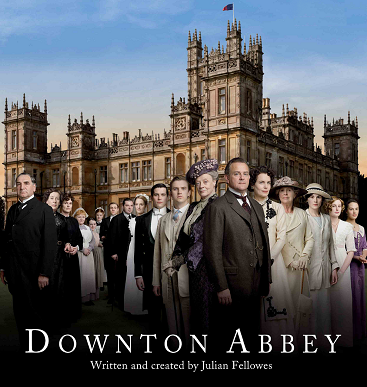 It should be known that I’ve quite enjoyed Downton Abbey. I’ll be watching Season 4 as it airs on PBS, and sharing a few comments from a worldview perspective on each episode, provided I have time, of course! There will, of course be SPOILERS for each episode, and I will assume readers know about each previous season and episode’s content as well. It will be assumed that readers are familiar with the characters and circumstances. I will not be summarizing the plot of the episode; I will merely interact with the content from a perspective of worldview. BE COURTEOUS AND DO NOT BRING UP LATER EPISODES THAN THE ONE DISCUSSED HERE IN YOUR COMMENTS.
Trust
It seems to me that this episode was particularly focused upon the issue of trust. Lady Grantham’s trust in Thomas was increased, but it was actually merely a fluke that Thomas’ hint about the nurse’s mistreatment turned out to be true. Trust can easily be misplaced. Of course, as my wife pointed out, it is possible to see this scene through the lens of “What you intended for evil, God intended for good” (see Genesis 50). Clearly, Thomas’ hint turned out to bring about a great good: the ridding of an abusive nurse.
Another example might be found in the young man’s trust of Rose’s story about being a housemaid. Although these may appear to be “white lies,” it is clear later in the episode that such lies can potentially bring about great harm. The first aspect is the fight the young man got in over Rose. The second potential for harm would be when the man showed up at Downton itself seeking Rose. Although the situation was handled comically, it seems clear it could also have ended in great emotional harm for the young man and possibly Rose as well.
Of course, “Downton Abbey” is largely centered around themes of trust. The way viewers see the interplay of truth and lie is part of the interest of the show. We know who is trustworthy (usually) and not, but the characters do not. It is telling that so many people turn out to have little value so far as trust is concerned.
Women
The times, they are a-changing! The women of Downton are seeking larger roles for themselves, whether it is Rose’s constant striving to explore and be entertained, or Lady Mary’s taking her rightful place as a co-owner of Downton. The show has continually done a good job of showing the interplay of power between patriarchy and the emergence of more egalitarian views in society. Of course much of this is steeped in our own cultural biases as a show is made about the past, but that doesn’t make it any less interesting.
The relationship between Lady Edith and the editor (whose name I can’t recall at this moment) will be interesting to monitor. For the first season in particular, Edith was kind of the whipping child for the show. Everyone seemed to take her for granted. Yet she has emerged as her own person, only to get involved with a married man. Of course, the man’s marriage is to someone who is, with the standards of the time, deemed mad. One might wonder how such a relationship will play out. Moreover, from a worldview perspective, how might we deal with the question of his attempt to divorce his wife due to insanity to marry another? Part of the difficulty of analyzing the situation migIht be found in the fact that (as my wife pointed out), we never meet his wife. Insanity could mean any of a broad spectrum of things; so it is hard to pinpoint the meaning and discussion here. Edith’s whole character continually raises tough questions, which makes her an excellent foil.
Prediction
My primary prediction for this season is that the housemaid that Lord Grantham kissed is going to turn up; likely dredged up in some fashion by Thomas or some other character with a major agenda against the family.
Conclusion
There is, of course, much more to comment on regarding this episode. I’m curious to have your thoughts on the episode and series. Again, do not spoil anything past this episode. What do you think of Edith’s relationship? How might the newfound trust in Thomas play out? What other worldview issues do you see in the episode?
Links
Be sure to check out the page for this site on Facebook and Twitter for discussion of posts, links to other pages of interest, random talk about theology/philosophy/apologetics/movies and more!
The image is copyright BBC and I do not claim any rights to it. To my knowledge it is freely available for purposes of promotion/critique and I use it under fair use.
SDG.
——
The preceding post is the property of J.W. Wartick (apart from quotations, which are the property of their respective owners, and works of art as credited; images are often freely available to the public and J.W. Wartick makes no claims of owning rights to the images unless he makes that explicit) and should not be reproduced in part or in whole without the expressed consent of the author. All content on this site is the property of J.W. Wartick and is made available for individual and personal usage. If you cite from these documents, whether for personal or professional purposes, please give appropriate citation with both the name of the author (J.W. Wartick) and a link to the original URL. If you’d like to repost a post, you may do so, provided you show less than half of the original post on your own site and link to the original post for the rest. You must also appropriately cite the post as noted above. This blog is protected by Creative Commons licensing. By viewing any part of this site, you are agreeing to this usage policy.
“The Hobbit: The Desolation of Smaug”- A Christian Reflection on the Film
 The second part of “The Hobbit” trilogy has arrived in theaters. What themes does it present? What might we talk about in relation to the latest film? Here, we’ll explore a few themes found through the film and view the movie through worldview glasses. There will be SPOILERS below.
Justice
Perhaps the strongest theme throughout the movie is that of justice. The most obvious aspect of this may be found in the quest at the heart of the story itself: the dwarves seeking to reclaim their homeland.
Yet justice also plays its part in reflection upon each ruler the film shows. Thorin, for example, seems to be consumed in part by greed. He is comfortable leaving members of his group behind so that they do not slow the quest. In fairness, when he does leave Kili, Oin, Fili, and Bofur behind, it is in a place in which they were welcomed (eventually) and so perhaps Thorin is not so cold here as he may seem.
Thranduil, on the other hand, is a clearly unjust ruler. First, he treats his subjects unjustly. When he discusses the potential feelings Legolas has for Tauriel, an elven captain, she (seemingly with some hope) mentions that she thinks he would never allow Legolas to become betrothed to a non-royal. Thranduil responds saying she is right, which is why he charges her with telling Legolas there is no hope. The injustice of the scene is both seen and felt. One cannot help but sympathize with Tauriel against Thranduil’s audacity.
Yet Thranduil’s unjust rule also extends to his entire kingdom. His concern seems to be purely with his own borders, as he prefers to keep evil out rather than confronting it at its source. His isolationism is based upon the notion that only his kingdom has “the light” and so that light must be preserved from the darkness of the surrounding world. The discussion made me think of the fact that some Christian evangelical groups withdraw from the world, because they do not wish to be part of the world or its darkness any longer. Yet as Christians, we are called to go into the world and confront the darkness rather than isolate ourselves from it. Thranduil’s comments speak to our own feelings, and his unjust ways are a call to us for action.
The Master of Laketown is also unjust in his dealings with his people. His highest aim is to preserve his own power. The thought of anyone sharing power with him–or the thought of the people having some say–is horrifying to him. Yet rather than ruling for the sake of his people, it seems his life is consumed by alcoholism and gluttony.
Light in the Darkness
The theme of light opposed to darkness is found throughout the film. Thranduil speaks of the battle between light and darkness in his own confused fashion, Beorn notices the “stench” of evil and a darkness over the woods, and Gandalf directly confronts darkness with light.
The latter instance is perhaps the most powerful, for it features Gandalf facing off against Sauron as Gandalf uses light from his staff to combat the blackness with which Sauron assaults him. Sauron’s words call out, telling Gandalf that there is not enough light in the world to combat his darkness.
For those who know how the Lord of the Rings ends, the scene is ironic. But in the moment, it rings true. It seems that darkness will indeed prevail.
Greed
Thorin, as noted, seems to be consumed by greed. Not only does he leave his fellow dwarves who would slow him behind, but he eventually confronts Bilbo regarding the Arkenstone. He uses his sword to bar Bilbo’s way and demands he hand over the Arkenstone, if he found it. The tension of the scene is only broken when Smaug attempts to destroy them both. However, the greed within Thorin seems to be growing. It will be interesting to see how it plays out in the conclusion to the trilogy.
The Master of Laketown also makes his decision through greed. Although the prophecy regarding the return of the king under the mountain makes clear the notion that his own town will burn, Thorin’s appeal to the Master based upon shared wealth does not fall upon deaf ears. The Master of Laketown succumbs both to his own greed and to the mob which has formed around the debate.
Evil
One of the more interesting things for me to reflect upon in the film was the way evil was portrayed. Clearly, the unjust rulers discussed above are each, in their own way, a kind of evil. However, the orcs were the clearest portrayal of evil. Yet their evil, to me, seemed to be inherently unreasonable. There was little reason for them to act as they did apart from pure hatred. Sauron was calling out to his evil minions as well, and his motivation seems to be simply the destruction of any who are not subject to him.
Reflection upon this depiction of evil leads to an insight: evil is, at its core, irrational. There is no reason to it. It goes against what genuinely makes sense in the world. This applies not only to the fanatical lust for murder which the orcs had, but also to the injustice of the rulers mentioned above. A viewer cannot help but think that Thorin, Thranduil, and the Master are each acting in an illogical fashion. Their greed corrupted them. For the orcs, their lust for suffering has consumed them. Evil is illogical; those who practice it are chasing fantasy.
Conclusion
I admit I did not enjoy “The Desolation of Smaug” as much as I enjoyed “An Unexpected Journey,” though I did still like the movie. I think the themes found here are worth reflecting upon, and the way they are presented forces viewers to really sit back and think as the movie continues. In particular, the feeling of injustice throughout the movie was unexpected, but it touched upon a number of areas related to our own lives and how we live them.
There is, of course, much more which could be discussed regarding the “Desolation of Smaug,” and I turn to you, readers, to start that discussion in the comments.
Links
The Hobbit: An Unexpected Journey- A Christian Perspective– check out my look at the first of “The Hobbit” trilogy.
Be sure to check out the page for this site on Facebook for discussion of posts, links to other pages of interest, random talk about theology/philosophy/apologetics/movies and more!
The picture featured in this discussion is an official movie poster and the property of MGM/New Line/WingNut films. I do not claim any rights to it.
SDG.
——
The preceding post is the property of J.W. Wartick (apart from quotations, which are the property of their respective owners, and works of art as credited; images are often freely available to the public and J.W. Wartick makes no claims of owning rights to the images unless he makes that explicit) and should not be reproduced in part or in whole without the expressed consent of the author. All content on this site is the property of J.W. Wartick and is made available for individual and personal usage. If you cite from these documents, whether for personal or professional purposes, please give appropriate citation with both the name of the author (J.W. Wartick) and a link to the original URL. If you’d like to repost a post, you may do so, provided you show less than half of the original post on your own site and link to the original post for the rest. You must also appropriately cite the post as noted above. This blog is protected by Creative Commons licensing. By viewing any part of this site, you are agreeing to this usage policy.
“Catching Fire”- A Christian Reflection on the Film
 “Catching Fire” is likely to be one of the biggest blockbusters of the year. There are an extraordinary number of things to discuss in this movie. It is filled to the brim with points of interest. Christians would do well to see it and reflect on some of these themes. I have drawn out a number of them below. There will be SPOILERS in what follows.
The Aftermath
Early in the film, Katniss is hunting alongside Gale. They see some wild turkeys, Katniss draws her bow to fire, lets loose and hits… Marvel? Marvel was the young man she killed in the Hunger Games about a year before. How could he be here? How did he get shot? The screen pans in, and Katniss is hyperventilating, struggling to comprehend the horror she has just witnessed. But… it wasn’t real. She comes back to the present. The nightmare, however, is not over.
The film explores this issue in moving, distressing ways. Katniss seems to be dealing with Post Traumatic Stress Disorder (PTSD). The memory of the violence she has wrought has come back to haunt her. Later, she is confronted by the families of those who died in the Hunger Games that she and Peeta “won.” Her heart is broken. She wakes with nightmares. Violence… is horrific.
But you, in the audience, are forced to deal with another level of the drama: is Katniss to blame for this? Yes, she did kill; but she was forced to kill or be killed. The system dealt her the cards she is playing with: did she merely play the part? Who is to blame? Surely, the system is to blame every bit as much as Katniss. Indeed, is Katniss to blame? An unjust system yields nightmares.
Friendship
Katniss and Peeta are forced to put on a show to meet the expectations of the Capitol. In one (somewhat comical) scene, Peeta is trying to learn more about Katniss, who reveals that she doesn’t feel she has friends. But what is it that makes friendship? As I noted in my look at the book, Katniss betrays her own pragmatism in many points. Her compassion wins out, and demonstrates that she really does have friends and even–shock!–understands what friendship is, though she may not realize it.
Her willingness to sacrifice for her friends proves just how much she understands about the nature of friendship. It is self-giving, self-sacrificing; and not based upon the mere exchange of information, as the scene with Peeta shows.
The Rich
The stark contrast between the lives lived by the people of the Capitol and those of the district comes through very strongly throughout the movie. One cannot help but shake one’s head when considering the way that Caesar Flickerman–the Hunger Games’ gameshow host–first somberly reflects that the people going into the games have been favorites of the Capitol for years but now will all die but one… and then his face turns into a grin and he says “it’s so exciting!”
To the people of the Capitol, it really is all a game. It is a show. But to those who are suffering, it is a remarkable sign of the great line of division between the haves and the have-nots. I think perhaps the most poignant image of this was when Effie Trinket, the escort for the tributes for District 12, is trying to grasp the reality of the horror with which she is confronted. The year before, she was just excited to have potential to win; it really was all just a game. But now, she is faced with the thought of losing her beloved winners. Now, it has become real. But the only way she can try to cope with it is to make them “a team” by purchasing gold things for everyone. Her hair is gold, Katniss’ pin is gold; everyone else should have a gold item as well!
But Effie should not be castigated; indeed, she has become enlightened to the brutality. As one who has awakened, it is right that she should try to fight against the unjust system in whatever way she knows how. Whether her struggle is successful or not, one should commend her for breaking out beyond her closed reality.
 Sacrifice
The theme of sacrifice runs strong throughout the movie. We have already seen that it comes out in friendship [and love] when Katniss is willing to lay down her life for Peeta; but there is another agenda going on of which she is unaware: she has become a symbol of hope for the people of the Districts.
As such, many of the other tributes in the Hunger Games are willing to sacrifice themselves to protect her. Time and again others give up their lives to defend both Peeta and Katniss from the dangers in the arena. But the plot to rescue Katniss is not revealed until the very end. Instead, the theme of sacrifice centers around Katniss and Peeta. Peeta is willing and fully committed to giving his life to save Katniss, but Katniss instead wants to give herself to defend Peeta.
Not only am I reminded of one extremely powerful quote: “Greater love love has no one than this: to lay down one’s life for one’s friends” – John 15:13, but I also reflect upon the figure who spoke them himself: Jesus. Jesus did exactly that: he laid down his life for his friends; indeed, for all people (John 3:16). Could there be echoes of this same self-sacrifice to be found in the story of Katniss? I would suggest that yes, there indeed are; though they are by no means explicit or even intentional.
Yet the theme of hope draws out this theme even more strongly, such that one must wonder: who or what is Katniss?
Revolution
Hope, President Snow realized, was the most dangerous thing of all. It was fine to have fear; one could use fear. But the moment hope was injected into the equation, fear no longer worked. With hope, people were willing to die for an ideal; for a person. Katniss, Snow found, was that embodiment of ideal into a person. Her action of being willing to give up her life in the Hunger Games a year before had become a symbol; the fact that she continued to live had become a rallying cry.
Yet Katniss herself did not realize the extent to which she had become just such an ideal. To Katniss, all she had done was try to survive. And it is in this that her story most clearly displays the disconnect between her and the one true Savior. But thematically, the message remains. A revolution needs hope; one spark can light a fire.
Consider the history of Christianity. It was the hope of the resurrection which brought about enormous social upheaval. Suppression did not work, for the Christians had hope in the risen savior. When I saw the people of District 11 reach out their hands in a symbol of defiance to the Capitol, I considered the defiance of the early Christians in refusing to bow the knee to false idols.
Bringing It Together
Of course these are extrapolations. Anyone could point out holes in the way I drew these themes together to point to a Christian message. But the film itself is so thought-provoking that it demands such extrapolation. It calls for interpretation. How might we apply it to understanding our own times?
First, we must consider the nature of the “system.” There is a call to action found within the Hunger Games, but it is not a call to violent rebellion; rather, the violent rebellion is symbolic of the call the film makes to us to end oppression.
Second, the imagery of Effie’s realization of the injustice is perhaps a wake-up call to those of us who are sleeping with the societal ills of human trafficking, hunger, and racism (to name but a few). Not only must we, like her, be awakened, but we should also make use of the tools we have been given to fight against these injustices. And, thankfully, there are many effective ways we can do so.
Third, the movie features a powerful call to realize the power of hope in what seems like a hopeless world. That power is found in the message of Christianity to a world which is in great need of hope.
Go see “Catching Fire.” I hope it lights a spark within you to fight against the iniquities of injustice in our world. More importantly, I hope it brings you to the realization that the Christian message provides the most powerful hope to the world. The self-sacrifice of one Lord has provided endless hope for all nations, districts, and yes, even the Capitol.
Links
Like this page on Facebook: J.W. Wartick – “Always Have a Reason.”
Check out my look at the themes in the book, “Catching Fire” by Suzanne Collins.
Christian Reflection on The Hunger Games Trilogy– I discuss the entire Hunger Games Trilogy, with a number of comments upon the themes and events found therein.
The Hunger Games Movie: A Christian Perspective– I wrote about the movie, “The Hunger Games” and provided some insight into what Christians may take away as talking points from the film.
Do you like The Hunger Games? Check out my evaluation of Ender’s Game both in movie and book form.
SDG.
——
The preceding post is the property of J.W. Wartick (apart from quotations, which are the property of their respective owners, and works of art as credited; images are often freely available to the public and J.W. Wartick makes no claims of owning rights to the images unless he makes that explicit) and should not be reproduced in part or in whole without the expressed consent of the author. All content on this site is the property of J.W. Wartick and is made available for individual and personal usage. If you cite from these documents, whether for personal or professional purposes, please give appropriate citation with both the name of the author (J.W. Wartick) and a link to the original URL. If you’d like to repost a post, you may do so, provided you show less than half of the original post on your own site and link to the original post for the rest. You must also appropriately cite the post as noted above. This blog is protected by Creative Commons licensing. By viewing any part of this site, you are agreeing to this usage policy.
“Pastrix: The Cranky, Beautiful Faith of a Sinner and Saint” by Nadia Bolz-Weber: Book Review
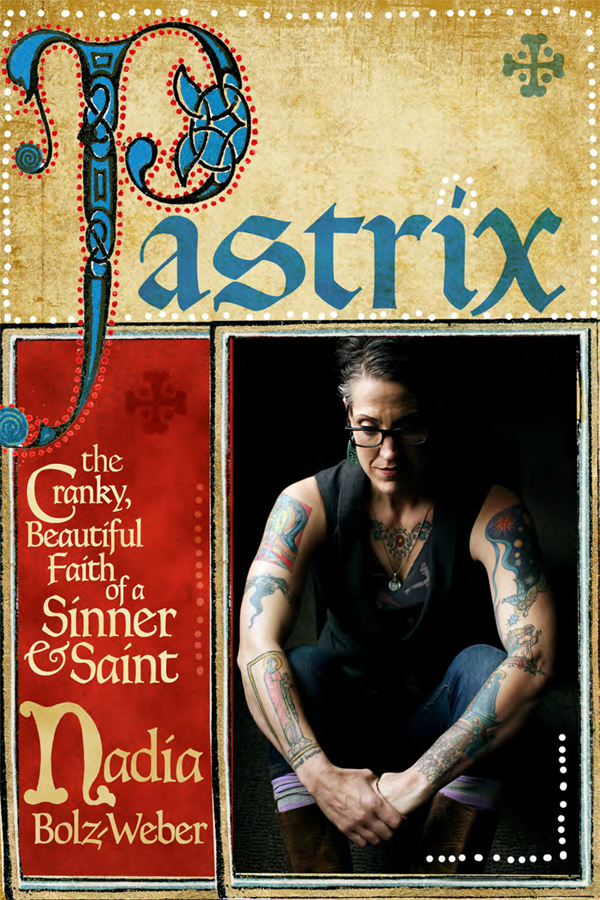 Nadia Bolz-Weber is an edgy, hard-hitting, and often witty pastor in the Evangelical Lutheran Church in America (ELCA). Her latest book is filled with autobiographical stories and a number of anecdotes which focus around the subtitle: they are often cranky, sometimes beautiful, and they reflect a sinner-saint.
The book traces Bolz-Weber’s path towards the ministry through her years in recovery from alcoholism to her starting a church: “House For All Sinners and Saints” and the struggles and triumphs she experienced throughout these events. I’ll not summarize the entire contents of the book but rather I have selected one story to give a brief sample of how the book flows.
The most poignant story in the entire book, in my opinion, is that of Bolz-Weber’s relationship with Chris Rosebrough from Pirate Christian Radio, a very conservative Lutheran (from the Lutheran Church–Missouri Synod [LCMS]) who runs a very conservative radio show. He is, in many ways, all that Bolz-Weber would oppose. And Rosebrough often criticized Bolz-Weber on his show. Then, one day, they had a chance to meet and they talked through the core of Lutheran theology: salvation by grace. Bolz-Weber wrote, “[The other people witnessing their meeting] saw us share a thirty-minute public dialogue about our own brokenness and need for confession and absolution, why we need the Gospel, and what happens in the Eucharist… God made my enemy my friend that day” (113).
Later, Bolz-Weber experienced criticism from her “own side”–liberals [her word, I’m not trying to use it in a derogatory fashion]–and talked with Rosebrough [who is, again, staunchly conservative] about it. They didn’t have to agree on the issues to carry on a conversation about God. “Chris [Rosebrough] doesn’t agree with me [about various issues]… But the one phone call I got in the middle of being attacked by my own tribe was from someone who is on the other side of the issue entirely… [H]e knew what it felt like… [He] said that he loved me and would pray for me. His enemy” (119-120).
Awesome, heart-stopping stories like this are scattered throughout the book. But they are in-between stories that will surely polarize readers. One is a story about a transgender girl turned boy and how Bolz-Weber helped hold a ceremony to help recognize “Asher”‘s new name and identity as a boy. Another story is about her time away from Christianity in which she worshiped a “goddess” instead.
Pastrix ends on a note about Bolz-Weber’s vision of church. Mary Magdalene becomes her foil as she reflects upon the meaning and purpose of church. She wrote, “Like Mary Magdalene, the reason we can stand up and weep and listen for Jesus is because we, like Mary, are bearers of resurrection, we are made new” (201).
Evaluation
There are no words minced in this book. The f-word is sprinkled throughout (and even featured twice in one chapter title). Bolz-Weber continually describes situations or feelings as “s***.” She is completely unapologetic in her approach in this regard.
This raised red flags for me. What does the Bible tell us about the Christian life, and does it say anything about the requirements for teacher, overseer, elder, and deacon? How might Bolz-Weber apply these to her life as a pastor? No, I’m not saying that as a woman she shouldn’t be a pastor–I’m firmly egalitarian. But I wonder about how she would take a passage like James 3 (specifically 3:1-2; 9-10):
Not many of you should become teachers, my fellow believers, because you know that we who teach will be judged more strictly. We all stumble in many ways. Anyone who is never at fault in what they say is perfect, able to keep their whole body in check… With the tongue we praise our Lord and Father, and with it we curse human beings, who have been made in God’s likeness. Out of the same mouth come praise and cursing. My brothers and sisters, this should not be.
Teachers are called to a higher standard. James noted that obviously people stumble, but that does not mean that we should give up or simply embrace whatever wrong behavior we are engaged in. “This should not be!” I wish Bolz-Weber had engaged with this issue in her book.
Another huge issue with the book for me is Bolz-Weber’s exegesis. It seems to me her preconceptions about what the text should mean often shape how she reads it. Specifically, this relates to the question of sanctification. Are Christians really in the process of being made new? If so, how does she reconcile this with the way she seems to conceive of “sinner-saint”–a valid concept–by which she seems to simply mean that one does not even have to try to change? She wrote:
Repentance in Greek means something much closer to ‘thinking differently afterward’ than it does ‘changing your cheating ways.’ Of course repentance can look like a prostitute becoming a librarian, but it can also look like a prostitute simply saying, “OK, I’m a sex worker and I don’t know how to change that, but I can come here and receive bread and wine and I can hold onto the love of God without being deemed worthy of it by anyone but God.”
It seems her primary point in this passage is that God’s grace is firm and sure and we, as sinners, can hold onto that. But I can’t help but feeling Bolz-Weber misses the mark at an astonishing margin in that she never discusses the need to go beyond that. Paul discussed various types of sins in 1 Corinthians 6, and then he went on to say “And that is what some of you were. But you were washed, you were sanctified, you were justified in the name of the Lord Jesus Christ and by the Spirit of our God.” That is, God’s work does not simply end with justification, it continues on into sanctification. We are sinner-saints in the sense that we are yet sinners but God has saved us; but also, we are being made saints by the work of the Holy Spirit. We are to flee from sin, not ignore it.
Bolz-Weber’s entire autobiographical account does speak to the way that the powerful message of grace changes someone, but she never draws this point into the open. Moreover, when she speaks about the life of others, sin is often treated lightly or even entirely ignored. It seems that she is fully willing and able to apply the Law to her own life, but she does not universalize it; she does not make the Law applicable to everyone. Thus, it seems to me she fails to properly preach Law and Gospel.
Pastrix, was a book I really wanted to love. But… I didn’t. There are a number of great insights and anecdotes scattered through the pages, but ultimately readers have to slog through gobs of unnecessary cursing, shock-value stories, and more to find them. One moment, it had me cheering along with Bolz-Weber; the next, I found myself confused about what she was trying to communicate. Ultimately, the book left me wondering who, exactly, the intended audience was supposed to be. It’s not the type of book I’d hand to someone to try to convince them of Bolz-Weber’s view. Nor is it the type of book that I, as someone who agrees in part with her, particularly enjoyed. It seems to me the audience is ultimately those who already agree with her on basically everything. That isn’t a problem, as it is perfectly acceptable to write books that preach to the choir, but I am left confused as to why Bolz-Weber actually did write Pastrix.
Throughout the book it seemed that she was trying to convince me of something, but it never really became clear what that message was. There are times when I really did “get it.” It was like she grabbed that which is Lutheran in me and just played it for all it was worth. But then she failed to make it universal; it applied to her, but she never made Law and Gospel universal. She would discuss intense need for grace which is free and abundant and ever-flowing. She would point out how we need not do works to access this. But then, so often, it seemed she would conflate this with the notion that Christians are not all called to move away from sinner and towards saint. There seemed to be no sanctification in the work. It was all about the initial call to grace; but little about the enduring, sanctifying work of the Spirit.
SDG.
——
The preceding post is the property of J.W. Wartick (apart from quotations, which are the property of their respective owners, and works of art as credited; images are often freely available to the public and J.W. Wartick makes no claims of owning rights to the images unless he makes that explicit) and should not be reproduced in part or in whole without the expressed consent of the author. All content on this site is the property of J.W. Wartick and is made available for individual and personal usage. If you cite from these documents, whether for personal or professional purposes, please give appropriate citation with both the name of the author (J.W. Wartick) and a link to the original URL. If you’d like to repost a post, you may do so, provided you show less than half of the original post on your own site and link to the original post for the rest. You must also appropriately cite the post as noted above. This blog is protected by Creative Commons licensing. By viewing any part of this site, you are agreeing to this usage policy.
Some quick thoughts on the “Noah” trailer
 It’s coming, folks. A big-budget movie about Noah and the Flood. A trailer was recently released for the film, in which Russell Crowe plays Noah.
I thought I’d share some thoughts on the brief glimpse we’ve had on the film, after a brief narration of the trailer. See the end of the post in which I reflect on a couple things not in the trailer.
The Scene
The trailer opens with Noah having some weird vision which seems to depict the Fall of humanity. He wakes up and says “He’s going to destroy the world.” Some old dude tells Noah about a story passed down from his father about how if humans continued in their wicked ways, the “Creator would annihilate this world.”
The old man also tells Noah that this Creator is able to communicate with him in a way he understands, which is apparently by dunking Noah in water and showing lots of burning things and then a flower growing, because, you know, that is really understandable. But apparently Noah gets it because he decides to build a big boat. One problem: the local King is upset about it for some undisclosed reason.
Lots of animals come to load up the Ark. It starts to rain. People try to get on the Ark but get blown up by water. The fountains of the deep are depicted as big geysers blowing up all over the place. Rain.
By the way, Hermione plays someone [I looked it up and she plays “Ila” who is apparently Noah’s adopted daughter and a heartthrob to Shem(?)], so that’s kind of cool.
Thoughts
Well, it looks like we have some Hollywoodization here. I’m not really sure what to think. First, I appreciate the fact that in the trailer the responsibility for the Flood is placed upon humans, who continued to behave in clearly brutal ways.
Clearly the random king showing up with some reason to be angry with Noah is fictitious in the sense that it is not recorded in the Bible. I suspect it is there to add drama to the narrative, but what will it add in addition to that? What plot exposition will be given that diverges from the biblical account? The Old Testament in many places is very terse, not many details are given. It is tempting to fill in the details, and it is clear this film will do so.
The movie also seems to be thankfully not avoiding the theological issues. I will be very interested to see how God interacts with humanity. Despite my tongue-in-cheek narration above, I think there is a point to be had that God may communicate in phenomenological ways, and that the biblical narratives often do report things from the viewer’s perspective.
Also: those clothes! Why is Noah wearing a tailored shirt made out of some weird attempted period-piece? What kind of styling is this!?
Joking aside it looks kind of cool. As a film, it looks like it will be exciting. Lots of special effects; extra tension added in; you name it. But how much correction of faulty understanding of the biblical narrative will need to be done afterwards? I don’t know. On the other hand, perhaps it will get people talking more about the Bible. It may help spur discussion of the issues raised in that passage, which could expand beyond that. Could this be a tool for believers? It may be best to read up on the Flood story yourself.
The movie is clearly generating a lot of discussion already, and having drawn in a big-name director as well as actors/resses, it will likely be discussed broadly.
Be assured that, God willing, I will reflect on the movie when it comes out next year. Until then, let me know your thoughts!
Having Written This, I discovered something else:
Apparently there may be quite significant additions to the film from the pseudepigraphal Book of Enoch, including some scenes with 6-armed angels and the like. I’m disappointed to learn about this divergence from the Biblical story. I get creative license, but this is a bit much.
Check out this excellent post which discusses the screenplay. My disappointment continues to mount as I read more about it. Note that I wrote this post 100% based upon the trailer, with almost no prior knowledge of the movie. The post I just linked to has major spoilers for the differences from film to movie. It looks like what we’re getting is something which is not faithful to the biblical story. I find that deeply disappointing. I get the use of creative license, but based upon this reading of the screenplay, it goes beyond creative license and into exploitation of the Bible to forward a specific agenda.
I wonder whether the rumors floating around about the studio wanting to make significant cuts to the film might be do to this negative reaction from Christian viewers. I suspect that it is possible that the studio wants to make it more palatable to Christian audiences.
The Image was found on Google and is not mine. I could not find rights to it, and do not claim them.
SDG.
——
The preceding post is the property of J.W. Wartick (apart from quotations, which are the property of their respective owners, and works of art as credited; images are often freely available to the public and J.W. Wartick makes no claims of owning rights to the images unless he makes that explicit) and should not be reproduced in part or in whole without the expressed consent of the author. All content on this site is the property of J.W. Wartick and is made available for individual and personal usage. If you cite from these documents, whether for personal or professional purposes, please give appropriate citation with both the name of the author (J.W. Wartick) and a link to the original URL. If you’d like to repost a post, you may do so, provided you show less than half of the original post on your own site and link to the original post for the rest. You must also appropriately cite the post as noted above. This blog is protected by Creative Commons licensing. By viewing any part of this site, you are agreeing to this usage policy.
“Catching Fire” by Suzanne Collins- A Christian look at the book
 The film version of Catching Fire is on the horizon (see my reflection on the movie), and as we approach the release, I thought it would be interesting to take a deeper look into the book. Here, I will consider some major themes in the work and their relation to Christian belief and practice. Check out some links at the end of the post for my other writings on the Hunger Games series. Be aware: there will be MAJOR SPOILERS in what follows.
Pragmatism
Katniss Everdeen often seems to be trying to operate under the moral system known a ‘pragmatism’–the notion that we should do what works. Sometimes, she may even border on egoism–the notion that self-interest drives what is morally right and wrong. Very often, in her first person narrative, she comments on doing things because she has “no choice” or simply because it seems to be what other people want in order for her to survive. One example is when President Snow comes to visit her in order to coerce her into attempting to help quell the rebellions which seem on the verge of breaking out across Panem, the world of The Hunger Games series. Snow himself senses this drive for self-preservation that Katniss has, and he masterfully uses it to manipulate her to his ends.
However, Catching Fire does not leave Katniss alone. She is unable to consistently hold to the moral position that her inner dialogue seems to filter her choices through. In fact, her moral decisions, in practice, often reflect virtue types of ethical theories more than egoism. But she doesn’t always or even often seem to be aware of her own moral virtues. Suzanne Collins writes Katniss in such a way as to be a believable character: her moral choices are often messy.
Katniss is confronted by the inconsistency in her own moral system–that of seeming self-preservation over all–when she is confronted by two women refugees who are fleeing from the violence in their colony (see pages 134-150). Katniss reacts initially in a way which begs for self-preservation, prepared to defend herself by killing. But then, when she discovers the reality of the situation, she actually feeds the women, listens to their story, and believes that there may be hope. The pragmatist would have turned the women in as traitors; Katniss feeds them and sends them on their way, but not before fashioning a new crutch for the one who is injured and teaching them briefly about how to survive in the wild. Her moral reality is much more complex than she herself realized.
Human Moral Worth
Although the topic is only hinted at, Catching Fire poignantly portrays the horror of objectification of the human being. Finnick’s backstory–as one of the other people who is forced to go into the Hunger Games–gives disturbing insight into the objectification of humans and the grim realities of the negative effect it has on the people involved. Finnick Odair’s story is interesting, because he was one of the youngest people to “win” the hunger games. His good looks made him popular, despite his young age of fourteen. Thus, people kept sending him things to help him. Collins writes:
The Citizens of the Capitol have been drooling over him ever since [his victory].
Because of his youth, they couldn’t really touch him for the first year or two. But ever since he turned sixteen, he’s spent his time at the Games being dogged by those desperately in love with him… He can go through four or five in his annual visit. Old or young, lovely or plain, rich or very rich, he’ll keep them company… but he never stays, and once he’s gone he never comes back. (209)
The licentious people of the Capitol are confused. They value human beings as means for their own pleasure. Hence the absurd celebration and pomp and circumstance of the Hunger Games, which trivializes an event that is really the vicious killing of children. Moreover, they eagerly await a young man to get “old enough” for them to use his body for their own ends, paying him with gifts or secrets for the pleasure his body might give them. The book is not explicit in this regard; but the implication is there.
Reality Confronts Falsehood
In fact, it is the people of the Capitol who are the real egoists. They are self-obsessed to the point of egotism as opposed to mere egoism. Their moral code is that whatever satisfies them is right. Collins, in Catching Fire, gives us a long, hard look at ourselves. How easy would it be for us to fall into the same pattern of thinking as the people of the Capitol? The book is disturbing because of how close it is to home. Human trafficking is an increasing problem, even on our “home turf.” Yet people look the other way. Children are increasingly exploited, but again, only a few are crying out.
Like the people of the Capitol, we are only concerned with ourselves. If something isn’t directly bothering us, we tend to ignore it. That’s an issue for someone else, after all.
But the real twist is President Snow. He and his cronies are in charge of preserving the illusion. He is in charge of maintaining the false reality. And in Catching Fire, Katniss finally starts to truly realize the extent of this evil. It is one thing to confront the evils going on around her; it is entirely another to confront those who are determined to keep the system in place which perpetuates the evil.
Conclusion
I am looking forward to “Catching Fire.” I am hopeful that it will, like “The Hunger Games,” preserve the raw emotion of the book and lead to a number of thought-provoking conversations. Catching Fire is a phenomenal work that ultimately confronts us with ourselves. It forces us to wonder: are we just as oblivious to the wrongs around us as the people in the Capitol?
Links
Christian Reflection on The Hunger Games Trilogy– I discuss the entire Hunger Games Trilogy, with a number of comments upon the themes and events found therein.
The Hunger Games Movie: A Christian Perspective– I wrote about the movie, “The Hunger Games” and provided some insight into what Christians may take away as talking points from the film.
Do you like The Hunger Games? Check out my evaluation of Ender’s Game both in movie and book form.
Source
Suzanne Collins, Catching Fire (New York: Scholastics, 2009).
The image is the cover of the book and the property of Scholastic Press.
SDG.
——
The preceding post is the property of J.W. Wartick (apart from quotations, which are the property of their respective owners, and works of art as credited; images are often freely available to the public and J.W. Wartick makes no claims of owning rights to the images unless he makes that explicit) and should not be reproduced in part or in whole without the expressed consent of the author. All content on this site is the property of J.W. Wartick and is made available for individual and personal usage. If you cite from these documents, whether for personal or professional purposes, please give appropriate citation with both the name of the author (J.W. Wartick) and a link to the original URL. If you’d like to repost a post, you may do so, provided you show less than half of the original post on your own site and link to the original post for the rest. You must also appropriately cite the post as noted above. This blog is protected by Creative Commons licensing. By viewing any part of this site, you are agreeing to this usage policy.
“Ender’s Game”: Fear and Hope in the Face of Annihilation- A Christian look at the film
 Ender’s Game is one of my all-time favorite books, so it was with some great anticipation that I looked forward to the release of the film. Here, we shall investigate some of the major themes that the film adaptation brings up in its portrayal of this epic science fiction novel. There will be MAJOR SPOILERS for the film in what follows.
Children and Violence
The first and most pervasive feature throughout the film is that of the boundaries crossed when placing children in situations which they should be protected from. It is much like the Hunger Games [I want to clarify: Ender’s Game was written long before Hunger Games and so any connections flow from Card to Collins!] in this regard, though Orson Scott Card’s book and the film take it much deeper.
The first and perhaps most poignant example of this is found early in the film, when Ender thinks he has been washed out from the possibility of command and so he no longer has the protection of adults monitoring him to make sure he is safe. He is approached by a group of bullies, but he uses his strong tactical sense to shame them into fighting him one-on-one. Then, he ruthlessly beats down one of the larger boys and continues kicking him while he is down. He does this, he explains later, because he wanted to make it so that his enemy could never come back and hurt him again. The key, for Ender, is to ensure not just that the enemy is unable to fight back now, but that they will be unable to do so ever. This survival instinct leads Colonel Graff to believe that Ender is right for battle school. But it leaves the viewer wondering about justice.
Elsewhere, the film deals rather pointedly with bullying. Ender continues to be alienated by his fellow students and they react with two common bullying tactics: they ostracize him and eventually, one tries to physically harm him. One scene shows how one can break the grip of bullying: by simply reaching out to the one who is bullied. The camera shifts to a top-down view and shows as one-by-one, students begin to sit next to Ender and abandon the bully. If we teach our youths to do the same: to reach out to understand instead of to conform to the pattern of the world and ignore the downtrodden, we could make steady strides against bullying.
The scenes of violence involving the children also do something that very few scenes of violence with adults are able to convey: the complete horror that is involved in such activities. One cannot help but be gripped by sorrow when one sees children reacting violently to each other. Very often, movies are unable to capture the wrongness of violence. I do not think it is far afield to suggest that blockbusters are even worse at doing so. One can imagine the amount of collateral damage wrought in a movie like “The Avengers,” yet the heroes are glorified and the violence justified by the end. “Ender’s Game” incredibly portrays the real awfulness of violence of human against human, and even of human against environment or nature. It is raw, powerful, and gut-wrenching.
Ends Justify…?
The viewer wonders throughout the entire film whether the cost is too high. Colonel Graff and Major Anderson engage in a brief dialogue on the question late in the story. Anderson notes that using children used to be a war crime, but Graff counters by arguing that humanity must do what they have to in order to ensure survival. In a way, his reasoning takes Ender as a foil. Both he and Ender agree upon the notion that the ends may justify the means.
However, the film doesn’t end with that message. Instead, Ender is forced to confront the reality that he has been used–lied to–in order to bring about the utter extinction of an entire alien sentient race. When faced with this truth, he reacts with extreme remorse and anger. Graff tries to reason with Ender, suggesting once more that they struck the enemy in such a way so as the enemy might never strike them back. But Ender suddenly realizes–with horror–that this is insufficient reason to justify his wiping out an entire species. He reacts angrily and is eventually sedated. The viewer is left to reflect upon the sheer enormity of what has happened. An entire sentient race has been extinguished by the activity of a child who was deceived into thinking he was merely playing games.
The child realizes it is horrible; the adults are the ones rejoicing.
From Death, Life: From Xenocide, Hope
I’ve already pointed out the way “Ender’s Game” depicts violence in such a way as to prevent it from being gloried. I’ll admit I was unsure of how I would react to the big reveal towards the end, when Ender discovers that he has been fooled into exterminating the “Buggers” [Formics–the alien race]. I wasn’t sure if the movie would depict it in such a way as to make the audience cheer and delight in the destruction of the enemy. However, I was totally blown away by the way it showed the scene. I couldn’t but be horrified when Ender turned to Graff and the other commanders of Earth’s military and said triumphantly, “Game Over.” I knew the twist that was coming, and that perhaps made it even more horrifying to me. Ender thought he was playing games, but those in charge knew he was not and cheer gleefully in the complete annihilation of a species which wasn’t even acting the aggressor any longer.
That alone would be an incredibly powerful message to leave viewers with, but Orson Scott Card did not write a book[and, by extension, the movie it spawned] that merely shows the horrors of such violence. Instead, the seeds of hope are scattered therein. The very end of the film shows the birth of life from death. One of the “Bugger” Queens has survived, and one egg for a new queen has been preserved. The Buggers had been trying to communicate with Ender, and they succeeded in getting him to find their last hope for preservation. Ender realizes almost immediately what he should do: take the egg to a place it will be safe. The film ends with Ender’s voice echoing the future story: that he would seek out a new home for the Buggers so that they could begin life anew.
Conclusion
“Ender’s Game” is a fantastic film. It is one with powerful messages for today. Yes, it has the moral message against bullying, and people who walk away only with that will have done well. But more deeply–and more powerfully because of this–it also shows the absolute horrors of violence. Harming others is not in any way glorified in this film. Ender realizes the wrongness of his own actions too late. Yet viewers are not spoon-fed this message. Indeed, the story begs to be debated. Do the ends justify the means in this case? Or perhaps Ender is right–understnading is more important. The themes provide much for anyone who watches the film to discuss.
Yet the most powerful message is saved for the very end: Life comes from death. It is brought about by an outsider, using means which could not have been predicted. And that is the most powerful and true message of all. It is a message which Christianity teaches: hope comes from the most hopeless situation, and it comes from the least expected direction, provided by God.
Links
“Ender’s Game” by Orson Scott Card: A Christian Reflection– I analyze a number of themes from the classic science fiction novel. It is extremely important to look into the
The Importance of Being Ender: A Closer Look at Orson Scott Card’s Modern Classic– Check out this look at the book by Anthony Weber at one of my favorite blogs, “Empires and Mangers.” It is well worth the read and also ha some very interesting links for more discussion of the book.
You liked Ender’s Game? Check out John Carter.
The Image is one of the official movie posters. I claim no rights to it.
SDG.
——
The preceding post is the property of J.W. Wartick (apart from quotations, which are the property of their respective owners, and works of art as credited; images are often freely available to the public and J.W. Wartick makes no claims of owning rights to the images unless he makes that explicit) and should not be reproduced in part or in whole without the expressed consent of the author. All content on this site is the property of J.W. Wartick and is made available for individual and personal usage. If you cite from these documents, whether for personal or professional purposes, please give appropriate citation with both the name of the author (J.W. Wartick) and a link to the original URL. If you’d like to repost a post, you may do so, provided you show less than half of the original post on your own site and link to the original post for the rest. You must also appropriately cite the post as noted above. This blog is protected by Creative Commons licensing. By viewing any part of this site, you are agreeing to this usage policy.
“Evermore: Edgar Allan Poe and the Mystery of the Universe” by Harry Lee Poe
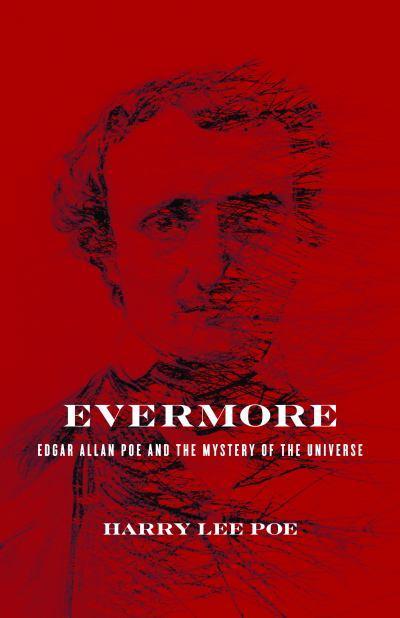 Edgar Allan Poe. His name immediately calls to mind images: a black raven haunting one’s thought, the beating of a heart driving one mad, gruesome, macabre deaths. It also brings to mind thoughts on the man himself: twisted, slightly mad, alcoholic, broken.
Are these images of the man’s work and life accurate? Harry Lee Poe (a cousin of Poe’s) argues that they are not. Instead, this kind of imagery is a result of both the popularization and the character assassination of one of the great American literary giants.
Harry Lee Poe’s work, Evermore: Edgar Allan Poe and the Mystery of the Universe
The Myth of Edgar Allan Poe
It is interesting to note that from the time he died, Edgar Allan Poe’s person was the target of a character assassination which would give rise to the popular portrayal of him as a dark, haunted drunkard. Rufus Griswold, a man who portrayed himself as a minister despite having never been ordained, published a work which has remained in the popular consciousness through the present day. In it, he falsified information about Poe and heavily edited a number of letters from the author in order to portray him as the dark, fearsome man he is often imagined even today. Harry Lee Poe exposes this mythos by noting the work of Arthur Hobson Quinn, who in 1942 published the letters Poe wrote alongside the altered letters Griswold used to make the image he created.
Thankfully, Edgar Allan Poe’s (hereafter EAP) image has been recovering in scholarship, but the damage at a popular level continues to be seemingly ubiquitous. The image of Poe as a brooding man matches what people wish to see when they read his works of horror and thrills. However, Harry Lee Poe (hereafter HLP) notes that there is much more to EAP’s body of work than is often known.
The Broader Poe
EAP’s body of work had its share of horror and mystery, but it also featured humor and satire, science fiction, and beauty. Remarkably, EAP contributed to the formation and even creation of entire genres which are extremely popular today. His science fiction was, at the time, known as “hoaxes” because no actual genre existed in order to encompass them. He also wrote the first detective mystery works to be known in literature. He was innovative and unique in his contributions to literature. He truly stands easily among the literary giants of all time.
The distribution of his works is also worth noting. EAP intentionally wrote in a number of different ways about a number of different things. HLP documents his major tales, numbering each under headings of genre. The results are surprising: EAP wrote more humor and satire than he did horror. Yet he is largely known today only for the latter (24-27). It is worth looking at Poe’s entire body of work in order to understand the man.
Mystery and Reality
One of the central parts of Poe’s work involves the writing of mystery stories. As has been noted, EAP was the first to write in the specific genre of detective mystery stories. EAP’s use of the mystery story shows that he assumed the problem of evil as a very real difficulty. However, the concept of a detective mystery story, in which the reader, through the characters, seeks to solve the mystery and find the one who committed the crime. In short, there is a broader concept of justice involved in a mystery story. Unless there is justice in the universe, the problem of evil cannot present a difficulty for one’s worldview, for evil could just be a given.
EAP, who had written horror stories already, moved the blood and gore from the climax of the story (horror) to the beginning (mystery). The rest of the story would not be about the blood and gore, but about righting a wrong: “injustice cannot be allowed to continue… the sense of justice assumes the basica rationality and order of the universe so that Truth may be discovered. The reader wants to know the truth” (115).
Beauty and Love
The concept of beauty was central to EAP’s work. He used the concept to evoke a particular feeling related to the injustice of crime, but he also saw beauty as a way to point beyond the mundane. “Beauty constituted to Poe evidence that human experience is not bound by time but belongs to eternity” (83).
The different varieties of love are exemplified throughout Poe’s works. Affection, friendship, and passion are developed by HLP to explain EAP’s concepts of how these related to the world at large. Each of these concepts could be forces for the positive or for ill. Affection, friendship, and passion could each become corrupted, and each would lead to devastating results if one allowed this to happen (86ff). Love provided a difficulty for EAP, for he saw that it may tell us about something beyond the world: it may inform us about God. But if it could be perverted, does that suggest an outside source from which love sprang, which we corrupted (107-108).
Eureka
Perhaps the most interesting portion of Evermore is the discussion of EAP’s own views as he expounded them in his work, Eureka. In this work, Poe examined the mystery of the universe. He held that the universe had a beginning and was actually expanding. He argued that light and electricity belonged “to the same continuum.” His view was close to the modern theory of the Big Bang. Yet EAP thought of this around a century before the latter came into vogue. Because the universe began, “Poe concluded that a God exists who created the universe for his pleasure. Love and Beauty provide a glimpse of God… Pain, suffering, evil, and death are the contingencies of physical existence that are left behind” (55). EAP saw the universe as a grand story, which was “the plot of God” (ibid).
The reasoning behind EAP’s amazingly prophetic vision of cosmology was found in his own observations. He noted the difficulties presented by the notion of an infinite universe, including the fact that the night sky had places where there were no stars to be seen (known as “Olber’s Paradox”).
In Eureka, EAP postulated a deity. It seemed intuitively obvious to him that if the universe began to exist, God must exist. Given that his own observational evidence led him to the conclusion that the universe began, he concluded that God exists. Moreover, he posited that this deity would have to design the universe and guide its expansion from a primordial particle (152). However, this deity was essentially pantheistic, which was his solution to the problem of evil. Each individual person would become Spirit individualized. God would become all-in-all, thus bringing holiness to all.
Edgar Allan Poe’s Beliefs?
HLP argues that EAP may indeed have become an orthodox believer late in life. Having already come to the conclusion that God exists and that the universe had a beginning (itself something EAP noted matched remarkably with the Biblical account), Poe would come forward at a Sons of Temperance meeting. HLP notes that such a move cannot be abstracted purely as coming out against alcoholism (something EAP struggled with himself). Instead, the group was explicitly evangelical in nature. Coming forward would be similar to someone today coming forward at a Billy Graham meeting (166). Those interested in Poe’s beliefs must therefore come to one of two conclusions: either he was “the charlatan and scoundrel that Griswold said he was” or “he had a conversion experience.” The Sons of Temperance taught explicitly evangelical Christianity, which would suggest that if EAP was genuine, he had come to accept a more evangelical, orthodox faith before he died.
Conclusion
Few works have intrigued me as much as Evermore has. Edgar Allan Poe has been a favorite of mine for some time, but I admit that I had bought into the stereotypical picture of the man as much as anyone else. Having only really read his horror and some poems, I have not had a complete vision of his actual body of work. Harry Lee Poe does an exemplary job of showing how EAP explicitly viewed his works as a growing body of interconnected themes, seeking to find the mysteries of the universe.
Edgar Allan Poe was a visionary. He was a great American author whose writings paved the way for hundreds of years to come. He was also well ahead of the science of his day, and similarly had already deduced the theological conclusions well before others had attempted to do so. Harry Lee Poe has presented a convincing, thorough look at EAP’s entire body of work. Having done so, he makes the man even more interesting than the myth. Edgar Allan Poe’s explorations of the mysteries of the universe leaves me profoundly interested in the man and his body of work. I highly recommend Evermore: Edgar Allan Poe and the Mystery of the Universe
Source
Harry Lee Poe, Evermore: Edgar Allan Poe and the Mystery of the Universe
SDG.
——
The preceding post is the property of J.W. Wartick (apart from citations, which are the property of their respective owners, and works of art as credited) and should not be reproduced in part or in whole without the expressed consent of the author. All content on this site is the property of J.W. Wartick and is made available for individual and personal usage. If you cite from these documents, whether for personal or professional purposes, please give appropriate citation with both the name of the author (J.W. Wartick) and a link to the original URL. If you’d like to repost a post, you may do so, provided you show less than half of the original post on your own site and link to the original post for the rest. You must also appropriately cite the post as noted above. This blog is protected by Creative Commons licensing. By viewing any part of this site, you are agreeing to this usage policy.
Resource Review: “Flight: The Genius of Birds”
 “Flight: The Genius of Birds
The Complexity of Birds
The film traces the incredible development of birds from single cells into babies and the way in which their bodies must work in order to achieve flight. One of the people interviewed in the film notes that flight is not an incremental phenomenon; the entire body must be set up in order to accomplish it. The way feet work, the shape of the wing, the structure of muscles, and the weight of bones are all factors which must come into play in order to make up an animal capable of flight.
Hummingbirds
“Flight” presents a number of different birds as case studies the complexity which the systems that make up a bird show. Hummingbirds’ flight muscles comprise, on average, 43% of the bird’s body mass. This allows the birds to have an enormous amount of precision in order to move in the ways that they can, such as hovering, moving backwards, laterally, etc. The hummingbird generates lift both on the back and the front strokes of their wings. This capability is grounded in the shoulder joints found in the bones which are at the bases of the wings. The hummingbird’s heart must beat at an enormous rate, which means that it also must eat quite a bit in order to sustain the energy level required for the bird’s metabolism and constant movement. The hummingbird’s tongue is particularly interesting, for it has a number of functions on it which allow it to draw up nectar far more efficiently than had been thought.
European Starlings
These starlings, sometimes flying in groups in the hundreds of thousands, move in a stirring, beautiful way, seeming to shift as if they comprised one organism. The way that these birds continue flying without running into each other is by monitoring those starlings which are closest to each other. Rather than monitoring the entire formation, they simply move when those around them move, which lends itself to the movement of a flock as one kind of organism. Their movements must take place within very minuscule spans of time in order to maintain the formation. They follow air flows to minimize the turbulence they encounter, and their formation also serves as a defense mechanism.
Arctic Terns
Arctic terns have the longest migration of any animal on earth. They cross the planet from pole-to-pole to seek out nesting and feeding grounds. From the North Atlantic, they head south, eventually splitting as half go along the African coast while the other half goes along the coast of Brazil. In the south, near Antartica, they feast upon small fish before heading back north. They must arrive back near Greenland and other areas in the north for a nesting period of about 8 weeks. Then, as winter sets in in the north, they head back south.
How did the complexity arise?
The film here presents an argument that a materialist must use Darwinian evolution to explain the unique functions of flight. No design may be invoked in order to explain these things in a materialistic worldview. Dinosaurs were the precursors of birds, and natural selection selected for those dinosaurs which began to develop better means by which to avoid predators and catch prey.
The Feather
One feather may contain around a million individual parts, from the shaft to the individual strands, barbs, which compose the feather, and each of these are made up of barbules. These are constructed in such a way as to interlock with each other. Yet the feather is but one of the many factors which must go into the mechanisms required for flight.
Other Mechanisms
Other than those already noted (muscles, bones, etc.), birds require a navigational system which allows them to migrate and follow food. They must have instincts to cue and direct their movements across continents and even oceans. One could see how these latter functions came into play in the case study of the Arctic Terns.
Natural Selection?
The film makes the argument that natural selection cannot account for the mechanisms required for flight. The primary problem presented by “Flight” is the “lack of foresight.” Natural selection cannot look ahead and select for various factors in order to put them together into an integrated whole. The argument is that the multiple and independent functions needed in order to get a functional bird which would have some chance at survival is impossible to get to by means of a process which is blind.
Evaluation
First, I have to say that there were moments I found myself with my mouth hanging open and the gorgeous imagery in “Flight.” This was particularly the case following the starlings’ movements, the icy regions the terns flew through, and the overall imagery related to the hummingbirds.
The use of particular case studies over the middle section of the film was particularly effective at showing the problems which may come up when trying to describe certain characteristics and behaviors which birds exemplify that cannot be explained so easily by naturalistic mechanisms.
The film also did a good job of noting that there are presuppositions when it comes to the scientific enterprise. Given naturalism, neo-Darwinism is the only game in town. However, as was asked repeatedly throughout the film, if one is capable of acknowledging design and intelligence when it comes to certain things, why should one preclude the possibility of an intelligent agent when it comes to higher orders?
One problem with the film can be found in the format. It is necessarily short, making only the briefest points and only touching upon those things which it discusses. I suspect that those who hold to a naturalistic worldview will be largely unimpressed, while those who hold to the possibility of intelligent agency in biology will see it as backing their own positions. However, those who may be on the fence will see that there are reasons to ask questions.
Overall, “Flight: The Genius of Birds
Disclosure
I was sent a copy of Flight: The Genius of Birds
SDG.
——
The preceding post is the property of J.W. Wartick (apart from citations, which are the property of their respective owners, and works of art as credited) and should not be reproduced in part or in whole without the expressed consent of the author. All content on this site is the property of J.W. Wartick and is made available for individual and personal usage. If you cite from these documents, whether for personal or professional purposes, please give appropriate citation with both the name of the author (J.W. Wartick) and a link to the original URL. If you’d like to repost a post, you may do so, provided you show less than half of the original post on your own site and link to the original post for the rest. You must also appropriately cite the post as noted above. This blog is protected by Creative Commons licensing. By viewing any part of this site, you are agreeing to this usage policy.
Book Review: “For the Beauty of the Earth” by Steven Bouma-Prediger
The practical consequences of… a radical faith are themselves radical. (182, cited below)
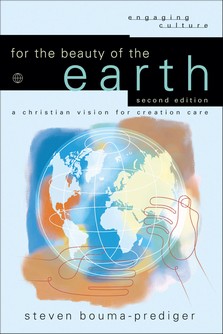
How should Christians think about creation care? More importantly, should Christians even bother with creation care? What is the state of the Earth? What does the Bible say about these issues? These are the primary topics which Steven Bouma-Prediger turns to in his work, For the Beauty of the Earth
Place
We are on Earth, and it is a place full of the glory of God. For the Beauty of the Earth (hereafter FBE) begins with a call to marvel at creation. Bouma-Prediger traces the beauty of the earth through ecological inter-connectedness of animals, plants, and geography in mountains, forests, and lakes. It is truly astounding to think of how the world interacts as a unit; it is still more fascinating to reflect upon how even the–to use a Biblical phrase–“least of these” has an extremely important part to play. I was reading this book while on a camping trip, and it was wonderful to resonate with FBE’s discussion of the wonders of the natural world. But what’s the point?
Bouma-Prediger notes that “We care only for what we love” (21). If we do not love the Earth, we will not care for it. Moreover, he points to the interconnections found throughout the world as a reflection of the importance of all things to creation. He draws ten primary points of importance, including a rejection of the notion that things can be “thrown away”–all things go somewhere; the fact that our actions never affect just one thing; the finitude of resources on the Earth; and the amazing complexity of Creation (19-20).
The Science
Having reflected on our place on Earth, FBE asks: What is the state of planet Earth? Put simply, it is not good. Population is booming while per-capita grain production has not increased, the extinction rates are vastly larger than ever in the past, deforestation is cutting down state-sized holes in the world forests (which leads to a decrease of plants capable of producing oxygen), water consumption is increasing exponentially, topsoil is eroding more quickly than it can be produced, and more.
Bouma-Prediger is careful to present a significant amount of documentation for the claims made in FBE. Consider “Global Warming”- there is an observable upward trend in the average global temperature. There is a real consensus on this topic, although there are always who will disagree with a consensus. It is important to note that “Global Warming” is something of a misnomer because it does not reflect the complexity of the issue. “Climate Change” is a better description, which captures the full range of the impact on the planet.
These issues remain controversial, but those who wish to deny humanity’s impact upon the planet must contend with all the lines of evidence. Bouma-Prediger notes that “The real scientific debate is not over whether global warming is real, but rather is over how much and how fast average global temperature might rise, whether other factors in the climate system will counter or amplify a temperature rise, and what the specific effects will be” (52). [2014 edit: it is interesting to observe that there seems to be some increasing skepticism among scientists over the phenomenon of global warming.]
Finally, he notes that the news is “not all doom and gloom,” for there are many bright spots regarding our care for the Earth as well. Unfortunately, “the case is overwhelming that we humans are responsible for the damage to our home planet” (55). The question it raises is: what now?
Ecological Apologetics
The charge has been made that Christianity is bad for the environment. That is, Christian belief tends to denigrate creation and thus should be rejected, for it cannot provide answers to the ecological crises discussed above. Bouma-Prediger presents a number of ways this objection can be stated and responds accordingly. The complaint ranges from charges that Christian eschatology entails a lack of concern for the current creation to (a very interesting) complaint that because a Christian worldview helped the rise of science, which has itself been the source of many things which harm creation, Christianity is to be blamed for the current crisis.
Bouma-Prediger offers multiple responses. Most importantly, the notion that there is any single root cause for our current ecological crisis is hard to sustain. He offers other responses related to eschatology and more. Christian theology, he argues, in fact gives extremely solid motivation for creation care.
Interestingly, at one point he notes that perhaps substance dualism could be divorced from Christianity (a thesis against which I have argued here). His argument is brief and largely just notes that there are other strands within Christianity which do not rely upon this substance dualism.
Finally, in an interesting spin, the charge is made that materialism actually denigrates the environment. In particular, materialism in the form of economic materialism: when wealth drives worth, the environment will suffer, period. Now, the book does not make the charge that this is the only or even the root cause of our crisis; instead, the point is that when one does value economic gain over other ends, the environment will suffer.
The Question for Christians
Clearly, the most important question is whether or not there is any reason for Christians to care about creation. Interestingly, Bouma-Prediger places this section towards the middle-end of the book as opposed to the beginning. In it, he offers an analysis of several Biblical texts to show that Christians should care for and about creation. Central to this is his conclusion that “Individual creatures and the earth as a whole have an integrity as created by God and as such have more than merely instrumental value” (136). When we view creation as a gift from God–a good gift–we see that no individual part of that creation should be denigrated or seen as merely an instrument.
He goes on to offer a number of ecological vices of excess and deficiency regarding a number of areas related to theology and ecology. These include addiction, belief in autonomy, and more.
A Vision for Creation Care
Finally, Bouma-Prediger presents a brief vision for creation care. He places this squarely within the context of the vice list and Biblical theology. Christians are to act in humility, wisdom, and virtue. As such, they are to care for that which God has given them and be aware that one should not destroy that which sustains oneself. Christians are called to emulate God’s benevolence and love for all creation as illustrated throughout the Biblical text. As such, to be dismissive of individual species or parts of creation does not line up with a Christian worldview.
Conclusion
There are many more themes found throughout FBE and in particular in the area of Christians and the environment. Overall, the book is an astounding, life-shifting read. It raises one’s awareness of the integration of their beliefs with the world around us. It is amazing to immerse oneself in a sense of place–be that a forest, mountain, lake, or elsewhere–and realize that this is truly a great good which God has created for us to enjoy. As embodied creations of God, we are to honor those other created aspects of His plan. We are to care for His creation. The book is commendable in its scope, erudition, and groundedness in those concerns which Christians would perhaps be most interested in. It comes highly recommended.
For the Beauty of the Earth.
Links
Like this page on Facebook: J.W. Wartick – “Always Have a Reason.”
Caring for Creation: A discussion among evangelicals– I write about creation care from a number of perspectives offered at a recent panel of prominent evangelical thinkers in this area.
SDG.
——
The preceding post is the property of J.W. Wartick (apart from citations, which are the property of their respective owners, and works of art as credited) and should not be reproduced in part or in whole without the expressed consent of the author. All content on this site is the property of J.W. Wartick and is made available for individual and personal usage. If you cite from these documents, whether for personal or professional purposes, please give appropriate citation with both the name of the author (J.W. Wartick) and a link to the original URL. If you’d like to repost a post, you may do so, provided you show less than half of the original post on your own site and link to the original post for the rest. You must also appropriately cite the post as noted above. This blog is protected by Creative Commons licensing. By viewing any part of this site, you are agreeing to this usage policy.

 J.W. Wartick - Reconstructing Faith