Ethics
Really Recommended Posts 3/25/12
 The recommended posts this week feature some extremely important topics. I can’t emphasize how much I recommend each one. As always, check out my brief description, browse as you want. Let me know of any other great links! Topics this week feature atheistic hermeneutics, after-birth abortions, the Reason Rally, Harold Camping’s admission of sin, Mormon scriptures, and apologetic methods. Like I said, a great array!
What Happens When Atheists Don’t Care About Hermeneutics?– A really excellent post highlighting the importance of intellectual honesty and humility in dialog.
“If there is no difference between a fetus in the womb and a new born baby, it should follow that neither should be killed. But, granting the scientific evidence demonstrating the continuity of life, some “ethicists” and pro-abortion fanatics are coming to a different conclusions: Since we can abort fetuses, we should also be able to “abort” new-born infants. So says an article in one of the most influential journals in medical ethics…” Check out the article and a brief evaluation here.
Atheistic fundamentalism? Is it a contradiction? No, not at all. The Reason Rally is full of it.
Harold Camping, who infamously failed in a number of doomsday predictions has confessed his sin. I’m honestly quite touched by this level of academic honesty and what seems like a sincere confession and repentance from another Christian brother.
Often, Mormons will tell you that if you just read the Book of Mormon and pray you’ll know it’s true. I’ve done so and not been convinced, but so have others. Sean McDowell points out some of the difficulties he found in the Mormon scriptures.
Holly Ordway has a simply fantastic series on effective communication in apologetics. Check out the first post here.
Finally, I couldn’t resist a plug for my favorite band. Check out this interview with the Christian Metal band, Demon Hunter.
Abortions rates are lower in countries where it is legal- some thoughts on recent pro-choice comments
Highly restrictive abortion laws are not associated with lower abortion rates. For example, the abortion rate is high, at 29 and 32 abortions per 1,000 women of childbearing age in Africa and Latin America, respectively—regions where abortion is illegal under most circumstances in the majority of countries. In Western Europe, where abortion is generally permitted on broad grounds, the abortion rate is 12 per 1,000. ( Sedgh G et al. cited below)

There it is in black and white. Countries in which abortion is illegal have higher rates of abortion in most cases. What does this mean for the pro-life argument? Some have argued that pro-life advocates should work to make abortion legal. For example, Margot Magawan writes, “It’s clear that top Republican candidates are being short-sighted and ineffective, rushing off in precisely the wrong direction if their goal truly is to reduce abortions.” The argument seems to be quite simple. After all, if the goal of the pro-life advocates is to reduce the number of abortions, then if making it legal reduces them, they should argue to legalize abortions.
There are a number of problems with this argument, however, and I’ll briefly list them before examining them in turn.
1. Those making this argument seek to compare countries unilaterally based on a situation with all kinds of factors which cannot possibly be weighed fairly.
2. The argument reduces the goal of the pro-life movement to reducing abortions only; but the movement has a broader range than that. The argument is susceptible to a reductio ad absurdum which shows that the premise on which it is based is absurd.
3. The argument begs the question against the pro-life position by assuming the position itself is false.
3. The argument assumes consequentialism as a metaethical theory without argument.
1. Comparing Countries Unilaterally
It seems strange to me to compare the situations of different countries unilaterally on an issue like this. For example, it seems to have been shown that many things cannot be compared in this way. Installing democracy into random countries does not have a stabilizing effect. Comparing the economic situation of Rwanda with that of the United States seems almost grotesque. I’m not disputing the results of the study cited above; rather, I’m disputing the application of those results to a moral sphere. Think of all the factors which must be weighed: economic status, education, career choices, etc. To then take the raw data and apply it to a moral sentiment is quite a stretch. After all, it doesn’t take into consideration all the factors that those countries in which abortion is legal may have.
I do not want to make this the focus of my rebuttal, however, because I think the next 3 points are much stronger. To those we shall now turn.
2. Is Pro-Life About Reducing Abortions?
Another problem with the argument is that it assumes the pro-life position is dedicated to reducing abortions. That sentence may seem strange on a first reading, but read it this way instead: “the pro-life position is dedicated to reducing abortions only.” That is where one of the major difficulties arises for those making this argument. The pro-life position is not only about reducing abortions. In fact, while reducing the number of abortions is a goal of the pro-life movement, that is not the only goal or even, perhaps, the highest goal.
Suppose that reducing abortions was the only goal of the pro-life candidate. In that case, one way to reduce abortions would be by eliminating all human beings. If, after all, not a single human being were alive, there would be no abortions! This is, of course, patently absurd. Why? Not just because it seems obviously wrong to murder everyone on earth (or to murder anyone) in order to reduce the number of abortions, but also because this is a gross reduction of the pro-life position.
The pro-life position isn’t just about reducing the number of abortions. It is about advocating for life. In other words, those in the movement are making a factual and a moral claim: the entities aborted are human persons and it is wrong to kill them. But those who want to make the argument that pro-life advocates should legalize abortions in order to reduce them are, on a pro-life view, essentially arguing something similar to this:
Suppose that making murder legal reduced the number of murders. If you are against murder, you should then legalize murder.
The absurdity of this argument becomes clear because no one but a psychopath wants to legalize murder. But then it becomes clear that those pro-choice people making this argument have begged the question against the pro-life person. Let’s turn to that.
3. The Argument Begs the Question
If the pro-life position is correct, then it makes a mockery of this argument. Suppose, for the sake of argument, that the advocate of the pro-life position is right: the unborn are not merely embryos (and other stages of development) but are rather human persons who deserve the same rights as people outside of wombs. Now, granting these assumptions, suppose one finds that legalizing abortions reduces them. To then argue that “we should legalize abortions to reduce their number” is exactly equivalent to arguing that we should legalize murder to reduce the number of murders. Note here that I’m not saying legalizing murder does reduce the number of murders; I’m arguing that if the pro-life position is correct, these arguments are exactly analogous. One who argues we should legalize abortions would be the same as one who argues we should legalize murders, if the pro-life position is correct.
Thus, it becomes clear that those who make an argument like that of Margot Magawan have begged the question against the pro-life position. They simply assume that it is morally permissible to have an abortion, and combine that with the false position that the pro-life position is only about reducing abortions. Thus, the argument fails because it begs the question. Without argument, the pro-choice advocate has caricatured its opposition and argued against this false image.
4. It assumes consequentialism.
The last rebuttal is more technical, but I want to keep it brief. Consequentialism is, basically, the position that it is not the status of actions themselves which are judged as moral but rather the consequences. If one takes an action which has morally good consequences, that action is deemed good.
Now consider once more the argument, “If your goal is to reduce abortions, you should legalize them [because if abortion is legal, the number is reduced].”
This argument doesn’t take into consideration the moral status of an abortion [again, see above: they’ve already begged the question]. Rather, it assumes that because the consequences (fewer abortions) are considered by pro-life advocates as morally good, they should take the action (legalizing abortions) which open the door for these consequences.
Without too much strain, it becomes clear that most pro-life advocates do not hold to consequentialism as a metaethical theory. There are many alternative metaethical theories which are preferable for any number of reasons. If a pro-life advocate holds to a deontological theory of ethics, for example, he will argue that the wrongness of abortion is outweighed by the benefits of reducing the number. Such examples could be multiplied almost beyond comprehension. Thus, the pro-choice advocate has assumed, again without argument, a controversial position and then utilized that position to argue against pro-life advocates. Therefore, the argument fails.
Conclusion
The argument which has been considered here is that “if the goal of the pro-life advocates is to reduce the number of abortions, then if making it legal reduces them, they should argue to legalize abortions.” I have rebutted this argument in four ways. First, it seems to trivialize the enormous amount of factors which must go into consideration of comparing abortion rates across countries. Second, it reduces the pro-life position almost beyond recognition and is susceptible to a reductio ad absurdem. Third, it begs the question. Fourth, it utilizes a controversial metaethical theory to justify its premise. For these four reasons, I conclude that the argument is unsound.
Source
Sedgh G et al., “Induced abortion: incidence and trends worldwide from 1995 to 2008,” Lancet, 2012. (accessible: http://www.thelancet.com/journals/lancet/article/PIIS0140-6736%2811%2961786-8/fulltext); summary: http://www.guttmacher.org/media/presskits/abortion-WW/statsandfacts.html.
Image Credit: http://commons.wikimedia.org/wiki/File:Prolife-DC.jpg
SDG.
——
The preceding post is the property of J.W. Wartick (apart from citations, which are the property of their respective owners) and should not be reproduced in part or in whole without the expressed consent of the author. All content on this site is the property of J.W. Wartick and is made available for individual and personal usage. If you cite from these documents, whether for personal or professional purposes, please give appropriate citation with both the name of the author (J.W. Wartick) and a link to the original URL. If you’d like to repost a post, you may do so, provided you show less than half of the original post on your own site and link to the original post for the rest. You must also appropriately cite the post as noted above. This blog is protected by Creative Commons licensing. By viewing any part of this site, you are agreeing to this usage policy.
Really Recommended Posts 3/3/12
 The really recommended posts this go-round feature Richard Dawkins, bioethics, philosopher’s opinions, women in the ministry, and more!
Arguments about Jesus’ resurrection are fascinating, and can be extremely useful in the question of theism. See this great article which features rigorous application of probability theory to the arguments from the resurrection.
Richard Dawkins’ book, The Greatest Show On Earth claims to show the undeniable evidence for evolution. Does it succeed? Jonathan Mclatchie does not think so and has written an excellent, lengthy review to show how Dawkins fails.
Philip Payne, the author of “Man and Woman, One in Christ” (which I reviewed here) has an excellent web site which responds to many criticisms of his positions. Those interested in the issue of women in the ministry should look into it.
No peer reviewed papers advocating intelligent design? False! Check out this list.
After birth abortions? Basically the logical conclusions of the general pro-choice position. Read more.
Prosblogion conducted a survey about philosopher’s opinions on theistic arguments. The results are mostly unsurprising, but interesting nevertheless. Check it out.
The Ontology of Morality: Some Problems for Humanists and their friends

Louise Anthony did indeed present the case for secular metaethics. The problem is that this case is utterly vacuous.
It will be my purpose in the following arguments to show that secular humanistic theories which try to ground moral ontology fail–and fail miserably.
Recently, I listened [again] to the debate between William Lane Craig and Louise Anthony. Some have lauded this debate as a stirring victory for secular ethics. (See, for example, the comments here–one comment even goes so far as to say “I swoon when someone evokes the Euthyphro Dilemma and frown at the impotent, goal-post-moving, ‘Divine nature’ appeal.”) In reality, I think Louise Anthony did indeed present the case for secular metaethics. The problem is that this case is utterly vacuous.
I’ll break down why this is the case by focusing upon three areas of development in secular and theistic ethics: objective moral truths, suffering, and moral facts.
Objective Moral Truths
Louise Anthony and William Lane Craig agree that there are objective moral truths. Now, this is important because many theists take the existence of objective morality to demonstrate–or at least strongly suggest–the existence of God. Interestingly, other humanist/secular scholars have agreed with Anthony, claiming there are objective truths (another example is Sam Harris–see my analysis of his position contrasted with theism here). The question, of course, is “How?” Consider the following:
Louise Anthony seems to be just confused about the nature of objective morality. She says in response to a question from the audience, “The universe has no purpose, but I do… I have lots of purposes…. It makes a lot of difference to a lot of people and to me what I do. That gives my life significance… The only thing that would make it [sacrificing her own life] insignificant would be if my children’s lives were insignificant. And, boy you better not say that!”
Craig responded, “But Louise, on atheism, their lives are insignificant.” Anthony interjected, “Not to me!”
But then she goes on to make this confused statement, “It’s an objective fact that they [her children] are significant to me.”
Note how Anthony has confused the terms here. Yes, it is an objective fact that according to Louise Anthony, her children matter to her. We can’t question Anthony’s own beliefs–we must trust what she tells us unless we have reason to think otherwise. But that’s not enough. What Craig and other theists are trying to press is that that simple fact has nothing to do with whether her children are actually valuable. Sure, people may go around complaining that “Well, it matters to me, so it does matter!” But that doesn’t make it true. All kinds of things can matter to people, that doesn’t mean that they are ontologically objective facts.
It matters to me whether the Cubs [an American baseball team] win the World Series. That hasn’t happened in 104 years, so it looks like it doesn’t matter in the overall scheme of the universe after all. But suppose I were to, like Anthony, retort, “But the Cubs matter to me! It’s an objective fact that them winning the World Series is significant to me!” Fine! But all the Cardinals [a rival team] fans would just laugh at me and say “SO WHAT!?”
Similarly, one can look at Anthony with incredulity and retort, “Who cares!?” Sure, if you can get enough people around Anthony who care about her children’s moral significance, you can develop a socially derived morality. But that’s not enough to ground objective morality. Why should we think that her values matter to the universe at large? On atheism, what reason is there for saying that her desires and purposes for her children are any better than my desires and purposes for the Cubs?
Another devastating objection can be found with a simple thought experiment. Let’s say Anthony didn’t exist. In such a world, there can be no one complaining that her children matter “to me!” Instead, her children just exist as brute facts. How then can we ground their significance? Well, it seems the answer for people like Anthony would be to point to the children’s other family say “Those children matter to them!” We could continue this process almost endlessly. As we eliminate the children’s family, friends, etc. and literally make them just exist on their own, we find Anthony’s answer about allegedly objective morality supervenes on fewer and fewer alleged moral facts. Suddenly “Those children matter to themselves!” is the answer. But then what if we eliminate them? Do humans still have value? The whole time, Anthony has grounded the significance of her children and other humans in the beliefs, goals, and purposes of humans. But without humans, suddenly there is no significance. That’s what is meant by objective morality. If those children matter even without humans, then objective morality is the case. But Anthony has done nothing to make this the case; she’s merely complained that her children matter to her.
Now, some atheists–Anthony and Sam Harris included–seem to think they have answers to these questions. They seem to think that they can ground objective morality. We’ll turn to those next.
Suffering
One of the linchpins of humanists’ claims (like Anthony and Sam Harris) is suffering. The claim is that we can know what causes suffering, and that this, in turn, can lead us to discover what is wrong. We should not cause suffering.
But why not?
Most often the response I’ve received to this question is simply that because we do not wish to suffer, we should not wish to have others suffer or cause suffering for others. But why should that be the case? Why should I care about others’ suffering, on atheism? That’s exactly the question humanism must answer in order to show that objective morality can exist in conjunction with secularism. But I have yet to see a satisfactory answer to this question.
Anthony was presented with a similar question in the Q&A segment of her debate with William Lane Craig. One person asked (paraphrased), “Why shouldn’t I base morality as ‘whatever benefits me the most’?” Anthony responded simply by simply arguing essentially that it’s not right to seek pleasure at the expense of others, because they may also want pleasure.
But of course this is exactly the point! Why in the world should we think that that isn’t right!?
The bottom line is that, other than simply asserting as a brute fact that certain things are right and wrong, atheism provides absolutely no answer to the question of moral objectivity. People like Anthony try to smuggle it in by saying it’s objectively wrong to cause suffering [usually with some extra clauses], but then when asked why that is wrong, they either throw it back in the face of the one asking the question (i.e. “Well don’t you think it’s wrong?”) or just assert it as though it is obviously true.
And it is obviously true! But what is not so obvious is why it is obviously true, given atheism. We could have simply evolved herd morality which leads us to think it is obviously true, or perhaps we’re culturally conditioned by our close proximity to theists to think it is obviously true, etc. But there still is no reason that tells us why it is, in fact, true.
Moral Facts
Anthony (and Harris, and others with whom I’ve had personal interactions) centralize “moral facts” in their metaethical account. As a side note, what is meant by “moral fact” is a bit confusing but I don’t wish to argue against their position through semantics alone. They claim that we can figure out objective morals on the basis of moral facts. Sam Harris, for example, argues that there is a “continuum of such [moral] facts” and that “we know” we can “move along this continuum” and “We know, we know that there are right and wrong answers about how to move in this space [along the moral continuum]” (see video here).
Now it is all well and good to just talk about “facts” and make it sound all wonderful and carefully packaged, but Anthony and Harris specifically trip up when they get asked questions like, “How do we figure out what moral facts are?”
Anthony was asked “How do you determine what the objective moral facts are”, and responded by saying, “We do it by, um, testing our reactions to certain kinds of possibilities, um, thinking about the principles that those reactions might entail; testing those principles against new cases. Pretty much the way we find out about anything” (approximately 2 hours into the recorded debate).
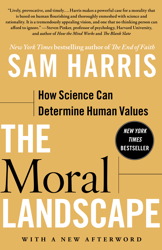 One must just sit aghast when one hears a response like that. Really? That is the way we discover moral truths? And that is the way we “find out about anything”? Now I guess I can’t speak for Anthony herself, but when I’m trying to find out about something, I don’t test my reaction to possibilities and then try to figure out what my reaction “might entail.” That is radical subjectivism. Such a view is utterly devastating for not just morality but also science, history, and the like. If I were to try to conduct scientific inquiry in this manner, science would be some kind of hodgepodge of my “reactions” to various phenomenon. Unwittingly, perhaps, Anthony has grounded the ontology of her morality in the reactions of people. But this error isn’t restricted to Anthony. Harris also makes this confounding mistake. His basic argument in the talk linked above is simply, “Science can tell us what people think about things, so it can tell us about morality.” This is, of course patently absurd. Suppose I tried to test these humanists’ theories on groups of people by sticking them in a room and having them watch all kinds of things from murder to the rape of children to images of laughter and joy. Now suppose I randomly sifted my sample among the population of the world, but somehow, by pure chance, got a room full of child molesters. As I observe their reactions, I see they are quite joyful when they observe certain detestable images. Now, going by Anthony/Harris’ way to “find out about anything” and thinking about what these people’s reaction entails, I conclude that pedophilia is a great good. But then I get a room full of parents with young children, who react in horror at these same images. Then, as I reflect on their reactions, I discover that pedophilia is a great evil. And I repeat this process over and over. Eventually, I discover that the one group was an aberration, but it was a group nonetheless.
What does this mean?
Quite simply, it means that both Harris and Anthony haven’t made any groundbreaking theory of ethics. Rather, they’ve just made a pseudo-humanistic utilitarianism. They ground moral ontology in our “reactions” to various moral situations. The only way for them to say something is morally wrong if people have different reactions is either to go with the majority (utilitarianism) or choose one side or the other, which essentially turns into a kind of Euthyphro dilemma against atheists. Either things are wrong because enough people think they’re wrong (in which case morality is arbitrary) or things are wrong because they simply are wrong, period (in which case the humanist has yet to provide an answer for moral ontology).
Conclusion
Given the discussion herein, one can see that those atheists, humanists, and/or secularists who desire to ground objective morality still have a lot of work to do. Louise Anthony’s best attempt to ground morality boils down into radical subjectivism. Sam Harris’ account fares no better. Those who are trying to ground objective morality within an atheistic universe will just have to keep searching. The solutions Anthony and Harris have attempted to offer are vacuous.
Image Source:
http://commons.wikimedia.org/wiki/File:SecularHumanismLogo3DGoldCropped.png
SDG.
——
The preceding post is the property of J.W. Wartick (apart from citations, which are the property of their respective owners) and should not be reproduced in part or in whole without the expressed consent of the author. All content on this site is the property of J.W. Wartick and is made available for individual and personal usage. If you cite from these documents, whether for personal or professional purposes, please give appropriate citation with both the name of the author (J.W. Wartick) and a link to the original URL. If you’d like to repost a post, you may do so, provided you show less than half of the original post on your own site and link to the original post for the rest. You must also appropriately cite the post as noted above. This blog is protected by Creative Commons licensing. By viewing any part of this site, you are agreeing to this usage policy.
Really Recommended Posts 02/03/12
 Says the Madman, “Humanity is Dead, and We Are Its Murderers”– An insightful post which argues that naturalism has undermined the worth and value of humans.
Zombies of Christianity– I really enjoyed this discussion of the diversity of doctrine in Christianity and how to approach it.
My latest post on abortion generated some controversy, but I’d like to point out that scientifically, the unborn simply is a human being. One can find this not only in numerous medical textbooks on embryology, but also in the words of abortions-rights advocates themselves. Check out this phenomenal post which outlines the fact that the unborn are human beings, period- Medical Testimony.
C.S. Lewis is one of the greatest Christian Apologists of all time. Check out this post which brings us Beyond Mere Christianity. Interested in literary apologetics? Check out Holly Ordway’s guest post on my blog here.
A Response to the Problem of an ‘Evil God’ as Raised by Stephen Law.– An excellent article, which I don’t fully agree with (I think Edward Feser answers the challenge correctly, for example), but which provides a thorough critique of Law’s position.
The Artist: A Film Review and Reflection- Holly Ordway shares her thoughts on “The Artist.”
How Many Atheists in America? Fewer than You Might Think– Pretty self explanatory.
The Issue at the Heart of the Abortion Debate
 I’m going to make what may initially seem to be contentious statements, so read the post to contextualize:
If the unborn is not a person, then abortion is morally permissible, and it doesn’t matter what you do with the unborn.
If the unborn is a person, then abortion is morally impermissible, and the unborn must be protected.
Note that these statements are conditional, marked by the word, “If.”
Why would I make these statements? Simply because I want to clarify the issue that is at the heart of the abortion debate. Namely, the status of the unborn.
Consider the following arguments in favor of the pro-choice position:
We shouldn’t bring unwanted fetuses into the world. It’s better to abort fetuses than force a woman to have an unwanted child.
If a mother can’t afford to have a child, she shouldn’t be forced to continue her pregnancy.
Women’s rights are at stake: it is a woman’s body we’re talking about!
Now, let’s contextualize them. Rather than debating the viability of these arguments, suppose we plug in the case in which we all agree there is a “person” involved. Suppose in place of the “unborn” or “fetus” we put “toddler” into the argument. In that case, the arguments would be:
We should kill unwanted toddlers. It’s better to kill them than to have them live in homes where they are unwanted.
If a woman can’t afford to feed her toddler, we should kill it.
Women’s rights are at stake! Think of the drain toddlers place upon their mothers!
These arguments are clearly absurd. Why? Because we all know that we can’t just go around killing children because their families don’t want them. We can’t kill toddlers because their families can’t afford to feed them. But that’s exactly the question these types of arguments beg: what is the unborn?
And so we return to the statements at the beginning of this post. Suppose the unborn is, in fact, just a cluster of cells, no different from a wart or growth. In that case, I would agree it is perfectly permissible to discard of the unborn whenever a woman desires.
But then, what if the unborn is, in fact, a “person”? What if the unborn is a baby after all? Well, in that case, it is certainly not permissible to discard of the baby.
The fact is, many arguments raised in favor of the pro-choice position are made from a position where one simply assumes that the fetus is no more than a clump of cells. But that’s exactly what the debate is supposed to be about! If the fetus is no more then a clump of cells, the debate is over. But if the fetus is indeed a person, then the arguments raised in favor of the pro-choice position are just as shoddy as those arguments with “toddler” substituted in for “unborn” or “fetus.”
Thus, arguments like this must always be contextualized. The heart of the abortion debate is the status of the unborn. Once that question is answered, the answer to the question: “Is abortion permissible?” becomes crystal clear.
For arguments against abortion, check out my Pro-Life Page. Specifically, one can find my arguments for the personhood of the fetus here.
Scott Klusendorf does a simply phenomenal job of centralizing this issue and pointing out how most of the issues which cloud the debate can simply be dropped in favor of debating the status of the unborn. The arguments presented here are based upon his tactic “trot out the toddler” which one can find in his book, The Case for Life or in his lectures in Ethics at the Edge of Life (found in the links here).
SDG.
——
The preceding post is the property of J.W. Wartick (apart from citations, which are the property of their respective owners) and should not be reproduced in part or in whole without the expressed consent of the author. All content on this site is the property of J.W. Wartick and is made available for individual and personal usage. If you cite from these documents, whether for personal or professional purposes, please give appropriate citation with both the name of the author (J.W. Wartick) and a link to the original URL. If you’d like to repost a post, you may do so, provided you show less than half of the original post on your own site and link to the original post for the rest. You must also appropriately cite the post as noted above. This blog is protected by Creative Commons licensing. By viewing any part of this site, you are agreeing to this usage policy.
Really Recommended Posts 9/23
 The World’s First Talking Chair Shows Up in the UK– one of my favorite websites, No Apologies Allowed, has recently featured a comic on Dawkins’ failure to man up and meet William Lane Craig in a debate on the existence of God. Given the absolute trouncing Craig gave to Dawkins’ buddy, Sam Harris, it’s not surprising Dawkins is hiding as far from this debate as possible.
Thinking Christian is another site I follow closely, and he recently had two fantastic posts. The first is a review of the Intelligent Design movie, “Metamorphosis.” I recently purchased the film but have yet to watch it. I anticipate it greatly. The second post points out some pretty interesting aspects about how the “person” status of slaves was revoked–just as people now revoke the unborn’s “person” status. Check out his post, “Non-Persons Yesterday and Today.”
Holly Ordway over at Hieropraxis has another interesting post which reflects on why we should be “Reclaiming Story for Christ.” Holly has a ton of awesome posts, and I highly recommend her site.
“God is Still Holy and What You Learned in Sunday School Is Still True: A Review of ‘Love Wins'” by Kevin DeYoung. I think the title says it all.
Randy Everist over at “Possible Worlds” has a fun post reflecting on the “Worst Objection to the Kalam Cosmological Argument.” For some reason I can’t get a direct link, so simply go to his site http://randyeverist.com/ and scroll down.
Readers should recognize that I’ve also been focusing on the Kalam recently, and can check out my more recent posts on the topic: Dawkins and Oppy vs. Theism: Defending the Kalam Cosmological Argument; “The Multiverse Created Itself” and “Who Made God after all?”- The Kalam Cosmological Argument
Do you like Biblical Archaeology? I do! Jason Dulle over at Theo-sophical Ruminations has featured another post in his series on the topic. This one features the ossuary of Caiaphas.
Image Credit:
Book Review: “Divine Motivation Theory” by Linda Zagzebski
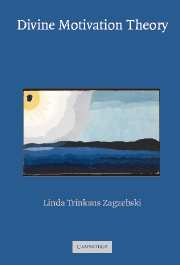 Linda Zagzebski is rightfully becoming a well-known figure in philosophy of religion. Her book, Divine Motivation Theory
The thrust of Zagzebski’s work is focused around two ideas: 1) exemplarism; 2) motivation. Together, these formulate the foundation for the rest of her discussion. The book is divided into three parts. The first explores “Motivation Theory” from a perspective which could be held even by those who are not theists. The second part explores “Motivation Theory” from within a theistic perspective. The third part deals with ethical pluralism.
One of the most important concepts in DMT is that of an exemplar. An exemplar is exactly what one would expect: a figure who demonstrates a “good life” by living it. Zagzebski writes of exemplars: “The particular judgments to which a moral theory must conform include judgments about the identity of paradigmatically good persons [exemplars]” (41). The thrust of Motivation Theory is a refocusing of metaethics. Rather than examining what is good and then evaluating judgments in light of that (as in Platonism, including theistic Platonism in many ways), and rather than focusing upon virtue (as in virtue theory), motivation theory focuses upon persons who are good. These persons formulate the basis for judging what is good, based upon motivation and emotion (40-50). A good action, motivation, or emotion, argues Zagzebski, is one which an exemplar would perform, have, or entertain.
Initially I admit I was a bit put off by this because it seemed quite arbitrary. Could we not define as exemplars people who are vicious and evil. Could not an exemplarist focus on ethics lead to Stalin, Hitler, and Pol Pot as exemplars?
Zagzebski counters this within DMT by focusing in part 2 upon the “divine.” Rather than arbitrarily choosing whomever one wishes as the exemplar, Zagzebski endorses God as the primary exemplar. This provides an alternative to Christian Platonism and Divine Command Theory by arguing instead that “God is essential to morality, not because it comes from either his intellect or his will, but because it comes from his motives. God’s motive dispositions, like ours, are components of his virtues, and all moral value derives from God’s motives” (185). The upshot of this is that God, being a perfect being (granting traditional theism), would have perfect motivations. Whatever God does, must be perfectly motivated.
The theistic focus on motivation within DMT provides several advantages. One among them is the fact that it solves many of the “problems” related to perfect goodness. For example, regarding what makes something God does good, DMT offers the solution that “God is good in the same way that the standard meter stick is one meter long. God is the standard of goodness” (185). Regarding the problem of evil, Zagzebski points out that her theory successfully solves the issue if it is metaphysically possible (313). The reason is that DMT’s focus upon motivation can be used analogically with human parents. “If we can understand,” she writes, “how the motivation of love of a human parent for her child might not involve any considerations of good and evil and yet still be a good motive, we must conclude that promoting good and preventing (or eliminating or not permitting) evil is not necessarily part of the motivational structure of a good being… even a perfect being might love in such [a] way that he would be willing to permit any amount of evil, not for the sake of some good, but out of love for persons” (317). These are oversimplifications of what Zagzebski writes on these problems, but I encourage the interested reader to read her work for a fuller explication.
There are so many things to discuss about DMT that remain, but I feel a full explanation would drag this review on unnecessarily. I would like to note a couple other very interesting arguments Zagzebski makes. She argues that there can be truth values with emotions (75ff). She points out that motivation is extremely important in moral judgments–if someone is doing something just to be hailed as a hero, they are much less praiseworthy than if they are doing it merely out of goodness (see 100ff). Elsewhere, Zagzebski and discusses several principles for dealing with pluralism (369ff). There are important points like these throughout the book. DMT challenges readers to rethink aspects of metaethical theory which they have unreflectively ignored. Yet in doing so, Zagzebski articulates a metaethic for theists which seems to have just as much (or more) plausibility as the alternatives.
Divine Motivation Theory deserves a reading by anyone interested in theistic metaethics. Linda Zagzebski offers a theory that has advantages over both Christian Platonism and Divine Command Theory. I highly recommend this work to any philosopher of religion. I cannot emphasize how much I think readers should get their hands on this work.
Source (and link to Amazon):
Linda Zagzebski Divine Motivation Theory
SDG.
——
The preceding post is the property of J.W. Wartick (apart from citations, which are the property of their respective owners) and should not be reproduced in part or in whole without the expressed consent of the author. All content on this site is the property of J.W. Wartick and is made available for individual and personal usage. If you cite from these documents, whether for personal or professional purposes, please give appropriate citation with both the name of the author (J.W. Wartick) and a link to the original URL. This blog is protected by Creative Commons licensing. By viewing any part of this site, you are agreeing to this usage policy.
Book Review: Natural Law: A Lutheran Reappraisal
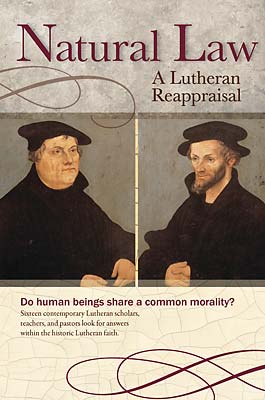 Natural Law: A Lutheran Reappraisal
The individual essays presented in NLL are almost all extremely strong. The topics covered include the views of early Lutherans on natural law (including Luther and the authors of the Confessions) , the view of several later Lutheran individuals (like Barth and Forde), and a kind of “applied ethics” section which uses natural law in individual instances.
The strength of many of these essays is a credit to the Lutheran scholarship which went into the work. The insight into Lutheran thinkers’ views on natural law helps to refute some notions that Lutherans do not “believe in” natural law. In fact, it seems the opposite is the case. “Luther,” argues Thomas Pearson, “understands natural law not as a Christian teaching, but as an observation of human nature in general” (63). Later, Carl Rockrohr expands on this idea to view natural law as a place of common ground for evangelism (196-197).
NLL really shines when it demonstrates that even topics which may at first seem unimportant (like an essay on Friedrich Stahl’s rejection of natural law) can serve to develop a modern view of natural law (Jacob Corzine argues in the aforementioned essay that Stahl’s critique helps ground a Christian natural law theory not in reason but in God [115]).
The applied ethics section of NLL has its ups and downs. “Natural Science, Natural Rights, and Natural Law: Abortion in Historical Perspective” by Korey D. Maas is a simply amazing critique of abortion which presents the case for pro-life not as a religious issue, but as one which can be established on common grounds of natural law (228ff). On the other hand, Albert Collver III’s argument against the ordination of women struggles because it only presents one Lutheran view on the issue (more on that below). The section (and book) concludes with Matthew Cochran’s great summing up and case for the use of natural law as a “Way Forward” for discussions of epistemology and natural law (see esp. 274ff).
The strength of NLL is therefore found in the fact that the essays manage to cohere to the point of building off one another. Whether this was intentional or not, it strengthens the whole work. The early essays provide the framework for the later developments into applied ethics.
This is not to say the book is without faults. One such fault is the woefully inadequate glossary. While the terms included are defined in detail, some terms are inexplicably left out. For example, while the glossary takes lengths to define idealism, it makes no mention of “epistemology,” a concept which was referenced several times. This makes the book seem at times unsure of its purpose. Is it written for the layperson or the professional, the philosopher or the theologian? It includes study questions and a glossary, which suggests use as a textbook in undergraduate (or high school) theology classes, but the very nature of the essays included and the inadequacy of the glossary suggests that only those already familiar with some of the issues will get the most bang for their buck. A final criticism I would level against the book is that while it does present essays from various Lutheran traditions, it is clearly founded specifically upon LCMS teaching. This is unsurprising, given that it is published by Concordia Publishing House (the official publishing arm of the LCMS), but this could cause some confusion when the book devotes an entire chapter to a critique of a different Lutheran tradition (the ELCA). This small shortcoming can also be seen when the book only presents a complementarian view of natural law (that is, a view that natural law excludes women from the ministry) despite the fact that other Lutheran traditions (for example, the NALC or ELCA) are egalitarian (ordain women).
NLL is a simply fantastic work. Lutherans looking to learn about the concept of natural law would be well served to pick the book up and read it cover-to-cover. Those outside of the Lutheran tradition would surely find NLL useful as well, as the essays on applications of natural law can serve as foils for the development of one’s own position. For those wishing to explore the important issue of natural law, I recommend the book highly.
SDG.
——
The preceding post is the property of J.W. Wartick (apart from citations, which are the property of their respective owners) and should not be reproduced in part or in whole without the expressed consent of the author. All content on this site is the property of J.W. Wartick and is made available for individual and personal usage. If you cite from these documents, whether for personal or professional purposes, please give appropriate citation with both the name of the author (J.W. Wartick) and a link to the original URL. This blog is protected by Creative Commons licensing. By viewing any part of this site, you are agreeing to this usage policy.
Why are Christians politically atheistic?
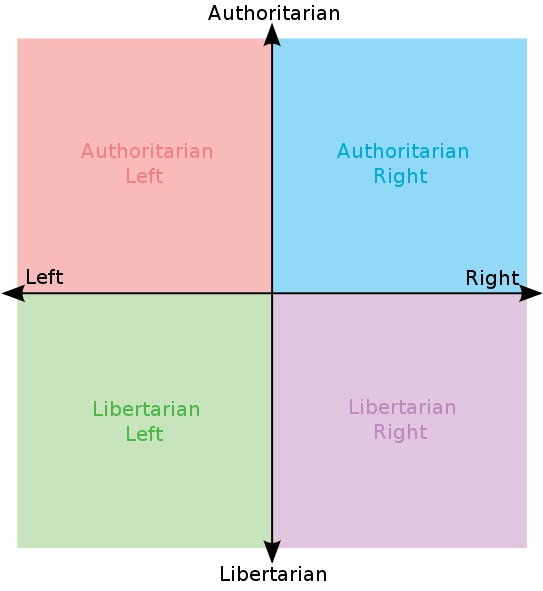 Of note: Atheist Austin Cline has recently linked to my post with his own. He caricatures my argument as saying “Christians should reject secular government.” In fact, I explicitly deny this in my post, as anyone who reads it could see.
I take issue with 3 parts of Cline’s critique. First, he attacks my view that the government can have authority to restrict unrepentant sin. Yet the authority for that restriction is based upon my assumption granted for the sake of this post; that the government gets its authority from God (Romans 13:1). Cline, being an atheist, obviously will reject that basis for authority. He did not outline his own position on the authority of government, so I cannot comment upon it, but it begs the question to assume that government should be secular, and then use that to critique a theo-centric government I explicate below. Second, he caricatures my argument as being a theocracy, which I deny explicitly, see below. Finally, he frames his post in a way that is clearly meant to induce panic, by calling it “J.W. Wartick: Christians should reject secular government.” There is nowhere that I have advocated that extreme position. In fact, that is also something I deny explicitly, agreeing with the apostle Paul in Romans, who said “Therefore, it is necessary to submit to the authorities, not only because of possible punishment but also as a matter of conscience. This is also why you pay taxes, for the authorities are God’s servants, who give their full time to governing. Give to everyone what you owe them: If you owe taxes, pay taxes; if revenue, then revenue; if respect, then respect; if honor, then honor” (Romans 13:5-7).
Recently, I was discussing the death of Osama bin Laden and the topic came up about whether he deserved to die, what role it played, and the like. Interestingly, the conversation opened up a discussion I’ve been contemplating. Namely, Why are so many Christians politically atheists?
Consider the death penalty. It was agreed upon that people can deserve the death penalty. Bin Laden, for example, was said to deserve such a penalty, along with serial killers and many murderers. But then the discussion turned to whether the government should deal out such punishment.
The friend offered following principle as normative for Christians:
1) If (some position such as the death penalty) cannot be justified by purely secular means, then it should not be forced onto others.
My immediate and somewhat snarky rejoinder to this argument was/is “Why?”
Why should I be a Christian in every aspect of my life, but when it comes to politics, be secular? Several answers are possible. For example, it could be asserted that “We (Christians) should not force our views onto others.” I think this is a fairly good response. But whence the principle? Perhaps it comes from the idea of living a Christlike life. But I don’t see anything in the example of Christ which said we had to conform to secularism or take religion out of politics. It would take an interesting argument to say that Christ advocated secularism in the realm of politics.
Or take Paul, for example, who states clearly that the government is God’s servant and doesn’t carry the sword “for nothing” (Romans 13:4). Not only that, but the reason the government carries the sword is in case “you do wrong.”
And what, exactly, is wrong? I think it would have to be obvious that, for a Christian, that which is wrong is defined by that which goes against God’s nature and/or commands. But then it seems as though Paul is charging the government to follow that same standard, not some supposedly neutral standard. I’ve argued elsewhere against the plausibility of atheism as a neutral ground. I think it should be clear that atheism is not neutral in regards to religion; rather, it is against religion.
Therefore, it seems strange to me that secularism is chosen as the grounds for determining politics. Why should I, a theist, choose to be atheistic in my politics? I suppose the accusation could then fly that I advocate a theocracy. But what exactly is a theocracy? It’s a political system in which God rules and the laws are divine commands. I never argued that’s what I would like the United States to turn into. My view is simply that Christians should cast their votes for those positions which are favored by Biblical teaching and against those which are condemned. I don’t see any reason to divorce that which I hold most dear (Christian theism) as something from which I must be divorced when it comes to the ballot box.
Consider the following argument, which is admittedly somewhat consequentialist:
A) A life of unrepentant sin often leads to unbelief. (w=>y)
B) Unbelief is the only sin which condemns people to hell. (If y, then z)
C) Advocating some policy, x, permits or encourages lives of unrepentant sin. (x=>w)
D) Therefore, advocating x by extension opens the way for more unbelief and condemnation to hell. (1-3)
E) Therefore, Christians should not advocate x.
So I’m advocating a theo-centric view of politics, not a theocracy. On this view, one’s theism takes center stage. Sincere belief in everlasting life and death leads Christians to take steps within the law to prohibit behaviors which would lead to lives of unrepentant sin.
How would this cash out? Would we have to be prohibitionists or go around making lying illegal? I think that the answer to this second question is pretty clear. Within Scripture there is no prohibition of drinking alcohol (quite the opposite, in some cases). Rather, drunkenness is prohibited and/or discouraged. With the damage alcoholism has done to our society, I doubt that laws which took measures to prevent drunkenness would be a bad thing. I think the laws which would go into effect based upon the argument above would look mostly like what we have now. Now take the case of lying. While lying is clearly discouraged in the Bible, I don’t see any precedent therein for making it illegal in a broad sense. To be perfectly clear, lying already is illegal in some senses: take perjury, for example, or slander. I think these are derivative of a Christian worldview anyway, and laws against libel, slander, and perjury seem to fulfill the requirements of the above argument.
Reflecting on the ideas about bin Laden, above, it would appear there is another principle as well: that of honoring the image of God in man. Osama bin Laden did not honor that image, and for the blood he spilled, his blood was forfeit. Therefore, in addition to E), I would suggest:
2) The intrinsic value of humans (which only makes sense on theism anyway) is such that we should vote for issues which place honor of this value first.
To nuance it for Christians,
2′) The image of God in humans should be respected, and Christians should vote for issues which respect this image.
Finally, a note on Biblical ethics. It is extremely important for Christians to realize the distinctions between Law and Gospel and practice correct exegesis when it comes to these issues. I favor a Lutheran view with some theonomic tilt, but it is important to note that almost no Biblical scholars believe the Levitical and most of the other laws within the Old Testament are applicable today in any literal sense. But the question for this post is not which laws apply and which do not; rather it is a challenge to my fellow Christians.
So my question remains: Christians, why are you politically atheists?
SDG.
——
The preceding post is the property of J.W. Wartick (apart from citations, which are the property of their respective owners) and should not be reproduced in part or in whole without the expressed consent of the author. All content on this site is the property of J.W. Wartick and is made available for individual and personal usage. If you cite from these documents, whether for personal or professional purposes, please give appropriate citation with both the name of the author (J.W. Wartick) and a link to the original URL. This blog is protected by Creative Commons licensing. By viewing any part of this site, you are agreeing to this usage policy.

 J.W. Wartick - Reconstructing Faith


