Ethics
Abortion: What logical arguments are there?
I’ve written about abortion before a few times. In fact, in my last post on the topic, I issued a challenge:
“I challenge anyone who is pro-choice to attempt to justify their position while maintaining some kind of civility. I challenge them to think about their position, and the ramifications that the arguments they make carry.”
No one accepted that challenge, despite over 200 views of that post since I wrote it.
What arguments are there for abortion that actually can logically justify it? I don’t think there are any. The key is the realization that we are indeed talking about human beings. There is no way to deny scientifically or philosophically that the unborn “fetus” (baby) is human. It is an established, empirical fact. What else could it be? A fish? No, it is a human fetus, and it is a human being, complete with a completely unique set of DNA, a 50% chance of being a different gender, and (often) a different blood type.
The question then is, according to those who are pro-choice, whether this “human being” is a person? While some may balk at such a strange question, that is indeed the question those within the pro-choice camp must put forth, for once it is acknowledged that a fetus is a human being, one must look to other means by which to justify killing this human being.
The argument is often made that while it is inside the mother, it is part of her. This is, in fact, completely false. Something that is part of the mother will have the same DNA as the mother, it will have the same blood type. An arm is not the same as a fetus.
To finally make this point as clear as possible, I cite none other than the “Pro-Choice Action Network”, which states “..even though a fetus is biologically human, it’s definitely not a person (legally and socially), and it’s questionable whether it’s a human being (physically)” (Arthur, cited below). Even the “Pro-Choice Action network freely acknowledges that the fetus is biologically human. The question they try to press is whether its a person. Further, they try to question “whether it’s a human being (physically)”. I don’t even know what this means. What is the difference between being biologically human and physically human? I see no difference whatsoever. It’s telling that these are the hairs the pro-choice network must try to split to make their case.
How is it that being transported outside the mother magically turns a baby into a “person”? Take an example of a baby premature by three months. What makes the 6-month old baby inside the mother less of a person than that baby outside of the mother?
Let’s turn again to Joyce Arthur’s article for the Pro-Choice Action network. “Another key difference is that a fetus doesn’t just depend on a woman’s body for survival, it actually resides inside her body. Persons, by definition, must be separate individuals who operate independently of others. They do not gain the status of persons by virtue of living inside the body of another person – the very thought is inherently ridiculous, even offensive” (Arthur, cited below).
I’m curious as to who made this definition of persons. Not only that, but I’m curious as to how this means that babies are persons? Babies cannot operate independently of others. They will die if left alone. Are babies no longer “persons”? Further, we see a wonderful example of the “straw man” fallacy here. The argument pro-life individuals make is not that babies gain the status of persons “by virtue of living inside the body of another person”. No, the argument is that babies gain the status of persons by being human beings. No other reason is needed. Personhood is not something to be bought and sold, defined and taken away. It’s not something to be arbitrarily defined as we see fit. That is exactly how such people as Hitler managed to murder millions of people. When we redefine personhood to fit our desires, we kill persons.
The chilling response is often that we can somehow justify killing this baby, for it is a “choice.” As Magda Denes wrote, “I do think abortion is murder–of a very special and necessary sort” (quoted in Alcorn, 99 [cited below]). How is it that murder is ever “necessary”? What other cases of murder can be “necessary” if there is such a thing as a “necessary” murder?
I’m confused as to what arguments remain. The inconsistencies in the pro-choice camp abound. They acknowledge that a baby outside the mother at 8 months is indeed a person and should not be killed, but that same baby, most would say, could be killed just hours before its birth! What kind of “logic” is this? Where will it lead? Where has it lead already?
I reissue my challenge to any pro-choice individual. Make your case. Make it without using ad hominems. Make it, acknowledging that science has shown that the fetus is human. Make your case for “necessary” murder of human beings.
Sources:
Alcorn, Randy. Pro Life Answers to Pro Choice Arguments. Multnomah Books. 2000.
Arthur, Joyce. “The Fetus Focus Fallacy.” The Pro-Choice Action Network. http://www.prochoiceactionnetwork-canada.org/articles/fetus-focus-fallacy.shtml. Accessed March 24, 2010.
——
The preceding post is the property of J.W. Wartick (apart from cited material which is the property of its respective owner[s]) and should not be reproduced in part or in whole without the expressed consent of the author.
The “Triumph” of Our Era: Institutionalized Death
It is Pro-Life Sunday (which I tend to think of as every Sunday, but that is beside the point).
As such, I will post again on that massacre of our day, abortion. I have written about it in the past. I’ve presented arguments against it here, and I attacked the institutionalized death again here. In this post, I will continue to make philosophical and scientific arguments against the institution of death.
It seems that arguments in the Pro-Choice camp are continually pushed back. I will examine this in detail in a moment, but for now let me sum up what I’m saying.
1. Some argued that the fetus was not a human. That has been obviously and scientifically refuted.
2. They retreated and then argued that the fetus is part of the woman. This has also been completely destroyed by scientific and common-sensical arguments.
3. Some then denied that the fetus was not a person and as such did not have the rights of other persons. This ridiculous claim is a slippery slope that, once started down, cannot be recouped.
4. Finally, the extremists argue that one’s right to one’s body justifies infanticide.
I’m not outlining every argument made by the pro-choice side, but rather showing how much they have been forced to retreat. It went from “a fetus is not a human” => “a fetus is part of the woman” => “a fetus is not a person” => “Okay, the fetus is a human person, but my rights trump the rights of it because it is inside me”
What a society we have become when we attempt to justify killing those whom we acknowledge are the same as us in every way, but unborn! This is the “triumph” of our era: institutionalized death.
First, there was the argument that the fetus was not a human. I don’t think I need to dwell on this point much at all. Clearly, the fetus is human. It is not a whale fetus, it is not a cat, it is not a unicorn, it is a human. It is biologically a human in every way. To deny that the fetus is human is to acknowledge that one has given up any attempt at rational inquiry into truth, as this is a simple fact.
Then, the argument became that the fetus was thus a part of the mother. Just as one had an arm, a leg, or an appendix, the fetus was a part of the body of the mother. This can be refuted in a way that is almost identical. The arm, leg, or appendix are made up of cells that are genetically coded by the mother’s DNA. The fetus, however, has a unique genetic code, often a different blood type, and 50% of the time is even a different gender than the mother. Thus, it is clearly not just some part of the mother that can be cast off. But here’s what makes this argument really strange to me. Even if the fetus were classified as part of the mother, does that mean that one is allowed to do whatever one wants with “it?” Do people routinely cut off their legs or arms, rip out a kidney, or do some other kind of self-mutilation? Obviously not. So what makes the fetus different? This argument is extremely confusing to me to begin with, but the fact that is entirely based on falsehoods means I don’t see a need to delve into it further.
The next stage of argumentation was then that a fetus is obviously human but not a person. While this claim may seem completely ludicrous, it is one that is used very often in debate on the abortion issue. The challenge I lay before one making this argument is to come up with an argument that does not exclude infants, young children, the elderly (senile), people with comas (that they are likely to recover from), etc. from being persons as well. If we are to play with the definition of who a person is, we must acknowledge the ramifications of such foul play and the potential for exclusion from basic rights that it can bring to all of us. And of course this is not to mention the obvious similarities in trying to strip personhood from the fetus with the Nazi efforts to strip personhood from various portions of the population.
A recent and disturbing trend in such argumentation that I have seen, however, is to acknowledge all of these points and still be pro-choice. Someone posting on another blog I was reading stated that they did agree that the fetus was a human person with such rights, but “If the entire human race is inside my womb, I am allowed to commit genocide.” Really? Are you? Is genocide now permissible for the sake of convenience? There really doesn’t seem to be a response to this argument, as the person making such an argument has shown that they literally have no qualms about killing at will. How long before being inside someone isn’t the only way this argument can be applied? Babies rely on their mothers for nourishment and care, so they clearly could be murdered as well, for it is not my duty (on such a view) to care for someone who is not me! This is morally disgusting.
I would like to cover a few other points before I close. There are a few more common arguments that I find equally ridiculous in their attempts to justify Institutionalized Death.
1) It is unfair to bring unwanted babies into the world.
2) It is unfair to bring babies into situations that are not beneficial to them
The first argument basically claims that it is not fair to children to be born to families that do not want them. What the person making such an argument seems fully willing to ignore is that it seems a lot more unfair to kill children who are unwanted! It’s striking that once the baby is born, if the mother doesn’t want it, and say, kills it, we charge her with murder. If she abandons it, we charge her with abandonment, etc. Not being wanted does not strip someone of their rights.
The second argument is often made with such claims that it is unfair to have children born into poverty, etc. I ask in response, “What right do we have to judge the quality of someone’s life before they live it?” In America, particularly, it seems that being born into poverty isn’t such a terrible thing, considering poverty here is rich in most other places. But not only that, I must press home the question, who are we to judge whether someone should live or die based on a guess that they will live in poverty (or some other situation). It seems obvious that a great many people in poverty are quite happy (and one needs only to read the tabloids to see how happy the rich are). There is no guarantee that someone born into poverty (or another situation) will always be there, and there is no way to objectively judge how much they will or will not enjoy their life. So what right do we have to kill people because we may think their lives aren’t worth living?
There are, as always, more points to cover, but I will save those for another post. I challenge anyone who is pro-choice to come here and present their arguments to me without being ad hominem in their attempts to refute me. I challenge anyone who is pro-choice to attempt to justify their position while maintaining some kind of civility. I challenge them to think about their position, and the ramifications that the arguments they make carry.
——
The preceding post is the property of J.W. Wartick and should not be reproduced in part or in whole without the expressed consent of the author.
Abortion: Further Issues
I’ve written arguments against abortion before, but I’ve come up with/read about some other ones and I wanted to bring them up as I think they raise some unique issues.
One argument I read recently (over here, though I can’t seem to locate the exact post) is that abortion seems to be very anti-men. Those concerned for the rights of individuals should, in order to be consistent, care about both women’s rights and men’s rights. The reason abortion is anti-male is because men don’t have the choice over whether the woman gets an abortion or not. Now, obviously, there are many cases where men (unfortunately) push their significant others for abortion, but what I’m pointing out is that if an adult woman wants to have an abortion, the man can’t stop her if she just goes in and does so. But here’s the punch line: if the woman decides to have the baby, and the man didn’t ever want him/her, he still has to pay child support. So the man can’t decide to have the baby, but if the woman does and he didn’t want him/her, he still has to pay the child support. I’m clearly not saying that men should not want babies, but this is an extreme double standard.
Another issue to raise is the fact that abortion is completely devastating certain minority communities, African Americans in particular (see here for a very interesting site, but if you doubt the validity of this claim, just google it and you’ll find plenty of statistics).
Abortion destroys objective human value. One great point that was brought to light in my eyes a while back (see other post) is the question of how is it that coming through the birth canal suddenly changes this fetus/nonhuman tissue/tumor/whatever term one wants to use to hide the “personhood” of the baby into a baby? What makes the “thing” a baby outside the mother, but not a baby inside the mother, at the exact same stage of pregnancy? How is it different to kill a baby inside the mother (abortion) or kill it outside (murder)? Just being inside a woman doesn’t somehow make the fetus/etc. part of the woman, particularly if it can survive outside of the woman. Though–and here is a very important and chilling point–if one wants to argue that direct dependence on the woman for survival is the difference, then children are not “persons” either until they are capable of taking care of themselves all on their own. A newborn baby, for example WOULD NOT SURVIVE without parental (or other) care. Does this mean the baby too is not a “person”? What definition of personhood is being used, and how does it avoid the points I raised in my other post that I have linked a few times?
Part of my reflections on abortion have lead me to try to see it through the eyes of a pro-choicer. Some of this has come through simply reading from blogs of pro-choice individuals. One thing that is surprising to me is how angry a lot of pro-choice people tend to be. They seem to think that pro-life people are specifically targeting women and trying to “keep them down” in some way. Is it really that hard to acknowledge that there is another side of the debate that might have legitimate reasons for being pro-life? Well, I at least am going to try to acknowledge that pro-choice individuals genuinely raise some good concerns. One of these is a concern for the rights of women. There is no reason to fault someone for wanting to be sure that men and women have equal rights (though interestingly, as above, it seems that men are sometimes pushed aside in this). Pro-choice people show a wonderful concern for women who are struggling with hard decisions, a concern that I think we pro-lifers need to acknowledge and adopt in our own testimony for our side of the debate.
Pro-lifers are not part of some agenda to “keep women down” this is completely ridiculous, and it is in fact a great example of the use of a “straw man” fallacy in argument. I wish that logic was incorporated more into this debate, because all too often I see people on both sides just shouting each other down or using all kinds of fallacious statements. Something this important to both sides, however, seems to alienate logic. I pray that one day this will not be the case. If any real headway is to be made, both sides need to sit down and discuss the issues in a logical way, while allowing for the other side to have some truth.
Keep Taxpayers from Paying for Abortions
Regardless of whether you are for the health care reforms or not, do you want your tax money to go to abortions? Write to your representatives in congress and ask them to vote against any proposal that does not explicitly state that tax dollars will not be used for abortions. Click here for an easy link, fill out the form, and you’re done! They send the email to your representatives. It takes a minute at most, but it will help make a difference.
Abortion Clinic Prayer Vigil
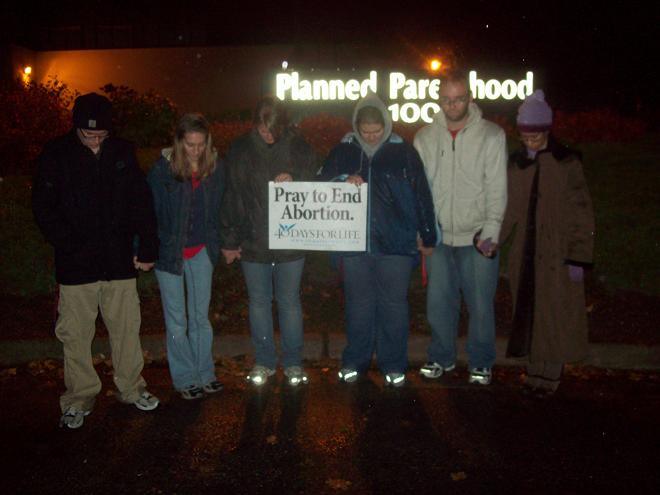
As part of 40 Days for Life, a group I’m in on Campus (Concordia Students for Life) went to an abortion clinic that was shockingly close. I’ll be discussing the experience, and there are a few photos:
When we first arrived on site, there was a man there to talk to us about what we could/could not do, where we could go, etc. It was late evening, so it was closed, but two employees drove by us while we were talking to the man. One of them had her hand over her mouth as she drove past. Not sure what she might have been saying/thinking but I hope that it may have been sorrow or regret of some kind. The man who was there told us about just talking to people, a couple stories, etc. The most striking thing though was him talking about the “medical waste” trucks that would come and take the “waste.” It’s disgusting… discarded babies, hauled as “waste.”
Once the man left, we stood in a circle and prayed. Then we sang some songs, just pieces of hymns or praise songs that we could remember. Then we separated and prayed individually.
The setting was so perfect. It was raining, freezing cold, and dark as sin. It was so striking to think of my previous thoughts on the notion of suffering and how God understands human suffering. Thinking of the rain as God’s tears… and thinking about the fact that just days before we drew 3200 hearts in chalk on the pavement outside the chapel to show the number of hearts each day that are never allowed to love. Those hearts were being washed away at the end of the day, just as the hearts they’d represented had been extinguished that entire day (several of us had this same thought). But we were there to protest, we were there to pray, to ask for forgiveness, and to acknowledge the Redeemer.
It was a truly powerful experience. There is an air about the place, a spiritual kind of malevolence. The moment I stepped onto the general property, I could feel it. I immediately teared up. What could I say? What prayer could I offer? I simply repeated a version of the Kyrie (“Lord have mercy, Christ have mercy, Lord have mercy on us”) the entire time as I prayed with emotions and thoughts, not words, just feelings. What kind of atrocity have we allowed? Will my generation stand against this? I pray it shall be so.
Most striking to me is the difference between just talking about abortion from an impersonal perspective and being at a clinic where I could feel the effects. I’m not trying to say it’s not worth trying to debate abortion from an objective standpoint, but it is so much more real than that (see here for my own arguments against abortion). It’s not something that’s just an interesting topic, but it is a matter of life and death, and it’s a matter of life on death on a huge scale. Several thousand a day in U.S.A. alone. What kind of happiness are we pursuing when we murder the innocent? It speaks volumes about our values that a “choice” is valued above a life. We have become such pragmatists that we can turn a blind eye to the massacre next door. It’s disgusting.
We can’t claim to care about freedom or justice or liberty and deprive thousands of people of their lives each day. It’s horrible. And the only response I can muster, the only prayer I can utter is “Lord have mercy on us.”
There are a couple pictures below.

Abortion: The Holocaust of our Day
Abortion is an issue that goes beyond faith and into simple ethics and morality. Note that these arguments can also be used in a debate with a Christian.
Arguments against abortion must be divided into two categories to insure usefulness in discussion.
The first category is made up of arguments that can be used against abortion with the non-believer.
The second category consists of arguments that can be used against abortion with the Christian. These include Biblical proofs that non-believers would not find convincing, but the believer must accept and submit to.
Arguments against abortion used when talking to non-believers include:
1. An unborn child is clearly a human
2. An unborn child must be defined as a “person,” for there is no clear line where personhood begins
3. Abortion leads logically to infanticide and beyond
4. Although abortion is seen as for women’s rights, it actually (ironically) is destroying women.
Arguments against abortion from a believer’s perspective:
1. Biblical Passages
2. Appeal to Christian Authorities
Before we delve more deeply into the arguments against abortion, let us observe some facts about abortion. In the United States, approximately one in every four pregnancies ends in an abortion (Feinberg, 47). Abortion is often seen as a method of birth control (47). Estimates in developing countries alone state that thirty million to forty-five million women have abortions every year. 125,000 to 250,000 of these women die from botched procedures (48). This is unacceptable. It is the holocaust of our time. Now, some facts of human development. Only 18 days into pregnancy, the baby’s heart is forming. 20 days into the pregnancy, the groundwork of the nervous system, including the brain and spinal cord is being laid. 43 days into pregnancy, the baby’s brain waves can be recorded (Feinberg, 54). That’s less than a month and a half. Can the baby feel pain? Is abortion really a simple procedure that does no harm to the fetus [note that the use of the word fetus is often used to dehumanize the subject, which again brings painful memories of the holocaust to mind]?
The conditions necessary for pain are known to exist in the fetus. These are “1) functioning neurological structures to sense pain; 2) overt behavior expressive of pain; and 3) a cause for pain [abortion] (Feinberg, 55).” Tests have been done that show a child in utero feels pain when pricked by a needle. “Contrary to what proponents of abortion claim, when a mother aborts her baby, most likely the baby feels pain (56).”
Now the arguments against abortion shall be explored in greater detail. The fundamental issue at hand is whether or not the fetus is a human. However, once the pro-choice individual has been persuaded of the fact that the fetus is a human [which we will find out shortly is much easier to prove than one might think], he/she often falls back on the term “personhood.” If the fetus is not a “person,” then it doesn’t have the rights that we “persons” have. These points must be made perfectly clear in order to overcome the evil of abortion.
It should first be noted that the idea of the fetus not being human is quite ridiculous upon examination. The fertilized egg is not going to develop into a bird, a fish, or a railroad train. The only natural possibility this fertilized egg has as it grows is to become a human. This alone is enough evidence to show that the fetus is human, just an undeveloped one. But we must also delve into the scientific aspects here. Norman Ford states that “The union of male and female chromosomes at syngamy [fertilization] ‘gives rise to a single cell with a set of twenty-three pairs of maternal and paternal chromosomes into one genetically new individual cell.’ This process is completed approximately twenty-four hours after fertilization, and yields a cell that is ready to replicate itself (Feinberg, 57).” Thus, it is clear that this zygote is human in nature. Further, before these first 24 hours, there is no way for the fertilized egg to become anything else. Thus, throughout the entirety of pregnancy, a human life is indeed present. The question must then turn to whether or not this human is indeed a “person” with the rights granted to those who have “achieved” personhood.
First, note that the fetus within the mother is an independent organism. This directly refutes the biological view of personhood. The fetus is genetically unique from its mother (Craig, 116). Yes, it lives within its mother, but it is not indeed a vestigial organ or part of its mother. No one can accurately claim that a fetus is the same genetically as its mother (Feinberg, 61). Second, one view of pro-choice advocates is that personhood is something that a fetus only has potential for, it is not indeed a person yet. The most obvious problem with this view is that it begs the question of “What is the definition of a person?” What must one “achieve” in order to be a person? This makes the definition wholly subjective.
A pro-choice party may choose to define personhood to exclude unborn children, but a pro-life party would obviously define it as the opposite. This argument is subjective and cannot be used as grounds to destroy human life. Indeed, it leads to a horrifying slippery slope where personhood could be defined by the majority to destroy the minority—targets could include race, age, etc. Indeed, one of the definitions often used by pro-choice parties includes the “ability to interact with the environment in a meaningful way.” This would then mean that the severely mentally handicapped, babies, and even Joe Shmoe while he is asleep (and therefore unable to interact with the environment in a meaningful way), are not persons. One could kill any of these without any moral repercussions. Personhood is not something that should be determined by a subjective definition.
Thus we see that neither the biological nor the sociological view of personhood can suffice. Neither is a basis upon which one can rationally make a moral judgment. Further, where could one draw the line between person and non-person? A life is a smooth process that, if uninterrupted by unnatural means, will lead to a natural death. The development hypothesis used by those who are pro-choice when determining personhood could be applied at any stage along the path of life (Craig, 116). Infants are clearly not fully developed “persons.” Neither are adolescents or late teenagers. Is 30 years a good point to draw the line where a human has finally earned personhood? What about 50? Should any line like this really be arbitrarily drawn? In the same way, should the line be drawn simply because we cannot see the life?
A baby is clearly going to result from the pregnancy [this is obvious, given that this is the reason abortions are performed]. But if we choose to arbitrarily cut off life at 6 months into development, who says we can’t expand that into infanthood or childhood? How does expulsion through the birth canal magically transform an inhuman, impersonal fetus into a human person (Craig, 119)? There is no clear stage where a human immediately gains personhood, unless one accepts the proposal that each human life is a person.
Perhaps one of the most disturbing and ironic topics in abortion is the fact that with all their gusto to defend the rights of women, pro-choice individuals have contributed to the destruction of females around the world. It was previously stated that abortions in developing nations account for 125,000 to 250,000 deaths of women because of botched pregnancies. Further, in places like India and China where it is preferable to a family to have a male child than a female one, abortion is often used to control the gender of the child. This has lead to an ominous massacre of females across the globe. There is no feasible way that one could argue for women’s rights in order to advocate abortion when it [abortion] is used to destroy the rights for a woman to life.
Finally, there are arguments from a believer’s perspective. The most obvious argument against abortion for the Christian is to cite the Bible. No, there is no verse that states explicitly that one should not have an abortion, but the commandment “Thou shall not murder” combined with other verses leads to undeniable evidence against abortion. Psalm 139:13ff (ESV) “For you formed my inward parts; you knitted me together in my mother’s womb. I praise you for I am fearfully and wonderfully made… My frame was not hidden from you, when I was being made in secret, intricately woven in the depths of the earth. Your eyes saw my unformed substance; in your books were written, every one of them, the days that were formed for me, when as yet there were none of them.” The Christian can’t possibly argue against this with any validity. The most telling verse here is verse 16: “Your eyes saw my unformed substance; in your books were written, every one of them, the days that were formed for me, when as yet there were none of them.” Or, if one prefers NIV, “your eyes saw my unformed body. All the days ordained for me were written in your book before one of them came to be.”God has plans laid out for our lives before we even came into existence. God clearly sees unborn life as having worth. Not only that, but He makes plans for each and every one of us before we are even in existence. There is no way for a believer to wriggle around that.
Another passage that can be offered in support is also from Psalms (51:5): “Surely I was sinful at birth, sinful from the time my mother conceived me.” How can something that is not a human person be sinful? One cannot be sinful if one doesn’t exist.
Dietrich Bonhoeffer says of abortion, “Destruction of the embryo in the mother’s womb is a violation of the right to live which God has bestowed upon this nascent life. To raise the question whether we are here concerned already with a human being or not is merely to confuse the issue. The simple fact is that God certainly intended to create a human being and that this nascent human being has been deliberately deprived of his life. And that is nothing but murder (Bonhoeffer, 174).”
Finally, we must examine a Bible passage that pro-choice Christians often use to attempt to back up their pro-choice stance, Exodus 21:22-25. “If men who are fighting hit a pregnant woman and she gives birth prematurely but there is no serious injury, the offender must be fined whatever the woman’s husband demands and the court allows. But if there is serious injury, you are to take life for life, eye for eye, tooth for tooth, hand for hand, foot for foot, burn for burn, wound for wound, bruise for bruise.” Some believers use this passage to state that it shows the unborn fetus has a lesser status of personhood. They state that verse 22 shows that though the woman loses the child, she sustains no injury, and the penalty is but a fine. They say that this, then, shows that the fetus does not demand the same repercussions as hurting a fellow human (Feinberg 63). There are several problems with this interpretation, however. First, it must be stated that even if one is to concede this interpretation [which is incorrect], it does not authorize abortion. The baby is not intentionally harmed in any manner, but only unintentionally hurt. Second, just the fact that there is a penalty shows that there is wrongdoing here. If the fetus something that may be discarded at will, why is there even a fine for its destruction? Third, the reason the fetus’ death does not require the death penalty is in keeping with the Mosaic exception to the death penalty in cases of accidental death (Exodus 21:13-14, 20-21, Numbers 35:10-34, Deuteronomy 19:1-13). Thus, the fact that there is “merely” a fine does not show that the fetus is less valued. Finally, it absolutely must be noted that Exodus 21 states various penalties for the killing of individuals that cannot be explained away with personhood. For example, verses 20-21 show that one who kills a slave unintentionally has no penalty. No one could argue that the slave is not a “person” (Feinberg, 64).
Further, the correct interpretation of this passage must be seen as the woman giving premature live birth, not a miscarriage. Thus, the implication is quite clear. If the mother gives a premature live birth because of the fight, there is merely a fine (despite no serious injury to anyone), but if either the mother or the fetus is injured, the law of retaliation (eye for an eye) is invoked. Thus, if the fetus is killed, the man causing harm is to be killed. This is remarkable, because it is the only place in Scripture where death is required for accidental homicide. It shows the extreme value placed on the life of the fetus (Feinberg, 65). This interpretation is based on the Hebrew verbs and nouns used in this passage, but that would be tedious to explain here. For further exploration, note the citation.
From this discussion, it can be clear that there is no ground upon which the pro-choice individual can stand.He or she must concede that 1) the fetus is human, 2) the fetus is a person, 3) persons have intrinsic value, and 4) killing a person is murder.
The believer must stand on even shiftier sands, forced to grasp at straws in the face of Biblical and philosophical arguments against abortion. We must pray that God would use His power to overcome the evils of our time. We must pray that God will use us to fight against this atrocity. When we stand at the throne of Christ on judgment day, having fought for the lives of the unborn, those children we did not know and that “The King will reply, ‘I tell you the truth, whatever you did for one of the least of these brothers of mine, you did for me (Matthew 25:40).’”
Sources:
Bonhoeffer, Dietrich. Ethics. New York. Touchstone,1995.
Craig, William Lane. Hard Questions, Real Answers. Wheaton, IL: Crossway Books, 2003.
Feinberg, John. Ethics for a Brave New World. Wheaton, IL: Crossway Books, 1993.
The arguments contained in this post were derived heavily from the sources cited. Of particular help was Feinberg’s Ethics for a Brave New World.

 J.W. Wartick - Reconstructing Faith