philosophy
God and Necessity
Logical necessity is one of the most interesting concepts within philosophy, in my opinion. What does it mean, for example, to say something is necessary? Can anything have necessary existence? It doesn’t take long for questions like these to come into play when thinking about the God of classical theism. This is what makes the concept so interesting to me.
Not so long ago, I read and reviewed the book The Nature of Necessity by Alvin Plantinga. I honestly must say I highly underrated it on my “Relevance” Criterion. I constantly find myself opening the book and paging through it in order to clarify some concept. It was a truly monumental work which outlayed the foundations of what the concept of “necessity” means within logic. Further, it presented Plantinga’s now famous (at least in the corner of the philosophical world I’m interested in) “Victorious Modal” Ontological Argument for the existence of God. But Plantinga only dedicated a chapter to these questions of what logical necessity means in terms of theism.
I have just finished reading God and Necessity
The idea that God exists necessarily is obviously an important one. But it must be maintained that this is not held in a question-begging fashion. Rather, the idea is that if God exists, God exists necessarily (9). Why is this important? If one were to simply say that God exists necessarily, it seems that one is begging the question in theisms favor. But this is not the case. Rather, theists are defending the view that if it is the case that God exists, then God exists necessarily. It is this kind of subtle but important point that God and Necessity excels in pointing out. They aren’t the central point of the work, but they are welcome additions.
If God exists, it is argued, then God exists of de re or ontological necessity rather than de dicto necessity (21). I have written about these concepts before, but I will briefly reiterate the definitions of these terms:
De dicto necessity is: “a matter of a proposition’s being necessarily true”
While de re necessity is: “an object’s having a property essentially or necessarily” (The Nature of Necessity Plantinga, V)
Thus, if God exists, then it could not be otherwise. Parrish states “God, if he is the LNG [logically necessary God], exists in all possible worlds and is eternal, independent, omniscient and omnipotent, etc. in all of the worlds. It is because of this concept that the factually necessary God (FNG), as Parrish describes it, cannot be the Greatest Possible Being (GPB), for the FNG is only necessary in one or some possible worlds, while the LNG is necessary in all possible worlds and unchanging (26). Further, the FNG could exist in worlds in which it were not the GPB in that world, so it can clearly not be the GPB, for one could conceive of a being that existed in more (or all) possible worlds and was the GPB in all of these.
Thus, God must be conceived of as the LNG. But some, such as Hume, have objected that God cannot be logically necessary, for we can conceive of God not existing. This objection quite obviously misses the point (49). For it is necessarily true that “2+2=4.” But we could certainly (mistakenly) hold that, say, “2+2=5.” Just ask any 3 or 4 year old some kind of logically true mathematical equation and you may get a wrong answer. Does this mean that these things are not necessarily true? Obviously not. Thus, just being able to conceive of it not being the case that a necessarily true proposition is true does not actually mean it is not necessarily true (50). “One can, and often does, conceive of necessary truths as being false” (51), but this does not make them false. This is generally a misconception I continually see in debate. When considering the laws of logic, something simply is regardless of whether or not anyone believes it to be the case. Things that are logically necessary simply are no matter what anyone thinks about them. The only way to argue against something that is being held as necessarily true is to show that there is some contradiction in holding this truth (56).
Another excellent point that Parrish makes is the concept of different kinds of existence. Often, a debate can derail because different kinds of existence are being discussed. He defines:
A-existence: something exists extra-mentally in the actual world
P-existence: something exists in any way (including mentally)
N-existence: something exists in every possible world (60)
It is a sign of a well-argued book if it can change a mind about an important issue. I have been operating under a kind of dichotomy in which I generally grant that God operates logically for the sake of argument, but don’t actually believe that, for example, the law of noncontradiction applies to God. God and Necessity changed my mind on this stance, and I now agree that God does operate logically and that logic is synthetically necessary to his being. One reason for this is Parrish’s discussion of Norman Geisler writing on this subject, “[O]ntologically, the laws of logic are dependent on God for their existence” (47). But it is across pages 72-79 that I became convinced. I don’t want to type out all of it here, but I will state the main points that convinced me. “For any object x, where x is intrinsically unknowable [i.e. it is a logical contradiction], then x is meaningless… Nothing whatsoever can be said about it (77).” I think this was possibly the turning point. For let us try to imagine some kind of thing that, on my old view (that God could do anything including make contradictions true) is possible. Let us imagine God could make a square circle. But just examining this concept, one can see that it literally means nothing at all. Other contradictions suffer the same problem. Finally, in closing his refutation of accomodationalism (that God can do contradictions and every logically possible thing), Parrish states, “This is not a limitation, for anything that God [as the GPB] could not do is nothing (79).” This tightly argued section was a simply fantastic refutation of a view that I have held throughout my philosophical explorations of theism.
The next section is quite important, the ontological argument. Two versions are given. The first is Plantinga’s victorious modal version:
1. The proposition there is a maximally great being is possible in the broadly logical sense
2. There is a possible world in which there is a maximally great being
3. Necessarily, a being with maximal greatness would be necessarily existent and would have (at least) omnipotence, omniscience, and moral perfection essentially
4. What is necessary does not vary from possible world to possible world
5. Therefore, a being that is necessarily existent and essentially omniscient, omnipotent and wholly good exists (Generally from “God, Freedom, and Evil” or “The Nature of Necessity”)
And the second is Parrish’s version:
1. The concept of the GPB is coherent (and thus broadly logically possible)
2. Necessarily, a being who is the GPB is necessarily existent, and would have (at least) omnipotence, omniscience, and moral perfection essentially.
3. If the concept of the GPB is coherent, then it exists in all possible worlds.
4. But if it exists in all possible worlds, then it exists in the actual world.
5. The GPB exists (82)
I again unfortunately don’t have the space or time to write out the wonderful defenses of this argument in the book, so I will highlight key points. Parrish starts with a refutation of the various parodies of the ontological argument. I have addressed these elsewhere and so will let this point stand.
The main point Parrish makes with the ontological argument is this: “When considering the GPB, the only way this object could fail to exist is through internal incoherence. The GPB cannot, by definition, fail to exist by chance or because his existence was prevented by some other being or beings (105).”
Another excellent point Parrish makes is about the GPB’s omni-benevolence, a point I have debated at some length. Parrish states, “[H]ow can there be some objective standard of good and evil to judge the being which, by definition, is the source of everything else (98)?” Further, “[T]here is no autonomous standard of ethics by which he might be judged (98).” There is more there, of course, but these two points were quite enlightening on this point that I myself have had some problems clarifying: why believe the GPB is all-good? Well, the GPB simply would be the standard of good and evil, so there would be no way by which to judge that the GPB is evil. Simply put, the GPB would be the standard and therefore would have no standard which could in turn judge the GPB.
Next, Parrish investigates the cosmological and teleological arguments. I’m not going to write much on this section, not because I didn’t think it was valuable, but because it is mostly a set up for Parrish’s main argument, that which he terms the “Transcendental Argument.” Parrish points out that everyone has some kind of “probability structure” from which they judge various propositions. Thus, someone who is a non-theist will believe that the probability of God’s existence is quite low, while a theist will most likely believe quite the opposite. Because of these probability structures, it is hard to fairly examine evidence from either viewpoint (generally 145 and following). I’d like to point out that Parrish’s discussion of plausibility/possibility structures is similar to Michael C. Rea’s own discussion of “Research Programs” in World Without Design (which I discussed here).
Thus, Parrish advances the “Transcendental Argument” which is, in my own terms, the argument that God’s existence is necessary prior to any kind of logical thought whatsoever. Basically, Parrish states that there are three possibilities for the existence of the universe: Brute Fact (that everything is chance), Necessary Universe (our universe exists necessarily), and Necessary Deity (183). There are worldviews that combine aspects of some or all of these, but essentially any worldview can be reduced to these beliefs. Parrish argues that the universe cannot be brute fact, because there is no way to explain for everything in our universe not continually fluctuating (i.e. if everything is chance, why are things not popping into and out of existence at random). He argues against the Necessary Universe by pointing out some contradictions in this structure, including that those who hold to objectivism commit a kind of de dicto – de re fallacy, equating what should simply be de dicto necessity with de re necessity. Finally, Parrish sums it all up by pointing to the GPB as argued earlier as being the only possible explanation for our universe. This is a very bare-bones summing up of his argument, but there really is no way to sum it up in any small fashion that does it justice. As with most philosophical works, it must be judged as a whole, not by taking single parts out and critiquing them. The arguments contained in God and Necessity build off of each other throughout the book, and culminate in the conclusion that in order for their to be any kind of rational thought at all, God, as outlined in Classical Theism, must exist (279).
Now that I’ve essentially outlined the contents of the book, I will review it below:
God and Necessity by Dr. Stephen E. Parrish is one of those books that is definitely exactly what the title says it is: a defense of classical theism that applies logical necessity to the concept of God.
Dr. Parrish argues for the concept of God as the Greatest Possible Being (GPB). Because of this concept of God, one can draw a number of conclusions, including God’s omnipotence, omniscience, omni-benevolence, etc. Dr. Parrish argues conclusively against the concept of a Factually Necessary God (FNG) as opposed to a Logically Necessary God (LNG) being the GPB. The FNG exists in many worlds as the GPB, but not in all possible worlds. Only the LNG exists in all possible worlds as the GPB.
He follows this with a form of the ontological argument unique to the work. Instead of grounding his version of the ontological argument on the premise that “Possibly, the GPB exists in some possible world” as most modal versions of the argument do, Parrish starts with “The concept of the GPB is coherent (82).” In this way, he avoids the problem that some versions of the argument don’t address, which is that someone could simply deny that it is possible that the GPB exists in any possible world. Thus, Parrish’s version is strengthened, for he bases it on concept of the GPB rather than on the modality of the GPB.
In each chapter, Parrish fairly presents counter-arguments and refutes them. His argumentation is always clear and as concise as possible. I would compare his style of arguing with Plantinga’s in that they both have a very clear flow of their book from start to finish, with each point building on the last throughout the work. Further, Parrish injects a touch of humor here and there in his work.
My one criticism is that sometimes, in his efforts to refute as many counter-arguments as possible, Parrish dismisses them a little too easily. This was particularly evident in his discussion of the compatibility of omniscience with incompatibilist (I believe this is equivalent to libertarian) free will. I would love to see his style of systematic argumentation applied to this issue. Despite this, this discussion really wasn’t all that relevant to the rest of his work, which may be part of the reason he didn’t dwell on it.
After presenting the case for the ontological argument, Parrish discusses the teleological and cosmological arguments, concluding that they may hold weight depending on one’s own plausbility structure. This point is quite interesting: everyone has his or her own plausibility structure from which he or she judges everything, including other plausibility structures. Thus, an argument like the teleological argument may hold some weight in one struture, but not as much in another.
Because of this, Parrish presents what he calls the “Transcendental Argument.” This argument, in my own words, essentially states that God’s existence is necessary for any kind of logical thought. The rest of the book focuses on this argument. Essentially, Parrish argues for this by presenting three possibilities for the universe: Brute Fact (the universe is chance), Necessary Universe (the universe exists for intrinsic reasons), and Necessary Deity (the universe exists because of an external, necessary being). He refutes the first two worldviews and provides support for the Necessary Deity (the GPB). This constitutes about half the book and is extremely useful, not just for its applicability in regards to the argument Parrish is making, but in that it helps refute various alternatives to theism.
God and Necessity is a philosophical masterpiece. It has a broad scope, it is tightly argued, and it is extremely relevant. Despite very few minor flaws, Dr. Stephen E. Parrish’s book, God and Necessity is an essential part of any Christian apologist’s library.
——–
The preceding post is the property of J.W. Wartick and should not be reproduced in part or in whole without the expressed consent of the author.
Keep Taxpayers from Paying for Abortions
Regardless of whether you are for the health care reforms or not, do you want your tax money to go to abortions? Write to your representatives in congress and ask them to vote against any proposal that does not explicitly state that tax dollars will not be used for abortions. Click here for an easy link, fill out the form, and you’re done! They send the email to your representatives. It takes a minute at most, but it will help make a difference.
Abortion Clinic Prayer Vigil
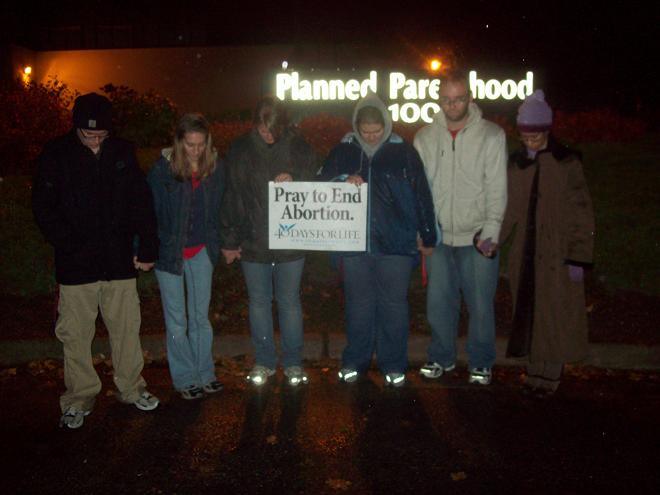
As part of 40 Days for Life, a group I’m in on Campus (Concordia Students for Life) went to an abortion clinic that was shockingly close. I’ll be discussing the experience, and there are a few photos:
When we first arrived on site, there was a man there to talk to us about what we could/could not do, where we could go, etc. It was late evening, so it was closed, but two employees drove by us while we were talking to the man. One of them had her hand over her mouth as she drove past. Not sure what she might have been saying/thinking but I hope that it may have been sorrow or regret of some kind. The man who was there told us about just talking to people, a couple stories, etc. The most striking thing though was him talking about the “medical waste” trucks that would come and take the “waste.” It’s disgusting… discarded babies, hauled as “waste.”
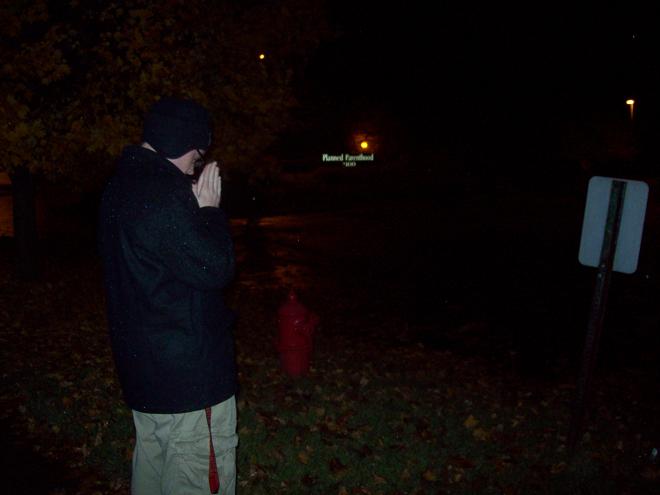
Once the man left, we stood in a circle and prayed. Then we sang some songs, just pieces of hymns or praise songs that we could remember. Then we separated and prayed individually.
The setting was so perfect. It was raining, freezing cold, and dark as sin. It was so striking to think of my previous thoughts on the notion of suffering and how God understands human suffering. Thinking of the rain as God’s tears… and thinking about the fact that just days before we drew 3200 hearts in chalk on the pavement outside the chapel to show the number of hearts each day that are never allowed to love. Those hearts were being washed away at the end of the day, just as the hearts they’d represented had been extinguished that entire day (several of us had this same thought). But we were there to protest, we were there to pray, to ask for forgiveness, and to acknowledge the Redeemer.
It was a truly powerful experience. There is an air about the place, a spiritual kind of malevolence. The moment I stepped onto the general property, I could feel it. I immediately teared up. What could I say? What prayer could I offer? I simply repeated a version of the Kyrie (“Lord have mercy, Christ have mercy, Lord have mercy on us”) the entire time as I prayed with emotions and thoughts, not words, just feelings. What kind of atrocity have we allowed? Will my generation stand against this? I pray it shall be so.
Most striking to me is the difference between just talking about abortion from an impersonal perspective and being at a clinic where I could feel the effects. I’m not trying to say it’s not worth trying to debate abortion from an objective standpoint, but it is so much more real than that (see here for my own arguments against abortion). It’s not something that’s just an interesting topic, but it is a matter of life and death, and it’s a matter of life on death on a huge scale. Several thousand a day in U.S.A. alone. What kind of happiness are we pursuing when we murder the innocent? It speaks volumes about our values that a “choice” is valued above a life. We have become such pragmatists that we can turn a blind eye to the massacre next door. It’s disgusting.
We can’t claim to care about freedom or justice or liberty and deprive thousands of people of their lives each day. It’s horrible. And the only response I can muster, the only prayer I can utter is “Lord have mercy on us.”
There are a couple pictures below.
Why ask the “Why” question?
I can’t help but continue to think about the suffering in the world and how it relates to Christianity. I don’t think people who are not Christian, or indeed not religious at all, don’t wonder about these concepts also. Quite the contrary, suffering so permeates our world that anyone who attempts to downplay it seems obviously wrong. But I continue not to think about the “why” part of the question, but the “how” question. Rather than asking “Why is there suffering?” I ask “Why do people have the concept of suffering?” The former question is answered on the Christian view of the fall into sin (or in various other ways in more depth, see here for a longish response). The latter question I believe Christianity also has an answer for.
I believe that the very question actually presupposes at least the concept of some kind of objective standard of good and evil. Suffering is often defined with such terms as “pain.” The very concept of suffering presupposes that there is some line between what is good and bad, what is pleasure and pain. But these concepts can exist in almost any epistemology. What sets this issue in a new light for me is the very fact that we ask questions about it.
How are we justified in asking questions like “Why is there suffering?”? I don’t see any reason that one can be justified in asking such a question unless they are supposing that there is a very real right and wrong. Someone is suffering. That is wrong. Why must they suffer? But what I must then press is my own question: Why do you think you’re justified in asking that question? It seems to me that a naturalist certainly cannot be justified in asking this question, because on naturalism the concepts of good and evil or right and wrong have evolved into us and are part of nature. They serve evolutionary functions, and no more. So what could justify someone who follows this epistemology to ask a question like “Why is there suffering?”? A possible answer could be that the reason there is suffering is because we have evolved some capacity that understands the world in such terms as right and wrong (similar to Dawkins discussion about the reason we observe that the universe seems remarkable and we seem unlikely within it [my comments here]), but these aren’t objective (we could have evolved a different experience of the world which would perhaps give us entirely different concepts of what suffering is, or a lack of the concept entirely) and therefore can’t serve as an objective answer to a question that seems to demand it. It seems completely unsatisfactory, especially in light of the fact that the question demands an objective answer. Some may be satisfied by it, I’m not arguing against that, what I am arguing is that naturalists haven’t answered the question in an objective sense. They can only pose it as a challenge to competing epistemologies.
So it seems to me that, on a naturalist ontology, we cannot be justified in asking these kinds of “Why” questions. The only answer to be provided is that it is natural. The question demands more. It begs for more. But in order to justify the question, one has to dig deeper than a naturalist ontology (which may be uncomfortable to accept for other reasons) can provide. One has to delve into that realm of theism. It is only when the objective meaning in the universe is personal that such personal, objective questions can be asked. We cannot ask a meaningless, eternal (or circular? self-existant? etc.) universe “Why is there suffering?” when the question itself demands an answer to “How can suffering be allowed?” We cannot ask the universe of deism or naturalism “Why” and claim we are justified in expecting a response other than “Because.”
This answer leaves us wanting. Others may refer to theism as a crutch. They may see a reliance on God as a way to strengthen a weakness in oneself. It’s not. Rather, it’s the answer. God can answer the “Why” questions that are so synonymous with our nature. And a God who suffers provides an even more personal answer. It may not be the answer we’re looking for. It may not be an explanation. Rather, the answer can come as an understanding. God understanding suffering and even suffering Himself.
The book of Job in the Bible examines this question in some detail. Job suffered. He suffered at the permission of God (Job 1:12). But Job’s faith remained strong, despite the verbal throttling he received from those around him. He says “Shall we accept good from God, and not trouble?” (Job 2:10). And Job suffered greatly. But why? What answer would God give to Job? God does answer, “Will the one who contends with the Almighty correct him? Let him who accuses God answer him!” (Job40:2) and “Brace yourself like a man; I will question you and you shall naswer me. Would you discredit my justice? Would you condemn me to justify yourself?” (Job 40:7-8). He continues, saying, “Who has a claim against me that I must pay? Everything under heaven belongs to me.” (41:11)
Job is left without answers to these questions from God. “Surely I spoke of things I did not understand, things too wonderful for me to know… Therefore I despise myself and repent in dust and ashes” (42:3, 6). It would seem here that God’s answer to the question “Why is there suffering?” may be a “You don’t understand” or even, “You can’t understand.” Job is content with this, but God isn’t. In the person of Christ, in whom all the fullness of the Deity lives in bodily form (Colossians 2:9), God suffered Himself. Not only that, but instead of answering “Why,” God delivered the ultimate answer: Jesus. This earth may be a time of suffering, but in the end there is eternal joy.
It is here, however, that the Christian now may be accused of not providing a satisfactory answer to the question. “Forget about all this theological garbage [1 Corinthians 1:18-31] and answer the question!” This is where the Christian can thank God for the gifts of logic and reason, for the answer to the question can be determined from them. I’m not going to rewrite everything, as I’ve already gone through the question here.
It therefore stands, in my mind, that the justification for such “Why” questions can only be had on theism. Naturalism, without objective right and wrong, has no stance from which to ask the question, and no answer that it can give achieves the transcendental meaning it demands.
——–
The preceding post is the property of J.W. Wartick and should not be reproduced in part or in whole without the expressed consent of the author.
The Ontological Consequences of Naturalism
What does naturalism entail? This is largely a discussion of the ideas contained within the book World Without Design: The Ontological Consequences of Naturalism by Michael C. Rea. An outline of his ideas comes first, followed by a look at a critique of his work.
Michael C. Rea has lofty goals for his book World Without Design: The Ontological Consequences of Naturalism. He lays them out almost immediately: to show that naturalists are 1. committed to rejecting realism about material objects (RMO), 2. are forced to reject materialism, and 3. cannot accept the reality of other minds (ROM) (Rea, 8).
Naturalism, according to Rea, is best understood as a research program. This he defines as: “a set of methodological dispositions” (Rea, 3). He argues that research programs cannot be accepted based on evidence, but can be discarded based on evidence. “[T]here is no method-neutral basis on which to assess the decision to adopt a particular research program” (Rea, 7). He pushes for acceptance of this view of naturalism as opposed to epistemological, metaphysical, etc. naturalism. While I believe that naturalism can certainly be viewed as a research program (using his definition), I think it is unclear from his arguments as to why exactly the other views of naturalism are to be rejected. Interestingly, however, it seems that Rea’s definition of research program manages to include these various types of naturalism.
Whether or not Rea is successful in his arguments to refocus naturalism as a research program, his arguments stand, as they are directed at this kind of “naturalism-at-large.”
It is important to note that a central concept that must be understood in order to discern Rea’s argument is that he is almost certainly attacking what seems to be most naturalists views that naturalism is unapproachable. Rea’s argument for viewing naturalism as a research method becomes stronger when taking this into account–for if naturalism is accepted without justification, it fits his definition of research program. He quotes Quine (who is extremely important in many fields of philosophy [such as logic], not just naturalism): “The proper answer to questions like ‘What justifies me in believing what I learn by way of scientific method?’ is simply ‘Do not ask that question'” (Rea, 44).
I believe that this stance should be, at the very least, uncomfortable for naturalists, or at least naturalists who attack theists for similar responses as to justification for belief in God, but that’s a whole different subject. I believe that, however, both cases need at least some kind of warrant or justification.
But let’s delve into the meat of World Without Design. Rea, as was said before, argues that naturalists are forced to ontologically give up RMO, ROM, and materialism. What grounds does he have for making these claims? I was initially quite skeptical. Obviously, I have every reason to rejoice in any attempts to undermine naturalism, but to claim that naturalism cannot even justify reality about material objects is, as I said, a lofty claim.
Rea cites The Discover Problem as the main reason naturalists are forced to these consequences. The Discovery Problem is “…just the fact that intrinsic modal properties seem to be undiscoverable by the methods of the natural sciences. Modal properties are properties involving necessities or possibilities for the objects that have them” (Rea, 77). It is this Problem that Rea continues to press against naturalists, and after analyzing his exhaustive arguments, I believe he succeeds.
The problem is that science can discover, at most, extrinsic modal properties, but not those that are intrinsic. Rea frames one of the problems that follows from the Discovery Problem as follows (paraphrased): one man owes another a debt. When the one to whom the debt is owed confronts the debtor about it, he argues that he is not the same person he was when the debt was incurred, for, after all, large amounts of the molecules in his body are no longer there, or have rearranged somehow, etc. The one owed the debt promptly punches him on the nose (Rea, 79ff).
But how is it that one can prove he is the same person? What makes it so that the matter can be said to be arranged “human-wise” instead of merely “collection-wise“? The answer is modal properties. The problem, however, is that in order to successfully point to the debtor as being the same person, one must use intrinsic modal properties, which are undetectable via scientific method, and, according to naturalism, must therefore be rejected.
I can’t type out the whole book here for a number of reasons, so I’ll highlight a few arguments:
“[I]t is possible for belief in material objects to be justified only if it is possible to have at least one justified M[odal]P[roperties] belief” (Rea, 83). This is because 1. one must be able to say this is a material object, 2. that belief can only be justified by beliefs in certain properties that are essential to the object (essential in the philosophical sense), and 3. these kinds of beliefs are MP beliefs (Rea, 83-84).
There are a number of ways naturalists have tried to get around this problem, but ultimately they can, at most, only grant extrinsic modal properties. In order to grant intrinsic modal values, on naturalism, “(a) we must observe it, (b) we posit its existence to explain our observations, or (c)we discover that our theorizing is simplified or otherwise significantly pragmatically enhanced by supposing that it exists” (Rea, 104). But modal properties are not observable, so only (b) or (c) are possibilities.
The possible solution (b) generally points to tying modal properties in with Proper Function. Proper Function is, generally, the belief that certain things that occupy a certain region have an objective function that they are supposed to perform. But even granting that empirical techniques can somehow claim this about anything, Proper Function can only grant extrinsic modal properties (such as saying that cat-arranged things have the proper function of “operating” as cats). The problem remains.
Solution (c) presents a pragmatic argument. Now setting aside some of the blatant flaws with pragmatism in general (i.e. the absurdity that, on pragmatism, it follows that if there are no people, there is no truth), this pragmatic consideration within naturalism doesn’t help in discovering intrinsic modal properties as it is completely unclear as to what pragmatic value there is in considering intrinsic modal properties on naturalism. Not only that, but Rea presents another valuable argument: “If, for example, it cannot be a truth that a thing x has a property p unless it is somehow useful or convenient for human beings to believe that x has p, then it is hard to see how x could have p in a world that does not include human beings.” [As I mentioned.] “So pragmatic theories of truth seem to imply (perhaps absurdly) that every property is extrinsic [ed: in that properties are assigned pragmatically]. hence, they also imply that modal and sortal properties are extrinsic. Thus they are incompatible with R[eality about]M[aterial]O[bjects]” (Rea, 146).
The Discovery Problem thus eliminates the possible of RMO, ROM, and materialism from the naturalist ontology. But these are things that naturalists will be extremely reluctant to eliminate. Rea follows with a discussion of intuitionism–which is another way naturalists might salvage RMO from the implications of naturalism, but the problem with intuitionism is that it is a version of idealism which eliminates RMO to begin with. I’m not going to go into the details of Rea’s argument here, as to do so would take quite a bit of extra space and I don’t think it is all that relevant to the current discussion.
I find Rea’s method quite sound, and his reasoning is certainly solid. Whether or not his book is successful (as I think it is), it certainly is thought-provoking. I expect many a naturalist will be forced to reconsider his or her position and attempt many a rejoinder to the arguments contained in World Without Design. One such rejoinder will be discussed next.
A critique of Rea’s work can be found here. The author (Troy Cross) was quite fair in his evaluation of Rea’s work, but I think the conclusions he drew weren’t quite spot on. For example:
“Rea’s ‘charitable’ proposal on naturalism’s behalf [that of it being a research program], by contrast, is to be avoided at all costs… Rea’s argument is not of the form: there are material objects, therefore, naturalism is false.”
But it is in Cross’ accusing Rea of being unnecessarily “charitable” that he seems to ignore one of the central arguments of the first chapters, which is an argument against naturalism as Cross seems to want to take it [though as I discussed above I am not entirely sure of its success]. Not only that, but while he states specifically what Rea’s argument is not (and I agree with him), he seems to ignore that if Rea has succeeded in his actual argument, then while naturalism may not be untrue or false on an epistemological level, naturalists are forced into some uncomfortable positions. In fact, I don’t really think that Rea is anywhere trying to prove naturalism is false, but only that naturalism forces us to give up much on an ontological level and that some of these beliefs seem basic to naturalism itself. It is in this way that many of Cross’s critiques fail. He seems to miss the general point of Rea’s book, which may perhaps be summed up in Rea’s own words:
“I think it is important to acknowledge that the theses I have said naturalists must give up are theses that many philosophers, naturalists in particular, will be very reluctant to give up.”
and
“We are told that if only we look in the right places we will find everything we want: realism about material objects, realism about other minds, materialism for those who want it, and much more. But when all the shells have been turned over, we find that we have been duped, and nothing is there.” (Rea, 170)
Further, Cross makes a rather bold statement by asserting, “Perception is a science-approved basic source of justification, and on a suitably robust notion, perception delivers real material objects, not merely sense data or mind-dependent objects.” Despite these claims, he offers no evidence to support it. It seems he missed the section on pragmatism, or at least chose to ignore it. In what way does naturalism, with its “science-approved” methodology somehow grant itself the assumption that perception is not mind based? How does his claim rule out idealism? He truly fails in this regard, and he falls victim to his own presuppositions.
Naturalists cannot seem to view their own worldview objectively at all (see Quine’s quote, above). Material objects are simply assumed based on perception and it is similarly assumed that materialism is true. And then it follows from these two assumptions that the mind is at the least supervenient on the physical. But this is nothing other than a circular argument. If any one of these three assumptions fails, then the circle is broken. And I don’t see any reason that all of these assumptions won’t fail. Not only that, but a circular argument is a simple logical fallacy.
What grounds do naturalists have to accept such a statement as Cross makes? The assumption that perception somehow proves material objects flies in the face of competing metaphysical approaches such as idealism and certainly begs the question against them. And because of this, such a statement is, if not false, at least lacking any kind of epistemic value. It’s nothing but an assumption with no grounds (other than perhaps pragmatism) for accepting it. And if one would like to argue for such a view on pragmatic grounds, the arguments presented by Rea against pragmatism apply.
Naturalists seem to make these kinds of statements all the time. Whatever they say they simply grant because of either pragmatic concerns or some kind of circular argument. There is no reason to accept either of these reasons.
So Cross seems to miss the mark in a number of ways. He is attempting to argue against a point Rea didn’t make. When he argues that Rea fails to give epistemic reasons that naturalism is false, he is arguing against a straw man. Rea isn’t trying to do so to begin with. Rather, he is arguing that if naturalism is true, it forces those who want to accept it to give up many of the things that they may wish to take as truths–those things shown above, namely, ROM, RMO, and materialism. Not only that, but Cross fails to make any kind of argument for a naturalism that escapes Rea’s casting of it as a “research program.” Cross instead states “[Rea] succeeds in aiding and motivating the construction of naturalistic theories.” The problem is that the construction of those theories hasn’t happened. The current naturalism is fully subject to the arguments presented in World Without Design, and the consequences of naturalism are hard to swallow.
I should note, in closing, that the arguments I make above against Cross (particularly my statement that he is making assumptions and/or begging the question for naturalism) might be leveled against my own view of theism. It should be noted, however, that Rea himself addresses these issues briefly. But there are other reasons that such accusations don’t have merit, for theism doesn’t presuppose such things as dualism. There is a huge amount of literature dedicated to the mind-body problem that is readily accessible. Further, claims that God is the basis for intrinsic modal properties and/or intrinsic human worth have also been addressed in many formats by theists. Certainly, theists may make claims that grant certain underlying beliefs, but those beliefs themselves are building blocks that theists at least have arguments that at the least warrant, if not justify those beliefs (I can once again refer to dualism as a prime example). Naturalists have no such warrant. It is simply assumed that scientism or empiricism is the correct method (or argued on the basis of pragmatism), and that somehow this serves as a defeater for idealism, various theistic views, or other explanatory positions. But, as can be seen in Rea’s book and our brief discussion, these claims only lead us to a rejection of those things which naturalists hold most dear: material objects and materialism itself.
——–
The preceding post is the property of J.W. Wartick and should not be reproduced in part or in whole without the expressed consent of the author.
The Paucity of Objections to George Berkeley’s Immaterialism
Immaterialism is a topic I’ve been reading [and writing] a lot on recently (particularly the works of George Berkeley, and reading Kant’s Critique of Pure Reason to go along with it as a balance of [transcendental] idealism).
The more I read it, the more it appeals to me, and the more I’ve been writing on the topic myself. What continues to shock me is the utter lack of any kind of good objections to immaterialism. The objections people come up with are readily answered by anyone who reads even a bit of George Berkeley’s Principles of Human Knowledge.
So I decided to make a blog on it, of course!
One of my favorite web sites for cursory research on philosophy is the Standford Encyclopedia of Philosophy. They generally provide some awesome work as far as philosophy is concerned, and I highly recommend it for those who want a free, quick research tool. Anyway, they list a few objections to Berkeley’s immaterialism (sometimes called universal immaterialism or dogmatic idealism), and, frankly, not one of them needed more than a few seconds of thought to answer.
For example:
One of the problems that people often bring up with Berkeley’s immaterialism relates to his principle, “Esse est percipi” or “to be is to be perceived.”
The argument is basically the classic question, “If a tree falls in a forest with no one around to hear it, does it make any sound?” A similar objection is written in a famous limerick:
There was a young man who said God,
must find it exceedingly odd
when he finds that the tree
continues to be
when noone’s about in the Quad.
But, it can be answered in a number of ways. The first is a counter-limerick (which I appreciate greatly):
Dear Sir, your astonishment’s odd
I’m always about in the Quad
And that’s why the tree
continues to be
Since observed by, yours faithfully, God (Stanford Encyclopedia of Philosophy)
In other words, immaterialists could simply reply:
Well, obviously someone hears/sees the tree, God is omniscient, after all.
But, it could be countered that God isn’t a given at all. Is there still a counter to this problem? Well, despite the fact that I personally think Berkeley’s form of immaterialism makes the existence of God almost necessary, let us assume we aren’t to use that as a way out with his theory. After all, Berkeley himself, I don’t think, would want us to not subject his theory to further investigation. If there is a God to continually perceive everything, then it is a given that things exist, but let us look for other evidence. I suggest there are at least two answers to this objection to immaterialism:
1. So what? What does it matter if objects wink into and out of existence if there is no one to observe them? I think it’s very unclear as to how this objection really serves a defeater of immaterialism whatsoever. The objection suggests that if something doesn’t exist if it’s not perceived, then things are continually coming into and out of existence. But what relevance does that have to the truth claims of immaterialism itself? I think Berkeley would counter by simply saying that even asking this question is begging the question in favor of materialism. Further, there is no way to say whether or not objects actually do come into and out of existence, because if esse est percipi, then no one could ever observe such an occurance!
2. I’m about to make a point that I am continually shocked that people miss in response to such objections to Berkeley, for he basically makes this point himself: If someone asks the a question like that above (“If a tree falls…”), they have already answered the question for themselves, for the fact that they are asking about the tree means that they are actively conceiving of it in their minds, and therefore they are perceiving it actively. Thus, to even ask such a question is unreasonable, for when one asks such a question, he or she is perceiving of the item in question, and therefore it simply does exist, based on the core principle esse est percipi.
It is worth observing that even the Stanford entry misses this rather simple answer entirely.
There are certainly other objections to Berkeley’s immaterialism, but as I have neither the time nor the motivation to go into any more here, that is all for now.
I close with the thought that has been nagging me ever since I first started reading Berkeley: it seems that ever since he published his works, they have been largely ignored or the arguments therein have been made straw men and knocked over. I think that this is due to a few reasons, but the most obvious are that 1. it is a hard philosophy to really even conceive of, and 2. it is a philosophy that stands wholly in opposition to the core materialist assumptions of the Western world. I think that if 1. were answered in a satisfactory way, 2. could possibly be overthrown.
Sources:
Stanford Encyclopedia of Philosophy. http://plato.stanford.edu/entries/berkeley/
The Works of George Berkeley, Volume I. Bibliobazaar. [Specifically Principles of Human Knowledge, and Three Dialogues…]
The Cambridge Dictionary of Philosophy.
The Oxford Guide: Philosophy.
The preceding post is the property of J.W. Wartick and should not be reproduced in part or in whole without the expressed consent of the author.
Abortion: The Holocaust of our Day
Abortion is an issue that goes beyond faith and into simple ethics and morality. Note that these arguments can also be used in a debate with a Christian.
Arguments against abortion must be divided into two categories to insure usefulness in discussion.
The first category is made up of arguments that can be used against abortion with the non-believer.
The second category consists of arguments that can be used against abortion with the Christian. These include Biblical proofs that non-believers would not find convincing, but the believer must accept and submit to.
Arguments against abortion used when talking to non-believers include:
1. An unborn child is clearly a human
2. An unborn child must be defined as a “person,” for there is no clear line where personhood begins
3. Abortion leads logically to infanticide and beyond
4. Although abortion is seen as for women’s rights, it actually (ironically) is destroying women.
Arguments against abortion from a believer’s perspective:
1. Biblical Passages
2. Appeal to Christian Authorities
Before we delve more deeply into the arguments against abortion, let us observe some facts about abortion. In the United States, approximately one in every four pregnancies ends in an abortion (Feinberg, 47). Abortion is often seen as a method of birth control (47). Estimates in developing countries alone state that thirty million to forty-five million women have abortions every year. 125,000 to 250,000 of these women die from botched procedures (48). This is unacceptable. It is the holocaust of our time. Now, some facts of human development. Only 18 days into pregnancy, the baby’s heart is forming. 20 days into the pregnancy, the groundwork of the nervous system, including the brain and spinal cord is being laid. 43 days into pregnancy, the baby’s brain waves can be recorded (Feinberg, 54). That’s less than a month and a half. Can the baby feel pain? Is abortion really a simple procedure that does no harm to the fetus [note that the use of the word fetus is often used to dehumanize the subject, which again brings painful memories of the holocaust to mind]?
The conditions necessary for pain are known to exist in the fetus. These are “1) functioning neurological structures to sense pain; 2) overt behavior expressive of pain; and 3) a cause for pain [abortion] (Feinberg, 55).” Tests have been done that show a child in utero feels pain when pricked by a needle. “Contrary to what proponents of abortion claim, when a mother aborts her baby, most likely the baby feels pain (56).”
Now the arguments against abortion shall be explored in greater detail. The fundamental issue at hand is whether or not the fetus is a human. However, once the pro-choice individual has been persuaded of the fact that the fetus is a human [which we will find out shortly is much easier to prove than one might think], he/she often falls back on the term “personhood.” If the fetus is not a “person,” then it doesn’t have the rights that we “persons” have. These points must be made perfectly clear in order to overcome the evil of abortion.
It should first be noted that the idea of the fetus not being human is quite ridiculous upon examination. The fertilized egg is not going to develop into a bird, a fish, or a railroad train. The only natural possibility this fertilized egg has as it grows is to become a human. This alone is enough evidence to show that the fetus is human, just an undeveloped one. But we must also delve into the scientific aspects here. Norman Ford states that “The union of male and female chromosomes at syngamy [fertilization] ‘gives rise to a single cell with a set of twenty-three pairs of maternal and paternal chromosomes into one genetically new individual cell.’ This process is completed approximately twenty-four hours after fertilization, and yields a cell that is ready to replicate itself (Feinberg, 57).” Thus, it is clear that this zygote is human in nature. Further, before these first 24 hours, there is no way for the fertilized egg to become anything else. Thus, throughout the entirety of pregnancy, a human life is indeed present. The question must then turn to whether or not this human is indeed a “person” with the rights granted to those who have “achieved” personhood.
First, note that the fetus within the mother is an independent organism. This directly refutes the biological view of personhood. The fetus is genetically unique from its mother (Craig, 116). Yes, it lives within its mother, but it is not indeed a vestigial organ or part of its mother. No one can accurately claim that a fetus is the same genetically as its mother (Feinberg, 61). Second, one view of pro-choice advocates is that personhood is something that a fetus only has potential for, it is not indeed a person yet. The most obvious problem with this view is that it begs the question of “What is the definition of a person?” What must one “achieve” in order to be a person? This makes the definition wholly subjective.
A pro-choice party may choose to define personhood to exclude unborn children, but a pro-life party would obviously define it as the opposite. This argument is subjective and cannot be used as grounds to destroy human life. Indeed, it leads to a horrifying slippery slope where personhood could be defined by the majority to destroy the minority—targets could include race, age, etc. Indeed, one of the definitions often used by pro-choice parties includes the “ability to interact with the environment in a meaningful way.” This would then mean that the severely mentally handicapped, babies, and even Joe Shmoe while he is asleep (and therefore unable to interact with the environment in a meaningful way), are not persons. One could kill any of these without any moral repercussions. Personhood is not something that should be determined by a subjective definition.
Thus we see that neither the biological nor the sociological view of personhood can suffice. Neither is a basis upon which one can rationally make a moral judgment. Further, where could one draw the line between person and non-person? A life is a smooth process that, if uninterrupted by unnatural means, will lead to a natural death. The development hypothesis used by those who are pro-choice when determining personhood could be applied at any stage along the path of life (Craig, 116). Infants are clearly not fully developed “persons.” Neither are adolescents or late teenagers. Is 30 years a good point to draw the line where a human has finally earned personhood? What about 50? Should any line like this really be arbitrarily drawn? In the same way, should the line be drawn simply because we cannot see the life?
A baby is clearly going to result from the pregnancy [this is obvious, given that this is the reason abortions are performed]. But if we choose to arbitrarily cut off life at 6 months into development, who says we can’t expand that into infanthood or childhood? How does expulsion through the birth canal magically transform an inhuman, impersonal fetus into a human person (Craig, 119)? There is no clear stage where a human immediately gains personhood, unless one accepts the proposal that each human life is a person.
Perhaps one of the most disturbing and ironic topics in abortion is the fact that with all their gusto to defend the rights of women, pro-choice individuals have contributed to the destruction of females around the world. It was previously stated that abortions in developing nations account for 125,000 to 250,000 deaths of women because of botched pregnancies. Further, in places like India and China where it is preferable to a family to have a male child than a female one, abortion is often used to control the gender of the child. This has lead to an ominous massacre of females across the globe. There is no feasible way that one could argue for women’s rights in order to advocate abortion when it [abortion] is used to destroy the rights for a woman to life.
Finally, there are arguments from a believer’s perspective. The most obvious argument against abortion for the Christian is to cite the Bible. No, there is no verse that states explicitly that one should not have an abortion, but the commandment “Thou shall not murder” combined with other verses leads to undeniable evidence against abortion. Psalm 139:13ff (ESV) “For you formed my inward parts; you knitted me together in my mother’s womb. I praise you for I am fearfully and wonderfully made… My frame was not hidden from you, when I was being made in secret, intricately woven in the depths of the earth. Your eyes saw my unformed substance; in your books were written, every one of them, the days that were formed for me, when as yet there were none of them.” The Christian can’t possibly argue against this with any validity. The most telling verse here is verse 16: “Your eyes saw my unformed substance; in your books were written, every one of them, the days that were formed for me, when as yet there were none of them.” Or, if one prefers NIV, “your eyes saw my unformed body. All the days ordained for me were written in your book before one of them came to be.”God has plans laid out for our lives before we even came into existence. God clearly sees unborn life as having worth. Not only that, but He makes plans for each and every one of us before we are even in existence. There is no way for a believer to wriggle around that.
Another passage that can be offered in support is also from Psalms (51:5): “Surely I was sinful at birth, sinful from the time my mother conceived me.” How can something that is not a human person be sinful? One cannot be sinful if one doesn’t exist.
Dietrich Bonhoeffer says of abortion, “Destruction of the embryo in the mother’s womb is a violation of the right to live which God has bestowed upon this nascent life. To raise the question whether we are here concerned already with a human being or not is merely to confuse the issue. The simple fact is that God certainly intended to create a human being and that this nascent human being has been deliberately deprived of his life. And that is nothing but murder (Bonhoeffer, 174).”
Finally, we must examine a Bible passage that pro-choice Christians often use to attempt to back up their pro-choice stance, Exodus 21:22-25. “If men who are fighting hit a pregnant woman and she gives birth prematurely but there is no serious injury, the offender must be fined whatever the woman’s husband demands and the court allows. But if there is serious injury, you are to take life for life, eye for eye, tooth for tooth, hand for hand, foot for foot, burn for burn, wound for wound, bruise for bruise.” Some believers use this passage to state that it shows the unborn fetus has a lesser status of personhood. They state that verse 22 shows that though the woman loses the child, she sustains no injury, and the penalty is but a fine. They say that this, then, shows that the fetus does not demand the same repercussions as hurting a fellow human (Feinberg 63). There are several problems with this interpretation, however. First, it must be stated that even if one is to concede this interpretation [which is incorrect], it does not authorize abortion. The baby is not intentionally harmed in any manner, but only unintentionally hurt. Second, just the fact that there is a penalty shows that there is wrongdoing here. If the fetus something that may be discarded at will, why is there even a fine for its destruction? Third, the reason the fetus’ death does not require the death penalty is in keeping with the Mosaic exception to the death penalty in cases of accidental death (Exodus 21:13-14, 20-21, Numbers 35:10-34, Deuteronomy 19:1-13). Thus, the fact that there is “merely” a fine does not show that the fetus is less valued. Finally, it absolutely must be noted that Exodus 21 states various penalties for the killing of individuals that cannot be explained away with personhood. For example, verses 20-21 show that one who kills a slave unintentionally has no penalty. No one could argue that the slave is not a “person” (Feinberg, 64).
Further, the correct interpretation of this passage must be seen as the woman giving premature live birth, not a miscarriage. Thus, the implication is quite clear. If the mother gives a premature live birth because of the fight, there is merely a fine (despite no serious injury to anyone), but if either the mother or the fetus is injured, the law of retaliation (eye for an eye) is invoked. Thus, if the fetus is killed, the man causing harm is to be killed. This is remarkable, because it is the only place in Scripture where death is required for accidental homicide. It shows the extreme value placed on the life of the fetus (Feinberg, 65). This interpretation is based on the Hebrew verbs and nouns used in this passage, but that would be tedious to explain here. For further exploration, note the citation.
From this discussion, it can be clear that there is no ground upon which the pro-choice individual can stand.He or she must concede that 1) the fetus is human, 2) the fetus is a person, 3) persons have intrinsic value, and 4) killing a person is murder.
The believer must stand on even shiftier sands, forced to grasp at straws in the face of Biblical and philosophical arguments against abortion. We must pray that God would use His power to overcome the evils of our time. We must pray that God will use us to fight against this atrocity. When we stand at the throne of Christ on judgment day, having fought for the lives of the unborn, those children we did not know and that “The King will reply, ‘I tell you the truth, whatever you did for one of the least of these brothers of mine, you did for me (Matthew 25:40).’”
Sources:
Bonhoeffer, Dietrich. Ethics. New York. Touchstone,1995.
Craig, William Lane. Hard Questions, Real Answers. Wheaton, IL: Crossway Books, 2003.
Feinberg, John. Ethics for a Brave New World. Wheaton, IL: Crossway Books, 1993.
The arguments contained in this post were derived heavily from the sources cited. Of particular help was Feinberg’s Ethics for a Brave New World.
Religious Experiences: Providing Warrant for Belief in God
Religious experience is something that has been shared by a significant minority (although it is perhaps a majority) of the population of the world. Surveys indicate that in 2000 about 36% of the population of Britain reported some kind of spiritual experience (Kwan, 515). 36% is a significant minority, but the fact is that it is possible that this number is too low. In fact, when people were allowed to develop a relationship and then conduct an interview (rather than simply have an impersonal poll), the percent of positive responses when asked about a religious experience increases to 62-67% (Kwan, 515).
The numbers are significant. Many people have what they perceive of as spiritual or religious experiences. The number is literally millions, if not billions. But what does this really mean? Does it reveal anything about the universe? Is there any way to argue for truth from such a subjective judgment?
Richard Dawkins certainly does not think so. In The God Delusion, he discusses the “Argument from Personal ‘Experience’” (note his use of scare quotes). Dawkins uses an illustration in which a man he knew thought he had heard the voice of the devil while camping, and when he shared this with some zoologists, they laughed at him… for the noise was simply the noise a local bird makes (Dawkins, 112).
I believe Dawkins almost manages to make a good point here. We should be skeptical of religious or spiritual experiences, if we ever experience them (1 John 4:1- Test the spirits…). But does this mean that every religious experience has a naturalistic explanation? Or indeed, does a naturalistic explanation somehow take precedence over a spiritual one?
Dawkins some convoluted argument against religious experience based mostly on the computational theory of mind (see here for a critique of CTM). I don’t think he is successful, but one can judge for themselves whether the CTM has any kind of explanatory power, or if it serves as a defeater for the spiritual (I again think it doesn’t in either case).
I would like to address the assumptions implicit in Dawkins’ story about religious experience in greater depth. If Dawkins doesn’t make this argument, it is certainly an argument I’ve heard many times before:
Conclusion: For any Religious Experience, there is a naturalistic explanation.
In the case of Dawkins’ story of the bird, there was indeed a naturalistic explanation. But there are two counters I would use against Dawkins and others who would argue against Religious Experience:
Counter 1: The claim that every religious experience has a naturalistic explanation begs the question.
Counter 2: A naturalistic explanation does not exclude other explanations.
First, let’s address Counter 1. I argue that the claim that every religious experience has a naturalistic explanation begs the question. What do I mean? Well, the claim that every religious experience has a naturalistic explanation assumes that for every experience, E, there is a naturalistic explanation. It does not allow for any explanation outside of naturalism to account for any E. To see this, let’s look at what Conclusion, above, analytically:
Conclusion: For any Religious Experience, there is a naturalistic explanation.
Thus: Religious Experiences, do, in fact, exist. (This follows from the first part of the conclusion, which assumes that there is such a thing as a religious experience).
Now, the fact remains that those who experience Religious Experiences (REs) certainly believe there is a non-naturalistic explanation. Hence the reason they are called REs to begin with.
It therefore follows that: A person S, who has an RE, believes that the RE has a non-naturalistic explanation.
But then the Conclusion listed above is really:
Conclusion*: Person S believes their RE is non-naturalistic, when in fact, there is naturalistic explanation.
Conclusion* begs the question, as does Conclusion. They both assume the conclusion “there is a naturalistic explanation” without any grounds to do so. In fact, they assume that the category RE is mistaken to begin with, and it is in fact simply a Naturalistic Experience, not an RE.
The burden of proof is on those who wish to claim that every RE has a naturalistic explanation to actually show that every RE has a naturalistic explanation, especially in light of the argument from theistic experience below. Any simple assumption that every RE has a naturalistic explanation simply begs the question against the Argument from Theistic Experience.
Now, Counter 2 must also be examined. “Counter 2: A naturalistic explanation does not exclude other explanations.”
Let us take Dawkins bird example. Let us change the RE in the example from an example of an evil force to that of a good one. So rather than a demonic sound, the man perhaps thinks he hears angels singing, or some such experience of God or His power. Now we know that the sound is actually just some kind of bird, the “Angel Voice” bird, common to the region. But what if the friend never found out that the noises had this naturalistic explanation? I believe anyone would agree he would happily go on assuming that the experience was an RE.
But what is it about a naturalistic explanation that is supposed to serve as a defeater of RE? I think it is generally assumed that the knowledge of a naturalistic explanation for an RE is supposed to defeat the RE. In other words, if the Angel-hearer found out that the angels were in fact just the “Angel Voice” bird, he would have to give up the experience as an RE and assume it is rather a naturalistic experience.
But why?
I don’t think that even the friend’s knowledge of a naturalistic explanation would necessarily serve as a defeater of the RE, for a few reasons:
1. At the time the friend experienced the event, he believed it was an RE. With an RE comes many emotions and other experiences. These emotions and experiences aren’t somehow invalidated by the idea that there is a naturalistic explanation to the RE. For example, think of someone, (A) who has been in love with someone else (B) for many years, believing there was a mutual love. But suddenly, B explains to A that B has never loved A. Does this somehow serve to invalidate A’s love for those years? Further, would A be required to give up love for B immediately, or at all? I don’t believe so. In the same way, person A could believe that B is an RE, and despite finding out that B was in fact a natural event, could go on believing that B is an RE… leading into:
2. Religious Experiences are compatible with natural explanations. It is said throughout the Bible that nature speaks of the glories of God (Psalm 19:1 “The heavens declare the Glory of God…” Psalm 69, Psalm 93, etc.). God is seen within a Christian ontology as one who works in and through nature to sustain the universe. Thus to claim that nature is somehow a defeater of something God is thought to bring about (an RE) not only begs the question, but also misunderstands the Christian view of nature.
3. There are plenty of things that have known naturalistic explanations that are still seen as God’s work by Christians and people of other faiths worldwide. Some examples are the beauty of a waterfall, the stars, various plants and animals, places like the Grand Canyon, etc. People know why these things occur naturally, and yet freely attribute such things to God. They aren’t multiplying entities unnecessarily (don’t begin sharpening Occam’s Razor yet), because they are simply saying that there is a certain order and beauty in all of these things that points to teleology. Further, even if one does want to use Occam’s Razor here, the first and second points still stand.
I’d also like to point out that if God does, in fact, exist, it would be wholly within His power to order things in such a way that REs would have naturalistic explanations that the people who experience them never find out about (and then continue in their belief of the RE). While I am not comfortable with claiming this is how God works (I don’t believe God works through what could be seen as trickery or deception, but does actually work in and through the world He set up, that being nature), I’m merely stating that it is possible.
I believe that the Argument from Theistic Experience actually helps grant warrant to belief in God.
First, a definition:
PCT: Principle of Causal Trust – “If it seems (epistematically) to me that x is present on the basis of experience, then probably x is present unless there are special considerations to the contrary (Kwan, 508).”
The argument:
1. Type PCT is correct
2. Theistic Experience (TE) is a well-established type of experience
3. It seems (epistematically) to S that God exists on the basis of a TE.
4. The TE is not defeated
5. Therefore, S is justified to believe that God exists
(Kwan, 512)
Now note that I’m not claiming that God does exist based on this argument, only that S is justified to believe that God does exist. I am thus confronting the de jure challenges to theistic belief–claims that such belief is unjustified or irrational (Plantinga, 167). These kind of challenges to theistic belief are exactly the kind that Dawkins seems to be referencing in The God Delusion, in fact, the book’s title points to the general accusation that anti-theists have brought against theism in general, but particularly against Christianity. The charge is that it is delusional to believe such things.
And indeed, such charges have (and likely will continue to be) been brought against Christianity despite, and perhaps even because of such arguments as the argument from TE. But I think that the PTC is indeed valid, and warrant is granted to those who have had TEs to take that on principal as a justification for belief.
There is of course further application involving a cumulative case argument in which TE can be weighed against simple spiritual experience or experiences of other faiths (such as a connection to the ONE or a feeling of emptiness). I don’t wish to explore that yet, but it is worth noting that there has been, of late, a somewhat significant increase in writings on these subjects.
I do believe that the argument from TE carries some weight, but it is mostly weight for those who have had TEs to counter charges that such ideas are delusional or unjustified, rather than being an argument for the existance of God. I think arguments of this type are fruitful, and I’m looking forward to reading more on them.
Sources:
Dawkins, Richard. The God Delusion.
Kwan, Kai-Man. “The Argument from Religious Experience.” The Blackwell Companion to Natural Theology.
Plantinga, Alvin. Warranted Christian Belief.
The preceding post is the property of J.W. Wartick and should not be reproduced in part or in whole without the expressed consent of the author.
Immaterialism and Idealism within Theism
Immaterialism/Idealism (essentially the same thing) is a philosophy that I believe can prove fertile for theism. I will start with an exploration of the Immaterialist views of Berkeley, an outline of his arguments, a brief critique, and how I believe Immaterialism can be used within theism.
Bishop George Berkeley was one of the pioneers of what he called Immaterialism, a philosophy that can generally be referred to as Idealism.
Immaterialism is the rejection of matter. It is the claim that “two kinds of things exist in reality: (1) minds (or spirits), and (2) the ideas they perceive (Lawhead, 321).”
Berkeley writes, “Some truths there are so near and obvious to the mind, that a man need only open his eyes to see them… all [the objects in the universe] have not any subsistence without a mind, tha t their being (esse) is to be perceived or known; that consequently so long as they are not actually perceived by me, or do not exist in my mind or that of any other created spirit, they must either have no existence at all, or else subsist in the mind of some eternal spirit… To be convinced of which, the reader need only reflect and try to separate in his own thoughts the being of a sensible thing from its being perceived (Berkeley, 89).”
Outside of being perceived, objects do not exist. There is no such thing as matter. Berkeley’s philosophy is probably that which lead to the question: if a tree falls in a forest, and no one hears it, does it make a sound? Berkeley would respond by saying that just the fact that we conceive of such a question means that yes, because by our act of even imaging such a thing, it brings it into our mind and therefore into perception.
It follows from this that we can’t simply bring things into perspective on our own. There must be a cause for these perceptions. Our minds have images of a “w0rld” in them, but it doesn’t follow that these are created by oneself. Berkeley claimed that our perception is directly projected into our minds by God.
Berkeley brought up a few arguments for his Immaterialism, believing that it was wholly rational to hold such a view. He is famously known for saying “Esse est percipi” or “To be is to be perceived.” The first is a set of arguments:
“1. Primary (solidity, motion, rest, quantity, etc.) and secondary qualities (color, taste, etc.) cannot be separated in the mind, because they always appear together and are perceived in the same way
2. Thus, if one quality is mind dependent, the other will be also
3. …Secondary qualities are mind dependent
4. Therefore, primary qualities are mind dependent (Lawhead, 325)”
and
“1. All properties which are relative are subjective
2. Primary properties are relative properties
3. Therefore, primary properties are subjective (Geisler, 145)”
This argument leads to the entire world, including such objects as dirt, flowers, birds, and the like, to be equivalent to imagined things such as a flying pig. All of these things are subjective and have qualities that are mind-dependent.
Another argument was his argument from the mental dependency of ideas:
“1. Sensible objects are things present to us in sense experience
2. What is presented to us in sense experience consists solely of our ideas
3. Ideas exist solely in our minds
4. Therefore, sensible objects exist solely in our minds (Lawhead, 323)”
Again the argument seems sound.
It is telling that Berkeley’s arguments are still debated in philosophy. Generally speaking, the only way any one has ever gotten around them was by arguing either Occam’s Razor (which I don’t think applies, as it’s not really multiplying entites, rather, Immaterialism would vastly reduce the entities involved) or by rejecting them based on common sense (i.e. we can see that there is a material world, so there is one–an argument that seems circular at best). Hume said of Berkeley’s views that ‘Their only effect is to cause… momentary amazement and irresolution and confusion.” I would tend to agree, in light of the following two problems.
The first is that if our thoughts and the things we conceive are projected into our minds by God as defined by Christianity, then why do we have in our thoughts evil things? The problem of evil is particularly strong against Berkeley’s view that all of our thoughts are projected into our minds by God–or at least sustained by Him. Why would God project evil, or why would He sustain evil thoughts so that we could conceive of or perceive them?
The second problem is that of Christianity itself. It seems that, if we are just minds and there is no actual matter or a “world,” there should be no need for Jesus as a physical “New Adam” and savior. Why would God work within the seemingly obvious universe in a historical fashion (i.e. being historically tied into Jesus), if history is so tied into matter and the physical world, which does not exist? It seems backward.
A third problem that I don’t think is valid is the argument that what we see is obvious–there is a physical world. Logically, this argument doesn’t seem to have a foot to stand on, especially given that Berkeley’s arguments specifically break down such an argument. Generally, this third problem is the reason Immaterialism is rejected: we just can’t make any sense of it.
I do believe that Immaterialism could prove a fertile ground for the Christian. The first point I’d make is that the arguments for it seem fairly conclusive. I’ve read some arguments that supposedly refute Immaterialism, but they all generally amount to my third objection. Just because we innately view the world as physical does not mean it is. The second point is that if Immaterialism, especially that of Berkeleyan influence, were true, then theism is unavoidable. These two points seem to make Immaterialism more appealing to theists.
I suggest two ways to approach Immaterialism in a theistic way. These two ways are wholly different.
1. The first way would be to argue that Immaterialism is indeed unavoidable. But rather than embracing the idea that perceived objects are projected into our minds by God, one could rather argue that perceived objects do in fact exist as sustained immaterial (here using “immaterial” only to mean not-made-of-matter) objects.
In other words, Berkeley’s premise that things that are not perceived do not exist is true, but we can focus on the point he follows that with: that all things subsist in the mind of some immaterial spirit (in other words, all “things,” “objects,” etc. exist in terms of being perceived by some being). Further, rather than saying that this spirit then projects these objects and thoughts into our minds, one could embrace the idea that such things are rather projected into a universe–one that is not matter per se but some kind of non-matter substance. Perhaps some kind of idea-substance.
Everything in the universe would therefore be ideas, but individual created minds (i.e. ours) could have some control over how these things interact. Evil is in the universe because God created us and granted us some influence over this universe. Our ideas corrupted it on the fall into sin. While this view seems at first glance rather nonsensical, I believe that it gains footing with Berkeley’s arguments for Immaterialism, as well as the idea that “matter” is itself just super-condensed energy. Ideas, thoughts, and the like, could be energy, but not some kind of undefined substance known as “matter.”
Thus there is a real world and it is the one we experience, but our understanding of it is completely wrong. Rather than some physical, material world, the world is wholly sustained and upheld by the Creator. Matter as we know it is undefined and is, in actuality, incarnations of ideas into the universe. Incarnation here being defined as a “manifestation of a non-material thing (i.e. an idea) into something that can be defined as, for lack of a better term, ‘physical.'” I would call this view Incarnationalist Immaterialism (a term I coin here). It’s not one I’ve read anywhere, but one I’ve developed myself (though I don’t necessarily believe it–see below).
-I tend to think of this first view as a sort of compromise between what I tend to think of as a very solid case for Immaterialism and the “common sense argument” for an actual world.
2. Rather than embrace Immaterialism in any form, a theist could point to such arguments as evidence for God. If we cannot prove that there is even a physical realm, what grounds do we have for assuming such things as naturalism, phsyicalism, and the like. Note that with this view, the theist does not even need to agree with any for mof Idealism/Immaterialism, he or she can simply incorporate it into a general pattern of argumentation, using arguments for Immaterialism to show that the way we perceive the universe, including such basic things as matter, is questionable. Theism points to something unquestionable and objective: God.
-These views are wholly different, and I’m not sure which I myself would conform to, if either. What I do believe, however, is that Berkeley’s argumentation for Immaterialism is nearly flawless. It is when he attempts to incorporate God as the all-perceiver that his argument suffers the problem of evil. Nevertheless, Immaterialism is a compelling view that, while it may not have much sway in the so-called real world, philosophically speaking is of great interest.
Sources (not any particular format):
Berkeley, George. Edited by G.N. Wright. The Works of George Berkeley, Volume I. Bibliobazaar.
Geisler, Norman and Paul Feinberg. Introduction to Philosophy. Baker Academic.
Lawhead, William. The Voyage of Discovery. Thomson Advantage Books.
The preceding post is the property of J.W. Wartick and should not be reproduced in part or in whole without the expressed consent of the author.
Freedom of Will/Divine Omniscience continued
On other sites (well, facebook anyway), the previous post generated a lot of interest, so I decided to continue with a very brief discussion raising a couple extra points.
The two main problems I have with any view other than divine omniscience AND human freedom (specifically, molinism) is that those who reject divine omniscience seem to reject Biblical teaching on this doctrine. There are plenty of verses that talk about God knowing all things. He even challenges those who would be gods to tell the future.
The most convincing case, however, in my opinion, is the fact that there is prophecy throughout scripture, given by God. Not only that, but Jesus himself prophesies. Also, the writers of the gospels continue to say things about Jesus that are prophecies fulfilled. Finally, Jesus predicting Judas’s betrayal and Peter’s denial can only be explained by his foreknowledge of such events. While some may assert that Jesus intuited such events, this derives them of all theological significance. Thus, those who do not want to deprive the gospel message and Jesus’ divinity, I believe, must adhere to omniscience.
Similarly, there is a vital (I think) flaw in those who assert that our free will doesn’t exist or that it is just an illusion. This flaw is the fall into sin. If God knows all things, and our free will is only an illusion to us, then we fell into sin by his knowledge AND will.
Theologically, God foreknowing man’s fall into sin is not an issue (another vast subject), but it would be for those who do not believe we have free will.

 J.W. Wartick - Reconstructing Faith