philosophy
Scrooge, Molinism, and the “Grounding Objection”
`Before I draw nearer to that stone to which you point,’ said Scrooge, `answer me one question. Are these the shadows of the things that Will be, or are they shadows of things that May be, only?’ …`Men’s courses will foreshadow certain ends, to which, if persevered in, they must lead,’ said Scrooge. `But if the courses be departed from, the ends will change. Say it is thus with what you show me.’
…`They [the curtains on Scrooge’s bed] are not torn down.’ cried Scrooge, folding one of his bed-curtains in his arms,’ they are not torn down, rings and all. They are here — I am here — the shadows of the things that would have been, may be dispelled. They will be. I know they will.’-The Christmas Carol, by Charles Dickens
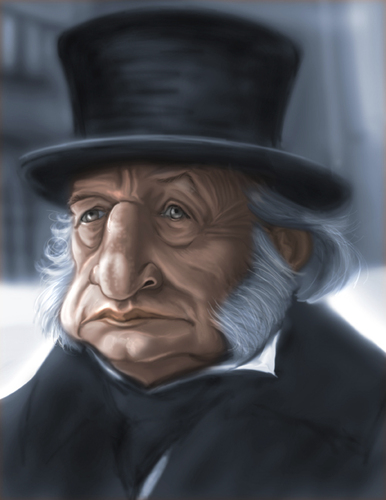
Such is Scrooge’s conclusion when he discovers that despite what he is shown about the future, he wakes up and discovers that he may change those ends. The story relies upon something which tends to be common in everyday language: the truths of counterfactuals. For example, Scrooge seems to conclude “If I change my course, then things will turn out differently.” Thomas Flint writes, “no one dismisses the story on the grounds that there simply are no such truths which ever could be revealed. The reason, I think, is that most people tacitly assume that there are such conditional truths” (Flint, 79, cited below).
It is therefore interesting that the most commonly cited philosophical objection to molinism is this very notion: that things can be true about what free beings will do in such-and-such circumstances. Most often the objection is put something like this: “What grounds the truths of these statements? If the creatures don’t exist yet, then how can there be anything to make such statements true?” I’ll be foregoing a lengthy philosophical defense of the position for now and instead focus on one rebuttal: Why suppose that such statements need to have a “truthmaker” or that they need to have a “grounding”?
What reason is there for supposing that “if a proposition is true, then something… causes it to be true…” (Alvin Plantinga quoted in Flint, 127)? Now Flint himself (and he says Plantinga follows) continues on beyond this to argue that there are in fact ways to ground such counterfactuals, but my own skepticism remains unconvinced. I’m not sure I understand the notion that propositions must have some grounds to make them true. It seems much more plausible to me that for any proposition, it is either true or false. Clearly, this is the case for many necessary truths. It is necessarily true that if something is pink it is colored. But does that mean that if nothing existed, this would not be true? Or would it follow that if no pink things existed, the statement would be meaningless? I’m not sure these things do follow, and so I remain highly skeptical of the notion that counterfactuals of freedom even need to be grounded to begin with. In any case, it seems to me highly questionable that they do.
It also seems extremely plausible to me to just accept my commonsense notion that the story of Scrooge just makes sense. If Scrooge had continued the life he had, then the things he was shown would have come about. Scrooge had a change of heart, so those things did not come about. But that doesn’t mean they would not have if he had not changed. The appeal to common sense is almost universally frowned upon in philosophy, but it seems like in this case there is little reason to doubt it.
Merry Christmas, all! I’ll resume posting after the day of the birth of our Savior!
Image Credit: Robert Doucette http://commons.wikimedia.org/wiki/File:George_c_scott_as_scrooge.jpg
SDG.
——
The preceding post is the property of J.W. Wartick (apart from citations, which are the property of their respective owners) and should not be reproduced in part or in whole without the expressed consent of the author. All content on this site is the property of J.W. Wartick and is made available for individual and personal usage. If you cite from these documents, whether for personal or professional purposes, please give appropriate citation with both the name of the author (J.W. Wartick) and a link to the original URL. If you’d like to repost a post, you may do so, provided you show less than half of the original post on your own site and link to the original post for the rest. You must also appropriately cite the post as noted above. This blog is protected by Creative Commons licensing. By viewing any part of this site, you are agreeing to this usage policy.
A Denial of Theological Determinism
 It was not too long ago that I read a book by John Frame, a respected Calvinist theologian, entitled No Other God: A Response to Open Theism. In my review of that book, I wrote, “Interestingly, while I went in reading this book looking for some good arguments against Open Theism, I came out with the realization that theological determinism is a far more dangerous doctrine indeed.” It is time to address theological determinism more fully.
The Debate
There are many sides to the debate over the content of and/or level of determination entailed by of God’s omniscience. Briefly, I will summarize what I see as the four major positions:
- Open Theism- Open Theists hold that the future is, in some sense, “open” to the extent that even God doesn’t know for sure what will happen. God knows everything that might happen, and so can plan for every contingency.
- Theological Determinism- Essentially, the view that God, in His sovereignty, has determined everything which will happen. It is generally paired with compatibilism, the view that, despite God’s determining of creaturely action, those creatures are still responsible for their behavior.
- Molinism- The “middle knowledge” perspective holds that God knows counterfactuals of creaturely freedom–God knows what anyone will do in any situation–and so comprehensively knows the future. However, molinists hold that God does not determine what will happen, He merely foreknows it.
- “Bare Omniscience”- Those who hold this view basically fall into a combination of the previous three categories–mixing and matching as they will.
The Biblical Evidence
I’m only briefly going to operate under a claim which I’m sure will be quite contentious for all involved, so I will qualify it heavily:
P1: The Biblical data about God’s omniscience lacks the philosophical development to settle the issue.
Now, this claim is very qualified: essentially I’m claiming that any one of the four positions discussed only briefly above can claim some kind of Biblical justification. Do I personally think they are all equal? Not at all, actually. But I do think that each position can put forth at least a few passages to try to justify their position. Thus, my suggestion is that the issue needs to be settled philosophically, not exegetically.
Some may latch onto this claim and rejoice, arguing that “J.W. has clearly rejected the Bible! [insert series of Bible verses]!” Such a strategy is wrongheaded for a number of reasons, foremost among them is the forcing of [cited verses] into a preconceived philosophical paradigm. I’m not arguing that the Bible cannot or does not reveal philosophical development. Rather, my argument is that on this issue, the Bible does not present a specific picture. Certainly, there are those who will disagree and say, “Well J.W. is just wrong! The Bible clearly states [favored position]!” It is not here my purpose to enter into a proof-text vs. proof-text argument. Rather, I wish to argue that determinism cannot be true and therefore one of the other positions must be the case. Given that most theologians grant there at least a few verses to support any of the previous positions, I think this is a safe qualification.
Against Determinism
I have argued extensively elsewhere for molinism and against open theism, and it is high time I turn my sights against determinism. I feel that theological determinism is, at best, philosophically untenable. At worst, it is incoherent. I shall put forth three theses to press my claim:
P2: Theological determinism’s only way to preserve creaturely responsibility (and thus save God from responsibility for causing evil) is compatibilism, which is incoherent.
Compatibilism, essentially, is the claim that God determines all things, and people are responsible for their actions.
I confess that, on the face of it, I struggle to understand compatibilism of any sort. But rather than giving in to a lack of imagination, I will seek to understand how theological determinists present compatiblism. Paul Helm, a Calvinist philosopher for whom I have great respect, writes “…God, though responsible, is not to blame for bringing about an evil act on the part of a human being if he has good reason for bringing such an act about, which he must have” (Helm, 164, cited below). Helm argues that God is the sufficient cause for all actions, but not the necessary cause of them. Because of this, Helm holds that “God may be ‘responsible’ for evil in some sense, but this does not mean that he is morally culpable” (Ibid, 164).
Again, I don’t see any way for this to work. First, if God really is the sufficient cause for evils, then it is extremely difficult to see how God would not be culpable. Sufficient causation implies exactly what it seems to: that God’s action alone is sufficient to bring about the evil. Yet Helm seems to think that because he holds that God is not a necessary condition for the evil actions, this removes God from responsibility.
Again, this seems to be exactly backwards, for at least a couple reasons. If God is the sufficient cause of all things, then that means that for any evil I can imagine (let’s say the Holocaust), one need only to refer to God to reveal its cause. Now Helm would hold that humans are the necessary conditions for this evil to occur. In other words, while God may have determined it to be such that the Holocaust would occur, it would not have occurred had there not been creatures to bring it about. But if this is the case, then it seems God is indeed squarely to blame for such evils because, after all, God is not only the sufficient cause of the events, but He also created the necessary conditions and set them up in such a way that these events would occur.
Other theological determinists take two supposedly different approaches to the problem. Some argue that because of total depravity, human wills are in fact free. In other words, humans are incapable of choosing good, but that does not mean they are not free or responsible because they continue to freely choose evil. This tactic does not seem to work, however, because theological determinists must also hold that God made humans in such a way that they would not desire good. In other words, God made these people totally depraved to begin with. Thus, those who disagree with determinists could counter by once more asking, “But isn’t God responsible for causing humans to only be free to choose evil anyway?”
The other tactic is to argue that while God is cause of all things, people themselves are the secondary cause. So while God might sustain my existence and even determine that I should do evil, it is I who do evil, not God. I am a creature, and I bring about the evil. God and I are separate entities, so it follows (on this view) that God is not the cause of evil. Now this view is really no different from Helm’s view explained above, but with less philosophical terminology. The problems with it are the same. Suppose we grant that it is the secondary causes, not God, which bring about evil. Whence these secondary causes? Why do these secondary causes act as they do? According to theological determinism, God created, ordained, and sustains these secondary causes. When a being brings about evil, that being acts secondarily–they are not themselves God. But God ordained and caused the world to be such that theses secondary causes would act in exactly the way in which they do. The secondary causes themselves are caused to act by God. So we have only pushed the problem back one step. Why would God cause secondary causes to do evil? It seems God would certainly be culpable for such evils.
Finally, a brief survey of those theological determinists who take the determinism seriously seems to confirm that God is the cause of evil. John Frame, for example, writes:
“The uniform witness of Scripture is that the evils of this life come from God” (Frame, cited below, 140).
“…[I]t is important to see that God does in fact bring about the sinful behavior of human beings, whatever problems that may create in our understanding” (68).
 John Calvin himself wrote, in the Institutes:
When, therefore, they perish in their corruption, they but pay the penalties of that misery in which ADAM FELL BY THE PRDESTINATION OF GOD , and dragged his posterity headlong after him. Is he not, then, unjust who so cruelly deludes his creatures? Of course, I admit that in this miserable condition wherein men are now bound, all of Adam’s children have fallen BY GODS WILL. And this is what I said to begin with, that we must always at last return to the sole decision of God’s will, the cause of which is hidden in him.
It seems, therefore, that theological determinists, when consistent, acknowledge that God causes evil, and indeed wills it. The main reason given is some kind of mystery or hiddenness. I conclude this section with the observation that, despite attempts to the contrary, theological determinism must hold that God causes evil.
P3: Theological determinism is not a “lived” philosophy.
One of the tests for a philosophy–and I should think a theology in particular–is whether it is livable. If something is true, it should reflect reality. Theological determinism holds that every action I take is determined by God. I have found that in practice, I have not yet run into any theological determinist who agrees that they live as though their lives are determined. When bad things happen to them, they are distressed; when relatives are in danger, they pray for the danger to pass without harm; etc. Yet if theological determinism is true, none of these things would matter–all things are determined already. Even were one to pray, that prayer itself would have been determined, along with the outcome. Therefore, theological determinism seems to be unlivable.
P4: If theological determinism is true, I cannot know that it is true. It is therefore self-refuting.
Finally, even if none of the above arguments seem convincing, P4, at least, seems devastating to theological determinism. The argument itself is remarkably simple:
1) If I am determined by non-rational factors to have belief x, then I cannot rationally hold x.
2) On theological determinism, I am determined by non-rational factors to have any given belief.
3) Therefore, on theological determinism, I cannot rationally hold any given belief.
4) Therefore, if theological determinism is true, then I cannot rationally hold that theological determinism is true.
It seems to me that this argument is quite powerful. If theological determinism is true, then my beliefs are determined by God. That includes the belief I currently have that theological determinism is false. However, suppose I believed theological determinism were true. In that case, I have been determined by God to believe theological determinism is true. In fact, my act of deliberating and coming to believe that determinism is true would, itself, be determined. Thus, I cannot rationally hold theological determinism to be true (this argument can be attributed to a podcast from William Lane Craig, though I can’t track down the reference).
Given these reasons, it seems that there are some quite sound objections to theological determinism. Given that there are other positions with at least some Biblical support, it seems theological determinism should be abandoned. The position makes God the author of sin (contrary to the objections of its supporters), it is unlivable, and it is incoherent.
Sources
Paul Helm, Eternal God: A Study of God Without Time (New York, NY: Oxford, 2010), 2nd edition.
John Frame,No Other God: A Response to Open Theism (Phillipsburg, NJ: P&R, 2001).
Image Credit: http://commons.wikimedia.org/wiki/File:Caen_palaisdejustice_peristyle.jpg
SDG.
——
The preceding post is the property of J.W. Wartick (apart from citations, which are the property of their respective owners) and should not be reproduced in part or in whole without the expressed consent of the author. All content on this site is the property of J.W. Wartick and is made available for individual and personal usage. If you cite from these documents, whether for personal or professional purposes, please give appropriate citation with both the name of the author (J.W. Wartick) and a link to the original URL. If you’d like to repost a post, you may do so, provided you show less than half of the original post on your own site and link to the original post for the rest. You must also appropriately cite the post as noted above. This blog is protected by Creative Commons licensing. By viewing any part of this site, you are agreeing to this usage policy.
If materialism, are there subjects?
 In this post I seek to establish one premise: If materialism is true, there are no subjects.
There has been much extended discussion in my post on atheism’s universe, wherein (in the comments) I asserted that, on atheism, there are no subjects. It is high time I clarified my position and drew out its implications.
Materialism and Atheism
My argument is based upon a materialist or physicalist view of reality [I use the terms ‘materialism’ and ‘physicalism’ interchangeably here–I realize they are sometimes used to delineate differences between hard and soft materialists, but for the sake of this post one may assume that any time I mention “physicalism” I mean materialism at large]. I am asserting that: if physicalism is true, there are no such things as “subjects.” I’ve briefly argued elsewhere (see the post linked above) that the only consistent atheism is materialistic. For atheists who are not materialists, I leave it to them to show that their view consistently allows for immaterial entities.
The Nature of a “Subject”
One constant objection to my position is that I never defined what I meant by “subject.” One reason I did not seek to define the term is because I did not want the debate to boil down into a semantic war over the meaning of subject. There are some features of “subjects” which most parties agree upon, but how to lay out those features is hotly debated. Further, I did not wish to beg the question against the materialist by defining a subject in such a way that no materialist ontology could even attempt to approach it (suppose I defined a “subject” as a “wholly mental feature of reality which acts as the center of consciousness”; in such a case, I’ve added nothing to the discussion because I’ve excluded materialism from the debate without argument).
There is no easy way to define what is meant by “a subject.” I will seek now to define it as broadly as possible, so as to avoid any questions begged.
A Subject:
- Is the referent of the term, “I”
- Endures from moment-to-moment as one being. A subject would be the same subject at T2 as it was at T1.
- Accounts for any mental states–whether they are actually aphysical or physical.
Hopefully these terms are agreeable to both sides. I’m sure people on either side will want to flesh out the notion of “subject” more, but it seems to me that these points can be acknowledged by all. The first point seems to be fairly clearly true. It is “I” who experience x and not someone else. The second point is necessary for subjects because otherwise “I” would be a different “I” from T1 to T2, and in fact not be the same being at all. The third point, likewise, seems fairly obvious, because it seems mental life is what comprises a subject to begin with. Whether the image in my mind of a cat is a purely physical phenomenon or not, any theory of the mind must take it into account.
Materialism Fails to Account for One and Many
On materialism, what is it that is the referent of the term “I”? Is it my brain (only)? Is it my body? What am “I”? I will here offer a brief argument that no materialist account can take seriously the notion that “I” am distinct from other entities. It is, basically, an offshoot of the “one and the many” problem in philosophy.
Materialism holds that all which exists is matter. Thus, “I” am composed of matter. The problem is distinguishing between everything else and me, for ultimately “I” am just a rearrangement of matter. Suppose that all matter is referred to as (M), and I am referred to by (I). Ultimately, on materialism, (I) is reducible to (M), which is really just all real being on materialism. Why suppose there are separate entities, (I) and (I2) and (I3) when all are, ultimately, (M)? It is much simpler to just suppose that (M) is all and that (I), (I2), and (I3) are (M) in rearranged forms.
Now I don’t suppose for a moment this isn’t highly contentious. Some will come along and say that their own experience is enough to confirm that they are a different being from every other. But why suppose this? Ultimately, that conscious experience is reducible to the brain, which is reducible to matter, which is everything. On materialism, there really is just one “thing”: the material universe as a whole. The “parts” of this “thing” are ultimately reducible to smaller and smaller particles which comprise all the “things” themselves. Ultimately, all is matter, merely arranged in different ways at different times. I’m not suggesting that matter is some kind of single entity. It is particulate. But matter is also one kind of thing. Ultimately, on materialism, all things are just this kind of thing: material. The only way to differentiate between them is by time and place, but even then every individual thing is itself composed of particles of matter. All things are reducible to the same thing.
What can save materialists from this? Materialists would have to embrace a robust metaphysics in order to supply a way out for the problem of “the one and the many.” Yet it seems to me that no materialist can take seriously a robust metaphysics, because they would then have to posit distinctions between entities that are aphysical. Positing such entities or properties would be decidedly contrary to materialism. For example, one solution is that entities are distinct in that all share being itself, but they also have essences which distinguish them from other things (see Clarke, 72ff, cited below). For a materialist to embrace this, they would have to hold that each individual person has an immaterial essence which is such that it makes it distinct from other entities. But of course, that would fly in the face of materialism. It seems to me, therefore, that materialism has no way to answer the problem of “the one and the many.”
Materialism Fails to Provide Enduring Identity
On what basis can a materialist affirm that I, J.W., am the same subject now as I was 20 years ago? All my matter has been replaced. There is no material component of me which is the same as it was back then. Yet my experience tells me that I am the same subject.
How can materialists account for this?
One possibility is that they can simply point out that I am numerically identical to my past self. Although the individual pieces of matter which comprise me are not the same as they were 20 years ago, they were replaced only in portions, during which my body endured as a totality.
The difficulty with this scenario is that it only serves to underscore the problems with materialism. Imagine a mad scientist, who, over the course of a day, cuts my brain into 24 pieces. Each hour, he removes one piece of my brain and places it into another body, which has no brain. He simultaneously replaces the piece of brain with an exact molecular copy. After the day, there is a body which has my brain in it, and my body, which has a copy of my brain in it. Which is me? And, if that question can be answered on materialism (which I doubt), when did my body/brain cease being me and transfer to the other body/brain?
Materialism simply cannot answer these questions. The worldview is baffled by them. Yet in order for something to be a subject, it must endure through time. On materialism, I have not endured through time at all. My entire being–from my fingers to the hairs on my head to my brain–is material, and has been replaced by new material. Where am “I”?
 Materialism Cannot Account for Mental States
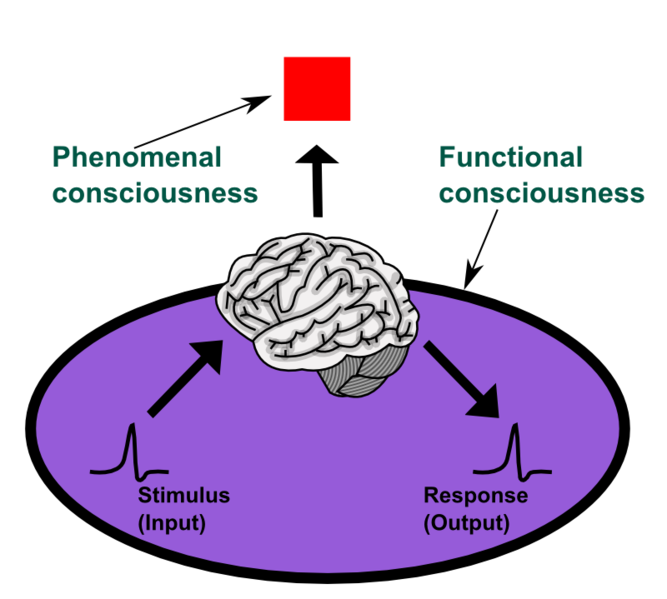
There are at least five features of mental states which materialism cannot take into account. They are:
- The feeling of “‘what-it-is-like’ to have a mental state such as a pain”
- Intentionality
- Inner, private, and immediate access to the subject
- Subjective ontology which is irreducible to the third person
- They lack spatial extension, location, etc. (Adapted from Moreland, 20, cited below)
While delving into these in great detail is beyond the reach of this post, I have already addressed a few of them in my post arguing for Substance Dualism against Monism. It seems that, on materialism, one must embrace supervenience and epiphenominalism in order to preserve mental states. Consider the following:
When I experience thought A’, it is because of a prior brain state, A. My mental states are either identical to, or supervenient upon, the physical state of my brain. The problem with this is that it relegates mental states to epiphenomenalism… This is because the mental state is entirely dependent upon (or identical to) the brain state. On physicalism, a mental state does not occur without a brain state occurring prior to, or in conjunction with, it.
…If it is always the case that Brain state A=> Mental state A’, then Brain state A causes whatever actions we take, for the brain state entails the mental state, which itself is identical to or supervenient upon the brain state to exist. But then, if we cut mental state A’ out of the equation, we would still have Brain state A and the action. Thus, consciousness is entirely superfluous. (Wartick, https://jwwartick.com/2010/11/10/against-monism/)
Reflection upon the supervenience of the mental on the physical leads materialist philosopher Jaegwon Kim to writes:
To think that one can be a serious physicalist and at the same time enjoy the company of things and phenomena that are nonphysical [by this he is referring to consciousness, the causal powers of thought, etc.], I believe, is an idle dream. (Kim, 120, cited below)
Objections
Objection 1: One of the most common objections I have encountered when I reason in this fashion is the common sense objection: “I think, therefore I am a subject!” or, as one commented on another post, “I’m an [atheist]. I have meaning. It’s possible.”
Such notions are scoffed at by materialist philosophers. Paul Churchland, the famed materialist and philosopher of mind, writes:
You came to this book assuming that the basic units of human cognition are states such as thoughts, beliefs, perceptions, desires, and preferences. That assumption is natural enough: it is built into the vocabulary of every natural language… These assumptions are central elements in our standard conception of human cognitive activity, a conception often called ‘Folk psychology’ to acknowledge if as the common property of folks generally. Their universality notwithstanding, these bedrock assumptions are probably mistaken.
In other words, the notion that “I’m a subject! I have meaning!” is nothing more than a philosophical dinosaur, a remnant of our ‘folk psychology’ which we should cast off now that we know the truth of materialism. Those who object in such a fashion as materialists seem to be blissfully unaware that they stand aligned against the vast majority of materialistic philosophy of mind. They must justify their position, but cannot, as they arguments above have shown.
Objection 2: Neuroscience has shown that the brain is the center of consciousness. When we think things, we can observe specific areas of activity in the brain.
This objection is clearly mistaken. The previous arguments have sought to establish the premise: On materialism, there are no subjects. I could easily grant Objection 2 without doing any damage to my arguments. Sure, when we “think thoughts” we may be able to observe effects in the brain. How does it then follow that “we” are subjects? All that this has done–assuming I grant it–is show that our consciousness is somehow related to our brains. It doesn’t demonstrate that mind is identical to brain, nor does it justify the position that “I am a subject.” In fact, it seems to undermine the notion that materialism can explain subjects, because it implies, once more, that “I” am reducible to “my brain” which is, of course, reducible to its component matter as well.
Conclusion: That There Are No Subjects on Materialism and the Implications Thereof
Any one of these problems provides insurmountable problems for materialists who believe they are, themselves, subjects. There is no way, on materialism, to distinguish the one from the many; there is no way for subjects to endure; mental states are reduced to causally inert epiphenomena; and there is no way to account for mental phenomena.
Thus, if atheism is committed to materialism, and materialism cannot account for subjects, it follows that, without question, there is no meaning on atheism. There cannot even be subjective meaning, for to reference something as a “subject” is, itself, illusory.
Sources
Jaegwon Kim, Mind in a Physical World (Cambridge, MA: MIT Press, 2000).
J.P. Moreland, The Recalcitrant Imago Dei (London, UK: SCM Press, 2009).
Paul Churchland,The Engine of Reason, The Seat of the Soul: A Philosophical Journey into the Brain, (Cambridge, MA: MIT Press, 1996).
W. Norris Clark, The One and the Many: A Contemporary Thomistic Metaphysics (South Bend, IN: Notre Dame, 2001).
SDG.
——
The preceding post is the property of J.W. Wartick (apart from citations, which are the property of their respective owners) and should not be reproduced in part or in whole without the expressed consent of the author. All content on this site is the property of J.W. Wartick and is made available for individual and personal usage. If you cite from these documents, whether for personal or professional purposes, please give appropriate citation with both the name of the author (J.W. Wartick) and a link to the original URL. If you’d like to repost a post, you may do so, provided you show less than half of the original post on your own site and link to the original post for the rest. You must also appropriately cite the post as noted above. This blog is protected by Creative Commons licensing. By viewing any part of this site, you are agreeing to this usage policy.
Jephthah, Human Sacrifice, and God: What should we make of Judges 11:29-40?
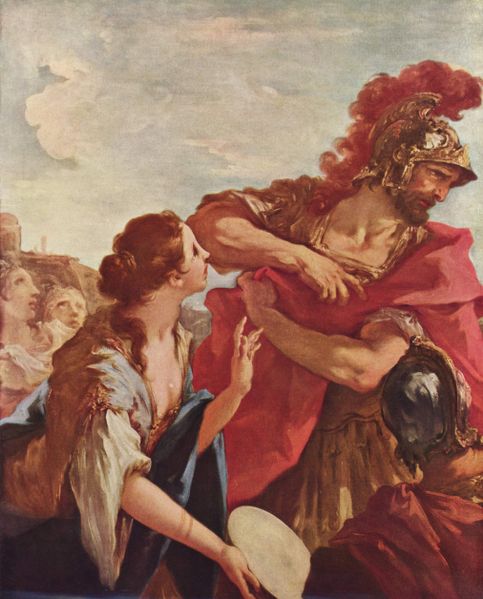
The story of Jephthah is one of the most difficult stories in the Bible. For those who don’t know it, Jephthah, an Israelite, is about to go to war against Israel’s enemies. He vows that if God grants him victory, he will sacrifice whatever comes from his door to greet him first. He wins the battle, and when he returns, his daughter runs out to meet him. She asks one last wish–that she may mourn her lack of marriage for two months. The story ends explaining that this is the reason Israelites (at the time of the writing of Judges) commemorate Jephthah’s daughter.
Understandably, the narrative raises many questions. I view the image here, a gorgeous painting by Giovanni Antonio Pellegrini, and it wrenches at my heart. Think of Jephthah’s anguish! The language in the Bible stirs the emotions:
When Jephthah returned to his home in Mizpah, who should come out to meet him but his daughter, dancing to the sound of timbrels! She was an only child. Except for her he had neither son nor daughter. When he saw her, he tore his clothes and cried, “Oh no, my daughter! You have brought me down and I am devastated. I have made a vow to the LORD that I cannot break.” (Judges 11:34-35)
The questions, as I noted, are many. Foremost of those which come to mind: “Why would God let this happen?” Another common question about this passage are “Does God allow human sacrifice?”
I’ve written on the passage before, but I think my responses were inadequate. Therefore, I have decided to reexamine this story and see what we can glean from it. Part of these thoughts are due to a conversation I had with an old friend.
Human Sacrifice
First, the question of human sacrifice. Throughout the Bible, God specifically condemns human sacrifice (cf. Leviticus 18:21; Lev. 20:2-5; Deuteronomy 18:10). One point some make is to try to draw the near-sacrifice of Isaac into the mix, but it is contextually clear that God did not intend for Isaac to be sacrificed (see Paul Copan’s excellent work on this story in his Is God a Moral Monster?). Furthermore, it is important to note that the book of Judges is a historical book, and it therefore is not prescribing the actions described therein, any more than other historical texts are prescribing the historical accounts depicted in them (see my “Description is not Prescription”). Yet those passages which are prescriptive all expressly forbid human sacrifice (again, see Lev. 18:21; 20:2-5, Dt. 18:10). Therefore, God forbade human sacrifice, He did not condone it.
Why Not Prevent It?- Context
It is therefore clear that God does not condone human sacrifice. Why, then, does God not intervene in the case of Jepthah and prevent this horrific event from occurring? As a friend noted, it would be quite simple for God to cause one of Jephtah’s servants or, indeed, anything else alive to have come from the door first. Why, then, does God not do this?
There is no simple response to this question. Instead, it is important to note several important points before I offer a possible answer. First, God has given humans free will. The nature of libertarian free will is such that it cannot be undone. Think of it this way: If God were to give us free will only until we tried to do something wrong, and in such cases God intervened and overcame our freedom to cause us to do good, we would not have genuine freedom. We’d really have a kind of pseudo-freedom. As long as we only chose what is good, we would be free, but we could not choose otherwise.
Second, think of what Jepthah had done to begin with. When he vowed that he would sacrifice the first thing to come out to meet him, it seems quite apparent that he had in mind human sacrifice, for a few reasons. It doesn’t seem likely that, for example, a cow walking through his doorway would count as coming to meet him. He specified that his sacrifice would be the first to come meet him. In fact, one might surmise he could have guessed it might be his own daughter–who is more likely to go running out to see him after a battle than his beloved child? There was no shortage of local cultures in the area who offered their children as sacrifices, and indeed the practice had corrupted Israel itself at a few points in history, so Jephthah may have been thinking of such a practice in order to bring about victory.
Third, Jephthah was an outcast. He had been driven from the land before because of his questionable parentage (Judges 11:1-3). The Israelites turned to him only in the time of their dire need, and Jephthah was clearly tempted by their offer to be their leader (Judges 11:4-11). Even given the small amount of context we have for this narrative, we can see that Jephthah desired greatly to be given headship over Israel. It is possible that, in his lust for power, foolishly made a vow to offer one of his household in exchange for the victory.
Fourth, we’ve already seen that it is expressly forbidden to offer human sacrifices. Yet Jephthah makes his vow with full knowledge of the likely consequences.
Finally, Jephthah’s vow offers a dilemma of sorts to a God who acts in history. If God wishes to prevent the human sacrifice, he must cause the defeat of Israel. This would not be just the destruction of Israel, but it would force God to go back on His promise to bring salvation through Israel, which it is impossible for God to do (Numbers 23:19). Not only that, but it would prevent God’s plan of redemption to take place. Yet if God does grant the Israelites victory, He knows that Jephthah will offer a sacrifice of whoever first steps from his house.
 Why not prevent it? -Solutions
From these quick thoughts we can see a number of possible answers. First, Jephthah made a vow which he would choose to fulfill in full knowledge that it would almost certainly be a human member of his household whom he would sacrifice. His vow was contingent upon the victory of Israel, whose defeat would have prevented God’s plan of salvation for all humankind. Therefore, Jephthah, by freely making this sinful vow, forced its conclusion. God did not prevent it from occurring because to do so would either destroy free will or prevent the Redemption.
Furthermore, some have argued that Jephthah’s vow to God superseded all else. (I myself made this argument in the original post.) I think this is wrong. God’s eternal moral commands would have superseded the vow. In fact, Jesus Himself commands His followers not to make vows, but rather to let their “yes” be “yes” and their “no” be “no” (Matthew 5:33-37). Jesus actually says that those who believe that a vow to God would supersede all else are wrong–they should not be making the vow in the first place! Thus, Jephthah’s vow was doubly sinful, because it essentially guaranteed a heinous act (human sacrifice) and because he should not have made such a vow to begin with. In fact, it should be noted that if Jephthah had acted in accordance with the Bible, he should have broken the vow! God expressly forbade human sacrifice, and when Jephthah saw that it was his daughter–or had it been any other human–who came to meet him, he should have realized his vow was made foolishly. One could even argue that God did indeed act in such a way as to try to get Jephthah to realize his error. The fact that it was Jephthah’s daughter who greeted him should not have only horrified him but made him realize that his vow was sinful to begin with, and so should not be upheld. Upon the realization that keeping his vow would cause him to break God’s Law, Jephthah should not have said “I must keep this vow” and therefore increase his sin–rather he should have said “I will break this vow, and prevent a horrific sin.” But again, with his freedom, he chose not to.
Jephthah’s story is, in fact, just the kind of story typified throughout Judges, and indeed throughout human history–that of God using sinful people to bring about His ends. Samson, another judge, was a violent and lustful man, yet God used him to save the Israelites on a number of occasions. In the Joseph narrative (Genesis 37ff), God used the evil actions of Joseph’s brothers to bring about a great good (Gen. 50:20). Similarly, Jephthah’s greed lead him to make a vow which he should not have kept which condemned at least one human to death.
Jephthah’s free decisions brought about the death of his daughter. That is why the Bible reports this stirring story–it teaches us that our free will has consequences. That is why the painting of Jephthah is so striking–we can relate to the horror of Jephthah’s realization of his own sinfulness. We’ve each committed our own sins and had to deal with the consequences. God is not a divine vending machine who will intervene when we make mistakes, or when we choose horrifying acts. He has already provided us with an objective reality–the discernment to tell what is right from wrong. Not only that, but He has also provided a Savior, His Son Jesus, to rescue us from all evil–even death itself. God has provided an infinite good to all human persons by providing a means for their salvation. Whosoever will be saved shall be saved.
The story also teaches us once more that God works through imperfect people. Although Jephthah was a sinful man with greedy intentions, he was still used by God to bring about a great good–the preservation of Israel, which itself paved the way for God’s redemptive act.
A Final, Philosophical Note
Those who may desire to press the objection still should investigate the philosophical basis of their claim. Presumably, they are arguing that:
P1- God is obligated to prevent evil (or some certain types of evil).
What justifies that claim? If God has given us free will, there are evils God cannot prevent–those which we choose to bring about. Further, what justifies the claim that God must intervene in every situation with x amount of evil? More specifically, why is God obligated to prevent Jephthah’s daughter from being the first to leave the house (again, I think that it was a series of free choices which brought Jephthah to this unfortunate event, and I disagree with those who think that God could just supersede free will whenever necessary, but I’ll grant it for a moment)? Is God obligated to prevent every evil?
I’m sure there are arguments that could be made to try to support the premise that “God is morally obligated to prevent all (or certain types of) evils” but I don’t think they would be more plausible than P2: “God has created free creatures” and P3: “Freedom cannot be limited.” I would accept a more restricted sense of:
P1′- God is morally obligated to prevent all evils which He is able to prevent and which do not provide for some greater good and which, if prevented, do not lead to other evils with similar or greater impact, etc.”
Those who would seek to continue objecting that God, in the Jephthah narrative, should have intervened, must defend their restricted sense of P1, while rebutting P2 and P3, and showing that P1 is more plausible than P1′. It therefore seems that philosophically, exegetically, and theologically, the Jephthah narrative, while poignant, does not threaten God’s character. God works through human history to bring about the Redemption, using imperfect, sinful people to bring about an infinite good. Furthermore, God has given us the good of freedom, but we choose too often to abuse it. Jephthah illustrates this misuse in a heart-rending fashion which serves as a definitive reminder to those who read it that they should heed God’s word and use their freedom not for greed or gain but for the furtherance of God’s Kingdom.
SDG.
——
The preceding post is the property of J.W. Wartick (apart from citations, which are the property of their respective owners) and should not be reproduced in part or in whole without the expressed consent of the author. All content on this site is the property of J.W. Wartick and is made available for individual and personal usage. If you cite from these documents, whether for personal or professional purposes, please give appropriate citation with both the name of the author (J.W. Wartick) and a link to the original URL. If you’d like to repost a post, you may do so, provided you show less than half of the original post on your own site and link to the original post for the rest. You must also appropriately cite the post as noted above. This blog is protected by Creative Commons licensing. By viewing any part of this site, you are agreeing to this usage policy.
Book Review: “Providence and the Problem of Evil” by Richard Swinburne
“In order rationally to believe that there is a God, despite [evil], we need either strong positive evidence for the existence of God, or a record of discovering with respect to many apparent bad states that a theodicy works with respect to them, or a theodicy for each kind of bad state which seems to count against the existence of God.”[1]
The problem of evil is considered by many to be the greatest challenge to theism.[2] Richard Swinburne offers a defense against this problem in his work Providence and the Problem of Evil
Swinburne first develops an account of goods within creation. His account includes beauty, actions, thoughts and feelings as various goods. Given the existence of God, he also argues that worship is a great good.[4] Human freedom is necessary for many goods. With freedom, humans can bring about all types of great goods.[5] The freedom of persons also allows for great evils. These goods are not just goods for people, but they are states which God would be expected to desire to bring about.[6] By developing this account, he is able to turn towards various types of evils.
First, there are moral evils. Moral evils are essentially those bad states of affairs which persons bring about. Swinburne argues that some moral evil is going to be necessary, because it is simply a fact that there are good states of affairs which are logically incompatible.[7] Second, there is natural evil—evils which occur without direct causation by persons.
These sections of the book are largely made up of background, yet Swinburne interweaves his theodicy into the chapters on evil. Central to Swinburne’s account is the idea that for every evil, there is some reason that it occurred. There is, in other words, no evil which is superfluous, no evil which is gratuitous. For every evil mentioned, Swinburne provides a possible reason for God’s allowing it to occur. What reasons could God have for allowing evils like the holocaust, or animal pain? Swinburne sums up his view concisely as follows:
“Every moral evil in the world is such that God allowing it to occur makes possible… the great good of a particular choice between good and bad… Every pain makes possible a courageous response… and normally the goods of compassion and sympathetic action… And all animal pain gives knowledge and opportunity for compassion to animals and humans if they know of it.”[8]
Swinburne’s view is that for every evil, there is a reason. The reason can be knowledge: when people (or animals) observe animals dying in forest fires, they learn to flee from the fires, and thus save themselves and others.[9] Choice is a great good, but in having choices, people can choose to bring about great evils. Horrendous evils like the Holocaust are not just the result of choices in the present, but are the consequences of a long series of evil choices.[10]
Importantly, Swinburne also argues that God is under no obligation to make everyone’s life equally good. “[I]f [God] gives to some ten good things, and to others twenty good things, no one is wronged; nor has he failed to be perfectly good. He has been generous, and, more so, he has made it possible for us to be generous.”[11] God’s providence is good to everyone. There is a level of inequality in the gifts received—but to any and all, gifts are given. The way people choose to use their gifts is what leads to extreme inequities.
Finally, Swinburne argues that God has the right to allow evil, largely due to the extreme dependence people have upon him.[12] Not only that, but God has brought about a world in which every person has the possibility of the nearly infinite good of being with God forever. Thus, Swinburne concludes that God has provided people with a choice between the good and rejection of the good. The responsibility for that action is upon the person, not God.[13]
Throughout Swinburne’s account are several theses many readers may find implausible. He rejects original guilt [he does not deny that there was an original sin and instead holds to an Eastern Orthodox view–thanks to a reader of the original review (linked below) for this point][14] and denies that God knows the future free actions of creatures.[15] These theological points do not undermine his main theses, however. It is undeniable that Swinburne has provided a lucid account of a “greater good theodicy.” He does provide possible reasons for allowing any type of evil to occur.
The key point of divergence with readers will be whether they are willing to accept these reasons in conjunction with his later conclusions. God has reasons for allowing every evil, and he provides for people to have extraordinarily good lives with the afterlife, but there remain those who will reject these goods. Swinburne’s account is cumulative: the reasons provided for allowing evils do not stand on their own. Rather, they stand together and in unison with God’s providence and direct goodness to all persons through maintaining the world, creating them, and providing them with choices.
Those interested in the problem of evil would do well to read Providence and the Problem of Evil. Usage of the “greater good theodicy” is on the wane. Many theists today only provide versions of the “free will defense” in relation to the problem of evil. In doing so, they cast aside a powerful philosophical tool for theism. While the “greater good theodicy” will not convince everyone, it can at least provide a strong cumulative case when joined with other defenses against the problem of evil.
[1] Richard Swinburne, Providence and the Problem of Evil (New York, NY: Oxford, 1998), 29.
[2] See Swinburne’s thoughts on this on pages 4ff.
[3] He also believes that we have strong positive evidence for the existence of God, but he focuses upon theodicy in this work. See his The Existence of God for a case for the existence of God based on positive evidence.
[4] 111ff.
[5] 105-107.
[6] 45.
[7] 125.
[8] 217.
[9] 176ff.
[10] 151-152.
[11] 149.
[12] 223ff.
[13] 251.
[14] 36-41.
[15] 127ff.
This review was originally posted at Apologetics315 here: http://www.apologetics315.com/2011/11/book-review-providence-and-problem-of.html
SDG.
——
The preceding post is the property of J.W. Wartick (apart from citations, which are the property of their respective owners) and should not be reproduced in part or in whole without the expressed consent of the author. All content on this site is the property of J.W. Wartick and is made available for individual and personal usage. If you cite from these documents, whether for personal or professional purposes, please give appropriate citation with both the name of the author (J.W. Wartick) and a link to the original URL. This blog is protected by Creative Commons licensing. By viewing any part of this site, you are agreeing to this usage policy.
The Multiverse and Theism: Theistic reflections on many worlds
 There has been much philosophical and scientific discussion on the topic of the multiverse. Recently, a lot of this discussion has been happening within philosophy of religion. Some attempt to use the multiverse to overcome classical theistic arguments like the Kalam Cosmological Argument, while others try to utilize it to avoid the teleological argument. Atheists and skeptics are not the only ones who are interested in the multiverse, however. Recently, a few prominent theistic philosophers have utilized the multiverse in inventive ways.
The Multiverse and the Problem of Evil
Some theistic philosophers have argued that the multiverse can provide a new type of theodicy. As eminent a philosopher as Alvin Plantinga writes:
…a theist might agree that it is unlikely, given just what we know about our world, that there is such a person as God. But perhaps God has created countless worlds, in fact, all the… universes… in which there is a substantial overall balance of good or evil… [A]s it happens, we find ourselves in one of the worlds in which there is a good deal [of evil]. But the probability of theism, given the whole ensemble of worlds, isn’t particularly low (Plantinga, 463).
Does such a theodicy help theists with the problem of evil? It seems to me that it may, but that it is not particularly strong. It could be included in a cumulative-case type of theodicy, however.
First, Michael Almeida offers a critique of this position. Suppose that God did, in fact, create such a multiverse. It seems plausible that such a universe would be infinite in the number of worlds (after all, for every “good” world, there seems one can always imagine a “better” world). Here Almeida ingeniously applies William Lane Craig’s arguments about the infinite, not to show that the set of universes cannot be infinite, but to show that in an infinite multiverse one could subtract specific worlds from this set without decreasing the good of the multiverse (Almeida, 305-306). Suppose God did in fact actualize an infinite multiverse–all the worlds which are, on the whole, good. If that’s the case, then God could easily not actualize any one (or infinite!) world(s) without decreasing the total good of creation. After all, it would remain infinitely good!
Timothy O’Connor offered a possible response to this argument, noting that “It may well be that [God] would have a distinct motivation to realize every fundamental kind of good-making feature, some of which are incommensurable. If so, this would put a further constraint on universe types… within a candidate infinite hierarchy” (O’Connor 2, 315). God could have chosen to actualize each individual type of good–some of which may exist in our own world to a maximal extent. This doesn’t seem implausible given the tremendous goodness of an event like the Redemption.
Some may be concerned that an appeal to the multiverse may undermine more traditional theodicies such as the “greater good theodicy” or the “free-will defense.” One might envision the multiverse as a kind of “throwing in the towel” on the traditional theistic defenses. I don’t see why this should follow, because any of these traditional theodicies would be just as applicable to our own universe whether it were one or one of many. There are, however, a few problems I see with this defense, which I’ll put off until the section “On the Possibility of a Multiverse” below.
 Which world would God Create?
Some have argued theism is irrational because they hold God is a perfect being, which would entail that God would create the best possible universe–itself an incoherent concept. It is possible that God need not create the best possible world. Robert Merrihew Adams, for example, doesn’t agree that God is obligated to create the “best possible world.” Rather, God could choose to create worlds which manifest His grace (Adams, 62). O’Connor cites William Rowe as providing an effective counter to this by arguing that there would then be a possible being better than the perfect being (O’Connor 1, 114). I’m unconvinced by this counter. If there is no best possible world, God cannot be obligated to create it (because it doesn’t exist).
O’Connor anticipates this response and seems to grant that it may be plausible (115). However, he among other theists, seems to believe that God would actualize a multiverse. He writes, “God’s choice isn’t between… single universes, but between the super universes [‘super universe’ being a ‘collection of one or more totalities that are mutually disconnected save for their common origin within God’s creative choice’]” (O’Connor 1, 116). God, on this view, actualizes many “good” worlds. He writes, “the creative motivation would be not to settle for a finite limit on the individual organic goodness of any of His products” (O’Connor 2, 315). God’s creation of many universes shows his “artisanship” (Ibid).
Such arguments are both interesting and compelling. Those who attack theism based upon the “best possible world” objection may be thwarted by the hypothesis of God’s creative multiverse.
On the Possibility of a Multiverse
Theistic proposals of a multiverse are clearly sometimes motivated for entirely different reasons than naturalists. What difficulties are there with such a proposal?
First, some theists object to the multiverse by arguing that it undermines several theistic arguments. It does not seem that the multiverse would do so, however. The cosmological argument would stand strong in spite of a multiverse, because any inflationary multiverse would still have a beginning in time. Design arguments would similarly be unchallenged because one would have to explain the fine-tuning of the multiverse. These objections to the multiverse, therefore, do not do much damage.
Other objections to the multiverse require more discussion of the meaning of the term “multiverse.” Jeffrey Zweerink notes several levels of multiverse. Some of these are uncontroversial. For example, the “Level I” multiverse is simply a description of other regions beyond the observable universe (Zweerink, 28). Of course, this is hardly what many mean when they refer to a “multiverse.” What is meant by multiverse here is a Level II or higher multiverse, such as inflationary bubble universes or other generative scenarios (Zweerink, 28-29). The difficulty with these is that there doesn’t seem to be any reason to hold that these universes exist. Zweerink notes that the Level II multiverse is predicted by some models of string theory, but to believe there are literally other unobservable universes on the basis of theoretical predictions alone hardly seems convincing.
Given these observations, it seems initially that while theism is unthreatened by the multiverse (and perhaps even bolstered by its possible existence), there is no better reason to think it exists on theism as on other worldviews. But perhaps that’s not the case. One can reflect once more on O’Connor’s belief that the multiverse shows God’s creative artistry (O’Connor 2, 315). Not only that, but one may even predict that God would actualize many worlds in order to bring about His desire to actualize various goods (O’Connor 1, 112ff). Perhaps one could argue that theism may even predict many universes. In that case, the multiverse is more likely than not.
My thoughts
Clearly, I think there may be some merit in the use of the multiverse in theistic arguments. I think it would amazing if, somehow, we made a discovery which confirmed the existence of other universes, and I do believe people could hold that theism might even predict such a discovery, but color me skeptical. I think it would generate an enormous amount of metaphysical baggage to hold to the existence of a multiverse. While the previous arguments may have shown that theism increases the likelihood of a multiverse, I don’t think it increases it enough to justify belief in a world ensemble. I remain open to the possibility, and indeed some compelling arguments have been offered in its favor, but for now I remain unconvinced. That said, I think theists could still utilize the multiverse in response to the problems illustrated above, because even a hypothetical multiverse could be used to bolster these defenses. Those opposed to theism might here object, saying that I condemn their own uses of the multiverse to try to get around theistic arguments. They would be incorrect. I condemn the use of the multiverse on competing views because I don’t think the other views can justify belief in the multiverse, nor do I think their usage actually defeats the difficulties with their own positions.
Is there a theistic multiverse? Maybe. Can theists utilize a hypothetical multiverse in their philosophical speculations? Absolutely.
Sources
Alvin Plantinga, Warranted Christian Belief (New York, NY: Oxford, 2000).
Timothy O’Connor 1, Theism and Ultimate Explanation (Malden, MA: Blackwell, 2008).
Timothy O’Connor 2, “Is God’s Necessity Necessary? Replies to Senor, Oppy, McCann, and Almeida,” Philosophia Christi 12 (2010), 309-316.
Michael J. Almeida, “O’Connor’s Permissive Multiverse” Philosophia Christi 12 (2010), 297-307.
Robert Merrihew Adams, “Must God Create the Best?” in The Virtue of Faith and Other Essays in Philosophical Theology 51-64 (New York: Oxford, 1987).
Jeffrey Zweerink, Who’s Afraid of the Multiverse? (Reasons to Believe, 2008).
Links
I discuss and rebut multiverse objections to the Kalam Cosmological Argument here and here.
The Theological Attraction of the Multiverse– An interesting post on the theology of the multiverse.
Christological Implications of the Multiverse– Another post worth reading on theology and the multiverse.
Living in the Multiverse- Is It Science?– Discussion of scientific evidence for the multiverse.
SDG.
——
The preceding post is the property of J.W. Wartick (apart from citations, which are the property of their respective owners) and should not be reproduced in part or in whole without the expressed consent of the author. All content on this site is the property of J.W. Wartick and is made available for individual and personal usage. If you cite from these documents, whether for personal or professional purposes, please give appropriate citation with both the name of the author (J.W. Wartick) and a link to the original URL. If you’d like to repost a post, you may do so, provided you show less than half of the original post on your own site and link to the original post for the rest. You must also appropriately cite the post as noted above. This blog is protected by Creative Commons licensing. By viewing any part of this site, you are agreeing to this usage policy.
Book Review: “Existential Reasons for Belief in God” by Clifford Williams
 Clifford Williams’ Existential Reasons for Belief in God (hereafter ERBG) is one of the most unique philosophy of religion books this reader has experienced. Rather than engaging in systematic arguments for the existence of God based upon sensory experience or philosophical reflection on the cosmos, Williams focuses on the subject of his subtitle: A Defense of Desires & Emotions for Faith.
Williams argues that “Christians need a conception of faith that is at least as much need-based as reason-based” (13). By uniting these into one concept Christians can help acquire and sustain faith (13). Need has been too often cast aside or ridiculed when it comes to faith (12).
After these introductory remarks, Williams jumps into detailed argument on the topic. Throughout the work he focuses on the concept that “people acquire their faith partly because they feel that it meets… existential needs and partly because they think that it makes sense or is true” (17, emphasis his). He begins his argument by surveying various types of needs people have (20ff). In chapter 3, Williams presents an existential argument for believing in God:
1. We need [various things like cosmic security, meaning, awe, delight in goodness, etc.]
2. Faith in God justifies these needs.
3. Therefore, we are justified in having faith in God. (32)
Clearly, this is not the typical argument for the existence of God. It’s not an argument for God’s existence at all. Williams recognizes this fact and argues that there is a distinction between evidential and existential reasons for belief. “In evidential justification for believing in God, one believes in God because of what one takes to be good evidence for doing so ” (41). By contrast, “The existential argument… says that faith in God is justified solely because it satisfies certain needs” (41). The argument, therefore, is not to show God exists, but to show that one can rationally believe in God.
Williams argues that such existential justification is permissible for a number of reasons. First, it helps clarify what nature is–it is not merely a faith based on aspects of reality but is instead a faith which is aimed at meeting certain needs (41). Second, people use existential reasoning in other instances–for example when they need to eat, they know that they are justified in going to meet that need (41).
Objections to this reasoning will, of course, be raised. The first objection is that “the existential argument does not guarantee truth” (61). With this objection, one sees the distinction between evidential and existential arguments becoming very clear. Williams returns to the food analogy. The existential argument there would be “1. Humans get hungry; 2. Eating food assuages hunger; 3. Therefore, eating food is justified” (63). Here the argument is not to establish the existence of food but rather to establish that eating food is justified (63). Similarly, with the existential argument for God, the argument is to establish the justification for believing in God (63-64). The argument presupposes, to some extent, the existence of God, and justifies that very belief (64).
Another interesting implication of the distinction between existential and evidential reasons for belief is that they can be combined to form a cumulative type of argument for the existence of God. Williams presents such an argument, which combines these types of reasoning:
1. We [have various existential needs.]
2. The best explanation for the presence of these needs in humans is that there is a God who has put them into humans.
3. Faith in God satisfies these needs.
4. Therefore, we are justified in believing there is a God in whom we can have faith. (67)
But, it may be objected, this argument justifies belief in any type of God! Consider someone who wants to believe in “Tyrant George” because they need humans to be tortured. They could be justified in believing in such a deity based upon their in-built needs. Williams frankly admits that this objection has its merit. The existential argument should be combined with reason (88). But he also takes issue with the “need” to torture. He delimits criteria which define “needs.” These criteria are:
1. Needs must be felt by many others… most people, if not all.
2. Needs must endure…
3. Needs must be significant…
4. Needs must be part of a constellation of connected needs, each of which meets the other criteria…
5. Needs must be felt strongly (89).
Why, however, should we believe these criteria? Williams argues that these criteria are independently verified and that they have been found useful in a number of settings, including psychology, courtrooms, and in assessment of unusual phenomena (90).
A third objection notes that not everyone feels existential needs. Williams challenges this notion and argues that most people will be aware of having the various needs he has outlined (119). Finally, it may be objected that we can satisfy these needs without faith. Williams counters by presenting a various tests wherein subjects may find temporary satisfaction in varied cases but their ultimate needs are not met (133ff).
Williams also surveys various thinkers–from Pascal to William James to Freud–and what they had to say about needs. He offers critiques of several theories while advancing his own.
There are those who may be thinking this is, so far, an entirely fideist account. Williams begs to differ and provides several reasons for why faith and emotion can work with the mind and reason to bring about a satisfactory, fulfilling faith (chapter 8). He concludes by showing various ways needs can draw us toward and away from God. Ultimately, “We humans find ourselves with certain deep and abiding needs… We need meaning… We need to kneel, so we kneel” (183).
One interesting thing to note throughout the book is that Williams continually underscores his points with excerpts written by people who have had various existential needs met by faith. These illustrations are also used to show various objections or difficulties people have when their needs aren’t met. They give ERBG a unique feel to it–one that is more intimate than most philosophy works. They’re also useful in that they give readers a concrete example for his argument.
Those coming from a very evidentialist view of apologetics and philosophy will have difficulties with this book, as this reader can attest to. It’s hard to admit that needs and emotions have their place in a rational world, but Williams does an excellent job focusing the reader on this fact. Too often, the focus is only upon a posteriori arguments based upon the world as opposed to those based upon the human condition. Williams adequately defends existential reasons for belief, and–perhaps most importantly–presented them in a way to which evidentialists can relate and understand. He acknowledged difficulties in the argument and responded to many key objections. Hopefully, Williams has reopened an avenue for philosophers of religion to explore. Too long have they ignored the usefulness of existential reasoning.
Source:
Clifford Williams, Existential Reasons for Belief in God (Downers Grove, IL: InterVarsity Academic, 2011).
SDG.
——
The preceding post is the property of J.W. Wartick (apart from citations, which are the property of their respective owners) and should not be reproduced in part or in whole without the expressed consent of the author. All content on this site is the property of J.W. Wartick and is made available for individual and personal usage. If you cite from these documents, whether for personal or professional purposes, please give appropriate citation with both the name of the author (J.W. Wartick) and a link to the original URL. This blog is protected by Creative Commons licensing. By viewing any part of this site, you are agreeing to this usage policy.
Can we evaluate worldviews? How to navigate the sea of ideas.
Think about it this way: worldviews are supposed to be reality. If a worldview does not match reality, how can it be reality?

I recently began a series on the truth claims of Mormonism. In that post, I asserted that there is positive evidence against the truth of the Book of Mormon. However, there is an important step to take before offering arguments against other religions. Namely, one must establish that evidence against the truth claims of a religion should rationally lead one to abandon that religion. (A related but similar point would be the positive evidence for religion leading to rational belief.)
Thus, before I continue to offer critiques of other religions, I offer some epistemic groundwork.
Truth Claims and Worldviews
First, it must be noted that worldviews are not mere matters of feeling, regardless of what the supporters of the varied views claim. For example, if one says “You can’t analyze what I believe, it’s just a matter of faith” they are making a claim about reality–that their faith cannot be analyzed. Similarly, if one claims “Israelites sailed to the Americas from the Middle East,” [Mormonism] or “There is no God” [atheism] they have made a claim about reality.
Such truth claims are capable of analysis, by definition. Statements are true or false. All worldviews make claims about reality, which are therefore true or false. Simply stating that one’s belief is “just faith” or “obvious” does not exclude it from making claims.
 How Do We Evaluate The Claims of Worldviews?
One’s beliefs should conform to reality, if one seeks to be rational. Certainly, one could say “To heck with the evidence, I’m going to believe x, y, and z! I don’t care if I can’t support the belief and that there is strong evidence against x, y, and z.” But if one were to say this, one would abandon their reason. Their heart could believe, but their mind could not. Ultimately, all truth claims can and should be put to the test.
Testing the claims of varied worldviews is no easy task. There must be objective criteria, otherwise one view will be favored over another. One cannot simply make their own view the default and argue that only by filtering truth claims through their position can truth be attained. Atheism, by no means, provides a neutral basis for evaluating religions, as I’ve argued elsewhere. In fact, atheism must past the standards for truth claims, just as any religion must. If one remains an atheist despite positive evidence to the contrary (or despite reasons to disbelieve the claims of varied atheistic worldviews like materialism), one abandons reason just as if one clung to a false faith.
Testing Worldviews as Hypotheses
In his monumental work,Christian Apologetics, Douglas Groothuis argues that worldviews can be proposed as hypotheses. Worldviews present themselves as answers to explain the phenomena we experience (Groothuis, Christian Apologetics, 49). Groothuis therefore presents criteria for evaluating worldviews as though they were hypotheses about the world. Kenneth Samples similarly draws out nine tests which can be used to determine whether the claims of a worldview are true in his book A World of Difference (page numbers from that text, citation below). From these proposed methods, we can derive tests to evaluate competing worldviews:
1) Coherence– if a religion is contradictory, it simply cannot be true. For example, if a religion claimed that “Person Z is god, and person Z is not god,” that religion would be incoherent (Samples, 33). Furthermore, “If a worldview’s essential propositions are coherent… it is more likely to be true than if its essential propositions are not related in this way” (Groothuis, 55).
2) Balance– “A valid worldview will be ‘neither too simple nor too complex.’ All things being equal, the simplest worldview that does justice to all aspects of reality deserves preference (Samples, 33-34).
3) Explanatory Power and Scope– Does the worldview explain what we experience in enough detail? If a worldview does not explain our world, or it cannot account for certain phenomena, then it is lacks explanatory power (Samples, 34). Worldviews which make propositions which they cannot account for lose credibility (Groothuis, 53).
 4) Correspondence– Does the worldview match the facts we know about the world to our experience of the world? If we know that the worldview in question promotes claims we know are false, it does not match reality (Samples, 34-35). Think about it this way: worldviews are supposed to be reality. If a worldview does not match reality, how can it be reality? We are able to test factual claims through empirical and scientific methods, so if a worldview continually is able to establish its essential claims by means of these methods, it is more likely to be true (Groothuis, 55).
5) Verification– Can this worldview be falsified? Worldviews which cannot be found to be false cannot be found to be true either.
6) Pragmatic Test– Can we live by this worldview? This test is less important, but still has credibility–we must be able to live out the worldview in question (Samples, 35-36). But worldviews should also be fruitful in the development of greater intellectual and cultural discoveries (Groothuis, 57).
7) Existential Test– Like the pragmatic test, this one is not as important as whether the view is factual, but it is still helpful. If worldviews do not account for inherent human needs, it is possible the view is false (Samples, 36). Again, this is not necessary for a worldview, but it helps measure a view’s completeness.
8 ) Cumulative Test– Does the worldview gain support from all the previous criteria? If a worldview is able to satisfy all the criteria, it gains credibility (Samples, 36-37).
9) Competitive Competence Test– If the worldview satisfies the previous criteria with more evidential power than other worldviews, it gains credibility over and against them (Samples, 37).
10) Radical ad hoc readjustment– Groothuis presents this as a negative test for worldviews. “When a worldview is faced with potentially defeating counterevidence, an adherent may readjust its core claims to accommodate the evidence against it. Various theories and worldviews can legitimately refine their beliefs over time, but radical ad hoc readjustment reveals a deep problem…” (Groothuis, 57). There is, as Groothuis pointed out, a line between refining belief and simply readjusting belief in an ad hoc way. If, for example, it were discovered that Jesus did not rise from the dead, then Christianity would be false (more on that below). If, however, one simply adjusted Christianity to say “Jesus spiritually rose from the dead,” that would constitute a desperate, ad hoc measure to preserve the worldview and count as discrediting Christianity.
These tests present objective criteria for testing worldviews. If, for example, one wished to deny their worldview had to be coherent, they’d have to affirm that which they denied, for in denying that criterion, they were attempting to make their view more coherent. The testing of worldviews is a legitimate task, and indeed one in which people should engage. Some things, if falsely believed, are harmless (for example, if one believed it rained yesterday when it did not). Worldviews, however, if falsely believed, are damaging on any number of levels. If one believed God didn’t exist when, in fact, He did, then one would be doing a great evil by not acting upon the truth of God’s existence (and the contrary). Thus, the testing of worldviews is no task to be skimmed over, but one which should be approached with fear and trembling. The criteria outlined above allow people to engage in this task and evaluate the realm of ideas.
Christianity Encourages Exploration of Reality
What I find extremely interesting is that Christianity, unlike many world religions, doesn’t discourage the discovery of truth, nor does it evade evidence by claiming that it is merely a faith or feeling. Rather, the founders of Christianity explicitly stated that it is based upon certain truth claims, and that if those claims are false, then Christianity is worthless. Paul, for example, wrote “And if Christ has not been raised, your faith is futile; you are still in your sins” (1 Corinthians 15:17). The truth of Christianity rests exactly upon a testable claim: Jesus rose from the dead. If He did not, Christianity is false. Christianity’s scope and explanatory power are superior- it can account for the existence of contingent objects, persons, consciousness, life, and the like. Christianity corresponds to reality, satisfies existential and pragmatic needs, is simpler than many other explanations, its coherent, and it matches all the criteria. Christianity expects its adherents–and outsiders–to test the faith and discover whether it is true. I have found, personally, that it pasts these tests over and over.
Conclusion
Whether one agrees or not, it is simply the case that religions make claims about reality. These claims are, in turn, true or false. Not only that, but they must match with reality in several important ways. Christianity not only adheres to these tests, but it encourages them. It also passes these tests. Does your worldview?
Sources
Douglas Groothuis, Christian Apologetics (Downers Grove, IL: InterVarsity, 2011).
Kenneth Samples, A World of Difference (Grand Rapids, MI: Baker, 2007).
Image Credit
I took this picture at Waldo Canyon near Manitou Springs, Colorado on my honeymoon. Use of this image is subject to the terms stated at the bottom of this post. The other image is the book cover from Samples’ book.
SDG.
——
The preceding post is the property of J.W. Wartick (apart from citations, which are the property of their respective owners) and should not be reproduced in part or in whole without the expressed consent of the author. All content on this site is the property of J.W. Wartick and is made available for individual and personal usage. If you cite from these documents, whether for personal or professional purposes, please give appropriate citation with both the name of the author (J.W. Wartick) and a link to the original URL. This blog is protected by Creative Commons licensing. By viewing any part of this site, you are agreeing to this usage policy.
William Lane Craig vs. Stephen Law- Thoughts and Links

Recently, William Lane Craig debated Stephen Law on the topic “Does God exist?” Remember the topic as I review the debate.
Craig 1
William Lane Craig presented a different set of arguments from his normal 5. This time, he argued the cosmological and moral arguments along with the argument from the resurrection. My guess is that the short time allowed was the reason for this change of strategy. Craig argued that actual infinites cannot exist in reality. He pointed out that transfinite math simply does not allow addition or subtraction of infinity, because it is absurd, but in the real world, if an infinite did exist, nothing could prevent it from having things added or taken away. Thus, Craig concluded, there cannot be an infinite past.
He then briefly outlined the empirical case for a finite past, citing Borde, Guth, and Vilenkin’s paper which shows that every model of the universe’s past must account for entropy, and therefore must be finite. I don’t want to get sidetracked from my review of the debate here, but so many people seem to either ignore or miss the point of this argument. It’s not that entropy only disallows an infinite universe that is one state, rather, entropy disallows an infinite past for oscillating universe models, bubble universes, and any other types of strategies people have tried to raise in order to rebut cosmological arguments. I recently got an e-mail in which someone said I’m being dishonest by only referencing the Big Bang as evidence for a finite universe, when there may have been previous universes. Well that’s simply wrong, even if there were previous universes, they would have to take entropy into account. If the past is infinite, all the energy available for the generation of universes would have been used up.
Anyway, Craig went on to argue the moral argument: If objective moral values exist, then God exists. They do, so God does. A great point Craig made is that any argument against the existence of objective moral values must rely upon premises which aren’t as plausible as the objective morals themselves. That’s an excellent point that many tend to ignore.
As far as the resurrection is concerned, Craig presented the “three facts” argument. He pointed out that three facts are agreed upon throughout scholarship on the topic: that the tomb was found empty, different individuals saw appearances of Jesus alive after his death, the disciples’ belief in Jesus resurrection despite having every predisposition to the contrary. These facts, argued Craig, are best explained by Jesus’ resurrection.
Law 1
Law began by arguing about animal suffering. He said that the extraordinary amount of suffering which is experienced by animals every day is such that it can weigh against the existence of God. He noted that some people dismiss this as “merely animals” but argued, “I wonder if they’d say the same thing if I took a red hot poker to their… cat.” Note how Law distorted his original argument, however. Certainly, I’d be extraordinarily angry with Stephen Law if he took a hot poker to my cat (I don’t have one any more but I used to). But the reason would be because Law is a moral agent. He is capable of knowing what he’s doing, and would clearly have to be sadistic in order to do such an action. If, however, an eagle came and carried my cat away, I would be extremely upset, but I would not accuse the eagle of having done a morally wrong action, because the eagle is not a moral agent. Yet Law used that very emotional image of himself–a moral agent–as an analogy for animal suffering. There’s clearly a major issue with such an argument.
Law went on to argue that there’s no reason to think that the God whose existence Craig is arguing for is not an evil god. Here I think Law had some decent points… for arguing against bare theism, but not against Christianity (see “Analysis” below). He argued that for certain theodicies, there can be parallel arguments constructed for an evil god. He also noted that Craig’s arguments could work just as well for an evil god (a notable exception would be the moral argument, more on that later… and it’s pretty hard to see how the resurrection would fit into his ‘evil god’ scenario). Law also argued that if the good in the world refutes an evil god, the evil in the world should refute a good God. Law didn’t do anything to rebut Craig’s arguments for the existence of God.
Craig 2
Craig quickly attacked Law’s appeal to emotion with animal suffering. He noted that it was very much anthropopathism to assume that animals had the same response to suffering as humans. In fact, he went on to note three hierarchies of suffering, and pointed out that animals do not have the capacity to be aware of the fact that they are suffering. So despite the suffering of animals, they are not even aware of that fact–something which Craig credited to God’s mercy. Animal suffering, he argued, is also necessary for a number of reasons, one of which is the stability of ecosystems. Without predation, all life on earth would be wiped out. Thus, it is fair to say that animal suffering fits into the divine plan.
Craig countered Law’s argument about the ‘evil god’ by noting that the moral argument specifically rebuts Law’s assertions. Not only that, but Law was arguing against a kind of theism which does not exist. Christians don’t survey the world and conclude God is good, rather, they believe God is good because that’s the type of being God is, necessarily.
Craig presented a number of reasons for thinking a good God would allow evil, which would therefore discount the rebutting evidence of evil. He also agreed with Law that looking at the world alone would lead to a draw, but that, as already noted, the moral argument and the type of being God is would defeat an ‘evil god’ scenario.
Law 2
Law argued that Craig had made a straw man of his position by saying that theism is not inductive. Then he went on to argue that the moral argument is the only one Craig can rely on to establish the goodness of God. He cited Swinburne as a Christian who did not believe objective morality relies on God. He ended his second segment by arguing that surely there is enough evil in the world to make the existence of God improbable.
Craig 3
Craig noted that Law has a strange kind of atheism which grants the existence of God but attacks the character. He pointed out that Law had still not rebutted any of his arguments, but focused merely on the character of God. He also pointed out that appealing to Swinburne was a mere appeal to authority and that he could cite a number of atheistic philosophers who agreed with his premises.
Law 3
Law argued that there are no objective moral values (curious, considering the citations Craig read in the debate). He then attempted to rebut the argument from the resurrection by citing an instance where a number of people believed they saw a UFO when it was really the planet Venus.
Craig Conclusion
Craig once more noted that Law had yet to rebut any of his arguments and that Law persisted in maintaining a strange atheism in which God exists, but may or may not be good. He noted that Law’s attempt to rebut the resurrection did not take into account the religio-historical context of that event and that all claims of experience must be measured by objective criteria, which the resurrection passes. He concluded that because his arguments stood undefeated, God exists.
Law Conclusion
Law basically said “why not believe in an evil god?” and argued that Craig still did not justify objective morals.
Analysis
Law came in with a pretty interesting argument which was unfortunately not the topic of the debate. I think it would be really interesting to see Law vs. Craig on a topic like “Is God good?” His arguments had some weight, but I think Craig did an excellent job rebutting them while remaining on track. Law essentially ignored the cosmological argument and put the topic of the debate aside in favor of arguing about whether God is good. As far as the topic of the debate goes, it’s clear that Craig established the existence of God. In fact, Law was essentially granting that point (in the Q&A he argued that it is not the case that because he didn’t rebut the arguments, he agrees God exists… but it is important to note that he did not rebut the arguments so, on the face of it, it seems that the arguments stand unchallenged). As far as Law’s good points go, I think he had the best points I’ve seen an atheist raise in a debate with Craig so far, but Craig was able to adequately rebut them while sustaining his primary argument: that God exists.
Finally, on the “evil god” hypothesis: Law failed to realize that the concept of “greatest possible being” is central to Christian theism and did not take that into account. Craig perfectly illustrated this when he acknowledged that a “creator” on its own cannot be shown to be good or evil, but went on to point out that that doesn’t affect Christian theism, which holds that God is the greatest possible being. Law was, in a sense, arguing against “bare theism,” which is, as he points out, incoherent. Yet Craig was arguing to establish the Christian God–the greatest conceivable being. Law’s arguments therefore seem to only underscore the coherence of Christian theism, by demonstrating that only with a correct concept of God can theism be coherent.
[The following section in brackets added after the post was up and had several comments.]
[I’d like to point out more explicitly why Law’s argument doesn’t work. The reason is because his concept of ‘god’ is incoherent. Theism claims that God is the greatest possible being. But Law is arguing that this being could be evil. Each of his arguments about the evil god were designed to argue that God ‘could be’ evil. But then Law would have to assert that evil is a property such that it makes beings great. I don’t see how he could argue this. He’d have to first argue the ontological reality of evil–which would establish the existence of objective morality and thus back up Craig’s moral argument. Then he’d have to argue that evil is, in fact, a property. Finally, he’d have to establish that evil is a great-making property. I don’t see any way he could possibly do this, and the burden of proof is definitely upon him to show these concepts are coherent. Unless and until he does that, his arguments are simply incoherent.]
Links
Stephen Law, his evil god, and radical skepticism– I analyze Stephen Law’s evil god challenge further and conclude that it entails radical skepticism.
http://www.premier.org.uk/unbelievable– follow the rest of Craig’s tour through England.
Download the debate at Apologetics 315.
Check out more analysis of the debate at Thinking Matters.
Was Stephen Law Guilty of a Bait and Switch?
An analysis of Law’s argument for an “evil god.”
Doug Geivett writes about “The Missing Ontological Argument” and Law’s misunderstanding of theism.
SDG.
——
The preceding post is the property of J.W. Wartick (apart from citations, which are the property of their respective owners) and should not be reproduced in part or in whole without the expressed consent of the author. All content on this site is the property of J.W. Wartick and is made available for individual and personal usage. If you cite from these documents, whether for personal or professional purposes, please give appropriate citation with both the name of the author (J.W. Wartick) and a link to the original URL. This blog is protected by Creative Commons licensing. By viewing any part of this site, you are agreeing to this usage policy.
Is God just lucky?: Possible Worlds and God’s Providence, a Defense of Molinism

Knowing all the possible circumstances, persons, and permutations of these, God decreed to create just those circumstances and just those people who would freely do what God willed to happen. (William Lane Craig, 86).
I’ve argued previously that molinism allows for human freedom and God’s perfect knowledge of the future. One objection which has been raised to my argument is that, granting all of it, it would seem that God is just really lucky that the world He wants to actualize is possible. Looking back, we can see that the argument flows from the logical priority of God’s knowledge. Central to my defense was the notion that the possible worlds are full of the free choices of creatures. The objection therefore argues that God must simply “get lucky.” There must be a possible world which God actually wants to actualize.
The argument would look something like this:
1) God can only create that which is possible
2) The set of possible worlds covers all possibilities.
3) Therefore, if there is a world which God wants to create, He would have had to be simply lucky–there would have had to be a possible world that contained the outcomes God desired.
The objection is quite thoughtful. It is not easy to resolve. Before rebutting this objection, it is important to note that the set of all possible worlds is the same whether one is a determinist, open theist, or molinist. Granted, open theists deny that this set would include future contingents, but for now that is irrelevant. All the positions agree the set of possible worlds includes no contradictions. Thus, any position must account for the “God got lucky” objection.
I believe that molinism offers a way around this difficulty, and it does so by again focusing upon logical priority. William Lane Craig’s quote above illustrates this. God’s will is at the forefront. I suggest that God’s will is logically prior to the set of possible worlds. Consider the following argument, which focuses upon the redemption (as one of the outcomes God would desire):
1) God only wills what is possible
2) God wills the redemption
3) Therefore, the redemption is possible (modus ponens, 1-2)
4) Whatever is possible exists in the set of possible worlds (tautology)
5) Therefore, the redemption exists in the set of possible worlds (3, 4)
From this argument, it wouldn’t be too difficult to draw the inference that God isn’t lucky in regards to the possibilities–God’s will would have some kind of determining power over the set of possible worlds, because anything God wills would have to exist in a possible world. In other words, God’s will is logically prior to the set of possible worlds. That which God’s will must be possible, so it is not the set of possible worlds that determines what God can will, it is rather God’s will which determines the set of possible worlds.
A potential objection I could see is that this argument just moves the debate up another level–does God will things because they are possible or are they possible because God wills them? My response would again point to logical priority, and I would say that God’s nature (will) is logically prior to the set of possible worlds.
An objection could then be raised: “Why doesn’t God will for a world without evil?” Answer: Free will defense would work here also. God could clearly will for a world to have the redemption without destroying free will for all persons, but to will a world without evil would (possibly) impinge on all persons’ free will.
Therefore, it seems that only molinism can adequately account for both human free will and God’s omniscience and providence. Whatever God wills will occur. God is not lucky, rather, God is sovereign.
SDG.
Sources
William Lane Craig, “God Directs All Things: On Behalf of a Molinist View of Providence” in Four Views on Divine Providence ed. Stanley Gundry and Dennis Jowers, 79-100 (Grand Rapids, MI: Zondervan, 2011).
Image Credit: I took this picture at Waldo Canyon near Manitou Springs, Colorado on my honeymoon. Use of this image is subject to the terms stated at the bottom of this post.
——
The preceding post is the property of J.W. Wartick (apart from citations, which are the property of their respective owners) and should not be reproduced in part or in whole without the expressed consent of the author. All content on this site is the property of J.W. Wartick and is made available for individual and personal usage. If you cite from these documents, whether for personal or professional purposes, please give appropriate citation with both the name of the author (J.W. Wartick) and a link to the original URL. This blog is protected by Creative Commons licensing. By viewing any part of this site, you are agreeing to this usage policy.

 J.W. Wartick - Reconstructing Faith

