arguments for God
The Ontological Argument: Question Begging?
 Is the ontological argument question begging? Short answer: some versions yes, others, no. For the long answer, read on:
Many versions of the ontological argument appear to beg the question. The Anselmian version of the argument seems invalid, but there are other formulations of it which avoid its invalidity (cf. Maydole’s chapter on the Ontological Argument in The Blackwell Companion to Natural Theology, eds. Craig + Moreland, 553ff). Then, Alvin Plantinga came along and introduced the modal ontological argument, which relies on S5 modal logic. I have discussed Plantinga’s argument elsewhere, as well as demonstrated its validity.
Therefore, we will focus on a new considerations. Consider the following very simple version of the modal ontological argument:
1) Possibly, God necessarily exists
2) Therefore, God necessarily exists
The argument seems, at first face, to be a very strange argument. However, the argument does not beg the question when viewed through modal logic. 1) does follow from 2) in a non-tautological way, but 1) must be established.
Symbolically, the argument is written as the following (Take “T” to be “God exists”):
1) ◊□T
2) □T
S5 modal logic is based upon this very axiom. Namely, ◊□x⊃□x or ◊□x iff □x (Hughes & Cressewell, A New Introduction to Modal Logic, 58). For in modal logic:
3) that which is “possible” exists in “some possible world.”
4) That which is necessary exists in all possible worlds
Therefore, if something is possibly necessary, then it must obtain in some possible world (3). however, if it is necessary, then it exists in all possible worlds (4). Therefore, if something is possibly (exists in some possible world) necessary (exists in all possible worlds), then it exists in all possible worlds.
Is this argument question begging? If it is, then it is not obviously so. Alexander Pruss has argued out that the argument is question begging only if it is directed at one who does not understand that 1) entails 2) (Pruss, The Principle of Sufficient Reason, 232). I’m not convinced that this is correct. Soundness of arguments don’t depend upon whether people understand them–they depend on whether they are valid or true. However, it seems Pruss has an intuitive point here, in that even if this argument isn’t question begging, it appears to be.
How might the theist respond? Well, Pruss argues that if the theist argues for the establishment of S5, then it is no longer question begging (232). Alvin Plantinga does just that in God, Freedom, and Evil, as Pruss points out. We’ve already established elsewhere that Plantinga’s argument doesn’t beg the question regardless (see here), but this symbolic proof is bolstered by providing an argument for S5.
Then, it seems to be the case that if S5 modality is valid, God necessarily exists.
Are there versions of the ontological argument that resist this reduction to the “simplistic” version offered here? Yes, there are. For example, Stephen Parrish’s ontological argument:
5) The concept of the GPB (Greatest Possible Being) is coherent (and thus broadly logically possible)
6) Necessarily, a being who is the GPB is necessarily existent, and would have (at least) omnipotence, omniscience, and moral perfection essentially.
7) If the concept of the GPB is coherent, then it exists in all possible worlds.
8 ) But if it exists in all possible worlds, then it exists in the actual world.
9) The GPB exists (Parrish, God and Necessity, 82)
This argument may initially seem to be susceptible to the same reduction, but it can avoid this reduction by lengthening it to:
10) the GPB is coherent (and logically possible)
11) the GPB’s coherence entails modal possibility
12) the GPB is necessary
13) modally, if something is possibly necessary, then it is necessary
14) the GPB exists necessarily
The key premise here is 10), because if it is true, then the rest of the argument follows necessarily. What reasons do we have for thinking 10) is true? Such a debate is beyond the scope of this post (good discussions can be found throughout theistic philosophy of religion–see, in particular, Craig and Moreland, Philosophical Foundations for a Christian Worldview and Swinburne, The Coherence of Theism; see also my brief discussion in the post on the argument here); but it seems to me that there is no incoherence in the concept. If that is the case, then I am justified in holding 14).
Therefore, it seems the modal ontological argument is not question begging, particularly if one argues first for the validity of S5 modality. Furthermore, there are other modal arguments which don’t rely on a reduction to a simple modal argument. For example, Parrish’s ontological argument relies instead upon the coherence of the GPB. Such arguments are successful if arguments against the GPB’s coherence are shown to be unsuccessful. In either case, God exists.
Ergo deus est.
SDG.
Sources:
Maydole, Robert E. “The Ontological Argument.” The Blackwell Companion to Natural Theology. Edited William Lane Craig and J.P. Moreland. Blackwell, 2009.
Parrish, Stephen E. God and Necessity. University Press of America. 1997.
Pruss, Alexander. The Principle of Sufficient Reason. Cambridge. 2006.
——
The preceding post is the property of J.W. Wartick (apart from citations, which are the property of their respective owners) and should not be reproduced in part or in whole without the expressed consent of the author. All content on this site is the property of J.W. Wartick and is made available for individual and personal usage. If you cite from these documents, whether for personal or professional purposes, please give appropriate citation and provide a link to the original URL. By viewing any part of this site, you are agreeing to this usage policy.
Book Review: Theism and Ultimate Explanation by Timothy O’Connor
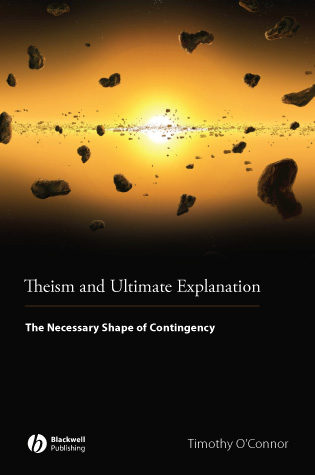 Timothy O’Connor’s brief Theism and Ultimate Explanation has already garnered much discussion since its publication in 2008. Notably, the most recent edition of Philosophia Christi features a book symposium on the work. What is all the fuss about?
Theism and Ultimate Explanation is broken into two parts. Part I addresses “The Explanatory Role of Necessity” while Part II addresses “The Necessary Shape of Contingency.”
Part I contains some fantastic arguments. O’Connor outlines various views on modality and seeks to defend modal realism, which takes modal truths to be actual truths about our world (and other worlds). Further, he defends the possibility of a priori truths against attacks from those who argue that all such truths need to be established empirically.
There are some who argue that empirical evidence (such as quantum mechanics) helps to undermine belief in some methods of reasoning, such as the law of non-contradiction, but O’Connor counters this by pointing out that those who make the argument that the “odd” data which may seem to contradict the method of reasoning against which their argument is directed are using the very methods of reasoning which they are trying to undermine. Another possibility is that the empiricist making this claim has switched to a different method of reasoning in order to critique that which holds to things like the law of non-contradiction, but O’Connor points out that a critique from such a method is “underwhelming” at best (46).
In Part II, O’Connor argues that it is coherent to ask the question, “Why is there anything (contingent) at all?” (65). He further argues that the only possible answer to this question is a termination in a necessary being. “If the universe truly is contingent, the obtaining of certain fundamental facts or other will be unexplained within empirical theory, whatever the topological structure of contingent reality… it will have to ground in some way… in a necessary being, something which has the reason for its existence within its own nature” (76).
He then turns to the question of what the nature of that necessary being may be, by examining two possibilities: “chaos” and “logos“. Logos is the view which calls the necessary being God, whilst chaos argues that it is a random being or a brute fact. O’Connor argues that logos is the most rational view to hold.
Finally, in chapter 6, O’Connor turns to theological reflections on the argument thus far. He argues that the concept of an immutable, timeless being seems contradictory to things like the trinity, but maintains that a less restricted of both of these views is plausible. He argues against molinism briefly, by stating that the counterfactuals involved would have no truthmakers.
O’Connor’s book weighs in at about 144 pages of text, but he makes use of every word. My biggest complaint about the book is how short it is. Often, it seems as though O’Connor simply doesn’t take the time to address the issues he is discussing in enough detail. Part I and the argument for the necessary being do seem to be adequately established, but chapter 6 in particular doesn’t do justice to opposing views. For example, the molinist could respond to O’Connor’s argument by saying that the “truthmaker” of such counterfactuals is simply existence in the mind of God. This could lead to an argument for determinism on molinism, but then the molinist could point to the distinction between de re and de dicto necessity. The arguments leveled against a timeless deity or an immutable one suffer similarly from limitations of space. I think O’Connor should have used the space of this chapter to expand the other ideas already present in his work.
As it stands, Theism and Ultimate Explanation is a fantastic work which is great reading for the philosopher of religion. It can be finished in one sitting, but the ideas therein will keep readers contemplating the work for quite a while afterwards. It comes recommended, but with the stipulation that readers may be left wanting more.
SDG.
——
The preceding post is the property of J.W. Wartick (apart from citations, which are the property of their respective owners) and should not be reproduced in part or in whole without the expressed consent of the author. All content on this site is the property of J.W. Wartick and is made available for individual and personal usage. If you cite from these documents, whether for personal or professional purposes, please give appropriate citation and provide a link to the original URL. By viewing any part of this site, you are agreeing to this usage policy.
Arguing for Deism?

One curious objection I have seen and heard to arguments for the existence of God is that these arguments apply to deism, not Christianity. For example, Michael, an atheist blogger, writes, “Note that these are effectively arguments for deism, not Christianity!” about the Moral Argument (here). Another example is found in the irrational and rather virulent attack on theistic argument (laughably, they use Dawkins as the primary source for saying that all arguments for God’s existence have been refuted) can be found here. The author, confused about the implications of the cosmological argument, writes, “YECers actually deny the Big Bang, but Craig appears to be a deist.”
I must confess at least a little confusion about these comment and others which I have seen and heard. The objection seems to be that an argument for the existence of God (such as the cosmological argument) that could be utilized for deism doesn’t help the epistemic justification for belief in the Christian God. This objection is completely misguided, however, for a number of reasons.
First, Michael objects in this way in his discussion of the Moral Argument. But deism is the belief in “a creator who has established the universe and its processes but does not respond to human prayer or need” (Honderich, 195 cited below). Clearly, then, this god of deism cannot be the God towards which the Moral Argument points. The moral argument places God as the objective standard of morality for the universe (note, it doesn’t place God as the arbitrary decision maker for what is right or wrong–but argues that God has objective goodness necessarily or essentially, thus avoiding the Euthyphro dilemma Michael presses). It is hard to see how a god which doesn’t care about or respond to human need could be the objective standard of morality.
Second, the classic arguments for the existence of God don’t each point specifically to the Christian God, but serve as a cumulative case to demonstrate His existence and attributes. The Moral Argument argues for omnibenevolence; the teleological argument demonstrates omniscience and omnipotence (along with omnibenevolence, to a lesser extent); the cosmological argument illustrates omnipotence, transcendence, and necessary existence; the transcendental argument shows God’s transcendence and necessity; the ontological argument combines all of the attributes into its first premise (usually); the argument from consciousness demonstrates God as mind; the argument from reason demonstrates the rationality of God; the list could continue. Furthermore, almost all of these arguments show that God is personal, and therefore, by definition, not deistic but theistic. The objection is specious already.
Furthermore, how is it an objection to these arguments to say that they don’t each individually demonstrate the Christian God is the one true God? This seems to be a confusion about how arguments work. Argumenst for the existence of a god, as long as they don’t contradict the God of Christianity, can be taken as evidence for the existence of the God, namely, the Christian God.
Take an example of a case in court. A man is accused of committing murder. The victim was found hung in his room. The prosecuting attorney argues that the accused had the means–he recently bought some rope. He then argues the accused had motive–the victim had recently gotten a promotion for which the accused was vying. He also shows that the accused has rope marks on his hand and scratch marks on his face, which show the struggle which occurred as the accused allegedly hung the victim. He argues, finally, the accused had opportunity–he was in the room at the time the victim died and he was also the only other person in the room.
Now imagine how ridiculous it would be if the defense attorney stood up and complained that these arguments don’t really apply to the case at hand, because none of them demonstrates the accused committed the murder! They just show, individually, that he had means, motive, and opportunity; not to mention the strong evidence for the accused being involved in a struggle with some rope and another person. But to demonstrate the guilt of the accused, the defense continues, the prosecution must come up with an argument that demonstrates all of these things at once! Otherwise, they just demonstrate the other things individually!
Obviously, the defense attorney has something wrong here. But then the atheistic objector also has something wrong. The Christian philosopher of religion has argued that God is omnipotent, omniscient, omnibenevolent, transcendent, necessary, etc.; the atheist responded by saying “those arguments individually only demonstrate a deistic God!” [Discounting, for the moment, that a deistic God wouldn’t share some of these attributes.] But that isn’t how the arguments work. Any argument which demonstrates that a God exists, as long as that God is not contradictory to the Christian God, can serve as evidence for the existence of the Christian God.
Source:
Ted Honderich, ed., The Oxford Guide to Philosophy (New York, NY: Oxford, 2005).
——
The preceding post is the property of J.W. Wartick (apart from citations, which are the property of their respective owners) and should not be reproduced in part or in whole without the expressed consent of the author. All content on this site is the property of J.W. Wartick and is made available for individual and personal usage. If you cite from these documents, whether for personal or professional purposes, please give appropriate citation and provide a link to the original URL. By viewing any part of this site, you are agreeing to this usage policy.
The Past, Probability, and Teleology
 This post has been expanded, edited, and published in the journal Hope’s Reason. View it in full here.
I have run into the idea more than once recently that we should discount things like the teleological argument due to the fact that it happened in the past. The thinking goes that, because an event (the existence of the universe, for example), has happened, the probability of that event happening is 1/1. Thus, people like Dawkins can say, “The fact of our own existence is perhaps too surprising to bear… How is it that we find ourselves not merely existing, but surrounded by such complexity, such excellence, such endless forms so beautiful… The answer is this: it could not have been otherwise, given that we are capable of noticing our existence at all and of asking questions about it” (here).
There are a number of ways to take such sentiment. The first is quite trivial. Of course, if an event e happened, the probability e having happened is 1/1. That’s, as I said, trivially true.
The problem is when people try to use this thinking against something like some forms of the teleological argument. Statistically, some people assert, the odds that the universe would be life-permitting (like the one we observe) must be 1/1, because, we are here, after all, to observe it!
Now, imagine the following:
d: The chances of any one side coming up are (granting a fair die and surface) 1/6. I toss a die (I really just did here) and get a 1.
Now, the equivalent claim of saying that the universe must have been life permitting because we are here to observe it is saying that d must happen, given that it is what did happen. Some people have no problem with asserting this, and indeed say that this should be the case. The fact that something is true, they may argue, means that the probability that it would happen was 1/1.
We can, in fact, reduce this whole discussion to symbolic logic. It is the case that:
□(p⊃p)
Which tells us that, if p is the case, then necessarily p is the case. Those who are arguing as above, however, need a much stronger conclusion, namely, □p. But this simply doesn’t follow from reality. It is the case that p, therefore, necessarily, p. But it is not the case that necessarily p.
The distinction is a simple de re verses de dicto fallacy. It is an elementary error philosophically, but it is easy to commit. I’ve done so in the past (see here for a post in which I caught myself in this confusion). Now, de dicto necessity is “a matter of a proposition’s being necessarily true” while de re necessity is “an object’s having a property essentially or necessarily” (Plantinga, v). De dicto necessity ascribes necessity to a proposition, while de re necessity argues only that each “res of a certain kind has a certain property essentially or necessarily” (Plantinga, 10).
Returning to the idea of past events, such as the universe coming into existence or rolling a die and having it come up as a 1, we can see where this error occurs. Those who deny with Dawkins that we can work out the prior probabilities of the universe being life-permitting because “it could not have been otherwise” are actually committing this basic error. They have assigned the proposition that the universe exists de re necessity, when in reality it is only a de dicto necessity. It is, in other words, true that whatever has happened, necessarily has happened. It is not true that whatever has happened has happened necessarily.
(This post is a very miniature version of a journal article I have under review for Hope’s Reason right now.)
Sources:
Plantinga, Alvin. The Nature of Necessity. Oxford University Press. 1979.
Image: http://commons.wikimedia.org/wiki/File:God-dice.jpg
Thanks to Dr. Timothy Folkerts and Dr. Stephen Parrish for some enlightening correspondence on the above points.
——
The preceding post is the property of J.W. Wartick (apart from citations, which are the property of their respective owners) and should not be reproduced in part or in whole without the expressed consent of the author.
The Leibnizian Cosmological Argument
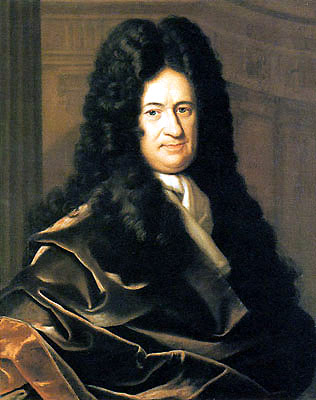 One of my personal favorite areas of philosophy of religion is studying the arguments for existence of God. One type of argument for God is the Cosmological Argument, and one of these arguments was developed by Gottfried Wilhelm Leibniz.
The Argument
A simple version of the argument, in syllogistic form, goes as follows:
1) Everything which exists has an explanation of its existence
2) If the universe has an explanation for its existence, that explanation is God
3) The universe exists
4) The universe has an explanation of its existence
5) Therefore God exists (Craig, 54ff)
Now I think this outlining of Leibniz’s argument is a little forward. Premise 2 may be a bit strong. I’ve edited it some, though I’m sure many others have outlined it similarly, to become:
1) All entities which exist have explanation of their existence. This explanation is either their own necessity or (for contingent entities) an external cause. (P1)
2) The universe exists (Axiom [A] 1)
3) The universe’s existence is not found in its own necessity (P2)
4) Therefore, the universe has an external cause (P1, P2)
5) There cannot be an infinite series of non-necessary causes (A2)
6) Therefore, the cause of the universe is transcendent (external) to it and necessary (4, A2 [I’m skipping a few steps here, but it would end up here eventually, as follows from 4 and A2])
What the Argument Demonstrates
I’m content with settling for the conclusion found in 6). Demonstrating that an external, necessary entity caused the universe is as close as to God as many arguments can go. A being which causes the universe would obviously be exceedingly powerful, the argument itself states it is transcendent to the universe, and the being exists necessarily. Many (most?) theists tend to agree that the other attributes Classical Theism has generally assigned to God follow quite easily from the acknowledgement that such a being exists.
The question must now turn towards reasons why we should believe that this valid argument is true.
Defense of the Premises
1) seems as though it should be accepted simply as a given. I don’t think I should need to defend 1). If we abandon the idea that everything which exists has an explanation (either contingently–from something outside of itself, or necessarily–from its own necessity), then we should expect any number of utterly random things to pop into and out of existence for no reason whatsoever! After all, it would be the height of self-delusion to think that, while all things require reasons to exist, it just so happens (how fortuitously!) that our universe is the only thing which exists for no reason. I’ll leave it at that for now… such ideas are more important for the Transcendental Argument, after all.
2) simply doesn’t need a defense.
Step 3) is alongside step 1) as the only two premises which are capable of being denied (for 2 is, again, obvious, and 4) follows simply from the first 3; we will discuss step 5 shortly) to avoid the conclusion. Denying step 1), I think, is clearly unacceptable, so denying step 3) is really the only way to go for the anti-theist. But what reasons do we have for thinking the universe exists necessarily? I think this is patently not the case. After all, everything which exists necessarily exists (necessarily) forever! Therefore, a necessary universe must have existed for an infinite amount of time (for time is part of the universe). But if this is the case, we run into the insurmountable problems which an infinite past brings up (these problems are also important for the Kalam Cosmological Argument).
I’ll pick just one problem to demonstrate: if the past is actually infinite (as it must be, granting a necessary universe), then we could never get to the present moment, for we would have had to traverse an actually infinite amount of time to get here! Not only that, but as time passes, there is no time being “added” to what came before. Infinity is infinity and it cannot be increased by adding to it or decreased from taking away from it. Therefore, every second which seems as though it is lengthening our lives is actually not doing anything of the sort, despite every commonsense notion with which we have lived out whole lives saying otherwise! The universe, on this view, is a deceptive place, in which nothing is as it seems.
Not only that, but if the universe were necessary, then it seems as though hard determinism–that is, the view that there is no freedom of the will whatsoever–must be the case. For, if the universe exists necessarily, then it has possessed all of its parts necessarily, forever.
Furthermore, there doesn’t seem to be any reason as to why the universe could not have been different. To assert the universe exists necessarily, once again, means to assert that no part of the universe could have failed to exist. Think of it this way: the universe in which I ate breakfast this morning (as opposed to this universe, in which I did not [shame on me, I know]) is logically impossible. Why? Because things which exist necessarily cannot change!
Worse yet, the explanation of a necessary universe leads to the question of why exactly everything is as it is. The anti-theistic view of such a universe is that, necessarily, the universe exists as it does, which happens to have an extraordinary amount of order, laws of nature which happen to allow for life, etc. (this objection was brought to my attention through Stephen Parrish’s God and Necessity, 241).
Thus, even if we grant that it is possible the universe exists necessarily, the individual properties of the universe still call out for explanation: why is it that the universal constants are what they are, and don’t deviate by the infinitesimal amount which would have prevented the existence of life? Ultimately, then, the necessary universe theory falls victim not just to objections against the idea of a necessary universe, but it also falls victim to the objections against the universe existing for no reasons whatsoever.
This means that we have established 1-4. Step 5 is an axiom which I have proposed, because it seems to me quite clear that an infinite regress of contingent causes is a vicious regress–an impossibility. Everything in such a chain would have to, by 1), have a cause outside of itself. If we take C1 to be caused by C2, but both are contingent, then C2 calls for an explanation, C3, which calls for C4, which calls for C5… ad infinitum. I don’t see any reason to deny that this regress is vicious.
Thus, 1-5 have been established. If this is the case, however, then 6 follows, simply because at some point the series of causes C1…C5… would have to be terminated in N1 (a necessary cause). Furthermore, this cause would be external to the universe, from step 1). Thus, the Leibnizian Cosmological argument provides us with powerful reasons to think that a transcendent, powerful, necessary entity brought the universe into existence. I don’t see any reason to call this entity anything but God. There are many reasons to think that an entity with these properties (namely, necessary existence, transcendence, omnipotence) would possess many or all the other properties generally assigned to God.
Therefore, God exists.
Sources:
Craig, William Lane. On Guard. David C. Cook Publishers. 2010.
Parrish, Stephen. God and Necessity. University Press of America. 1997.
——
The preceding post is the property of J.W. Wartick (apart from citations, which are the property of their respective owners) and should not be reproduced in part or in whole without the expressed consent of the author.
God and Logical Priority
Logical priority, broadly defined, is the way things are ontologically ordered. That is, to say that for two factors, x and y, x is logically prior to y if and only if x takes precedence over y. An example could be to use miracles and God (note this is just for the sake of example, I realize that some would argue miracles can exist without God, but I’m simply using it as an illustration). The existence of God is logically prior to miracles in the sense that if God does not exist, then miracles do not. In this case, God would be x, while miracles would be y. In order for y to be the case, x must also be the case, thus making x logically prior to y.
So what does this have to do with God? Very much, I would say. For one of the most common objections to the existence of God is that there is no (or not enough) scientific evidence to demonstrate God’s existence. I have addressed such objections before, but now I would like to take a completely different approach. That is, I believe that the existence of God is logically prior to the question of scientific evidence.
The reason I take the existence of God to be logically prior to scientific evidence is be cause logic is prior to science. Take the case of necessity, for example, and combine it with the case of scientific laws. Now, in science, a law is generally something like “if x occurs, then y will occur.” But it is not the case that such laws operate on a logically necessary level. For it is not the case that “Necessarily, If x occurs, then y will occur” (or, □(x⊃y) for those who enjoy ‘logic-ese’). It is simply the case that this is what happens in all observed cases. It could even (possibly, but not modally) be said that “If x occurs, then, necessarily y will occur” (again, logic-ese: x⊃□y), but this does not establish logical necessity in the modal and broader sense.
The type of necessity which can therefore be ascribed to scientific laws is a contingent or “accidental” necessity. They operate in a necessary sense in that in this world (out of all possible worlds) it is the case that if x then y, but they do not operate necessarily in the sense that in every possible worlds it is the case that “if x then y.”
Logical necessity, however, is prior to this. For, on logical necessity, that which is necessary is necessary in all possible worlds. Logical necessity is the very thing which scientific necessity lacks.
Again, we may ask, what does this have to do with God? Well, if it is the case that it can be demonstrated that God exists out of logical necessity, then the question of scientific evidence is irrelevant. For logical necessity is prior to scientific necessity. This is not to say that scientific evidence is not useful when exploring the “God question”, if you will, but it is to say that if it can be demonstrated that God is logically necessary, then demands for scientific evidence to demonstrate or even make probable the existence of God are misplaced. For if God is logically necessary, then to deny the existence of God is incoherent in the strong sense (that is, it is illogical). The logical demonstration would be prior to and therefore supersede the scientific evidence or lack thereof (I believe that there are at least some reasons scientifically to believe God exists, but that is off topic).
But then, we must ask, can it be demonstrated that God is logically necessary? Well yes, I believe so. I have argued this at length elsewhere, so I won’t reiterate it (see here). If any of these arguments are sound (as I believe they are), then the question of scientific evidence for God’s existence is simply a non-factor. Certainly, the scientific (and other) evidences may be seen as providing further justification for believing that God exists, but if it is the case that the arguments for God’s logical necessity are sound, then such arguments are the only tools needed to defend the claim that God exists. Further, to dispute such a claim (that is, God’s existence) would be incoherent in the strongest possible sense.
——
The preceding post is the property of J.W. Wartick (apart from citations, which are the property of their respective owners) and should not be reproduced in part or in whole without the expressed consent of the author.
The Ontological Argument: Therefore God Exists
The Ontological Argument is probably the most widely misunderstood and maligned of all the theistic arguments. Counters to it often entail little more than mud-slinging, calling such an argument “wordplay” or “trickery,” but few get to the meat of the argument. Often counter-arguments include attempts to parody the argument (as here) or a dismissive strategy. But does anyone truly confront the argument? Rarely. Here I’ll present two forms of the ontological argument, and discuss them in some detail.
The first version of the argument that I will present is Alvin Plantinga’s “Victorious Modal” version of the argument. I actually don’t think this is the strongest version of the ontological argument, but it is one step towards the strongest version. First, the argument:
“1) The property of being maximally great is exemplified in some possible world
2) The property of being maximally great is equivalent, by definition, to the property of being maximally excellent in every possible world
3) The property of being maximally excellent entails the properties of [at least] omniscience, omnipotence, and moral perfection
4) A universal property is one that is exemplified in every possible world or none
5) Any property that is equivalent to some property that holds in every possible world is a universal property
Therefore,
6) There exists a being that is essentially omniscient, omnipotent, and morally perfect (God) (Maydole, 573)”
Now let’s analyze this argument. The long story short is that this argument is logically valid. The conclusions follow from the premises. This can be shown with deductive symbolic logic (Maydole, 590). Thus, one cannot argue against it as being invalid, rather, the argument must be attacked for soundness.
Let’s sum it up in easier-to-understand language, shall we? The first premise simply claims that in some possible world (out of infinite or nearly infinite), the property of “maximal greatness” is exemplified, that is, some body has this property. Premise 2) argues that this property is equivalent to maximal excellence, which is explained in 3) as (basically) the attributes generally believed to be possessed by God in classical theism. Premise 4) states the obviously true statement that if a property is universal it is in either every possible world or none. This is a simple tautology, it is true by definition. One could just as easily say a property that exists in every possible world or none is universal. X = X, this is true. Then, Plantinga argues 5) that maximal greatness is a universal property. This is key to understanding the argument. Basically, in his book God, Freedom, and Evil (and elsewhere), Plantinga makes the point that if a being is maximally great, then that simply entails being maximally great in all possible worlds. For a being that is maximally great in, say 200 worlds is not greater than one that exists in 2,000, but then this continues up the ladder until you have a being that is maximally great in all possible worlds, which then excludes the possibility of other beings with that property (for they would then, necessarily, not be the maximally great being). Finally, premise 6) follows from the previous premises (for if the maximally great/excellent being exists in all possible worlds, it exists in our own).
The question for this argument is then whether it is true. The premise on which this argument hinges is 1) “The property of being maximally great is exemplified in some possible world”. This seems to be perfectly clear. Denial of this premise means that one would have to argue that it is logically impossible for maximal greatness to be exemplified in any possible world at all, not just our own. This means someone must have infinite knowledge of all possible worlds. Therefore, it seems as though this argument is almost airtight. But suppose someone insists that one can deny premise 1), well then the whole argument falls apart. I must admit I don’t see how anyone could logically do so, but I don’t doubt that people will do so. So if someone wants to deny premise 1), and then–in my opinion–become rather dishonest intellectually, they can deny the soundness of the argument.
I don’t think that there is a way around this argument, but it is actually possible to make the Ontological Argument even stronger.
The most powerful version of the ontological argument, in my opinion, is presented in the book God and Necessity by Stephen E. Parrish (previously discussed here).
The argument goes as follows:
1) The concept of the GPB is coherent (and thus broadly logically possible)
2) Necessarily, a being who is the GPB is necessarily existent, and would have (at least) omnipotence, omniscience, and moral perfection essentially.
3) If the concept of the GPB is coherent, then it exists in all possible worlds.
4) But if it exists in all possible worlds, then it exists in the actual world.
5) The GPB exists (Parrish, 82)
This argument is also deductively valid. Premise 1) argues that the Greatest Possible Being is coherent–that is, there is no logical contradiction within such a being. 2) further defines what a GPB would be (Plantinga’s argument outlines this thoroughly). Premise 3) states the major part of the argument in a different way. Rather than arguing that it is possible that “maximal greatness” is exemplified in some possible world, Parrish argues that the concept of the GPB entails logical necessity along with such maximal greatness, and thus 3) follows from the previous premises, just as Plantinga’s version of the argument does. The key is to remember that in Parrish’s version of the argument, the coherence of the GPB is what is important, not the possibility (for if it is coherent, it is possible). 4) This is tautologically true. 5) follows from the previous premises.
What Parrish does here is actually takes out the possibility of denying premise 1) in Plantinga’s argument. Let’s look into this closely. Parrish argues that the concept of the Greatest Possible Being is coherent. Why is this so important? Well, because if we grant for a moment that the GPB exists, such a being could not fail to exist due to some kind of chance mistake or having some other being or thing prevent the GPB’s existence (Parrish, 105). The first point (that chance could not prevent the GPB’s existence) is true because the GPB would be logically necessary (it would either exist or not exist in all possible worlds). This claim is reinforced by the idea of maximal greatness being a universal property (above). The second point (nothing else could prevent the GPB’s existence) seems quite obvious. If there were a being or body or thing, etc. that could prevent the GPB’s existence, the GPB would clearly not be the Greatest Possible Being. If some other being were powerful enough to prevent the GPB’s existence, then that being would be greater.
So the only thing that could prevent the GPB from existing is self-contradiction within the concept.
Why is this? Well, after a little investigation it seems pretty clear. If the GPB is a coherent (and logically possible) concept, then such a being does exist. Let us say that the GPB is coherent. Let us then take some world, W, and see whether the GPB can fail to exist.
The concept of the GPB includes logical necessity in all possible worlds. The GPB has all the properties of maximal greatness. This means that these properties are universals. We can simply refer back to the argument above. If the GPB exists and has omnipotence, omniscience, etc. then it must exist universally, because, again, if some being is the GPB in only 200/1,000,000,000 possible worlds, the being that is GPB in 2,000 is greater. But this seems ridiculous, for the truly Greatest Possible Being must exist in all of them, for if there was a possibility for some being to exist in all the worlds that the GPB exists in +1 and exemplify the maximally great attributes, then that being would be the GPB (and the previous one would not really have omniscience, etc., for the GPB would be more powerful, existing in all possible worlds, and being sovereign in all possible worlds) . Now let us return to W. It now seems completely clear that W could not be such that, if the GPB is coherent (and therefore possible), W could not fail to exemplify the GPB.
But have we then demonstrated that coherence is really the issue here? Is it possible that we are just thinking up some thing, calling it the GPB, and then arguing it into “supposed” existence? Logically, it does not seem so.
The reason is because we are arguing that the GPB entails these properties. Things have, essentially properties. I exemplify the property of “having fingers.” I also exemplify the properties of “being finite,” “being human,” “having two feet,” etc. These properties don’t belong to me simply because someone sat around and decided to assign them to me, rather they belong to me because of the kind of thing I am. (Parrish argues similarly, 55). But in the same way, we could answer such objections by saying that these properties are part of the concept of God because that’s the kind of thing God is. Certainly, there have been all kinds of “gods” claimed throughout history that are finite in power or activity, but those aren’t the “gods” whose existence we are arguing for. Rather, we are arguing for the existence of the God of classical theism, and that God has such properties as necessary existence (in the analytic sense), omnipotence, omniscience, etc. This objection really doesn’t have any weight. But again, let’s assume for the sake of argument that it does.
Let’s assume that the objection may be true. We are just taking some “X” and arbitrarily saying that it is omnipotent, necessary, etc. Does that preclude such an object existing? I don’t see how this could be true. But even further, some claim that this doesn’t match up with Christianity’s concept of God. This seems preposterous. One needs only to open a Bible to find that, while words like “omnipotence” are not used, words like “Almighty”, “Most High”, and the like constantly are. And what kind of objection is this really? Is the person making this objection going to concede that it is possible that there exists some nearly-omnipotent-but-not-actually-omnipotent creator of the universe? No, the objection is beyond logic and into emotional repugnance at the thought of God actually existing.
But we can even go further. For let us simply define God as the Greatest Possible being. This seems like it could very easily operate as a definition of what “God” is, at least on classical theism. Well then, what properties might this Greatest Possible Being have? And then we simply build them up. Omnipotence seems obvious, as does omniscience, as does necessity, etc. So this isn’t some arbitrary assigning-to of properties, but rather such properties are part of the GPB simply because of what the GPB actually is, if the GPB existed.
Now we can return to the matter at hand. Does God exist? Well it follows from all of this that yes, God does exist. The theist has established that there are some arguments that deductively prove that God does exist. The only “way out” for the atheist is to attack premise one and argue that the concept of the GPB is, in fact, contradictory. And let’s be honest, there have been many attempts to do so. I can’t possibly go into all of them here, but I can state simply that I remain unconvinced. Often these arguments are things like “Omnipotence and omniscience are impossible to have, because if God knows in advance what He’s going to do, He can’t do anything else!” This argument is obviously false, for simply knowing what is going to happen is not causation. I know that a sheep is an animal, this does not cause the sheep to be an animal. I know that I am going to finish typing this post, that does not cause me to do so. Rather, I choose to continue typing and finish this post.
Of course, one might say “You can’t really know you’re going to finish this post! Your computer might explode and you may get brain washed, etc.” Well that is a whole different debate, but I think that such objections, ironically, actually apply not at all to God. For if God is omniscient and omnipotent, it seems clear that God actually would be above such things! For nothing could prevent God from finishing something He knows He’s going to do! Not only that, but God’s knowledge is such that He actually would know He is going to do something, and freely chooses to do so. I don’t see why God’s foreknowledge of an event somehow limits omnipotence, especially when one considers that God is part of agent-causation, so God chooses to do the things He is going to do. Thus, the argument falls apart.
But now I’m already farther off track than I was (and thus preventing myself from finishing this post, AH the irony!). Suffice to say that I very much doubt that any objection to the coherence of the GPB even comes close to succeeding. But then, if that is true, God exists.
Therefore God exists.
(Edit: I’ve included below a proof of Plantinga’s argument)
Let
Ax=df x is maximally great
Bx=df x is maximally excellent
W (Y) =df Y is a universal property
Ox = df x is omniscient, omnipotent, and morally perfect 1) ◊ (∃x)Ax pr
2) □(x)(Ax iff □Bx) pr
3) □(x)(Bx⊃Ox) pr
4) (Y)[W(Y) iff (□(∃x)Yx ∨ (□~(∃x)Yx)] pr
5) (Y)[(∃Z)□(x)(Yx iff □Zx)⊃ W(Y)] pr
6) (∃Z)□(x)(Ax iff □Zx) 2, Existential Generalization
7) [(∃Z)□(x)(Ax iff □Zx)⊃W(A)] 5, Universal Instantiation
8 ) W(A) iff (□(∃x)Ax ∨ (□~(∃x)Ax) 4, Universal Instantiation
9) W (A) 6, 7 Modus Ponens
10) W(A)⊃ (□(∃x)Ax ∨ (□~(∃x)Ax) 8, Equivalence, Simplification
11) □(∃x)Ax (□~(∃x)Ax) 9, 10 Modus Ponens
12) ~◊~~(∃x)Ax ∨ (□(∃x)Ax) 11, Communication, Modal Equivalence
13) ◊(∃x)Ax ⊃ □(∃x)Ax Double Negation, Impl
14) □(∃x)Ax 1, 13 Modus Ponens
15) □(x)(Ax iff □Bx) ⊃ (□(∃x)Ax ⊃ □(∃x)□Bx) theorem
16) □(∃x)□Bx 14, 15 Modus Ponens (twice)
17) □(x)(Bx ⊃ Ox) ⊃ (□(∃x)□Bx ⊃ □(∃x)□Ox theorem
18) □(∃x)□Bx 16, 17 Modus Ponens (twice)
19) (∃x)□Bx 18, Necessity Elimination
(taken directly from Maydole)
Sources:
Maydole, Robert E. “The Ontological Argument.” The Blackwell Companion to Natural Theology. Edited William Lane Craig and J.P. Moreland. Blackwell, 2009.
Parrish, Stephen E. God and Necessity. University Press of America. 1997.
——
The preceding post is the property of J.W. Wartick (apart from citations, which are the property of their respective owners) and should not be reproduced in part or in whole without the expressed consent of the author.
God’s “Purposively Available Evidence”
If God exists, then what kind of evidence should we expect about his existence? How exactly would God operate in allowing for evidence or inquiries into his existence? These are some questions I have been pondering a great deal recently.
Paul K. Moser places questions like this in his book The Elusive God which I recently reviewed. Moser argues therein that questions like “Do we humans know God exists?” must be rephrased because if that (perfectly loving, etc.) God exists, then we should consider how God would interact with humans (4). Thus, argues Moser, such questions should be rephrased as “Are we humans known by God in virtue of (among other things) our freely and agreeably being willing (i) to be known by God and thereby (ii) to be transformed toward God’s moral character of perfect love as we are willingly lead by God in volitional fellowship with God, thereby obediently yielding our wills to God’s authoritative will?” (4, Moser’s emphasis). But even this question must be seen in light of a third rendering of the question “Do we humans know God Exists?” which is “Are we humans known by God in virtue of… our freely being willing to receive an authoritative call to… fellowship with God…?” (4).
I think that Moser raises some very valid points here. If God does in fact exist, then the question “Does God exist?” takes, of necessity, a different tone. Rather than expecting some kind of sterile evidence that makes no demands of us, this evidence may indeed be seen as some kind of authoritative call. Moser’s argument, I believe, is unfortunately not well developed, despite the 280 pages he dedicates to this very issue. My purpose here is not to try to expand on his argument, but to bring it into a context that reflects more what I believe and would therefore use instead.
I believe Moser is on the right track when he argues that God’s purposes in revealing Himself are very important when discussing His existence. Thus, God would not coerce us into belief. Moser argues in “God is Great, God is Good” (cited below) that God, assuming He exists, could seek “to offer a profound existential, motivational challenge to wayward humans” (53). On the other hand, and here is a point Moser seems to make but never develop, the “authoritative call” aspect of God’s existence is something that I believe is of vital importance to an understanding of God’s existence and reality.
He does argue that we need to let God be God (which I read as an assertion of sovereignty) even in the areas of inquiry into His existence. Thus, we cannot make demands of a sovereign God, which would be counter-intuitive. Rather, God can make demands of us.
So how do we answer the question of God’s existence? Moser makes an argument for the existence of God that is essentially an argument from religious experience (see my own posts advancing this argument here and here). His argument is outlined in The Elusive God:
“The transformative gift [is defined as] via conscience, a person’s (a) being authoritatively convicted and forgiven by X of all that person’s wrongdoing and (b) thereby being authoritatively called and led by X both into noncoerced volitional fellowship with X in perfect love and into rightful worship toward X as wrothy of worship and, on that basis, transformed by X from (i) that person’s previous tendencies to selfishness and despair to (ii) a new volitional center with a default position of unselfish love and forgiveness toward all people and of hope in the ultimate triumph of good over evil by X” (134-135) Which leads to:
“1. Necessarily, if a human person is offered, and unselfishly receives, the transformative gift, then this is the result of the authoritative leading and sustaining power of a divine X of thoroughgoing forgiveness, fellowship in perfect love, worthiness of worship, and triumphant hope (namely, God).
“2. I have been offered, and have willingly unselfishly received, the transformative gift.
“3. Therefore, God exists” (135).
I’m still pondering this argument and trying to decide how weighty it is. The more I’ve looked it over and thought about it, the more interesting it seems to me. For now, I’ll advance my own argument, based on Moser’s writings and my own input:
1) The question “Does God exist?” must be asked in such a way that we humans acknowledge that if God does in fact exist, the question of His existence involves, necessarily, a life-changing, “creating anew” (2 Corinthians 5:17) that is the work of the Holy Spirit, which is a gift of God, not by our works (Ephesians 2:8-9). This is because i) if God exists, then, necessarily, His existence would apply to every aspect of all things (specifically, our lives).
2) Evidence of God’s existence thus entails an entirely life-changing event that is the work of God and not of ourselves (e.g. baptism). It can thus be seen (Moser’s words) as “purposively available evidence”–evidence with the purpose of justification/creating a new [see 1) above].
3) God allows people to reject such life-changing evidence
4) We humans are often in rebellion against God and refuse to acknowledge 1), 2), and 3)
5) If we are in rebellion against God, then we reject the life-changing gift as seen in 2)- faith worked by the Spirit
6) Therefore, God’s existence may indeed be justifiably inaccessible to humans who are in rebellion against God, for the most powerful evidence of God’s existence can be found in 2)–the life-changing gift of the work of the Holy Spirit, and humans who are in rebellion against God reject such evidence, despite its being (purposively) available
I believe that this argument avoids some of my theological objections to Moser’s brand of (some kind of) universalism while still advancing an answer to “Why doesn’t God make his existence blatantly obvious?” I agree wholeheartedly with Moser that God could certainly have reasons for keeping his existence hidden. These reasons could be innumerable, but for now I’m content to settle with the argument that God’s purposes are to use evidence for His existence such as to be life changing through the means of grace (eg. baptism, communion, other religious experience).
My argument is obviously not so much an argument for the existence of God as it is an argument about how exactly we should go about trying to discover the answer to the question “Does God exist?”. I am not here begging the question of the existence of God. Instead, this argument is pointing to the means by which one might go about further inquiring into the question of God’s existence. If Christianity is true, then this argument is (I believe) completely sound.
Now it is appropriate to return to Meister’s argument for the existence of God and similarly modify it.
1)If the God of classical theism exists, He is sovereign
2) If the God of classical theism God exists and is (therefore) sovereign, then His existence would likely be purposively available (see argument above)
3) If there is purposively available evidence that is available and life-changing (read: applicable to every aspect of everything, specifically our lives), then God exists
4) I have perceived such purposively available evidence of God’s existence (as a gift of the Holy Spirit through baptism, communion, and religious experience).
5) Therefore, God exists.
Clearly this doesn’t solve any issue of religious pluralism, which is something beyond the range of this post. What it does say, however, is that someone may be justified in holding the belief that God exists based on religious experience of purposively available evidence. Thus, such belief is not irrational or unjustified.
These reflections were based on information found in the following sources: Paul K. Moser, The Elusive God. I’ve also read his discussions in two other places: the book “God is Great, God is Good” (edited by William Lane Craig and Chad Meister) and the publication “Philosophia Christi” (Volume 11, Number 2, 2009) which is published by the Evangelical Philosophical Society (a society that I am a student member of!).
——
The preceding post is the property of J.W. Wartick and should not be reproduced in part or in whole without the expressed consent of the author.
Religious Experience: Evidence for Beliefs About God
I think that perhaps one of the most often dismissed evidences for the existence of God is Religious Experience–that is, an experience that someone takes to be an experience of God of the supernatural. I have experienced more than one such experience, and this claim is of course met with ridicule or at least massive skepticism by non-theists, and surprisingly enough even by many Christians. Why is this? I personally think that it is due to 1) on the side of the Christian or theist who doubts it, the granting of a kind of empirical belief that such things should be viewed quite skeptically and only believed in light of massive evidence and 2) on the side of the non-theist, an obvious presupposition that such things are obviously false and explainable naturalistically.
So, is there really a case for believing that Religious Experience can give any grounds for belief in (here I’ll more be arguing for beliefs about) God at all? I believe there is a rather strong case. I’ve argued elsewhere that such an experience can grant at least some amount of warrant for belief in God. But I believe that there is more to be said.
First we must discuss sense perception. What does it mean when someone senses something (here “sense” meaning using one of the five senses to ascertain knowledge of something)? There are a number of explanations, but I believe the most obvious one is simply that (in the case of sight) someone (x) sees something (y). Thus, I believe there is a kind of immediacy to sense perception. (Just a side note–this doesn’t go against my beliefs in a kind of Theistic Idealism, as my form of idealism involves a “real world” in the sense of Husserl’s “empty x” that we can perceive.) Now of course sense perception can be wrong, but the main idea is that when x sees y, it is just the case that x sees y, not the case that, say, x believes that x sees y or something even more drawn out.
But then what exactly is our justification for believing that sense perception has warrant? There really is no non-circular way to justify a belief based on a sense perception. Yet we continually believe that we are reliable when we form beliefs based on perceptions. The most common argument for the validation of sense perception in epistemic warrant is to say that our beliefs are justified because sense perception continues to feed us valid data (i.e. we are justified for believing that we are being appeared to “redly” because it is most often the case that when we believe we are being appeared to “redly” we are, in fact, being appeared to “redly”). But of course such a kind of justification is quite circular. It basically boils down to saying that our beliefs formed because of sense perception are valid because sense perception confirms such beliefs. So why do we trust our sense perceptions? It seems as though we have a few alternatives here (not trying to be comprehensive, merely illustrative): 1) we can simply not trust our sense perceptions, or 2) we can agree that it is possible for some system of epistemic justification to validate itself through repeated confirmation (as in the case of being appeared to “redly”). But if 2) is the case, as it almost certainly is, then we must be consistent with ourselves on this regard (this argument is based off Alston’s, cited below).
So then let us return to religious experience. Beliefs from religious experiences are, it seems, justified epistemically in the same way. The subject forms a belief based on the confirmation of that belief within the system. Let us say that some subject has a religious experience in which they believe that God is presenting himself as good. The subject then justifies this belief on the basis that they believe they are being appeared to “goodly” by God and that this is backed up by other experience (perhaps the belief that God continually sustains all things). While this may be circular in nature, one cannot object to the circularity unless they wish to subject sense perception to the same objection. Either both must be rejected, or neither. And if neither is rejected, then it is possible to have justification for a belief about God based on a religious experience.
There is more to say, of course. I mentioned above that I believe it is the case that when x sees y, x simply sees y. That can be applied to religious experience, especially those varieties of religious experience in which the subject claims to have a kind of sense perception of God (like “I saw a great light…” or something of the sort). Thus, when it is the case that the subject, x, experiences in a religious experience some sensation, y, it is simply the case that x experiences y, without any intermediaries.
Here now I’ll turn to a very commonly raised objection to religious experience. It may be claimed that when one experiences such a perception, they are subjected to a kind of euphoric state, either by drugs, by their own control over their brains (they want so badly to experience the religious that they cause it, unknowingly, to happen), or some other factor. These experiences can then be boiled down to a kind of reduction to brain waves, chemicals in the brain, etc. And because these experiences can be explained naturalistically, they are invalid for epistemic justification.
I believe this claim is utterly false. Again we can point to sense perception as being subjected to the same kind of reduction. If religious experience is merely the matter of neurons firing in the brain (among other things), then so is sense perception and indeed all knowledge in itself. But then we must reject everything that we perceive by our senses! For if we are to be consistent in our claim that if something can be reduced to natural causes, it has no epistemic warrant, then yes, religious experience could possibly be reduced to simply brain activity, but so could the existence of things outside of our heads, for we could observe brain activity happening when we observe things and form beliefs about them. Thus, for the sake of consistency, we would need to reject the reality of objects outside of our heads! This is of course not something that someone who raises such an objection is willing to do, but if they want to raise such an objection, their own beliefs are subject to the exact same scrutiny, and it will turn out to be the case that there is no such thing as a belief at all, if indeed all things are just brain activity (a hypothesis I utterly disagree with).
So it seems to me that it is indeed the case that people can form beliefs based on religious experience. I will write more in the future about whether these experiences can have any kind of warrant for those who did not experience the same thing, the problem of religious diversity in regards to claims of religious experience, and more on the concept of warrant with religious experience. For now, however, I’ll leave this as it stands. People can indeed be justified in believing something based on religious experience, if one wants to object in any of the ways outlined above, they simply must be consistent and reject sense perception, material objects, and the like.
Sources:
Alston, William P. Perceiving God: The Epistemology of Religious Experience. Cornell University Press, 1991.
Kwan, Kai-Man. “The Argument from Religious Experience.” The Blackwell Companion to Natural Theology. Blackwell, 2009.
——
The preceding post is the property of J.W. Wartick and should not be reproduced in part or in whole without the expressed consent of the author.
The Teleological Argument
The “Teleological Argument,” which is also known as the “Argument from Design,” has been popularized by the Intelligent Design movement, though the version I defend below is cosmological rather than biological.
The Teleological Argument is an inductive argument that doesn’t attempt to prove that God exists, but rather argues to justify or confirm that belief. In other words, it can function much like the Argument from Religious Experience in providing warrant, not proof, for belief. It’s an inductive argument that seeks to increase the probability of theism, not prove it.
Robin Collins wrote the chapter on the Teleological Argument in The Blackwell Companion to Natural Theology, entitled “The Teleological Argument: An Exploration of the Fine-Tuning of the Universe.” I can honestly say that I only understood about 70-80% of the material. While there is a large amount of hefty philosophical argumentation involved, it was the double-dose of astronomy and physics (things I have an average-at-best understanding of) that kept me from fully understanding this chapter. That said, I think That I understood enough to have the core of the argument intact. Collins argues that the universe has been “fine-tuned” to be a Life-Permitting Universe (LPU). He states that “This fine-tuning falls into three major categories: that of the laws of nature, that of the constants of physics, and that of the intial conditions of the universe…” (BCNT, 202).
I have long been skeptical of the usefulness of the Teleological Argument, but Collins puts forward a rather subdued version, in which he doesn’t loftily claim to prove God’s existence, but rather to state that “…given the fine-tuning evidence, LPU strongly supports T[heism] over the [Naturalistic Single Universe Hypothesis (hereafter referred to as the NSU)]” (205). Thus, instead of arguing that theism is true based on teleology, he argues that naturalism is less likely than theism based on teleology.
Collins pits the “Theistic Hypothesis” (as he calls it, T) against the NSU. He introduces the “Likelihood Principle,” which, in my own stripped down version basically states that if there is some evidence, e in favor of a hypothesis (say, T) over another (NSU), then T is more likely (205). All of this sounds, as I said, very subdued. The Teleological Argument as Collins presents it is not an end-all, be-all argument to convince everyone, but rather seems to be a justification for belief.
Now we must return to the evidence for fine-tuning. As previously stated, this falls into three categories: the laws of nature, the constants of nature, and the intial conditions of the universe (202). The laws or principles of nature that are required for “self-reproducing, highly complex material systems” (211) are 1) a universal attractive force, such as gravity 2) a force similar to the strong nuclear force, 3) a force similar to electromagnetic force, 4) Bohr’s Quantization Rule or something similar (electrons occupy only fixed orbitals [213]), and 5) the Pauli Exclusion Principle (“no two fermions… can occupy the same quantum state” [213]). The reason such things are required is because without #1, things would just float around everywhere, #2 allows for nucleons to stay together, without which it seems obvious there would be no complexity, #3, if it were not true, would mean there were no atoms (for nothing could hold them in orbit [212]), #4 allows electrons to keep energy, and #5 directly allows for complex chemistry (“without this principle, all eelectrons would occupy the lowest atomic orbital…” [213]) (211).
The constants of physics also are essential for an LPU. These include the constant of gravity and the cosmological constant (214, 215). Both of these seem necessary for the existence of life. The cosmological constant, for example, states that when it is positive, it will act as a repulsive force, but when negative, it will act as a negative force. If this constant had been different than it is, then the universe would have expanded or collapsed too quickly for stars and galaxies to form (215).
Naturalistic alternatives will be lacking. For example, one of the most likely alternatives for the naturalist is to discover some set of laws such that they explain the cosmological constant being what it is. But if this is the case, the naturalist has only pushed the question up one step higher, for now one could ask for an explanation for the fine-tuning of such a law. Another problem is that, as always, it seems the naturalist is assuming that an explanation will be discovered (219). There are a few problems with this in itself. One is that it is an argument to the future, which is a logical fallacy. One cannot simply state that one’s position is correct by stating that one day it will be demonstrated. Further, the naturalist may claim the theist has now created a “God of the gaps.” This is another fallacious way to attempt to argue against the theist. As stated before, the assumption that science will one day fill in every gap is a fallacy: argument to the future. Naturalists create their own “science of the gaps” in which they assume every gap will be filled by science. Another problem is that in order for the naturalist’s objection “God of the gaps” to work, it must carry weight for the theist, lest it be question-begging in nature. Yet there is no plausible way that, given theism, appealing to God for explanation of some concept should be ruled out a priori. Thus, the naturalist begs the question in objecting in a “God of the gaps” fashion. Further, such an objection as the “God of the gaps” is question begging in that they assume the theist is proposing theism as a scientific hypothesis. This is not the case. The theist is proposing God as a metaphysical and philosophical explanation, not a scientific one (225). Not only that, but if, for example, there is some theory of everything yet to be discovered, this would only push the fine-tuning up one level, and the naturalist would have to explain the existence of this theory of everything. The Teleological Argument doesn’t lose weight in light of such objections.
The Teleological Argument Collins brings forward is (my very summed up version, though all of the following are direct quotes):
“1) Given the fine-tuning evidence, LPU is very, very epistemically unlikely under NSU…
2) Given the fine-tuning evidence, LPU is not unlikely under theism…
3) Theism was advocated prior to the fine-tuning evidence (and has independent motivation)
4) Therefore, by the restricted version of the Likelihood Principle, LPU strongly supports Theism over NSU (207)”
The first premise is one that should not really be all that heavily debated. Just as one example, the cosmological constant is fine tuned to about 1 part in 10^120 (Reasonable Faith by William Lane Craig, 159). There are many other constants that have such unfathomably small likelihood of occurring. The difference is in how one explains this. Some argue for brute fact (it just is), but others argue based on the multiverse hypothesis.
Collins argues in various ways against the multiverse hypothesis scientifically. I will present my own argument, which is philosophical in nature. If our universe is one of many (perhaps infinitely many), then a number of logical problems arise. One is the problem of discovery. If we are granting naturalism, then how do we scientifically discover these other universes, if, based on the multiverse hypothesis, we cannot? Not only that, but there are modal problems with the multiverse hypothesis. Given an infinite number of universes that exist, then it seems highly likely there are other “J.W. Wartick”s in these universes. But there would likely be a far greater number in which there is no “J.W. Wartick” (much to the chagrin of the inhabitants!). If this is the case, then I simultaneously exist and do not exist, which is contradictory. But, it could be argued, these other “J.W. Wartick”s are not actually me, they are alternate mes in entirely different universes! This only introduces other problems, such as identity.
This problem is another discovery problem, but this one does not exist in a scientific sense but a philosophical one. How, for example, do we identify these other universes? How do we discover their properties? How do we infer any truths about our universe if, as stated just before, they are entirely different universes, and one cannot say that there are two “J.W. Wartick”s out there? In other words, if we state that the problem of “J.W. Wartick” existing and not existing isn’t a problem because these universes are not our own and are entirely different, how then do we derive knowledge of our own unverse from these hypothetical universes in the sense that we infer that our own universe isn’t all that unlikely given that we are one in infinite (or a great many)? One cannot have it both ways.
Others modify the multiverse hypothesis to say that there really aren’t infinite universes out there, but rather only those with laws similar to our own, selected by a sort of naturalistic machine that determines which universes are and are not possible. But if this is the case, then we have again only shifted the problem of our own existence from one point on the ladder to another. What determines this “machine” that selects universes non-arbitrarily (for it must not be arbitrary if we are using it to try to explain apparent fine-tuning)? Thus, this hypothesis doesn’t solve anything.
Then there is what Collins calls the “Weak Anthropic Principle objection.” I believe this is the claim Dawkins was making that I analyzed in another post. Collins writes, “According to the weak verson of the so-called Anthropic Principle, if the laws of nature were not fine-tuned, we should not be here to comment on the fact. Some have argued, therefore, that LPU is not really improbable or surprising at all under NSU, but simply follows from the fact that we exist” (277). There are a few problems with this, as I pointed out in the post I linked with Dawkins (such as the claim that such a thing is necessarily true that is implicit). But there are even more problems. The first is the argument could simply be restated to argue that our existence as embodied moral agents is extremely unlikely under NSU, but not under theism (277).
More convincing, however, is an example:
Imagine that I am standing to be executed, with 50 sharpshooters ready to fire at me. They fire, and they all miss. Would my response really be, “if they had not missed me, I would not be here to consider the fact?” Such a response is inadequate. One would almost be forced to conclude that there was some reason they all missed, given the background information that had the intention been to kill me, they almost certainly would have killed me (276).
Thus, such a dismissal of the evidence as Dawkins performs misses the mark (pun slightly intended).
Brute Fact must similarly be discareded as an explanation. Dr. Parrish argues in his book God and Necessity (which I recently read and discussed) that Brute Fact is logically undercut as an explanation for a number of reasons. These include that the Brute Fact hypothesis states explicitly that everything is random. If this is the case, then there should be no laws to observe, and, in fact, things should randomly be happening constantly. But Brute Fact proponents may argue that everything was random, but once it started, it was determined (God and Necessity, Stephen E. Parrish, 189). This, however, ignores the fact that relationships, in Brute Fact, are completely random. There is no reason to believe that, for example, a law should continue to operate how it does, even if we can observe it for a great deal of time doing so. Further, if such things were set in place upon being randomly selected by Brute Facy randomness, there are two major probelms. The first is that Brute Fact has no way to explain why such things should become determined upon selection, and the second is that even if one could get around this first problem, there remains no way to explain why it should always be the case. If everything is random, then everything is random, necessarily. There can be no constants.
Thus, it seems as though theism is the best way to explain the fine-tuning of the universe. Multiverse hypotheses fail in that they have scientific (which I did not discuss) and logical problems. Brute Fact can’t account for constants. Finally, just saying that we are here to observe the universe doesn’t do anything to undermine questions that ask Why are we here, and not somewhere else, or nowhere?
I don’t believe the Teleological Argument proves God exists, but it does add a significant amount of warrant to the belief that He does.
——–
The preceding post is the property of J.W. Wartick and should not be reproduced in part or in whole without the expressed consent of the author.

 J.W. Wartick - Reconstructing Faith
