Reconstructing Faith
How Inerrancy Displaces God

James Barr (1924-2006) was a renowned biblical scholar who, in part, made some of his life’s work pushing back against fundamentalist readings of Scripture and Christianity. I have found his work to be deeply insightful, even reading it 40 or more years after the original publications. His most controversial and perhaps best-known work was Fundamentalism (1977), in which he offered a survey and critique of fundamentalism, which applies incredibly strongly to Evangelicalism and conservative Christianity to this day.
One of the many incredible insights Barr provides is how the doctrine of inerrancy actually displaces God by making the Bible a or the primary focus of Christianity. We’re going to take an extended look at what he writes about the Bible under fundamentalism, along with some commentary, below [all these quotes are from pages 36-38 in the edition I have):
“For fundamentalists the Bible is more than the source of verity for their religion… It is part of the religion itself, indeed it is practically the centre of the religion, the essential nuclear point from which lines of light radiate into every particular aspect. In the fundamentalist mind the Bible functions as a sort of correlate of Christ. Christ is the personal Lord… the Bible is a verbalized, ‘inscripturated’ entity, the given form of words in which God has made himself known, and thus the Bible equally enters into all relations, its words cannot be quoted too often, its terms, cadences and lineaments are all to be held dear.”
Barr here starts his fusillade by noting that for the fundamentalist, the BIble is nearly on par with Christ. Why? Because like Christ, the Bible is in every relationship, and because it is visualized as verbally inspired–the very individual words God intended–it becomes in a way like the deity Christ-self.
“While Christ is the divine Lord and Saviour, the Bible is the supreme religious symbol that is tnagible, articulate, possessable, accessible…”
Christ is far off, almost mythical compared to the reality of the Bible one can just hold in one’s hand. Barr does moderate this a bit:
“From this point of view it is wrong to say, as is sometimes said, that they put the Bible in the place of Christ. But from another point of view the Bible is really more important: it is the Bible, because it is the accessible and articulate reality, available empirically for checking and verification, that provides the lines that run through the religion and determine its shape and character.”
So while it may be wrong to say the Bible is put in place of Christ, in reality the inerrantist almost makes the Bible even more important than Christ. Again, Christ is not immediately available, in their minds, to pick up and interact with. But the Bible is. So one can open the Bible and verify what is supposed to be reality.
“The Bible is thus the supreme tangible sacred reality.”
I think here of my own (Lutheran) tradition in which we believe we can experience sacred reality through Christ’s promises and literally being present in, say, the Lord’s Supper.
“…once the symbolic elevation of the Bible goes beyond a certain point it begins to alter the shape and character of evangelical religion altogether. Certain kinds of biblical criticism and theology are felt to threaten the status of the Bible as absolute and perfect symbol of the religion; and in order to protect that symbolic status of the Bible the religion itself has to be adjusted or distorted.”
I think here of the many, many times I heard inerrancy as the central part of Christianity. Not Christ; inerrancy. Because–it was reasoned–after all, if the Bible has an error, why trust it about Christ? And so you lose everything if even one error exists. And here we see how the Bible is absolutely the central religious symbol.
“The fundamentalist position about the infallibility and inerrancy of the Bible is an attempt to prevent this tradition from being damaged through modes of interpretation that make the Bible mean something else… Especially in its intellectual and apologetic work… [fundamentalism] finds that it gradually has to alter and even abandon essential elements in the very religious tradition form which it started out. When this happens it is valid to say that the Bible as symbol, rather than the Christ who speaks through the Bible, has become the supreme controlling factor.”
I think here of my background as a young earth creationist, in which certain elements of geology were seen as specifically threatening to my faith in a way that no Christians prior to the 1900s would have been able to even comprehend.
“This symbolic function of the Bible has a deep effect on personal behaviour… [such as] the incantational use of Scripture.”
This hits hard–the idea that merely repeating utterances of the exact wording of Scripture has some kind of power or reality-bringing for it.
“In a religion lacking in ritual, the citation of Scripture has often functioned as a practically ritualistc procedure. The Bible… undergirds and harmonizes with the fundamentalist tradition of religion. It is a matter of course that preaching will use biblical texts, celebrate the centrality and infallibility of the Bible, and quote it frequently. It is by no means, however, a matter of course that it will make a careful exegetical examination of the meaning of the passages. Most fundamentalist preaching merely reiterates the traditional evangelical point of view, quoting the accepted proof texts but not really asking openly after the meaning.”
Yes! I have found it deeply ironic that in the conservative Lutheran circles I grew up in, the attempt to actually find what the Bible means was avoided. While saying they wanted to use the “historical grammatical” method of interpretation rather than the “historical critical” method, I’d encounter pastors and theologians who would explicitly tell me I “shouldn’t” be using actual historical facts about the Bible or its setting in the interpretation thereof. It was far more important to affirm the tenets of conservative Lutheranism rather than ask questions about what the text might “really” mean. Indeed, asking what a text might “really” mean was compared to the snake in the Garden asking if God “really” said something.
I haven’t even gotten to Barr’s chapter in this book on the Bible itself, but it has already provided immense food for thought. Insisting on Biblical inerrancy not only undermines how Scripture works, but it also displaces God, making the Bible the ultimate symbol of faith.
SDG.
Because of Concordia and Seminex

The news broke about a week ago (writing in February 2024). The Ann Arbor campus of Concordia University, also known as Concordia University – Ann Arbor (hereafter CUAA) is in dire financial straits. The University has been special through my life, as multiple family members including myself eventually attended and graduated from CUAA. However, I have mixed feelings about the place itself, especially some specific parts of the theology taught and interactions with people there. I’ve written some about this in posts elsewhere.
At the same time as I was thinking about CUAA and the complex feelings I have about it, Seminex hit its 50th anniversary. Seminex was shorthand for Seminary in Exile, a schism in the LCMS specifically centered at Concordia Seminary in St. Louis that led to several professors and hundreds of students leaving the Seminary. A complete history of Seminex is beyond the scope of that post. Briefly, the rise of a militantly conservative wing in the LCMS led to calls of heresy against multiple professors at Concordia Seminary in St. Louis due to their teaching mainstream tools for biblical interpretation. Rather than filing formal charges, these accusations essentially acted as a kind of blackballing and besmirching of the names of those professors deemed unorthodox by this radical wing. It ultimately led to the majority of professors and students walking out to form their own seminary, which ultimately merged with other Lutheran groups, including what would be come the ELCA.
As I prepared to write this article, I sifted through hundreds of photographs I took from my time on campus. It was like revisiting an old friend, in some ways literally. But it was also painful. A lot of those old friends aren’t friends anymore. Some of them have messaged me to tell me I’m going to hell. Others set people I didn’t even know to do the same. Still others disappeared without a trace, turning into nothing but ghosts from the past, living their lives as if I don’t exist.

I also revisited some of the works I’ve read about Seminex. Power, Politics, and the Missouri Synod by James C. Burkee tells the story of the conservative takeover of the LCMS. Like other denominations (eg. the Southern Baptist Convention), this takeover, when examined in the light of history, was less about the theological positions held by those involved than it was about power politics. Burkee himself taught at Concordia University Wisconsin, and tells the story from the perspective of a concerned insider, not an anti-LCMS outsider. It’s incredibly detailed, well-documented, and frankly alarming on almost every level.
But the book that has resonated most right now is No Room in the Brotherhood by Frederick W. Danker. Danker was one of the professors who left to be part of Seminex, and his telling of the way Seminex played out is both insightful and cutting in its analysis. His conclusion states explicitly that the various major names on either side of the conflict were not heroes or villains. Instead, the culprit was the “deep-seated conviction of the Missouri Synod that it was completely right. Any actions undertaken in concert with that conviction were therefore also right and it [the LCMS] was willing to perpetuate its institutional identity at any cost” (352).
The reason this resonated, and the reason my mind connected these two events–the possible closure of CUAA and Seminex’s 50th–is because the reaction and impetus seem so intertwined. I can’t tell you how many posts I’ve seen in the last week about how CUAA is the “city on a hill.” The language Jesus uses surrounding the city on a hill is that of letting Christians’ light so shine so that the good deeds of those will lead others to God. As Danker wrote, there’s this deep-seated conviction that the Missouri Synod (in this case, CUAA) is “completely right.” But it wasn’t completely right for so many.
It wasn’t completely right for gay people on campus who were mocked for who they were. It wasn’t a city on a hill for a woman who wanted to follow God’s call to be a pastor but was told she was disobeying God for wanting to serve. It wasn’t completely right for a Baptist friend who was told their view of baptism meant they were facing hellfire. It wasn’t a city on a hill when I witnessed pre-seminary men make fun of women, Jews, and Muslims. It wasn’t completely right for anyone perceived as “liberal.”
And here’s the hell of it: CUAA felt completely right so long as you were “in.” So long as you were LCMS, thought men should be in charge, and toed the party line, it felt like a city on a hill. I know, because I absolutely felt that way while I was there for a lot of the time I was there. Being an insider wasn’t just great, it was also, often, blissful ignorance that anyone was outside. After all, if we were experiencing this lovely joyful celebration of God, if we could really feel God’s working and presence in a chapel service or a late night call to prayer around a bonfire, how could it be anything but perfection? And how could anyone not want the same thing? And, importantly, how could they not want it in the same way?
That’s what makes this all feel so complex and, to use a sort of silly term, “yucky” about the whole thing. Because the second I was on the outside, I saw the willingness of people on the inside to perpetuate that identity “at any cost” as Danker wrote. A friend sicced an unknown seminarian on me to tell me that both I and my wife would be going to hell for thinking women could preach. Other friends disappeared, whether from the age-old Facebook friends list or entirely out of our lives. People I thought would be by my side throughout my life are no more than fragments of memory now. There was “no room in the brotherhood” for a man like me. And, like those attacked during the purge of the LCMS 50 years ago, I felt firsthand the equivocation between the perfection of the LCMS and the inerrancy they ascribe to Scripture. Questioning the LCMS view on anything wasn’t just questioning the LCMS, it was questioning Scripture and, by proxy, God!
So now, we’re here, and CUAA feels like this kind of epic thing in my life; a crucible through which I passed. Yes, there were good times–great times. That’s what makes it all so very hard. Because what was there could have been amazing. But if you stepped a toe out of line, God help you. The hashtag #becauseofconcordia is being used by people working to save CUAA. But I know that a few dollars–even the several million dollars that the campus needs to be in the black–aren’t enough to save CUAA. Only God can save CUAA and the LCMS. From itself.
Maranatha.
Links
Formerly Lutheran Church – Missouri Synod (LCMS) or Wisconsin Synod (WELS)– A Facebook group I’ve created for people who are former members of either of these church bodies to share stories, support each other, and try to bring change. Note: Anything you post on the internet has the potential to be public and shared anywhere, so if you join and post, be aware of that.
Leaving the LCMS/WELS– Not sure about whether to leave or thinking about leaving? Do you want to others who are thinking along the same lines? I created a group for those who are contemplating leaving these denominations, as well.
Why I left the Lutheran Church – Missouri Synod Links Hub– Want to follow the whole series? Here’s a hub post with links to all the posts as well as related topics.
Be sure to check out the page for this site on Facebook and Twitter for discussion of posts, links to other pages of interest, random talk about theology/philosophy/apologetics/movies and more!
SDG.
——
The preceding post is the property of J.W. Wartick (apart from quotations, which are the property of their respective owners, and works of art as credited; images are often freely available to the public and J.W. Wartick makes no claims of owning rights to the images unless he makes that explicit) and should not be reproduced in part or in whole without the expressed consent of the author. All content on this site is the property of J.W. Wartick and is made available for individual and personal usage. If you cite from these documents, whether for personal or professional purposes, please give appropriate citation with both the name of the author (J.W. Wartick) and a link to the original URL. If you’d like to repost a post, you may do so, provided you show less than half of the original post on your own site and link to the original post for the rest. You must also appropriately cite the post as noted above. This blog is protected by Creative Commons licensing. By viewing any part of this site, you are agreeing to this usage policy.
Joshua and Judges as contrasting accounts- Archaeological evidence and apologetic import

Joshua and the Conquest Narratives- Archaeology says otherwise
Dever’s work, Beyond the Texts: An Archaeological Portrait of Ancient Israel and Judah is hyper-focused on the archaeological evidence related to Ancient Israel and Judah. There’s a lengthy section at the beginning about the differences between looking at archaeological evidence and its (largely) “given” nature (eg. a soup bowl is a soup bowl-that’s its use, and arguing otherwise doesn’t change it) as opposed to texts like the Bible or other writings which have interpretation, memory, hyperbole, fictionalization, etc. built in.
The book is full of major insights, and Dever continues to rely almost exclusively upon archaeological evidence to make his points. Eventually, he gets to the conquest narratives of Joshua-Judges. Of the 30+ sites mentioned as being conquered in those books of the Bible, only 3-4 have any signs of destruction in the right time period. Writes Dever:
“[I]n the light of the overwhelming archaeological evidence, there was no large scale warfare on the thirteenth- and twelfth-century horizon, except that initiated by the Philistines along the coast… The inevitable conclusion is that the book of Joshua is nearly all fictitious, of little or no value to the historian. It is largely a legend celebrating the supposed exploits of a local folk hero.” (186)
I kind of knew this already–a major impact point for myself as someone who literally got a degree in apologetics was looking at the evidence in ANE history and trying to reconcile that with the Bible. And broadly speaking, evangelicalism has a severe problem when it comes to the archaeological evidence here.
Dever, however, doesn’t simply unload on the Joshua account and move on. He shows the marked contrast between how Judges shows the inhabitation of the land and how Joshua does so, noting the difference in themes between the two books. Dever concludes regarding the two books:
“The conclusion in light of archaeology is inevitable. The book of Joshua looks like a late, Deuteronomistic construct preoccupied with theological concerns, such as the Sinai covenant, centralization, and the temple, that were paramount particularly in the exilic and postexilic era. Its authors were scarcely familiar or concerned with life in the early Iron Age settlements. The book of Judges, by contrast, has the ring of truth about it. The core of the narrative consists of stories about everyday life in the formative, prestate era, when ‘there was no king in Israel [and] all the people did what was right in their own eyes’ (Judges 21:25). The portrait of as much as two hundred years of struggles under charismatic leaders with other peoples of the land–of a long drawn-out process of socioeconomic, political, and cultural change–is more realistic than that of the book of Joshua, which is really the celebration of a legendary hero” (187-188).
These conclusions are supported broadly by Dever’s own look at the way people of that time period were living, with fascinating insights into the lack of states and lack of even defensive positions throughout the region at the time (see 133ff). Additionally, the conclusions are supported by Dever’s noting of the contrast between how Joshua does not accurately represent that region at the time while Judges even has details of how the people lived at the time portrayed in accurate ways (188). A careful reading of the two books reveals these contrasts, to go along with the list complied by Dever which includes things like Israel being a huge territory immediately conquered in Joshua compared to a small, decentralized entity in Judges. Again, the latter, a group of settlements with little to unify them and no central state, reflects the time period and the archaeological data far more than the concept of a vastly populated land ripe for dramatic, swift conquest. This is all buttressed even more by the fact that many of the sites mentioned in Joshua have been excavated and shown to either be unoccupied or unconquered with no layers of destruction in the time period it supposedly would have taken place.
These aspects present a series of problems for the conservative apologist as one who wants a unified, inerrant text with total historical accuracy. We’ll look at one attempt to do just that below, but for now I want to note the import of moving beyond such a view. Dever’s point of Joshua being theologically oriented to questions of the time in which it was written is vastly important. To say that Joshua doesn’t present an accurate view of what actually happened in the land does nothing to undermine its intent. It is not intended to be historically accurate as an account of Iron Age settlement in the region. Instead, it is focused upon questions of the land, the temple, and the strict monotheism, sprinkled with a heaping helping of hero worship of Joshua and classic Ancient Near Eastern hyperbole. It is only when the book is forced into modern boxes that it becomes problematic. The genocidal violence it portrays did not happen, and therefore does not present a problem for God’s character. While some may press that even this portrayal calls into question the character of God, I’m much less interested in that argument, because once we acknowledge that it is a work of humans attempting to understand God, it becomes, for me, much more understandable that sometimes they get it wrong.
A Contrasting, Evangelical View and Some Problems
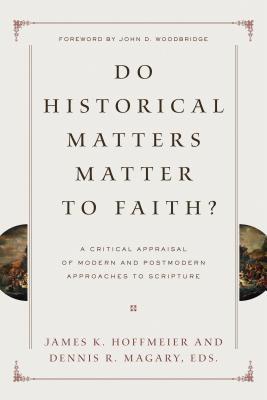
Evangelical apologists, a group which once would have included me, have had a confrontation with this evidence in sight for a long time. In Do Historical Matters Matter to Faith?, a group of evangelical authors published with a conservative press (Crossway, 2012) a collection of essays attempting to confront some of the “modern and postmodern” challenges to Scripture. John M. Monson’s chapter is entitled “Enter Joshua: The ‘Mother of Current Debates’ in Biblical Archaeology.” Monson notes that apart from the most conservative scholars, the Joshua conquest account has been taken to be historically unreliable (431).
Monson confronts this presumed unreliability by calling into question a few things related to consensus views of archaeology. First, he plants the seeds of doubt by complaining that archaeology has been “given a privileged role of proving or–through assumed lack of evidence–disproving the biblical record” (431). Note the wording of this first contention. The use of the word “assumed” here carries a lot of weight in the sentence. Monson is implying that people are simply assuming the biblical text is mistaken on the conquest (and other) accounts. But that implies that there simply hasn’t been anything found, and so people are assuming with “lack of evidence” that there is no evidence. That is not the case, however, as Dever and others have demonstrated. Dever’s book outlines a list of 35+ sites mentioned in the Biblical conquest accounts. Of those sites, only 3-4 have any evidence of even possibly being threatened by Israelite incursions, and the majority of those which have been excavated do not show a layer of destruction in the right timeline for the conquest narratives. Thus, it is hardly fair to say people are assuming the biblical account is unreliable based on a “lack of evidence.” Instead, there is positive evidence to suggest that the Joshua conquest accounts are indeed inventions.
Monson, however, goes on in his defense. He argues that archaeology is a younger discipline and that combining its findings with other disciplines remains “fraught with challenges” (435, 439), he suggests that archaeology is simply assumed to be the discipline to confirm ancient writings but implies that such a use is perhaps mistaken (438-439), and he maintains that archaeology, due to its “scattered, random, and incomplete nature” struggles to find the right place alongside the Bible’s account which “is selective, ancient, and theologically oriented” (439). Many of these points are points that resonate with me, particularly the latter. Archaeology, like paleontology, relies quite a bit on luck. Now, both disciplines can rely increasingly on technology to help guide their finds, so “random” isn’t necessarily correct, but there is no corrective for discovering things which simply no longer exist. Like ancient creatures whose entire fossil record may have been destroyed by vulcanism, excavation, construction, or simply lack of preservation, with archaeology there are any number of figments of the past which no longer exist for any number of reasons. To rely too heavily upon archaeology for the construction of the ancient past seems to be the wrong approach. However, Monson’s own words about the Bible being “selective, ancient, and theologically oriented” should suggest to him and other apologetically oriented and/or evangelical readers that perhaps it is their own view of Scripture which is at fault here. If they are going in assuming that a text written with a theological (or other) purpose is supposed to yield faultless history, then perhaps that assumption itself is worth questioning as well. Indeed, why not simply acknowledge that Joshua is attempting to make theological and selective points rather than convey a 100% accurate historical picture of what happened in Israel?
Monson, for himself, goes on to make an argument that Joshua records geographically accurate accounts of coming into the land. When I originally read the book about 10 years ago, I found this utterly convincing. However, reflection now suggests that Monson’s argument is too neat. For one, while it is elegant in attempting to show that Israel’s conquest as recorded in Joshua would make sense along geographic lines, that doesn’t account for the fact that whatever ancient writers/editors of the book would also be well-familiar with the geography of the region and so would be unlikely to invent or embellish an account which did not correspond to the geography of the area. Second, Monson claims that his argument from geography shifts the burden of proof such that it “lies with those who would deconstruct these stories” (452). That may be, but having two alleged campaigns correspond geographically with the reason does not somehow undermine or disprove the archaeological evidence directly showing that multiple sites allegedly conquered during this time period either show no signs of occupation or no signs of conquest. This, notwithstanding Monson’s claims that some of these sites were uninhabited and so wouldn’t have had such signs (I believe I’m understanding his argument correctly on p. 436-438).
Monson’s argument appears to be revisionist and reactionary. While he provides one positive evidence in support of his claim, his entire argument for these two supposed campaigns relies not upon the actual evidence of destroyed sites but rather on the lay of the land. Fascinatingly, Monson is forced into analogical language even in this geographic argument, such as spending extensive time arguing that the Hebrew word for “gate” can refer to geographical features (448-449). That may well be the case, but it is hard to credit Monson for making an argument that supposedly buttresses the Joshua conquest narratives against archaeological evidence when he is to be found arguing not just that “gate” means a geographical feature, but also that Ai, the region being considered, can be referred to as “The Ruin” due to another lengthy argument relying upon the definite article being used with “ruins” (443-444) and that Ai, apparently problematic for a number of archaeological regions, could have, “For all we know,” been “nothing more than a small squatter’s settlement in the vicinity of the imposing ruins of the mighty Early Bronze Age City of the third millennium BC” (437-438). Well sure, but for all we know, that “squatter’s settlement” would then not make a lot of sense as the sight for two massive military campaigns that crisscrossed a whole region!
Finally, the real motivation between Monson becomes clear at the very end of his chapter. After pointing out the text of Joshua shows him remaining faithful to God, Monson writes: “Over a millennium later, another Joshua walked through this same region. He too remained faithful. If we dismiss the real Joshua ben-Nun and his times, what is to stop us from dismissing the later Joshua, Jesus of Nazareth?” (457). This remarkable final sentence of Monson’s chapter is a case study in a loaded question. First, it implies that only by agreeing with the conquest narratives in toto can one agree there was a “real Joshua ben-Nun.” Second, it implies that there is an evidential link between Jesus and Joshua’s conquest narratives. That may be true, but it is unargued for here. Third, it uses scare tactics. Only those who agree with a slippery slope type argument will acquiesce to it, but for those people–presumably inerrantists–it’s a powerful way to thwart disagreement. After all, if the Bible isn’t historically accurate on Joshua, then that somehow means we have to question Jesus! This, of course, is ridiculous, but it’s exactly what Monson is implying. And frankly, this scare tactic shows where Monson is coming from in the earlier parts of his chapter. There’s not a genuine engagement with the evidence happening. Rather, the evidence needs to be massaged, evaded, or simply denied in order to maintain the story of Joshua at all costs; because for Monson, Jesus and the literal, genocidal conquest of Canaan stand or fall together.
Conclusion
It is probably clear to the reader at this point that I think Dever’s account is much more convincing than Monson’s. Yet, I say this as one who remains a Christian. Reading Dever actually gave me a sigh of relief. For so long, I had a bunch of issues with these accounts. Initially it was the ethical problem–why would God destroy these peoples? Later, I had the archaeological problem–now that I’d sacrificed my ethical impulse to condemn the slaughter, what if it hadn’t actually happened? To have someone who studies the archaeology simply lay out the evidence and say “This did not happen, and it was likely a fictitious invention to celebrate a folk hero” is, in a way, a relief. For one, his following that up with arguing that Judges is likely a much more accurate account makes me convinced yet again of something I’ve thought for a while–that once one leaves aside inerrancy, the biblical text becomes not just more readable but less scary in some ways–it doesn’t require you as a reader to constantly defend the indefensible. For another, setting aside the conquest narratives means that it is what I had long leaned towards–that these parts of the Bible are really just people trying to hyperbolically make “their guy” sound better than “the other guy”–seems backed by archaeological evidence. And Christians, we should truly be concerned with truth rather than attempting to support a pet doctrine, inerrancy, that doesn’t work on its own terms anyway.
All Links to Amazon are Affiliates links
Links
Be sure to check out the page for this site on Facebook and Twitter for discussion of posts, links to other pages of interest, random talk about theology/philosophy/apologetics/movies and more!
Reconstructing Faith– Links for posts related to my own faith journey and how I have been reconstructing faith (scroll down for more).
Inerrancy With No Autographic Text?– Even those looking to defend inerrancy are having difficulty with the concept of the autographic text. But what if it is not just that we can never find such a text, but rather that no such text existed to begin with? I argue that such is the case at least for some works and that inerrancy therefore does not work.
SDG.
——
The preceding post is the property of J.W. Wartick (apart from quotations, which are the property of their respective owners, and works of art as credited; images are often freely available to the public and J.W. Wartick makes no claims of owning rights to the images unless he makes that explicit) and should not be reproduced in part or in whole without the expressed consent of the author. All content on this site is the property of J.W. Wartick and is made available for individual and personal usage. If you cite from these documents, whether for personal or professional purposes, please give appropriate citation with both the name of the author (J.W. Wartick) and a link to the original URL. If you’d like to repost a post, you may do so, provided you show less than half of the original post on your own site and link to the original post for the rest. You must also appropriately cite the post as noted above. This blog is protected by Creative Commons licensing. By viewing any part of this site, you are agreeing to this usage policy.
Why I left the Lutheran Church – Missouri Synod: Still Faithful

Still Faithful
It has taken me a long time to work up to writing this post. It’s actually been more than a year since I last made a post in this series, in part because of my own processing of the events. However, I’ve been asked time and again by many who have left the LCMS or who have left evangelicalism or other restrictive Christian groups to tell about why I am still a Christian. Why did I stay, despite the abuse, despite so many things I saw as wrong, despite everything? And, an oft-unspoken part of the question that I’ve heard is “How?” How is it, that after all these observations, after coming to a place in which I found much of what I was taught and thought was true is totally wrong, that I continue to believe anything?
Faithful?
Part of my hesitancy to write this post is because I know from bitter experience how many might read it and scoff. “‘Still faithful,’ he says? He’s a heretic/wolf in sheep’s clothing/demon-possessed!” I have heard each of these from various people, including people in person. And, while it’s easy to say to ignore those people who dress up their power trip in theological garb, it is so much easier said than done. When you had a true fear of literal hellfire for many years, it’s very harmful to be confronted by people who use that fear to try to silence and oppress. So yes, I know the scoffers are out there, and that I’ll hear or see some of those awful comments again. But I still think it’s important to write on this because there are so many out there who are wondering if it is okay to still be faithful when so much harm comes from within. I write this for you–and for me.
I Still Believe… what?
One thing that is easy to trip up on as people are deconstructing and/or reconstructing faith is the constant refrain of questions pushing to get at exactly what we believe. I get that a lot from more conservative Christians and especially apologists, who are often, unfortunately, seeking to argue about whatever beliefs I espouse instead of engage with me honestly. I know this is true. I have my degree in Apologetics. Literally. I did this same thing from the other side, and I repent of that. Engaging online is often helpful because it opens you up to others who might be on the same path, but it also invites in those who simply out to argue with everyone. And so often, the way people are taught about Christianity is a “my way or the highway” mentality such that any divergent view isn’t just seen as wrong, but actually excludes the person who holds that view from the Christian community.
Suppose I told you that I believe trans people are worthy and loved by God not in spite of but for who they are. If your visceral reaction to that is to immediately turn to argument, then that is that same upbringing or that same background of beliefs I’m referring to. You, the one reading this, are using that belief I hold in order to “other” me. I am now “less than” on your view.
It is this black and white, either/or thinking that I have broken away from. It has taken more than a decade, and it has taken so much pain and spiritual agony and angst, but I have finally broken beyond the dichotomy in my thinking. None of this means that I don’t think that reality has things that are true or false, or that some theological positions are correct, while others are not. No, it’s the inherent urge to repress/correct/change those who disagree with me that I’ve broken out of. And, more importantly, it’s the urge in myself to stand upon certainty in all things that I am still in the process of breaking away. It’s okay to say “I don’t know” as a response to theological questions. It really is. And maybe you are fairly sure about some things. That’s okay, too. What I’m talking about breaking away from is that inherent tension, fear, and othering of anyone who disagrees or any belief that is different. Some things I do still hold fairly strongly to. Others, not so much. There are so many things I hold now that while I may be able to answer “I believe this about that,” I am also comfortable saying, “but I’m not really sure about it.”
All of this is to say I’m not as interested in the “nail down the answers to theological questions A, B, C, ….Z” approach anymore. Sure, there are many theological positions I still hold, and may hold firmly. But to me that’s so much less interesting than God in Christ.
False Gods
Recently, I went to a retreat for a bunch of progressive Christians or formerly-Christian people still interested in theology. It was incredibly life-giving. It was filled with praise. It was filled with questions. It was uncomfortable at times.
One song that I heard live was “Some Gods Deserve Atheists” by Derek Webb. I’d never heard it before. He prefaced his singing by saying we should constantly be trying to kill our gods. Any god we could kill simply by thinking hard enough about it would deserve such a death. And some gods deserve atheists–they aren’t real; they’re formed of hate or fear. For me, a god who created people for the express purpose of condemning them to an eternal hellfire is one such god. Such a god deserves atheists; that god is not worth our time or worship. That’s a god of “othering” when the God I believe in, the God I learned about in Christ, is a God of Love, a God who is literally described as love itself on the highest possible level. God is love; and any God who doesn’t reflect that deserves atheists.
Does this mean I’m putting myself in judgement of God? Well, only if that god is small enough to be able to be judged by me. Any god that can be so contained into a box that I can sit back and disprove that god in my head, or by that god’s fruits on Earth, is no god.
Still Faithful
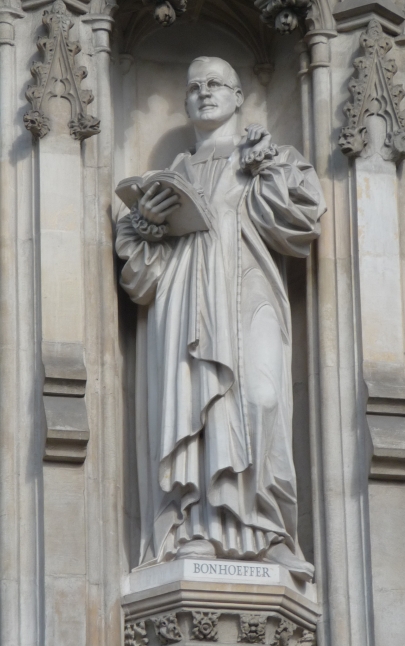
One thing that has shocked me, and that I am by turns disturbed and comforted by, is that a big part of why I still believe is that I still tend to think a lot of Lutheran answers to big questions are correct. Dietrich Bonhoeffer was a Christian theologian in Nazi Germany who was executed, in part, for his participation in the Confessing Church, a tiny minority of Christians in Germany who opposed the Nazis even as the overwhelming majority of Christians capitulated to or joyfully joined hands with them. Before he was murdered, some of his writings feature him speaking of “religionless Christianity.” Misinterpretations of his theology here have him lionized by various movements. But at the core of his thought wasn’t the overthrow of churches–that wouldn’t have made sense for a man whose theology included seeing sacraments such as Baptism as integral to Christian faith. The core, rather, is the stripping away of the structures that prevent Christians from living wholly into Christ or mirroring Christ to others. Bonhoeffer wrote of the maximal importance of living for the people around us and for the world. One helpful summary of religionless Christianity is found in Tom Greggs’s work, Theology Against Religion. Therein, he writes in part that religionless Christianity is “fiercely anidolatrous”–its doctrine of God seeks to constantly fight against the human tendency to create God in our own image or a God who defends our preconceptions; it is “resolutely unwilling to engage in articulating binaries“–it doesn’t seek to “other” but to unite; it is “not differentiating between sacred and secular spaces“–our lives are lives reflecting Christ in whatever spheres we enter; and it is “seeking to meet people in the fullness of their lives” (emphasis his, 218).
All of this is an extended way to get at some things I want to highlight. First, I think that the faith I hold now welcomes others in radical ways. Second, it remains tied inherently to streams of thought in Christian tradition, often reaching back to the earliest Christian theologians like Origen or Gregory of Nyssa. Third, it remains a faith radically against Christianity empowered by structures of state or hierarchies of power. That is, my faith stands against any use of Christianity for oppression. And yes, the church has so much to answer for here.
Finally, I must turn to a few concrete beliefs and affirmations because without them it doesn’t make sense of the question “How do I remain Christian” in a meaningful way.
The evils of the world, merely contemplating them, left me broken for a time. School shootings that could have easily been prevented if humans would have acted also call into question why God wouldn’t act. I mean, if God could really drop a stone on anyone at any point, why wouldn’t God do so–just once–in order to stop a school shooting in progress even as humans failed to do so? And the tired apologetic answer I used to rely on–that we don’t know how many such tragedies God has prevented by whatever means–just doesn’t work for me anymore. If God really could just intervene, why don’t we just see it?
I know all the answers to this question. Like, really. I studied theodicy so much while getting my degree. Molinism, open theism, process thought, free will defense, etc. The answers range from God doesn’t intervene because God has greater goods planned (free will, or whatever) to God can’t actually prevent such evil, so that’s why God doesn’t. And I have a confession: none of them are really satisfactory to me. Why does God allow evil? I don’t know. And the more I suffered over this question, the more I fell into holes of anxiety looking at the latest news of a massive shooting or some other horrible evil, the more I realized that I just don’t know, but I feel like I know other things that make me live in tension on this question. For example, I feel I know Jesus Christ is real, and that God is love. And since those feel real to me, and I believe them, I live in tension on the question of evil. If I were a really good Lutheran, I’d fully embrace an appeal to mystery here. And that’s kind of what I’m doing, in a way. But it’s deeper; I just don’t know that we can know. Whatever answer is given here is going to be unsatisfactory in some way. If it’s because God can’t prevent evil; to me that seems to make God smaller in ways I don’t understand. If it’s because God has some greater good in mind, it seems to underplay the real horrible suffering of people now. If it’s because God can’t prevent evil due to allowing for free will, it seems that it would be worth suspending free will–even entirely–in order to prevent so much suffering. And so I just… I don’t know. And I’m learning to be honest with myself in holding to that uncertainty.
Other theological questions have led to rethinking of positions. One such question was that of the fate of the lost. Why would a God who claims to be loving form people who that same God would then sentence to suffer for eternity? For a time, I held to conditional immortality, also known as annihilationism. That view, which I still think is better attested Scripturally than any kind of eternal conscious torment view, holds that those who don’t believe in Christ for whatever reason are ultimately annihilated or destroyed by God. Immortality, that is, is conditional upon faith in Christ. But I continued to struggle with this, whether it’s the reality that so many never get a chance to even hear about Christ, or that so many hear about Christ only through systems of colonialism and oppression, it didn’t make sense to me. Additionally, many verse in Scripture suggest that God wants all to be saved. So why not do so? More than that, long Christian tradition reaching back to the earliest teachers of Christianity affirms universal salvation. So, a short answer to the question of the lost and how I stay Christian regarding that question is that I think God will really reconcile the whole world to Godself, so that God really will be all in all (1 Cor. 15:28).
Ah! One might immediately challenge that with other scriptural verses that strongly suggest that not all are saved. And to that, another answer I have come to is that the Bible is polyvocal. It doesn’t speak with a united front on these topics. And, while that is annoying and has caused confusion and so much pain, it also is somewhat freeing and beautiful. God didn’t pigeonhole the authors of Scripture into losing their opinions and voices. It’s far more complex than that.
There are so many more, but these are some of the big questions I personally faced that I hadn’t addressed yet in the series, and some of the answers I continue to settle upon. I offer them not to try to convince you, but to try to answer the question of how I remain Christian. I remain Christian, in part, because I reconstructed my faith, and I came to answers that I think make more sense of reality than the answers I had before.
Concluding Thoughts
I have so much more to say. I wish that for those readers who ask me the question “why/how do you stay Christian” who are genuinely wondering about it, that I could sit and have brunch with you and talk about it for hours. I mean, isn’t that question so far reaching, so fascinating? And I look back over what I wrote and it all seems so small, and so inadequate to even begin the conversation.
For me, Jesus Christ is so fascinating, so loving, and so central still, that it compels me to come back time and again. When I see the awfulness that is so much of Christianity; the latest report of a Christian pastor using a position of power to assault or degrade others, for example, I find myself fleeing back to Christ. And I don’t mean a trite “that’s not real Christianity” type answer to the evils Christians perpetrate. The links of Christianity in America and power are too interwoven to pretend that real Christians don’t bring about much harm. Rather, what I mean is, I flee back to a God who came into our world, who suffered, and who rose, and who intentionally brought so much powerful goodness to the world that our lives, when viewed from eternity, will all be for good.
Links
Formerly Lutheran Church – Missouri Synod (LCMS) or Wisconsin Synod (WELS)– A Facebook group I’ve created for people who are former members of either of these church bodies to share stories, support each other, and try to bring change. Note: Anything you post on the internet has the potential to be public and shared anywhere, so if you join and post, be aware of that.
Leaving the LCMS/WELS– Not sure about whether to leave or thinking about leaving? Do you want to others who are thinking along the same lines? I created a group for those who are contemplating leaving these denominations, as well.
Why I left the Lutheran Church – Missouri Synod Links Hub– Want to follow the whole series? Here’s a hub post with links to all the posts as well as related topics.
Be sure to check out the page for this site on Facebook and Twitter for discussion of posts, links to other pages of interest, random talk about theology/philosophy/apologetics/movies and more!
SDG.
——
The preceding post is the property of J.W. Wartick (apart from quotations, which are the property of their respective owners, and works of art as credited; images are often freely available to the public and J.W. Wartick makes no claims of owning rights to the images unless he makes that explicit) and should not be reproduced in part or in whole without the expressed consent of the author. All content on this site is the property of J.W. Wartick and is made available for individual and personal usage. If you cite from these documents, whether for personal or professional purposes, please give appropriate citation with both the name of the author (J.W. Wartick) and a link to the original URL. If you’d like to repost a post, you may do so, provided you show less than half of the original post on your own site and link to the original post for the rest. You must also appropriately cite the post as noted above. This blog is protected by Creative Commons licensing. By viewing any part of this site, you are agreeing to this usage policy.
“The Book of Mormon” (The Musical) and Reconstructing Faith
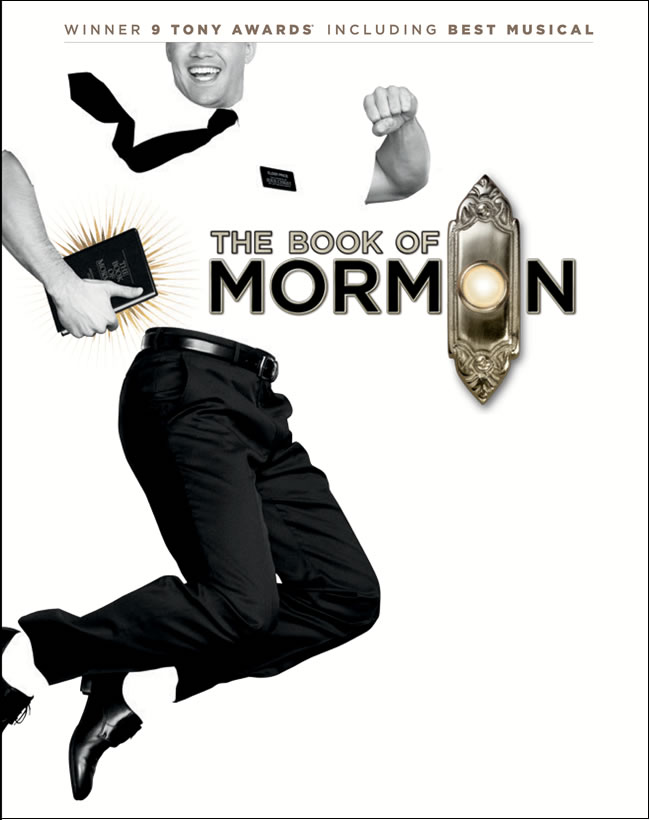
I recently saw the musical “The Book of Mormon” in person for the first time. Going in, I knew very little about the Broadway show, just that it featured Latter-Day Saints (LDS) as major characters and the Book of Mormon itself in a critical light. I wasn’t really prepared for just how over the top and wild it would be. For those interested, a good plot summary can be found on Wikipedia.
CONTENT WARNING: my reflection will discuss violence, explicit language, sexual violence, and other sensitive topics the musical talks about.
One major thought I had throughout the whole production is that it is almost entirely mocking of the faith of LDS believers. Satire is often useful, but at some point it definitely becomes mean-spirited. And I’m almost positive that is at least some of the intent behind the show. It starts to feel like beating a dead horse after a while.
One also wonders about the application writ large behind a lot of the musical. The point is ridicule of beliefs that are presented as absurd. And that is done in order to bring laughter, yes, but also to shift viewers’ minds about the subject matter. If we’re laughing at the beliefs of another worldview, it is much easier to dismiss the claims without any kind of argument or evidence. The scenes going back to “early America” with Jesus visiting New York and the burying and discovery of the Book of Mormon itself make this even more explicit. Here, the curtain is occasionally totally drawn back to reveal the point being made, with interjections like “or something” or “just because” [I don’t remember the exact phrases] added amidst the truncated telling of some of the history of the Book of Mormon and LDS history.
The type of argument isn’t subtle. Ridicule as dismissal of opposing views has a long history in not just public discourse but in philosophy. Any study of ancient rhetoric or readers of debates like the deistic controversies in England would easily find examples of the same. But when one wields the hammer of satirical mockery against beliefs with which one disagrees, any and every belief can start to look like a nail. After all, if it is hilariously ridiculous to believe that one is going to inherit one’s own planet to populate for oneself, is it all that much less ridiculous to believe that one man could die and take on the guilt/sin/etc. of all other humans past, present, and future? Or isn’t it absurd to think the universe oscillates between expansion and contraction, going from a Big Bang to a Big Crunch and back again into the infinite past and future? Or that all the matter and energy in the universe was once smashed into a teensy, infinitesimal point before it exploded to make everything we see now? Or… or… Eventually, any belief system could be subjected to the same satirical ridicule. One’s simply happening to believe the thing that is being mocked is largely what determines one’s reaction to that ridicule. It goes quickly from laughter to “Hey, it’s actually pretty reasonable to think that…”
But there are also plenty of things to reflect on with the musical aside from this point. First is the extremely explicit cursing at God found among the villagers of the fictional place the LDS missionaries went to in Uganda. A whole song is dedicated to singing “F you, God,” much to the horror of the newly arrived missionaries. While the explicit nature of the song and its totally in-your-face style is probably meant to needle audience members and make many uncomfortable, I was wondering personally about the imprecatory Psalms. In those Psalms, the writers cry out to God for justice in the midst of the horrors they’re witnessing on Earth. And “The Book of Mormon” makes clear some of those horrors. In this fictional village, the people live in terror of a local warlord who has threatened to come and forcibly circumcise all the women in the village. The villagers nearly all have AIDs (interesting to note that Uganda has been effectively working to reduce the spread of AIDs: see here). Others deal with other diseases. Poverty, hunger, drought, and more afflict the village, such that life is depicted as an attempt to survive every single day both physically and mentally.
The above situations highlight another aspect of the musical which challenges concepts from Christianity. When missionaries come to tell the people of Uganda about Jesus–they have other things on their mind. The immediate problems already discussed seem far more important than the possibility of an afterlife with no suffering. One character misinterprets the everlasting hope the missionaries intended to provide with a real here and now hope found in a mystical Salt Lake City where the missionaries can bring the people away from their troubles. Another of the missionaries embellishes the stories from the Book of Mormon with concepts from Star Trek, Star Wars, and other fantastical settings. In doing so, he makes a kind of new Book that answers the questions of the people in their real world situations. Later, we find that most of the people saw the words of the Book as metaphorical, giving some ambiguity to their beliefs.
Mission work though, one supposes, must encounter much of the same. What kind of real hope is being offered to people if their current problems aren’t addressed? And what kind of contextualization takes things beyond the text? And what kind of help is missionary work doing? I don’t know the answers to these and many related questions that come up, but the musical forcefully raises them.
“The Book of Mormon” pokes and prods at just about any religious bone in anyone’s body. I’ve noted some problems with it, but I think that it also can force people like me to think on some of the harder topics in ways we may not have before.
Links
Reconstructing Faith– Read other posts as I search for truth and navigate the messiness that is faith.
Be sure to check out the page for this site on Facebook and Twitter for discussion of posts, links to other pages of interest, random talk about theology/philosophy/apologetics/movies and more!
SDG.
——
The preceding post is the property of J.W. Wartick (apart from quotations, which are the property of their respective owners, and works of art as credited; images are often freely available to the public and J.W. Wartick makes no claims of owning rights to the images unless he makes that explicit) and should not be reproduced in part or in whole without the expressed consent of the author. All content on this site is the property of J.W. Wartick and is made available for individual and personal usage. If you cite from these documents, whether for personal or professional purposes, please give appropriate citation with both the name of the author (J.W. Wartick) and a link to the original URL. If you’d like to repost a post, you may do so, provided you show less than half of the original post on your own site and link to the original post for the rest. You must also appropriately cite the post as noted above. This blog is protected by Creative Commons licensing. By viewing any part of this site, you are agreeing to this usage policy.
Why I Left the Lutheran Church – Missouri Synod: Points of Fracture: Women in the Church Part 2
The reasons I left the Lutheran Church – Missouri Synod were complex. Whether it was the science I was taught as a child not aligning with reality or the misogynistic and racist actions of pastors and those training to be the same, or any of a number of other issues I had, these all were contributing factors. Now, I am going to spend some time on perhaps the biggest reason I am no longer part of the LCMS, which is their views on women in the church and home. This is a deeply personal subject for me, and I have numerous personal stories related to it. Names and other details may be modified for privacy.
Points of Fracture: Women in the Church, Part 2
I wrote before about being confronted about the possibility of women being pastors when I was in college and dated a woman who wanted to be a pastor. I went straight to texts approved by the LCMS to try to prove that women could not be pastors. For a while, I was in a comfortable space thinking I was right, despite a few hiccups here and there. But one question that I’d never thought of before continued to plague me: why couldn’t women be pastors? It was one thing to read the texts a certain way and believe they excluded women from the ministry, but why would that be?
The answers I received when I asked LCMS pastors–who were plentiful at my school and the churches I attended in college–were unsatisfactory. With few exceptions, they boiled down to “Because God said so.” I could accept that. There were plenty of things I believed God had done or determined that I either couldn’t understand or hadn’t the information to even begin trying to comprehend them. But what bothered me more is that this didn’t seem to be the reason given until very recently. When I looked into why women were excluded from the ministry in older LCMS works or in church history, the answer continually came up that women had less ability to pastor. That is, they weren’t as smart, or they had some inferiority in them. Or, because of the curse from the fall, women had to submit to men. Another answer was a reading of 1 Timothy 2:14 (“Adam was not the one deceived; it was the woman who was deceived and became a sinner”) that claimed women were inherently more prone to being deceived.
These reasons, while they didn’t align with reality I observed, at least were reasons apart from “God said so.” As someone who was becoming increasingly interested in Christian Apologetics (a branch of theology in which people work to defend the Christian faith against objections and provide positive reasons for belief), I was especially sensitive to the “God did it” type of reasoning which many non-Christians accused Christians of appealing to when it came to questions of how the universe works. To me, having a reason why women shouldn’t be pastors, even if it was a poor and transparently misogynistic one, was better than having no reason other than a bare appeal to authority. But this reason didn’t stand up when I raised it to others. At one point, I recall even foolishly raising it to the young woman I was dating who wanted to be a pastor. She shot the reasoning down with all the scorn it deserved. After all, did I really, truly believe that men were any less inclined than women towards sinfulness? And didn’t the Lutheran confessions themselves teach that all people–men and women alike–are inherently sinful? How did men somehow get a free pass on this?
I realized that the reason I’d found didn’t work pretty quickly. Not only did it not match reality, but it also was blatantly misogynistic on a level with which I was uncomfortable despite the misogyny in my own background (see, for example, here). This left me adrift. I thought the Bible taught women couldn’t be pastors, but I could find no adequate as to why that should be the case. Then, one day, I walked into a Christian bookstore and came upon a book: Man and Woman, One in Christ by Philip Payne.
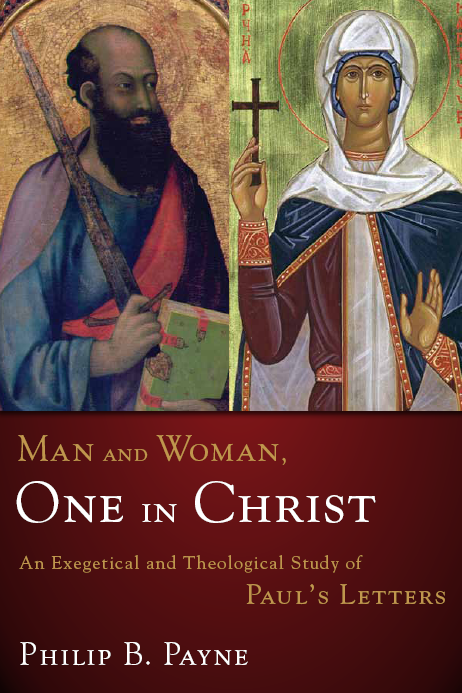
The first few pages of the book had the author talking about how he affirmed inerrancy but believed that men and women were equally gifted to serve and lead in the church. Here was someone who claimed to believe as I did about the authority of the Bible while still affirming women in leadership. I bought the book and over the course of the vacation I was on I read it, underlining copiously, looking up Bible passages (“Does it really say that!?”), looking at my Greek New Testament, and more. Payne focused on the Pauline corpus related to women in the church, but as that’s where the most significant “clobber passages” were drawn from in my own tradition, that made it a nearly comprehensive study of the topic. And what I found is what I’d begun to suspect: the reading I had been taught was mistaken. Not only did it ignore the cultural context of the text, which I’d been taught was important for understanding the true meaning of the words, but the readings were simplistic on the highest level. They relied, often, on English translations by people already inclined to exclude women from ministry in order to make their points. Payne’s analysis was insightful and absolutely cut the core out of my own view.
I still wasn’t ready to accept women as pastors, but I realized I had massively oversimplified the biblical debate. Then, one day, push came to shove.
My girlfriend had changed her career path because of my objections to her chosen field. She’d decided to study psychology and possibly do some kind of family counseling. But then she came to me telling me that her sense of call from the Holy Spirit into the pastoral ministry hadn’t gone away. Indeed, in some ways it had strengthened. Could I accept what she felt called to do?
I prayed fervently that God would show me the way. I believed–and believe–that God answers prayer, and I dedicated most of my free time for over a week to ask God to guide me. Finally, I prayed one night something like, “God, I know I should not test you, but even your servant Gideon asked for a sign[1]. Please, show me a sign.” I set my Bible on my bed, and flipped it open.[2] It landed on 1 Corinthians 12. I started reading, and became greatly agitated. There it was, about as plain as it seemed it could be, 1 Corinthians 12:28: “And God has appointed in the church first apostles, second prophets, third teachers, then miracles, then gifts of healing, helping, administrating, and various kinds of tongues.” The verse showed that God put an order in the church. That order seemed to be a kind of authoritative or hierarchal order. First were the apostles, second the prophets, third the teachers, and then other gifts. But those first 3 were numbered in an order form first through third. And every understanding I’d seen of pastors in the Bible would say the word “teachers” could be applied to pastors. And, while Junia was an apostle in the Bible, I hadn’t yet read enough on that topic to realize how important she was or even acknowledge that fact. No, what mattered is that women were prophets in the Bible. Absolutely no one could deny that. But if that was the case, then women prophets were set above teachers in the church by God Himself.
It can’t be emphasized enough how much this verse shifted my understanding of the topic. I had been taught that men were suppose to have more authority than women. Indeed, the word “authority” was absolutely essential to an understanding of the topic of women in the ministry. Women just weren’t supposed to have authority over men, they were supposed to submit to them in everything. But here was a verse that plain as day stated that prophets ranked above teachers–the word I’d been assured was one of the biblical words for pastors. And because women prophets existed and no one denies that, that meant that women could be above pastors in whatever sense the verse meant.[3]
It was a revelation, and one that had struck me at the very moment I’d been most fervently praying for a sign from God. There it was. What more could I do than acknowledge it? My mind had been changed, and not because I wanted it to be changed for the sake of my relationship. It hadn’t been changed by “the culture,” whatever that’s supposed to mean. It had instead been changed by prayerful consideration of the text and a strong adherence to carefully reading the same. My mind had been changed. Women could be pastors. I realized this was going to be a major life-changing event for me in a way that people outside some obscure theological debates might not be fully able to grasp. It truly was a paradigm-shifting moment in my life, and one about which I’d not yet realized the full implications and consequences that would follow.
[1] The book of Judges has been a longtime favorite of mine, ever since I was enthralled by the illustrated kids’ Bible in which the action hero nature of this book made it jump off the page. Gideon’s story can be found in Judges 6 and following. The part I was referencing was Judges 6:37-40.
[2] I realize some readers might be uncomfortable about thinking God works this way. So am I. I don’t think God typically works in such a fashion. I can only report what I experienced and my belief that, in the moment, God used a broken, mistaken understanding about how God works to bring me to a better understanding of the Bible.
[3] Obviously much more nuance is needed here, and I’ve since thought and read quite a bit about this issue. However, I’ve yet to see a complementarian answer about this specific verse that is able to read the words on the page without somehow subverting the order in the church as stated here.
Next: Women in the Church Part 3- I write about my experience within the LCMS on the other side of the issue of women in the church.
Links
Formerly Lutheran Church – Missouri Synod (LCMS) or Wisconsin Synod (WELS)– A Facebook group I’ve created for people who are former members of either of these church bodies to share stories, support each other, and try to bring change. Note: Anything you post on the internet has the potential to be public and shared anywhere, so if you join and post, be aware of that.
Leaving the LCMS/WELS– Not sure about whether to leave or thinking about leaving? Do you want to others who are thinking along the same lines? I created a group for those who are contemplating leaving these denominations, as well.
Why I left the Lutheran Church – Missouri Synod Links Hub– Want to follow the whole series? Here’s a hub post with links to all the posts as well as related topics.
Be sure to check out the page for this site on Facebook and Twitter for discussion of posts, links to other pages of interest, random talk about theology/philosophy/apologetics/movies and more!
SDG.
——
The preceding post is the property of J.W. Wartick (apart from quotations, which are the property of their respective owners, and works of art as credited; images are often freely available to the public and J.W. Wartick makes no claims of owning rights to the images unless he makes that explicit) and should not be reproduced in part or in whole without the expressed consent of the author. All content on this site is the property of J.W. Wartick and is made available for individual and personal usage. If you cite from these documents, whether for personal or professional purposes, please give appropriate citation with both the name of the author (J.W. Wartick) and a link to the original URL. If you’d like to repost a post, you may do so, provided you show less than half of the original post on your own site and link to the original post for the rest. You must also appropriately cite the post as noted above. This blog is protected by Creative Commons licensing. By viewing any part of this site, you are agreeing to this usage policy.
Why I Left the Lutheran Church – Missouri Synod: Points of Fracture: Women in the Church Part 1
The reasons I left the Lutheran Church – Missouri Synod were complex. Whether it was the science I was taught as a child not aligning with reality or the misogynistic and racist actions of pastors and those training to be the same, or any of a number of other issues I had, these all were contributing factors. Now, I am going to spend some time on perhaps the biggest reason I am no longer part of the LCMS, which is their views on women in the church and home. This is a deeply personal subject for me, and I have numerous personal stories related to it. Names and other details may be modified for privacy.
Points of Fracture: Women in the Church, Part 1
My dad was an LCMS pastor, which meant that I’d only had a male pastor–him–my whole life. I don’t recall ever hearing anything about whether women could or could not be pastors as a young child. I met several other pastors and families, of course. My parents formed lasting friendships at seminary and many of their friends and circles they were in were LCMS pastors as well. I never really thought about the fact that all the pastors I met were men.
The first time I remember encountering anything about whether women could be pastors was in middle school, at an LCMS school. We were in small groups talking about future careers and in my group there was a girl who said she wanted to be a pastor when she grew up. Again, I’d never really thought about it one way or another that I can recall. I mentioned it to a few LCMS people in the school and was told that no, women couldn’t be pastors. It was against the Bible. Nothing could be a higher authority than that. There wasn’t an in-depth discussion of why women couldn’t be pastors, or what verses allegedly made that the case. It was just that: because the Bible says so. Carelessly, I then went back to that girl and told her she couldn’t be a pastor. Why not? Because the Bible says so. I felt a kind of righteous vindication, because I was telling her what God had said about what she could or couldn’t do. I’m sorry.
It wasn’t until college that I would have any further reflection on women pastors. After a deeply religious experience, I decided to become a pastor. Knowing the LCMS well, I knew that involved a kind of commitment to doctrinal purity. Whether it was biblical inerrancy, ordaining only men, or something else, I knew I had to be ready to fight the ways of the world when it came to these things. After the summer, I was in student leadership as a spiritual life representative–think of them kind of like Resident Assistants, but for spiritual life. We did devotions in the dorms, were there for talking, that kind of thing. I helped move the freshman in on their first day, and I met one young woman. We hit it off and decided to hang out later.
Later that week, I was at breakfast for pre-seminary students, those who were planning to go on to be pastors, and she showed up at the breakfast. I was stunned. Why… was she here? It turned out she was there because she was planning to study to become a pastor–something she was manifestly Not Supposed To Do. The series of events after that is difficult to piece together, but I know that the theological question of whether women could be pastors went from something I couldn’t be bothered to learn more about to something that I needed to be able to prove to others. I needed to be able to show that women should not be pastors.
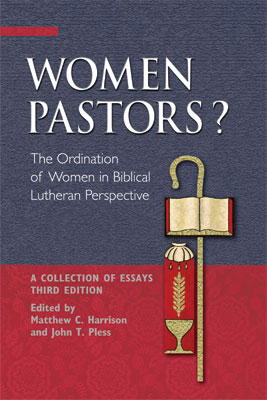
Like some of my favorite literary characters, when confronted with a challenge to something I thought, I hit the books. And, like most people do, I hit the books on my own side to see how I could refute this belief. The first book I dove into was Women Pastors? The Ordination of Women in Biblical Lutheran Perspective edited by Matthew C. Harrison and John T. Pless. The book was published by Concordia Publishing House, the publishing arm of the LCMS. It had, in other words, a doctrinal seal of approval that meant I could trust implicitly anything that it had to say therein. I knew that this book would have the answers I was seeking. However, as I cracked the cover and skimmed through the chapters, I found some things of deep concern. While passages like 1 Corinthians 14:34-35 were cited and used to silence women in the church, other exegesis did not align with what I was being taught about how to read the Bible.[1]
For example, in a chapter about the Trinity in the book, I read, “Even though [God the Son] is in all ways equal to the Father and in no way inferior to the Father, he is nevertheless utterly subordinate to the Father… Christ’s relation as Son to his Father is therefore characterized by his subordination to the headship of the Father” (222-223, first edition only, the chapter by John Kleinig). This was not what I’d learned about Trinitarian orthodoxy. Indeed, it seemed to be skirting the lines of Arianism. I was strongly put off. Much later, I’d learn that this chapter was either removed or heavily edited in a subsequent edition. At the time, I was shaken. If this was the kind of thing that got past official doctrinal review, what would it mean for other doctrinal issues?
Of course, this hardly caused a collapse of my position. Other chapters seemed more solid in their approach, and I felt like I was armed to show people, especially this young woman, why women shouldn’t be pastors after all. I don’t recall exactly how our discussion played out, but I do know it didn’t escalate into an outright argument. She decided to switch from the pre-seminary program to a different one, and I thought that’d be the end of it.
It wasn’t. The question was opened in my mind. It was even more open because I realized there were people who appeared to be faithful Christians who nevertheless believed women should be ordained and, shockingly, there were even ordained women pastors who weren’t clearly working to undermine Christianity at every step. I know this reads dramatically, but this is truly the way I thought, and certainly the way many pastors and others I interacted with thought about women pastors. The Bible, it is assumed, is simply so clear on whether women can be pastors that anyone who disagrees and even engages in the opposite practice absolutely must be some kind of heretical person or someone actively working to try to discredit Christianity. But because the question had been opened, I couldn’t just drop it. I kept investigating, despite the fact that the woman I was dating had changed course. This wasn’t the kind of thing I could just drop and leave aside. The very question of whether God was calling women into the ministry was at stake. If I really believed that God wanted to keep one half of the human population from even being possibly called by the Holy Spirit, I wanted to be sure that I was supremely confident that I was right.
I kept reading the Women Pastors? book, but became more and more disillusioned with the LCMS arguments against women pastors. Contradictory arguments abounded, and the exegetical principles used to conclude women couldn’t be pastors were simplistic even by the standards I was being taught in LCMS pre-seminary classes. It was like the pastors and theologians who’d written the book had abandoned things like the historical grammatical method when it came to this one issue.[2] I began to start asking questions, mostly in private, about the LCMS teaching on women pastors, but was met with either horror or a blanket statement about how clearly the Bible taught against it.
It’s worth a brief aside here at how often people–including more than one pastor–would try to silence the questions I was asking about women pastors or other issues by quoting Satan in the Garden of Eden: “Did God really say?” [Genesis 3:1]. This was used time and again as an answer to any questioning of the LCMS’s supposedly clear and exclusively biblical teachings. So, when it came to Genesis 1-3 and I pointed out that it seemed to be based upon ANE myths while turning them on their heads to refute aspects of them, not a literal, blow-by-blow account creation, I was told that I was like Satan in saying “Did God really say” that creation happened a certain way. When I asked about whether a verse truly taught what I was told it did, I was again questioning not the interpretation, but the word of God itself: Did God really say what the LCMS said it did–oops–what the Bible says God did? This clobber passage in context, of course, isn’t intended the way these pastors and others were using it at all. Indeed, the phrase itself is ripped from the middle of a sentence from the serpent’s mouth in which he was asking specifically about whether God had told them not to eat from any tree in the garden. The way the passage was being used against me was abusive and did cause trauma. Imagine being told that you’re just like Satan, tempting others with your nefarious questions just because you genuinely care about and want to know what the Bible says. It’s terrible.
My questioning would continue as I kept reading more about the topic, but while I was no longer convinced the Bible taught women shouldn’t be pastors with certainty, I was also unconvinced by arguments that women should or could be pastors. I was stuck in a kind of confused middling view. It was deeply uncomfortable, and not just because the woman I was dating had agreed to change her life based upon my discomfort. No, the very way God worked to call people to the ministry was at question, and I struggled to find any reason why God wouldn’t call women apart from a trite “The Bible says God doesn’t do that” type of answer. But did the Bible say that, or did it only read that way if one adopted the overly-simplistic hermeneutic I saw time and again in LCMS works on the topic–a hermeneutic that was different from the one I was being taught in LCMS classrooms? It was a question that would loom larger soon.
Next Time: Women in the Church, Part 2
There had to be some kind of reason why women weren’t called to the ministry. Only in some older LCMS works or references to earlier Christian teaching on the topic would I find any kind of answer.
[1] I wrote more about this same phenomenon when it came to young earth creationism. Time and again, despite being told to read the Bible contextually and take care to try to find the original meaning, the historical sense, etc., I did not find that reading reflected in LCMS teaching or reading of various texts. And, when I challenged those readings, I was told that I was challenging the text itself.
[2] I have been critically reviewing the Women Pastors? book chapter-by-chapter. Not all of the issues I raise with it in my reviews were ones I realized at the time I’m writing about now, but the more one reads the book, the more one realizes the poorly argued nature of it. See also note 1 above and the link therein about how I found on other issues the hermeneutical method I was being taught and the one actually being used did not align.
Why I Left the Lutheran Church – Missouri Synod: By Their Fruits… (Part 5)

By Their Fruits… (Part 5)
My previous posts in this miniseries focused on specific things: my discovery that Christians could believe one thing and act in ways contrary to it, racism I encountered in the LCMS, misogyny I encountered in the LCMS, and homophobia rampant in the LCMS. This post will summarize several other aspects of practice and belief I found within the LCMS that drove me away. It comes from a wide variety of sources, but again, I focus on behavior from people who either were leaders in the LCMS (pastors, professors, teachers) or were studying to become those leaders. These are not stories of random laity, but trained LCMS people. Other examples are specifics about LCMS teachings, whether official or not. [1]
Growing up in LCMS schools, I learned to say not just the pledge of allegiance, but the pledge to the cross. Yes, the pledge to the cross. “I pledge allegiance to the cross of our Lord Jesus Christ, and to the faith for which it stands, with mercy and grace for all.” We would stand and say the pledge to both flags, which were set up across from each other in classrooms and sanctuaries. It didn’t bother me until I was a young adult that we would say a pledge to both–as if our allegiance to a nation state should be as strong or on the same level as our allegiance to Christ. When I started to raise objections to flags in sanctuaries or unquestioning allegiance to our nation, I was told, basically that that was along the lines of a Jehovah’s Witness and because they were wrong about everything, I shouldn’t agree with them on this topic. That didn’t sit well with me.
It wasn’t until years later, when I read The Myth of Religious Violence by William Cavanaugh (book review here), that I could better articulate my problems with the integration of nationalism and religion that remains entrenched in many LCMS churches. When I started to express those views, the reaction was almost entirely negative. Flags were in sanctuaries in part, I was told, because of a holdover from when the LCMS shed some of its outward associations with Germany, particularly during WWI[2]. But that didn’t explain why they needed to remain there, or why the pledge to the cross was said alongside the pledge of allegiance. The nation state, I kept pointing out, seemed to be elevated to the same place as allegiance to Christ. The flag in the sanctuary was and is very often next to and on the same level as the so-called Christian flag. The pledges were said in tandem. As a kid, the link between the two was impossible to miss. As an adult, no correctives were offered. Nationalism is frequently conflated with patriotism, just as it is in the general populace. However, reconciling my belief that our allegiance should be to Christ alone with the way allegiance to the nation state is assumed and even pushed within the LCMS became impossible.

Pastors in the LCMS are extremely inconsistent when it comes to practice related to the Lord’s Supper. Many speak with pride about the extreme doctrinal purity the LCMS pushes. In practice, however, maintaining that supposed purity gets complicated. As a kid, I remember not taking communion in other churches. It was because they believed differently from us, and so we weren’t supposed to participate in that. I specifically remember one time before I was “confirmed”[3], I was offered communion at a Methodist church. I was super excited to take it, but (as I recall-it was a young memory) my hand was physically moved from taking the bread or grape juice offered. I remember people being denied communion in our church, and some of them being upset by that. Again, I learned it was because of different beliefs about what communion was. When I got older, I learned that the reasoning behind denying others communion was because we didn’t want people to eat and drink destruction on themselves. This belief was backed by a rather idiosyncratic reading of 1 Corinthians 11:27: “So then, whoever eats the bread or drinks the cup of the Lord in an unworthy manner will be guilty of sinning against the body and blood of the Lord.” This verse was used to justify virtually any reason for not allowing a person to have communion.
While the LCMS has produced documents about who should and should not be allowed to receive communion, from firsthand experience I can say that these documents are entirely ignored or applied whenever the pastor desires (or not). Ultimately, the practice of closed (or, a preferred term: “close”) communion, while given lip service as a way to protect people from grave sin, is wielded by many LCMS pastors as a totally arbitrary way to punish those with whom they disagree. Alternatively, refusing communion to people can enforce a pastor’s doctrinal whims. Indeed, the LCMS website itself renders many decisions to the “individual pastor’s judgment,” such as whether someone with Celiac disease can have communion with gluten-free wafers. Thus, it is entirely possible for there to be LCMS churches in which, because the pastor chooses not to use gluten free wafers, people with Celiac disease are effectively excommunicated not because of different belief but because of a chronic immune disorder.
The decision about whether or not to commune someone was totally arbitrary even in churches in which I found inserts about their beliefs about who could or could not commune in bulletins. One church had such an insert, and it said, essentially, that people who differed about the real presence of Christ’s body and blood in the bread and wine could not receive communion. I remain Lutheran, and affirm real presence to this day. When I was denied communion by the pastor of that same church, he justified it by saying that because I disagreed with the LCMS on other things, I couldn’t really share their belief on real presence, as all beliefs are ultimately tied together. Such a reach for what can or cannot qualify someone based on what is already a tenuous reading of Scripture effectively meant this pastor believed he could exclude anyone from communion for any reason. I told the pastor this, and he just smiled and said he wasn’t changing what he said.
In the LCMS, one of the strongest beliefs I was taught was the need to properly divide law and gospel. C.F.W. Walther, perhaps the single most influential LCMS pastor and leader, wrote a book on the topic. There was no question in my mind that the arbitrariness with which this pastor and others applied closed communion was a key example of mixing gospel (the forgiveness found in the Lord’s Supper) with law (attempts to punish people for disagreement or call out sin therein). This was not the first or only time I’d be denied communion for absurd reasons. Another time, while staying at a friend’s house on a trip, I was denied communion because I didn’t affirm young earth creationism. Indeed, that pastor’s interpretation of 1 Corinthians 11:29 meant that I’d be unworthily receiving the body and blood because I disagreed about how old the planet is. At that stage, I was still a member in good standing within the LCMS and regularly attended an LCMS church, at which I was given communion. In spite of that, I was denied communion at this LCMS church based on the age of the Earth. The practice is, again, entirely arbitrary. LCMS documents and leaders give lip service to how it protects people, but show total disregard for the spiritually abusive way many pastors apply the practice to exclude Christians from participating in Christ’s body and blood.
I could illustrate this time and again with many, many firsthand accounts or accounts shared with me by others. Another Lutheran was denied communion when they were traveling as part of an LCMS choir because they weren’t a young earth creationist. At a different time, the same person was denied communion because they believed women could be pastors. In neither case was this policy stated, nor were others on the same trip queried about their beliefs on those same topics. The only reasonable conclusion is that LCMS pastors are totally arbitrary about when they apply the doctrine of closed communion. This should be seen as a damning indictment of the practice. After all, the LCMS teaches that closed communion is intended to protect people’s souls, or at least protect them from unknowingly participating in sin. If that’s the case, then why would something with such huge import be so subject to inconsistency about its application? And how is it possible that people like me could go to four different LCMS churches and experience 4 totally different practices about communion such that I received it without question in one, after a brief discussion with the pastor in another, and was denied it for totally different reasons in two others? Inconsistency is one of the surest signs of a failing belief or system, and it can be found all over regarding this practice in LCMS churches. The leadership of the LCMS has effectively handed individual pastors a carte blanche to use their office to arbitrarily withhold the Sacrament from parishioners for whatever reason they desire. It’s a recipe for abuse of the system.
In LCMS schools, I was taught to read the Bible. It’s a legacy I keep to this day, and one I hugely appreciate. When I got to college, I finally began learning more about how to read the Bible, not just to read it. The consistency with which the method was applied was impressive, as I found multiple different professors in the theology department (all of whom were pastors) emphasizing points that were, if not the same, then essentially interchangeable. The bedrock belief was that scripture interprets scripture. Another hallmark of the system was talking about the historical grammatical method of interpretation. The historical grammatical method includes attempting to find the original meaning of the text. I found this exciting, because it meant that for the first time, I was reading about history and archeology and seeing what they could teach me regarding the Bible. This was alongside my surging interest in Christian apologetics. I was (and am) fascinated by finding out about idioms in the Bible, or euphemistic language that explained why things were written in the way they were. It was truly an exciting time.
Then, it started to become problematic. The simplistic reading of passages that I grew up with started to make less sense. Some of this coincided with my turning away from young earth creationism. There was a distinct incongruity between what I was learning regarding what the original intent might have been for a passage and what I was supposed to accept it to mean. It culminated in one private discussion with a professor (who, again, was an LCMS pastor) in which I pointed out that it seemed like the Flood story had precursors in the ancient world, and that it seemed to be almost polemical in its intent rather than historical. That is, the Flood story to me read as an intentional reframing of existing stories to teach monotheism and about how God overpowered forces of chaos than it did as a sort of rote historical report. This reading, the professor pointed out, contradicted another aspect of the historical grammatical method, which is that the events depicted in the Bible are actually historical essentially all the way through. I would later learn that this was a distortion of what evangelicals broadly held to be the historical grammatical method, and that would be its own kind of revelatory gain. In the moment, however, I was a bit shocked. I was simply trying to apply the hermeneutic I’d been learning to the texts themselves. Instead, I was being told that I was undermining Scripture as history and, possibly, denying the Bible itself.
When I shared my thoughts with another LCMS pastor, I was told straightforwardly that the way to distinguish someone who believed the Bible or not was to ask them about whether certain passages or books were historical. Thus, this pastor said you should ask whether they believe Jonah was a real person who was truly swallowed by a whale (or, he conceded, maybe a giant fish instead). You should ask whether they believe Adam and Eve were real and whether they were the first and only humans. You should ask whether a snake literally did speak to them. Noah’s Flood was another example. This pastor wasn’t just implying that denial of any of these meant one didn’t believe the Bible, he straightforwardly said it. That meant that my reading had to be rejected out of hand. I was devastated, but for the moment I dropped my investigation of Ancient Near Eastern background for the text. It would take me years to get back into it, and to this day I’m still trying to find resources to learn more.
One thing I’d theorized for a while about the LCMS and other groups that push beliefs that are outside of mainstream science was that once someone starts to disbelieve scientists regarding one thing, it becomes much easier to doubt scientists in other things. I wrote about how, as a child, I learned that scientists weren’t just wrong but were actively lying about things like the age of the Earth. Once you’ve accepted that there is some kind of global scientific conspiracy to cover up something like the age of the Earth, it becomes much easier to accept that same kind of thinking in other areas.
I dove into the question of climate change entirely from the view of one who wanted to deny that it was occurring. Again, from hearing things like Rush Limbaugh’s radio show and other sources, I was convinced it was another example of scientists lying. In college, I continued to read on the topic, watched and listened to several debates, and read some books on either side. What I kept finding is that the numbers couldn’t be thrown out. When I explored the age of the Earth, I kept finding young earth creationists saying things like “We look at the same data, we just interpret it differently.” The same thing seemed to be occurring with climate change. I eventually brought this notion to one of my professors as we talked about what I was hoping to study going forward. We were in his office and I distinctly remember him saying “It’s such a shame that global warming [using the parlance more common at the time] has become a politically charged question. The data is there; it is happening! It’s okay to debate what to do about it, but to deny that it exists is like sticking your head in the sand. It shouldn’t be political.” He went on to talk about a number of other issues he saw as unnecessarily political. It was hugely refreshing to hear, and it helped free me to think about all sorts of topics in different ways. But this put me on the outside of many conversations with LCMS leaders or leaders-in-training, who frequently talked about the lie of global warming. It wouldn’t be a major factor in alienating me from the LCMS, but it would serve as another example of how teaching about scientists all lying in one area made it easier to accept the same elsewhere.[4]
None of these served as overwhelming reasons why I left the LCMS, but united with the reasons from the previous posts, they became a massive case for leaving. Next time, we’ll delve into one more major reason I left the LCMS.
Next: Points of Fracture- Women in the Church
[1] I’ve said before there are many things the LCMS has a de facto position in relation to without explicitly drawing out or spelling it out in doctrines. One of these is the de facto young earth creationism within the LCMS. While they have some documents saying there is no official position, the continued adoption of resolutions effectively teaching YEC makes holding other positions problematic at best and grounds for excommunication for some pastors. I say the latter from my own experience of being denied communion for differing beliefs on the age of the Earth.
[2] There is some of the history of the LCMS’s transition from a German-speaking church to an English-speaking church in Authority Vested by Mary Todd, which has a history of the LCMS.
[3] a broadly used practice in the LCMS to teach children what they supposedly need to know before participating in the Lord’s Supper.
[4] I didn’t include a longer aside about anti-vaccination beliefs in the LCMS. It certainly is not an official position within the LCMS, but I’ve found it to be more common there than in the general population, even before Covid-19. Again, I believe this is linked to a general mistrust of scientists and science. If scientists are liars about one thing, why trust them in others? It genuinely makes me concerned about what might happen in the future if more and more people I know start to refuse vaccines, despite demonstrable evidence that they work.
Links
Formerly Lutheran Church – Missouri Synod (LCMS) or Wisconsin Synod (WELS)– A Facebook group I’ve created for people who are former members of either of these church bodies to share stories, support each other, and try to bring change. Note: Anything you post on the internet has the potential to be public and shared anywhere, so if you join and post, be aware of that.
Why I left the Lutheran Church – Missouri Synod Links Hub– Want to follow the whole series? Here’s a hub post with links to all the posts as well as related topics.
Be sure to check out the page for this site on Facebook and Twitter for discussion of posts, links to other pages of interest, random talk about theology/philosophy/apologetics/movies and more!
SDG.
——
The preceding post is the property of J.W. Wartick (apart from quotations, which are the property of their respective owners, and works of art as credited; images are often freely available to the public and J.W. Wartick makes no claims of owning rights to the images unless he makes that explicit) and should not be reproduced in part or in whole without the expressed consent of the author. All content on this site is the property of J.W. Wartick and is made available for individual and personal usage. If you cite from these documents, whether for personal or professional purposes, please give appropriate citation with both the name of the author (J.W. Wartick) and a link to the original URL. If you’d like to repost a post, you may do so, provided you show less than half of the original post on your own site and link to the original post for the rest. You must also appropriately cite the post as noted above. This blog is protected by Creative Commons licensing. By viewing any part of this site, you are agreeing to this usage policy.
Why I left the Lutheran Church – Missouri Synod: By Their Fruits…. (Part 4)
For several posts, I have been writing about specific things that came up while I was within the LCMS–that is, at its schools, churches, and university–that made me start to think that the LCMS way of things didn’t align with some aspect of reality, what I learned in the Bible, or something else. Here, I continue a miniseries within that about the fruits of our actions and how they tell about who we really are.
By Their Fruits… (Part 4)
[Content warning: Homophobia across the spectrum and language related to it described.]
Homophobia was absolutely a given among pre-seminary students at my LCMS school. Denial of homophobia was also a given. The trite “well actually” type of discussion often seen online abounded in person. (Eg. people saying, as I heard, “I’m not homophobic, because that would mean I’m afraid of homosexual people.”) Calling things “gay” as a derogatory term was absolutely normal among pre-seminary students. The utter contempt for gay people was clear on a day-to-day basis. It should be noted that we had more than one out of the closet gay man on campus.
I’d lived in Massachusetts for a few years in high school. Before we moved there, I had a conversation with some adults about what it meant for someone to be gay. I genuinely didn’t really understand that the category even existed. Having grown up in LCMS schools and churches, I had actually never heard the topic discussed–or at least, not in a way that left me with any memory of the event. As an avid reader, I probably encountered the occasional gay character, but without the background knowledge to even understand the category, I can’t remember any specific instances of that happening. In other words, I was remarkably ill-educated regarding how people lived their lives. The discussion about gay marriage in Massachusetts before moving there was something like: some men think they love other men and want to marry them, which is obviously wrong, and Massachusetts is so liberal that they let them get married, which is wrong. I could understand the concepts when put so simply.
When I went to high school in Massachusetts, it was a bit of a culture shock. I learned there was such a thing as a “Gay Straight Alliance,” and I actually had to ask classmates what that even meant. I had no idea before moving there that rainbow flags existed or what they meant. One classmate I was friendly with asked me to hang out. I didn’t realize he meant it as a date, and had to awkwardly explain as we were hanging out that I was straight–a category I’d only recently learned about.
I remember in sitting in a prep period in high school in a circle with other students and one of them told us she was a lesbian. I barely even knew the word’s definition. For her to then share her story and her struggles as a lesbian in high school was eye-opening to the nth degree. I was, in a word, stunned. I know this sounds unbelievable, but before these experiences in Massachusetts, I really didn’t even know this was a thing. But the teachers in that high school, many of whom I respected, took gay students as a given and didn’t treat them any differently. I’m writing this from my position as someone who was totally ignorant. These experiences had a profound impact on me as I basically learned from these teachers how to treat others. The experience changed how I thought and acted about gay people.
That would be challenged when I got to my LCMS college and said that I didn’t really see the problem with gay marriage. People from all over corrected me, including phone calls from pastors to explain to me what the Bible said and meant about gay people and why letting them get married was wrong. In no uncertain terms, it was explained to me that it was better to not let them get married because although this would maybe make them sad in this life, it would potentially help prevent the eternal punishment they’d experience in hell. I remember pushing back a little, saying that didn’t make sense because other sins people committed don’t automatically consign them to hell, but the counter was that gay marriage was willful, unrepentant sin and so would lead to hell. I was never fully comfortable with this explanation, but at the time it made me silent about objections. I did not want to be responsible for someone’s eternal soul, after all.
I knew of at least a couple gay men on campus, and wanted to make sure that even if I didn’t necessarily support them fully, that they weren’t totally ostracized. I spoke to a few other pre-seminary students, telling them I thought the homophobic comments and jokes needed to be toned down. One asked me to explain, and I argued that if we really believed it was sinful and could put someone’s eternal life in jeopardy, that we should not potentially put up another barrier to their repentance by being jerks to them. This kind of convoluted reasoning never sat well with me. For years, I dealt with a kind of double life in which I struggled with what I thought was doctrinally correct–that it was sinful–and my ethical senses that the arguments against gay marriage and other ways to exclude LGBT+ people from various societal places and norms were discriminatory at best.
What I did not feel ambiguous about, though, was that everyone sins. One of the most frequently quoted passages of the Bible in my life was Romans 3:23: “For all have sinned and fall short of the glory of God.” This verse still remains dear to me. No one is righteous, not even one (Romans 3:10). The fact that everyone was a sinner was perfectly clear. Why, then, did we treat some sinners differently from others?
The contempt for gay men especially was strong among not just men studying to be pastors, but among many pastors as well. There were clear exceptions–one pastor with whom I had quite a lot of interactions wasn’t affirming to my knowledge but also never once condemned gay people of any sort. Those exceptions were just that, though, exceptions. Calling gay men derogatory names was extremely common, and, again, using the word “gay” as an insult was engrained into us. Transgender people were seen as especially sinful–not just because of the Bible passages interpreted to be against homosexuality but also because of prohibitions against cross-dressing (at least, as interpreted by many in the LCMS).[1] Lesbians were barely mentioned as a category, but when they were it was either in order to sexualize lesbians (often with a wink and a nudge) or to shoehorn them into already understood gender norms (women need comfort more than men, so lesbianism could be explained as such), or, when fully confronted, it was something like “If only she’d met a real man” (read: like myself) “she wouldn’t be a lesbian.”
The way so many LCMS future and current leaders spoke so strongly against gay men especially was difficult to reconcile with how they behaved around men they knew were gay. While I cannot speak for the lived experience of gay men on campus, when I saw interactions, it seemed these LCMS leaders-in-training would tone down their language and act almost meekly, as though they were afraid being gay might rub off on them. It sounds absurd, but that’s genuinely the impression I had.
One gay man on campus shared stories with me about how other men in his dorm told him they were concerned they might get AIDs if they washed their clothes in the same washer and dryer as him. Another time, a pre-seminary man accidentally took a drink from his cup and was worried out loud he would get AIDs from taking a sip. The pre-seminary men, he told me, were the people who were worst to him of anyone on campus. These overt examples could certainly be multiplied. The way that pre-seminary men and even LCMS pastors treated and talked about gay people was and is abhorrent. There seems to be more focus on maintaining an insular status quo than in reaching out and trying to love one’s neighbor.
Reflecting on all of this now paints an ugly portrait. While I can accurately say that the rampant homophobia within the LCMS was a factor in driving me away, I can also say that at times I stood on the same side. There’s a sense of belonging in thinking that you stand against “the world” when it comes to morality and ethics, standing strong upon a stance that is perceived as unpopular and may lead to your supposed persecution. I wish I had been better and done more to stand up for people who were often silenced and mocked. I pray that I can do more now. The total lack of love of neighbor was reflected in how LCMS leaders treated and spoke about all non-straight persons. By their fruits…
[1] I don’t want to get into disputes over how to translate passages, but many passages taken to be straightforwardly about transgender people seem to have different implications in the Ancient Near Eastern context in which the Bible was written. I’ll talk some about some disharmony between how I was taught to interpret the Bible and how I saw the Bible being interpreted within the LCMS in a later post.
Links
Formerly Lutheran Church – Missouri Synod (LCMS) or Wisconsin Synod (WELS)– A Facebook group I’ve created for people who are former members of either of these church bodies to share stories, support each other, and try to bring change. Note: Anything you post on the internet has the potential to be public and shared anywhere, so if you join and post, be aware of that.
Why I left the Lutheran Church – Missouri Synod Links Hub– Want to follow the whole series? Here’s a hub post with links to all the posts as well as related topics.
Be sure to check out the page for this site on Facebook and Twitter for discussion of posts, links to other pages of interest, random talk about theology/philosophy/apologetics/movies and more!
SDG.
——
The preceding post is the property of J.W. Wartick (apart from quotations, which are the property of their respective owners, and works of art as credited; images are often freely available to the public and J.W. Wartick makes no claims of owning rights to the images unless he makes that explicit) and should not be reproduced in part or in whole without the expressed consent of the author. All content on this site is the property of J.W. Wartick and is made available for individual and personal usage. If you cite from these documents, whether for personal or professional purposes, please give appropriate citation with both the name of the author (J.W. Wartick) and a link to the original URL. If you’d like to repost a post, you may do so, provided you show less than half of the original post on your own site and link to the original post for the rest. You must also appropriately cite the post as noted above. This blog is protected by Creative Commons licensing. By viewing any part of this site, you are agreeing to this usage policy.
Why I left the Lutheran Church – Missouri Synod: By Their Fruits… (Part 3)
For several posts, I will be writing about specific things that came up while I was within the LCMS–that is, at its schools, churches, and university–that made me start to think that the LCMS way of things didn’t align with some aspect of reality, what I learned in the Bible, or something else. Here, I continue a miniseries within that about the fruits of our actions and how they tell about who we really are.
By Their Fruits… (Part 3)
[Content warning: discussion of misogyny.]
I wrote in my short history of my time in the LCMS: “What I thought when I decided to become a pastor is that I’d find a group of like-minded men… I did find several like-minded men, but I also found some of the most inward-looking, doctrine-obsessed, orthodox-rabid, self-righteous, and, unfortunately, misogynistic people I’d ever run into. I was one of them for a while.”
There’s intense pressure within the LCMS to fit in. The focus on “doctrinal purity” is immense, and this means that any dissent from some supposed norm is met with black-and-white simplicity. There simply cannot be dissent from the LCMS party line if one wants to be right about anything. This pressure to be “doctrinally pure” increases peer pressure on other levels. One doesn’t want to be seen as the weirdo who goes against commonly accepted jokes and practices. I found myself, then, as a pre-seminary student studying to be a pastor, in a group of men[1] with a like-minded focus on doctrine. This manifested in some strange ways.
For one, it meant that we largely had to pretend to know everything about Lutheran and LCMS doctrine. This wasn’t hard for me, as one who was a pastor’s kid and spent much of my childhood memorizing parts of Luther’s Small Catechism and other works. But it meant that if one of us was found out of step with something within the LCMS, there simply was no wiggle room. You either had to conform or be shunned; there’s no middle ground. So if someone was called on something that was not LCMS-correct, they either had to double down and defend it, proving it was LCMS appropriate or they had to show they’d been misunderstood. Recanting or repenting was largely out of the question because it meant that one’s doctrinal purity was suspect going forward. After all, if you couldn’t be trusted to know who to exclude from communion (or not) based on obscure and arcane rules, how could you be trusted to lead a church?[2]
The peer pressure was enormous, and would often get applied to things that weren’t necessarily official stances of the LCMS, but were rather logical outcomes of LCMS stances on things. One of those is the LCMS’s stance on women, which is an historically complex topic that has developed over the life of the Synod (see, for example, this historical work on the topic).
My increasing support of women’s rights and equality put me on the outside of these pre-seminary circles. Eventually, that would permanently remove me from those circles, but that’s a later post. Jokes at the expense of women were frequent. I’ll never forget being in a philosophy class, huddled together with some other pre-seminary men as we waited for the professor, talking around a set of desks. We were talking about intramural sports or something similar when significant others came up. One of the other pre-seminary men bragged about how his significant other had made him a sandwich the previous day, and he joked that “she’d be doing that for the rest of her life.” Everyone else laughed, but I didn’t. My increasing unease with jokes like this was becoming well-known on campus, and at least one of the other men said something like “take a joke” when I said it wasn’t funny.
Jokes weren’t the only way I experienced pastors or pastors-in-training to be derogatory towards women. The very acts and stances they took regarding women underscored this at every level. I heard from multiple different LCMS pastors things like “If a wife isn’t happy, no one in the house is happy,” a saying taken as a kind of truism about how women’s emotional lives will lash out at everyone else and bring them down.
The frequency of jokes in expense of women cannot really be overstated. Whether it was about women making sandwiches, needing to stay in the kitchen, being only good for raising children, or not having the right body parts to be a pastor, women were the butt of jokes. Menstrual cycles were seen with derision, and the verses in the Bible that mentioned them or euphemisms for them were treated with unease. But they also were fodder for jokes, and I heard jokes even from seminarians and pastors about a woman being “in her time of the month” if they were upset or expressed any kind of emotion. Conversely, men were emasculated if they showed emotions, “crying like a girl” or “running like a girl” was reason enough to be treated with scorn. Women’s place in the home was undermined even by their children. Teenage males were told they were “head of the household” if the father was away. I know this isn’t limited to my own experience, as I recall conversations with other LCMS-raised men talking about the same things.
For those who know the inner workings of LCMS theology, all of this shouldn’t be that surprising. While the LCMS ostensibly values women and claims women are fully equal to men, in practice that is far from the truth. Franz Pieper, an early President of what became known as the LCMS, wrote a lengthy multivolume systematic theology work. I used to own it. One of the passages in it basically says regarding women that they ought to be home and in the kitchen. It’s that blunt. I don’t have the volumes on hand anymore to get the exact wording. Pieper is seen by some LCMS theologians as extreme or off-base, but usually because of his views on things like predestination, not because of his views on women. The pre-seminary students were at least vaguely aware of theology like this existing, and some even cited it directly if their jokes about women were questioned.
To the outsider, this might sound absurd. Surely some random college kids wouldn’t be this aware of obscure theological texts from their theological heritage! Well, again, these were men studying specifically to be pastors. And because of the LCMS’s extreme emphasis on doctrinal purity as a kind of shibboleth for deciding who’s in or out, these students were very much aware of at least the basics of their theological heritage. They had to be, else their own doctrinal purity might be questioned and all might be lost. Again, this sounds over the top, but I cannot emphasize how accurate it is.
The emphasis on doctrinal purity came out in regards to other denominations as well. While non-Lutherans were generally tolerated as “wrong” or “deeply deluded” by the pre-seminary crowd, the phrase “familiarity breeds contempt” was astonishingly accurate. The LCMS seems to have an extreme case of bitterness against the Evangelical Lutheran Church in America (ELCA). I’ve noted this as I read LCMS-published theological texts, nearly all of which I’ve read have at least a footnote somewhere trashing the ELCA for some perceived wrong. This absolutely flows through the veins of many pastors in the LCMS, as well as in the pre-seminary and seminary students I knew. One pre-seminary student “converted” from ELCA to LCMS while in college with us, and he quickly moved to distance himself as much as possible from the ELCA, becoming a front-runner in making jokes at the expense of women and about “homosexuals.” This kind of insular hatred directed at a near theological rival is extremely common.
In college, I was dating an ELCA woman, and this led to one of many examples of this that directly impacted me. In the earlier days of Facebook, posts would be “[your name] [status]” so you’d post things like “is tired…” so it would say “J.W. is tired.” I posted something like “J.W. is so grateful to have a girl with [these great attributes]”[3]. A pre-seminary student who saw this status aped it, but modified it ever-so-slightly: “Charles is so grateful to have a girl with [same great attributes] who’s LCMS!”[4] It was a clear dig at my status, and an implicit questioning of my orthodoxy. After all, how could I date a woman who was in the ELCA?
What kind of answer could be given to this? The easiest response to all of this would be to offer a similar response to the proposed one regarding Racism: not all LCMS pastors are racist, and many would be appalled by racist jokes. Not all LCMS pastors are misogynists. Not all LCMS pastors joke about women’s place in the kitchen or write systematic theologies arguing to that end… not all… I agree. It’s true that not all LCMS pastors are guilty of the things I saw and experienced. But too many LCMS pastors allow misogyny within their ranks. Too many LCMS pastors cover up or make demeaning comments about women. Too many LCMS pastors have misogynistic mindsets. “By their fruits, you will know them.”
Next: By their fruit… (Part 3) I discuss still more bad fruit I witnessed within the LCMS.
[1] I occasionally will interchange “men” or “pre-seminary students” or similar terms. Unless otherwise noted, these should all be understood to be all men. The LCMS does not ordain women into the office of ministry, and so women in a pre-seminary program are vanishingly rare.
[2] I will address closed communion and some related idiosyncratic practices within the LCMS in a later post.
[3] Note the use of the term “girl” for woman, and the notion of ownership of a significant other; these talking points were imbibed and encouraged with in an LCMS context that devalues women and treats people who’d care about calling women “girls” as absurdities. Again, I’m not proud of myself for having adopted this language at that point, but I am thankful that woman challenged me to do better.
[4] Again, I’ve changed any names throughout this series.
Links
Formerly Lutheran Church – Missouri Synod (LCMS) or Wisconsin Synod (WELS)– A Facebook group I’ve created for people who are former members of either of these church bodies to share stories, support each other, and try to bring change. Note: Anything you post on the internet has the potential to be public and shared anywhere, so if you join and post, be aware of that.
Why I left the Lutheran Church – Missouri Synod Links Hub– Want to follow the whole series? Here’s a hub post with links to all the posts as well as related topics.
Be sure to check out the page for this site on Facebook and Twitter for discussion of posts, links to other pages of interest, random talk about theology/philosophy/apologetics/movies and more!
SDG.
——
The preceding post is the property of J.W. Wartick (apart from quotations, which are the property of their respective owners, and works of art as credited; images are often freely available to the public and J.W. Wartick makes no claims of owning rights to the images unless he makes that explicit) and should not be reproduced in part or in whole without the expressed consent of the author. All content on this site is the property of J.W. Wartick and is made available for individual and personal usage. If you cite from these documents, whether for personal or professional purposes, please give appropriate citation with both the name of the author (J.W. Wartick) and a link to the original URL. If you’d like to repost a post, you may do so, provided you show less than half of the original post on your own site and link to the original post for the rest. You must also appropriately cite the post as noted above. This blog is protected by Creative Commons licensing. By viewing any part of this site, you are agreeing to this usage policy.

 J.W. Wartick - Reconstructing Faith