Sunday Quote
Sunday Quote! – Does location determine personhood?
 Every Sunday, I will share a quote from something I’ve been reading. The hope is for you, dear reader, to share your thoughts on the quote and related issues and perhaps pick up some reading material along the way!
Does location determine personhood?
I have been reading through The Ethics of Abortion: Women’s Rights, Human Life, and the Question of Justice by Christopher Kaczor. It is a philosophical defense of the pro-life position and the notion that the unborn is a human person. In his discussion of partial-birth abortion, Kaczor makes the following point:
In Sternberg v. Carhart, later reversed in Gonzalez v. Carhart, the United States Supreme Court affirmed a constitutional right to… partial-birth abortion, and with it affirmed the legality of the conventional pro-choice view that abortion ought to be legally permissible through all nine months of pregnancy, until the human being has been entirely removed from the mother’s body. The court gave no justification why moving the head of the child just a few inches marks the crucial distinction between non-personhood and personhood… (52, cited below)
Frankly, I think this is something that any pro-choice individual must deal with: what is it about the location of the unborn which conveys personhood or prevents the unborn from being a person? What is it, that is, which transforms the unborn from non-person to person as the unborn is birthed?
Links
Be sure to check out the page for this site on Facebook and Twitter for discussion of posts, links to other pages of interest, random talk about theology/philosophy/apologetics/movies and more!
Check out my other posts on the debate over abortion.
Source
Christopher Kaczor, The Ethics of Abortion: Women’s Rights, Human Life, and the Question of Justice (New York: Routledge, 2011).
Sunday Quote! – Do Trilobites Yield a Greater Good?
 Every Sunday, I will share a quote from something I’ve been reading. The hope is for you, dear reader, to share your thoughts on the quote and related issues and perhaps pick up some reading material along the way!
Trilobites Yield a Greater Good
Recently, I finished reading Nature Red in Tooth and Claw
The purpose of that low organism [the trilobite] is by no means exhaustively explained when we have taken a measure of the sensational happiness he derived from his monotonous existence… But a far higher purpose is served in the adaptation of his complicated organism and of the position of his tomb in a sedimentary deposit to arrest the attention and direct the reasoning of a scientific observer. The pleasure of one lofty thought is worth more… than a whole heard of sensational pleasures. (142, cited below)
There is much to unpack in this quote, but for simplicity’s sake we’ll just examine one facet. Wright asserted that the final cause–the ultimate purpose–of a trilobite is not merely found in its own existence, but also in its existing to “arrest the attention and direct the reasoning” of a more highly developed organism. Indeed, Wright argued that the learning the life (and death) of the trilobite brought to the scientific observer was a far greater good than the life the trilobite lived of sensational pleasures.
A number of issues would need to be addressed before a fuller theodicy could be developed from this point. First, not every trilobite was able to convey its life to the good of a scientific observer. Second, is the good of scientific observation really better than sensational life of the trilobite?
Of course, I personally think the point by Wright is interesting and compelling to a point–but to develop that argument would take as much space as Murray dedicates to it. My final observation would be that Wright’s argument was not intended as the final word on the subject. It is but one among many facets of a greater good theodicy or a conjoined theodicy with other varieties of approaches to the problem of evil. Nature Red in Tooth and Claw
Links
Be sure to check out the page for this site on Facebook and Twitter for discussion of posts, links to other pages of interest, random talk about theology/philosophy/apologetics/movies and more!
Animal Pain Re-Visited– Over at Reasonable Faith, Michael Murray defends some theses of his book that I discussed above.
Source
Michael J. Murray, Nature Red in Tooth and Claw: Theism and the Problem of Animal Suffering
Sunday Quote!- A Disconnect Between Parchment and Pew?
 Every Sunday, I will share a quote from something I’ve been reading. The hope is for you, dear reader, to share your thoughts on the quote and related issues and perhaps pick up some reading material along the way!
A Disconnect Between Parchment and Pew?
I just started reading Jeff Jordan’s Pascal’s Wager: Pragmatic Arguments and Belief in God, which I admit I have high hopes for. Right at the beginning I came upon a brief tidbit I thought was interesting to consider:
A disconnect exists between the arguments that philosophers find interesting and the arguments actually employed by Christians and other theists as reasons in support of their religious commitments. (vii, cited below)
I wonder sometimes about this very disconnect. The average person in the pew is unfamiliar with and unaffected by things like the Kalam Cosmological Argument or the subtle distinctions required to discuss the problem of evil. Rather, they are more concerned with the practical aspects of faith and the amount of work needed to explain these arguments is neither required nor desired. There does exist this disconnect between parchment–the philosophical theories–and the pew–the average Christian. What can we do to bridge this gap? What does this say about the epistemic validity of faith generally? Is this even an area for concern at all? I don’t think there are easy answers to these questions.
Interestingly, Jordan went on to suggest that one way to bridge the disconnect was with pragmatic arguments, such as Pascal’s Wager. It will be interesting to see how he develops that thesis, and how he defends such arguments. I eagerly look forward to continuing my read of the book.
Links
Be sure to check out the page for this site on Facebook and Twitter for discussion of posts, links to other pages of interest, random talk about theology/philosophy/apologetics/movies and more!
Jeff Jordan, Pascal’s Wager: Pragmatic Arguments and Belief in God
Sunday Quote! – Infant Baptism and the Imagination?
 Every Sunday, I will share a quote from something I’ve been reading. The hope is for you, dear reader, to share your thoughts on the quote and related issues and perhaps pick up some reading material along the way!
Infant Baptism and the Imagination?
I was reading through Imaginative Apologetics: Theology, Philosophy, and the Catholic Tradition
A child baptism… is a wonderful argument in itself for the religious dimension. Even apart from the putting on of Christ, dying to sin[,] and regeneration at its heart, the simple fact that a family brings a baby to church is a religious act. They are seeing their child apart from themselves… she is truly real to them. To offer a baby for baptism is to affirm that she is more than a bundle of rosy flesh and a needy mouth. She means more than she seems. In a young infant we encounter reality and it leads us upwards. (42, cited below)
The “imagination” involved in this is not so much a imagination in the sense of “making up” but rather in the sense of experiencing and accessing a different reality. The parents bring their child in to be baptized, thus affirming that this is one who needs God as much as any other; one whom God has called. Infant baptism is an “encounter” with reality which “leads us upwards.” It goes beyond the water and the words and becomes Word and Sacrament. I thought this was a beautiful quote to illustrate the nature of an infant baptism.
Links
Be sure to check out the page for this site on Facebook and Twitter for discussion of posts, links to other pages of interest, random talk about theology/philosophy/apologetics/movies and more!
Source
Alison Milbank, “Apologetics and the Imagination: Making Strange” in Imaginative Apologetics: Theology, Philosophy, and the Catholic Tradition
Sunday Quote!- The Desperate Lights of Genesis?
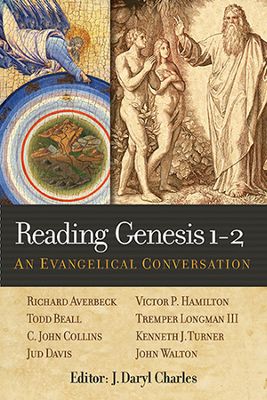 Every Sunday, I will share a quote from something I’ve been reading. The hope is for you, dear reader, to share your thoughts on the quote and related issues and perhaps pick up some reading material along the way!
The Source of Light: A Desperate Bid?
One of the heated questions about the age of the Earth of course concerns the meaning and length of the days of creation. Of the questions related to that, one which persists is where from and why, on a literal reading, is there light before the bodies which produce light (stars, sun, etc.) are apparently created (though this is also debated) on day four? In Reading Genesis 1-2: An Evangelical Conversation, Tremper Longman III offers the following comment on one path that some creationists take to explain the light prior to the sun:
The counterargument [to the fact that the solar bodies were not created until day 4] that God could provide an alternative light source is an act of desperation. Of course, God could provide light and darkness in some other fashion in a twenty-four-hour period, but that would still not constitute a literal evening and morning that is defined by the setting and rising of the sun and the movement of the other celestial bodies. (105, cited below)
Although I’m not sure I would qualify this move as “desperate,” I do still wonder how, exactly, one is to define the days of creation and a “literal” evening and morning without the actual solar bodies. I mean, realistically, what does it mean to say there is “evening” without such a reference point? Interestingly, some concordist positions (concordist meaning views which seek to explain the Bible in light of science or vice versa–and would encompass both young and old earth creationists of various types [see my taxonomy of positions]) actually take this to show that the days are not indeed 24 hour periods.
What are your thoughts on this issue? Do you see this move as desperate or do you think its perfectly reasonable? Somewhere in between? Why?
Source
Tremper Longman III, “What Genesis 1-2 Teaches (and What It Doesn’t)” in Reading Genesis 1-2: An Evangelical Conversation
Sunday Quote! – Is Monotheism from Egypt?
 Every Sunday, I will share a quote from something I’ve been reading. The hope is for you, dear reader, to share your thoughts on the quote and related issues and perhaps pick up some reading material along the way!
Is Monotheism from Egypt?
I completed Winfried Corduan’s In the Beginning God: A Fresh Look at the Case for Original Monotheism recently. I have to say, it is one of those books which caused a paradigm-shift for me. It made me realize many mistakes I had made in my assumptions regarding the area of study for origins of religion. I’ll review it in a while when I have time to really sit down and write. Here, we’ll examine the notion that monotheism came from Egyptian polytheism. Corduan wrote:
The people were exhorted to acknowledge Aten, but there was only one way in which they could worship him… the way in which commoners… had always been instructed to worship the gods, by worshipping the pharaoh and his wife… Thus, if Aten were the one and only God, and he could only be worshiped by worshipping the Pharaoh, this was hardly a ‘monotheistic reform.’ Instead, it was the ultimate in egotism and delusions of grandeur. (312)
Corduan’s statement is the climax of several pages of examination of the cult of Akhenaten and the religion of Egypt. Essentially, his point is that one can hardly conclude from this consolidation of worship of deity into one form of worshipping the Pharaoh and his wife that this served as the source for later monotheism, specifically Hebrew/Israelite worship.
What do you know of Egyptian religion and the worship of Aten/the cult of Akhenaten? Have you examined your conclusions regarding this knowledge? What do you think about monotheism and Egypt?
In the Beginning God is an extraordinary study into the origins of religion and the theory of original monotheism. I highly recommend you grab a copy and read it.
Links
Be sure to check out the page for this site on Facebook and Twitter for discussion of posts, links to other pages of interest, random talk about theology/philosophy/apologetics/movies and more!
Source
Winfried Corduan, In the Beginning God: A Fresh Look at the Case for Original Monotheism
SDG.
——
The preceding post is the property of J.W. Wartick (apart from quotations, which are the property of their respective owners, and works of art as credited; images are often freely available to the public and J.W. Wartick makes no claims of owning rights to the images unless he makes that explicit) and should not be reproduced in part or in whole without the expressed consent of the author. All content on this site is the property of J.W. Wartick and is made available for individual and personal usage. If you cite from these documents, whether for personal or professional purposes, please give appropriate citation with both the name of the author (J.W. Wartick) and a link to the original URL. If you’d like to repost a post, you may do so, provided you show less than half of the original post on your own site and link to the original post for the rest. You must also appropriately cite the post as noted above. This blog is protected by Creative Commons licensing. By viewing any part of this site, you are agreeing to this usage policy.
Sunday Quote! – Does reading Genesis Require a PhD?
Every Sunday, I share a quote from something I’ve been reading. The hope is for you, dear reader, to share your thoughts on the quote and related issues and perhaps pick up some reading material along the way!
Does Reading Genesis Require a PhD?
One of the topics of major interest to me is the debate within Christianity over the means and timing of creation. Recently, a friend sent me a copy of Reading Genesis 1-2: An Evangelical Conversation
Genesis 1 should be read… as historical narrative that is meant to be taken literally. This is the normal reading of the account… It does not require a person with a PhD to unlock the key to these chapters by appealing to A[ncient] N[ear] E[astern] literature or a special genre or some other special figurative approach. (48)
The quote is in context of Beall’s discussion of various evangelicals “coming out” as not reading the text literally for various reasons, such as ANE context, notions of genre, or the like. Basically, Beall’s point seems to be that we can (and should?) just read the text straightforwardly without having to study all kinds of topics to understand it. What do you think of this notion? What might this say about the cultural context of Genesis? Does that context matter? Should we be concerned with possibilities regarding such a context, differing genres, or the like?
Bonus Quote
Interestingly, a later author in the same work, Tremper Longman III, confronts Beall’s allegation regarding the PhD:
…isn’t the Bible equally clear to everyone, even those who have not studied the Bible and its cultural background? The simple answer to that question is no, it is not. After all, unless you have studied Hebrew, Greek, and Aramaic you cannot read the Bible at all without scholarly help. (121)
Links
Be sure to check out the page for this site on Facebook and Twitter for discussion of posts, links to other pages of interest, random talk about theology/philosophy/apologetics/movies and more!
Source
Todd S. Beall, “Reading Genesis 1-2: A Literal Approach” in Reading Genesis 1-2: An Evangelical Conversation edited J. Daryl Charles (Peabody, MA: Hendrickson Publishers, 2013).
Tremper Longman III, “What Genesis 1-2 Teaches (and What It Doesn’t)” in Reading Genesis 1-2: An Evangelical Conversation edited J. Daryl Charles (Peabody, MA: Hendrickson Publishers, 2013).
SDG.
Sunday Quote! – Is Atheism Wishful Thinking?
 Every Sunday, I will share a quote from something I’ve been reading. The hope is for you, dear reader, to share your thoughts on the quote and related issues and perhaps pick up some reading material along the way!
Atheism as Wish Fulfillment
I’ve been reading through Edward Feser’s The Last Superstition: A Refutation of the New Atheism. Feser is a Thomistic philosopher (one who follows in the tradition of Thomas Aquinas) and so he approaches these questions from a slightly different perspective than that of other theists who have responded to the challenge of the New Atheism. I’ve only just begun the book, but I found this quote juicy:
It is true that a fear of death, a craving for cosmic justice, and a desire to see our lives as meaningful can lead us to want to believe that we have immortal souls specially created by a God who will reward or punish us for our deeds in this life. But it is no less true that a desire to be free of traditional moral standards, and a fear of certain (real or imagined) political and social consequences of the truth of religious belief, can also lead us to want to believe that we are just clever animals with no purpose to our lives other than the purposes we choose to give them, and that there is no cosmic judge who will punish us for disobeying an objective moral law. Atheism, like religion, can often rest more on a will to believe than on dispassionate rational arguments. – Edward Feser, The Last Superstition, 10
Feser’s point is that atheists are just as capable of allowing their desires to cloud judgment when it comes to matters of philosophical judgments as are theists. Everyone has desires; the question is what the evidence is to support those desires. What do you think of this quote? How would you respond to those who assert that religious people are merely seeking wish fulfillment?
Links
Be sure to check out the page for this site on Facebook and Twitter for discussion of posts, links to other pages of interest, random talk about theology/philosophy/apologetics/movies and more!
Guest Post: “The Presumption of Popular Atheism” by David Glass– In this post, David Glass, himself an able response-man to the New Atheism, highlights one primary argument atheists make regarding theism: that theists have all the burden of proof on their side.
SDG.
Sunday Quote! – Secularism as necessary in the Political Sphere?
 Every Sunday, I will share a quote from something I’ve been reading. The hope is for you, dear reader, to share your thoughts on the quote and related issues and perhaps pick up some reading material along the way!
Secularism in International Politics
The quote this week is from Elizabeth Shakman Hurd, The Politics of Secularism in International Relations
“[T]he objective of laicism is to create a neutral public space in which religious belief, practices, and institutions have lost their political significance… The mixing of religion and politics is regarded as irrational and dangerous. For modernization to take hold, religion must be separated from politics… Laicism adopts and expresses a pretense of neutrality… This makes it difficult for those who have been shaped by and draw upon this tradition [laicism] to see the limitations of their own conceptions of religion and politics.” -Elizabeth Hurd, “The Politics of Secularism in International Relations,” 5.
What do you think of the concept of laicism based upon this quote? Have you heard of it before? What are your thoughts on the possibility of the presumption of secularism in politics?
Links
Be sure to check out the page for this site on Facebook and Twitter for discussion of posts, links to other pages of interest, random talk about theology/philosophy/apologetics/movies and more!
Book Review: “The Myth of Religious Violence” by William T. Cavanaugh– I review the book which has led me to discuss the ways the category of religion is used to stigmatize the other and also forced me to rethink a number of issues. I highly recommend this book.
SDG.

 J.W. Wartick - Reconstructing Faith