Christian Doctrines
Against Open Theism: Definitions
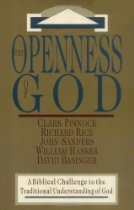 I’ve encountered Open Theism a number of times in my readings and online. Many people I respect greatly fall under the category of “Open Theists.” Greg Boyd, for example, wrote one of the first apologetic books I ever read, yet he is an ardent Open Theist. Yet the doctrine of Open Theism is one with which I disagree vehemently. Therefore, I’m going to write several posts outlining a series of arguments against the doctrine.
Definitions
Open Theism: The doctrine that God, through his own freedom and sovereignty, chose to create free creatures (humans) which could make truly free decisions. Because God made these free creatures, he freely chose to limit his knowledge of the future, such that he would not pre-ordain their actions. Therefore, God knows only those things which God unilaterally brings about.
Another Definition
From http://www.opentheism.info/, a site collecting information and advocating Open Theism (endorsed by John Sanders, a well known proponent of the view) we can examine a 5-part definition:
1) “In freedom God decided to create beings capable of experiencing his love.” (emphasis theirs)
2) “God has, in sovereign freedom, decided to make some of his actions contingent upon our requests and actions. God elicits our free collaboration in his plans. Hence, God can be influenced by what we do and God truly responds to what we do.” (emphasis theirs)
3) “God has chosen to exercise general rather than meticulous providence, allowing space for us to operate and for God to be creative and resourceful in working with us. It was solely God’s decision not to control every detail that happens in our lives.”
4) “God has granted us the type of freedom (libertarian) necessary for a truly personal relationship of love to develop. ”
5) “God knows all that can be known given the sort of world he created… in our view God decided to create beings with indeterministic freedom which implies that God chose to create a universe in which the future is not entirely knowable, even for God. For many open theists the ‘future’ is not a present reality-it does not exist-and God knows reality as it is.”
(Again, please note these are quoted verbatim from sections on http://www.opentheism.info/; I do not claim credit for these 5 steps of the definition.)
Areas of Disagreement/Agreement
There are many areas of agreement I can share with the Open Theist. For example, I agree that God created free creatures, who have libertarian free will (1 and 4). I agree that God has not predetermined all future events (3). I agree at least in some sense that God’s actions are contingent upon our own (2)–but that’s where the differences begin.
I disagree with Open Theists on an unqualified 2 and 5. It is my belief that:
A) Future Events are knowable
B) God knows the outcome of all future events before they happen.
C) God’s knowledge of the future allows him to take into account our free choices and respond to them from eternity.
One final area of disagreement would be with the implicit idea within Open Theism of divine temporality. I believe:
D) God is essentially timeless.
What’s at Stake
“Okay, all this is well and good,” you may say, “but what’s the payoff? What’s really at stake in this debate?”
Fair questions! There are some who argue that Open Theism is a heresy, period. A simple Google search turns up dozens of articles and comments calling the doctrine a heresy. Several have attempted to ban Open Theists from evangelical circles (the ETS voted to keep two prominent Open Theists within their ranks; others have lobbied to call it heretical).
I do not think that Open Theists are heretics. While I disagree with their views, I think that they have some very good arguments for their position. I do think, however, that the Scriptural evidence excludes Open Theism from possibility. While there are many passages which could be utilized to argue for the position of Open Theism, I believe those passages which exclude the position take priority, and therefore the passages appearing to advocate the position are to be interpreted as use of metaphors or anthropomorphism.
Other Posts in the Series
This post will also serve as a host for links to other posts in the series. View them below, with brief descriptions of their content:
God’s Infinite Knowledge– Argues that Scripture clearly states God’s knowledge is infinte/without number/unlimited. Yet, on Open Theism, God’s knowledge increases, and would therefore have to be finite. Concludes Open Theism is false.
Scrooge and God’s knowledge of the future– Addresses one of the main arguments for Open Theism–that God changes his mind or repents of certain actions.
Book Review: “No Other God: A Response to Open Theism” by John Frame– I review John Frame’s work on open theism. Interestingly, Frame combats open theism with the opposite extreme: theological determinism, a view which I disagree with as adamantly (or more) than I do open theism.
——
The preceding post is the property of J.W. Wartick (apart from citations, which are the property of their respective owners) and should not be reproduced in part or in whole without the expressed consent of the author. All content on this site is the property of J.W. Wartick and is made available for individual and personal usage. If you cite from these documents, whether for personal or professional purposes, please give appropriate citation with both the name of the author (J.W. Wartick) and a link to the original URL. This blog is protected by Creative Commons licensing. By viewing any part of this site, you are agreeing to this usage policy
The end of it all…
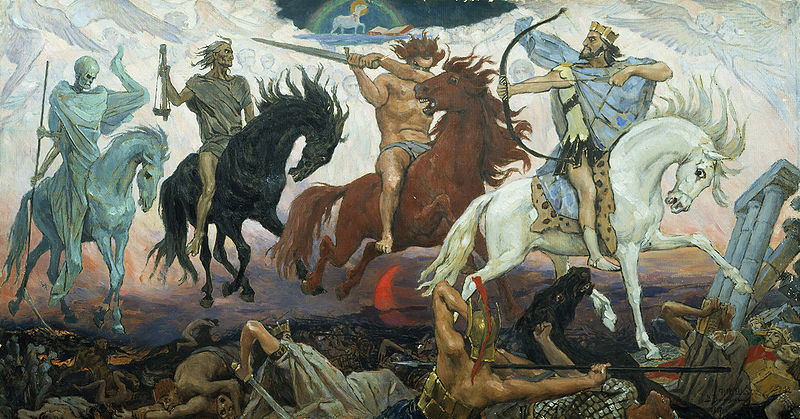 There’s a lot of confusion about endtimes in our world. It isn’t helped by the fact that there are false prophets springing up all around us, trying to tell us that which is to come. The recent controversy over Harold Camping’s prediction that the world would end on May 21st has me thinking about the study of end times (eschatology).
It’s an area I admit I haven’t studied much. The subject is confusing. There is a staggering array of views about what will happen in the end. The book of Revelation, from which we draw much of our knowledge over what will happen in the end times, can be greatly confusing to both the uninitiated and the scholar.
There are two major themes upon which I’d like to focus: knowledge of the end and our behavior at the end.
1) Knowledge of the end
Thinking about the apocalypse–the end of the world–is a tough issue. Like I said, there is a lot of diversity on the subject. As such, it is important for Christians to look to the Bible to see what we can know about the end. The key is to remember that must always go back to the Bible to see what it says about a subject before we believe what someone tells us it may say.
We are warned by Jesus in Matthew that there will arise false prophets (Matthew 24:24). Harold Camping is one such false prophet. He has distorted the truth of Scripture to gain followers.
Perhaps the most telling verse in the Bible which speaks against us being able to know when the end will come is Matthew 24:36, in which Jesus Himself says “But about that day or hour no one knows, not even the angels in heaven, nor the Son, but only the Father.” If that’s true, then how would any other human know? Not even Christ, in his state of humiliation, could tell us when the last day would come!
The bottom line is that we can’t know and we won’t know when the last days have arrived–not until Jesus Himself is here.
2) Behavior at the end
Suppose for a moment we are at the last days; what should our attitude be? The resounding chorus in Scripture is that we should be diligent and ready, but we should continue to spread God’s Kingdom. Looking back at the Matthew 24 passage, Jesus tells us, ““Therefore keep watch, because you do not know on what day your Lord will come… Who then is the faithful and wise servant, whom the master has put in charge of the servants in his household to give them their food at the proper time? It will be good for that servant whose master finds him doing so when he returns” (24:42, 45-46).
So our attitude should be one of the watchful servant: ready for Christ to come, but not letting that distract us from the work He has given us. Rather than put up billboards and go around telling everyone the end is nigh, our task is to continue what should be our “business as usual”–spreading the Word, taking care of the needy, and living our lives as Christians.
Conclusion
It is easy to get caught up in the “end times” controversies. I admit that often when I hear of such predictions, I am more diligent than usual in remembering to repent of my sins. But what does that tell me? It tells me that I need to be more diligent about that at all times. For we need to be ready when Christ does come. A life of readiness for Christ means a life of spreading the Good News about Him to all people. It means living a life of repentance and reconciliation to God. We may not know when the end will come, but it is coming–and we will experience it either in this life or the next.
SDG.
Links
Check out this blog post by Austin which discusses the Camping controversy: here.
News article discussing Camping’s befuddlement about his failure: here.
Image: “Four Horsemen of the Apocalypse” by Viktor Vasnetsov, 1887.
——
The preceding post is the property of J.W. Wartick (apart from citations, which are the property of their respective owners) and should not be reproduced in part or in whole without the expressed consent of the author. All content on this site is the property of J.W. Wartick and is made available for individual and personal usage. If you cite from these documents, whether for personal or professional purposes, please give appropriate citation with both the name of the author (J.W. Wartick) and a link to the original URL. This blog is protected by Creative Commons licensing. By viewing any part of this site, you are agreeing to this usage policy.
Sam Harris on Christian Sacraments–Lunacy?
 Sam Harris recently debated William Lane Craig on the topic “Is Good from God?” See my comments on the debate here. During the debate, Harris argued that the rituals of Christianity can be seen as a kind of lunacy. Harris said, “[Religion] allows perfectly decent and sane people to believe by the billions what only lunatics could believe on their own. If you wake up tomorrow morning thinking that saying a few Latin words over your pancakes is going to turn them into the body of Elvis Presley, you have lost your mind. But if you think more or less the same thing about a cracker and the body of Jesus, you’re just a Catholic.”
Consider what Harris is claiming here. Basically, he’s saying that to believe a cracker becomes the body of Jesus is a kind of lunacy. Interestingly, throughout the debate he issued these veiled (or not so veiled) insults to Christians at large, and quickly retreated from them when he was called out. But that’s neither here nor there.
My contention is that Harris’ implicit argument against the rationality of the Sacraments (and Christian rituals at large) contains an implicit assumption. Once that assumption is exposed, his argument fails. The implicit assumption is this:
1) Christianity is false
Yeah, I’m serious. The reason is because the only way Harris’ argument makes sense is if one assumes a priori that Christianity is false. For consider his objection if Christianity is true. If Christianity is true, then God exists, Jesus was God, Jesus told us what would happen in Communion/the Eucharist, etc., etc. But then if Christianity is true, it is perfectly rational to hold that the uttering of certain words as part of a ritual would be causative in the sense that God said it would be. So Harris’ argument turns on the assumption that Christianity is false.
But perhaps I’m missing Harris’ point. Perhaps he is instead trying to say “Look at what you guys do! It’s crazy if it’s something else!” But again the only way this would make sense is by assuming Christianity is false. If I believe Christianity is true, then I have no reason to think the rituals involved therein are lunacy or anything other than perfectly rational worship of our God.
But it could be pressed that it does seem as though Harris’ assertion that Holy Communion would be viewed as lunacy in other contexts is in some sense correct. For were I to do the same with pancakes and Elvis, I would be seen as a lunatic. Why not the Christian too? Well, then the question would have to be what kind of evidence do we have for thinking Christianity is true as opposed to other beliefs? In short, if the Christian is epistemically justified in believing Christianity to be true, then Harris’ argument is exposed for what it is: a facile argument which shows how deeply Harris and the other “New Atheists” fail to understand the position they attack.
SDG.
Image: Priest distributing Holy Communion at Holy Protection Church, Düsseldorf.
——
The preceding post is the property of J.W. Wartick (apart from citations, which are the property of their respective owners) and should not be reproduced in part or in whole without the expressed consent of the author. All content on this site is the property of J.W. Wartick and is made available for individual and personal usage. If you cite from these documents, whether for personal or professional purposes, please give appropriate citation with both the name of the author (J.W. Wartick) and a link to the original URL. This blog is protected by Creative Commons licensing. By viewing any part of this site, you are agreeing to this usage policy.
Omniscience, Substance Dualism, and Private Access
 I recently attended a seminar on God and Time with William Lane Craig (view my post on it here). One topic (among many) that caught my interest was Craig’s denial of one of the arguments for substance dualism, namely, the “private access” of some truths.
J.P. Moreland argues for private access in his work The Recalcitrant Imago Dei: Human Persons and the Failure of Naturalism. He argues that mental states have an “ofness or aboutness–directed towards an object” which is “inner, private, and immediate to the subject having them” (20, emphasis his). Basically, the claim is that even were someone else to know everything about J.W. Wartick, they could not say that they know what it is to say “I am J.W. Wartick”, because they are not J.W. Wartick. Certain truths and facts are such that only the knower can know them. I cannot say I am Abraham Lincoln, because I am not him. Nor could I say that I was Abe Lincoln even were I to comprehensively know everything about Abe Lincoln from the events that occurred in his life to the exact synapses in his brain. There is something about a phrase like “I am Abe Lincoln” which only Abe Lincoln can know.
Interestingly, Craig denied that there was such a thing as “private access.” He argued that, were this the case, it would mean God is not omniscient.
Why should it follow that God is not omniscient? Well, Craig defines omniscience as “Knowledge of any and all true statements” (definition from my lecture notes). Due to the fact that God would not know true facts which have private access, argued Craig, there is no such thing as private access. This seemed like an odd way to go about denying private access in regards to substance dualism. The argument seemed to be:
1) Omniscience =def.: God knows any and all true statements.
2) God is omniscient.
3) Truths available only through private access would entail truths God does not know
4) Either God is not omniscient or there are not truths available only through private access (1, 2, 3)
5) God is omniscient (2)
6) Therefore, there are no truths available only through private access (4, 5)
The argument would work, if one agrees with the definition of omniscience in (1). But I find it more likely that omniscience is analogous to omnipotence, which is defined as God’s ability to do anything logically possible. Why should it not be the case that God can only know things which are logically possible to know? On such a view, then, private access would not challenge omniscience whatsoever, because it would be logically impossible for God to know truths only knowable to their subjects.
I brought this up to Craig, and he responded by saying that my definition of omniscience made it into a modal property, and omniscience is not a modal property. I don’t see why omniscience could not be a modal property. In fact, it seems to me as though it is necessarily modal. Omniscience entails that any being which is omniscient would have to know all possible truths about all possible worlds (for any being who did not know truths for all possible worlds could be outdone by a being which knew about more possible worlds), which is clearly a modal claim. So it seems to me omniscience is clearly a modal property, and there is no problem revising Craig’s definition to:
(7) Omniscience=def.: A being is omniscient if it knows everything it is logically possible to know.
Further, a denial of (7) would seem obviously contradictory because one who denies (7) would have to assert:
(7`): Omniscience=def.: A being is omniscient if it knows everything, including things it is logically impossible to know.
And this would lead to contradictions about omniscience. So I don’t see any reason not to revise Craig’s definition of omniscience to note that God can only know that which it is logically possible to know (for a denial of this would imply God’s knowledge could be contradictory). But then private access provides no challenge to omniscience, and Craig’s denial falls apart.
Finally, “private access” seems like an intuitively obvious feature of knowledge. How could one deny that there are truths such as “I am J.W. Wartick”? It seems clear that only I can experience what it is to be J.W. Wartick. So I think it is necessary to modify Craig’s definition and simply deny his argument, both because God cannot know or do the logically impossible, and because “private access” is such a well-established phenomenon.
Edit: See the interesting discussion in the comments below. I am forced to modify the definition I presented in this post in the comments below due to an insightful comment by Midas. Those interested can read below or just read my modification here: “A being is omniscient iff it knows all truths which are not delineated by private access [of others] or experiential knowledge [of others].”
SDG.
———
The preceding post is the property of J.W. Wartick (apart from citations, which are the property of their respective owners) and should not be reproduced in part or in whole without the expressed consent of the author. All content on this site is the property of J.W. Wartick and is made available for individual and personal usage. If you cite from these documents, whether for personal or professional purposes, please give appropriate citation and provide a link to the original URL. By viewing any part of this site, you are agreeing to this usage policy.
Atonement and a Timeless God
 One of my own struggles with Christianity as I began serious contemplation of its core doctrines is the doctrine of atonement. Specifically, I kept wondering how it is that Jesus’ death two thousand years ago could be used as atonement for my sins now. In order to overcome my difficulties figuring this out, I admittedly opted for a fideist type of approach and just assumed that God could do what He wanted, and if He wanted to forgive me because of something two thousand years ago, that was fine.
More recently, however, I’ve been thinking about God’s timeless nature. I touched on these thoughts in my last post, but wanted to get into more depth now.
Consider this: If God is timeless, then God’s existence occurs “all at once”; there is no sequence of events to God, only one eternal “now.” But then it follows that God the Son, Jesus Christ, is eternally crucified, eternally exalted, eternally reigning on high.
In some sense, if God is timeless, then it follows that while I am sinning, Christ is suffering on the cross. As I ask for forgiveness, He is rising from the tomb. As I read Scripture, Christ is speaking. I don’t mean these things temporally, of course, for on this view, god is atemporal–He is without time. Thus, I am not saying that “now”, Christ is dying in a temporal sense; rather, it is meant metaphorically. Christ is crucified in God’s eternal “now”; during which all events are “present.”
What does this mean for atonement? At least in my opinion, it seems to make a lot of sense out of the idea that Christ’s death pays for my sins. For there is no moment at which Christ is not suffering for my sins–a truly horrific thought. On the other hand, there is no moment at which Christ is not glorified with His Father in heaven. All of God’s experience occurs in an instant.
It should be noted again that these considerations are not intended to imply that all events are “simultaneous” in a temporal sense of “occurring at the same time”; rather, they are simultaneous in the sense that from God’s perspective, they have occurred; are occuring; and will occur. All events are eternally present to God. Neither does this mean that God has no sense of the order of events. God’s eternal now sees events in order of logical priority as opposed to temporal progression. Therefore, God knows that one event (x) occurs “before” another (y) in the sense that x is logically prior to y; x had to occur for y to happen. But God experiences all events as “now”; as the changeless, immutable deity, He is eternally crucified, eternally glorified; eternally paying for our sins, and eternally forgiving us for them.
At Communion today (Sunday), I was contemplating the implications of an atemporal God for atonement and justification. I was overcome with emotion as I thought deeply on the issue. As I was eating of the body and blood, Christ was being crucified for my sins; as my forgiveness was declared, Christ was rising.
Powerful thoughts. I think divine temporalists (those who hold that God is temporal) still have to deal with the doctrine of atonement: how does a death thousands of years ago atone for me now? Those who hold God is timeless can answer this question sufficiently: Christ is paying for your sins.
SDG.
———
The preceding post is the property of J.W. Wartick (apart from citations, which are the property of their respective owners) and should not be reproduced in part or in whole without the expressed consent of the author. All content on this site is the property of J.W. Wartick and is made available for individual and personal usage. If you cite from these documents, whether for personal or professional purposes, please give appropriate citation and provide a link to the original URL. By viewing any part of this site, you are agreeing to this usage policy.
“God, Time, and Creation”: A Seminar with William Lane Craig
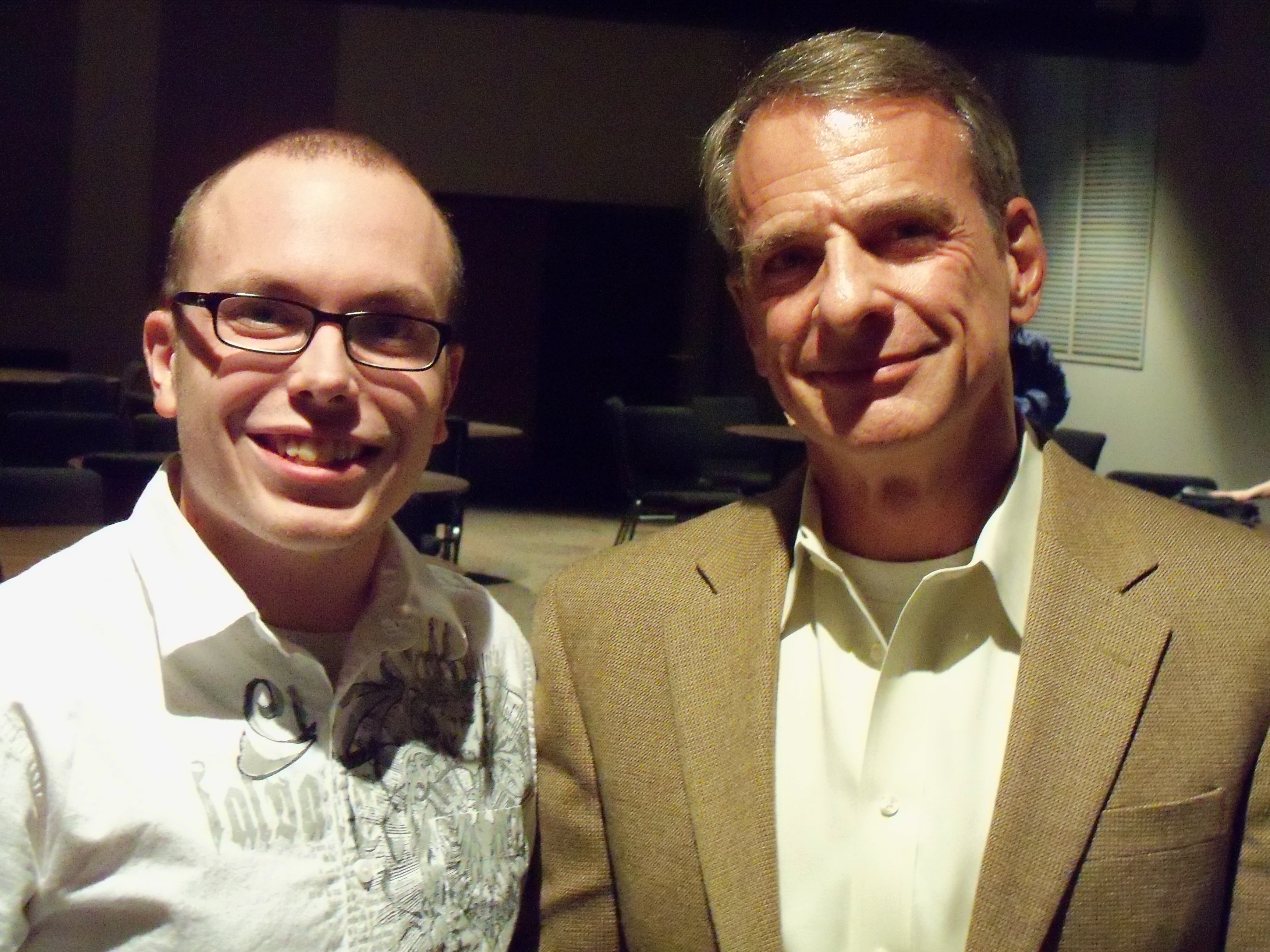 Over the past weekend, I was privileged to spend some time in Georgia (Atlanta area) at the seminar “God, Time, and Creation” with William Lane Craig (in picture next to me). It was part of a class of the same name for the Master of Arts Program with Biola University.
The seminar was a blast. I took approximately 25 pages of notes. Craig’s lecture notes comprised about 440 pages. Awesome!
The seminar focused on God’s relationship to time. Is God timeless, or temporal? Interestingly, Craig holds that God was timeless without creation and temporal subsequent to creation. His book, Time and Eternity, expands on the issues at great length.
First, Craig covered the arguments for and against a timeless God. It seems like a timeless God is not philosophically untenable, and the argument for a timeless God based upon the idea of the imperfection of a temporal life has some plausibility. Then, Craig went over the arguments for and against a temporal God.
After that, we covered the static (B-theory) of time–which holds that all of time and space is a kind of 4-dimensional block–and the dynamic (A-theory) of time–which holds that temporal becoming and passing away is real. It seems that the B-theory of time is, at best, extremely counterintuitive. If the B-theory is correct, our feeling of passing through time is illusory. Further, the theological problems with the view make it really implausible. If time is static, then the J.W. from three hours ago is literally a different entity than the J.W. now, because each is a different “slice” of a four-dimensional “block” of time. So, for example, it would seem as though the J.W. now could not be punished for the sins of a past J.W.–they are, in fact, different entities. Therefore, the doctrines of atonement, justification, sin, etc. seem to be at best vacuous. So a static theory of time, I think, is very implausible for the Christian to hold.
I’m reading through Paul Helm’s Eternal God: A Study of God without Time right now. He holds that God is timeless, and holds that time is static. I’m interested to see if he counters any of these theological issues.
Craig concluded that without creation, God is timeless–there is no change. But once God created, He underwent at least an extrinsic change, which Craig argues means God is temporal subsequent to creation.
This is one of the few areas I disagree with Craig on. I actually think it is more theologically plausible to hold that God is timeless, period. The main problem with this view is that many argue a timeless God entails a static theory of time. If I find on my further study into the area that this is the case, I may be forced to abandon the view that God is timeless. Therefore, I’m looking forward to delving into greater detail on this topic.
I’ve read Brian Leftow’s Time and Eternity and found it extremely interesting and thought-provoking. Craig is highly critical of Leftow’s view and charges that Leftow makes category mistakes throughout his work. As I said, I’m also reading Helm’s Eternal God, so I’ll see how that holds up. This is a very interesting topic which affects the core of study about the nature of God, how God relates to the world, divine providence, and many other areas. I’m excited to continue my research in this area.
On a side note, the Atlanta area is pretty awesome to visit! The weather was gorgeous. It isn’t that much fun driving there, however.
I visited a Christian Bookstore in the area–Lifeway Christian Bookstore–which had a huge sale on CDs. I couldn’t resist picking up some more Christian music (5$ cds!).
SDG.
———
The preceding post is the property of J.W. Wartick (apart from citations, which are the property of their respective owners) and should not be reproduced in part or in whole without the expressed consent of the author. All content on this site is the property of J.W. Wartick and is made available for individual and personal usage. If you cite from these documents, whether for personal or professional purposes, please give appropriate citation and provide a link to the original URL. By viewing any part of this site, you are agreeing to this usage policy.
Our Longing For God
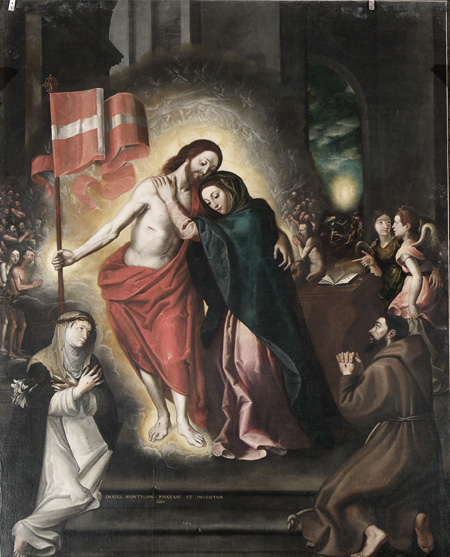 Recently, I had a discussion with my fiancée about the idea of Song of Songs being utilized as an analogy for Christ and the Church. Song of Songs is clearly a book about love, even erotic (eros) love. There are verses like 1:4 “Draw me after you; let us run. The king has brought me into his chambers” or 6:3a “I am my beloved’s and my beloved is mine.” If we are to apply such verses to the life of a Christian and his or her relation to God, we can see it sometimes as an almost uncomfortably close relationship. We aren’t comfortable thinking of our love of God as this kind of intimate desire; a desire for union, to be brought into the chambers of our God.
Yet it is exactly this kind of intimacy–this kind of eros love–which God has planned for us. Song of Songs is such a beautiful book because of this exact thing. It teaches us that we need not be ashamed of the kind of union we desire with God. We are sheep lead astray, and our one desire should be to return to our Lord, in whose arms we find peace and love.
There are other verses in Scripture wherein we can see this idea. Psalm 84:2 states “My soul yearns, even faints for the courts of the Lord; my heart and my flesh cry out for the living God.” Psalm 63:1 puts it eloquently, “Oh God, you are my God, earnestly I seek you; my soul thirsts for you, my body longs for you.”
My favorite exposition of these ideas is found in Alvin Plantinga’s Warranted Christian Belief, of all places. In this monumental work, Plantinga discusses the very idea of God’s love as eros. I feel compelled to quote him at length:
This love for God isn’t like, say an inclination to spend the afternoon organizing your stamp collection. It is longing, filled with desire and yearning; and it is physical as well as spiritual… It is erotic; and one of the closest analogues would be with sexual eros. There is a powerful desire for union with God… What is to be made of this phenomenon? Most psychiatric literature has tended to follow Freud in understanding religion as a kind of neurosis, the ‘universal obsessional neurosis of humanity.’ From this point of view, the religious eros is to be understood as a kind of analogue, displacement, or sublimation of (broadly) sexual energy…
From a Christian perspective… here (as often) Freud has things just backwards. It isn’t that religious eros, love for God, is really sexual eros gone astray or rechanneled… It is sexual desire and longing that is a sign of something deeper: it is a sign of this longing, yearning for God that we human beings achieve when we are graciousliy enabled to reach a certain level of the Christian life. It is love for God that is fundamental or basic, and sexual eros that is the sign or symbol or pointer to something else and something deeper.
[S]exual eros points to two deeper realities… human love for God… [and] a sign, symbol, or type of God’s love. (Plantinga, 311-318)
Those who have had religious experiences in which they felt a kind of union with God can attest to what Plantinga is describing. The kind of mystical union we experience when we are granted the chance to commune with God in a relation of creature-creator is beautiful, to the point of being even sensual. It is something which we long for; something we look forward to in the hereafter.
This also serves to help describe the kind of feelings involved in religious experience. It is a kind of fulfillment of a yearning and a quenching of thirst. Our longing for God is part of humanity. Plantinga argues it is part of our sensus divinitatis–our inborn sense of divine reality. Only when we submit to God and experience relation with him can our deepest desires be realized.
Source:
Alvin Plantinga. Warrented Christian Belief (New York, NY: 2000, Oxford).
——
The preceding post is the property of J.W. Wartick (apart from citations, which are the property of their respective owners) and should not be reproduced in part or in whole without the expressed consent of the author. All content on this site is the property of J.W. Wartick and is made available for individual and personal usage. If you cite from these documents, whether for personal or professional purposes, please give appropriate citation and provide a link to the original URL. By viewing any part of this site, you are agreeing to this usage policy.
Alexander Pruss on Open Theism
Open Theism is basically the view that God does not know the future. The Evangelical Philosophical society recently tweeted this post by Alexander Pruss on the topic. I found it very interesting. The argument he presents is (quoted word for word from his blog):
- (Premise) If p is overwhelmingly probable on the balance of God’s evidence, then God believes p.
- (Premise) If open theism is true, then some of the propositions that are overwhelmingly probable on the balance of God’s evidence are false.
- Therefore, if open theism is true, God believes some falsehoods.
- (Premise) God believes no falsehoods.
- Therefore, open theism is false.
I think that perhaps the best way for the open theist to avoid this argument may actually be to deny (4), for which Pruss does not argue. The open theist could hold that: (4`) Possibly, God believes falsehoods. I doubt that many open theists would be perturbed by accepting this premise, but I may be wrong. If I’m right, however, Pruss’s neat argument doesn’t work. Again, check it out.
Original Sin and the Metaphysics of the Soul
Original Sin Defined
The writers of the Augsburg Confession (found in the Book of Concord) defined Original Sin as the belief that “…since the fall of Adam all human beings who are propagated according to nature are born with sin, that is, without fear of God… [we] teach that this disease or original fault is truly sin, which even now damns and brings eternal death to those who are not born again through baptism and the Holy Spirit” (BOC, 39).
One Objection
Ezekiel 18:20a states, “The soul who sins is the one who will die. The son will not share the guilt of the father, nor will the father share the guilt of the son.”
The word used for “soul” in this passage is the Hebrew word, nephesh. This passage leads to the objection that original sin cannot be true as I have outlined it, because it involves the son inheriting the guilt of the father.
The Question of the Soul: A Metaphysic of Original Sin
Three views of the soul are prevalent in Christianity. All of them presuppose metaphysical dualism. They are:
1) Our soul is constructed just as our physical body: Our soul is a half-and-half combination of the souls of our mother and father.
2) God specially creates each soul for each person when he/she is conceived/born/etc. Alternatively, God has already created every soul for everyone who will ever live, and puts them in a body when one is needed. The main problem with this view is that it would seem that if original sin is true (in the sense I have outlined it above), then God creates sinful souls for us.
3) Our soul is from Adam. There are no new souls for mankind, rather, we all share, in some sense, Adam’s soul.
I tend to favor 1) (now, anyway). But I favor a version of 1) which is not so much a half-and-half combination of souls, but a union of the totality of the souls we inherit. I originally wrote this post for my new site, but an insightful commentator lead me to heavily edit my views here. Just as we become one in the union of sex, so do our souls become one when we conceive a child.
What this means, then, is that the soul we inherit from our ancestors includes the inheritance of the guilt of sin. I must note the distinction here between sins which require action and those that do not. I have been pondering this idea for some time–is it possible to have sins for which we are guilty that we don’t commit? The answer I lean toward is “No”, but that doesn’t preclude original sin. The reason is that through the soul, we have literally participated in the original sin of Adam. When we are told that we have the “Old Adam” in us, this should be taken in a more literal sense than it often is.
We are told by Paul that there is a natural and spiritual body (1 Corinthians 15:44). These are both the inheritance of our ancestors. In a literal sense, then, there is the “old self” (Romans 6:6) and the Old Adam (1 Corinthians 15:45) which, from birth, enslave us to sin (Romans 6:6). Metaphysically I think this means that our soul has literally participated in, and is therefore held accountable for, the original sin. Original sin is a substantive entity–it corrupts our very nature. This is no mere inclination to sin, but a bondage to sin and a separation from God. It only makes sense to me on a metaphysical level to argue that this sin is inherited through our soul, which, like our body, maintains the union with Adam himself.
So how does this answer the objection from Ezekiel 18:20? Initially, one may argue it seems to purge the passage of all meaning. This is not the case, however. What Ezekiel is referring to is the sin of commission. That is, it refers to a sin which requires an action. Ezekiel is telling us that the actions of the father do not condemn the actions of the son. This does not, however, preclude the original sin in the metaphysical sense in which I have outlined it, because we have each participated in the action which causes original sin.
One final note is required, however. This is again a modification of my original thoughts due to enlightening discussion with my good friend’s comments. We must remember that this stain of sin, this original sin, has passed away for those who have faith in Christ. For, though the passages I quoted above discuss the nature of our original guilt, they immediately turn to salvation which is through Christ. Our New Adam replaces the Old (1 Corinthians 14:42-57), and our enslavement to sin is no more (Romans 6:6-14). Our original guilt, received through our sharing in the action of Adam, and our shared spirit with him, is no more.
Source:
The Book of Concord. Augsburg Fortress. 2000.
——
The preceding post is the property of J.W. Wartick (apart from citations, which are the property of their respective owners) and should not be reproduced in part or in whole without the expressed consent of the author.
Molinism and Timelessness–A Match Made in Heaven (No, really!)
It seems to me that there are few matches better made than the doctrine of Divine Timelessness and Molinism (aka Middle Knowledge). I think they truly are a match made in heaven, for God Himself possesses both of these attributes/properties.
First, some definitions. God is timeless, which means that “God exists, but exists at no time” (Leftow, xi). Middle knowledge is God’s knowledge of counterfactuals (simplifying the case to some extent here, see Thomas Flint’s discussion in Divine Providence: The Molinist Account). Jointly these propositions serve as explanations for a number of phenomena of Christianity.
First, human freedom and divine omniscience is a problem curtailed jointly by these doctrines. Timelessness solves any kind of potential incompatibility by simply denying that omniscience is foreknowledge. Instead, it is simply knowledge, known all at once in one “instant” in eternity (Leftow, 246ff). That which is not in time cannot determine things “ahead of time”.
Molinism, on the other hand, can also deny any incompatibility by asserting that the counterfactuals of God’s knowledge are not under the control of God. In other words, God has no control over whether or not Jenny will freely choose to go mountain climbing. God can control the circumstances in which Jenny is placed, and then bring it about that some other counterfactual would be true (i.e. Jenny does not go mountain climbing because she stays home to nurse her ailing goldfish). But this control over circumstances does not entail control over choices. The choices remain free (Flint, 11ff).
Now, one objection to Molinism is that because God decides which circumstances in which to place Jenny before the creation of the world, he still is determining what she will do because he picks from the circumstances. But this is not quite the case. Jenny’s actions are not determined, but some of the circumstances in which she is placed are. This doesn’t preclude her free choice, however, for God only controls the situations Jenny will encounter, while her free choices remain outside of His control.
Timelessness is sometimes denied due to a perception that a timeless God could not have meaningful interactions with His creatures. This does not seem to be the case however, once one analyzes exactly what timelessness entails. Leftow argues convincingly that timelessness can be thought of as, in some sense, a parallel “time” during which all things happen at once, though not simultaneously. The relationship of successive temporal instants can be thought of in some ways as similar to logical priority. If a timeless God has middle knowledge, furthermore, then God can indeed have “real” interactions with creatures, because He, in eternity, all-at-once performs the creative, providential act. This includes the situations in which His creatures will be placed.
Thus, by His creative act, He sets the situations in which He will interact with His creatures, and this action is a true interaction because He factors in their free choices and takes such things into account. Furthermore, the objection that God’s interactions are diminished because they happen “before” the interaction occurs is a specious claim, for if God is timeless, then none of His actions occur “at a time” other than in Eternity.
Therefore, it seems to me that jointly, a molinist account and a timeless God make quite a lot of sense. This is not to say that there are no other accounts of God that make sense, but this is part of the interest of philosophy of religion, after all, particularly among Christians: the dialogue, the interaction with the Biblical texts which perhaps speak to each issue, and the different conclusions which can be drawn. These differing conclusions do not take away from or destroy the validity of our faith, rather, they ensure that we delve ever deeper, striving for an understanding of the divine Godhead.
Sources:
Leftow, Brian. Time and Eternity. Cornell University Press. 2009 (reprint).
Thomas Flint, Divine Providence: A Molinist Account. Cornell University Press. 2006.
——
The preceding post is the property of J.W. Wartick (apart from citations, which are the property of their respective owners) and should not be reproduced in part or in whole without the expressed consent of the author.

 J.W. Wartick - Reconstructing Faith
