Christian Doctrines
Is the Son “Equal To God”? – A reflection on an article from a Trinitarian Subordinationist
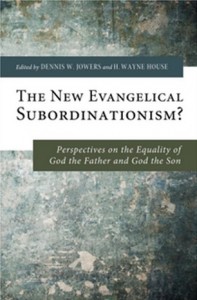
One of the debates going on within evangelicalism today is the concept of the eternal subordination of the Son. That is, is God the Son eternally–not just in the Incarnation or some other temporal state–subordinate to God the Father? Setting aside the complexities of the debate, one of the central questions is whether this eternal subordination entails ontological subordination. The pro-subordination side says it does not; others charge that it does. There are, of course, many other issues, but here we will examine an article from Denny Burk written about Philippians 2:6 in the book The New Evangelical Subordinationism?
Burk’s Thesis: The Son should not pursue “Equality with God”
Denny Burk argues that the Son “should” not pursue “equality with God” and the phrases “form of God” and “equality with God” are not synonymous. He surveys the use of the Greek article and concludes that the use in this instance is not anaphoric–basically the use of one expression carrying the meaning of another in context (I’m not linguist, so I hope I explained this adequately). Granting this distinction, I would suggest that Burk goes too far in concluding the Son is eternally subordinate and in fact arguing that the Son is inequal to the Father.
The Son , he argues, is in the form of God, but should not pursue “equality with God.” The final sentences of his article make this clear: “Therefore, in Paul’s Christology ‘form of God’ is something that Jesus possessed by virtue of his deity, while ‘equality with God’ is not. In fact, ‘equality with God’ is best understood as a role that Jesus refused to pursue so that he could pursue his redemptive work in the incarnation” (104, cited below).
Unequal Persons of the Godhead?
I found these statements astonishing, because I think they fundamentally do divide the Trinitarian persons on an ontological level. Consider the following premise:
P1- If two persons are “unequal,” those persons are not of the same essence.
I think this premise is eminently defensible, but simply asserting this premise begs the question against Burk’s position. Moreover, one would have to narrow down the definition and see what is meant by “unequal,” whether it applies to all forms of inequality, and the like. So rather than going down that route (one which I think would be ultimately successful but also highly complex), I’d simply suggest the following:
P2- If the Son is not “equal to God” to the same extent that the Father is “equal to God” then there is ontological division in the Trinity.
Unfortunately, we again run into the problem that without a demonstration of P2, it begs the question against Burk (and subordinationists who would use the same language). However, I think P2 is even more defensible than P1, so the establishing of P2 shall be the brief project to demonstrate Burk (and any who agree) have crossed the line with subordinationism into undermining the ontological unity of the Trinity.
Defense of P2 and Analysis of Burk’s position
There is no little danger in treating “God” as a kind of distinct entity from “Father,” “Son,” and “Spirit” because we may collapse into not just tritheism but rather quadri-theism where there is God, and then the the other three divine persons. Burk’s lack of defining what is meant by “equal to God” in his expressions seem to cross into this territory.
My defense of P2 will be quite simple. First, Christianity holds that Jesus is God. Period. Ergo, Jesus is equal to God. If Jesus is not just as “equal to God” as God the Father, then Jesus is not God but rather the Father is God and Jesus is some sort of quasi-divine entity having the “form of” but not “equality” with God.
Second, if we argue that two beings, x and y, do not equally share some aspect of nature, z, then it follows that x and y are not both essentially z. Converting that to our discussion of the Trinity, if we suppose that the Son and the Father do not equally have “equality to God,” then surely it must follow that the Son is not essentially God. The substance of the Godhead is not united in this view, but rather divided. If one wants to argue that I am mistaken here, I’d simply ask for a defense of the opposite position. How can there be two entities that are not both reflecting some attribute but who are then said to both be that attribute?
Again, we run into the great difficulty that Burk never does (in this article) adequately explain what he means by “equal to God.” It seems he is using this phrase as though “equal to God” is semantically equivalent to “equal to the Father” but then Burk’s position surely assumes quite a bit and reads subordinationism into the text rather deriving it from this text. After all, we know that Paul is perfectly capable of referencing God as “Father” so if he meant to say that the Son “should not” (using Burk’s terminology) pursue equality to the Father, he could have just said that.
Burk’s own discussion of how “form of God” and equality to God may be distinct is brief:
[A]lthough Jesus actually possessed an identical characteristic of His Father with respect to his deity (i.e. “he existed in the form of God”), he did not want to grasp after another role that was not his–namely, “equality with God.”
…[T]he contrast between “grasping for equality” and “emptying himself” suggests both are functiona categories… Paul argues here that in his pre-incarnate state, Christ’s [sic] existed as theos [I transliterated this word–it is Greek for ‘God’]. Yet in this pre-incarnate existence, Christ Jesus did not seek to be like theos [transliterated] in every respect. (103-104)
These statements lead us to a related difficulty–one related to the first I noted in this section: Burk’s position seems to either turn into equivocation between “God” and “God the Father” without any distinctions (as just noted) or it seems to treat “God” as a distinct entity from the Trinitarian persons. But either of these is extremely problematic.
Moreover, one is forced to wonder how one might say of God the Son that he is God but not like God in every respect. How might one conclude that the persons of the Trinity are of one being if one is “equal to God” in role, but another is not? Burk offers little reason to think this is possible, and simply avers to roles within the Trinity. I contend that this offers little comfort to those with concerns over the possible ontological division within the Trinity coming from subordinationism.
Conclusion
I believe that P1 (properly construed) and P2 are each correct and that Burk’s subordinationism–along with any others who would draw similar conclusions–does indeed ontologically split the Trinity. Moreover, I believe that Burk fails to adequately ground any reason for thinking his position does not break the essential nature of the unity and the one being of the Godhead. It is well and good to assert different roles within the Trinity, but when one “role” is “equality to God,” and that “role” is not shared by all the persons of the Trinity, the implications for Trinitarian theology seem deleterious.
It is certainly possible I am misunderstanding Burk on these points, but it seems the conclusions I’ve drawn follow from his position. I’m happy to be corrected on this. I must, for now, conclude with a rhetorical question: In what sense can we affirm that the Son is God if the Son is not “equal to” God?
Links
Be sure to check out the page for this site on Facebook and Twitter for discussion of posts, links to other pages of interest, random talk about theology/philosophy/apologetics/movies and more!
Women, Complementarianism, and the Trinity- How getting subordination wrong has undermined the Trinity– I note how some complementarians have distorted the doctrine of the Trinity in order to ground their theological position on women in the ministry
Source
Denny Burk, “Christ’s Functiona Subordination in Philippians 2:6: A Grammatical Note with Trinitarian Implications” in The New Evangelical Subordinationism?
SDG.
——
The preceding post is the property of J.W. Wartick (apart from quotations, which are the property of their respective owners, and works of art as credited; images are often freely available to the public and J.W. Wartick makes no claims of owning rights to the images unless he makes that explicit) and should not be reproduced in part or in whole without the expressed consent of the author. All content on this site is the property of J.W. Wartick and is made available for individual and personal usage. If you cite from these documents, whether for personal or professional purposes, please give appropriate citation with both the name of the author (J.W. Wartick) and a link to the original URL. If you’d like to repost a post, you may do so, provided you show less than half of the original post on your own site and link to the original post for the rest. You must also appropriately cite the post as noted above. This blog is protected by Creative Commons licensing. By viewing any part of this site, you are agreeing to this usage policy.
Microview: “Searching for an Adequate God” edited by John Cobb Jr. and Clark Pinnock
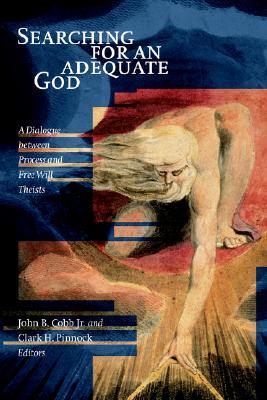 Searching for an Adequate God
Given the major divergence between these positions, this book provides a fascinating dialogue and real insights into points of division between two radically different concepts of God. Intriguingly, the two positions also share many basic premises (as is emphasized by every author) such as an emphasis on human free will as a way to handle theodicy, the notion that God is temporal and impacted in some way by creation, and so on. The essays herein revolve, therefore, around these dual notions–the radical differences between the groups and the shared insights they argue they provide for theology.
The essays by David Ray Griffin (process) and William Hasker (open), along with their rebuttals to each other, frame the debate in an extremely interesting fashion, as their essays truly show the great differences between the positions. In between, essays by the other contributors (and their responses to each other) offer frequently autobiographical reflections on the two positions.
Perhaps most enlightening is the way that both positions show their distance on various points from classical theism and Christianity. Each of the Process contributors (and David Ray Griffin in particular) blithely dismissed or redefined the Trinity as a tertiary (as Griffin described it) doctrine for Christianity. This astounding claim demonstrates how vast the chasm is between the process view and Christianity. The open position, particularly as represented by Hasker, is highly critical of views of providence which entail God being even a secondary cause of evil.
The Good
+Fascinating interaction between two radically different yet frequently similar non-standard theistic positions
+Solid lineup of major representatives on both sides of the debate
+Good format
+Interesting insight into two positions which challenge classical theism
The Bad
-Too frequently autobiographical rather than topical in the middle essays
Conclusion
The value of Searching for an Adequate God
Links
Be sure to check out the page for this site on Facebook and Twitter for discussion of posts, links to other pages of interest, random talk about theology/philosophy/apologetics/movies and more!
Book Reviews– There are plenty more book reviews to read! Read like crazy! (Scroll down for more, and click at bottom for even more!)
Source
John B. Cobb, Jr. and Clark Pinnock, eds. Searching for an Adequate God (Grand Rapids, MI: Wm. B. Eerdmans, 2000).
Is Natural Theology Excluded for Apologetics? – Sunday Quote!+
 Here’s a special edition Sunday Quote which features a more extended discussion. Let me know what you think in the comments.
Is Natural Theology Excluded for Apologetics?
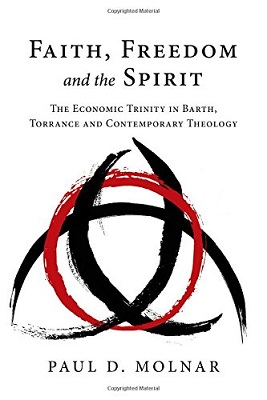
Paul Molnar’s Faith, Freedom and the Spirit 
If contemporary theologians were to make explicit the role of the Holy Spirit in enabling our knowledge of the triune God, then there could be wide agreement that natural theology of whatever stripe is not only unhelpful but is directly excluded from any serious understanding of theological epistemology. (82)
Now, “natural theology” is, according to Justo Gonzalez’s Essential Theological Terms, “A theology that claims to be based on the natural gifts of the human mind, and on the ‘general revelation’ granted to all… rather than on a ‘special revelation’ in Scripture or Jesus Christ” (118). Natural theology, that is, is the attempt to show that God exists and certain other truths through looking at the world. From this quote, it seems that Molnar is arguing that if we had a better notion of the role of the Holy Spirit, we would basically think that natural theology is worthless related to knowledge of God.
Molnar develops this notion further throughout the next 50 pages or so. His argument basically is that if we acknowledge that it is the Holy Spirit who enables faith and knowledge of God, then any “knowledge” of God which is not directly through faith (i.e. through something like a cosmological argument) is not objective knowledge of God.
Although some of what Molnar argues resonates with me–particularly the notion that the Holy Spirit is the one who imparts faith rather than it being some kind of choice we make–I think that his dismissal of natural theology is unnecessary and mistaken. First, the most obvious question to be asked is whether the Spirit can use natural theology to create faith. If it is the case that the Holy Spirit can work through natural theology–something which seems to be clearly correct to me–then the objection that natural theology ignores the role of the Spirit is mistaken.
Second, Molnar’s argument seems to rely on a concept of natural theology which is entirely about trying to impart knowledge of God to those who do not have faith. This, however, ignores the use of apologetics in strengthening the faith of believers. Natural theology can be a valuable tool for those who have faith to pursue the call of 1 Peter 3:15 and have a reason for the hope within them. Whatever one’s view of whether natural theology can bring people to the true God, it seems that it can and should be used for believers to explore the natural world and bolster their faith.
Third and finally, it seems to me that Romans 1 in particular demonstrates that natural theology is not a worthless project. If God’s invisible attributes are capable of being discovered in the things God has made, then surely natural theology has some value in tracing God’s handiwork.
Should we think that natural theology is a failed project? Can it have other uses like those I listed? Is it possible to go from God to Christ? What of the role of the Spirit in apologetics?
Faith, Freedom and the Spirit
Links
Be sure to check out the page for this site on Facebook and Twitter for discussion of posts, links to other pages of interest, random talk about theology/philosophy/apologetics/movies and more!
Sunday Quote– If you want to read more Sunday Quotes and join the discussion, check them out! (Scroll down for more)
Source
Paul D. Molnar, Faith, Freedom and the Spirit (Downers Grove, IL: InterVarsity, 2015).
SDG.
——
The preceding post is the property of J.W. Wartick (apart from quotations, which are the property of their respective owners, and works of art as credited; images are often freely available to the public and J.W. Wartick makes no claims of owning rights to the images unless he makes that explicit) and should not be reproduced in part or in whole without the expressed consent of the author. All content on this site is the property of J.W. Wartick and is made available for individual and personal usage. If you cite from these documents, whether for personal or professional purposes, please give appropriate citation with both the name of the author (J.W. Wartick) and a link to the original URL. If you’d like to repost a post, you may do so, provided you show less than half of the original post on your own site and link to the original post for the rest. You must also appropriately cite the post as noted above. This blog is protected by Creative Commons licensing. By viewing any part of this site, you are agreeing to this usage policy.
Is Middle Knowledge Uncontroversial?
 I was reading a recent blog post at one of the sites from which I read every post–the Pastor Matt blog–and discovered a point of some importance for those interested in the debate over omniscience and divine foreknowledge. His post “Middle Knowledge Misunderstood” is a brief introduction to the concept of middle knowledge. My focus is not going to be on that topic so much as on a claim made in the article: that middle knowledge is uncontroversial. Simply put, this claim is mistaken. Middle knowledge is the subject of much debate to this day.
Middle knowledge is God’s knowledge of counterfactuals of creaturely freedom: specifically, God’s knowledge of “If x, then y” in regards to human and other created beings’ freedom. It is more than that, and yes I am simplifying this quite a bit.
Middle knowledge has been the subject of no little amount of my efforts in studying, and when I read the claim that it is uncontroversial, I was taken aback. Frankly, to say that middle knowledge is not controversial is just entirely mistaken. I shall now demonstrate that point.
First, middle knowledge is controversial among those who deny that God has absolute knowledge of the future, namely, open theists. William Hasker, John Sanders, Clark Pinnock, and other open theists each explicitly deny the existence of these counterfactuals that make up middle knowledge. Greg Boyd, another prominent open theist, argues in multiple places that the “would” counterfactuals of middle knowledge (i.e. in situation x, person s would do y) should instead be “might” counterfactuals because “would” counterfactuals can have no truth value (see, for example, his response to William Lane Craig in Divine Foreknowledge: Four Views (Downers Grove, IL: Intervarsity, 2001).
Second, middle knowledge is controversial among Calvinists. Paul Helm, a noted Calvinist philosopher, writes:
Since the Reformed held that all that occurs is unconditionally decreed by God and that men and women are responsible for their actions, they saw no need for a third kind of divine knowledge, a middle knowledge, which depended upon God foreseeing what possible people would freely do in certain circumstances.
In other words, middle knowledge is superfluous. Helm goes on to state as much:
Not only is middle knowledge unnecessary to an all-knowing, all-decreeing God, but the Molinists’ conception of free will makes it impossible for God to exercise providential control over his creation. Why? Because men and women would be free to resist His decree.
I would contend that most any theological determinist should hold to a similar belief regarding middle knowledge. On such a position, middle knowledge is unnecessary and indeed contrary to their entire system. Certainly Calvinists in general would deny that middle knowledge is necessary or uncontroversial.
Third, Thomists, I believe, would also reject middle knowledge–and historically have–for a number of reasons, including the notion that it entails potentiality in God. The reason it would do so is because of the whole structure of modality–including possible worlds–which advocates of middle knowledge tend to put forward as well. If the assertion is that there is a different way that things God could have created, then that implies that there is a potential there–something that any Thomistic view of the world would deny. I believe the same point would go for Scholastic thinkers in general, but I’m not familiar enough with the range of scholasticism to say that is for sure.
All of this is not even delving into things like whether those who hold to simple foreknowledge would endorse middle knowledge. David Hunt, for example, in the aforementioned Divine Foreknowledge: Four Views, also argues that counterfactuals of freedom required for foreknowledge are illogical. Frankly, I think any position of simple foreknowledge would have to deny middle knowledge because on simple foreknowledge the whole concept is just as superfluous and contrary as it is for theological determinists. After all, if we contend that God just knows the future, then there is little room for things like God’s knowledge of what creatures would do in varied situations: God just knows what the future is going to be. Again, I don’t know the range of thought within the simple foreknowledge position to say for sure, but I suspect the majority position would be to deny middle knowledge.
Now when I shared some of these thoughts with Pastor Matt, his response was to grant that open theists deny middle knowledge, but then later he also granted that some Calvinists do. My point is that even were these the only ones who denied middle knowledge, that would not qualify as being “uncontroversial.” But now, having demonstrated that it is theological determinists, Calvinists, some who hold to simple foreknowledge, open theists, and Thomists (and possibly others?) who would deny middle knowledge, I think that the point has carried: middle knowledge is not uncontroversial.
I say all of this as someone who thinks middle knowledge does exist. But I think that we need to confront the reality that Molinism–the position which most closely endorses middle knowledge–is itself highly controversial and hardly above criticism.
Links
Be sure to check out the page for this site on Facebook and Twitter for discussion of posts, links to other pages of interest, random talk about theology/philosophy/apologetics/movies and more!
Middle Knowledge Misunderstood– Pastor Matt’s post on middle knowledge.
SDG.
——
The preceding post is the property of J.W. Wartick (apart from quotations, which are the property of their respective owners, and works of art as credited; images are often freely available to the public and J.W. Wartick makes no claims of owning rights to the images unless he makes that explicit) and should not be reproduced in part or in whole without the expressed consent of the author. All content on this site is the property of J.W. Wartick and is made available for individual and personal usage. If you cite from these documents, whether for personal or professional purposes, please give appropriate citation with both the name of the author (J.W. Wartick) and a link to the original URL. If you’d like to repost a post, you may do so, provided you show less than half of the original post on your own site and link to the original post for the rest. You must also appropriately cite the post as noted above. This blog is protected by Creative Commons licensing. By viewing any part of this site, you are agreeing to this usage policy.
Debate Review: Al Mohler vs. Chris Date on “Should Christians Rethink Hell?”

Not hell. But it is a pretty picture I took with a kind of intriguing/ominous path.
I want to preface this post by saying I am by no means an expert on the topic of hell. I’ve only read two books on the subject and listened to several lectures. I approach this as one who is still learning and seeking understanding. I hold to what would be called in this debate the “traditional” view of hell as opposed to a literalist view of hell. That is, I believe hell is a place (spiritual? physical?) that is eternal; but I am unconvinced that the fire references made in the Bible are to be taken literally (i.e. how are they literal flames and yet the place is in darkness? – seems to me to be metaphorical language).
I was very interested in listening to this debate between the traditional view, as espoused by prominent conservative theologian Al Mohler and the conditional view (that of annihilationism–those who are unsaved are annihilated at the judgment [typically–please correct me if I have misportrayed this) as put forward by Chris Date. Here, I’ll offer a brief summary of major statements in the debate, followed by my own analysis. Note that these are my summaries of what was said, not necessarily direct quotes. I welcome critique and comments. Let me know if you listened to the debate, and feel free to offer your own thoughts! The debate may be found here.
Summary
Justin Brierly asked Mohler to speak on what he thought about the biblical basis for conditionalism.
Mohler- Anyone who speaks on a doctrinal question sees their side as more biblical, and I find the evidence for conditionalism wanting. We must also present the picture of hell which is that which should be presented to others–we have to see what the biblical picture of hell is. The biblical “meta-narrative” points to dual everlasting destinies–eternal life in a New Heaven and New Earth–and also for eternal punishment. The unified consensus reading of Scripture for the history of Christianity has been the traditional position.
Date– Regarding Matthew 25, the question is not the duration of the punishment but the actual nature of the punishment. The context suggests that the wages of sin is death, physical death and not living any more. At judgment, the conditionalist holds that the second death will be just that–death. Moreover, the alleged consensus opinion on hell has not been completely on the side of traditionalism, and in the last few centuries conditionalism has gained support. [Outlines the biblical evidence for conditionalism while citing a huge number of texts.] The preponderance of Scripture points to conditionalism. The concept of eternal punishment is correct; the question is what the nature of this punishment is.
Mohler– The normal Christian reading of Matthew 25 has been eternal conscious torment, not destruction. The infinite wrath and infinite grace of God are each being experienced. To say that eternal punishment is not an eternal state but just something that endures until it is taken away does not seem to be what the text itself implies. Humans have a life beyond this life–not an inherent right to immortality of the soul but because of the image of God in humanity–we are made for eternal life.
Date– Saying that Christ purchased eternal salvation for us in Hebrews does not imply a continued state of Christ forever redeeming; it was an act in time with eternal consequences. Eternal life is something only experienced by the saved–the punishment is death and its effect lasts forever.
Mohler– It is difficult to square this view with the actual texts. Rather than appealing to a different passage in Hebrews, Date must explain the parallelism in Matthew 25 regarding the phrase eternal–does it mean two things in the same context?
Date– Eternal means forever in both cases–eternal life and death which lasts forever.
Mohler– Substituting death does not explain away the parallelism in the text. The Christian church has long understood that this passage means eternal torment.
Date– That’s why it’s called the traditional view!
Mohler– The traditional view does not rest on isolated texts of Scripture but on the church’s understanding of the weight of the texts as a whole. There is no indication in various depictions of hell in which there is an end to the torment as spoken.
Date– Mohler’s interpretation is incorrect; the Greek can be taken in different senses in the places he cites.
Mohler– These interpretations are based on arguing that when we look at a text, we have to say it doesn’t mean what it looks like it means.
Date– Many Christians held to a conditionalist view in historic Christianity. Moreover, we should not forget that we come to the text with presuppositions, and such giants of the church as Augustine who held to the traditional view had a Platonic view of the soul which influenced their interpretation of the Bible.
Mohler– There was development of the doctrine of hell. Regarding Augustine, if we argue that Augustine’s view was due to Platonism, we have to see that his entire picture of reality was Hellenized and so his view of other important doctrines like the deity of Christ is undermined.
Date– Nobody is claiming that everything found in the Platonic view or the Hellenistic view is wrong. Scripture is the authority, however, not the culture. The Platonic view specifically imported mistakes into the view of the soul and its indestructible nature according to that view.
Mohler– Jesus held to what we call the traditional view. However, Jewish thought at the same time didn’t have much developed thought regarding hell, which is largely a distinctively Christian view.
Date– Jesus’ language speaks of destruction and seemingly endorsed the view of annihilationism through his use of language of destruction and burning up.
Mohler– Gehenna does not point to Jesus endorsing an annihilationist view because the use of that term was a reference to continued endless fire, despite being a distinct historic view. …Jesus spoke more about eternal punishment and hell than about heaven. Our understanding of the Gospel is impacted by a different view of hell. The urgency of the Christian message is undermined by the conditionalist position because it effectively removes any urgency for conversion because the materialist already believes they will just cease existing.
Date– Atheists often reject Christianity because they see the traditional view as unjust, which means that a conditionalist view has greater apologetic value. Moreover, the Gospel can continue to be presented as either the gift of life or the punishment of death. Conditionalism does not undermine urgency of spreading the Good News.
Analysis
It was edifying to listen to both presenters on this program and get a better idea about the differing views related to hell within Christianity. The speakers were each respectful and gracious–something that should be the case!
Chris Date cogently argued for and defended his position against major objections. I think one of the most pressing issues for the conditionalist/annihilationist remains the notion that, on their view, there really is no major difference between the end of the unsaved and that which the materialist believes will happen. However, it should be noted this is less a biblical challenge than it is a philosophical/theological one. Date’s defense of the biblical capacity for conditionalism was challenging to my paradigm as I think he presented some passages which do possibly read more easily on his view than on the traditional view.
I do think, however, some of Date’s claims were a bit of a stretch. For example, his assertion that Jesus endorsed conditionalist teachers perhaps goes beyond the evidence we have. Moreover, his style of argument in some sections was problematic because he simply through a number of texts out (without quoting the text, simply citing the locations) without giving any sort of context. Of course, this latter issue is more due to the format than a defect of his position.
One of the biggest problems with Al Mohler’s defense of the traditional view is how much he appealed to, well, tradition. It seems to me like the traditional view has a solid scriptural basis, and to appeal to the notion that the church as a whole has largely leaned towards the traditional view is inadequate as a defense. Thus, it was his method which I think was greatly problematic. However, towards the end he got deeper into the issues and I think made some solid points, particularly in regards to whether Gehenna necessarily entails the conditional view and on the seeming parity of the unsaved on the conditional view vs. their own position. That said, I think a stronger focus on exegesis would have been more compelling rather than a continued appeal to traditional church teaching.
Overall, I came out of this debate feeling challenged to consider my own position. I also think the conditionalist view is not, as some assert, clearly unbiblical. If one wants to continue asserting that, I think they must deal very closely with the texts Date and others cite for their position. One can’t just cite a single proof text and say that other texts must be reinterpreted in light of a single text.
What are your thoughts? Please let me know in the comments.
Links
Should Christians Rethink Hell?– The link for the audio of the debate along with some related links from Premier Christian Radio.
Be sure to check out the page for this site on Facebook and Twitter for discussion of posts, links to other pages of interest, random talk about theology/philosophy/apologetics/movies and more!
*The image in this post was taken by me. I claim the copyright as noted below.
SDG.
——
The preceding post is the property of J.W. Wartick (apart from quotations, which are the property of their respective owners, and works of art as credited; images are often freely available to the public and J.W. Wartick makes no claims of owning rights to the images unless he makes that explicit) and should not be reproduced in part or in whole without the expressed consent of the author. All content on this site is the property of J.W. Wartick and is made available for individual and personal usage. If you cite from these documents, whether for personal or professional purposes, please give appropriate citation with both the name of the author (J.W. Wartick) and a link to the original URL. If you’d like to repost a post, you may do so, provided you show less than half of the original post on your own site and link to the original post for the rest. You must also appropriately cite the post as noted above. This blog is protected by Creative Commons licensing. By viewing any part of this site, you are agreeing to this usage policy.
Does “50 Shades” reveal some unspoken longing for gender hierarchy?
The only thing (probably) I’m going to write on 50 Shades of Grey is this post. I know, there are literally hundreds of Christian responses to the book. This is not another. It is a response to an article from First Things called “Fifty Shades Against Gender Neturality,” which I found to be deeply problematic.
Let’s get the basics out of the way. No, I haven’t read the book. No, I’m not commenting on the content of the book because I haven’t read it. All this post is trying to put forward is the notion that 50 Shades of Grey somehow reveals an unspoken longing for gender hierarchy, as alleged in the aforementioned article, is mistaken.
This article will not be explicit but by nature its content is more “adult” than my site normally is.
Only Women?
The author of the article on First Things writes:
[T]here’s a hunger that’s not being satisfied: Namely, for men who are unabashedly masculine, who aren’t afraid to take control, and to lead. That is, there’s a longing (even a lusting) for men who aren’t afraid of what’s classically been called “headship.”
A major difficulty with the article is the premise that women’s desire to be dominated somehow reveals a more basic gender hierarchy ingrained into human nature. One difficulty with this is that it is not only women who desire such things. There are men also who are “into” things like being dominated. Thus, should we draw the conclusion that there is a basic hierarchy of women over men in human nature? Clearly not. Moreover, what response could the author of the article on First Things say in response to this? That human nature is broken? Obviously! But it is clearly special pleading to say that women’s desires in this realm point to intrinsic human nature while that desire of men is a reflection of the opposite. The standards need to be the same.
But the author never even mentions or acknowledges awareness of men longing for the same type of activity. Why not? Perhaps it is just ignorance, or perhaps it is the desire to push an agenda. But the reality of men who want to play the role of submissive demolishes this absurd premise. Surely the author wouldn’t agree that this reality means:
There’s a hunger that’s not being satisfied: Namely, for women who are unabashedly feminine, who aren’t afraid to take control, and to lead. That is, there’s a longing (even a lusting) for women who aren’t afraid of what’s classically been called “headship.”
But if women lusting after these kinds of relationships entail this for men, why would it not entail the same for women? It seems that the only reason is because this would go against the argument for male headship. That, indeed, is special pleading.
There is a kind of brokenness here, but it is not a hidden desire for men to be in a relationship of headship of women; it is a brokenness of the fallen human nature–lusting after characters or even activities which we don’t have. The women and men reading 50 Shades is indicative of something: broken human nature.
What Are We Attracted To?
The central premise of the author’s argument is that that which we are attracted to must reveal something about human nature. Our desires must somehow show a “hunger” “not being satisfied.” In the case of 50 Shades, the author argues that it is male hierarchy. But how fluid are these hungers? Who decides what the “hunger” ultimately points towards?
As one commentator on the article shared when I posted it to a Facebook group, what do human desires for pornography, materialism, or mind-altering drugs point to? The permutations of what we could arbitrarily assign to these things are nearly infinite. Materialism–the desire for more things–points to our need to dominate the earth; to outdo our neighbor; to love our neighbor by buying them things; to assert our authority over those who can’t buy things; perpetuation of immoral systems of wealth; etc.
The arbitrariness of assigning interest of 50 Shades to an unspoken desire for gender hierarchy is clear and tells us more about the author’s presuppositions than about the reasons behind the book’s success.
Looking for the Brothel
The author writes:
If Fr. Smith, the titular character in the Bruce Marshall novel, is right that “the young man who rings the bell at the brothel is unconsciously looking for God,” what are fans of the Fifty Shades series seeking?
This line reveals how the author’s presuppositions have guided their article.* Think about it:
Men seeking brothel = looking for God
Women seeking pornographic books = looking for men
How does that follow? The article is blatantly male-centric and yet offers no reason for thinking that this strange split should be believed. Why think that men seek after God while women must seek after men? Are women incapable of also seeking God? Could women’s desire for similar sins also be a kind of replacement for God? Perhaps men seeking a brothel are in fact unconsciously looking for women to love and care for them. Perhaps they are looking to perpetuate a sinful cycle of violence against women.
But according to the author, when it comes to men- they seek God. Women? Apparently they have to seek after men.
Conclusion
There is something happening when we go after sinful desires. We are seeking to replace God with an idol. Whether that idol is a brothel, a dirty book, accumulating wealth, or something else, we can unanimously affirm that all of these desires point to a replacement of God with something else. There is a God-shaped hole in our hearts, and we as fallen people will seek to fill it with anything. These desires don’t reveal the way things should be, as though our sinful longings were somehow pointers towards the good. Instead, these desires are themselves evil. They are a replacement of God with something which is not God. The fallen world does not show how things should be; it shows them as fallen. To arbitrarily psychoanalyze desires and assign to them our chosen pet issues is to do injustice to the real impact of sin on human nature and in society. Rather than trying to put forth our agendas of what preferred stance we take on gender issues or something else, we should seek to reconcile with God and point people towards God.
*Another commentator on the article when I shared it helped develop this point.
Links
Be sure to check out the page for this site on Facebook and Twitter for discussion of posts, links to other pages of interest, random talk about theology/philosophy/apologetics/movies and more!
SDG.
——
The preceding post is the property of J.W. Wartick (apart from quotations, which are the property of their respective owners, and works of art as credited; images are often freely available to the public and J.W. Wartick makes no claims of owning rights to the images unless he makes that explicit) and should not be reproduced in part or in whole without the expressed consent of the author. All content on this site is the property of J.W. Wartick and is made available for individual and personal usage. If you cite from these documents, whether for personal or professional purposes, please give appropriate citation with both the name of the author (J.W. Wartick) and a link to the original URL. If you’d like to repost a post, you may do so, provided you show less than half of the original post on your own site and link to the original post for the rest. You must also appropriately cite the post as noted above. This blog is protected by Creative Commons licensing. By viewing any part of this site, you are agreeing to this usage policy.
A God Who Risks… too much?- A Difficult Dilemma for Open Theists
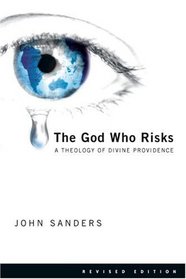 Open theism is, briefly, the notion that God does not comprehensively know the future [edit: strictly speaking, the view is that there is no settled “future” to know to begin with, so it is not a lack of knowledge but rather the absence of such a thing as a future that will occur; see next sentence and thanks for a clarifying comment below]. The future, it is held, is in some sense “open” because it is undetermined, even for God. Most frequently, this claim is put forth in terms of denial of knowledge of free creaturely action. Representative is the claim of John Sanders:
God cannot know as definite what we will do unless he destroys the very freedom he granted us… The future is not completely fixed, but open, to what both God and humans decide to do, so there are numerous possible futures (not just one). God knows as possibilities and probabilities those events which might happen in the future. (Sanders, 206, cited below)
Thus, it is fairly central to the open theistic perspective that God does not (and indeed cannot) know the future exhaustively, and the parts God does not know exhaustively are such because free will is involved. For the open theist, then, the proposition: ‘God does not know the future free actions of creatures with certainty’ is true. Gregory Boyd, another prominent open theist, puts it this way: “open theists hold that if God is omniscient… and if the future is in fact partly comprised of ontological possibilities, then God must know the future as partly comprised of such possibilities” (Boyd, 195, cited below).
Because of this, we may fairly state the open theistic perspective as holding the following proposition to be true: “God does not know [future] counterfactuals of creaturely freedom [CCF].”
The Dilemma
I propose that open theism, because of its commitment to denial that God knows the future free actions of agents, raises an enormously difficult dilemma for those who hold to the position:
Either God possibly created knowing that it was possible no one would be saved or at least one counterfactual is true.
The dilemma draws its strength from propositions open theists, by their own writings, accept. Open theists, as demonstrated above, deny that God knows CCF. Thus, the following statement is unknown to God according to open theism:
If I (God) create the universe, at least one free creature will be saved.
Open theists must deny this statement as being known by God in order to maintain their stance that God cannot know the future free actions of creatures. But denying this counterfactual is theologically very problematic, because it means that the God who risks (to use John Sanders’ terminology) effectually risked so much that God decided to create a universe populated by moral agents without so much knowing that even one of these agents would be saved. Sure, one of the possibilities was probably that all such moral beings would be saved, but another possibility is that all moral beings would be damned. On open theism, God just didn’t know.
Now it could be that God was 99.999999999(repeating)% sure that at least one agent would be saved, but according to open theism, God could not know. I would suggest that any theological system which seriously puts forth the notion that God would create without knowing that at least one being would be saved is a theological system that cannot maintain the moral benevolence of deity.
The second part of the dilemma is also a serious problem for the open theist. Suppose the open theist embraces this part and counters “Very well, then God knew that at least one being would be saved.” But of course this would have been a CCF when God chose to create. Thus, the open theist would be forced to accept that at least one of these future counterfactuals is true. But if one is true, what possible grounds could there be for denying that others are true as well? It seems the open theist would either have to accept that CCF can be known without restraint (and therefore overthrow the philosophical framework of open theism) or simply engage in special pleading for those CCFs that must be maintained in order to not impugn the moral character of God.
Counter Arguments
Character Settled?
Greg Boyd has argued that free agents may have settled characters such that free will may not be a consideration (for the sake of space I’ve greatly summarized here; see Boyd 193-194 for one example). Perhaps at least one creature could have a settled will such that they are saved and thus God could know their salvific status without threatening to know CCFs. My response to this would be to note the highly controversial nature of this argument on a number of levels: 1) it suggests that humans are capable of, by their own free will, coming to such a point that they change their will into a form that will, with certainly, act according to God’s will, which is objectionable on a number of Scriptural grounds; 2) it holds to a view of human nature that both affirms and denies compatibilism; 3) the possibility of a “settled will” is difficult to establish or define; etc.
CCFs not Denied
Perhaps the open theist could respond by arguing that open theism need not deny that God knows CCFs. I do not think this would be possible while still maintaining open theism because it would mean God knows comprehensively the future including my future free actions.
God’s Character not Impugned?
Perhaps the most fruitful counter for the open theist would be to deny that God’s moral character is impugned by creating without knowing that at least one person would be saved. Perhaps such an activity is merely morally neutral, or God’s other reasons for creating could overcome the difficulty.
I think this is, as I said, the best avenue for open theists to pursue, but on reflection I think that the real possibility that God would create in such a way as to not know that the moral agents God brought into being would be saved–that they all might be damned despite that not being God’s intent–is extremely problematic.
Conclusion
I believe that the dilemma offered above is, frankly, lethal to open theism. I have read several works by leading proponents of open theism and think that many arguments against the same are off the mark because they often do not hit on the points open theists actually hold. Here, however, I have presented an argument derived from the core of open theistic thought. Thus, I believe that open theism is untenable. It either impugns God’s character or is self-referentially incoherent.
Links
Be sure to check out the page for this site on Facebook and Twitter for discussion of posts, links to other pages of interest, random talk about theology/philosophy/apologetics/movies and more!
The Consolation of Counterfactuals: The Molinism of Boethius– Boethius was an early Christian thinker who thought of a very insightful way to discuss counterfactuals of freedom.
Is God Just Lucky?: Possible Worlds and God’s Providence, a Defense of Molinism– I examine the set of possible worlds from a molinistic perspective.
The New Defenders of Molinism: Reconciling God’s Foreknowledge and Our Free Will– I present a general case for molinism, analyzing various positions and concluding that God does know what we will do without predetermining it.
Sources
John Sanders, The God Who Risks (Downers Grove, IL: InterVarsity, 2007).
Gregory Boyd “God Limits His Control” in Four Views on Divine Providence edited Gundry and Jowers (Grand Rapids, MI: Zondervan, 2011).
SDG.
——
The preceding post is the property of J.W. Wartick (apart from quotations, which are the property of their respective owners, and works of art as credited; images are often freely available to the public and J.W. Wartick makes no claims of owning rights to the images unless he makes that explicit) and should not be reproduced in part or in whole without the expressed consent of the author. All content on this site is the property of J.W. Wartick and is made available for individual and personal usage. If you cite from these documents, whether for personal or professional purposes, please give appropriate citation with both the name of the author (J.W. Wartick) and a link to the original URL. If you’d like to repost a post, you may do so, provided you show less than half of the original post on your own site and link to the original post for the rest. You must also appropriately cite the post as noted above. This blog is protected by Creative Commons licensing. By viewing any part of this site, you are agreeing to this usage policy.
Constantine’s Faith and the Myth of “Constantine’s Takeover”
 There is a narrative within some branches of Christianity (and some… “offshoots”) regarding church history. It is a narrative in which Constantine is seen as the great evil (whether intentionally or not) which corrupted Christianity. The narrative basically goes like this: Constantine rose to power, then everything went wrong in Christianity. He made Christianity the state religion, which introduced scores of nominal Christians into the church. He made service in the church a well-paying position, which corrupted the office of the ministry. He himself was probably not even a Christian!
So the story goes. Is it accurate?
From Narrative to History
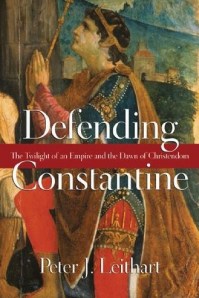
The question of Constantine is one of history. Too often, people have subjected Constantine to psychoanalysis, analyzing an ancient historical figure’s mental state to determine his motives. Historical study may indeed speculate about such things, but to suggest, as some do, that one may uncover some nefarious ancient plot to take over Christianity and lead it into heresy is to engage in writing historical fiction. So what may we actually learn from the historical accounts? Peter Leithart’s work, Defending Constantine: The Twilight of an Empire and the Dawn of Christendom 
Leithart notes that it seems clear that Constantine actually paid much deference to Christianity (Leithart, 93; 121ff; 128-129; 326-328, etc., cite below). He was keen to prevent major divisions within the Church which could have resulted, for example, from the Arian controversy. Hence, he called a council at Nicaea which would define Christian orthodoxy for centuries to come. Constantine himself likely favored the view of Arius, but when the Nicene Council ultimately came against Arianism, Constantine submitted to the defining of orthodoxy.
Constantine’s life appears to be one not of a plot to take Christianity over for political gain, but rather as a life lived struggling with newfound faith and attempting to integrate that faith into public policy. Alister McGrath notes that Constantine’s faith led him to legalize Christianity and sanction it, with some interesting and perhaps unforeseen side-effects:
The new imperial status of Christianity meant that its unity and polity were now matters of significance to the state. (McGrath, 139, cited below)
The much-discussed question of why, if Constatine’s faith were genuine, he would have waited until his deathbed to get baptized is easily answered by his belief that he should wait until the last possible moment to gain the purifying from sins which baptism would provide (Leithart, 299-300).
Frankly, the more one reads about Constantine, the more difficult it becomes to imagine him as someone whose faith was not genuine. Like any Christian, he had his faults–he was a sinner-saint–but he also worked through his position to try to spread and unite Christianity. Leithart notes that many of Constantine’s laws were “more often Christian in effect than in intent” (304). What he means by this is that many laws he made spring from a Christian worldview, though not being explicitly Christian themselves. For example, he outlawed gladiator shows–hardly something which can be said to be explicitly Christian–and this demonstrated Constantine’s genuine concern for human life and the “image of God” in humanity which was noted in yet another law he made (303-304).
In another work, a collection of essays on Apologetics in the Roman Empire
[The work] reveals an emperor who was able to give more substance to his faith than many clerics, and an apologist whose breadth of view and fertile innovations make it possible to mark him with the more eminent theologians of his age (275).
It’s time to set aside the notion that Constantine was somehow “faking it.”
 Constantine’s Takeover?
The “narrative” of Constantine has, unfortunately, often dipped into the notion that he was indeed a Pagan who overthrew traditional Christianity and condemned Christianity to political power-plays for centuries after his death. This notion simply does not line up with historical reality. Although Constantine’s enriching of the church’s coffers did lead to church positions becoming a political gain, it also provided a counter-balance to Imperial authority (Leithart, 304).
Moreover, Leithart argues that the notion that Constantine himself brought about so many wrongs to the church is historically fictitious: “[T]here was a brief, ambiguous ‘Constantinian moment’ in the early fourth century, and there have been many tragic ‘Constantinian moments’ since. There was no permanent, epochal ‘Constantinian shift'” (287). Indeed, the notion of church and state was something found seeded in Augustine’s writings (286) and although Constantine did bring about some monumental changes, the effects they had could only take place over vast amounts of time. It would be impossible to argue that the Catholic Church of the Medieval Period was directly the same or even the exact result of Constantine’s policy.
Finally, Constantine’s policies and actions “Baptized Rome” (Leithart, 301ff). He built churches, empowered bishops, called for unity, and deferred to church teaching. His laws, as noted above, were rooted in a genuinely Christian worldview and sprung from faith.
Conclusion: Defending Constantine
Was Constantine a perfect human? Obviously not. But was Constantine a Pagan who dramatically undermined Christianity; was he a usurper of the Church’s authority who did incalculable damage to Christianity? It does not seem so. Whatever your views on the matters, one must contend with strong historical evidence for the genuineness of Constantine’s faith. His policies indeed may have (and at points certainly did) damage the church, but was that his intent? Again, psychoanalysis of ancient figures is dubious, but the actions Constantine took were those of someone with genuine concern for the stability of Christianity. Most telling, perhaps, were his actions that were not explicitly stamped with Christianity but reflective of his background beliefs: by seeking to end violence, help alleviate poverty, and the like, he demonstrated his faith.
Links
Be sure to check out the page for this site on Facebook and Twitter for discussion of posts, links to other pages of interest, random talk about theology/philosophy/apologetics/movies and more!
Sources
Peter Leithart, Defending Constantine: The Twilight of an Empire and the Dawn of Christendom
Alister McGrath, Heresy: A History of Defending the Truth
Mark Edwards, Martin Goodman, and Simon Price, eds., Apologetics in the Roman Empire
SDG.
——
The preceding post is the property of J.W. Wartick (apart from quotations, which are the property of their respective owners, and works of art as credited; images are often freely available to the public and J.W. Wartick makes no claims of owning rights to the images unless he makes that explicit) and should not be reproduced in part or in whole without the expressed consent of the author. All content on this site is the property of J.W. Wartick and is made available for individual and personal usage. If you cite from these documents, whether for personal or professional purposes, please give appropriate citation with both the name of the author (J.W. Wartick) and a link to the original URL. If you’d like to repost a post, you may do so, provided you show less than half of the original post on your own site and link to the original post for the rest. You must also appropriately cite the post as noted above. This blog is protected by Creative Commons licensing. By viewing any part of this site, you are agreeing to this usage policy.
Honoring Giftedness- Women in David Weber’s science fiction
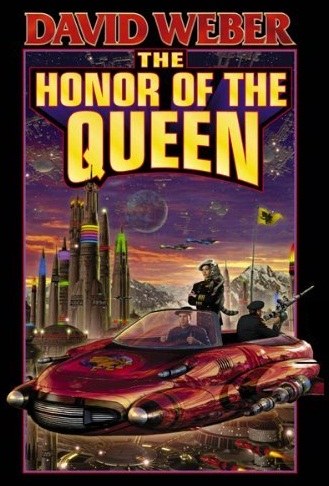 David Weber is the author of a few New York Times Bestselling science fiction series. One, the Honor Harrington series, follows a woman who starts off as a captain of a starship sent on routine (and initially boring) missions. The second book in the series, The Honor of the Queen
The two nations are complementarian in nature. Complementarianism is the theological belief that men and women are “complementary” in roles, which means that men should be in charge in the church and home. I have discussed it and the rival view that women should be ordained/treated as equals (egalitarianism) at length elsewhere [scroll down to see other posts].
What really struck me is that David Weber fairly presented firm theistic believers as a spectrum. In the future, the Christian Church has continued to reform and have splinter groups form because of this. Weber’s presentation of the issue showed that believers–even some who might be considered extreme–can be reasoned with and even persuaded to believe differently based upon evidence. Furthermore, he showed that even those who may line up on the side with which he disagrees are not all (or even mostly) blinded by faith or foolishness. Rather, although there are some truly evil and disillusioned people, Weber shows that many are capable of changing their position or at least acknowledging that rival views are worth consideration.
The most vivid portrayal of this theme is found in a conversation between Admiral Courvosier and Admiral Yakanov. Courvosier is from the same nation as Honor Harrington and wholly endorses his female officer in a position of command. They discuss Captain Honor Harrington:
[Yanakov responds to Courvosier’s question about his society’s reaction to Honor]: “If Captain Harrington is as outstanding an officer as you believe–as I believe–she invalidates all our concepts of womanhood. She means we’re wrong, that our religion is wrong. She means we’ve spent nine centuries being wrong… I think we can admit our error, in time. Not easily… but I believe we can do it.”
“Yet if we do[” Yanakov continues, “]what happens to Grayson [Yanakov’s world]? You’ve met two of my wives. I love all three of them dearly… but your Captain Harrington, just by existing, tells me I’ve made them less than they could have been… Less capable of her independence, her ability to accept responsibility and risk… How do I know where my doubts over their capability stop being genuine love and concern?” (96, cited below)
The exchange is characteristic of the way Grayson’s people are treated throughout the book. They are real people, capable of interacting with other views in honest ways. They feel challenged by a view contrary to their own. Some react poorly, and there are extremists who are blinded by hatred and anger. Yet all of them are treated as people with real concerns shaped by their upbringing and backgrounds.
Honor Harrington ends up saving Grayson, and at the end of the book, she is commended by the rulers of that planet. She talks to the “Protector” [read: king/president] of Grayson:
“You see,” [said the Protector] “we need you.”
“Need me, Sir?” [Responded Honor]
“Yes, Grayson faces tremendous changes… You’ll be the first woman in our history to hold land… and we need you as a model–and a challenge–as we bring our women fully into our society.” (419)
Weber thus allows for even ardent supporters of specific religious backgrounds to respond to reasoned argument and to change. They are capable of interacting on a human level and deserve every bit of respect as those who disagree with them. Again, there are those who are radicals and will not be reasoned with, but they are the minority and they do not win out.
The dialogue presented in this book provides some interesting insight into facets of the present dialogue between complementarians and egalitarians. David Weber’s fictional character presented a challenge to the Grayson’s notions of what it meant to be a woman by being an excellent officer and professional. There are, it seems, real “Honor Harringtons” out there, challenging preconceived notions of what it is to be a woman. When, for example, a woman takes on the role of leadership in the church and succeeds, that should not be dismissed as a fluke, but rather a challenge to a paradigm which may itself be undercutting women’s ability to succeed.
On a personal note, I have been challenged in exactly this way. When I was younger, I was a complementarian and was confronted by a woman who destroyed my presuppositions about what a woman “could do” spiritually. She showed that she could be a leader and present Christ to all without having to fit into role I defined for her. This real challenge caused me to realize that my notions of what a woman “should be” were themselves social constructs, not anything derived from the Bible. Like Yanakov, I had to rethink what my words and actions had done to perhaps limit the women around me. By God’s grace, this woman’s very existence forced me to rethink what I had assumed as truth and go back to God’s word to see where I had gone wrong.
David Weber’s own presentation of Honor Harrington as a paradigm-shattering woman is something that hits close to home for me. For you, dear reader, I think it is worth considering the same: who has challenged your view of what they are “supposed to be”? Is your view of someone’s giftedness directly drawn from the Bible or is it something that you’ve just always assumed? As for me, I think we need more Honor Harringtons in our lives.
Links
Be sure to check out the page for this site on Facebook and Twitter for discussion of posts, links to other pages of interest, random talk about theology/philosophy/apologetics/movies and more!
Check out my posts on egalitarianism (scroll down for more).
Source
David Weber, The Honor of the Queen
SDG.
——
The preceding post is the property of J.W. Wartick (apart from quotations, which are the property of their respective owners, and works of art as credited; images are often freely available to the public and J.W. Wartick makes no claims of owning rights to the images unless he makes that explicit) and should not be reproduced in part or in whole without the expressed consent of the author. All content on this site is the property of J.W. Wartick and is made available for individual and personal usage. If you cite from these documents, whether for personal or professional purposes, please give appropriate citation with both the name of the author (J.W. Wartick) and a link to the original URL. If you’d like to repost a post, you may do so, provided you show less than half of the original post on your own site and link to the original post for the rest. You must also appropriately cite the post as noted above. This blog is protected by Creative Commons licensing. By viewing any part of this site, you are agreeing to this usage policy.
Sunday Quote!- The Heartbeat and Delight of Christianity
 Every Sunday, I will share a quote from something I’ve been reading. The hope is for you, dear reader, to share your thoughts on the quote and related issues and perhaps pick up some reading material along the way!
The Heartbeat and Delight of Christianity
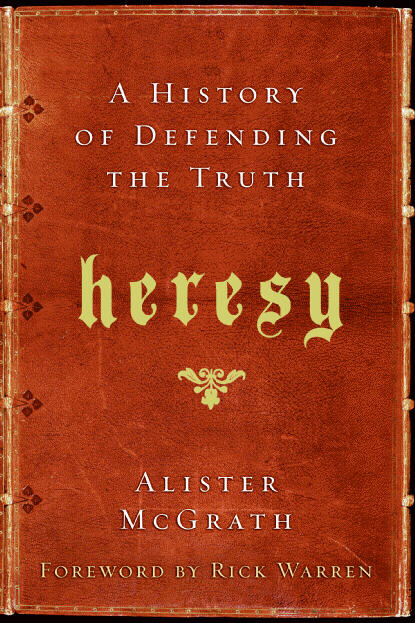
I re-read Alister McGrath’s Heresy: A History of Defending the Truth
If there is a heartbeat of the Christian faith, it lies in the sheer intellectual delight and excitement caused by the person of Jesus of Nazareth. Here is the one whom the church finds to be intellectually luminous, spiritually persuasive, and infinitely satisfying, both communally and individually. (17, cited below)
I found this passage quite powerful. Jesus is the heartbeat of Christianity, and our delight. Without Christ, there is no faith. Without our Lord, there is no salvation. But McGrath goes beyond that: Jesus of Nazareth is an intellectually compelling person, which drives us to seek out formulations to explain who He is; Christ is satisfaction and communal unity.
Have you thought about Jesus in these ways? How has Jesus spurred your intellect? In what ways have you recently delighted in the person of Jesus Christ?
Links
Be sure to check out the page for this site on Facebook and Twitter for discussion of posts, links to other pages of interest, random talk about theology/philosophy/apologetics/movies and more!
Sunday Quote– If you want to read more Sunday Quotes and join the discussion, check them out! (Scroll down for more)
Book Review: “Heresy: A History of Defending the Truth” by Alister McGrath– Check out my review of McGrath’s book.
Source
Alister McGrath, Heresy: A History of Defending the Truth
SDG.

 J.W. Wartick - Reconstructing Faith