Christian Doctrines
Is God just lucky?: Possible Worlds and God’s Providence, a Defense of Molinism

Knowing all the possible circumstances, persons, and permutations of these, God decreed to create just those circumstances and just those people who would freely do what God willed to happen. (William Lane Craig, 86).
I’ve argued previously that molinism allows for human freedom and God’s perfect knowledge of the future. One objection which has been raised to my argument is that, granting all of it, it would seem that God is just really lucky that the world He wants to actualize is possible. Looking back, we can see that the argument flows from the logical priority of God’s knowledge. Central to my defense was the notion that the possible worlds are full of the free choices of creatures. The objection therefore argues that God must simply “get lucky.” There must be a possible world which God actually wants to actualize.
The argument would look something like this:
1) God can only create that which is possible
2) The set of possible worlds covers all possibilities.
3) Therefore, if there is a world which God wants to create, He would have had to be simply lucky–there would have had to be a possible world that contained the outcomes God desired.
The objection is quite thoughtful. It is not easy to resolve. Before rebutting this objection, it is important to note that the set of all possible worlds is the same whether one is a determinist, open theist, or molinist. Granted, open theists deny that this set would include future contingents, but for now that is irrelevant. All the positions agree the set of possible worlds includes no contradictions. Thus, any position must account for the “God got lucky” objection.
I believe that molinism offers a way around this difficulty, and it does so by again focusing upon logical priority. William Lane Craig’s quote above illustrates this. God’s will is at the forefront. I suggest that God’s will is logically prior to the set of possible worlds. Consider the following argument, which focuses upon the redemption (as one of the outcomes God would desire):
1) God only wills what is possible
2) God wills the redemption
3) Therefore, the redemption is possible (modus ponens, 1-2)
4) Whatever is possible exists in the set of possible worlds (tautology)
5) Therefore, the redemption exists in the set of possible worlds (3, 4)
From this argument, it wouldn’t be too difficult to draw the inference that God isn’t lucky in regards to the possibilities–God’s will would have some kind of determining power over the set of possible worlds, because anything God wills would have to exist in a possible world. In other words, God’s will is logically prior to the set of possible worlds. That which God’s will must be possible, so it is not the set of possible worlds that determines what God can will, it is rather God’s will which determines the set of possible worlds.
A potential objection I could see is that this argument just moves the debate up another level–does God will things because they are possible or are they possible because God wills them? My response would again point to logical priority, and I would say that God’s nature (will) is logically prior to the set of possible worlds.
An objection could then be raised: “Why doesn’t God will for a world without evil?” Answer: Free will defense would work here also. God could clearly will for a world to have the redemption without destroying free will for all persons, but to will a world without evil would (possibly) impinge on all persons’ free will.
Therefore, it seems that only molinism can adequately account for both human free will and God’s omniscience and providence. Whatever God wills will occur. God is not lucky, rather, God is sovereign.
SDG.
Sources
William Lane Craig, “God Directs All Things: On Behalf of a Molinist View of Providence” in Four Views on Divine Providence ed. Stanley Gundry and Dennis Jowers, 79-100 (Grand Rapids, MI: Zondervan, 2011).
Image Credit: I took this picture at Waldo Canyon near Manitou Springs, Colorado on my honeymoon. Use of this image is subject to the terms stated at the bottom of this post.
——
The preceding post is the property of J.W. Wartick (apart from citations, which are the property of their respective owners) and should not be reproduced in part or in whole without the expressed consent of the author. All content on this site is the property of J.W. Wartick and is made available for individual and personal usage. If you cite from these documents, whether for personal or professional purposes, please give appropriate citation with both the name of the author (J.W. Wartick) and a link to the original URL. This blog is protected by Creative Commons licensing. By viewing any part of this site, you are agreeing to this usage policy.
The New Defenders of Molinism: Reconciling God’s Foreknowledge and Our Free Will
God has both complete foreknowledge concerning how… creatures will act and great control over their actions, in the sense that any act they perform is either intended or permitted by him. Yet because the knowledge which generates this foresight and sovereignty is not itself a product of free divine activity, our actions remain genuinely free, not the robotic effects of divine causal determinism. (Thomas Flint, 44, cited below)

Middle Knowledge–God’s knowledge of counterfactuals–is under attack from all sides. On one side, theological determinists argue that God’s foreknowledge necessitates all states of affairs. On the other side, open theists and process theists argue that foreknowledge limits the free will of creatures. That said, there are some extremely powerful philosophical defenses–and defenders–of the doctrine of middle knowledge.
Logical Priority and Creaturely Freedom
Essential to a correct understanding of molinism is an investigation of creation. Here, however, the discussion is not over the temporal nature of creation or the steps God took in creating. Rather, the focus is upon the logical priority within God’s creative act. By drawing out the logical priority involved, molinism solves the objections of both determinism and open theism.
The logical order of events is different from the chronological order in which they occur. Determinists focus only upon the chronological order: 1) Future contingents are true or false, God knows those which are true. 2) The events which are true occur (Craig, 128). From this, determinists (and open theists who deny God’s foreknowledge in order to preserve freedom of the will for this reason) conclude that everything is determined. The problem is they have ignored the contribution middle knowledge can make to reconciling free will and foreknowledge.
The logical priority of events occurring is quite different from its chronological order: 1) Events occur; 2) Statements about the events are true or false; 3) God knows the true statements.
By drawing out the logical priority of events’ occurring, one can then apply this to creation. William Lane Craig points out “The Three Logical Moments of God’s Knowledge”: 1) Natural Knowledge- God’s necessary knowledge of all possible worlds; 2) Middle Knowledge- God’s knowledge of creaturely counterfactuals. Here is the pivotal point: the third “logical moment” (again, note the distinction between chronological priority and logical priority) occurs only subsequent to God’s decision to create a world. God uses His natural knowledge to peruse the possible worlds, and His middle knowledge to determine how to best bring about His divine plans. Then, He chooses which possible world to create, and this brings about the third “moment” of God’s knowledge: 3) Free Knowledge–God’s contingent knowledge of the actual world (Craig, 131).
Note that God’s free knowledge is contingent–it is based upon actualizing a world from the set of possible worlds. Combining this with the facts of logical versus chronological priority, the resolution of the alleged difficulties from both determinists and open theists is revealed. Determinists ignored the fact that God, upon creating, is selecting from the set of possible worlds–included in each possible world is the set of free creaturely choices which will occur. God, therefore, does not determine which events will occur, but selects a world full of free choices. Open theists, on the other hand fail to recognize that the choices are free. The point must be emphasized: the choices themselves are logically prior to God’s knowledge of them. In other words, there is a set of possible worlds, each of which features various states of affairs. Middle knowledge reveals the free choices made by the individuals which can populate the possible worlds. God’s knowledge does not determine the choices–God simply chooses to actualize one of the worlds full of free choices. It is only the “free knowledge” of God which is determined by God (Flint, 42).
The Theological Superiority of Molinism
Reconciling God’s foreknowledge and creaturely free will is not the only reason to accept molinism. The doctrine has a number of theological advantages over both open theism and theological determinism. First, the doctrine undermines the extremely untoward idea within theological determinism that God causes evil. John Frame, for example, says quite simply “…[I]t is important to see that God does in fact bring about the sinful behavior of human beings, whatever problems that may create in our understanding” (Frame, 68). Molinists, on the other hand, acknowledge that God accounts for evil within His plan but they can rightly argue that evil is due to the free acts of creatures.
Molinism also provides a grounds for Biblical Inerrancy. Open theists have great difficulties providing any grounds for this doctrine (and often end up abandoning it). The reason for this is because open theists don’t believe God knows what free creatures will do. Thus, free creatures–the authors of the Bible–could be fallible. Middle knoweldge, on the other hand, shows that God knows what the creatures will do in whatever circumstances they are placed in. Thus, God would have known who, what, where, when, why, and how to bring about His infallible Word.
Most notably, prophecy perhaps only makes sense on a molinist account. While determinism allows for the truth of prophecy, it undermines the creature-creator relationship inherent in prophecy (and found in accounts like that of Jonah). God simply foreordains that His prophets come forward and prophecy, then He unilaterally brings about the truth of their prophetic utterances. Open theism, on the other hand, must force prophecy either into God’s luck or argue that it is one of the “unilateral” actions of God (which undermines the core of open theism–human freedom). Molinism, however, allows for human freedom and the truth of prophecy. Thomas Flint points out that prophecy on a molinist account could be brought about in two ways–either through God acting to bring about the truth of the prophetic utterance, or through God’s foreknowledge of the free actions of creatures (Flint 197ff).
Again, prayers and their answers may only make sense upon a molinist account. Determinists, in particular, have difficulty with prayer. God seems quite narcissistic–He foreordains that His creations worship Him, and then chooses to bring about their requests. Open theists, on the other hand, have left God hog-tied. I may pray for a friend to come to the faith, and God can only hope with me that that friend might change his/her mind. God doesn’t know what will happen, on open theism, so He, like me, can just try His best. Conversely, molinism allows for creaturely freedom to choose to pray, while also allowing God to bring about the states of affairs prayed for (Flint, 229ff–Flint specifically is discussing praying “for things to have happened”).
Conclusion
Molinism provides a wealth of theological insight. Not only that, but it also reconciles God’s foreknowledge with our free will. Molinism avoids the difficulties of both open theism and determinism, while making sense of theological and philosophical truths. The defenders of molinism have won their case.
Sources
William Lane Craig, The Only Wise God (Eugene, OR: Wipf and Stock, 1999).
Thomas P. Flint, Divine Providence: The Molinist Account (Ithaca, NY: Cornell, 1998).
John Frame, No Other God: A Response to Open Theism (Phillipsburg, NJ: P&R, 2001).
Image Credit: Bdpmax http://commons.wikimedia.org/wiki/File:Baitou_Mountain_Tianchi.jpg
SDG.
——
The preceding post is the property of J.W. Wartick (apart from citations, which are the property of their respective owners) and should not be reproduced in part or in whole without the expressed consent of the author. All content on this site is the property of J.W. Wartick and is made available for individual and personal usage. If you cite from these documents, whether for personal or professional purposes, please give appropriate citation with both the name of the author (J.W. Wartick) and a link to the original URL. This blog is protected by Creative Commons licensing. By viewing any part of this site, you are agreeing to this usage policy.
What if? The “Job Answer” to the Problem of Evil
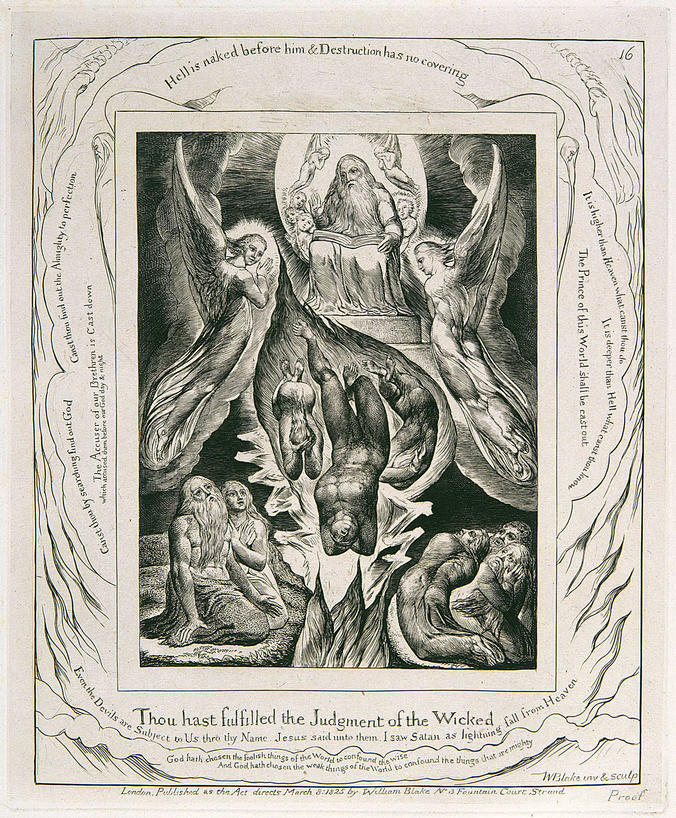 “Who has a claim against me that I must pay?
Everything under heaven belongs to me.” Job 41:11
There are many different kinds of theodicy or defenses to rebut the problem of evil. As I read the Bible I see a few different answers, but one extremely important theodicy in the Scriptures is what I shall deem the “Job Answer,” which is found in the book of Job, although a similar idea is touched upon by Paul in Romans.
Job was known as the most righteous of all the people on earth. Yet God allowed terrible things to happen to him, as part of a test to show Satan that Job was indeed as faithful and righteous as was thought.
But why? Why do bad things happen to good people? Why is it that Job, who God Himself called blameless and upright (1:8) has so many bad things happen to him?
Job’s friends gathered around him and offered various explanations. Job must have done something to deserve it, he must have erred in some way, etc, etc. Yet all of these, Job says, are wrong. He is indeed without blame, and he remains faithful. Yet despite this faith, he cannot help but complain to God. And in this defense of himself and appeal to God, he again points out that he is righteous (see Job 31).
God’s answer to this complaint is where I draw the “Job Answer.” God responds, basically, by saying “Job, you don’t know how I operate, but don’t you think it’s reasonable to conclude that I know what I’m doing?”
Is this a satisfactory answer? Can Job demand another answer? Should he?
That is often the route taken by atheists and even Christians when they investigate the problem of evil. They demand that God provide an answer they themselves find suitable. They act as though God owes them the answer, as if God cannot possibly be good unless the answer is found acceptable in their own eyes. But what does God say to that? In Job chapter 41, He says “Who has a claim against me that I must pay? Everything under heaven belongs to me.”
Is that easy? Is that the answer we Christians like to see? Not really. It would be so much easier if God just said “You know, I gave you guys freedom of will, so given your sinful nature (which you chose, by the way), wouldn’t you expect to see some pretty awful things happening?” That’s the kind of answer I find more appealing. That’s easy.
But that isn’t the answer God gave. He said “Everything belongs to me. Who must I repay?” Does that mean God is not good?
Francis Chan and Preston Sprinkle’s recent book Erasing Hell has had me reflecting on these very questions. Hell is a tough issue, and it has some serious implications for the problem of evil. In a particularly intriguing part of this book, the authors quote Scripture and follow it with a few questions. Specifically, they are reflecting on the idea that God knows who is going to hell before they themselves choose to do so. Check it out:
“What if God, desiring to show his wrath and to make known his power, has endured with much patience vessels of wrath prepared for destruction, in order to make known the riches of his glory for vessels of mercy, which he has prepared beforehand for glory?” (Rom. 9:22-23)
…What if God, as the sovereign Creator of the universe, decided to create ‘vessels of wrath prepared for destruction”? …And what if it’s His way of showing those He saves just how great His glory and mercy is? What would you do if He chose to do this? Refuse to believe in Him? Refuse to be a ‘vessel of mercy’? Does that make any sense? Would you refuse to follow him? Really? Is that wise? (p. 130, cited below)
The passage quoted is from Paul, writing to the Romans. Note how he phrases it: he starts it with what if. He’s not saying this is what God does, or that God does operate in this way, but he’s offering it as a possibility. Chan and Sprinkle continue this line of reasoning: What would we do if this is how God works? Would it make sense to rebel… to become a vessel of wrath just because we know they exist? Does it mean that God is doing wrong if this is how He operates?
Again, we turn back to Job to find the answer. God’s ways our not our own. God answers Job by listing things Job cannot do, and cannot even comprehend. ‘These things,’ God implies, ‘are outside of your comprehension… yet you expect to understand something even more incomprhensible?’ But that is not where God leaves it. He also tells us that ultimately, He will bring justice to all. Those who are now downtrodden will be lifted up, and justice will reign. How can Job respond? By repenting “in dust and ashes” (42:6).
So the “Job Answer” fits in a unique place among various defenses and theodicies for the problem of evil. Instead of using human nature and free will or a greater good to justify evil, the answer given to and by Job is that God, being good, has a reason, even if that reason is inscrutable for us. It is a response of faith.
But this does not mean the “Job Answer” is the only answer given in all of Scripture. Jesus is the ultimate answer to the problem of evil. He came and took our pain and suffering upon Himself, which in turn defeats evil ultimately and for all time. There are other Biblical answers to the problem of evil, but the answer Job gives is simple: Have faith. It does not promote an unphilosophical or unreflective faith, but points out the obvious: If we have good reasons to believe in God, and reasons which point to God as good, then we can simply trust that the apparent problem of evil is solved, ultimately, by God.
Thus, the “Job Answer” implies a second version of theodicy. Namely, that the evidence for the existence of God provides a rebutting defeater for the problem of evil. If we know that God exists and is good, then the problem of evil simply cannot be coherent.
In either case, the “Job Answer” provides a powerful, Biblical, answer to the problem of evil.
Source cited: Francis Chan and Preston Sprinkle Erasing Hell (Colorado Springs, CO: 2011, David C. Cook).
Response to an attack on this post found here (Search for “On Job.”)
SDG.
——
The preceding post is the property of J.W. Wartick (apart from citations, which are the property of their respective owners) and should not be reproduced in part or in whole without the expressed consent of the author. All content on this site is the property of J.W. Wartick and is made available for individual and personal usage. If you cite from these documents, whether for personal or professional purposes, please give appropriate citation with both the name of the author (J.W. Wartick) and a link to the original URL. This blog is protected by Creative Commons licensing. By viewing any part of this site, you are agreeing to this usage policy.
Inerrancy, Scripture, and the “Easy Way Out”
 Inerrancy, defined as simply as possible, is the Christian doctrine that the Bible is divinely inspired and without error.
But it is important to move beyond this simple definition, because people often come away with misconceptions about the doctrine. The Chicago Statement on Biblical Inerrancy explicates what evangelicals mean when they speak of inerrancy. I highly recommend that anyone interested in Inerrancy read this statement. It clears up a number of misconceptions.
A rejection of inerrancy is frequently due to a misunderstanding of what the doctrine means. Here are some common misreadings of the doctrine:
1) Inerrancy does not mean that there will be no discrepancies between Gospel accounts. These discrepancies, based upon an interpretation given by one who affirms inerrancy, are not seen as errors but as the different authors expressing their biographical accounts in different ways. Unlike modern conceptions that a quoted phrases must be exact, historians in the first century felt at their liberty to rearrange temporal events to better illustrate a common theme. The Gospels can be seen to utilize several methods of ancient biographies as they emphasize certain aspects of Christ’s life.
2) Inerrancy does not mean that there are no cultural or personal aspects to Scripture. An example of this can be seen in the geocentrism in the Bible. That there is geocentrism in the Bible does not undermine inerrancy. Inerrancy is the belief that what the Bible teaches is without error. The Bible does not teach geocentrism, but features it as part of the background beliefs of the cultural context of the authors. The authors have imported their culture into expressing God’s word, but that does not undermine the teachings.
3) Inerrancy does not mean God dictated the Bible word-for-word. This point ties into 2: God used human authors and gave them the leeway to write within their cultural background.
Those who reject inerrancy have taken an easy way out. Rather than investigating the issue of historical grammatical interpretation of Scripture or looking into what inerrancy means, they find what is perceived as an “error” in Scripture and reject the doctrine. The misconceptions outlined above are just a few of the errors made by people who do not investigate the issue seriously enough. Rather than coming upon a difficulty in the text and rejecting inerrancy, I urge readers to explore the difficulty, see what people have to say about it. I’ve found on more than one occasion that something I thought could be an error was explained by a cultural tradition or misreading of the text.
Finally, I’d like to address something that might come up to those reading through this. Often atheists object to the doctrine of inerrancy. I’ve run into this in my own personal discussions with those outside of the faith. They say things like “Do you really think a book written by a bunch of humans is without error?”
Well, if the Christian God exists, then the Bible is not just a book written by a bunch of humans. If God exists, there is no reason to think that God would be incapable of guiding His people to write a book to reveal Himself in a way that allows them to use their historical and cultural contexts without transmitting error in teaching. It would take a very powerful argument to convince me that an omnipotent deity would be unable to do this.
Image credit: http://commons.wikimedia.org/wiki/File:Bibbia_con_rosa.jpg
SDG.
——
The preceding post is the property of J.W. Wartick (apart from citations, which are the property of their respective owners) and should not be reproduced in part or in whole without the expressed consent of the author. All content on this site is the property of J.W. Wartick and is made available for individual and personal usage. If you cite from these documents, whether for personal or professional purposes, please give appropriate citation with both the name of the author (J.W. Wartick) and a link to the original URL. This blog is protected by Creative Commons licensing. By viewing any part of this site, you are agreeing to this usage policy.
Quick Link: N.T. Wright on Women in the Ministry
Eminent New Testament scholar N.T. Wright, former Bishop of Durham, is an egalitarian. Yes, he knows Pauline writing, and he believes women can (and should) be pastors. Check out his wonderfully lucid article on the topic: here.
Here are some choice quotes:
Mary Magdalene and the others are the apostles to the apostles. We should not be surprised that Paul calls a woman named Junia an apostle in Romans 16.7. If an apostle is a witness to the resurrection, there were women who deserved that title before any of the men.
In regards to 1 Timothy 2:
The key to the present passage, then, is to recognise that it is commanding that women, too, should be allowed to study and learn, and should not be restrained from doing so (verse 11). They are to be ‘in full submission’; this is often taken to mean ‘to the men’, or ‘to their husbands’, but it is equally likely that it refers to their attitude, as learners, of submission to God or to the gospel – which of course would be true for men as well. Then the crucial verse 12 need not be read as ‘I do not allow a woman to teach or hold authority over a man’ – the translation which has caused so much difficulty in recent years. It can equally mean (and in context this makes much more sense): ‘I don’t mean to imply that I’m now setting up women as the new authority over men in the same way that previously men held authority over women.’ Why might Paul need to say this?
Now if you were writing a letter to someone in a small, new religious movement with a base in Ephesus, and wanted to say that because of the gospel of Jesus the old ways of organising male and female roles had to be rethought from top to bottom, with one feature of that being that the women were to be encouraged to study and learn and take a leadership role, you might well want to avoid giving the wrong impression. Was the apostle saying, people might wonder, that women should be trained up so that Christianity would gradually become a cult like that of Artemis, where women did the leading and kept the men in line? That, it seems to me, is what verse 12 is denying. The word I’ve translated ‘try to dictate to them’ is unusual, but seems to have the overtones of ‘being bossy’ or ‘seizing control’. Paul is saying, like Jesus in Luke 10, that women must have the space and leisure to study and learn in their own way, not in order that they may muscle in and take over the leadership as in the Artemis-cult, but so that men and women alike can develop whatever gifts of learning, teaching and leadership God is giving them.
Really, check out the rest of his article.
Check out my argument for women pastors: here.
Book Review: “No Other God: A Response to Open Theism” by John Frame
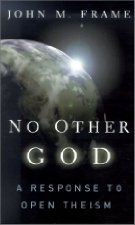 I recently finished No Other God
Areas of Agreement
One of the strengths of Frame’s book is how clear his thinking is. His style of argumentation is precise, and he clearly lays out what he considers evidence for his positions. He is unafraid to make statements with huge implications.
A particularly interesting aspect of Frame’s work was a brief historical look at the roots of Open Theism, leading it back to the Socinianism. Frame points out that advocates of Open Theism tend to portray their view as the “new theology on the block” despite the fact that it has been around (and rejected) for quite some time.
I believe Frame is correct when he argues against the centralization of any one attribute of God. Specifically, the centralization of love on Open Theism tends to ignore other important attributes of God (49ff). (Interestingly, Frame’s own account of God unnecessarily over-emphasizes Sovereignty, though he disguises this by calling it “Lordship.)
Frame levels strong critiques against Open Theism’s reading of Scripture. Open Theists tend to advocate the “straightforward” reading of texts which help their case. One of Open Theist’s favorite passages is God testing Abraham. Yet Frame rightly notes that if there is a straightforward reading of the text, then God did not know the present truth of Abraham’s heart, whereas Open Theists attempt to use this to support God not knowing the future (47). Further, if God was trying to figure out how Abraham would act in the future, then He was trying to do something He couldn’t (determine what the libertarian free choices of humans would be) according to Open Theism. So the story’s straightforward reading does not work to support Open Theism. Frame urges a similar examination of other passages, though he doesn’t expand on it.
Areas of Disagreement
Despite these areas of agreement, I vehemently oppose Frame’s position on several issues. Most notably, on theistic determinism, compatibilism, and libertarianism.
First, libertarianism. Frame correctly notes that the core of Open Theism is the assumption of libertarianism. Yet his critique of libertarianism is wrongheaded. He caricatures libertarians as believing that choices are made in the absence of any motivation. He writes, commenting on the libertarian view, “if our decisions are caused by anything or anyone (including our own desires), they are not properly our decisions… to be responsible, we must be able to do otherwise” (121). Yet this is explicitly not libertarianism. Peter van Inwagen, for example, explicates libertarianism by saying “…that someone’s acts are undetermined does not entail that they are uncaused” (van Inwagen, An Essay on Free Will, Oxford: 1983, p. 14).
But Frame explicitly centers his critique of libertarianism on a contra-causal account of freedom, saying, for example, “If guilt presupposed libertarian freedom, then in order to show that Hubert [a man accused of robbing a bank] is guilty, the prosecutor would have to show that his decision to rob a bank had no cause…” (126). But again, libertarians deny this very type of contra-causal freedom, so Frame is arguing against a straw man. Because Frame thinks libertarianism is so utterly central to Open Theism, this means that the core of his critique fails to hit home.
The problem with Frame’s counter against libertarianism is that it barely touches the surface of the philosophical arguments for the position. He correctly rails against the idea that our actions are just random occurrences, but incorrectly assumes that this is libertarianism.
Finally, the greatest area of disagreement I have with Frame is on his view of omnidetermination. Consider the following two quotes:
“The uniform witness of Scripture is that the evils of this life come from God” (140).
“…[I]t is important to see that God does in fact bring about the sinful behavior of human beings, whatever problems that may create in our understanding” (68).
I’d be curious to see how Frame reconciles these assertions with the constant witness of Scripture that God is just; fair; good; opposed to evil; etc. Frame utilizes several verses to support his position, but he makes primary those which say God uses “all things” and verses which say calamities are from God. But regarding the former, this can easily refer simply to permissive will, and regarding the latter, the verses he uses are out of context (and even were one to grant the “straightforward reading,” one could counter by saying the calamities are not every evil action, but merely those things which God uses–i.e. storms, other nations, etc.–to instruct His people). Frame, like many theological determinists, is not building even on sand, but on a void. Literally saying that God causes evil is so utterly repugnant and contrary to Scripture that this view overshadows all the good things Frame has to say.
Conclusions
Ultimately, No Other God is on target in a few ways, but it is wildly gunning the wrong direction on too many issues. Frame’s philosophical case against libertarianism is off the mark, he fails to deal with the strong philosophical arguments for libertarianism, and his view that God literally causes evil is baseless. Interestingly, while I went in reading this book looking for some good arguments against Open Theism, I came out with the realization that theological determinism is a far more dangerous doctrine indeed.
SDG.
Check out other posts about Open Theism here.
John Frame,No Other God
——
The preceding post is the property of J.W. Wartick (apart from citations, which are the property of their respective owners) and should not be reproduced in part or in whole without the expressed consent of the author. All content on this site is the property of J.W. Wartick and is made available for individual and personal usage. If you cite from these documents, whether for personal or professional purposes, please give appropriate citation with both the name of the author (J.W. Wartick) and a link to the original URL. This blog is protected by Creative Commons licensing. By viewing any part of this site, you are agreeing to this usage policy.
Book Review: “Eternal God: A Study of God Without Time” by Paul Helm
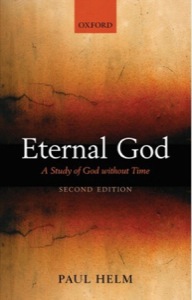 Paul Helm is, in my opinion, one of the most lucid thinkers on the topic of God and Time. His Eternal God
Helm points out early in his book that the issue of divine temporality/atemporality is “underdetermined” in Scripture (7). This means it’s one of those fun issues that lies most squarely in philosophy of religion.
And that is where Helm excels. Chapter-by-chapter he outlines a cohesive case for divine atemporality. Where Paul is most successful, I think, is in his rebuttals of arguments for temporality. For example, a well-known argument for temporality is that if God interacts in time, he must be temporal. Helm counters by pointing out that a precisely parallel argument could be constructed for God and space. Yet few Christian philosophers accept that God is spatial (49ff). While this doesn’t rebut the argument, it does point out something important: it doesn’t seem as though the conclusion (God is temporal) follows from the premise (God interacts in time) any more than it would if it were spatial (God is spatial/God interacts with space).
There are many different accounts of divine timelessness, from Brian Leftow’s spaceless timelessness (see his work Time and Eternity) to relative timelessness, and beyond. Helm takes the much less popular route and takes the tough pill of saying that God created spacetime as a static bloc. This allows Helm to easily deny many of the arguments for temporality which stem from a-theory or dynamic time. But it also raises many problems. Foremost among these (in my opinion) is human freedom. For, on the B-Theory of time (static theory), everything which will ever happen, has happened, and in a sense exists. As we go from moment to moment, we’re really just passing through a bloc of spacetime, we aren’t literally moving through a present. Presentness is a subjective phenomenon, given static/B-theory. It’s just our perspective. So where does human responsibility and freedom come in?
Helm here turns to compatibilism. He freely admits that timeless creation entails determinism (170). Thus, he denies that humans have free will in the libertarian sense. But this, he argues, does not undermine human responsibility. I don’t think I can do justice to the nuances of his argument, but the basic idea is that Helm argues that just because past actions/events determine our actions in the future, that doesn’t mean that we aren’t responsible for what we do. As I said, this is a really, really watered down version of his argument, but I think this is one of the weaker points of his work.
Why? Because the idea of responsibility simply does not make sense on determinism, particularly when it is theistic determinism. For consider the idea proposed here. God has created all of time and space as one bloc. Thus, everything I do or have ever done was created by God once he brought the universe into being. Literally, everything I did, I do because God created the universe such that I would do x. So how could it be that I am responsible for doing x, if I never chose to do x. I simply do x because I have to, I have “already” done it, on the static theory. If I could create a time travel device, I could travel forward in time and see myself doing x, and could not prevent it, because God created the world such that I would do x. But the core of responsibility is that I chose to do x. While we punish people for things they do by accident (vehicular manslaughter, for example, or accidentally breaking a window), these things still resulted from prior choices (playing baseball near breakable window/driving carelessly). I simply do not see how any account of responsibility could make sense unless someone can choose to do what they do.
There are several different positions about divine temporality/atemporality. Helm swallows the hard pill of going with the static theory of time to ground his divine atemporality. This, I believe, grants his account extreme philosophical plausibility. If God created the entire universe as a space-time continuum (I’ve always wanted to use that phrase from Star Trek!), then there’s no reason to suppose God would be affected by time. It’s ontologically outside of God, and all of his interactions already have taken place. While I’ve already pointed out some of the problems with this view, these problems are not with the coherence of the view but with the theological nature of it. Thus, I think it possible to say that Helm has adequately defended a position of divine eternity.
It would be impossible to cover everything of interest in such a comprehensive look at the topic of divine timelessness. Helm analyzes an extraordinary number of arguments in great detail. I cannot recommend the book more highly. Although I ultimately reject Helm’s second contention (B-theory), I believe his view is extremely coherent, and I can find little fault in it. Anyone interested in the issue of God’s relationship to time must read this book. It’s a book I think I shall re-read so that I can better grasp his arguments.
(Note: This review is based on the recently published second edition of this text, which includes several new chapters with much of interest, including a rebuttal of William Lane Craig’s arguments against timelessness. I recommend interested readers get their hands on the newer edition.)
SDG.
Source:
Paul Helm, Eternal God
——
The preceding post is the property of J.W. Wartick (apart from citations, which are the property of their respective owners) and should not be reproduced in part or in whole without the expressed consent of the author. All content on this site is the property of J.W. Wartick and is made available for individual and personal usage. If you cite from these documents, whether for personal or professional purposes, please give appropriate citation with both the name of the author (J.W. Wartick) and a link to the original URL. This blog is protected by Creative Commons licensing. By viewing any part of this site, you are agreeing to this usage policy.
Against Open Theism: Scrooge and God’s knowledge of the Future
 I was listening to William Lane Craig’s Defenders podcast (Doctrine of God: Part 13) and he brought up an interesting analogy about omniscience. He discussed Scrooge in Dickens’ “Christmas Carol.” The last spirit to appear to Scrooge is the ghost of Christmas to come. He takes Scrooge around and shows him all sorts of disturbing imagery that will happen. Scrooge asks the ghost whether these are things that must happen, or whether he can stop them. The spirit remains silent.
Craig pointed out the spirit would have to remain silent to have any sort of effect. For suppose the spirit knows what will happen: that Scrooge will repent and so these awful things won’t happen. But then if he tells Scrooge what he knows, Scrooge will feel little remorse about not acting to prevent them. Yet if the spirit told Scrooge these things would happen, then Scrooge has no reason to modify his behavior, for he cannot prevent the events from happening.
Craig suggests, then, that we should look at omniscience and instances of God “changing his mind” in the same fashion. This has some interesting applications in the case of Open Theism, because it undermines one of the core exegetical arguments for the position: cases of God “repenting” or “changing his mind.”
God, on classical theism, knows what will happen in every circumstance. He comprehensively knows the future (contra Open Theism). If this is so, then God would have to withhold some of his knowledge in order to bring things about, despite his knowledge that it would occur. Like the Ghost of Christmas Yet to Come, God would know the answer to Scrooge’s question, but would not answer him, so that he could bring it about that Scrooge would repent.
Consider Jonah. Open Theists often point to the story of Nineveh as an example of God not comprehensively knowing the future. Because God sends Jonah with the message that Nineveh will be destroyed, but then, when Nineveh repents, he shows mercy, many people say that God did not know the Ninevites would have such a reaction. Yet why should this be the case? Isn’t it plausible that God did know they would repent and that God sent the message that they would be destroyed because that is the only way Nineveh would be led to repentance? This is, in fact, hinted at later in the book, when Jonah says to God, “Isn’t this what I said, LORD, when I was still at home? That is what I tried to forestall by fleeing to Tarshish. I knew that you are a gracious and compassionate God, slow to anger and abounding in love, a God who relents from sending calamity” (4:2).
But if God had told the Ninevites “I will not destroy you” because he knew that he would not, would not the impetus of Jonah’s message lose its strength. With the threat of destruction, the Ninevites repented. Without, would they have done so? Imagine Jonah’s message going through the streets “Forty more days and Nineveh will not be destroyed!” I think it obvious that this would probably not have the same effect that the initial message was.
So it seems quite plausible that God, like the Ghost of Christmas Yet to Come (in our analogous case), may refrain from telling all he knows at many points throughout Scripture. For if he told people everything he knew, he would know that they would not repent, turn aside from their evil ways, or bring about the actions he desired. The instances wherein God ‘changes his mind’ or ‘repents’ are instances of this: rather than revealing his knowledge, God withholds it, in order to bring about the ends that he desires to (and knows will) happen. We, like Scrooge, would not respond to calls for repentance if we felt it didn’t make a difference in the end.
Final note: the above account implicitly assumes molinism to be the case. So much the better for it, I say!
SDG.
This is part of a series I’ve written against the doctrine of Open Theism. If you’d like to read more, check out the original post for discussion and links.
——
The preceding post is the property of J.W. Wartick (apart from citations, which are the property of their respective owners) and should not be reproduced in part or in whole without the expressed consent of the author. All content on this site is the property of J.W. Wartick and is made available for individual and personal usage. If you cite from these documents, whether for personal or professional purposes, please give appropriate citation with both the name of the author (J.W. Wartick) and a link to the original URL. This blog is protected by Creative Commons licensing. By viewing any part of this site, you are agreeing to this usage policy.
The Unacknowledged Teachers: an argument for women pastors.
 An argument for the position of egalitarianism (the position that women are not to be restricted from certain offices in the church):
1) Women say things in Scripture which are not condemned (cf. Deborah’s song, Mary’s Magnificat which is used in liturgical worship, Ruth’s words which are used in wedding ceremonies, Esther’s story and her actions, etc., etc.). [Edit: this premise must be made more clear. The things women say in Scripture are not simply not condemned, but are often explicitly centralized. The Song of Deborah; Ruth’s words to Naomi; the magnificat; etc. These words are made into liturgies and used for teaching. Yet they are the words of women. Thanks to Adam at Unworthy Yet Redeemed for pointing out this flaw in the argument. Consider P1 to be modified to “Women say things in Scripture which are centralized and utilized for church liturgies and teaching.”]
2) All Scripture is useful for teaching, rebuking, correcting, and training in righteousness (1 Timothy 3:14-17).
3) Those things which women say in Scripture teach us truths useful for teaching, rebuking, correcting, and training in righteousness (1, 2).
4) If we use truths women teach us in Scripture to teach doctrine/righteousness/etc., we should not exclude women from the ministry. (Premise)
5) We use truths women teach us in Scripture to teach doctrine/righteousness/etc. (1-3)
6) Therefore, we should not exclude women from the ministry (4, 5, modus ponens).
Defense of premise 1: I cited examples in the argument itself. See Judges 4-5; Luke 1:46-56; Ruth 1:16-17 (and the rest of the book); the book of Esther; these are just a few examples.
Defense of premise 2: Again, directly from Scripture: 1 Timothy 3:14-17.
3 follows from 1 and 2.
Premise 4 is likely to be the most controversial of these premises. The position of those who hold that women should not be ordained into the office of the ministry (complementarianism) is generally based upon the suggestion that women should not teach doctrine in a public setting (see more on this below). Therefore, I think that premise 4 must be accepted by complementarians because a denial of this premise would undermine their position. In other words, if one wants to hold that premise 4 is false, they would have to provide a different reason to exclude women from the ministry. Premise 4 simply states that which the sides agree upon. Ultimately, the strength of premise 4 will depend upon one’s definition of “the office of the ministry.” However, if one’s definition of “office of the ministry” includes “teaching”; “teaching doctrine”; “rebuking” [those who need correction]; etc., then premise 4 is correct.
Further, premise 4 could be weakened so that its conclusion would be not quite as strong. Instead, one could reword it as:
4′) If we use truths women teach us in Scripture to teach doctrine/righteousness/etc., we should not exclude women from teaching doctrine/righteousness/etc. to others.
This modified premise will not yield the conclusion that women should not be excluded from the “office of the ministry” but it would yield the conclusion that women should be allowed to teach doctrine, righteousness, and other things no matter who the audience happens to be.
Premise 5 follows from 1-3. 6 follows via modus ponens from 4 and 5. The same could be said for 4′ and the perceived 5′ and 6′.
The language used by those who are against women preaching must be very carefully selected because they do not wish to say women cannot be teachers at the university, or that they cannot teach elsewhere–rather, it is restricted to the church. Yet the argument above would be specifically useful for permitting women to teach in the church. After all, their words are used to teach continually. Whenever the Magnificat is sung or spoken, we use the words of Mary to teach us truths about Jesus. Whenever we read the story of Ruth or use her words in our wedding vows, we use them authoritatively.
Another way we could put this argument would be “If it is okay for women to compose sections of the Bible, perhaps we should let them teach it?” (quoted from Lamb, 64, citation below). I think the answer to the question is eminently obvious: yes
Therefore, women are already acting as a kind of “unacknowledged teacher” in the church: their very words are being used to tell us about God. I conclude that women should not be excluded from the ministry.
Note on terminology: by “teach” I am explicating the role of “teacher” in the church–the pastor.
Part of this argument was developed from a reading of God Behaving Badly by David Lamb (Downers Grove, IL: InterVarsity Press, 2011), 64-65, wherein he states “If it is okay for women to compose sections of the Bible, perhaps we should let them teach it?” (64).
SDG.
——
The preceding post is the property of J.W. Wartick (apart from citations, which are the property of their respective owners) and should not be reproduced in part or in whole without the expressed consent of the author. All content on this site is the property of J.W. Wartick and is made available for individual and personal usage. If you cite from these documents, whether for personal or professional purposes, please give appropriate citation with both the name of the author (J.W. Wartick) and a link to the original URL. This blog is protected by Creative Commons licensing. By viewing any part of this site, you are agreeing to this usage policy.
Against Open Theism: The Infinite Knowledge of God
 Psalm 147:5
“Great is our Lord, and of great power: his understanding is infinite” (KJV).
“Great is our Lord, and abundant in power; his understanding is beyond measure.” (ESV)
” גדול אדונינו ורב־כח לתבונתו אין מספר׃” (Hebrew Old Testament)
Infinite Knowledge
Within Scripture we find that God knows all things. But here, in the Psalms, we read that God’s knowledge is “infinite.” Of course, this is a translation of the Hebrew, which says “…his understanding is without number/measure.” But this can also be correctly translated simply as the KJV does, “His understanding is infinite.” Thus, within Scripture, we have a picture of God’s knowledge as infinite or without number.
The Argument
1) If God’s knowledge is infinite/without number/unable to be counted, then God’s knowledge cannot be increased (it’s infinite).
2) God’s knowledge is without number.
3) God’s knowledge cannot be increased.
4) Open Theism asserts that God’s knowledge can be increased.
5) Therefore, Open Theism is false.
Defense of Premises
Premise 1 can be defended in a similar fashion as one would argue against actual infinites in the Kalam Cosmological Argument. Basically, we cannot add up to infinite. Nor, if something is actually infinite, can we increase or decrease its “number” in any way. We cannot add to infinity and increase it, nor can we take away one item from an infinite set and decrease it to some finite number. Therefore, if God’s knowledge is infinite, it is complete–it cannot be increased.
Premise 2 simply asserts what the Bible passage says.
Premise 3 follows from 1 and 2 deductively.
Premise 4 follows from the core of Open Theism. On Open Theism, God knows all things which have happened and are happening, but he does not necessarily know what will happen until it does happen. Therefore, God’s propositional knowledge would continually be increasing. Each day, he would learn an astounding number of truths which he did not previously know.
Premise 5 follows from 3 and 4; if 3 is true, 4 cannot be true. Yet 3 is true, so 4 cannot be true.
Therefore, Open Theism is false.
A Potential Rebuttal
Can the Open Theist get out of this argument? One way would be to challenge that the Psalm is not claiming God knows an actually infinite number of propositions, but simply that conceptually, God’s knowledge is so far beyond our own it appears to be infinite.
I would respond to this counter-argument by challenging the Open Theist to successfully read that off the Hebrew, which literally says “without number”/”infinite.” Open Theism, by definition, would have to entail God knowing only a finite number of propositions. If God did not know only a finite number of propositions, then His knowledge could not increase (it would be infinite). Thus, on Open Theism, the number of propositions God knows would increase by the second/minute/day. So the Open Theistic reading of Psalm 147:5 would have to read it like “[God’s] knowledge is unlimited; it increases forever.” But that reading is not justified by the text.
[Edit: Note the comment section for some great discussion of this post, wherein two commentators provided a “way out” for the Open Theist regarding my argument and a denial of premise 4.]
This is part of a series I’ve written against the doctrine of Open Theism. If you’d like to read more, check out the original post for discussion and links.
SDG.
——
The preceding post is the property of J.W. Wartick (apart from citations, which are the property of their respective owners) and should not be reproduced in part or in whole without the expressed consent of the author. All content on this site is the property of J.W. Wartick and is made available for individual and personal usage. If you cite from these documents, whether for personal or professional purposes, please give appropriate citation with both the name of the author (J.W. Wartick) and a link to the original URL. This blog is protected by Creative Commons licensing. By viewing any part of this site, you are agreeing to this usage policy

 J.W. Wartick - Reconstructing Faith

