theology
A Vision for Christian Apologetics to World Religions
 Christian Apologists seem to only rarely focus upon world religions. Perhaps that is because many Christian apologists feel uncomfortable interacting with other religions. It is easy to be weighed down by fears that one might say something wrong and be deemed either ignorant or bigoted. It may also be simply that Christian apologists don’t feel they have the expertise do operate in this area. It is my goal in this post to paint in broad strokes and provide areas of development for Christian apologetics and theology regarding world religions. Because I’m painting in broad strokes, I’ll be raising many questions I’ll leave unanswered for now. I’ve included links at the end of the post for those interested in reading more.
A Vision for Christian Apologetics and World Religions
It has been said that evangelicalism needs a theology of religions. What does the existence of other religions mean? Do they have truths? How do we interact with them? These questions must be addressed by Christians who desire to explore the reality of their faith. Christian apologists, in particular, must be learned enough to know what position they take on these issues before they seek to defend their faith.
The study of another religion should not be done superficially. It is a good start to have a general volume on “world religions” and then read each religion’s respective section, but it is not nearly enough for the Christian apologist to do if the apologist desires to interact with believers from these other religions. A study of another religion, particularly for those interested in witnessing to them, must be more in-depth. The holy book(s) of the other religion is(are) necessary reading. But one cannot stop there. Few religions are based upon one book. Christians can readily acknowledge this, having had much thought and belief defined through tradition, apostolic and patristic. Similarly, when a Christian studies another religion, he or she must be willing to delve into the religion, to understand it from an insider’s perspective.
It is not enough for the apologist to read books about other religions, seeking to find fast and easy ways to refute them. Rather, the Christian apologist must engage with believers of other faith, acknowledging shared truths where they exist and seeking to understand the differences. Certainly, apologists must know the areas of weakness in other religions so that they can point these out as they debate and dialog on the religions. What I’m suggesting is that this cannot be the only thing Christians know about other religions. They must not be satisfied merely by knowing a series of arguments against those from other religions. Rather, they must be willing and able to engage with those in other religions.
Thus, this vision for Christian Apologetics to World Religions is a vision not just of debate but of dialog; a vision of give-and-take. The Gospel will not be heard where it is beat into people. It will not be heard where the only avenues for its witness are arguments. Paul wrote,
Although I am a free man and not anyone’s slave, I have made myself a slave to everyone, in order to win more people. (1 Corinthians 9:19)
The attitude of the apologist is a servant’s heart–one that seeks to understand. In understanding, he or she will win many. Thus, when apologists approach another religion, they must understand that religion enough to engage with those who believe it and who live it. The Christian apologist must not deceive, but rather seek to understand. In understanding, Christians will understand more about their own faith, and be better able to spread it to those of other faiths.
There are five major things to keep in mind when doing apologetics regarding world religions:
- Know what the other believes. Never assume you know their faith as much as they do.
- Read their book. Nothing will open up avenues for discussion as much as the knowledge that you have read the books they find holy.
- Know Christianity. If you don’t know what you yourself believe, how are you to share that with others? As you engage with people of other faiths, you must continue to learn about your own faith and its answers to the questions others pose.
- Preach the Gospel. The goal should not only be to rebut the others assertions and beliefs. It should be to guide the other towards Christ crucified and the salvation provided for by God.
- Build a Genuine Relationship. It isn’t enough to simply engage in dialog; one must show they are interested in what the other has to say and what they believe. They must also be more than an occasional debate partner; they must build a relationship and become a friend. I’m not suggesting deception here, the relationship must be genuine. By showing a Christlike life to others, we can show them the intimate joys of Christianity.
Going forward, it is time to turn to a method for Christian Apologists to learn about other religions.
 Studying a Religion: A Method of Learning for Christian Apologists
- Read general discussions about the religion. A book on world religions is a good place to start, but be aware that these are, by necessity, generalized.
- Read what other Christians have said about the religion. Neighboring Faiths by Winfried Corduan is a simply phenomenal resource which surveys the world religions from a Christian perspective.
- Read the holy books of the religion with which you are going to interact. If you wish to engage a Muslim, read the Quran. If you want to interact with a Taoist, read the Tao Te Ching. As you read these books, keep in mind that you will find truths in other religions due to God’s natural revelation to all people.
- Seek out believers from the religion, and engage with them in discussion. Ask them what they believe, but don’t allow your questions to be that general. Instead, focus on specifics. For example, “If I were seeking to learn more about your religion and beliefs, how would I go about doing so?”; “What is[are] your favorite passage[s] from your holy book, and why?” Questions like these will show them you’re not seeking to attack but to understand.
- Read web sites dedicated to explaining other religions to those seeking. In this way, you will get a basic introduction to the religion while also viewing it from an insider’s perspective.
- Read other Christians who have engaged these religions in dialog and mission work.
- Consider responses from scholars within the religion to Christians working in that field. Be familiar with arguments for and against the positions you seek to put forward.
- Above all, read God’s word. Only by being familiar with the Bible will one become an effective apologist and missionary. Jesus’ words will draw people from all backgrounds, and the Bible’s richness and truth will gain a hearing from all nations.
This list is, of course, not comprehensive. It merely provides avenues for research.
What to do with the knowledge?
Christians must engage with those of other faiths. Seek out those who are willing to discuss their faith with you. You will find that many interesting discussions will follow and you will learn much about yourself and Christianity in the process. Never stop seeking truth. All truth is from God. If someone from another faith says something which challenges you, seek the answer. There are thousands of years of Christian writing out there just waiting to be tapped. Not only that, but simple searches online will turn up innumerable apologetic resources. Do not let the discussions turn into debates only. Debates are good when there is an audience of people who may be swayed one way or the other, but in individual conversation, your goal should be to spread the Gospel, not to win an argument.
Become a prayer warrior. Do not let a day go by where you do not pray for those with whom you are engaged in discussions about the faith.
Tap your fellow resources. There are many other Christians working in the areas of religions, and they are willing to help. Do not be afraid to ask for it when needed.
Conclusion
The vision for Christian apologetics and world religions I’ve put forth here is admittedly vague, but I hope it will provide a way forward for those interested in dialog with those of other faiths. This vision has followed five primary thoughts: know the other’s faith, read their book, know Christianity, preach the Gospel, and build a genuine relationship. The most important thing to remember is that as a Christian it is your duty to spread the Gospel. Do not let yourself come in its way.
Resources
Some argue that there is no real way to tell whether any religions are true. That is not the case. There are some very real ways to determine truth in a religious paradigm. Check out this post: “Can we evaluate worldviews? How to navigate the sea of ideas.”
What about the truth found in other religion? How do we relate that to Christianity? Kenneth Samples is an amazing writer in this area. Check out this post in which he provides a way forward for thinking about other religions from a Biblical perspective: “Thinking Biblically About the World’s Religions.”
I highly recommend Winfried Corduan’s book Neighboring Faiths.
What about some of those unanswered questions–what about the unevangelized? This is matter of considerable debate and there are numerous books on the topic. I would recommend “What About Those Who Have Never Heard?” for an introduction to these views. For those wanting to explore inclusivism further, see No Other Name by John Sanders. Those interested in exclusivism/particularlism, see Is Jesus the Only Savior? by Ronald Nash.
SDG.
——
The preceding post is the property of J.W. Wartick (apart from citations, which are the property of their respective owners) and should not be reproduced in part or in whole without the expressed consent of the author. All content on this site is the property of J.W. Wartick and is made available for individual and personal usage. If you cite from these documents, whether for personal or professional purposes, please give appropriate citation with both the name of the author (J.W. Wartick) and a link to the original URL. If you’d like to repost a post, you may do so, provided you show less than half of the original post on your own site and link to the original post for the rest. You must also appropriately cite the post as noted above. This blog is protected by Creative Commons licensing. By viewing any part of this site, you are agreeing to this usage policy.
Women, Complementarianism, and the Trinity- How getting subordination wrong has undermined the Trinity
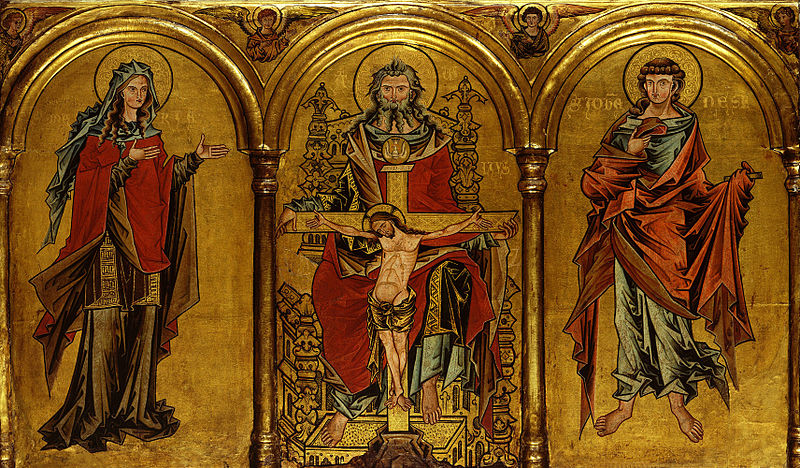
[Please see note at end of this post for some qualifications added 2/1/15.]
Even though [God the Son] is in all ways equal to the Father and in no way inferior to the Father, he is nevertheless utterly subordinate to the Father… Christ’s relation as Son to his Father is therefore characterized by his subordination to the headship of the Father. (John Kleinig, 222-223 cited below)
In opposition to the above:
The subordination of Jesus Christ is this: it is his freely chosen submission ‘for us and for our salvation.’ The person of the Son is truly subordinate only for ‘economic’ reasons, and only insofar as these reasons entail being subordinate (and even thus far only contingently)–even while his full divinity, equality, and communion with the Father and Holy Spirit continues unabated, world without end. (Thomas McCall and Keith Yandell, 358, cited below)
The doctrine of the Trinity is a subject of enormous theological debate. One of the major debates of our time is social trinitarianism as opposed to substance views of the Trinity or other classical positions. However, another important area to explore is the nature of Christ’s submission to the Father. Paul writes in 1 Corinthians 15:28 “When he [God the Father] has done this [put all things under Christ’s feet], then the Son himself will be made subject to him who put everything under him, so that God may be all in all.” Some have argued that this means that Jesus Christ is eternally into the future, and even from eternity past, subordinate to God the Father (see Wayne Grudem and Bruce Ware for two examples of scholars who hold to this view–in fairness to John Kleinig, cited above, I do not include him as one of those who assert these positions because his view of the Trinity was not fully developed in the material from him to which I have access). We shall refer to this position as “necessary role subordination,” following McCall and Yandell.
What does such a position entail about the Trinity? First, if the functional subordination of the Son (and, very often, the Spirit is also said to be subordinate) is indeed necessary, then “it is necessarily true that the Father is authoritative over the Son, and the Son subordinate to the Father” (McCall and Yandell, 354). Why? Because the modal implications of this necessary subordination entails that the Father has, as an essential property, “being authoritative over the Son” (Ibid). Now, this in turn entails that the Father has an essential property the Son (and perhaps the Spirit) do not have. Then, by simple evaluation of the law of identity, the Father has different being than the Son and Spirit. Indeed, the Son would then be “heteroousios rather than homoousios.”
The error can be understood by viewing the Trinity within the substance based metaphysics from which the doctrine has been classically analyzed. As William Alston notes in his study of substance metaphysics and the Trinity, the formulation of the Trinity has been placed squarely within a substance metaphysics, and this provides a grounds for viewing the Trinity as three persons in one being (Alston, 183ff, cited below). Tying this into the laws of identity, one finds that in order for the Trinity of persons to be one being, none of them can lack essential properties of the others. But, as noted, once one asserts that the Son (and/or the Spirit) are necessarily subordinate to the Father, one has separated their essential properties and therefore confounded the Triune nature of God.
The Biblical arguments for such a position are fairly weak. For example, Ware and Grudem (and Kleinig, who does make this argument) argue that 1 Cor. 15:25ff entails the eternal subordination of the Son. But these verses explicitly state that “God may be in all in all.” It does not state “God the Father alone may be all in all” (I owe this point to McCall and Yandell, 342-344).
It may be that these theologians are not drawing this necessary role subordination from Scripture so much as allowing their other theological dispositions to color their trinitarianism. Grudem, Ware, and Kleinig are all explicit complementarians–that is, they restrict women from the ministry. Now please understand I absolutely do not think that complementarianism entails this position on the Trinity. However, I am asserting that complementarianism can color one’s perception of the doctrine of God.
Why think that the correlation between those who hold to necessary role subordination and complementarianism is interesting? First, because necessary role subordination, if true, would give some philosophical bolster to complementarianism; second, because at least one complementarian makes the connection himself.
Regarding the first point, complementarianism has been struggling with a major philosophical challenge presented by Rebecca Groothuis (among others). Namely, the problem of how to ground the subordination of women. Groothuis argues, essentially, as follows: If the permanent, comprehensive, and ontologically grounded subordination of women is justified, then women are inferior persons; Women are not inferior persons; Therefore, women’s subordination is not justified (Groothuis, cited below, 317). Now I’ve defended this argument elsewhere, and I think that some complementarians actually agree with the general argument. Instead of rejecting complementarianism, however, they choose to model their doctrine of the Trinity in order to try to preserve their position. How? By grounding subordination analogously in the submission of God the Son to God the Father. Here, Kleinig is an explicit example of this position. Following the quote at the beginning of this post, he writes, “Those who serve in [the pastoral ministry] pass on what they have received from God the Father through Christ… The exercise of the public ministry depends on this pattern of subordination within the church…” (Kleinig, 223). Now, the subordination of Christ, it is claimed, “has nothing to do with the dominance and power of the Father. It involves and expresses the harmony of the Son with the Father and his love for the Father” (Ibid). Thus, according to Kleinig, the model for women and men in the church is grounded in the Trinity, and because, according to him, the Son is subordinate to the Father yet remains equal, so too should women be subordinate to men and yet remain equal.
Does this complementarian view entail necessary role subordination? It seems so. For what is woman’s role subordinate upon? It seems it must be because of her being (for an argument to that end, see my post linked above and here). Yet her being is, of course, her essential nature. It is necessarily the case, therefore, that she is subordinate.
Finally, it is interesting to note that even were the egalitarian to grant to Ware, Grudem, and Kleinig their points about the Son’s subordination to the Father, it would not follow that the Trinity is an adequate model for women in the church. Why not? Kleinig essentially says it himself, “Now this call to subordination in the divinely instituted order of the church is based on the willing subordination of the Son to the Father” (Kleinig 223, emphasis mine). Well that’s exactly the point egalitarians make! Egalitarians argue that the roles of subordination in the church are taken willingly by those who serve at various levels. The laity has not been called to the ministry, and therefore willingly cede the authority of the office of the ministry to their ministers. It is a bit stunning to see Kleinig make this remark, for it also undermines his own case. Women, unlike Christ, are not [all] willingly subordinate. Rather, some very much would like to be ordained. Thus, if Christ’s subordination is grounded in his “willing subordination” then it seems that Kleinig’s case has completely evaporated. So too, of course, has the case of other complementarians who make this argument.
Do I think that those who make these arguments are heterodox? I wanted to explicate that I think that Ware, Kleinig, and Grudem are more likely victims of misuse of philosophical theology and their own presuppositions than they are actually trying to claim that the Trinity is not of one being. Certainly, I think, were they to examine their position on the subject, they would distance themselves from such a claim. Instead, as I’ve pressed, I think they’ve allowed their presuppositions–that women cannot be pastors and that they must ground this in the Trinity–to cause philosophical confusion on the topic. Kleinig, for example, almost so much as admits this point when he favorably cites Willliam Oddie, making the claim “that the ordination of women would involve a radical changing in the teaching of the church about the fatherhood of God” (224). It seems that it is not so much egalitarians who are guilty of misconstruing the Trinity, but rather over-eager complementarians who are shaping the Trinity to match their own preconceived notions of subordination and roles. Perhaps it should serve as a warning to take more care when doing philosophical theology and systematics. In any case, I sincerely hope these Christian brothers do not reject the doctrine of the Trinity as one being.
The theological implications of this discussion can now be brought to light. Some complementarians, in their eagerness to support their philosophically vacuous position, have read eternal subordination into the doctrine of the Trinity. I agree that complementarians are correct to worry about the implications of women’s ordination for the doctrine of the Trinity, but I disagree with their conclusions. In their zeal to exclude women from the ministry, they have undermined the doctrine of God. By confusing the willing, economic, salvific role of Christ submitting to the Father in a contingent manner with the eternal, ontological “subordination” of women, complementarians have mounted an attack on the Godhead. Indeed, as has been shown above, their position entails the that the Trinity is not “of one being.” Thus, it is a position that must be rejected. Again, I do not think that all or even most complementarians hold this position in relation to the Trinity, but those who do must consider the theological implications of their position: it entails that God the Son lacks at least one essential property of God the Father and therefore is of a different being; it fails to adequately account for the Scripture related to the Trinity; and finally, it doesn’t even make their case because the subordination is grounded in Christ’s willingness to do so.
In light of these major problems, it seems complementarianism, when tied to necessary role subordination, must be rejected. Should it be rejected outright, even with such ties severed? I certainly think so. Complementarianism is philosophically tenuous and can’t account for all the Scriptural evidence (see Philip Payne’s book, reviewed here). It is time to stop allowing preconceptions to shape all doctrine. Rather than reforming God in the image of complementarianism, we should allow God to shape our image of humanity. God is coequal, with no essential properties split among His being. Similarly, human kind is equal, sharing the image of God. Man and woman: one in Christ.
[It has come to my attention that there is a newer edition of Kleinig’s essay which was published in the 2009 version of the book from which I quoted. A message sent to me on the topic informed me that Kleinig’s essay is substantially different–to the extent that the first four quotes I present from him are not present in the newer edition, which is also a page shorter. I am pleased to note that perhaps this means Kleinig has dropped his original view, which seemed to entail necessary role subordination. Regardless, my points would still stand for any who do hold such a position.]
[NOTE: I complementarians do not necessarily have to hold to eternal subordination; nor do those who argue for eternal subordination have to be complementarian. One can be an egalitarian with gender roles but argue for the Son’s subordination and vice versa.]
Sources
William Alston, “Substance and the Trinity” in The Trinity ed. Stephen Davis et al. (New York, NY: 1999), 179-201.
Rebecca Groothuis, “‘Equal in Being, Unequal in Role’: Exploring the Logic of Woman’s Subordination” in Discovering Biblical Equalityed. Ronald Pierce and Rebecca Groothuis, 301-333 (Downers Grove, IL: InterVarsity Academic, 2005).
John Kleinig, “The Ordination of Women and the Doctrine of the Holy Trinity” in Women Pastors? The Ordination of Women in Biblical Lutheran Perspective (St. Louis, MO: Concordia, 2008), p. 217-225.
Thomas McCall and Keith Yandell, “On Trinitarian Subordinationism”Philosophia Christi 11-2, 2009, p. 339-358.
SDG.
——
The preceding post is the property of J.W. Wartick (apart from citations, which are the property of their respective owners) and should not be reproduced in part or in whole without the expressed consent of the author. All content on this site is the property of J.W. Wartick and is made available for individual and personal usage. If you cite from these documents, whether for personal or professional purposes, please give appropriate citation with both the name of the author (J.W. Wartick) and a link to the original URL. If you’d like to repost a post, you may do so, provided you show less than half of the original post on your own site and link to the original post for the rest. You must also appropriately cite the post as noted above. This blog is protected by Creative Commons licensing. By viewing any part of this site, you are agreeing to this usage policy.
Really Recommended Posts 02/03/12
 Says the Madman, “Humanity is Dead, and We Are Its Murderers”– An insightful post which argues that naturalism has undermined the worth and value of humans.
Zombies of Christianity– I really enjoyed this discussion of the diversity of doctrine in Christianity and how to approach it.
My latest post on abortion generated some controversy, but I’d like to point out that scientifically, the unborn simply is a human being. One can find this not only in numerous medical textbooks on embryology, but also in the words of abortions-rights advocates themselves. Check out this phenomenal post which outlines the fact that the unborn are human beings, period- Medical Testimony.
C.S. Lewis is one of the greatest Christian Apologists of all time. Check out this post which brings us Beyond Mere Christianity. Interested in literary apologetics? Check out Holly Ordway’s guest post on my blog here.
A Response to the Problem of an ‘Evil God’ as Raised by Stephen Law.– An excellent article, which I don’t fully agree with (I think Edward Feser answers the challenge correctly, for example), but which provides a thorough critique of Law’s position.
The Artist: A Film Review and Reflection- Holly Ordway shares her thoughts on “The Artist.”
How Many Atheists in America? Fewer than You Might Think– Pretty self explanatory.
Book Review: “Salvation and Sovereignty: The Molinist Approach” by Kenneth Keathley
 Molinism is a topic hotly debated in theological circles. There have been several books on the topic published just in the past few years, which, for a topic of analytic theology, is extraordinary. Kenneth Keathley’s work, Salvation and Sovereignty: A Molinist Approach
Keathley’s central position is that the Calvinistic “TULIP” (Total depravity; Uncondtiional election; Limited atonement; Irresistible grace; Perseverance of the saints) is the incorrect approach to salvation. Instead, he endorses the “ROSES” approach (Radical depravity; Overcoming grace; Sovereign election; Eternal life; Singular redemption).
The contrast is laid out in detail through the book, but to sum up, Keathley provides a comparison in the introduction. Radical depravity allows for free will while still emphasizing the fallen nature of people. Overcoming grace emphasizes “God’s beckoning that overcomes our wicked obstinacy” (3-4); sovereign election is the affirmation that God desires salvation of all; eternal life is to note that believers “enjoy a transformed life that is preserved and we are given a faith which will remain” (4); finally, singular redemption emphasizes that Christ’s atonement is not limited to the elect (4).
Keathley seeks to wed these concepts of salvation and sovereignty with the analytic theological concept of molinism. Molinism, Keathley argues, is a “middle way between Calvinism and Arminianism” (7). Molinists can affirm that God controls all things, that “man does not contribute to his salvation,” that the believer is eternally secure in Christ; further, they can affirm that “God is not the author of sin” that “God desires the salvation of all,” and that “At crucial times, humans have the ability to choose” (7).
Keathley then turns to a defense of molinism. Here, he touches briefly on some of the philosophical aspects of the molinist account. There are three “moments” of God’s knowledge: natural knowledge, middle knowledge, and free knowledge. These are not to be understood as temporal moments but rather moments of logical priority. The first moment, natural konwledge, is God’s knowledge of all possibilities. God’s middle knowledge is the knowledge of everything that “would” happen in given circumstances. Between this “moment” and the next, God chooses a world to actualize. Finally, God’s free knowledge is that knowledge of everything that will happen, given the created world (17). Keathley distinguishes these moments as “could” (natural knowledge), “would” (middle knowledge), and “will” (free knowledge) (17-18).
Next, the Biblical account is expounded. Before going into depth with individual verses, Keathley argues that the Bible teaches that God exhaustively knows all things (including the future), that God is holy and righteous and does not cause sin, and that humans do have freedom–contingent choices are placed before people (20). Keathley then turns to exegetical studies of various aspects of God’s knowledge and human freedom. First, he argues that God has exhaustive knowledge of all things (including the future), meticulous providential control, freedom, and righteousness (20ff). He then turns to a defense of the notion of human freedom in the Bible through a study of “contingent choices” put before people. He draws on both Old and New Testament examples to make his case. [In the interest of length I’ll not go through these arguments, but I would like to note that he utilizes over 30 separate verses in the first two pages of the Biblical evidence sections alone.]
The second chapter covers a side topic: Does God desire salvation for all people? Here, Keathley outlines 4 major positions regarding this. First, there is universalism–all are saved; second, there is double predestination–God chooses who will be saved and who will be reprobate; third, God has two wills–a revealed will in which God desires salvation and a decretive will in which, for unknown reasons, He passes over some; fourth, God has a consequent and antecedent will–“God antecedently desires that all be saved, but He consequently wills that faith is a condition to salvation” (42-43). Keathley argues that the fourth option is the most defensible (43ff).
Next, Keathley turns his work towards a specific defense of the “ROSES” position discussed above. This defense encompasses the rest of the book.
Radical depravity is a rejection of determinism along with an affirmation that humans are in bondage to sin and fallen (63). Keathley endoreses “soft libertarianism,” which affirms that people’s characters can determine the range of choices, but also that they are the “origin and source of their choices” and that they are genuinely free to reject or choose specific actions (70ff).
Overcoming grace holds that while grace is monergistic–God is the only worker in salvation, it is resistible. “God’s grace is truly offered and available. The difference between the saved and the lost is the continued rebellion of the unbeliever” (105). This is an “ambulatory” model, which basically means that God is drawing all people to Him at all times, such that the only way to not be saved is to resist belief in Him.
Keathley holds “sovereign election” in which “God ordains the salvation of the elect but only permits the damnation of the reprobate” (142). Keathley follows this chapter with “Eternal Life” in which he argues that believers can feel certainty about their salvation. Finally, “Singular Redemption” is the notion that “redemption is provided for all, but applied only to those who believe” (194). This reflects the “penal substitutionary atonement” view (ibid). Thus, God provides salvation to all who believe, and applies it to those who do.
Salvation and Sovereignty is not unique simply because of its emphasis on the theological utility of molinism. The book is also written at a level that general readership will find accessible. Considering the extreme nuances and significant philosophical groundwork which must go into an explication of molinism, Keathley does a simply phenomenal job making the concept accessible to readers who are not philosophically trained.
However, it should be noted that because of this simplification, several of the philosophical issues related to molinism drop off. Not only that, but it seems that Keathley is operating under very slightly different views of what molinism entails. For example he states that molinism is a kind of “compatibilism” (5). This is false for most molinists, because most molinists defend libertarian freedom in conjunction with God’s foreknowledge. Thus, it is not compatibilism but libertarianism. Finally, many philosophical objections to molinism are left untouched. Due to the focus of the book, however, these seem minor flaws for the overall work.
Keathley’s work is exciting in many ways. It brings the molinist discussion to a more general readership. It provides a significant challenge to theological determinism. Finally, and perhaps most interestingly, it provides an account which shows the theological fruitfulness of the concept of middle knowledge. Readers interested in any of these topics should immediately get the book and read it. For those who have engaged with molinism on a philosophically developed level, it provides an interesting account of how to apply those studies to a theological framework. For those who know little or nothing about molinism, it provides an excellent introduction. While readers may not agree with all of Keathley’s theological positions, his work will challenge and inform anyone who reads it. It comes highly recommended.
Source:
Kenneth Keathley, Salvation and Sovereignty: A Molinist Approach
SDG.
——
The preceding post is the property of J.W. Wartick (apart from citations, which are the property of their respective owners) and should not be reproduced in part or in whole without the expressed consent of the author. All content on this site is the property of J.W. Wartick and is made available for individual and personal usage. If you cite from these documents, whether for personal or professional purposes, please give appropriate citation with both the name of the author (J.W. Wartick) and a link to the original URL. If you’d like to repost a post, you may do so, provided you show less than half of the original post on your own site and link to the original post for the rest. You must also appropriately cite the post as noted above. This blog is protected by Creative Commons licensing. By viewing any part of this site, you are agreeing to this usage policy.
Mormonism and God: A Philosophical Challenge to Mormonism
 Central to discussions about God is the very concept of God itself. What does one mean when they refer to “God”? Suppose one is debating about the existence of God and in the course of that debate, one finds out that the other, when using the term “God” is thinking of a contingent, powerful but limited, and embodied deity; yet the other person has been trying to argue for the God of classical theism–infinite in power, wisdom, love, etc., omnibenevolent, omniscient, and omnipotent, transcendent, and the like. Clearly, there is a difference over who “God” is. Now talk about God can be meaningful between these two because they can choose to use “God” as a title, similar to that of “King” (this is suggested by Paul Moser in The Evidence for God, 22ff).
That said, for this post I will not assume that “God” refers exclusively to the God of classical theism. Rather, I’m going to turn to the Mormon concept of God and examine its coherence. If Mormonism’s concept of God is incoherent, then Mormonism faces a serious philosophical challenge. (As has been argued elsewhere, coherence is a central test of a religion’s truth claims.)
It is important to note that there is no single “Mormon concept of God.” As with Christianity, there is an array of beliefs about specific attributes of God. Thus, for this post, I’ll focus on just two concepts of deity within Mormonism.
 Monarchotheism (Also Known as Henotheism)
Explication
Stephen Parrish and Carl Mosser take Mormon teaching to expound the concept of God known as Monarchotheism, “the theory that there is more than one God, but one God is clearly preeminent among the gods; in effect, he is the monarch or ruler of all the gods” (Parrish and Mosser, 195, cited below). This concept of God is embodied (see Teachings of the Prophet Joseph Smith cited in P+M, 201). Furthermore, this God is contingent, the organizer of a world that was originally chaos, and one of many gods (Ibid, 201). Furthermore, Joseph Smith himself taught that this “God himself was once as we are now, and is an exalted man…” (TPJS 345, cited in P+M, 202).
Critique
There are many difficulties with this Mormon concept of God. Perhaps most crucial is the inclusion of contingency in the concept of God. If God is contingent, then it does indeed beg the question “Who Made God?” Consider this against classical theism, which holds that God exists necessarily. Classical theists can respond to this question by simply saying, “No one made God, because God, as necessarily existent, never came into being.” Yet Mormons who hold God is contingent must answer this question.
That’s not the only difficulty with God as contingent either, for holding that God is contingent removes several of the reasons to believe that such a deity exists. Consider one of the classical arguments for the existence of God: that contingent things have all come into being, so there must be something which has always existed in order to terminate the infinite regress. Of course, if this deity which terminates the regress is, itself, contingent, then one must continue the regress to the next step. Thus, this Mormon concept of God provides no grounding for the universe itself.
Further, this Mormon concept of deity has no way to ground objective morals. While Mormons tend to hold that God is all good/omnibenevolent, they have no way to ground this goodness in God Himself. Rather, because God is contingent, there must exist some measure by which God is judged, and so one is left with all the difficulties of grounding morality without God. If, instead, morality is still to be based upon God, then it could only really be some form of extreme occamism/voluntarism–whereby things are moral just because God says so. The difficulties with such a view are extreme.
Of course, once more classical theism can explicate objective morality by grounding them in the nature of God. Because God is necessarily the greatest possible being, God is necessarily the source of all goodness, and therefore the grounds of morality are found in God.
 Finally, there is the question of the problem of evil. Classical theism has a number of answers to this problem, but none of them are effective upon a monarchotheistic view of God. First, because there can be no grounding for objective morality on Mormonism, there remains the difficulty of explaining how actions could truly be evil to begin with (Parrish and Mosser, 215, see similar difficulties with naturalism here). Second, because evil is part of the universe and God himself is part of the eternal universe, evil can be seen as a natural part of the order of the cosmos (ibid, 215). Third, and most poignantly, because God is contingent and part of the universe, it seems that there is great difficulty with the notion that God would one day overcome evil. Because evil is part of the universe, and has therefore existed eternally rather than as a corruption of the goodness of nature, it seems that there is no way to finally overcome evil. Thus, the problem of evil is exacerbated exponentially on Mormonism (ibid, 216).
So, to sum up, monarchotheism appears to be one plausible interpretation of the Mormon concept of God. This concept is expounded by Joseph Smith in his Teachings and is also found in various theological works of Mormons (cf. McMurrin, Theological Foundations; Ostler, “Mormon Concept of God”; Paulsen, “Comparative Coherency”–these are noted in P+M, 457). However, this concept has been shown to be riddled with difficulties. It cannot explain many of the central features of our world, such as the existence of objective morality. Furthermore, it undermines reasons to believe in the existence of a God. Finally, this Mormon concept of God fails to even explain the existence of the universe itself. Thus, it seems to me this concept of deity is incoherence.
 Polytheism
So much for Monarchotheism. But what about other Mormon concepts of God? There is one other concept which is attested in Brigham Young’s writings along with other Mormon writers. This view can fairly be referred to as polytheism.
Explication
Once more we find that the eternal existence of the universe is central to this view of Mormonism. Matter is eternal. God the Father organized the universe, but at least some laws of nature are outside of god’s control (see the discussion in Francis Beckwith and Stephen Parrish, See the Gods Fall, 99ff, cited fully below).
Furthermore, the notion that there are innumerable contingent “primal intelligences” is central to this Mormon concept of god (P+M, 201; Beckwith and Parrish, 101). That there is more than one god is attested in the Pearl of Great Price, particularly Abraham 4-5. This Mormon concept has the gods positioned to move “primal intelligences along the path to godhood” (Beckwith and Parrish, 114). Among these gods are other gods which were once humans, including God the Father. Brigham Young wrote, “our Father in Heaven was begotten on a previous heavenly world by His Father, and again, He was begotten by a still more ancient Father, and so on…” (Brigham Young, The Seer, 132, quoted in Beckwith and Parrish, 106).
The rest of this concept is similar to the Monarchotheistic view, although rather than God the Father being a “monarch” over the others, he is more like one of many. As already stated, he is just one of a string of “Fathers.”
Critique
The logic of the Mormon polytheistic concept of God entails that there is an infinite number of gods. To see this, it must be noted that each god him/herself was helped on the path to godhood by another god. There is, therefore, an infinite regress of gods, each aided on his/her path to godhood by a previous god. There is no termination in this series. Now because this entails an actually infinite collection of gods, the Mormon polytheistic concept of deity must deal with all the paradoxes which come with actually existing infinities (for some problems with the actual infinite search “infinite” and check out the problems Craig points out in his Q+A’s section).
Now, polytheistic Mormonism would also seem to have to deal with all the difficulties of Monarchotheism, for this concept also carries with it the contingency of deity and eternity of the world.
Finally, it seems polytheistic Mormonism has a difficulty at its heart–namely the infinite regress of deity. While on Monarchotheism, the infinite regress was merely hinted at (and still extremely problematic), polytheistic Mormonism has infinite regress at its heart and soul. Each god relies upon a former god, which itself relies upon a former god, forever. Certainly, this is an incoherence at the core of this concept of deity, for it provides no explanation for the existence of the gods, nor does it explain the existence of the universe. Polytheistic Mormonism, it seems, fares even worse than its Monarchotheistic counterpart.
Addendum: The “Standard Works” and Classical Theism
It is worth noting that those who wish to adhere to a strict “Standard Works only” approach to Mormonism may object to the critiques I’ve given above. The reason being that in the Standard Works, it seems like a view much closer to classical theism is expounded. For example, God is referred to as “Lord God Omnipotent” (Mosiah 3:5 [and “Lord Omnipotent” in 3:17-18]; Mosiah 5:2). Further, God’s infinite goodness and mercy are affirmed (Mosiah 28:4, Moroni 8:3, 2 Nephi 1:10).
It is indeed the case that were one to only operate from this explication, one might come to believe in a God very similar to classical theism. There are three responses I would offer: first, I’d be very happy to welcome any others who do affirm mere classical theism. In that case, I’d like to discuss the finer points of differences between Christianity and Mormonism.
However, I think it is the case that many who object by showing a Standard Works reading of Mormonism do not themselves hold to a “Standard Works only” belief. Any who holds that, for example, humans can be exalted to godhood must accept the implication that God the Father would therefore be contingent, and would then most likely fall into one of the categories listed above. Second, I already noted how in Abraham 4 and 5 it seems quite apparent there are many “Gods” (any who disagree, feel free to simply read the Pearl of Great Price, Abraham 4… literally any verse between 5-31; it explicitly states “the ‘Gods'”). Because classical theism holds that there is only one who can occupy the title “God,” this places even the Standard Works alone reading outside the realm of orthodoxy regarding classical theism.
Finally, I’ve already quoted Brigham Young and Joseph Smith in other writings outside the “Standard Works” both affirming that God the Father is an exalted man and that God the Father was preceded by another Father. If Mormonism is to be conceived in a form akin to classical theism, Mormons must reject these writings, and with it discredit their prophets.
Conclusions
Central to the Mormon faith is God, just as God is central to any theistic religion. Yet, as has been seen, two of the major explications of the Mormon concept of deity fall victim to insurmountable philosophical problems. The third, closer to classical theism, must contend with the fact that other Mormon writings (and indeed, even the Pearl of Great Price) are contrary to their position. The fact that Momonism’s concept of God is incoherent strikes a major blow to the truth claims of the Mormon faith. Without coherence in that which is central to the religion: God, the entire theological system falls apart.
Links/Sources
Check out other posts in my series on Mormonism:
The Book of Mormon: Introduction and Importance– This post is pretty self descriptive.
Genetic Evidence and the Book of Mormon: Did any Native Americans come from the Middle East?– Argues that the Native Americans are not Middle Eastern in ancestry. Because the Book of Mormon claims they are, the Book of Mormon is false.
Sources
Stephen Parrish with Carl Mosser, “A Tale of Two Theisms” in The New Mormon Challenge: Responding to the Latest Defenses of a Fast-Growing Movement ed. Beckwith et. al, 193-218 (Grand Rapids, MI: Zondervan, 2002).
Francis Beckwith and Stephen Parrish, See the Gods Fall: Four Rivals to Christianity (Joplin, MO: College Press, 1997).
[I have edited this post to put back in several references to Mormon scriptures that I initially omitted for length. Further, I modified it to make more clear the difference between “finite” in mathematical terms and “contingent” in philosophical meaning.]
SDG.
——
The preceding post is the property of J.W. Wartick (apart from citations, which are the property of their respective owners) and should not be reproduced in part or in whole without the expressed consent of the author. All content on this site is the property of J.W. Wartick and is made available for individual and personal usage. If you cite from these documents, whether for personal or professional purposes, please give appropriate citation with both the name of the author (J.W. Wartick) and a link to the original URL. If you’d like to repost a post, you may do so, provided you show less than half of the original post on your own site and link to the original post for the rest. You must also appropriately cite the post as noted above. This blog is protected by Creative Commons licensing. By viewing any part of this site, you are agreeing to this usage policy.
A Dilemma for Open Theists
 John Sanders writes in his treatise arguing for open theism, The God Who Risks, “Following Plato, Calvin declares that any change in God would imply imperfection in the divine being” (74). He proceeds to argue merely that God does change His mind. The problem is that, in arguing thus, Sanders has perhaps unknowingly presented a powerful dilemma for open theism to solve.
If God literally changes His mind, as Sanders desires to demonstrate, then:
1) If God changes His mind, and this brings about a better state of affairs, then it reveals that God was previously operating under a flawed or imperfect plan. [By implication, there are parts of God’s plan which could use improvement, but which God either chooses not to improve or doesn’t know how to improve.]
or
2) If God’s changing His mind brings about a worse state of affairs, then God has made a mistake, which perfect beings cannot do.
Now an immediate response could be that perhaps neither state of affairs is best. In that case, then, there would be no reason for God to change His mind in the first place and is therefore acting arbitrarily.
A response to this rebuttal may be that the change of mind is not arbitrary, but rather demonstrates God’s responsive, interpersonal nature. By changing His plan, God is responding to prayers and altering the course of history. If that is true, though, we have the first horn of the dilemma: God’s changing His mind is an improvement. And then that would mean God increased in perfection.
One may object with a tu quoque response: “Doesn’t anyone who hold that God becomes incarnate imply that God changes, and therefore wouldn’t they equally be skewered by this dilemma?”
A response to this could be simply that, assuming God has comprehensive foreknowledge, God has planned the incarnation from before the dawn of time, and so there is no changing of the divine plan.
It is interesting to see that Open Theists don’t necessarily hold that the crucifixion was God’s way of bringing about salvation in history. Sanders writes, “Though the incarnation and human suffering and death which would accompany it may have been in God’s plan all along, the cross as the specific means of death may not have been” (102). He concludes this because of his alignment with open theism, and the assertion that, given the free will of those involved, the crucifixion was not predestined (105). Not only that, but Sanders also holds that the suffering and death of Jesus were required by the atonement. Wholly apart from criticizing this theological point of interest, one can see that in this quotation, the open theist is entirely open to the dilemma. Suppose Jesus were to be assassinated, stabbed like Julius Caesar, instead of dying on a cross. Clearly, this wouldn’t suit to fill the prophecies in the Bible which were taken to reference the crucifixion (see Sanders’ discussion 102ff). Thus, it seems that this fulfillment of the divine purpose would have been less perfect than the crucifixion. Perhaps there are ways to improve on the atoning sacrifice of Christ. It seems ludicrous to type such a sentence, but if the crucifixion was unnecessary, it seems at least logically possible that a better way to provide for atonement may have been accomplished.
Finally, one may object that the dilemma could work for any who hold that God created the world. One could adapt the dilemma for the creation of the universe and say that God could have brought about a better world and didn’t (and hence is imperfect). Now there are several ways in which this argument is disanalogous to the dilemma presented above, but one could simply answer it by saying that there are specific reasons for bringing about our world over others’ which are “better” or argue that there seems to be no such thing as a way to measure worlds against each other (for some discussion of this see here).
It seems to me that only versions of theism which imply that God does not know [comprehensively] the future will be susceptible to this dilemma. While some versions of theism hold both that God knows the future and that God changes, these versions will [almost all] fail to be susceptible to the dilemma because they’ll have an account for God’s plan which is unchanging.
SDG.
——
The preceding post is the property of J.W. Wartick (apart from citations, which are the property of their respective owners) and should not be reproduced in part or in whole without the expressed consent of the author. All content on this site is the property of J.W. Wartick and is made available for individual and personal usage. If you cite from these documents, whether for personal or professional purposes, please give appropriate citation with both the name of the author (J.W. Wartick) and a link to the original URL. If you’d like to repost a post, you may do so, provided you show less than half of the original post on your own site and link to the original post for the rest. You must also appropriately cite the post as noted above. This blog is protected by Creative Commons licensing. By viewing any part of this site, you are agreeing to this usage policy.
Scrooge, Molinism, and the “Grounding Objection”
`Before I draw nearer to that stone to which you point,’ said Scrooge, `answer me one question. Are these the shadows of the things that Will be, or are they shadows of things that May be, only?’ …`Men’s courses will foreshadow certain ends, to which, if persevered in, they must lead,’ said Scrooge. `But if the courses be departed from, the ends will change. Say it is thus with what you show me.’
…`They [the curtains on Scrooge’s bed] are not torn down.’ cried Scrooge, folding one of his bed-curtains in his arms,’ they are not torn down, rings and all. They are here — I am here — the shadows of the things that would have been, may be dispelled. They will be. I know they will.’-The Christmas Carol, by Charles Dickens

Such is Scrooge’s conclusion when he discovers that despite what he is shown about the future, he wakes up and discovers that he may change those ends. The story relies upon something which tends to be common in everyday language: the truths of counterfactuals. For example, Scrooge seems to conclude “If I change my course, then things will turn out differently.” Thomas Flint writes, “no one dismisses the story on the grounds that there simply are no such truths which ever could be revealed. The reason, I think, is that most people tacitly assume that there are such conditional truths” (Flint, 79, cited below).
It is therefore interesting that the most commonly cited philosophical objection to molinism is this very notion: that things can be true about what free beings will do in such-and-such circumstances. Most often the objection is put something like this: “What grounds the truths of these statements? If the creatures don’t exist yet, then how can there be anything to make such statements true?” I’ll be foregoing a lengthy philosophical defense of the position for now and instead focus on one rebuttal: Why suppose that such statements need to have a “truthmaker” or that they need to have a “grounding”?
What reason is there for supposing that “if a proposition is true, then something… causes it to be true…” (Alvin Plantinga quoted in Flint, 127)? Now Flint himself (and he says Plantinga follows) continues on beyond this to argue that there are in fact ways to ground such counterfactuals, but my own skepticism remains unconvinced. I’m not sure I understand the notion that propositions must have some grounds to make them true. It seems much more plausible to me that for any proposition, it is either true or false. Clearly, this is the case for many necessary truths. It is necessarily true that if something is pink it is colored. But does that mean that if nothing existed, this would not be true? Or would it follow that if no pink things existed, the statement would be meaningless? I’m not sure these things do follow, and so I remain highly skeptical of the notion that counterfactuals of freedom even need to be grounded to begin with. In any case, it seems to me highly questionable that they do.
It also seems extremely plausible to me to just accept my commonsense notion that the story of Scrooge just makes sense. If Scrooge had continued the life he had, then the things he was shown would have come about. Scrooge had a change of heart, so those things did not come about. But that doesn’t mean they would not have if he had not changed. The appeal to common sense is almost universally frowned upon in philosophy, but it seems like in this case there is little reason to doubt it.
Merry Christmas, all! I’ll resume posting after the day of the birth of our Savior!
Image Credit: Robert Doucette http://commons.wikimedia.org/wiki/File:George_c_scott_as_scrooge.jpg
SDG.
——
The preceding post is the property of J.W. Wartick (apart from citations, which are the property of their respective owners) and should not be reproduced in part or in whole without the expressed consent of the author. All content on this site is the property of J.W. Wartick and is made available for individual and personal usage. If you cite from these documents, whether for personal or professional purposes, please give appropriate citation with both the name of the author (J.W. Wartick) and a link to the original URL. If you’d like to repost a post, you may do so, provided you show less than half of the original post on your own site and link to the original post for the rest. You must also appropriately cite the post as noted above. This blog is protected by Creative Commons licensing. By viewing any part of this site, you are agreeing to this usage policy.
Women in the Ministry: The philosophy of equality and why complementarianism fails
 The argument advanced in this post will make the following claim:
If women are excluded from the ministry solely due to their nature as women, then women are ontologically inferior.
The argument entails:
If complementarianism (the position that women should not be in the ministry) is true, then women are ontologically inferior to men.
Some may note that this doesn’t necessarily imply that complementarianism is false, but astute readers will note that there is one further implication, namely:
If complementarianism holds that women are ontologically equal to men, but the position entails that women are inferior to men, then complementarianism holds contradictory propositions to be true.
And this would entail that complementarianism is false.
The Argument
Argument 1:
The argument is directly from Rebecca Groothuis, “Equal in Being, Unequal in Role,” 317 (full citation below). She writes,
P1: If the permanent, comprehensive, and ontologically grounded subordination of women is justified, then women are inferior persons.
P2: Women are not inferior persons.
Conclusion: Therefore, women’s subordination is not justified.
Premise one is contentious. Complementarians often anticipate such arguments and counter by asserting that women are “equal in being, unequal in role.” Groothuis has cogently argued that this is merely a semantics game. First, she notes that “functional differences often are compatible with personal equality…” (“Equal in Being…” 315). The problem for those who wish to exclude women from the ministry is that the role of women is not simply functional. Rather, it “differs from functional subordination in its scope, duration, and criterion” (316). Women’s subordination is permanent, because women are subordinate throughout their life, and it applies to all women at all times (Ibid). The subordination is comprehensive in scope because everything a woman does must be done in submission to males (if one disputes this they need only browse complementarian literature: see John Piper, cited below, 50ff). Finally, the criterion for women being subordinate is not analogous to functional subordination (wherein the subordinate member enters the functional relationship either willingly or through need) because the subordination is based merely on the woman’s unalterable female being (Groothuis, 317).
P2 is almost universally acknowledged as true. Unless the complementarian is willing to swallow the pill and affirm that women are inferior persons, they must grant P2.
The conclusion follows from P1 and P2. Therefore, it seems that women should not be made subordinate to men. There are, of course, many objections to this argument. We shall turn to these below.
Objections
Objection 1: The argument above is all well and good, but it is a philosophical argument. We all know that it is Sola Scriptura, and your argument assumes that philosophy can trump the Bible, which it doesn’t.
There are a number of clarifications required to respond to this objection. First, those who assert Sola Scriptura are themselves making a philosophical claim: that Scripture alone is the basis for our faith. Second, if one wishes to jettison philosophy because they hold a position which is philosophically untenable, then they cannot coherently assert “My position is true.” Why? Because when one throws philosophy out the window, one throws logic out the window. Thus, the principle of non-contradiction would also be false. If that is true, then when one says “My position is true” they could be both right and wrong, and therefore their position could also be false. This is absurd, and it undermines every single truth claim. Those who reject philosophy must also reject truth.
Finally, even those who argue that philosophy and logic must have a “ministerial role” implicitly accept that their claims are governed by logic. I can think of at least two extremely plausible reasons for this to be true. First, those who want philosophy to occupy a “ministerial” place argue that because they have come to the logical conclusion that the Bible must govern reality. Here’s the problem: they also seek to reconcile contradictions in the Bible and draw out its claims–and this is a philosophical endeavor. Thus, those who argue in this fashion are, themselves, doing philosophy and logic. Second, those who argue that philosophy must be “ministerial” often do so because a position they hold is logically untenable. But if philosophy (and, by implication, logic) must function underneath Biblical truth, why reject logic to begin with? If philosophy and logic don’t apply to Biblical teaching, then there’s no reason to reject it, because things can be true and false! Yet those who argue this way realize that their claims are philosophical (without using that word), and so reject the counterarguments by trying to make the logical move of throwing philosophy out the window. It’s incoherent.
Objection 2: P1 is false because ontologically grounded subordination does not imply inferiority.
Clearly, this objection is more thought out than objection 1. Those who object in this way accept that logic governs these disputes, and instead set on rejecting a premise of the argument so that the conclusion will not follow.
I cannot answer this objection without a bit of philosophical development, so my readers will have to forgive me.
Adam Omelianchuk addresses this objection head on in his article “Ontologically Grounded Subordination” (full citation below). He writes that “the central metaphysical concern is over whether subordination is essential to the personal identity of woman” (169). He goes on to introduce the notion of “proper function” (well known in philosophy due to Alvin Plantinga’s series on “Warrant”). Proper function “means something is functioning properly if it is doing what it is supposed to do” (170). Now, on complementarianism, women are designed in such a way as to be subordinate to men, while men are designed to be the leader. Thus, the woman’s proper function is to be subordinate by nature, while the man’s function is to be leader by nature. When a woman tries to become a minister, she is violating her proper function. She is, by nature, only functioning properly when subordinate. Now, we’ve already addressed the notion of unequal roles, but here we are trying to establish that a woman is, in fact, ontologically inferior if complementarianism is true. Omelianchuk writes:
[I]t is not plausible to believe that men and women are ontologically equal, because manhood and womanhood are not ontologically equal. Obviously, manhood and womanhood are “different,” so they are not equal in the sense that they are not identical. But if we differentiate manhood and womanhood by hierarchical features essential to manhood and womanhood themselves, and if we maintain that God designed men and women to fulfill these functions of manhood and womanhood, then we have a prima facie reason to believe that women are essentially inferior to men. Hence, complementarianism fails. (174).
In other words, the very nature of manhood and womanhood is such that man is at a greater position on the hierarchy of authority than woman. They are not equal. Again, as Omelianchuk writes, “[Women] simply are not equal in being, and their ‘role’ obtains just because their being is fit for subordination” (176-177).
Finally, those who continue to object may assert that I have not yet made explicit how women are inferior to men. It seems to me to have already been made fairly explicit–men, by nature, are higher in authority than women–but some persist in this objection. Perhaps a thought experiment may help illustrate my point. Complementarians hold that women should also be subordinate in the home to their husbands. Consider Jackie and Jim. Jim gets a job offer in Alaska which pays about the same as Jackie’s current job, but is something he would enjoy (as opposed to the job he currently has, which he hates and pays much less). Jackie loves her current job, but would have to work at a job she didn’t like were they to move to Alaska. They argue about whether or not to move to Alaska. Finally, they get to the point where they are at an impasse, and neither is willing to budge. Jim, on complementarianism, is the leader of the home, and Jackie is subordinate. So, when push finally comes to shove, Jim decides they will move, and Jackie, on complementarianism, should submit with all due respect and go to Alaska without further debate. Jim has asserted his role as the leader of the home, and therefore they must move.
It seems clear to me that this story may not make explicit how subordination entails inferiority, but it does seem to show that the woman has a clearly inferior position. If an argument comes to the point where neither side will go one way or the other, the man always gets his way. Now I realize that complementarians often argue that men should be loving leaders, should not use their leadership role to trump their wife all the time, etc., but when it comes down to the nitty-gritty details, Jim in the above story was acting in his role as the leader in the home. His decision is the one which must be followed. Perhaps Jim later grants Jackie’s requests to visit friends and family “back home” and does all sorts of other things for her to make her comfortable in Alaska, but that doesn’t change the fact that her position is inferior to his–at least in the sense that whenever a decision is made about which they are split, his choice wins out.
Conclusion
[Thanks to one reader who was kind enough to point out I hadn’t properly drawn my points together, I have added this conclusion a few hours after this post originally went up.]
The argument I have written above shows that on complementarianism, women are ontologically inferior. Why should that entail that complementarianism is false, as noted in the introduction? Well, there are few (if any) who actually assert that women are inferior. In fact, the Biblical teaching on this topic is extremely clear. God, throughout His Word, affirms the equality of man and woman. Galatians 3:28 is one oft-cited example, but one can also look at Genesis 1:26-28, wherein male and female are created equally in God’s image. Groothuis addresses the notion of Biblical equality more in her chapter, so I won’t expand much more.
We therefore have issued a major challenge to complementarians: Women, according to Scripture (and essentially universal affirmation of all involved), are equal to men in being. Yet complementarianism entails that women are inequal in being–they are, in fact, inferior. If that’s true, then complementarianism affirms contradictory truths: women are equal and inequal, equal and inferior. Thus, complementarianism is false.
Sources
Adam Omelianchuk, “Ontologically Grounded Subordination,” Philosophia Christi 13-1, 2011, p. 169-180.
John Piper, “A Vision of Biblical Comlementarity: Manhood and Womanhood Defined According to the Bible” in Recovering Biblical Manhood and Womanhood ed. John Piper and Wayne Grudem, 31-59 (Wheaton, IL: Crossway, 2006).
Rebecca Groothuis, “‘Equal in Being, Unequal in Role’: Exploring the Logic of Woman’s Subordination” in Discovering Biblical Equality ed. Ronald Pierce and Rebecca Groothuis, 301-333 (Downers Grove, IL: InterVarsity Academic, 2005).
SDG.
——
The preceding post is the property of J.W. Wartick (apart from citations, which are the property of their respective owners) and should not be reproduced in part or in whole without the expressed consent of the author. All content on this site is the property of J.W. Wartick and is made available for individual and personal usage. If you cite from these documents, whether for personal or professional purposes, please give appropriate citation with both the name of the author (J.W. Wartick) and a link to the original URL. If you’d like to repost a post, you may do so, provided you show less than half of the original post on your own site and link to the original post for the rest. You must also appropriately cite the post as noted above. This blog is protected by Creative Commons licensing. By viewing any part of this site, you are agreeing to this usage policy.
A Denial of Theological Determinism
 It was not too long ago that I read a book by John Frame, a respected Calvinist theologian, entitled No Other God: A Response to Open Theism. In my review of that book, I wrote, “Interestingly, while I went in reading this book looking for some good arguments against Open Theism, I came out with the realization that theological determinism is a far more dangerous doctrine indeed.” It is time to address theological determinism more fully.
The Debate
There are many sides to the debate over the content of and/or level of determination entailed by of God’s omniscience. Briefly, I will summarize what I see as the four major positions:
- Open Theism- Open Theists hold that the future is, in some sense, “open” to the extent that even God doesn’t know for sure what will happen. God knows everything that might happen, and so can plan for every contingency.
- Theological Determinism- Essentially, the view that God, in His sovereignty, has determined everything which will happen. It is generally paired with compatibilism, the view that, despite God’s determining of creaturely action, those creatures are still responsible for their behavior.
- Molinism- The “middle knowledge” perspective holds that God knows counterfactuals of creaturely freedom–God knows what anyone will do in any situation–and so comprehensively knows the future. However, molinists hold that God does not determine what will happen, He merely foreknows it.
- “Bare Omniscience”- Those who hold this view basically fall into a combination of the previous three categories–mixing and matching as they will.
The Biblical Evidence
I’m only briefly going to operate under a claim which I’m sure will be quite contentious for all involved, so I will qualify it heavily:
P1: The Biblical data about God’s omniscience lacks the philosophical development to settle the issue.
Now, this claim is very qualified: essentially I’m claiming that any one of the four positions discussed only briefly above can claim some kind of Biblical justification. Do I personally think they are all equal? Not at all, actually. But I do think that each position can put forth at least a few passages to try to justify their position. Thus, my suggestion is that the issue needs to be settled philosophically, not exegetically.
Some may latch onto this claim and rejoice, arguing that “J.W. has clearly rejected the Bible! [insert series of Bible verses]!” Such a strategy is wrongheaded for a number of reasons, foremost among them is the forcing of [cited verses] into a preconceived philosophical paradigm. I’m not arguing that the Bible cannot or does not reveal philosophical development. Rather, my argument is that on this issue, the Bible does not present a specific picture. Certainly, there are those who will disagree and say, “Well J.W. is just wrong! The Bible clearly states [favored position]!” It is not here my purpose to enter into a proof-text vs. proof-text argument. Rather, I wish to argue that determinism cannot be true and therefore one of the other positions must be the case. Given that most theologians grant there at least a few verses to support any of the previous positions, I think this is a safe qualification.
Against Determinism
I have argued extensively elsewhere for molinism and against open theism, and it is high time I turn my sights against determinism. I feel that theological determinism is, at best, philosophically untenable. At worst, it is incoherent. I shall put forth three theses to press my claim:
P2: Theological determinism’s only way to preserve creaturely responsibility (and thus save God from responsibility for causing evil) is compatibilism, which is incoherent.
Compatibilism, essentially, is the claim that God determines all things, and people are responsible for their actions.
I confess that, on the face of it, I struggle to understand compatibilism of any sort. But rather than giving in to a lack of imagination, I will seek to understand how theological determinists present compatiblism. Paul Helm, a Calvinist philosopher for whom I have great respect, writes “…God, though responsible, is not to blame for bringing about an evil act on the part of a human being if he has good reason for bringing such an act about, which he must have” (Helm, 164, cited below). Helm argues that God is the sufficient cause for all actions, but not the necessary cause of them. Because of this, Helm holds that “God may be ‘responsible’ for evil in some sense, but this does not mean that he is morally culpable” (Ibid, 164).
Again, I don’t see any way for this to work. First, if God really is the sufficient cause for evils, then it is extremely difficult to see how God would not be culpable. Sufficient causation implies exactly what it seems to: that God’s action alone is sufficient to bring about the evil. Yet Helm seems to think that because he holds that God is not a necessary condition for the evil actions, this removes God from responsibility.
Again, this seems to be exactly backwards, for at least a couple reasons. If God is the sufficient cause of all things, then that means that for any evil I can imagine (let’s say the Holocaust), one need only to refer to God to reveal its cause. Now Helm would hold that humans are the necessary conditions for this evil to occur. In other words, while God may have determined it to be such that the Holocaust would occur, it would not have occurred had there not been creatures to bring it about. But if this is the case, then it seems God is indeed squarely to blame for such evils because, after all, God is not only the sufficient cause of the events, but He also created the necessary conditions and set them up in such a way that these events would occur.
Other theological determinists take two supposedly different approaches to the problem. Some argue that because of total depravity, human wills are in fact free. In other words, humans are incapable of choosing good, but that does not mean they are not free or responsible because they continue to freely choose evil. This tactic does not seem to work, however, because theological determinists must also hold that God made humans in such a way that they would not desire good. In other words, God made these people totally depraved to begin with. Thus, those who disagree with determinists could counter by once more asking, “But isn’t God responsible for causing humans to only be free to choose evil anyway?”
The other tactic is to argue that while God is cause of all things, people themselves are the secondary cause. So while God might sustain my existence and even determine that I should do evil, it is I who do evil, not God. I am a creature, and I bring about the evil. God and I are separate entities, so it follows (on this view) that God is not the cause of evil. Now this view is really no different from Helm’s view explained above, but with less philosophical terminology. The problems with it are the same. Suppose we grant that it is the secondary causes, not God, which bring about evil. Whence these secondary causes? Why do these secondary causes act as they do? According to theological determinism, God created, ordained, and sustains these secondary causes. When a being brings about evil, that being acts secondarily–they are not themselves God. But God ordained and caused the world to be such that theses secondary causes would act in exactly the way in which they do. The secondary causes themselves are caused to act by God. So we have only pushed the problem back one step. Why would God cause secondary causes to do evil? It seems God would certainly be culpable for such evils.
Finally, a brief survey of those theological determinists who take the determinism seriously seems to confirm that God is the cause of evil. John Frame, for example, writes:
“The uniform witness of Scripture is that the evils of this life come from God” (Frame, cited below, 140).
“…[I]t is important to see that God does in fact bring about the sinful behavior of human beings, whatever problems that may create in our understanding” (68).
 John Calvin himself wrote, in the Institutes:
When, therefore, they perish in their corruption, they but pay the penalties of that misery in which ADAM FELL BY THE PRDESTINATION OF GOD , and dragged his posterity headlong after him. Is he not, then, unjust who so cruelly deludes his creatures? Of course, I admit that in this miserable condition wherein men are now bound, all of Adam’s children have fallen BY GODS WILL. And this is what I said to begin with, that we must always at last return to the sole decision of God’s will, the cause of which is hidden in him.
It seems, therefore, that theological determinists, when consistent, acknowledge that God causes evil, and indeed wills it. The main reason given is some kind of mystery or hiddenness. I conclude this section with the observation that, despite attempts to the contrary, theological determinism must hold that God causes evil.
P3: Theological determinism is not a “lived” philosophy.
One of the tests for a philosophy–and I should think a theology in particular–is whether it is livable. If something is true, it should reflect reality. Theological determinism holds that every action I take is determined by God. I have found that in practice, I have not yet run into any theological determinist who agrees that they live as though their lives are determined. When bad things happen to them, they are distressed; when relatives are in danger, they pray for the danger to pass without harm; etc. Yet if theological determinism is true, none of these things would matter–all things are determined already. Even were one to pray, that prayer itself would have been determined, along with the outcome. Therefore, theological determinism seems to be unlivable.
P4: If theological determinism is true, I cannot know that it is true. It is therefore self-refuting.
Finally, even if none of the above arguments seem convincing, P4, at least, seems devastating to theological determinism. The argument itself is remarkably simple:
1) If I am determined by non-rational factors to have belief x, then I cannot rationally hold x.
2) On theological determinism, I am determined by non-rational factors to have any given belief.
3) Therefore, on theological determinism, I cannot rationally hold any given belief.
4) Therefore, if theological determinism is true, then I cannot rationally hold that theological determinism is true.
It seems to me that this argument is quite powerful. If theological determinism is true, then my beliefs are determined by God. That includes the belief I currently have that theological determinism is false. However, suppose I believed theological determinism were true. In that case, I have been determined by God to believe theological determinism is true. In fact, my act of deliberating and coming to believe that determinism is true would, itself, be determined. Thus, I cannot rationally hold theological determinism to be true (this argument can be attributed to a podcast from William Lane Craig, though I can’t track down the reference).
Given these reasons, it seems that there are some quite sound objections to theological determinism. Given that there are other positions with at least some Biblical support, it seems theological determinism should be abandoned. The position makes God the author of sin (contrary to the objections of its supporters), it is unlivable, and it is incoherent.
Sources
Paul Helm, Eternal God: A Study of God Without Time (New York, NY: Oxford, 2010), 2nd edition.
John Frame,No Other God: A Response to Open Theism (Phillipsburg, NJ: P&R, 2001).
Image Credit: http://commons.wikimedia.org/wiki/File:Caen_palaisdejustice_peristyle.jpg
SDG.
——
The preceding post is the property of J.W. Wartick (apart from citations, which are the property of their respective owners) and should not be reproduced in part or in whole without the expressed consent of the author. All content on this site is the property of J.W. Wartick and is made available for individual and personal usage. If you cite from these documents, whether for personal or professional purposes, please give appropriate citation with both the name of the author (J.W. Wartick) and a link to the original URL. If you’d like to repost a post, you may do so, provided you show less than half of the original post on your own site and link to the original post for the rest. You must also appropriately cite the post as noted above. This blog is protected by Creative Commons licensing. By viewing any part of this site, you are agreeing to this usage policy.
Book Review: “Man and Woman: One in Christ” by Philip Payne
 Philip Payne’s book Man and Woman, One in Christ
Summary of Contents
Paul’s Background
Payne notes that Paul was taught by Gamaliel, who was far more egalitarian than his contemporaries. Given this background, it is implausible that Paul had a low view of women (37).
Galatians 3:28
Those opposed to egalitarians (basically, egalitarians are people for women pastors, complementarians are those opposed to women pastors) often portray the position as having its only support in Galatians 3:28. Philip Payne does not base the egalitarian position on this verse alone, but he does argue that the passage provides a strong basis for the egalitarian position. Payne writes, “The natural implication of the equality of male and female in Paul’s teaching is that the gifts of women for ministry in the church should be recognized, welcomed and exercised in all areas of church life, including… church leadership” (104).
1 Corinthians 7- the equal rights of men and women in marriage
In 1 Corinthians 7, Paul explicitly parallels the obligations, rights, and conditions of men and women in marriage. Payne notes a large number of verses in which Paul uses the same language for both men and women (105-106). Not only that, but Paul specifically challenges the concept that men should be the spiritual leaders in the home in 1 Cor. 7:14 (107).
1 Corinthians 11
Payne’s book quickly turns to an extremely in-depth exegesis of the core verses related to the debate over women in church leadership. To put this into concrete terms, Payne’s analysis of 1 Timothy 2:8-15 covers eight chapters and 142 pages; 1 Corinthians 14 has nearly 50 pages dedicated to it, 1 Corinthians 11 is covered by over 100 pages. Payne does not set theology or exegesis to the side in favor of emotional appeals, as some complementarians tend to accuse egalitarians of doing. Rather, he centralizes the Bible as the inerrant Word of God and unswervingly demands that all sides conform to what the Bible teaches, no matter how difficult that teaching may be.
Regarding 1 Corinthians 11, Payne notes that the analogy regarding the “head” of woman does not imply authority, as complementarians must hold. Rather, “source” is a better exegetical and philological fit (113ff, see especially 131, 133). Payne further argues that the proper application of 1 Corinthians 11 would draw out the respect and honor men and women should have for each other as equals (214-215).
1 Corinthians 14:34-35
Rather than mincing words, I’ll jump right to the point: Payne argues that these verses are an interpolation. I’ll cover my own thoughts in the section below “Analysis/Critique,” but for now, I’ll focus on Payne’s argument.
Payne notes that there are a number of ways offered to interpret the passage, but he argues that the only plausible interpretation of the text is that women must be silent, no matter what, in every circumstance. The reasoning is lengthy, but the primary rationale behind this interpretation as most plausible is the it reiterates the prohibition three times, which, in the 1st Century, would have been seen as an absolute prohibition (218-219). Complementarians who allow women to sing in worship, therefore, are inconsistent in their interpretation of this passage, because they add a qualification which is not in the text (221).
Payne, however, argues the text is an interpolation. The evidence is both internal and external. First, the external evidence. The movement of the text itself hints that it was an interpolation which was placed in different parts of 1 Corinthians depending on the textual lineage (227ff). There is also a distigme which is used elsewhere to mark interpolations that is in the last line of 14:33, the correct place to mark 14:34-35 as an interpolation (232ff). Bishop Victor, between AD 541-544, corrected the text to omit 14:34-35 as an interpolation (246ff). Victor’s acumen for detecting interpolations is noteworthy, because he also omits the Trinitarian interpolation in 1 John 5:7-8 (246). MS88 omits the text, likely because it was copied from a manuscript which lacked the interpolation (249). Clement reflects a text without the verses (250-251). He notes other evidence as well (251ff). Payne also notes 9 lines of internal evidence for the text being an interpolation (253ff).
1 Timothy 2:8-15
These verses occupy the largest treatment in MWOC. The key to properly interpreting this passage, argues Payne, is the context and the church situation to which it is addressed. Context is always important in properly interpreting the Bible, but with letters it is even more important. Payne approvingly quotes Raymond Collins on this point, “…it is the epistolary genre that is most conditioned by the coordinates of time and space, historical and relational circumstances… They are ad hoc compositions whose essential import relates immediately and directly only to the situation that dictated their composition” (291).
Payne asserts that scholars know the situation in Ephesus–there was a preponderance of false teaching (296ff). Because of this, it is important to read the letter as a letter designed to put a stop to these teachings. Paul’s prohibition of women’s teachings is tied directly to the fact that false teachers had been praying upon women (299ff). The phrase Paul uses, “I am not permitting” “indicat[es] a new, case-specific injunction in response to a problem in Ephesus that does not carry the weight of church tradition” (321).
Payne also highlights the importance of the Greek word oude as conjoining the prohibitions Paul makes in this passage. The word is used throughout the Pauline corpus to “join together expressions that reinforce or make more specific a single idea” (338). Because of this, it is important to note that the word is used to conjoin the prohibitions in 1 Timothy 2:12. The prohibitions are “to teach” and “to assume authority.” Thus the prohibition is not Paul saying women cannot teach or assume authority over man… rather it is “Women should not teach in conjunction with assumed authority” (348-356).
But does authenteo mean “assume authority”? Complementarians generally must argue that it means simply “have authority.” Payne destroys such arguments, citing etymological (363-365) and document (365-373) evidence to demonstrate the word means “assume authority [to oneself-385ff].” Payne also deconstructs the complementarian argument to the contrary, showing that Paul used other words to refer to authority in a basic sense (373-380).
Importantly, Payne draws out the implications of Paul’s exhortations to women to learn quietly. This was the proper position of students. Paul is not telling women they have no place in the church, he’s calling them to learn in a proper fashion before teaching (see 316-317 for an example of this argument).
Thus, Payne concludes that Paul is not prohibiting women from teaching in the church. In the face of the counter-evidence of Paul’s affirmation of women teachers (61-68), the specific context of 1 Timothy, and the proper translation of the Greek words, the text should be read as a temporal restriction on teaching by women in a church struggling with false teachings being spread by women.
…And More
I have not even begun to draw out all of Payne’s arguments in MWOC. There are many more lines of reasoning including Paul’s affirmation of women in positions of ministry, Paul’s theological axioms which imply equality of man and woman, “salvation through childbirth,” Ephesians 5:21-33 and Colossians 3:18-19 with husband-wife relationships, Titus 1:5-9 and 1 Timothy 3:1-13 and the requirements for deacons and overseers, etc., etc. I cannot emphasize how broad Payne’s line of argument is, and how lucidly he explains his points. The book simply must be read by anyone interested in the topic.
Analysis/Critique
There are so many points Payne makes in MWOC that it would be impossible to cover them all. I found Payne’s arguments largely persuasive. That said, I have a few minor notes.
First, I am not convinced that 1 Corinthians 14:34-35 is an interpolation. I also think Payne dismisses the possible egalitarian readings of the passage too quickly (219ff). That said, Payne’s arguments are extremely powerful. I would have dismissed such arguments before reading this book, but now I’d say I’m very close to agreeing with Payne that these verses are an interpolation.
However, I wish that Payne had did a bit more work on the text to at least investigate the exegetical possibilities. I believe very few complementarians would be willing to accept that these verses are an interpolation, so if Payne had offered other possible interpretations, complementarians might find his case stronger. However, it is the case that complementarians who desire to use this passage to exclude women from the ministry now have the burden of proof upon them to demonstrate that it is not an interpolation, and they must do so with the same careful attention to the internal and external evidence which Payne utilized.
Initially I thought Payne might be overstating the case from Galatians 3:28, but he drew out enough parallel passages that it seems pretty convincing that egalitarians can interpret other passages in light of the Galatians verse (Payne does not use this method–he deals directly with the texts said to undermine egalitarianism… I’m merely suggesting that Payne’s work on Galatians 3:28 would allow egalitarians to be justified in utilizing it as a kind of “proof text” by which others must be judged).
Conclusion
Payne’s sustained positive argument for the equality of man and woman essentially convinced me of the egalitarian position over a year and a half ago. I have only recently finished the book, but when I first got it and skimmed through the arguments, I realized every argument I’d been using as a complementarian had an egalitarian answer. Not only that, but Payne’s critique of the complementarian position undermined the theological position which I’d held my entire life. I think it takes a great deal of intellectual integrity to read books which challenge one’s fundamental beliefs, and I have experienced it firsthand. I challenge readers on both sides of the issue to read this book.
Man and Woman, One in Christ provides an insurmountable challenge to the complementarian position. Any scholar working on the topic in the future must interact with this magnificent work. I simply must recommend it over and over again. I am thoroughly convinced that egalitarianism has a much stronger Scriptural and theological basis than the complementarian position, and MWOC is one of the works which lead me to that position. Payne’s thorough and thought-provoking analysis of the texts themselves demonstrates the Biblical accuracy of the egalitarian position. His work is one with which all must contend. The issue of women in the ministry is one we [the church] cannot get wrong. A thoughtful, open-minded approach to the Biblical issues is necessary. Let us make men and women one again.
Source
Philip B. Payne, Man and Woman, One in Christ
SDG.
——
The preceding post is the property of J.W. Wartick (apart from citations, which are the property of their respective owners) and should not be reproduced in part or in whole without the expressed consent of the author. All content on this site is the property of J.W. Wartick and is made available for individual and personal usage. If you cite from these documents, whether for personal or professional purposes, please give appropriate citation with both the name of the author (J.W. Wartick) and a link to the original URL. This blog is protected by Creative Commons licensing. By viewing any part of this site, you are agreeing to this usage policy.

 J.W. Wartick - Reconstructing Faith

