theology
Against Open Theism: Scrooge and God’s knowledge of the Future
 I was listening to William Lane Craig’s Defenders podcast (Doctrine of God: Part 13) and he brought up an interesting analogy about omniscience. He discussed Scrooge in Dickens’ “Christmas Carol.” The last spirit to appear to Scrooge is the ghost of Christmas to come. He takes Scrooge around and shows him all sorts of disturbing imagery that will happen. Scrooge asks the ghost whether these are things that must happen, or whether he can stop them. The spirit remains silent.
Craig pointed out the spirit would have to remain silent to have any sort of effect. For suppose the spirit knows what will happen: that Scrooge will repent and so these awful things won’t happen. But then if he tells Scrooge what he knows, Scrooge will feel little remorse about not acting to prevent them. Yet if the spirit told Scrooge these things would happen, then Scrooge has no reason to modify his behavior, for he cannot prevent the events from happening.
Craig suggests, then, that we should look at omniscience and instances of God “changing his mind” in the same fashion. This has some interesting applications in the case of Open Theism, because it undermines one of the core exegetical arguments for the position: cases of God “repenting” or “changing his mind.”
God, on classical theism, knows what will happen in every circumstance. He comprehensively knows the future (contra Open Theism). If this is so, then God would have to withhold some of his knowledge in order to bring things about, despite his knowledge that it would occur. Like the Ghost of Christmas Yet to Come, God would know the answer to Scrooge’s question, but would not answer him, so that he could bring it about that Scrooge would repent.
Consider Jonah. Open Theists often point to the story of Nineveh as an example of God not comprehensively knowing the future. Because God sends Jonah with the message that Nineveh will be destroyed, but then, when Nineveh repents, he shows mercy, many people say that God did not know the Ninevites would have such a reaction. Yet why should this be the case? Isn’t it plausible that God did know they would repent and that God sent the message that they would be destroyed because that is the only way Nineveh would be led to repentance? This is, in fact, hinted at later in the book, when Jonah says to God, “Isn’t this what I said, LORD, when I was still at home? That is what I tried to forestall by fleeing to Tarshish. I knew that you are a gracious and compassionate God, slow to anger and abounding in love, a God who relents from sending calamity” (4:2).
But if God had told the Ninevites “I will not destroy you” because he knew that he would not, would not the impetus of Jonah’s message lose its strength. With the threat of destruction, the Ninevites repented. Without, would they have done so? Imagine Jonah’s message going through the streets “Forty more days and Nineveh will not be destroyed!” I think it obvious that this would probably not have the same effect that the initial message was.
So it seems quite plausible that God, like the Ghost of Christmas Yet to Come (in our analogous case), may refrain from telling all he knows at many points throughout Scripture. For if he told people everything he knew, he would know that they would not repent, turn aside from their evil ways, or bring about the actions he desired. The instances wherein God ‘changes his mind’ or ‘repents’ are instances of this: rather than revealing his knowledge, God withholds it, in order to bring about the ends that he desires to (and knows will) happen. We, like Scrooge, would not respond to calls for repentance if we felt it didn’t make a difference in the end.
Final note: the above account implicitly assumes molinism to be the case. So much the better for it, I say!
SDG.
This is part of a series I’ve written against the doctrine of Open Theism. If you’d like to read more, check out the original post for discussion and links.
——
The preceding post is the property of J.W. Wartick (apart from citations, which are the property of their respective owners) and should not be reproduced in part or in whole without the expressed consent of the author. All content on this site is the property of J.W. Wartick and is made available for individual and personal usage. If you cite from these documents, whether for personal or professional purposes, please give appropriate citation with both the name of the author (J.W. Wartick) and a link to the original URL. This blog is protected by Creative Commons licensing. By viewing any part of this site, you are agreeing to this usage policy.
The Unacknowledged Teachers: an argument for women pastors.
 An argument for the position of egalitarianism (the position that women are not to be restricted from certain offices in the church):
1) Women say things in Scripture which are not condemned (cf. Deborah’s song, Mary’s Magnificat which is used in liturgical worship, Ruth’s words which are used in wedding ceremonies, Esther’s story and her actions, etc., etc.). [Edit: this premise must be made more clear. The things women say in Scripture are not simply not condemned, but are often explicitly centralized. The Song of Deborah; Ruth’s words to Naomi; the magnificat; etc. These words are made into liturgies and used for teaching. Yet they are the words of women. Thanks to Adam at Unworthy Yet Redeemed for pointing out this flaw in the argument. Consider P1 to be modified to “Women say things in Scripture which are centralized and utilized for church liturgies and teaching.”]
2) All Scripture is useful for teaching, rebuking, correcting, and training in righteousness (1 Timothy 3:14-17).
3) Those things which women say in Scripture teach us truths useful for teaching, rebuking, correcting, and training in righteousness (1, 2).
4) If we use truths women teach us in Scripture to teach doctrine/righteousness/etc., we should not exclude women from the ministry. (Premise)
5) We use truths women teach us in Scripture to teach doctrine/righteousness/etc. (1-3)
6) Therefore, we should not exclude women from the ministry (4, 5, modus ponens).
Defense of premise 1: I cited examples in the argument itself. See Judges 4-5; Luke 1:46-56; Ruth 1:16-17 (and the rest of the book); the book of Esther; these are just a few examples.
Defense of premise 2: Again, directly from Scripture: 1 Timothy 3:14-17.
3 follows from 1 and 2.
Premise 4 is likely to be the most controversial of these premises. The position of those who hold that women should not be ordained into the office of the ministry (complementarianism) is generally based upon the suggestion that women should not teach doctrine in a public setting (see more on this below). Therefore, I think that premise 4 must be accepted by complementarians because a denial of this premise would undermine their position. In other words, if one wants to hold that premise 4 is false, they would have to provide a different reason to exclude women from the ministry. Premise 4 simply states that which the sides agree upon. Ultimately, the strength of premise 4 will depend upon one’s definition of “the office of the ministry.” However, if one’s definition of “office of the ministry” includes “teaching”; “teaching doctrine”; “rebuking” [those who need correction]; etc., then premise 4 is correct.
Further, premise 4 could be weakened so that its conclusion would be not quite as strong. Instead, one could reword it as:
4′) If we use truths women teach us in Scripture to teach doctrine/righteousness/etc., we should not exclude women from teaching doctrine/righteousness/etc. to others.
This modified premise will not yield the conclusion that women should not be excluded from the “office of the ministry” but it would yield the conclusion that women should be allowed to teach doctrine, righteousness, and other things no matter who the audience happens to be.
Premise 5 follows from 1-3. 6 follows via modus ponens from 4 and 5. The same could be said for 4′ and the perceived 5′ and 6′.
The language used by those who are against women preaching must be very carefully selected because they do not wish to say women cannot be teachers at the university, or that they cannot teach elsewhere–rather, it is restricted to the church. Yet the argument above would be specifically useful for permitting women to teach in the church. After all, their words are used to teach continually. Whenever the Magnificat is sung or spoken, we use the words of Mary to teach us truths about Jesus. Whenever we read the story of Ruth or use her words in our wedding vows, we use them authoritatively.
Another way we could put this argument would be “If it is okay for women to compose sections of the Bible, perhaps we should let them teach it?” (quoted from Lamb, 64, citation below). I think the answer to the question is eminently obvious: yes
Therefore, women are already acting as a kind of “unacknowledged teacher” in the church: their very words are being used to tell us about God. I conclude that women should not be excluded from the ministry.
Note on terminology: by “teach” I am explicating the role of “teacher” in the church–the pastor.
Part of this argument was developed from a reading of God Behaving Badly by David Lamb (Downers Grove, IL: InterVarsity Press, 2011), 64-65, wherein he states “If it is okay for women to compose sections of the Bible, perhaps we should let them teach it?” (64).
SDG.
——
The preceding post is the property of J.W. Wartick (apart from citations, which are the property of their respective owners) and should not be reproduced in part or in whole without the expressed consent of the author. All content on this site is the property of J.W. Wartick and is made available for individual and personal usage. If you cite from these documents, whether for personal or professional purposes, please give appropriate citation with both the name of the author (J.W. Wartick) and a link to the original URL. This blog is protected by Creative Commons licensing. By viewing any part of this site, you are agreeing to this usage policy.
Against Open Theism: The Infinite Knowledge of God
 Psalm 147:5
“Great is our Lord, and of great power: his understanding is infinite” (KJV).
“Great is our Lord, and abundant in power; his understanding is beyond measure.” (ESV)
” גדול אדונינו ורב־כח לתבונתו אין מספר׃” (Hebrew Old Testament)
Infinite Knowledge
Within Scripture we find that God knows all things. But here, in the Psalms, we read that God’s knowledge is “infinite.” Of course, this is a translation of the Hebrew, which says “…his understanding is without number/measure.” But this can also be correctly translated simply as the KJV does, “His understanding is infinite.” Thus, within Scripture, we have a picture of God’s knowledge as infinite or without number.
The Argument
1) If God’s knowledge is infinite/without number/unable to be counted, then God’s knowledge cannot be increased (it’s infinite).
2) God’s knowledge is without number.
3) God’s knowledge cannot be increased.
4) Open Theism asserts that God’s knowledge can be increased.
5) Therefore, Open Theism is false.
Defense of Premises
Premise 1 can be defended in a similar fashion as one would argue against actual infinites in the Kalam Cosmological Argument. Basically, we cannot add up to infinite. Nor, if something is actually infinite, can we increase or decrease its “number” in any way. We cannot add to infinity and increase it, nor can we take away one item from an infinite set and decrease it to some finite number. Therefore, if God’s knowledge is infinite, it is complete–it cannot be increased.
Premise 2 simply asserts what the Bible passage says.
Premise 3 follows from 1 and 2 deductively.
Premise 4 follows from the core of Open Theism. On Open Theism, God knows all things which have happened and are happening, but he does not necessarily know what will happen until it does happen. Therefore, God’s propositional knowledge would continually be increasing. Each day, he would learn an astounding number of truths which he did not previously know.
Premise 5 follows from 3 and 4; if 3 is true, 4 cannot be true. Yet 3 is true, so 4 cannot be true.
Therefore, Open Theism is false.
A Potential Rebuttal
Can the Open Theist get out of this argument? One way would be to challenge that the Psalm is not claiming God knows an actually infinite number of propositions, but simply that conceptually, God’s knowledge is so far beyond our own it appears to be infinite.
I would respond to this counter-argument by challenging the Open Theist to successfully read that off the Hebrew, which literally says “without number”/”infinite.” Open Theism, by definition, would have to entail God knowing only a finite number of propositions. If God did not know only a finite number of propositions, then His knowledge could not increase (it would be infinite). Thus, on Open Theism, the number of propositions God knows would increase by the second/minute/day. So the Open Theistic reading of Psalm 147:5 would have to read it like “[God’s] knowledge is unlimited; it increases forever.” But that reading is not justified by the text.
[Edit: Note the comment section for some great discussion of this post, wherein two commentators provided a “way out” for the Open Theist regarding my argument and a denial of premise 4.]
This is part of a series I’ve written against the doctrine of Open Theism. If you’d like to read more, check out the original post for discussion and links.
SDG.
——
The preceding post is the property of J.W. Wartick (apart from citations, which are the property of their respective owners) and should not be reproduced in part or in whole without the expressed consent of the author. All content on this site is the property of J.W. Wartick and is made available for individual and personal usage. If you cite from these documents, whether for personal or professional purposes, please give appropriate citation with both the name of the author (J.W. Wartick) and a link to the original URL. This blog is protected by Creative Commons licensing. By viewing any part of this site, you are agreeing to this usage policy
Against Open Theism: Definitions
 I’ve encountered Open Theism a number of times in my readings and online. Many people I respect greatly fall under the category of “Open Theists.” Greg Boyd, for example, wrote one of the first apologetic books I ever read, yet he is an ardent Open Theist. Yet the doctrine of Open Theism is one with which I disagree vehemently. Therefore, I’m going to write several posts outlining a series of arguments against the doctrine.
Definitions
Open Theism: The doctrine that God, through his own freedom and sovereignty, chose to create free creatures (humans) which could make truly free decisions. Because God made these free creatures, he freely chose to limit his knowledge of the future, such that he would not pre-ordain their actions. Therefore, God knows only those things which God unilaterally brings about.
Another Definition
From http://www.opentheism.info/, a site collecting information and advocating Open Theism (endorsed by John Sanders, a well known proponent of the view) we can examine a 5-part definition:
1) “In freedom God decided to create beings capable of experiencing his love.” (emphasis theirs)
2) “God has, in sovereign freedom, decided to make some of his actions contingent upon our requests and actions. God elicits our free collaboration in his plans. Hence, God can be influenced by what we do and God truly responds to what we do.” (emphasis theirs)
3) “God has chosen to exercise general rather than meticulous providence, allowing space for us to operate and for God to be creative and resourceful in working with us. It was solely God’s decision not to control every detail that happens in our lives.”
4) “God has granted us the type of freedom (libertarian) necessary for a truly personal relationship of love to develop. ”
5) “God knows all that can be known given the sort of world he created… in our view God decided to create beings with indeterministic freedom which implies that God chose to create a universe in which the future is not entirely knowable, even for God. For many open theists the ‘future’ is not a present reality-it does not exist-and God knows reality as it is.”
(Again, please note these are quoted verbatim from sections on http://www.opentheism.info/; I do not claim credit for these 5 steps of the definition.)
Areas of Disagreement/Agreement
There are many areas of agreement I can share with the Open Theist. For example, I agree that God created free creatures, who have libertarian free will (1 and 4). I agree that God has not predetermined all future events (3). I agree at least in some sense that God’s actions are contingent upon our own (2)–but that’s where the differences begin.
I disagree with Open Theists on an unqualified 2 and 5. It is my belief that:
A) Future Events are knowable
B) God knows the outcome of all future events before they happen.
C) God’s knowledge of the future allows him to take into account our free choices and respond to them from eternity.
One final area of disagreement would be with the implicit idea within Open Theism of divine temporality. I believe:
D) God is essentially timeless.
What’s at Stake
“Okay, all this is well and good,” you may say, “but what’s the payoff? What’s really at stake in this debate?”
Fair questions! There are some who argue that Open Theism is a heresy, period. A simple Google search turns up dozens of articles and comments calling the doctrine a heresy. Several have attempted to ban Open Theists from evangelical circles (the ETS voted to keep two prominent Open Theists within their ranks; others have lobbied to call it heretical).
I do not think that Open Theists are heretics. While I disagree with their views, I think that they have some very good arguments for their position. I do think, however, that the Scriptural evidence excludes Open Theism from possibility. While there are many passages which could be utilized to argue for the position of Open Theism, I believe those passages which exclude the position take priority, and therefore the passages appearing to advocate the position are to be interpreted as use of metaphors or anthropomorphism.
Other Posts in the Series
This post will also serve as a host for links to other posts in the series. View them below, with brief descriptions of their content:
God’s Infinite Knowledge– Argues that Scripture clearly states God’s knowledge is infinte/without number/unlimited. Yet, on Open Theism, God’s knowledge increases, and would therefore have to be finite. Concludes Open Theism is false.
Scrooge and God’s knowledge of the future– Addresses one of the main arguments for Open Theism–that God changes his mind or repents of certain actions.
Book Review: “No Other God: A Response to Open Theism” by John Frame– I review John Frame’s work on open theism. Interestingly, Frame combats open theism with the opposite extreme: theological determinism, a view which I disagree with as adamantly (or more) than I do open theism.
——
The preceding post is the property of J.W. Wartick (apart from citations, which are the property of their respective owners) and should not be reproduced in part or in whole without the expressed consent of the author. All content on this site is the property of J.W. Wartick and is made available for individual and personal usage. If you cite from these documents, whether for personal or professional purposes, please give appropriate citation with both the name of the author (J.W. Wartick) and a link to the original URL. This blog is protected by Creative Commons licensing. By viewing any part of this site, you are agreeing to this usage policy
The end of it all…
 There’s a lot of confusion about endtimes in our world. It isn’t helped by the fact that there are false prophets springing up all around us, trying to tell us that which is to come. The recent controversy over Harold Camping’s prediction that the world would end on May 21st has me thinking about the study of end times (eschatology).
It’s an area I admit I haven’t studied much. The subject is confusing. There is a staggering array of views about what will happen in the end. The book of Revelation, from which we draw much of our knowledge over what will happen in the end times, can be greatly confusing to both the uninitiated and the scholar.
There are two major themes upon which I’d like to focus: knowledge of the end and our behavior at the end.
1) Knowledge of the end
Thinking about the apocalypse–the end of the world–is a tough issue. Like I said, there is a lot of diversity on the subject. As such, it is important for Christians to look to the Bible to see what we can know about the end. The key is to remember that must always go back to the Bible to see what it says about a subject before we believe what someone tells us it may say.
We are warned by Jesus in Matthew that there will arise false prophets (Matthew 24:24). Harold Camping is one such false prophet. He has distorted the truth of Scripture to gain followers.
Perhaps the most telling verse in the Bible which speaks against us being able to know when the end will come is Matthew 24:36, in which Jesus Himself says “But about that day or hour no one knows, not even the angels in heaven, nor the Son, but only the Father.” If that’s true, then how would any other human know? Not even Christ, in his state of humiliation, could tell us when the last day would come!
The bottom line is that we can’t know and we won’t know when the last days have arrived–not until Jesus Himself is here.
2) Behavior at the end
Suppose for a moment we are at the last days; what should our attitude be? The resounding chorus in Scripture is that we should be diligent and ready, but we should continue to spread God’s Kingdom. Looking back at the Matthew 24 passage, Jesus tells us, ““Therefore keep watch, because you do not know on what day your Lord will come… Who then is the faithful and wise servant, whom the master has put in charge of the servants in his household to give them their food at the proper time? It will be good for that servant whose master finds him doing so when he returns” (24:42, 45-46).
So our attitude should be one of the watchful servant: ready for Christ to come, but not letting that distract us from the work He has given us. Rather than put up billboards and go around telling everyone the end is nigh, our task is to continue what should be our “business as usual”–spreading the Word, taking care of the needy, and living our lives as Christians.
Conclusion
It is easy to get caught up in the “end times” controversies. I admit that often when I hear of such predictions, I am more diligent than usual in remembering to repent of my sins. But what does that tell me? It tells me that I need to be more diligent about that at all times. For we need to be ready when Christ does come. A life of readiness for Christ means a life of spreading the Good News about Him to all people. It means living a life of repentance and reconciliation to God. We may not know when the end will come, but it is coming–and we will experience it either in this life or the next.
SDG.
Links
Check out this blog post by Austin which discusses the Camping controversy: here.
News article discussing Camping’s befuddlement about his failure: here.
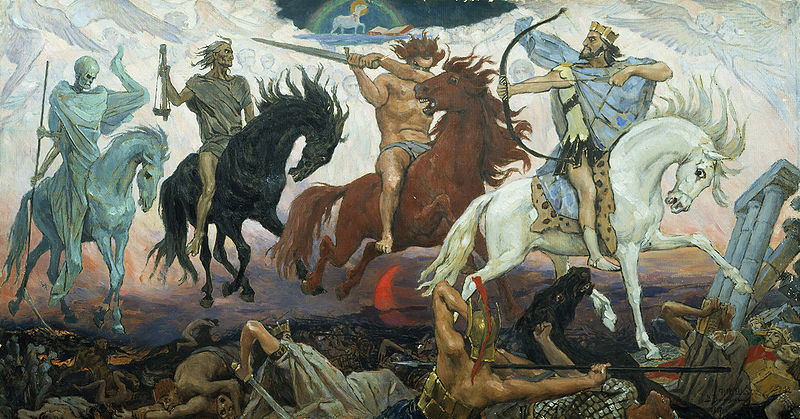
Image: “Four Horsemen of the Apocalypse” by Viktor Vasnetsov, 1887.
——
The preceding post is the property of J.W. Wartick (apart from citations, which are the property of their respective owners) and should not be reproduced in part or in whole without the expressed consent of the author. All content on this site is the property of J.W. Wartick and is made available for individual and personal usage. If you cite from these documents, whether for personal or professional purposes, please give appropriate citation with both the name of the author (J.W. Wartick) and a link to the original URL. This blog is protected by Creative Commons licensing. By viewing any part of this site, you are agreeing to this usage policy.
Sam Harris on Christian Sacraments–Lunacy?
 Sam Harris recently debated William Lane Craig on the topic “Is Good from God?” See my comments on the debate here. During the debate, Harris argued that the rituals of Christianity can be seen as a kind of lunacy. Harris said, “[Religion] allows perfectly decent and sane people to believe by the billions what only lunatics could believe on their own. If you wake up tomorrow morning thinking that saying a few Latin words over your pancakes is going to turn them into the body of Elvis Presley, you have lost your mind. But if you think more or less the same thing about a cracker and the body of Jesus, you’re just a Catholic.”
Consider what Harris is claiming here. Basically, he’s saying that to believe a cracker becomes the body of Jesus is a kind of lunacy. Interestingly, throughout the debate he issued these veiled (or not so veiled) insults to Christians at large, and quickly retreated from them when he was called out. But that’s neither here nor there.
My contention is that Harris’ implicit argument against the rationality of the Sacraments (and Christian rituals at large) contains an implicit assumption. Once that assumption is exposed, his argument fails. The implicit assumption is this:
1) Christianity is false
Yeah, I’m serious. The reason is because the only way Harris’ argument makes sense is if one assumes a priori that Christianity is false. For consider his objection if Christianity is true. If Christianity is true, then God exists, Jesus was God, Jesus told us what would happen in Communion/the Eucharist, etc., etc. But then if Christianity is true, it is perfectly rational to hold that the uttering of certain words as part of a ritual would be causative in the sense that God said it would be. So Harris’ argument turns on the assumption that Christianity is false.
But perhaps I’m missing Harris’ point. Perhaps he is instead trying to say “Look at what you guys do! It’s crazy if it’s something else!” But again the only way this would make sense is by assuming Christianity is false. If I believe Christianity is true, then I have no reason to think the rituals involved therein are lunacy or anything other than perfectly rational worship of our God.
But it could be pressed that it does seem as though Harris’ assertion that Holy Communion would be viewed as lunacy in other contexts is in some sense correct. For were I to do the same with pancakes and Elvis, I would be seen as a lunatic. Why not the Christian too? Well, then the question would have to be what kind of evidence do we have for thinking Christianity is true as opposed to other beliefs? In short, if the Christian is epistemically justified in believing Christianity to be true, then Harris’ argument is exposed for what it is: a facile argument which shows how deeply Harris and the other “New Atheists” fail to understand the position they attack.
SDG.
Image: Priest distributing Holy Communion at Holy Protection Church, Düsseldorf.
——
The preceding post is the property of J.W. Wartick (apart from citations, which are the property of their respective owners) and should not be reproduced in part or in whole without the expressed consent of the author. All content on this site is the property of J.W. Wartick and is made available for individual and personal usage. If you cite from these documents, whether for personal or professional purposes, please give appropriate citation with both the name of the author (J.W. Wartick) and a link to the original URL. This blog is protected by Creative Commons licensing. By viewing any part of this site, you are agreeing to this usage policy.
Omniscience, Substance Dualism, and Private Access
 I recently attended a seminar on God and Time with William Lane Craig (view my post on it here). One topic (among many) that caught my interest was Craig’s denial of one of the arguments for substance dualism, namely, the “private access” of some truths.
J.P. Moreland argues for private access in his work The Recalcitrant Imago Dei: Human Persons and the Failure of Naturalism. He argues that mental states have an “ofness or aboutness–directed towards an object” which is “inner, private, and immediate to the subject having them” (20, emphasis his). Basically, the claim is that even were someone else to know everything about J.W. Wartick, they could not say that they know what it is to say “I am J.W. Wartick”, because they are not J.W. Wartick. Certain truths and facts are such that only the knower can know them. I cannot say I am Abraham Lincoln, because I am not him. Nor could I say that I was Abe Lincoln even were I to comprehensively know everything about Abe Lincoln from the events that occurred in his life to the exact synapses in his brain. There is something about a phrase like “I am Abe Lincoln” which only Abe Lincoln can know.
Interestingly, Craig denied that there was such a thing as “private access.” He argued that, were this the case, it would mean God is not omniscient.
Why should it follow that God is not omniscient? Well, Craig defines omniscience as “Knowledge of any and all true statements” (definition from my lecture notes). Due to the fact that God would not know true facts which have private access, argued Craig, there is no such thing as private access. This seemed like an odd way to go about denying private access in regards to substance dualism. The argument seemed to be:
1) Omniscience =def.: God knows any and all true statements.
2) God is omniscient.
3) Truths available only through private access would entail truths God does not know
4) Either God is not omniscient or there are not truths available only through private access (1, 2, 3)
5) God is omniscient (2)
6) Therefore, there are no truths available only through private access (4, 5)
The argument would work, if one agrees with the definition of omniscience in (1). But I find it more likely that omniscience is analogous to omnipotence, which is defined as God’s ability to do anything logically possible. Why should it not be the case that God can only know things which are logically possible to know? On such a view, then, private access would not challenge omniscience whatsoever, because it would be logically impossible for God to know truths only knowable to their subjects.
I brought this up to Craig, and he responded by saying that my definition of omniscience made it into a modal property, and omniscience is not a modal property. I don’t see why omniscience could not be a modal property. In fact, it seems to me as though it is necessarily modal. Omniscience entails that any being which is omniscient would have to know all possible truths about all possible worlds (for any being who did not know truths for all possible worlds could be outdone by a being which knew about more possible worlds), which is clearly a modal claim. So it seems to me omniscience is clearly a modal property, and there is no problem revising Craig’s definition to:
(7) Omniscience=def.: A being is omniscient if it knows everything it is logically possible to know.
Further, a denial of (7) would seem obviously contradictory because one who denies (7) would have to assert:
(7`): Omniscience=def.: A being is omniscient if it knows everything, including things it is logically impossible to know.
And this would lead to contradictions about omniscience. So I don’t see any reason not to revise Craig’s definition of omniscience to note that God can only know that which it is logically possible to know (for a denial of this would imply God’s knowledge could be contradictory). But then private access provides no challenge to omniscience, and Craig’s denial falls apart.
Finally, “private access” seems like an intuitively obvious feature of knowledge. How could one deny that there are truths such as “I am J.W. Wartick”? It seems clear that only I can experience what it is to be J.W. Wartick. So I think it is necessary to modify Craig’s definition and simply deny his argument, both because God cannot know or do the logically impossible, and because “private access” is such a well-established phenomenon.
Edit: See the interesting discussion in the comments below. I am forced to modify the definition I presented in this post in the comments below due to an insightful comment by Midas. Those interested can read below or just read my modification here: “A being is omniscient iff it knows all truths which are not delineated by private access [of others] or experiential knowledge [of others].”
SDG.
———
The preceding post is the property of J.W. Wartick (apart from citations, which are the property of their respective owners) and should not be reproduced in part or in whole without the expressed consent of the author. All content on this site is the property of J.W. Wartick and is made available for individual and personal usage. If you cite from these documents, whether for personal or professional purposes, please give appropriate citation and provide a link to the original URL. By viewing any part of this site, you are agreeing to this usage policy.
Atonement and a Timeless God
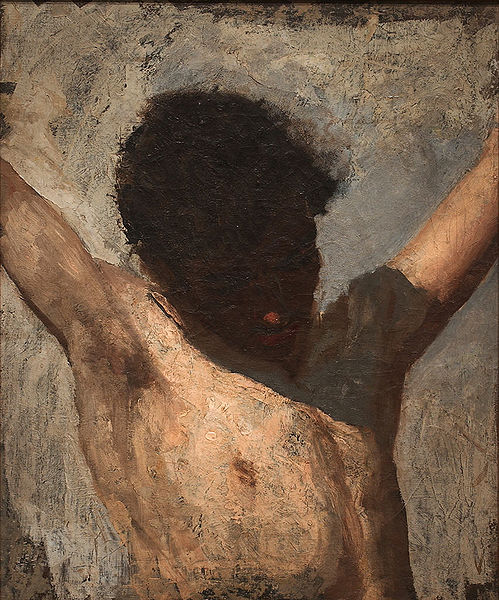 One of my own struggles with Christianity as I began serious contemplation of its core doctrines is the doctrine of atonement. Specifically, I kept wondering how it is that Jesus’ death two thousand years ago could be used as atonement for my sins now. In order to overcome my difficulties figuring this out, I admittedly opted for a fideist type of approach and just assumed that God could do what He wanted, and if He wanted to forgive me because of something two thousand years ago, that was fine.
More recently, however, I’ve been thinking about God’s timeless nature. I touched on these thoughts in my last post, but wanted to get into more depth now.
Consider this: If God is timeless, then God’s existence occurs “all at once”; there is no sequence of events to God, only one eternal “now.” But then it follows that God the Son, Jesus Christ, is eternally crucified, eternally exalted, eternally reigning on high.
In some sense, if God is timeless, then it follows that while I am sinning, Christ is suffering on the cross. As I ask for forgiveness, He is rising from the tomb. As I read Scripture, Christ is speaking. I don’t mean these things temporally, of course, for on this view, god is atemporal–He is without time. Thus, I am not saying that “now”, Christ is dying in a temporal sense; rather, it is meant metaphorically. Christ is crucified in God’s eternal “now”; during which all events are “present.”
What does this mean for atonement? At least in my opinion, it seems to make a lot of sense out of the idea that Christ’s death pays for my sins. For there is no moment at which Christ is not suffering for my sins–a truly horrific thought. On the other hand, there is no moment at which Christ is not glorified with His Father in heaven. All of God’s experience occurs in an instant.
It should be noted again that these considerations are not intended to imply that all events are “simultaneous” in a temporal sense of “occurring at the same time”; rather, they are simultaneous in the sense that from God’s perspective, they have occurred; are occuring; and will occur. All events are eternally present to God. Neither does this mean that God has no sense of the order of events. God’s eternal now sees events in order of logical priority as opposed to temporal progression. Therefore, God knows that one event (x) occurs “before” another (y) in the sense that x is logically prior to y; x had to occur for y to happen. But God experiences all events as “now”; as the changeless, immutable deity, He is eternally crucified, eternally glorified; eternally paying for our sins, and eternally forgiving us for them.
At Communion today (Sunday), I was contemplating the implications of an atemporal God for atonement and justification. I was overcome with emotion as I thought deeply on the issue. As I was eating of the body and blood, Christ was being crucified for my sins; as my forgiveness was declared, Christ was rising.
Powerful thoughts. I think divine temporalists (those who hold that God is temporal) still have to deal with the doctrine of atonement: how does a death thousands of years ago atone for me now? Those who hold God is timeless can answer this question sufficiently: Christ is paying for your sins.
SDG.
———
The preceding post is the property of J.W. Wartick (apart from citations, which are the property of their respective owners) and should not be reproduced in part or in whole without the expressed consent of the author. All content on this site is the property of J.W. Wartick and is made available for individual and personal usage. If you cite from these documents, whether for personal or professional purposes, please give appropriate citation and provide a link to the original URL. By viewing any part of this site, you are agreeing to this usage policy.
“God, Time, and Creation”: A Seminar with William Lane Craig
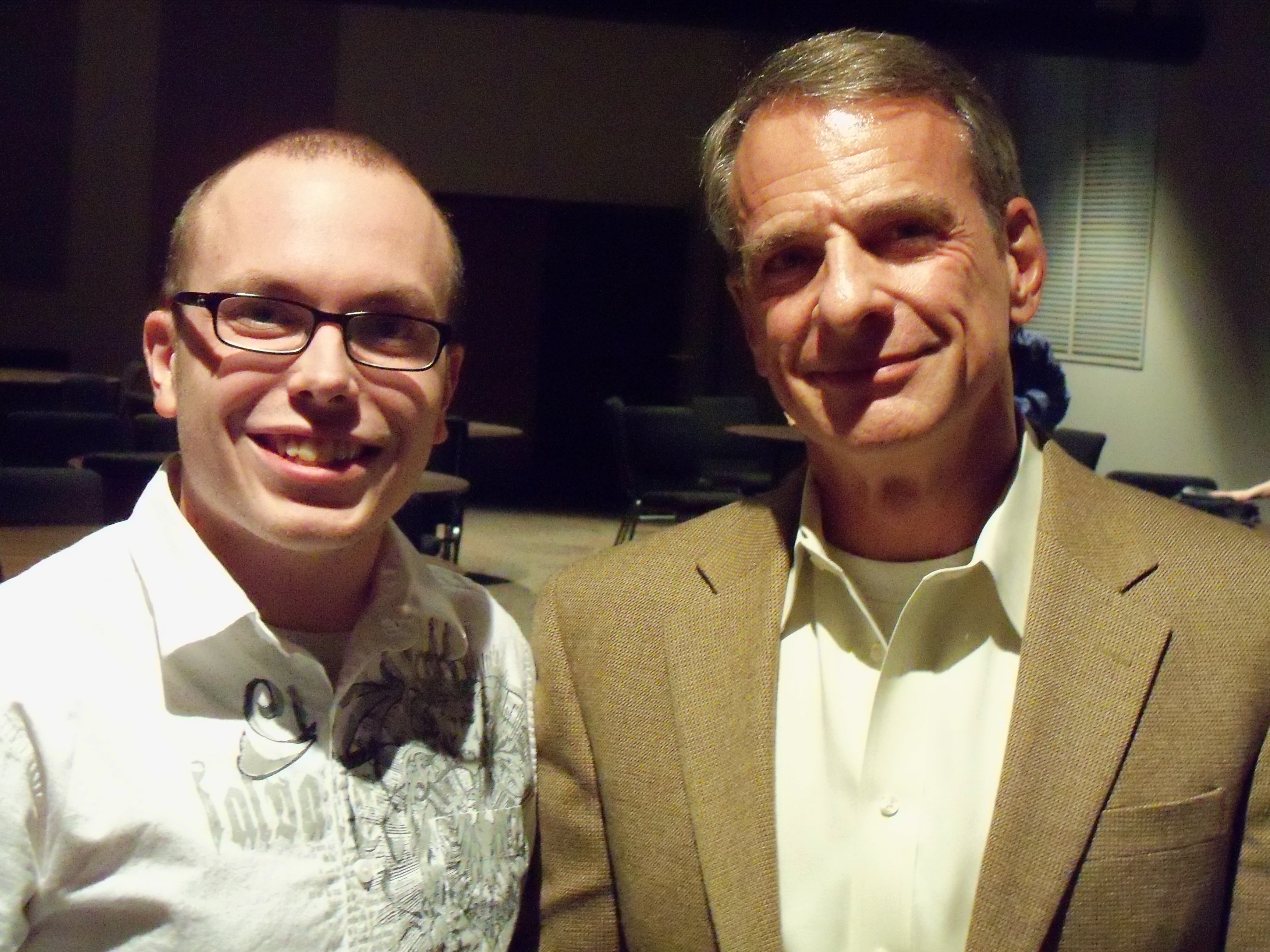 Over the past weekend, I was privileged to spend some time in Georgia (Atlanta area) at the seminar “God, Time, and Creation” with William Lane Craig (in picture next to me). It was part of a class of the same name for the Master of Arts Program with Biola University.
The seminar was a blast. I took approximately 25 pages of notes. Craig’s lecture notes comprised about 440 pages. Awesome!
The seminar focused on God’s relationship to time. Is God timeless, or temporal? Interestingly, Craig holds that God was timeless without creation and temporal subsequent to creation. His book, Time and Eternity, expands on the issues at great length.
First, Craig covered the arguments for and against a timeless God. It seems like a timeless God is not philosophically untenable, and the argument for a timeless God based upon the idea of the imperfection of a temporal life has some plausibility. Then, Craig went over the arguments for and against a temporal God.
After that, we covered the static (B-theory) of time–which holds that all of time and space is a kind of 4-dimensional block–and the dynamic (A-theory) of time–which holds that temporal becoming and passing away is real. It seems that the B-theory of time is, at best, extremely counterintuitive. If the B-theory is correct, our feeling of passing through time is illusory. Further, the theological problems with the view make it really implausible. If time is static, then the J.W. from three hours ago is literally a different entity than the J.W. now, because each is a different “slice” of a four-dimensional “block” of time. So, for example, it would seem as though the J.W. now could not be punished for the sins of a past J.W.–they are, in fact, different entities. Therefore, the doctrines of atonement, justification, sin, etc. seem to be at best vacuous. So a static theory of time, I think, is very implausible for the Christian to hold.
I’m reading through Paul Helm’s Eternal God: A Study of God without Time right now. He holds that God is timeless, and holds that time is static. I’m interested to see if he counters any of these theological issues.
Craig concluded that without creation, God is timeless–there is no change. But once God created, He underwent at least an extrinsic change, which Craig argues means God is temporal subsequent to creation.
This is one of the few areas I disagree with Craig on. I actually think it is more theologically plausible to hold that God is timeless, period. The main problem with this view is that many argue a timeless God entails a static theory of time. If I find on my further study into the area that this is the case, I may be forced to abandon the view that God is timeless. Therefore, I’m looking forward to delving into greater detail on this topic.
I’ve read Brian Leftow’s Time and Eternity and found it extremely interesting and thought-provoking. Craig is highly critical of Leftow’s view and charges that Leftow makes category mistakes throughout his work. As I said, I’m also reading Helm’s Eternal God, so I’ll see how that holds up. This is a very interesting topic which affects the core of study about the nature of God, how God relates to the world, divine providence, and many other areas. I’m excited to continue my research in this area.
On a side note, the Atlanta area is pretty awesome to visit! The weather was gorgeous. It isn’t that much fun driving there, however.
I visited a Christian Bookstore in the area–Lifeway Christian Bookstore–which had a huge sale on CDs. I couldn’t resist picking up some more Christian music (5$ cds!).
SDG.
———
The preceding post is the property of J.W. Wartick (apart from citations, which are the property of their respective owners) and should not be reproduced in part or in whole without the expressed consent of the author. All content on this site is the property of J.W. Wartick and is made available for individual and personal usage. If you cite from these documents, whether for personal or professional purposes, please give appropriate citation and provide a link to the original URL. By viewing any part of this site, you are agreeing to this usage policy.
Religious Pluralism: The Argument Assessed
 “If you were born in India, you’d probably be a Hindu.” “What of those sincere believers in other faiths, are you suggesting they are wrong?” “Jesus is just one of the many ways towards salvation/bliss/righteousness/etc.”
These are the types of “bumper sticker” quotes Christians often get in our pluralistic society. I’ll be focusing on only one of the many problems with views such as these:
The argument against theism from religious pluralism rests on the implicit assumption that all religions are equally veridical.
The religious pluralist (or the objector to religious belief) who uses arguments like these unjustifiably makes the assumption that all religions are on equal ground (epistemically–on equal footing in the realm of knowledge). That this assumption is made is fairly evident, but we can illustrate it with a thought experiment (ignore some of the disanalogies–this is for example only):
Suppose Bob believes that he is reading a book, An Introduction to Philosophy. Now, suppose Steve else comes along and says “You can’t be sure that you’re right in your belief that you are reading An Introduction to Philosophy–after all, there are billions of people who read books which are not An Introduction to Philosophy. And they think they know what they are reading. How can you be sure that you are reading An Introduction to Philosophy? You may be reading a book on psychology, or a novel!”
Bob responds by saying, “Well, I can look at the cover and see the title. I can open it up and see the ISBN and confirm by searching for the ISBN online that it is only tied to An Introduction to Philosophy. The contents certainly seem as though they would match a book of that title. Also, I know the authors name is Jane Doe and this is the only book she’s ever written.”
The key point is that Bob has some very good reasons for thinking that he is reading An Introduction to Philosophy. Steve’s objection assumed that there was no way to determine what book Bob was reading.
Religious pluralists often do the same thing. They ask “How can you know you are right?” or “How do you know yours is the only true religion?” The assumption seems to be that there are no criteria for determining whether one religion is to be favored over another (again, using these terms in an epistemic sense–the sense having to do with knowledge). SO, let’s revisit the scenario:
Bob is sitting contemplating the universe. He’s a Christian, and Steve knows it. Steve comes along and says “Bob, how do you know you’re right? The Hindu, the Buddhist, and the Muslim all think they are just as right as you.”
Bob responds, “Well, I think there are very good reasons to think Christianity is true. There are cosmological, teleogical, and ontological arguments which I believe are quite successful. If they are successful, Buddhism and Hinduism are wrong. And I think the Gospels are quite reliable due to the standard historical criteria such as the principle of embarrassment and multiple attestation. But if the Gospels are reliable (and Jesus died and rose again), then Islam is wrong too. So I don’t think those other religions are on equal footing with my own faith. Christianity seems to me to have the most explanatory power.”
The assumption that all religions are on equal footing seems patently false. Why should we think that Hinduism = Buddhism = Islam = Christianity = Jainism (etc.) when it comes to whether or not we can evaluate their truth? The religious pluralist simply assumes we cannot. However, in light of the evidence for Christianity, it seems the world religions are not all on equal epistemic ground.
Finally, the pluralist objection assumes that it is, itself, on a higher epistemic ground than its rivals. The pluralist believes that, while all religions are equally veridical, pluralism itself is true. Yet pluralism’s truth entails the falsehood of large portions of theistic, pantheistic, and atheistic belief. Pluralism must chop away the incompatible components in the world’s religions in order to make way for a distorted view of reality. What reason do we have for holding on to pluralism when we have much better reasons to think Christianity is true?
SDG
———
The preceding post is the property of J.W. Wartick (apart from citations, which are the property of their respective owners) and should not be reproduced in part or in whole without the expressed consent of the author. All content on this site is the property of J.W. Wartick and is made available for individual and personal usage. If you cite from these documents, whether for personal or professional purposes, please give appropriate citation and provide a link to the original URL. By viewing any part of this site, you are agreeing to this usage policy.

 J.W. Wartick - Reconstructing Faith
