theology
Book Review: New Proofs for the Existence of God by Robert Spitzer
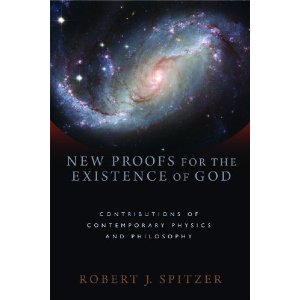
Robert Spitzer’s New Proofs for the Existence of God (hereafter NPEG) presents in rigorous detail, five arguments for the existence of God, a section discussing the plausibility of multiverse/string universe scenarios, and some philosophical discussion on methodology.
Before continuing the review, I should note that the “New” in NPEG is nuanced. Spitzer notes this himself (my guess is that it was a marketing technique. “New” refers to the evidence from cosmology and further research in philosophy which lend new power for these arguments.
Chapter 1 presents a cosmological argument. Spitzer cogently argues that “(1) If there is a reasonable likelihood of a beginning of the universe… and (2) if it is apriori true that ‘from nothing, only nothing comes,’ then it is reasonably likely that the universe came from something which is not physical reality” (Spitzer, 45). This conclusion is supported by explorations of current cosmological theories about the origins of the universe.
Chapter 2 presents the teleological argument, which Spitzer bases on the universal constants. The argument leads to the conclusion that “the odds against an anthropic condition occurring are astronomically high, making any life form… exceedingly improbable.” It is a probabilistic argument, the likes of which I defend in my article Past, Probability, and Teleology (Hope’s Reason 2011-1).
Following chapter 2 is a chapter which discusses the possibilities of inflationary cosmology and the string multiverse written by Bruce Gordon. It is extremely technical and will provide readers with cogent arguments against the possibility of a multiverse scenario circumventing the previous arguments.
Chapter 3 presents Spitzer’s metaphysical argument for the existence of God, which is full of sound argumentation along with some interesting Thomistic Philosophy wherein he discusses God’s simplicity in the most coherent way I have read. I greatly encourage readers to look into this chapter, if only for the discussion of this oft-neglected doctrine.
Spitzer follows this with Chapter 4’s metaphysical argument derived from Bernard Lonergan’s Insight, which is a subtle version of the argument from reason. This chapter was particularly good because it focuses on a little-used type of arguments for the existence of God–that if our universe is intelligible, that can only be explained by God’s existence.
Chapter 5 is an argument from contingency similar to the Leibnizian cosmological argument.
Chapter 6 engages the question of method in philosophy along with whether atheism is actually rational. I was intially put off by the title of this chapter (“Methodological Considerations and the Impossibility of Disproving God”), but happened throughout the book, I was pleasantly surprised by the rigorous arguments and enlightening conclusions Spitzer laid out.
Finally, the last two chapters outline some more considerations about the universe and the relation of humans and God.
NPEG was a surprising read for me. I went in with neutral expectations, and those were blown away. Spitzer’s knowledge of the topics in the work runs deep, and his writing style is clear and cohesive. It is genuinely exciting to read. Readers will be challenged by the arguments for the existence of God, and engaged in the details and philosophical explanations of these arguments. I highly recommend this work to those interested in advanced books on arguments for God’s existence.
——
The preceding post is the property of J.W. Wartick (apart from citations, which are the property of their respective owners) and should not be reproduced in part or in whole without the expressed consent of the author. All content on this site is the property of J.W. Wartick and is made available for individual and personal usage. If you cite from these documents, whether for personal or professional purposes, please give appropriate citation and provide a link to the original URL. By viewing any part of this site, you are agreeing to this usage policy.
Our Longing For God
 Recently, I had a discussion with my fiancée about the idea of Song of Songs being utilized as an analogy for Christ and the Church. Song of Songs is clearly a book about love, even erotic (eros) love. There are verses like 1:4 “Draw me after you; let us run. The king has brought me into his chambers” or 6:3a “I am my beloved’s and my beloved is mine.” If we are to apply such verses to the life of a Christian and his or her relation to God, we can see it sometimes as an almost uncomfortably close relationship. We aren’t comfortable thinking of our love of God as this kind of intimate desire; a desire for union, to be brought into the chambers of our God.
Yet it is exactly this kind of intimacy–this kind of eros love–which God has planned for us. Song of Songs is such a beautiful book because of this exact thing. It teaches us that we need not be ashamed of the kind of union we desire with God. We are sheep lead astray, and our one desire should be to return to our Lord, in whose arms we find peace and love.
There are other verses in Scripture wherein we can see this idea. Psalm 84:2 states “My soul yearns, even faints for the courts of the Lord; my heart and my flesh cry out for the living God.” Psalm 63:1 puts it eloquently, “Oh God, you are my God, earnestly I seek you; my soul thirsts for you, my body longs for you.”
My favorite exposition of these ideas is found in Alvin Plantinga’s Warranted Christian Belief, of all places. In this monumental work, Plantinga discusses the very idea of God’s love as eros. I feel compelled to quote him at length:
This love for God isn’t like, say an inclination to spend the afternoon organizing your stamp collection. It is longing, filled with desire and yearning; and it is physical as well as spiritual… It is erotic; and one of the closest analogues would be with sexual eros. There is a powerful desire for union with God… What is to be made of this phenomenon? Most psychiatric literature has tended to follow Freud in understanding religion as a kind of neurosis, the ‘universal obsessional neurosis of humanity.’ From this point of view, the religious eros is to be understood as a kind of analogue, displacement, or sublimation of (broadly) sexual energy…
From a Christian perspective… here (as often) Freud has things just backwards. It isn’t that religious eros, love for God, is really sexual eros gone astray or rechanneled… It is sexual desire and longing that is a sign of something deeper: it is a sign of this longing, yearning for God that we human beings achieve when we are graciousliy enabled to reach a certain level of the Christian life. It is love for God that is fundamental or basic, and sexual eros that is the sign or symbol or pointer to something else and something deeper.
[S]exual eros points to two deeper realities… human love for God… [and] a sign, symbol, or type of God’s love. (Plantinga, 311-318)
Those who have had religious experiences in which they felt a kind of union with God can attest to what Plantinga is describing. The kind of mystical union we experience when we are granted the chance to commune with God in a relation of creature-creator is beautiful, to the point of being even sensual. It is something which we long for; something we look forward to in the hereafter.
This also serves to help describe the kind of feelings involved in religious experience. It is a kind of fulfillment of a yearning and a quenching of thirst. Our longing for God is part of humanity. Plantinga argues it is part of our sensus divinitatis–our inborn sense of divine reality. Only when we submit to God and experience relation with him can our deepest desires be realized.
Source:
Alvin Plantinga. Warrented Christian Belief (New York, NY: 2000, Oxford).
——
The preceding post is the property of J.W. Wartick (apart from citations, which are the property of their respective owners) and should not be reproduced in part or in whole without the expressed consent of the author. All content on this site is the property of J.W. Wartick and is made available for individual and personal usage. If you cite from these documents, whether for personal or professional purposes, please give appropriate citation and provide a link to the original URL. By viewing any part of this site, you are agreeing to this usage policy.
Alexander Pruss on Open Theism
Open Theism is basically the view that God does not know the future. The Evangelical Philosophical society recently tweeted this post by Alexander Pruss on the topic. I found it very interesting. The argument he presents is (quoted word for word from his blog):
- (Premise) If p is overwhelmingly probable on the balance of God’s evidence, then God believes p.
- (Premise) If open theism is true, then some of the propositions that are overwhelmingly probable on the balance of God’s evidence are false.
- Therefore, if open theism is true, God believes some falsehoods.
- (Premise) God believes no falsehoods.
- Therefore, open theism is false.
I think that perhaps the best way for the open theist to avoid this argument may actually be to deny (4), for which Pruss does not argue. The open theist could hold that: (4`) Possibly, God believes falsehoods. I doubt that many open theists would be perturbed by accepting this premise, but I may be wrong. If I’m right, however, Pruss’s neat argument doesn’t work. Again, check it out.
Original Sin and the Metaphysics of the Soul
Original Sin Defined
The writers of the Augsburg Confession (found in the Book of Concord) defined Original Sin as the belief that “…since the fall of Adam all human beings who are propagated according to nature are born with sin, that is, without fear of God… [we] teach that this disease or original fault is truly sin, which even now damns and brings eternal death to those who are not born again through baptism and the Holy Spirit” (BOC, 39).
One Objection
Ezekiel 18:20a states, “The soul who sins is the one who will die. The son will not share the guilt of the father, nor will the father share the guilt of the son.”
The word used for “soul” in this passage is the Hebrew word, nephesh. This passage leads to the objection that original sin cannot be true as I have outlined it, because it involves the son inheriting the guilt of the father.
The Question of the Soul: A Metaphysic of Original Sin
Three views of the soul are prevalent in Christianity. All of them presuppose metaphysical dualism. They are:
1) Our soul is constructed just as our physical body: Our soul is a half-and-half combination of the souls of our mother and father.
2) God specially creates each soul for each person when he/she is conceived/born/etc. Alternatively, God has already created every soul for everyone who will ever live, and puts them in a body when one is needed. The main problem with this view is that it would seem that if original sin is true (in the sense I have outlined it above), then God creates sinful souls for us.
3) Our soul is from Adam. There are no new souls for mankind, rather, we all share, in some sense, Adam’s soul.
I tend to favor 1) (now, anyway). But I favor a version of 1) which is not so much a half-and-half combination of souls, but a union of the totality of the souls we inherit. I originally wrote this post for my new site, but an insightful commentator lead me to heavily edit my views here. Just as we become one in the union of sex, so do our souls become one when we conceive a child.
What this means, then, is that the soul we inherit from our ancestors includes the inheritance of the guilt of sin. I must note the distinction here between sins which require action and those that do not. I have been pondering this idea for some time–is it possible to have sins for which we are guilty that we don’t commit? The answer I lean toward is “No”, but that doesn’t preclude original sin. The reason is that through the soul, we have literally participated in the original sin of Adam. When we are told that we have the “Old Adam” in us, this should be taken in a more literal sense than it often is.
We are told by Paul that there is a natural and spiritual body (1 Corinthians 15:44). These are both the inheritance of our ancestors. In a literal sense, then, there is the “old self” (Romans 6:6) and the Old Adam (1 Corinthians 15:45) which, from birth, enslave us to sin (Romans 6:6). Metaphysically I think this means that our soul has literally participated in, and is therefore held accountable for, the original sin. Original sin is a substantive entity–it corrupts our very nature. This is no mere inclination to sin, but a bondage to sin and a separation from God. It only makes sense to me on a metaphysical level to argue that this sin is inherited through our soul, which, like our body, maintains the union with Adam himself.
So how does this answer the objection from Ezekiel 18:20? Initially, one may argue it seems to purge the passage of all meaning. This is not the case, however. What Ezekiel is referring to is the sin of commission. That is, it refers to a sin which requires an action. Ezekiel is telling us that the actions of the father do not condemn the actions of the son. This does not, however, preclude the original sin in the metaphysical sense in which I have outlined it, because we have each participated in the action which causes original sin.
One final note is required, however. This is again a modification of my original thoughts due to enlightening discussion with my good friend’s comments. We must remember that this stain of sin, this original sin, has passed away for those who have faith in Christ. For, though the passages I quoted above discuss the nature of our original guilt, they immediately turn to salvation which is through Christ. Our New Adam replaces the Old (1 Corinthians 14:42-57), and our enslavement to sin is no more (Romans 6:6-14). Our original guilt, received through our sharing in the action of Adam, and our shared spirit with him, is no more.
Source:
The Book of Concord. Augsburg Fortress. 2000.
——
The preceding post is the property of J.W. Wartick (apart from citations, which are the property of their respective owners) and should not be reproduced in part or in whole without the expressed consent of the author.
New Page: Christian Diversity
I have started another blog, which will not interfere with this one (though there may be some overlap). It is called Christian Diversity. Here’s the mission statement:
Christianity has been separated into divisions over denominational, cultural, and theological lines, yet the message of Christianity remains the same for all generations: Christ crucified for our sins. We at ‘Christian Diversity’ seek to demonstrate that while Christianity may be divided institutionally, we are of one mind spiritually. We affirm ‘Mere Christianity’, which is the belief that Christianity is ultimately this faith in Jesus Christ as Lord and Savior. We affirm the Three Ecumenical Creeds (The Apostles’, Nicene, and Athanasian Creeds).
The goal of ‘Christian Diversity’ is to discuss doctrinal differences on matters not essential to the faith. We understand that the goal of total ecumenism–that is, the unity of all churches–may be out of reach, but we strive to come to the understanding that all Christians are saved, and there are no divisions among us when it comes to Christ. Thus, while we may disagree on many of the issues we discuss, we continue to strive towards a better understanding of our fellow Christians and increase unity with them. This will serve to strengthen us as brothers and sisters in Christ.
Our motto comes from St. Paul, who writes in 1 Corinthians 1:10 I appeal to you, brothers, in the name of our Lord Jesus Christ, that all of you agree with one another so that there may be no divisions among you and that you may be perfectly united in mind and thought.
Check it out! Let me know your thoughts!
Religious Diversity: What’s the Problem?
Religious diversity is one of the greatest challenges found by people of any faith in our pluralistic society. There are so many things to consider about this subject that there is no way to adequately cover it in one post.
First we must ask ‘what exactly is the problem of religious diversity?’ Is there really any logical problem to their being more than one religion in existence? I think the answer to this objection, if it is any objection at all, is simply to answer that, as in other areas of life, the fact that there is a broad array of beliefs about a subject does not mean that all are false or that the subject is unknowable.
Is the problem, then, instead specific to religions which claim exclusivism? Is it true that all religions have truth in some way, and that those which claim to have the truth are fundamentally flawed in some way? This, again, doesn’t seem to follow from anything. The fact that there is a plurality of opinions over the Divine (or whether there is a Divine-thing-being) alone does not justify the assertion that all religions are somehow about the same thing or that none are true. Nor does it imply that religions which claim to have the only way are incorrect. Again, there doesn’t seem to be any kind of structured argument here.
Often, this problem is focused around a specific religion; namely, Christianity. The problem is posed in the following way: If [traditional] Christianity is true, then Jesus is the only way of salvation. What then, of those “good people” who are not Christians? What of the faithful Buddhist, Hindu, or Zoroastrian? Would the loving God of Christianity condemn these to hell?
This is the problem posed in its most powerful form, in my opinion. Religious diversity doesn’t itself function as a defeater for theistic belief. Instead, it can pose a problem to exclusivist Christian belief. This is the problem upon which my next posts will focus. Broadly, I will address the other attempted defeaters above throughout my posts on religious diversity, but it is the exclusivist Christian position around which I will focus. This is the position to which the problem of religious diversity poses the greatest problem (note that any religion which features exclusivism will also face this problem).
Let me briefly offer the outline of what will be my expanded response:
1) Jesus is indeed the only way to salvation (John 14:6)
2) Jesus’ death and resurrection provided the possibility of salvation to all people, on the condition of faith (Romasn 3:21ff)
3) People are judged by the knowledge they have (Romans 2:12ff)-This is the key point. The distinction between ontological (availability of) and epistemological (knowledge of the means of) salvation must be drawn.
4) The salvation provided by Christ is ontologically necessary. The key issue is of its epistemic necessity.
Molinism and Timelessness–A Match Made in Heaven (No, really!)
It seems to me that there are few matches better made than the doctrine of Divine Timelessness and Molinism (aka Middle Knowledge). I think they truly are a match made in heaven, for God Himself possesses both of these attributes/properties.
First, some definitions. God is timeless, which means that “God exists, but exists at no time” (Leftow, xi). Middle knowledge is God’s knowledge of counterfactuals (simplifying the case to some extent here, see Thomas Flint’s discussion in Divine Providence: The Molinist Account). Jointly these propositions serve as explanations for a number of phenomena of Christianity.
First, human freedom and divine omniscience is a problem curtailed jointly by these doctrines. Timelessness solves any kind of potential incompatibility by simply denying that omniscience is foreknowledge. Instead, it is simply knowledge, known all at once in one “instant” in eternity (Leftow, 246ff). That which is not in time cannot determine things “ahead of time”.
Molinism, on the other hand, can also deny any incompatibility by asserting that the counterfactuals of God’s knowledge are not under the control of God. In other words, God has no control over whether or not Jenny will freely choose to go mountain climbing. God can control the circumstances in which Jenny is placed, and then bring it about that some other counterfactual would be true (i.e. Jenny does not go mountain climbing because she stays home to nurse her ailing goldfish). But this control over circumstances does not entail control over choices. The choices remain free (Flint, 11ff).
Now, one objection to Molinism is that because God decides which circumstances in which to place Jenny before the creation of the world, he still is determining what she will do because he picks from the circumstances. But this is not quite the case. Jenny’s actions are not determined, but some of the circumstances in which she is placed are. This doesn’t preclude her free choice, however, for God only controls the situations Jenny will encounter, while her free choices remain outside of His control.
Timelessness is sometimes denied due to a perception that a timeless God could not have meaningful interactions with His creatures. This does not seem to be the case however, once one analyzes exactly what timelessness entails. Leftow argues convincingly that timelessness can be thought of as, in some sense, a parallel “time” during which all things happen at once, though not simultaneously. The relationship of successive temporal instants can be thought of in some ways as similar to logical priority. If a timeless God has middle knowledge, furthermore, then God can indeed have “real” interactions with creatures, because He, in eternity, all-at-once performs the creative, providential act. This includes the situations in which His creatures will be placed.
Thus, by His creative act, He sets the situations in which He will interact with His creatures, and this action is a true interaction because He factors in their free choices and takes such things into account. Furthermore, the objection that God’s interactions are diminished because they happen “before” the interaction occurs is a specious claim, for if God is timeless, then none of His actions occur “at a time” other than in Eternity.
Therefore, it seems to me that jointly, a molinist account and a timeless God make quite a lot of sense. This is not to say that there are no other accounts of God that make sense, but this is part of the interest of philosophy of religion, after all, particularly among Christians: the dialogue, the interaction with the Biblical texts which perhaps speak to each issue, and the different conclusions which can be drawn. These differing conclusions do not take away from or destroy the validity of our faith, rather, they ensure that we delve ever deeper, striving for an understanding of the divine Godhead.
Sources:
Leftow, Brian. Time and Eternity. Cornell University Press. 2009 (reprint).
Thomas Flint, Divine Providence: A Molinist Account. Cornell University Press. 2006.
——
The preceding post is the property of J.W. Wartick (apart from citations, which are the property of their respective owners) and should not be reproduced in part or in whole without the expressed consent of the author.
The Life Dialogue: Matt Moss Guest Post Part 3
This is part 3 of a series of guest posts by Matt Moss on the Genesis Creation account. Check out the first post here, and the second here.
Thesis 5– Genesis 1 – 2 describes the whole of creation as God’s (pre-fall) Temple.
When examining the seven days of creation we see several factors that indicate something cultic (meaning religious) taking shape. The first three days show a forming of the earth which (in v. 2) was “without form.” In the second set of three days you see a filling of the earth which (in v. 2) was “void.” Walton, in keeping with his functional model suggests a better translation of these words tohu and bohu (without form and void). Similar to bara’ he provides a survey of tohu’s use in the Bible (bohu occurs three times, always with tohu) and shows that the word “describes that which is non-functional, having no purpose and generally unproductive in human terms (48-9).” In light of this, the state of tohu and bohu means that the earth has a functional non-existence. Thus, when God begins His bara’ work, the functional bringing into existence of all that He does, Genesis 1 wants us to see what purpose everything serves.
Examining the functions in Genesis 1 we will find many parallels to the religious life of ancient Israel as studied in Exodus, Leviticus, and the rest of the OT. I’d like to turn now to days 4 – 7 of the Genesis 1 account (1:14 – 2:3) to examine the indicators that the Genesis 1 cosmology is a temple cosmology.
Genesis 1:14-19 (ESV) – “And God said, “Let there be lights in the expanse of the heavens to separate the day from the night. And let them be for signs and for seasons, and for days and years, 15 and let them be lights in the expanse of the heavens to give light upon the earth.” And it was so. 16 And God made the two great lights—the greater light to rule the day and the lesser light to rule the night—and the stars. 17 And God set them in the expanse of the heavens to give light on the earth, 18 to rule over the day and over the night, and to separate the light from the darkness. And God saw that it was good. 19 And there was evening and there was morning, the fourth day.”
So let’s look at what functions these lights in the sky are given:
1) to separate the day from the night
2) to be for signs and for seasons (moed) and years
3) to give light upon the earth
4) to rule the day & night
5) to separate the light from the darkness
Now you may be asking yourself, “I don’t see anything here that is particularly temple focused. First I would like to point out that in a society where watches & clocks are not present, the Sun, Moon, and stars are what tell you when it is time to worship (they did so much more often than once a week). Second, we can see throughout the OT that specific days of specific months are given festivals and holidays. These were mapped out by using these very lights, after all that is their given purpose in point two, “to be for signs and for moediym and years.”
The word moed occurs 223 times in the OT, so we have a large cross section of uses to help us nail down the possible meanings and the intended meaning within this context. The basic lexical entry is “appointed time.” However it is important to note that in Exodus 23:15, God says, “You shall keep the Feast of Unleavened Bread. As I commanded you, you shall eat unleavened bread for seven days at the moed in the month of Abib, for in it you came out of Egypt.” At the very beginning of the cultic/religious life of Israel upon exiting Egypt this word is tied to their religious festivals! Throughout Exodus, Leviticus, & Numbers moed is unanimously used in the phrase “tent of meeting (moed)” for the tent in the centre of the Tabernacle (the travelling version of the Temple before Solomon builds the first Temple). Now, beyond this there are countless uses of moed as “appointed time” in the worship life of Israel. I would thus maintain that Genesis 1 claims the functional purpose of the Sun, Moon, and stars is to indicate the daily, weekly, monthly, and yearly worship schedules of God’s people. In other words, when the ancient Israelite children asked their parents, “why is that moon shining in the sky?” the parents would answer in accord with Psalm 104:19 and say, “God made the moon to remind us when to observe the Feast of Passover and the other feasts/festivals.”
There is one more minor indicator that I would like to bring up when discussing the functional creation of Light. When we examine Genesis 1 as a Temple cosmology we realize just why something seemingly inconsequential like the Golden Lampstand (Ex. 25:31ff) is present in the Temple. Not only does it serve to light the room, but it is absolutely necessary to have this light in the Temple because this Temple reflects the Cosmic Temple corrupted in the Fall. If the Cosmic Temple has Light (Gen 1:3-5, 14-19) so must the Tabernacle/Temple have that Light (Ex. 25:31-40; 2 Chron 4:7).
Genesis 1:20-23- “And God said, “Let the waters swarm with swarms of living creatures, and let birds fly above the earth across the expanse of the heavens.” 21 So God created the great sea creatures and every living creature that moves, with which the waters swarm, according to their kinds, and every winged bird according to its kind. And God saw that it was good. 22 And God blessed them, saying, “Be fruitful and multiply and fill the waters in the seas, and let birds multiply on the earth.” 23 And there was evening and there was morning, the fifth day.”
Granted, there is not much here that we would directly relate to the Temple if we did not first see that days 4-6 are paralleling days 1-3. Now, when we look back to verses 6-8 and read it in the light of other ancient Near Eastern cosmologies we see that on days two and four more than any other we find the physical shape of a temple. The Lutheran Study Bible footnote on these verses is very helpful in pointing out the structural/functional aspect of how the “expanse” works and the image it evokes. “The point of the image is the function rather than the substance: the sky serves as a divider. The Israelites often used figurative terms to describe the cosmos as it appeared to them (cf. Is 40:22, where the sky is described as a “curtain” and a “tent”).”
[Further expansion of thesis 5 coming later this week]
Rising Above the Dogma: A Call to Christian Fellowship
Dogmatics. Too often this word is seen as a “dirty” word. We don’t want to deal with stuffy theology books or learning about doctrine. It is my sincere belief that Christianity has unfortunately traveled two paths when dealing with Christian doctrines:
1) Christians simply don’t care about doctrine. They abandon systematic theology, and in turn abandon the soul of Christianity.
2) Christians emphasize soundness of doctrine with such zeal that they alienate and make enemies of fellow Christians. In doing so, they abandon Christ’s teaching.
I just finished reading the book Christ Among the Dragons by James Emery White, and I must say it should be required reading of all Christians. Among the wonderful points made by White throughout this work, I found the most important to be his discussion of our interactions with fellow Christians. Too often, I found myself literally in tears, either because I stood convicted by the words he wrote or because fellow Christians had wronged me in the ways he outlined. He writes concerning debates over doctrinal issues:
“Truth be told, we should have enough theological humility to admit that we may all be wrong. The greater issue is refusing to make our theological viewpoint the test of orthodoxy, the agenda for which we exist and the basis of our community… And our rhetoric isn’t helping. ” (126).
White later quotes two other theologians, John Stott and the Lutheran theologian Peter Meiderlin. Stott wrote:
“Perhaps our criterion for deciding which is which [that is, which doctrines are essential and which are matters of liberty]… should be as follows. Whenever equally biblical Christians, who are equally anxious to understand the teaching of Scripture and to submit to its authority, reach different conclusions, we should deduce that evidently Scripture is not crystal clear in this matter, and therefore we can afford to give one another liberty” (127-128).
Meiderlin said, “In essentials, unity; in non-essentials, liberty; in all things, charity.”
These powerful calls to Christian unity too often fall on deaf ears from those who adhere to either of the views I described above. Those who believe doctrines are unimportant criticize those who attempt to stress the essentials. Those who emphasize doctrinal purity too often attack fellow Christians for matters which should be of liberty.
I hope and pray for a day in which we can move past such disturbances in the body of Christ. No longer will Christians feel “second class” because they are of a different denomination. No longer will Christians abandon the Creeds of the Catholic Church (meaning the whole Church at large, not just the Roman Catholics). No longer will Christians accuse their fellows of rejecting Scripture for having different views on matters of “liberty.” No longer will Christians abandon the message of Christ in favor of ethical teaching.
We Christians are a Body. We must stick together. Divided we fall, united we stand.
I’d like to add that when we deal with our fellow man, and particularly our fellow Christian, the most important thing we should remember is that our message is Christ, and our witness is our deed. I close with another quote from White in Christ Among the Dragons:
“When we condescendingly say that our position is simply the ‘gospel,’ as if it’s not really a debate worth having, then we are being arrogant. When we make our view the litmus test of orthodoxy, or even community, we are being neither gracious nor loving. When we say that our view alone upholds God’s sovereignty or that our perspective is the only one that cares about lost people, we are not being truthful. When we exhibit a haughty smirkiness, or we so state our position that we divide churches, student ministry groups or denominations, then we are sinning.” (126-127)
Source:
White, James Emery. Christ Among the Dragons. InterVarsity Press. 2010.
Book Review: “On a Complex Theory of a Simple God” By Christopher Hughes
Christopher Hughes’ work, On a Complex Theory of a Simple God: An Investigation in Aquinas’ Philosophical Theology (hereafter CTSG), is part of a series of books (on independent topics by different authors—meaning one can jump in on whichever book one wants) called the “Cornell Studies in the Philosophy of Religion.” It is the first book in the series which I have read (though I have 5 more sitting on my shelf), but if it is any indicator of things to come, I highly recommend this series.
CTSG mostly focuses on Thomistic Philosophy, but it specifically highlights St. Thomas Aquinas’ arguments for Divine Simplicity and his discussions of the Trinity and the Incarnation. I must admit that initially I found it hard to maintain interest in this work. Thomistic Philosophy is by no means a specialty of mine, and I got the book mostly because I was vaguely interested in whether or not Divine Simplicity—that is, the idea that God is “omnino simplex”, altogether simple, and “in no way composite” (Hughes, 4). Hughes, however, manages to make a topic in which I displayed only a passing interest into a page-turner of a philosophical work.
Divine Simplicity was appealing for a few reasons. First, if God is composite in no way, then it seems as though many objections to the compatibility of properties of God—say, of omnipotence and omniscience—fail to be objections at all. For if God is absolutely simple, omnipotence just is omniscience (following the example) and vice versa, and if this is the case then to object that omniscience and omnipotence are incompatible would be to object that two things which are identical are incompatible. Aquinas holds to this very view. On Aquinas’ view, “His [God’s] existence is also His goodness, wisdom, justice, omnipotence, and so on” (22). Second, if God is perfectly simple, then it seems as though God as a hypothesis, if you will, increases in merit, granting Occam’s Razor. For, if God is absolutely simple, then to object to God’s existence as being too complex (as some do) is entirely specious, as God is not complex at all. Third, philosophical interest in Divine Simplicity had me longing to learn more about it.
Hughes’ analysis and critique of the arguments for Divine Simplicity are fantastic. His capabilities in discerning and detailing the complexities involved in Thomistic Philosophy are spectacular. It is his unbiased analysis, however, which most characterizes CTSG. Throughout pages 28-57, he destroys (in my opinion) Aquinas’ arguments for Divine Simplicity. Then, he argues that God cannot be identical to His insular attributes, which counters the argument in defense of Divine Simplicity that, roughly, ‘omnipotence and omniscience may appear to be different, but perfection of either quality shows that they are actually the same’ (60-68).
Yet despite his rather convincing arguments against Divine Simplicity as drawn out by most proponents, Hughes also outlines a possibility for a defense for that very idea. For if 1) God exists necessarily in the logical sense, and 2) if all things are contingent upon God’s existence (two premises Hughes disagrees with, but does not offer an argument to refute per se—instead he refers to Humean thinking as a reason not to accept 1)), then
“[b]y 2), any individual substance in world w distinct from B exists there only at the sufferance of B, and would not have existed if B had exercised its will in a way it might have. By 1), we know that there is an individual substance—the individual in our world which is (a) God—which exists in w, and does not exist at the sufferance of B, that is, could not have failed to exist through any possible exercise of B’s will. It follows that the individual who is a God in our world is identical to B. Since B and w were chosen arbitrarily, we may conclude that nothing actual or possible could have the specific nature Deity without also being the very same individual as God. In other words, God’s individual essence is no different from His specific essence” (99).
This allows the defender of Divine Simplicity a “way out,” if you will. For she can hold that 1) and 2) are both true, and then argue (though, as Hughes notes, in “a flavor more Leibnizian than Thomistic” [100]) that God exists and his specific and individual essence must be identical. This allows for a modification of Divine Simplicity which avoids the downfalls Hughes points out in the other formulations.
Another fantastic section of Hughes’ work is his defense of omniscience. He suggests (following David Lewis) that omniscience can be defined as “X is omniscient if and only if X knowingly (that is, in such a way as to satisfy the conditions for knowledge) self-ascribes all and only those properties that X exemplifies” (126). This suggested definition of omniscience has much to recommend it. First, it clearly avoids any problems with the supposed incompatibility of a timeless deity and knowledge, thus allowing those who favor Divine Timelessness (such as myself) to have an adequate, defensible view of omniscience. Second, it allows for the compatibility of a timeless, changeless, and omniscient deity (127).
The rest of CTSG is made up of Hughes analyzing Aquinas’ view of the Trinity and the Incarnation. This covers approximately half the work, but I feel the need to sum up Hughes wonderful analysis simply by saying that it seems he has shown there are serious problems with Aquinas’ formulation of the Trinity, granting Aquinas’ presuppositions about identity, simplicity, etc., but it seems that Hughes “way out” for the defender of Divine Simplicity outlined above could potentially be a “way out” for those desiring to defend the Trinity and the Incarnation on a modified account. Hughes himself offers possibilities for defending each of these doctrines which may not necessarily require abandoning Simplicity (cf. 251-253 for one example). As it stands, however, it seems that Aquinas himself has not provided an adequate defense of the propositions he wishes to claim as “compossible.” Rather, defenders of Thomistic philosophy must turn outside of that realm–towards analytic or Liebniz–to reconcile those doctrines which Aquinas wishes to defend.
Hughes does a simply fantastic job of outlining Aquinas’ arguments, analyzing them, critiquing them, supplementing them, and then providing a final analysis. Hughes remains fair and, I would say, unbiased throughout his work. He allows for the possibilities that central theses of Aquinas’ “philosophical theology” are indeed correct, granting formulations Hughes himself does not share. I, however, do share many of the premises of those who can defend Divine Simplicity, and therefore continue to find it a “bruised, not beaten” doctrine. Hughes’ insightful work should command a place of care on any philosopher of religion’s bookshelf, as he has not only written a wonderfully compelling investigation into Aquinas’ philosophical theology, he has also contributed to modern Thomistic and analytic philosophy, but most of all he demonstrated a willingness to concede possibilities on the “other side” of the debate and a rigorous approach to analytic philosophy of religion which one can only hope will be emulated.
Source:
Hughes, Christopher. On a Complex Theory of a Simple God: An Investigation in Aquinas’ Philosophical Theology. Cornell University Press. 1989.
——
The preceding post is the property of J.W. Wartick (apart from citations, which are the property of their respective owners) and should not be reproduced in part or in whole without the expressed consent of the author.

 J.W. Wartick - Reconstructing Faith