anxiety
Book Review: “A Non-Anxious Life: Experiencing the Peace of God’s Presence” by Alan Fadling
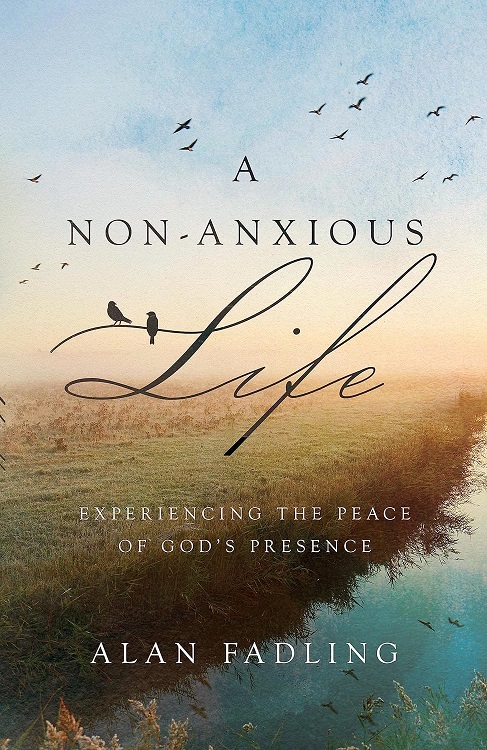
A Non-Anxious Life: Experiencing the Peace of God’s Presence by Alan Fadling seeks to provide readers with ways to manage anxiety through a Christian lens. There are some good points to be had throughout the book, but I also had significant difficulties with it.
Perhaps the biggest strength of the work is that it emphasizes how we can find comfort in God.
Perhaps my greatest reservation about the book is that it doesn’t have clear messaging. I didn’t see any clarity on the fact that anxiety is often a brain problem–a neurological issue–and this leads to some messaging that seems to make anxiety blameworthy on the individual. For example, early on in a chapter entitled “Anxiety isn’t for the birds,” Fadling writes, “Worry doesn’t help. It doesn’t improve anything. My worry is rooted in an unfortunate experiential blindness to the reality of God’s presence and God’s care in my present situation” (23). This is almost the exact opposite of what I’ve read with successful treatment or care for anxiety. Instead of noting how worry and anxiety are often rooted in patterns of brain activity which we’ve been taught, in trauma, and/or internalized from very young ages (at times), Fadling says that anxiety is “rooted in,” basically, not trusting God enough. This is sets readers up for a cycle of self-blame throughout the book. If, for example, some of the later practices for anxiety management don’t succeed, maybe that’s just the reader suffering “blindness to the reality of God’s presence.” We’re not trying hard enough, and if we just believed enough, we’d be okay. I think it is deeply problematic to set the stage in this fashion for the rest of the book.
Some of the practices Fadling includes do seem helpful, while others are too vague to be practically applied. A small section about “Transferring Our Cares to God” suggests that readers should seek humility or to be humble in times in which they are “try[ing] to take responsibility for what is God’s to care for” (37). Fadling says that one can instead “humbly trust God’s powerful care” in these moments, thus following a “way of humility” that leads us to recall that “God is not overwhelmed by the bad things to happen to us” and leave God to care for things we cannot manage (ibid). While I think this is a potentially useful practice, I was left wondering how to integrate it into any routine, especially given the stage-setting mentioned above. It seems to, again, punt the issue to just being something like trust God harder when you’re anxious, but how does that work?
The chapter on “Practicing Presence” is especially helpful as it focuses on spiritual practices such as focusing on the sense of presence with God–a nearly meditative concept. Fadling also notes how for Christians, peace can be envisioned as a person–Christ–and some ways this could be beneficial on reflection. As someone who has had therapy for anxiety, I found this to be perhaps the most helpful chapter.
One worrying thing throughout the book in addition to the problems noted above is how little emphasis (read: none) there is on things like therapy or research based perspectives on anxiety. This is evident time and again. Fadling notes at one point that “I probably won’t ever reach a point when anxious feelings do not arise in me” (76) but then the only resolution that’s offered to this is “trust Jesus harder” or “be more patient.” Fadling’s degree is an Master of Divinity–a degree many pastors achieve–but it’s not one that provides much training or certification in therapy. It makes me nervous how little any reference points are made to practical insights from trained professionals in that field, especially when paired with some of the problematic messaging I mentioned above.
A Non-Anxious Life has some practical use and tools, but I’m not sure I could endorse it given some of the issues I outlined above. It’s an intriguing attempt to integrate some useful tools for anxiety management from a Christian perspective, but I would recommend potential readers also seek research based therapy and answers.
All Links to Amazon are Affiliates links
Links
Be sure to check out the page for this site on Facebook and Twitter for discussion of posts, links to other pages of interest, random talk about theology/philosophy/apologetics/movies and more!
Book Reviews– There are plenty more book reviews to read! Read like crazy! (Scroll down for more, and click at bottom for even more!)
SDG.
——
The preceding post is the property of J.W. Wartick (apart from quotations, which are the property of their respective owners, and works of art as credited; images are often freely available to the public and J.W. Wartick makes no claims of owning rights to the images unless he makes that explicit) and should not be reproduced in part or in whole without the expressed consent of the author. All content on this site is the property of J.W. Wartick and is made available for individual and personal usage. If you cite from these documents, whether for personal or professional purposes, please give appropriate citation with both the name of the author (J.W. Wartick) and a link to the original URL. If you’d like to repost a post, you may do so, provided you show less than half of the original post on your own site and link to the original post for the rest. You must also appropriately cite the post as noted above. This blog is protected by Creative Commons licensing. By viewing any part of this site, you are agreeing to this usage policy.

 J.W. Wartick - Reconstructing Faith