atheism
Dying for Belief: An analysis of a confused objection to one of the evidences for the resurrection
 There is an objection to one of the evidences for the resurrection which is, frankly, terribly confused. I most recently ran into it on the discussion page for the radio show Unbelievable? Essentially, the objection goes like this: Christians say the fact that the disciples died for what they believe is evidence for its truth, but all kinds of religious people die for what they believe; are they all true?
The objector then often proceeds to note that some Muslims will die in suicide bombings due to their beliefs; they will note events like Thich Quang Duc burning himself to protest persecution; they will note other events in which religious people die for their beliefs. The implication, it is alleged, is that this cannot count for evidence for the truth of what they belief. People die for false things all the time; it doesn’t make what they believe true.
The objection seems compelling at first because it is, in fact, largely correct. The simple fact that people are willing to die for something does not make whatever they are wiling to die for true. However, this objection shows that the objector is badly misrepresenting the Christian apologetic argument.
The apologetic argument is intended to be used against those who would allege that the disciples made up or plotted for the notion of the resurrection for some reason. It therefore presents a major disanalogy with people of other faiths (or even later Christians) dying for what they believe. The major difference is that the Christian is claiming the disciples who went willingly to their deaths would have known what they were dying for is false, if it were.
Suppose you and a group of friends decided to make up a story to get some money. You decided that you were going to pretend that a buddy had died and risen again. You managed to set up circumstances in which your buddy appeared to die; then smuggled him off to Argentina–because that’s where everyone likes to hide, apparently. Later, you ran about the streets proclaiming that you’d seen your buddy walking around. He had been risen from the dead. And, you’d tell the story for the right price. To your delight, the story spreads like wildfire. But eventually it attracts attention of the wrong kind, and people are coming to kill you. Now, suppose that you could easily get out of it alive by simply confessing you’d made up the whole story. What would you do?
Alleged explanations for the evidence for the resurrection which appeal to purported conspiracies are much like this. The disciples would have known they were lying. Thus, the fact that they willingly went to their deaths does indeed count as evidence for the truth of what they were claiming. Otherwise, one would have to claim that these people quite seriously and willingly went to their deaths for something they knew was a lie they themselves had invented.
Thus, it is not enough for the objector to simply point out that other people die for faith not infrequently. That is not the core of the apologetic argument. Instead, they must argue for the implausible notion that the disciples willingly died for what they knew was a lie. It was not something they simply thought might be a lie; it would have been something that they were certain was false.
I do not think it is too far afield to suggest that the objection fails. It seems far more likely that they certainly believed what they professed were true, and they were in the unique position of knowing whether or not they were lying. Thus, the explanation of the resurrection is more credible than the explanation of a conspiracy. There are, of course, other attempts to explain away the historical argument for the resurrection, but those are arguments for a different time.
Links
Be sure to check out the page for this site on Facebook and Twitter for discussion of posts, links to other pages of interest, random talk about theology/philosophy/apologetics/movies and more!
SDG.
——
The preceding post is the property of J.W. Wartick (apart from quotations, which are the property of their respective owners, and works of art as credited; images are often freely available to the public and J.W. Wartick makes no claims of owning rights to the images unless he makes that explicit) and should not be reproduced in part or in whole without the expressed consent of the author. All content on this site is the property of J.W. Wartick and is made available for individual and personal usage. If you cite from these documents, whether for personal or professional purposes, please give appropriate citation with both the name of the author (J.W. Wartick) and a link to the original URL. If you’d like to repost a post, you may do so, provided you show less than half of the original post on your own site and link to the original post for the rest. You must also appropriately cite the post as noted above. This blog is protected by Creative Commons licensing. By viewing any part of this site, you are agreeing to this usage policy.
Book Review: “Hardwired: Finding the God You Already Know” by James Miller
 Irreverent. That’s how I would describe Hardwired
Illustrative was his comment early on in the work. Miller was approached by a mother who was heartbroken over her son leaving the faith. She asked him, “‘How do I convince him there is a God?'” Miller’s answer is indicative of his apologetic method: “He already believes in God.” This startling statement forms the basis for the rest of the book. Miller’s approach revolved around showing people the God they “already know.”
How might one justify this outlandish claim? First, Miller argued that human beings are not “blank slates”–that is, the human mind is in fact shaping that which it observes even as it observes it: “You and I, witnessing events through the same pair of glasses, would not know the same thing, because your brain and my brain do different things with the knowledge” (42). All knowledge is filtered through the preconceptions one has that sorts it into different levels of experience. Miller provided several reasons for thinking that the notion of our minds as blank slates is wrong (42-44; see also 58-61).
The notion that we are not “blank slates” also means that we filter ideas through a number of pre-existing categories. It also means that a wholly objective approach to discovering truth is impossible; we simply cannot step entirely outside of our presuppositions about reality. Moreover, human beings seem to have a shared experience of certain affirmations, even though some may attempt to deny them. For example, “we assume that our perceptions of the world… are accurate… We assume that there are real moral rights and wrongs… We assume that life has a purpose… We assume that there can be meaningful communication in which two people accurately share what they are thinking” (26). These assumptions are not uncontroversial; indeed, many have sought to deny any or all of them. Hardwired featured concise arguments for the fact of each of these notions.
Apart from these seemingly universal human experiences, Miller also argued that the very position of agnosticism is one which does not cohere with reality. Agnosticism is fundamentally a witholding of belief, but that is itself based upon a supposed ignorance of all the available data. He compared it to a court case regarding evidence: “People are only off the hook when they can show both that they didn’t know and that there was no way they could have known.” It is not enough to plead ignorance: “they are still guilty if they didn’t know because they avoided finding out” (55). The Bible clearly states that all people are capable of knowing God, and stand without excuse (Romans 1). “The onus is on honest agnostics to produce a pretty substantial bibliography of failed research” (56).
The fact of God’s existence may be found throughout reality, argued Miller. First, there is the reality of religious experience, but Miller prefers to view these as “epiphanies” which are “a sudden piercing discovery…” which may “draw our attention to things we’ve previously taken for granted or ignored” (69). Second, the existence of moral absolutes is a universal experience. However, this is not to be taken as a proof for God; rather Miller suggested that it means we have “inclinations that cannot be filled by anything but the exisence of God” (91). Even the atheistic moral objection to the God of the Bible assumes objective morality, because it assumes that they are capable of discerning real right and wrong (91-92). The very fact of valuation hints at the Creator (108-111).
The Christian faith gives compelling reasons to believe because its story matches and exceeds the criterion of embarrassment: its “hero,” Jesus, is scorned and shamed, not glorified and given rule over all nations (121ff).
The existence of God, Miller argued, is not tied to arguments or debates, rather, “What convicts us of the existence of God [are]… the soft, subjective facts of an experience that resonates with human longing and confirms are deep suspicions” (156). Hardwired is Miller’s attempt to point to those experiential factors.
By way of analysis, I first note that I think Miller has done an excellent job summarizing a number of extremely complex and difficult issues in ways that the “person on the street” could pick up the book and understand. He is concise and clear. Moreover, I sympathize in many ways with his approach. It seems to me to be true that humans cannot approach a topic as though we are “blank slates” ready to take whatever input we are given without layers of interpretation. That, I think, is the greatest strength of Miller’s approach. He pointed out the deeply seeded assumptions we hold which influence the way we view reality and showed how these lead to God.
However, I wonder about the coherence to Miller’s approach. His critique of natural theology does not sit well with his appeal to some of the very types of arguments that natural theologians use. For example, his appeal to objective morality is essentially no different from the defense provided for the “moral argument” by natural theologians like William Lane Craig, whose approach Miller criticizes. His presuppositional argument itself depends upon some forms of evidentialism (and here I am intentionally wording this to avoid being accused of being unaware of the fact that presuppositional apologists do use evidence–it is manifestly true that even the staunchest presuppositional apologist uses evidence… my point is that the method Miller uses is often evidentialist in its approach). Ultimately, readers will be left with what essentially amounts to an existentialist evidentialism, which seems itself to rely upon natural theology in a number of traceable ways.
Another difficulty I had with Hardwired is that it seemed Miller sometimes overstated his case. Perhaps the most obvious example of this, in my opinion, is his discussion of evolution. He discussed natural selection and sought to evaluate it by looking at humans: “[I]f natural selection actually works, a few million years should make for some pretty shiny, strong, effective gladiators who have good teeth and rarely catch cold… Specifically, there are some traits of humanity that should by all means have been weeded out by now: sleep (which makes people vulnerable to predators for a third of their lives)… endoskeletons, appendices, wisdom teeth, birth defects, stupidity, and obesity” (94).
I’m not about to dive into biology, which is by no means an area of my expertise, but it seems to me that none of these are required expectations given Neo-Darwinism. Miller’s critique does not take into account the fact that humans have worked using their intelligence to circumvent many of these difficulties (i.e. we live in shelters which keep us safe while sleeping; appendices still have function; etc, etc.). The critique offered here also seems shamelessly teleological, which is the very thing Neo-Darwinists would deny within their system.
Hardwired is a brief missive which applies presuppositional apologetics in a straightforward, easy-to-understand fashion. Miller doesn’t fall into using terminology that will be difficult for the uninitiated to understand. Instead, he provides a coherent beginning-to-end approach in how to argue for faith from his presuppositional approach. It is a commendable work for its simplicity, and despite the areas of disagreement I noted above, I certainly think it is worth a read. Miller has a way of answering the difficulties that people raise against Christianity in concise but convincing fashion. It’s a mixed bag, but one well worth the time spent.
Source
James W. Miller, Hardwired: Finding the God you Already Know (Nashville, TN: Abingdon Press, 2013).
Disclaimer
I received a copy of Hardwired free of charge for review. I was only asked to give an honest review of the book.
SDG.
——
The preceding post is the property of J.W. Wartick (apart from quotations, which are the property of their respective owners, and works of art as credited; images are often freely available to the public and J.W. Wartick makes no claims of owning rights to the images unless he makes that explicit) and should not be reproduced in part or in whole without the expressed consent of the author. All content on this site is the property of J.W. Wartick and is made available for individual and personal usage. If you cite from these documents, whether for personal or professional purposes, please give appropriate citation with both the name of the author (J.W. Wartick) and a link to the original URL. If you’d like to repost a post, you may do so, provided you show less than half of the original post on your own site and link to the original post for the rest. You must also appropriately cite the post as noted above. This blog is protected by Creative Commons licensing. By viewing any part of this site, you are agreeing to this usage policy.
Really Recommended Posts 11/8/13- The Emerging Church, Bible translations, and atheism, oh my!
 Creating Atheists: Made, Not Born– Peter Boghossian’s new book, A Manual for Creating Atheists, has caused a stir. Here, Tom Gilson turns his evaluation to the notion that atheists are made as opposed to born, which is implicitly suggested by the title of Boghossian’s book. It is well worth a read, so check it out.
What your preferred Bible translation says about you– Read it all the way to the end… a very powerful piece about Bible translations and our perceptions.
The Emerging Church– There has been a lot of talk about the “Emergent Church” movement, but it is extraordinarily hard to pin down what is meant by this terminology. Moreover, what–if anything–unites this movement’s thought? D.A. Carson provides some helpful background and a number of great talking points regarding the movement. Although he sometimes over-generalizes, I think, this will give you good insight into what to look for and what to discuss with those wondering about or in the “Emerging Church.”
Hugh Ross vs Danny Faulkner- How Old is the Universe? [Video]- An extremely lengthy video debate between the old earth creationist Hugh Ross and a young earth creationist, Danny Faulkner. If you’re interested in this issue, this will be a very thought-provoking video for you. Be aware that it is over 5 hours long, so you may want to watch it in segments!
Sensus Divinitatis– A brief post which surveys the history of Christian thought on the notion that human beings have a built-in sense of the existence or presence of the divine.
Back-Alley Abortions, Apologetics, Male Hierarchy, and more! – Really Recommended Posts 10/18/13
 I have given you, dear reader, this edition of “Really Recommended Posts” which is simply bulging at the seams with great content. Herein, you shall discover the myth of the back alley abortion, an analysis of male rule, sociology and religion’s impact on society, Augustine and the creation/evolution debate, and more! Check ’em out. Let me know what you think!
Is Male Rule a Biblical Ideal?– Here, Mimi Haddad confronts some of the common arguments for male rule in the church and home. These arguments include the fact that Jesus was male, that the 12 disciples were male, etc.
Sociologist Rodney Stark discusses whether religion is good for society– A highly interesting post in which a sociologist takes on claims that religion could be bad for society. Looking into the actual statistics and facts of the matter makes an extraordinary difference to one’s perception.
Pro-Choice “Facts”: Illegal Abortion Deaths– One of the very common arguments for abortion is that we need to keep such things safe. After all, if women will get abortions anyway, we should try to keep them safe. This article examines the myth of the back-alley abortion and exposes it for what it is: a fraud.
The dangers of apologetics– My wife linked me to this article which I think makes some extremely valuable points regarding the nature and practice of apologetics. I particularly liked that the author did not throw apologetics out the window but rather offered pieces of advice for apologists and what to avoid as an apologist. What are your thoughts?
Augustine’s Origin of Species– Within the creation/evolution debate, many continue to allege that one cannot consistently be a Christian and hold to certain views of the age of the universe or the origin of species. Here, Alister McGrath analyzes these claims alongside the wonderful Christian theologian, Augustine.
Signs that the New Atheist Movement May be Collapsing– A post which examines the intellectual collapse of the New Atheism. I think the most fascinating point is the third, that New Atheists are suppressing intellectual dialogue.
John Loftus Exits in Infamy– Speaking of the New Atheists, David Marshall analyzes his own recent dialogue with John Loftus, a[n] [in]famous atheist. The way the dialogue proceeded is highly telling.
Really Recommended Posts 10/11/13- Worldview, Wilberforce, and World [Religions]! Plus some more!
Dear readers, this week I stumbled across a collection of posts I had prepared some months ago for your reading, but had forgotten to actually share! I have now rectified that error by placing the following posts before you for your reading pleasure. Check ’em out, and as always, leave a comment to let me know what you thought!
Dallas Willard – The Nature and Necessity of Worldviews (Video)– An hour-long presentation by the late Dallas Willard on worldviews. He provides some good insights into what makes up a worldview and the applications thereof.
William Wilberforce, Hannah More, and Their Legacy in Public Education– A wonderful but brief historical post reflecting on the impact of Wilberforce and the More sisters upon education today. Christian lives lived.
C.S. Lewis: A Life, by Alister McGrath – Book Review– I haven’t hard the opportunity to read this biography by Alister McGrath, but this review at least quenched some of my thirst by providing a great overview and discussion of the work.
Listening to Young Atheists: Lessons for a Stronger Christianity– What are young atheists saying? Whatever it is they are telling us about religion is quite instructive, because it allows Christians to shore up their defenses and counter the distortions atheists have about Christianity. Most importantly, it seems that Christians are viewed as insincere and unconcerned with the way their beliefs should inform their lives. Read this post and get some valuable takeaways.
Allah is not Jehovah– I found this post to be remarkably insightful. There are some who have been trying to synthesize Christianity and Islam. The fact is that these two faiths are mutually contradictory on a number of points. This post by the “Valley Girl Apologist” outlines 21 major differences between Islam and Christianity.
Guest Post: “The Presumption of Popular Atheism” by David Glass
David Glass is the author of Atheism’s New Clothes: Exploring and Exposing the Claims of the New Atheists
 In the New Atheism and related forms of popular atheism belief in God is frequently ridiculed and dismissed without any serious consideration of the arguments. Underlying this mindset is the belief that there is a quick-and-easy argument against belief in God and that as a consequence there is no need to take theism seriously. The argument is this: in the absence of evidence for God’s existence it is much more rational to disbelieve in God than it is to believe or to adopt a neutral stance. In his book The God Delusion, Richard Dawkins makes this point by drawing on a story by Bertrand Russell. He asks us to consider how we would respond to someone who claimed that there is a teapot orbiting the sun somewhere between Earth and Mars, but which is too small to be detected by any telescope. Just because there is no way of proving that it does not exist, it does not mean that we should adopt the view that there is a 50:50 chance that it does exist. Since there is no evidence for its existence, we should believe that it does not exist or, more strictly, that its existence is very improbable. By analogy, he claims that the same applies to God.
This is a version of the presumption of atheism, the idea that the burden of proof lies with the theist to show that God exists rather than with the atheist to show that he does not. It’s important to distinguish the presumption of atheism from the claim that there is no evidence for the existence of God. In popular atheism, the two notions tend to go together with the latter point often taken for granted, but it is entirely possible to be a theist and yet embrace the presumption of atheism. Such a theist would accept the burden of proof, but claim that the burden can be met as there is plenty of evidence for God. Interestingly, it seems that the late Antony Flew, who was probably the leading advocate of the presumption of atheism in the twentieth century, eventually gave up his atheism because of the evidence for the existence of God. He still maintained, however, that the presumption of atheism was the right starting point; it’s just that the evidence for God was too convincing to ignore.
So one problem with the New Atheist approach to the presumption of atheism – what we might call the presumption of popular atheism – is that it presupposes that there is no evidence for God just as there is none for Russell’s celestial teapot. No doubt the New Atheists would claim that they have considered all the purported evidence and arguments for the existence of God, but their discussions of these topics leave a lot to be desired and are generally considered to be the weakest part of their attack on religious belief. Furthermore, their approach to the presumption of atheism seems to distort their views on what would constitute evidence for God. To take one example, does the fine-tuning of physical constants and other features of the universe constitute evidence for God? Dawkins is not impressed with the anthropic principle response to fine-tuning, the idea that we shouldn’t be surprised by the fine-tuning because we wouldn’t be here to talk about it in the absence of fine-tuning. For Dawkins, an explanation is required and so he appeals to a multiverse, the idea that our universe is only one of many. He doesn’t seem overly impressed with multiverse explanations of fine-tuning either, but he finds them preferable to design. Why? Because God is so improbable that he cannot be considered as an explanation for fine-tuning.
Notice the logic of the argument. Dawkins believes he has a good reason for adopting the presumption of atheism and hence assigning a very low probability to God. (We’ll come back to his argument for this in a moment.) He then uses this same belief to justify ruling God out as an explanation for fine-tuning and so he rejects the idea that fine-tuning can provide evidence for God.[1] In other words, his views about the presumption of atheism have determined whether fine-tuning constitutes evidence for God.
Setting aside the problems with the New Atheists’ hasty dismissal of evidence for God, what about the presumption of atheism itself? Let’s take the analogy between God and the celestial teapot. Clearly, God is not like a teapot orbiting the sun! The teapot would be just another object in the universe, admittedly a very odd one, but it would not help us to make sense of anything else. By contrast, as the Creator of the universe, God would be the most important being to exist. God would provide the ultimate reason for the universe itself, for the order within it and for our existence. As Dawkins himself points out:
a universe with a supernaturally intelligent creator is a very different kind of universe from one without. The difference between the two hypothetical universes could hardly be more fundamental in principle, even if it is not easy to test in practice.[2]
The same could hardly be said for a teapot! For this reason, the hypothesis of theism cannot be dismissed in the same way as the hypothesis of the celestial teapot.
Dawkins does not merely appeal to an analogy with the celestial teapot, but provides an argument based on organized complexity to support his contention that God’s existence is highly improbable. Unfortunately for Dawkins, this argument fails for multiple reasons, the most obvious of which is that there is no good reason to think that God would possess the kind of organized complexity required for Dawkins’ argument to work.[3]
So Dawkins and the other New Atheists have given us no good reason to embrace the presumption of atheism. And they can’t expect the rest of us to embrace it just because it is intuitively appealing to them. As atheists have generally recognized, there can be no presumption of the presumption of atheism. If it is to be embraced, a good reason is needed yet none has been provided.
In summary, the idea in popular atheism that there is an easy way to dismiss belief in God based on a presumption of atheism and the claim that there is no evidence for God does not stand up to scrutiny. If the case for God’s existence is to be evaluated seriously, presumptions and analogies with teapots are not much help.
[1] I’ll set aside the question of whether there are other good responses to fine-tuning. Here I’m only concerned with the logic of Dawkins’ argument. Interestingly, even in the context of biology, he makes use of this dubious argument.
[2] Richard Dawkins, The God Delusion (London: Bantam, 2006), p. 58.
[3] See chap. 6 of Atheism’s New Clothes. See also http://www.saintsandsceptics.org/theres-probably-no-god-a-response-to-richard-dawkins/
“The Rocks Don’t Lie” by David Montgomery: Preface and Chapter 1
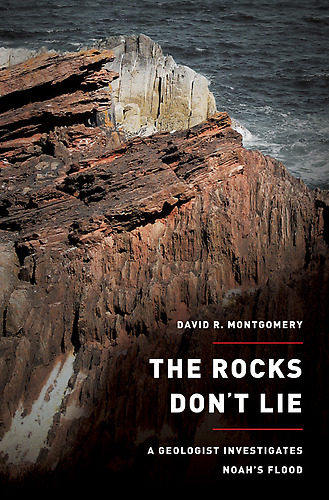 I recently finished reading the Christian geologist Davis Young’s The Biblical Flood

It didn’t take long before I had decided that I would go through this one on an extended basis (sometimes lumping more than one chapter together) similar to how I reviewed Rob Bell’s work Love Wins. The reason is because I think the work has much to inform both Christian and atheist alike, while it also has some problems I would like to discuss as I go along.
I have not finished the book, but am rather writing these reviews as I read the chapters, so each one is fresh. Check out the end of the post for links to the other chapters as well as other related posts.
Outline
Preface
David Montgomery states that his purpose in writing the book was initially “to present a straightforward refutation of creationism, the belief that the world is a few thousand years old and that all the world’s topography… was formed by the biblical Flood.” However, he came to “a different story about the nature of faith” once he began researching the topic: “…I thought I’d find the standard conflict between reason and faith. Instead, I found a much richer story of people struggling to explain the world–and our place in it” (xii).
Essentially, he discovered that there was a complex interrelationship between science and theology which has played out in vastly different ways over time.
Chapter 1
Montgomery begins the book by telling a story of how he discovered evidence for a local flood in Tibet. He observed various geological features and came to believe that a lake had once covered the land. He suspected that such a feature in memorable history would yield an oral tradition and was rewarded with a story of a flood in the area (2-7). He asserts that “People around the world tell stories to explain distinctive landforms and geological phenomena” (7).
These stories are often dismissed as “relic[s] of another time,” but he believes that they may have an element of truth: “For most of our history as a species, oral traditions were the only way to preserve knowledge. So why wouldn’t the world’s flood stories record actual ancient disasters” (8-9). He notes that the story of Noah’s Flood may perhaps be among these stories, and hints that there could be truth to the biblical tale (9).
When science has come to interact with evidence which may hint at explanations for Noah’s Flood, certain forms of Christianity (here he uses “creationist” as he defined it in the preface) are “outraged” due to the preconceived notion that the Flood must have been global and account for all geologic history.
Yet the Flood has had a positive influence on geology by providing an early hypothesis to be tested once geology had progressed as a science (11-12). Theology and geology played off each other in a complex way which has spawned various factions of belief over the use of that evidence in theology (12-14).
Analysis
Preface
David Montgomery presents his case in a very winsome manner. I cannot help but be pleased by the way he has begun his interaction with science and faith issues. Rather than ranting over the alleged war between science and faith (something he admits he was expecting), he discovered a different story of a complex relationship which has often been mutually beneficial. Would that all atheists–and yes, it is worth saying, theists–interacted with other views in such a generous manner.
Chapter 1
Montgomery has provided a number of interesting insights already, particularly in regards to the fact that the relationship between science and faith is multifaceted and not as one-dimensional as many often portray it.
It is unfortunate, I think, that his own faith was seemingly built upon very poor theology. He writes, “In Sunday school I learned that Bible stories were parables to be read more for their moral message than their literal words. The story of Noah’s Flood taught mankind to be stewards of the environment… Growing up, I was satisfied that Jesus taught how to live a good life and that science revealed how the world worked” (9-10). Here we see how an anemic theology cannot be sustained. Christianity is picture that is much fuller than a mere “moral message” or “how to live a good life.” If only someone had taught that in Sunday school instead!
If the book continues in this fashion, I will have no qualms about recommending it. Tune in next week to continue the series!
Links
Like this page on Facebook: J.W. Wartick – “Always Have a Reason”
Check out my review of a similar work by a Christian: The Biblical Flood. I think this book is vastly important and should be in every Christian’s library.
Be sure to browse my extensive writings on the “Origins Debate” over creationism, theistic evolutionism, and intelligent design (among other views) in Christianity.
Source: David Montgomery, The Rocks Don’t Lie
SDG.
——
The preceding post is the property of J.W. Wartick (apart from citations, which are the property of their respective owners, and works of art as credited) and should not be reproduced in part or in whole without the expressed consent of the author. All content on this site is the property of J.W. Wartick and is made available for individual and personal usage. If you cite from these documents, whether for personal or professional purposes, please give appropriate citation with both the name of the author (J.W. Wartick) and a link to the original URL. If you’d like to repost a post, you may do so, provided you show less than half of the original post on your own site and link to the original post for the rest. You must also appropriately cite the post as noted above. This blog is protected by Creative Commons licensing. By viewing any part of this site, you are agreeing to this usage policy.
William Paley (1743-1805) – Historical Apologist Spotlight
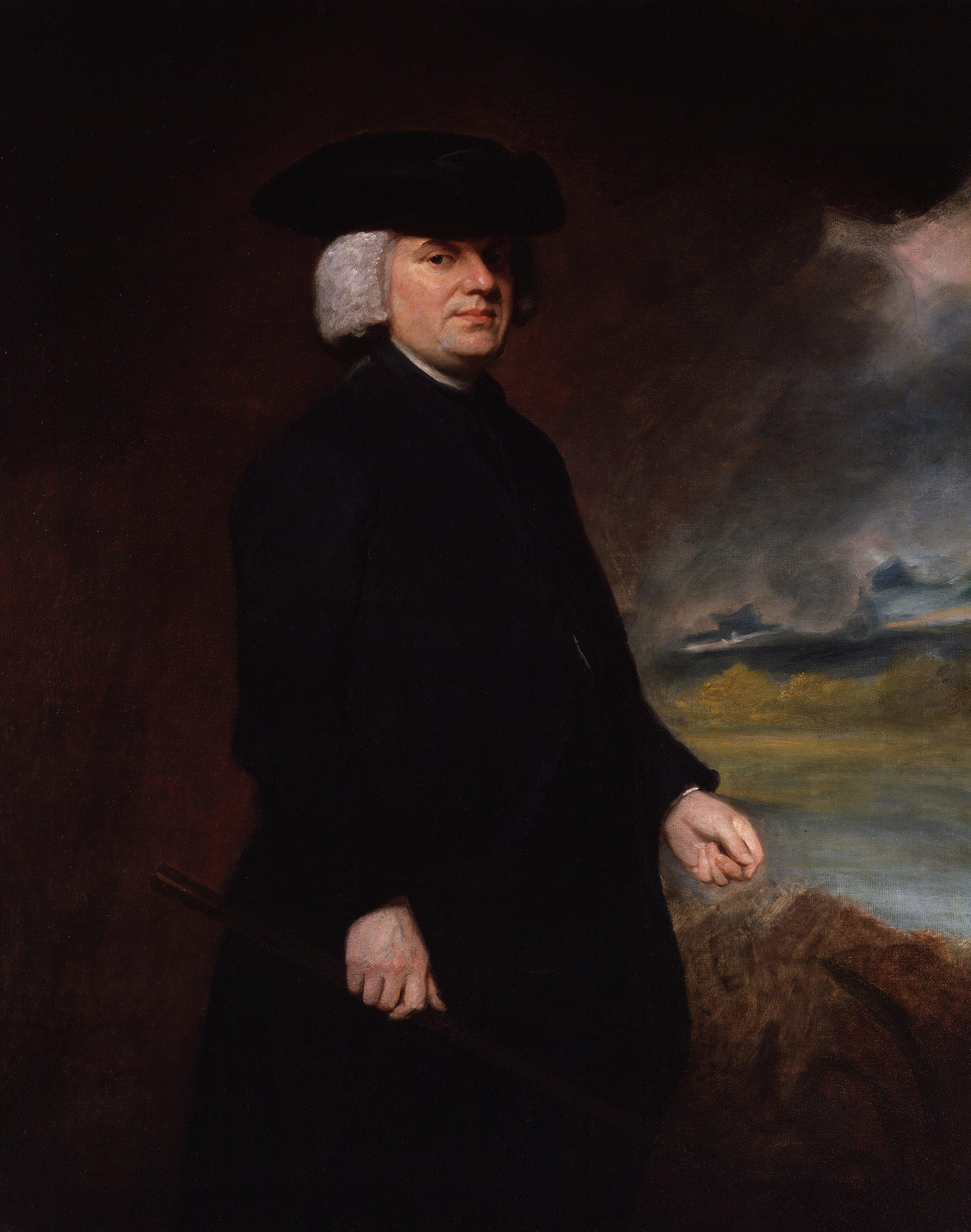 William Paley (1743-1805) is a name which echoes through history. His Natural Theology

Brief Biographical Note*
Paley went to school at Christ’s College and Cambridge. At the latter, he was awarded multiple times for his scholarship. He eventually became the Senior Dean at Christ’s College and was awarded a Doctorate of Divinity from Cambridge. Bishop Barrington of Durham granted him the rectory of Bishop Wearmouth. His life was strewn with accomplishments.
He was a utilitarian with deep Christian convictions. Throughout his life, he remained controversial. His utilitarianism was condemned, as was his critique of the often extreme defenses of property ownership. His anti-slavery was unpopular alongside his support of the American Colonies in the Revolutionary War.
The powerful nature of Paley’s works is revealed in the fact that his major work on utilitarianism, The Principles of Moral and Political Philosophy, became mandatory reading at Cambridge. His Natural Theology continues to be discussed in courses on philosophy of religion. The man was acclaimed by some within the church, who praised his defense of the faith despite others’ objections to his metaethical views.
His contributions to Christian apologetics are the focus of this piece, and we shall turn to them now.
Natural Theology
Paley’s most famous work nowadays is undoubtedly Natural Theology. In this work, he makes his well-known case for the design argument. He utilizes the analogy of a watch. If one finds a watch on a beach, one knows instantly that someone made the watch. Paley applied this same notion to life; one sees the sheer complexity and life and can infer that it, like the watch, was designed.
Many have dismissed Paley’s work here, noting that at points he relies on scientific explanations which have been discredited, while at others his examples have been explained. Yet the genius of his work is found in broader principles, which moderns should note. First, he argued that simply never having observed design in action on a biological level does not preclude any possibility of arguing for that same design (Natural Theology, 8, cited below). Second, evidence of things “going wrong” within a design does not invalidate the design of an object in and of itself. Third, higher level natural laws which may lead to order does not explain away the order itself. Fourth, when something appears to be designed, the burden of proof is upon those who assert an object is not designed.
These points seem to me to hold true to this day. I am sure none of them are uncontroversial, but Paley places his defense of this points squarely within his analysis of those artifacts which he considers to be designed (i.e. the eye and ear). A full treatment of these points thus must turn to his own arguments, but for now I would provide the following brief defenses. Regarding the first, this point seems obvious. If I have never seen someone construct a car, that does not in any way mean that I cannot conclude that someone had to have made it. The second point should be well taken within the context of the debate between Intelligent Design and Darwinian forms of evolution. The point is that simply pointing out a flaw in a design does not mean an entire object is undesigned. The third item seems correct because if something exhibits order, and that order is shown to be based around an ordering principle, the very order in and of itself has not been explained; instead, it is only the mechanism for generating that order which is observed. Finally, the fourth point is likely to be the most controversial–after all, appearances may deceive. Yet it does seem to be the case that if, a priori, something appears designed, then to conclude that something is not designed one must have defeating evidence for this appearance.
A View of the Evidences of Christianity
Paley’s Evidences (commonly known as “Evidences of Christianity”) became almost instantly famous. The work generated a number of summaries and expositions by other authors who were delighted with its style and the arguments contained therein. It is easy to see why, once one has begun a read through this apologetic treatise. Paley presents a number of arguments in favor of the Christian worldview. These evidences are largely historical in nature and include the suffering of those who spread Christianity as evidence for its truth, extrabiblical evidence for the truth of the Gospels, the authenticity of our Gospel accounts due to the early practices and beliefs of Christians, undesigned coincidences, and many more. Paley also provides a dismantling of David Hume’s argument against miracles.
It seems to me that any and all of these arguments retain the force they had in Paley’s own day. Consider the argument from the suffering of Christians. Well of course those of other faiths are willing to even die for that which they believe is true. But Paley rightly pointed out a huge difference between those of other faiths dying for their beliefs and the early eyewitnesses of the events surrounding Christ dying for their own beliefs. Namely, these people would know for certain whether that which they believed were true. That is, they either saw the resurrected Christ or they did not. If they did not, then explaining their willingness to die for this profession of faith becomes extremely difficult. However, if they did actually see that which they declared, their willingness to suffer unto death for this belief makes perfect sense. Many miss this important distinction even to this day. The rest of Paley’s arguments found in the Evidences is filled with insights similar to this.
Horae Paulinae
An argument which has largely been neglected within modern apologetic circles is that of “undesigned coincidences.” I have made an exposition of this argument already, and it should be noted that the best places to discover it are in the realm of historical apologetics. William Paley dedicated this work, Horae Paulinae
Now, the argument from undesigned coincidences takes quite a bit of work to properly outline. It is, in essence, a matter of looking through the Scriptures and finding how incidental details in one account fill in the blanks of another account. However, this description is so brief as to be simplistic. Paley himself acknowledged a number of the difficulties with describing undesigned coincidences in this way. Regarding the Pauline corpus, for example, it could be that someone invented letters from Paul but based them upon his history found in Acts. But the argument itself takes this into account and generally serves as a defeater for this notion by sheer weight of evidence. That is, the more coincidences are found, the more credulity is stretched if one wishes to assert forgery.
Paley buries the objections to undesigned coincidences in this fashion throughout the Horae Paulinae. The sheer volume of coincidences he finds, and the way they seem so clearly to be incidental, serves to dispel doubts about their genuine nature.
Other Works
Here, we have surveyed Paley’s major works, but he was a prolific writer who published sermons and of course his (in)famous work on utlitarian ethics. The preeminence of Paley as a scholar and writer is unquestionable. It is time we acknowledge how much we have to learn from those who have come before us.
Conclusion
We have seen the diverse array of arguments which Paley offered in favor of Christianity. These ranged from biological design arguments to undesigned coincidences to historical arguments in favor of the Gospels. Paley was a masterful writer whose arguments continue to influence apologists and draw ire from atheists to this day. Although the arguments have not been unscathed, I have offered a few reasons to reconsider some which have long been dismissed or forgotten. Paley’s influence endures.
I would like to dedicate this post to Tim McGrew, who introduced me to the vast field of historical apologetics. Without his bubbling delight and enthusiasm in the field, I would never have known much–if anything–about people like Paley. It is my hope and prayer that you may also be persuaded to pursue historical apologetists/apologetics. Be sure to check the links for some good starting places.
Be sure to check out the links at the end of this post as well as the resources from Paley.
Links
Like this page on Facebook: J.W. Wartick – “Always Have a Reason.” I often ask questions for readers and give links related to interests on this site.
Library of Historical Apologetics– Here is where I got started, with Tim McGrew’s phenomenal collection of works. In particular, the “annotated bibliography” will set you up with some fine works. The site features a “spotlight” on the main page for various fantastic reads. Browse and download at will. Also check out their Facebook page.
On the Shoulders of Giants: Rediscovering the lost defenses of Christianity– I provide a number of links as well as an annotated list of historical apologetics works which are great jumping off points for learning more about the vast array of arguments which have largely been forgotten within the realm of apologetic argument. I consider this one of the most important posts on this site.
Forgotten Arguments for Christianity: Undesigned Coincidences- The argument stated– Here I outline the argument from undesigned coincidences and explain how it can be used within apologetics.
Sources
William Paley, Evidences of Christianity
—-, Natural Theology (Oxford World’s Classics)
—-, Horae Paulinae
*I am indebted to the discussion of Paley’s life found in the introduction of the Oxford Classic’s edition of Paley’s Natural Theology, which I have cited above.
SDG.
——
The preceding post is the property of J.W. Wartick (apart from citations, which are the property of their respective owners, and works of art as credited) and should not be reproduced in part or in whole without the expressed consent of the author. All content on this site is the property of J.W. Wartick and is made available for individual and personal usage. If you cite from these documents, whether for personal or professional purposes, please give appropriate citation with both the name of the author (J.W. Wartick) and a link to the original URL. If you’d like to repost a post, you may do so, provided you show less than half of the original post on your own site and link to the original post for the rest. You must also appropriately cite the post as noted above. This blog is protected by Creative Commons licensing. By viewing any part of this site, you are agreeing to this usage policy.
Debate Review: Fazale Rana vs. Michael Ruse on “The Origin of Life: Evolution vs. Design”
 Fazale Rana recently debated Michael Ruse on the topic of the origin of life. Essentially, the question of the debate was whether the origin of life is best explained by naturalism or design. Here, I will provide brief comments on the debate.
Please note I make no claims to being a scientist and I am fully aware that I evaluate this debate as a lay person.
Michael Ruse Opening
Michael Ruse was careful to note that he is not keen on saying design is not possible. Rather, his claim is that naturalism is the most plausible explanation for the origins of life.
Ruse’s argued that design is implausible. Specifically, he noted that if design is the hypothesis put forward, there are any number of ways that one might consider that hypothesis. Is the designer a natural being within the universe or a supernatural being like God? Is there only one designer, or was there a group of designers (and he notes that a group of designers seems more plausible because automobiles require many designers to bring them about)? Finally, he raised the issue of bad design choices. He asked why, if there were a “hands-on” designer, would that designer not grant immunity to HIV and the like.
Ruse also argued that one can fall into the fallacy of selective attention- if one focuses upon only one example in isolation, then one might come to a conclusion that certain laws/theories may not be correct. But placing these same problems in context shows that they can be explained against “the background of our knowledge.”
Finally, Ruse ended with a number of examples for how problems which were seemingly insoluble were explained by naturalistic means. He also argued that one of the popular arguments for design, the flagellum, has so many different varieties (and is sometimes found to be a vestigial organ), and so cannot be shown to be designed.
Fazale Rana Opening
The problems which must be accounted for within an origins of life model are numerous. One must account for self-replication, the emergence of metabolism, the formation of protocells, the synthesis of prebiotic materials, the formation of life’s building blocks, and more.
Rana then turned to some primary models used by researchers to explain origin of life (hereafter OOL). First, there was the replicator-first model, which was problematic because in order for a molecule to be a self-replicator, it must be a homopolymer. But the complexity of the chemical environment on early earth rendered the generation of a homopolymer on the early earth essentially impossible. Next, the metabolism-first model runs into problem due to the chemical networks which have to be in place for metabolism. But the mineral surfaces proposed for the catalytic systems for these proto-metabolic systems cannot serve as such; Leslie Orgel held that this would have to be a “near miracle” and Rana argues that it is virtually impossible. Finally, the membrane-first model requires different steps with exacting conditions such that the model is self-defeating.
Rana argued positively that OOL requires an intelligent agent in order to occur. The reason is because the only way that any of these models can be generated is through the work on OOL in a lab. Thus, they can only be shown to be proof-of-principle and the chemistry breaks down when applied to the early earth. The fact that information is found in the cell is another evidence Rana presented for design. The systems found in enzymes with DNA function as, effectively, Turing machines. Moreover, the way that DNA finds and eliminates mistakes is machine-like as well. The fact that the needed component for success in lab experiments was intelligence hinted, according to Rana, at positive evidence for design.
Finally, Rana argued that due to the “fundamental intractable problems” with naturalistic models for the OOL and the fact that the conditions needed for the OOL and the processes required to bring it about have only been demonstrated as in-principle possible with intelligent agents manipulating the process.
First Cross Examination
At this point, Ruse and Rana engaged in a dialogue. Ruse first challenged Rana to show how the OOL model based on design could actually be based upon Genesis, as he quoted from Rana’s book (written with Hugh Ross), Origins of Life. He pointed out a few difficulties with using the Genesis account in this manner. Rana answered by putting forth his view of the Genesis account as an account of the origins of life on earth–a view which sees the Genesis account as corresponding with the scientific account (concordism). Yet the Genesis account is itself written from the perspective of a hypothetical observer found on the face of the earth rather than a perspective above the earth.
Rana asked Ruse for his thoughts on how much impact philosophy has on the debate over the OOL. He noted that it may be a presupposition of naturalism which lends itself to interpreting the OOL. Ruse answered by saying it is a good point and that philosophy cannot be denied a role in the discussion. But the question is not simply one of “gut commitments” and that one has to also take into account the scientific evidence and a “pragmatic reason” for holding to naturalism: naturalism works. It continually explains problems, even if it takes time.
Ruse Rebuttal
The difficulty with the OOL debate is that it is too easy to take things out of context in order to show how many problems there are with a model. He argued that it is “peculiar” to take the results of a group of researchers and yet somehow go “flatly” against the “overall interpretation that each and every one of these people” would have taken from the research.
Despite all the difficulties, Ruse argued, researchers are starting, slowly, to get some view of how to explain the OOL. He pointed to some successes within the OOL sciences to show how eventually we may discover a naturalistic explanation.
Rana Rebuttal
Rana began with the notion of a creation model. He argued that models are not always drawn from the data, but rather models and theories are constructed from a number of different points.
Regarding the science itself, Rana noted that there is no established source of prebiotic materials on the early earth. The popular theories for how these materials might be generated fail for a number of reasons.
The argument, Rana said, is not a god-of-the-gaps argument. Instead, it is an observation of the breadth of scientific evidence which shows that in-principle experiments have been successful, but when applied to the scenarios for the early earth, the only way for success to be achieved is through intelligent agency (scientists in a lab manipulating the conditions).
 Second Cross Examination
Rana asked Ruse to respond to the notion that OOL research is similar to literary criticism in that all the different theories continue to be debated but none have come into dominance or can be established over the others. Ruse responded by noting that OOL research does have some “just so” stories but that science has taken seriously the criticisms and come towards the possibility of answering some of the questions.
Ruse asked why God would not intervene for things like cancer. Rana answered by noting that in the broad scope of a model with intelligent agency, poor design is no problem. But because Rana believes it is the God of the Bible, he says it may be a legitimate criticism of the design position. However, things which appear to be bad designs can turn out later to have some reason for the way they are used. Moreover, once a creator has put in place designs, they are subjected to the laws of nature and so they could become decayed or break down.
Ruse Closing Argument
Ruse argued that when one takes a “Biblical position” one is “not doing science any more.” If one wants to assert that the science points to miracles, then Ruse said he would argue that the nature of our experience is not “blank” in relation to the OOL, but rather that the previous successes of naturalism means we should fall back upon naturalism regarding the OOL because it has worked in so many other areas. Thus, the problem with the OOL is not with the problems themselves but rather with our own ability to solve the problems.
Rana Closing Argument
The OOL and complexity of the cell require an intelligent agency in order to account for the OOL on earth, Rana maintaned. The problems with naturalistic accounts appear to be intractable, and the role of intelligent agency in lab work cannot be ignored because that same agency is what leads to the allegedly naturalistic successes. The information found in biological systems also give evidence for design.
Finally, methodological naturalism turns science into a game to be played in which the goal is always to find a naturalistic explanation, even if none is forthcoming. Instead, science should be, in practice, open to the possibility of agency within the natural world. Ruse’s argument is essentially an appeal to the future in which the notion is just that one day the answers will come forth.
Analysis
First, I would note how pleased I was with the nature of this dialogue. Unlike some other debates, Ruse and Rana were largely cordial and even amiable towards each other. It is clear that they each had respect for the other’s work and arguments.
The debate itself was very interesting. Fazale Rana continually went back to the science and pointed out the difficulties which remained, while Ruse seemed to continually appeal to the overall success of the naturalistic paradigm. Regarding Ruse’s position, I think it was perhaps disingenuous to conflate naturalism with science, particularly considering that very point was largely at the center of the debate. Is it indeed the case that we must be methodological naturalists? It seems that even Ruse agreed that our answer to this question will largely shape one’s interpretation of the problems and reactions to the problems brought up.
Regarding the science itself: Ruse brought up several successes which scientific research has yielded, but it seemed clear that none of these offered evidence which countered Rana’s arguments of the intractable problems for the OOL. Rana did an excellent job showing how the models which are in vogue right now for the OOL all fail on a number of levels to account naturalistically for the OOL.
Moreover, the fact that current research does rotate around the actions of intelligent agents. Given that such intelligent agents are necessary to bring about even the in-principle results for the OOL, it seems that Rana’s argument that this hints at an intelligent agent in the overall OOL schema was largely successful. It seems to me to count as positive evidence for design.
Overall, I have to say this was a great debate. I think one’s conclusions regarding the outcome of the debate largely will come down to a matter of worldview.
Links
Be sure to check out my extensive writings on the origins debate within Christianity.
The debate can be found here. It is worth a watch/listen due to the complexity of the issues involved. Or you could just watch it here:
Be sure to check out the Reasons to Believe web site, which is the organization Fazale Rana is part of.
SDG.
——
The preceding post is the property of J.W. Wartick (apart from citations, which are the property of their respective owners, and works of art as credited) and should not be reproduced in part or in whole without the expressed consent of the author. All content on this site is the property of J.W. Wartick and is made available for individual and personal usage. If you cite from these documents, whether for personal or professional purposes, please give appropriate citation with both the name of the author (J.W. Wartick) and a link to the original URL. If you’d like to repost a post, you may do so, provided you show less than half of the original post on your own site and link to the original post for the rest. You must also appropriately cite the post as noted above. This blog is protected by Creative Commons licensing. By viewing any part of this site, you are agreeing to this usage policy.
Book Review: “Inerrancy and Worldview” by Vern Sheridan Poythress
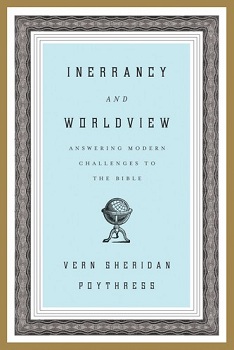 Vern Sheridan Poythress approaches the defense of the truth of the Bible in a unique way in his recently-released duo of books, Inerrancy and Worldview

Overview
Poythress has set Inerrancy and Worldview
That is the central thesis of the book: our preconceived notions shape how we will view the Bible. Poythress writes:
Part of the challenge in searching for the truth is that we all do so against the background of assumptions about truth. (21)
Thus, it is critical to recognize that one’s presuppositions will in some ways guide how they view the Bible.
Poythress then introduces the materialistic worldview as the primary presupposition for the Western world which sets itself up against a Biblical worldview. The essential point here is that the world is a very different place if primary causes are personal or impersonal.
From here, Poythress dives into the various challenges which are set up against the Bible. First, he looks at modern science. The major challenges here are the Genesis account of creation, which he argues is explained by God making a “mature creation” where the world appears aged (41) and other alleged scientific discrepancies, which he argues are due to God’s condescending to use human expressions to explain the concepts in the Bible (38-39).
What of historical criticism? Again, worldview is at the center. If God exists, then history inevitably leads where God wills it. If, however, one assumes the Bible is merely human, then it is unsurprising to see the conclusions which historical critics allege about the text.
Challenges from religious language are dealt with in the same fashion. On a theistic worldview, God is present “everywhere” including in “the structures of language that he gives us.” Thus, we should expect language to refer to God in meaningful ways (101). Only if one assumes this is false at the outset does one come to the conclusion that language cannot possibly refer to God (ibid).
Sociology, psychology, and ordinary life receive similar treatments. The point which continues to be pressed is that ideologies which reject God at the outset will, of course, reject God in the conclusions.
Analysis
Inerrancy and Worldview was a mixed read for me. Poythress at times does an excellent job explaining points of presuppositional apologetics, but at others he seems to be floundering in the vastness of the topics he has chosen to discuss.
There are many good points Poythress makes. Most importantly is his focus on the concept of one’s worldview as the primary challenge to Biblical authority. It seems to me that this is the most important thing to consider in any discussion of inerrancy. If theism is true, inerrancy is at least broadly possible. If theism is false, then inerrancy seems to be prima facie impossible.
The continued focus upon the fact that worldview largely determines what one thinks about various challenges to the Bible is notable and important. In particular, Poythress’ conclusion about challenges from religious language is poignant. The notion that we can’t speak meaningfully about God is ludicrous if the God of Christianity exists.
While there are numerous good points found in the book, but they all seem to be buried in a series of seemingly random examples, objections, and response to those objections. For example, an inordinate amount of space is dedicated to the OT discussing “gods” (including sections on p. 63-65; 66-70; 71-78; 79-81; 111-112; 116-117). His discussion of the Genesis creation account also left much to be desired. The “appearance of age” argument is, I believe, the weakest way to defend a Biblical view of creation.
Poythress’ discussion of feminism is also problematic. The reason is not so much because his critique of feminist theology is off-base, but rather because his definition is far too broad for the view he is critiquing. He writes, “feminism may be used quite broadly as a label for any kind of thinking that is sympathetic with gender equality. For simplicity we concentrate on the more popular, militant, secular forms” (121). But from the text it seems clear that Poythress is focused upon feminist theology more broadly speaking then secular feminism specifically. Where he does seem to express secular feminism, he still mentions the Bible in context (124). Not only that, but his definition of feminism seems to express a view which should be entirely unproblematic (“sympathy with gender equality”) yet he then spends the rest of the section as though there is some huge negative connotation with gender equality. One must wonder: is Poythress suggesting we should advocate for “gender inequality”? And what does he mean by “equality” to begin with? Sure, this section is a minor part of the book, but there are major problems here.
Furthermore, one is almost forced to wonder how this work is a defense of inerrancy. For example, the lengthy discussion of gods referenced above has little if anything to do with inerrancy. Instead, Poythress spends the bulk of this space attempting to show how the gods referenced are really idols which people worship instead of God. Well, of course! But what relevance does this have for inerrancy specifically? Perhaps it helps solve some issues of alleged errors, but solving individual errors does little to defend the specific doctrine of inerrancy.
And that, I think, is one of the major issues with the book. Poythress seems to equate rebutting specific errors with a defense of inerrancy. While this obviously has relevance for inerrancy–if there were errors, the Bible is not inerrant–it does little to provide a positive case for inerrancy.
Perhaps more frustratingly, Poythress never spends the time to develop or explain a robust doctrine of inerrancy. It seems to me that this is part of the reason the defense seems so imbalanced. Rather than clearly defining the doctrine and then defending it, he spends all his time defending the Bible against numerous and varied errors. This is important; but it does not establish inerrancy specifically. There are plenty of Christians who are not inerrantists who would nevertheless defend against particular alleged errors in the Bible.
Conclusion
Inerrancy and Worldview
Addendum
I must make it clear that I am an inerrantist. The reason I do this is because I have seen other critical reviews of this work where comments are left that the author of the review must not believe inerrancy. Such an accusation is disingenuous. It is perfectly acceptable to say that a specific defense of inerrancy is insufficient while still believing the doctrine itself.
Links
Like this page on Facebook: J.W. Wartick – “Always Have a Reason”.
Inerrancy, Scripture, and the “Easy Way Out”– I analyze inerrancy and why so many Christians reject it. I believe this is largely due to a misunderstanding of the doctrine.
The Presuppositional Apologetic of Cornelius Van Til– I analyze the apologetic approach of Cornelius Van Til, largely recognized as the founder of the presuppositional school of apologetics.
The Unbeliever Knows God: Presuppositional Apologetics and Atheism– I discuss how presuppositional apologetics has explained and interacted with atheism.
Source
Vern Sheridan Poythress, Inerrancy and Worldview
SDG.
——
The preceding post is the property of J.W. Wartick (apart from citations, which are the property of their respective owners, and works of art as credited) and should not be reproduced in part or in whole without the expressed consent of the author. All content on this site is the property of J.W. Wartick and is made available for individual and personal usage. If you cite from these documents, whether for personal or professional purposes, please give appropriate citation with both the name of the author (J.W. Wartick) and a link to the original URL. If you’d like to repost a post, you may do so, provided you show less than half of the original post on your own site and link to the original post for the rest. You must also appropriately cite the post as noted above. This blog is protected by Creative Commons licensing. By viewing any part of this site, you are agreeing to this usage policy.

 J.W. Wartick - Reconstructing Faith