Bearing Sin as Church Community: Bonhoeffer’s Harmartiology
“Bearing Sin as Church Community: Bonhoeffer’s Harmartiology” by Hyun Joo Kim- A fascinating look at the doctrine of sin through Bonhoeffer’s theology
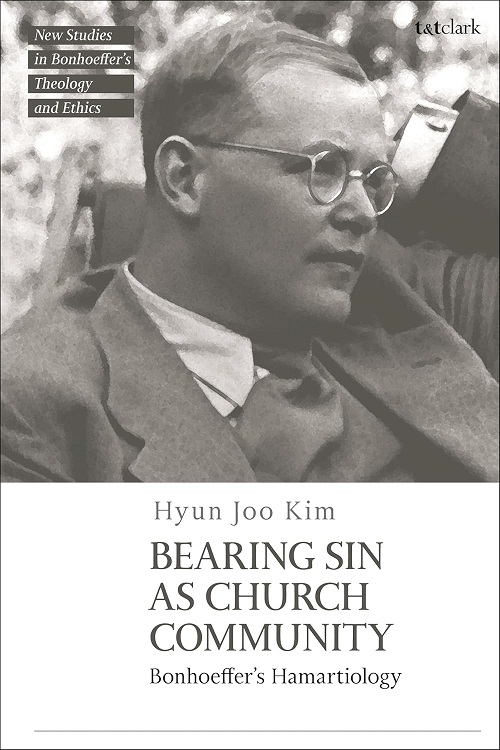
Dietrich Bonhoeffer’s theology continues to contribute enormously to discussions of theology today. What is especially rewarding about the work being done on Bonhoeffer’s corpus is finding topics that haven’t been explored as deeply as others. Hyun Joo Kim’s Bearing Sin as Church Community: Bonhoeffer’s Harmartiology specifically explores Bonhoeffer’s theology for the doctrine of sin, and the book richly rewards careful reading.
One of the central beliefs of Lutheranism, Catholicism, Calvinism, and several other branches of Christianity is that of original sin. For my own part, I find it an incredibly fruitful doctrine when contemplating the state of the world. Humans are incredible adept and finding imaginative ways to bring harm to each other. The horrors of the world are immense, and for me, one way to explain humanity’s awfulness to itself is to hold to a notion of original sin. Bonhoeffer’s views, by Kim, also make the position of original sin less incredible to believe, particularly in regards to explaining how it works. Instead of being linked to a (likely non-extant) original human couple, or being passed along through intercourse, Bonhoeffer’s view makes original sin and the Fall linked to human community and brings it into his ecclesiology. It all helps lend itself to his broader ethical stance, while still preserving the Lutheran view of original sin and guilt.
Before diving into Bonhoeffer’s doctrine of sin (harmartiology), Kim dives into the Augustinian doctrine of original sin. Augustine’s doctrine of original sin is closely linked with the notion of concupiscence–original sin as being transferred through the act of intercourse. Obviously, there is much more to it, but for Augustine, explaining original sin eventually boiled down to a kind of generational passing down through the act of intercourse itself. This saddled the doctrine of original sin with quite a bit of theological and other baggage. Kim then outlines Luther’s move from Augustinian original sin to a shift of seeing original sin integrated within Luther’s Christocentric theology. In essence, Luther’s focus on Christocentrism leads to a holistic theology that, while maintaining several aspects of Augustine’s view of original sin, centers Christ even in the doctrine of original sin. Luther’s view already started driving a wedge between concupiscence and original sin because while he apparently viewed the former as an essential aspect of transmitting the latter, he also held that original sin is forgiven in Baptism but that concupiscence remains a powerful influence on humankind (43).
Next, Kim turns to Bonhoeffer’s view of original sin. This includes a rejection of concupiscence as the basis for original sin. Rather than framing original sin in the “the biological and involuntary transmission of culpability…” Bonhoeffer frames original sin in “the relational and ethical bearing of the sin of others” (71). One of the main aspects of Bonhoeffer’s ethic is that the Christian has freedom for the other, and in this case, his doctrine of sin echoes that but in the bearing of sin for the other; it remains an alien guilt imputed, but a guilt nonetheless. Bonhoeffer’s reflection on original sin moves the alien culpability of Augustine’s doctrine of original sin from the sovereignty of God and to the church community. For Bonhoeffer, “the culpability of Adam is not biologically inherited; however, it is inseprably related to all human beings individually and corporately by the universal sinfulness after the fall” (72). This has some relation to Orthodox understandings of the fall [so far as I know from thinkers like Richard Swinburne–I admit very little direct knowledge of Orthodox teaching on the topic]. Bonhoeffer’s move, however, neither requires an original couple from whom all humanity is descended, such that the culpability can be passed down from one to another like a genetic lineage; nor does it need a specific means by which the original sin can be passed along. By sidestepping these two issues, essentially assigning guilt not to the individual through inheritance but rather through the very nature of humanity as sinful beings, he avoids many of the modern challenges to original sin, such as the question of human evolution–despite this clearly not being in Bonhoeffer’s mind as he wrote about the doctrine.[1]
Kim does draw some distinctions between Bonhoeffer’s earlier thinking on the doctrine of sin and his later theology, but to me these largely seem to be things that could be reconciled together as a continuum of the same theology. And of course the whole story is not told simply through Bonhoeffer’s views on original sin. Quite a bit more is featured on Bonhoeffer’s thoughts on sin and Christian life and ethics. Kim pays careful attention to Bonhoeffer’s book Creation and Fall and his exegesis of the Genesis narratives here. Kim’s argument is that Creation and Fall exists in the same sphere as his other works, Sanctorum Communio and Act and Being, and as such, it focuses on communal personalism and still integrates aspects of Lutheran and Augustinian notions into the reading.
Bearing Sin as Church Community is an absolutely essential read for those wishing to dive deeply into Bonhoeffer’s theology. It also is an exceptionally powerful theological work that demands close and careful reading. It provides new ways forward in understanding some of the core doctrines of some branches of Christianity, and new challenges to those that do not hold those doctrines. Highly recommended.
Notes
[1] It seems fairly clear in reading Bonhoeffer’s corpus both that he was largely aware of scientific consensus on his day on various topics, which would have included the evolutionary lineage of humankind, and also that he was supremely unconcerned with scientific truths related to theology. For him, it seems, there was no conflict between Christianity and science unless Christians themselves decided to make such a conflict by purposely moving theology into the sphere of science (or vice versa) when that is an utterly inappropriate move. See, for example, his brief comments about science near the beginning of Creation and Fall.
All Links to Amazon are Affiliates links
Links
Dietrich Bonhoeffer– read all my posts related to Bonhoeffer and his theology.
Be sure to check out the page for this site on Facebook and Twitter for discussion of posts, links to other pages of interest, random talk about theology/philosophy/apologetics/movies and more!
SDG.
——
The preceding post is the property of J.W. Wartick (apart from quotations, which are the property of their respective owners, and works of art as credited; images are often freely available to the public and J.W. Wartick makes no claims of owning rights to the images unless he makes that explicit) and should not be reproduced in part or in whole without the expressed consent of the author. All content on this site is the property of J.W. Wartick and is made available for individual and personal usage. If you cite from these documents, whether for personal or professional purposes, please give appropriate citation with both the name of the author (J.W. Wartick) and a link to the original URL. If you’d like to repost a post, you may do so, provided you show less than half of the original post on your own site and link to the original post for the rest. You must also appropriately cite the post as noted above. This blog is protected by Creative Commons licensing. By viewing any part of this site, you are agreeing to this usage policy.

 J.W. Wartick - Reconstructing Faith