bible
Ken Ham, honesty, and AiG’s Reformation- A lesson in careful reading and hermeneutics
I recently responded (Ken Ham on “Compromise” and Stand to Reason) to a blog post–really a rant–by Ken Ham, young earth creationist. Well, Ken Ham apparently took issue with my own posts (and others’–see links at the end), and has offered another response. All block quotes are from Ken Ham’s post “To Help Bring Reformation” and all credit goes to him for the writing of said quotes. For a shorter response to Ham’s latest post, check out Unrecognized Agreement and Unity.
First, it is worth noting that Ham doesn’t cite any specific sources for the views he attacks, so it may be difficult to draw out all the points. To be fair, it seems that at least a few of his points respond directly to my own blog post. I will try my best to draw out Ham’s points while offering another critique.
In my initial post on the topic, I pondered the notion that AiG is seeking to start a reformation. I mean, Ken specifically stated such in his blog. To whit:
Thus, as part of the mission of AiG, we believe we have been called to challenge the church to return to taking God at His Word from the very first verse—we liken this to helping bring in a new Reformation. -Ken Ham
Leaving aside the hidden assumption that any view which is not exactly the same as AiG’s position is, by implication, not “taking God at His Word”… I wondered what exactly it was that Ken Ham and AiG is seeking to do with a reformation–is it a reformation simply pressing YEC or is it a comprehensive, whole-church reformation. Ham responded:
A few Christians reacted to my comments with blogs falsely accusing me (and AiG) of equating such “Reformation” as getting people to believe in young-earth creationism. That is not our motive—and never has been (despite the numerous times we have been accused of such). Really, believing in a young earth is a consequence of believing God at His Word in Genesis. In other words, our efforts are not directly to get people to believe in a young earth, but to get God’s people to take God at His Word in Genesis. -Ham
That’s fair. Ken Ham–and many other young earth creationists–tend to argue that if one takes the Bible at “its Word,” then one will end up as a YEC as well. But how is it that Ham and others assert their position is the position at which one will arrive if one takes the Bible as true? Well, clearly, it is through a specific hermeneutic. In fact, Ham cites it himself as part of the AiG mission statement:
We relate the relevance of a literal Genesis to the church and the world today with creativity. -AiG Mission statement as cited by Ken Ham
Right! Well then it is part of the mission of the group to endorse, legitimize, and put forward as the truth the hermeneutic of reading a “literal Genesis”–by which it is meant a Young Earth view. But of course others read a “literal Genesis” and have no problems with old earth positions and indeed see absolutely nothing in the account as contradicting an old earth position. So, it seems that if YEC is supposedly a consequences of the position AiG holds, then YEC is absolutely part of the “reformation of the church” that AiG is trying to bring about. It is a consequence of their hermeneutic.
But then there is the question of whether or not their are readings of Genesis which allow for or even call for an old earth position. Other inerrantists like C. John Collins or G.K. Beale argue that the passages do not necessitate a young earth position. Thus, it seems like, without argument, we once more have a YEC dismissing other positions as against “believing God at His Word.” This is the kind of subtle ad hominem attack that people who can sense logical fallacies will react against. Notice the dichotomy that is set up: if you “believe God at His Word” you will hold the same position as AiG; but if you don’t hold the young earth position, you therefore do not believe God at His Word. One can’t make a worse accusation against other evangelicals than this.
But hey, why stick with subtlety?
These bloggers and others who falsely accuse us of being focused on young earth creationism are themselves undermining the authority of the Word of God, for which they will be held accountable before the God of creation. -Ken ham
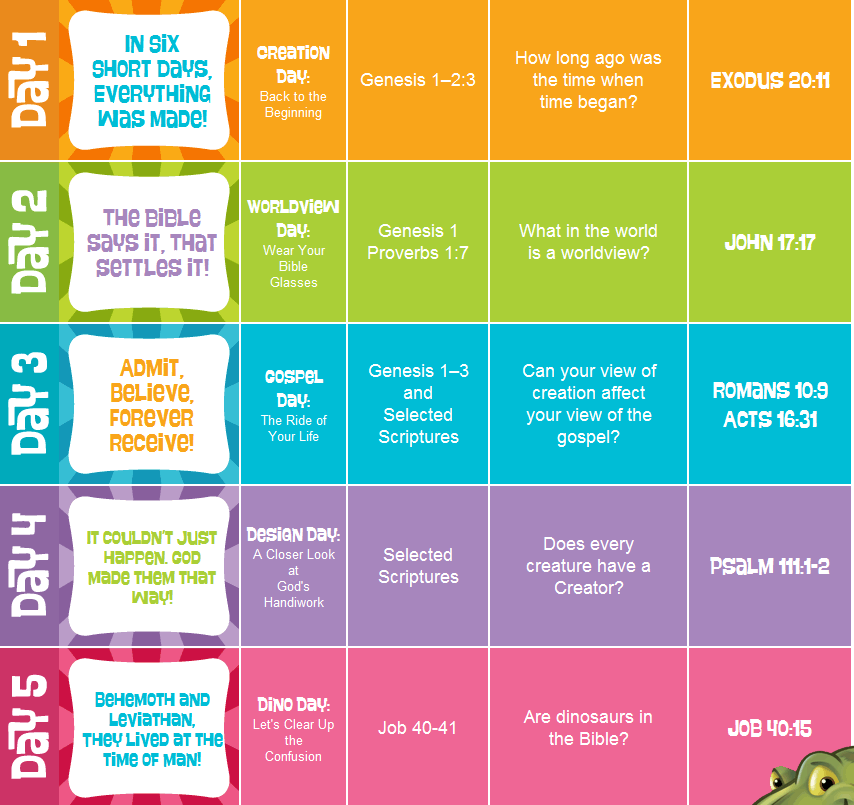 Yes, that’s right. Apparently I (and others) falsely accuse a group named “Answers in Genesis” which actively promotes young earth creationism through books (including children’s books), a magazine, a research journal, and even a VBS program [image on right all credit to answersvbs] (notice that the entire curriculum is focused on Young Earth Creationism: day 1 is in six short days, everything was made; day 2 is the bible says it, that settles it [and note that in Ham’s other post he argued we should teach our children how to think, not what to think–or at least in addition to ‘what to think’]; day 3’s main question is “Can your view of creation affect your view of the gospel?”; day 4 is on intelligent design [admittedly this doesn’t specifically mean young earth]; day 5 is going to teach children there are dinosaurs in the Bible) of focusing on a young earth.
Seriously, you did read that right. I and others are accused of falsely stating that Answers in Genesis is focused on young earth creationism.
Look, I’m not saying it’s a bad thing to have your ministry focused on a specific area. In fact, I think that Christians who are strong in science, the arts, philosophy, and other areas of knowledge need to step up and do what they’re best at for the glory of the Lord, whether that means making new discoveries in a lab or going and working at a retail job. Do it well! The problem is that Ken Ham is saying we’re falsely accusing Answers in Genesis of being focused on young earth creationism. Sorry, but they are.
Moving on:
Thus it is obvious that millions of years is incompatible with God’s Word. And one does not get millions of years from the Bible—it comes from fallible man’s interpretation of the past.- Ken Ham
Honestly, this has to be the favorite line YECs use: “man’s fallible __________” or some variant. Again, all it does is subtly poison the well. Isn’t it equally possible that man’s fallible interpretation could lead to a young earth view? Let me answer the question: YES. People are fallible, and they make hermeneutical mistakes, science mistakes, and other mistakes. Thus, one could equally say: “It is obvious that the young earth position is not necessitated by the text. To say that it is necessitated is to use man’s fallible interpretations of Scripture.”
Suddenly YEC looks like it is the evil “compromiser.” But I’m not going to take that route. Rather, I want to consider arguments, not attacks on character; I want to consider the text, and not bring eisegesis into it by assuming my position is the only possible interpretation.
Moving on:
I would also be prepared to say that those church leaders who condone “gay” marriage will have compromised Genesis! – Ken Ham
Another classic YEC scare tactics. I pointed it out in my last post responding to Ken Ham. Basically, you take the position you want to refute and then associate it with anything people who already agree with you will think is bad. For example, you could say “Hugh Ross believes in an old earth, just like evolutionists.” Suddenly, the people who read things like AiG’s website know that Hugh Ross is evil.
Here’s the problem: Hugh Ross isn’t evil. The statement is no argument. It’s guilt by association. It’s poisoning the well, and it’s unChristian.
Hey look, he does it again:
Those in the church who compromise Genesis with millions of years and evolutionary ideas are really saying that man’s word is infallible, and God’s Word is fallible! It is the other way round!- Ken Ham
Scare words abundant throughout. No argument, just assertions.
So no, the “Reformation” we are calling the church to is not (as some critics have been recently claiming) to get people to believe in a young earth— it’s having them accept the full reliability of the Bible. Believing in a young earth is a consequence of accepting God at His Word in Genesis.- Ken Ham
Honestly, this is the best piece of the entire blog post. It sums up Ham’s position well. Basically, he goes in with the assumption that the young earth is the only possible reading of Genesis. Thus, if anyone does not hold to a young earth position, they do not “accept God at His Word.” Now, what he’s saying is that it’s not that the reformation is young earth creationism; rather, the reformation is to re-evangelicalize the church: sola Scriptura! Amen!
Here’s the problem: a young earth is not the only possible reading of Genesis, and by putting it forth as such, and explicitly stating that it must be a consequences of “accepting God at His Word,” Ham and others who make similar claims have therefore put their views as God’s views. Their view is, in fact, a consequences of an ultra-literal hermeneutic which they espouse. The text itself does not warrant it. The fact that there is almost limitless reading from authors who argue that the Genesis account is Ancient Cosmology; or that it lines up with one week as part of creation; etc.; alone speaks to the fact that AiG’s position is not necessarily a consequences of the text, but of their hermeneutic: it’s a consequences of their method, not the source.
Bottom Line: Let’s focus on the issues involved in Genesis and the world that God has revealed to us, which is a reliable guide to truth (Psalm 19). The only reason I spend time responding to Ken Ham and others like this is because I do not want such statements to go unchallenged. When a Christian goes around accusing other Christians of being “compromisers” or other scare-words simply because they differ in their interpretation of a passage of Scripture, that Christian needs to carefully rethink the issues and realize “In essentials, unity, in non-essentials, liberty.” Stop throwing out the accusations. Focus on the issues.
Frankly, I pray this will happen, but I doubt that it will. As long as one holds one’s own methodology and hermeneutic is the only way to do it, there can’t really be thoughtful dialog. I hope I’m wrong, and I hope that maybe Ken Ham and AiG will be willing to work with others who have different views but still hold to inerrancy of Scripture in order to bring about a whole-church reformation towards inerrancy. But that would require AiG dropping the position that only they are right.
Links to Other Responses to Ken Ham’s “Compromise” Posting
Ken Ham on ‘Compromise’ and Stand to Reason– my response to Ham’s initial post.
Compromising the Kingdom– Faithful Thinkers offers a really in-depth critique of Ham’s use of emotional and ad hominem attacks.
A Brief Word on Ken Ham, Stand to Reason, and the OEC/YEC Debate– two really good points raised in this post. How do our attitudes drive people away?
SDG.
Shells and the Biomass of Earth: A serious problem for young earth creationists
 Imagine an earth covered with 15 creatures per square foot. And no, these creatures are not merely bacteria; rather, they are animals which can produce shells. The sheer amount of biomass would be so great that none of the creatures could survive. Their food would all be gone and their habitat insustainable. Over at Naturalis Historia, the Natural Historian has written a compelling article about how just the fossilized shells in one portion of the Midwest lead to extreme problems for the Young Earth position.
The author of that post did a brief survey of fossils over a 300×500 mile section of the Midwest from West Virginia to Eastern Missouri and from southern Kentucky to the middle of Indiana and Ohio. Utilizing samples and several calculations which were based off of these samples, he decided to try to calculate how thick a layer would be of fossils if just this area (totally covered in fossils) were spread out over the surface of the entire planet. He was able to conclude that “15 shells per square foot are estimated…” over the surface of the earth just from this sampling. Readers should note that in his article he utilized the lower end on his estimates in order to avoid tilting the scale in favor of an old earth position.
What is the point of this discussion? Who cares? Well this fact actually presents young earth creationism (YEC) with a few major difficulties:
…even 15 shells trying to live within the space of a square foot at the same time would have trouble. One also has to consider several other things:
1) Not all the surface of the earth was ocean before the flood, if we say that 50% of the surface was land then that would mean there were 30 shells per square foot in the ocean.
2) In addition, most organisms that produced these shells likely could only live in shallow water along coasts not in the deep ocean so unless the whole ocean were very shallow (and I think some claim that it was, although that presents some other very perplexing problems) then that would also dramatically reduce the space in which these shells could have grown and died.
3) The shells are not sorted at all by size, as very small (<1cm) to large (>4cm) shells are always found mixed with one another.
Each of these is presents a different difficulty with YEC. For, as the author noted, the shells he surveyed is only one small sample of untold amounts of these deposits across the surface of the earth (see below for my own samples and some analysis). Now if YEC is correct, then all of these creatures would have had to live over the course of around 10,000 years (or fewer). Think about that for a moment. I know from personal experience that the area covered with these shells is about twice as large as estimated in the numbers already referenced above, and so we are then talking about 30 creatures per square foot over the surface of the earth. But then consider that these types of formations can be found across America and across the earth. I have no way to estimate the numbers, but ultimately we’re talking about a simply astounding amount of life living on the surface of the earth in that short of a time span. It would be physically impossible for the sheer weight of living creatures to survive at the same time. If the Earth were only about 10,000 years old, then we would have been knee deep or even buried in shell-producing creatures over the course of our lives.
Not only that, but these creatures would have been competing for resources like food and air (think about how much oxygen these creatures would have sucked up all at once!). And again, it’s not like the entire surface of the earth would have been habitable–these creatures live only in shallow waters. It doesn’t seem unreasonable to think that if all these creatures lived over the course of 10,000 years then the oceans would have overflowed with them.

The image I have linked to the right shows a pair of stones discovered in limestone in Kansas. There were literally dozens of feet of fossils just like these as far as the eye could see in the Castle Rock formation in Kansas. One could just walk up and pick a rock up off the ground and it would be like the picture to the right. There are places one can’t walk without stepping on large numbers of fossils. The picture that is at the beginning of this post is a picture I took while in this formation. It is not just the author of the article above who has observed the seemingly unending supply of fossils throughout the Midwest. I myself have observed limestone formations with fossils like these across Kansas for hours and hours of interstate. Not only that, but I grew up in northwest Indiana and observed massive limestone formations there as well. Here in Minnesota, one can also observe limestone along cutouts of the highway and elsewhere. One can go to areas along the Mississippi here in Minnesota and pick up fossilized shells along the riverbed.
So imagine that the estimates listed above by the Natural Historian are correct on the low end. Now imagine that all of Kansas is covered with these shells–I can attest to it. Imagine further that more portions of the Midwest are covered with other types of limestone which also would have added to the biomass of earth. Again, the numbers are staggering.
How in the world did all of this biomass get here within a few (10?) thousand years? That is the question which young earth positions must deal with. Note that the argument and evidence in this post do not rely upon any dating system, any background knowledge, or other scientific dating systems YECs tend to denigrate. Note that the argument only shows what is observable and asks a question: how did it get here? YECs would have to come up with some way to plausibly explain how all these creatures could have had their lives condensed into about 10,000 years.
God is not a liar (Numbers 23:19). The natural world attests to Him (Psalm 19). These conjoined Biblical points tell us that when we go outside and observe that the life we can observe in the past could not have all lived within 10,000 years, then it did not. Those who claim otherwise seemingly must either introduce a third option (some plausible explanation for these creatures’ lives–and note that it must be more plausible than the argument that they lived and died at the same rate they do now and that the world is simply old enough to have had that much life and death over the course of time) or they fall victim to a dilemma involving the cited verses: either the natural world does not attest to the Truth or God is actively deceiving us. The bottom line is that this is just one more hole in the Young Earth position. YEC is, simply put, false.
Appendix 1: A response to one objection
There have already been a few responses to this post on places other than this site. One response argued that the samples which I and/or Natural Historian took were not representative of the fossil record. Here is my brief response:
Take a trip through the Midwest sometime and look at the cuts through the highways. Every single time you pass through one in Kansas it is absolutely filled with limestone and fossil-rich rock. The same happens through most of Missouri, Illinois, Indiana, etc. I could literally walk up to a wall of shells and pull out a huge sampling of them.
Now suppose this isn’t representative. Suppose that it just so happened, at random, that the roads were set up in such a way that they only hit the most fossil-rich deposits out there. What does that mean?
Not very much. We can observe these same deposits all over the world. The sheer amount of these deposits means that we could very easily produce the number of fossils Natural Historian estimates over just the Midwest.
Again, to clarify, I’m saying let’s assume that Natural Historian overestimated several thousand(milliion?)-fold and so the number of fossils he estimates for the midwest can only be gathered if we collect them from all over the earth, and only from those highway cuts or other points of exposure where such deposits have observed (again, making the extreme assumption that only those places which have happened to get hit by highways or erosion are those with these deposits). But in that case, we can still gather enough fossils to say the entire surface of the earth could be covered by about 15 fossils per square foot.
But wait–these fossils don’t occur in deep oceans or on land. They only occur in shallow oceans. Suddenly we’re up to about 30 per square foot if we assume they occurred in water anywhere (including riverbeds, deep oceans, and the like). But eliminate the places these types of fossils do not occur and the number of fossils increases even more.
Suddenly we find that the exact problem I raised above remains a problem–even if we only take those fossils which are exposed now (and again note that this is a huge underestimate and requires extreme blind faith that there are no other fossils under the ground anywhere, not to mention the fact that there may be even more fossils that are exposed which could drive that number up exponentially). There has been simply too much life on earth to maintain a young earth position.
SDG.
——
The preceding post is the property of J.W. Wartick (apart from citations, which are the property of their respective owners) and should not be reproduced in part or in whole without the expressed consent of the author. All content on this site is the property of J.W. Wartick and is made available for individual and personal usage. If you cite from these documents, whether for personal or professional purposes, please give appropriate citation with both the name of the author (J.W. Wartick) and a link to the original URL. If you’d like to repost a post, you may do so, provided you show less than half of the original post on your own site and link to the original post for the rest. You must also appropriately cite the post as noted above. This blog is protected by Creative Commons licensing. By viewing any part of this site, you are agreeing to this usage policy.
Animal Death?- A Response to AiG Critique of My Argument
I recently wrote a post called “A theological argument against young earth creationism.” In it, my stated claim was “YEC is morally impermissible…” Why? Because “on YEC, animals died because of Adam’s sin…” not because of anything they themselves did. This argument is intended to use the YEC assumption that animal death is an inherently bad thing against them. Let’s outline the argument:
1. If animals did not die before the fall, then their death must be the result of sin.
2. Animals are incapable of sinning (they are not morally responsible agents)
3. Therefore, animal death must be the result of a morally culpable agent’s sin.
The argument as it stands contains a few assumptions which I’ve found in YEC literature. 1) Animals did not die before the fall; 2) Death is inherently a bad thing; 3) all physical death is the result of sin. Now a denial of these assumptions can undermine my argument; I grant that. My point is that if one holds to these three assumptions, my argument shows that YEC is morally impermissible.
Now, Answers in Genesis has provided a critique of my argument, and I must say that I’m very appreciative of their interaction on this important topic. Elizabeth Mitchell wrote the entry, check out her critique, in its entirety, here (under the “And don’t miss…” section). Let me examine the criticism below. (I recommend reading my entire post prior to this one in order to have proper interaction with it.)
First, Mitchell wrote, that my post “…attempts to show young earth creationism is wrong by demonstrating death documented in the fossil record preceded human sin and was unrelated to it.”
I admit I was a bit befuddled when I read this, because nowhere in my post did I try to “demonstrate death document in the fossil record preceded human sin…” I’m not sure where this claim was made in my original post. I don’t mention the fossil record anywhere in the original post and so I’m a bit concerned by this apparent misreading of my article.
Then, she wrote, “He cites no Scripture…” Indeed, I did not cite a single Scripture passage. However, the argument is directly based upon the assertions that some YECs make. But what kind of rebuttal is it to say “He cites no Scripture…” anyway? An argument must be dealt with whether it has Bible passages in it or not.
 The argument itself is based upon the logic of the YEC argument against old earth positions. The picture to the right here demonstrates pictorially the view most YECs present of old earth positions–that animal death before the fall makes God morally questionable (image credit to AiG, accessed here). For example, premise 1 is backed up by this quote from the AiG critique: “the connection between Adam’s sin and animal death…” Premise 2 is indeed mostly an assumption, but I think it is one that most Christians would grant. Animals are not on the same level as humans; they are not moral agents made in God’s image. Three is again backed up by the quote I put above; the AiG (and more generally, YEC) argument assumes that all death is the result of Adam’s sin.
Now, AiG does claim that the Bible backs up this position. They wrote, that I “[seem] oblivious toRomans 8:20–22, which explains the connection between Adam’s sin and animal death” (Mitchell, cited below). Well no, I’m not oblivious to Romans 8:20-22, which makes no mention of animal death. In fact, the word “death” is not even used in the passage. Thus, it looks like this an inference from Scripture, not an obvious connection. And an inference is subject to presuppositions. The YEC presupposition is that animals did not die before the fall, so of course their inference will lead to a reading of Romans 8 in light of that presupposition.
Mitchell argues in regard to my statement, “The post on Answers in Genesis hints that it is because animals are cursed due to the serpent’s deception of Adam and Eve,” that “…we [AiG] teach no such thing” (Mitchell, cited below). That’s fair, and I appreciate the clarification. The reason was that I read the following quote on the original post I was working from: “The first recorded death and passages referring to death as a reality came with sin in Genesis 3 when the serpent, Eve, and Adam all were disobedient to God” (Hodge, cited below). The wording here does seem to at least “hint” at a connection between the serpent and the rest of animal death, but I could be mistaken here and I’m fine with that.
To sum up, my argument was based upon rather firmly established YEC assumptions. That animals did not die before the fall is argued throughout YEC literature, and both posts I cite have this idea in them. That animal death is due to the sin of Adam is demonstrated in the AiG response to my post. That animal death is somehow inherently bad is shown in the picture above as well as throughout YEC literature. For just one example, Bodie Hodge wrote, in the article I was originally linking (cited below), “God gave the command in Genesis 2:16–17 that sin would be punishable by death. This is significant when we look at the big picture of death. If death in any form was around prior to God’s declaration in Genesis 1:31 that everything was ‘very good,’ then death would be very good too—hence not a punishment at all.” But just from these three theses I can construct my argument (as above) which leads to the conclusion:
“Animal death must be the result of a morally culpable agent’s sin…” (on the YEC position).
And, as I argued in my original post, this seems to undermine the goodness of God on YEC, for “the animals didn’t do anything. One day, they were happily living potentially infinitely long lives, eating plants, and doing their animal things. The next day, Adam sinned, and so God decides to start killing them all… not because they themselves sinned” (here).
So, given the assumptions that YECs make, I have constructed an argument that shows their own position is morally impermissible. What does this entail? I suggest it entails that the reading of the texts that YECs present is incorrect and must be modified. I suggested a few ways to do this in the original post, so I won’t repeat them here. Ultimately, it seems my original post has not been refuted.
Sources
Bodie Hodge, “Biblically, Could Death Have Existed before Sin?” Answers in Genesis. 2010. Accessible here: http://www.answersingenesis.org/articles/2010/03/02/satan-the-fall-good-evil-could-death-exist-before-sin
Elizabeth Mitchell, “News to Note, March 17, 2012.” Answers in Genesis. Accessible here: http://www.answersingenesis.org/articles/2012/03/17/news-to-note-03172012.
J.W. Wartick, “Animal Death?- A Theological Argument Against Young Earth Creationism.” 2012. Accessible here: https://jwwartick.com/2012/03/12/against-yec-theology/.
——
The preceding post is the property of J.W. Wartick (apart from citations, which are the property of their respective owners) and should not be reproduced in part or in whole without the expressed consent of the author. All content on this site is the property of J.W. Wartick and is made available for individual and personal usage. If you cite from these documents, whether for personal or professional purposes, please give appropriate citation with both the name of the author (J.W. Wartick) and a link to the original URL. If you’d like to repost a post, you may do so, provided you show less than half of the original post on your own site and link to the original post for the rest. You must also appropriately cite the post as noted above. This blog is protected by Creative Commons licensing. By viewing any part of this site, you are agreeing to this usage policy.
Jephthah, Human Sacrifice, and God: What should we make of Judges 11:29-40?
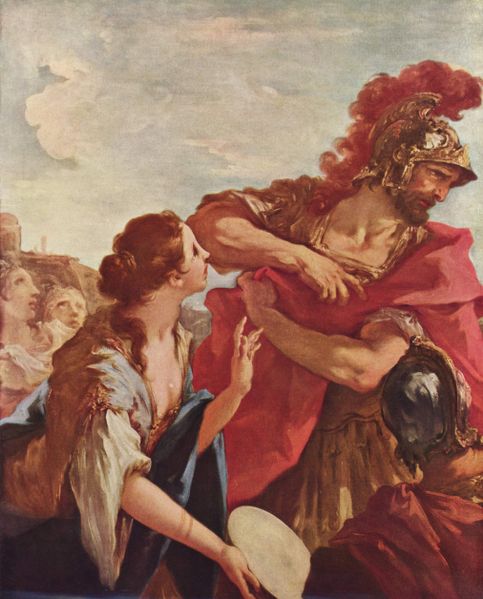
The story of Jephthah is one of the most difficult stories in the Bible. For those who don’t know it, Jephthah, an Israelite, is about to go to war against Israel’s enemies. He vows that if God grants him victory, he will sacrifice whatever comes from his door to greet him first. He wins the battle, and when he returns, his daughter runs out to meet him. She asks one last wish–that she may mourn her lack of marriage for two months. The story ends explaining that this is the reason Israelites (at the time of the writing of Judges) commemorate Jephthah’s daughter.
Understandably, the narrative raises many questions. I view the image here, a gorgeous painting by Giovanni Antonio Pellegrini, and it wrenches at my heart. Think of Jephthah’s anguish! The language in the Bible stirs the emotions:
When Jephthah returned to his home in Mizpah, who should come out to meet him but his daughter, dancing to the sound of timbrels! She was an only child. Except for her he had neither son nor daughter. When he saw her, he tore his clothes and cried, “Oh no, my daughter! You have brought me down and I am devastated. I have made a vow to the LORD that I cannot break.” (Judges 11:34-35)
The questions, as I noted, are many. Foremost of those which come to mind: “Why would God let this happen?” Another common question about this passage are “Does God allow human sacrifice?”
I’ve written on the passage before, but I think my responses were inadequate. Therefore, I have decided to reexamine this story and see what we can glean from it. Part of these thoughts are due to a conversation I had with an old friend.
Human Sacrifice
First, the question of human sacrifice. Throughout the Bible, God specifically condemns human sacrifice (cf. Leviticus 18:21; Lev. 20:2-5; Deuteronomy 18:10). One point some make is to try to draw the near-sacrifice of Isaac into the mix, but it is contextually clear that God did not intend for Isaac to be sacrificed (see Paul Copan’s excellent work on this story in his Is God a Moral Monster?). Furthermore, it is important to note that the book of Judges is a historical book, and it therefore is not prescribing the actions described therein, any more than other historical texts are prescribing the historical accounts depicted in them (see my “Description is not Prescription”). Yet those passages which are prescriptive all expressly forbid human sacrifice (again, see Lev. 18:21; 20:2-5, Dt. 18:10). Therefore, God forbade human sacrifice, He did not condone it.
Why Not Prevent It?- Context
It is therefore clear that God does not condone human sacrifice. Why, then, does God not intervene in the case of Jepthah and prevent this horrific event from occurring? As a friend noted, it would be quite simple for God to cause one of Jephtah’s servants or, indeed, anything else alive to have come from the door first. Why, then, does God not do this?
There is no simple response to this question. Instead, it is important to note several important points before I offer a possible answer. First, God has given humans free will. The nature of libertarian free will is such that it cannot be undone. Think of it this way: If God were to give us free will only until we tried to do something wrong, and in such cases God intervened and overcame our freedom to cause us to do good, we would not have genuine freedom. We’d really have a kind of pseudo-freedom. As long as we only chose what is good, we would be free, but we could not choose otherwise.
Second, think of what Jepthah had done to begin with. When he vowed that he would sacrifice the first thing to come out to meet him, it seems quite apparent that he had in mind human sacrifice, for a few reasons. It doesn’t seem likely that, for example, a cow walking through his doorway would count as coming to meet him. He specified that his sacrifice would be the first to come meet him. In fact, one might surmise he could have guessed it might be his own daughter–who is more likely to go running out to see him after a battle than his beloved child? There was no shortage of local cultures in the area who offered their children as sacrifices, and indeed the practice had corrupted Israel itself at a few points in history, so Jephthah may have been thinking of such a practice in order to bring about victory.
Third, Jephthah was an outcast. He had been driven from the land before because of his questionable parentage (Judges 11:1-3). The Israelites turned to him only in the time of their dire need, and Jephthah was clearly tempted by their offer to be their leader (Judges 11:4-11). Even given the small amount of context we have for this narrative, we can see that Jephthah desired greatly to be given headship over Israel. It is possible that, in his lust for power, foolishly made a vow to offer one of his household in exchange for the victory.
Fourth, we’ve already seen that it is expressly forbidden to offer human sacrifices. Yet Jephthah makes his vow with full knowledge of the likely consequences.
Finally, Jephthah’s vow offers a dilemma of sorts to a God who acts in history. If God wishes to prevent the human sacrifice, he must cause the defeat of Israel. This would not be just the destruction of Israel, but it would force God to go back on His promise to bring salvation through Israel, which it is impossible for God to do (Numbers 23:19). Not only that, but it would prevent God’s plan of redemption to take place. Yet if God does grant the Israelites victory, He knows that Jephthah will offer a sacrifice of whoever first steps from his house.
 Why not prevent it? -Solutions
From these quick thoughts we can see a number of possible answers. First, Jephthah made a vow which he would choose to fulfill in full knowledge that it would almost certainly be a human member of his household whom he would sacrifice. His vow was contingent upon the victory of Israel, whose defeat would have prevented God’s plan of salvation for all humankind. Therefore, Jephthah, by freely making this sinful vow, forced its conclusion. God did not prevent it from occurring because to do so would either destroy free will or prevent the Redemption.
Furthermore, some have argued that Jephthah’s vow to God superseded all else. (I myself made this argument in the original post.) I think this is wrong. God’s eternal moral commands would have superseded the vow. In fact, Jesus Himself commands His followers not to make vows, but rather to let their “yes” be “yes” and their “no” be “no” (Matthew 5:33-37). Jesus actually says that those who believe that a vow to God would supersede all else are wrong–they should not be making the vow in the first place! Thus, Jephthah’s vow was doubly sinful, because it essentially guaranteed a heinous act (human sacrifice) and because he should not have made such a vow to begin with. In fact, it should be noted that if Jephthah had acted in accordance with the Bible, he should have broken the vow! God expressly forbade human sacrifice, and when Jephthah saw that it was his daughter–or had it been any other human–who came to meet him, he should have realized his vow was made foolishly. One could even argue that God did indeed act in such a way as to try to get Jephthah to realize his error. The fact that it was Jephthah’s daughter who greeted him should not have only horrified him but made him realize that his vow was sinful to begin with, and so should not be upheld. Upon the realization that keeping his vow would cause him to break God’s Law, Jephthah should not have said “I must keep this vow” and therefore increase his sin–rather he should have said “I will break this vow, and prevent a horrific sin.” But again, with his freedom, he chose not to.
Jephthah’s story is, in fact, just the kind of story typified throughout Judges, and indeed throughout human history–that of God using sinful people to bring about His ends. Samson, another judge, was a violent and lustful man, yet God used him to save the Israelites on a number of occasions. In the Joseph narrative (Genesis 37ff), God used the evil actions of Joseph’s brothers to bring about a great good (Gen. 50:20). Similarly, Jephthah’s greed lead him to make a vow which he should not have kept which condemned at least one human to death.
Jephthah’s free decisions brought about the death of his daughter. That is why the Bible reports this stirring story–it teaches us that our free will has consequences. That is why the painting of Jephthah is so striking–we can relate to the horror of Jephthah’s realization of his own sinfulness. We’ve each committed our own sins and had to deal with the consequences. God is not a divine vending machine who will intervene when we make mistakes, or when we choose horrifying acts. He has already provided us with an objective reality–the discernment to tell what is right from wrong. Not only that, but He has also provided a Savior, His Son Jesus, to rescue us from all evil–even death itself. God has provided an infinite good to all human persons by providing a means for their salvation. Whosoever will be saved shall be saved.
The story also teaches us once more that God works through imperfect people. Although Jephthah was a sinful man with greedy intentions, he was still used by God to bring about a great good–the preservation of Israel, which itself paved the way for God’s redemptive act.
A Final, Philosophical Note
Those who may desire to press the objection still should investigate the philosophical basis of their claim. Presumably, they are arguing that:
P1- God is obligated to prevent evil (or some certain types of evil).
What justifies that claim? If God has given us free will, there are evils God cannot prevent–those which we choose to bring about. Further, what justifies the claim that God must intervene in every situation with x amount of evil? More specifically, why is God obligated to prevent Jephthah’s daughter from being the first to leave the house (again, I think that it was a series of free choices which brought Jephthah to this unfortunate event, and I disagree with those who think that God could just supersede free will whenever necessary, but I’ll grant it for a moment)? Is God obligated to prevent every evil?
I’m sure there are arguments that could be made to try to support the premise that “God is morally obligated to prevent all (or certain types of) evils” but I don’t think they would be more plausible than P2: “God has created free creatures” and P3: “Freedom cannot be limited.” I would accept a more restricted sense of:
P1′- God is morally obligated to prevent all evils which He is able to prevent and which do not provide for some greater good and which, if prevented, do not lead to other evils with similar or greater impact, etc.”
Those who would seek to continue objecting that God, in the Jephthah narrative, should have intervened, must defend their restricted sense of P1, while rebutting P2 and P3, and showing that P1 is more plausible than P1′. It therefore seems that philosophically, exegetically, and theologically, the Jephthah narrative, while poignant, does not threaten God’s character. God works through human history to bring about the Redemption, using imperfect, sinful people to bring about an infinite good. Furthermore, God has given us the good of freedom, but we choose too often to abuse it. Jephthah illustrates this misuse in a heart-rending fashion which serves as a definitive reminder to those who read it that they should heed God’s word and use their freedom not for greed or gain but for the furtherance of God’s Kingdom.
SDG.
——
The preceding post is the property of J.W. Wartick (apart from citations, which are the property of their respective owners) and should not be reproduced in part or in whole without the expressed consent of the author. All content on this site is the property of J.W. Wartick and is made available for individual and personal usage. If you cite from these documents, whether for personal or professional purposes, please give appropriate citation with both the name of the author (J.W. Wartick) and a link to the original URL. If you’d like to repost a post, you may do so, provided you show less than half of the original post on your own site and link to the original post for the rest. You must also appropriately cite the post as noted above. This blog is protected by Creative Commons licensing. By viewing any part of this site, you are agreeing to this usage policy.
Book Review: “Man and Woman: One in Christ” by Philip Payne
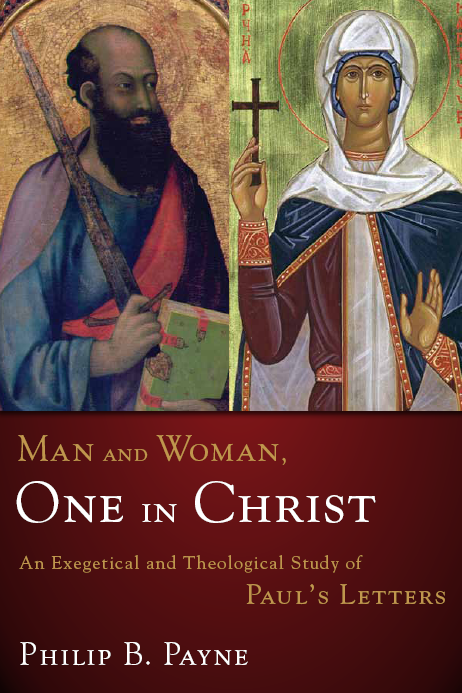 Philip Payne’s book Man and Woman, One in Christ
Summary of Contents
Paul’s Background
Payne notes that Paul was taught by Gamaliel, who was far more egalitarian than his contemporaries. Given this background, it is implausible that Paul had a low view of women (37).
Galatians 3:28
Those opposed to egalitarians (basically, egalitarians are people for women pastors, complementarians are those opposed to women pastors) often portray the position as having its only support in Galatians 3:28. Philip Payne does not base the egalitarian position on this verse alone, but he does argue that the passage provides a strong basis for the egalitarian position. Payne writes, “The natural implication of the equality of male and female in Paul’s teaching is that the gifts of women for ministry in the church should be recognized, welcomed and exercised in all areas of church life, including… church leadership” (104).
1 Corinthians 7- the equal rights of men and women in marriage
In 1 Corinthians 7, Paul explicitly parallels the obligations, rights, and conditions of men and women in marriage. Payne notes a large number of verses in which Paul uses the same language for both men and women (105-106). Not only that, but Paul specifically challenges the concept that men should be the spiritual leaders in the home in 1 Cor. 7:14 (107).
1 Corinthians 11
Payne’s book quickly turns to an extremely in-depth exegesis of the core verses related to the debate over women in church leadership. To put this into concrete terms, Payne’s analysis of 1 Timothy 2:8-15 covers eight chapters and 142 pages; 1 Corinthians 14 has nearly 50 pages dedicated to it, 1 Corinthians 11 is covered by over 100 pages. Payne does not set theology or exegesis to the side in favor of emotional appeals, as some complementarians tend to accuse egalitarians of doing. Rather, he centralizes the Bible as the inerrant Word of God and unswervingly demands that all sides conform to what the Bible teaches, no matter how difficult that teaching may be.
Regarding 1 Corinthians 11, Payne notes that the analogy regarding the “head” of woman does not imply authority, as complementarians must hold. Rather, “source” is a better exegetical and philological fit (113ff, see especially 131, 133). Payne further argues that the proper application of 1 Corinthians 11 would draw out the respect and honor men and women should have for each other as equals (214-215).
1 Corinthians 14:34-35
Rather than mincing words, I’ll jump right to the point: Payne argues that these verses are an interpolation. I’ll cover my own thoughts in the section below “Analysis/Critique,” but for now, I’ll focus on Payne’s argument.
Payne notes that there are a number of ways offered to interpret the passage, but he argues that the only plausible interpretation of the text is that women must be silent, no matter what, in every circumstance. The reasoning is lengthy, but the primary rationale behind this interpretation as most plausible is the it reiterates the prohibition three times, which, in the 1st Century, would have been seen as an absolute prohibition (218-219). Complementarians who allow women to sing in worship, therefore, are inconsistent in their interpretation of this passage, because they add a qualification which is not in the text (221).
Payne, however, argues the text is an interpolation. The evidence is both internal and external. First, the external evidence. The movement of the text itself hints that it was an interpolation which was placed in different parts of 1 Corinthians depending on the textual lineage (227ff). There is also a distigme which is used elsewhere to mark interpolations that is in the last line of 14:33, the correct place to mark 14:34-35 as an interpolation (232ff). Bishop Victor, between AD 541-544, corrected the text to omit 14:34-35 as an interpolation (246ff). Victor’s acumen for detecting interpolations is noteworthy, because he also omits the Trinitarian interpolation in 1 John 5:7-8 (246). MS88 omits the text, likely because it was copied from a manuscript which lacked the interpolation (249). Clement reflects a text without the verses (250-251). He notes other evidence as well (251ff). Payne also notes 9 lines of internal evidence for the text being an interpolation (253ff).
1 Timothy 2:8-15
These verses occupy the largest treatment in MWOC. The key to properly interpreting this passage, argues Payne, is the context and the church situation to which it is addressed. Context is always important in properly interpreting the Bible, but with letters it is even more important. Payne approvingly quotes Raymond Collins on this point, “…it is the epistolary genre that is most conditioned by the coordinates of time and space, historical and relational circumstances… They are ad hoc compositions whose essential import relates immediately and directly only to the situation that dictated their composition” (291).
Payne asserts that scholars know the situation in Ephesus–there was a preponderance of false teaching (296ff). Because of this, it is important to read the letter as a letter designed to put a stop to these teachings. Paul’s prohibition of women’s teachings is tied directly to the fact that false teachers had been praying upon women (299ff). The phrase Paul uses, “I am not permitting” “indicat[es] a new, case-specific injunction in response to a problem in Ephesus that does not carry the weight of church tradition” (321).
Payne also highlights the importance of the Greek word oude as conjoining the prohibitions Paul makes in this passage. The word is used throughout the Pauline corpus to “join together expressions that reinforce or make more specific a single idea” (338). Because of this, it is important to note that the word is used to conjoin the prohibitions in 1 Timothy 2:12. The prohibitions are “to teach” and “to assume authority.” Thus the prohibition is not Paul saying women cannot teach or assume authority over man… rather it is “Women should not teach in conjunction with assumed authority” (348-356).
But does authenteo mean “assume authority”? Complementarians generally must argue that it means simply “have authority.” Payne destroys such arguments, citing etymological (363-365) and document (365-373) evidence to demonstrate the word means “assume authority [to oneself-385ff].” Payne also deconstructs the complementarian argument to the contrary, showing that Paul used other words to refer to authority in a basic sense (373-380).
Importantly, Payne draws out the implications of Paul’s exhortations to women to learn quietly. This was the proper position of students. Paul is not telling women they have no place in the church, he’s calling them to learn in a proper fashion before teaching (see 316-317 for an example of this argument).
Thus, Payne concludes that Paul is not prohibiting women from teaching in the church. In the face of the counter-evidence of Paul’s affirmation of women teachers (61-68), the specific context of 1 Timothy, and the proper translation of the Greek words, the text should be read as a temporal restriction on teaching by women in a church struggling with false teachings being spread by women.
…And More
I have not even begun to draw out all of Payne’s arguments in MWOC. There are many more lines of reasoning including Paul’s affirmation of women in positions of ministry, Paul’s theological axioms which imply equality of man and woman, “salvation through childbirth,” Ephesians 5:21-33 and Colossians 3:18-19 with husband-wife relationships, Titus 1:5-9 and 1 Timothy 3:1-13 and the requirements for deacons and overseers, etc., etc. I cannot emphasize how broad Payne’s line of argument is, and how lucidly he explains his points. The book simply must be read by anyone interested in the topic.
Analysis/Critique
There are so many points Payne makes in MWOC that it would be impossible to cover them all. I found Payne’s arguments largely persuasive. That said, I have a few minor notes.
First, I am not convinced that 1 Corinthians 14:34-35 is an interpolation. I also think Payne dismisses the possible egalitarian readings of the passage too quickly (219ff). That said, Payne’s arguments are extremely powerful. I would have dismissed such arguments before reading this book, but now I’d say I’m very close to agreeing with Payne that these verses are an interpolation.
However, I wish that Payne had did a bit more work on the text to at least investigate the exegetical possibilities. I believe very few complementarians would be willing to accept that these verses are an interpolation, so if Payne had offered other possible interpretations, complementarians might find his case stronger. However, it is the case that complementarians who desire to use this passage to exclude women from the ministry now have the burden of proof upon them to demonstrate that it is not an interpolation, and they must do so with the same careful attention to the internal and external evidence which Payne utilized.
Initially I thought Payne might be overstating the case from Galatians 3:28, but he drew out enough parallel passages that it seems pretty convincing that egalitarians can interpret other passages in light of the Galatians verse (Payne does not use this method–he deals directly with the texts said to undermine egalitarianism… I’m merely suggesting that Payne’s work on Galatians 3:28 would allow egalitarians to be justified in utilizing it as a kind of “proof text” by which others must be judged).
Conclusion
Payne’s sustained positive argument for the equality of man and woman essentially convinced me of the egalitarian position over a year and a half ago. I have only recently finished the book, but when I first got it and skimmed through the arguments, I realized every argument I’d been using as a complementarian had an egalitarian answer. Not only that, but Payne’s critique of the complementarian position undermined the theological position which I’d held my entire life. I think it takes a great deal of intellectual integrity to read books which challenge one’s fundamental beliefs, and I have experienced it firsthand. I challenge readers on both sides of the issue to read this book.
Man and Woman, One in Christ provides an insurmountable challenge to the complementarian position. Any scholar working on the topic in the future must interact with this magnificent work. I simply must recommend it over and over again. I am thoroughly convinced that egalitarianism has a much stronger Scriptural and theological basis than the complementarian position, and MWOC is one of the works which lead me to that position. Payne’s thorough and thought-provoking analysis of the texts themselves demonstrates the Biblical accuracy of the egalitarian position. His work is one with which all must contend. The issue of women in the ministry is one we [the church] cannot get wrong. A thoughtful, open-minded approach to the Biblical issues is necessary. Let us make men and women one again.
Source
Philip B. Payne, Man and Woman, One in Christ
SDG.
——
The preceding post is the property of J.W. Wartick (apart from citations, which are the property of their respective owners) and should not be reproduced in part or in whole without the expressed consent of the author. All content on this site is the property of J.W. Wartick and is made available for individual and personal usage. If you cite from these documents, whether for personal or professional purposes, please give appropriate citation with both the name of the author (J.W. Wartick) and a link to the original URL. This blog is protected by Creative Commons licensing. By viewing any part of this site, you are agreeing to this usage policy.
Ehud the Judge/Assassin
 Ever notice that the Bible is like an action movie? There are some seriously amazing stories in the Bible. Judges is full of them. Some of these stories can really make people think, whether they believe the Bible is the Word of God or not.
Take Ehud. His story would make a really awesome action movie. It’s recounted in Judges 3:12ff. Here are the highlights:
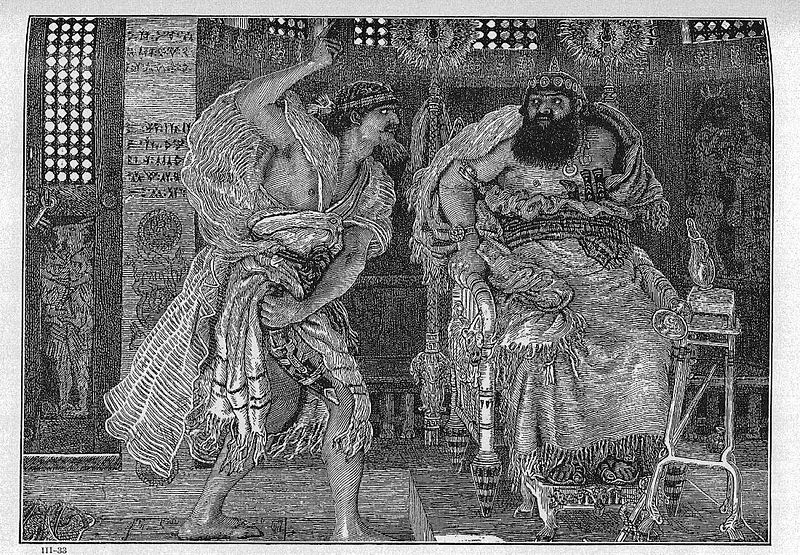
The Israelites sin. The LORD punishes them by sending Eglon, King of Moab. Eglon gets some allies of his to come with him and they beat up Israel. The Israelites cry out for help, and the LORD sends help for them. Enter Ehud, the assassin. Ehud is left-handed, and the king’s body guards don’t discover his weapon (probably because they didn’t bother to search his right side–his sword would be on opposite hand to make it easier to draw). Ehud asks for a private audience and Eglon grants it. Ehud stabs Eglon so hard that it sinks all the way into the portly man’s flesh. Leaving his blade behind, Ehud escapes and rallies the troops, who unite around their new leader. He then strikes ten thousand Moabites down with his army, and none escape.
Yeah, it could make a pretty epic action movie. But what about a Bible story? How are we supposed to take this story in the context of Scripture? Note once more the beginning of the story: the Israelites did evil (Judges 3:12). Throughout Judges, we see the same pattern: the Israelites do evil, and God punishes them by oppressing them with one of the nations in the area. Then, the Israelites realize their evil, and they cry to God, repentant, and ask Him for help. He delivers them from their enemies, and there is peace in the land.
What can we take away from this story? Does it show another instance of evil in the Bible which Christians must hide? No, rather it shows the story that we can see woven throughout the Scriptures: a story of redemption and peace with God. Because of Jesus, we now live in an era in which we no longer have to wait for a deliverer, as Israel did. We’re told that all people have sinned and fall short (Romans 3:23), just as the Israelites did. And we all deserve punishment. But when we cry out to God, we know there is a redeemer close at hand. God forgives our sins because of Christ, and we can live in peace.
The cycle in Judges is repeated over and over. It reflects a time in which everyone did what they willed (Judges 21:25). God came to His people with the understanding they had. But in our time, we have Jesus who died once for all. The cycle is broken, and we may enjoy eternal peace.
See Judges 3 for more on Ehud.
This is part of a continuing series on “Awesome Person(s) of the Bible.” Other posts can be found here.
SDG.
——
The preceding post is the property of J.W. Wartick (apart from citations, which are the property of their respective owners) and should not be reproduced in part or in whole without the expressed consent of the author. All content on this site is the property of J.W. Wartick and is made available for individual and personal usage. If you cite from these documents, whether for personal or professional purposes, please give appropriate citation with both the name of the author (J.W. Wartick) and a link to the original URL. This blog is protected by Creative Commons licensing. By viewing any part of this site, you are agreeing to this usage policy.
What if? The “Job Answer” to the Problem of Evil
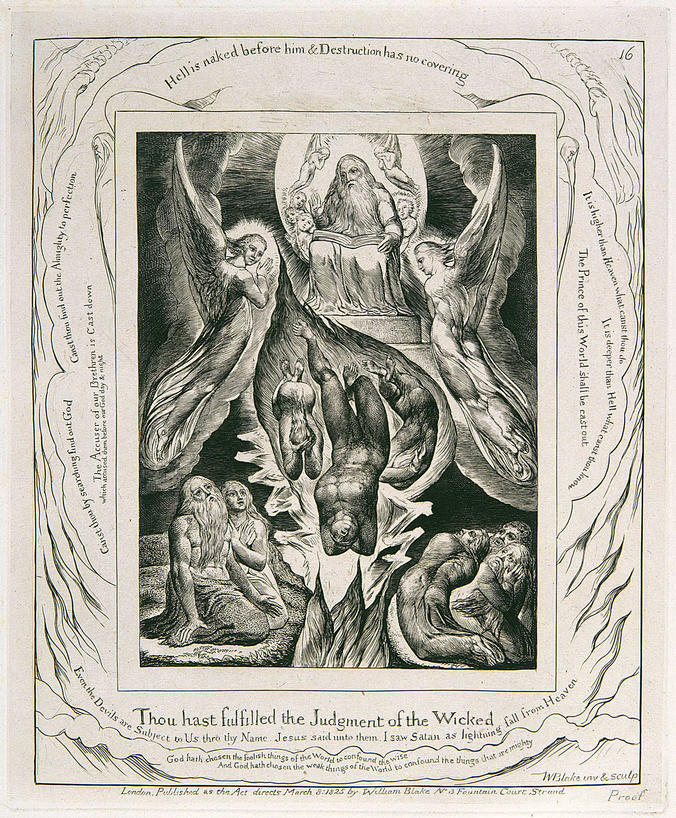 “Who has a claim against me that I must pay?
Everything under heaven belongs to me.” Job 41:11
There are many different kinds of theodicy or defenses to rebut the problem of evil. As I read the Bible I see a few different answers, but one extremely important theodicy in the Scriptures is what I shall deem the “Job Answer,” which is found in the book of Job, although a similar idea is touched upon by Paul in Romans.
Job was known as the most righteous of all the people on earth. Yet God allowed terrible things to happen to him, as part of a test to show Satan that Job was indeed as faithful and righteous as was thought.
But why? Why do bad things happen to good people? Why is it that Job, who God Himself called blameless and upright (1:8) has so many bad things happen to him?
Job’s friends gathered around him and offered various explanations. Job must have done something to deserve it, he must have erred in some way, etc, etc. Yet all of these, Job says, are wrong. He is indeed without blame, and he remains faithful. Yet despite this faith, he cannot help but complain to God. And in this defense of himself and appeal to God, he again points out that he is righteous (see Job 31).
God’s answer to this complaint is where I draw the “Job Answer.” God responds, basically, by saying “Job, you don’t know how I operate, but don’t you think it’s reasonable to conclude that I know what I’m doing?”
Is this a satisfactory answer? Can Job demand another answer? Should he?
That is often the route taken by atheists and even Christians when they investigate the problem of evil. They demand that God provide an answer they themselves find suitable. They act as though God owes them the answer, as if God cannot possibly be good unless the answer is found acceptable in their own eyes. But what does God say to that? In Job chapter 41, He says “Who has a claim against me that I must pay? Everything under heaven belongs to me.”
Is that easy? Is that the answer we Christians like to see? Not really. It would be so much easier if God just said “You know, I gave you guys freedom of will, so given your sinful nature (which you chose, by the way), wouldn’t you expect to see some pretty awful things happening?” That’s the kind of answer I find more appealing. That’s easy.
But that isn’t the answer God gave. He said “Everything belongs to me. Who must I repay?” Does that mean God is not good?
Francis Chan and Preston Sprinkle’s recent book Erasing Hell has had me reflecting on these very questions. Hell is a tough issue, and it has some serious implications for the problem of evil. In a particularly intriguing part of this book, the authors quote Scripture and follow it with a few questions. Specifically, they are reflecting on the idea that God knows who is going to hell before they themselves choose to do so. Check it out:
“What if God, desiring to show his wrath and to make known his power, has endured with much patience vessels of wrath prepared for destruction, in order to make known the riches of his glory for vessels of mercy, which he has prepared beforehand for glory?” (Rom. 9:22-23)
…What if God, as the sovereign Creator of the universe, decided to create ‘vessels of wrath prepared for destruction”? …And what if it’s His way of showing those He saves just how great His glory and mercy is? What would you do if He chose to do this? Refuse to believe in Him? Refuse to be a ‘vessel of mercy’? Does that make any sense? Would you refuse to follow him? Really? Is that wise? (p. 130, cited below)
The passage quoted is from Paul, writing to the Romans. Note how he phrases it: he starts it with what if. He’s not saying this is what God does, or that God does operate in this way, but he’s offering it as a possibility. Chan and Sprinkle continue this line of reasoning: What would we do if this is how God works? Would it make sense to rebel… to become a vessel of wrath just because we know they exist? Does it mean that God is doing wrong if this is how He operates?
Again, we turn back to Job to find the answer. God’s ways our not our own. God answers Job by listing things Job cannot do, and cannot even comprehend. ‘These things,’ God implies, ‘are outside of your comprehension… yet you expect to understand something even more incomprhensible?’ But that is not where God leaves it. He also tells us that ultimately, He will bring justice to all. Those who are now downtrodden will be lifted up, and justice will reign. How can Job respond? By repenting “in dust and ashes” (42:6).
So the “Job Answer” fits in a unique place among various defenses and theodicies for the problem of evil. Instead of using human nature and free will or a greater good to justify evil, the answer given to and by Job is that God, being good, has a reason, even if that reason is inscrutable for us. It is a response of faith.
But this does not mean the “Job Answer” is the only answer given in all of Scripture. Jesus is the ultimate answer to the problem of evil. He came and took our pain and suffering upon Himself, which in turn defeats evil ultimately and for all time. There are other Biblical answers to the problem of evil, but the answer Job gives is simple: Have faith. It does not promote an unphilosophical or unreflective faith, but points out the obvious: If we have good reasons to believe in God, and reasons which point to God as good, then we can simply trust that the apparent problem of evil is solved, ultimately, by God.
Thus, the “Job Answer” implies a second version of theodicy. Namely, that the evidence for the existence of God provides a rebutting defeater for the problem of evil. If we know that God exists and is good, then the problem of evil simply cannot be coherent.
In either case, the “Job Answer” provides a powerful, Biblical, answer to the problem of evil.
Source cited: Francis Chan and Preston Sprinkle Erasing Hell (Colorado Springs, CO: 2011, David C. Cook).
Response to an attack on this post found here (Search for “On Job.”)
SDG.
——
The preceding post is the property of J.W. Wartick (apart from citations, which are the property of their respective owners) and should not be reproduced in part or in whole without the expressed consent of the author. All content on this site is the property of J.W. Wartick and is made available for individual and personal usage. If you cite from these documents, whether for personal or professional purposes, please give appropriate citation with both the name of the author (J.W. Wartick) and a link to the original URL. This blog is protected by Creative Commons licensing. By viewing any part of this site, you are agreeing to this usage policy.
Inerrancy, Scripture, and the “Easy Way Out”
 Inerrancy, defined as simply as possible, is the Christian doctrine that the Bible is divinely inspired and without error.
But it is important to move beyond this simple definition, because people often come away with misconceptions about the doctrine. The Chicago Statement on Biblical Inerrancy explicates what evangelicals mean when they speak of inerrancy. I highly recommend that anyone interested in Inerrancy read this statement. It clears up a number of misconceptions.
A rejection of inerrancy is frequently due to a misunderstanding of what the doctrine means. Here are some common misreadings of the doctrine:
1) Inerrancy does not mean that there will be no discrepancies between Gospel accounts. These discrepancies, based upon an interpretation given by one who affirms inerrancy, are not seen as errors but as the different authors expressing their biographical accounts in different ways. Unlike modern conceptions that a quoted phrases must be exact, historians in the first century felt at their liberty to rearrange temporal events to better illustrate a common theme. The Gospels can be seen to utilize several methods of ancient biographies as they emphasize certain aspects of Christ’s life.
2) Inerrancy does not mean that there are no cultural or personal aspects to Scripture. An example of this can be seen in the geocentrism in the Bible. That there is geocentrism in the Bible does not undermine inerrancy. Inerrancy is the belief that what the Bible teaches is without error. The Bible does not teach geocentrism, but features it as part of the background beliefs of the cultural context of the authors. The authors have imported their culture into expressing God’s word, but that does not undermine the teachings.
3) Inerrancy does not mean God dictated the Bible word-for-word. This point ties into 2: God used human authors and gave them the leeway to write within their cultural background.
Those who reject inerrancy have taken an easy way out. Rather than investigating the issue of historical grammatical interpretation of Scripture or looking into what inerrancy means, they find what is perceived as an “error” in Scripture and reject the doctrine. The misconceptions outlined above are just a few of the errors made by people who do not investigate the issue seriously enough. Rather than coming upon a difficulty in the text and rejecting inerrancy, I urge readers to explore the difficulty, see what people have to say about it. I’ve found on more than one occasion that something I thought could be an error was explained by a cultural tradition or misreading of the text.
Finally, I’d like to address something that might come up to those reading through this. Often atheists object to the doctrine of inerrancy. I’ve run into this in my own personal discussions with those outside of the faith. They say things like “Do you really think a book written by a bunch of humans is without error?”
Well, if the Christian God exists, then the Bible is not just a book written by a bunch of humans. If God exists, there is no reason to think that God would be incapable of guiding His people to write a book to reveal Himself in a way that allows them to use their historical and cultural contexts without transmitting error in teaching. It would take a very powerful argument to convince me that an omnipotent deity would be unable to do this.
Image credit: http://commons.wikimedia.org/wiki/File:Bibbia_con_rosa.jpg
SDG.
——
The preceding post is the property of J.W. Wartick (apart from citations, which are the property of their respective owners) and should not be reproduced in part or in whole without the expressed consent of the author. All content on this site is the property of J.W. Wartick and is made available for individual and personal usage. If you cite from these documents, whether for personal or professional purposes, please give appropriate citation with both the name of the author (J.W. Wartick) and a link to the original URL. This blog is protected by Creative Commons licensing. By viewing any part of this site, you are agreeing to this usage policy.
Really Recommended Posts 7/25
My Really Recommended Posts for the day are below:
What is a Free Thinker? over at “Cold and Lonely Truth.” This post discusses the term “free thinker” and its implications. Arthur comes to the conclusion that a “free thinker” isn’t so much free as they are dogmatic. I had some similar ideas I expressed in my “Letter to a Free Thinker.”
Science Sez So: Man Made God over at “The Gospel of Erik.” Erik discusses the recent argument by some atheistic neuroscientists that mankind made God.
Another Reason I Won’t Debate the Historicity of Jesus Christ over at “Josiah Concept Ministries.” Cory links to a video of skeptic Bart Ehrmann demolishing an atheist in a discussion over whether Jesus existed or not.
Is the Bible from God? 3 Signs of the Supernatural at “Apologetics Guy.” A great introductory apologetics read for those looking to defend the Bible as God’s Word.
Erasing Hell at “In Christ Jesus.” A brief look at Francis Chan and Preston Sprinkle’s book, Erasing Hell. I recently got the book and will be reading it shortly.
The end of it all…
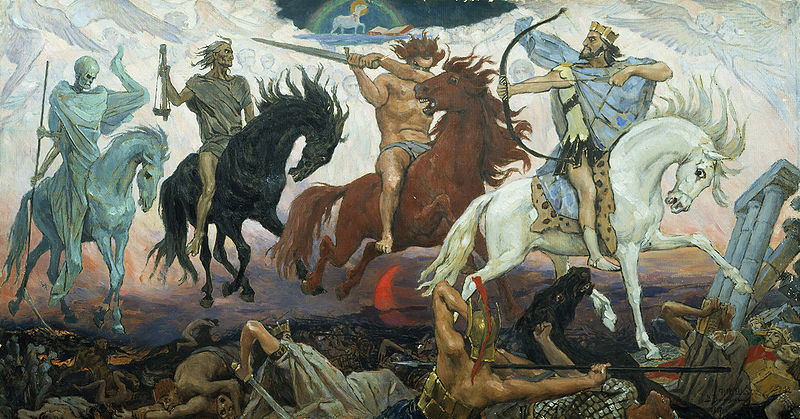 There’s a lot of confusion about endtimes in our world. It isn’t helped by the fact that there are false prophets springing up all around us, trying to tell us that which is to come. The recent controversy over Harold Camping’s prediction that the world would end on May 21st has me thinking about the study of end times (eschatology).
It’s an area I admit I haven’t studied much. The subject is confusing. There is a staggering array of views about what will happen in the end. The book of Revelation, from which we draw much of our knowledge over what will happen in the end times, can be greatly confusing to both the uninitiated and the scholar.
There are two major themes upon which I’d like to focus: knowledge of the end and our behavior at the end.
1) Knowledge of the end
Thinking about the apocalypse–the end of the world–is a tough issue. Like I said, there is a lot of diversity on the subject. As such, it is important for Christians to look to the Bible to see what we can know about the end. The key is to remember that must always go back to the Bible to see what it says about a subject before we believe what someone tells us it may say.
We are warned by Jesus in Matthew that there will arise false prophets (Matthew 24:24). Harold Camping is one such false prophet. He has distorted the truth of Scripture to gain followers.
Perhaps the most telling verse in the Bible which speaks against us being able to know when the end will come is Matthew 24:36, in which Jesus Himself says “But about that day or hour no one knows, not even the angels in heaven, nor the Son, but only the Father.” If that’s true, then how would any other human know? Not even Christ, in his state of humiliation, could tell us when the last day would come!
The bottom line is that we can’t know and we won’t know when the last days have arrived–not until Jesus Himself is here.
2) Behavior at the end
Suppose for a moment we are at the last days; what should our attitude be? The resounding chorus in Scripture is that we should be diligent and ready, but we should continue to spread God’s Kingdom. Looking back at the Matthew 24 passage, Jesus tells us, ““Therefore keep watch, because you do not know on what day your Lord will come… Who then is the faithful and wise servant, whom the master has put in charge of the servants in his household to give them their food at the proper time? It will be good for that servant whose master finds him doing so when he returns” (24:42, 45-46).
So our attitude should be one of the watchful servant: ready for Christ to come, but not letting that distract us from the work He has given us. Rather than put up billboards and go around telling everyone the end is nigh, our task is to continue what should be our “business as usual”–spreading the Word, taking care of the needy, and living our lives as Christians.
Conclusion
It is easy to get caught up in the “end times” controversies. I admit that often when I hear of such predictions, I am more diligent than usual in remembering to repent of my sins. But what does that tell me? It tells me that I need to be more diligent about that at all times. For we need to be ready when Christ does come. A life of readiness for Christ means a life of spreading the Good News about Him to all people. It means living a life of repentance and reconciliation to God. We may not know when the end will come, but it is coming–and we will experience it either in this life or the next.
SDG.
Links
Check out this blog post by Austin which discusses the Camping controversy: here.
News article discussing Camping’s befuddlement about his failure: here.
Image: “Four Horsemen of the Apocalypse” by Viktor Vasnetsov, 1887.
——
The preceding post is the property of J.W. Wartick (apart from citations, which are the property of their respective owners) and should not be reproduced in part or in whole without the expressed consent of the author. All content on this site is the property of J.W. Wartick and is made available for individual and personal usage. If you cite from these documents, whether for personal or professional purposes, please give appropriate citation with both the name of the author (J.W. Wartick) and a link to the original URL. This blog is protected by Creative Commons licensing. By viewing any part of this site, you are agreeing to this usage policy.

 J.W. Wartick - Reconstructing Faith
