bible
The Pro-Life position and the Bible
 We are currently in the time of the year known as “40 Days for Life.” During these 40 days (as well as the rest of the year), it is important to focus on issues related to the beginning of life. The Bible has much to say about the topic.
A survey of the Bible can reveal many verses which can be used for the pro-life position. I will focus upon a few (verses in ESV). I will outline how they argue for the pro-life position, how a pro-choice Christian might respond to them, and a rebuttal or concession based upon their response.
Jeremiah 1:5- “”Before I formed you in the womb I knew you,and before you were born I consecrated you;I appointed you a prophet to the nations.”
Here we see that God called Jeremiah to be a prophet before he was born. In other words, even before his birth he was valuable to God, to the point of being called as a prophet. One interesting counter to a verse like this would be to hold that all it is saying is that God knew about Jeremiah from eternity, so the “before” is being used here as logical priority as opposed to temporal priority. I think this objection has some merit, so perhaps this verse isn’t as strong as it seems. I looked up the Hebrew in this verse and it seems to me that the first clause may be referencing pre-ordination, however the verb is not in the right form (Pual) to make this certain, and so the first clause may be referencing a process of forming not yet completed (which would mean the verse suggests God is interacting with a person before that person is born). The word “before” here, however, again could be said to note that the verse is talking about pre-ordination even though the verb doesn’t necessitate that reading. I tend to lean towards the pre-ordination meaning, but not as the only possibility. However, the second clause is even stronger because it talks about “consecrating,” and that word seems to entail the existence of something to be consecrated. Thus, it would mean that Jeremiah would have had to exist in order to be consecrated while in the womb, before being born.
There is a more powerful verse on this topic to be found:
Luke 1:15- “for he [John the Baptist] will begreat before the Lord. And he must not drink wine or strong drink, and he will be filled with the Holy Spirit, even from his mother’s womb.”
Here there is no question of the verse just being God’s knowledge of John the Baptist’s prophetic call before his birth, rather, God will fill him with the Holy Spirit, even while John is in the womb. In other words, before he is born, John will be empowered by God. I don’t see how a pro-choice response could get around this. That John will be filled with the Spirit before his birth is a powerful argument for the pro-life position from Scripture because it would mean John would have to be capable of being filled. Pro-choice Christians often have to fall back to saying the unborn aren’t “persons”, but that would be impossible here, for why would the Holy Spirit fill a being which is impersonal?
Psalm 51:5 states: “Surely I was sinful at birth, sinful from the time my mother conceived me.” It would seem to be quite absurd for someone who is not a person to be sinful. Pro-choice Christians who argue that the unborn is not a human person are placed in a very difficult position by this verse. It quite clearly states that from conception a person is sinful. Without personhood, one cannot sin. One must have the capacity to be sinful in order to sin. It would seem very odd for the pro-choice Christian to have to say an impersonal ‘blob of cells’ is capable of sinning.
There are many verses which point to God forming us in the womb (i.e. Job 31:15; Isaiah 44:2; and Psalm 139:13-16). These verses could be seen as supporting the pro-life position. However, the pro-choice Christian may respond by saying that it does not follow that just because God makes us in our wombs, we exist as persons in the womb or that we are inherently valuable in the womb. The counter to this argument is that the verses do not make sense otherwise. For if it were true that all the verses were pointing out were God’s creative activity, then much of the sense of the verse would be lost. In the Isaiah passage, for example, God is talking about His interaction with the nation of Israel, the implication is that because he formed them in the wombs, they are loved by Him–His creative act was an act of love to His people. So it would seem these verses must be understood as pointing towards the value of the baby in the womb, as opposed to a mere observation of God’s action.
But there are more sophisticated arguments against abortion that can be drawn from the Bible. I wrote elsewhere on Exodus 21:22-25, which has interestingly been used by pro-choice Christians to say their position is correct:
“If men who are fighting hit a pregnant woman and she gives birth prematurely but there is no serious injury, the offender must be fined whatever the woman’s husband demands and the court allows. But if there is serious injury, you are to take life for life, eye for eye, tooth for tooth, hand for hand, foot for foot, burn for burn, wound for wound, bruise for bruise.” Some believers use this passage to state that it shows the unborn fetus has a lesser status of personhood. They state that verse 22 shows that though the woman loses the child, she sustains no injury, and the penalty is but a fine. They say that this, then, shows that the fetus does not demand the same repercussions as hurting a fellow human (Feinberg 63). There are several problems with this interpretation, however. First, it must be stated that even if one is to concede this interpretation [which is incorrect], it does not authorize abortion. The baby is not intentionally harmed in any manner, but only unintentionally hurt. Second, just the fact that there is a penalty shows that there is wrongdoing here. If the fetus something that may be discarded at will, why is there even a fine for its destruction? Third, the reason the fetus’ death does not require the death penalty is in keeping with the Mosaic exception to the death penalty in cases of accidental death (Exodus 21:13-14, 20-21, Numbers 35:10-34, Deuteronomy 19:1-13). Therefore, the fact that there is “merely” a fine does not show that the fetus is less valued. Finally, it absolutely must be noted that Exodus 21 states various penalties for the killing of individuals that cannot be explained away with personhood. For example, verses 20-21 show that one who kills a slave unintentionally has no penalty. No one could argue that the slave is not a “person” (Feinberg, 64).
Further, the correct interpretation of this passage must be seen as the woman giving premature live birth, not a miscarriage. The implication is quite clear. If the mother gives a premature live birth because of the fight, there is merely a fine (despite no serious injury to anyone), but if either the mother or the fetus is injured, the law of retaliation (eye for an eye) is invoked. Thus, if the fetus is killed, the man causing harm is to be killed. This is remarkable, because it is the only place in Scripture where death is required for accidental homicide. It shows the extreme value placed on the life of the fetus (Feinberg, 65). This interpretation is based on the Hebrew verbs and nouns used in this passage… (here)
Given these passages (and there are more where those came from), it seems as though the pro-life position has very solid grounding in the Bible
Image: http://commons.wikimedia.org/wiki/File:Pro-Life_Demonstration_at_Supreme_Court.jpg
Feinberg and Feinberg, Ethics for a Brave New World (Wheaton, IL: Crossway, 1993).
SDG.
——
The preceding post is the property of J.W. Wartick (apart from citations, which are the property of their respective owners) and should not be reproduced in part or in whole without the expressed consent of the author. All content on this site is the property of J.W. Wartick and is made available for individual and personal usage. If you cite from these documents, whether for personal or professional purposes, please give appropriate citation with both the name of the author (J.W. Wartick) and a link to the original URL. This blog is protected by Creative Commons licensing. By viewing any part of this site, you are agreeing to this usage policy.
Book Review: “A Carpenter’s View of the Bible” by Charlie March
 A Carpenter’s View of the Bible (hereafter CVB) by Charlie March is a unique book. It is part memoire, part Bible study, and part an archaeological/carpentry primer.
Throughout the book, there is a palpable sense of wonder with God’s creation. March delights in the hexagonal patterns found throughout nature, from the bee’s hive to the cowfish (7). Moreover, the book is structured around this sense of wonder; filled with the assertion that God is a “builder” (2-3), and our building reflects His.
There is a diversity of topics within CVB, and this sometimes takes away from the cohesiveness of the book, which at a few points seems to flounder. However, March covers the diversity of topics with a flair and insight that keeps it going despite the sometimes disconnected nature of topics.
On the topic of God’s destruction of the peoples of Palestine in the wake of the Hebrews, March writes “God’s perfect justice and righteousness is defined by his treatment toward disobedience and immorality, for which the typical response is his corresponding punishment. He reacts harshly against sin… (28).” He continues on to discuss how Noah’s Ark and the Ark of the Covenant show “divine-human collaboration” which can be seen as a “redemptive act” (29).
The joy of God’s “building” plan interwoven with mankind’s struggles therein is a strand March works throughout CVB. His discussion of the Tower of Babel and idols reflects the kind of interesting interplay between memoir, biblical study, and carpentry I hinted at earlier. The Tower, argues March, can be seen as a kind of attempt at protection from another flood–an attempt to reach above the waters and strike at God. The result is “a humanistic building that challenges God’s law” (41). Rather than reacting with destruction in this case, God confuses the languages, thus resulting in a kind of third chance for mankind as they are forced to rebuild once more. But they fail again, by constructing idols. March points out the strangeness that is an idol: it is something that the craftsman must make himself, and then worship. One might rightly ask, “Dude, how does that chunk of wood you harvested from the forest become a god?” (48).
But humans didn’t always fail. March writes that the construction of altars, ‘heaps’, and standing stones is a “physical act” which serves as a “physical marker in our lives to remind us of the passing of significant events” (49).
The chapter on Jericho is where many of the themes in CVB really come together. March not only makes an interesting argument about the symbolism of the wall, but he also delves into the archaeological research done on Jericho and discusses the faith of Rahab. March argues that the key to the story is the wall (again, the elements of memoir remain as he remembers a show, The Time Tunnel, he used to watch). The wall is a symbol of our lives as well as the kind of barriers we can put up to God (62), but they also symbolize strength. March makes an interesting argument that perhaps the entire purpose of God’s rerouting to Jericho wasn’t so much to eliminate a threat to His people (a plausible argument) as it was a specific salvific act. He argues that God was rescuing the “little lamb who was caught up in the thicket”–Rahab, among the people in Jericho. “[S]imilarly,” argues March, God would “divert the course of history for you and me” (75). One could draw out the implications here and say God did do this in Christ.
Again, March’s discussion of archaeology in conjunction with Sodom is enlightening, and readers will find his discussion there interesting. But March doesn’t leave it with archaeology, he goes on to note that it is important to realize that Sodom was not some ugly town, but a “cool” one which would have the kind of appeal for God’s people that other sinful locales may have for His people today (111-112).
Thinking about Jesus is, of course, a central task of CVB. He is the savior, but we should not forget that “the principle of redemption is not only an event of salvation but an ongoing lifestyle program” (136).
CVB is a fresh, if sometimes disjointed, look at the Bible. March draws from his own life, detailed analysis of archaeology and history, and Scripture in order to weave together an enriching work on the Bible. Interestingly, the book’s central purpose is withheld until it is almost over. March writes that “To live a full life is to build according to the precepts of Scripture drawn to our scale by the Great Architect who set the code from which we should build our lives.” This is the theme throughout the book: our lives are a work in progress, and it is not just God’s work but our own. The book is filled with wonder at God’s creation and insightful parallels between His and our creative acts. Choose wisely how to build.
Disclaimer: I was provided a review copy of this book by WinePress publishing.
SDG.
Awesome Person of the Bible: Michael
 There are few persons (using the word “person” here in the broad sense as opposed to meaning simply “humans”) in the Bible more awesome than Michael the Archangel. He only shows up a few times, but those times in which he does appear, he is one bad (read: good) dude. Seriously, check out the three major places he shows up:
1) Daniel 12:1: “At that time Michael, the great prince who protects your people, will arise. There will be a time of distress such as has not happened from the beginning of nations until then. But at that time your people—everyone whose name is found written in the book—will be delivered.”
You read that right. The archangel Michael is the prince of God’s chosen people. And by prince, we don’t mean that sissy version of a prince who’s always running around wishing he wasn’t king or being stupid. We mean he’s the ruler, protector, and guide of Israel. He protects them until God’s chosen people are delivered, according to God’s plan.
I know, “So what? There are a bunch of princes out there. Big deal.” Fine, but what about:
2) Jude 1:9: “But even the archangel Michael, when he was disputing with the devil about the body of Moses, did not himself dare to condemn him [the devil] for slander but said, ‘The Lord rebuke you!'”
Oh yeah, that’s right. The archangel Michael fought with SATAN over Moses’ body. Not only that, but he won the fight. How did he win? By invoking the name of the Lord, YHWH. You may be saying “Wow, that’s not a very big deal. I could probably do that.” Think so? How about:
3) Revelation 12:7-9: “Then war broke out in heaven. Michael and his angels fought against the dragon, and the dragon and his angels fought back. But he was not strong enough, and they lost their place in heaven. The great dragon was hurled down—that ancient serpent called the devil, or Satan, who leads the whole world astray. He was hurled to the earth, and his angels with him.”
Uh huh. Try that one on for size. First off, Michael’s an archangel. That, on its own, makes you awesome. But Michael isn’t just some rank-and-file archangel, he is an archangel out to kick some massive tail. Michael is just chilling out in heaven one day, picking his teeth with a toothpick made of demon’s bone, when suddenly war breaks out between God and Satan. I don’t know about you, but I’d be running the opposite direction. What does Michael do? He gets his gang of burly warrior-angels and fights Satan and the demons. And notice what the text tells us about Michael: “[Satan] was not strong enough, and they lost their place in heaven.” Yup, Michael is more powerful than Satan himself. He comes along and literally hurls Satan out of heaven and down to the earth. I don’t know about you, but I think that is pretty awesome.
Archangel Michael, you are a certified “Awesome Person of the Bible.”
SDG
———
The preceding post is the property of J.W. Wartick (apart from citations, which are the property of their respective owners) and should not be reproduced in part or in whole without the expressed consent of the author. All content on this site is the property of J.W. Wartick and is made available for individual and personal usage. If you cite from these documents, whether for personal or professional purposes, please give appropriate citation and provide a link to the original URL. By viewing any part of this site, you are agreeing to this usage policy.
Devotion for an Apologist/Philosopher: Ecclesiastes
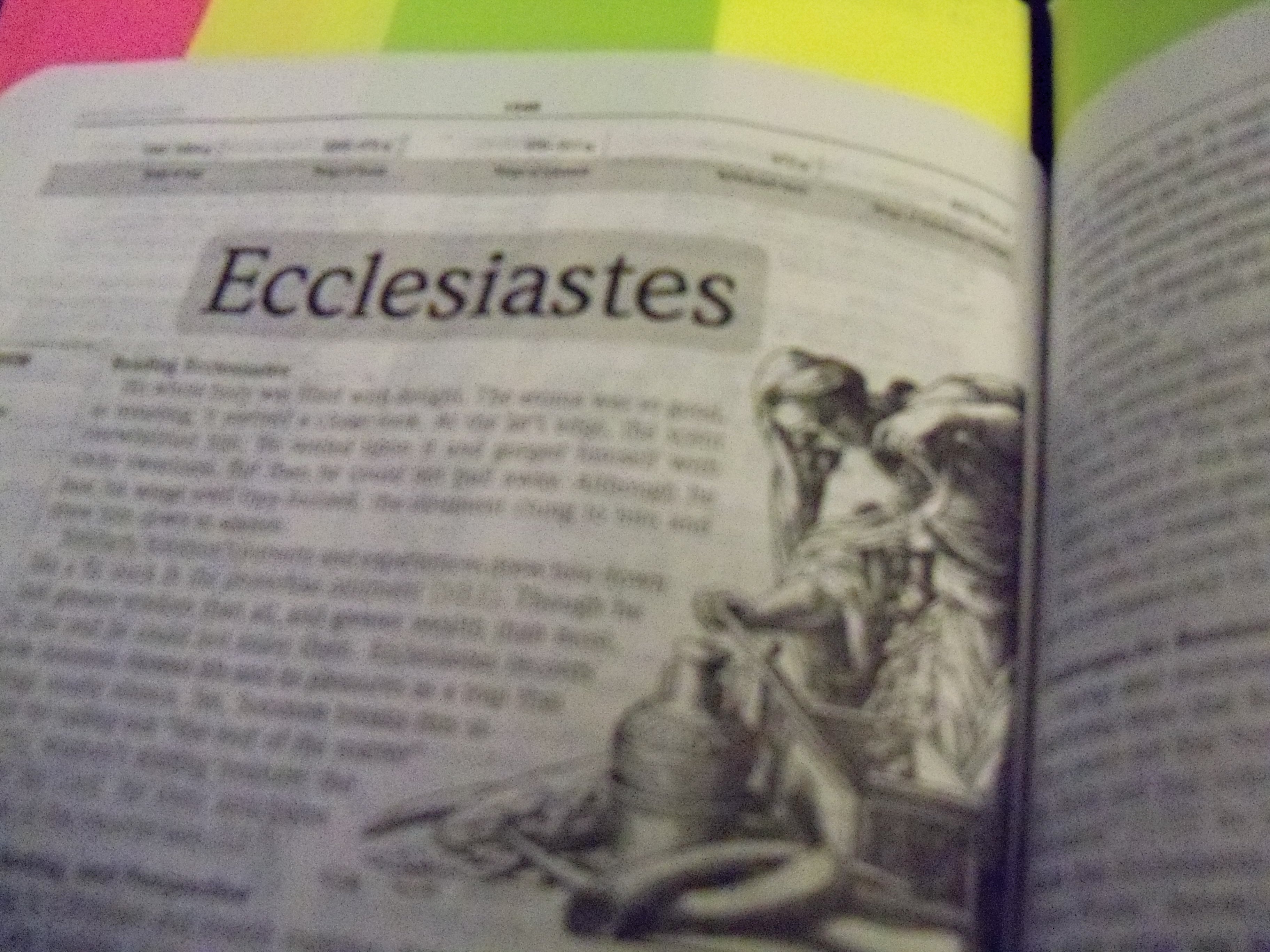 There are so many verses, chapters, and books in the Bible which resonate with me as a Christian philosopher/apologist. Ecclesiastes ranks near the top, however, due to its wonderfully philosophical message and style. The underlying theme of Ecclesiastes is that without God, everything is meaningless.
“‘Meaningless! Meaningless!’
says the Teacher.
‘Utterly meaningless!
Everything is meaningless.’… What has been is what will be, and what has been done is what will be done, and there is nothing new under the sun.” (1:2, 9).
The book starts with the idea that there is “nothing new under the sun.” The theme of “under the sun” is important to note. Consistently, “under the sun” is used to refer to “on earth.” It is in stark contrast to the “permanence of heaven” (TLSB). The theme contrasting life here on earth with heaven does not become apparent until very late in the book, so we too shall leave it until the end.
Solomon continues to explore the idea that that which we do “under the sun” is utterly meaningless. “For in much wisdom is much vexation, and he who increases knowledge increases sorrow” (1:18). The more we know, the more we sorrow. We can see themes like this in atheists like Albert Camus or Sartre, whose exploration of a world without God lead them to question whether suicide may be the only valid option.
“For what happens to the children of man and what happens to the beasts is the same; as one dies, so dies the other. They all have the same breath, and man has no advantage over the beasts, for all is vanity [also translated “meaningless”]. All go to one place. All are from the dust, and to dust all return” (3:19-20). The Teacher/Preacher goes on to contemplate our end: “Who knows whether the spirit of man goes upward and the spirit of the beast goes down into the earth? …Who can bring [man] to see what will be after him?” (3:21, 22b). It is death itself which makes life meaningless. Who knows what happens after death? Everything “appears utterly futile” (Waltke).
However, the Preacher/Teacher does not want us to collapse into despair. Without God, under the sun, all is meaningless. But with God, there is hope, joy, and meaning. This theme is sown in chapter 5 (verses 2-3; 7; and 19-20). Yet before fully developing this theme, Solomon returns to a life (and death) under the sun.
The existential life under the sun is absurd. “For the living know that they will die, but the dead know nothing, and they have no more reward, for the memory of them is forgotten. Their love and their hate and their envy have already perished, and forever they have no more share in all that is done under the sun” (9:5-6). Again the theme is “under the sun”. Without God, the life under the sun is meaning. We die, we pass away forever, we know not what comes after death, and even our actions pass away from under the sun. We no longer have a “share” in what is done under the sun.
The theme repeats throughout the book. “Under the sun”, all is meaningless, there is nothing new, and life itself passes away. Even a constant search for pleasure can only be meaningless.
Yet the conclusion to Ecclesiastes radically re-imagines the book. Solomon’s point so far has been that “you cannot make sense of life” (Waltke). Life under the sun is meaningless, futile, and vain. Existentially, the more we know, the more despair we can find. The more we explore life “under the sun,” the more we realize that it will be extinguished, and our actions will no longer impact that life.
The story does not end there, however. “The end of the matter; all has been heard. Fear God and keep his commandments, for this is the whole duty of man. For God will bring every deed into judgment, with every secret thing, whether good or evil” (12:13-14). The final verses of the book turn the meaning of the entire work about. The Preacher/Teacher comes to the conclusion: without God, all is meaningless; with God, there is good and evil, there is judgment, and there is duty. Rather than striving for nothing, we should strive for God. Rather than despair and futility; there is duty and good. Without God, life is meaningless; with God, there is meaning.
Sources:
Bruce Waltke, “Understanding the Old Testament.” Institute of Theological Studies. 2009.
The Lutheran Study Bible. (St. Louis, MO: Concordia Publishing House, 2009).
The picture is from The Lutheran Study Bible.
———
The preceding post is the property of J.W. Wartick (apart from citations, which are the property of their respective owners) and should not be reproduced in part or in whole without the expressed consent of the author. All content on this site is the property of J.W. Wartick and is made available for individual and personal usage. If you cite from these documents, whether for personal or professional purposes, please give appropriate citation and provide a link to the original URL. By viewing any part of this site, you are agreeing to this usage policy.
Jesus, Dedication, and Wise Men
 Are these Biblical accounts of Jesus’ birth irreconcilable:
“When the time came for the purification rites required by the Law of Moses, Joseph and Mary took him to Jerusalem to present him to the Lord.”- Luke 2:22
“When [the Magi] had gone, an angel of the Lord appeared to Joseph in a dream. ‘Get up,’ he said, ‘take the child and his mother and escape to Egypt. Stay there until I tell you, for Herod is going to search for the child to kill him.’ So he got up, took the child and his mother during the night and left for Egypt…” Matthew 2:13-14
One says he was dedicated in the temple, the other, that Joseph took Mary and Jesus and fled to Egypt. The key to solving this potential problem is, as frequently is the case with Bible difficulties, context, context, and context.
The dedication of Jesus would have taken place very shortly after His birth. But reading the account of the visit of the Magi, we find that the wise men came at some point after the birth of Jesus. This is evident in Matthew 2:1-12, in which the Magi initially stop to visit King Herod to ask him where Jesus was born. Unless one is to assume the Magi were able to travel instantaneously to Bethlehem from Jerusalem with all of their escort, one should have no difficulty thinking that the Magi arrived at some point after Jesus had already traveled to Jerusalem and back for His dedication at the temple.
Not only that, but despite some traditions drawings of the Magi, it is unlikely that they came while Jesus was merely a babe. Again, these men came from “the east,” so it is unlikely that they made the trip in a few days. But there is also textual evidence for this idea, for when Herod seeks to kill Jesus, he kills all boys 2 years old and younger (2:16). Sure, he may have simply had no idea how old Jesus was and simply been shoring up his bets, but the text goes on to say that he kills boys 2 and younger “in accordance with the time he had learned from the Magi” (2:16b). So at some point he must have asked them how long they’d been traveling, and it was long enough to warrant killing the boys 2 and younger.
Thus, there is no contradiction in the text.
Merry Christmas.
SDG.
This is part of a series I’ve entitled “Jesus: the Living God,” which explores Jesus from Biblical, theological, and apologetic levels. View other posts in the series here.
——
The preceding post is the property of J.W. Wartick (apart from citations, which are the property of their respective owners) and should not be reproduced in part or in whole without the expressed consent of the author. All content on this site is the property of J.W. Wartick and is made available for individual and personal usage. If you cite from these documents, whether for personal or professional purposes, please give appropriate citation and provide a link to the original URL. By viewing any part of this site, you are agreeing to this usage policy.
Our Longing For God
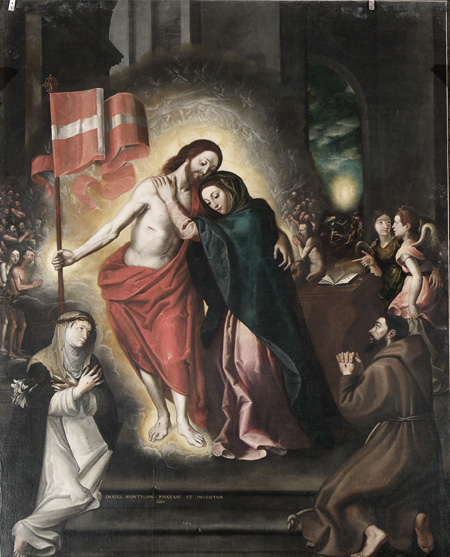 Recently, I had a discussion with my fiancée about the idea of Song of Songs being utilized as an analogy for Christ and the Church. Song of Songs is clearly a book about love, even erotic (eros) love. There are verses like 1:4 “Draw me after you; let us run. The king has brought me into his chambers” or 6:3a “I am my beloved’s and my beloved is mine.” If we are to apply such verses to the life of a Christian and his or her relation to God, we can see it sometimes as an almost uncomfortably close relationship. We aren’t comfortable thinking of our love of God as this kind of intimate desire; a desire for union, to be brought into the chambers of our God.
Yet it is exactly this kind of intimacy–this kind of eros love–which God has planned for us. Song of Songs is such a beautiful book because of this exact thing. It teaches us that we need not be ashamed of the kind of union we desire with God. We are sheep lead astray, and our one desire should be to return to our Lord, in whose arms we find peace and love.
There are other verses in Scripture wherein we can see this idea. Psalm 84:2 states “My soul yearns, even faints for the courts of the Lord; my heart and my flesh cry out for the living God.” Psalm 63:1 puts it eloquently, “Oh God, you are my God, earnestly I seek you; my soul thirsts for you, my body longs for you.”
My favorite exposition of these ideas is found in Alvin Plantinga’s Warranted Christian Belief, of all places. In this monumental work, Plantinga discusses the very idea of God’s love as eros. I feel compelled to quote him at length:
This love for God isn’t like, say an inclination to spend the afternoon organizing your stamp collection. It is longing, filled with desire and yearning; and it is physical as well as spiritual… It is erotic; and one of the closest analogues would be with sexual eros. There is a powerful desire for union with God… What is to be made of this phenomenon? Most psychiatric literature has tended to follow Freud in understanding religion as a kind of neurosis, the ‘universal obsessional neurosis of humanity.’ From this point of view, the religious eros is to be understood as a kind of analogue, displacement, or sublimation of (broadly) sexual energy…
From a Christian perspective… here (as often) Freud has things just backwards. It isn’t that religious eros, love for God, is really sexual eros gone astray or rechanneled… It is sexual desire and longing that is a sign of something deeper: it is a sign of this longing, yearning for God that we human beings achieve when we are graciousliy enabled to reach a certain level of the Christian life. It is love for God that is fundamental or basic, and sexual eros that is the sign or symbol or pointer to something else and something deeper.
[S]exual eros points to two deeper realities… human love for God… [and] a sign, symbol, or type of God’s love. (Plantinga, 311-318)
Those who have had religious experiences in which they felt a kind of union with God can attest to what Plantinga is describing. The kind of mystical union we experience when we are granted the chance to commune with God in a relation of creature-creator is beautiful, to the point of being even sensual. It is something which we long for; something we look forward to in the hereafter.
This also serves to help describe the kind of feelings involved in religious experience. It is a kind of fulfillment of a yearning and a quenching of thirst. Our longing for God is part of humanity. Plantinga argues it is part of our sensus divinitatis–our inborn sense of divine reality. Only when we submit to God and experience relation with him can our deepest desires be realized.
Source:
Alvin Plantinga. Warrented Christian Belief (New York, NY: 2000, Oxford).
——
The preceding post is the property of J.W. Wartick (apart from citations, which are the property of their respective owners) and should not be reproduced in part or in whole without the expressed consent of the author. All content on this site is the property of J.W. Wartick and is made available for individual and personal usage. If you cite from these documents, whether for personal or professional purposes, please give appropriate citation and provide a link to the original URL. By viewing any part of this site, you are agreeing to this usage policy.
Devotion for a Philosopher/Apologist: Job and Natural Theology
 One thing I’ve noted throughout my involvement in apologetics and philosophy is a constant need and desire for good devotions. I’ve written some guidelines for how to go about a devotional life here, but I’ve noticed that many readers are coming to my site looking for actual devotions themselves. Thus, I’ve decided to start this series of devotions for the Christian Philosopher or Apologist.
Job and Natural Theology
Recommended reading: The book of Job, a chapter or book on natural theology
Often, I find myself struggling, as I am so enmeshed in abstract concepts of God and philosophy, to maintain that personal connection with my Lord. Nowhere do I find a better place to reignite this personal connection than the book of Job. It appeals to me on a number of levels–it has verses which demonstrate the greatness of faith, the horrors of evil, and the greatness and existence of God.
As Christian philosophers/apologists, we can smile and nod along with such passages as Job 12:7-10″
“But ask the beasts, and they will teach you; the birds of the heavens, and they will tell you; or the bushes of the earth, and they will teach you; and the fish of the sea will declare to you. Who among all these does not know that the hand of the LORD has done this? In his hand is the life of every living thing and the breath of all mankind.”
We can note how often we echo these very words, pointing to such things as the teleological argument or arguments from design. Scripture preaches what we teach! We are told here that creation itself witnesses the Creator! But these aren’t the only verses in Job which help affirm the tasks to which we have set ourselves, for we are told in Job about the attributes of God (He is unchangeable 23:13, almighty chapters 25-26, majestic 37:1ff, omnibenevolent 34:10 [though note that we must be careful to assertain doctrinal truths from Job’s friends, who are often mistaken about the works of God], and sovereign 1:21) we are informed that religious experience can convey knowledge (4:12, but again note that this is a friend of Job’s, so be careful with interpretation), and we discover that there will be a physical resurrection (19:25).
Already, we have experienced many of the parts of Job which speak directly to us as apologists and philosophers. But there is so much more here! We are to focus upon faith. As I said before, I often lose sight of my personal relationship with God in the midst of the abstract arguments, but Job (the book) calls us towards such a strong relationship with God.
Job 5:8-27 can give us great comfort. It is God to whom we commit our cause (5:8). God does great and unsearchable things, providing for our every need (5:9-16). Furthermore, we are comforted in times of trouble. God may allow us to be wounded, but he binds us, we may be shattered, but God heals us (5:18).
Finally, within Job we have a stirring account from God. Another struggle I can find myself involved in is an inflated view of my knowledge. Job struggled with this same issue, as he complained to God about his sufferings. God’s response is not to explain suffering, but to reassert His greatness and unlimited knowledge (see the dialogue in chapters 38 and following). We are then shown what our proper response is to God’s great majesty, Job 42:1-6:
Then Job answered the LORD and said: “I know that you can do all things, and that no purpose of yours can be thwarted. ‘Who is this that hides counsel without knowledge? ‘Therefore I have uttered what I did not understand, things too wonderful for me, which I did not know. ‘Hear, and I will speak; I will question you, and you make it known to me.’ I had heard of you by the hearing of the ear, but now my eye sees you; therefore I despise myself, and repent in dust and ashes.”
Job understands how our lives should reflect our commitment to God. We too often utter what we do not understand, when we encounter God, we realize that compared to His great glory, we can only repent of inability to always be perfect ambassadors of Christ. Yet, along with Job, we know that our redeemer lives (Job 19:25). What a great blessing it is to know that we will walk with him, in the flesh, upon the earth!
God’s grace and peace to you, my fellow brothers and sisters in Christ Jesus. I hope this devotion will be helpful in your studies. I’d appreciate any feedback you can give me to help improve any future devotions I may share.
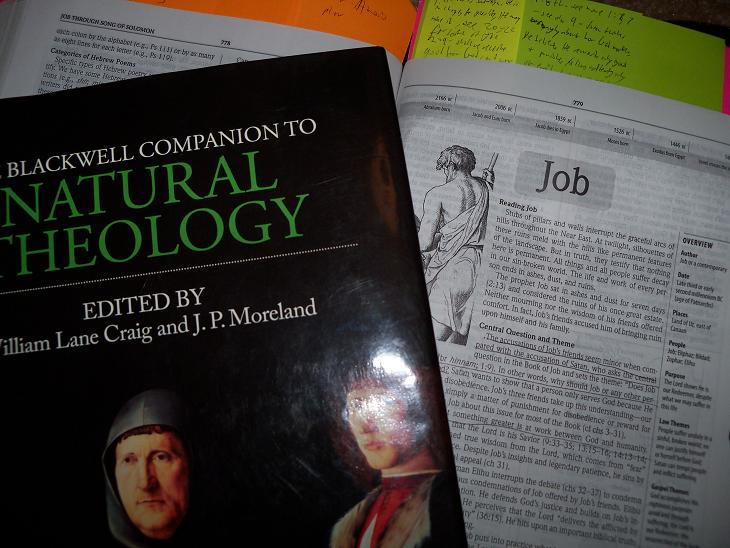
The image in this post was a (very unprofessional) photograph by me of the Lutheran Study Bible and the Blackwell Companion to Natural Theology
——
The preceding post is the property of J.W. Wartick (apart from citations, which are the property of their respective owners) and should not be reproduced in part or in whole without the expressed consent of the author.
The Life Dialogue: Matt Moss Guest Post Part 4
This is part 4 of a series of guest posts by Matt Moss on the Genesis Creation account. Check out the first post here, the second here, and the third here.
It would now be my contention that day two and its parallel day four are the building and filling of the Cosmic Temple. In the religious Tabernacle/Temple of Israel this comes off a bit differently because of the Fallen status of the world. Day 2’s establishment of the expanse parallels the setting up of the tent of the Tabernacle and the walls of the Temple. Notice then that day 5 is the creation/assignment of the birds of the sky (above the tent’s curtain) and the sea creatures (below the tent’s foundation). What fills the temporal Temple will come on days 3 and 6.
For now I would like to add one more decorative indicator of Temple cosmology. If you remember your temple diagrams that you’ve seen and the Levitical procedures you may have read about in various OT courses/studies, you will surely remember the pools and the washings! Priests had to regularly wash themselves and their robes before proper use in the Temple. For the Tabernacle, see Exodus 30:17-21. And for the Temple see 1 kings 7:23-26; 2 Chron 4:2-5. As with the lampstand above, these serve a symbolic purpose as well as a practical one! They are part of the Temple precisely because they are part of the Cosmic Temple in Genesis 1!
Genesis 1:11-13 and 24-25, “And God said, “Let the earth sprout vegetation, plants yielding seed, and fruit trees bearing fruit in which is their seed, each according to its kind, on the earth.” And it was so. 12 The earth brought forth vegetation, plants yielding seed according to their own kinds, and trees bearing fruit in which is their seed, each according to its kind. And God saw that it was good. 13 And there was evening and there was morning, the third day… [day 6] And God said, “Let the earth bring forth living creatures according to their kinds—livestock and creeping things and beasts of the earth according to their kinds.” And it was so. 25 And God made the beasts of the earth according to their kinds and the livestock according to their kinds, and everything that creeps on the ground according to its kind. And God saw that it was good.”
As foreshadowed above, on day 3 we have a further establishment of the Cosmic Temple and on day 6 we have the first part of the filling of the Cosmic Temple. First I will deal with day 3. While travelling through the wilderness, the Israelite Tabernacle did not uproot and replant trees in the Tabernacle every where they went. However! You will read and see Acacia wood being used in everything from the Ark of the Covenant to the pillars that hold up the curtain and the walls of the Holy Place (see The Lutheran Study Bible page 141 for a great breakdown of materials used). The tent posts all the way around the outer court too serve as a garden image with all their rich colours. Later in the Solomonic Temple, there is a similar tree-like architectural feature. First we note that cedar and cypress timber from Lebanon was used (1 Kings 5:8-9; 6:14-18). Just as the trees and vegetation of day 3 served to decorate the Cosmic Temple, so also the acacia, cedar and cypress wood are used to decorate Israel’s Tabernacle & Temple.
As for day six, I have isolated the first part from the second part (mankind) simply because man deserves a bit of time on his own. Much like the birds and fish are to fill the Cosmic Temple but are kept out of the temporal Tabernacle/Temple, so too these animals are included in the Cosmic Temple BUT are only brought into the Israelite Tabernacle/Temple to be sacrificed (more on this later!).
Genesis 1:26-31- “Then God said, “Let us make man in our image, after our likeness. And let them have dominion over the fish of the sea and over the birds of the heavens and over the livestock and over all the earth and over every creeping thing that creeps on the earth.”
27 So God created man in his own image,
in the image of God he created him;
male and female he created them.
28 And God blessed them. And God said to them, “Be fruitful and multiply and fill the earth and subdue it and have dominion over the fish of the sea and over the birds of the heavens and over every living thing that moves on the earth.” 29 And God said, “Behold, I have given you every plant yielding seed that is on the face of all the earth, and every tree with seed in its fruit. You shall have them for food. 30 And to every beast of the earth and to every bird of the heavens and to everything that creeps on the earth, everything that has the breath of life, I have given every green plant for food.” And it was so. 31 And God saw everything that he had made, and behold, it was very good. And there was evening and there was morning, the sixth day.”
I’ll cut right to the chase. Man is the priest of the Cosmic Temple. This becomes even more explicitly clear in 2:15, “The LORD God took the man and put him in the garden of Eden to work it and keep it.” These two tasks, “to work it and keep it” (avad and shamar) are only used together in reference to the Levitical priesthood. Upon God’s resting of day seven, the Cosmic Temple is fully ordered and filled, that is, it is fully functional! God is present and he places His man in the Garden of Eden, the Holy of Holies of this Cosmic Temple, to be the High Priest who serves God by working and keeping this Temple. And at the centre of this Cosmic Temple stands the Tree of Life and the Tree of the Knowledge of Good & Evil. Man is given one command by which he might serve and love the gracious Creator, “You may surely eat of every tree of the garden, but of the tree of the knowledge of good and evil you shall not eat, for in the day that you eat of it you shall surely die (Gen 2:16-17).”
Despite avoiding material creation questions throughout his book, Walton appears to lean toward the special creation of mankind. He therefore rejects the evolution of man even though he allows room for evolution of animals. For him, Genesis 2 allows us to have a material understanding of man’s formation/creation (out of the dust). I don’t think it’s the strongest part of his book, but for now I am too fixated on the notion of the man as priest of the Cosmic Temple.
God then makes a suitable helper for the man (gender roles, order of creation, marriage, and the like are topics for further discussion in other forums). We all know what happens next. The perfect, complete, finished, and functional Cosmic Temple, perfectly and wonderfully ordered by God that He might live in communion with His creation, is disturbed. No, that’s too weak a description. The fully ordered creation is hurled into disorder, chaos, and disarray. SIN enters in 3:7.
The next post will discuss Thesis 6.
The Life Dialogue: Matt Moss Guest Post Part 2
This post is the second guest post in my series on the “Life Dialogue” within Christianity. See Part 1 here. See other posts in the series here.
PART 2
Thesis 4– Genesis 1 does not address the specific method that God used in material creation, therefore (given T1-3) no specific answer to the questions of how or when is necessary to salvation.
Walton makes an important distinction between material creation and functional creation. Material creation is what modern debates obsess over. How did the material (the animals and people) get here: did they evolve or were they created or both? When did they come about? A quick reading of Genesis 1:1 – 2:3 shows that good, solid answers to these questions are not given. “In the beginning” is hardly a round number. Even those who attempt to date the earth using the various genealogies of the Bible prove their ignorance of ancient Near Eastern family lists which often “telescope” or skip generations of individuals and focus on the most notable. In other words, no one should think that the genealogy from Adam to Abraham is intended to tell us exactly how old the earth is. That was not the purpose of the genealogy and that is not what the genre allows a modern reader to do either.
Now, as for the “how material was created.” Walton argues very convincingly that Genesis 1 remains silent on this. With our modern biases we immediately object, “how can that be!? It says plainly, ‘and God said let there be light.’” Walton backs up to Gen 1:1 and addresses the Hebrew word bara’ (to create). In our understanding we always attach an ex nihilo understanding onto this word. That alone shows how materially minded we are, we have a very material focused cosmology. Walton first demonstrates that all ancient Near Eastern cosmologies were ‘function’ oriented, not material oriented. This means that the neighbouring creation accounts are concerned with the gods assigning functions to what comes about. How and when was not the question they were asking.
Walton then shows a similar mindset in ancient Israel. Even the word bara’ is a functional word. Walton provides a survey (p. 42) that outlines every use of the verb in the Hebrew Bible. The first thing of note is that God is always the subject. The second thing of note is that it nearly always is used in a functional sense, where God is giving something a specific purpose or function. Let’s look back to that light example. Genesis 1 does not stop with, “And God said let there be light.” No, Genesis 1:3-5 says “‘Let there be light,’ and there was light. 4And God saw that the light was good. And God separated the light from the darkness. 5Godcalled the light Day, and the darkness he called Night. And there was evening and there was morning, the first day. (italics mine)”
More than making light is taking place. God is assigning functions to the light and the darkness, he is naming them for their functions! This is seen even more specifically when God creates the Sun and Moon. “Let there be lights in the expanse of the heavens to separate the day from the night. And let them be for signs and for seasons (A more accurate translation is “festivals”- a temple word), and for days and years, 15and let them be lights in the expanse of the heavens to give light upon the earth. (underlining mine)” How and when is not important. Why are they present? That is the question God chose to answer for the people.
Walton does go through these days in detail and then gives brief critiques of the various models out there. The first thing worthy of note is that yom (Day) does mean day… not age. Walton would argue that this hardly seals the deal for Young Earthers since they are completely fixated on material models of creation. Walton seems to take the side that the seven days of Genesis 1 are the seven days in which God assigned all creation its specific function, indeed without function one might hardly say that they exist at all (he uses the analogy of a company- before it is certified it cannot be said to exist even if it has a building and equipment and workers). Thus, Walton, like Genesis 1, remains mute on the hows and whens of material origins before the days when God assigns the functions and Walton sticks with what Genesis 1 does give us, which is the next thesis [coming next week in part 3].
Bible Difficulties 4: Hardening Hearts
Exodus 4:21 (ESV): “And the LORD said to Moses, “When you go back to Egypt, see that you do before Pharaoh all the miracles that I have put in your power. But I will harden his heart, so that he will not let the people go.”
Summary
The Bible speaks of the Israelites in Egypt in Exodus. God hardened Pharaoh’s heart “so that he will not let the people go” (Exodus 4:21). Throughout the stories of the plagues Pharaoh’s heart was hardened, either by himself or God.
Why is this passage difficult?
Why would God harden Pharaoh’s heart? Doesn’t this mean God is causing Pharaoh to sin? Does this mean Pharaoh is not accountable for his actions?
Commentary
It is first important to note that God did not harden Pharaoh’s heart until after Pharaoh had himself hardened his heart against God (compare Exodus 7:13, 8:15, 8:32 to Exodus 9:12). As Geisler and Howe put it, “God did not harden Pharaoh’s heart contrary to Pharaoh’s own free choice” (65, cited below). It seems as though Pharaoh, freely reacting to God’s interaction, hardens his heart against the will of God. Such an interpretation is strengthened greatly by Exodus 5:2: “But Pharaoh said, ‘Who is the LORD, that I should obey his voice and let Israel go? I do not know the LORD, and moreover, I will not let Israel go.'” Pharaoh declares that he does not know the LORD, and refuses to submit to the LORD’s will. Such rebellion demonstrates a profound choice to harden his heart.
Another way to respond to the challenges listed above would be to note Paul’s own interpretation of the passage in Romans 9:17: “For the Scripture says to Pharaoh, ‘For this very purpose I have raised you up, that I might show my power in you, and that my name might be proclaimed in all the earth.'”
Granted that all authority in heaven and on earth is given by God, the fact is that Pharaoh’s position of authority was given by God Himself. Therefore, the rebellion seen in Exodus 5:2 is even more haughty than previously thought. Not only that, but Paul’s comments on these verses show how God intended to use Pharaoh’s actions to show His power and authority over all the earth. Thus, God was using Pharaoh to spread His name such that even greater amounts of people could come into a saving relationship. It therefore seems as though God utilized Pharaoh’s hardened heart to bring about a far greater good: the spreading of His name. This is a theme seen throughout Scripture. Geisler/Howe cite the story of Joseph as another instance: Joseph’s brothers sold him into slavery, but God utilized this for good (445).
Instead of viewing this story of Pharaoh’s hardened heart as God somehow forcing Pharaoh to sin, we have two ways to counter such reasoning:
1) Pharaoh hardened his own heart against the commands of God (Exodus 5:2, 7:13, etc.), which means God did not cause him to sin and Pharaoh is accountable for his own actions
2) God utilizes the wicked actions of man to bring about His own purposes, while still allowing for freedom of the will. His omniscient (including, of course, middle knowledge) perspective allows for Him to take into account and plan for such evil actions and utilize even great evils for good.
Sources:
The Lutheran Study Bible. Concordia Publishing House.
Geisler, Norman and Thomas Howe. The Big Book of Bible Difficulties. Baker Books. 1992.
This post is the fourth in a series I’ve been working on which discusses Bible Difficulties–hard passages in Scripture. Other posts in the series can be accessed here.

 J.W. Wartick - Reconstructing Faith
